Shared posts

29 Oct 21:50

Fix and repair Windows 10 issues with FixWin 10

by Martin Brinkmann
Ross Nixon

Looks very useful.

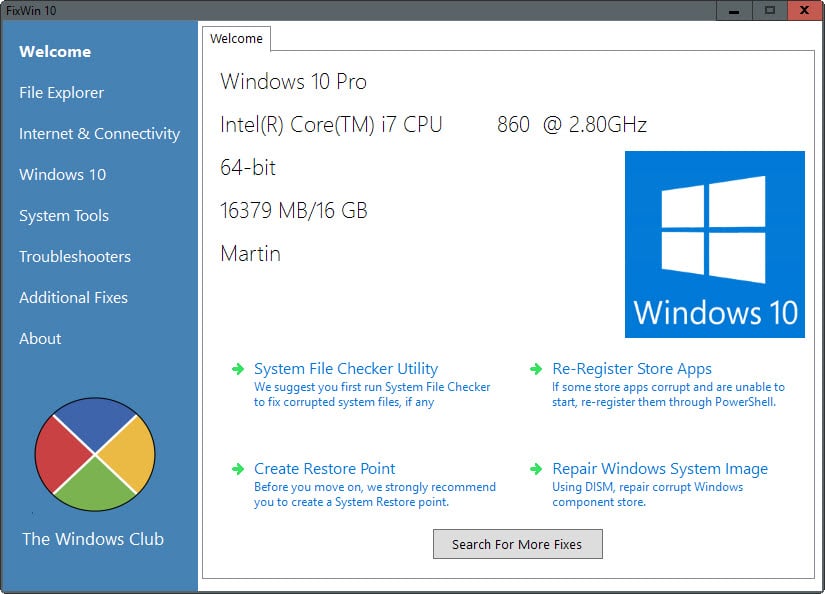
FixWin 10 is an update to the popular FixWin application that introduces several Windows 10 specific repair options to the application.

We have reviewed FixWin back in 2010 when it was released to the public and came to the conclusion that it is a useful troubleshooting tool for devices running Windows.

The update delivers more of the same include a setting reserved solely for Microsoft's latest operating system.

The program requires the Microsoft .Net Framework 4 but no installation. The interface itself has been updated slightly with a modern look. Information about the underlying system are displayed on start.

fixwin 10

There you find fixes for common issues listed as well, for instance to register all store apps again to make sure they are available again on the system and functioning properly.

If you have removed an app accidentally for instance, it can be helpful to regain access to it.

A click on Windows 10 opens all repair options for fixes for the operating system. The following options are provided:

  1. Repair the Windows Component Store using Deployment Imaging and Servicing Management (DISM).
  2. Reset the Settings app. Useful if it does not open anymore or crashes.
  3. Disable OneDrive file synchronization.
  4. Repair the Windows Start Menu. Handy if it does not work properly or does not open at all.
  5. Repair WiFi if it is not working.
  6. Fix Windows Update stuck downloading updates after upgrading to Windows 10.
  7. Clear and reset the Store cache to resolve issues downloading applications from the Windows Store.
  8. Fix "The Application wasn't installed" in Windows Store, Error Code: 0x8024001e.
  9. Fix Windows Store apps not opening. Registers all apps anew.

The remaining options appear to be more or less identical to those provided in the previous version of FixWin.

One great feature of FixWin 10 is that you get instructions to run the fix manually as well. All you have to do is click on the help icon next to each fix to display information on what it does in detail, and instructions to run it manually.

manual troubleshooting

The manual approach usually comes down to one or multiple commands that you need to run from the command line or PowerShell. To make things easier, it is possible to double-click on the manual instructions to copy them.

I like this option a lot since it allows me to check the fix before it is applied. I always have a hard time trusting applications when they don't reveal what they do in the background to fix an issue. Since FixWin details that, I find it much easier to trust it in this regard.

Closing Words

If you run into one of the issues that FixWin 10 can repair, then you may want to give it a go as it may fix the issue for you in that case.

It is up to you to run the fix from within the interface or manually. The manual approach may take longer but it has the added advantage that you know what to do next time without running the program at all.

Ghacks needs you. You can find out how to support us here or support the site directly by becoming a Patreon. Thank you for being a Ghacks reader.

The post Fix and repair Windows 10 issues with FixWin 10 appeared first on gHacks Technology News.

27 Aug 05:31

The Genesis Flood and Noah's Ark

Ross Nixon

An excellent summary

Evidence for the Genesis Flood and Noah's Ark is crucial to understanding the world's history.
18 Apr 21:22

This Technical Signaled The Last Two Market Crashes And It Just Happened

by Tyler Durden
Ross Nixon

Might be time to sell my shares.

Submitted by Thad Beversdorf via FirstRebuttal.com,

So the fundamental case for a 20 year bull run as BMO is calling for and  certainly many other banks seem to be onboard with that is not looking great YTD.  In fact, most perma bulls have shy’d away from even mentioning fundamentals other than to say that generally they aren’t looking great but don’t worry the Fed is still engaged.   And so I feel its a worthwhile exercise to have a look at the technicals.  Thing about the technicals is that you can cherry pick any baseline point to really make any case, good or bad.  But if we take a look at a time period that encompasses several cycles we negate our ability to cherry pick the baseline and we can be much more confident in our overall analysis.

So what I’ve done is taken a two decade period of S&P pricing which encompasses several cycles.  Mid 1990′s was a market mid cycle having recovered from the short recession of the early 1990′s but before things really began heating up in the late 1990′s.  If we just have a gentle look at the chart we see we’ve had a couple large cycles with fairly extreme booms and subsequent busts.  Currently we are in the midst of the third boom which has taken us to new all time highs.  Now even a 5 year old can look at the chart and say at some point this thing has a large down turn, same as it always does.  That’s easy to see and not many will argue it.  But as so many bulls remind us we could have said the same thing about this chart a year ago and we’d have missed out on significant returns.  Very true.  So the key is then figuring out where the down turn begins.  I know I know that’s the kind of stuff you have to go to biz school for eh.  Ok so let’s first have a look at the easy chart.

Screen Shot 2015-04-17 at 3.20.32 PM

So pretty simple.  Two full cycles and into the third which doesn’t tell us much.  Let’s add some markers to see if we can’t pick up on some technical cues.

Screen Shot 2015-04-17 at 2.39.28 PM

So what we’ve done is run a 2.5 standard deviation Bollinger Band (BB) using a 100 period moving average looking at monthly returns because we are interested long cycle technical cues.  We’ve also run Relative Strength Indicator (RSI) using 20 periods.  What we find is actually quite notable.  During the tech bubble cycle we saw the S&P rise to the upper BB where it tracked the upper band for some time.   During that same period we saw the RSI move above 70.  Now as the market peaked we saw the S&P move below the upper BB and we also saw a decline in RSI.  What is very interesting is that the point where RSI dropped below 70 is the point the tech bubble burst and sent S&P into a free fall.  The market continued to sell until the RSI dropped below 30 at which point the market stabilized and reversed higher.

This took us into the start of the credit bubble cycle.  Here the RSI move up very quickly and plateaued just below 70 for several years during which time the S&P moved up but never quite made it to the upper BB.  Then in 2007 the RSI moved above 70 but then quickly reversed back down below the upper band.  Interestingly again the RSI dropping below the upper band seemed to trigger the bursting of the credit bubble as we saw S&P again move into free fall.  Then here too we saw the market stabilize as the RSI moved through the bottom band.

And again this brought us into the latest Fed bubble.  Now during this latest cycle the RSI moved up but bounced off the upper band a few times without actually breaking through 70.  At the same time the S&P moved higher but with quite heavy volatility.  Eventually we saw the RSI move up and break through the upper limit.  It was about the same time that the S&P traded higher to the upper BB where it tracked for some time.  However, at the end of November 2014 the S&P started to dislocate and moving down below the upper BB.  And then ominously January of this year we saw the RSI also move below the upper RSI band.

Remember this technical signaled the popping of the past two bubble cycles.  Now February saw the RSI move back above the upper band but March moved back down below.  I would watch this very carefully now.  I would venture to say if April remains below the upper RSI band we could very well have moved into the latest and perhaps greatest period of wealth destruction. It is time to protect those assets.


27 Feb 21:35

Ghacks is dying and needs your help

by Martin Brinkmann
Ross Nixon

This is one of my favourite tech sites. I hope it survives.

When I started ghacks.net in 2005 I never imagined what a ride it would be. The site became popular quickly and allowed me to quit my day job to become a full time blogger.

This worked well for the first years and Ghacks went from one high to the next.

I have always operated Ghacks on my own. When the site took off, I was able to hire others to add different perspectives to the site. Jack Wallen for instance who ran the Linux section here on this site and contributed more than 900 articles to it.

But 2011 changed that.

Google introduced new algorithms that turned the world upside down. Popular great sites such as Freeware Genius or Raymond.cc fell victim to that as well and many others are suffering up until this very day from what Google introduced back then while some don't even exist anymore.

Ghacks felt the change as well and traffic dropped since then by more than 60%. This was also the time when it became clear that the site could not sustain multiple writers anymore.

It felt undeserved seeing great sites being affected by algorithms that use a definition of quality that feels far off from reality at times, especially since massive networks and sites that cover every imaginable topic thrived even more than before.

I tried a lot to increase the perceived quality of the site. Removed some advertisement, rewrote hundreds of articles, installed a new theme, removed more than 10,000 tags and a dozen other things but none brought the desired result (a reversal of the process).

In addition to that, ad blockers and script blockers became increasingly popular. Since advertisement is what keeps this site alive, a yearly increase between 5 and 10% in ad-block usage is not something that you can endure for long especially if it goes hand in hand with a decline in traffic.

Currently, between 42% and 44% of all users use blockers when they visit the site and if the trend continues, more than 50% might before the end of the year.

ads-blocked

If you take these two factors together, it is only a matter of time before ad revenue won't be sufficient to pay for the site's upkeep anymore.

Advertisement is dying in its current form. While I could make a quick buck throwing popups, auto-playing videos or other nasty stuff at you, I'd never do that.

Heck, those are the things that make people use ad-blockers in the first place and as much as I like this site to survive, I like to protect the integrity of this site and you from these diabolical monetization methods even more.

Advertisement won't be sufficient to keep this site up and there is not really much out there that I could implement or try instead to make sure this site is not taken off the Internet in the next year.

I could sell blog posts, and believe me I get enough offers for those, but never ever sold a single blog post here on this site.

The Solution

Don't get me wrong, I won't give up easily. I thought about possible solutions and there is one that I think could work. In fact, it is the only viable solution that I think might work as it makes this site independent of advertisement and traffic.

Patreon is a relatively new service where people support content creators by giving money directly to them.

It starts as low as $1 per month and gets as high as you want it to be. This money is independent of advertisement revenue or search engine traffic.

If 5% of all visitors of this site would give $1 per month, we won't have this conversation ever again and Ghacks will be there until I'm too old to write articles for it.

This link takes you to the Ghacks Patreon page

Update: If you prefer to make a one-time payment feel free to send money using PayPal. The ID is martin@mysega.de

I understand that this is not for everyone and that is fine.

But if you like this site and would like to see it be there for you in the future, then this is probably the best option to ensure that.

I don't know if this will work at all, if enough of you are willing to support me to keep this site alive but I will do my best to ensure that you will never regret it if you decide to do so.

Other options

Patreon is certainly not an option for all visitors of this site. If you don't want to become a member there then there is still something that you could do to help this site out.

  1. If you are running an ad-blocker or script-blocker, you could whitelist ghacks.net. This site has never run annoying ads: no popups, popunders, audio or video ads that play automatically, full page ads, overlay ads and god knows what else there is that annoys Internet users. Whitelisting helps as many ads pay per cpm. Even if you never click on those ads, it helps pay the bills of this site.
  2. Spread the word about this site. Tell friends, colleagues and family about it if you think it is a good fit. Share it if you are active on social media sites and don't mind doing that.

Both of these options help out tremendously as well.

Closing Words

I had a great time running this site and met lots of great knowledgeable people, and for that I'm forever thankful. I'm not only talking about the authors who wrote for this site throughout the years but also each and every reader who left a comment on this blog, via email or social media sites.

While I have not responded to each individually, I read them all and will continue to do so.

Ghacks needs you. You can find out how to support us here or support the site directly by becoming a Patreon. Thank you for being a Ghacks reader.

The post Ghacks is dying and needs your help appeared first on gHacks Technology News.

15 Feb 04:33

Nuclear Specter Returns: "Threat of War Is Higher Than In The Cold War"

by Tyler Durden
Ross Nixon

That is a WORRY!

Authored by Markus Becker via Der Spiegel,

The Ukraine crisis has dramatically worsened relations between NATO and Russia. With cooperation on nuclear security now suspended and the lack of a "red telephone," experts at the Munich Security Conference warn any escalation in tensions could grow deadly.

The scientists had no idea that their experiment could spell the end of civilization. On Jan. 25, 1995, Norwegian and American researchers fired a rocket into the skies of northwestern Norway to study the Northern Lights. But the four-stage rocket flew directly through the same corridor that American Minuteman III missiles, equipped with nuclear warheads, would use to travel from the United States to Moscow.

The rocket's speed and flight pattern very closely matched what the Russians expected from a Trident missile that would be fired from a US submarine and detonated at high altitude, with the aim of blinding the Russian early-warning system to prepare for a large-scale nuclear attack by the United States. The Russian military was placed on high alert, and then President Boris Yeltsin activated the keys to launch nuclear weapons. He had less than 10 minutes to decide whether to issue the order to fire.

Yeltsin left the Russian missiles in their silos, probably in part because relations between Russian and the United States were relatively trusting in 1995. But if a similar incident occurred today, as US arms expert Theodore Postol warned recently, it could quite possibly lead to nuclear catastrophe.

Deep Mistrust

"Five or six minutes can be enough time, if you have trust, if you have communication and if you can put this machinery immediately to work," former Russian Foreign Minister Igor Ivanov said on the sidelines of last weekend's Munich Security Conference. Unfortunately, he argued, this machinery works very poorly today, and there is great mistrust.

When asked what would happen today if the 1995 missile incident happened again, Ivanov responded, "I cannot be sure if the right decision would be taken."

Deep mistrust has developed between the West and Russia, and it is having a massive effect on cooperation on security matters.

In November 2014, the Russians announced that they would boycott the 2016 Nuclear Security Summit in the United States. In December, the US Congress voted, for the first time in 25 years, not to approve funding to safeguard nuclear materials in the Russian Federation. A few days later, the Russians terminated cooperation in almost all aspects of nuclear security. The two sides had cooperated successfully for almost two decades. But that is now a thing of the past.

Instead, Russia and the United States are investing giant sums of money to modernize their nuclear arsenals, and NATO recently announced that it was rethinking its nuclear strategy. At the same time, risky encounters between Eastern and Western troops, especially in the air, are becoming more and more common, a report by the European Leadership Network (ELN) recently concluded.

"Civilian pilots don't know how to deal with this," explains ELN Chair Des Browne, a former British defense minister. "One of these incidents could easily escalate. We need to find a mechanism in which we can talk at the highest level."

Brown, together with Ivanov and former US Senator Sam Nunn, the grandfather of international disarmament policy, published an analysis last week. The trio recommends "that reliable communication channels exist in the event of serious incidents." In other words, these channels currently do not exist. Recently Philip Breedlove, the head of NATO Allied Command Operations in Europe, even called for a new "red telephone," alluding to the direct teletype connection established in 1963 between the United States and the Soviet Union after the Cuban missile crisis. A direct line had been set up between NATO and the Russian military's general staff in February 2013, but it was cut as a result of the Ukraine crisis.

'A Very Dangerous Situation'

"Trust has been eroded to the point of almost being destroyed," said Nunn. "You got a war going on right in the middle of Europe. You got a breakdown of the conventional forces treaty, you got the INF (Intermediate-Range Nuclear Forces) treaty under great strain, you got tactical nuclear weapons all over Europe. It's a very dangerous situation."

In late January, the Bulletin of the Atomic Scientists set its "Doomsday Clock" to three minutes to midnight. The last time it was set to that time was in 1983, "when US-Soviet relations were at their iciest point," as the group of scientists explained. The only other time when the situation was even worse was in 1953, when the clock was set to two minutes to midnight. Unchecked climate change and the "nuclear arms race resulting from modernization of huge arsenals" pose "extraordinary and undeniable threats to the continued existence of humanity," the group's statement read.

The current rhetoric coming from the rivals in the East and West seems poorly suited to reducing the threat. "The Russian aggression is a direct threat to NATO," British Defense Secretary Michael Fallon said at the Munich Security Conference.

The situation is made more complicated by the fact that Russia's actions in Ukraine are difficult to define. With camouflage, trickery and deception, the Russians are applying the full arsenal of so-called hybrid warfare, from propaganda to cyber warfare and funding the separatists right up to clandestine military operations.

In Munich, Norwegian Defense Minister Ine Marie Eriksen Søreide demanded that Russia's aggression should be clearly identified as such. "And it goes without saying," she said, "that Article 5 of the NATO Treaty applies to such aggression." This means that if Russia were to attack a NATO member, in the way it is now intervening in Ukraine, all other member states would be required to enter the war to defend that country.

Higher Risks with Hybrid Warfare

"It (hybrid warfare) makes everything more dangerous," said Nunn, "It makes tactical nuclear weapons more dangerous, and it makes weapons material more dangerous." It is common knowledge that some of these weapons are also stationed in Germany. Up to 20 B61 aerial bombs, now being updated at great expense, are stored at the Büchel Air Base in the Eifel region of western Germany. They are under US command, but German Tornado fighter jets would drop the bombs in the event of a war.

When asked if hybrid warfare could raise the danger of nuclear weapons being used, US diplomat Richard Burt -- who, in his role as chief negotiator, helped put together the Strategic Arms Reduction Treaty, or START, between the United States and the Soviet Union -- answered in the affirmative. "The simple answer is yes. Both American and Russian nuclear arms are essentially on a kind of hair-trigger alert. Both sides have a nuclear posture where land-based missiles could be authorized for use in less than 15 minutes." In the situation of hybrid warfare, he warns, "that is a dangerous state of play."

"In the Cold War, we created mechanisms of security. A huge number of treaties and documents helped us to avoid a big and serious military crash," says former Foreign Minister Ivanov. "Now the threat of a war is higher than during the Cold War."


15 Jan 01:29

A Biblical Creationist Cosmogony

Ross Nixon

I've got a lot of time for John Hartnett's hypotheses.

The cosmogony proposed is consistent with all creationist understandings of the biblical texts and has no light-travel time problem.
11 Dec 19:59

[UPDATE] SoftPerfect Network Scanner v6.0.2

SoftPerfect Network Scanner is a feature-rich, multi-threaded network scanner to find and identify network resources. Includes IP, NetBIOS and SNMP, can ping computers, scans for listening TCP ports, and shows what types of resources are shared (including system and hidden). In addition, it allows you to mount shared resources as network drives, browse them using Windows Explorer, filter the results list and more.

A 64-bit version is available (within the folder).

18 Nov 02:16

Ukraine: Who started the conflict in eastern Ukraine? Was it Putin who “invaded” or was it the west who funded a coup and neo nazis to destabilize a country and topple a president? (Chronological list with sources)

by InvestmentWatch

From Reddit:

I’ve been collecting news for months now and decided to lay it out in chronological order for people who would like to know what’s going on in Ukraine. I’ve bolded the most interesting and important documentaries and news pieces.

The west and many opposition parties did not like Yanukovich since he was very pro-Russian. These anti-Yanukovych people started “maidan” (a big demonstration on “Maidan Nezalezhnosti” – a large square in downtown [...]
21 Oct 07:24

What is Facebook Saved?

by Martin Brinkmann
Ross Nixon

Useful!

Facebook rolled out Saved a couple of months ago both on the web interface and Facebook apps on Android and iOS mobile devices.

The problem is that it is not really advertised on the web and if you don't know where to look you may not have noticed that the feature exists at all which makes it likely that the feature went by unnoticed largely.

The Saved link in the sidebar on the web is for instance only displayed after you have saved at least one item.

The idea behind the feature is to give an option to Facebook users to save interesting links and media for later use.

It is not really that useful for users who don't get many new posts per day in their newsfeed but for users who get hundreds or even thousands, it may be useful as they can save interesting looking links and media directly on the site and don't have to process them right away to avoid losing sight of them.

facebook save this link

To save a post click on the small arrow icon on the right of a post on your newsfeed. Please note that the option to "save" the post is only listed on posts with links at the time of writing.

Every link you save is added to your saved storage on Facebook.  Once you have saved your first link and refreshed the Facebook page, you should see the Saved option listed at the top left corner of the Facebook page.

It is alternatively possible to open https://www.facebook.com/saved/ directly at any time to open the Saved page as well.

There you find listed everything that you have saved sorted chronologically. You can filter the results by type, for instance by links, videos, music or events so that only those are displayed in the timeline.

saved links

Saved links can be moved to the archive with a click on the x icon when you hover the mouse cursor over them or shared with users on Facebook.

There does not seem to be an option to remove saved posts from the "saved" page again. You can however unsave elements from the Facebook newsfeed.

Mobile users find the saved option when they tap on the menu button that lists their favorites, pages and more. The option to save a link is available in the same location as on the web.

So how useful is this?

Facebook users who wanted to save links before Saved could do so with the help of browser bookmarks or by saving media directly to the local system.

The only change is that Facebook has integrated a similar feature natively which may make it more practicable for some users.

The limitation to posts with links on the other hand restricts what can be saved which means that some users may still use bookmarks or other means to save the information.

The post What is Facebook Saved? appeared first on gHacks Technology News.

15 Oct 19:55

Will YOU offer the gift of Hope?

by Adrian Warnock
Ross Nixon

I want this book!

It has started to happen. People have been buying copies of Hope Reborn to give away, and as a result some people have become Christians. Today I received the following DM on Twitter: “Encouragement! I’ve given 2 copies of Hope Reborn to 2 Alpha graduates. Both gave their lives to Jesus after reading half the book! [Read More...]
03 Oct 21:38

An Ex-Muslim Extremist Speaks in NZ

by coNZervative

islam-murderersYesterday I did a body detail for a Moroccan man now living secretly in a Western nation (I cannot identify him; and photos are not allowed on Facebook).  I have run protection for him twice. He was once a Muslim, his father is an Imam (still is) but he was disturbed by the radicalism and hatred of Islam.  After a long journey involving incredible suffering and persecution, he became a Christian.  This act alienated him from his family (his Aunt hates him) and the only reason he was not killed by his father, was because he was his son. He is an expert on Islam, having studied it for twenty years , memorizing the Quran and reading Mohammed’s life story over and over again. He is unable to travel to many Muslim nations, and cannot go to his homeland of Morocco.

He now works for a Christian TV ministry preaching the love of Christ to Muslims in difficult nations.  This is done directly with colleagues from across Muslim nations (we met a Christian co-worker from Saudi Arabia, who still dresses in traditional attire), with tracts, and through a direct TV channel in the Saudi language which pulls no punches.  “The Quran is not from God.”  “Mohammed is not a prophet.”

I met many ex-Muslim Christians from many countries, many of whom I have got to know over time.  They tell me about the incredible suffering of their families in Egypt and especially Iraq.  They are warm, living, generous and fantastic people, and even though I cannot understand much of what they say publicly, privately I warm to their affinity and personal warmth.

The speaker said some remarkable things.

1. That Islam allows criticism of Christianity, yet believes when Christians critique Islam they must die.  This contradiction disturbed him early on.  Islam allows no criticism.  The Quran is not “studied” as such, not like the Bible, which is open to critique, questioning, opposition and analysis (2000 years of it). Islam cannot broke such analysis. This makes it inherently inferior because it is not a freedom but an inflexible and aggressive dogma.

He explained that civilised people (whether Muslim or Christian) allow one another to criticise and question, and without this, we cannot have civilised society. [This is why ISIS must be confronted with force; same as the Nazis].

2. After becoming a Christian, he challenged his Muslim friends to kill him.  “the Quran says you must kill me! Why can’t you? You have a heart, but your God does not!”

3. He said there is a huge difference between Muslims and Islam.  Islam is evil, Muslims are human beings, there are many good-hearted Muslims. The difference is people and dogmas.  He said the dogmas (Islam) are evil. They foster hatred and were invented  by a man. Many Muslims are nominal, they hold to basic human decency and a ‘cultural Islam’ but do not adhere consciously to the imperatives of Islam (kill Infidels and Jews!).  This is the same in Christianity, many people are ‘nominal’ but they do not understand Christianity especially, and do not ‘follow’ Christ consciously.

4. He stated with conviction and personal knowledge that if you read and follow Islam enough you will become a terrorist.  Everything in the Middle East is about religion, and Islam causes terrorism. It makes Muslims if they adhere to the dogmas, hateful, evil and committed to murderous terror. He said this was because of the dogmas which are specific and unequivocal.

5. He said political correctness in the West was dangerous, because it separates “terrorism” from “Islam” but the two are inseparably linked and Islam causes terrorism as have other dogmas throughout human history. This mistake will lengthen and intensify the consequences of confronting violent Islam which is philosophically and religiously committed to forcing the world to obey their dogmas (with ‘god’ on their side).

6. He rebuffed a number of common Muslim myths about Christianity and said most Muslims misunderstand Christianity.  He also said Msulims think differently than people in the West.


Filed under: Uncategorized
21 Jul 02:12

Is Genesis history?

by Crossroads Church Palmerston Nth
Ross Nixon

That was a good summary.

16 Apr 20:33

Do Not Disturb for Chrome blocks annoying things on the web

by Martin Brinkmann
Ross Nixon

Good for Opera Next also.

The web can be annoying at times. Sometimes on purpose, at other times not on purpose but with the same end result.

Think about popups for instance, screen overlays that ask you to subscribe to a newsletter, or auto-playing videos or media files on websites.

Not all annoyances are clearly visible on the other hand. Most users may not even realize that they are being tracked, and that data that they enter on websites and their activities are being used to profile them.

The Google Chrome extension Do Not Disturb looks on first glance much like the popular Disconnect extension.

Disconnects concentrates on third-party scripts that run on many websites to trigger irritating features such as ads or media. Do Not Disturb on the other hand does not do that.

While Disconnect works fine in blocking third-party scripts, it does not do anything against annoyances running on the server of the site you are on.

do not disturb chrome

It does not catch popups, screen overlays and other annoyances that originate from the website itself.

Do Not Disturb blocks a variety of items on the active page and displays the overall count of blocked items in its icon in the Chrome toolbar.

So what is the extension taking care of?

  1. Potential Content Overlay.
  2. Potential URL Hijack.
  3. Content Widget.
  4. Data Miner / Consumer Survey.
  5. General Annoyance.
  6. Prestitial Page Attempt.
  7. Pop Up / Pop Under

While some do not require explanation, others do. Unfortunately though, there is no help file or explanation what each item covers.

It is easy enough to determine for pop up and pop under items, but there is no information about general annoyance for instance and what is included here, or what prestitial page attempts are (the latter is an ad unit that is displayed before the actual site that you are about to visit).

Content Widgets are related posts or "from the web" posts that are displayed on websites. They are powered by companies such as Outbrain or TAboola, and often not related to the web page you are on.

So how well does this blocking work?

It worked quite well during tests but is not a catch-all solution. It will block quite a few items on many web pages, but you may still be exposed to elements that it did not block.

I have not tried it in conjunction with Disconnect or another third-party script blocker, but it is likely that you can improve the blocking significantly if you run both extensions at the same time in Chrome.

A whitelist is available in the options that you can use to put sites on the ignore list. Websites that are on it are not affected by the extension at all.

The only other options you have here are to disable the extension for the time being and to disable the blocking of content widgets on websites.

Closing Words

Do Not Disturb is an interesting extension for Google Chrome that can help you block annoying items that you encounter on the web.  It won't protect you from all annoyances but it does remove quite a few of them.

facebooktwittergoogle_plusredditlinkedinmail

The post Do Not Disturb for Chrome blocks annoying things on the web appeared first on gHacks Technology News.

13 Apr 08:08

Turn YouTube into a radio station

by Martin Brinkmann

YouTube's popularity and size makes it a prime choice for all things music. If you are looking to play a particular song, chance is you find it on YouTube in one version or the other.

The related videos that YouTube displays on its video pages may also be a great source of discovering new music, and playlists ensure that you can listen to multiple songs one after the other without interaction.

If you want even more control, then you need to turn your eyes to third-party solutions that provide you with those options.

MuzicGenie is a free third-party services that turns YouTube into a radio station.

All you have to do is type the name of a band or song that you want to use as the starting point of the station.

youtube music radio

The service displays a list of matching bands and song titles that you can select one from. From here on out, it is automatic and you can sit back and listen to (and watch) the videos play without interaction.

The next song in line is displayed on the screen as well as the currently playing song. You can skip that song, remove the song next in the queue, or click on the repeat button to play a song multiple times.

Muzicgenie has more to offer than that though. You can add search results to the queue so that they are played with priority by the service.

Just hover your mouse over a result and click on the plus icon to do so. If you want, you can create your own custom playlists using this option so that only songs that you have selected are played on the website.

If you register a free account, using your email address or Facebook or Twitter, you get additional options such as the ability to save and create permanent playlists.

The site makes available to additional lists that you may find useful. Now Playing displays the current song and the previous songs that were played on the site.

You can go back to a song here at any time and play it again if you like or save the current set as a playlist if you are logged in.

Related videos on the other hand displays a list of videos  related to the search term that you have entered in the beginning.

Verdict

MuzicGenie is an easy to use service that turns YouTube into an Internet radio station for you.  What I really like about it is that you specify a song or band that you want to start with and sit back afterwards to listen to music that is related to that all day long.

The search works fine most of the time, but you may come into situations where you need to refine it to find what you are looking for.

Still, it is a pretty cool service especially if you work on the computer throughout the day, want to play Internet radio, but also control what is being played and what is not.

facebooktwittergoogle_plusredditlinkedinmail

The post Turn YouTube into a radio station appeared first on gHacks Technology News.

10 Feb 08:01

FileSearchy is a fast Windows Search alternative

by Martin Brinkmann

Depending on what you search for, Windows Search can either produce the result in record time, or not at all. The native search functionality works well for certain kinds of file types and locations, but not so well when you need to find custom files.

That's were specialized search tools come into play. Popular programs such as Everything, Fileseek, Search My Files or Switftsearch improve Windows Search in numerous ways.

Generally speaking, they find many files faster than the native Windows Search does. The programs are not identical on the other hand. Some require indexing of their own, while others work without the need to index drive contents before you can start your searches.

FileSearchy review

file searchy

FileSearchy is a free search program for Windows that does not have to hide behind other programs. In fact, it ships with a couple of interesting features that makes it quite the interesting tool to try out.

The program needs to be installed before it can be used. When you start it, you will notice that it supports two different search options.

You can run a file name search, or search within file contents instead. The file name search works right out of the gate. Just type in the name you are looking for, or part of it, and hit the search button to get started.

Results are populated instantly and you can sort them by name, size, modification date or type in the results window.

It is furthermore possible to customize the search, by limiting searches to specific directories, sizes or modification dates. The program supports regular expressions which you can make use of to create advanced search queries.

Files can be opened with a double-click, while a right-click displays the Windows Explorer menu for that file type which you can use for other functionality such as copying, deleting, sharing or scanning.

file search

The in-contents search feature provides you with the means to find specific contents in files. A variety of file types are supported, including all Microsoft Office formats, pdf documents, HTML and other web documents, as well as all plain text types such as php or css files.

This search may take a while to complete, depending on the directory structure that you have selected for the search. Results are populated while the search is still ongoing, which works well as you can go through the current results listing while the search is still being processed.

If you dig deeper, you will find several other options that may help you in your searches. You can exclude file types or folders for example from the search to speed things up, enable full word search or case sensitive searches (both file names and in-contents),  or disable the automatic skipping of binary files if you want those included in content searches.

Verdict

FileSearchy is a fast Windows Search alternative that lets you search for file names and file contents. It offers a wide range of customizations that help you perform those searches and leaves little to be desired in this regard.

The in-content search works well and while it may take the program a while to display all results, especially if you search a whole drive or large directory, you can get started going through results right away as they are populated in real-time.

facebooktwittergoogle_plusredditlinkedinmail

Do you enjoy our publications? Consider supporting us by becoming a member. Pay what you like and get access to an ad-free site and a member's only forum!

The post FileSearchy is a fast Windows Search alternative appeared first on gHacks Technology News., all rights reserved.
07 Feb 21:49

Fittest Can’t Survive If They Never Arrive

by Editor
A study on mutational possibilities suggests that benefits to fitness are too rare to account for evolution.
19 Dec 01:24

Why the Bible Still Prohibits Date Setting

by BibleProphecyBlog.com
By Dr. Thomas Ice Pre-Trib Research Center At least six passages (eight if parallel passages are included) specifically warn believes against date-setting. Yet down through church history there has been an amazing amount of date-setting. About every two years there is usually someone who makes...

Click on the Title to Read the Full Article
18 Dec 07:45

Former Top NSA Official: “We Are Now In A Police State”

by George Washington

Bill Binney is the high-level NSA executive who created the agency’s mass surveillance program for digital information.  A 32-year NSA veteran widely regarded as a “legend” within the agency, Binney was the senior technical director within the agency and managed thousands of NSA employees.

Binney has been interviewed by virtually all of the mainstream media, including CBS, ABC, CNN, New York Times, USA Today, Fox News, PBS and many others.

Last year, Binney held his thumb and forefinger close together, and said:

We are, like, that far from a turnkey totalitarian state.

But today, Binney told Washington’s Blog that the U.S. has already become  a police state.

By way of background, the government is spying on virtually everything we do.

All of the information  gained by the NSA through spying is then shared with federal, state and local agencies, and they are using that information to prosecute petty crimes such as drugs and taxes. The agencies are instructed to intentionally “launder” the information gained through spying, i.e. to pretend that they got the information in a more legitimate way … and to hide that from defense attorneys and judges.

This is a bigger deal than you may realize, as legal experts say that there are so many federal and state laws in the United States, that no one can keep track of them all … and everyone violates laws every day without even knowing it.

The NSA also ships Americans’ most confidential, sensitive information to foreign countries like Israel (and here), the UK and other countries … so they can “unmask” the information and give it back to the NSA … or use it for their own purposes.

Binney told us today:

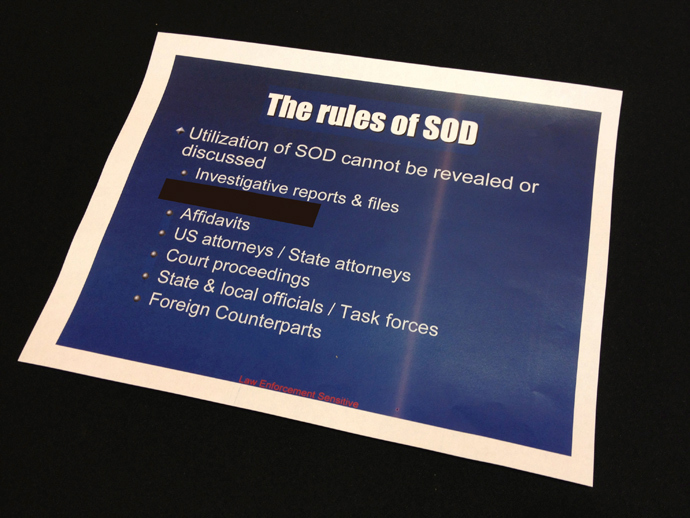
The main use of the collection from these [NSA spying] programs [is] for law enforcement. [See the 2 slides below].


These slides give the policy of the DOJ/FBI/DEA etc. on how to use the NSA data. In fact, they instruct that none of the NSA data is referred to in courts – cause it has been acquired without a warrant.


So, they have to do a “Parallel Construction” and not tell the courts or prosecution or defense the original data used to arrest people. This I call: a “planned programed perjury policy” directed by US law enforcement.


And, as the last line on one slide says, this also applies to “Foreign Counterparts.”


This is a total corruption of the justice system not only in our country but around the world. The source of the info is at the bottom of each slide. This is a totalitarian process – means we are now in a police state.

Here are the two slides which Binney pointed us to:

A slide from a presentation about a secretive information-sharing program run by the U.S. Drug Enforcement Administration's Special Operations Division (SOD) is seen in this undated photo (Reuters / John Shiffman)

A slide from a presentation about a secretive information-sharing program run by the U.S. Drug Enforcement Administration's Special Operations Division (SOD) is seen in this undated photo (Reuters / John Shiffman)

(Source: Reuters via RT)

We asked Binney a follow-up question:

You say “this also applies to ‘Foreign Counterparts.’”  Does that mean that foreign agencies can also “launder” the info gained from NSA spying?  Or that data gained through foreign agencies’ spying can be “laundered” and used by U.S. agencies?

Binney responded:

For countries like the five eyes (US, Canada, UK, Australia, New Zealand) and probably some others it probably works both ways.  But for others that have relationships with FBI or DEA etc.,  they probably are given the data to used to arrest people but are not told the source or given copies of the data.

(See this for background on the five eyes.)

View past discussions between Washington’s Blog and Binney here, here, here and here.

Bonus:


13 Dec 02:01

Newly Discovered Greenhouse Gas Is 7,000 Times More Powerful Than CO2

by timothy
Ross Nixon

Combat global cooling.

Hugh Pickens DOT Com writes "Suzanne Goldenberg writes at The Guardian that researchers at the University of Toronto's department of chemistry have identified a newly discovered greenhouse gas, perfluorotributylamine (PFTBA), in use by the electrical industry since the mid-20th century, that is 7,000 times more powerful than carbon dioxide at warming the Earth. 'We claim that PFTBA has the highest radiative efficiency of any molecule detected in the atmosphere to date,' says Angela Hong. Concentrations of PFTBA in the atmosphere are low – 0.18 parts per trillion in the Toronto area – compared to 400 parts per million for carbon dioxide but PFTBA is long-lived. There are no known processes that would destroy or remove PFTBA in the lower atmosphere so it has a very long lifetime, possibly hundreds of years, and is destroyed in the upper atmosphere. 'It is so much less than carbon dioxide, but the important thing is on a per molecule basis, it is very very effective in interacting with heat from the Earth.' PFTBA has been in use since the mid-20th century for various applications in electrical equipment, such as transistors and capacitors. 'PFTBA is just one example of an industrial chemical that is produced but there are no policies that control its production, use or emission,' says Hong. 'It is not being regulated by any type of climate policy.'"

Share on Google+

Read more of this story at Slashdot.


11 Dec 19:38

Recent, Functionally Diverse Origin for Mitochondrial Genes from ~2700 Metazoan Species

Ross Nixon

Genetic evidence for young earth creation.

These data provide a compelling alternative to old-earth and evolutionary explanations for molecular diversity, and they challenge the millions-of-years timescale common to these models.

09 Dec 10:08

Constitutional Crisis LOOMS – Obama’s real BIRTH Certificate Surfaces

by InvestmentWatch
Ross Nixon

So this was 2009, and have the courts refused to rule on it?

This video offers enough proof, if all parties in this video will, and do testify, or are given opportunity to swear, and, or, give affidavit, as they all will do, or have already done. Any court of law would and must determine that Barack Obama is indeed not a natural born citizen of the U S of America and is thereby disqualified to be the President. All parts of the [...]

02 Dec 19:53

Double-decade dinosaur disquiet

A sneak preview from the soon-to-be-released Creation magazine. For twenty years now, dino bones have progressively divulged their contents to researchers who did not expect to find the likes of DNA and radiocarbon 'millions of years' after dinosaur extinction.
29 Nov 21:55

New Zealand Geodata on the Move this Weekend

by Adena Schutzberg
Land Information New Zealand (LINZ) is updating geodata for the South Island of the country after eight earthquakes in Christchurch and Fiordland since 2000. Here's the message from LINZ: The update to Landonline will occur on the weekend of 30 November - 1 December, and will be... Continue reading
28 Nov 02:02

An Initial Estimate of Avian Ark Kinds

Creationists recognize that animals were created according to their kinds, but there has been no comprehensive list of what those kinds are. As part of the Answers in Genesis Ark Encounter project, research was initiated in an attempt to more clearly identify and enumerate vertebrate kinds that were present on the Ark. In this paper, using methods previously described, 196 putative bird kinds are identified. Due to the limited information available and the fact that avian taxonomic classifications shift, this should be considered only a rough estimate.

28 Nov 01:57

Arctic Sea Ice Extent Same As 40 Years Ago

by Marc Morano
Arctic Sea Ice Extent Same As 40 Years Ago http://stevengoddard.wordpress.com/2013/11/27/arctic-sea-ice-extent-same-as-40-years-ago/ NSIDC cleverly starts their graphs in 1978, the year of peak Arctic ice. This creates the impression that there is a linear downwards trend. Index of /DATASETS/NOAA/G02135/north/daily/data/ What NSIDC is hiding is that there were satellite measurements much earlier than 1978, which showed that 1978 [...]
26 Nov 01:29

in Westminster Abbey...Reflections on C.S.Lewis

by DM

I don’t often get invited to great national occasions, and was touched to be asked (by the Dean of Westminster) to attend the unveiling of C.S.Lewis’s memorial in Poets’ Corner  last Friday. I was given a rather privileged seat, a cushioned stall behind the choir on the North side. My seat was even labelled, though any delusions of grandeur were swiftly deflated by the fact that they had mis-spelled my name.  


Suitably put in my place, as one of course should be in church,  I instead paid close attention to events as we waited for proceedings to begin. I find Westminster Abbey a bit chilly in mood, compared with some of the other great mediaeval churches.  Salisbury Cathedral has much the same effect on me, whereas Exeter, Wells, Winchester, Chichester Canterbury, Lincoln, York and Durham don’t. Have the tourists and the state occasions somehow sucked out the spirit?   Everything in the actual ceremony was more or less right in itself, and the music was of the expected high standard, though I do wish we could have sung John Bunyan’s  original ‘Who would true valour see’, with its giants and lions , hobgoblins and foul fiends, which I was raised on, instead of Percy Dearmer’s milksop revised version. I can’t help thinking that Lewis, who like all Protestant English-speakers of his age would have been brought up to know Bunyan’s ‘Pilgrim’s Progress’, and indeed wrote his own ‘Pilgrim’s Regress’,  would have preferred the hobgoblin version. He wasn’t averse to the mention of foul fiends himself.  In fact, what may turn out to have been his best work, The Screwtape Letters, is an exchange between a senior and a junior foul fiend.


Rowan Williams, the former Archbishop who is now Lord Williams of Oystermouth, managed to preach a rather good sermon, sweetly self-mocking about his own often fuzzy use of language.  (Oystermouth, amusingly, turns out to be a piece of South Wales more or less indistinguishable from The Mumbles). He made a comparison,  which I have often felt was justified, between Lewis and George Orwell, because both of them saw clarity of language as an outward sign of inward virtue. The opposite is of course just as true. There’s quite a lot about the importance of language in the ‘Narnia’ books (of which more later) in which speech is the thing which separates fully-aware creatures from the others (readers will remember the crucial difference between talking beasts and dumb ones). And Ransom, the hero of the ‘Science Fiction Trilogy’ is a philologist.  But – as Lord Williams said - the point is most crucially made at the ‘Banquet at Belbury’ in ‘That Hideous Strength’ (the third in the Trilogy), in which the enemies of goodness, having rejected the Word of God, become unable to speak coherently at all. But because they and their listeners are so used to lying language, it takes quite a while for either speakers or listeners to realise the curse that has fallen upon them. The story of the Tower Of Babel – one of the most memorable in the Bible, springs to life much more, once one has read this passage.


We heard an extract from what turns out to be the only surviving recording of Lewis’s voice, fortunately a  powerful wartime meditation on the dangers of self-seeking ( a transcript and recording can be found here http://www.awesomestories.com/assets/cs-lewis-only-surviving-episode-of-broadcast-talks) , eventually incorporated in ‘Mere Christianity’.


The final passage ‘Give up yourself and you will find your real self. Lose your life and you will save it. Submit to death, submit with every fibre of your being, and you will find eternal life. Look for Christ and you will get Him, and with Him everything else thrown in. Look for yourself and you will get only hatred, loneliness despair and ruin’, probably couldn’t be broadcast on the BBC now without some sort of post-modern ironic bracketing, or a warning that difficult material was about to follow.


This was followed by a goodly chunk of Isaiah (read by Dr Francis Warner, Lewis’s last pupil), the most poetic and mysterious of all the prophets, whose words often seem to be accompanied by the distant sound of golden trumpets,  from the Authorised Version of the Bible.


I hate to think what the  modernisers have done to : ‘Then the eyes of the blind shall be opened, and the ears of the deaf shall be unstopped. Then shall the lame man leap as an hart, and the tongue of the dumb sing.’


The Nineteenth Psalm (which Lewis rightly said was the greatest of all of them, though this is a very difficult contest) was sung. What a pity it is that the Psalms, which Lewis heard every evening in Magdalen Chapel,  have been subjected to Beeching-style cuts and relegated in C of E services. They are crammed with mystery, beauty and savagery, and are a terrific challenge to the sort of Bible literalists who idiotically proclaim ‘This is the Word  of the Lord’ after some clearly man-made account of bloodthirsty vengeance. I especially enjoy the merciless and wholly unChristian, but also beautifully written,  109th, which almost no choir will dare to sing in full any more. Its whole point is that it expresses the true feelings of the oppressed and cheated against those who have wronged them.


And 2nd Corinthians, Chapter 4, verse 5 to the end,  was intelligently read by Helen Cooper, current holder of the Cambridge Chair of Mediaeval and Renaissance Literature, which Lewis once occupied.


Then Douglas Gresham (Lewis’s younger stepson, whom we now know was rather touchingly offered a home by J.R.R.Tolkien when Lewis was dying) read an extract from ‘The Last Battle’ , which is of course the most explicitly Christian (and in my view the least effective) of the Narnia books,  


He read it very well. But as he did so I felt a conviction growing, one that I have had for some time, that the Narnia books will not last much longer. They’re completely accessible to me, as a child of the English middle classes of the 1950s who actually read the Boy’s Own Paper and the Children’s Encyclopaedia, bought treats at Tuck Shops, understands and recognises the appalling, Edwardian jargon  of boarding schools, the spite, bullying,  gangs, sport obsessions and other elements of these places, and also remembers the various sorts of ‘grown-ups’ who moved about on the edge of our savage little society, occasionally intervening.


But all that stuff about the term being over and the holidays beginning, and much of the rest of the attitudes and tone of voice in the books, must now be baffling and off-putting to anyone under the age of about 60.  In fact the books now slow down and stumble, for me, whenever the Pevensie children feature at any length.  I keep feeling embarrassed for them.  They are rather more incredible to a modern child, I should have thought, than the White Witch, a pair of talking Beavers, or a Faun. Is it possible that children ever talked and acted like this? (It is, in fact. I saw it with my own eyes. But even I find it increasingly hard to credit). I am surprised that the films have done so well, given this problem and the difficulty of conveying the Pevensies’ transformation, once in Narnia, into almost completely different beings.


It’s odd that Lewis should have trapped his principal characters in such specific bonds of class and time (and in the ludicrous school uniforms of that date), since he himself was spared quite lot of the miseries of boarding school, leaving Malvern College early and being taught privately by William Kirkpatrick, probably the original of Professor Kirke in the Narnia books.


This used not to trouble me. Until I became a parent I didn’t really grasp just how much of a revolution had taken place in childhood since my own ( does anybody?). It became even more intense in the mid 1990s, when the atmosphere of the whole country changed so fast and so completely. Having spent much of the years 1990-95 abroad, I was struck by this even more fiercely than most people were.


Now it really troubles me. ‘The Horse and His Boy’, which hardly features the Pevensies at all, and never strays into English private schools or suburbs, now seems to me to be the best of the books *as a whole* (the others all have fine moments).  ‘The Magician’s Nephew’ , which brings the terrifying enchantress Jadis from the dead world of Charn to late-Victorian London, is a close second. It also has no scenes in mid-20th-cnetury Britain. Modern CGI techniques could do wonders with both. The dead city of Charn, the Wood between the Worlds, the wild rampage of Jadis through the London streets would all now be filmable, as would the great imagined city of Tashbaan, with the terrifying old tombs and the chase across the desert, and easily solve the problem of talking horses.    


‘That Hideous Strength’,  however, grows in power and force all the time. It is set in a recognisable era, but not among schoolchildren.  Its depiction of a gruesome totalitarianism growing up unchecked in a free society is extraordinarily accurate. Its portrayal of the corruption of individuals in such times is disturbingly right.  The way in which it locks on to the modern woman’s dilemma about childbearing is prophetic. Its love of weather (all weather) is a joy. And its grasp of the essential principles of a free society (and its furious revulsion against vivisection) is deadly to modern complacency. I’m not so sure about the two previous volumes in the Trilogy . They do contain a lot of powerful narrative and concentrated thought. And they do leave lasting pictures in the mind. But ‘That Hideous Strength’ is far more potent, because it all actually takes place in and around a recognisable English university town, with recognisable earthbound (though not too earthbound) characters.


Lewis (like Chesterton, whom I like less, finding a lot of his writing too contrived) has become a sort of cult in the USA. This doesn’t seem to me to do him much good. It’s not good for any writer to be revered so much that people stop reading his works critically.  The film ‘Shadowlands’ (notably more sentimental than the much better TV version starring Joss Ackland,  which seems to have disappeared from circulation) has achieved a sort of personal canonisation of a man who, in many ways,  simply cannot have been all that nice. This is not a criticism. No real person is without human faults. And no cause is served by pretending otherwise. Lewis convinced his hearers and readers in his 1940s and 1950s heyday, because it was easy to tell that he had suffered the same doubts about faith as most normal people suffer, had overcome them, yet remained intelligent, informed and fully human. Had he really been a saint, he would have had nothing to say to the suburban backsliders who were (and are) his audience.  


Why should he have been saintly? He was devastated by his mother’s horrible death. His poor brother (whom he seems to have looked after without hesitation) drank to excess for much of his adult life, and must often have moved him to fury and grief, and possibly despair -  as self-indulgent drinkers do to those who love them.  


He had to fight in the First World War, an experience which undoubtedly coarsened and hardened him in ways that we of this era might find repellent and frightening. Again in ‘That Hideous Strength’, there’s an Ulsterman (not intended to be a bad character, I think) who exults unpleasantly about the grislier aspects of trench warfare, in a fashion I find more shocking each time I read it.  


He played college politics, was the object of severe academic jealousy, and wasn’t unmoved by it.  He long resented Oxford’s refusal to give him a professorship. His personal life before his conversion, and indeed after it, was rather, um,  irregular. Nobody has ever really settled for certain what his relationship was with Mrs Moore, the mother of a wartime comrade, to whom he had promised that he would take care of her.  Not all his friends thought his late marriage to Joy Davidman was a good idea, before, during or afterwards.  Its portrayal in both versions of ‘Shadowlands’ may be a bit idealised.


I suspect him of being enjoyably impatient for his pleasures. There’s a wonderful drawn-from-the-life moment in (I think) ‘Out of the Silent Planet’ (like some of my books, the volumes in the Trilogy have been confusingly renamed later in life), in which his hero  gets more and more exasperated with a verbose character who takes ages opening a bottle of whisky. This is because he is the sort of person who cannot talk and open a bottle at the same time. Many people suffer from this problem. In general, they should hand over the bottle to someone who can apply his mind fully to the matter ( as Lewis assuredly could have done). Ransom’s exasperation over the needlessly-delayed dram  is expressed so well that it could almost be Kingsley Amis writing. And not many people would put Amis and Lewis in the same category.


I have mixed feelings about the mutual loathing that existed between Lewis and the undergraduate John Betjeman, since a part of me can’t stand Betjeman as a person, and is suspicious of quite a lot of his poems as well, while acknowledging that others are good and that Betjeman saved many fine buildings that would otherwise have been destroyed.   I suspect Betjeman was an insufferable striped-blazered twerp in his Oxford days, and Lewis may have been suffering a rather justifiable sense-of-humour failure at the time. In any case, this encounter wasn’t at all saintly or sweet.


And, as a non-theologian, as a loather of literary criticism and as one who abandoned the study of philosophy after losing his way in its arid foothills, I can’t say much about many of the things that dominated Lewis’s working and writing life (others, who know better than I,  have persuasively suggested that he was far better writer, and literary academic, than he was a philosopher or a theologian).


What I have always liked is the love of language, the steeping of the mind in legend and poetry ( there’s a passage about language in ‘Surprised by Joy’, about Homer’s description of a ship at sea, which must be one of the best passages ever written about the true music of words, and how in their original tongue they mean far more than any translation can possibly convey ). And the sense of a voice, a very powerful, individual voice, in clear, unaffected English, warning us (long before it was too late) of the dangers of the modern world. And ,yes, I did choose the name of ‘The Abolition of Britain’, my first book, after reading ‘The Abolition of Man’. And I wish I could write fiction, for I understand ‘The Abolition of Man’ far better after I had read its fictional counterpart ‘That Hideous Strength’. Lewis knew what his latter-day foe, Philip Pullman,  also knows;  that ‘once upon a time’ is a far more effective way of influencing your readers than ‘thou shalt not’.
05 Nov 09:50

Stand Together Now Or You Will End Up Facing the Police State Alone …

by George Washington

Preface: German pastor Martin Niemöller initially supported Hitler. But he later opposed him, and was imprisoned in the Dachau concentration camp for years.

Niemöller learned the hard way that keep your head down doesn’t keep one out of trouble … in the long run, it increases the danger to all of us.

Niemöller wrote a brilliant poem – First They Came – about the manner in which Germans allowed Nazi abuses by failing to protest the abuse of “others” … first gypsies, gays, communists, and Jews, then Catholics … and eventually everyone.

This is my modern interpretation of Niemöller’s poem …


First they tortured a U.S. citizen and gang member
I remained silent;
I wasn’t a criminal

Then they tortured a U.S. citizen, whistleblower and navy veteran
I remained silent;
I wasn’t a whistleblower

Then they locked up an attorney for representing accused criminals …
I remained silent;
I wasn’t a defense attorney

Then they arrested a young father walking with his son simply because he told Dick Cheney that he disagreed with his policies
I remained silent;
I’ve never talked to an important politician

Then they said an entertainer should be killed because she questioned the government’s version of an important historical event
I remained silent;
I wasn’t an entertainer

Then they arrested people for demanding that Congress hold the President to the Constitution
I did not speak out;
I’ve never protested in Washington

Then they arrested a man for holding a sign
I held my tongue;
I’ve never held that kind of sign

Then they broke a minister’s leg because he wanted to speak at a public event …
I said nothing;
I wasn’t a religious leader

Then they shot a student with a taser gun and arrested him for asking a question of a politician at a public event …
I remained silent;
I wasn’t a student

Then they started labeling virtually every innocent and normal behavior as marking Americans as “potential terrorists”
I remained silent;
I didn’t want to be called a terrorist

Then they threw political dissenters in psychiatric wards
I remained silent;
I didn’t want to be seen as crazy

Then they declared that they could label U.S. citizens living on U.S. soil as “unlawful enemy combatants” and imprison them indefinitely without access to any attorney …
I remained silent;
I didn’t want to be labeled an enemy

Then they assassinated an American citizen without any court trial
And they killed his son because he should have had a “far more responsible father”
I remained silent;
I live on American soil

Then they declared that they could assassinate U.S. citizens living on U.S. soil without any due process of law (update) …
I remained silent;
I didn’t want to be on the list

Then they forced down the airplane carrying the president of a sovereign nation, because they were looking for a whistleblower
I remained silent;
I’m not a foreign leader

Then they called for the founder of an independent publisher to be killed by drone
I remained silent;
I don’t want to worry about drone strikes against me

Then they started spying on all Americans, even though top experts say that doesn’t protect us from terrorism
I remained silent;
I didn’t want to call even more attention to myself from the spies

Then they charged the partner of an investigative journalist with terrorism for transporting whistleblowing documents to the journalist regarding illegal NSA spying
I remained silent;
My wife isn’t a journalist

When they came for me,
Everyone was silent;
there was no one left to speak out.

Postscript: I originally wrote this poem in 2007. I have updated it with additional verses as current events have unfolded.

Bonus: 

Legal Expert: “Under [the Government's] Definition, The Pentagon Papers Could Be Treated As The Same Act As The 9-11 Bombings”


20 Jul 04:33

[UPDATE] RIOT (Radical Image Optimization Tool) v0.5.0

RIOT (Radical Image Optimization Tool) presents a before-and-after image compression view that allows you to reduce file size of an image into JPG, PNG, or GIF format. Includes optional metadata removal, batch operations, compression to a target file size, transparency options, and other common editing functions (flip, rotate, zoom, pan). Notable versus similar software in the ability to gradually reduce the available colors one-by-one (7, 8, 9, 10...), not just milestones of 16, 32, 64, etc.

The program is also available as a plugin for XnView, GIMP, or Irfanview (see website).

Functional in Linux using Wine. An old, unsupported version is available for earlier versions of Windows.

06 Jul 02:38

Is It “Anti-Faith” To Prepare For The Coming Economic Collapse?

by InvestmentWatch

By Michael Snyder

Preppers

Does being a prepper show a lack of faith in God?  Should good Christians reject prepping altogether?  Yesterday, someone actually accused me of being “anti-faith” because I am encouraging people to prepare for the coming economic collapse.  This person believes that if I had faith, then I would make “no provision” for what is ahead and simply trust “in God’s providence alone”.  So is that person right?  Is it really “anti-faith” to prepare for the coming economic collapse?  I spent quite a bit of time thinking about these questions today.

Those that visit my site on a regular basis know that I am a Christian and I am very open about that fact.  I am someone that places a very high value on faith.  The Scriptures tell us to “trust in the Lord with all your heart and lean not on your own understanding”.  Without God, none of us has any hope.  In fact, without God I would probably be dead by now.

But faith is not about sitting on your couch and waiting for God to do everything for you.  Rather, faith is about taking action on what God has directed you to do.

What I don’t understand is why any of these Christians that are 100% against prepping continue to go to work.  If we are to make “no provision” for ourselves and simply trust “in God’s providence alone”, then why do they need to earn a paycheck?  Why can’t they just sit home and wait for God to fill up their bank accounts?

Yes, God can do mind blowing supernatural things that require absolutely no participation on our part.  I know, because it has happened to me.  But the vast majority of the time, God works with us.  He requires us to take steps of faith and obedience, and in the process He leads us, He guides us, He blesses us and He opens doors for us.

The story of Noah is a perfect example of this.  He was perhaps the very first “prepper”.  God could have kept Noah and his family safe from the flood by transporting them to some sort of very comfortable “heavenly waiting area” and brought them back when everything was dry, but He didn’t do that.  Instead, God warned Noah about what was coming and ordered him to build a boat.

So did Noah just sit back and wait for God to do everything for Him?  No, he exercised his faith by taking action.  He believed the warning and he built a giant boat.  In Hebrews 11:7, Noah is commended for his radical faith which produced radical action…

By faith Noah, when warned about things not yet seen, in holy fear built an ark to save his family. By his faith he condemned the world and became heir of the righteousness that is in keeping with faith.

Faith almost always involves action.  God wants to see if we are going to believe Him and do what He has instructed us to do.

And the amount of faith that Noah exhibited was staggering.  The boat that he and his family built was approximately the size of a World War II aircraft carrier.  It took a very, very long time to build that boat and collect all of the food and supplies for his family and for all of the animals.

And surely Noah must have gotten very tired of all of the mocking as he warned everyone else about what was coming for decades.

But in the end, Noah’s prepping paid off.  He and his family were saved, and everyone else drowned.

Unfortunately, there are lots of Christians out there today that are 100% against preparing for what is ahead, even though they will admit that an economic collapse is coming.

The individual that accused me of being “anti-faith” is an example of this.  The following is an excerpt from the message that this person wrote to me…

Now, although I agree with you about the things you write about the corruption of the financial system, and that there will be a collapse, yet I do not agree with you in promoting people to be self-sufficient contrary to the Lord’s teaching. If you truly have God then no provision needs to be made at all for yourself, just trust in God’s providence alone.

This individual agrees that a collapse is coming, but insists that we should do absolutely nothing to prepare for it.

Is that really what God would have us do?

In Genesis 41, God revealed to Joseph that there would be seven good years followed by seven lean years.  So did Joseph party for seven years and “trust in God’s providence alone” for the lean years?

No, Joseph engaged in an “emergency food storage project” unlike anything that the world had ever seen up until that point.  By heeding God’s warning and taking action, he ended up saving the nation of Egypt and his entire family.

Some people believe that preparing for hard times means that you are “fearful”, but I don’t see it that way at all.

Rather, I believe that there is hope in understanding what is happening and that there is hope in getting prepared.

The people that stick their heads in the sand right now are going to get blindsided by what is coming.  Many of them will totally give in to despair when they realize that they have lost everything.

I think that we would all benefit greatly by taking advantage of the wisdom found in Proverbs 6:6-11…

Go to the ant, you sluggard; consider its ways and be wise! It has no commander, no overseer or ruler, yet it stores its provisions in summer and gathers its food at harvest.

How long will you lie there, you sluggard? When will you get up from your sleep? A little sleep, a little slumber, a little folding of the hands to rest— and poverty will come on you like a thief and scarcity like an armed man.

You don’t prepare when the storm hits.  Rather, you prepare while the storm is still off in the distance.

Throughout the Scriptures, those that “prepare” are commended.

For example, just check out the following parable of Jesus that we find inMatthew 25

“At that time the kingdom of heaven will be like ten virgins who took their lamps and went out to meet the bridegroom. Five of them were foolish and five were wise. The foolish ones took their lamps but did not take any oil with them. The wise ones, however, took oil in jars along with their lamps. The bridegroom was a long time in coming, and they all became drowsy and fell asleep.

“At midnight the cry rang out: ‘Here’s the bridegroom! Come out to meet him!’

“Then all the virgins woke up and trimmed their lamps. 8 The foolish ones said to the wise, ‘Give us some of your oil; our lamps are going out.’

“‘No,’ they replied, ‘there may not be enough for both us and you. Instead, go to those who sell oil and buy some for yourselves.’

“But while they were on their way to buy the oil, the bridegroom arrived. The virgins who were ready went in with him to the wedding banquet. And the door was shut.

“Later the others also came. ‘Lord, Lord,’ they said, ‘open the door for us!’

“But he replied, ‘Truly I tell you, I don’t know you.’

“Therefore keep watch, because you do not know the day or the hour.

Do we want to be like the wise virgins or the foolish virgins?

Yes, we never want to become obsessed with material things.  We need to keep our priorities in order and focus on the things that are really important.

But that doesn’t mean that we can all just sit on our couches, eat chips, and wait for God to do everything for us.

In my opinion, we have been warned about the coming economic collapse in a multitude of different ways.  At this point, what is coming should be glaringly obvious to anyone with half a brain.

On my site, I have shared thousands upon thousands of facts and statistics that show that a horrific economic collapse is coming.  If you are new to all of this, the following are just a couple of articles that can get you started…

-”40 Statistics About The Fall Of The U.S. Economy That Are Almost Too Crazy To Believe

-”Show This To Anyone That Believes That Things Are Getting Better In America

I am trying to do my best to warn people about what is coming from my little spot on the wall.  In the Scriptures, those that are aware that a threat is coming are responsible for warning others about it.  The following is a short excerpt from Ezekiel 33

Son of man, speak to your people and say to them: ‘When I bring the sword against a land, and the people of the land choose one of their men and make him their watchman, and he sees the sword coming against the land and blows the trumpet to warn the people, then if anyone hears the trumpet but does not heed the warning and the sword comes and takes their life, their blood will be on their own head. Since they heard the sound of the trumpet but did not heed the warning, their blood will be on their own head. If they had heeded the warning, they would have saved themselves. But if the watchman sees the sword coming and does not blow the trumpet to warn the people and the sword comes and takes someone’s life, that person’s life will be taken because of their sin, but I will hold the watchman accountable for their blood.’

Are you a watchman on the wall?

Are you blowing your trumpet?

That is one of the reasons why I work so hard on my articles.  I hope that people will use them as a tool to help warn others about what is coming.

My goal is never to create fear.  Rather, my goal is to wake people up and give them hope.

Yes, very, very painful economic times are coming.

Those that heed the warnings and diligently prepare will have a good chance of weathering the coming storm.

I honestly don’t know what those that have made absolutely no preparations are going to do.


19 Jun 02:59

Watch Your Cash: New BAIL-IN Rules Will Force “Failed Bank Losses on Investors”

by InvestmentWatch
Ross Nixon

Banksters are out to rob you!

Mac Slavo
June 18th, 2013
SHTFplan.com


Bank Error

When the Cypriot government forced account holders to cover bank losses earlier this year most of the world assumed this was a one-off event, limited only to the people of Cyprus.

Though warnings urging depositors to get their money out of banks spread across the world, few have taken them seriously.

Perhaps now they’ll reconsider.

We’re all familiar with bail-outs, as in the government rescuing failed institutions, namely banks, by injecting them with tens of billions of dollars to prevent collapse.

But have you ever heard of a bail-in?

Japan’s Financial Services Agency will enact new rules that will forced failed bank losses on investors, if needed, via a mechanism known as a “bail-in,” according to The Nikkei. Mitsubishi UFJ (MTU), Mizuho Financial (MFG) and Sumitomo Mitsui (SMFG) are among those proposing amendments to allow them to issue the types of preferred shares or subordinated bonds that would be used in such cases, the report noted.

Cyprus was a test run. It worked.

This is now the official policy of the country of Japan, and is a serious considerationthroughout the Eurozone and the United States.

Euro zone finance ministers will discuss on Thursday how to decide which creditors will lose money and in what order during future bank rescues by the bloc’s bailout fund, the European Stability Mechanism.

Just so we’re clear, we are all bank creditors by these definitions, thus the regulations being created apply not to just large bond holders, but every individual depositor.

Notice how they didn’t say “in case future bank rescues are necessary.” That’s because they know what’s coming.

The collapse of the global financial system is a foregone conclusion and it has just been confirmed by finance ministers around the world.

When the next banking crisis hits the United States you can be assured that creditors (i.e. individual depositors) will be forced to ‘bail them in.’

Given that that billionaire insiders are rapidly unloading millions of shares of financial stocks  as we speak, there is a strong possibility that this scenario may soon unfold.

So, if you’ve got any significant amount of money at financial institutions, you’d better think twice about how safe it is.

Of course, this is the United States of America, where nothing of the sort could ever happen. According to Federal Reserve Chairman Ben Bernanke, here in the U.S. thecrisis is contained and poses no risks to the broader economy or financial markets.

So, you can probably just move along and ignore this warning.

Nothing to see here… It’s just Japan and Europe, after all, and they are all the way on the other side of the ocean.