Shared posts

23 Jun 14:36

Guidance: ILR specification, validation rules and appendices 2016 to 2017

Updated: New version of ILR specification 2016 to 2017 learning delivery monitoring (LDM) codes uploaded on 5 June 2017.

Individualised Learner Record (ILR) specification 2016 to 2017

This document sets out the details of data about further education (FE) learners and their learning that must be collected by colleges, training organisations, local authorities and employers (FE providers).

It provides a technical specification of ILR data collection requirements, for those who make data returns, implement data specifications and design information systems; including management information (MI) managers, software writers and suppliers.

The data collected is used to calculate funding due to FE providers, for performance monitoring, future planning and to ensure that public money is being spent in-line with government targets.

  • the document may be revised and re-issued through the year
  • all changes from previous versions are highlighted within the document
  • notifications of new documents and new versions of documents will be issued in our Twitter stream
23 Jun 14:30

Is Knowledge Management Relevant?

by Britt

This week in my course for Creighton University – ILD 831: Technology and Leadership – the students are exploring the concept of knowledge management.  Nancy Dixon had described the three eras of knowledge management back in 2009 as moving from leaders leveraging explicit knowledge, to leaders leveraging experiential knowledge, and finally to leaders leveraging collective knowledge.  I have remixed her graphic some to suggest that we have moved into a fourth ill-defined era:

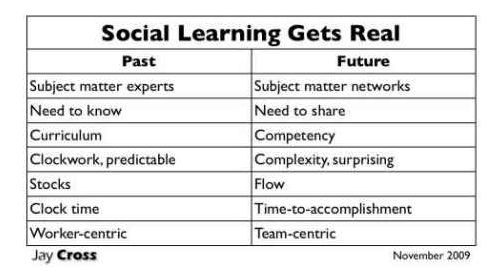
KM Evolution RevisedHarold Jarche in his post “Loose hierarchies for knowledge management” noted that KM has become contextual, requiring loose hierarchies and strong networks.   This networked concept also surfaces in Weinberger’s (2012) Too Big To Know, which suggested the internet has fundamentally altered how organizations will work and succeed.  According to Weinberger, knowledge in the past was seen as a narrowing pyramid, with those at the top having the most critical knowledge. Yet the web now allows any level of employee to gain information from the vast storehouse of human knowledge, and share that with anyone else at any level of an organization … or outside the organization.  Jay Cross called this “social learning“.

sociallearning_cross

If knowledge is now socially developed, what is the role of leadership in knowledge management…particularly in a world in which, as Clay Shirky suggested, anyone can publish anything…and it is up to us to filter, rather than the previous centuries-old vetting process of filter…then publish?  After all, is not knowledge management a form of filtering?

Thomas Davenport wrote off knowledge management in an op-ed piece for the Wall Street Journal last year.  He suggested that individuals focused on managing knowledge missed the boat when big data came along.

“Any chance that this idea will come back? I don’t think so. The focus of knowledge-oriented projects has shifted to incorporating it into automated decision systems. The hot technology for managing knowledge is now IBM Corp.’s Watson—very different from the traditional KM model. Big Data and analytics are also much more a focus than KM within organizations. These concepts may be declining a bit in popularity too, but companies are still very focused on making them work.”

The tag line for David Weinberger‘s book is “Rethinking knowledge now that the facts aren’t the facts, experts are everywhere, and the smartest person in the room is the room.”  In this era of machine intelligence and rapidly evolving work structures, we need to rethink knowledge.  Davenport ends his piece suggesting that one should continue to believe in knowledge management, and I agree … but as Weinberger noted, we have to be smart differently.

I am looking forward to hearing what my students make of this evolving concept!


23 Jun 14:27

The University of Law and Damar Training launch new Apprenticeship partnership

by Legal Futures

The University of Law (ULaw) and Damar Training (Damar) announce the launch of a new partnership designed to transform the national apprenticeship offering for law firms, allowing them to grow their own talent and build diversity.

The post The University of Law and Damar Training launch new Apprenticeship partnership appeared first on Legal Futures.

23 Jun 14:20

Blog: Apprenticeship reforms and the implications for the health sector

by steven.haines@nsahealth.org.uk (Candace Miller (Director of the National Skills Academy for Health))

Candace MillerAs National Apprenticeship Week 2016 gets underway, Candace Miller, Director of the National Skills Academy for Health, reflects on the government’s apprenticeship reform programme and how these changes are impacting healthcare employers.

23 Jun 14:20

Getting apprenticeships right: what does the workforce of tomorrow think?

by Georgina Taylor

23 Jun 14:19

Will Amazon be the `Netflix’ of learning?

by Donald Clark

Amazon often surprises. When it moved out of books only into anything and everything, we were surprised. When it started to deliver cloud services, we were surprised. When it said it wanted to open bookstores, we were surprised. But the idea of Amazon being a global education provider – that’s a shocker.
Secretive

Notoriously secretive, we can only guess what they’re up to. But this much we know. They’ve got a ‘wait list’ for their new educational service. That’s an interesting little marketing play. Keep it secret, keep it scarce – then launch. They bought TenMarks a couple of years ago, use predictive analytics to sell stuff and have the ability to deliver a super-massive global service if they so desire.


Amazon have been playing around with TV, with Amazon Prime. But they produced Alpha Four about four Senators - a dud. Netflix used data, but much more fine-grained, and produced House of Cards. Data analysis, in itself, is not enough. You need data plus experts. That's why Amazon made their mistake - they were too cocky about the data alone. See this TED talk for more. 
Role of AI?
I’ve written tons on the future role of AI in teaching and learning. I’ve invested in it, am building my own company in the area, talk on the subject, write on the subject, so I’m a convert. But I’m not Jeff Bezos and I don’t have a global platform that is as good as anyone at delivering stuff with consummate ease to the entire planet. Jeff does.

Knowing Amazon, there will be some predictive, recommendation engine, review, ratings and an interface that works. They are the masters of ‘ease of use’. They’re bandying about the word ‘open’, which is heartening but could mean anything. An open publishing platform could be interesting but the OER world is full of teacher-created content that lies dead in the unloved repositories of reusable content. If that is their strategy – a sort of share and swap service for resources, with ratings, - it will fail. Delivering smart, interactive e-books could be interesting. Add the magic dust of AI, it has a real chance.
Textbook wipeout?

The textbook market is ripe for a Wikipedia-like cleanup. They’re often poorly written, linear, text-heavy, media unfriendly, quickly out of date and far too expensive. If they have a pop at this market, I for one, will cheer them on. The very concept of a textbook is under attack and it is well on its way to becoming obsolete.


Polish experiment
There's already been nationwide work done in Poland on OER textbooks, the first country to politically support an open-textbook strategy. The government funded Creative Commons Licensed textbooks that can be translated, reused and adapted in primary and secondary schools. The huge savings for both parents and government are obvious, running to around €200 million. They plan to continue the program until 2020. Other places to watch are S Africa and Brazil. The question is whether the clout of a global brand, like Amazon, will help. The evidence suggests that private sector delivery does help. Most OER initiatives fail through lack of business and marketing skills, and remain unloved and unused. Amazon may just provide the infrastructure, marketing and skills to turn this into a global phenomenon.
Conclusion

I wrote some time back about the possibility of a Netflix in education. I feel that we’re moving closer to this, with the rise of AI and adaptive learning. What’s missing is the organization with the chops to pull this off. There are a few around but it really comes down to the big five – Apple, Facebook, Microsoft, Amazon and Google. It is often claimed that IBM’s Tom Watson, who sold a LMS to Hitler, said that there world would only need five computers. He said no such thing. Like most quotes from Einstein and others at educational conferences it’s bullshit. Yet it may, despite its false providence, turn out to be true. These guys do have a grip on the market, and enough cash, to make them almost invincible. As they say, watch this webspace.


06 Jun 13:43

What killed the mobile learning dream? - Digifest speaker, John Traxler

by nathalie.carter@jisc.ac.uk

Mobile learning has stalled, argues John Traxler, professor of digital learning at the University of Wolverhampton's Institute of Education. He challenges Digifest to examine what's happened and how can it get back on track.

Mobile learning was e-learning's dream come true. It offered the potential for completely personalised learning to be truly anytime, anywhere.

Instead, we've ended up with mobile access to virtual learning environments that are being used as repositories. So, in practice, students reading their notes on the bus.

We've ended up with mobile access to virtual learning environments that are being used as repositories

To be sure, in a few pockets in a few well-resourced institutions there may be some subject-specific mobile enhancements but we've certainly not seen the fundamental transformation that was forecast.

So what happened?

Twenty years ago the technology was expensive and fragile, scarce and difficult and it was the prerogative of clever people in universities to see how it could be deployed in support of learning. They bought into a particular model of innovation, believing that their innovative work would eventually percolate downwards and outwards to the chalk face.

However, innovation conceived in that way needs money. And so it reached the chalk face and people found they couldn’t afford it or they couldn’t understand it or that it wasn’t actually improving their lives in the way that the innovators thought it might.

Small scale

One of the key mistakes we made was that most of those early projects were predicated on the researchers giving out devices to the students - because when we started the devices were expensive. So we ended up with relatively short term experiments with a relatively small number of students that may well have produced interesting results but only if we subsidised the provision of the equipment, which we couldn't do.

[#insertinlinedriver quick-mobile#]

Small scale projects teach you little about how they'll work scaled up. Research projects that are only a year or two years do not teach you much about sustainability. They teach you about working with enthusiasts in the fixed term, but you rarely find out very much about the attitudes or abilities of rank and file teachers.

That model is not financially sustainable. The way in which institutions have traditionally provided desktops cannot simply be extended to laptops, mobiles and tablets. Even if the money was there, the variety and rapidity of churn of devices would be nightmarish. But, then, people noticed that, actually, the students have got the equipment already.

The way in which institutions have traditionally provided desktops cannot simply be extended to laptops, mobiles and tablets

So that means that our small scale short term projects, based around giving students a particular device, has actually taught us nothing of any use in this new world in which the students bring their own devices.

Bring your own device

Bring your own device, enabling students to use their own equipment, introduces more questions: is there a specific range of technologies they can bring, what's the nature of the support offered, and have we got a network infrastructure that won’t fall over when 20,000 students turn up with gadgets? What kind of staff development is needed to handle the fact that not only will the students turn up with many different devices but tomorrow they’ll have changed to even more different devices?

[#insertinlinedriver byod-guide#]

I don’t think we’ve clearly thought through what exactly that might mean but, also, some of those concerns are proxies for a rather different question.  When students bring their own devices, they also bring their own services and connectivity, and whereas we used to make the rules by which they could use the desktops or by which they could access the network – because it was ours - in future it will be their network and their devices.

When students bring their own devices, they also bring their own services and connectivity

Who's in control?

That changes the nature of our control, especially as we’re not just talking about hardware, we’re talking about software. Suddenly, students are bringing all of their habits and expectations with them about who and how and what they learn – and that isn’t necessarily limited merely to accessing whatever stuff the lecturer puts on the VLE. That's quite challenging in terms of the lecturer identity.

What's the nature of your job, if you don’t understand the technology the students are using for learning and you don’t understand the complexity and the abundance of the resources they could be accessing on their devices?

If you can learn from podcasts and Facebook and Wikipedia then what’s the role of the university and what’s the role of the lecturer?

If you can learn from podcasts and Facebook and Wikipedia then what’s the role of the university and what’s the role of the lecturer?

What’s the role of teachers and lecturers and educational designers when the world doesn’t need any more content, when the world doesn’t need any more apps?

And how do we define an appropriate digital literacy curriculum that will enable our students to survive and flourish in that kind of world and also to do so on a basis that’s sustainable and equitable?

Opening up, opening out

[#insertinlinedriver john-twitter#]

We ought to be challenging our students to find, or providing our students with, the best learning materials. We ought to be collecting and orchestrating what’s best out there already rather than providing another version of fundamentally the same thing.

We also want our students to learn by discussion and interaction. They can do that in an open world as well. Why do we want to get our students to get locked into our VLE to consume our closed content?

Mobile learning has stalled. It has spent quite some time barking up the wrong tree, looking backwards and inwards. I’d like to direct the community’s attention onward and outward instead.

Mobile learning has stalled. It has spent quite some time barking up the wrong tree, looking backwards and inwards. 

This portrayal may seem overly pessimistic. It is not. It should be read in terms of cumulative experience and familiarity with the uses of mobile technology, both social and educational, at a time when their availability opens far greater possibilities and opportunities than we could conceive of at the start of the century.

Join John at Digifest 2016

Digifest

This is the fifth and final piece from a series of features from our speakers for this year's Digifest. 

John is speaking on day two of Digifest, 9:00-10:00, during our plenary session about the power of digital for learning and teaching. See full programme.

Join the debate

The views expressed by contributors to Jisc Inform are theirs alone and not necessarily those of Jisc.  You might not agree with everything that the contributors say but you are guaranteed to read something that will raise questions and spark debate while you're at Digifest - and beyond. 

06 Jun 13:43

Norway: a new brand promotes enterprises that take apprentices

ReferNet Norway

The new brand makes it easier for consumers to identify enterprises that take their corporate social responsibility seriously by hiring apprentices.

06 Jun 13:43

The top 15 things you need to know about the Ultra experience for Blackboard Learn

by Vivek Ramgopal

SaaS. The Ultra experience. The Ultra Course View. The Original experience. The Original Course View. And a new course theme?

There has been a lot to digest during the course of the past year*, and we’ve made communication and transparency the top priority for our product marketing and management teams. For example, we had nearly 2,000 people register for the Winter and Spring roadmap webinars, and we now have ones scheduled for the rest of the year.

Earlier this year, I posted a blog about SaaS with the goal of answering the top questions you’ve been asking about the newest deployment option for Blackboard Learn. In the same spirit, I’m addressing some of the most frequently asked questions about the new user experience here in this blog.

#1. Do I automatically get a new look for Blackboard Learn after moving to a SaaS deployment?

No. As I wrote in the earlier SaaS blog, one of the most common misconceptions is that the look and feel of Blackboard Learn changes when you move to SaaS. This is not the case. By default, Blackboard Learn in a SaaS environment looks EXACTLY the same as the Blackboard Learn 9.1 user experience you have today.


deployment-image

#2. What is the Original experience?

This is Blackboard’s traditional user experience (at the system and course level) that is enabled by default in Blackboard Learn today, regardless of whether an institution is self hosted, managed hosted, or on a SaaS deployment. Schools that are on SaaS use the Original experience today and schools can keep the Original experience as long as they want.

#3. What is the Ultra experience?

One area where we have not done as good of a job as we could have in the past year is distinguishing between the overall Ultra experience and the Ultra Course View. We should have better articulated that schools decide if and when to turn on the Ultra experience.

The Ultra experience is the term for the new user interface that is more personalized, proactive, and intuitive for learners and educators. The experience includes a new navigation and activity stream that provides:

  • Quick access to the most critical information to easily stay updated and take action
  • Cross-course perspective to eliminate the need for educators and learners to dig inside individual courses for information (e.g. an activity feed, grades, calendar, messages, etc.)
  • Fast access to other resources “outside the course” (e.g. organizations, system announcements, etc.) 

Laptop_Templates_1___Read-Only_

The Ultra experience provides quick access to cross-course information
(e.g. organizations, activity stream, grades).

The Ultra experience is also consistent across our teaching and learning portfolio, providing a learner-centric focus for not just Blackboard Learn, but also Blackboard Collaborate and the Bb Student mobile app.

#4. What are the course view options?

When you enable the Ultra experience, there are two course views that you can make available: the Original Course View and the Ultra Course View.

  • Original Course View: The perfect choice for long-time users of Blackboard Learn and those with more extensive course needs. They get the workflows and capabilities (including content partners and 3rd party tools) they’re used to, but with a new look. No course re-design is required for these courses. Existing courses just work with a refreshed user experience.
  • Ultra Course View: Great for many instructors. We’ve completely redesigned essential workflows and put it into a brand new, efficient, fully responsive view. This is also ideal for instructors who are new to teaching online, so schools can drive more adoption of the LMS with the Ultra Course View.

#5. What is the Original Course View?

Whether the Ultra experience is enabled or not, the Original Course View provides all of the traditional Blackboard Learn 9.1 workflows that users have today. Schools that are on SaaS deployment today are currently using the Original Course View for programs and classes.

#6. Isn’t the Original Course View getting a new theme?

It already did – for SaaS, Managed Hosted and Self-Hosted Customers! This is one place where we’ve evolved our strategy based on your feedback. Many of you have told us that your instructors want the depth of functionality that the Original Course View provides today, but they also want a new look for their courses. So we’ve put additional resources into giving the Original Course View a new look and feel that is inspired by the Ultra experience – a new theme.

Original course view

screenshot of original course view on a mobile deviceThe Original Course View will contain all the traditional
workflows
of Blackboard Learn, with a new look.

Take a look at the screens above. It probably looks a lot like what you’re used to seeing in Blackboard Learn 9.1. It has all of the features and workflows that your Blackboard Learn 9.1 users have today, but it has a new look, and is more mobile-friendly.

#7. What is the Ultra Course View?

The Ultra Course View is what many immediately associated with the term “Ultra.” The Ultra Course View is the simplified and streamlined course view that is fully responsive (designed for PCs, tablets, and smartphones). This course view is only available with the SaaS deployment of Blackboard Learn when the Ultra experience is enabled.

We have done a tremendous amount of research to understand which workflows instructors are using most in Blackboard Learn today. Right now the Ultra Course has a rich enough feature set to meet the needs of a certain segment of instructors. If you’re thinking about changing existing courses from the Original Course View to the Ultra Course View, a built-in diagnostic tool will let you know if any changes are needed.

Ultra course view

The Ultra Course View has completely rebuilt essential workflows
and put them into a modern, simplified, fully responsive view.

#8. Will Blackboard build out the Ultra Course View further?

Absolutely! Over time, we’ll keep “ultra-fying” Original Course View features, but instructors can use the Original Course View for a long time. There are no plans to phase out the Original Course View.

#9. Why do you offer two course views?  

“Why don’t you have two systems – one for faculty who are getting started with online learning and another for those who are more proficient and want sophisticated features?”

Ever since we first provided sneak peeks at the new course design, we have been getting this kind of feedback. No two programs or instructors are the same, and they have different course needs. This has been supported by our own analytics as well as third-party research.

With the dual course mode, both Course Views are available in the same institution. We’re able to support the full spectrum of instructors, whether they’re just starting to teach online or whether they have been using Blackboard Learn’s capabilities for years.

Here is something else we have heard from you:

We want to provide an improved learner experience but we don’t want to go through the process of re-designing or updating all of our courses.  Or some of our faculty will be willing to make the change but others are committed to keeping their courses exactly as they are now.”

The great thing about the dual course mode is that you can give your students what they want and need while accommodating both of these instructor camps. As we move to a more learner-centric interface, we expect students to initiate their most common learning workflows through the personalized, user-specific stream, whether those actions stem from a course with the Original Course View or one with the Ultra Course View. In this personalized, learner-centric view the interface of the individual courses becomes less relevant than the ability for the learner to get all the information he or she needs in one place and at the appropriate time.

The evolution of the New Learning Experience is away from courses and toward this personalized experience for the learner.  And since the Original Course View gets the new theme, students will have a modern look and feel regardless of course type, device, or even product even when they do drill down into the detailed course content.

#10. Who controls which instructors use what course type? 

Here is another evolution in our product strategy based on your input. Institutions have the option of making the Ultra Course View available to instructors, departments, and programs of their choosing. So for example, XYZ institution can decide that the entire Math department will use the Ultra Course View while the rest of the institution uses the Original Course View. This is just one example, but we expect different schools will make different choices based on their needs.

original-or-ultra

#11. Will the Ultra experience be available for Blackboard Learn customers who are self hosted or managed hosted?

No, but we’re going to provide some of what Ultra provides to self hosted and managed hosted customers. The new theme for Original Courses is one example of this. This will provide a new look and feel for both the system and courses (see question six above) as well as make them more mobile-friendly.

#12. Are there webinars that I can join for more info?

Yes, you can see the “Best of BbWorld” replay webinars here.

#13. This is a really long blog. Can you boil it down for me?

My quick blog turned out to be much longer than I had anticipated, but I wanted to make sure you have the information you have been asking for. If you skipped ahead and just want the key takeaways, here they are:

  • Schools that move to SaaS deployment can keep the Original experience that faculty and students are already familiar with from Blackboard Learn 9.1 – for as long as they want to do so. A move to SaaS does not automatically mean a move to the Ultra experience.
  • Schools decide when to turn on the Ultra experience.
  • When the Ultra experience is enabled, the Original Course View still provides faculty with all the features that they have access to today in Blackboard Learn 9.1.
  • The Original Course View has new, modern theme while keeping all the traditional functionality and workflows.

Schools decide when to turn on the Ultra Course View and for whom (individual instructors, departments, schools, programs).

#14. Who should I contact for more information?

Please reach out to us (the product marketing & management teams or your account representative) for additional information about transitioning to SaaS, the Ultra experience, or the roadmap for Blackboard Learn 9.1.

#15. Did you add #15 just so you could make the title “Top 15” vs “Top 14”?

Yes, was it that obvious? I hope this helped, and we’re happy to do a follow up top 10 FAQs blog post with the questions you send in!

Editor’s Note: This post was originally published in February 2016 and has been updated to reflect current offerings and plans

Ultra-experience-webinar


The post The top 15 things you need to know about the Ultra experience for Blackboard Learn appeared first on Blackboard Blog.

06 Jun 13:39

Leadership development in health care

Sonnino RE
06 Jun 13:29

Your Top Three Gamification LMSs for 2016

by Craig Weiss

Three.  It is the magic number.  Well, actually, probably it isn’t, but let’s roll with it.

As with anything that involves rankings there will be conjecture on this or whether it really belongs with that.

Most of all, folks will wonder why there system isn’t in my top three.  Or they will wonder what they can do it be in the top three of whatever the topic happens to be.

Simply speaking, make it better.  If your system has social, improve it to go beyond what everyone else is doing.

  If your system has a level of gamification, just don’t stop at having a leader board, points, rankings and badges. 

That was so yesteryear.   You must adapt, you must enhance and frankly, you must change.

With that said, here are the top three (which BTW, will be presented in my report coming out Jan. 22nd, and which provides even greater details and insight on each of these platforms, along with other rankings, etc.)

#3  Spoke by Unboxed Technology

First and foremost this is a system that might not be for everyone.  Okay, it is quite unique and might not be for everyone.  But, I like it, because it goes about learning with a different approach and flair.

Is it an LMS? The answer is yes, but it achieves it within the learning platform approach, which as I have noted before, is just another niche within the LMS world.

Gamification Features

  • Levels –  Once a learner achieves whatever is expected of them, they go up a level.  One of the cool pieces is that, the levels just as the system itself is fresh with a slick UI.  As a learner, I would want to zip into the system.  
  • Leader board, rankings – Everyone has it, and their system does to.
  • Badges – To get them, you have to unlock certain learning components, which means complete them (more on that in a sec.)
  • Reward Center using virtual wallet
  • Coins –  Another way and take on the points piece, and honestly, I love it.  Here is its approach

Each course or content or whatever you have in the system is assigned coins (the administrator sets this up ahead of time).  When the learner completes whatever task or learning piece, they get the coins. 

As they accrue the coins, they can turn them to get gifts.  In other words, a reward center.

The client (i.e. the company whose learners are in the system) has set aside within a virtual wallet, funds that are disbursed towards these items.

For example, the learner has 100 coins.  They go into the “virtual center”, and check out what they can turn the coins into.  At 50 coins it is some swag from the company (like a coffee cup).

At 500 coins, they can get a Fitbit (again, the funds have already been set aside by the company (not the LMS vendor) and the company has selected what items are available for purchase using those coins).

So the learner doesn’t have enough coins.  But let’s say, they have 500 coins and they want the Fitbit. 

Here is where it gets really cool. 

They select the Fitbit, fill out their address (whever they want it sent) and click send (or whatever you pick as the go button).  

Now, the order is automatically sent to wherever and filled and sent to the learner at a later point (depending on shipping date).

No more having the company, order these items. 

BTW, with the levels you set up, I should note, that you can create clever titles, like “Ninja”.

Bonus items

  • Works nicely on mobile devices
  • Social strong (it’s in my top three rankings for 2016)
  • Fun to use, admin side easy to figure out
  • Streamlined system
  • Works well with employees and customers, albeit I see it stronger on the employee side

One minus

  • Learning must be completed to get the coins.  Defeats the purpose of WBT, which is designed to allow the learner to go wherever they want in a course or content and focus on the areas of learning, following non-linear.  They may complete it or not.

Spoke by the way is not the only system that does the “you must complete” angle.  If the administrator wants to set it up that way fine, but if not, allow them to do so. 

#2  Axonify

Should this surprise you? 

First off, you can’t judge a web site by the product, because well, the web site stinks.  Reaks of uber professionalism and not “hello, I’m a fun LMS”.

Anyway, they follow the approach of micro bursts of learning (which everyone should utilize in their building of learning).

Features

  • Learning games upon entering the system.  Listen this isn’t going to be even Colecovision games, but it’s a nice start
  • Reward Center – Notice a cool trend here with these platforms?
  • Competitions – Allowing learners to compete say, “complete these three items” angle.  But anything can be utilized in the competition.
  • Leader board, points – On the point side this is the approach towards accrue to get those rewards.  People can also bid on the “prizes”.
  • See where they rank compared to their compadres

Bonus items

  • Content curation utilizing some gamified components
  • Works and looks sharp on all types of mobile devices
  • Streamlined and slick UI
  • Solid for both employees and customers

#1  Growth Engineering

I will say it.  They have the best and frankly the strongest gamification LMS on the market.  Not only that, but this is a full blown and strong LMS with extensive feature sets and capabilities.

There is a reason they are #2 Top LMS for 2016 and it isn’t just because of gamification.

If you are open, heck into gamification, this is the system for you.  If you are not into gamification, then honestly none of the systems presented are for you.

But let’s say you are into gamification.  Well, if you want the best, here it is.

Features

  • Gamified system – everything is tied to gamification (the administrator decides what and how points, etc. are assigned and to what)
  • Genie – authoring tool that comes with the system offers gamification points, badges, games to the folks building the courses.  I’ve honestly never seen that with any authoring tool – you know, rewarding the folks who build the courses.
  • Learning games in the system – Some are fun, some are the usual – climb the mountain learning journey.  Growth constantly adds new games.  As I recall, I think they have eight so far and continue to add.
  • Points, Leaderboard, rankings – The standards
  • Virtual wallet and reward center – Hey, do you notice the trend now?  Hint, hint – virtual wallet, reward center for learners (just in case you haven’t figured it out yet)

Bonus items

  • Administration side uses icons and is easy to figure out
  • Learners will want to use the system – it’s fun and well, it’s fun.. so deal with that
  • Ask an expert feature in the platform – can tie points to that as well
  • Very cool UI
  • Full blown system – many folks might think, “well it is just gamification” as if that is a minus.  Sorry, people, this is a very strong system.
  • Works well on any mobile device

Bottom Line

Applause. Applause.  Congrats to the top three gamification LMSs for 2016.  Were their others that were sweet and solid, oh yes, yes there were.

Gamification, for one has become a standard in the industry.  Yet there are systems who are holding back or are lacking the next tier of components.

And that is why, there will always be winners who “get it”.

They see the trends and in some cases, lead those trends.

We don’t need a leader board or rankings to figure that out.

We need ingenuity, adaptability, creativity and the willingness to risk it all.

And either succeed or fail.

But at least try.

To earn points that will work for your learners, wherever they are and whomever they are.

It’s not a race.

It’s a journey. 

Your journey.

E-Learning 24/7


27 Mar 15:37

Eight reasons to welcome an audit of your assessments

by John Kleeman
Posted by John Kleeman Have you just heard that your assessment programme is to be audited? Does this make you want to run out of the building never to return? Or is this something you welcome, confident that your assessment will withstand scrutiny? Whether the audit is formal or informal, aimed at your program or […]
27 Mar 15:37

10 Actionable Steps for Building a Valid Assessment – Infographic

by Julie Delazyn
Posted by Julie Delazyn Using item analysis can greatly improve the validity of your assessments by helping you quickly and easily spot any red flags and weed out unreliable questions that are not performing well. Our infographic highlights 9 additional steps you can take to produce valid assessments.  View and download the infographic here. Are you […]
27 Mar 15:33

LMS: Evolution or Extinction – 8 trends that change everything (Part 3 of 8): Compliance

by Michelle Sullivan

Trend #3: Compliance
(Part 3 of 8)

Don’t Be Caught Unawares

Multinational and global companies deal with different regulations and various regulators around the world. Training records are nearly always reviewed during an inspection or audit by regulatory authorities to check that employees have received the appropriate training and their competencies or certifications are current and valid.

SOPs & Training Records

In environments where personnel are required to work according to written procedures, documented instructions or standard operating procedures (SOPs), there needs to be a set of guidelines that define the tasks to be done and what has to be documented to demonstrate that the activity was actually performed. If any deviations to the procedure are made, they have to be documented at the time of the deviation, not later.

Training plays an important part when implementing a new or updated SOP since the training is what teaches employees on the new procedures. This is where the learning management system (LMS) plays a vital role — being able to schedule and track the training of individuals on the SOP’s. It is critical that organizations are able to keep accurate records of individuals and their training plans.

Electronic versus Paper

There is no regulatory requirement that dictates whether organizations must use paper or electronic media to document their personnel training records; it is left to individual companies to make that decision. The major differences between the two media are:

Item Electronic Paper
Training Plan Generated in LMS, stored easily and accessible to all appropriate personnel Manually written and requires physical presence of the person to read the document
Training Class Individual signs on to a training class and is recorded in the LMS database Presence is recorded manually on an attendance sheet
Training Completion Completion is automatically recorded in the LMS database Course completion certifications have to be gathered and recorded manually
Real-time Data Always current Not always up-to-date as records are manually updated at a later point after the training is completed
Training Records Can easily view records online or printed as a report Reports have to be manually generated from certificates that have been gathered, which may be incomplete
Data Integrity Before each important operation in the LMS, an electronic signature (e-signature) is required before the operation can happen Manually signed or initialed documents are not easy to verify or prove as valid
Version Control Electronic training records are accurately updated with the  exact version of courses taken; course revisions can automatically trigger required training to maintain compliance Paper-based document control is prone to mistakes; paper records are difficult to control, may be lost/misplaced or changed without anyone knowing and version control is hard
Audits Changes made to sensitive data are audited in the database with info on the type of change, who made it and when. Changes include any creation, update or deletion of sensitive data. Physical checklists, manually recorded

Compliance-LMS3of7
LMS Compliance Considerations

  • e-signatures in audit tracking
  • competencies and certifications
  • proactive reporting, dashboards, and analytics
  • easy access to compliance content

Given the above, are compliance checklists and reactive reporting enough from a risk perspective versus true workforce readiness and proactive compliance dashboards?

This is the third of an eight-part series on LMS: Evolution or Extinction — 8 Trends that Change Everything.

24 Mar 10:31

The best place to learn for a job may not be a classroom

by Tom Maksymiw

Ask any of us where we learnt to do our current job and the chances are we will talk about work experience first and educational qualifications second. Education and training systems have (sometimes reluctantly) recognised the benefits of work-based learning as a bridge between the worlds of education and of work. Workplaces are great places to learn both hard and soft skills and they also offer value for money since high-quality vocational programmes in schools or colleges can be expensive.

But getting employers to offer work placements can be hard. Sometimes the balance of costs and benefits is not clear. When training starts, employers make an investment, which only comes to fruition later on when skilled trainees repay the investment with higher productivity. That final period is essential, as it allows employers to make up for the initial losses – but make it too long and trainees will find long periods of being paid a trainee wage with little further learning unattractive. So the design of work-based learning schemes is essential to make them appealing to both employers and learners.

At a seminar in London on 10 February 2016 organised by the OECD and the UK Commission for Employment and Skills, 50 participants from nine countries exchanged a host of ideas and innovations on how WBL schemes can balance the different interests of employers and trainees while maximising productivity benefits.

Participants from each country also shared their experiences of initiatives that support firms to offer high-quality work-based learning. Managing inexperienced trainees and dealing with extra administrative work can be demanding, especially for SMEs. In Norway, firms organise themselves in “Training offices” to better coordinate and support apprenticeships. In Switzerland, all supervisors of apprentices must participate in a 100-hour long training course preparing them for the task. Chat in Swiss school corridors also seems to be an important quality assurance tool – apprentices talk to each other during off-the-job training days and the reputation of a firm spreads fast. Some of the best trainers used to be apprentices themselves – an insight that has led to a “train the trainer” module in the final stage of apprenticeships in the US.

The seminar on WBL and productivity is part of a wider OECD project, which focuses on different topics in work-based learning. Key messages from this seminar and analytical work on WBL and productivity will be drawn together in a report to be published in May 2016. Further workshops and seminars will take place between April and September 2016, each focusing on a particular topic.

Further information on the wider OECD project on work-based learning and published reports can be found on our website.

17 Mar 12:15

Blog - Why leaders are blind to the most important productivity opportunity of all

Email is the leading cause of preventable productivity loss in organizations today. Forbes Magazine (2008)

Employees spend 1 to 3 or more hours per day managing email at 40-60% of capacity.  That means they typically lose 30-60 minutes PER DAY.   Not some.  All — even the ones who believe they are extremely productive. That means you too.

It goes completely unnoticed because you probably think this is an exaggeration.  It isn’t.  Go ahead and challenge me.

Employees, many of them top managers, lose, forget or simply don’t have time to get to 5-15% or more of their email – a lot of which is highly important.  Many of these mails haven’t even been looked at.

It goes completely unnoticed because it has become status quo.  It shouldn’t because it is ravaging your business.

These otherwise highly productive employees often answer unimportant little task emails rather than pouring their focus into the most important things – systematically.  The idea of applying a methodology to the way people manage email (25-30% or more of their day I remind you) is not even discussed or considered.  Who’s in charge of email productivity in your company?  No one.  It’s not even on the map. It goes completely unnoticed because you think email is personal and difficult to systemize.  Rubbish.

There is no other single activity in your business that is as poorly regulated and in so much need of improvement than email management, and yet…it goes completely unnoticed.

Why isn’t fixing email management a burning platform in your organization?

No one has experienced what it is like to have an entire team of employees:

  • working their inboxes at twice the current velocity; prioritizing and executing what is important and urgent; and having complete visibility control over what is going on at all times of the day. 
  • never late, never missing ANY emails.

Face it, most people probably can’t imagine that this is possible – THAT’s why there is no burning platform.  You simply can’t know what you don’t know or have experienced.  Wilbur and Orville had this same problem.


Enjoy this article? Than why not read Michael's other blog on our website: E-mail Management is not the problem. Management is.


About the Author  Untitled

Michael Hoffman is an Executive Coach; CEO of LeanMail, a suite of productivity solutions for email, meetings and projects; and Partner, CEO of Atrendia, a consultancy firm working with medium to large organizations bringing about dynamic improvements in productivity for knowledge workers through innovation and the facilitation of change. Michael has diverse experience in various management roles involving many kinds of people and cultures. His experience as an entrepreneur spans over 25 years.

14 Mar 19:27

The 2016 Social Media Image Sizes Cheat Sheet

by Randy

The 2016 Social Media Image Sizes Cheat Sheet infographic

Sometimes, one image size doesn't fit all. The 2016 Social Media Image Sizes Cheat Sheet from Hub Spot will help you optimize your images for all of your social media sites.

When you're designing cover photos, graphics, and other social media assets, sometimes knowing the bare bones image dimensions isn't enough.

What if you wanted to place text or an arrow on your Facebook cover photo without it getting covered by the profile photo? And what about the shared link thumbnails on Facebook or in-stream photos on Twitter ... how big should those be?

These change so often, a current infographic guide like this is always helpful.

21 Feb 17:24

The Smell of Knowledge

by julianstodd

I found myself in the library. Some twenty years after i was here last. Things have changed. I grew up with this library: adventure books with tigers and sharks, books about boats and adventure, maps and atlases, novels and dictionaries. Books to read in bed, on holiday, on long summer holidays or through the winter nights. You collected your stash, made your way to the front, where the librarian would carefully take the small card out of the front and place it in a wooden tray, slotted into a little cardboard envelope with your name on it, and stamp the book with the date of return, and the promise of a fine for late delivery.

The Smell of Knowledge

When last i was in this library, not only did i not have an iPhone, but nobody had any kind of mobile phone.Indeed, it would have been around that time that i remember being in the car with a friend whose dad was so successful that he had a phone IN THE CAR. I called my parents on it once. It was so exciting that i remember it still.

Today, the desk has gone. The cards have gone. Indeed, it seems as though the librarians have gone, replaced in their stead by a tall monolith, reminiscent of 2001, a space odyssey, more than Maureen, wielding the stamp of destiny.

Upstairs: the reference library.

If the galleries downstairs were the preserve of teenage thrillers and disposable fiction, the hallowed space upstairs was reserved for only the most serious literary investigation: encyclopaedias (remember them kids? Just Google it…), giant atlases and reams of microfiche (really tiny photos of… ok, just imagine the internet if it was printed out really really small).

It was the last desperate hope of the school project and the place to hide from figures of authority. It was the cathedral of books.

Books at Blickling Hall

Today, however, it’s the preserve of annoying teenagers with white Apple buds in their ears doing homework and two rather bored looking librarians. Barely an outdated tome in sight.

A lot has changed in the library, but one thing remains: the smell.

As i walked in the door, it hit me and took me back in a moment: the smell of books, more specifically the smell of THESE books.

I’ve since spent a lot of time in a great many libraries: from military history to research, university to cathedral, but none smelt like this one. Books, it turns out, must truly be alive.

Knowledge in books

A sign above a Brighton bookshop

Even today, even in the age of distributed knowledge, where technology connects us to co-created and crowd sourced meaning, there is something wonderful about a library. Something archaic and yet comforting.

Some libraries are throwing out books, installing 3D printers, creating play spaces and innovation labs, which is all great, but forever we must find space in our lives for cathedrals of knowledge and the reassuring smell of literature, sleeping peacefully on the shelf.


12 Feb 08:39

Comparing collaborative annotations on books between libraries and social community sites

by Dan Wu
The Electronic Library, Volume 34, Issue 2, Page 178-195, April 2016.
Purpose – Based on the study of overall situation of the tagging function in the provincial public libraries and library of major colleges and universities, this paper aims to examine the difference of tagging behaviour of its users in library and social community sites. The authors also want to understand the causes of a variety of annotation behavior in social community sites and libraries. Design/methodology/approach – The authors collected all system log data of tags, comments and ratings users added in Wuhan University library, and then found the tags, comments and rating of corresponding books in Douban. Then, the authors did questionnaire survey to the Wuhan University students. Findings – The authors found that the annotation service in the library is not perfect as that in social community site. Enthusiasm of users annotating books in the library is far less high than that on the social community sites. Lack of understanding of the annotation service is the main reason why users are not concerned or do not use the tagging service. But users have the needs of the organization of personal information in the library using tags. Originality/value – This paper investigated the library users’ behavior in the using library OPAC course and compared the difference of annotation behavior between library and social community site.
11 Feb 08:40

10 Ways to Fail When Creating an Online Program

by Joshua Kim

Is your college considering online learning?

30 Jan 08:56

3 Unusual Hacks to Dramatically Up Your LinkedIn Game

by larry.kim

Posted by larry.kim

Wouldn't it be so cool if you could drive engagement and qualified traffic to grow your business and brand from LinkedIn?

You can!

This article will show you how to get tons of likes on your LinkedIn updates and further grow your reach with LinkedIn Pulse.

Doing so requires one crucial thing. You must:

Be a Linkedin Unicorn in a Sea of Donkeys (source: Larry messing around with photoshop)

(Image source: me attempting to use Photoshop)

1. Build a large LinkedIn network

Smart marketers must build a large LinkedIn network.

The LinkedIn news feed algorithm isn't a black box. It's more like an open box. It's about as basic as boiling water.

Updates that you "like" will be shared with your LinkedIn network. If your connections "like" your status updates, their connections will see that update.

NxF3lFC.jpg

So if you have 20,000 connections on LinkedIn, then it's so much more likely that (a) more of your connections will click "Like" on your updates and (b) that their connections will also click "like" on your updates.

LinkedIn's algorithm is about as stupid-simple as it gets — it shows your updates to all of your connections.

There's no way to search for updates on LinkedIn — not even with advanced search. Nobody will see your updates unless they are connected to you.

When more people see your updates, it increases the odds that more people will like that update.

More connections. More likes. Simple.

Add connections and the results will multiply over time. Quality connections are key here. Only connect with people you know and want to know — don't just try to connect with random people, recruiters, or those really annoying sales spammers.

If you add 10x more connections, then you're 10x more likely to get that engagement.

How do you expand your LinkedIn network? You can definitely help yourself by optimizing the heck out of your LinkedIn profile and writing irresistible LinkedIn connection requests.

But having tons of connections is only half the battle.

2. Post high-engagement updates to LinkedIn

The second half of the battle is posting interesting updates more often. And by often, I mean 1 to 3 times a day.

But our battle begins not on LinkedIn. It begins on Twitter.

gghjsUf.jpg

Here's how this pyramid scheme works. (Don't worry, it's totally legal!)

You can try out lots of different updates on Twitter. Let's say you post 20 tweets a day.

Some of your tweets will get tons of engagement (clicks, replies, retweets, likes). Some will do moderately well. Others will die of loneliness (hopefully not too many!).

We want to focus on the winners.

5lrwtB7.jpg

Think of this as your personal "LinkedIn Update Hunger Games."

You audition the different updates on Twitter. Each tweet is one of your "tributes."

Your best stuff is transported from Twitter to LinkedIn. Only your "victors" get the heroes' welcome at The Capitol.

Using Twitter analytics, you pick your victors — the top 5 or 10 percent top-performing Twitter updates. The tweets people liked, retweeted, or replied to.

Use your top stuff from Twitter as a guide for your LinkedIn updates. After all, it's highly likely that the same content that did well on Twitter will also get lots of likes on LinkedIn.

3. Hacking LinkedIn Pulse

Now let's turn our attention to Pulse, LinkedIn's content app and news feed curation service.

You can blog on LinkedIn and easily get a few thousands views. According to LinkedIn's latest available figures, more than a million people have published posts on LinkedIn's platform; more than 130,000 posts are published every week; and the average post reaches LinkedIn members in 21 industries and nine countries.

Sometimes LinkedIn articles perform fantastically well, transforming from average to a unicorn. We're talking 50,000, 100,000, or even millions of views.

Wish you could get that many views? You can!

How do you do it?

First, you must get your content featured on a Pulse channel. Pulse has several Channels (i.e., topics) that have millions of followers — some of the most popular include Leadership & Management, Big Ideas & Innovation, Technology, Entrepreneurship, and Marketing & Advertising.

linkedin pulse channels


If you only have 500 or 1,000 followers on LinkedIn, Pulse is the outlet that can expose you to a massive audience.

So how do you get your blog post featured on a Channel?

4gGuTOe.jpg

Algorithmically

You need to do old-school SEO on your post. LinkedIn Pulse categorizes your content based on an analysis of the text of your article. This is like SEO from 15 years ago, when all you had to do was put the keyword in the title and all throughout the article! Crazy simple.

DFB6hUV.jpg

Ask an editor to feature your story

You can tweet them @LinkedInPulse and ask them to feature your article in a specific channel.

Getting featured on a Channel is awesome. But it isn't enough.

Hitting it big on LinkedIn Pulse is similar on Digg or Reddit. Just because you submit something doesn't mean you're automatically going to get tons of traffic. You need to be one of the top two or three featured stories to get the lion's share.

The same is true on LinkedIn. You'll experience the biggest wins after you get to the top of a Pulse Channel.

How do you get to the top? One tactic that can work brilliantly is using Facebook, Twitter, and Linkedin promoted posts to quickly drive lots of traffic to your LinkedIn article.

weHGOCa.jpg

One key factor of LinkedIn Pulse's algorithm is the amount of traffic and engagement an article has seen in the last several minutes. You don't have to drive traffic forever. You just need a catalyst — something that gives your article a little push to get it to the top.

Once your Facebook, LinkedIn, and Twitter ads help your article get to the top, it will be self-sustaining for a while as people go to the Channel and check out what's trending – make sure it's your post!

The winning LinkedIn formula

So, there you have it. The way to get tons of likes on LinkedIn is the combination of high engagement content plus lots of connections. Then, take it a step further by optimizing for LinkedIn Pulse to expose yourself an even larger audience.

A long time ago, I used to treat LinkedIn separately. But I've since grown and found several reasons to treat LinkedIn more like Twitter. Key among them: More people will engage with you, share your best content, and visit your website.

LinkedIn is constantly evolving to serve its more than 400 million members. So evolve your LinkedIn marketing strategy accordingly in 2016. Start building more connections and raising your visibility!


Sign up for The Moz Top 10, a semimonthly mailer updating you on the top ten hottest pieces of SEO news, tips, and rad links uncovered by the Moz team. Think of it as your exclusive digest of stuff you don't have time to hunt down but want to read!

18 Jan 18:51

How to Institutionalise Innovation

by Morten Bennedsen, INSEAD Professor of Economics and Political Science
Family firms provide lessons in creating continuously innovative companies.
17 Jan 19:21

5 steps towards Modern Workplace Learning

by Jane Hart

shield-492991_640Following my two previous posts on change in 2016, Rethinking Workplace Learning and Rethinking CPD, I have been asked?

“What are the steps for taking this forward in my organisation?”

I believe this involves a 5 step process:


  1. See the change
    • Have a vision of what you would like to see in your own organisation:
      • A new mindset that embraces all the way people learn at work (not just training)
      • A new role for L&D that enables and supports workplace learning rather than commands and controls it
    • See the success of this new learning mindset and approach in terms of increased organisational agility as well as improved job, team and business performance
  2. Be the change
    • Adopt a new mindset/approach for your own professional learning and development (CPD) and focus on exposing yourself to new thinking and ideas rather than just addressing current job needs.
    • Encourage the rest of your team to do the same
    • Provide a private group space where you can build a social team and share everyday workplace experiences as well as new ideas and thinking
  3. Show (the value of) the change
    • Promote the new mindset throughout the organisation – that workplace learning is more than training – – from the very top to the bottom by demonstrating
      • what this new approach to learning looks like for you and your team
      • what you are achieving from it – on a practical day-to-day basis (working more closely together, learning from one another on an ongoing basis) as well as
      • what it means in terms of improved job and team performance.
  4. Support the change
    • Consider how L&D teams needs to evolve to support this change in new ways (ie the new roles and skills required)
    • Work with managers and their teams to help them put it into practice. (Note: don’t bang your head against a brick wall trying to convince managers and teams who want to cling onto the traditional workplace learning (training-focused) model – but identify work those who can see there is a better way forward)
      • Help managers to becoming more involved in developing individual potential
      • Help managers to encourage learning from work as well as at work (ie not just through training)
      • Help managers to build their own social team and provide a private space where the team can learn (and share what they learn) as they work
    • Encourage independent learning (though personal and professional learning) and the sharing of new ideas from exposure to new thinking.
    • Use a performance consultancy approach to identify how ad hoc problems might best be solved – so as not to assume that training is the only/best solution
    • As appropriate, create learning campaigns, learning challenges or learning flows, as well as flexible, on demand, flexible resources.
  5. Measure the (success of the) change
    • Measure the right things – NOT learning activity NOR learning outcomes BUT how well this new mindset and approach are contributing to improved organisational agility and performance.

challengeSo essentially, it revolves around the L&D department developing this new mindset and approach FIRST for their own learning and professional development, so that they can then espouse the change and help others to embrace it too in new ways.

Helping to kick-start this new L&D mindset and approach is the purpose of the 2016 L&D Challenge. that starts on Monday 1 February and runs over 15 weeks: Part A is designed to help you experience a range of new learning approaches, so that in Part B you can consider how to put them into practice in your own organisation.

[If you prefer some bespoke help, let me know. I am currently working with a number of companies to help them work through these 5 steps – to help them with the vision of MWL for their organisation, to help the team ready themselves, and re-shape themselves for the change, as well as work with different parts of the organisation (managers, individuals etc) to effect and support the change.]

16 Jan 10:30

The Pressing Concern of People, Skills, and Talent

by KPMG Management Consulting
Marc Snyder
Managing Director, CIO Advisory
Head of Global Centre of Excellence at KPMG

Talent scarcity — the new normal in the Digital Age?

People, skills, and talent are top of mind for today’s CIOs. In fact, nearly six out of ten CIOs believe that skills shortages will prevent their organization from keeping up with the pace of change. This trend started last year, and it appears to be only accelerating. Compared to 2013, concerns about skills are up by over 30 percent.

So what kind of skills do CIOs need the most? Big data / analytic skills head the list by a wide margin — almost six times higher than change management, the second skill most in demand. The proportion of CIOs who plan to increase their technology headcount is at a five-year high in 2015. More than four in ten now look to hire new IT talent in the coming months. Meanwhile, the need for more traditional IT skills in areas such as enterprise and technical architecture has fallen. IT leaders’ demand for social media skills has also been declining, perhaps because social is becoming more the responsibility of marketing.

Talent retention remains a significant concern for nearly 90 percent of CIOs, especially at smaller organizations. At the same time, the proportion of women in IT leadership roles has reached only 8 percent. A large majority of CIOs also reported that they prefer full-time teams on permanent contracts.

Related Insight: New window: Take the 2016 Harvey Nash Survey
16 Jan 10:28

implementing a useful model – 70:20:10

by Harold Jarche

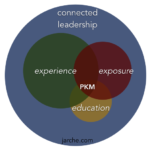
The 70:20:10 framework is a useful model based on observations that generally, people learn 70% of what they need to do their job from experience. About 20% is learned from exposure to new tasks or environments. Only 10% is learned through formal education. These numbers are not firm but they provide a rule of thumb, especially for planning and resource allocation to support learning at work.

PKM-connectsThe most important aspect of 70:20:10 is that it requires leadership to hold the space so that workplace learning is connected through experience, exposure, and education.  Leaders have to promote learning and themselves master fast, relevant, and autonomous learning. There is no other way to address the many wicked problems facing us today. If work is learning and learning is the work, then leadership should be all about enabling learning. Holding space means protecting the boundaries so that people can work and learn.

Personal knowledge mastery is the core competency for each person working in the networked era. But organizations have to provide the support and remove barriers to learning. Leaders need to provide the space for learning.

One approach to supporting workplace learning, based on the 70:20:10 model, is for the organization to provide three types of enablers:

  • Tools: that workers are dependent upon to do their work
  • Skills: competencies to work independently
  • People: social structures to work interdependently with others, inside & outside the organization

Education can enhanced by first designing formal instruction through a process like Cathy Moore’s action mapping, instead of focusing on content delivery. Instructors can develop new skills by flipping their classrooms and focusing on engagement, not lectures. Participants can be more engaged in formal training when it is linked to their own personal learning network.

Exposure can be facilitated by enterprise social networks, so everyone can see what others are working on. The practice of working out loud exposes people to more diverse opinions. But exposure often comes from others, so engaging people at all levels in practices like cognitive apprenticeship becomes necessary.

Work is learning and learning is the work. Social media are new languages, requiring new communication proficiency, but they help expand our social networks, enabling more loose connections and potential for innovative ideas. PKM is the discipline of engaging with our professional networks and creating a diverse source of information, knowledge, ideas, and opinions. In order to make sense of their experiences, people need to engage with communities of practice, consisting of mixed social ties, in order to test new ideas in a trusted space. Organizations can help to identify and support these communities, both inside and outside the enterprise.

70-20-10

I have described one relatively simple way to practically implement the 70:20:10 framework. There are many other possible approaches. If these methods make sense, you can learn more by joining the Moving to Social online community.

12 Jan 17:43

L&D Global Sentiment 2016

by donaldhtaylor

L+D GSS 2016 Map

Yesterday at 23:30 UK time I closed my annual ‘What will be hot in L&D this year?’ survey. For full results, join me for Three corporate learning trends to watch in 2016 on 20 January at 16:00 UK time, 11am ET.

This is the third year I’ve run this one-question survey. 728 people voted from 52 countries, casting a total of 1922 votes (each person can vote for up to 3 items). The global results are:

Collaborative/social learning 250 13.0%
Personalization/adaptive delivery 218 11.3%
Consulting more deeply with the business 167 8.7%
Mobile delivery 159 8.3%
Micro learning 151 7.7%
Games/gamification 132 6.9%
Neuroscience/cognitive science 132 6.9%
Showing value 115 6.0%
Curation 108 5.6%
Developing the L&D function 92 4.8%
Synchronous online delivery (eg webinars) 85 4.4%
Video 68 3.5%
Knowledge management 67 3.5%
MOOCs 63 3.3%
Wearable tech 58 3.0%
Other: 57 3.0%

The question asked was “What will be hot in L&D in 2016?” and respondents were asked to vote for what they thought would be hot, rather than should be hot. No definitions were provided for the choices given, nor for what ‘being hot’ meant.

I’ll do a full analysis of this in my webinar with Axonify on 20 January 2016 at 16:00 UK time, 11am ET: Three corporate learning trends to watch in 2016. For now, though, here are some quick observations:

  1. Caveats – this population was not pre-qualified (so we don’t know it was L&D only) and was voluntary and so self-selecting. It is, therefore, likely a skewed population: more tech-focused, more social than others in the profession. For all that, over 3 years I have noticed that this population does tend to predict what will become strong in corporate L&D eventually (if not in the current year) and also, what will fall from being ‘hot’ to either being part of business as usual (eg video) or irrelevant.
  2. Collaborative learning remains strong – it was #3 in 2014, #1 in 2015 and remains at the top of the leader board. It also features in the top 3 of just about every geography.
  3. Micro learning is strong, but US-focused – a new entry at #5, Micro learning’s popularity is largely founded in North America. Elsewhere it’s still a new term.
  4. Mobile maintains, video drops – mobile remains on people’s minds (although dropping from #1 to #3 to #4 this year), but video’s drop has been precipitous – from #5 in 2013 to #13 this year. This seems to signal that mobile remains a challenge while video is now seen as ‘business as usual’
  5. Global variations are strong – there are clear differences across different territories. The UK and North America differ from each other, as they do from Europe and Australia/NZ. More about this on the 20th.
  6. MOOCs are …. what, exactly? With a slight variation in wording, MOOCs have been in the survey since 2014, but have fallen from #4 to #14. Why? Three possible reasons:
    1. They are now seen as ‘business as usual’ (not my observation)
    2. L&D knows about them, but refuses to use them
    3. L&D knows about them, but can’t find a use for them – yet


What do you think? Do these results match your observations of L&D? Is there anything missing? Feel free to comment ….


10 Jan 18:50

Top 8 posts of 2015 to help you conquer stress and well-being

by Limeade Marketing

A new year brings fresh starts – but it also allows us to reflect on ways to improve. Take a look at our top posts of 2015. 

Stress

How to combat workplace stress

What’s making your employees so stressed? We’ve got five things they’re freaking out about and what you can do.

3 TED talks to help you de-stress

Carve out 15 minutes for yourself to check out our three favorite TED talks on stress.

Well-being

Research finds employees more engaged when employer cares about well-being

We partnered with Quantum Workplace to find out what motivates employees. Here’s what we found after analyzing feedback from nearly 2,000 survey responses.

3 ways gamification can improve your team’s well-being

We love games, and we bet your employees do too. Help them achieve their goals and improve their health by introducing these gamification strategies.

Culture

What is company culture?

Culture isn’t necessarily what you think. Our Chief People Officer Laura Hamill, Ph.D., explains what it is and shares questions to ask yourself.

How we own our culture of improvement

We’re proud of our intentional culture of improvement – it pushes us to live our values and delight our customers every day. See our culture in action in this eight-minute video on bi-annual Own It Day event. 

Work-life integration

How to talk to your manager about flexibility

Looking for the autonomy to choose where and how you work – but aren’t sure where to start?Expert and author Tracy Brower, Ph.D shares seven steps to take.

It’s time to rethink your traditional vacation policy

Traditional work-life balance is dead. This means your traditional vacation policy might be too. We’ve got three progressive ways to give employees the time off they want and need to recharge.

Here’s to a healthier, happier 2016!

The post Top 8 posts of 2015 to help you conquer stress and well-being appeared first on Limeade.

10 Jan 18:48

Modern office design principles favour extroverts, study claims

by Mark Eltringham

Open plan officesThis week’s British Psychological Society Occupational Psychology Division annual conference in Nottingham has proved to be a fruitful hunting ground for insights into the nature of modern work and workplaces. The week culminates today with the presentation of a new study from business psychologists OPP which claims that personality has a big impact on the type of office environment people prefer to work in. Modern features such as shared space and open-plan floors appeal mainly to extroverted workers and made introverts uncomfortable. Over 300 people (71 per cent female and average age 47 years) completed an online survey about their current workplace. The participants had previously completed a personality test to ascertain their personality type. The results showed that many features of the modern office were more likely to be preferred by extroverts than by introverts.

Extroverts were significantly happier at work and had higher levels of job satisfaction. Personality differences were also shown to be behind areas of conflict in the office, such as people’s reactions to the idea of a clear desk policy. Some features were desired by almost everyone, such as having your own desk and working area, having well-designed workplaces and having ‘quiet areas’ available. Others, such as desk-sharing or hot-desking, were disliked by most people.

John Hackston said: “Despite changes in technology many people still work in an office. Understanding how personality interacts with the office environment is key to improving job satisfaction and productivity. These results support previous research into the unpopularity of open-plan offices and hot desking and the positive effects of personalisation. However, there are some simple changes that can be made to improve staff satisfaction and increase productivity.

“These include allowing staff more storage for personal items when hot desking; creating smaller neighbourhoods within open-plan offices; not overdoing clear desk policies as clearing away all personal items can be demotivating to some people and providing quiet zones for people to work in when needed.”

The post Modern office design principles favour extroverts, study claims appeared first on Workplace Insight.

07 Jan 15:49

Lifelong Learning is the Most Crucial Educational Mindset

by Edudemic Staff
I.gardner.gb

Relevance of lifelong learning for school teachers.

Doctors, lawyers, and other professionals never stop learning new techniques and strategies to hone their craft and remain on the cutting edge in their field – and so, too, do teachers. Teachers should consider the concept of “lifelong learning” and a few reasons it’s a great frame of mind for educators to have. What Is […]

The post Lifelong Learning is the Most Crucial Educational Mindset appeared first on Edudemic.

06 Jan 13:47

Compliance & Learning Crisis!

by admin
I.gardner.gb

Intro goes over some obvious ground but lots of common sense.