Shared posts

30 Sep 09:28

Tableau Software: Visualising data for new insights in HE

by heather@mclean-media.com
Solutions case study 1 NUI Galway 3

By James Eiloart, SVP EMEA at Tableau Software. Colleges and universities are central to leading new, ground breaking research in every sector. However, their downfall ironically lies in knowing how to use data more efficiently to run the institutions themselves. The use of big data analytics is estimated to contribute £322 billion to the UK […]

The post Tableau Software: Visualising data for new insights in HE appeared first on Tech & Learning UK.

29 Sep 13:14

Day two at Learning Live 2016

by kategraham23

I’m exhausted (in a good way) after what was to my mind, the strongest Learning Live event yet in terms of content and take aways. There were several clashes of sessions that meant I couldn’t get to see everyone I wanted to which is a good problem to have. My head is bursting and there is much to ponder from what I’ve heard today, but I wanted to get some immediate reflections down.

Elliot Masie keynote

I enjoyed Elliot’s session, he is a such an engaging character. And it was good to have a keynote who actually knows L&D rather than someone from outside our world applying something that they do to L&D (not that that’s bad – see Richard Wiseman below – but it made a nice change). He didn’t push too many boundaries but equally he didn’t espouse theories either, his pretty practical musings went down well with the audience. He talked about ritual being the biggest obstacle for L&D and how we need to start thinking about things differently. If L&D was rewarded for performance of new starters for example, how long they stayed, how long they took to get to a decent competency level – Masie posits that the induction training process would change pretty quickly! Out would go the introductory videos from the CEO and the learning would be far more focused on their actual job. But instead he said: masie-tweet

I can’t argue with that! I think we know we need to move beyond this type of evaluation to actually measuring the impact and performance results of what learning does. But it never hurts to be reminded of it!

Joe Tidman – Delivering an agile global learning strategy

Joe works for GlaxoSmithKline and the scale of his task in learning is just mind blowing. 100,000 people across 150 countries in an organisation that turns over more than £20 billion. A couple of years ago, there were hundreds of staff not really knowing what they were doing, millions of pounds being spent on nobody really knew what – an incredibly fragmented learning landscape. Not uncommon in this type of organisation, but what Joe and his team have done is wrestle back control of that. They started by focusing on three core pillars. Joe believes that real change wouldn’t have happened if they had just focused on one element – all the change needed to happen simultaneously and work together. They focused on organisational alignment, creating a global curriculum and a global capability model (there were previously over 40 models company wide – argh!) Having these pillars in place is enabling them to streamline and become more agile in implementing learning initiatives.

They did shed some L&D staff along the way, but now their global learning organisation is split across learning operations (the biggest pool), embedded business partners and a small centre of excellence. They’ve also gone through tech changes (interestingly Joe imposed a blackout of old systems and content so when he introduced new ones, people couldn’t revert back to the old stuff), introduced a new approach to learning that doesn’t always involve a F2F course (80:10:10 as opposed to 70:20:10) and have had to deal with handling huge cultural shifts:

They’ve achieved an awful lot but there is more to do. The bugbear Joe still hears is that there’s so much content, people can’t easily find what they need when they need it. So they’re working on surfacing resources and creating more personalised journeys for people. This was a really honest and informative session. For me, the key takeaways are: there are numerous benefits in unifying fragmented learning operations across an organisation, that a tech blackout is a useful tool when introducing new systems (I hadn’t heard of this before and thought it sounded like a great idea to support a new system launch) and that to personalise we must first standardise. Joe had to make sense of what they had, streamline it and apply it in a standard way to sort learning out *before* he could start looking at personalising people’s learning journeys. And I think that’s potentially valuable advice for anyone in a similar situation.

Professor Richard Wiseman

Wow. This guy blew Learning Live away this afternoon. From the moment he came on stage doing a magic trick, the audience were in the palm of his hand. Engaged and often crying with laughter, Wiseman applied humour to relax us and put us into an open mindset. So when he later talked about the nature of good luck and bad luck (more on his work here) we were all very open to what he was talking about. Much like Dweck’s work on mindset, his psychological studies have revealed that much of what makes us lucky is down to our approach to life. And if you have a growth mindset you are probably likely to be ‘lucky’ as you will see opportunities as they arise. It’s basically impossible to do the session justice but the takeaways relate to my own views on being open and aware so that you can spot and make the most of new opportunities. Wiseman encouraged us to try doing things differently, echoing Masie’s earlier sentiment that ritual can be a bit of a killer. Which was summed up by this fantastic clip of an American Football play that goes a little ouside the box…there’s something for us all to learn from this in expanding our horizons and doing things a little differently.


Julian Stodd – The socially dynamic organisation

I’ve said before that I can barely keep up with Julian – his brain just operates on another level! So this session was challenging to tweet and is proving challenging to summarise. He introduced it as a working out loud session where he is applying some of his new research and thinking.

I’m familiar with Julian’s view that organisational structures and cultures need to move beyond their Victorian origins of command and control (couldn’t agree more). But this can’t happen without a huge impact on the social contract between an organisation and its people. No longer should people be viewed as merely assets or resources. And Julian’s new research is exploring the dynamics that exist around issues like people’s trust in an organisation or how they feel valued. This links back to employee engagement for me. And it is going to be a huge problem for organisations if their people don’t trust them and don’t feel valued (which is about more than just money by the way, although financial rewards top the list) they won’t be able to retain or develop talent. And they will fail. The social age is one of flux it seems and I am intrigued to see how much the organisational model can really evolve. It is going to be slow with many falling by the wayside I fear. Whatever we do in L&D will happen against this backdrop and I really think learning is well placed to be a driver in all this change rather than a laggard responding to these changes after the fact.All very high level but fascinating nonetheless. I am looking forward to getting my head more around Julian’s thinking with the second edition of his book which I gladly picked up after the session.

Sarah Lindsell – Getting practical

The last session of the day can sometimes feel like a chore at events. But getting insights from PwC’s Global Director of Digital Learning and Transformation was a privilege. Sarah talked about how she runs her (huge) L&D remit across 142 territories as a business within the business. And this puts her in a mindset that is all about being proactive and performance oriented. She is ‘not about bums on seats or completion rates’ and to demonstrate this, she produces a value report at the end of every financial year. This details the global L&D spend and the impact it’s had. A great tip to highlight to the rest of the organisation where you’ve added value over the past year. This mindset also means Sarah leads from the front by representing her ‘business’ and that means being able to sell and market what L&D is doing. And building key relationships to help it function effectively e.g. making friends with the people you need like IT and procurement (echoing Joe Tidman’s advice earlier in the day).

Sarah also shared her model for innovation: watch, play, jump, fly. I like the honesty that sometimes trying new things is a bit of a leap of faith. And to help her innovate she schedules a ‘getting lost day’ once a month where she catches up on new research or plays with new tech. Setting aside time to do this is such a good idea as it’s so easy to get caught up in the day-to-day work that it’s easy to lose that opportunity to see what’s going on elsewhere. The other catchphrase Sarah has is ‘know enough to be dangerous’. So if you’re implementing a new platform, take the training and know how it works – that way you’re eating your own food before serving it someone else, but you also have enough understanding of your new tech to question it (or what people are doing with it). And I think once you get to the top of any profession, that level of detailed insight can get lost. You don’t need to know it inside out but being able to interrogate what’s going on is excellent advice.

This is a long post and it wasn’t intended to be, so apologies if it’s a little rambling. But there was a lot to cover and you can see more of what happened via #LearningLive. I’d just like to extend my thanks again to Colin Steed, Ed Monk and the rest of the LPI team for having me along.


29 Sep 13:02

Opportunity Management in Project Management

by Sean Lowe

opportunity-managementWhen asked how typical risk management exercises are conducted, most project managers reply that this involves conversations and documentation around risk events and their respective probabilities and impacts. While this is a necessary and beneficial exercise, this standard approach and mind-set does not account for taking time to recognise and focus on maximising opportunities, and it often leads the team and project manager in the opposite direction.

Effective risk management should not be focused solely on recognising possible failure points, but also on learning how to best recognise and capitalise on opportunities to ensure both project and future success.

Opportunity Management is about removing barriers to success and creating a path for yourself and your teams.

Make sure you create time not only to identify and deal with risk, but also to recognise and capitalise on opportunities in your projects.

Chances are this change in perspective will enable you to see multiple opportunities that may not have arisen otherwise.

Enumerated here are six opportunities that nearly every project manager, regardless of discipline, can and should capitalise upon.

1. Take the opportunity to recognise and reward success.

Successful projects are always the result of successful teams. Successful teams are the result of the collaboration and efforts of motivated and talented individuals. The project manager must maximise all opportunities to recognise and reward team success.

This can be challenging in today’s marketplace given the tremendous financial emphasis on budgets and spending. In tough economic markets, don’t discount the importance of direct individual feedback.

2. Take the opportunity to provide and ask for feedback.

Feedback is an incredibly powerful, yet often overlooked opportunity that can be utilised with peers, direct reports management vendors and senior management as well. Many project managers realise the importance of providing feedback to functional managers but fail to maximise opportunities that may arise from asking for feedback.

The important thing to keep in mind is that people always remember how they were treated and made to feel, long after the American Express gift checks are spent. We as project managers are in a unique position to provide both constructive criticism and praise to both team members as well as their functional management.

It is the project manager’s responsibility to stand up for team members to ensure that their best interests are represented.

3. Take the opportunity to network with professional project managers in your field regarding lessons learned.

Most professional project managers aren’t shy about sharing lessons learned, opportunities they’ve maximised and those they’ve missed along the way!

Take the opportunity to share experiences as well as to learn from others. Local PMI chapters, special interest groups and LinkedIn are but a few of the many ways to accomplish this. These lessons learned could very well be the result of feedback from number two, above!

4. Take the opportunity to utilise and involve senior leadership and your sponsor.

Never underestimate the value of the project sponsor when it comes to removing obstacles to get things done. People tend to listen a bit more intently when senior leadership speaks.

Allow them to be engaged and assist with removing barriers and obstacles. Project initiation is also a great time to have candid conversations with leadership about their vision for the project as well as opportunities they foresee. This also affords you the opportunity to highlight movement toward and capitalisation on said opportunities in status meetings.

5. Take the opportunity to recognise cultural boundaries, international holidays and cultural differences, etc.

Most teams these days are a veritable melting pot of cultures and time zones. As such, communicating and determining a mutually agreeable time for the team to meet often presents many challenges and opportunities.

The project manager should take the opportunity to build rapport with international team members and stakeholders by learning about international holidays as well as working off-hours to account for different country’s time zones.

6. Encourage Opportunity Management within your teams.

This demonstrates to the team that you not only value their input, but are willing to recognise and implement it toward the success of the project.

Everyone has unique perspectives and insights regarding opportunities within the project—oftentimes all you have to do is ask.

Capitalising on these six opportunities will assist with building rapport within team as well as provide the project manager and team with valuable and timely information beyond conventional risk exercises.

29 Sep 09:27

Sale of Student Loans

by andrewmcgettigan

The 2015/16 BIS accounts state that a first sale of ‘pre-2012’ income contingent student loans is planned for 2016/17.

For the first time, the BIS accounts breakdown the loan book into ‘pre-2012’ and ‘post-2012’ loans, providing separate fair and face values for each category.

Click on image to enlargepre-post-2012-loans

The fair value of loans earmarked for potential sale is therefore £34bn and BIS was aiming to raise around £12bn from a five-year sale programme.

It is important to note that the fair value – what the government thinks the loans are worth – is not what will be used in a value for money test. This is because the government uses a much higher discount rate to assess VfM: a sale could represent a substantial loss to government but still go ahead, since a higher discount rate means a lower valuation for future money.

Page 75 of the 2015/16 accounts:

Under accounting policies the amortised cost discount rate (currently 0.7 per cent) applies whereas the Department has agreed with HM Treasury that any decision to retain or sell an asset on the balance sheet the applicable discount rate is the social time discount rate (currently 3.5 per cent). The Department will also explore options to sell Green Investment Bank and the Government’s 33 per cent shareholding in Urenco.

The decision to change the reporting discount rate for student loans has sidestepped the dominant political debates about the sustainability of student finance with a classic accounting move, but this means that a central pillar of HE policy – selling the loans to clear the balance sheet and lower national debt – becomes less ‘presentable’.

Remember that the government only raised £3.3bn from the sale of Royal Mail shares and was thought to have missed out on millions. The government is entertaining an annual process that would generate more losses each year – but it’s hoping no one will pay too much attention.

For illustrative purposes here is a simple cash stream (£10 per year for 10 years) discounted at the two different rates (using RPI of 2.8%). You can see that an asset worth £83 would pass a VFM sale test if someone offered £72.


Click on image to enlarge

discounting

(ps this was updated as my original spreadsheet used the old plus 2.2 discount rate rather than the plus 3.5 VfM discount rate)


Tagged: discount rate, sale of student loans, Value for money
29 Sep 09:14

The Professional Pushes Back

by Jane Hart
29 Sep 09:08

Controlling healthcare professionals: how human resource management influences job attitudes and operational efficiency

by Julie Ann Cogin, Ju Li Ng and Ilro Lee
We assess how human resource management (HRM) is implemented in Australian hospitals. Drawing on role theory, we consider the influence HRM has on job attitudes of healthcare staff and hospital operational eff...
29 Sep 07:59

5 Brilliant Insights About Education From John Dewey

by Patrick Cole

Share

john_dewey_stamp

Education has yet to Catch up to the Wisdom Dewey Offered Long ago

Generally, society’s thinking about different topics will advance incrementally, as various individuals make their contributions to the foundation of our understanding. From time to time however, one individual will have a significant impact on an important aspect of society, pushing it forward by leaps and bounds.

John Dewey was just such a person. This philosopher, psychologist and educational reformer was instrumental in advancing education. Throughout his life he worked tirelessly to advance our understanding of what a student-focused educational system should look like, and how it should work.

Dewey is best known for his work in creating a more progressive educational system, but that isn’t the only field he wrote about. In fact, he was quite prolific. He wrote in such fields as epistemology, metaphysics, aesthetics, art, logic, social theory and ethics. To get into all of those, however, we’d need a whole book!

Today we’re going to focus on what he’s best known for – his insights into teaching and learning.

“Education is not preparation for life; it is life itself”

Dewey wrote about education throughout most his life and he regularly argued that education and learning, rather than being only between the teacher and the student, are really much larger than that. Schools are social institutions, which can and should serve to provoke and create a better society.

What’s more, if the students – instead of being passive learners – are encouraged to interact with the curriculum and are allowed to take part in their own learning, they can advance their understanding and their social roles far more effectively. This would allow them to become far more engaged with both what their learning and with society as a whole.

Schools, according to Dewey, are not just places where we learn facts and numbers, but also places where we learn how to live. In other words, the point is not just to learn a certain set of skills (though that helps as well) but rather to realize one’s full potential, and use what you’ve learned for the greater good.

How did we lose sight of this?

“Were all instructors to realize that the quality of mental process, not the production of correct answers, is the measure of educative growth, something hardly less than a revolution in teaching would be worked.”

Dewey understood that the best way was the middle way between the two conflicting schools of thought of his time. The first school was that of being curriculum focused and had as its primary goal to move through the material being taught.

The big drawback of this school of thought, according to Dewey, was the inactivity of the student, or – to use his words – “the child is simply the immature being who is to be matured; he is the superficial being who is to be deepened.” This he believed was the wrong approach. For education to be at its most effective, he believed, content must be presented so that the information the student is learning is actually connected to their prior experiences.

The secondary education philosophy was that of child centered excesses. Here he believed that being too focused on the child and too reliant on their previous experiences could be detrimental as well. The problem here was that in this educational philosophy the role of both the material and the teacher was overtly minimized.

His belief was that a balance between the two philosophies must be found.

“The child and the curriculum are simply two limits which define a single process. Just as two points define a straight line, so the present standpoint of the child and the facts and truths of studies define instruction.”

This realization led him to advocate hands-on learning, for he believed that it is through our interaction with natural objects that we can learn best, as opposed to simply thinking about them abstractly. In this way, students are engaged to consider the lesson actively and – when the question is asked correctly – to come up with the answer by themselves.

In fact, this directly contributed to the very popular modern-day educational model of Problem Based Learning, where learning is achieved through active inquiry rather than through the passive absorption of abstracted facts.

“If we teach today’s students as we taught yesterday’s, we rob them of tomorrow.”

His influence did not stop there, however. He also realized that the schooling system as it had existed was not up to the task of teaching the students of his time. Previously, students were taught a basic set of skills so that they could excel at specific jobs.

Dewey realized that this was no longer a suitable way to educate our children. That instead of teaching them a set of simple skills, they needed to learn how to learn. This meant not just that students needed to be taught differently but that teachers needed to be taught differently as well.

Because how can a teacher teach students how to learn if they themselves do not possess that skill themselves? And so it was necessary to change education so that students became active and vocal citizens rather than people who simply complied with authoritarian government.

For Dewey and his followers, education taught in the wrong manner actually end up worse off than if they’d never gone to school, as the wrong kind of teaching – in which knowledge only goes in one direction and is not questioned – ends up stifling individual autonomy.

For him the most important facets of a teacher were not a set of mechanical skills, but rather a natural love of working with children, a natural propensity to inquire about a subject in order to understand it, and a desire to share what they had learned and how to learn it.

“The path of least resistance and least trouble is a mental rut already made. It requires troublesome work to undertake the alteration of old beliefs. ”

In effect, Dewey pioneered the idea that teachers were to a degree social service workers, who were tasked with creating the social and psychological goods to promote the present and future progress of society. Teachers, he said, were there to increase the intelligence of society, while the school system should strive to maximize the opportunities for students to acquire this intelligence. Children should think in creative ways because that way their brains can develop faster.

The main goal was for people to leave the school system equipped to act intelligently and wisely, no matter what profession they ended up in. What’s more, this didn’t just measure the success of the school system, it measured the success of the civilization in which the school system was based.

Last thoughts

Most of these thoughts Dewey wrote about in the late 19th and early 20th centuries. And yet we can still learn much from them today – or to put it in a stronger light – we still don’t seem to have fully learned the lessons he’s supplied.

In this modern era, technology and society is moving so fast that it is very challenging to provide people the technical skills they need, as some will be obsolete before the person even leaves school. It has never been more evident that an educational philosophy that encourages continuous learning (as with many of Dewey’s other ideas) was well ahead of it’s time.


28 Sep 14:01

Microsoft Unveils New Office 365 App Launcher UI

by Paul Thurrott
Microsoft Unveils New Office 365 App Launcher UI

I don't know what's in the water in Redmond, but Microsoft's Office 365 group has been pumping out updates like there's no tomorrow all year. And the latest change is one that will impact how many users interact with the service.

The post Microsoft Unveils New Office 365 App Launcher UI appeared first on Thurrott.com.

28 Sep 10:29

Microsoft Announces a Stunning Array of Office 365 Updates for September

by Paul Thurrott
Microsoft Announces a Stunning Array of Office 365 Updates for September

Microsoft has really outdone itself with this month's massive list of Office 365 updates, which once again spans all of the client platforms that they support. Here's what's new.

The post Microsoft Announces a Stunning Array of Office 365 Updates for September appeared first on Thurrott.com.

28 Sep 10:26

Examity brings secure online proctoring to Blackboard Learn

by Blackboard

There is no doubt that the growth of online education in higher education has benefited both students and institutions.

Students now have more opportunities than ever to learn beyond the walls of their classroom, and institutions are able to expand their reach. One of the most critical components of any institution’s online program is its academic integrity and credibility.

At the heart of this issue lies the exam. How do you ensure exam integrity while also delivering on student expectations for online learning? More and more institutions are looking to technology for the answer to this question.

That’s why we’re excited to announce our exclusive Premier Partnership with Examity, the industry-leader in enterprise-wide online proctoring. Examity provides institutions a convenient, cost-effective way to ensure academic integrity and protect their brands. Together we are enhancing the online learning experience.

We invite you to learn more about how Examity can help you increase the efficiency, security, and convenience of online testing at your institution. Ready to get started? Full integration can be completed within 30 days. Request more information.

The post Examity brings secure online proctoring to Blackboard Learn appeared first on Blackboard Blog.

06 Sep 12:22

5 Ways To Increase Knowledge Sharing In Your Organization

by Abbi Havens

Whether you have an unorganized heap of knowledge or a knowledge hoarding problem, many organizations fall flat when it comes to knowledge management. When individuals struggle to access information they need to perform their jobs to the best of their abilities, your company’s bottom line suffers.

For those of you who are unfamiliar, knowledge hoarding occurs when an individual possesses knowledge that would be beneficial to their team members but either refuses to share it or makes it difficult to access. While it sounds spiteful, it’s actually more common than you might think, and it is a massive detriment to productivity for any organization experiencing it. Knowledge hoarding causes distrust amongst your team, kills any efforts being made to increase collaboration, and costs your company valuable time and money.

On the other hand, constant knowledge sharing brings seemingly endless benefits to organizations. To name a few, knowledge sharing increases social interaction in the workplace, leading to a rise in creative, collaborative problem solving, preserves pre-existing knowledge so it is not lost as employees retire or move on, and enables every department to access the information they need, when they need it, therefore speeding up response times.

Sounds pretty good, right? Here are 5 ways that you can increase knowledge sharing within your organization:

1. Design your office space to be conducive to conversation.

This is not something many consider when making efforts to increase knowledge sharing within an organization, but the impact of physical space should not be overlooked.

Think of fast food restaurants; they intend to move customers through their establishment as quickly as possible (hence the name fast food). Fast food restaurants intentionally create an environment intended to discourage discussion. Things like closely packed, uncomfortable seating, high dividers between spaces, etc. should act as a model of what NOT to do in your office space.

Building a space that encourages collaboration doesn’t have to be a full-blown remodel. Here are a few examples of easy fixes to make your office space social-friendly:

  • Coffee stations: Set up several coffee stations throughout the office, and not just in the kitchens. Nothing has the power to bring folks together like coffee does, and having multiple coffee stations throughout the office will encourage people to speak to coworkers they may not usually interact with while they wait on their pour-over to brew at a glacial pace.
  • Conference rooms: Who says conference rooms have to consist of one large table that demands everyone sit in a nice, neat, rectangle? Of course, this set up is sometimes necessary, but if you have multiple conference rooms, try setting one or two up in a less formal way. Have several smaller tables with groups of chairs around them, and maybe some couches. Not every conference is a stuffy, round-table discussion, so provide a space that allows for that.
  • Casual seating in common spaces: How many times have you passed a coworker in the hallway without so much as a, “How’s it goin’?” By placing cafe tables and casual group seating in high-traffic common spaces, coworkers will be more likely to sit down and have a quick chat with coworkers in passing.

2. Encourage various forms of knowledge sharing.

Get ready, because it’s about to get hold-hands-around-the-campfire up in here. People have different gifts. Not everyone is an expert public speaker or professional round-table discusser, and not everyone feels confident sharing their written work, documents, graphs, tutorials, etc. with the entire company. While the end goal of your knowledge sharing initiative should be for everyone to feel comfortable spreading the wealth in a multitude of ways, allow people to begin where they are comfortable. Here are a few suggestion to ensure that everyone’s voice is heard:

  • Set aside time for face-to-face collaboration. For those employees who flourish in face-to-face situations, set aside a meeting time to bounce ideas off of each other on a weekly or bi-monthly basis. Team members who already feel comfortable with this will have an opportunity to express their ideas, and team members who are a little shyer will get some great practice.
  • Set aside time to share and contribute content. Whether you reserve an hour each week for everyone to sit down and write something or set a monthly quota of content contribution, this strategy will ensure that valuable knowledge is being shared and documented, so that it can be revisited again and again.
  • Schedule off-site events and meetings. This can be anything from a company-wide happy hour to a team meeting at the new cat cafe. The point is to change up the scene. Sometimes all it takes is a refreshing new space to set the collaboration in motion.

Emphasize that every single team member has something valuable to share, and that can be accomplished in many different ways.

3. Incentivize knowledge sharing.

Everyone loves being rewarded, and we are not above bribery. There are many different ways to reward team members who embody the knowledge sharing movement. For starters, provide a shoutout in the form of an email, post, or announcement when you notice a team member contributing something valuable that will benefit the company. Specify exactly what the content was, and some tangible ways everyone will benefit from the contribution. Give small prizes like t-shirts, water bottles, and other swag to team members who are demonstrating excellent collaboration skills. Consider giving a bonus to the employee who shares the most highly utilized piece of content every quarter, or every year.

Whatever way you decide to reward employees for knowledge sharing, having an incentive is sure to kickstart some next-level collaboration and get the creative juices flowing.

4. Revamp your training and onboarding methods.

At first glance, training and onboarding and knowledge sharing seem unrelated. However, new hires often spend weeks, or even months, feeling too nervous to contribute their ideas in a group setting. As a result, you lose the valuable skill set and knowledge that you hired them for! Here are a few suggestions to get your new hires contributing and collaborating on the first day:

  • Give each new hire a mentor: Cultivating a successful mentor/mentee relationship has a BIG positive impact new hires. To know that there is someone they can go to with their questions, free of judgement, is a major confidence-booster and empowers new hires to speak up when they’re not following.
  • Job shadowing: Choose another team member (who is not the new hire’s superior) that exemplifies knowledge sharing and collaboration and allow the new hire to shadow them for a day or two as they work. Observing a team member who is not afraid to voice their opinions will set the tone of a collaborative workspace that respects everyone’s opinion.
  • Ask new hires for their input: A great way to make a person feel that their input is not valued is to never ask for it. Don’t assume they don’t want to contribute just because they are new! Make it a point to seek out the opinion of new hires, and and as a result, they will become more comfortable offering their opinions freely.

5. Find a knowledge sharing software that is right for your organization.

Last but not least, is selecting a knowledge sharing platform. Ever find yourself repeatedly answering the same question? Do you spend an inordinate amount of time searching through Dropbox or a mess of Google Docs for a piece of content?

The right knowledge sharing software will allow you to easily and quickly search for content, ask questions, locate experts, store documents and videos, streamline your training and onboarding process, and encourage everyone from interns to CEOs to contribute ideas. For more tips on selecting a knowledge sharing solution, click here.

Building a company culture of knowledge sharing looks different for every organization. Use these tips as a launch pad, and your organization will be on it’s way to maximizing the impact of every single team member’s valuable contributions. Good luck!

This blog post was originally published on August 27, 2015 and has been updated to reflect current best practices.

The post 5 Ways To Increase Knowledge Sharing In Your Organization appeared first on Bloomfire.

06 Sep 08:52

Apprenticeships plan 'needs to be linked to economy'

The government's multi-billion pound apprenticeships scheme needs to be more strategically linked to economic plans, a report says.
01 Sep 08:01

Coursera launches new executive platform

Move creates rival to online courses it delivers from universities
31 Aug 14:44

Corporate Wikis Are Dead

by Abbi Havens
I.gardner.gb

Would argue still offer some functions - really down to the ecosystem of what you have available.

We’re nearing the end of 2016, and some companies are still considering wiki software for a knowledge sharing solution. Sure, at one point in time (long, long ago in a galaxy far, far away), wikis were the best option out there for a social intranet, maintaining up-to-date product information, aligning sales and marketing, making customer support faster, and streamlining training and onboarding.

Since there has been knowledge, there has been the need for a tool to store that knowledge where those who need it most can easily access it. Cave drawings, hieroglyphics, your grandmother’s recipe tin, and then corporate wikis (in that order).  For a while, wikis got the job done.

But the universe continues to expand, and knowledge sharing solutions continue to improve. Wikis are no longer the best option when it comes to curating, organizing, storing, and sharing company content, and here’s why:

1. No content oversight.

One of the wiki’s greatest strengths is also one of its greatest weaknesses. Everyone contributing content to a wiki is equal, meaning anyone can say anything, without permission and without approval from experts on the subject. Everyone has knowledge to contribute, but when there is no hierarchy of authorship, information tends to get lost or misconstrued.  

New knowledge sharing solutions strike a balance between allowing everyone to contribute and making sure those contributions are composed of quality, up-to-date information. Leaders have content oversight, meaning the ability to approve information and answers to questions while not restricting anyone from providing their input. Social learning relies on trusting your team, but organizations need a system in place to ensure everyone has access to the most current and accurate product knowledge.

2. Too much clutter.

If your end goal looks something like an attic packed so tightly with old files that finding what you need is impossible, wikis are great. If your end goal looks more like a well organized, easily searchable collection of relevant and current company knowledge, it might be time for a new solution.

The best knowledge sharing solutions will allow for content curation. Leaders can track which content is actually being viewed, how much time people are spending with the content, and exactly who is engaging with it. So, if there is a piece of content that hasn’t been touched in a year, you can archive it and make room for something more useful.

3. Sharing content is nearly impossible.

The best you can do with a wiki is post a piece of content and email a link to relevant parties (and we all know how much fun searching through thousands of emails for an old document is).

Top knowledge management platforms allow you to share content internally across communities and departments, as well as externally with clients. They also notify others within your community of new contributions, and allow for comments and questions directly under the document. This way, everyone benefits from the conversation surrounding content, and not just those included in an email thread.

4. Search is traditionally terrible.

Tagging content in wikis ranges from difficult to impossible, so organizations are forced to rely on simple search to locate the content they need. This deficiency results in customer support moving slowly as they struggle to search for information, sales lacking content to send to prospects, marketing producing content that isn’t reaching sales, and the list goes on.

Instead, look for a solution that allows users to tag and categorize content, making it easy to search and accessible at a moment’s notice.

Wikis had their moment, and we applaud them for what they were able to accomplish during their 15 minutes of fame. But don’t be the old uncle who still brags about his high school state championship at family gatherings. Keep up with the times (and your competitors) by finding a knowledge solution that allows you to easily curate, organize, store, and share valuable company knowledge.

R.I.P. corporate wikis, R.I.P.


This post was originally published on March 10, 2015, and has been refurbished to reflect current information and best practices.

The post Corporate Wikis Are Dead appeared first on Bloomfire.

31 Aug 14:26

Levying the playing field: apprenticeships and universities

by David Morris

The apprenticeship levy has had a rough ride already, but universities willing to seize the day could play a vital role in upskilling the workforce and delivering new higher education in the workplace.

The post Levying the playing field: apprenticeships and universities appeared first on Wonkhe.

31 Aug 14:21

Skype for Business and More Flexible Captions

by Tania Bronstein
I.gardner.gb

Skype for Business integration looks nice!

Online meetings and web conferences are an efficient way to collaborate and make decisions within distributed organizations. But what happens to all the valuable content exchanged within those meetings after they wrap up?

Today, we’re excited to announce a new release of Panopto that helps solve that challenge. In our August 2016 product update, we’ve taken the next logical step to making online meetings more valuable through an elegant integration with Skype for Business.

Also included in the release is an accessibility update that improves the flexibility and playback experience of video captions.

Let’s dive in and discuss these new capabilities.


Extending the Value of Skype for Business Meetings

Among web conferencing technologies, Skype for Business (formerly Microsoft Lync) has seen incredible growth in the past few years. As of last March, Microsoft estimated that over 100 million employees were using the product for business communication.

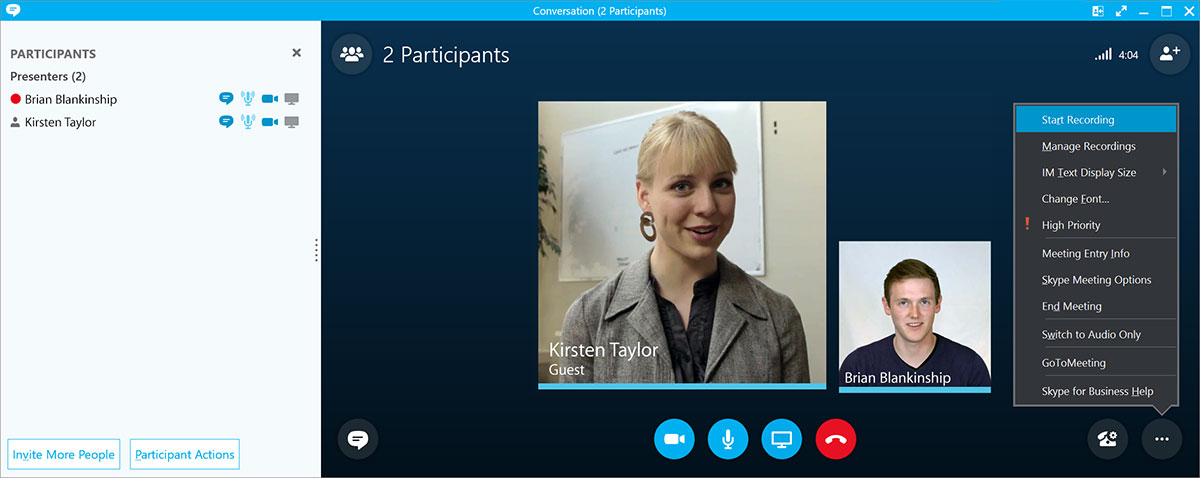
During this same period, businesses have become more interested in recording the content of their online meetings. As a result, vendors like Microsoft have implemented basic recording capabilities into their web conferencing products. The Skype for Business recorder captures the audio, video, and screen content of the online meeting, and then saves the recording to the user’s hard drive.

This is where Skype’s video capability ends, however, resulting in negligible real value to the organization. That’s because this approach doesn’t take into account the need to easily share the video or access its content in the future. Specifically:

  1. On the user’s hard drive, the video can’t be discovered or easily shared with co-workers.
  2. The video file isn’t formatted for efficient streaming across the corporate network.
  3. The content within the video can’t be searched, limiting its value as an on-demand reference.

Our new integration with Skype for Business picks up the ball where Microsoft left off.

First, it enables Skype users to automatically publish their recorded meetings to their Panopto personal folder. Setting up auto-publishing is as easy as clicking a checkbox within the Panopto for Windows Settings interface:

Skype for Business Settings - Panopto Video PlatformEnabling the Skype for Business integration is as easy as clicking a checkbox.

Once the setting is checked, any recordings initiated from Skype are automatically uploaded to Panopto and published to the user’s folder.

Skype for Business Recording - Panopto Video PlatformAfter the meeting owner initiates a Skype recording, the resulting video file is auto-uploaded to Panopto.

Second, once a recording is uploaded to Panopto, it’s transcoded into formats that are optimized for playback on desktops and laptops, tablets, smartphones, and audio-only devices. This transcoding process helps ensure that the recordings stream efficiently across corporate WANs and the internet, and that they play consistently on any device.

Finally, Panopto also indexes the recordings so that their content can be searched. Specifically, our unique Smart Search technology uses automatic speech recognition (ASR) to index words spoken during the meeting, and uses optical character recognition (OCR) to index words that appear on-screen during the recording. As a result, the meeting owner (or anyone they share the video with) can find and fast-forward to any word spoken or shown during the meeting.

Skype for Business Integration - Panopto Enterprise Video PlatformUsers can find and fast forward to any word spoken or shown on-screen in Skype for Business recordings.

By making online meetings automatically shareable, streamable, and searchable, your Skype for Business recordings instantly become a more valuable resource, filled with complete details on what was decided, why decisions were made, and what next steps were identified.

We see this automatic publishing workflow as the next logical step in preserving the value of online meetings — not just for Skype, but ultimately for other online meeting technologies as well.


Improved Captioning Flexibility and Playback

As video continues to become the preferred way that universities and businesses teach, train and communicate, the accessibility of video content management systems is an increasingly important purchase consideration.

Since our initial product release in 2008, accessible video management and playback has been a cornerstone of Panopto, with support for captioning, keyboard accessibility, screen readers, variable-speed playback, WCAG compliance, and more.

Building on these existing investments, today’s release introduces new ways to configure captions and view them on multiple devices:

  1. Administrators can specify the position of captions — either overlaid at the bottom of the video, or docked below the video.
  2. Caption size and color scheme can be configured, providing six additional options for on-screen caption readability.

Caption Settings - Panopto Video Content Management SystemEasily specify the colors, size, and position of captions.

By default, Panopto will dock the captions at the bottom of the Panopto interactive player. This ensures that the captions don’t cover up valuable on-screen content.

Captions - Panopto Video CMSThe default view of captions in Panopto.


Take Panopto for a Spin
If you’re interested in learning more about the latest Panopto update, or about how Panopto can help your organization use video for learning and communication, request a free trial of our video platform.

The post Skype for Business and More Flexible Captions appeared first on Panopto Video Platform.

10 Aug 08:56

Randstad to Acquire Monster

by Michael J. O'Brien

Randstad, a leading human resources services provider, and Monster Worldwide, Inc., a global leader in connecting jobs and people, today announced the signing of a definitive agreement under which Randstad will acquire Monster, according to this press release.

Under the terms of the merger agreement, Randstad will pay $3.40 per share in cash, or a total purchase price of approximately $429 million (enterprise value).

By leveraging Monster’s multiple distribution channels to bridge two different but complementary parts of the extended recruiting industry, Randstad intends to build the world’s most comprehensive portfolio of HR services. Monster will continue operating as a separate and independent entity under the Monster name.

“In an era of massive technological change, employers are challenged to identify better ways to source and engage talent,” said Jacques van den Broek, CEO of Randstad. “With its industry leading technology platform and easy to use digital, social and mobile solutions, Monster is a natural complement to Randstad. The transaction is aligned with our Tech and Touch growth strategy and reflects our commitment to bringing labor supply and demand closer together to better connect the right people to the right jobs. We look forward to welcoming the Monster team and working together to shape the evolving global job industry.”

Share on FacebookShare on Facebook

Tweet This!
27 Jul 09:28

Navigating through the confusion

by Catherine Sezen

Year 11 students who have been doing their GCSE exams, my own daughter included, are now enjoying a long summer holiday before embarking upon the next stage in their education and training.

What they might not realise is they are a historic group.  They are the last group to take GCSEs which will all be awarded a letter grade A*-G. In May and June next year, year 11 students will take new GCSEs in English language, English literature and maths, with a tougher syllabus and graded from 9 to 1. In the subsequent two years, all GCSEs will move over to the new grading system.

There are nine grades in the new system whereas currently there are eight, A* to G. In the new system, 9 is the highest grade that a student can achieve, 1 the lowest. The highest grades of A* and A (achieved by approximately 20% of students in any given subject) will be replaced by 7, 8 and 9, meaning that it will be easier to differentiate between the highest achievers. Grades B and C will also be replaced by three numbers, 4, 5 and 6. The gold standard grade C pass, recognised for many employment and higher education opportunities, will be a 5. However, a 5 is not exactly the same as a C; it is equivalent to a high C or lower grade B. Confused? It’s hardly surprising.

But it’s a fundamental change and understanding the changes is important. The move to numbers rather than letters is accompanied by changes to the content and exams.  The Government highlights that the content of the 9-1 GCSES will be more demanding. Modular assessment will not be available and there will be greater emphasis on end-of-course exams in the summer of year 11. Other types of assessment will only be used to test essential skills. For example, in the 9-1 GCSE English course there are no longer controlled assessments taken in class at intervals throughout the course and marked by the teacher. Instead there will be two final exams in place of the current one. GCSE English will include a wider range of texts and maths will have more difficult content. ‎ 

The Government believes that these more stretching GCSES will improve standards and boost achievement. For students in years 10 and 11 it could mean a more limited number of options as schools devote more hours to English and maths for example.

In the other home nations Wales and Northern Ireland are keeping the A*-G system and, of course, Scotland has nationals and highers. So what does all this mean for progression to college, university and ‎work?  First of all it must be remembered that in England from September 2017 students will receive results that include a mixed bag of numbers and letters for at least the following three years, so checking the entry requirements for a particular career, college or university is important, especially in English and maths.

For the first two years of the 9-1 GCSE results, 2017/18 and 2018/19, students who have not achieved a grade 4 in maths and English will need to retake these exams as part of their post-16 study programme at college or school.  In 2019 it is likely that this bar will be raised to include those who have not achieved a grade 5 in these subjects.

It remains to be seen whether standards will be raised as the Government hopes. It is clear that, while it is important that young people are tested, it isn’t fair to make it so complicated that they, their parents and employers cannot understand what the changes are and why. We shouldn’t be left in a situation where a student sitting an exam one year might achieve a good pass, but in another year would have failed to make this grade.  This only creates confusion for students about the value of the exams. Most importantly, with the new numbering system in England adding another layer of complexity, we all have a duty to make sure that young people are not demotivated when they should be inspired and encouraged to achieve to the best of their individual ability.

Catherine Sezen is the Policy Manager for 14-19 and Curriculum at the Association of Colleges.

26 Jul 11:29

New skills minister Robert Halfon hires his fourth apprentice

by Sophie Perry
TES are reporting that Robert Halfon, the new minister for apprenticeships and skills, has hired a new apprentice for his parliamentary office.… Read the rest
26 Jul 11:29

Yorkshire head warns teacher shortages could see school system implode

by Sophie Perry
I.gardner.gb

In other words the system needs change - less focus on teacher to student ratio, etc.

The Yorkshire Post is reporting that a leading headteachers has warned that the school system is in danger of imploding because of a lack of good teachers.… Read the rest
14 Jul 14:34

The pros and cons of moving universities to DfE

by Mark Leach

As universities are on the move from BIS to DfE, we weigh up the advantages and disadvantages of move for the higher education sector.

The post The pros and cons of moving universities to DfE appeared first on Wonkhe.

14 Jul 14:33

Universities move to the Department for Education

by Mark Leach

A new government is being appointed and universities are being moved to the Department for Education. Updates as we get them.

The post Universities move to the Department for Education appeared first on Wonkhe.

14 Jul 13:25

Gotta Catch 'Em All – 5 tips from Pokémon Go to create compulsive learning

by Seth Dickens
I.gardner.gb

Only matter of time until these types of articles started! ;-)

pokemon-go-blog-banner

14 Jul 12:17

The art of collaboration to provide a better service for UK higher education

by vix.reeve@jisc.ac.uk

As the UK higher education system goes through its biggest overhaul in 20 years, together with cost cutting targets becoming the norm, partnerships and collaborations are more important than ever before.

Earlier this year in March, the Higher Education Statistics Agency (HESA), Jisc and the Quality Assurance Agency (QAA) announced plans to collaborate and cost share through a new partnership known as the M5 Group.The process of collaboration between the three of us has been one of openness and looking at how we provide a better service for the sector.[#pullquote#]we’re thinking creatively and long term about how to achieve real savings through new ways of working[#endpullquote#]We’re not only looking at what we can do immediately to ensure the group works as efficiently as possible, but we’re thinking creatively and long term about how to achieve real savings through new ways of working.Better serviceWe are all constantly looking for ways to keep subscriptions as low as possible as funding arrangements change, and through our partnership we’re identifying ways of creating better services for our members.Common systemsThroughout our discussion at the early part of this year it was really clear we have very distinct and different strengths and offers. So whilst we are continuing to operate as separate and independent organisations we have identified a variety of common systems that, if brought together, could generate efficiencies in both cost and workflow.[#pullquote#]it is really clear we have very distinct and different strengths and offers[#endpullquote#]We have been exploring the feasibility of a number of options and have identified priorities that can achieve both savings and efficiencies. The first step is to look at our IT and infrastructure, and over the next two years we’re ambitiously looking at a potential £0.5-1million in efficiency savings.For example, we are moving to a common cloud-based customer relationship management platform, whereby we share the cost of licences, implementation and administration – that doesn’t mean we’re sharing membership data, but negotiating savings and collaborative working arrangements where it is sensible to do so.Ways of workingIn the longer term we’re exploring the use of the office space we have across the M5 Group in the south west in Bristol, Cheltenham and Gloucester, as well as across the rest of the country. We are also looking at where it might make sense for smaller offices, like those in London, to share space too.[#pullquote#]In the longer term we’re exploring the use of the office space we have across the M5 Group [#endpullquote#]Jisc and QAA are exploring a joint London location as the lease of QAA’s London office will expire next year, and HESA already makes use of Jisc desk and office space in London. All our teams are used to flexible working, moving between locations and working from home. So we’re exploring how we can all be part of the eduroam network which means our teams can move easily between locations and are able to connect wherever they are.Playing to our strengths and expertiseRecognising each organisation's strengths and areas of expertise, we’re delighted, therefore, to be putting our collaboration on a legal footing with a memorandum of understanding. This work is just beginning and has much potential with more to come.
14 Jul 12:17

Justine Greening announced as new education secretary replacing Nicky Morgan

by Sophie Perry
FE week is reporting that Justine Greening is the new secretary of state for education, replacing Nicky Morgan who has served in the role for two years.… Read the rest
12 Jul 15:15

Millennials not as keen on the gig economy as you might think, claims study

by Mark Eltringham

MillennialsThe supposed confluence of two of the most currently talked about workplace phenomena may not be all it seems, according to a new report from PwC. It appears that Millennials may not be all that keen on the gig economy after all, and might prefer some of the things that previous generations enjoyed such as stability, security and an ability to plan their lives with at least some degree of certainty. They are realists however, and understand that the use of freelance work will continue to grow over the next few years. Indeed, the report suggests that it is older workers who – perhaps unsurprisingly – are more keen on freelance work. According to the study based on 1,385 respondents in the US, overall 41 percent of employees expect to be employed on a contract basis within the next year, even though over  a third  (39 percent) don’t like the income uncertainty, and over half (53 percent) expect to be fully self employed within the next five years.

CaptureWhile 86 percent of respondents at least somewhat agree that they have ‘a strong desire to work independently’, of the over 50s surveyed, around two-thirds (65 percent) say they’d prefer to work as independent contractors, presumably on the basis that they have established careers and a degree of financial security. This is roughly twice the proportion of the 18-34s.

The bonds that tie people to employers work both ways of course, and the report confirms that younger people are also less likely to be committed to their employers. While over half (55 percent) of the over 50s claim to be in a ‘committed partnership’ with their employers, only a third of younger  workers say the same.

Overall, workers seem to be happy in their jobs with 60 percent rating their degree of satisfaction between 8 and 10 on a 10 point scale. There are issues however, with only a third of workers believing they have achieved what they would like in terms of work-life balance and a similar proportion agreeing with the statement that their opinions count at work. The report also suggests a correlation between autonomy and job satisfaction with those able to enjoy flexible working nearly half as likely to rate their work as a ten on the job satisfaction scale.

The post Millennials not as keen on the gig economy as you might think, claims study appeared first on Workplace Insight.

11 Jul 08:49

It’s Take Your Dog to Work Day!

by Michael J. O'Brien

Today marks the 18th annual celebration of Take Your Dog To Work Day and, fittingly enough, a new survey sheds (pun clearly intended) some light on the topic to show the benefits reaped by organizations that allow their workers to bring their four-footed friends into the workplace.

Of course, it may seem like a shaggy-dog story to some skeptics (I’m looking at you, cat owners) that bringing your dog to work actually does produce positive workplace effects. But according to this research from Randolph Barker (no joke!), a professor of management at Virginia Commonwealth University:

“Dogs in the workplace can make a positive difference,” he said. “The differences in perceived stress between days the dog was present [at an office participating in a study] and absent were significant. The employees as a whole had higher job satisfaction than industry norms.”

From the looks of a recent poll, organizations are (slowly) warming to the idea of pet-friendly workplaces: A 2015 Society for Human Resource Management survey found that 8 percent of American workplaces allow employees to bring their furry friends to work, up from 5 percent in 2013.

(And while it may be too late this year, here’s a link to obtain a toolkit to help you set up the event for next year.)


Share on FacebookShare on Facebook

Twitter It!
11 Jul 08:20

The other NHS crisis: the overworked nurses who are leaving in despair

by Sarah Whitehead

The junior doctors’ dispute may be nearly over, but another crisis is brewing in the nursing profession, where staff shortages, a lack of recruitment and funding cuts have left many feeling they cannot carry on in the job they love

Related: Our grassroots campaign is fighting NHS bursary cuts

At what point is a qualified nurse – who entered the NHS expecting long hours and low pay – pushed so far that they can no longer carry on? For Stacey, a 27-year-old nurse from Liverpool, it was when she had become so broken that she felt she had lost every one of the “five Cs” that are instilled in nurses during their training: commitment, conscience, competence, compassion, and confidence.

Related: NHS nurse shortages 'to last another four years'

Related: Major hospital incidents becoming year-round occurrence, nurses warn

Related: The future of nursing: bursaries versus loans

Continue reading...
23 Jun 14:05

What makes a good leader in today's NHS?

by Sarah Johnson

In a climate where many NHS staff are demoralised and the service is facing unprecedented demand, how do leaders meet challenges?

Good leadership is often credited with being able to save the NHS. For individuals willing to take on leadership roles, the rewards can be great. However, with a general feeling of demoralisation in the workforce and services facing unprecedented demand, the challenges are even greater.

Marcus Powell, director of leadership and organisational development at The King’s Fund, recognises that leaders get “buffeted in all sorts of situations” and that they must have the ability to absorb problems and make sure their team feels safe.

Related: Developing individual leaders is not enough to save the NHS

Related: The NHS is moving backwards on race equality

Continue reading...
23 Jun 13:22

Exploring the capabilities of xAPI

by Haitham Gasim

Haitham Gasim, the Kineo US Director of Technology has been on a quest to dig deeper into xAPI and thinking about how Kineo can implement xAPI in order to better serve our clients.