I.gardner.gb
Shared posts
Talent Development in the Post-Knowledge World
Microsoft is Bringing Skype Translator to Calls to Mobiles and Landlines

Microsoft recently announced that it is taking the final steps towards broader availability of its amazing Skype Translator capabilities.
The post Microsoft is Bringing Skype Translator to Calls to Mobiles and Landlines appeared first on Thurrott.com.
How I Use Microsoft OneNote

Following up on last week's OneNote posts, I thought I'd open up my own notebooks and explain how I use this product every day.
The post How I Use Microsoft OneNote appeared first on Thurrott.com.
Technical and Relational Skills in Project Management

Last month I went along to a TwentyEighty Strategy Execution event in London on The Six Relational Skills that Define Successful Project/Programme Leaders. More on what those skills are later in the week but for now there were some interesting insights into the current thinking about how comfortable we’re getting with the technical skills – and not putting enough emphasis on the relational skills.
So a quick look at the differences:
At its simplest – technical skills in project management are those things like methods, frameworks, plans, risk logs, PIDs and so on. The actual techniques we use to create a work breakdown structure or pull together a change log etc.
The relational side of project management are the more people based things – how we work with others – lead a team, communicate with stakeholders, negotiate with clients, manage a conflict with a supplier and so on. Also known as behavioural or soft skills.
I think we all know that project practitioners today don’t spend as much time on developing the relational side of their roles as they do on the technical side – however that has started to change – especially with the increase in interest around ‘leadership in project management’.
It’s also started to change because projects and programmes have started to change – in some cases because of complexity or risk – in other cases because of the products or services being produced (“internet of thing”, digitisation etc) and because people working on projects want to try different ways of working (agile, lean etc).
There’s another reason too – project managers are becoming more interested in the bigger picture of projects and programmes in their businesses and how they link to the strategies of the organisation (portfolio management, prioritisation, benefits realisation etc). PMI’s new talent triangle features business management as a development angle.
If we look at the extent of a project manager’s world today – we can see that different skills, styles, approaches, goals and achievements – extend further than just the job specific competencies with technical and relational skills required within a business context too.

In the session, the audience – all experienced project management practitioners – were asked to think about the differences between these technical and relational skills.
One way to think about it is the split in the project management role, for example:
When we think about these splits – as practitioners we tend to like the comfort zone of using technical skills in planning and execution – these are the easier to learn and after time, with experience, become easier to manage. Of course we use relational skills in our everyday work but we don’t tend to gain depth in our education around them – or take time to try out new relational skills.
The conclusion in this part of the session is that a ‘leadership gap’ is opening up – there aren’t enough good leaders to go around – or those coming up through the ranks of project management who will carry out the more strategic roles in project management tomorrow.

Another point made in the session was about the increasing complexity of projects – purely from a stakeholder point of view – with the number of communication channels project managers have to maintain – and in a lot of cases – building great relationships too.
The simple equation below shows just how many communication channels there are as the number of stakeholders (N) increase.
It brings it home just how important communication is – and how project managers have to address this problem.

Looking at the wider project environment – at an organisation level, the diagram below was shared to show the technical skills used to actually do the work better with areas like a common way of working with a methodology, focusing on hitting the goals of delivering on time and on budget consistently.
On the other side, the organisation also needs to provide the right kind of culture and environment for people to do the best job they can. That could mean focusing on improving motivation in the workforce – which then has a knock on effect of increases in the number of successful projects and programmes.
It’s interesting to see that relational skills in project managers are not just down to the project manager, it is also the organisation which has a role to play in providing an environment which recognises and uses these relational skills to do better business. Perhaps if organisations could see how good relational skills make a difference to their day-to-day business or the bottom line, perhaps we might start seeing more investment into these skills in the first place.
On Thursday’s post we’ll look at the Six Relational Skills that Define Successful Project/Programme Leaders – which might not necessarily be what you think they are.

RISC and iSpring Announce First Top-to-Bottom cmi5-Compliant Solution by News Editor

RISC and iSpring Solutions have announced the first commercially available combination of an authoring tool and an LMS that is compatible with the brand-new cmi5 eLearning standard.
IBM, Pearson and the Cognitive Infrastructure of Education
The world’s largest edu-business, Pearson, partnered with one of the world’s largest computing companies, IBM, at the end of October 2016 to develop new approaches to education in the “cognitive era.” Their partnership was anticipated earlier in the year when both organizations produced reports about the future trajectories of cognitive computing and artificial intelligence for personalizing learning. I wrote a piece highlighting the key claims of both at the time, and have previously published some articles tracing both Pearson’s interests in big data and IBM’s development of cognitive systems for learning. The announcement of their partnership is the next step in their efforts to install new machine intelligences and cognitive systems into educational institutions and processes.
At first sight, it might seem surprising that IBM and Pearson have partnered together. Their reports would suggest they were competing to produce a new educational market for artificially intelligent or cognitive systems applications. Pearson, however, has had a bad couple of years, with falling revenue and a major organizational restructure in 2016, which appears to have resulted in the closure of its own in-house Center for Digital Data, Analytics and Adaptive Learning. IBM, meanwhile, has been marketing its cognitive computing systems furiously for use in business, government, healthcare, education, and other sectors. The key to the partnership is that, despite its business troubles, Pearson retains massive penetration into schools and colleges through its digital courseware, while IBM has spent years developing and refining its cognitive systems.
The Pearson-IBM partnership also taps into current enthusiasm and interest in new forms of machine-based intelligence. This is reflected in the new Leverhulme Centre for Future Intelligences at the University of Cambridge, a White House report on preparing the future of artificial intelligence, and a Partnership on AI established by Facebook, Amazon, Google, IBM and Microsoft.
Together, these developments point to a growing concern with forms of machine intelligence that are sometimes described as “weak” or “narrow” forms of AI. Weak or narrow AI includes techniques such as cognitive computing, deep learning, genetic algorithms, machine learning, and other automated, algorithmic processes, rather than “strong” or “general” models of AI which assume computers might become autonomous super intelligences.
So, what is education likely to look like if the glossy imaginary projected by Pearson and IBM of learning in the cognitive era materializes in the future?
Learning Machines
The key technology underpinning their ambitions is Watson, IBM’s highly-publicized cognitive supercomputing system. The IBM webpages describe Watson as “a cognitive technology that can think like a human.” Watson is able to analyze and interpret data, including unstructured text, images, audio and video. It can “reason” and “provide personalized recommendations by understanding a user’s personality, tone, and emotion.” Watson can also “learn,” utilizing machine learning to “grow subject matter expertise,” and “interact” through “chat bots that can engage in dialog.”
Though IBM has been promoting cognitive computing in education for a few years — in 2013, it produced a glossy visualization of the classroom in five years time, a “classroom that will learn you” — it is now firmly seeking to establish Watson in the educational landscape. IBM Watson Education “is bringing education into the cognitive era” through “personalization”:
Cognitive solutions that understand, reason and learn help educators gain insights into learning styles, preferences, and aptitude of every student. The results are holistic learning paths, for every learner, through their lifelong learning journey.
One of the key applications IBM has developed is a data-based performance tracking tool, IBM Watson Element for Educators:
Watson Element is designed to transform the classroom by providing critical insights about each student — demographics, strengths, challenges, optimal learning styles, and more — which the educator can use to create targeted instructional plans, in real-time.
Designed for use on an iPad so it can be employed directly in the classroom, Element can capture conventional performance information and student interests and other contextual information, which it can feed into detailed student profiles. It can also track whole classes, and automatically generates alerts and notifications if any students are off-track and need further intervention.
Another complementary application is IBM Watson Enlight for Educators, designed to:
support teachers with curated, personalized learning content and activities aligned with each student’s needs. … Teachers can optimize their time and impact throughout the year using actionable, on-demand insights about their students … [and] craft targeted learning experiences on-the-fly from content they trust.
The partnership with Pearson will allow Watson to penetrate into educational institutions at huge scale, thanks to the massive reach of Pearson’s courseware products. Pearson’s press release stated it would “make Watson’s cognitive capabilities available to millions of college students and professors”:
Pearson and IBM are innovating with Watson APIs, education-specific diagnostics and remediation capabilities. Watson will be able to search through an expanded set of education resources to retrieve relevant information to answer student questions, show how the new knowledge they gain relates to their own existing knowledge and, finally, ask them questions to check their understanding.
Strikingly, it proposes that Watson will act as a:
flexible virtual tutor that college students can access when they need it. With the combination of Watson and Pearson, students will be able to get the specific help they need in real time, ask questions and be able to recognize areas in which they still need help from an instructor.
The IBM press release added that Watson would be “embedded in the Pearson courseware”:
Watson has already read the Pearson courseware content and is ready to spot patterns and generate insights. Serving as a digital resource, Watson will assess the student’s responses to guide them with hints, feedback, explanations and help identify common misconceptions, working with the student at their pace to help them master the topic.
What Watson will do, then, is commit the entirety of Pearson’s content to its computer memory, and then, by constantly monitoring each individual student, cognitively calculate the precise content or structure of a learning experience that would best suit or support that individual.
The partnership is ultimately the material operationalization of a shared imaginary of machine intelligences in education that both IBM and Pearson have been projecting for some time. But, this imaginary is slowly moving out of the institutional enclosures of these organizations to become more widely perceived as desirable and attainable in the future.
Cognitive Enhancement Technologies
Caution is clearly required about the extent to which the technology will live up to its futuristic hype. As educational technology critic Audrey Watters has argued, “the best way to predict the future is to issue a press release.” IBM and Pearson are both marketing their vision of the cognitive future of education because their businesses depend on it. For them, it’s necessary to suggest that people today are at a cognitive deficit when faced with the complexities of the technologized era, so they can sell products offering cognitive enhancement.
The promise of cognitive computing for IBM, as stated in its white paper “Computing, cognition and the future of knowing,” is a fundamental reimagining of the “next generation of human cognition, in which we think and reason in new and powerful ways”:
It’s true that cognitive systems are machines that are inspired by the human brain. But it’s also true that these machines will inspire the human brain, increase our capacity for reason and rewire the ways in which we learn.
These extraordinary claims put companies like IBM and Pearson in the cognitive enhancement business. They have positioned themselves at the vanguard of the generation of hybrid “more-than- human” cognition, learning and thinking.
Clearly there may be consequences of the development of cognitive enhancement technologies and machine intelligences in education. They could ultimately become responsible for establishing the educational pathways and progress of millions of students. They could “learn” some bad habits, like Microsoft’s infamous AI chatbot. They could be found to discriminate against certain groups of students, and reinforce and reproduce existing social inequalities. Privacy and data protection is an obvious issue as all the intimate details of individual students are ingested and stored on the IBM cloud.
Access to these technologies won’t be cheap for institutions either. This could lead to competitive cognitive advantage as new forms of hybrid cognitive capital become available for students at institutions that invest in these cognitive systems. Given that Pearson’s own global databank of country performance, the Learning Curve, compares education systems according to students’ “cognitive skills,” measuring national cognitive capital as a comparative advantage in the “global race” could also become attractive to government agencies.
In this final sense, IBM and Pearson also anticipate the development of real-time adaptive forms of governance in education. Both Pearson and IBM are trying to bypass the cumbersome bureaucratic systems of testing and assessment by creating real-time analytics that perform constant diagnostics and adaptive, personalized intervention on the individual. Pearson’s previous report on AI in education spells this out clearly:
Once we put the tools of AIEd in place … we will have new and powerful ways to measure system level achievement. … AIEd will be able to provide analysis about teaching and learning at every level, whether that is a particular subject, class, college, district, or country. This will mean that evidence about country performance will be available from AIEd analysis, calling into question the need for international testing.
Although the current partnership with IBM may be focused on college students, this is just part of a serious aspiration to govern the entire infrastructure of education systems through real-time analytics and machine intelligences, rather than through the infrastructure of test-based accountability that currently dominates. As Adrian Mackenzie argues, “cognitive infrastructures” such as Watson “present problems of seeing, hearing, checking and comparing as no longer the province of human operators, experts, professionals or workers … but as challenges set for an often almost Cyclopean cognition to reorganise and optimise.” IBM and Pearson are seeking to sink a cognitive infrastructure of accountability into the background of education — an automated, data-driven, decision-making system which is intended to measure, compare, reorganize and optimize whole systems, institutions and individuals alike.
Banner image credit: Atomic Taco
The post IBM, Pearson and the Cognitive Infrastructure of Education appeared first on DML Central.
A Framework for Driving Digital Transformation

Connecting Knowledge Communities: Approaches to Professional Development
Conrad Taylor writes:
The September 2016 meeting of NetIKX was introduced by David Penfold. He explained that at this time in 2015, the NetIKX meeting about ‘connecting communities’ had heard from various organisations in the knowledge and information management space. This year, the decision to focus the meeting on training and development had been partly influenced by a plea at an ISKO UK meeting for more thinking about these topics.
All our speakers had interpreted the meeting topic as being about Continuous Professional Development (CPD). There were two presentations, followed in the usual NetIKX pattern by discussion in table groups. The first presentation was given by Luke Stevens-Burt, who is Head of Business Development (Member Services) at the Chartered Institute of Library and Information Professionals.
CILIP’s Professional Knowledge and Skills Base
Luke explained that CILIP accredits degree programmes at universities, and registers and certifies members though chartership and fellowship, but that their main support for the development of its members is delivered through CPD, which he defined as ‘intentionally developing the knowledge, skills and personal knowledge needed to perform professional responsibilities’. In the past, CPD had been conceptualised as a formal training process, but there has been a shift towards understanding informal experiences and exposure to ideas as being as important, if not more so.
As a person’s work experience develops, and the world of work changes, CPD helps to bolster adaptability. The resources available for learning are diversifying, including MOOCs, journals, seminars and conferences and meetings, even informal conversations over coffee.
Central to CILIP’s support for CPD is something they call the ‘PKSB’, which stands for Professional Knowledge and Skills Base. The conceptual diagram for this – rather difficult to read because of unfortunate low-contrast colour choices – Luke called the ‘wagon wheel’. At the hub, the diagram places ‘Ethics and Values’. Radiating from this are eight spokes representing aspects of Professional Expertise, and four more spokes represent Generic Skills. Around these the diagram portrays a ‘rim’ representing the wider context of the library, information and knowledge sector, and finally an outer ‘tyre’ of an even wider context, to do with the employing organisation and its environment.
The eight headings for ‘Professional Expertise’ are: organising knowledge and information; knowledge and information management; exploiting knowledge and information; research skills; information governance and compliance; records management and archiving; collection management and development; and so-called ‘literacies’ and learning.
The more generic skillsets, which can be found in many professions, were identified as use of computers and communication, leadership and advocacy, strategic planning, and a sundry collection around customer service design and marketing.
A system for self-assessment
Fundamentally, it seems, the PKSB toolkit is a system, using which a person can make a self-assessment of their level of understanding or skill in each of these areas (and subsidiary sets under these, totalling about a hundred in all), based on a ranking between zero for ‘no understanding’ and four for the highest level of expertise.
In using the PKSB, CILIP members are supposed to define what level they are at in each skill area that’s relevant to their current job, and what level they would ideally like to attain, and add an explanatory comment. For example, a person might decide that they only score a basic ‘1’ at using classification schemes and taxonomies, but would like to make progress towards level ‘2’. An alternative use of PKSB could be for career planning, related not to your current job, but to one into which you would like to progress, which might require an upgrading of skills.
Apparently, this PKSB system is used by CILIP in deciding whether to register someone as a member, for example as a chartered member. In this case, the self-assessment is only one step, because one must also submit a portfolio, explaining how you have gained your skills, and this will go before an Assessor.
Thereafter, the PKSB is purely a self-assessment tool so that members can monitor their progress and design a CPD path for themselves. It is for use by CILIP members only, though it is also used as the framework for deciding whether university courses meet the standard at which they can be accredited by CILIP.
Until mid 2016, CILIP members used the PKSB by printing out a set of forms and maintaining them manually. The recent developments do not fundamentally change the system, but make it available as an online interactive system with an app-like interface, usable from a computer, tablet or smartphone. Much of the rest of Luke’s presentation consisted of a live demonstration of the online PKSB interface and facilities, for example showing how it can generate summary reports.
Finally, Luke touched briefly on the resources CILIP can directly provide to support professional development. Within CILIP there are a number of member networks. Some are regionally based, and some are special interest groups – such as the School Libraries Group, the Multimedia Information & Technology group, and the UK eInformation Group (UKeIG). CILIP also plans to launch a new SIG in January 2017 for knowledge and information management, as a revamp of the existing Information Services Group (it will be interesting to see whether this new body will be prepared to collaborate with others in the field, such as NetIKX, ISKO, etc).
CILIP also maintains a Virtual Learning Environment, with online modular courses, about which it would have been nice to hear more; and publishes a members’ magazine (Update), e-bulletins, and various journals, some of which are in print form and some online.
CPD in Government
The second presentation was given by Christopher Reeves and Karen Thwaites, who both work for the Department for Education – Christopher on the records management side, and Karen as a knowledge and information manager with a training role. Additionally, Christopher is on the working group for the Government Knowledge and Information Management (GKIM) Skills Framework, which was the topic of their talk.
The Knowledge and Information Management (KIM) profession has been recognised by the UK government only since the turn of the century, though there have been many jobs in the civil service with aspects of KIM within them, such as librarians and managers of information rights, and records managers. Karen displayed an ‘onion diagram’ showing a core set of KIM roles, surrounded by allied roles such as specialists in geospatial information or data scientists, and an outer rim of allied professions.
The Civil Service Reform Plan, published in June 2012, stated that civil servants should operate as ‘digital by default’, with a set of skills transferrable between the public and private sector. People with KIM roles have become more prominent lately; in the field of records management, the Hillsborough Enquiry played a role in raising a more general level of awareness, as has the current independent enquiry into child sexual abuse.
The GKIM Framework working group
A working group for the GKIM Skills Framework was announced in 2015 by Stephen Mathern as Head of Profession, and gathered under the chairmanship of David Elder to review an existing Framework and propose revisions. The volunteer participants in the group, which included Christopher, represented a range of grades and a variety of KIM roles, across a broad spectrum of departments. The new Framework was launched at a conference in 2016.
The process started with a survey of KIM colleagues, via the departmental Heads of Profession. The results indicated that the existing Framework was seen as too rigid, not user-friendly, with complex language and jargon, and not accessible.
Putting together a plan of action, the working group resolved that the replacement Framework should be flexible, able to fit the profession as it evolves. However, the three main skill areas were retained as definitions: these are (a) abilities to use, evaluate and exploit knowledge and information; (b) abilities to acquire, manage and organise knowledge and information; and (c) information governance skills.
The group resolved to define a ‘foundation level’ for KIM skills, appropriate for juniors, and those outside the profession itself who nevertheless need better information and knowledge handling skills. Because people need to be able to benchmark their skills and performance, a self-assessment tool was recommended (showing parallels with what CILIP have done with their PKSB). Finally, the working group was asked to gather examples of good practice and competency within KIM roles.
Six core KIM-professional roles were identified as existing in all departments (and Christopher returned to the ‘onion diagram’ to display these) – they were, the Information Managers, Records Managers, Information Rights Officers, Knowledge Managers, Information Architects and Librarians. The working group members divided up responsibility for gathering examples of good practice for each of these roles, at all levels.
The draft Framework proposals were then circulated to the departmental Heads of Profession and widely consulted on in other ways, and the working group asked for opinions about whether they had managed to meet the needs expressed by the previous survey. The feedback was overwhelmingly positive, but did lead to some minor amendments being made.
GKIM launch and implementation
The new GKIM Framework was officially launched at the 2016 GKIM Conference. The launch was actively promoted to the departmental Heads of Profession, and Civil Service Learning weighed in by enabling a Web presence for the GKIM materials. (It later emerged in discussion that the Framework documentation consists of one over-arching document, and there are add-ons with more detail about each of the core KIM professions identified.)
Karen closed the presentation with a brief look at the Department for Education as a case study. Within the DfE, senior KIM professionals now have a good awareness of the Framework and its supporting documentation, and are committed to rolling it out to departmental colleagues.
The profile of KIM will be promoted through a ‘KIM Learning Month’ (March 2017), and a stand at the DfE departmental ‘fair’ event in October 2016. The KIM strategy will also be linked to DFE’s performance management objectives, and the Permanent Secretary’s Transformation Programme, within which knowledge management has a critical role to play.
Q&A about GKIM
There were questions asked about whether the slide-set would be available for NetIKX members to peruse later (yes, they will be posted in the Members’ Area), also how accessible the GKIM Framework documents were . The answer to this was that the Framework can be downloaded from http://www.cilip.org.uk/government-information-group/working-government/gkim-skills-framework. David Penfold reported that the July/August 2016 issue of CILIP Update includes an interview with David Elder about the GKIM Skills Framework.
Table group discussions
I confess that my memory of the table group discussions at this meeting are a bit vague. A flip chart was available during the tea break, on which people could write suggestions for discussion questions, and four were written up, though I cannot remember them in detail, even though I contributed one! The arrangement whereby one question was assigned to each of four table groups was not to my liking: I thought several questions were worth talking about, and the division seemed artificial.
One of the table groups looked at how KIM skills should feature in everyone’s development, not just that of ‘information professionals’ – at least, at the level of promoting a core awareness of the issues. An example might be that everyone should have an awareness about information governance.
The point was made that the language around ‘knowledge’ and ‘skillsets’ is too limiting. You could pick up knowledge and maybe skills by attending some workshops and getting a CPD certificate; but organisations need employees to have appropriate behaviours and values around information and knowledge. I suppose examples could be things like habitually paying attention to information security, or sharing knowledge appropriately with other sections rather than hoarding it.
One of the tables (where I was) had explored a number of topics and not limited to professional development, but looking also at general intellectual development in society at large. There had already been mention of basic skills around information and knowledge, and we considered extended definitions of ‘literacy’, such as ‘information literacy’, and in particular the ability to evaluate information sources as to accuracy, relevance and trustworthiness. 2016 seems to have brought some very low points for poor quality and misleading information, in politics and the media particularly. I personally would like to see more critical thinking taught even in childhood.
There was discussion about how some people need only perhaps a basic ‘awareness’ of KIM issues, plus maybe knowledge about whom to approach for further help. Christopher said that at the foundation level of the GKIM Framework, they do talk about ‘Information Awareness’.
With the government moving in the direction of putting pressure on businesses to take on apprentices, it may be apposite to think about what a KIM apprenticeship might look like, perhaps along the lines of the ‘management apprenticeship’ scheme being developed by the Chartered Management Institute.
[Apologies to Conrad and to all readers for the delay in uploading this report.]


Articulate 360: What Does the New Subscription Model Mean for You?
Articulate Storyline users have been anxiously anticipating the release of Storyline 3. For many months, Articulate has been previewing some of the features, such as the new responsive player. Well, the release came on Wednesday, and it wasn’t Storyline 3 but rather Articulate 360. It’s not just an update to the software, but a complete change to their business model and how you might purchase Storyline moving forward.
How does the subscription work?
With Storyline 2, you paid about $1,399 for the software, and you could use it for as long as you wanted. Called a “perpetual license,” you could still be using the same license five years later. Under that model, when a new version came out, you would have chosen whether or not you wanted to buy the new version or keep using your existing license.
With the new Articulate 360 subscription model, you pay $999 (discounted to $599 if you are already a Storyline or Studio user) for the rights to use everything for a year. Then if you want to keep using it, you would pay another $999 to use it for that year. While your subscription is active, you would be eligible for any updates that Articulate puts out. (And they are hinting that they’ll be rolling out new versions with new features more regularly, instead of waiting several years and doing a big upgrade with lots of features at once.)
If you stop paying your yearly subscription fee, you can no longer access Storyline or the other items in the subscription. You can still use any content you created with them, but you won’t be able to edit that content or create anything new.
So is this a better model for you? It depends. I wrote a blog post a few years ago about the pros and cons of Captivate’s subscription model. Many of those arguments are valid here as well.
One thing that’s very different about the Articulate 360 subscription over the Captivate subscription is that you get more than just the core e-learning authoring tool. Which brings us to the next question…
What else comes with the Articulate 360 subscription?
In short, a lot! In addition to Storyline 360, you get:
Studio 360: Studio is Articulate’s other authoring tool that is template based and very easy to use. However, it is not as robust as Storyline.
Content library: My guess is that a lot of people will want the subscription just for this. Storyline 2 comes with about 25 or so illustrated characters and 1 photo character (with the option for a few more). This new content library comes with many more character options in a library that lets you filter by graphic style, dress style, and age. The library also includes some very professional-looking templates organized into design themes that can help you create a cohesive course (as opposed to individual templates that may or may not work together). These content assets can save development teams a lot of time and money.
Replay: This is a simple application that lets you record your webcam and what you are doing on your desktop at the same time. Then you can publish a movie that switches back and forth between the two or uses picture-in-picture.
Rise: This is a new cloud-based authoring tool that creates fully responsive courses. Storyline 360 has a responsive player, but the slides themselves don’t change based on device size or orientation. With Rise, the whole slide changes. It’s template based, meaning it is easy to use, but doesn’t have the kind of full design control you have with Storyline.
Preso: Preso is an iPad app that lets you create narrated, annotated presentations. For example, you can load slides or other visuals, record what you are saying about them, and make annotations on the screen such as circling part of a diagram with your stylus. All of that gets recorded into a movie.
Peek: This application lets you record quick screencasts on a PC or a Mac.
Articulate Review: This service lets you load your courses online for stakeholder review. Your review team can access the courses and add their feedback.
Articulate Live: Subscribers will have access to live online training. There’s very little information on their website about this offering, so we’ll all have to stay tuned to learn more.
So what if you don’t need all of these tools? Well, that’s one of the challenges of a subscription package–it’s an all or nothing deal. If you want all of these things, then it’s a great bargain. If you aren’t likely to use these other tools, then you might wonder if you are overpaying. At this point, there is not an option to buy any of the elements individually.
Are the improvements to Storyline worth the update?
If you primarily care about Storyline and not all of the extra tools, is it worth switching? The major improvements to Storyline 360 are for the HTML5 output. There are a lot of behind-the-scenes changes that make courses work better in HTML5, there’s a responsive player that is easier to use on touch-screen devices, especially phones, and the accessibility features (Section 508 and WCAG 2.0) now work in the HTML5 output. So if you are going mobile, these improvements are a big plus. But even if you aren’t going mobile, these are still good enhancements. More and more nails are going into Flash’s coffin every month it seems, and Flash content will quickly become problematic in many desktop environments. So it’s good to know that Articulate content is poised to be ready for an HTML5-only world.
There are a handful of other “nice-to-have” features, such as a dial (similar to a slider, but round), new trigger events (such as when objects intersect), and a few others. I like many of these features, but I wouldn’t call any of them significant enough to be worth the update. The main business case for updating is the HTML5/mobile enhancements and the extra elements you get with the subscription.
Is Storyline 360 backwards compatible?
Nope. You can open/import Storyline 2 content into 360, but you can’t open/import 360 content into SL2. This is fairly standard for e-learning software.
Can you still buy new Storyline 2 licenses? Will there ever be a Storyline 3?
Yes and yes. And I quote from Articulate Sales Support: “No worries. Our perpetual software isn’t going anywhere. We’ll continuing selling it alongside 360. It’ll just be a little behind feature-wise.”
If you are not interested in the new subscription model for whatever reason, you can still buy a Storyline 2 license. Perhaps you are on a large team who is on Storyline 2 and you don’t have the funds until next fiscal year to upgrade. But now you have a new person on the team. You can’t put her on a new 360 license because her work would then be incompatible with everyone else’s. Instead, she can get a Storyline 2 license. Eventually, Articulate will come out with a Storyline 3 using the perpetual license, and it will have the features found today in 360. But it’s likely to be several months before that happens.
Will E-Learning Uncovered be publishing a Storyline 360 book?
I’m SURE this is the most burning question on your mind, and the answer is YES! The target release date is December 15.
What do you think?
We’re curious to hear what you have to say. What are your thoughts on the new Articulate 360 subscription model?
The post Articulate 360: What Does the New Subscription Model Mean for You? appeared first on E-Learning Uncovered.
Influential think tank calls for college-only route to replace the level 2 apprenticeship
Left-wing think tank IPPR wants the government to phase out level two apprenticeships for 16-18 year olds, and replace them with a programme only offered by colleges.
Entitled ‘Earning & Learning – Making the Apprenticeship System work for 16-18 year olds’, its new report warned youth unemployment is being fuelled by “too many” 16–18 year olds studying level two courses that do not help them progress through vocational education or into work.
Authors Joe Dromey, senior research fellow on work, skills and family at IPPR (pictured above), Jonathan Clifton, who left the IPPR to become Head of Strategic Policy at Department for Education after drafting the report and Charlynne Pullen, now head of workforce data at The Education and Training Foundation, instead proposed that level two apprenticeships should be replaced by “a distinct pre-apprenticeship programme”.
This, they added, should “only be offered by FE colleges, or training providers which are run on a not-for-profit basis”.
The report said that level two apprenticeships “are often very job specific, they do not include much off-the-job training, they only last one year, and – from next year – they will not be required to include a recognised qualification”.
The authors added: “Young people who leave full-time education with a level two qualification have an employment rate of 70 per cent – which is almost 20 percentage points lower than those who leave full-time education with a level three qualification or higher education.”
In addition, they said, wage returns for level two qualifications are low, and relatively few of these learners progress to level three – only 39 per cent of those on one year level two courses.
In contrast to the current system, IPPR said, pre-apprenticeships would be “explicitly designed to help young people move onto a full level three apprenticeship at age 18 or 19”.
The proposed scheme would differ from the current system in a number of ways, including “more ‘off the job’ training”, “more general education (including English and maths)”, and a final “transferable qualification” at its outcome.
The report also suggested “employers do not want to hire young apprentices” and therefore should be subsidised for taking on a young person on a pre-apprenticeship – for example by being “allowed to use their levy payment” to cover the wages.
In response to the report, David Hughes, chief executive of the Association of Colleges, said: “The AoC has been calling for the introduction of a pre-apprenticeship offer for some time, so it’s good to see other organisations pushing for the same idea.
“All FE colleges provide apprenticeships and are keen to do more, so it is interesting to see the suggestion that this offer should only be open to colleges and not-for-profit training providers. I’m sure that will be debated long and hard.”
AELP chief executive Mark Dawe, who has written an expert piece on this, commented: “We should be debating what is in the best interests of young people based on evidence rather than institutionally-biased proposals.
“Many industries need and want a level two starting point and therefore it would be a denial of social justice to disallow a 16 year old the opportunity to gain knowledge and proper experience of work.
“Moreover due to failings in the schools system, many 16 year olds need to start at level two and yet some opinion-formers seem bent on punishing them further.”
Last year there were 130,400 16-18 year olds apprenticeship starts, of which 86,700 (66%) were on level two frameworks.
When asked to respond to the report recommendations, skills and apprenticeships Minister Robert Halfon said: “We are determined to ensure that people of all backgrounds and all ages can get on the ladder of opportunity. That is why we introduced traineeships, which are backed by business, and provide young people with the vital work experience and skills they need to gain an apprenticeship or a job.
We want to transform this country into an apprenticeship nation and Level 2 apprenticeships are a key part of that. Level 2 apprentices can earn up to £74,000 more over their lifetime, thanks to the skills they gain. We are also supporting young people into full-time jobs with training through 16- 18 apprenticeships – providing sustainable careers, with proven returns on future earnings and employment.”
IPPR recommendations:
- The government should abolish level two apprenticeships for 16–18-year olds and replace them with a pre-apprenticeship programme
- Pre-apprenticeships should contain more off-the-job training and a final transferable qualification
- Employers should be subsidised for hiring pre-apprentices – giving them a clear financial incentive to take part in the programme
- There should be one pre-apprenticeship programme for each of the 15 technical pathways
- Pre-apprenticeship programmes should only be offered by FE colleges or not-for-profit training providers
- Pre-apprenticeships should be explicitly designed to help young people move onto a full level three apprenticeship at age 18 or 19
it’s not a skills gap
The lack of skills is not the main problem facing most organizations today, in spite of what many managers and executives might say.
Researchers Dave Swenson and Liesl Eathington identified several factors contributing to hiring challenges, but a widespread lack of skilled workers was not one them … The Iowa researchers’ conclusion? “When employers say there’s a skills gap, what they’re often really saying is they can’t find workers willing to work for the pay they’re willing to pay,” – GE Reports
Neither is a lack of tools the core issue in organizational performance. Many organizations have more tools than they need. I worked with a company that had several hundred software platforms and programs at its disposal. It still had issues around sharing knowledge, managing institutional memory, and collaborating across departments.
Tools and skills are easy-to-fill buckets, but meta-competencies of learning to learn and working in digital networks take significant time, effort, and support to fill. A long-term strategy to support these meta-competencies is lacking in many organizations today. Everyone wants a quick fix. Projects are designed around clear short-term deliverables. Few measure competencies for the long term.

The Institute for the Future has identified 10 Future of Work Skills. They all require discipline and practice to develop.
- Sense-making
- Social Intelligence
- Novel & Adaptive Thinking
- Cross-cultural Competency
- Computational Thinking
- New Media Literacy
- Transdisciplinarity
- Design Mindset
- Cognitive Load Management
- Virtual Collaboration
The discipline of personal knowledge mastery can address four of these skills: sense-making, social intelligence, new media literacy, cognitive load management. When people practicing PKM get to work together, they can develop more of these essential competencies through social learning, by working out loud, from modelling behaviour, or being supported through cognitive apprenticeship.
Working and learning out loud are essential practices that can change the nature of work. They help make transparent what is happening in the organization and democratize knowledge creation. First of all, everyone must be engaged in observing their environment (PKM). Then groups of people can work on problems together and learn as they work. The results of working and learning out loud can then be codified as network knowledge, which is always open for modification, as knowledge flow becomes knowledge stock.
 Working out loud in teams and sharing knowledge in diverse communities of practice can develop more of these essential future of work competencies, such as virtual collaboration. But this work must be done in an environment of ‘perpetual beta’. Experimentation and learning by doing must be part of everyday work. When work is learning and learning is the work, then novel & adaptive thinking can bubble to the surface. This is working in perpetual beta.
We do not have a traditional skills shortage and we do not lack the tools. The meta-competencies of learning to learn and working in digital networks cannot be taught in any classroom. They need to be embedded in the organizational operating system. This includes:
- Providing time and space for self-directed learning
- Encouraging working out loud
- Supporting communities of practice for all workers
- Promoting cooperation across departments and outside the organization
- Openly supporting experimentation
It’s not a skills gap we have, but the lack of ecosystems to develop the necessary meta-competencies for the network era.

Learning Styles, MBTI, NLP and asbestos
The other week I wrote about morals and ethics of L&D models and interventions we choose to use. It’s an interesting one because many practitioners are wedded to their preferred models, theories, etc.
In truth, I can be too. I find it increasingly hard to justify using MBTI as a tool because it doesn’t seem to have good reliability as a tool – that is, if you were retested on the tool there’s no guarantee it wouldn’t give you different results. That’s just not helpful.
Decades ago, asbestos was used as a building material for its resilience and fire proof qualities. It was such a good material for use in buildings that everyone used it. No-one doubted that it shouldn’t be used.
Until people started falling unexplicably ill. So ill in fact it caused life long health problems with breathing, and in many cases, death.
Woah.
For literally, decades, no one knew such a robust and resilient building material was so dangerous to human life. So they banned it as a material and we’re still having to deal with the fallout of its use in buildings across the world.
What we thought was good and useful insight was deeply flawed. We wouldn’t, in good conscience, ever use asbestos when constructing a building ever again.
Learning Styles, NLP and MBTI are the L&D equivalent of asbestos.
They are all deeply flawed theories and models. Regardless that practitioners may respond that their clients report healthy insights and useful outcomes, these are still flawed. Insight from a flawed basis isn’t what we should be trying to defend.
I’ve personally moved away from these models and theories because I have no faith in their construction as tools, their validity for personal development, or their relevance in learning solutions. I will actively choose to not include these when designing learning solutions.
Which is why in recent years I’ve invested a huge amount of time and energy into learning about other models and theories where I can be confident that they have a solid research base. Approaches like emotional intelligence, positive psychology, cognitive psychology, neuroscience, behavioural economics, adult learning theories, all provide much more relevant ways to design learning solutions.
It’s a tough one. And it’s hard to argue a right and wrong. Am I right in my assertions? For some people I will be. Am I challenging many practitioners in what they do and how they do it? Yes, that’s what I’m doing. Am I wrong? Quite possibly, and I’m really hoping to have a good and healthy debate about this.


Project vs Campaign Management
In September, I facilitated a “Project and Campaign Management” training session for the Professional Marketing Forum (Details of future courses: http://www.pmforum.co.uk/training/) While the focus was on understanding the formal project management processes and how they apply in business development and marketing projects, we also considered the issues in terms of “Project vs Campaign Management”.
A project is:
- A sequence of tasks
- With a defined start and end date
- To achieve objectives within three critical success factors: Time, Budget and Results
There were plenty of examples of major projects that span beyond marketing and business development teams including: CRM systems, KAM initiatives, new product/service development and major change management. Business development and marketing often also have programmes – projects that reoccur such as annual events or quarterly index updates.
A campaign is similar
One key difference is that a major business development or marketing campaign – for example a strategic thought leadership positioning campaign – may contain a number of separate projects. For example, client analysis, market research, report development, content management, digital communications, a series of events and a programme of sales meetings.
Both project and campaign management involve:
- Careful analysis of the problem (or opportunity)
- Development of SMART objectives so that a business case can be built and results assessed
- Creation on a team including sponsors and specialists
- Communications with stakeholders
- Scoping and definition of boundaries
- Detailed planning of what is to be done, when and by whom
- Identifying standard task units (particularly valuable in establishing procedures and processes for common or frequent activities)
- Budgeting both human resources (time) and cash investment
- Establishing systems to monitor progress and manage any changes
- Risk analysis and management (including contingency plans)
- Progress reporting
Both projects and campaigns require a lot of advance preparation and planning. And both can suffer if insufficient attention is devoted to maintaining momentum during implementation, testing and execution phases.
In project management, we often use visualisation techniques to provide an overview of the entire project – and this is particularly useful in campaign management as it shows quickly all of the key elements involved in the pre-campaign planning, roll out and follow up activities. It’s a useful communication tool – especially for the stakeholders who may not be interested in the detail.
One of the main advantages of structured project and campaign planning and management is that it makes it easier for other people to become involved. It is easier to delegate tasks if you who is doing what and when (resource management) and also if the specific activities that must be completed have been set out clearly. It therefore provides a great tool for both capturing best practice and developing younger team members to take a project leadership role in future.
If the project or campaign uses critical path techniques – management, team members and any contributors can see the consequences of them being unable or late in completing those tasks for which they are responsible.
We discussed how, in project management, a change in one of the elements (time, resources or desired outcomes) will have an impact on the others. We observed that often in professional services marketing campaigns we are required to work faster or with less resources but still achieve the same outcome.
There is more information about project management here:
http://www.kimtasso.com/project-management-in-marketing/
http://www.kimtasso.com/faq/project-management-important-professions/
Campaign management blogs are here:
http://www.kimtasso.com/5-top-tips-for-time-project-and-campaign-management/
http://www.kimtasso.com/10-steps-to-create-a-business-development-campaign-2/
http://www.kimtasso.com/improve-marketing-campaign-management-for-professional-service-firms/
http://www.kimtasso.com/what-makes-a-good-marketing-campaign/
http://www.kimtasso.com/thought-leadership-campaigns-the-basics/
Is creativity the difference?
One of the main areas where the delegates felt that project management and campaign management would be different is in the area of creativity.
The best campaigns are based on a core insight into the target audience. And the best campaigns are creative in the way they identify a “big idea” or concept or approach that addresses that insight and makes the message stand out and differentiate and achieve results.
There are numerous blogs about creativity including:
http://www.kimtasso.com/faq/what-is-creativity-and-how-do-i-increase-mine/
http://www.kimtasso.com/creativity-the-experts-view/
http://www.kimtasso.com/creativity-1-seven-steps-become-creative/
http://www.kimtasso.com/creativity-2-creativity-personality-profiling/
http://www.kimtasso.com/creativity-3-update-brainstorming-techniques/
http://www.kimtasso.com/creativity-4-enhancing-creativity-using-leonardo-da-vincis-seven-methods/
http://www.kimtasso.com/creativity-5-books-creativity/
http://www.kimtasso.com/creativity-6-doodling-good/
http://www.kimtasso.com/creativity-7-creativity-good-bad-stress/
http://www.kimtasso.com/the-psychology-of-creativity/
http://www.kimtasso.com/creative-competencies/
http://www.kimtasso.com/change-management-creativity-third-adapt-easily/
The post Project vs Campaign Management appeared first on Kim Tasso.
Are you ready for the new apprenticeship levy law?
It’s not long now until the new apprenticeship levy becomes law. In spring next year, the government will change the way it funds apprenticeships in England. These changes affect how apprenticeship training is funded for all employers, with employers with an annual wage bill of over £3 million becoming liable to pay the levy.
In order to comply with the new levy, HR and employers need to make sure they are ready for it. To help you, we have set out what the levy means, when it comes into force, who will be liable to foot the bill, how and why.
Let’s start with the when and the who. There are three dates that HR and employers need to be aware of. Firstly, after 6 April 2017, all organisations with a wage bill of more than £3 million a year will be liable to pay the levy at a rate of 0.5% of their wage bill. The wage bill is defined as the total earnings of all the employees in an organisation.
All companies will receive an offset allowance of £15,000, equivalent to 0.5% on a payroll of £3 million. This will be paid in monthly installments of £1,250.
Secondly, all UK employers that will be liable for the levy must declare themselves to the HMRC by 22 May 2017.
Thirdly, whether an employer is liable to pay the levy or not, the principles that apprenticeship funding will operate on come into force on 1 May 2017.
What is the purpose of the new levy?
The government thinks larger businesses should shoulder the responsibility of growing apprenticeship numbers. It is hoped that the scheme will raise £3 billion a year. Those funds will be used to meet the target of funding 3 million apprentices by 2020.
The levy is replacing all taxpayer funding of apprenticeship for companies of all sizes.
The Government issued a document called ‘English Apprenticeships: Our 2020 Vision’. This sets out the case for apprenticeships, explains why employers should be ‘in the driving seat’ and talks about building a long-term apprenticeships system, among other things.
Regional differences
The levy means different things for different parts of the country because apprenticeships are a devolved policy. What this means is that authorities in each of the UK nations – England, Northern Ireland, Scotland and Wales – manage their own apprenticeship programmes. That includes how the funding is spent on apprenticeship training.
English employers will be able to claim back their levy contributions as digital vouchers that they can use to pay for training apprentices. This digital voucher system will not apply in Northern Ireland, Scotland or Wales.
How will it be paid?
The levy will be collected every month through the PAYE system, alongside Income Tax and National Insurance Contributions. Single employers who operate with multiple PAYE schemes will have just one allowance.
What else do you need to know?
Levy payments will now count towards corporate tax deductions. Companies will be able to access their funding from 1 May 2017.
New national register of training providers
The government has said that there will be a new Register of Apprenticeship Training Providers (RoATP) and that it will be up and running by April 2017. Training providers that want to be on this list and deliver apprenticeship-level training need to put forward an application. Training providers must also remember to re-apply every 12 months in order to stay on the Register.
This doesn’t mean that employers can’t provide their own training. They can. However, those employers that pay the apprenticeship levy and want to provide their own training will need to ‘meet the same quality criteria’ as training providers.
The post Are you ready for the new apprenticeship levy law? appeared first on DPG Plc.
Learndirect top-slices almost £20 million through subcontractors deals
Latest figures have shown that Learndirect top-sliced almost £20 million through its deals with subcontractors last academic year, FE Week can reveal.
The Skills Funding Agency (SFA) has threated to suspend public money for lead providers that fail to publish all of their management fees – the amount of government cash they withhold for themselves, before paying subcontractors to run training for them – on their websites.
Funding rules for last academic year ordered lead providers to make “the actual level of funding paid and retained for each of your subcontractors” publicly available, within 30 days of the October 20 closing date for submission of final 2015/16 individual learner records.
It means that every provider should by now have published full details of how much they are withholding, or topslicing from the original funding pot.
Providers have actually been required to specify their subcontracting management fees since August 2014, and FE Week found four months later that the rules were being ignored by a number of providers — including the country’s then-biggest SFA contractor Learndirect.
We have monitored how the Sheffield-based company has complied ever since, and latest figures available on its website showed it retained £19,831,208 (36 per cent) from its 64 subcontractors – out of £55,321,135 total SFA funding.
This was the same proportion as 2014/15 (see tables below).
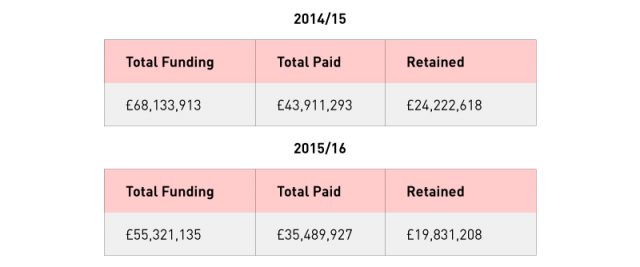
When asked today by FE Week to justify why its management fees remain so high, a spokesperson said: “We work in partnership with an extensive range of suppliers, each providing contract-specific services, which complement those we provide directly.
“We don’t subcontract the whole delivery to third party suppliers and then charge a fee – we don’t have one size fits all approach.
“The nature of relationship and the associated commercial agreement with a supplier will depend on factors including the contract being delivered, the services provided by the supplier in question and the support a supplier buys from us.”
She also elaborated on what the company’s management fees cover.
“We provide marketing, learning resources and content, and the quality, audit and contract management framework within which they sit,” the spokesperson added.
“We offer a range of added value services to our partners including data management, training, funder management, access to growth opportunities including regional and national employer relationships and inclusion in bids.”
While Learndirect has met the SFA requirement to publish it management fee details, the figure itself is uncomfortably close to the 40 per cent SFA chief executive Peter Lauener has said he would find unjustifiable.
Mr Lauener told FE Week in an exclusive interview two years ago that he “would find it quite hard to see a set of arrangements that would justify a 40 per cent management fee, because it’s kind of obvious that what is taken as a management fee is not going to frontline education or training”.
As well as requesting that management fees information should be published on websites, and include current supply chain fees and charges policy, the SFA called for relevant weblinks to be provided on 2015 to 2016 subcontractor declaration forms.
The crackdown followed a long campaign against excessive top slicing by FE Week that was launched in the paper’s pilot edition in June 2011.
SFA apprenticeship tender for small employers rejected by quarter of providers
A quarter of apprenticeship providers have declined the opportunity compete for an SFA contract to deliver training to small and medium sized businesses from next May.
The new Register of Apprenticeship Training Providers, which providers have to be on if they want to deliver apprenticeship starts from May 1 next year, closed for applications at 5pm Friday (November 25).
FE Week can exclusively reveal that 1,753 providers applied to the register to be able to deliver training directly or as a sub-contractor to large, levy-paying employers.
Of these, just 1,310 – or 75 per cent – also applied to deliver training to smaller, non-levy paying employers.
This means that 25 per cent of providers have turned down the opportunity to receive an allocation to deliver apprenticeships to companies that won’t be subject to the levy – despite them making up the overwhelming majority of businesses in England.
Figures published by the Department for Education in August showed that 19,150 companies – only 1.3 per cent of all employers – will be subject to the levy when it is introduced next April.
And a mere 400 companies will pay around half the total levy, the Skills Funding Agency revealed recently.
Providers were able to apply to be on the register via three routes.
The main route was for all colleges and independent training providers who wanted to deliver training to levy-paying employers, either directly or as a sub-contractor.
The supporting route was an “entry route to the apprenticeship market for organisations that offer a specialism, and providers who only want to deliver as a subcontractor”, according to the SFA’s guidance.
The employer-provider route was for companies that wish to deliver apprenticeship training to their own staff.
In addition, providers that wanted to deliver apprenticeship training to non-levy paying employers could also submit an invitation to tender alongside a main route application.
As reported by FE Week on Friday, the SFA warned just hours before the register deadline that some providers were failing to follow instructions and were applying via more than one route.
It also reminded providers that ITTs should be submitted as well as a main route application – but despite this, FE Week understands that not all providers knew that they needed to submit the separate ITT.
FE Week understands that some providers only want to deliver training to non-levy paying employers as subcontractors, and therefore do not need to submit an ITT.
In total there were 2,327 applications to the new register.
In addition to the 1,753 main route applications there were 238 via the employer provider route and 336 via the supporting route.
There are currently 798 prime, or lead, apprenticeship providers on the existing register of training organisations.
There are also 3,815 providers on the current ROTO that can subcontract apprenticeships, but it’s not clear how many of them actually do so.
Peter Lauener, head of the SFA and the Education Funding Agency and shadow chief executive of the Institute for Apprenticeships, told FE Week’s Annual Apprenticeship Conference in March that the new register was being introduced “to make sure that any provider that is available for an employer to use meets the right standards”.
A DfE spokesperson said: “The apprenticeship register is central to the broader reforms being introduced to drive up the quality and quantity of apprenticeships.
“We welcome the strong interest from training providers and are pleased that they are fully engaging with the process.”
Agile, PRINCE2 and PMBoK – How They Fit Together

Agile, PRINCE2 and PMI’s Project Management Body of Knowledge (PMBoK) are all complementary parts of project management. They are parts of a whole, but not THE whole.
Let me explain further.
The Whole
The whole is everything that project management embodies – the processes, the methods, the techniques, the tools, the behavioural or people skills required by the people working in a project environment. The whole is also support for the journey to a stable use of a Target Operating Model; the future state of business as usual or “just how we do it around here (now)”.
Let’s take a look at the three popular parts, starting with PRINCE2:
What is PRINCE2?
 PRINCE2 is a control structure, a framework, a skeleton, the pipe-work through which project control information flows down and up. Down to grant authority over resources and decision-making and set targets, up to reports status and raise the need for intervention (exceptions).
PRINCE2 doesn’t tell us how to know if we are in exception but it lets us know who to tell, what information to give them and the management decisions we should all be taking when we decide we are. I think of it as the middle tier of a three layer organisation cake.
And what are Agile and PMBoK?
 The bottom tier contains (or should contain) activity inspired by the PMBoK and/or inspired by agile procedures.
Both are collections of tools and techniques for measuring status and building baselines so we can travel to the projects destination in a coordinated whole and tell when we are in or out of exception.
Agile includes mindset and product development guidance, often with quiet rigid procedures. PMBoK is more a library of interlinked activities described via the inputs, tools and techniques and outputs. The interlinks are never obvious in the manual.
Mindset
All three tiers – strategy at the top – management control in the middle and development – technical specialists at the bottom, should but rarely are, suffused with the mindset of agility and value creation.
The Agile community have shown the power of mindset and the limitations to its successful introduction. It’s easiest to introduce to those with less hierarchical structure and traditional layers of authority.
The mindset is the piece of most significance, the bit that most often trips up those rushing for the latest silver bullet. Agile is an amplifier of culture and a bad starting culture will exacerbate the stresses more than deliver solutions.

New Thinking for the21st Century?

Ford Assembly Line 1913
Agile uses insight from Complex Adaptive Systems Thinking.
Systems thinking realises that you can only know the system as a whole by looking outside it at its interactions.
Historically project management has grown from engineering. Engineering uses the approach that you understand how something works by looking at its component parts. This is the technique of decomposition. Unfortunately breaking things down removes the essential qualities of the whole system that we’d otherwise study.
PRINCE2 and PMBoK are the legacy of ‘projects are engineering’.
When we apply systems thinking to managing change the best control approach we can adopt is frequent inspection and adaptation over pre-planned in advance actions.
Approaches based on the idea of pre-plan have a long history that resulted from the work of Henry Fayol, Henry Ford, FW Taylor and others.

By Snowded (Own work) [CC BY-SA 3.0 (http://creativecommons.org/licenses/by-sa/3.0)], via Wikimedia Commons
Defined Procedures
Setting aside philosophy, mindset and values to focus on mechanics then – both agile as a set of procedures and PMBoK are descriptions of steps, tools and techniques by which we can build plans and report status.
Assumed Product Development Approach
PMBoK doesn’t insist but is written assuming that we progress through a project’s scope by gathering all the requirements before doing all the design.
Agile is at the other extreme and says ‘do all the development phases to the smallest useful subset of scope and then start again with the next subset.’
PRINCE2 delivers a structure where it can legitimately say:
“Here we don’t care which order you do development in, let’s negotiate resource needs, agree authorisation to work then report status, log configuration data from quality control activities and tell us when you need help (exceptions) and eventually that you’ve handed over the results and are done.”
Pros and Cons
One approach makes high integrity solutions more likely at the risk of complete failure through late detection of misunderstood intent while the other offers partial success, fast cycle-time feedback and graceful exit with some delivered value for money but only where the solution allows incremental delivery.
You can’t usefully deliver one wing of an airplane but watching your favourite BoxSet on NetFlix as each episode is released is much better than waiting until 8 episodes to make a whole DVD.
A 21st century project professional should not enter absolute arguments about one over the other but appreciate how to plug them together to gain the advantages of each.
Go read, adopt, sign Alistair Cockburn’s Oath of NON-Allegiance!
Summary
PMBoK is a project toolkit for building schedules and budgets and teams, for controlling procurement and risk and quality.
Most agile frameworks are half product development approaches and half project scheduling and budgeting mechanisms that overlaps PMBoK to reinvent wheels with new names.
PMBoK explains tools like Earned Value while agile uses Burn Charts and the Measurable News (page 32) give us formal mathematical proof that the two are the same save their names.
A sensible PRINCE2 practitioner should pick the best product development approach for each product or team in their project’s scope.
Use the Burn Charts or Earned-Value and call planning ‘Rolling Wave’, ‘Stages’ or ‘Release and Sprint’ depending on what keeps everyone happy.
Also focus on ‘value (agile label)’ or ‘benefits (PRINCE2 label)’.
A sensible PMBoK user and agile proponent should recognise that PRINCE2 brings useful structure to interface to the rest of the organisation’s deep-rooted constraints in hierarchy, annualised budgeting, matrix resource structures, routine reporting and dislike of change.

#WOLWeek Day 7 – Plan Next Steps
Last week (7-13 November 2016) was International Working Out Loud Week (#WOLWeek). I used it as an opportunity to promote Working Out Loud (WOL) and give my own practices a boost by following the 7 days worth of actions to get you started working out loud.

Image source: WOLWeek.wordpress.com
In addition to consciously completing the WOL activity each day I committed to writing a blog post about that activity. My posts described both what I had done on the day as well as my experience with that activity during my current WOL Circle. Over the past few days I’ve been reflecting what I’ve learned and what I will do differently in coming weeks.
Reflecting on my Goal
A goal needs to be something I care about in order to motivate me. I’ve realised that to be a high enough priority for me to put sustained effort into it over the 12 week period of a WOL Circle it also needs to be highly relevant to my current work. It needs to be something I can apply to a current project. In the nine weeks since the start of this Circle my work focus has shifted. I’ve started an assignment with a new organisation, but I didn’t update my goal to be relevant to this project. Consequently my attention has moved to the new assignment and I’ve struggled to make time to progress my original goal.
Working Out Loud is a Force Multipler
On Day 5 I described WOL as a ‘force multiplier‘ – “it amplifies your presence and accelerates you work.” Although it’s challenging to change your practices to build WOL into the flow of your daily work, the value of working in a more open, connected, generous way is tremendous. WOL has helped me to:
- build my network and forge deeper relationships
- improve my practices and the quality of my work by helping me find resources, get early input and feedback from others, and build on the experience and work of others
- make faster progress on my goals
- create new opportunities
Power of Making Your Work Visible
Making your work visible (also known as ‘showing your work’ or ‘narrating your work’) is powerful for many reasons. For me, one of these reasons that it forces me to consciously reflect on my work rather than plough on in a near-continuous stream of activities. Secondly, it increases my accountabilty to make progress. It also leads to connection and conversation.
Power of Conversation
When I work on a project, especially where there is something novel about it for me, my thoughts shift over time. There is a process of discovery where I gather information, start processing it, hypothesise, gain insight, make some progress then find something new which results in me updating my view. The quality of my thinking greatly improves if I can ‘think out loud.’ I can do this by sharing my progress – making my work visible in any appropriate format.
Having a conversation about what I’ve shared is even more powerful, especially if it’s with someone who has some relevant experience or is able to challenge and extend my thinking through the use of powerful questions or different perspectives The way in which I make my work visible can increase the number of helpful conversations I generate. I can:
- target who I share my work with
- practice empathy and share my work with people to whom it is relevant, and explain why they should care (what’s the WIIFM?)
- make it easy for others to consume and process by keeping it brief and clear
- share early in the process
- ask for input and help
- maintain and communicate an open mindset
- thank people for their help
- acknolwedge the contribution of others
What next with WOL for me?
The reflection on my goal and the power of Working Out Loud have led me to change my goal for the remaining three weeks of my WOL Circle. My new goal is:
“to Work Out Loud in the flow of work in my current role.”
This goal will help me to build my network in my new organisation, find people with an interest in the work I am doing, access a range of assistance, and reduce the risk that I duplicate work that has already been done. While waiting for access to the organisation’s IT infrastructure I have had the opportunity to present in person to a range of forums, and have accepted all subsequent invitations to meet with interested people. I have IT access from today, and look forward to the experience of using Yammer within an organisation for the first time and observing how the learning community is connecting and collaborating online. I will use Simon Terry’s 3 tiny habits to build working out loud into my day as I familiarise myself with this new environment.
On the flip side, I felt that while I was blogging daily last week I spent more time in ‘output’ mode than in ‘listening’ mode in my networks. I feel a need to redress the balance and listen more in my public networks over the next few weeks, looking for opportunities to engage and contribute too others along the way.
What did you learn during WOL Week?
Please post below to let me know what you learned during WOL Week, or at any other time when you have worked out loud.
AoC and AELP bosses battle over independent provider quality
The bosses of FE’s two biggest associations have traded verbal blows over the quality of apprenticeships that are delivered by private training providers.
David Hughes, chief executive of the Association of Colleges, has claimed that independent providers offer apprentices “not very much” training, mostly assessing them “on the job”.
But his comments sparked a war of words with Mark Dawe, boss of the Association of Employment and Learning Providers, who challenged the AoC chief to “produce the evidence” to back up his allegation.
Mr Hughes’ criticism of independent training providers was made during an interview with FE Week in which he defended colleges’ poor take-up of apprenticeships over the past year.
The former skills minister Nick Boles had challenged colleges to stop letting private providers “nick your lunch” at the 2015 AoC annual conference – something that the figures show they haven’t really managed.
Pressed on why some colleges haven’t been expanding their apprenticeship provision ahead of the levy, Mr Hughes said: “Colleges are big organisations and there’s always going to be a degree of cautiousness about suddenly shifting your business into new areas.
“If you’re an independent provider and you’re doing most of that work assessment on the job, there’s a lot of evidence that many apprentices get no-off-the job training, even at level four and five, even at degree-level apprenticeships. It’s much easier to suddenly switch your business and grow your business and get big numbers.”
Mr Dawe hit back at Mr Hughes, labelling his claim “disappointing and plain wrong”.
He told FE Week: “I challenge David to produce the evidence he refers to, given that Ofsted believes that 79 per cent of independent provider provision is good or outstanding, and the latest FE Choices and CBI data shows that by far the average highest satisfaction ratings among employers and learners are for independent providers.
“Is he really saying that an apprentice has to leave the employer’s premises to get access to the necessary facilities and kit?
“Off-the-job training for the technical certificate, and improving English and maths, can and does frequently takes place in training rooms on site or at the provider’s facilities.
“David may be inferring, and it may be the case that many colleges are not suited to certain types of delivery.
“Therefore they should focus on what they are good at rather than trying to turn everything into classroom education.”
Just days after the exchange, the left-leaning think-tank IPPR called on the government to phase out level two apprenticeships for 16- to 18-year-olds, and replace them with a programme only offered by colleges.
It is also likely that the government’s skills plan will favour colleges if classroom-based facilities are required to deliver its 15 new technical professional education routes.
“AELP has nearly 50 college members, some of which are very large, who offer high quality work-based learning and I would be surprised if many of them agreed with David,” added Mr Dawe.
“I am puzzled why the size of an institution should prevent it from entering the apprenticeship market – it is all about willingness to seize the opportunities that the levy offers and getting better at employer engagement.”
Minister ‘pretty sure’ assessments will be in place by the time apprentices finish
The apprenticeships and skills minister is “pretty sure” that no apprentices will get to the end of their course without an end-point assessment organisation in place.
Robert Halfon was grilled on the topic in speaking at a sub-committee on education, skills and the economy evidence session on apprenticeships today (November 2) in the Palace of Westminster, by co-chairs Neil Carmichael and Iain Wright, and Ian Mearns, MP for Gateshead.
While the government claims 60 per cent of standards have assessment organisations, many of these standards have no learners.
As previously reported in FE Week, of those standards with learners, 59% (33) have no assessment org and 42% (1,790) of apprentices are on the 33 standards with no assessment organisation.
Speaking to the sub-committee, Mr Halfon said: “Even where there isn’t an assessment organisation yet, we’re pretty sure that by the time they’ve finished their apprenticeship, which could be on year, two years, they will have the assessment organisation in place.
“Huge amounts of resources are being put in in terms of working with the providers; a lot of work is going on with the employers to make sure of that.”
He added: “I don’t think the picture is quite as bleak as it’s been painted in some areas.”
Mr Halfon’s words followed similar comments made yesterday by Peter Lauener, interim chief executive of the new Institute for Apprenticeships, and chief executive of the Skills Funding Agency and Education Funding Agency.
Mr Lauener told a packed audience at the Association of Employment and Learning Providers Autumn conference in Manchester that having no approved awarding organisations for over 40 per cent of learner starts on new standards is “not ideal” but the situation was “manageable”.
He added that he did not think “there’s a consensus” view that the situation was a serious problem or that apprentices should not start their courses without an end-point assessor in place.
However, when AELP chief executive Mark Dawe took a poll of the audience, not a single hand went up to say it was acceptable for an apprentice to be studying on a course that had no end-point assessment organisation assigned to it.
In today’s debate Mr Halfon told the sub-committee that “60 per cent of standards have an assessment organisation in place” and “that figure goes up from 60 per cent to 94 per cent if you include assessment organisations either about to be registered or within 12 months of the gateway of the end of the apprenticeship”.
 David Hill, director of apprenticeships at the Department for Education (pictured right), who accompanied Mr Halfon at the evidence hearing, added: “Looking specifically at apprentices expected to be ready for their end-point assessment in the next 12 months, our analysis is that of those 1737 (86 per cent) already have at least one end-point assessment organisation ready for selection.
“That leaves another 278 apprentices and we’ve gone through exactly the status of those apprentices on different standards”.
He highlighted that for three apprenticeship standards, covering 40 apprentices, “we have organisations very, very close to being approved and we’re working with those organisations to get them on the register”.
Mr Hill concluded: “We’ve looked hard at this we are confident that we have a plan in place to make sure that there will be full coverage.”
In an FE Week article on October 14, Dr Sue Pember, who stood down as the civil service head of further education and skills investment in February 2013, said it is “diabolical to let an apprentice start a programme, without explaining not only what the end test will contain, but where it will be, what shape it will take and who will be the organisation to oversee and manage the process”.
Mr Dawe, also commented on the topic in an FE Week expert piece, when he wrote: “Having appropriate standards and robust EPAs are vital to the success of the apprenticeship programme and the development of skills in the UK.
“However feedback from AELP members suggests that while there are some excellent ones, this isn’t true for every standard developed and the damage that could be done to apprenticeships is far worse than the concerns around funding changes which we have had over the past weeks.”
Minister accused of ‘hoodwinking the house’ over apprenticeship cuts
Apprenticeships minister Robert Halfon (pictured above) has been accused of “trying to hoodwink the house” over apprenticeship funding cuts during a heated clash in parliament this morning.
The accusation was made by David Lammy, MP for Tottenham, at the end of a Westminster Hall debate – over planned apprenticeships funding cuts for younger and disadvantaged learners exposed by FE Week.
He said that Mr Halfon had not responded to key questions on the issue of framework funding, and had instead focused on new standards – despite their low take-up.
“Over 99 per cent [of starts] are on the frameworks, which is the matter of the debate, and the minister has not addressed it at all,” Mr Lammy said.
“He’s trying to hoodwink the house.”
Mr Halfon did not respond to the cuts during his comments today, despite them being raised by a number of speakers including Mr Lammy and Gordon Marsden, shadow skills minister.
But he did say: “To use some frameworks as a way to say the government is not helping the poorest is entirely wrong.”
Mr Lammy’s frustration at Mr Halfon’s lack of response was evident, and he had to be called to order in his closing remarks, during which he said: “It is disappointing that the minister has said nothing about funding rate cuts in this country.
“He’s been reliant on the £2.5bn extra he’s said is coming in. He’s robbing Peter to pay Paul.”
This morning’s debate was called by Mr Lammy in response to FE Week’s analysis of apprenticeship funding rates proposed by the Department for Education in August.
As revealed by FE Week, these new rates would see funding slashed for 16 to 18-year-olds in the most deprived areas by up to 50 per cent for some of the most popular frameworks.
Following a successful #SaveOurApprenticeships campaign by FE Week, the government has now announced a partial u-turn on the worst of the cuts.
The DfE announced on Tuesday it would now pay an extra 20 per cent on the funding band limit for 16-18 year-olds, and £60 million “additional support in areas of disadvantage”.
However, further FE Week analysis into the impact of this u-turn found that while the cuts now aren’t set to be quite as high as before, most frameworks will still feel cuts of 20 per cent or more.
Every 1% saved from chaotic NHS procurement could save £220m
If health secretary Jeremy Hunt took a tougher line over procurement, the millions saved could pay for thousands more junior doctors
Last week, when she met Simon Stevens, the chief executive of NHS England, prime minister Theresa May dashed any hopes of a cash boost in next month’s autumn statement.
But there is one area of NHS England spending that has not yet come sufficiently under the microscope: procurement. Every 1% reduction – a reasonably conservative target – in hospital trusts’ annual procurement expenditure of £22bn could, for instance, pay for more than 4,000 extra junior doctors.
Related: BMA: Theresa May lacks understanding about seriousness of NHS crisis
Related: NHS plans closures and radical cuts to combat growing deficit in health budget
Continue reading...How colleges can keep up with apprenticeship reforms
If colleges wish to continue to deliver apprenticeships, they will need to adapt quickly, writes Teresa Frith
We are sitting in the middle of a maelstrom of reform in apprenticeships. But what should be at the forefront of our minds is that whatever apprenticeships we provide, they must be high quality. We will be doing a disservice to all apprentices and employers if we chase the government’s target of three million new apprenticeships by 2020 without keeping in mind that this must work for them first and foremost. Despite concerns about a lack of clarity in implementing the reforms, one thing is clear: we all still believe apprenticeships are a significant part of the solution for improving skills in the UK.
Colleges have always been apprenticeship providers, but this delivery has been part of a wide range of education and training opportunities for the local community. Their apprenticeship provision tends to be reflective of what might be called the ‘harder markets’: small businesses that are unlikely to add profit to the college and need significant support; students who are harder to place; sectors where apprenticeship training is expensive to deliver.
Obviously there are exceptions, but well over half of English college provision is delivered to businesses who take only one or two apprentices; on top of this, over 50 per cent of all apprenticeship provision in some key STEM-based areas is delivered by colleges. Colleges have spent a lot of time and energy ensuring that they can be the ‘second (or more) chance saloon’ for the people they serve and that they are accessible to all employers, picking up activity that does not appeal to other types of provider.
Colleges by now recognise that the current reforms focus on the needs of employers, and that the approach that is being encouraged is a commercial one. If a college wishes to continue to deliver apprenticeships, they
will need to adapt quickly to this new approach. To continue to train apprentices who are at a disadvantage, they will need to charge what it actually costs to deliver, or find some money from elsewhere; disadvantage uplifts, and other fair-yet-complicated aspects of the existing funding methodologies, are going.
If a college needs to support a micro business through the whole process of creating an apprenticeship, filling the vacancy then running the programme, they will need to charge the employer what it costs to do this, or find money from elsewhere. So from a practical, financial perspective, colleges need to adapt and find a sustainable delivery strategy.
The approach that is being encouraged is a commercial one
It is hard to see how such a strategy will allow them to continue to work with employers that need a significant time investment prior to and during delivery, however, as well as people who are further away from the job market. This is why one of AoC’s recommendations in its autumn statement submission is for apprenticeship funding to retain a factor to support those from low-income families. It is hard to believe that all this is the genuine intent of the reforms, but it currently remains the reality of the implementation plans.
So in which markets might colleges be seeking to deliver more apprenticeships? Just like ‘employers’, ‘colleges’ are not a homogenous group; they will respond and adapt in myriad ways.
It seems sensible for colleges to play to their strengths and likely that we will see elements of specialisms being introduced. In line with employer demand, we can expect that a significant amount of work might shift from the ‘entry into work’ apprenticeship market to the ‘progression in work’ apprenticeship market.
But all this is speculation; we will have to wait and see what happens after the introduction of the new apprenticeship funding system on May 1, 2017. In the meantime, AoC will continue to work with the government to ensure that apprenticeships do not become a ‘cash cow’ for profiteers, but continue to provide a genuine learning experience for students and achieve real productivity gains for employers and the UK.
There will be forums on making the apprenticeship agenda work for your college at the AoC Conference (15-17 November)
Don't let market forces rob universities of their social role
We need to protect the benefits universities bring to their communities and the wider world - and the new bill puts that at risk
Bill Rammell, author of a new report from the Higher Education Policy Institute, warns that the social role of universities is being overlooked as the government pushes ahead with its marketisation of the sector.
Universities make an enormous contribution to civil society, not only through providing education opportunities and extending knowledge through research, but in their engagement with communities, their international networks, and the fostering of open public debate.
Continue reading...Companies turn off the tap on funding EMBAs
I.gardner.gbPleased to say we still support our staff!
The unstoppable rise of management apprenticeships
Management is now the third most popular apprenticeship subject, and analysis by FE Week suggests it will rocket to the top spot once the apprenticeship levy kicks in next year.
A huge 83 per cent of all 25+ higher apprenticeship frameworks are currently in management, according to the latest Department for Education data.
And the number of starts for 25+ higher management apprenticeships in the nine months between August 2015 and April 2016 has already exceeded the total for the previous 12 months, with 4,670 compared to 4,660.
This trend is not a new one. The percentage of all apprenticeships in management frameworks has increased rapidly since 2002/03, soaring from around one per cent to over 10 per cent for 2015/16.
The rise has accelerated since 24+ apprenticeships were permitted in 2007/08.
When the apprenticeship levy comes into play next April, close to 20,000 employers will have a levy pot – and for many, the easiest way to make use of this funding will be to place existing employees on management apprenticeships.
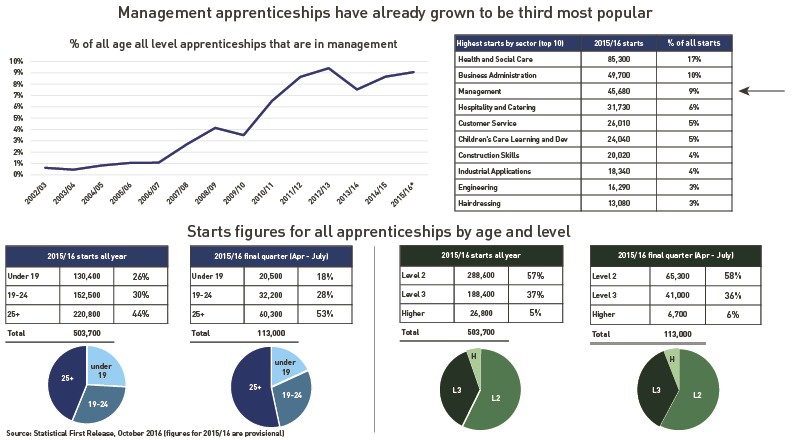
Click table to enlarge
Apprenticeships and skills minister Robert Halfon has recently singled out the importance of higher and degree apprenticeships as a “ladder” to help employers bring in new talent and to improve social mobility.
But the popularity of management apprenticeships raises a new question: should large sums of government funding, much of it expected to be generated by the forthcoming levy, go on what is effectively upskilling firms’ existing managers.
Mark Dawe, the chief executive of AELP, raised concerns about the trend when FE Week showed him its analysis.
“AELP has been hearing from levy-paying employers for some months that their strategic planning in preparation for the levy includes many more apprenticeships at higher levels, in particular management training,” he said.
“AELP’s concern is the knock-on consequence of not enough levy money being available for non-levy-payers, and those exceeding their levy pot.
AELP’s concern is the knock-on consequence of not enough levy money being available for non-levy-payers, and those exceeding their levy pot
“We have regularly expressed concern about this in our correspondence to ministers, as we believe any restriction on non-levy-payer apprenticeships will have an impact on social justice and productivity.”
In July last year, a new apprenticeship standard for a chartered manager degree was launched, following its development by employers such as Barclays Bank, Sainsbury’s and Virgin Media.
The Open University is just one of the higher education institutions making the most of this new standard.
Its chartered manager degree apprenticeship will cost £22,500 per apprentice, highlighting the opportunity that now for universities – either public or private – to corner this market.
With an upper fee-limit of £9,000 for higher apprenticeships and £27,000 for degree apprenticeships in all sectors, the management standard is set to be a best seller.
According to the CFA Institute, there are 400,000 new managers a year – which would amount to around £3.6bn.
And once the Skills Funding Agency system of allocating funding is removed, there will be no ring-fence for 16-to-18 apprenticeships, meaning that companies could potentially spend their entire levy allowance on training managers aged 25 or more.
Mr Halfon told delegates at this week’s Conservative Party Conference that once the apprenticeship levy is in operation, employers might try to “game the system”, by rebranding existing training in order to claw back as much of their levy contribution as possible.
He said: “I’m not going to deny to you, inevitably there may be some gaming of
the system.
“But I don’t actually believe it will be widespread. If gaming is widespread … then of course we would look at it later on and make sure we stop it as much as possible.”
FE Week took a look at some of the universities that have jumped at the chance to offer management degree apprenticeships (below).
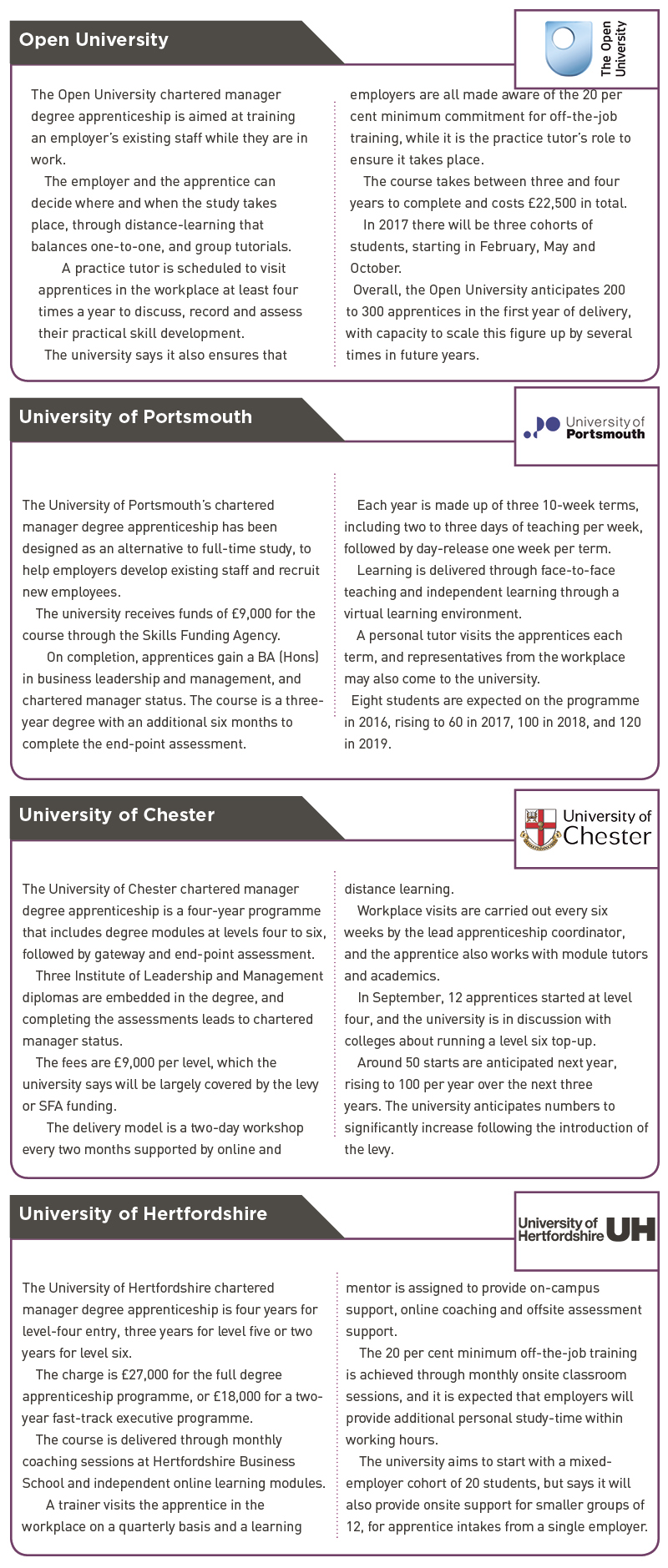
Making Things Better - Visual Value in Health Information Management
PwC Legal to be absorbed into accountancy firm’s wider business
PwC – the first of the ‘big four’ accountants to gain an alternative business structure (ABS) licence – has become a true multi-disciplinary practice by merging its connected law firm into the wider business, in a move that has been welcomed by the Solicitors Regulation Authority.
The post PwC Legal to be absorbed into accountancy firm’s wider business appeared first on Legal Futures.
The Top 200 Tools for Learning 2016 is announced
 It was in 2007 that I compiled the first Top 100 Tools for Learning from the votes of learning professionals worldwide and have done so every year since then. This year to mark the 10th anniversary I have compiled the TOP 200 TOOLS FOR LEARNING 2016. The full list appears in the left-hand sidebar; follow the links to find out more about each of the tools. The slideset of the Top 200 Tools is embedded at the bottom of this page.
Knowledge-Letter: Gurteen Knowledge Letter: Issue 195 - September 2016
Gurteen Knowledge Letter: Issue 195 - September 2016
Contents
- Introduction to the September 2016 Knowledge Letter
- Decisions Are Emotional, Not Logical
- The dangers of anonymity
- World Values Day 20th October 2016
- In the future, will everything be a coffeeshop?
- The last of human freedoms
- Gurteen Knowledge Tweets: September 2016
- Upcoming Knowledge Events
- Subscribing and Unsubscribing
- The Gurteen Knowledge Letter
Introduction to the September 2016 Knowledge Letter
Something a little different to kick off this month's knowledge letter :-) Have you seen Elon Musks plan for colonizing Mars? It's a tremendously ambitious plan that even as he acknowledges might never happen.
I love the vision. I am sure one day we will do this. Take a look at his recent hour-long presentation at the 67th International Astronautical Congress in Guadalajara, Mexico, where he outlined the long-term technical challenges that must be solved in order to support "the creation of a permanent, self-sustaining human presence on Mars."
And if you don't have an hour to spare but would like to get an idea of the vision, watch this simulation of his envisaged SpaceX Interplanetary Transport System.
It would be an incredible adventure. It would be the most inspiring thing that I could possibly imagine.
Life needs to be more than solving problems every day.
You need to wake up every day and be excited about the future, and be inspired, and want to live.
Credit: Elon Musk
Decisions Are Emotional, Not Logical
Neuroscience is throwing more and more light on our true nature as human beings and has the potential to dramatically transform the way we see the world.
This is an interesting article about decision making and the research that confirms what I suspect most of us have intuited for a long time - decisions are emotional - not logical.
Think of a situation where you had bulletproof facts, reason, and logic on your side, and believed there was absolutely no way the other person could say no to your perfectly constructed argument and proposal.
To do so would be impossible, you figured, because there was no other logical solution or answer.
And then the other person dug in his heels and refused to budge. He wasn't swayed by your logic. Were you flabbergasted?
The dangers of anonymity
There are several ways in which we express our ideas or have discussions while hiding who we are.
Many on-line discussion forums allow us to post anonymously or to give a false name and we can frequently express our opinions anonymously in surveys or interviews.
We employ these techniques for seemingly good reason. If we are introverted or lack confidence in our beliefs; they allow us to speak up without fear of judgment or personal criticism.
And in fear of the consequences, they potentially make it possible to be more truthful by saying things that others might not wish to hear.
But anonymity has a serious downside as it encourages us:
- to be less authentic
- to avoid intimacy
- to avoid building relationships
- to lie rather than tell the truth
- to avoid confrontation
- to be nasty and vindictive (think internet trolls)
But worst of all, it allows us to avoid conversation.
I don't want my views challenged.
I want to have my say, but I don't want to hear what you have to say.
It's about monologue, not dialogue.
Anonymity kills the conversation.
World Values Day 20th October 2016
World Values Day is coming up on 20th October and will be the first truly international World Values Day.
The objective of the Day is to raise and deepen the awareness and practice of values all around the world. Positive values that is :-)
The day will provide an opportunity to think about our most deeply held values and to act on them. If we are aware to our values and put them into action each and every day, we can change our lives and change the world we live in.
See the World Values Day website for information on events and activities taking place around the world as well as many useful tools and resources that can help in exploring our own values and those of our organisations and communities.
And if you are in London on the 20th then come along to my World Values Day Café in the evening where the subject of the conversation will be "Putting our values into action - why is it so hard?" It's free.
In the future, will everything be a coffeeshop?
In the future, will everything be a coffee shop?. Universities? Bookstores? Retail Stores? Offices?
Note that like the coffeehouses of 17th century London, that even today coffee shops are more than just places to drink coffee. They are places to meet, to read, to study, to work, to hold meetings, to have conversations and more.
What do you think?
The last of human freedoms
In 1989, I first read Stephen Covey's The 7 Habits of Highly Effective People and he introduced me to the life and work of Viktor Frankl.
Viktor Frankl was an internationally renowned psychiatrist. In 1946, he wrote the book Man's Search for Meaning.
In his book, he begins with a deeply moving personal account of his imprisonment in Auschwitz and other concentration camps during the Second World War, and his struggle during that time to find reasons to live.
In the second part of the book called "Logotherapy in a Nutshell," he describes the psychotherapeutic method that he pioneered as a result of his experiences in the concentration camps.
At the core of Logotherapy is his belief that man's primary motivational force is a search for meaning.
One sentence in the book stood out for me:
The last of human freedoms - the ability to chose one's attitude in a given set of circumstances.
Credit: Viktor E. Frankl
Stephen Covey expresses the concept a little more fully:
In the space between stimulus (what happens) and how we respond, lies our freedom to choose.
Ultimately, this power to choose is what defines us as human beings.
We may have limited choices, but we can always choose.
We can choose our thoughts, emotions, moods, our words, our actions; we can choose our values and live by principles.
It is the choice of acting or being acted upon.
Credit: Stephen R. Covey
This idea that we have the ability to chose our response to any stimulus in any set of circumstances has had a huge shaping influence on me over the years and I have tried to abide by the philosophy. Not always successfully I might add.
And then much more recently, I came across the work of Peter Block. Peter in his book Community: The Structure of Belonging says this:
The real task of leadership is to confront people with their freedom.
Credit: Peter Block
Peter's ideas have been very much influenced by the work of Peter Koestenbaum
To my mind, we are all leaders to one degree or another, and so it's the task of each and every one of us to remind each other of our freedom to choose not only how we respond to situations but:
- who we are
- what we think
- what we do
- and how we go about it
Gurteen Knowledge Tweets: September 2016
Here are some of my more popular recent tweets. Take a look, if you are not a Tweeter, you will get a good idea of how I use it by browsing the list of micro-posts.
- Not a lot has really changed in 100 years or so :-) http://pic.twitter.com/8M18LgIgH8
- If you remember Marty Feldman - the British script writer & comedian - you will love this documentary about his life http://buff.ly/2cbM2ID
- Knowledge Management at Transport for London http://buff.ly/2dbps1F
- World Values Day is 20 October 2016 @ValuesDay http://buff.ly/2cVHYvP #WorldValuesDay
- To Thrive, We Must Be In Touch With Each Other http://buff.ly/2ccjH6B
- Hold conversations, not meetings http://buff.ly/2cQViVA
- Seth Godin thinks we should create work that gets criticize http://buff.ly/2c1yzk5
- Thoreau: Emerson's 1862 essay in The Atlantic eulogizing his late friend http://buff.ly/2bSaJ9x
- Esko Kilpi @EskoKilpi and the value of wine and interaction http://buff.ly/2c6UIiE
- Research shows that humor can help people be more creative in problem solving http://buff.ly/2bkzImc
- The Science Behind Effective Teams at Google http://buff.ly/2apfJX7
If you like the Tweets then subscribe to my Tweet stream.
Upcoming Knowledge Events
Here are some of the major KM events taking place around the world in the coming months and ones in which I am actively involved. You will find a full list on my website where you can also subscribe to both regional e-mail alerts and RSS feeds which will keep you informed of new and upcoming events.
Knowledge Cafe 4 - Intelligent Machines and Network Analysis
Wed 05 Oct 2016, New York City, United States
13th International Conference on Intellectual Capital, Knowledge Management & Organisational Learning
14 - 15 Oct 2016, New York, United States
World Values Day Café
Thu 20 Oct 2016, London, United Kingdom
8th International Conference on Innovation and Knowledge Management in Asia Pacific (IKMAP 2016)
23 - 24 Oct 2016, Kobe, Japan
KM World 2016
14 - 17 Nov 2016, Washington DC, United States
Cultural and Community Knowledge in Australia
16 - 17 Nov 2016, Melblourne, Australia
Knowledge Cafe Masterclass - with David Gurteen
Tue 22 Nov 2016, London, United Kingdom
KM Asia 2016
30 Nov - 01 Dec 2016, Hong Kong, China
KM Legal Europe 2017
18 - 19 Jan 2017, Amsterdam, Netherlands
Advancing your OD practice
24 - 25 Jan 2017, Henley on Thames, United Kingdom
IntraTeam Event Copenhagen 2017
28 Feb - 02 Mar 2017, Copenhagen, Denmark
9th European Conference on Intellectual Capital
06 - 07 Apr 2017, Lisbon, Portugal
5th International Conference on Innovation and Entrepreneurship 2017
26 - 27 Apr 2017, Kuala Lumpur, Malaysia
Subscribing and Unsubscribing
You may subscribe to this newsletter on my website. Or if you no longer wish to receive this newsletter or if you wish to modify your e-mail address or make other changes to your membership profile then please go to this page on my website.
The Gurteen Knowledge Letter
The Gurteen Knowledge-Letter is a free monthly e-mail based KM newsletter for knowledge workers. Its purpose is to help you better manage your knowledge and to stimulate thought and interest in such subjects as Knowledge Management, Learning, Creativity and the effective use of Internet technology. Archive copies are held on-line where you can register to receive the newsletter.
It is sponsored by the Henley Forum of the Henley Business School, Oxfordshire, England.
You may copy, reprint or forward all or part of this newsletter to friends, colleagues or customers, so long as any use is not for resale or profit and I am attributed. And if you have any queries please contact me.
David GURTEEN
Gurteen Knowledge
Fleet, United Kingdom