Shared posts

18 Apr 12:09

Learning & Development: Digital Learners Won’t Let You Waste Their Time

by Sari Wilde

Given so much of the way that the world’s employees accomplish their work has changed rapidly across the past half decade, it’s no surprise that corporate learning and development has changed as well. Elliott Masie, a learning technology expert and producer of Broadway musicals, says in Chief Learning Officer, “Some of your learners … may be showing new behaviors that look more like online dating:

“Your learners look at a learning offer and:

  • Quickly give it a swipe left or a swipe right — keep it or let it go.
  • Want to know, ‘Did other employees like this? Is it worth my time?’
  • Say, ‘Hey, give me the good stuff; skip the fluff.’

“Your learners are better guardians of your wage time than you. Set up a 75-minute webinar for every regional manager, and their attitude kicks in:

  • ‘Is there really 75 minutes of new and valuable stuff?’
  • ‘Could I watch the archived version, and skip to the few minutes of important info?’
  • ‘Ah, let me order my lunch, check my emails, and have a side telephone call during this very long webinar.’

“Your learners have attitude because times are changing, and choices are getting more complex.”

Make it Effortless, Not Fun

Masie’s observations align neatly with CEB analysis, which showed that while the making learning more fun and engaging does increase employees’ satisfaction with learning offerings, it does not always help them retain and apply what they learn.

What the most successful L&D functions do is to make the learning experience as effortless as possible. They make learning materials easy to find and readily applicable to employees’ day-to-day jobs as well as their future careers.

The CEB research identified a number of interesting distinctions, one of which is that many employees have different attitudes when they are looking to acquire knowledge or information as opposed to when they are actually trying to learn and develop a new skill. Learners’ habits and attitudes have already changed, as Masie notes, when they are looking for information. They are impatient, have shorter attention spans, and have certain expectations about format.

On the other hand, when employees are looking to develop new skills, particularly “soft skills” (interpersonal skills) and leadership skills, they tend to have more patience for longer, in-person learning experiences.

Many L&D functions are working hard to accommodate what they think employees want across all of the learning solutions they offer, but they – understandably – find it tough to help employees develop better leadership skills through an 18-minute “TED talk.” Maybe it’s time for a rethink.


18 Apr 11:59

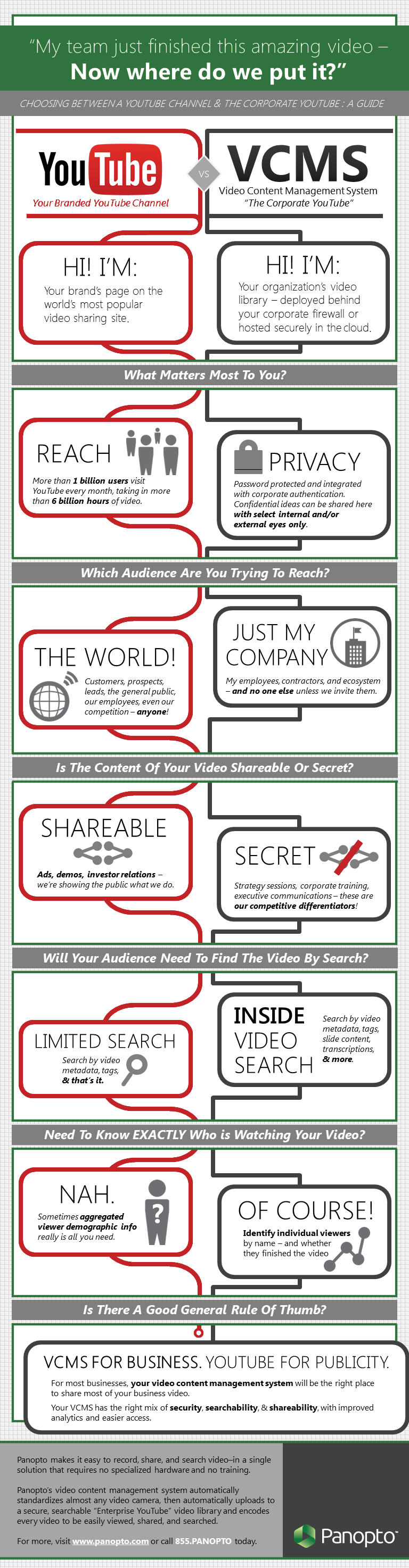
INFOGRAPHIC: The Super Quick Guide To Corporate Video Hosting

by g-panopto

As organizations increasingly use video for communication, training, and presentations, the question of where to keep all this video has become critical.

Often, this question comes down to two options:

So how can you decide where to store your business videos? Check out our newest infographic for a convenient quick reference guide.


Want To Learn More About Corporate Video Hosting Options?

Download our white paper, “Your YouTube Channel vs. The Corporate YouTube” today to learn more.

The post INFOGRAPHIC: The Super Quick Guide To Corporate Video Hosting appeared first on Panopto Video Platform.

18 Apr 11:14

Impacts of Workforce Management Software

by WhoKnows

Workforce Analytics is a combination of different methods that apply statistical models to workforce related data, allowing enterprise leaders to optimize human resource management. The field of Human Resource has changed immensely over the past few years. And plenty of positive changes have been caused by workforce management software. Data driven management practices are becoming common among business leaders.
ff
The basic impacts of workforce management software on the company:

Workforce analytics help address changes in the workforce

Workforce software’s main benefit is the ability to foresee disruptions and changes before they occur. By identifying patterns in data, business leaders can easily address changes in the company with a structured framework of data.

Analytics can help proactive HR strategy

Workforce analyst can give HR the necessary tools and approach needed to make bigger contributions at the strategy table. Presently, businesses need workforce software to assist in strategic processes, everything from modeling workforce to managing resources, to finding better talent investments. It can act as a proactive resource to optimize businesses.

HR professionals can further their capabilities

Workforce software helps HR enhance their decision-making capabilities in ways which were never possible before. With this software, HR easily builds analysis and interpretation skills that allow them to broadly contribute to the overall company’s strategy.

If you are looking for a workforce management software solution to optimize your company’s processes, visit WhoKnows. It is an online platform that derives and recommends expertise, automatically taking the load off the user to manually update their profiles. It helps companies develop a deeper understanding of their employee analytics and employee skills inventory. It provides real time, correct insights, and collaboration across your entire organization. To know more about WhoKnows or to request a demo, please visit https://corp.whoknows.com/.

The post Impacts of Workforce Management Software appeared first on WhoKnows.

10 Apr 13:56

Apprenticeships: what are Ofsted inspectors looking for?

by Christopher Jones

Apprenticeships are not vehicles to validate employees’ existing skills – our inspectors want to see that apprentices are learning something new, says Christopher Jones

Asign outside a shop in my local market town reads: ‘the only constant in life is change’. I usually ignore such nuggets of wisdom, but this one stuck with me.

As we approach a significant milestone in the funding of apprenticeships, reflect on the new roles for employers, review the list of approved apprenticeship training providers, appraise the detail of apprenticeship standards, and await the official launch of the Institute for Apprenticeships (and Technical Education), it is clear that change is all around us.

In Ofsted’s 2016 annual report, her majesty’s chief inspector highlighted the increased proportion of apprenticeship programmes found to be ‘good’ or ‘outstanding’, but acknowledged that 37 per cent of those inspected were less than good.

Apprenticeships work best when training providers and employers ensure that the structure and delivery of the programme helps apprentices meet exacting standards and contribute to the growth of the business. The best employers provide their apprentices with consistent support and effective training, both on the job and away from work, to ensure their success.

Too often employers do not know enough about the requirements of the apprenticeship programme

Here at Ofsted, we currently have 32 apprentices. Some are working at level two and others at level three. We offered our apprentices a permanent role from the first day of their programme, making a genuine commitment to their development and future career. As an organisation we are committed to social mobility, so during the recruitment and selection process we focused on the apprentices’ skills and potential, rather than their previous academic achievements.

All of our apprentices are proving to be dedicated and valuable members of the team.

We know from our inspection findings that too often employers do not know enough about the requirements of the apprenticeship programme or the quality of the training. And, in some cases, they are concerned that the off-the-job training provided does not enable apprentices to develop the skills they need. We need to ensure that apprenticeship provision is of the highest quality so apprentices can thrive and businesses can benefit.

Changes to the funding of apprenticeships may encourage more businesses to consider developing their existing employees through an apprenticeship. But remember, apprenticeships are not vehicles to validate employees’ existing skills.

It’s vital that employers and training providers ensure these apprentices learn new skills and gain the knowledge that will help them to earn a promotion, take on more responsibility, contribute to increased productivity, or get a payrise.

We know apprenticeships are switching from frameworks to standards, and while recruitment to standards-based apprenticeships has increased significantly, they still account for just three per cent of apprentices who began their training after September 2016.

Our inspectors want to see that apprentices know something new

Currently, around 95 per cent of apprenticeships are at level two and level three, but over a third of the standards that have been developed are at level four and above. The slow development and approval of standards for the majority of apprentice job roles means that providers may have some apprentices on frameworks and some on standards for the foreseeable future.

So what does this mean for inspection? Rather than change, it is business as usual for Ofsted. Regardless of the format of an apprenticeship programme, our inspectors want to see that apprentices know something new, can do something better, are able to work on their own, and can make independent decisions as a result of their training and learning.

We want to see that employers and providers have structured their training programmes to ensure that apprentices can achieve the very best of their potential. So while we might well see change all around us every day, when it comes to inspection, we will simply keep calm and carry on.


Christopher Jones is HMI specialist advisor on apprenticeships at Ofsted

10 Apr 13:56

Globalizing an Online Nursing Course at Duke

by Sophia Stone, Ed.D.

The Center for Instructional Technology (CIT) partnered with the Duke University School of Nursing (DUSON) to redesign and implement a cross-cultural perspective to N502: Health Promotion and Disease Prevention, a graduate online course. The online course included students enrolled through Duke in Durham and Duke in China at Duke Kunshan University. The project team proposed a set of recommendations for a more interactive, student-centered, mobile-friendly course that included cross-cultural and global components.

Engaging Lecture Videos

Modular, mobile-friendly content: Working with the Duke Office of Information Technology (OIT) video team and Queen Utley-Smith, Associate Professor, Duke School of Nursing, we developed 11 new professional and personalized videos. We created modular content, shortening lecture videos from over an hour to approximately 20 – 25 minutes each. Longer videos were offered in multiple parts.

Embedded Videos with Warpwire

Weekly lectures were recorded using a video recording kit provided by OIT. We embedded the videos in the weekly lessons page using Warpwire, which makes it easier for students to access course content on mobile devices. The redesign included new slide decks and graphics for the lectures.

Video with Animation

The course overview video included an animation to visually tell a compelling story central to the importance of the course’s theme on health promotion and disease prevention.

Interactive Video with Playposit

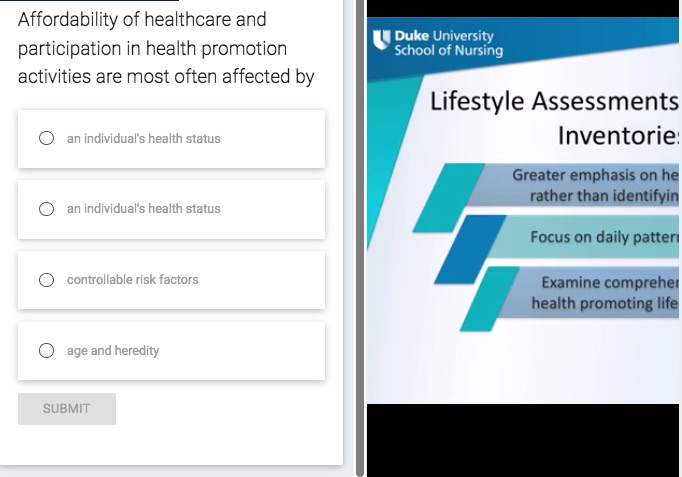
We piloted the integration of Playposit, adding in-video quiz questions in the form of multiple-choice questions to some of the lecture videos.  Playposit was used as a tool to reinforce students’ learning by building in practice time and making for a more engaging learning experience.

Integration of Global Components

Video Captured in China

Utley-Smith traveled to China to Duke Kunshan University to interview practicing health practitioners on health promotion activities to add a more cross-cultural presence by integrating this video content into the course.

Queen Utley-Smith at DKU

The instructor captured her own video in China, using video equipment available at the Duke Link. More information is available on equipment available to faculty for loan. OIT provided video training onsite at Duke. The video kit included an external hard drive and all the necessary connections, but a tripod was provided separately by OIT. A new video captured in China, “An example of global health community-based health promotion activities to combat non-communicable diseases,” was added to the course to enhance the cross-cultural learning experience for students at Duke and at Duke Kunshan.

Learner-centered Design

Our visual redesign included:  (1) designing course templates and banners and redesigning the course overview “home” page (2) streamlined navigation (3) visual redesign of the 12 lesson modules and the “Weekly Lessons” landing page, and (4) a Start Here page with embedded video, including a course orientation tour video.

Designing Global Online Courses: What to Consider

For faculty who plan to take on a global online course redesign project in the future, here are a few key points to consider:

  • Video time commitment: Faculty will need to build in practice time and plan on more than one take of a video.  Learn more at Online Duke: Time and Process to Make Video.
  • Creating modular content: In addition to the time needed to record lecture videos, storyboarding content takes time. The lecture storyboarding can be a challenge when trying to condense material to create modular content, but storyboarding can help an instructor be more efficient at condensing a large amount of content.
  • Video capture at a remote site: An instructor planning to travel internationally to capture video, but trained at Duke on using the equipment, needs to be aware the international environment will be different and it might not be possible to capture video that closely matches the way faculty were set up and trained at Duke. (It is also beneficial to have video help at the remote site.)
  • Global learner perspective: Consider how teaching methods and techniques, communication, and technology might impact international learners. Create opportunities for synchronous interactions, using WebEx or other communication tools.
  • Pilot: Always pilot the initial redesign and plan to make changes and improvements in the next offering.

Resources

10 Apr 13:54

Authoring Tool Trends for 2017

by Craig Weiss

The authoring tool industry continues to evolve. Adapt? Yes in some cases, no in other cases.  If you are inquiring adoption across all learning tech capabilities and consumer demand (from the consumer marketplace and learners), then the answer is half yes and half no. 

I won’t regurgitate everything that appeared and did not for that matter in the authoring tool space as a whole in 2016, but a few have crossed over in a positive light, which is pushing trend.

Speaking of trends. 

Similar to the one I had for an LMS, here is the Authoring Tool version for 2017.  Each item will be covered a bit afterwards. 

features

Integration

This is more of a two-prong approach.

  • Direct integration with an LMS, whether it is via an API (most likely) or some other fashion. 

The big item to remember here is that it will be a separate license or licenses to use the authoring tool that is directly integrated with the LMS.  I suspect some vendors might tie it together in some pricing approach, giving an appearance that it is free.    

This I should note is different than the common way – most common – whereas you upload your courses directly into the LMS whether it be via a desktop or SaaS.  You can use any third party authoring tool that accepts whatever course standards the LMS accepts.

With the integration you still will be able to, but the advantage to the direct integration is a quick push to the LMS, repeatedly if you decide. 

In other words, create the course, then click publish and whammo it appears in the LMS (on admin side, where they then have it go live).  Afterwards, when you make changes to the course, fix it and push.  Real time updating without all the hassle of finding it on your desktop and uploading directly.   

  • With other tools via API

Let’s say you are using Survey Monkey.  You love Survey Monkey.  Your 3rd party authoring tool has a survey function but it is not as strong as Survey Monkey.  Right now, your option is to either use the survey tool in the authoring tool or use Survey Monkey separately (which is what folks do).

In API integration Survey Monkey now appears in your 3rd party authoring tool, thus you can create surveys with Survey Monkey in the authoring tool, publish out those surveys wherever, including in the LMS (the benefit here). 

The data on results not only appear as they would in the LMS since it is via the course tool, but analytics appear in Survey Monkey as they would for a survey tool.

If the authoring tool has analytics (a trend, but one I am not a fan of), then the data could at some point, down the road, appear there too.

Expect early integration to be tied to such items as Google Drive, Dropbox, Box, OneDrive and iCloud.   However, the possibilities to other API options is endless.  And yes, I will add that integration to Twitter, Linkedin, Facebook do appear today, but that is just minimal to the potential.

I should add that the integration oomph is best served with a SaaS authoring tool.  

Mobile

No shock here.  The buzz word “Mobile First” is already in play in the LMS world and now it is appearing more frequently in the authoring tool space, especially among SaaS vendors.   Yeah, got it.

The same with “Mobile Responsive”, which everyone does.  The difference though is that when published the course should look like the course and not something smushed together and looks different than what you initially created.  With some mobile responsive, the smushed version is what you see. 

I’m still a m-learning purist. These are folks who believe that a course designed for mobile, looks great in mobile – whatever the device size is and type- but looks crummy on a desktop/laptop screen.  

As a whole, we are not there yet.  But at least, the trend of looking good on a mobile device with exact similarity to what you created is the start.  

Expect to see some mobile tools show up here as well.  I wouldn’t be surprised to see a few authoring tool vendors enable the users to upload their mobile videos,images, etc. directly into a client specific asset library in the authoring tool, for which the designer or whomever is creating the courses can utilize it. 

Yeah, you can do it now – but they the user has to send the item to you as a file and basically you have to take it from there.  Time consuming.

Publish or Perish

I talked about that up there a bit, but the basics are this:

  • Create your course, content, etc. 
  • Click the format you choose for publish
  • Click publish
  • Goes right into the LMS
  • You need to update, you can in real time (although I recommend that the update is offline in the LMS, until the admin is ready to update the “live” version). 
  • Versioning is kept within the authoring tool, with notes for example

Publish/Perish is designed for SaaS btw.  Which leads to

SaaS

The uptick is still there, growing more and more, but 100% not a chance.  I expect to see more growth this year.  Why are some vendors reticent about going cloud?

Cost is a major factor.  It is a big time investment and some vendors just have no desire to do it, even if they have the funds.  Another is design. A cloud based authoring tool behaves differently and the whole UI/UX is different.  Which is what?  Another cost.

Personally, I would never buy a desktop authoring tool.  Too many minuses today, including the infamous, if something happens to my laptop/desktop and I lose the app, I have to download again and install. 

Sure, you can save the app somewhere else, but still, it involves re-stall.  Oh, and I want it on other desktops, yeah more installs.  Thank you, my friend. 

For those wondering  – best cloud based authoring tools are

  • dominKnow Claro – #1
  • Lectora Online 
  • Gomo

Storyline 360 is not a 100% cloud based authoring tool, just fyi.

Basic 2 Advanced

The world of authoring tools started at the advanced level, Authorware, Toolbook and to an extent DazzlerMax.  You either needed a tech skill set (at least moderate) or authoring tool design/development experience and preferably both.  They all had a learning curve.

But wide adoption for the masses wasn’t there.

Then Articulate Studio appeared.  Actually it was more of Dreamweaver that came with templates (at least IMO).   Anyway, Studio was perfect for those who wanted to build a course but had no  ID/e-learning developer skill set nor moderate tech skills (no offense on either).

It was and still is a PowerPoint converter with feature sets.  But it is easy to use.

The Rapid Content Authoring Tool market took off from there.  The premise is simple.  Anyone can come in off the street and create a course.   The problem though was that folks who had the authorware and so forth experience AND/OR folks who were ID and e-learning developers were stuck.

The RCATs weren’t designed nor made for them.  But you have to use what is available.

Fast Forward.

Products like Captive, Claro, Lectora and Storyline enabled the ID folks to create robust courses.  I know plenty of people who work in custom development at places  who use these products.  And the course capabilities and output is amazing.

Nowadays there are quite a few tools that offer that power.

But here is the twist.

They also offer the ability to still create a course with either no ID/e-learning development background, course background or tech skills beyond the basics.   This is a big jump.

You can see it with really four tools (and this is not a slight mind you) – Claro, Lectora Online, Storyline 360 (started in Storyline2) and Gomo. 

 I’m sure other vendors will say, you can do it with us too, and yeah in some cases you can, but I’m basing it on my testing and others I know who are at elite level with course design and build them daily. 

Anyway, the trend will continue.  Good for all.  Oh, and sorry Captivate your tool is not easy. 

More of This/One Stop Shop

This trend is on a big upswing.  More of this simply means more features, capabilities and assets.  Oh those assets.  Vendors love to toss out big numbers.  10,000, 20,000, 50,000 assets.  My question is will you use all those assets?

My take is highly unlikely.  I’d rather have outstanding assets numbering in 200 range, than 10,000 assets, of which 9,995 represent either clip art of old days, lame templates even as HTML5, audio clips that sound like they were recorded in a garage and so on.

Regardless, the asset increase is continuing.  I expect to see an easier to find search, than exists for most vendors today, using metadata.  And cross-categories, which as a whole vendors are awful in.  A cross-category means you have a video clip.  The clip is a 15 seconds of waves.

Cross categories would be video as a category, and nature as another category.  After all some folks first instinct is to look for “nature”, others are “video”.  This is a big plus in RLOs (reusable learning objects).  

If you have the right amount of assets, with drag and drop functionality (which expect to see more of this capability on the product itself), along with my own library of assets which I create (and is expanding with more options), then when you think about it, why would I need to purchase assets from a vendor, such as eLearning Brothers.

Great assets there, but the “one stop shop” approach is emerging in the authoring tool market.  Let’s take video capture and recording.  Yes, most vendors already have it, but is it as strong as say Camtasia? 

The result is you have to purchase another tool to do that, along with your 3rd party authoring tool.   This is changing.  One stop shop.  Lots of assets, robust screen recording and capturing, video capabilities (beyond just adding a video to a course), web cam options and so on.

Video

People are wanting to create a video course.  Not just add a video to a course or upload a video into a system, but actually take a video, create bookmarking, table of contents and ability for folks to jump into different sections of the video (with tracking analytical data that goes beyond, how often Casey watched it or downloaded it).

Expect to see more vendors enabling this capability.  It will not be as robust as some of us want, but it will be better than what it is today, which is virtually nil.

Micro Learning

First off, anyone can create micro-learning with the tool they have and have had for years. I created micro learning, real life scenario based courses back in 2000.

All it means, micro-learning that is, is to have a short in length/time course.  That’s it.  It does not mean it will be engaging, interactive or useful (which all courses should be regardless of size).

You can still have a TOC with a micro-learning course and I strongly recommend it.  And if you are going video, 2-3 minutes in length.  A micro-learning course should focus on one topic only, two or three points at max on what you are covering.   Thus, you can create lots of micro courses.

Anyway, vendors will push out this capability more in 2017.   The micro-learning capability that is.   Expect ad nauseum. 

Already noted analytical data on the back end for authoring tool vendors.  Not a fan as noted. An authoring tool should uh focus on being an authoring tool, not a pseudo or lite LMS.  Plenty of those out there.  

Preview in Real Time

Many, many vendors pitch this already as a feature.  The ideal way is to see the preview in various modes, by selecting the image – i.e. it looks like a smartphone, click I see in real time what it looks like.  The challenge is to actually move around the preview, click a few screens in the preview.   

Some do it today, more – in the real time preview in specific modes, will do so in 2017.  The movement around is slow, but I expect more to incorporate.

Other Trends 

VR

We are all hearing it and will going forward.  There are a few items to note here (I also recommend reading my previous post on VR/AR/MR).

  • Custom development shops and individual folks are creating VR content
  • There are authoring tools where you can play and playback VR content
  • Consumers – companies – are expressing great interest in VR content
  • When people think of VR content – they overwhemingly think of it from an Oculus Rift or similar type headset device – This is one of the problems – and here is why

All the data that is out there shows that the explosion of VR content will come via smartphones using a VR headset and not devices such as Oculus Rift.   With an Android smartphone (the market is geared specifically for them and not iOS), you can purchase well over 75 headsets including Google Daydream that will work (or claim to) with your Android device.  Lots of apps exist in the Google Play store for VR too.

Pricing ranges from several dollars and up.  Sure there are some minuses to be aware of – 10 minutes to play then get off the thing before you get sick, then play again;  but many more people already have a smartphone. 

Another problem – the authoring tool vendors themselves.  I’ve spoken with quite a few, and no one is jumping into the VR creation option within their tool.  Well, if you want something to really take off with VR courses, you need that capability within a 3rd party authoring tool.

There are a couple of VR tools out there – NOT AUTHORING TOOL VENDORS – so if you are one of the folks who loves to mention this, then yes VR tools exist. 

I expect a vendor or two, to test the waters in 2018, late 2017.  

The same with AR, no authoring tool vendor is jumping into it and it has been around for years.

Last thing on VR – The Sony VR headset for Playstation is hot.  They are on pace to surpass their projections by mid-year.  You need a Playstation to use it (its tethered).  And for those who said to me, Oculus Rift does not offer tethered to a PC, they in fact do.

The more popular one, and the one more people are using is the non-tethered one.  Oh, I would recommend that if you are in a crowd and someone is passing around a headset, that you bring some wippies.  I have yet to see a headset be wiped with some anti-germ wipes before handing it to someone else. 

I’m waiting for the day that Xenia starts a Pink-Eye epidemic at a convention. 

Cost

Look authoring tools can be expensive.  Buying a license can be in some cases past $1,500 (per).   So, when I say cost, I’m referring to a different model.

Subscription by seats (course developers).   Expect to see this model zoom in 2017.   It is yearly, and as you can see in the consumer marketplace (Office365, Adobe Creative Cloud, to name just two) are popular.  

I’ve seen a vendor go subscription by content (it is confusing), but the better model is by humans.  As long as you maintain the subscription, you get free updates, maintenance (if SaaS based) and a higher level of customer support (not just e-mail or go to our community for example).   

Not Trends, but something you should do

Take the authoring tool for more than a test drive.  I’ve seen vendors offer seven day trials – which honestly is way too short, others higher.  I always recommend 30 days after all, someone testing it, has other things to do – and isn’t just going to sit there all day or part of each day, playing with it.

Make sure everything is active.  If they offer a tool that comes with your package – test that out and test it to see if it works as they say it does with your other tool(s), i.e. authoring tool.  

If you have a lot of course designers, test out that collaboration feature, heck if you do not, get some folks to test it out while you are in your own location.  Does it do what they say it will do? 

Do you hit any lag time?  Try it out of the workplace.  Many people nowadays create courses at the workplace but also out of the workplace.

After creating a course, test to see if it works in your LMS or see if the authoring tool vendor has a sandbox you can test in. 

A sandbox though – when it comes to an authoring tool only – doesn’t really get you the true sense if you have an LMS.  Better to test in the LMS or your LMS sandbox  (if you have one – and yeah, it is a new trend in the industry).

Community

I expect to see more authoring tool vendors having a community, beyond just a help guide/manual and/or tutorials.  

A community should include the following

  • Humans – end users and even folks exploring the product
  • Topics, categories – look for one “new users” or something along those lines
  • Moderator who responds to any question.  Take a look to see how many questions in that topic have zero responses.  What types of questions?  If it is related to the product, it should have a response.   See the lag date.  Does the moderator respond daily, hourly or once in a blue moon?  
  • Best practices or how-to that are easy to find and use.  
  • Examples –  step by step is ideal, gets back to how to do something
  • Video tutorials that follow the “show me, let me try it” model.  Majority of vendors who have video tutorials are just showing a video – i.e. screen recording.  That is fine, but seriously if you are pitching your authoring tool as something that can be interactive shouldn’t I see tutorials that are?

Knowledge banks are basic, but some are difficult to use. No offense to Microsoft here, but the search bank within Word for example is not easy.  Frustration is a better response. 

Nor do I recommend telling folks to go find videos on YouTube on how to use the product.  If that is your mantra, then I can only imagine your customer support.  

Find out if they have courses that they built, that you can see and play around in – in the community or wherever on the site. 

I want to see the true power of the what the product can do, not what I can do or someone who is brand new to it.  We want people to learn new skills and expand – you can’t to that, if you do not show me what is possible.

Lastly, negotiate if you have multiple folks.  If they want you they will do a discount, especially if you have at least ten course builders.   Unlikely to score a deal with less than that, but you never know – unless you ask.

And ask a salesperson, not someone in the community.

Bottom Line

The emerging trends for 2017.

Authoring tool style.

The market is mature.  

They range from poor to great.  The size of the space is not large, not even close.

Thus, you’ll have an easier time to find what you are looking for.

And the trends in 2017.

Will assist you in that

Endeavor.

E-Learning 24/7

Next post – March 13th, will cover the VR/AR conference, what I saw – related to products, along with the latest on Immersive learning as a whole – new data, insight for this new market.  Oh, and for those wondering, playing a video game is not immersive learning.  I’m just saying.  : )


Tagged: authoring tools, learning tech, micro learning, trends in e-learning, VR
10 Apr 13:51

CILIP the err.. library and information association.

by philipbradley

I noticed a tweet today:

He's quite right. It's very difficult to find, and I was only able to see 'Chartered Institute of Library and Information Professionals' in the title of the site and in some images. In fact, if you look a bit further, it seems to have changed its name. And the logo. And the colour of the logo. And the font...

Newciliplogo

It appears that the 'Chartered Institute of Library and Information Professionals' no longer exists. No discussion, no voting, no long, angry meetings, nothing. It's an impressively soft launch. And when I say 'soft launch' I mean 'let's not mention it to *anyone*' and see how long it takes them to notice. I am in quiet hysterics here, I really am. All that pain, anguish and quite honestly pure hatred of a few years ago, and for what? I'm sure someone is going to mention the new abbreviation could be LAIA, which is pretty close to La-la, but I'm only doing it because someone is going to, and it may as well be me.

I actually like the strapline - it's got 'library' and 'information' in there, so it's good for those that like to hark back to our roots and look forward. I'm less impressed with the logo, with it's clipped right corner which is not clever branding or artistic; it's just irritatingly sloppy. The blue is best described as 'meh-blue', because it's neither one thing or another, but hey, anything is better than that god awful pink, right? And of course, it IS just a strapline. CILIP remains, but is now a pointless acronym for a phrase that doesn't exist any more. Necessary, because the 'Chartered' bit is very important, and there's only so far that you can go without involving the Privy Council, or consulting members of course. So, if you want, you can still argue that CILIP retains the name CILIP, but as for what that means, well, that's an entirely different story.

I'm already imagining the conversations - 'Yes, I'm from CILIP, the library and information association'. 'Oh right, so what's CILIP then?' 'Well, umm, it's er... well, the library and information association'. 'So what does CILIP stand for?' 'Well, we don't like to talk about it really...' That conversation could run and run.

I'm fully expecting all of the people who took up arms last time around to do so this time. After all, last time, there were consultations galore, this time it's more a case of 'we're doing this and hoping to keep it quiet', so Nick Poole had best be on the look out for flaming brands and pitchforks outside of Ridgmount Street. It's ok - I checked, they haven't moved the offices to Harrogate or the Outer Hebrides, it's still in the same place. And there's still a President, so that's ok. Though, given the way this was done... who knows?

I'm happy with the changes; it certainly works for me. I'm slightly less happy with the fait accompli nature though. Seriously - not a single communication? Not even an update anywhere? Not a news item? Nothing? That does tend to smack of arrogance and a 'f*ck you' attitude and complete disregard for the member vote we had on the name change a few years back. If I'd argued against it, and voted against it, I would be hopping mad right now, and I'm just wondering if CILIP Council is hoping that people are just too damn tired, scared, worried about other things and worn out to do anything - perhaps the most we'll see is a quiet little 'meh, whatevs' response. But in general....

Well played, Library and Information Association. Well played. I shall now get myself a bucket of popcorn, sit back and crank Twitter up to 11. 

10 Apr 13:50

70:20:10 Holistic Knowledge Ecosystems by Dennis L. Thomas and Martha Nawrocki

article thumbnail image
Holistic knowledge ecosystems (HKEs) require a different kind of modeling expertise from that of instructional designers. The former is about faithfully modeling domains of knowledge, while the latter is about translating those domains into creative expressions intended to make learning more effective and engaging. There is a strong connection between HKEs and the 70:20:10 learning principle.
10 Apr 10:46

The old rules versus the new rules of corporate learning

by Martinc
#deloitte has just just published its 2017 Global Human capital Trends 2017 report. In its section on learning there is an interesting table on the old rules versus the new rules of learning. Read the full report here.
10 Apr 10:26

Tom Bennett's Behaviour Report

by OliverC

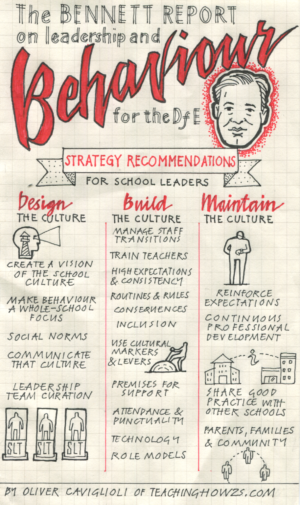
Tom was commissioned by the DFE to write a report on how leaders should lead in creating positive behaviour cultures. He asked me to provide some illustrations for this report.

The large overview infographic

The cover

Sketchnote

Here’s a sketchnote I did a week later for Tom to tweet.

21 Mar 13:49

eLearning Badges: Benefits and Best Practices

by Will Davis

By Katy Mullin, Director of Course Development at Scitent

eLearning badges

In eLearning, we’re always looking for effective ways to engage learners. A digital badge is a visual token of achievement in the online learning environment. Awarding badges as part of your online course is a way to acknowledge your learners’ accomplishments – both big and small – as they work their way through your course or certification.

Executed properly, badging can enhance learner engagement by motivating them to continue through the curriculum to earn the next badge level. Additionally, the process of creating achievement badge milestones throughout your curriculum requires you to have a clarity of purpose for your content. This helps keep you, as the learning solutions designer, on track throughout content development. It also benefits your learners by giving them visual cues about the learning landscape ahead. In addition, badging also taps into a basic human trait that exists at some level within all of us – competition. Badging motivates learners to “level up” and earn that next badge.

Not only does badging enhance your learners’ experience, it also provides an important benefit by bolstering your brand and the credibility of your online courses. Badging gives your learners an easy and visual way to extend your reach and reputation by sharing their success on social sites like LinkedIn. They can post their earned badges on their page and, by touting their achievements in this very social way, your course is promoted organically to other potential learners.

So, now that you understand what badging is and how it benefits learners and your organization, I’d like to share some best practices to keep in mind as you plan to incorporate your own achievement badges:

  • Clearly map badges to skills and topics
    Get clear on the purpose and overall goal of your course by identifying your learning objectives and the respective topics/skills. Then, you can clearly map those to a badge that is representative of a skill your course teaches.
  • Build badge difficulty
    At the beginning of your course, you’ll want to make the badges achievable, by awarding a badge for simply completing the online learner profile, for instance. But as the course progresses, you’ll want to make the badges more difficult – though not impossible – to achieve.
  • Know your audience
    The approach you take with your badge awards will depend largely on the pool of learners you are targeting. If you are creating content for engineers or physicians, for example, you might consider incorporating a leader board to engage these individuals who tend to be highly competitive.  
  • Partner with associations
    There’s a big movement toward the ability to transfer badges across an industry, which can be a powerful way to give your badges – and ultimately your eLearning content – “legs.” For example, a course for bookkeepers could be structured so after achieving a badge at a certain level, the learner becomes eligible for a certification from a CPA organization. By striking partnerships such as these, you will be able to offer additional value to your learners who not only obtain your badge, but also can achieve additional certifications for professional advancement.

Do you have questions about how to incorporate badges in your eLearning content? Leave comments below, or contact us to learn more.

The post eLearning Badges: Benefits and Best Practices appeared first on Scitent eLearning.

21 Mar 13:47

Beyond Training – The Importance of Workwide Learning

by Jane Hart
There is a lot of talk about lifelong learning – but most of it focuses on lifelong education – that is continuously taking courses throughout your life. For instance, the recent Economist article, Lifelong learning is becoming an economic imperative, explained how “Technological change demands stronger and more continuous connections between education and employment”. This …

Continue reading "Beyond Training – The Importance of Workwide Learning"

21 Mar 13:43

Pearson Shares Its Learning Design Principles by Pamela S. Hogle

article thumbnail image
In a push for transparency, Pearson has published a set of 45 learning design principles under an open license; a company blog says that the company seeks an “extended dialogue” around their use.
06 Mar 13:42

Why Do Employees Stay? A Clear Career Path and Good Pay, for Starters

by Andrew Chamberlain
mar17-06-158935401

Employee turnover is expensive. Replacing an employee who quits costs, on average, 21% of their annual pay. While it’s tempting to dismiss turnover as a fact of life in today’s fast-moving job market, new research shows otherwise. Many reasons employees jump ship are surprisingly simple, and business leaders who don’t ask why workers want to go may be unnecessarily losing people who are pricey to replace.

At Glassdoor, we have ample data on workers’ job trajectories from millions of résumés that people have shared on our site. Looking at those résumés, we can gain insight into the reasons for employee turnover by comparing job transitions where workers stayed with their original employer with those where people left for another company.

Related Video
What Great Managers Do
Exceptional managers find and capitalize on their employees' unique strengths. Learn how they do it with this 6 minute video slide deck. Download a customizable version in Subscriber Exclusives.

In a new study, Glassdoor data scientist Morgan Smart and I looked at more than 5,000 job transitions from a sample of thousands of résumés shared by job seekers on Glassdoor from 2007 to 2016. Some were employees who moved into a new role but stayed at the same employer — for example, a junior accountant who switched into a job as accounting manager. Others were employees who moved to a new role and left for a new employer.

By combining the data on real-world job transitions with Glassdoor company ratings and salary information, we were able to pinpoint which statistical factors push workers out the door and which motivate employees to stay and grow in their existing organization. Although these patterns are correlational, we believe they reveal important clues to the HR puzzle of how to retain talent. In our study, we looked at how job turnover correlated with pay, company culture, how long an employee has been in their current job, what industry they’re in, and more.

Factors That Drive Turnover

One of the drivers of turnover is easy to overlook: allowing workers to stagnate in their current role. Even after controlling for pay, industry, job title, and many other factors, we find workers who stay longer in the same job without a title change are significantly more likely to leave for another company for the next step in their career. Stagnating in a role for an additional 10 months raises the odds that employees will leave the company for their next role by about one percentage point, a statistically significant effect.

The likely reason is that workers who don’t see a clear progression from their current role to a better position in their company ultimately turn to opportunities elsewhere. And that suggests an easy solution. By providing clear paths for employees, moving them through job titles on a regular progression over time, employers can help boost perceived career opportunities and limit this type of harmful stagnation.

Pay Matters

However, our research finds that escalating workers through new job titles over time isn’t enough; making sure pay is competitive is also essential to retaining talent. We found that 10% higher base pay is associated with a 1.5-percentage-point increase in the likelihood that workers will stay at their current company the next time they move to a new role, a statistically significant link.

The lesson is that in the long term, employees won’t stay for new job titles alone. As they assume new responsibilities on their upward paths, compensation should rise along with career arc. If managers do not offer meaningful promotions, in both responsibilities and pay, our data suggests employees are more likely to look elsewhere for their next role.

Culture Matters

Aside from career progressions and pay, we found that workplace culture matters for employee retention. This will come as little surprise to leaders who are well aware of the research showing the benefits of positive company culture. When employees switch employers, we find they usually move to companies with higher Glassdoor ratings.

In particular, we found that raising a company’s overall rating on Glassdoor by one star (on a one-to-five scale) was associated with a four-percentage-point higher chance that employees would stay for their next role. Similarly, we found statistically significant links between two detailed measures of workplace culture: higher career opportunities ratings and higher culture and values ratings. In each case, raising a company’s Glassdoor rating on these two dimensions by one star (out of five) was associated with a five-percentage-point higher chance that workers would stay for their next role. It appears that employees who see clear career paths for themselves and who feel committed to a company with a positive value system are statistically less likely to leave for their next role.

What Doesn’t Seem to Matter

We found that some workplace factors don’t seem to matter for employee turnover. The first is the quality of a company’s senior leadership. This suggests to us that workers who are deciding whether to remain with an employer do so based on their own prospects for growth in a job, or perhaps based on their relationship with their manager. Even the most inspiring CEOs may not increase worker loyalty if individual employees feel that their careers have stagnated.

Second, we find that work-life balance doesn’t have any statistical link to whether employees stay or leave. Work-life balance certainly contributes to overall employee satisfaction, but does not seem to matter much for turnover compared to other factors. Workers often choose to leave an employer when their prospects for advancement are better elsewhere, and a job with great work-life balance isn’t likely to change that decision much.

What It Means

From the perspective of employees, moving to a new role is something to look forward to. On average, we find workers earn a 5.2% raise in base pay each time they transition to a new role. But more often than not, employees find it necessary to leave for a new employer to achieve that career progression: Among the résumés we examined, 73% of job transitions were workers leaving their employer, while just 27% stayed for their next role.

That high rate of employee attrition illustrates the challenges facing HR managers, but also suggests an opportunity. There is room in today’s labor market for greater reliance on internal transitions relative to external career moves. Addressing the drivers of employee turnover can have a profound impact on organizations over time. Even a 1% improvement in the odds that employees will stay for their next role can translate into hundreds of retained employees at a 10,000-person employer.

For recruiters, there is another side to the findings of our study. Our results suggest a variety of ways to target talent that may be ready for a move. Candidates who have stagnated in roles for a year or more are statistically more likely to be receptive to recruiter inquiries than candidates who are rapidly climbing their company’s career ladder. And candidates whose current employers have low culture ratings or who are underpriced relative to the market are statistically more likely to consider offers at new employers.

Employee turnover is a costly quandary for employers. Our research shows that employers are partly in control of turnover, and that there are clear solutions to reduce it. To better retain employees, set a clear career path for employees, pay them competitively, and cultivate a healthy workplace culture.

06 Mar 11:26

gaining insight through social and informal learning

by Harold Jarche
I.gardner.gb

Love this as a performance improvement visual.

Organizational performance improvement is comprised of reducing errors and increasing insights, according to Gary Klein. For the past century, management practice has focused very much on error reduction, with practices such as Six Sigma, especially in manufacturing.

“Fifty-eight of the top Fortune 200 companies bought into Six Sigma, attesting to the appeal of eliminating errors. The results of this ‘experiment’ were striking: 91 per cent of the Six Sigma companies failed to keep up with the S&P 500 because Six Sigma got in the way of innovation. It interfered with insights.” —Gary Klein

Learning and development (L&D) practices reflect this priority on error reduction. Subject matter experts are interviewed or observed, good practices are noted, and then training programs are designed to develop the skills that make up some or all of a job. Anyone with the requisite abilities, as quantified in the job description, can then be trained.

But what if we don’t know what work needs to be done? This is the area of insight. We cannot know in advance what insights will develop emergent practices. Most organizations have some error reduction processes in place. Few have practices to increase insights. We cannot train for insights. But we can put in practices that might lead to an increase in insights. Klein identified five types of ‘triggers’ that produced insights, based on 120 case studies he reviewed.

  1. Contradictions
  2. Creative Desperation
  3. Connections
  4. Coincidences
  5. Curiosity

These five triggers can be enhanced through informal and social learning. The last three are often outcomes of the practice of personal knowledge mastery. Insights usually come while working, resting, and playing, not while undergoing training.

As more aspects of jobs get automated there will be less demand for standardized, routine work to be done. This is the type of work for which training has traditionally been developed. But there will be an increased demand for unique, non-standardized work. While courses cannot be developed to directly improve these human traits — curiosity, creativity, empathy, passion, and humour — systems can be put in place to promote them at work. Often this involves reducing artificial barriers between people so they can learn from each other.

To improve insights on an organizational level, all work should be focused on learning. This is learning while working, not heading off on a course or attending a class. Social learning involves working out loud, sharing insights, questioning assumptions, and trying things out together. Time is needed for all of this, especially time for reflection, missing in all too many workplaces. Encouraging and supporting social learning can prepare the workforce for a creative, network economy.

This economy, and the society that emerges, will be much more complex than the previous market economy. We are already seeing signs of this as our established institutions struggle to deal with complex challenges for which they were never designed. Complex problems often require insight, beyond what training can prepare anyone for. There are no clear objectives with complex problems. Learning as we probe the problem, we gain insight and our practices are emergent (emerging from our interaction with the changing environment and the problem). This is social learning, which is much fuzzier than following a prescribed educational curriculum. Prescribing training to address complex performance situations does not work. There are too many variables to train for. Instead, systems and structures are needed to support social and informal learning in work teams, communities of practice, and social networks. This is 90% of the 70:20:10 principle.

05 Mar 10:52

Budget will give green light to FE maintenance loans, which is a step in the right direction

by Shane Chowen

It’s hard to believe that it’s been nearly a year since Lord Sainsbury’s independent panel on Technical Education reported the findings of their inquiry and kick-started what the government are now calling “the most ambitious post-16 education reforms since the introduction of A Levels 70 years ago.”

Central to Sainsbury’s reforms, and subsequent commitment from government including the 2017 Spring Budget, is to ‘level the playing field’ between an established and well-respected academic route through post 16 education, and a technical training route for ‘other people’s children.’

Part of this divide has been that for a long time, the State has significantly financially incentivised full time residential higher education; tuition fee loans and maintenance loans for living costs have been provided and the information on accessing those is relatively easy to come by. There’s even a handy government calculator

Post-recession, interest in forms of education and training that were ‘vocational’ and ‘work based’ grew.

However at the same time, public funding for those kinds of courses was cut.


But, in 2013, tuition fee loans were introduced in to the further education sector. Now from 19 years-old upwards, an Advanced Learner Loan will cover your tuition costs and you’ll repay under the same terms as HE student loans; 9% of your income over £21,000 a year and nothing until you earn that amount.

This is undoubtedly a step in the right direction.

Yet, the State provides additional loans to help HE students meet some of their living costs while studying.

There was still an unfairness in the system. Quitting your full time job and doing a full time level 4 in a technical subject somewhere across the country would still not be a viable option unless you were well off enough to afford all of your living costs yourself.

So, redressing the balance between academic and technical student finance support even more, then Skills Minister, Nick Boles MP, launched a consultation 12 months ago on the introduction of further education maintenance loans.

One year later, and we have now heard that government intends to go ahead with its proposals and introduce maintenance loans for higher technical students to “create real parity with the academic route”. Maintenance loans will be made available to support students on courses at levels 4-6 at National Colleges and Institutes of Technology.

Providing extra support to stimulate demand for higher level technical training is absolutely welcome. But the question has to be asked – what about all of the higher technical students of the future, on a Sainsbury approved technical training route, but not studying at a National College or Institute of Technology? Is this levelling the playing field, or is this just another ball-game of winners and losers?

In our response to the original consultation of maintenance loans, Learning and Work Institute opposed restricting access to maintenance loans for students in National Colleges and Institutes of Technology. We believe it would be wrong for the State to intervene in the supply market in such a way that doesn’t have anything to do with quality.

The government would not suddenly restrict student loans to students at Russell Group universities.

Instead, there should be a universal offer of maintenance loans for higher technical education students. Just like there is for university students.

This is undoubtedly a step in the right direction.

We look forward to when more detail will be published following the Budget on Wednesday.


04 Mar 21:35

‘Shocked’ staff sent packing as huge apprenticeship training provider goes bust

by FE Week Reporter
I.gardner.gb

Not going to be the last of these.

One of the largest apprenticeship providers in England has called in the administrators after the Skills Funding Agency terminated their contract, FE Week has learned.

First4Skills, which holds an annual £15m apprenticeship allocation and is 60 percent owned by City of Liverpool College, this afternoon told around 200 ‘shocked’ staff to pack their belongings and leave.

It is understood as many as 6,500 apprentices will be affected, typically in the retail sector, some with the 14 subcontractors that share £4.7m in contracts.

Matthew Kopanski, an employee in the administration team at First4Skills, described  how “we were emailed today, and a minute later called into an office with the director and the administrator and told we have no job, no notice period and no redundancy pay from the company.

“It’s a massive shock and I’m disappointed with what has happened. I have rent to pay and holidays booked, as well as other day to day expenses.”

One First4Skills manager took to LinkedIn to say “this has been an absolute shock to all concerned. So many talented staff members, not to mention the learners, will be affected by this decision.”

Another this evening said: “I am utterly gutted! I have given First4Skills my all for over 10 years, working with some amazing people. I wish all of my colleagues to come out of this stronger than ever.”

It is believed that First4Skills were inspected by Ofsted in early February and in a few weeks their published report will confirm a grade four, which as a private training provider would typically lead to a funding contract termination.

When asked whether the Skills Funding Agency were aware of the situation, a DfE spokesperson said: “We have exercised our right to terminate First4Skills Limited’s contract.

“We are working to ensure learners’ programmes are not disrupted and that where required alternative training provision is identified and transfer arrangements made.

“We will work with employers through the National Apprenticeship Service to ensure they are fully involved in the transfer process.”

The First4Skills website has been taken down and this afternoon the phone went unanswered.

The majority owner of First4Skills, City of Liverpool College, has itself had “severe financial problems” requiring millions in bailouts according to the government..

In a scathing letter from the Skills Minister in October, the college was informed it was to be placed into “Administered College status with immediate effect.”

The letter said that despite the college spending money on lawyers to challenge the FE Commissioner process the “government has provided £2 million of Exceptional Financial Support to the college as a result of its failures of financial management this year”.

The Minister went on to say “the Commissioner’s initial assessment in April indicated that the existing leadership had failed to exercise adequate financial oversight, and the recent, incomplete stocktake also found that the board had not properly managed senior post holders or held them to account.

Financial mismanagement is not simply a matter of hitting annual budgets, but of proper financial planning which enables the college to invest in outcomes and quality.”

As a result of the ‘administered status’ the college is “required to consult the Skills Funding Agency about any fundamental changes affecting its operations or finances.”

At the time of publication City of Liverpool College had not been approached for comment.

26 Feb 20:05

The 2nd edition of the MWL Newsletter is now online

by Jane Hart
Published weekly on a Sunday, the MWL Newsletter provides news and articles about Modern Workplace Learning (MWL) selected by – and with commentary from – Jane Hart. Sign up to receive this newsletter by email. MWL Newsletter No 2 is now available.
26 Feb 10:31

Five Disruptions in Learning and Performance That You Must Adopt Now by Vicki Kunkel

article thumbnail image
About six percent of Fortune 500 companies have reimagined and redefined work and, in the process, have enjoyed increased profits and higher employee morale. How did they do it? By embracing and implementing disruptive technologies in employee performance and training. Here are the five disruptive technologies that are the “secret sauce” for these companies’ successes.
25 Feb 11:15

Colleges welcome new apprenticeship subcontracting rules

by Jude Burke

Colleges are using the new subcontracting rules to regain some of the ground lost to independent training providers accused of nicking their lunch, FE Week can reveal.

Just a third of apprenticeship funding is currently allocated to colleges – and a significant proportion of that is actually delivered by independent training providers acting as subcontractors.

The problem has become so severe that the former skills minister Nick Boles warned colleges in 2015 that they should not let ITPs “nick your lunch” over apprenticeships.

But new rules coming into force in May mean that lead providers will soon need to “directly deliver” at least some of the training or assessment of each apprenticeship programme – and the government stresses that this must “not be a token amount”.

The change is being seen as “an enormous opportunity to expand apprenticeship provision”, according to Andrew Martin, the deputy principal of West Nottinghamshire College, which has the largest apprenticeship allocation from the Skills Funding Agency of any college.

Why on earth are you letting these guys [ITPs] nick your lunch?

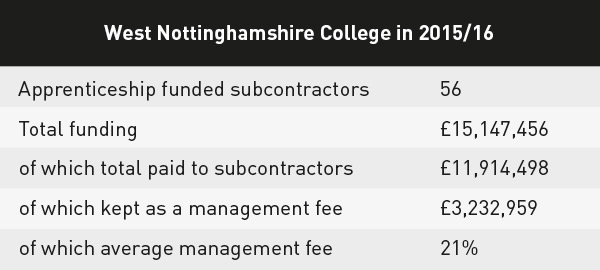
The college subcontracted 82.4 per cent of its apprenticeship provision in 2015/16, which earned it £3.2 million in topslicing fees from provision worth £15.5 million.

However, he added that “new delivery models are already emerging” which “will still require a sub-contracting relationship”.

The rules state that “the volume of training and/or on-programme assessment that you directly deliver for each employer must have some substance and must not be a token amount to satisfy this rule.”

All subcontracting arrangements must now be agreed with the employer before the start of an apprenticeship programme.

As previously reported by FE Week, the proportion of all apprenticeship funding allocated to colleges dropped from 37 per cent in 2015/16 to 32 per cent in 2016/17 – despite Mr Boles’ challenge for colleges to double their share of apprenticeships.

Speaking at the Association of Colleges annual conference in November 2015, he urged colleges to move from delivering one third of all apprenticeships to two thirds.

“As your friend, I have to ask you this, why on earth are you letting these guys [ITPs] nick your lunch?” he asked.

A Freedom of Information request published by the AELP in June 2016 revealed the scale of apprenticeship subcontracting by colleges.

The FOI, based on SFA data, showed that 40 per cent (62,240 out of 157,290) of all apprenticeship starts contracted through FE colleges in 2014/15 were actually delivered by ITPs as subcontractors.

All lead providers are required to publish a list of subcontractors, the value of any subcontract, and the management fees retained they have retained.

A top-slice fee of around 15 to 20 per cent of the contract value is typical for many lead providers – income that is now at risk due to the new rules.

But Teresa Frith, senior skills policy manager at the AoC, said the new rule would not stop colleges from subcontracting.

“What it will do is stop those main and subcontractors who see apprenticeships as an income stream, with little serious thought given to providing quality education and training,” she said.

The needs of the apprentice and the employer must be the priority for both the provider and the subcontractor

“The needs of the apprentice and the employer must be the priority for both the provider and the subcontractor.”

Eastleigh College principal Jan Edrich said she “welcomes the opportunity to deliver some provision directly to apprentices”.

The college subcontracted 80 per cent of its apprenticeship provision in 2015/16.

A spokesperson for Hull College, another major subcontractor, said it was also looking to continue to farm out part of its provision.

The college is “working closely with partners to ensure any future delivery within a partnership model meets the criteria clearly set out by the SFA”, according to its spokesperson.

And a representative for Central College Nottingham said it had “developed a five-year plan going forward to reduce our subcontracting activity and work with partners in other ways”.

FE Week has repeatedly reported on the issue of subcontracting – and the large management fees charged by lead providers – since our first edition in 2011.

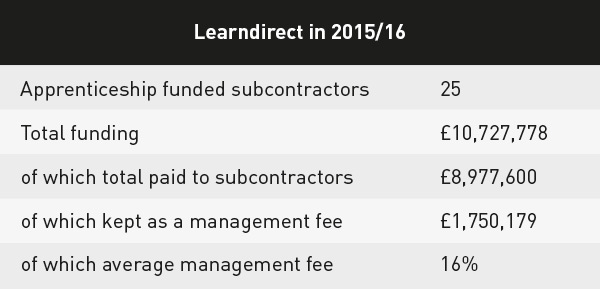
One of the worst offenders is Sheffield-based provider Learndirect, which retained almost £20 million in management fees from its 64 subcontractors in 2015/16 – amounting to 36 per cent of its £55.3 million SFA funding.

A Learndirect spokesperson said: “We expect our engagement with subcontractors to reduce as our primary approach is to directly deliver apprenticeship services to these employers.”


West Nottinghamshire College: New delivery models

The impact of the new subcontracting rule is likely to be felt most keenly at West Nottinghamshire College.

It has the largest apprenticeship allocation from the SFA of any college – but the majority of its provision is delivered by subcontractors.

According to figures published on its website, the college subcontracted provision worth more than £15 million in 2015/16 – representing 82.4 per cent of its apprenticeship provision.

These deals earned the college £3.2 million in management fees.

Andrew Martin, its deputy principal, acknowledged that the new rules would “reduce the value of subcontracted provision over the course of the 2017/18 year and beyond, as many high-quality training providers who previously subcontracted choose to work directly with employers”.

He pointed out that “new delivery models are already emerging”, and that these would “still require a subcontracting relationship” with “training providers and colleges working in partnership to best meet employers needs for quality apprenticeship delivery”.

He added: “We see the reforms as an enormous opportunity to expand apprenticeship provision through West Nottinghamshire College to improve workforce skills, whether this is through traditional direct delivery or by working together with our outstanding range of training-provider partners.”


Eastleigh College: Welcoming the opportunity

Eastleigh College has the second largest adult apprenticeship allocation of any college – but also subcontracts the majority of this provision.

It has an adult apprenticeships allocation of £11.5 million and a 16-to-18 apprenticeships and traineeships allocation of £1.8 million for 2016/17.

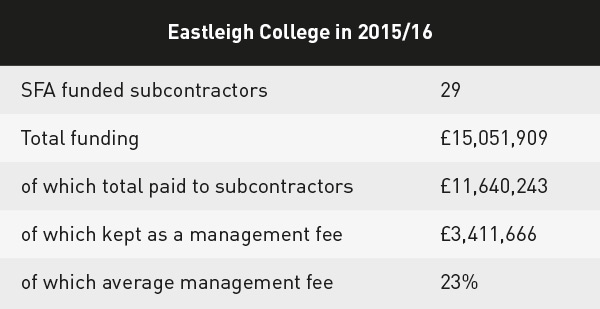
Eastleigh’s published subcontracting fees for 2015/16 show that it subcontracted provision worth £15 million, retaining management fees of £3.4 million – although it’s not clear how much of this was for apprenticeships.

A spokesperson told FE Week that 80 per cent of its apprenticeship provision for that year was delivered by subcontractors.

Its principal Jan Edrich said the college “welcomes the opportunity to deliver some provision directly to apprentices within its subcontracting arrangements”.

She indicated that the college still saw subcontracting as part of its apprenticeships programme.

“The college has had a strong partnership relationship with its subcontractors for many, many years and sees the new requirement as a further way of enhancing the way it works with them,” she said.

“The apprenticeship programmes being developed to meet the new requirement bring together the strengths of each partner for the benefit of the learner.”


Learndirect: Engagement with subcontractors to fall

Learndirect – which keeps hitting FE Week headlines due to its soaring top-slicing fees – has said it will deliver more apprenticeships itself.

Latest figures published in November showed it retained almost £20 million (around 36 per cent) in subcontracting management fees from total funding worth £55 million.

The provider has now said it expects “our engagement with subcontractors to reduce as our primary approach is to directly deliver apprenticeship services to these employers, but recognise that should the partnership require it we will explore other delivery options, which could include an element of subcontracting”.


24 Feb 16:44

New legal apprenticeships contract between SFA and employers unveiled

by Paul Offord

The controversial new legal agreement, that employers will have to sign with the Skills Funding Agency to run new apprenticeships, has been unveiled.

FE Week exclusively revealed last September that businesses would for the first time have to sign strict contracts with the SFA – rather than just with providers, as the sector had expected.

The ‘sensitive’ document has now been published on gov.uk.

The key paragraph states: “The SFA reserves the right to recover from the employer any funding paid to a training provider from the employer’s digital account, where the payment of funding or any arrangement between the employer and the training provider does not comply with the funding rules.

“The SFA will act reasonably and proportionately in exercising its discretion to recover any sum from the Employer under this clause.”

This will come into affect with the launch of the new apprenticeship levy, when larger employers made to pay will take responsibility for deciding how they should spend resulting funds stored in their digital account.

Having read the new contract, Association of Employment and Learning Providers boss Mark Dawe said: “While the overarching principles of the levy and delivering apprenticeships are relatively straightforward, the contractual relationship between the SFA, employer, provider and learner is significant.

“This guidance makes clear that the funding is government money with government requirements. 

Mark Dawe

“We are working with AELP member providers to support them in understanding the key elements and also helping our members support and explain to the employers that they are delivering training to. 

“As we have previously said, the separate contract between the employer and the provider is equally important and we have already invested in making sure all parties understand their obligations.”

The need for the new contract with the SFA and the employer only came to light when FE Week asked about  about an unrelated matter – whether providers paying to access employer levy pots would break bribery laws, an issue which had been worrying the AELP.

In the SFA’s response, they let slip that there would be “agreements between the SFA and the employer” – a condition that has never previously been mentioned publicly.

The SFA spokesperson said: “In the contractual arrangements between the SFA and the employer this practice will be prohibited. This will be mirrored in agreements between the SFA and providers.”

These contracts came as a shock to many involved with FE and skills, given that the government’s message up until then had been that the only financial relationship for employers would be with the provider.

Pippa Morgan

Pippa Morgan, head of group at the CBI, told FE Week at the time: “We are concerned this is only coming to light now… as company procurement process are complex and time consuming to change.

“The outcome of all this needs to be something that enables firms to buy the training they need, while avoiding gaming of the system.”

The levy, first announced by the government in July, is set at 0.5 per cent of an employer’s paybill.

As outlined in the new guidance, all employers will receive a £15,000 allowance to offset against the levy.

This means only businesses with a paybill of more than £3m will pay.

The money raised will be ring-fenced, so it can only be spent on training apprentices and all levy-paying companies will receive a 10 per cent top up on monthly levy contributions.

24 Feb 16:40

Trends from LT17 – Part 2

by abipearsunicorn
We pick up with part two of our blog looking back at the overarching trends and themes from last week’s Learning Technologies show…  The changing role of L&D Dr Tobias Kiefer, Global Learning Leader Advisory at Ernst & Young Munich, described the role of L&D departments as becoming ‘conductors of the orchestra’. No longer will […]
24 Feb 16:34

Trends from LT17 – Part 1

by abipearsunicorn
It’s been a few days since the curtain came down on Learning Technologies so now is the perfect time to look beyond the event white noise and reflect on what we really learned from the 2017 conference and exhibition. It was called different things, described in different ways, utilised in different capacities, but when you […]
24 Feb 16:22

The Uber HR mess, it probably starts at the pitch meeting

by Steve

I don't have a lot more to add to what has been voluminous coverage over the last several days of the recent expose of Uber's (probably) hostile work environment, particularly for the women at Uber. The process of the shocking reveal of what is was really like to work at Uber from a former employee, the wide and far calls of condemnation and Uber boycotts, followed by the quick (and high profile) reactions and vows to 'fix' things from Uber's CEO and their celebrity board member are playing out more or less how you would expect them to.

Whether or not Uber can, wants to, or will really be able to 'fix' things remains to be seen, and is probably the less important of the things that the rest of us can take away from this mess. It is probably more useful for us to think about how Uber (and others like them), got to this point in the first place.

Recode has a good piece about how Uber insiders attribute a large portion of the situation at Uber, the ineffectual support and response of internal HR to employee complaints, to the HR culture at Uber of being 90% about recruiting, and 9% about terminations, with the leftover 1% spent doing the necessary admin functions. I made up the percentages, but the idea is clear - Uber was scaling up at a rapid pace, hiring was critical to meeting their business objectives, and it seems likely once people were hired, they were more or less on their own.

And while the Recode piece makes some great points, and I have no reason to think it is not accurate, I would add one more possible 'cause' to all this mess at Uber, (and the many, many other tech companies that continually struggle with these issues). And it is this - from the earliest stages of the enterprise, the initial presentations and investor pitch decks that the founders use to raise funds, building and supporting diverse teams of people is almost (I can't find one example) never mentioned in these contexts. The 'formula' for raising investments does not include things like a diversity plan or strategies to incorporate talent from underrepresented groups as a key element that will lead to business success.

It is just never mentioned. What gets mentioned, (and rewarded), are the product ideas, the 'briliance' of the founder, or the reasonable line of sight the investor can assess from the idea to some kind of highly profitable outcome. 

I did some quick searching this morning for 'Best Pitch Decks Ever' or 'Top Pitch Decks of All Time' and I looked through about 20 of them and did not find one mention of diversity, inclusion, or a stated goal to build a more open, welcoming, fair, or equitable workplace. Note, I am certain this exists somewhere, but I could not find an example right off the bat.

So back to the question of where to these problems start at places like Uber?

I think they start from that very first slide deck and from that first presentation where I bet no one talks about these issues.

Should they be raised at that early point in a company's growth? I will leave that up to the professional investors and founders I guess.

But having said that, leaving that question up to those two groups has led us to places like Uber.

Have a great Wednesday!


24 Feb 16:16

Rule change could price assessors out of running apprenticeship exams

by Jude Burke

It might not be financially viable for awarding bodies to run end-point assessment exams, after it emerged that they will be forced to base their costs on deals negotiated with employers without their say-so.

New rules coming into force in May will set the cost of final apprenticeship exams at a fifth of the overall training costs agreed between an employer and a training provider – moving away from previous guidelines which set the charge at no more than 20 per cent of the funding-band maximum for that standard.

Assessors fear that this means they will lose money if employers drive hard bargains on deals with providers.

A draft copy of the handbook for apprentice assessment organisations, seen by FE Week, makes it clear that the change is designed to drive down overall costs.

It says: “The published rules confirm that the 20 per cent is of the total agreed price, not 20 per cent of the funding-band maximum.

“We agreed this because if the agreed price is less than the funding-band maximum, it ensures that the assessment costs are proportionately lower as well.”

Awarding organisations can only provide their services for a fair price

Stephen Wright, the chief executive of the Federation of Awarding Bodies, issued a stark warning about the impact of the new rule.

“Like every other organisation, awarding organisations can only provide their services for a fair price,” he said.

“If the percentage of the price between the trainer and the employer is too low to deliver a valid assessment, then awarding organisations will simply not offer end-point assessments, which will undermine the whole system.”

Graham Hasting-Evans, the managing director of NOCN, a major awarding body, said that awarding organisations need control of the exam charges, to make sure they cover their costs and are able to make some profit.

He stressed that apprenticeship exam costs “are driven by the employer group’s specification for testing as set out in the assessment plan, and have nothing at all to do with the training costs”.

Details of what should be included in an apprentice’s final exam are set out by the employer groups developing a standard, and are outlined in the assessment plan.

Exam costs… have nothing to do with the training costs

Some of these can be highly detailed, and therefore have high costs attached to them. For example, the gas network team leader assessment plan estimates the final exam to cost £3,808.

But the standard has a funding-band maximum of £9,000 and the agreed price may be lower than that.

As the assessment costs are not related to the cost of training, the cost of delivering these exams to the specification set out in the assessment plan is unlikely to change regardless of the negotiated price for the apprenticeship.

Mr Hasting-Evans said that one way the government could reduce the cost of apprenticeship exams was to “review all the specifications with a view to improving efficiency and reducing costs”.

FE Week understands that a number of assessment organisations are reporting difficulties in recruiting assessors at payment rates that would allow them to break even.

The government has already started struggling to persuade organisations to sign up to deliver apprenticeship final exams.

By the end of January just over half – 81 out of 159 – standards approved for delivery had at least one assessment organisation in place.

But the proportion of learners on standards without an approved assessment organisation has been dropping rapidly, from 42 per cent in July to 18 per cent in October.

The Department for Education declined to comment either on the rule change or on the concerns raised by Mr Hasting-Evans and Mr Wright.

07 Feb 09:52

Emotional Intelligence Has 12 Elements. Which Do You Need to Work On?

by Daniel Goleman
feb17-06-682304915

Esther is a well-liked manager of a small team. Kind and respectful, she is sensitive to the needs of others. She is a problem solver; she tends to see setbacks as opportunities. She’s always engaged and is a source of calm to her colleagues. Her manager feels lucky to have such an easy direct report to work with and often compliments Esther on her high levels of emotional intelligence, or EI. And Esther indeed counts EI as one of her strengths; she’s grateful for at least one thing she doesn’t have to work on as part of her leadership development. It’s strange, though — even with her positive outlook, Esther is starting to feel stuck in her career. She just hasn’t been able to demonstrate the kind of performance her company is looking for. So much for emotional intelligence, she’s starting to think.

The trap that has ensnared Esther and her manager is a common one: They are defining emotional intelligence much too narrowly. Because they’re focusing only on Esther’s sociability, sensitivity, and likability, they’re missing critical elements of emotional intelligence that could make her a stronger, more effective leader. A recent HBR article highlights the skills that a kind, positive manager like Esther might lack: the ability to deliver difficult feedback to employees, the courage to ruffle feathers and drive change, the creativity to think outside the box. But these gaps aren’t a result of Esther’s emotional intelligence; they’re simply evidence that her EI skills are uneven. In the model of EI and leadership excellence that we have developed over 30 years of studying the strengths of outstanding leaders, we’ve found that having a well-balanced array of specific EI capabilities actually prepares a leader for exactly these kinds of tough challenges.

There are many models of emotional intelligence, each with its own set of abilities; they are often lumped together as “EQ” in the popular vernacular. We prefer “EI,” which we define as comprising four domains: self-awareness, self-management, social awareness, and relationship management. Nested within each domain are twelve EI competencies, learned and learnable capabilities that allow outstanding performance at work or as a leader (see the image below). These include areas in which Esther is clearly strong: empathy, positive outlook, and self-control. But they also include crucial abilities such as achievement, influence, conflict management, teamwork and inspirational leadership. These skills require just as much engagement with emotions as the first set, and should be just as much a part of any aspiring leader’s development priorities.

W170124_GOLEMAN_EMOTIONALINTELLIGENCE


For example, if Esther had strength in conflict management, she would be skilled in giving people unpleasant feedback. And if she were more inclined to influence, she would want to provide that difficult feedback as a way to lead her direct reports and help them grow. Say, for example, that Esther has a peer who is overbearing and abrasive. Rather than smoothing over every interaction, with a broader balance of EI skills she could bring up the issue to her colleague directly, drawing on emotional self-control to keep her own reactivity at bay while telling him what, specifically, does not work in his style. Bringing simmering issues to the surface goes to the core of conflict management. Esther could also draw on influence strategy to explain to her colleague that she wants to see him succeed, and that if he monitored how his style impacted those around him he would understand how a change would help everyone.

Similarly, if Esther had developed her inspirational leadership competence, she would be more successful at driving change. A leader with this strength can articulate a vision or mission that resonates emotionally with both themselves and those they lead, which is a key ingredient in marshaling the motivation essential for going in a new direction. Indeed, several studies have found a strong association between EI, driving change, and visionary leadership.

In order to excel, leaders need to develop a balance of strengths across the suite of EI competencies. When they do that, excellent business results follow.

How can you tell where your EI needs improvement — especially if you feel that it’s strong in some areas?

Simply reviewing the 12 competencies in your mind can give you a sense of where you might need some development. There are a number of formal models of EI, and many of them come with their own assessment tools. When choosing a tool to use, consider how well it predicts leadership outcomes. Some assess how you see yourself; these correlate highly with personality tests, which also tap into a person’s “self-schema.” Others, like that of Yale University president Peter Salovey and his colleagues, define EI as an ability; their test, the MSCEIT (a commercially available product), correlates more highly with IQ than any other EI test.

We recommend comprehensive 360-degree assessments, which collect both self-ratings and the views of others who know you well. This external feedback is particularly helpful for evaluating all areas of EI, including self-awareness (how would you know that you are not self-aware?). You can get a rough gauge of where your strengths and weaknesses lie by asking those who work with you to give you feedback. The more people you ask, the better a picture you get.

Formal 360-degree assessments, which incorporate systematic, anonymous observations of your behavior by people who work with you, have been found to not correlate well with IQ or personality, but they are the best predictors of a leader’s effectiveness, actual business performance, engagement, and job (and life) satisfaction. Into this category fall our own model and the Emotional and Social Competency Inventory, or ESCI 360, a commercially available assessment we developed with Korn Ferry Hay Group to gauge the 12 EI competencies, which rely on how others rate observable behaviors in evaluating a leader. The larger the gap between a leader’s self-ratings and how others see them, research finds, the fewer EI strengths the leader actually shows, and the poorer the business results.

These assessments are critical to a full evaluation of your EI, but even understanding that these 12 competencies are all a part of your emotional intelligence is an important first step in addressing areas where your EI is at its weakest. Coaching is the most effective method for improving in areas of EI deficit. Having expert support during your ups and downs as you practice operating in a new way is invaluable.

Even people with many apparent leadership strengths can stand to better understand those areas of EI where we have room to grow. Don’t shortchange your development as a leader by assuming that EI is all about being sweet and chipper, or that your EI is perfect if you are — or, even worse, assume that EI can’t help you excel in your career.

06 Feb 15:18

Is the future of L&D already here?

by kategraham23

Three days isn’t really long enough to reflect on everything that I saw and heard at Learning Technologies 2017 last week, but whilst things are fresh in my mind I wanted to capture some immediate takeaways.

The stand out session for me was from the keynote speaker on day one, Thimon de Jong. You can hear my immediate thoughts in this interview with Martin Couzins straight afterwards. Even though the talk was not about L&D specifically there was so much that resonated with me, especially with reference to the Digital Learning Realities research that Fosway has been conducting in partnership with Learning Technologies. This isn’t a plug – it genuinely gave me lots of reasons to be cheerful. I often leave keynote talks from futurist type speakers, or look at the gap between what’s being talked about on the conference floor versus the exhibition, and feel a bit depressed. But this talk combined with the initial results from the research indicates, to me at least, that L&D knows where it needs to go.

‘You know me’

Thimon talked about a ‘you know me’ culture. One where we want companies to respect our privacy, but conversely to exploit the data they have on us to create tailored experiences based on our preferences that speak to us in a more personalised way. That might be as a customer of Vodafone, or it might be as a learner within your own organisation. Consumer-facing organisations are improving at this all the time and it’s a trend that needs to happen internally as well as externally. The digital realities research bears out an understanding from L&D professionals (1,060 at the time these particular numbers were crunched) that they key drivers for digital learning are increasing availability (87%), speed of learning (84%) and learner engagement (83%). All of which point to a need for creating ‘better’ learning experiences.

The numbers also demonstrate an increasing focus on the importance of analytics. And it is the artificial intelligence and algorithms which drive analytics that give us a realistic hope of being able to deliver personalised learning experiences en masse. Netflix is so often cited as an example of an experience that learning should aspire to that I now eye-roll whenever I hear it. But interestingly, Thimon told us that there are over 300 people working in the in AI department at Netflix….that’s a serious amount of human intervention in what’s purportedly ‘artificial’ intelligence right there! The average L&D team clearly can’t compete with that! However, if we continue this emerging trend of treating learners like consumers – much as Thimon referenced – then getting a grip of analytics, and learning how to apply the insights it provides us with, is a key step in getting the right content to the right people at the right time.

And the reason this made me cheerful (or at least not depressed) is that L&D seems to recognise this – and there is lots of decent technology out there that can help us act on it. This isn’t about looking ahead at how virtual reality might one day land in the average organisation. This is about something we can start doing now to improve what L&D does.

In L&D we trust

The second part of Thimon’s talk which also resonated, was a discussion on trust. The internet is so full of information, but he questions how we determine what’s fact and what’s opinion. In the current climate of ‘fake news’ this could hardly be more timely. But focusing back in on L&D again, we know that learners don’t just get their information from the learning department these days. Everyone has access to Google (even if it’s via their personal phones rather than company systems) but sifting through what’s fact and what’s opinion, which videos are worth watching and which sources are worth reading can be hard work. This is where the evolution of L&D’s role kicks in.

The excellent Lloyds TSB case study session from Richard Clayton and Angela Sweeney talked about how they successfully began surfacing relevant content to the right people at the right time based on internal ‘demand plans’ carefully crafted with each business department. They worked out what was needed and by whom, and how best to filter that content through to their learners (whilst making some incredible cost savings). Later on, Tobias Kiefer of EY went one step further and explored the concept of ‘Own Your Own Learning’. My tweet on where this leaves the L&D department seemed to strike a chord, because where does this leave L&D?

Kiefer believes L&D needs to become ‘challengers, storytellers, curators, eonomists and data analysts – a list to which Andrew Jacobs (quite rightly in my opinion) added engineers (there still needs to be some infrastructure). ‘By thinking of how we can make ourselves obsolete, we can generate the value the business has always been expecting from us’ Kiefer said. I’m not sure I agree with this 100% but changing the focus from trying to be the last word in where/how learn in an organisation, to one of providing access, filtering, tailoring and nudging is one I can get on board with.

Coming back to Thimon’s point, L&D has to establish itself as a trustworthy source. And coming back to the research, it’s not only about providing content and resources that are accurate and useful – but providing them in ways that are easily available, contextual and engaging are all part of building that trust with learners.

This all makes me feel optimistic because my sense is L&D has grasped that this is the direction of travel. And the technology needed to support it is already out there. It’s not about stuff that’s super expensive or out of reach (although I’m sure you could spend a lot if you have the budget). And that makes me think it’s eminently achievable in the not too far distant future.

More on Learning Technologies 2017 to follow…


06 Feb 13:26

The Future of the Corporate University

by Benjamin Kessler, Asia Editor and Digital Manager
How firms can maximise the impact – and profitability – of in-house management training.
06 Feb 12:31

10 eLearning Trends You Need to Know for 2017

by AurionLearning
I.gardner.gb

A fair enough list of current priorities.

25th Jan 2017
0
L&D professionals have a lot to keep up with, the change of pace isn’t slowing down that’s for sure! Staying up-to-date on industry...
By
AurionLearning
Marketing Manager
03 Feb 10:26

Learning Technology Map 2017

by julianstodd

I sketch a map of learning technology every year, not to talk about specific systems, but rather trends and direction, as well as reflections on application. Some key points about this year’s map: I retain an overall frustration that much of the industry focuses on features and technology over learning methodology and effectiveness. It’s a weakness of the system, where vendor’s lead conversations to sell product, to a market whose needs are changing, where many in the market don’t yet realise it.

Learning Technology Map 2017

For the first time last year I split the map into light and heavy technologies: the point was to represent how learning is increasingly impacted, out in the real world, by lightweight, pocket -sized technologies. Organisations tend to focus on heavyweight infrastructure technology. I think the Socially Dynamic organisation will maintain a broad ecosystem of technology that utilises both.

Learning Technology Map 2016

Learning Technology Map 2016

The key thing about lightweight technology is that it is rapidly developed, rapidly prototyped, typically cheap, highly interconnected, and most importantly of all, absolutely most importantly of all, it’s rapidly disposable.

This is a core weakness of current organisations: they are exceptionally good at procuring technology that is heavyweight and long lasting, and they do so from a marketplace of vendor’s trying to secure long-term and broad reaching contracts. And yet out in the real world, we are adopting and cycling through rapidly iterating and highly disposable technologies. In a rapidly evolving ecosystem, we need this capability.

Learning Technology Architecture

The person who has just procured a system needs the space and authority to walk in six months later and say, ‘this is no longer fit for purpose, something better has come along that we should prototype’. Few people in any organisation can say this, and yet the most agile and dynamic organisations will do precisely this. This is the challenge of change: constraints are often not imposed upon us from outside, but rather are held in the power structures and ways of being that we have built internally. The very things that made us strong yesterday may make us weak today.

In lightweight technologies I think the big interest is around AI, although what people usually mean is machine learning. True AI, if indeed it’s ever possible, may be decades away, but machine learning is with us now. It has broad potential and will revolutionise many aspects of what we do today. Indeed, if I had to characterise it, I think few people recognise how much of an impact it is already having. One challenge being that much of that impact will come at the cost of current jobs, power, and individual potential. As an entire ecosystem changes, new roles will emerge, and old ones will fall away.

The Future of Technology: innovation and impacts

Much of the early impact of machine learning will be mundane, but it will grind forward and change everything: particularly as we see narrative capability, storytelling capability, where the technology can tease out stories and write them in a compelling manner.

The potential for the geolocation and contextualisation of knowledge and learning is largely untapped: for many types of organisations, from manufacturing to military, there is huge potential here.

Future Tech: Innovation and Impact

Social learning is of great interest, although almost universally I see common mistakes: a belief that technology will drive engagement, when in fact it may do the opposite. In the Landscape of Trust research, the early results show that people trust formal technology much less than we would like to think, possibly 30% less. Technology is a foundation, but an early challenge for organisations will be to build high functioning, highly cohesive, high trust, communities.

The rise of reputation, held within social systems, but impacting into formal ones, is significant, and we are seeing the emergence of technologies that will support this. As with many aspects of technology that sits at the intersection between formal and social systems, we will have to find ways to maintain a dynamic tension between conflicting interests. Annual performance management is outdated, deeply asynchronous, and often misused. Reputation-based, synchronously measured, socially engaged, aspects of performance, measuring support, thanks, kindness, generosity, sense making, support, are deeply relevant. I would encourage any organisation to experiment meaningfully in the area of social reputation, measured with technology.

In an ever noisy world, filtering technologies will come of age. I would be exploring this as it has potential to clear space within the system, to give people the time needed for reflection.

On the heavy side, the LMS and other heavyweight systems remain often unloved, repainted but outdated, and often seeing social as their salvation. Don’t misunderstand me: I think most organisations need a really superb LMS as part of their formal infrastructure. The mistake is to expand the remit of the LMS into other areas, without understanding how those other, predominantly social, areas function.

The Socially Dynamic organisation will have a great LMS, alongside a broad range of other technologies: some highly formal, some highly social, all deeply interconnected. So there may be a heavyweight backbone, but surrounded by, and connected to, this wide range of lightweight and adaptive systems.

Work on badges is widespread and needs to broaden to cater for both formal and socially moderated badges: badges defined and awarded by the community itself.

I’m working more around game dynamics and mechanics at the moment, I suspect we will see the increasing failure of early game systems and approaches that are not based upon robust learning methodology that clearly demonstrates not interactions, but how game dynamics are supporting learning.

Games are another area to explore and experiment, not yet to buy off the shelf.

Finally monitoring: one of the early impacts of machine learning will be the monitoring and utilisation of social chatter within the organisation. As we step into this space, we need to be deeply engaged with and respectful of the community. Indeed we may need an ethics committee. Who owns this content? How was it recognised and rewarded? Tread carefully in social spaces.

I simplified the learning technology map this year: last years had more reflection in it, but in retrospect was somewhat complex when I shared it. We are just at the dawn of the exciting impact of many categories of technology, which will revolutionise learning. There are some great organisations designing and developing these technologies, and some great organisations buying and using them. I would just encourage a fluidity on both sides: for vendor’s to invest more in research and learning science, and for organisations to get better at experimenting, relinquishing control, and earning trust.