Shared posts

17 Jul 14:41

Academic LMS Market Share By Enrollments, Part Deux

by Phil Hill

Based on our recent publication of market share data and graphics, we have had multiple requests to share similar data by enrollment. In Friday’s post I shared a non-traditional view of the LMS market based on the percentage of institutions within small, medium, and large enrollment bands for North America (US and Canada) and Europe. This view gave some interesting insights, particularly with large positive correlation (Canvas) and negative correlation (Moodle)  between enrollment bands and market share in North America. Meanwhile, there were other LMS solutions (D2L and Sakai in particular) that have fairly consistent distribution in market share.

For this second view, instead of showing percentage of institutions within each enrollment band, the data is aggregated for all North American institutions and scaled by each institution’s official enrollment data (e.g. the US data is from IPEDS). The net result shows the percentage of enrollments across the region that have different LMS solutions as their primary system at their school. As always, the underlying data for these market share studies is provided by our partner LISTedTECH.

Some Notes:

  • For North American Higher Education, Blackboard Learn at 39% is still in first place, Canvas is second at 25%, D2L Brightspace is third at 15%, Moodle is fourth at 13%, and Sakai is fifth at 4%.
  • It has been widely reported when just looking at percentages of institutions that Moodle has long been the second most-used system in North America, but in this view both Canvas and D2L Brightspace have a larger market share.

It is useful to look at different views using institutional and enrollment metrics to get a deeper understanding of the academic LMS market dynamics.

The post Academic LMS Market Share By Enrollments, Part Deux appeared first on e-Literate.

17 Jul 12:34

Flipping Training on its Head: Getting Started with a Performance Support Video Solution

by Chuck Jones

Many training departments today are incorporating performance support tools, including the use of micro video, into their arsenals to help their employees perform the work required of their positions. The effective development of this type of solution requires us to re-think the traditional training model. In this article, I’ll explain why. Then, I’ll give you some tips and tricks I’ve used for the past 6 years as I have developed my own performance support video system comprised of more than 120 individual videos.

learn_doThink of a traditional classroom setting.  What are some characteristics of traditional training? When does learning occur? When are the skills applied? If your sessions are like most anyone else’s, your learners may feel like they’re drinking from a firehose. For software training, they may receive a bulky manual outlining all of the software’s features along with step-by-step instructions for performing the myriad of tasks they will be required to do once training is complete. They learn, then they do.  Learning occurs first. Only after that do the learners apply the new skills back on the job. Along the way, we hope as instructors that the ‘a-ha’ moment occurs at some point during the training.

do_learn2But what if we could flip that model? What if we could give learners the tools necessary to immediately perform the duties of their position, even before receiving any type of formal training? What if we could develop a system so that learning follows doing rather than precedes it? That’s exactly what performance support is.  It’s breaking down a job into its individual tasks, then providing some type of tool to help the worker complete that task. The skills can be applied immediately.

In 2000, I developed my first EPSS (electronic performance support system.) I had developed an intense two-week training session in which I taught coding technicians how to code 18 different transactions into an HR software program. I broke down the two weeks into 18 “chunks.” During each of these chunks, I presented some brief conceptual information about the transaction we would be coding, demonstrated how to code it, and then gave learners some examples which they needed to code into our training database. When the learners completed their training, they returned to their desks with their cumbersome 3-inch thick binders and we turned them loose on the software. After I developed the EPSS, I was able to reduce the two-week training program to three days.  how_used3We then spent two days of practice using those same simulations I had developed for the two-week course. I gave them the practice they needed on using the performance support video solution. Accuracy rates of coding increased by nearly 20% for new coders evaluated after 90 days on the job. In other words, their performance was higher even though they spent fewer hours in the classroom.

Performance support walks users through a process. They do. And as they do, or even after they do, they learn. The a-ha moment occurs not during the training, but rather back on the job.

I am currently involved in a multi-year project in which we are developing more than 120 short performance support videos to help learners work through some very complex processes. When we conducted focus groups after releasing our first batch of videos, we learned that since most of our users have two monitors, they have the actual software program open on one monitor, with one of our videos open on the other. steps2They’ll watch a step of the video, pause it, then complete that step in the software program. Then they’ll resume the video, pause it, and complete the next step, and so on.

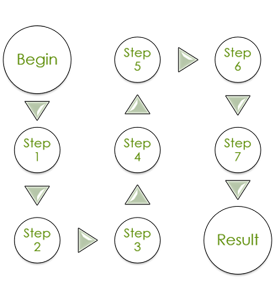
Most processes require a number of steps to complete.  You begin with step 1 and complete each step until the result is achieved.  Each step can vary in the amount of time each takes to perform, as well as the complexity of what is to be done to accomplish that step. For each step, you will want to consider using an individual performance support video.

In my next article, I’ll share with you how I make these videos available to learners and the various roles required to build an effective performance support video solution. We’ll then look at the process of building a peanut butter and jelly sandwich and break it into its steps. From that, we’ll develop a shot list so we can begin developing our video system.

17 Jul 12:34

The unbearable lightness of knowledge working

by Michael Hanley

Here’s an interesting article that’s been rattling around the web for a while now, but worth revisiting: according to Jared Sandberg at the WSJ – In the Information Age, so much is worked on in a day at the office… Continue Reading →

The post The unbearable lightness of knowledge working appeared first on E-Learning Curve Blog.

10 Jul 12:16

Would Penge by any other name smell as sweet?

by Paul Mawdesley

Local historian Martin Spence explores the origins of the P-word

Let’s face it, Penge is widely regarded as a bit of a joke, and a lot of that is down to its name. But why exactly is the name thought to be so funny? Is it because it’s a single syllable? Is it the dialectical interplay between the initial plosive ‘P’ and the extended nasal ‘enge’? I have no idea. But those of us who choose to live here must simply learn to live it.

In fact, Penge is a very unusual place-name: the only pre-English, British place-name in Greater London. As we’d expect, most places around here have English names: Beckenham, Bromley, Croydon, Dulwich and Sydenham are all modern versions of good old English place-names which go back to Anglo-Saxon times. But Penge is older still. It derives from the British language spoken by the native population before the Anglo-Saxon settlement, the language from which modern Welsh is descended.

The name has two parts. The ‘Pen’ part means ‘head’ or ‘hill’ or ‘high’ or possibly ‘end’. The ‘ge’ part is a squashed survival of the word ‘coed’ which means ‘wood’. If Penge’s name were English, it would be something like Woodhill, or Woodhead, or Woodend, or High Wood, all of which would be sort of OK, but much less interesting, less exotic, than Penge.

How did this ancient British place-name survive so long? We know that this whole area was heavily wooded (it was part of the Great North Wood, remembered in ‘Norwood’), so maybe it was a sort of refuge, where British-speakers kept their own language alive while most of their neighbours came to speak English.

There are other place-names in South London which hint at the same thing. The ‘Camber’ in ‘Camberwell’ may be related to ‘Cymry’ which is the modern Welsh word for Welsh people. And in nearby ‘Walworth’ the ‘Wal’ element may be related to the word ‘Welsh’ itself. The implication is that, during the Anglo-Saxon settlement, English only became the dominant language very slowly, and for a while there was an ethnic and linguistic patch-work, with some British-speaking communities hanging doggedly on. And in one case – the case of Penge – the British place-name hung on for so long, and became so familiar to English-speakers as well, that it stuck.

Penge enters written history as ‘Paenge’ in a charter of 957, issued by King Eadwig:

Herto ge byreo se pude pe hatte Paenge . seofen milen . seofen furlang . and seofen fet embeganges. (“Hereto belongeth the wood that is called Penge, seven miles and seven furlongs and seven feet round about”).

The place to which Penge ‘belonged’ was the manor of Battersea, which then occupied a large swathe of South London. Battersea owned Penge for its woods, valuable both for grazing animals, and as a source of timber for building.

Incidentally, this link between Penge and Battersea continued for the next 900 years. Even today you can see a metal boundary post in Upper Norwood which reads ‘Battersea 1854’. This seems insane given that Battersea is nearly ten miles away. But in 1854 the post was quite correct: it was marking the boundary between Penge – then a “detached hamlet of Battersea” – and Croydon.

After 957, Penge’s next documentary appearance was in a charter of 1067. In that year, fresh from his victory at Hastings, William the Conqueror gave Battersea to the Abbot of Westminster – which meant that the Abbot was also entitled to “the hunting of the Wood which appertains to Battersea”, that wood being Penge.

There is another oblique reference in the Domesday Book of 1086, where Battersea’s wealth is said to include “wood for fifty hogs of pannage” – that is to say, enough acorn-producing woodland to graze fifty pigs. Again, this must be Penge, because Penge was the only extensive woodland that Battersea possessed.

An intriguing document from King John’s reign records a legal settlement between the Abbot of Westminster, and William de Ginnei and his wife Matilda from Beckenham. The settlement stated that “his wood of Pange” belonged to the Abbot; but it also granted William and Matilda, alone among Beckenham residents, extensive rights to graze their pigs, cattle and sheep in the woods. This looks like a pretty good result for a middle-ranking couple up against one of the most powerful churchmen in the land.

Even 400 years later, when Penge started to appear on printed maps, it was still identified as a wooded, rural, ‘green’ place. In John Speed’s 1610 map of Surrey it is shown as ‘Pensgreene’, and in John Rocque’s map of 1746 the cluster of houses around the Crooked Billet appears as ‘Penge Green’, with Penge Common stretching round to the north and west.

So, the next time some idiot pokes fun at Penge, you can round on them and say:

Aha! The joke is on you, my friend! For Penge is a unique survival from the ancient British tongue which is ancestral to modern Welsh!! I wonder if you can laugh at that!!!”.

And you will find that indeed they can.


You can read more about the history of Penge in Martin’s terrific book ‘The Making of a London Suburb: Capital Comes to Penge’, available in local bookshops and online.

The post Would Penge by any other name smell as sweet? appeared first on Penge Tourist Board.

10 Jul 12:05

What is a Knowledge Management Strategy—Is it Enough?

by Dana Youngren

Knowledge is the most abundant asset a business has–but it’s also the most frequently wasted. People bring unique knowledge and expertise with them to work, but all too often, it stays in their heads or siloed within their team. Employees waste time trying to track down the right information or subject matter experts, and when people leave the company, their knowledge goes with them.

Unless their organization has a company-wide knowledge management strategy in place. 

Keeping teams aligned and informed is critical in our ever-changing business world, and the organizations that are most successful at this likely have a carefully crafted knowledge management strategy to help them operate efficiently and grow.

But what does a modern knowledge management strategy look like, and how can it help improve operations so that organizations meet their goals?Let’s dive into what a knowledge management strategy looks like in practice and how it can help build a framework for team alignment.

Knowledge Management Strategy: A Definition

When you look at where your organizational struggles are coming from, consider this: are departmental silos fragmenting your work environment? Moving quickly can mean growing where you need it, when you need it, resulting in a fragmented workplace. With separate departments focused solely on their given roles—be it sales, marketing, customer support, IT, or any other number of responsibilities—communication and knowledge sharing can feel impossible.

A knowledge management strategy is a plan of action that outlines how your organization will manage and centralize company information, data, and knowledge to improve your productivity and efficiency. The most successful of these strategies are closely aligned with company-wide goals and objectives.

Why Is a Knowledge Management Strategy Important?

Your organization has a vast trove of knowledge, including corporate intellectual property, institutional knowledge such as process and policy documents, and the individual know-how that each employee brings to their role. This collective intelligence is critical to both day-to-day operations and innovation—but you’ll never realize its full value if people lack easy ways to share, access, collaborate across, and leverage your company’s knowledge.

By investing in an organization-wide knowledge management strategy, businesses can empower their teams to tap into shared knowledge and make informed decisions that impact revenue, retention, and innovation. Benefits of a successful knowledge management strategy include:

  • Boosted productivity as employees spend less time looking for information and more time applying it
  • A decrease in duplicated work and errors
  • Faster and better informed decision-making
  • Accelerated employee onboarding (and a better onboarding experience)
  • Customer service improvements due to frontline employees having fast access to the knowledge they need
  • Increased employee self-sufficiency and confidence
  • Better collaboration and cross-functional collaboration on new ideas and information

How to Develop a Knowledge Management Strategy

Building a knowledge management strategy from the ground up might seem daunting, but it’s a classic eating-the-elephant-one-bite-at-a-time process. Breaking it down into smaller activities and identifying the right team members to help implement the strategy will make your initiative much more manageable.

Here are the key steps to start with:

Identify Your Needs

Start by documenting the challenges your organization is trying to address and how a knowledge management strategy will help you resolve them. Examples might include:

  • Knowledge lives in many different repositories. → We need one central repository for company-wide knowledge.
  • Employees waste hours per week trying to track down information. → We need a searchable platform that reduces the time it takes to find information.
  • Knowledge is lost when employees leave the company or move to a new role. → We need clear processes to have employees document and share their knowledge.

Set Goals and KPIs

Once you know what challenges you’re trying to solve, you can start setting goals around them. Your goals should be SMART: specific, measurable, attainable, relevant, and time-bound. You should also determine your key performance indicators (KPIs). These will be metrics that help you measure your success. For example, if you have a goal around reducing the time employees spend searching for information, one of your KPIs might be average hours saved per employee per month.

Map Existing Knowledge and Gaps

Conduct a knowledge audit to identify all your organization’s knowledge assets, where they live, and who has access (consider bringing together a team to divide and conquer this project). This will help you identify current obstacles (e.g., are some teams unable to access certain assets that they need?), come up with a plan to migrate assets to a centralized location, and uncover knowledge gaps that you need to fill through new content creation.

Establish a Cross-Functional Knowledge Management Team

Identify stakeholders from different teams who understand the value of knowledge management and are interested in working cross-functionally to improve your company’s KM efforts. Make sure they have the bandwidth (and willingness) to commit to participating in your KM initiative, and then establish a regular cadence for the team to meet. Make sure each meeting is as productive as possible by assigning action items based on your goals.  

Best Practices of Knowledge Management Strategies

When setting out to implement a knowledge management strategy, every organization is unique. There are, however, common practices that span organizations and industries, including:

  • Increasing awareness and understanding of all the types of knowledge (explicit, implicit, and tacit) that exist across the organization
  • Building a business case and attracting resources for implementation
  • Providing a communicable plan about where your organization is now, where you want to be, how knowledge management will get you there, and how you will measure that
  • Working with knowledge management champions across different departments and promoting an organization-wide culture of knowledge engagement
  • Identifying an executive sponsor who can drive buy-in for your knowledge management strategy from the top down

Not sure where to start with your knowledge management strategy? We’ve got you covered.

Download our Step-by-Step Guide to Performing a Knowledge Audit.

But Is Knowledge Management Enough?

Having a strategy in place to share company knowledge is a great place to start, but is it enough? It depends on what you include.

If your knowledge management solution is focused solely on documenting and preserving information, then no, it isn’t enough. A knowledge management strategy is most successful when it also includes:

  • Communication to break down silos between departments
  • Tools to make it easy for employees to search for and leverage company knowledge without extensive training
  • Opportunities for employees not just to access, but to actively contribute to, their organization’s collective intelligence

Documenting knowledge and information is only one piece of the equation: you also need to empower employees to engage with and add to that knowledge so that it becomes a dynamic, sustainable resource.

If you are currently using knowledge management tools that have low engagement and are not making tasks easier, reconsider your strategy. It may be time to dig deeper and find a solution that goes beyond the basic management of company data. Give your employees an easy-to-use platform to not only share their knowledge but also communicate and collaborate around that information.

Note: We periodically update blogs to reflect the latest trends, research, and best practices in knowledge management. This blog was most recently updated and expanded in February 2023.

The post What is a Knowledge Management Strategy—Is it Enough? appeared first on Bloomfire.

10 Jul 12:03

Rage Against The ‘Meh’: Our Fight Against So-So, OK and “That’s Fine”

by merge-admin
10 Jul 09:40

Academic LMS Market Share: A view across four global regions

by Phil Hill

In much of our coverage of the LMS market as well as media stories, there is a natural tendency to focus on change. Institution x abandons LMS y and adopts LMS z. In our recent post on Moodle, I described the trajectory of Moodle, noting that “the data seem to indicate a collapse of Moodle selections in the US and Canada, and potentially a significant slow-down in other regions”.

But we need to be careful to not lose perspective and miss the installed base of LMS customers. While there has market share information for US higher ed available for years, we can now share the broadest description of LMS market share in higher education. The view below, originally shared with subscribers to our LMS market analysis service, shows market share as the percentage of primary systems at degree-granting institutions for each of four global regions: North America (US and Canada), Europe, Latin America, and Oceania (Australia, New Zealand and surrounding island countries).

Thanks as always to our partners at LISTedTECH for the data and visualizations.

What is most striking to me is that across the globe we essentially have had a duopoly in this market – Moodle and Blackboard Learn. North America is the only region where a third-place solution (Canvas) or fourth-place (D2L), comes close to these two systems in market share. And Canvas only recently began its push into international markets. Put simply, Moodle and Blackboard own the lion’s share of academic LMS usage for higher education for all four global regions we currently track.

Additional Notes

  • From a regional perspective, North America is the only region that is not truly a duopoly. There are four vendors in that region who have 90% of the market share.
  • At the same time, Europe has the largest number of long-tail systems. Sakai, Ilias, Olat, Stud.IP, Claroline, itsLearning, and Fronter are all second-tier competitors (although our data shows virtually no new implementations for these systems – see this report for more details).
  • While I have seen plenty of coverage about Moodle’s global footprint, what is less known is just how strong Blackboard Learn’s market position is internationally. And this view doesn’t even cover one of Blackboard’s biggest clients in Saudi Arabia, a nationwide deal.
  • There has been a lot of investor interest in Instructure since they went public almost two years ago. Depending on your perspective, Canvas either has a long way to go to join Moodle and Blackboard as overall market leaders, or Canvas has a tremendous amount of headroom to continue its growth both in North America and in international regions.
  • While not discussed as frequently in LMS market coverage, D2L ranks third in Oceania and Latin America market share and fourth in North America.
  • It will be interesting at the users conferences for Moodle (MoodleMoot in the US), Blackboard, D2L and Instructure to see how much these providers share information about their global presence.

Yes, there is a lot of change occurring in the market with Canvas growing the fastest and D2L Brightspace securing key wins in the past year. But this view of installed base should augment the change-based coverage and provide a broader view to understand the general situation of academic LMS usage for higher ed.

The post Academic LMS Market Share: A view across four global regions appeared first on e-Literate.

10 Jul 09:32

Most eligible employers not yet on levy system

by Alix Robertson

Less than half of the employers eligible to register on the government’s apprenticeship system had done so by the end of May this year, new government statistics suggest.

A total of 8,200 accounts were registered by May 31, according to figures published for the first time by the Department for Education on July 6.

But figures published by the DfE last August estimated that 19,150 companies – which represent just 1.3 per cent of all employers – would be eligible to pay the apprenticeship levy.

This suggests as many as 11,000 large employers have yet to sign up with the online service that enables them to spend their levy funds.

March was the most popular month for registering for an apprenticeship services account this year, with 3,390 accounts set up, followed by 2,060 in April.

When FE Week asked whether the Department for Education was happy with the progress and if it would be doing anything to try to encourage more employers to sign up, a spokesperson said: “We have been working hard to support employers, and our records show they are engaged and ready to use their funds to invest in quality training for apprentices.

“Currently nearly 90 per cent of top levy paying employers have registered to the apprenticeship service.”

Mark Dawe, the chief executive of the AELP, said the figures fitted with what he had been hearing from providers about their conversations with employers.

“Levy payers have two years to spend their money and some are carefully considering what their mix of apprenticeship training should be, whether via recruitment or training up existing members of staff and at what levels,” he told FE Week.

“There is still a big job to do for providers as the government’s salesforce for apprenticeships to explain to a significant number of employers the benefits of using their levy funding and a key message is that Brexit means investment in skills via apprenticeships is more important than ever.”

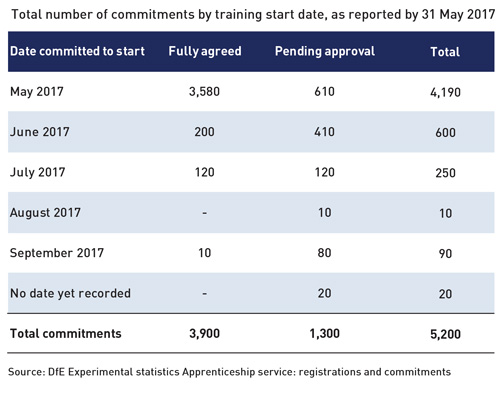
The latest DfE figures also showed that employers had made 5,200 commitments to deliver apprenticeships on the apprenticeship service by May 31, while a huge 4,190 of these planned to start delivery that month.

A further 600 commitments were made with June as the training start date, and 250 for July.

The numbers dropped to single figures for August and September.

Speaking at the AELP 2017 conference on June 26, Keith Smith, director of funding and programmes at the Education and Skills Funding Agency, praised the work of his department for simply getting the apprenticeship service up and running.

“The first question is ‘how many people in the room lost money betting that the system wasn’t going to be ready on time?’ So, that was a huge achievement for us,” he said.

“A year ago I came and spoke at this very conference, put this very slide, and said this is what the service was going to encompass, this is what we’re going to stand up for levy paying employers, and importantly change the way that you guys interact with the system and the service.

“This is what we’ve done, and this is what we’ve achieved. So we’ve delivered it pretty much to the letter.”


06 Jul 08:46

How We Encourage Continuous Learning at Teamwork.com

by Gráinne Forde

CEO of Teamwork.com, Peter Coppinger, shares details of how the company is building a strong reading culture to support the professional growth and development of every team member.


I’m a firm believer that reading is the best shortcut to growth.

When I hear of companies with an internal book club, I must admit I’m a little jealous because I believe that having something like this helps to build better companies.

We did attempt a company book club here at Teamwork.com a while back, but to be completely honest it was a disaster because we assumed a book club should operate in a certain way. We were forcing people to have a book read by a certain date and to discuss it as a group. That was the wrong way to do it, and the result was that it sucked the joy out of the process.

I realize that not every improvement initiative is going to work for every company, so I made the decision to continue experimenting with ways to encourage workplace reading until we found the right fit for Teamwork. After trying, testing (and failing!) with the book club initiative I decided to make another attempt at promoting reading in our workplace.

Today, we’ve replaced the book club concept with recommended readings.

Whenever I come across a book that has the potential to improve Teamwork.com or encourage professional development I always recommend the titles to the rest of the team in Teamwork Chat. I wanted to take this a step further so taking inspiration from David Cancel and the list he published on Seeking Wisdom I purchased 10 copies of all 13 books for Teamwork.com’s office library. The titles are:

  1. Ego Is The Enemy
  2. The One Thing
  3. Focus: The Future of Your Company Depends on It
  4. Do The Work: Overcome Resistance and Get Out of Your Own Way
  5. Sam Walton: Made In America
  6. The Score Takes Care of Itself: My Philosophy of Leadership
  7. From Impossible To Inevitable: How Hyper-Growth Companies Create Predictable Revenue
  8. Hooked: How To Build Habit-Forming Products
  9. Crossing the Chasm: Marketing and Selling High-Tech Products to Mainstream Customers
  10. Behind the Cloud: The Untold Story of How Salesforce.com Went from Idea to Billion-Dollar Company-and Revolutionized an Industry
  11. Marketing: A Love Story: How to Matter to Your Customers
  12. Predictable Revenue: Turn Your Business Into A Sales Machine
  13. The Hard Thing About Hard Things: Building a Business When There Are No Easy Answers

Here’s a snippet from the internal blog post I published when I announced the recommended reading list initiative to the rest of the team:

These books will be in the office library in January, and I’d love, if, in your spare time you would pick one to read and share your thoughts. Remote Teamsters, all you need to do is create a task for the Accounts team specifying which books you want. Also, if anybody wants to keep a copy from the office library for themselves, that’s no problem, just replace it by creating a task for the Accounts team.

Shortly after introducing the recommended reading list to Teamwork, I figured that this wasn’t enough, so I made the decision to take my quest to encourage reading another step further again by including copies of all 13 books in each of our new hire’s onboarding packs. I also made the team aware that the company is happy to buy books, ebooks or audiobooks once the simplicity of our expense policy is kept in mind: “Always act in Teamwork.com’s best interest.”

The reason why I want to build a strong reading culture is simple—I want Teamwork.com to be a company staffed exclusively with people who are continuously learning—and books are the best way to do this. That said, I understand that we all have life and time pressures and other pursuits so all I ask of everyone (including myself) is that we do our best, even if that just means reading a few pages when we’re taking a break.

Looking ahead to next year, one idea I have is to make our recommended reading list collaborative by updating it with the 10-15 most recommended books from the entire team.

If anyone has other ideas on how to build a strong reading culture at work, I’d love to hear from you in the comments below!

The post How We Encourage Continuous Learning at Teamwork.com appeared first on Teamwork.com.

21 Jun 15:49

Business apprenticeship: a viable business model in management education

Journal of Management Development, Volume 36, Issue 6, Page 734-742, July 2017.
Purpose The purpose of this paper is to position the business apprenticeship model (a work-based learning model where student managers alternate between academic and workplace learning) at a political, institutional and student level in order to explain how it fits within the French business education landscape and how it is considered as a viable business model in management education. Design/methodology/approach Business apprenticeship is analysed through the prism of Osterwalder and Pigneur’s (2010) Business Model Canvas to evaluate the nine dimensions of the business model: customer segments, value proposition, customer channels, customer relationships, revenue streams, key resources, key activities, key partners and cost structure. Findings Two major advantages of the model are identified, namely, the potential for widening participation and affordability and three concerns are outlined: the corporate vision of the apprentice, the recent governmental reforms on funding this model, and the potential synergies between theory and practice. Research limitations/implications This paper is useful for all those who wish to develop an apprenticeship track within their business schools and for employers who are considering the development of apprenticeship partnerships with business schools. Originality/value This paper provides insight into business apprenticeship as a work-based learning model.
21 Jun 15:47

The xAPI story continues and it’s quite an exciting one!

by Peter Gillis

The xAPI story continues and it’s quite an exciting one!

By Mirjam Neelen


Back in 2015, Learnovate completed an initial xAPI project to explore the overall concept and all the things organisations would have to consider when implementing xAPI.


Back in 2015, Learnovate completed an initial xAPI project to explore the overall concept and all the things organisations would have to consider when implementing xAPI. We also did a proof of concept in which we implemented xAPI ourselves in a meaningful way for the users involved. This project resulted in:

  • An xAPI Checklist – which helps organisations to determine if they should or could consider xAPI,
  • a ‘Proof of Concept’,
  • a ‘How to’ guide
  • an invitation by LPI to present at the Learning Live conference in London.

Now, half way through 2017, there are still major questions in the minds of learning folks such as ‘What are xAPI’s key values? When to consider xAPI? What is the recommended design process when implementing xAPI?
Learnovate has been very much aware that thought leaders in the xAPI space, such as HT2 Labs, the Connections Forum, and of course the Tin Can xAPI lads and gals have made quite some progress with xAPI implementations and explorations, and we felt it was about time to create an overview of xAPI’s current state of the art.
We dug through academic research (we can’t help ourselves), piled up the case studies, and spoke to Ben Betts from HT2 Labs who was so nice to free up some time to share their experience with xAPI with us (by the way, they have also created some wonderful resources, such as ‘The Learning Technology Manager’s Guide to xAPI’ and – coming soon ‘Investigating Performance: Design and Outcomes with xAPI’).
After some careful analysis, we had to conclude that there are many good reasons to implement xAPI. The main reason being that, when you’re truly interested in offering learners (no matter if they’re employees or students) the best support to improve themselves and they’re using various systems and you need evidence to back your decisions up, then you need learning analytics to put all the pieces of the puzzle together. xAPI enables you to capture the required date from multiple sources, in a structured standardised way, using a single Learning Record Store (LRS).
The State of the Art report that we produced, discusses the ins and outs of the design process and the many things you need to consider when designing for xAPI. At a high level, the recommended design process looks as follows:

MIRJAM3

The complexity lies in identifying what you want to measure and why you need to measure it, dealing with legacy and planning for future systems, data analytics and visualisations, and all the privacy stuff, to just name a few. A fascinating but challenging nut to crack.
We also found some really interesting case studies which together paint quite a clear picture of why organisations go for xAPI and what its benefits are. We have explored seven of them in more depth; two in a K-12 context, two in a higher ed context, and three in a ‘learning for professionals’ context. In the last category, one of Learnovate’s partners, Intuition has kindly shared their experiences with us. They have implemented xAPI successfully and learnt some valuable lessons along the way.
From the case studies that we’ve collected and written up, a couple of trends arose that actually can be captured in one phrase:
Personalising and adapting learning experiences which are taking place in many different ways and places with the goal to increase learning effectiveness using learning analytics to drive evidence-informed decision-making. The example of an Emergency Medical Training using the Internet of Things (beacons) is showcasing this trend:

health

During a medical training simulation beacons on EMTs, firefighters, victims, equipment, and an ambulance record data. The data is sent to an xAPI
Learning Record Store (LRS) in the cloud where it is visualised in real time
The data can be analysed after the simulation to support performance improvement in order to improve patient outcomes in medical emergencies.

Although, like in 2015, we recognised that expanding xAPI beyond a single use case is a tough cookie, we must admit our eyes do sparkle a bit because of the fact that our case studies (and we’re sure there are tons more out there) not only show the potential of xAPI but also the drive in the learning and education arena. To be continued!

In case you’re up for some additional xAPI exploration, please contact us at info@learnovatecentre.org

12 Jun 08:08

the world needs knowledge catalysts

by Harold Jarche

“We live in a society absolutely dependent on science and technology and yet have cleverly arranged things so that almost no one understands science and technology. That’s a clear prescription for disaster.” —Carl Sagan

When people are presented with a problem the first urge is to resolve it. If the computer does not work, they want it fixed. Then they can move on to what they were trying to do in the first place. But quite often the source of the problem did not go away. People also need to understand how the problem was created. This requires time and effort to learn. But when the problem is gone, there is little incentive to learn about the implications and complexities that created the problem.

Many people live in this digital network society with computers at our fingertips but little idea of how they work. This is why Facebook and Google are so popular. Not only are they free but they require no understanding of how they work. Indeed, they hide how they work from even the most inquiring minds, while mapping the relationships and behaviours of +2 billion people. These platforms are just too convenient.

“We haven’t really got appropriate historical analogies for the tech giants,” explains Dr Powles. Their powers, she continues, extend “far beyond” the likes of the East India Company and monopolies of old, such as Standard Oil … “What is most striking is the sense of resignation, the impotence of regulation, the lack of options, the public apathy,” says Dr Powles. “What an extraordinary situation for an entity that has power over information – there is no greater power really.” —BBC 2017-05-26

Most people are happy with their technology until it doesn’t work for them. Then they quit, complain, or try to solve the problem. The latter takes time. It’s what few of us do. It hurts to understand that with each level of understanding we actually understand less. If we learn a bit we may become little exemplars of the Dunning-Kruger effect. If we continue to learn we can get more frustrated and perhaps cynical. It’s the curse of our digital age and the surveillance economy.

It’s easy to say that people have to take responsibility for their learning, but not everyone had the luxury of learning how to program. But computers and networks control our lives today. While all individuals have a responsibility to learn, those who know more have a greater responsibility to share. This is part of the Personal Knowledge Mastery Seek > Sense > Share model. If you are an expert, you are not helping your human network get any smarter if you are not sharing. Experts have to become knowledge catalysts. The PKM workshop helps connectors and experts become knowledge catalysts.

Being a knowledge catalyst means taking the time to add value to your knowledge. One way is to simplify what you know. Make your work human understandable. Speak in non-geek terms. If experts do not do this they will become surrounded by less informed people over time. Our global human networks will get dumber. These networks of people might even vote for bombastic populists or support policies that will make all of us poorer or less free to pursue our goals.

The way out of this mess is to make our social networks, and our society, smarter. Leadership today is helping our networks make better decisions.

22 May 15:47

Conservatives announce surprise pledge to let levy pay wages

by Jude Burke

A surprise move has been made by the Conservatives to allow large firms to use apprentice levy funds to pay wages – in a manifesto retaining the commitment to 3 million starts by 2020.

The document, launched this morning, also commits to a major review of tertiary education funding, which it is thought could review the future of advanced learning loans.

But no commitment is made to expanding university technical colleges, in stark contrast to the party’s 2015 general election manifesto.

As part of a pledge to introduce a national retraining scheme, this year’s document says: “Under the scheme, the costs of training will be met by the government, with companies able to gain access to the apprenticeship levy to support wage costs during the training period”.

The pledge will add further strain on the levy, which is also expected to fund apprenticeship training in companies not subject to the charge.

And it remains unclear whether this would prioritise young apprentices, given concern as reported in FE Week that employers would shun them over older and more experienced candidates.

There is nothing mentioned about how the Conservatives plan to support skills training for small and medium sized enterprises.

Read Editor Nick Linford’s view here

It follows concerns over providers receiving much-reduced allocations for delivering apprenticeships to smaller non-levy employers, for the next eight months.

Mark Dawe, chief executive of the Association of Employment and Learning Providers, said he was “a little concerned” about the wages pledge, and lack of apparent support for SME apprenticeships.

“The levy is going to transform skills and productivity among large employers, but growth in the economy is heavily dependent on SMEs. We must ensure that enough funding from whichever source is being directed towards supporting the apprenticeships of these businesses,” he said.

But the proposal was welcomed by Neil Carberry, CBI director for people and skills policy, who said it was a “good first step towards creating the flexible skills levy that employers want to see: one which enables levy funds to be invested in a much broader range of training and associated cost and delivers the skills needed to boost growth and productivity in the economy”.

And David Hughes, Association of Colleges chief executive, said the proposal “has merit”, although he warned that it “must not result in employers reducing their own training spending”.

A Conservative party spokesperson said the party believed the levy funds “should be sufficient to support wage costs”.

Today’s manifesto includes a promise to “deliver on the commitment to create 3 million apprenticeships for young people by 2020” – the same target it set two years ago.

There is a commitment to “launch a major review of funding across tertiary education as a whole, looking at how students can get access to financial support that offers value for money, is available across different routes and encourages the development of the skills needed as a country”.

James Kewin, deputy chief executive of the Sixth Form Colleges’ Association, was “delighted” the Conservatives had promised to carry out this funding review.

“This should focus on the growing gap between the funding made available to educate sixth formers and the actual cost of delivering an academic curriculum,” he said.

FE Week has asked for further details about this review, and whether it will focus specifically on advanced learner loans, but has not yet received a response.

Take-up on advanced learner loans, first introduced in 2013, has been slow, with the system open to fraud.

There is no mention in the manifesto of troubled UTCs, which have struggled to attract sufficient learners to their post-14 recruitment model, in contrast to the 2015 manifesto which said “We will ensure there is a UTC within reach of every city”.

A spokesperson for the Baker Dearing Trust, which promotes UTCs, said: “The UTC programme has had cross party support since it started in 2010 and we hope that the next government will continue to encourage them.”

The Conservatives have though committed this time to “introduce significantly discounted bus and train travel for apprentices”.

That comes after a pledge by Labour to cover apprentices’ travel costs dropped off its published manifesto, after it appeared in a draft version leaked to our sister paper Schools Week.

The Tories have also promised to double the Immigration Skills Charge from £1,000 to £2,000.

This is a charge, introduced in April, on employers that take on skilled workers from outside the European Union, and will be invested in “higher level skills training for workers in the UK”.

FE Week has asked the Conservatives for more detail on its election pledges but has not yet received a response.


17 May 08:08

Podcast Interview on eLearning in Healthcare

by Christy Tucker

Lawrence Laganelli of the Inside Medical Assisting Podcast interviewed me about elearning, especially as it applies in healthcare. Although we focused on examples related to training medical assistants, much of our conversation applies to other organizations as well. Note that this is geared to people outside the field of elearning, including subject matter experts and instructors.

Topics covered:

  • What media I prefer for online learning
  • Key elements that make elearning effective
  • Methods to maintain student interest
  • Example of how to teach interpersonal communication
  • Presenting yourself and managing virtual classrooms
  • Trends in the future of online learning

The interview is about 35 minutes long.

Links and References

The branching scenario example we discuss in the interview is available in my portfolio for you to try yourself.

If you want to read more on how to use storytelling and scenarios for learning, check out my collection of posts.

I referenced Julie Dirksen’s work several times in the conversation. You can buy her book Design for How People Learn.

microphone


Filed under: e-Learning, Instructional Design
17 May 07:50

Movement of Canvas LMS to Global Markets

by Phil Hill

We’re coming up on our one-year anniversary of the e-Literate Big Picture: LMS market analysis service and getting our Spring 2017 report ready. One of the things that I love about working with LISTedTECH as our partners for this service is that their data goes beyond a snapshot in time and well beyond the North American market. Not to mention their skills with visualization of data.

During a session today at the ASU/GSV Summit, Instructure CEO Josh Coates described how the company tests out new ideas – making bets and getting rapid feedback – and one example used was seeing if they could sell the Canvas LMS into a new country, Spain in this case.

Most people know that Instructure is pushing Canvas in markets outside North America, but our friends at LISTedTECH have a few charts that visually convey that movement in a striking manner. First a few quick caveats:

  • With the Spring 2017 report, our market analysis is expanding to Latin America and Oceania (Australia, New Zealand, surrounding island countries) for the first time after we added Europe in Fall 2016. The data gets more solid over time, so there is less “noise” in the US and Canadian data.
  • We have not finished our analysis for the report, so these graphics have not been reviewed and tested as much as others. So pay attention more to broad trends than specific numbers.
  • The subscription service is for higher education and does not include K-12 schools.

With that in mind, we couldn’t help but share this data publicly on e-Literate. First, consider the footprint of Canvas as an LMS in 2013, a few years after the product launched.

Global map of Canvas implementations in 2013

Now look at the global footprint as of May, 2017.

Global map of Canvas implementations in 2017

That’s quite a bit different, and the northern European countries in particular show a lot of growth. But there is also new implementations in Latin America, Oceania, and others areas.

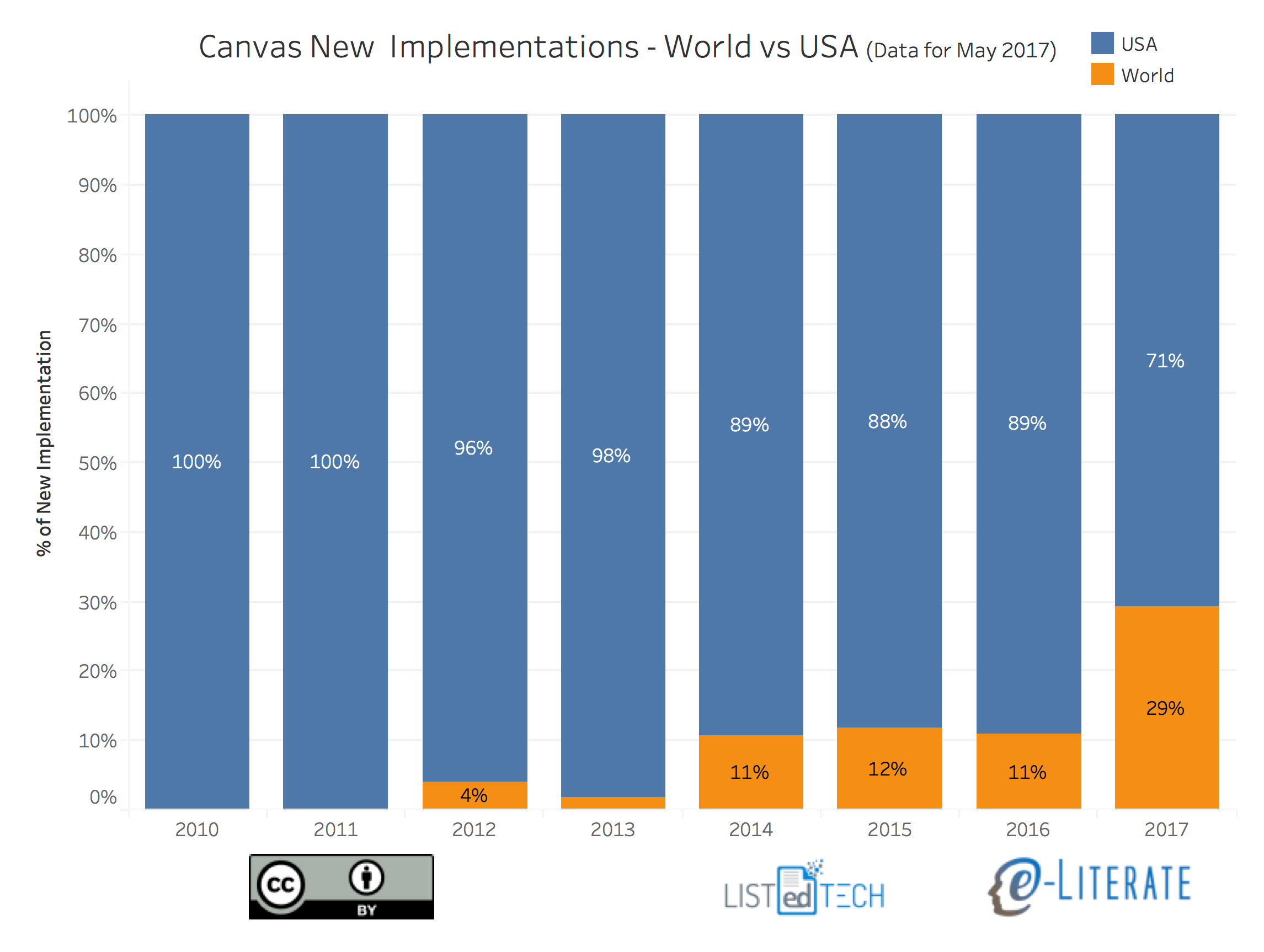
Now look at the percentage of Canvas new implementations happening in the US vs. the rest of the World (“World” in this graphic equals all other countries). Note that 2017 is partial-year data through early May.

Remembering that broad trends are most important in this first-view of data, we can see a big jump in 2017 thus far for international markets for Canvas. It will be interesting to update this view at the end of the year to see if the trend holds, but it is quite clear that Instructure is making Canvas a global LMS.

We have already mentioned that other LMSs – most notably Moodle, but followed by Blackboard Learn and D2L Brightspace after them – have already been established as global market systems, so don’t interpret this data as showing Canvas as the first. But it does show a real change in the global market that will have big impacts.

For those interested in the LMS market analysis service, go to this page for details, pricing, and order form links. The same page also has a signup on the right column for those wanting more information on the service but not yet ready to subscribe. We’ll have more data to share on e-Literate as well as we get the report finalized.

The post Movement of Canvas LMS to Global Markets appeared first on e-Literate.

17 May 07:48

Benefits of Internal Collaboration

by Michelle Ockers

Community logo with textEarlier this week I was interview by HR Daily in advance of my presentation at the Workplace Learning Congress (8-9 June 2017 in Sydney) on Advocating Working Out Loud in your Organisation.  The interview discussed the benefits of internal collaboration.  Full text of the HR Daily article is posted below.  Please contact me via LinkedIn or Twitter if you would like to discuss how to build collective capability in your organisation through knowledge sharing and collaboration.

Benefits of internal collaboration too great to ignore

Too many organisations are not yet recognising the benefits of fostering collaborative online employee networks, an L&D strategist says.

Many employers today have an internal social network, or use Yammer or SharePoint, but far fewer are realising the full potential of online sharing, says learning practitioner and collaboration expert Michelle Ockers.

Some fear inappropriate comments and behaviour, others are overly concerned about sharing information too widely across the organisation. But a bigger risk, she says, is the “opportunity cost” of not utilising collaborative networks.

There’s a “business continuity risk”, for example, of employees failing to pass on unique and valuable knowledge. “There’s that risk they walk out the door with it, because there haven’t been active efforts to cross-pollinate, to share it, and not everything can be written in documents and trained – there’s a lot of tacit knowledge-sharing that you risk missing,” Ockers says.

There’s also an increased risk of unnecessary rework and duplication – “if people aren’t connected and working openly, there’s a lot of waste and cost in that” – and the risk of losing employees who thrive on online collaboration and networking, particularly those from younger generations.

The benefits, on the other hand, can create a significant competitive advantage, and have a big impact on productivity. Regular status updates among members of a project team can, for example, make for shorter, more efficient meetings.

“I’ve sat on projects where we’ve transformed project team meetings from status updates more to getting straight into issues, risks and so on, because people were providing their status updates online,” says Ockers, who is currently reviewing Qantas’s L&D approach, and previously held senior L&D roles at Coca-Cola Amatil.

The key to effective online collaboration is to be clear about the purpose of the network, and structure it accordingly, she says.

“Think strategically… what is going on in your organisation and what is it in your strategy that you need to address?” If the strategy is to leverage internal expertise more effectively, the focus might be solely internal, but if the organisation needs to stay abreast of certain cutting-edge fields of knowledge and expertise outside the organisation, the approach might be to assign key people to build external networks and collaborate there, before bringing that information back to in-house networks.

HR should ask, “what are the relevant communities of practice or bodies of knowledge we want to connect people around?” and consider setting up different forums around different interests, projects and topics, Ockers says.

Differentiation is important because if employees know their knowledge is relevant to all members of a community, they’ll be more likely to share with greater detail.

One way to improve internal network participation is to get senior managers and executives to lead by example by sharing updates on their own work and thoughts, she says.

“I worked at one organisation where the CEO did a weekly blog… She wrote about what she’d been doing that week, what sort of things she’d been thinking about, who she was meeting with and the kind of conversations she was having. She put in a little bit about her family and what was going on for her personally. It made her very approachable and it gave people a sense of what was on her mind and the direction she was heading, which was very powerful.”

Some leaders will require coaching on how to increase their online presence, others will simply need encouragement. HR can also consider running regular events to increase participation, such as monthly chats where different leaders field live questions or answer questions that have been submitted beforehand.

17 May 07:47

NVIDIA Wants to Train 100,000 Developers in Deep Learning, AI this Year

by Chris Kanaracus
By Chris Kanaracus

Constellation Insights

GPU (graphical processing unit) maker NVIDIA launched the Deep Learning Institute one year ago, offering low-priced training to developers on a variety of AI and machine learning technologies. Now it has significantly ramped up its ambitions, saying it intends to train 100,000 coders this year, compared to 10,000 in 2016. Here are the key details from its announcement at the GPU Technology Conference:

The institute has trained developers around the world at sold-out public events and onsite training at companies such as Adobe, Alibaba and SAP; at government research institutions like the U.S. National Institutes of Health, National Institute of Science and Technology, and the Barcelona Supercomputing Center; and at institutes of higher learning such as Temasek Polytechnic Singapore and India Institute of Technology, Bombay.

In addition to instructor-led workshops, developers have on-demand access to training on the latest deep learning technology, using NVIDIA software and high-performance Amazon Web Services (AWS) EC2 P2 GPU instances in the cloud. 

Beyond reaching more developers, NVIDIA is adding to the Institute's curriculum. New areas of study include the application of deep learning for self-driving care, healcare, robotics and financial services. 

NVIDIA is not attempting to reach 100,000 developers on its own. It will partner with AWS, Facebook, Google, the Mayo Clinic and Stanford to co-create training labs. The labs will focus on the Caffe2, MXNet and TensorFlow deep learning frameworks. 

In addition, NVIDIA has teamed up with Facebook AI research head Yann LeCun to create a teaching kit for educators. It says hundreds of professors at Oxford, UC Berkely and elsewere are already using it. 

Lab content is being ported to Microsoft Azure and IBM's cloud. And finally, NVIDIA plans to introduce formal certifications for DLI students. To date, DLI has issued certificates noting the completion of a course, but does not offer certification tests.

Analysis: The AI Opportunity Is Far From A Game to NVIDIA

GPUs are better suited than CPUs for deep learning due to their architecture. While CPUs may have only a couple or several cores, GPUs have thousands of smaller ones that are geared for massively parallel processing of simple tasks. This maps well to compute-intensive deep learning workloads.

NVIDIA's GPUs have long been dominant fixtures in graphics and video cards for gaming and other purposes, but the company's investment in deep learning extends back nearly 10 years, long before the current awareness and hype level around AI.

An aggressive expansion of DLI now makes sense, since the market for GPUs in deep learning remains nascent and NVIDIA should make every effort to expand on its early lead. Its chief competitors, AMD and Intel, are only bringing specialized deep learning GPUs to market this year.

While Intel in particular will have plenty of money to throw behind its products, NVIDIA's other edge lies in the extensive libraries and mature software frameworks it's already developed for deep learning workloads. The more it can train up developers, the more GPUs it can sell, both in specialized hardware or to cloud service providers. In turn, AI developers who align with NVIDIA for GPU acceleration benefit from its early-mover maturity and expertise.

24/7 Access to Constellation Insights
Subscribe today for unrestricted access to expert analyst views on breaking news.

16 May 15:00

Breaking: Labour manifesto plans for FE and skills unveiled

by Paul Offord

Labour has unveiled its plans for the future of FE and skills in its official general election manifesto just out.

Central to this is the plan to “introduce free, lifelong education in FE colleges, enabling everyone to upskill or retrain at any point in life”.

Key points include plans to:

  • Introduce free, lifelong education in FE colleges, enabling everyone to upskill or retrain at any point in life.
  • Abandon Conservative plans to once again reinvent the wheel by building new technical colleges, redirecting the money to increase teacher numbers in the FE sector.
  • Share the broad aims of the Sainsbury Review, but ensure vocational routes incorporate the service sector as well as traditional manufacturing
  • Improve careers advice and open up a range of routes through, and back into, education, striking a balance between classroom and on-the-job training, to ensure students gain both technical and soft skills
  • Bring funding for 16 to 18-year-olds in line with Key Stage four baselines
  • To implement the Sainsbury recommendations, correct historic neglect of the FE sector by giving the sector the investment – in teachers and facilities –  it deserves to become a world-leading provider of adult and vocational education.
  • Restore the education maintenance allowance for 16 to 18-year-olds from lower and middle income backgrounds
  • Replace advanced learner loans and upfront course fees with direct funding, making FE courses free at the point of use, including English for Speakers of Other Languages courses.
  • Encourage co-operation and leadership across colleges and sixth forms, improving curriculum breadth and quality
  • Setting a target, backed up by funding, for all FE teaching staff to have a teaching qualification within five years.
  • Extend support for training to teachers in the private sector
  • Increase capital investment to equip colleges to deliver T-levels and an official pre-apprenticeship trainee programme.
  • Maintain the apprenticeship levy while taking measures to ensure high quality by requiring the Institute for Apprenticeships and Technical Education to report on an annual basis to the Secretary of State on quality outcomes of completed apprenticeships
  • Set a target to double the number of completed apprenticeships at NVQ level three by 2022
  • Give employers more flexibility in how the levy is deployed, including allowing the levy to be used for pre-apprenticeship programmes
  • Guarantee trade union representation in the governance structures of the Institute of Apprenticeships
  • Protect the £440 million funding for apprenticeships for small-and medium-sized employers who don’t pay the levy
  • Set targets to increase apprenticeships for people with disabilities, care leavers and veterans, and ensure broad representation of women, and people with disabilities in all kinds of apprenticeships
  • Consult on introducing incentives for large employers to over-train numbers of apprentices to fill skills gaps in the supply chain and the wider sector
  • Reverse cuts to Unionlearn
  • Set up a commission on Lifelong Learning tasked with integrating further and higher education

More to come…

08 May 14:27

the uncertain future of training

by Harold Jarche

Training courses are artifacts of a time when resources were scarce and connections were few. That time has passed.

The roots of training are to get a lot of people to do the same thing competently. The Roman army trained soldiers for battle and many other duties, like building roads. Standard methods were developed. Drill and feedback over time helped to develop competence. But the modern training field exploded after 1945. Large organizations created training departments, now called ‘learning & development’ or some other variant, but still focused on one thing: looking backwards. Training looks at how people currently do work and then gets others to replicate this. These are described as competencies, made up of certain, skills, knowledge, and attitudes. The assumption was that what works today will work tomorrow. The training department assumed the status quo.

No More Courses

The notion of best practices still permeates the business of training. By looking at what is currently being done well we can replicate this and pass it on through training. Best practices, and even good practices, assume a state of order. They assume that we will get the same results each time we do something. But humans are complex. So are most of the work challenges we face. Any best and good practices are being automated by software and machines. If the work is standardized and repetitive it will be automated. Driving a car is one of these. So is handling standard banking procedures, like deposits and withdrawals. A local bank teller told me that her work today is mostly dealing with exceptions. Online banking and ATM’s handle the routine transactions.

The world is not stable. Work is not routine. Problems are not standard. What worked today may not work tomorrow. I call this a state of perpetual beta where our mental models and how we work need to change with the environment. Strong opinions, loosely held are better than a fixed mindset.

If training cannot prepare us for an uncertain future, what can? The best tool we have to deal with uncertainty is human learning. The human brain is not a computer. It makes intuitive leaps beyond any silicon-based artificial intelligence. Humans also learn socially. It is how we developed our civilizations. We share what we do and learn from each other. No other primates do this. We learn over time.

Training as knowledge delivery is dead. When this is needed, such as learning how to do a procedural task, it will be automated through simulation. The machines will be infinitely patient.

Focus on Learning

The future of training is a refocus on learning. Learning is not something we can do for others. But there will always be a need to help others become better learners. Modelling with our own practices is that way. Removing barriers to learning is another role for the now-defunct training department. Many organizations block access to resources. Some do not promote time and space for reflection. There is little accommodation to actually learn lessons from our collective actions. Increasing the speed of organizational learning should be the new focus. Promoting self-directed learning, supporting social learning, and removing barriers to learning should replace course development and delivery.

Supporting modern workplace learning is much more difficult than delivering 20th century training ever was. I have worked with companies making this transition. It takes time, measured in years, not months. Many people cannot make the leap from course development, to performance consulting, and social learning. I have watched with sadness as people are let go because they have a fixed training mindset. If you are in the training field, now is the time to expand your mental models and build capabilities in social learning support. First, become an expert learner. Then you may be ready for an uncertain future.

Continued:

the missing half of training


08 May 13:38

15 Easy Ways For Project Managers To Develop Professionally

by Elizabeth Harrin

Project Manager DevelopmentWhen budgets are tight you don’t want to have to spend a lot to get some professional development time in. Here are some suggestions of ways to build your professional capability easily. Some involve an investment, but many don’t so you’ll be sure to find something in the list you can implement tomorrow to start gaining new skills.

1. Journalling

Journalling works. Take some time each day or each week to write down how you felt your work is going. Think about what you did well and what you didn’t. Mind-map your goals. Doodle your thoughts about your career. Let it all out on to paper, then close the notebook and let your subconscious work on how you are going to achieve the changes you’ve thought about.

If journalling feels a bit out there for you, I have another (less woo) suggestion below which achieves a similar aim. It’s number 8.

2. Feedback

Ask for feedback. Ask your manager, your team, your subordinates if you have any, your colleagues. If your HR department runs a formal 360 degree feedback programme, get into that.

The feedback you get will astound you and be incredibly valuable in planning your professional development.

3. Networking

Networking? On a list of things that are supposed to be easy?

Networking is easy! If it feels outside your comfort zone it’s probably because you haven’t done it often enough or planned it properly. Do something small, like attend an internal work town hall meeting and speak to one new person in the queue to get coffee. Then build up to attending industry seminars. You can do it, and just the act of challenging yourself to do it will help you develop all kinds of skills.

4. Doing Your Job Better

Be honest, you know what you aren’t very good at, don’t you? Do it better tomorrow. It’s low cost, low stress and you’ll feel awesome when you’ve cracked it.

5. Get Qualified

Getting a professional qualification can help your career – studies show that qualified project managers earn more money and it certainly can’t hurt your employment prospects. Think about what qualification would be the most meaningful to you as there are plenty of certificate schemes out there.

This is an easy one to decide to do, less so to follow it through as you actually have to study and then take an exam. But it’s worth it.

6. Attend a Conference

PMO Conference

Join Twenty Eighty Strategy Execution at this year’s PMO Conference

One of my favourite ways to take time out to work on my own professional skills is to go to a conference. Being surrounded by so much positive energy and so many amazing speakers is a great opportunity for me and it always leaves me feeling so happy about the line of work I have chosen. And I learn something new every time.

Will you get the same buzz? You’ll never know unless you sign up for one and go along.

7. Join A Community

A community of interest can take many forms, from your professional community of project managers at work, perhaps organised by your PMO, an online community or an industry group or professional body that you are part of – one that has regular meet ups.

Whether you join something like the PMO Flashmob, or the discussion groups on LinkedIn, you’ll learn something if you chip into the discussion and meet new people.

8. Reflect

OK, so journalling isn’t for you. Take a walk at lunchtime and don’t think about what your stakeholders are up to and why your team isn’t getting their work done.

Think about you, how you reacted to a situation, how you could have kept your cool better. Or where you want to be in 5 years’ time.

We often don’t build enough thinking time into the day. Without it, you can’t focus on what’s important to move forward professionally.

9. Read

Conference papers and informal chats with your community members can only take you so far. To get in-depth about a subject you really need to read up on it. And, although I’m a blogger myself, I would say that 99% of blog posts and online articles don’t go deep into a subject. For that, you need to turn to the good old-fashioned book.

Get one on a subject that interests you and drink it all in.

Project Management Training Courses

10. Mentor Someone Else

It’s fantastic to be mentored but mentoring someone else will give you a totally different experience. It’s a good way to build your leadership skills and to make new connections.

Mentoring is simply supporting someone else through their career journey, and you can learn from them at the same time, as well as developing your own skills in listening, teaching and coaching.

11. Get a Coach

This is probably the hardest thing to do on this list because it involves an effort in selecting someone, paying for their time and then spending time working with them.

You can develop incredibly with the support of a coach. If you feel this would benefit you in taking your work to the next level, go for it. You’ll quickly find out how it can benefit you, and it will be worth making the investment in your career.

12. Take a Secondment

Ask your manager to give you time away from your day job to do something else. This could be a secondment to a big project, a period of time for study or a shift to another department for 6 months.

This is time where you can try out something new and come back to your job feeling as if you have developed new skills – that is, if you want to come back at all.

13. Do Some Training

There are plenty of courses that don’t lead to qualifications. These are worth looking at for professional development as well, especially those around soft skills and leadership.

However, in my experience it doesn’t much matter what the training is. Getting time away from the office to focus purely on learning something new or developing deeper expertise in an existing skill will help you return to work feeling refreshed.

14. Book an Appraisal

You don’t have to wait until the end of the year to review your progress with your manager. If you want time with them to talk about your objectives and professional development, book it. In fact, right now is a great time as we approach the midpoint of the year. This is a good time to be reflecting on what you’ve achieved during the first two quarters and what’s still to come.

15. Find a Buddy

I have someone at work whom I turn to with questions. Recently I asked her how she dealt with project issues in our project management software. She doesn’t know she’s my buddy (she might now if she’s reading this) but we’ve got the kind of relationship where we can bounce ideas off each other.

She asks me for tips, I ask her. We don’t meet up that regularly but when we do it always ends up in sharing good advice, strategies for dealing with particularly tricky situations and I respect her opinion.

Find someone like this at work. It’s a fast way to get answers and to learn from each other in a supportive environment.

Which of these are you going to try? Let us know in the comments.

05 May 15:38

Making Sense of Windows 10 S

by Paul Thurrott
Making Sense of Windows 10 S

Windows 10 S is no less than the future of Windows. And I can identify only one change that would make this new Windows version viable for many, many more users.

The post Making Sense of Windows 10 S appeared first on Thurrott.com.

05 May 15:31

Teams Adds to the Office 365 Compliance Story

by Tony Redmond
Microsoft.com

Microsoft.com

Better Than Expected Compliance in Teams

I have criticized the support for compliance functionality in Teams and Planner in the past. Now, it seems that Microsoft is doing the right thing for Teams. However, Planner appears to be left behind, which seems to be its normal status.

In a recent blog post, Microsoft laid out the compliance features supported by Teams today and what their immediate plans are in this area. There is much to like here, including support for the new Office 365 data governance framework.

Chats and Conversations

People communicate in Teams through “chats”, or threaded conversations. Teams stores chats in a Teams data store hosted by Azure. Because the data store lies outside Office 365, the information is unavailable to the data governance framework.

The solution is to capture contributions into users’ Exchange Online mailboxes. As people contribute to chats, a process running in the “Office 365 substrate” (think of a mailbox assistant type process) logs contributions to conversations as mailbox items. In some respects, this is a similar approach to what happens when Exchange captures mailbox audit events in a hidden folder in user mailboxes.

Chats are captured as follows:

  • Team and 1:1 chats are captured in the mailboxes of the participating users. For example, if John and Pat have a 1:1 chat, copies of the chat are recorded in both their mailboxes.
  • Contributions made to a chat in a channel are recorded in the group mailbox belonging to the team.

In all cases, the mailbox items are created in a special hidden folder called Conversation History\Team Chat. This is a sub-folder of the Conversation History folder used to store copies of IM conversations for Skype for Business calls. Because the folder is intended to hold data for compliance purposes, clients like OWA and Outlook desktop do not expose the Team Chat folder to users.

Depending on load, the mailbox item is available soon after a user contributes to a conversation. In my tests, the time to create the mailbox items varied from a few seconds to a few minutes. Once captured in a mailbox, the chat is automatically indexed and discoverable by content searches.

To see how many items are in a user or group mailbox for team chats, use a command like this:

[PS] C:\> Get-MailboxFolderStatistics -Identity "Tony Redmond"| ? {$_.Name -eq “Team Chat”} | Format-Table Name, ItemsInFolder

Identity                                    ItemsInFolder
--------                                    -------------
Tony Redmond\Conversation History\Team Chat            29

The name of the hidden folder holding chat items varies with language. For instance, you would use “Discussion d’equipe” to check a folder for someone whose mailbox is configured to use French.

Searching Chats

You do not have to do anything special to include Team chats in content searches as they are scanned automatically when mailboxes are added as search locations. The same is true for the folders in the group document library holding Team Files, which are included in searches when the team site is a location. Figure 1 shows how Teams items show up in the preview for a content search.

Teams Chat Search

Figure 1: A contribution to a team chat shows up in a content search (image credit: Tony Redmond)

In this case, the search has found a contribution to a conversation in a channel. We know this because the item subject has the name of the team and the channel (Engineering Testers and Complaints) followed by a unique number. If the item belonged to a 1:1 or group chat, it would have an “IM/” prefix for the subject. In both cases, the item type is IM rather than the normal “Email” for mailbox items.

Any in-place holds or litigation holds applied to the mailboxes holding team conversations apply to those items. In short, Exchange Online treats items captured for Teams conversations just like any other mailbox item.

Some Issues

Microsoft acknowledges that its compliance story for Teams is still imperfect. Among the known bugs are failure to capture chats with Bots, items created by Office 365 connectors to bring content into channels, and email sent to channels. Microsoft expects to fix these bugs soon.

Auditing Teams

In addition to capturing individual conversations, Teams records audit events such as the creation and deletion of channels, changing channel settings, and users signing into Teams. To see these events, go to the Search & Investigation section of the Security and Compliance Center, then select Audit log search, and then select which Teams events you want to view (Figure 2).

Teams Audit Events

Figure 2: Teams events show up in the Office 365 Audit Log (image credit: Tony Redmond)

Sponsored

Teams Get Better All the Time

In line with the fast pace they have generally used in developing the application, Microsoft has done a decent job to equip Teams for compliance. You might complain that no capture is possible to ensure compliance for voice and video conversations, but that is the same for Skype for Business too. As always, there is more work to do, but the good news is that Microsoft’s compliance story around Teams is solid. Now what about Planner?

Follow Tony on Twitter @12Knocksinna.

Want to know more about how to manage Office 365? Find what you need to know in “Office 365 for IT Pros”, the most comprehensive eBook covering all aspects of Office 365. Available in PDF and EPUB formats (suitable for iBooks) or for Amazon Kindle

The post Teams Adds to the Office 365 Compliance Story appeared first on Petri.

05 May 15:29

training > performance > social

by Harold Jarche

Thank Goodness It’s Monday! This is my second TGIM post. Mondays for freelancers mean new opportunities. Weekends are often times to get work done when it’s quiet. Mondays are good days to take a day to reflect, as clients are usually busy going through their inboxes and catching up. So happy Monday to everyone.

In my last TGIM post I went through my social bookmarks on PKM. This post looks at resources related to my training-performance-social workshop.

One approach to supporting workplace learning, based on the 70:20:10 model, is for the organization to provide three types of enablers (see image at bottom):

  • Tools: that workers are dependent upon to do their work
  • Skills: competencies to work independently
  • People: social structures to work interdependently with others, inside & outside the organization

Training

The Five Failures of Workplace Learning Professionals

“In the training and development field, our five biggest failures are as follows:

1. We forget to minimize forgetting and improve remembering.
2. We don’t provide training follow-through.
3. We don’t fully utilize the power of prompting mechanisms.
4. We don’t fully leverage on-the-job learning.
5. We measure so poorly that we don’t get good feedback to enable improvement.”

Flipped classrooms put learning to work

“At its core, the concept of the flipped classroom is that the design of the instruction is reversed (or flipped), so that instructional content is provided outside of the classroom (e.g, through video, e-learning modules, reading) and the prescribed learning activities that were often looked at as ‘homework’ are completed in the classroom itself (whether that classroom is physical or virtual).

The argument supporting this practice goes something like this: The moment when learners are completing what was traditionally viewed as ‘homework’ is the exact time when they need the most support and guidance (e.g., from the instructor/advisor). This is not the time for them to go-it-alone!”

Performance Improvement

Harold’s Performance Improvement Toolbox

When Your Employees Can Solve The Biggest Problems With Performance Support

1. When accuracy is critical and errors are risky.
2. When a work task is performed infrequently, making it difficult to remember.
3. When a work task is error prone, so that mistakes are made too often.
4. When there are multiple decision points or many steps.
+ 4 more …

Re-thinking Workplace Learning: extracting rather than adding

“Approaching workplace learning in this way – by supporting the extraction of learning from work rather than the injection of learning activities into work – presents a whole new set of challenges for HR, Talent and L&D professionals.

the challenges include the facts that:

It can’t be built into a course or programme.
It can’t be ‘delivered’.
Managers need to be enabled and supported if it is to work.
It can’t be managed and controlled in the way discrete training and learning injections into the workflow can be.
most of the learning processes are opaque to HR and L&D and can only be made explicit through observation and other field survey and data collection approaches.”

Social Learning

What is a community of practice? (lessons learned)

1) Narrow down the domain and purpose (i.e. make it attainable).
2) Hire a community facilitator, or even better, a social artist?
3) Reduce bottlenecks and start with ‘low hanging fruit’ type of platforms.
4) Modeling how to be social is critical.
5) Learning might lead to collaborative works.
6) CoPs grow like gardens and that’s why developmental evaluation is becoming really interesting to me.

Value delivery mechanisms for Communities of Practice

1. Solve problems for each other
2. Learning before
3. Learning during
4. Learning after Benchmark performance with each other
5. Exchanging resources
6. Collaborating on purchasing (buying things that any one member could not justify)
7. Collaborating on contracts (using the purchasing power of the community)
+ 10 more

05 May 10:14

Emotional Intelligence - another fraudulent fad

by Donald Clark
I.gardner.gb

Certainly agree not something to "assess" would disagree that the components (reflection, etc) have no value.

The L and D hammer is always in search of nails to slam into the heads of employees. So imagine their joy, in 1995, when ‘Emotional Intelligence’ hit HR on the back of Daniel Goleman’s book ‘Emotional Intelligence’. (The term actual goes back to a 1964 paper by Michael Beldoch and has more than a passing reference to Gardner’s Multiple Intelligences.) Suddenly, a new set of skills could be used to deliver another batch of ill-conceived courses, built on the back of no research whatsoever. But who needs research when you have a snappy course title?

EI and performance At last we have some good research on the subject which shows that the basic concept is flawed, that having EI is less of an advantage than you think. Joseph et al. (2015) published a meta-analysis of 15 carefully selected studies, easily the best summary of the evidence so far. What they found was a weak correlation (0.29) with job performance. Note that 0.4 is often taken as a reasonable benchmark for evidence of a strong correlation. To put this into plain English, it means that EI has a predictive power on performance of only 8.4%.  Put another way, if you’re spending a lot of training effort and dollars on this, it’s largely wasted. The clever thing about the Joseph paper was their careful focus on actual job performance, as opposed to academic tests and assessments. They cut out the crap, giving it real evidential punch.

EI is a bait and switch

What became obvious as they looked at the training and tools, is that there was a bait and switch going on. EI was not a thing-in-itself but an amalgam of other things, especially good-old personality measures. When they unpacked six EI tests, they found that many of the measures were actually personality measures, such as conscientiousness, industriousness, self-control. These had been stolen from other personality tests. So, they did a clever thing and ran the analysis again, this time with controls for established, personality measures. This is where things got really interesting. The correlation between EI and job performance dropped to a shocking -0.2.

Weasel word ‘emotional’

Like many fads in HR, an intuitive error lies at the heart of the fad. It just seems intuitively true that people with emotional sensibility should be better performers but a moment’s thought and you realize that many forms of performance may rely on many other cognitive traits and competences. In our therapeutic age, it is all too easy to attribute positive qualities to the word ‘emotional’ without really examining what that means in practice. HR is a people profession, people who care. But when they bring their biases to bear on performance, as with many other fads, such as learning styles, Maslow, Myers-Briggs, NLP and mindfulness, emotion tends to trump reason. When it is examined in detail EI, like these other fads, fall apart.

Weasel word ‘intelligence’

I have written extensively about the danger in using the word ‘intelligence’, for example, in artificial intelligence. The danger with ‘emotional intelligence’ is that a dodgy adjective pushes forward an even dodgier noun. Give emotion the status of ‘intelligence’ and you give it a false sense of its own importance. Is it a fixed trait, stable over time, can it be taught and learned? Eysenck, the doyen of intelligence theorists, dismissed Goleman’s definition of ‘intelligence’ and thought his claims were unsubstantiated. In truth the use of the word is misleading.

Bogus tests

Worse still, EI has some tests that are shockingly awful. Tests often lie at the heart of these fads, as they can be sold, practitioners trained and the whole thing turned into a pyramid selling, Ponzi scheme.  Practitioners, in this case are sometimes called ‘emotional experts’ (I kid ye not), who administer and assess EI tests. However, the main test, the MSCEIT, is problematic. First, the company administering the tests (Multi-Health systems) was found by Føllesdal to be peddling a pig with lipstick. To be precise, 19 of the 141 questions were actually being scored wrongly. They quietly dropped the scoring on these questions, while keeping them in the test. Reputations had to be maintained. More fundamentally, the test is weak, as there are no correct answers, so it is not anchored in any objective standard. As a consensus scored test, it has all the haziness of a drifting, shape-shifting cloud.

EI and leadership

Goleman’s outrageous claims, that general EI was twice as useful as either technical knowledge, or general personality traits, has been dismissed as nonsense, as is his claim that it accounts for 67% of superior, leadership performance. This undermines lots of Leadership training, as EI is often used as a major plank in its theoretical framework and courses. Føllesdal (2013) looked at test results (MSCEIT) of 111 business leaders and compared these with the views of those same leaders by their employees. Guess what – there was no correlation.

Conclusion

The whole sorry affair has all the hallmarks of other HR fads – the inevitable book, paucity of research, exaggerated claims, misleading language, the test, ignoring research that shows it is largely a waste of training time. Don’t waste your time and money on this. There are far better ways to assess and train employees if performance is your goal.
For another seven Ponzi scheme fads see here.
02 May 14:40

Union membership and job satisfaction: Initial evidence from French linked employer–employee data

by Patrice Laroche

A number of contradictory theoretical hypotheses have been advanced about the relationship between unionisation and job satisfaction. In this article, new evidence of the effects of unionisation on job satisfaction is presented using French linked employer–employee data from the 2011 REPONSE Survey. A bivariate probit model is estimated to deal with the reverse causation issue that many previous studies have failed to account for. The results indicate that union members are less satisfied with their jobs than non-members, even after taking into account certain individual characteristics, job attributes and workplace characteristics. However, after controlling for endogeneity of union membership, we find that the difference in job satisfaction between unionised and non-unionised workers disappears because of a selection effect in workplaces covered only by a national/sectoral collective agreement and attributable to a causal effect arising from union's voice function in workplaces covered by a local agreement.

02 May 14:40

Skills crisis worsening as UK training spend falls significantly

by Debora Figueiredo

UK employers are facing a massive skills crisis and are not doing anywhere near enough to overcome it. So says a new CIPD report, ‘From ‘inadequate’ to ‘outstanding’: making the UK’s skills system world class’, which claims that the UK is “sleepwalking into a low-value, low-skills economy”.

The report, which reviewed the UK’s skills policy over the past 20 years and is part of the CIPD’s formal response to the Government’s Industrial Strategy Green Paper, highlights several factors that it says are behind the worsening skills crisis. Low employer spend on training is one of the main factors, the other big contributory factor being an inadequate education system.

How much is spent on employee training is a problem that employers can do something about. At the moment, UK employers spend less on training than other major EU economies. They also spend less than the EU average. The CIPD report cited statistics from the Continuous Vocational Training Survey, which show that UK employers spent an average of 226 euros per employee on training in 2010, compared to 511 euros spent per employee on training on average across the EU. Plus, in the UK, the cost of vocational training as a share of total labour costs was 1.1%, compared to 1.6% across Europe.

And the situation is getting worse, not better: UK training spend has been falling since 2005. “Participation in job-related adult learning has fallen significantly in recent years, leaving us languishing close to the bottom of the league table,” says Peter Cheese, chief executive of the CIPD. The UK is now fourth from bottom place in an EU league table of job-related adult learning.

However, as the CIPD points out, the effectiveness of training is not necessarily determined by how much is spent on it. It is possible that UK employers have found ways to minimise their training spend, without reducing the quality of the training. This could be by harnessing the power of digital or by negotiating better deals with training providers, for example.

Cheese says employers and HR need to take a much more strategic, proactive and targeted approach to skills and training. Rather than reacting to skills needs as they arise and pursuing a policy of recruiting skills and talent on a needs-must basis, employers and HR should be identifying critical skills in advance and developing them in-house. Employers and HR should be investing in the skills needed now and in the future.

According to the report, it is particularly important that employers and HR focus on the skills development of the younger generation, those in the early days of their career. “It is hard to avoid the impression that many young people experience slower progression in the workplace in their first years of employment than in many other OECD economies’, reads one of the lines in the report.

If the situation is of concern now, the CIPD is even more concerned about a UK skills deficit post-Brexit. Should there be less access to migrant labour from EU countries post Brexit, then there will be an increased pressure on the UK talent pool. The skills shortage is already proving detrimental to businesses’ long-term prospects – HR and employers cannot afford to wait to see what happens post-Brexit. The time to act is now.

The post Skills crisis worsening as UK training spend falls significantly appeared first on DPG Plc.

02 May 14:29

3 million Apprenticeships target under threat after massive government funding cuts

Apprenticeship training providers have reacted with unprecedented dismay to government cuts to the funding that helps support smaller businesses offering apprenticeships.
18 Apr 12:01

Why Knowledge Management at Decentralized Companies Demands Unique Solutions

by lauren.trees
I.gardner.gb

People not tools.

I talked to Diego Fernandes, knowledge management senior analyst at Odebrecht, about engaging people in knowledge sharing at a decentralized company.

read more

18 Apr 11:02

LRS Rankings (Learning Record Store)

by Craig Weiss

I’m a dreamer.  I dream that those who are involved in e-learning (online) and soon immersive (VR/AR/MR), learn and understand about the nuances of the various types of learning technology current and down the road.

Each piece can help you achieve amazing and outstanding results.  But, as with anything, used wrongly or poorly, and the technology fails.  

There are plenty of folks out there that get it. They understand that the most effective courses (regardless of micro or not) are non-linear (people can jump around).  That they utilize adult learning and are engaging/interactive. 

Plus they each can incorporate a form of learning technology, believe it or not.  And many do. 

I note this because there are a lot of people who see an LMS and their subsets as merely a place to host courses.  This is a fallacy.  A myth that constantly plays out on a daily basis.

When this happens, any new piece of learning technology that is either contained within an LMS (and its subsets) is blackballed or not utilized across the board OR is pitched as being standalone, as if that is an ideal and better route to go.

I’m here to tell you to not fall into that trap.  A LRS is ideal and a perfect fit within an LMS (and subsets). 

I don’t care if you have a TM/PM system – you want an LRS in it.  Pitching your platform as employee engagement – get an LRS as a component.   Social learning solution? LRS as a component.  Oh, mobile learning solution or micro-learning platform, I want an LRS in it.

Selecting though which LRS is the right one for you though is the challenge today.  More are popping up and will likely continue to do so in 17 and 18, especially when it comes to vendors in the LMS space incorporating them as part of their platform.

If you are someone who says, I want an LRS but I do not want it in my LMS or adding one of the below via an API into your LMS, that’s fine.  Because they can be standalone offerings.

Before jumping into the rankings, I recommend an interview that was done a year ago, regarding LRS and xAPI (it was conducted on this blog).

Keys to remember

  • There are some standards in terms of what data is captured that is seen in most LRSs. These include top influencers, xAPI, statement activity, most popular content, search extraction, data visualization (but all over the place from that standpoint), and connectors.
  • When I note “LMS integration/incorporation” it means that an LMS vendor has struck a deal with an LRS vendor to incorporate the LRS into their LMS as their LRS, thus the vendor does not have to build their own LRS. 
  • If an LRS vendor has a partnership in place with an LMS vendor that I am unaware of at the time of this writing, I will make an update to their listing.  And tweet a notice about it, so follow me @diegoinstudio if you want the update.

A few quick points, that many vendors fail to note regarding an LRS (and I can’t decide if it is because they are unaware or indifferent).

  • The premise (besides what it can do and its benefits) was that each learner has this data record and it captures everything (which it does), BUT and here is the kicker, if the learner leaves the company, school, etc., they take their data record with them.

Thus, if they go to another company, business, school/university the data record can be inserted into that LMS (assuming it has an LRS) and it will work fine (interoperability). 

  • From an education standpoint, I can see how a data record of the student’s learning can go from primary to secondary to higher education. 

Some vendors though have changed the premise of the data record transference.  How?

  • They delete the record if the person leaves (regardless if they quit, fire, bolt, go the route of the school angle above, etc.)

Yes, an LRS can be an amazing tool and component, but that data record is an important piece of the pie. 

If you follow the route of deletion, then that approach of its total usefulness, from the learner angle is gone. 

Just something to think about.  

Anyway onto the rankings

Oh, I added screenshots when possible and a couple of recordings of screens from the top two.  The screens are just for visual purposes only. 

  1. Yet Analytics –  A very strong LRS that can do a lot.  The graphical interface is robust. A lot of analytical data can be viewed and captured.   Data visualization is great.  Pluses include usage behaviors, influencers, trends of actors (learners including network), learner profiles with details, statement frequencies (many systems do this, just fyi).  Unaware of any LMS vendor that has incorporated the LRS into their platform.  Can be standalone or API into your system/platform including TM/PM.   The system is just a winner in so many ways.   Pricing is listed on the web site.  Easy to use.  Has connectors.


2. Watershed LRS –  This is a very good solution that provides a lot of power and some difference in terms of analytical data extraction than Yet.   That is not a minus per se, rather, an approach that will work for many folks – who want an alternative. 

The data is easy to follow and read.  I wish the graphical interface was better (my understanding is that they are working on a new GUI (graphical user interface).  Right now, compared to some others it looks dated, which is a shame, because as noted it packs a sweet set of information.   Pricing is listed on the site.

There are LMS vendors who have Watershed in their system (as their LRS).  It can also be a standalone or API into your system/platform including TM/PM.  Easy to use.  Has connectors.

3.  Wax LRS by Saltbox  –  A good LRS that at one time, I felt was top of the pack. That no longer is the case, but it isn’t because of them per se, rather there are ones that have just moved further up due to functionality contained within.  

The graphical interface needs an update, but is user-friendly and provides a solid set of data visualization.  I love the fact that they have connectors with other SaaS offerings such as Salesforce, Zapier and Slack.  Albeit, I’m not seeing the real benefit of incorporating an LRS into Slack, especially since the premise of that data record seems lost in this manner. I mean, honestly, how is Slack being harnessed when it comes to learning/training?

I am equally unaware of any LMS that has Wax incorporated into the system.  Can be a standalone or API into any system/platform including PM/TM.  Pricing is on the site, but the top of the line solution is a “Contact us” approach. Hey, thanks for the transparency!


4.  Learning Locker–  A lot of people love Learning Locker. It is open source first of all, which I surmise plays a role (although it also offers a fee-based option too).  It has a very nice GUI and is easy to use. They say they are the most installed LRS in the world. Not sure about that, as in highly doubt it (and will continue to say so, until they can show the data to back up such a claim).

I love the ability to create business rules (from simple to complex).  Identifies influencers too (listed as top performers) and why they are the leaders.  Captures the data many other LRSs do as well, including statement activities and learner history. 

Connectors include Slack (surprise), SAP, Tableau (many support as well).   Data visualization as a whole can be better.  Seems too simple for me, but I am a fan of lots of data, lots of analytical extraction to chop up, cut up and see.  Especially when it comes to training – the more I know, the better I can develop, design and implement content/courses/etc. for my learners, regardless if they are customers, employees or both.  

Pricing is on the site.  Standalone, API, connectors (as noted above).  Unaware of LMS vendors that incorporated it. 

Others

LMS vendors that created their own LRS.  Many vendors have gone this route.  As a result, the quality is all over the place. Some are strong, others are not.  GUI follows suit.  Data visualization is useful but to a degree.  The biggest issue I have with several vendors is the data record deletion and the refrain from offering all the analytical data that the LRS captures.  It is more of a drip, drip, drip – here are the common stuff that virtually everyone else does and here are some unique pieces BUT if you want the store, forget about it.  

Listen you can extract a monster set of data with an LRS, so why hold back?  I get the pitch not everyone wants it, but when you are doing your setup, ask the customer if they want “regular – which is what comes with the system” or “extreme” which punches a lot of analytical information and all that it entails.  Again, from a training/learning standpoint the more data the better.  After all, if you want to do an effective gap analysis, is simple really better?

Xyleme Analyze –  Provides the standard fare of LRS analytical data.  The GUI is very user-friendly, and follows more of a streamline visual appearance.  Personally, it should be a tad more robust on the data visualization side of the house.   Includes items such as most popular content, top influencers, activity statements (all of which are standards nowadays – as in every LRS does this to some degree).  Standalone, API, integrated into an LMS/learning platform/TM/PM too.  No pricing on the site.

Xyleme

Riptide Storepoints – Nice GUI. Data visualization is solid, nothing to blow you away.  Includes most of the standards today in the LRS space.  Connectors include BI tools.  Says they can track digital content such as VR and iOT.  Uh, I wonder about the iOT, because who is heck is saying, “Hey I have iOT content on my smartwatch, we need to track that baby.”  Unaware of any LMS vendor integration/incorporating.  Standalone, API.  Works with any system, including LMS (subsets too), TM/PM and aforementioned BI tools.

Screen shot is small, but that is the best I could capture on their site.  Squint.

riptide

GrassBlade.  Love that it can generate certificates, includes many of the standard features on a side note (but not all of them). Connectors include LearnDash (WordPress LMS) and Zapier (sweet!)  Data visualization is doable, but nothing to write home or email folks about.  Another alternative out there.   For some folks, it is a fine fit.  Unaware of any LMS vendor incorporating it, standalone, API options.  Pricing is on the site.

Mzinga. It is there.  Captures some of the standard data, not enough to warrant a love factor for me.  Standalone, API, LMS integration – unaware of others though.

edTotal.  Captures some of the standards.  Standalone, API.  Will be doable for some folks.  At least they are trying, so that is a plus.

Bottom Line

There they are. The rankings of the top four and a few others to examine, consider or just think, maybe some day, I will try one out for size.

For the folks who believe an LRS is an LMS, it is not.  It is a compliment to an LMS.

A bonus.

Of great value.

If it is done right.

With data visualization that empowers the training, L&D, even HR executive to do more. To design, define and interpret so that what is being extracted means something beyond just tracking for the sake of it.

LRSs are a form of learning technology.

Start now and reap the benefits.

But be realistic.

For that LRS you seek, may not be there right now.

Tomorrow, another story.

E-Learning 24/7


Tagged: learning record store, LRS, rankings
Yet
Watershed
Wax
LearningLocker
18 Apr 09:26

Articulate Storyline 3 is here

by Georgina Taylor

There has been much anticipation around when Articulate would be releasing the next version of Storyline, especially after the release of Articulate 360 last year. It has been quite some time since we last had a full authoring tool from Articulate but after two and a half years since Storyline 2 was released, Storyline 3 is now here!