Shared posts

04 Dec 19:26

Kirkpatrick evaluation: kill it - happy sheet nonsense, well past its sell-by-date

by Donald Clark

Kirkpatrick has for decades been the only game in town in the evaluation of corporate training, although hardly known in education. In his early Techniques for evaluation training programmes (1959) and Evaluating training programmes: The four levels (1994), he proposed a standard approach to the evaluation of training that became a de facto standard. It is a simple and sensible schema but has not stood the test of time. First up - what are the Kirkpatrick's four levels of evaluation?

Four levels of evaluation

Level 1 Reaction

At reaction level one asks learners, usually through ‘happy sheets’ to comment on the adequacy of the training, the approach and perceived relevance. The goal at this stage is to simply identify glaring problems. It is not, to determine whether the training worked.

Level 2 Learning

The learning level is more formal, requiring a pre- and post-tests. This allows you to identify those who had existing knowledge, as well as those at the end who missed key learning points. It is designed to determine whether the learners actually acquired the identified knowledge and skills.

Level 3 Behaviour

At the behavioural level, you measure the transfer of the learning to the job. This may need a mix of questionnaires and interviews with the learners, their peers and their managers. Observation of the trainee on the job is also often necessary. It can include an immediate evaluation after the training and a follow-up after a couple of months. 

Level 4 Results

The results level looks at improvement in the organisation. This can take the form of a return on investment (ROI) evaluation. The costs, benefits and payback period are fully evaluated in relation to the training deliverables. 

JJ Phillips has argued for the addition of a separate, fifth, "Return on Investment (ROI)” level which is essentially about comparing the fourth level of the standard model to the overall costs of training. However, it is not that ROI is a separate level as it can be included in Level 4. Kaufman has argued that it is merely another internal measure and that if there were a fifth level it should be external validation from clients, customers and society. In fact there have been other evalutaion methods with even more levels, completely over-engineering the solution.
Criticism

Level 1 - keep 'em happy

Traci Sitzmann’s meta-studies (68,245 trainees, 354 research reports) ask ‘Do satisfied students learn more than dissatisfied students?’ and ’Are self-assessments of knowledge accurate?’ Self-assessment is only moderately related to learning. Self-assessment captures motivation and satisfaction, not actual knowledge levels.She recommends that self-assessments should NOT be included in course evaluations and should NOT be used as a substitute for objective learning measures.

So Favourable reactions on happy sheets do not guarantee that the learners have learnt anything, so one has to be careful with these results. This data merely measures opinion. 

Learners can be happy and stupid. One can express satisfaction with a learning experience yet still have failed to learn. For example, you may have enjoyed the experience just because the trainer told good jokes and kept them amused. Conversely, learning can occur and job performance improve, even though the participants thought the training was a waste of time. Learners often learn under duress, through failure or through experiences which, although difficult at the time, prove to be useful later. 

Happy sheet data is often flawed as it is neither sampled nor representative. In fact, it is often a skewed sample from those that have pens, are prompted, liked or disliked the experience. In any case it is too often applied after the damage has been done. The data is gathered but by that time the cost has been incurred. More focus on evaluation prior to delivery, during analysis and design, is more likely to eliminate inefficiencies in learning.

Level 2 - Testing, testing

Level 2 recommends measuring difference between pre- and post-test results but pre-tests are often ignored. In addition, end-point testing is often crude, usually testing the learner’s short-term memory. With no adequate reinforcement and push into long-term memory, most of the knowledge will be forgotten, even if the learner did pass the post-test.

Tests are often primitive and narrow, testing knowledge and facts, not real understanding and performance. Again, level 2 is inappropriate for informal learning.

Level 3 – Good behaviour

At this level the transfer of learning to actual performance is measured. Many people can perform tasks without being able to articulate the rules they follow. Conversely, many people can articulate a set of rules well, but perform poorly at putting them into practice. This suggests that ultimately, Level three data should take precedence over Level two data. However, this is complicated, time consuming and expensive and often requires the buy-in of line managers with no training background, as well as their time and effort. In practice it is highly relevant but usually ignored.

Level 4 - Does the business

The ultimate justification for spending money on training should be its impact on the business. Measuring training in relation to business outcomes is exceedingly difficult. However, the difficulty of the task should, perhaps, not discourage efforts in this direction. In practice Level 4 is often ignored in favour of counting courses, attendance and pass marks.

General criticisms

First, Kirkpatrick is the first to admit that there is no research or scientific background to his theory. This is not quite true, as it is clearly steeped in the behaviourism that was current when it was written. It is summative, ignores context and ignores methods of delivery. Some therefore think Kirkpatrick asks all the wrong questions, the task is to create the motivation and context for good learning and knowledge sharing, not to treat learning as an auditable commodity. It is also totally inappropriate for informal learning.

Senior managers rarely want all four levels of data. They want more convincing business arguments. It's the training community that tell senior management that they need Kirkpatrick, not the other way round. In this sense it is over-engineered. The 4 linear levels too much. All the evidence shows that Levels 3 and 4 are rarely attempted, as all of the effort and resource focuses on the easier to collect Levels 1 and 2. Some therefore argue that it is not necessary to do all four levels. Given the time and resources needed, and demand from the organisation for relevant data, it is surely better to go straight to Level four. In practice, Level 4 is rarely reached as fear, disinterest, time, cost, disruption and low skills in statistics mitigate against this type of analysis.

The Kirkpatrick model can therefore be seen as often irrelevant, costly, long-winded, and statistically weak. It rarely involves sampling, and both the collection and analysis of the data is crude and often not significant. As an over-engineered, 50 year old theory, it is badly in need of an overhaul (and not just by adding another Level).


Models and messages
Models such as ADDIE, Malsow's pyramid, VAK learning styles Myers-Briggs and Kirkpatrick send the wrong message. They seem as though they are scientific and certain when they are neither. Kirkpatrick gives the illusion of certainty, but s Wll ThalHeimer showed, Kirkpatrick didn;t come up with the four-level model, he uses Katzell's work. Read Kirkpatrick's paper, as it is there on the first page. It is anot a researched model, it was lifted from someone else and was well marketed. Kirkparick mentions Katzell in his first 1956 paper but never again after 1960. The KIrkPatrick model is not only badly researched, it is downright misleading. It simplifies and suggests a model that starts with learner perceptions and proceeds in a linear fashion to business impact, but as the earlier levels are irrelevant, people set of at Level 1 but the journey is so long they never get to Level 4. It's easy doing smile sheets, hards to measure business impact.
Alternatives

Evaluation should be done externally. The rewards to internal evaluators for producing a favourable evaluation report vastly outweigh the rewards for producing an unfavourable report. There are also lots of shorter, sharper and more relevant approaches; Brinkerhoff’s Success Case Method, Daniel Stufflebeam's CIPP Model, Robert Stake's Responsive Evaluation, Kaufman's Five Levels of Evaluation, CIRO (Context, Input, Reaction, Outcome), PERT (Program Evaluation and Review Technique), Alkins' UCLA Model, Provus's Discrepancy Model and Eisner's Connoisseurship Evaluation Model. However, Kirkpatrick is too deeply embedded in the culture of training, a culture that tends to get stuck with theories that are often 50 years, or more, old.

Evaluation is all about decisions. So it makes sense to customise to decisions and decision makers. And if one asks ‘To what problem is evaluation a solution’ one may find that it may be costs, low productivity, staff retention, customer dissatisfaction and so on. In a sense Kirkpatrick may stop relevant evaluation.

Conclusion

Kirkpatrick’s four levels of evaluation have soldiered on for nearly 60 years as, like much training theory, it is the result of strong marketing, now by his son James Kirkpatrick, and has become fossilised in ‘train the trainer’ courses. It has no real researched or empirical background, is over-engineered, linear and focuses too much on less relevant Level 1 and 2 data drawing effort away from the more relevant Level 4. Time to Kill Kirkpatrick.

Bibliography

Kirkpatrick, D. (1959). Techniques for evaluation training programmes.

Kirkpatrick, D. (1994). Evaluating training programmes: The four levels.

Kirkpatrick, D. and Kirkpatrick J.D. (2006). Evaluating Training Programs (3rd ed.). San Francisco, CA: Berrett-Koehler Publishers

Phillips, J. (1996). How much is the training worth? Training and Development, 50(4),20-24.

Kaufman, R. (1996). Strategic Thinking: A Guide to Identifying and Solving Problems. Arlington, VA. & Washington, D.C. Jointly published by the American Society for Training & Development and the International Society for Performance Improvement

Kaufman, R. (2000). Mega Planning: Practical Tools for Organizational Success. Thousand Oaks, CA. Sage Publications.

Sitzmann, T., Brown, K. G., Casper, W. J., Ely, K., & Zimmerman, R. (2008). A review and meta-analysis of the nomological network of trainee reactions. Journal of Applied Psychology93, 280-295.

Sitzmann, T., Ely, K., Brown, K. G., & Bauer, K. N. (in press). Self-assessment of knowledge: An affective or cognitive learning measure? Academy of Management Learning and Education.
04 Dec 18:58

How are HR departments supporting staff digital capability?

by Lou McGill

We are about to start a short review of how Human Resources (HR)  departments in educational institutions support staff with the development of their digital capability.

HR departments in universities and colleges increasingly recognise the need to contribute towards supporting staff to respond to challenges and opportunities offered by technologies. In 2016 their annual conference focused on the  The Changing Face of Work where they explored ‘How can we best equip our organisations to respond to our increasingly digital world and to meet the needs of our Generation Z employees?’  Helen Beetham presented at the conference about the Jisc digital capability work.

HR teams have a range of roles that require an understanding of the impact of technologies on staff:

  • recruitment
  • induction
  • staff health and wellbeing
  • conflict management
  • CPD support

HR staff also need to effectively use technologies and tools to deliver services. They need to ensure that their own digital capabilities are sufficient to make the best of available data and metrics and be aware of how social media and other technologies can impact on the changing relationships between students and staff. It is timely to find out how far HR departments are engaging with these challenges and to identify new and interesting practice.

Organisational approaches to developing digital capabilities

Jisc has been working with educational institutions to consider organisational approaches to developing digital capabilities and produced a supporting guide earlier this year. We hope that this work will build on those relationships we have already established with some HR teams and help us generate new links.

The work will review practice of HR departments in colleges and appropriate professional associations, and will also include an exploration of the role of trade unions in digital capability discussions and identify opportunities for developing strategies for their involvement.

Contribute to this review

The review will be carried out by Lou McGill and Tim Gray. If you are interested in contributing to this study, or know someone who may be interested, please contact Lou McGill. We will be launching an online survey soon to capture a snapshot of current practice.

04 Dec 18:58

Learning Experience Platform – WRONG

by Craig Weiss

I’ll get right to the point.  I totally dislike the term, “learning experience platform”.  It really makes no sense, because anything and everything we do, can turn into a learning experience.  Secondly, it does a major disservice to any platform that is called by that name.

Allow me to elaborate.

I put together a tiny list (three) on learning experiences that I “learned” in just the last week:

  • One of my dogs, Voodoo has “learned” that if he digs a deep hole he will find the gopher tunnel, because he hears them.  Thus, a learning experience
  • I learned that a Doubletree I stayed at in London has a theft problem with people taking bottle openers, which is why I was told, no one has one in their rooms.  A learning experience, was never more present.
  • I learned that my neighbor seems to enjoy parking his cars in front of my trash can on garbage day. Thus, the garbage truck often misses it. If I had super human strength, I’d probably have learned how to pick up his cars and heave them over the hill I live on.  Sadly, I don’t, nevertheless a learning experience.

Now I ask you, would you want your platform to be defined as a learning experience?  Especially, when a buyer really has no clear idea on what this actually means?  I say this in all honesty. Because, I asked others in the L&D space what a learning experience platform meant to them, and each one had no specific response to provide.  Although one said to me, “isn’t it the same as an LMS?”

And here lies the rub, it has some functionality as an LMS, but it is by means, not an LMS.

The name

I’ve spent quite a bit of time this past year, exploring these platforms to get a real sense of what they are and are not.  There are multiple features/functionality that all of them possess, at some level.   Then on top of that, they go a little of this and a little of that way. 

What stands out right away, is that in all of them, engagement is a big driver.  In fact, I’d argue it is the key essential takeaway with each and every one of them.

Thus the appropriate name should be Learning Engagement Platforms.

And therefore going forward, I’m going to reference them as such. 

Before diving into the functionality they all possess,  I’d add a few points:

  • They are ideally suited as a “bolt-on” to an LMS, while they can be a standalone, in nearly all cases the vendors have told me, that the majority of their customers already have an LMS.   There are exceptions, but it is really few and far between.
  • They are a subset, a niche genre of the learning system industry.  The biggest player in the learning system space are LMSs (just an fyi).  
  • They are a growth market segment, but they will need to constantly evolve because the big player, LMSs are starting to add similar functionality to what Learning Engagement Platforms can do.
  • I will be developing and launching an RFI template specifically targeting the learning engagement platform space at the end of Nov.  It will be available for download and free to use.
  • Three of them are in my Top 50 for 2018. They are Learn Amp, Degreed and Grovo. 

The Functionality

Every learning engagement platform (LEP) is about engagement and content.  Content is the queen here, next to the engagement (king).   You need both with an extensive amount of content, constantly being added.  Content can be – video, audio (inc. podcasts), courses, micro-learning courses (a favorite among LEPs), documents, PDFs and various other types of files (depending on the vendor).    

As noted above, micro-learning is utilized or at least pitched often in an LEP. 

What all of them offer in terms of functionality

  • Modern UI –  It is a must.   None of them look like something from the late 90’s or even mid 2000’s.
  • UX driven –  User experience is another must.  This is visible immediately, when a learner sees their content (in an appearance vendors often note as “Netflix” like)
  • Under the “content” on the main learner screen

a. Content currently being taken or required to be taken

b.  Recommended content – can be an aggregator of the entire community and/or of your own company.  Some LEPs allow the administrator the choice of either, some do not.  If it is “not”, it is of the entire community. 

c.  Top content, popular content, something along these lines – A favorite among LEPs.  Again, could be based on the entire community or your own company (depending on vendor).   

d. Content Acquisition –  This is where a couple of vendors in this space differ – as in you buy the platform and they give you their content (you cannot go to a 3rd party and buy directly nor do they offer such an option to you).  As a whole though, LEPs provide you with a wealth, err extensive list of content providers, some are free (i.e. TED), the rest and thus majority are fee based.  An example of fee based is Udemy, which appears in some of the LEPs.  Another name seen is Lynda.com (but not in all of them).  

e. Buying the content, usually can be done within the LEP.  However, taking the courses/content from a third party provider (when fee based), usually occurs on the 3rd party vendor site.  There are exceptions, but when I say exception, I mean minimal.

e.  Extensive – an understatement here – on the amounts of content.  And it is noted in their marketing of the LEP. I mean having a small library isn’t going to fly.  You need a couple hundred at a minimum.  Some pitch “thousands”.  

  • Container is a popular – In essence it is adding pieces of content and making it a learning path.  Some vendors call it by another name, but the format is the same.
  • You can take your pieces of content or modules in a linear format or bounce around (admin selects)
  • Each module contains a listing of “items”.  Again, the vernacular may be different, but they all have the “items” angle as in multiple pieces of content, and yes they can be multiple courses are in the module, per se.  It could be a couple of lessons, micro-learning courses (in some cases, they are listed as chapters), materials, presentations, etc.  Again, the admin decides if you go linear or non-linear (bounce around).    And yeah, you can have assessments here too.
  • Tags and ability to search using “tags”
  • Social at some level.  A few LEPs have a strong social component, others have the moderate, even minimal (as in one). However, no one has hit impressive in the social category, and utilizing the social capabilities of late 2017, nor the soon to be 2018.
  • Links – Link to courses, link to content, link to web sites that have articles of interest, in other words, links.  
  • Topics of Interest – Most have the ability for the end user to list “topics of interest”.   The vernacular here can be different.  Nevertheless, it plays a role in LEPs, because the learner can then have/view courses/content that are in those topics of interest. 
  • Metadata search of content
  • Employee driven system.   Could you do B2B with this?  If your B2B is internal, i.e. franchises, retail locations, that type of scene, then yes.  If it is clients of yours, where you are willing to give them access to content you bought – and thus free to them, then yes.   But you cannot resell the content (although one vendor does offer this as an option – but it is their content (100%) – and it is via a 50/50 revenue split).   That said, these systems are employee oriented. 
  • Skills are presented – with the learner here, and thus content is tied to that
  • Ratings –  could be by stars, thumbs up – Facebook “like”, or other
  • Comments, usually seen when you click the piece of content.   One vendor did not offer the comments option, but as a whole, comments do appear.
  • Mobile responsive and mobile learning –  not everyone has native apps, nor on/off synch (rare), but you can view it on your mobile device.  Which is amazing, since you can view anything on the internet on your mobile device.  Whew, I was worried there for a moment.
  • Sharing of content at some level.  Sharing via social media.  What you (as the receiver) can actually view when you click the link to see the content is another matter, but there is a sharing component here.
  • Categories of content always include sales, compliance or similar nomenclature, customer service, tech, leadership development.
  • Uploading of your own content is a mixed bag.  Some allow it, some don’t.  The same issue with course standards, some allow the ability to upload SCORM courses into the system, others have you link to the SCORM course which is hosted by you somewhere.  Heck, there are those who do not accept any course standard.  If they do accept SCORM reigns supreme. 
  • For the freebie content, it can be viewed within the platform.  TED is a popular one vendors in the LEP space like to note (if they offer it).  One vendor told me that since TED has an open API they can view within the system, whereas with Lynda.com, it has to be on Lynda.com’s site.   Uh, okay.
  • Create your own content – They all offer it at some level.  None of these creator tools are robust authoring tools, so you can stop drooling. 
  • Analytics and Reporting –  In the reporting side, the common approach is downloading the reports and then view them.  Rather than viewing them within the system.  Again, exceptions here. 
  • Gamification –  It’s there.   At what stage, that is open to interpretation.  Seriously, just like the term learning experience – ha, zing!
  • Certificates –  A few allow the option to add your certificates to Linkedin.  I like that, although, I do not see the real value here, unless that certificate is tied to a topic whereas you need to improve your chances for a new gig or entice someone and showcase your level of certificate.  If I have a certificate in bowling, unless I’m about to hit the PBA tour, who cares?  Besides the PBA. And you local bowling buddies.

The players

There are four that really stand out in this space, and I’m going to add a fifth who no doubt will disagree with my assessment that they slide under the learning engagement platform market.  When I say standout, I should say, are solid, with two rising to the cream of the crop.

Here they are in ranked order.

Learn Amp – The best one on the market that no one has heard about it.

Degreed –  The dominator in the space.  Very good LEP.

Grovo –   Well-known and never really defined.  They started out as one thing, switched to another and now full charge ahead.  Good, and yeah, better than Pathgather.

Pathgather –  A platform that generates a lot of interest from potential investors.  Solid, not great.  There are better one out there (see above).  I should add they have changed their model, err approach, multiple times.  From an analyst standpoint that is cause for concern. 

Linkedin Learning –   I’m sliding you folks in this space, based on the functionality as a whole.  I’ve written about Linkedin Learning, here is one review (latest), and an earlier review.   Out of the five here, I’d rank them #5.

Bottom Line

I introduce you ladies and gentlemen, to learning engagement platforms. They are not learning experience, unless that experience explains nothing to me as the buyer, nor consumer of the content.

Engagement on the other hand,

Usually leads to marriage of two parties

Interest and Knowledge Attainment.

Presided over by Content.

Isn’t love grand?

E-Learning 24/7

No blog next week due to Thanksgiving in the U.S.

04 Dec 11:30

Corporate LMS Forecasts 2018

by Craig Weiss

I reviewed the numbers from 2016 for predications for 2017, and despite a couple of hiccups, still crossed over the 90% percentile once again.  As I recall, it was 92-93%.   The hiccups were along the lines of slower than anticpated adoption of data visualization, and sluggishness of LRS too, which although I thought wouldn’t be fast, I was surprised how bad it really was from within an LMS.

As for new readers, each year, I list up some forecasts (not all mind you, after all I have biz clients).

hotThe Forecasts

fireProjection HOT

  • Knowledge reinforcement tools.  The key here is mobile. As in mobile driven.  I’m not a lot of on/off synch app here as part of the tool, which is a shame.  If it appears, it will be slow.  What I do see though is a big boom in KRTs.  The essentials are mobile driven, with the learner focused on using the mobile side of the house, while the admin functionality is web based.  Some KRTs will play both front on web, using your browser and with mobile as the primary.  Ideally, and by 2019, I think you will see mobile only for learner, and web only for admin.  

Regardless, if you want into the space, and are not seeking LMS route, I’d go here.  Big time.   And if you have an LMS, better add the tool. 

  • Skill based assessments  – Anything related to skills and skill gaps will be strong.  Skill pre-assessments are gaining traction, with the preference being the assessment tool in the LMS, and not in an authoring tool per se.  What some folks will do, vendor wise, is tie-in the skills driven angle with their system itself or within the KRT.   The challenge here is that LMSs as a whole have been about training gap analysis, which wait for it… involves skills – as the learner to gain, increase, expand.  So the whole notion of someone’s system being skill driven only as something new is a stretch.  The difference now, is that expansion of skill based assessments, even the utilization of skills as part of…
  • Deep Learning –  Still on the fast track here, but the algorithim is the key and without going back into ad nasuem on this, the ability for admins to change the weights/points, so that people who use WBT (for non-linear) and without having to finish the content/course are not penalized nor weighted as high for someone who completes.  When a vendor does this, the “must complete it” it tells me they were/are unaware of why WBT and online learning was designed in the first place.

Anyway, right now it is all about the content/courses that folks take, complete, etc. as the key indicators for DL (aka as machine learning in the consumer world).  A few vendors have recognized the value of adding other variables if you will, with skills being the primary. I see this as continuing.  The key if you will, is having the admin be able to change what someone sees their skill level at/and/or if they really have that skill.

Research shows that people tend to rate their skills higher than the actually are (for the most part).  As a result, your data will be skewed.  Think this way, I run into many folks who tell me they are experts in PowerPoint.  Then I ask how do they do VBAs?  Silence.  Ok, your not an expert.

Other indicators, variables will start to appear as well.  Job roles for one. Another are “interests”.  Expect to see some slow growth with HRIS tie-in variables.  

  • Built-in authoring tools.  They are BACK! In the early days they were all the rage, then by around 2010, started to go the way of Bigfoot, now returning.  It won’t be at the level nor amount compared to mid 2000s (in relative to the number of vendors), but it still will be strong.  

Consumers please be aware that a built-in authoring tool will not match a 3rd party authoring tool such as Storyline 360, Captivate, Flow, etc.  They are designed to build courses quickly and easily.   I’ve seen now four in the entire space, that could be standalones because they can be robust.  

  • Sales Enablement Platforms –  Another heavily mobile driven product.  The top players here are MindTickle and Qstream.  MindTickle is far superior.  In case you are wondering what these platforms look like.  They sort of follow the KRTs in the aspect of lack on on/off synch app, and while mobile focused, the learner can utilize the system in their desktop/laptop browser with some feature sets.   The admin side is viewed in your desktop/laptop browser.   SEPs can and often will note that they have customer support/service folks on it too.  And yes, I concur.   This is going to be a strong market, but I see KRTs even hotter.     
  • 3rd party courseware/content providers showing up in your LMS.  YOWSA, sunny has never been better.  As previously noted, the majority of the content is not free, that said..
  • More LMS vendors to offer some content/courses for free.  In my experience, it is around avg. at best.  I see a lot of yuck, but hey it is free.    Anyway,  you will see more of it – uh, the free content/courses, and hopefully not the yuck. 

 lsitedMid-growth

  • LRS tied to data visualization.  Yeah, I know I thought it would be better than it is, i.e. the usage of data visualization, but everything points that it will get there.  So, I’m giving it solid and steady.  Not fast or even 30% has it.   The funny thing, or maybe not, is that LMS vendors are not utilizing the purpose of an LRS (data record movement), rather are using it for its other benefits.  An important benefit is what it can capture, which in turn can be visualized.

The vendors who have an LRS and tied it to some type of data visualization have not harnessed its full capabilities.  This will continue to be a problem in its growth.   A second problem, is that vendors who have an LRS usually fail to note it in their marketing, a factor I see related to the lack of benefit explanation to the customer. 

On the LRS side,  my data shows that vendors as whole, will continue to build their own, rather than go third party.  Yes, there will be folks that go 3rd party, but more will build on their own.

  • xAPI – slow and steady.  Again, those who have it, really are not maximizing it.  Those who don’t seem indifferent about it.  And there are those who have it, who repeatedly say it isn’t working as it should.   It is a still a work in progress, and for the amount of time it has been in the market, that is an issue in of itself (and for another day).   But it still has so many advantages over SCORM, let alone any other course standard, that it is a must in my functionality.  The data though says steady. 
  • Coaching/Ask and Expert – Another on the steady front,  and still not fully at its full potential.   Ditto with content curation.
  • LMS ecosystems – Here they come, walking down the street. Hey hey, wait.. I am seeing the Monkeys here, any who ha,  ecosystems have been around, but now they are back in higher gear.  I anticipate solid growth for 2018.  Think of an ecosystem as a one stop shop.  Toss in the free courses/content; add the online course marketplace/providers, built-in screen/web cam recorder, video management, multi-tenant, free sandbox (post go-live), KRT and few of this and that.  Tada! Ecosystem.   You can have one for employees, customers or both audiences.  Oh and you do not need PM/TM to be listed as an ecosystem.   The ones I see as upside are those that do not have TM functionality.  You want that? Get a TM, HCM or HRIS platform
  • Next hot market for vendors –  Western Europe.    You do not need a physical location, btw.  If you do, well, a couple of great locations (sorry client only).  : )

ouiTechnology and Technobabble

  • Screen recorder/web cam recorder  – Expect an uptick.  These are in the system, not 3rd party.
  • Video management – YOWSA, battle hands on deck. Super speed hot for 2018.  Video management to me include the following:

                          a. Video overlays, most folks who have VM are doing video assessment pieces within the video content itself.

                          b.  FPS auto-detection, frames per second, whereas your mobile can auto detect the bandwidth/speed and thus show you the video with the right FPS. 

                         c.   Video streaming – although for vendors that offer it, some do it for free, some charge you.  It should be free.

                        d.  Upload to highest quality of video.  

                       e.  Video bookmarking –  slow growth here.  An awesome feature for consumers though and something I’d want if I was a learner.  For vendors that offer it, usually it is via points if you will within the timeline of the video content.

                      f.  Video editor – Slow growth.  Great potential and something that seems to be a no-brainer, but still in slow mode.  

  • Mobile recording/web cam recording and playback in the LMS.  Ties best to coaching/ask an expert.  Expect solid growth for 2018.  Only one vendor in the space, that I have seen, has come close to its potential.  And even then, they are not seeing “IT”.  The glass breaker if you will. 
  • VR/AR –  Slow.  Vendors will pitch that you can view it in a system, content that is, but it is somewhat misleading.  Yeah, you can see it, but you need to have the right VR smartphone headset or VR headset with the latest Chrome VR, to view it via an LMS (in the cloud).     I do think VR courses can be amazing, and have seen them firsthand, but in order to have the all amazing experience, the LMS would have to offer a greater VR experience in of itself.   And that is way off in the distance..way off.      Therefore I see a better, again, still slow rate with
  • Digital learning courses.  Here is a link to how I define digital learning in today’s world.   Uh, it is not the same as online learning.      DL courses are ideal for mobile. In fact, that should be the only way to go about it, but I understand the trepidation. 
  • HCMs jumping into the learning space, as in adding a LMS or learning platform.  Too much money here.  And if you are missing the one component that is hurting you landing your customers, what would you do?  Add learning.  

disappointedOther

  • Micro Learning – Super growth here, but let’s not be caught into the idea that micro learning is something new.  It isn’t.  Any LMS even back in the late 90’s accepted micro learning courses, heck I built a few (with a TOC no less). 
  • What you are seeing now though, are vendors pitching their system as a micro learning platform or system.  Pure marketing spin.   As for micro learning itself, just because it is short doesn’t mean it is better.
  • So, yeah short is better, but to have effective micro learning you need to have SBL – scenario based learning, bringing in real world – real life scenarios for your learners.  Do that, and you scored the winning goal or touchdown or – well you know what I mean.
  • Mobile first! – Still a nice buzz word, but without on/off synch, means nothing.  Hey, I can see this blog in my mobile browser.  Yep, mobile first!
  • On/off synch app – Slow still.  Frankly for retail vertical it is a must, but yet, plenty of vendors who target retail do not offer it.  Strange. 
  • SMB is the rage.  This ties into the “Enterprise” whereas the term rely no longer applies, I cover this and more in my latest newsletter.  Anyway, SMB is the big gorilla for 2018, across all online learning systems.

Bottom Line

There you go.  Several LMS forecasts for 2018.  I define corporate as anything that is not in the education K-12 or higher education markets, in case you were wondering if your vertical is under coporate.

Let’s check back and the end of 2018, to see how I did.

And I’ll check in regulary to see how you are doing.

With my crystal ball,

Of course.

E-Learning 24/7

Say it ain’t so – DEAL DEAL $100 OFF MY Top 50 2017 Report, Use promo code “NEWS”.

01 Dec 12:24

Participate in our study into how HR departments support staff to develop their digital capability?

by Lou McGill

Would you like to contribute to a new Jisc study and shape future developments in this area?

Jisc want to find out what HR departments are doing to support staff in dealing with the challenges and making the most of the opportunities offered by technologies? We are also keen to find out how confident HR teams are of their own digital capabilities to support staff in their institutions?

We have just started our short study and hope to find out from HR staff how their activities link to institutional strategies and activities around digital capabilities.

By participating in the study HR staff will have the chance to inform future developments and to highlight the good practice that is already happening.

We have produced a short (5 minute) online survey to help us create a snapshot of current practice in the UK and to find out about HR staff levels of confidence around digital capability.

Please let your HR teams know about the study and ask them to complete the survey.

https://jisc-beta.onlinesurveys.ac.uk/hr-support-of-staff-digital-capabilites

29 Nov 14:06

Applying Project Management Strategies in a Large Curriculum Conversion Project in Higher Education

Fall 2017 - Volume 20 Issue 3

by Joel Gardner, Patrick A. Bennett, Niccole Hyatt and Kevin Stoker

Higher education is undergoing great changes that require universities to adapt quickly, and making these changes can be difficult. One discipline that can aid in executing change is project management, which has developed a set of clear processes and strategies for completing initiatives quickly and effectively. Several authors have identified project management competencies as key in the practice of instructional design. However, in our experience it can be difficult to operationalize project management, particularly in instructional design projects that are large in scope and require a quick turnaround. In this case study, we describe our response to an immediate need to convert 53 courses from a 15-week to a 12-week format. We share the project management processes, strategies, and technologies we used to plan, organize, and lead this large course conversion project. We share our experiences working with organizational culture, collaborating with busy faculty, and hiring part-time designers and content experts. Finally, we share our own best practices for managing and leading large, multi-course instructional design projects.
29 Nov 14:05

Whose curriculum is it anyway? Stakeholder salience in the context of Degree Apprenticeships

by Philip Powell, Anita Walsh

Abstract

A Degree Apprenticeship model has recently been introduced into the United Kingdom (UK) Higher Education system as part of wider changes to vocational training. The system has experienced numerous rapid changes in regulation and funding, and it is now little understood by many stakeholders. Distinguishing different phases in UK Higher Education, and using a salience model as a lens for analysis, this article identifies and examines stakeholders with regards to their influence on the Higher Education curriculum. The new Degree Apprenticeship model is funded by an employer payroll levy and it requires Higher Education institutions to deliver training to specific standards. This research explores the implications of the model for the Higher Education curriculum, concluding that the direct involvement of employers in the design and delivery of vocational Higher Education introduces untried elements into UK Higher Education on the assumption that the funding requirement will lead to a change in employer behaviour. This, coupled with the opening of Higher Education provision to private providers, transfers power over the curriculum to those with potentially no commitment to wider public values, and may offer a threat to the international standing of UK Higher Education. This article contributes to research in understanding how Higher Education systems respond to, and actors cope with, imposed change.

28 Nov 16:09

7 ways to use AI to massively reduce costs in the NHS

by Donald Clark
I once met Tony Blair and asked him “Why are you not using technology in learning and health to free it up for everyone, anyplace, anytime?” He replied with an anecdote, “I was in a training centre for the unemployed and did an online module – which I failed. The guy next to me also failed, so I said ‘Don’t worry, it’s OK to fail, you always get another chance…. To which the unemployed man said 'I’m not worried about me failing, I’m unemployed – you’re the Prime Minister!” It was his way of fobbing me off.
Nevertheless, 25 years later, he publishes this solid document on the use of technology in policy, especially education and health. It’s full of sound ideas around raising our game through the current wave of AI technology. It forms the basis for a rethink around policy, even the way policy is formulated, through increased engagement with those who are disaffected and direct democracy. Above all, it offers concrete ideas in education, health and a new social contract with the tech giants to move the UK forward.

In healthcare, given the challenges of a rising and ageing population, the focus should be on increasing productivity in the NHS. To see all solutions in terms of increasing spend is to stumble  blindly onto a never-ending escalator of increasing costs. Increasing spend does not necessarily increase productivity, it can, in some cases, decrease productivity. The one thing that can fit the bill, without inflating the bill, is technology, AI in particular. So how can AI can increase productivity in healthcare:

1. Prevention

2. Presentation

3. Investigation

4. Diagnosis

5. Treatment

6. Care

7. Training

1. Prevention

Personal devices have taken data gathering down to the level of the individual. It wasn’t long ago that we knew far more about our car than our own bodies. Now we can measure signs, critically, across time. Lifestyle changes can have a significant effect on the big killers, heart disease, cancer and diabetes. Nudge devices, providing the individual with data on lifestyle – especially exercise and diet, is now possible. Linked to personal accounts online, personalised prevention could do exactly what Amazon and Netflix do by nudging patients towards desired outcomes. In addition targeted AI-driven advertising campaigns could also have an effect. Public health initiatives should be digital by default.

2. Presentation

Accident and Emergency can quickly turn in to a war zone, especially when General Practice becomes difficult to access. This pushes up costs. The trick is to lower demand and costs at the front end, in General Practice. First, GPs must adopt technology such as email, texting and Skype for selected
patients. There is a double dividend here, as this increases productivity at work, as millions need not take time off work to travel to a clinic, sit in a waiting room and get back home or to work. This is a particular problem for the disabled, mentally ill and those that live far from a surgery. Remote consultation also means less need for expensive real estate – especially in cities. Several components of presentation are now possible online; talking to the patient, visual examination, even high definition images from mobile for dermatological investigation. As personal medical kits become available, more data can be gathered on symptoms and signs. Trials show patients love it and successful services are already being offered in the private sector.


Beyond the simple GP visit, lies a much bigger prize. I worked with Alan Langlands, the CEO of the NHS, the man who implemented NHS Direct. He was adamant that a massive expansion of NHS Direct was needed but commented that they were too risk averse to make that expansion possible. He was right and now that these risks have fallen, and the automation of diagnostic techniques has risen, the time is right for such an expansion. Chatbots, driven by precise, discovery techniques, can start to do what even Doctors can’t, do preliminary diagnosis at any time 24/7, efficiently and in some areas, more accurately, than most Doctors. Progress is being made here, AI already has successes under its belt and progress will accelerate.

3. Investigation

Technology is what speeds up the bulk of investigative techniques; blood tests, urine tests, tissue pathology, reading of scans and other standars tests, have all benefited from technology. In pathology, looking at tissues under a microscope is how most cancer diagnosis takes place. Observer variability will always be a problem but image analysis algorithms are already doing a good job here. Digitising slides, and scans also means the death of distance. Faster and more accurate investigation is now possible. Digital pathology and radiology, using data and machine learning, is the future. If you need convincing further look at this famous test for radiologists.

4. Diagnosis

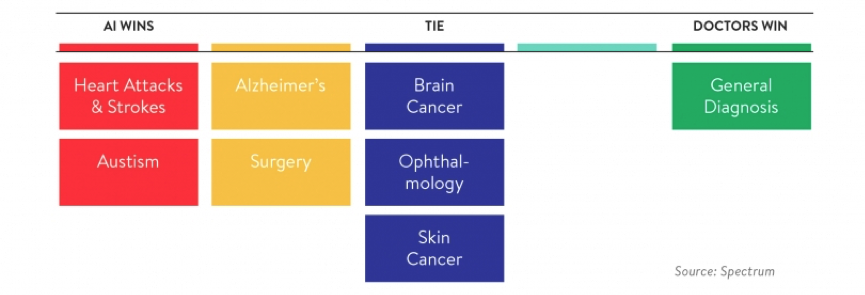
AI already outperforms Doctors in some areas, matches them in others and it is clear that progress will be rapid in others. Esteva et al. in Nature (2017) describes an AI system trained on a data set of 129,450 clinical images of 2,032 different diseases compared its diagnostic performance to 21 board-certified dermatologists. The AI system classified skin cancer at a level of competence comparable to the dermatologists. This does not means that Doctors will disappear but it does mean they, and other health professionals, will have less workload and be able to focus more on the emotional needs of their patients. Lots of symptoms are relatively undifferentiated, some conditions rare and probability-based reasoning is often beyond that of the brain of the clinician. AI technology, and machine learning, offers a way forward from this natural, rate-limiting step. We must accept that this is the way forward.
5. Treatment

Robot pharmacies already select and package prescriptions. They are safer and more accurate than humans. Wearable technology can provide treatment for many conditions, as can technology provided for the patient at home. Repeat prescriptions and on-going treatment could certainly be better managed by GPs and pharmacists online, further reducing workload and pressure on patients time. Above all patient data could be used for more effective treatment and a vast reduction in waste through over-prescribing.

Treatment in hospitals through automated robots, such as TUG, are already delivering medication, food and test samples, reducing the humdrum tasks that health professionals have to do, day in, day out. Really a self-driving car, it negotiates hospital corridors, even lifts, using lasers and internally built AI maps. The online management of treatement regimes would increase complaince to those regimes and save costs.

6. Care

Health and social care are intertwined. Much attention has been given to robots in social care but it is  AI-driven personalized care plans and decision support for care workers along with more self-care that holds most promise and is already being trialed. AI will help the elderly stay at home longer by providing detailed support. AI also gives support to carers. It may also, through VR and AR, provide some interesting applications in autism, ADHD, PTSD, phobias, frailty and dementia.

7. Medical education

Huge sums are spent on largely inefficient medical training. There are immense amounts of duplication in the design and delivery of courses. AI created content can create high quality, high-retention content in minutes not months (WildFire). Adaptive, personalized learning gets us out of the trap of batched, one size fits all courses. On-demand courses can be delivered and online assessments, now possible with AI-driven digital identification, keystroke tests and automated marking make assessment easier. Healthcare must get out of the ‘hire a room with round tables, a flipchart and PowerPoint (often awful)’ approach to training. The one body that is trying here is HEE with their E-learing For Health initiative. Online learning can truly reduce costs, increase knowledge and skills at a much lower cost.
Conclusion


It is now clear that AI can alleviate clinical workload, speed up doctor-patient interaction, speed up investigation, improve diagnosis and provide cheaper treatment options, as well as lower the cost of medical training. We have a single, public institution, the NHS, where, with some political foresight, a policy around the accelerated research and application of AI in healthcare could help alleviate the growing burden of healthcare. Europe has 7% of the world’s population, 25% of its wealth and 50% of its welfare spending, so simply spending more on labour is not the solution. We need to give more support to healthcare professionals to make them more effective by taking away the mundane sides of their jobs through AI, automation and data analysis.

01 Nov 17:33

The Strayer/Capella Merger and What it Means for For-Profits

by Michael Feldstein

Strayer Education and Capella Education just announced a merger.

STRA Capella

Strayer has the upper hand in the merger, taking a 52% controlling interest in the new company, which will be called "Strategic Education" and will maintain Strayer's "STRA" stock symbol. With combined enrollments of close to 80,000 students, the new company will be one of the largest for-profits in the US.

As the company touts, there is a high degree of complementarity between the two entities. First, both kept their noses clean during the for-profit scandal era and maintained good reputation. Capella has, in fact, shown a willingness to actively collaborate with the broader university community, including not-for-profits, by sharing best practices and collaborating in research on topics like learning analytics. Strayer's degrees are largely concentrated in business and IT, while Capella has a broader portfolio including education, health care, and criminal justice. Strayer has a number of physical campuses for classroom or blended learning, while Capella is focused on fully online. Strayer is known to be particularly good at building partnerships with employers, while Capella is known for its work in new educational trends like learning analytics and Competency-based Education (CBE). Strayer has a lot of working adults completing their undergraduate degrees while Capella has a robust set of graduate programs. Both dabble in other formats like code academies, and Capella has 51 certificate programs.

Assuming the merger goes through, both schools will continue to operate largely separately as independent brands. Faculties are specifically called out as remaining separate, though credits will be tranferrable from one institution to the other. The areas singled out for "consolidation" (read: layoffs) are "executive and corporate functions, certain marketing capabilities and IT operations." Corporate headquarters will be in Virginia, where Strayer's headquarters currently are, but IT will be run out of Minnesota, where Capella is.

When we look at this merger in the context of both Purdue's acquisition of Kaplan, DeVry's internal restructuring, and University of Phoenix's transition of ownership and leadership, some trends in the for-profit space begin to emerge.1

Still on the defensive

Despite the hype about the Trump administration being friendlier to for-profits than the Obama administration, the truth is that we continue to see defensive moves. University of Phoenix's old PE owner decided to sell the business, and the leadership brought in by the new owner promptly closed 20 campuses. DeVry fired its CEO after closing 14 campuses and settling a slew of state and Federal lawsuits.2 Kaplan decided to get out of the for-profit university business altogether. (What is left over of that company after the sale to Purdue, and what it will become going forward, is still unclear.) And the most immediate effect of the Strayer/Capella merger will be cost cutting in redundant operations.

In other words, Education Secretary Betsy DeVos has not changed the laws of physics. These institutions were under pressure before and are still under pressure now. We should not be surprised to see more closures like Corinthian Colleges and ITT Tech, particularly of second- and third-tier for-profits. They may not be driven by active prosecutions, but the damage to the sector has already been done. Government intervention wasn't the sole cause of the collapse of Corinthian; lack of cash on hand played a role.

The questions going forward are (a) is the for-profit crash bottoming out, and (b) if so, what does their next act look like? It's too early to tell regarding the first question, but we are getting some interesting hints regarding what the leadership of some of the larger for-profits think possible answers to the second one is.

Course design, analytics, and employer connections

A few details of the Strayer/Capella announcement stand out. The first one comes out of the rhythm of a merger announcement like this one. There's a format of "Company A brings strength X while company B brings complementary strength Y." The announcement touts one of Strayer's strength as "close relationships with employers" that complements Capella's "competency-based learning infrastructure, assessment capabilities and track-record of improving student success." To begin with, these are real strengths of the respective companies rather than made-up talking points. Strayer is good at employer partnerships and does fairly extensive profiling of their students' career goals and paths. Capella, for its part, was giving talks about their learning analytics work way back in the early days, before there were even products on the market.

The bit about CBE, which comes up several times in the released materials, requires a bit of unpacking. Capella offers two flavors of what they label Competency-Based Education: "FlexPath," which is a fully self-paced program in the style of Western Governors University or SNHU's College for America, and "Guided Path," which Capella labels as CBE despite the fact that it is instructor-facilitated, delivered within a term structure for a class cohort, and charged by the credit. What they really mean by CBE in this case is what Phil calls "CBE lite" or what is more commonly known in academic circles as "backwards design," where the outcomes and assessments are designed first and then the content is structured to match (rather than picking the content for the syllabus and then designing assessments after).

Only a relatively small percentage of Capella's degree programs are full CBE FlexPath programs:

Screenshot 2017-10-30 11.45.48

So most of these programs are not actually self-paced CBE but backwards-designed and traditionally delivered courses. That may actually be a lot more important. As Phil has written, full self-paced CBE is still struggling to take off. Backwards design, in contrast is a good practice for course designs that drive improvements in student outcomes and is also a prerequisite for various types of learning analytics and adaptive learning approaches as well as full self-paced CBE. So when Strayer touts Capella's strength in CBE, the real value may be in the course design process and the ways in which those designs can be instrumented in the learning analytics.

Strong connections to employers, consistent application of backwards course design principles, and analytics supported by those course designs, are three areas where the centralized structure of for-profits enables them to move more quickly than many not-for-profits. Reading between the lines, it looks like the Strayer/Capella leadership think they have found a way to compete on quality. And they may not be the only ones tacking this approach. We see signs that at least pieces of these strategies are beginning to surface elsewhere. For example, it was interesting to see that the University of Phoenix's new owner chose a new president who was previously an executive at McGraw-Hill Education, which currently styles itself a "learning science company."

Kaplan is obviously different, but maybe not as different as it appears at first blush. They had a very strong learning science and analytics-driven approach to course design, driven by thought-leader Bror Saxburg (who recently left to work at the Chan-Zuckerberg Initiative). Purdue, for its part, pioneered retention early warning analytics. Despite some controversy regarding one of their research papers, the university has deep experience with using analytics to drive outcomes.

It's still early days, but we may be seeing the beginning of a trend among for-profits to drive toward a particular notion of a quality education as a key competitive differentiator.

  1. Disclosure: University of Phoenix was recently one of our consulting clients.
  2. Disclosure: DeVry has recently been a consulting client of ours.

The post The Strayer/Capella Merger and What it Means for For-Profits appeared first on e-Literate.

13 Oct 13:39

How Big Should Your HR Staff and Budget Be?

by Ann Bares

9349538696_1eb99b608f_zHow big should your HR staff and budget be?

While this is a question best answered in the context of your unique talent strategy -- what it will take to execute that strategy to drive organization success and what role HR plays in making that happen -- benchmarks can sometimes provide a helpful reference point.

Bloomberg BNA's 2017 HR Department Benchmarks and Analysis Report (its 40th annual HR benchmarking study), based on the responses of 681 U.S. HR executives and professionals, supplies some data points for consideration.

A few summary outtakes:

HR Staffing

  • HR staffing ratios, at median across those reporting, have increased 40% over the last 10 years, from 1.0 HR employees for every 100 workers served in 2007 to 1.4 HR employees in 2017.
  • Smaller employers tend to report higher HR staff ratios while larger organizations - who have the advantage of economies of scale - maintain a lower ratio of HR staff.

HR Budgets

  • Budgeted HR spending dipped to a 10-year low in 2017, with a median of $1,087 per employee, down from $1,440 in 2016. This seems incongruent with the trend in HR staffing noted above; Bloomberg BNA hypothesizes that perhaps programs and activities have seen modest growth in line with HR staffing increases, but an expansion of the employee population has resulted in a decrease in spending per capita.
    population drove down per capita costs
  • As with HR staffing, employer size and ability to leverage scale appear to impact HR budgets.  The median per capita HR budget ranges from $594 per employee for employers with 2,500 or more workers to $2,966 per employee among those with less than 250 workers.

More details on the BNA research and report here.

Thoughts and reactions?

Creative Commons image "Group of People" by Karina Freitas

13 Oct 13:39

L&D needs a tuneup, Why training fails, ‘Digital transformation’ is a misnomer, and more …

by Jane Hart
News and articles about Modern Workplace Learning (MWL) selected by Jane Hart for the week 6-12 August 2017
13 Oct 13:35

10 Myths about Modern Workplace Learning

by Jane Hart
Inspired by TeachThought’s 22 myths in modern academic learning, here are 10 misconceptions about Modern Workplace Learning (MWL).  More to come in another post. 1 – MWL simply means modernising training. No. It is much more than modern training. It means a modern approach to learning at work – recognising …
13 Oct 13:35

A Holistic Approach to Workplace Competencies

by Michael Hanley

"Traditional" workplace learning has focused on developing domain-specific skills. Other skills, including “soft skills” are usually assigned a lower priority. Continue Reading →

The post A Holistic Approach to Workplace Competencies appeared first on E-Learning Curve Blog.

13 Oct 12:55

25 healthcare mobile apps for consumers

Library Hi Tech News, Volume 34, Issue 7, Page 16-23, September 2017.
Purpose The purpose of this paper is to provide a curated sample of consumer healthcare mobile apps that can be recommended to library patrons for obtaining health-related information and/or monitor and track their health. Design/methodology/approach Various health and medical apps listed on major app stores have been explored to address diverse consumer health and medical needs. Findings Healthcare mobile apps are increasingly being used by patients and consumers. Originality/value This paper examines some mobile apps that consumers are using as healthcare tools or for finding health information.
13 Oct 12:54

Authoring and enactment of mobile pyramid-based collaborative learning activities

by Kalpani Manathunga, Davinia Hernández-Leo

Abstract

Collaborative learning flow patterns (CLFPs) formulate best practices for the orchestration of activity sequences and collaboration mechanisms that can elicit fruitful social interactions. Mobile technology features offer opportunities to support interaction mediation and content accessibility. However, existing mobile collaborative learning research has mostly focussed on simple activity orchestrations from the perspective of collaborative flow orchestration and flexibility requirements, predominantly in face-to-face pre-university educational contexts. This paper proposes a particularisation of the Pyramid CLFP to support flexible face-to-face and distance mobile learning scenarios in which learners interact in increasingly larger groups along a sequence of activities (Pyramid levels). PyramidApp implements this Pyramid particularisation that provides both a web-based authoring tool and an enactment tool accessible through web or mobile devices. The authoring tool was evaluated in workshops where teachers appreciated its design and applicability to their educational contexts. PyramidApp flows were enacted in three higher education settings. Learners enjoyed the activities but usage and satisfaction varied depending on several design and contextual factors like the epistemic tasks given, the education level and application mode (face-to-face or distance).

13 Oct 12:49

Collection: Health app development: creating apps for health professionals

Public Health England (PHE) has developed a process to encourage the development of effective health apps.

This recommended assessment procedure was created in order for apps to be considered for use by health professionals, and has been developed and refined through consultation and real-life testing.

04 Oct 12:40

Latest Beats in Microsoft’s Pulse of Innovation

by David Tunnicliff

Takeaways from Ignite 2017

To ask someone working at Microsoft about the capacities of digital transformation is increasingly comparable to a ‘how long is a piece of string?’ analogy. It’s ever-changing, ever-developing and largely, the pulse of Microsoft’s innovation story. At the annual event, Ignite, Microsoft revealed the pulse’s latest beats.

Ignite is an annual conference run by Microsoft where technical and business leaders come together and get immersed in the industry’s latest technological advents. Last week, AlfaPeople had the pleasure of sending our Director of Dynamics 365 Enterprise Architecture, David Tunnicliff, to the 2017 event.

Here’s are some of Dave’s key takeaways…

1. The conference was quite literally, huge.

Microsoft Ignite was massive. The Orange County Conference Centre where it was hosted is the second biggest conference centre in the USA. As always with these things, there was a lot of sitting, but thanks to the size of this place, a lot of walking too! I was getting in 13-17km a day!

2. Accelerating Digital Transformation

The event this year continued to focus on accelerating digital transformation through ongoing investment and rapid development of the Microsoft platform and graph. Backing this up were plenty of examples of Microsoft using its own technology in Microsoft’s internal transformation under the direction of Satya Nadella.

You can find some great videos here, including the Vision keynote from Satya Nadella here.

3. Enriching the Microsoft Graph

One key message was that the Microsoft Graph was becoming more enriched and more tightly integrated with Microsoft applications.

As part of this, we are seeing that LinkedIn is finally starting to become more available across the Microsoft tools. Ultimately, LinkedIn will feed into the business applications, providing more contextually rich data and as such, hugely enhancing sales, marketing, and recruitment throughout. Dynamics 365 for Talent will be further enriched with ‘Attract’ and ‘Onboard’. Not to mention from an HR perspective, having LinkedIn data associated to the Office 365 suite enables great networking facilities for colleagues. Microsoft also announced that Flow and PowerApps will become more deeply integrated into Dynamics 365.

4. Microsoft Teams

It wasn’t that long ago that Lync became Skype for Business. Microsoft announced at Ignite that over time (no time frame was given) that SfB will be rolled up into Microsoft Teams.

5. GDPR and Data Governance

GDPR and data governance was a big topic this year which was good to see. Azure has a load of useful tooling for GDPR – including threat protection. To find out more about GDPR compliance at AlfaPeople, read the article here.

6. Improved AI

Unsurprisingly, AI was big this year, including improvements to the bot tooling. Specifically focusing on Dynamics 365 CE and Dynamics 365 F&O, intelligent conversion, customer care and customer service channels are benefiting from AI components. Cognitive services were also shown off throughout, not to mention some cool things around speech to text and the OCR capabilities of MS cognitive services.

7. Connected Data

Common Data Services/Common Data Models (CDS/CDM) are clearly key to connected data. I spent a decent time talking to some guys from a commercial database company who are going live with a Dynamics 365 implementation using CDS/CDM to orchestrate centralised data. It was great to hear of a real-world implementation.

LogicApps was another area where huge advancements were shown. Some great demos and great examples of using real world no/low code integrations through logic apps and swagger endpoints – even a pretty whacky example of mapping a route between Orlando and Miami, picking up the traffic incidents along the way, then searching Spotify for tracks matching those incidents and creating a playlist from them. Not particularly enterprise, but an interesting example of the power of LogicApps nonetheless.

Focusing on PowerApps, data integration services are getting some power through the addition of power query. This brings the same capabilities provided through Power BI and Excel into data integration services as well. ‘Prospect to Cash’ templates have been hugely extended within the standard templates in PowerApps admin.

8. Advancements in Finance and Operations

Dynamics 365 for Finance and Operations was an area I paid particular attention to – and I’m glad I did. Advancements in Retail, Talent, CEO Overview Dashboards / reporting, the new Distributed Order Management (DOM) model which is an upcoming feature, and connected workplaces all add to the overall power of Dynamics generally. Summarised below:

Keen to find out more about the latest events at Microsoft? You can also read our blog article on key takeaways from Inspire 2017 here.

The post Latest Beats in Microsoft’s Pulse of Innovation appeared first on AlfaPeople-UK.

03 Oct 13:47

adapting to life in perpetual beta

by Harold Jarche

Twenty years ago I was finishing my Master’s thesis on learning in the information technology workplace. A significant part of my research relied on the work of Marshall McLuhan, especially his laws of media. My job at the time was the development of all training related to a fleet of helicopters employed in tactical aviation: from pilots, to technicians, and including flight simulation and computer based training. The web was a new thing in 1997. But I was convinced, based on my readings of McLuhan and many others, that it would create an epochal shift in how we work and learn. I decided that understanding this shift would become my professional focus.

I retired from the military in 1998 and took a position as project manager at The Centre for Learning Technologies, a now closed external department of Mount Allison University, here in Sackville. This is why we live in such a remote place. Later I was in charge of professional services for an e-learning company. In 2003 I started my consulting practice and soon after, this blog.

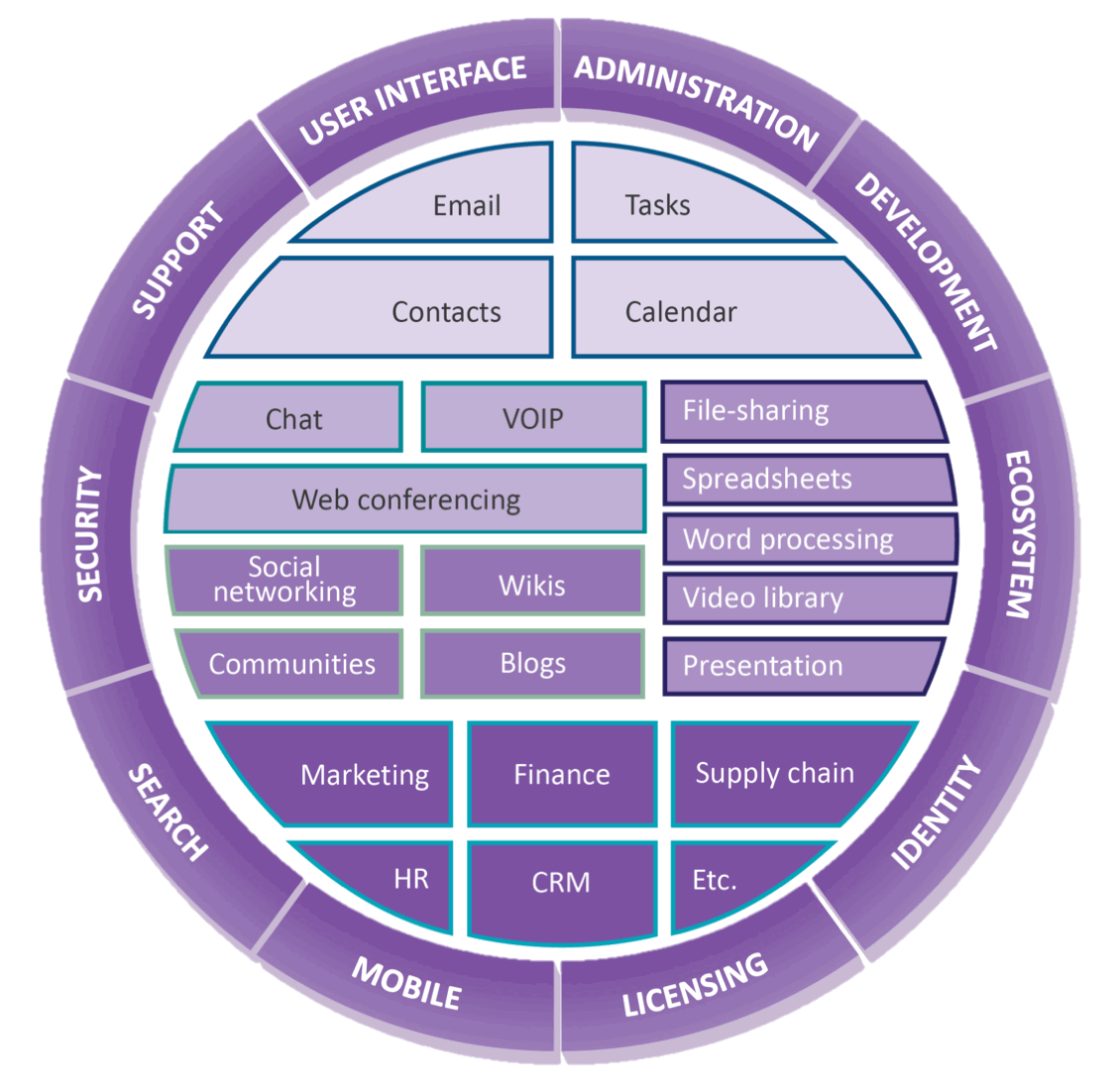
Over the past +14 years I have always had a challenge describing what I do for a living. Today I came across an article on the future of work, by Deloitte. The image included with the article pretty well describes my professional focus for the past twenty years.

The bottom three boxes cover almost all my work. Here are some examples.

  1. Individuals: The personal knowledge mastery framework I have developed over more than a decade helps individuals take control of their professional development.
  2. Organizations: The social learning workshop is for those supporting organizational learning and I have developed a suite of models as guidance for the future of work, or what I call the network era.
  3. Public Policy: I have given forward-looking advice (PDF) to Canada’s Department of Justice, spoken on governance & the networked city with the London Voluntary Service Council (video), and have an upcoming session with the Finnish Prime Minister’s Office on the transformation of work.

So, in a nutshell, I work with individuals, organizations, and public policy influencers to develop practical ways to adapt to the technological, demographic, and societal changes facing us today. You could call it adapting to life in perpetual beta.

03 Oct 13:46

Goodbye Totara LMS 9, hello Totara Learn 10

by Kayleigh Tanner
BRIGHTON, UK (22 September 2017) -- Totara Learning has just released Totara Learn 10, the latest version of its open...
11 Sep 09:14

Evolve Release 3.8

by Matt Cleghorn

Evolve 3.8; bringing you @mentions, Hinting and plenty more.

The team at Appitierre have been working hard to bring you Evolve 3.8 and I’d like to let you know about all the updates, improvements and just plain cool stuff that’s in this update.

Don’t have time to read? Check out the video.

Annotations

It’s now possible to mention team mates. How? Easy use @username and you’ll see a list of matching team mates. They’ll get an update using desktop notifications, email and inside Evolve so there’s no risk of delaying those changes you need.

New Hint component

Add hints to your pages and display these as buttons. Display your hint buttons in configurable rows and reveal one hint after another. Really useful for helping learners on a course.

Box menu improvements

It’s possible to set the number of items per row (2,3,4). Items in the box menu match height in their rows.

Course Reviewers get email alerts

When added to a review Reviewers receive and email and a desktop notification if they’re logged in.

Scroll Progress Extension

Display horizontal bar that fills as users scroll down pages. This can be styled, have it’s height set on large and medium desktops.

Asset improvements

It’s now possible to set the default sort order for Assets in user settings.

Hero images have an additional graphic option

Add a ‘floating’ graphic to your hero images and position it precisely anywhere inside the hero image.

Position navigation logo left, right or center.

Additional updates

  • Achievements: Now has the options to reset the course if the learner runs out of lives.
  • Achievements: New theme option to hide the info bar on page/menu headers
  • Favicon: The evolve favicon now changes when a new message is received.
  • Video Stream Component: Added Interface Language Option to youtube player
  • Course Importing: New UI that displays import progress
  • Narrative Component: Option to have the text above slides
  • Feedback: Can now add global feedback images
  • Accessibility: Skip to content added
  • Branching Component: The item editor now automatically increases to allow more room for organising items
09 Aug 11:02

A history of enterprise search 1970-1979

by Martin White

Although the theme of this series of posts is enterprise search only now in the 1970s do products emerge which are clearly the antecedents of what we would regard as enterprise search applications. From here on in the focus on academic research will be significantly less, not because less research is being carried out but because it is well documented in a range of books. In particular  each chapter of Introduction to Information Retrieval by Manning, Raghavan and Schutze has an annotated bibliography and can be downloaded as a pdf. However there are three academics that I must include. The first of these is Gerard Salton. He developed the SMART software application as a ‘test bed’ at Harvard University and took it with him to Cornell University where he stayed for the rest of his career. Salton developed the cosine vector space model (VSM) to compare the relevance of a group of search results. The evolution of this model took place over a number of years and David Durbin has tried to unravel the way in which it developed, providing a good bibliography. Karen Spark Jones worked in a number of departments at Cambridge University from the time of her PhD in 1964. A profile of her work whilst at Cambridge links to papers describing her research, all of which has had a major impact on information retrieval. Her overview of information retrieval research is essential reading. The third person is Stephen Robertson, a research colleague of Karen Spark Jones who went on to work at the Microsoft Research Laboratories in Cambridge. His work has extended from the mid-1970s until quite recently, the scope of which is indicated by his list of research papers. Stephen is especially noted for his development of the BM25 ranking model, which built on the work of Karen Spark Jones on the term frequency.inverse document frequency model.

If you want to choose a date to mark the beginning of enterprise search then 1970 is that date, It marked the launch by IBM of STAIRS (Storage and Information Retrieval System), an evolution of the AQUARIUS software that IBM developed to cope with the documentation for the defence of an anti-trust suit in the USA that started in 1969. STAIRS was specifically designed for multi-user time-share applications (the typical enterprise scenario) and remained on the IBM product list until the early 1990s. Jumping out of any sort of chronology in 1985 STAIRS was subject to a very thorough evaluation which raised doubts about the effectiveness of full text indexing, A review article by David Blair, published in 1995, is a must-read for anyone with an interest in enterprise search and evaluation as it looks back at the 1985 evaluation with the benefit of substantial hindsight, and benefits from the fact that although Blair was one of the authors of the original review it comes across as an independent and unbiased assessment.

By the mid-1970s mini-computers were being adopted very widely, and many organisations and companies saw this as an opportunity to develop text/document retrieval software products for these mini-computers. These included BASIS (Battelle Institute) and INQUIRE (Infodata). So far this history has been dominated by developments in the USA but the mini-computer market stimulated software development in the UK, including ASSASSIN (ICI), STATUS (Atomic Weapons Research Establishment), CAIRS (Leatherhead Food Research Association) and DECO (Unilever). I had a role on the development team of DECO from 1979 – 1981. These and other applications all emerged towards the end of the 1970s. An interesting comparative review of them was published in 1984. These applications all evolved from specific organisational requirements which were then productised for use more widely, demonstrating that you did not need to be a large academic institution or software company to develop retrieval software. These systems were accessed through networked terminals; the IBM PC was not launched until 1981. I am sure the market developed in the same way in the USA but information on the US market at this time is very difficult to find.

As a footnote to this post on the 1970s the first assessment of the potential role of artificial intelligence in information retrieval was published in 1976. Just over a decade later Verity, the prototype for all enterprise search applications, emerged from a company specialising in AI development. That is a story for the next post.

(A history of enterprise search 1960-1969 7 August)

Martin White


08 Aug 14:54

The Long Tail, the 80:20 Rule and the role of learning professionals

by Michael Hanley

“What is the Scope of our Responsibility as Learning Professionals?” In 1959 Peter Drucker coined the term “knowledge worker” to describe one who works primarily with information or one who develops and uses knowledge in the workplace. It is performed… Continue Reading →

The post The Long Tail, the 80:20 Rule and the role of learning professionals appeared first on E-Learning Curve Blog.

08 Aug 14:34

Google Classroom: Isolated adoptions for higher education institutions

by Phil Hill

At last month’s Future Trends Forum hosted by Bryan Alexander, I received several questions around the intersection of K-12 and higher education markets for learning platforms. A condensed version of my answer is that the mainline LMS vendors are seeing increased overlap (Canvas, D2L Brightspace, Blackboard, Moodle, and Schoology in particular), but that there was little overlap when it comes to the teacher-oriented Big Classrooms (Google and Facebook).

Three years ago when the buzz over Google Classroom was at its peak, I wrote several posts looking at the platform, ultimately concluding in the post titled “Why Google Classroom won’t affect institutional LMS market … yet”:

None of this argues that Google Classroom is an inferior tool – it is just not designed to replace the full-featured LMS. Remember that Google is a technology-vision company that is comfortable putting out new tools before they understand how the tools will be used. Google is also comfortable playing the long game, getting more and more instructors and faculty using, giving feedback, and pushing forward the new toolset. This process will take some time to play out – at least 2 or 3 years in my opinion before a full institutional LMS may be available. If Google like the direction Classroom usage is going.

Subsequently, Google has addressed some of the gaps in the product, including a programming interface that could allow deeper integration with student record systems used at higher ed institutions.

We’re now 3 years down the road from the initial analysis – has Google Classroom started to be adopted as a full institutional LMS?

Our partners at LISTedTECH have performed an initial analysis on this question. We do not yet have full data coverage in the same fashion as our LMS market analysis, but this early view should give some insight into higher ed adoption of the platform.

For this initial view, we are looking at institutional adoption. Where a school supports Google Classroom as their primary or secondary system. There are plenty of other cases where individual faculty choose to use the platform in an unsupported manner.

Notes from initial view:

  • A lot of the interest seems to come from developing countries where the education budgets are quite low. Malawi, Papau New Guinea, etc.
  • For the United Kingdom, the number is artificially high as 5 of the institutions are all part of Warwickshire College Group (a collection of Further Education colleges). Nevertheless, the UK has the higher number (so far) of institutional adoptions.
  • The usage of Google Classroom as a secondary system makes sense – an alternative platform that doesn’t have all the features and integrations typically needed for primary system usage – but there are cases now of primary usage.
  • In the US, the most notable adoption is the California University of Management and Sciences, a Student and Exchange Visitor Program (SEVP)–certified institution in Anaheim. They support both Moodle and Google Classroom for primary LMS usage.
  • While we don’t have comprehensive coverage yet, it appears that there are some isolated cases of Google Classroom institutional adoption in higher education. The platform is still not a true LMS competitor, but we’ll keep watching.

The post Google Classroom: Isolated adoptions for higher education institutions appeared first on e-Literate.

08 Aug 14:26

Why L&D Goes Hand in Hand with M&A

by Eric Duffy

Mergers and acquisitions are playing an increasing role in business strategy, as 56 percent of CEOs expect their companies to pursue an acquisition over the next 12 months, according to EY’s Global Capital Confidence Barometer.

If anything underscores the executive-level interest in M&A, it’s this: While political landscapes are shifting around the world, “we may be witnessing a new kind of M&A market, where these geopolitical concerns might not derail deals, unlike in previous cycles,” EY said, adding: “More than ever, companies that hold back from inorganic growth strategies could struggle to remain relevant in a fast-moving environment.”

M&As can provide the ideal opportunity to overhaul broken, ineffective or antiquated processes. Yet despite their strategic importance, few things make workers more nervous than acquisitions, since newly joined companies often look for opportunities to cut costs or spin off certain subsidiaries. Plus, at least two workforces must be integrated as the organizations restructure and reassign roles.

This nervousness isn’t unfounded, as countless statistics can be widely cited about the disappointing success rates of M&As, and experts have struggled to pinpoint the root of the problem. One thing is clear: The HR team plays an important role throughout an M&A. “Human talent and leadership are at the very crux of what makes some M&As successful and others not,” Dennis C. Carey and Dayton Ogden write in The Human Side of M&A: How CEOs Leverage the Most Important Asset in Deal Making.

While Learning & Development may not be the end-all and be-all of a successful M&A, it can play a vital role. Effective L&D can help foster confidence in new leadership, assuage employees’ fears about the future, ease transitions among teams and help discordant workforces find synergies.

Why Knowledge Sharing is Critical in Acquisition

The seemingly at-odds trends mentioned above — that M&As are highly intriguing to executives even though they frequently fail to meet anticipated goals — makes it worth considering where the key areas of failure occur. In a 2016 webcast, J. Keith Dunbar, founder of Potentious, a boutique M&A consulting firm, explains that these root causes tend to fall into three buckets: strategy/valuation, people and due diligence/integration.

The last two buckets — people and due diligence/deal integration — are where L&D can play a vital role.

Mergers or acquisitions bring pain points related to cultural dissonance in the workplace (a large part of the “people” failure bucket). For one thing, if the deal creates a significantly larger organization, it’s sure to face scaling processes and growing pain. Culture clashes, confusion over roles and power struggles may also arise, especially when the merging organizations are significantly different in size, involve international offices or combine an established corporation with a startup. Amid the tensions that usually form during the M&A process, employee morale can be tenuous.

Such uncertainty can make the M&A process a trying time for employee retention, according to Deloitte. Turnover rates can skyrocket. Yahoo’s acquisition of Tumblr offers one such example: Barely two years after the deal, one source with knowledge of the company’s internal turmoil told Business Insider that close to half of Tumblr’s sales team had quit. The exodus, which included the Tumblr sales team’s Global Head of Brand Partnerships Lee Brown (now the CRO at Buzzfeed), occurred after Yahoo decided to combine the two sales teams.

For the “integration” part of the M&A process, common sense dictates that an updated system be put in place to share knowledge. Updating L&D around a common strategy not only helps employees thrive in their new roles, it also showcases leadership’s commitment to employees’ well-being.

An L&D environment customized to address the new organization’s challenges allows individuals to pool their skills and core competencies. These assets become knowledge powerhouses for the entire company. Fostering collaborative environments also encourages new colleagues to bond through shared learning.

Using L&D to Retain Top Talent

A strategic L&D game plan can help companies retain their most valuable employees, subject matter experts and leaders in their field. An L&D ecosystem that encourages employees to act as thought leaders — while sharing their own arsenal of knowledge and learning resources — nurtures both relationship-building and leadership development among and across teams.

Furthermore, Dunbar explained, effective L&D programs can detect potential problems in an M&A’s early stages: They can be used as “early warning systems” to determine areas of potential discord — a poor skills-fit for an employee moved to a new team, for example.

An organization that emerges from an M&A contains a hodgepodge of skills, talents and opinions — and will demand its own unique L&D formula. What a newly merged company’s L&D overhaul will look like depends upon internal dynamics, the deal’s goals and what the current learning processes look like.

Here’s where a decentralized L&D approach can play a key role: A mixture of e-learning, experiential tactics, quality content and collaborative social learning taps into shared values and helps lay the foundation for a smooth transition.

It’s a mistake to let L&D strategy become stuck in the bottleneck of priorities that forms during a merger or acquisition. By spreading the concept of L&D organically, companies can eliminate some of the uncertainty that may drive a wedge between employees, their new colleagues and their new management team — and improve the chances of an M&A’s success.

08 Aug 14:18

A history of enterprise search 1948-1959

by Martin White
I.gardner.gb

Great post - the historical perspective on issues is too often ignored in workplace productivity and when considering current affairs in general.

I have set the start date for this history somewhat arbitrarily as 1948, the year of the Royal Society Scientific Information Conference. This conference identified the challenges that lay ahead in managing the flow of scientific information, challenges that we have not solved. The earliest research into how computers might help was undertaken by Philip Bagley as part of a Masters project at MIT. His thesis was entitled Electronic Digital Machines for High-Speed Information Searching. He set out the basic principles of ‘information searching’ and wrote a program for the Whirlwind computer at MIT. This Masters thesis should not be confused with his later PhD thesis in which he was the first to use the term ‘metadata.

By June 1952 there was enough interest in the subject at a number of research centres across the USA to hold a Symposium for Machine Techniques for Information Selection at MIT. One of the speakers at the Symposium was Hans-Peter Luhn, at that time working on punched-card retrieval systems for IBM. Luhn would turn out to be hugely influential in information retrieval. Another very influential person was to be Eugene Garfield, who in 1955 published a paper in Science about the value of citation analysis. From this approach Garfield developed the Institute for Scientific Information, in due course one of the leading online databases. However his insight also became one of the innovations incorporated into Google at the outset on the 1990s, but that is another story. Of more immediate interest is a paper by Allen Kent and his colleagues at the Battelle Memorial Institute, Ohio. In this paper the concepts of ‘recall’ and ‘pertinency’ are proposed as metrics for a search application; ‘relevance’ later replaced pertinency.

There were two further important conferences in the 1950s.The first was the International Study Conference on Classification for Information Retrieval, held in Dorking, UK in 1957. This was the first opportunity for UK and US research teams to exchange ideas and research on information retrieval. The US may have had a technology lead but the UK was held in high regard for research and implementation of  classification and index frameworks. A year later an International Conference on Scientific Information was held in Washington to take note of developments since the 1948 Royal Society conference and much of the discussion was about information retrieval. The papers make for some fascinating reading. Even in 1958 Dow Chemicals was studying how computer-based systems could be used to manage in-house documentation.

The chemistry community have long had some special information retrieval challenges (such as searching chemical structures) and have always been in the vanguard of search development. It was at an American Chemical Society meeting in Miami in 1957 that Luhn gave a paper on A Statistical Approach to Mechanized Encoding and Searching of Literary Information in which (in effect) he set out the constituent elements of a search application.

The following year Luhn published a paper on his work at IBM in which (according to the abstract) “excerpts of technical papers and magazine articles that serve the purposes of conventional abstracts have been created entirely by automatic means. In the exploratory research described, the complete text of an article in machine-readable form is scanned by an IBM 704 data-processing machine and analyzed in accordance with a standard program. Statistical information derived from word frequency and distribution is used by the machine to compute a relative measure of significance, first for individual words and then for sentences. Sentences scoring highest in significance are extracted and printed out to become the “auto-abstract.” A visionary approach. Luhn also proposed that the frequency of word occurrence in an article furnished a useful measurement of word significance. This is the origin of the now familiar term frequency – inverse document frequency model although it was not until 1972 that Karen Sparck-Jones developed a rigorous statistical basis for TF.IDF.

In 1959 Maron and Kuhns wrote a seminal paper entitled On Relevance, Probabilistic Indexing and Information Retrieval  in which they defined ‘relevance’ and the use of ‘probabilistic indexing’ to allow a computing machine, given a request for information, to make a statistical inference and derive a number (which they called the “relevance number”) for each document, which would be a measure of the probability that the document will satisfy the given request. The result of a search would then be an ordered list of those documents which satisfy the request ranked according to their probable relevance. The importance of the paper is that Maron and Kuhns then evaluated their proposal through a manual (rather than computer-based) trial, so setting out not only the fundamental principle of determining the probability that a document was relevant but the importance of system evaluation.Fifty years later Maron published a short account of the background to this paper in which he provides a fascinating insight in how he and Kuhns developed this principle.

Although Maron and Kuhns had shown that a probabilistic approach was superior to a Boolean approach virtually all of what might be seen as the first generation of commercial search applications used Boolean logic because the challenge of calculating a ‘relevance number’ had yet to be solved. It is of note that Maron was at the Rand Corporation as a spin off, System Development Corporation, played an important role in search development. Another important development in 1959 was the establishment of the Augmentation Research Center at Stanford Research Institute under the direction of Doug Engelbart.

So by the end of the 1950s almost all the core elements were in place, including understanding the required modularity of the search process, the benefits of a probabilistic view of document retrieval (rather than using Boolean operators), the concepts of precision, recall and relevance, and the value of testing and evaluation. What was needed now was computing power. In the 1960s California would forces with Massachusetts in the quest to scale up search and make it widely available within and outside of the organisation.

Martin White

(A history of enterprise search – starting out 27 July)


08 Aug 14:16

What does the 6th annual Learning in the Workplace Survey say about the state – as well as the future – of L&D?

by Jane Hart
This year in the 6th Annual Learning in the Workplace survey, I asked respondents to rate the importance (value/usefulness) – of the following 12 ways of learning for, at or through work. Classroom training e-Learning (e.g. online courses for self-study) Internal resources (documents, guides etc.,) Knowledge sharing within your team Daily work experiences (i.e. doing …

Continue reading "What does the 6th annual Learning in the Workplace Survey say about the state – as well as the future – of L&D?"

08 Aug 13:50

General Data Protection Regulation (GDPR): More FAQs

More FAQs on the General Data Protection Regulation (GDPR) have been added to XpertHR.
31 Jul 15:39

Zoho Launches Zoho One Business Suite

by Alan Lepofsky
I.gardner.gb

Interesting development as an alternative to the usually mentioned players.

By Alan Lepofsky

This week Zoho launched Zoho One, an offering that provides customers with access to all of the Zoho business and productivity applications for a single price of $1/person/day. If you're unfamiliar with Zoho, you should really take a look at their extensive product portfolio which includes:

  • Personal Productivity: Word processing, spreadsheets, slides and note-taking
  • Communication and Collaboration: Email, chat, web-conferencing, social networking, group messaging, file-sharing and project tracking
  • Business processes: Sales/CRM, marketing, customer support, finance/invoicing, human resources and a custom application (low-code) developer tool

While perhaps not as well know as its Microsoft and Google competitors, Zoho does have an impressive 3rd party ecosystem of extensions available via the Zoho Marketplace

Customers Take Note

While individual applications in the Zoho One portfolio may not offer as many features as their counterparts from Microsoft Office 365/Dynamics, Google GSuite, Salesforce, Workday, and others, Constellation Research believes Zoho One's complete platform solution provides a very attractive option for many businesses. As outlined in the research report Why Your Organization Should Buy a Collaboration Platform Instead of a Best-of-Breed Solution, having a single platform provides advantages in integration, administration, security and several other areas.


24 Jul 13:38

Reconsidering Your Office Layout

by Jack Robinson

Gallup survey results  reinforce a key point of my recent story about the distracting acoustical problems of open offices: In the workplace, privacy matters.

Gallup’s 2017 State of the American Workplace (full report is  here) finds that while an estimated 70 percent of U.S. offices use open floor plans to encourage collaboration, “people still want a personal space at work,” according to Annamarie Mann, who is Gallup’s employee engagement and well-being practice manager.

Her  sensible recommendations are summarized on Gallup’s site in an article titled “How to Make an Open Office Floor Plan Work.”

Mann’s suggestions include:

  • “Allow every employee to have a home base, even in a flexible, collaborative office.”
  • “Provide a variety of types of spaces—big group tables, booths, comfy chairs, soundproof areas, large and small meeting rooms— that allow employees the freedom to choose how they work best.”
  •  “Start a conversation about how your organization understands collaboration in relation to productivity.”

Analyzing the responses to Gallup’s surveys, Mann finds a link between office environment and employee engagement. The research found “employees who have a personal work space are 1.4 times more likely to be engaged at work” than other workers, Mann notes. (Gallup found only 52 percent of responding workers have a work space with a door they can close.)

And “employees who have the ability to move to different areas at work are 1.3 times more likely to be engaged than other employees,” she writes. (Gallup found 74 percent of respondents said they have that freedom.)

18 Jul 12:20

First degree apprentices in UK graduate

by Paul Offord

The first group of degree apprentices in the UK have graduated today, with seven out of the 11 gaining first class honours.

The Aston University learners were awarded bachelors of science degrees in digital and technology solutions, following three years of combined study and work with the global consulting, technology and outsourcing company Capgemini.

The other four all achieved second-class degrees.

Professor Ian Nabney, executive dean of the university’s School of Engineering and Applied Science, said: “Degree apprenticeships are a valuable option to applicants whose learning style is less suited to a traditional on-campus study route.

“The difference in delivery allows them to apply their learning in the workplace rather than the classroom. This offers those with the right skills and aptitudes a challenging but rewarding route to graduate-level jobs, while their academic achievement is recognised as being at the same high level as a traditionally earned degree.”

the skills and apprenticeships minister Anne Milton offered her own words of congratulation for the graduates’ graft.

“I am delighted,” she said. “The hard work and commitment involved is truly admirable and highlights the opportunities apprenticeships can bring.

“I hope this will encourage more people to consider a degree apprenticeship.”

Also recognised today at the ceremony was Sue Husband, director of the National Apprenticeship Service, who collected an honorary doctorate in science.

“I am absolutely delighted to attend the graduation of the first cohort of degree apprentices in the country, for what is a momentous occasion,” she said.

“Degree apprenticeships are a significant step forward, providing the opportunity to develop and nurture talented individuals, and are a key part of our apprenticeships reform programme.”

This good news will be welcomed by many involved with degree apprenticeships, which have endured a difficult time of late.

FE Week reported in June that many higher education leaders are issuing dire warnings about their very future.

The FE sector reacted in horror after the Education and Skills Funding Agency announced in April that it would pause the procurement process for providers delivering apprenticeships to smaller non-levy-paying employers, and would extend existing contracts instead.

It then emerged that many universities had been ruled out of delivering new degree-level apprenticeships to small employers from September, as they cannot be funded through the extended contracts.

It’s a situation that will risk the future growth of degree apprenticeships, according to Nicola Dandridge, the chief executive of Universities UK, the representative body for higher education leaders.

“Employers want degree apprentices to address key skills needs and to drive growth,” she said, adding that “any region that has many non-levy-paying employers, such as the south-west, will see very few degree apprenticeships supported from this procurement, regardless of employer demand or local enterprise partnership strategy”.

The problem arose because non-levy allocations for providers’ existing contracts were worked out on the basis of their previous delivery, a situation which will apply for the eight months between May to December this year.

As most degree apprenticeships are new programmes starting in September, they cannot be funded by existing contracts.

The pause has therefore meant that these new degree apprenticeships can only be funded through levy-paying large employers until December at least.

Five HE institutions – many of them modern universities, those that won their status after 1992 – and 20 FE colleges received funding through phase one of the Higher Education Funding Council for England’s degree apprenticeship development fund.

The cash, which totalled £4.5 million across 18 projects, was awarded in November with the specific aim of developing “new provision to support up to 5,200 new degree apprenticeships” from this autumn.

But Alan Palmer, head of policy and research at Million Plus, which represents modern universities, said the procurement pause puts  this commitment “at risk”.


Main image caption: James Gee, one of the Gapgemini degree apprentices