Shared posts

03 Jul 09:23

Digital capability community continues to grow

by Clare Killen

The second network event for our digital capability community of practice took place in Birmingham on 30 November 2017 with around 100 participants from over 54 colleges and universities coming together to share practice, exchange ideas and work together. The presentations, resources and Periscope recordings are available from our event page.

The strong interest in this community of practice signifies the centrality of digital capabilities to all aspects of educational practice and a recognition that digital capabilities are not only vital for the employability and future career prospects of our students but also have the potential to enhance institutional reputations and aid organisational efficiency.

Sharing practice

The contributions made on the day, by our presenters and by collaborative engagement in workshop sessions were greatly valued.

“I wanted to hear examples of other institution’s approaches to developing digital capability, and there were plenty of examples.”

Developing a holistic institutional approach

Our keynote speaker, Karen Barton, director of learning and teaching at the University of Hertfordshire, shared their approach to developing a holistic institutional approach to digital capabilities development. The formation of a digital capability steering group has been a key enabler, engaging senior stakeholders and sponsoring wider participation with their teams.

The Jisc digital capabilities framework proved useful in getting dialogue going and helping others to get to grips with the language and vocabulary used to describe digital capabilities. Karen also talked about the University of Hertfordshire’s model for staff development at different stages of their careers and the work on mapping where digital capabilities fit into their broader CPD framework and learning landscape.

Ongoing work includes the establishment of a student experience academic research group with a sub group focusing on technology enhanced learning and exploring whether the academic CPD model can be applied to other role profiles.

Watch the Periscope recording of Karen’s session or view the slides on our event page. See also their institutional story on their participation in the first stage pilot for the discovery tool.

Community-led discussions

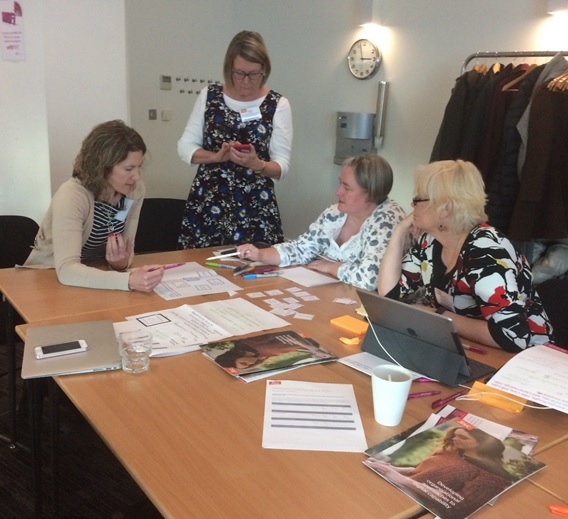
Group work at digital capability community of practice 301117

Participants at the first digital capability community of practice event in May 2017 requested time for community-led discussions and topics identified by those registered for the November 2017 event included:

  • Effective staff development strategies – how to upskill staff with digital capabilities
  • Developing organisational approaches to digital capability and getting buy-in from senior managers
  • Measuring the impact of initiatives, tools and strategies on staff/student capability
  • Student digital capability, embedding digital capabilities into the curriculum and student/staff partnerships

Facilitated by community members, participants were tasked with identifying critical issues and sharing experiences and solutions – the outputs are captured on our padlet. A variety of strategies were used – in one group, participants were challenged to come up with 20 ideas/potential solutions in just five minutes with most achieving the target before being further challenged to identify one thing they could action the following day. This proved a very effective way of moving from general discussion to action-focused solutions in a short period of time.

Strategies for engaging staff

Community members cited staff engagement in digital capabilities as one of their most critical issues and so the opportunity to hear from four community members on their differing approaches was informative and insightful.

Non Scantlebury and Jo Parker both shared innovative techniques they’d used to engage staff in conversations around digital capability. Non asked participants to share their favourite apps and reveal their digital superpowers mapped to the framework; Jo used the ‘love letters and break up letters’ approach which elicited deep and more emotive feedback about the digital discovery tool.

Randeep Sami and Delon Commosioung shared strategies and practical examples of how they are engaging staff in their respective colleges.  Randeep explored the concept of the digital classroom and shared details of their 21st century teaching programme; Delon outlined how working as part of the quality team has helped to position effective use of technology as integral to teaching, learning and assessment.

One of the highlights of the meeting was a series of five Pecha Kucha sessions from community members willing to share their experience, practice and strategies. These short seven-minute presentations shared journeys so far, outlined institutional approaches and transformative ambitions, bringing the day to a well-paced end.

Video recordings and presentations are available to view on our event page.

Looking ahead to 2018

Building digital capability project update

A lot has happened since the first digital capability community of practice event in May 2017:

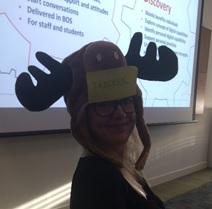
  • Tabetha Newman96+ institutions have signed up to take part in the second phase of our pilot of the digital capability discovery tool which runs from December 2017 to May 2018.  See Helen’s Beetham’s blog post Digging deeper with the discovery tool which provides a useful analysis of the motivations and aims of those signed up to pilot the new tool. See also Helen Beetham and Tabetha Newman’s update on the digital discovery tool including a succinct and entertaining guide on the differences discovery tool and the student experience tracker – complete with appropriate hats!
  • New for 2018: senior leaders briefing and video case studies – Recognising the strategic importance of digital capabilities, Jisc will be producing a senior leaders briefing in March 2018 along with four institutional video case studies. A study of how HR departments are supporting the development of digital capabilities is also underway with a report and case studies available in April 2018 – see Lou McGill’s blog post for details of how you can take part.
  • Visioning the new building digital capability service – Jisc is also working on the development of a new web-based portal designed to provide organisations and individuals with clear routes through the wealth of information, support options and resources available to support digital capabilities development. Keep up-to-date by signing up to the digital capability mailing list and the project blog.  As the prototype of the digital capability service is being developed we are looking for volunteers to get involved in some short online user testing activities (30 minutes or less). If you would like to take part, please get in touch with Alicja Shah.
  • A series of training events and webinars on curriculum confidence, digital well-being and identity, and digital leadership is also running over the next few months.

Shaping the next agenda: your take-aways and thoughts for future events

While Jisc has founded this community, the focus is very much on building a sustainable network and in facilitating participants to share the collective wealth of experience. Feedback from the event is very positive and naturally reflects the different stages people are at in their own personal and institutional journeys.

Participants valued the opportunities to hear the developmental journeys of others and highlighted other areas they would like to see more focus on at future events.

“It was good to be able to discuss issues and ideas with like-minded people as a small group”

“It has given me some ideas to try out.”

Suggestions for the next event include creating time and space for:

  • Discussion on the changing landscape around learner expectations and needs, societal views on education and the effect of this disruption and how digital capabilities feature in this
  • Feedback and case studies from students and their experiences in digital capabilities development
  • Networking with colleagues

What did you take away from the event?

What would you like to see on the programme for the next event?

Use the comments below or share your thoughts via the digital capability mailing list.

Save the date

We are delighted to announce that the next digital capability community of practice event will be hosted by the University of Leicester on 22 May 2018.

Do join us for what promises to be another rich exchange of ideas, approaches, strategies and resources.

03 Jul 09:22

An Introduction to Modern Workplace Learning in 2018 (free e-book)

by Jane Hart
A new series of 3 e-books is now available to download. These e-books include some (updated) content from Jane Hart’s previous books as well as new material. Part 1 is embedded below. You can download the PDF using the Download link beneath it.  Part 2 (Designing, Developing and Managing Modern Training Experiences) and Part 3 (Supporting Continuous Independent Learning)
03 Jul 09:22

How Google Creates Impactful Employee Training

by AlexK
11th Jan 2018
Businesses today spend more on employee training than ever before, but the results have failed to keep pace with spending. Every worker can...
By
AlexK
Head of Social Media Strategy
03 Jul 09:12

Reflecting on Blackboard’s 20th Year, With Our Sights Set on Future Innovation and Partnership

by Bill Ballhaus

2017 was a special year for the Blackboard team. It marked our 20th anniversary as a company, giving us many opportunities to reflect on the journey we’ve taken with our clients over the past two decades and to also think hard about how we can continue to evolve and innovate for our partners.

With 2017 behind us, I’ve been reflecting on how we’ve delivered on our promises to Blackboard community members in the past year, and also how we can continue to help our clients reach their goals in the future. With that in mind, I am excited to recap some of our key achievements in 2017:

  1. We helped institutions build more inclusive digital learning environments

Accessibility of course content is an important priority at many institutions today, and it also poses significant challenges. Blackboard is committed to helping our partners overcome those challenges by providing more accessible, higher quality and more usable content that will benefit all learners. Since we made our accessibility solution Blackboard Ally available in May, more than 250 institutions worldwide have partnered with us to provide support for teaching students of all learning styles and abilities. We continue to expand Ally’s support to a growing list of languages that now includes English, French, Danish, Portuguese and Brazilian Portuguese, Finnish, Swedish and Welsh.

  1. We delivered continued innovation across our teaching and learning suite

Over the past 12 months we’ve added a number of new features and enhancements across our teaching and learning portfolio, helping learners, teachers and administrators achieve better outcomes through a seamless and unified user experience.

Thanks to a regular release schedule, Blackboard Learn is the most complete and robust LMS available on the market today. Recently added features include a Blackboard Ally integration, enhanced responsiveness and mobile optimization, additional drag and drop options and workflow enhancements, and certification for IMS LTI 2.0.

And we’re thrilled to see that clients are taking note of these regular enhancements. As of this month, we have over 300 clients that have made the move to Blackboard Learn SaaS, giving them access to the latest and greatest features without having to wait longer periods of time. In addition, we’re seeing continued momentum with clients implementing Blackboard Learn Ultra. We’re encouraged by the positive feedback we’ve received from multiple participants in our Ultra Pilot Program (UPP), which offers customers the opportunity to partner closely with us as they prepare for the Ultra experience.

With two new releases for Moodlerooms, we added unique features including a Blackboard Ally integration, new media player with improved accessibility, Learning Tools Interoperability 2 (LTI 2) compliance, and support for SmartEvidence (preview) and IntelliBoard 4.7.

Our web conferencing solution, Blackboard Collaborate, has also been further enriched in past months with new capabilities including polling, breakout groups, persistent content for multiple sessions use, private chat, and the ability to host sessions with up to 500 participants.

  1. We enhanced the learning experience across multiple learning management systems – not just our own

Blackboard’s mission is to partner with the global education community to enable student and institutional success, by leveraging innovative technologies and services. While we successfully serve millions of Blackboard Learn users around the world, we also understand that there are millions of others who use a different LMS. As part of our commitment to having a positive impact on schools, instructors and students, this year we brought several of our LMS-agnostic products to several other systems beyond Blackboard Learn.

Blackboard Ally seamlessly integrates with Blackboard Learn and other LMS providers, enabling more institutions to meet the needs of students with different learning abilities. We recently announced that in early 2018, we will offer our SafeAssign plagiarism prevention tool for Moodle and Moodlerooms, our open-source based LMS.

And our web conferencing solution, Blackboard Collaborate, seamlessly integrates with any LTI-compliant LMS.

  1. We made it easier than ever before for developers to partner with us, giving faculty and students access to even more rich integrations

While we provide a full range of solutions, we also recognize that institutions use a wide variety of products to fulfill their educational missions. That’s why we’re committed to interoperability standards and openness, with our products specifically designed to be part of an educational ecosystem. As part of this commitment, we recently launched the Open Innovation Initiative, which enables developers utilizing REST or the IMS Global Learning Tools Interoperability® (LTI®) standard to create integrations and customizations for Blackboard’s solutions without incurring upfront costs. Removing this barrier makes it easier for developers to deploy innovative solutions to address today’s top education problems. For students and faculty, it means they have access to even more integrations, technologies, and features that enrich their learning experiences and make teaching easier.

  1. We made it easier for educators to share critical classroom updates directly with families and students

Blackboard understands that in order for classroom-to-home communication to be successful, districts needs oversight, teachers need an easy-to-use product that meets their needs, and parents/students need a consolidated platform to unite the current fragmentation occurring amongst teacher products. To meet these needs, we launched Teacher Communication, a new tool that helps educators share student-specific information, relevant news and timely updates with families to create a positive and supportive environment for every learner.

It has been quite a busy year here at Blackboard and while I’m pleased with what we’ve accomplished, we’re never finished with our efforts to improve. This year, we ask that you continue to push us.  Our company is only successful when you are successful in serving your learners. That’s why we’re dedicated to listening and learning more about the challenges you are facing today, and your concerns and hopes for the future.

In 2018, we plan to continue to innovate on your behalf and develop the highest quality products focused on enabling student success, while being the best partner that we can be to you.

From all of us at Blackboard, we look forward to continuing to be your partner in change in 2018.

The post Reflecting on Blackboard’s 20th Year, With Our Sights Set on Future Innovation and Partnership appeared first on Blackboard Blog.

03 Jul 09:09

Survey: L&D in the Modern Workplace

by Jane Hart
In 2011 I ran a short anonymous survey to find out what people thought about the role of L&D in the workplace. I thought I’d run it again 7 years later to find out how things had changed. Here it is below. I’ll share the results in a couple of …
02 Jul 15:19

Online healthcare learning - in minutes not months

by Donald Clark
Healthcare is a complex business. So many things to learn, so much new knowledge to constantly master. The sector is awash with documents from compliance to clinical guidelines, all with oodles of detail and never enough time to train, retain and recall. As it is patients health, even lives, that matter, there’s little room for error. Yet so much training is still delivered via lectures and PowerPoint in rooms full of professionals who are badly needed on the front line. There must be a better way to deliver this regulatory and clinical knowledge?

Online learning is part of the solution but traditional online learning takes months to produce and even one 50 page clinical guideline is often prohibitively expensive. With this in mind, rather than use tools where most of the budget goes on graphics and not interaction, AI is producing tools that do this for you. One of those tools is WildFire, a service that creates high-retention in minutes not months at a faction of previous costs.

Sources

So far we’ve delivered a lot of content to a range of organisations from a range of pharmaceutical companies and a Royal College to the NHS. The content originated as:

·      Documents

·      PowerPoints

·      Podcasts

·      Videos

Easy input

With a modest amount of preparation, one takes the text file (or automatically created transcripts from podcasts and video) and cut and paste them into WildFire, which identifies what it thinks are the main learning points. Taking our lead from recent research in cognitive science, well summarised by researchers in Make It Stick, we focus not on multiple-choice questions (see weaknesses here) but open input, even voice, if desired. Open input is superior to MCQs as it results in better retention and recall.

Frictionless

Note that healthcare documents are often highly regulated, and the fact that we take the original document means we are not breaking that covenant. It also means almost no friction between designers and subject matter experts. The content has already been signed-off – we use that content in an unadulterated form.

Effortful learning

The learner has to literally type in the correct answers, identified by our AI engine. But we do much more. We also get the AI to identify links out to supplementary content. This is done automatically. This works well in healthcare, as the vocabulary, definitions and concepts can be daunting.

Chunking

We break the content down into small 10-15 minute learning experiences. This is necessary for focus as well as frequency of formative assessment. So a large compliance or clinical guideline document, such as a NICE Guideline, can be broken down meaningfully and accessed, as and when needed.

Competence

At the end of each pass through one of these short modules, your knowledge is assessed as Green (known), Amber (nearly known) or Red (not known). You must repeat the Ambers and Reds until you reach full 100% competence. This matters in healthcare. Getting 70% is fine but the other 30% can kill.

Curation

We don’t stop there. At the end of each module you can add curated content (again using AI) by searching for content directly related to the modules at hand from the selected learning points. This guided curation increases relevance. This is the stuff that you could know, as opposed to the stuff you should know.

Types of content

This is about moving from reading to retention. One clinical guideline may be intended for many audiences, clinicians, various healthcare professionals, carers, even patients. Updates can be delivered separately when they are published. In general, WildFire has been used for:

·      Peer-reviewed medical papers

·      Royal College clinical Guidelines

·      NICE Guidelines

·      Clinician in charge of trial podcasts

·      Question & answer session with experts

·      Clinician in charge of trial video

·      Nurse training videos

·      Patient videos

·      Training PowerPoints

·      Process documents

·      Compliance documents

·      Sales processes

·      Lots more….

Uses

What matters most is not that this learning content is useful but how it is used. We have delivered online learning prior to workshops and seminars, so that expensive F2F training can benefit from everyone being brought up to speed on the basic knowledge and vocabulary. Just as important is the post F2F experience of reinforcement and revision for exams, new jobs and so on. The content is far more successful when you know the context for delivery.

Conclusion


A full trial looking at speed of production, ese of use and learning efficacy has been done, and is avilable on request. So, if you have good assets that are not being used for learning, WildFire offers a way to get them into effortful, high retention and recall online learning, in minutes not months. To find out more or ask for ademo see here.

02 Jul 15:15

14 Key Factors Of Successful Knowledge Management Implementation

by Bloomfire Admin

It’s estimated that organizations spend anywhere from 3 percent to 7 percent of their revenue on technology.  If technology is not implemented correctly or if you don’t adequately prepare your employees for change, it can be a huge drain on your company. It can cost you millions of dollars as a direct result of loss of productivity, and that’s not to mention the technology spend itself. The truth is that this happens more than you might realize, and knowledge management platforms are no exception–which is why it’s so important to focus on the factors of successful knowledge management implementation.. 

Organizations invest in knowledge management platforms so that employees, whether it’s across an entire organization or within departments, can find and share the information they need to do their jobs. Successfully implementing a knowledge management system requires a great deal of preparation, patience, and a willingness to learn.

That’s why we’ve put together 14 tips to help you implement your knowledge management platform. Before you know it, your employees will be sharing and collaborating like you’ve never seen before.

1. Define Your Goals and Objectives

The first step with any technology implementation is to define your goals and objectives. While this might seem obvious, this is probably one of the biggest reasons why implementations fail. When you define your goals and objectives, you need to take into consideration each group who will be affected. Meet with each of the department heads and other company leaders to discuss and clearly define the goals and objectives for your knowledge management solution.

Setting your goals early will also help you determine how you’ll measure performance and define success. The more specific you are, the easier it will be to track your progress.

“Think about the specific business goals you are hoping to achieve, and which metrics you’ll track to determine whether or not you achieve those goals. It’s important that you set yourself up to measure ROI down the road.”

-Emma Galdo, Director of Customer Success, Bloomfire

2. Identify and Articulate Your Motives

Second to defining your goals and objectives is transparency. This step is critical—especially considering one in three projects fail due to poor stakeholder engagement, according to research conducted by the Project Management Institute. So, once your goals and objectives are established, communicate this information back to the team so no one is left in the dark. Everyone should understand the purpose of the change, how it can benefit them, and their responsibilities in ensuring the implementation is a success. Take time to illustrate exactly how the new platform will improve their day-to-day. By making it more personal, they’ll be more inclined to push through the learning curve.

“If nothing else, defining and communicating your goals with the platform helps end-users to distinguish it from the other ten platforms your organization uses. I see many companies that have what I call ‘new software fatigue.’ The best way to cure software fatigue is to communicate the specific purpose of your knowledge engagement platform clearly and often.”

-Betsy Anderson, Senior Implementation Project Manager, Bloomfire

Don’t be afraid to address some of the knowledge management challenges your organization faces right off the bat. Explain the productivity and monetary losses that happen when your customer service team can’t find the information they need to help customers, when your sales team takes too long to onboard new reps, or what happens when marketing notices a lack of consistent branding. Help them see the pain of not using the platform compared to the massive benefits the entire company will experience when the solution is fully implemented.

3. Outline Technology Needs

Once you have a clear understanding (and documentation) of your motives, objectives, and goals, it’s time to outline your technology needs. Identifying the non-negotiable things that your knowledge management platform needs to do will help you come up with a shortlist of solutions that may meet your needs. For example, if you know you’re going to be publishing a lot of training videos to the platform and want employees to be able to jump to specific points in the video where a keyword is spoken, then you should focus on solutions that have this capability.

As you evaluate knowledge management systems, make sure you’re focusing on the big picture problems you’re trying to solve, and when you meet with different vendors, make sure they can clearly demonstrate how their solution solves these problems.

4. Develop a Change Management Strategy

Even though you’ve established your goals and objectives, it’s imperative to understand that change doesn’t happen overnight. This is why it’s important to recognize and develop a strategy and tactics for continuous change management.

“To a certain extent, it doesn’t matter how good your software is if you don’t have a solid plan for adoption. Change management is the human side of process improvement. You can’t have one without the other.”

-Betsy Anderson, Senior Implementation Project Manager

We recommend providing updates on engagement metrics and other KPIs during department or company meetings. And don’t stop after your implementation—make sure to keep the platform top of mind post-launch by mentioning it frequently and reminding others of the benefits. These not-so-subtle hints will make the transition more comfortable for your employees and can have a huge impact on their overall engagement and success of the program.

In other words, you need to normalize the new platform and help all teams recognize the value it’s bringing to the organization in real-time. Change is always hard, but the more you loop the new solution into everyday conversations, the more comfortable employees will feel using it, asking questions to improve their understanding, and evangelizing it to others.

5. Identify and Recruit Internal Champions

Employees will most likely use your knowledge management platform if they see their peers having success with it. This is why it’s important to identify one or multiple members of your organization to be your internal champions. These individuals are driven, upbeat, and eager to drive organizational change. Your internal champions will play an important role in generating excitement around the launch of your knowledge management platform and also have a role in the soft launch (we will discuss this more in a little bit).

Of course, not everyone will be thrilled from the get-go, and it’s important to seriously consider the concerns and feedback of those who are more resistant to change.

“Resist the urge to get feedback only from the folks who are excited about the new initiative,” she says. “Early naysayers and critics can provide some of your most valuable feedback throughout the implementation process. And once you’ve converted them, they’ll be your best advocates.”

-Betsy Anderson, Senior Implementation Project Manager

Allow everyone an opportunity to be heard. If people are unhappy or frustrated, take time to understand exactly what’s bothering them and identify ways to overcome those obstacles. By showing you value their opinion and involving them in ironing out the kinks, they’ll be more likely to engage with the platform more going forward.

Also, keep in mind that although only a few employees may be willing to speak up, if one person is having challenges, others are likely experiencing the same difficulties (but just doing so in silence). 

6. Establish High-Level Processes

Hopefully you’re launching a knowledge management platform that is easy to use and requires minimal training. However, even with an intuitive system, it can still be valuable to document some basic processes for platform usage, especially for employees who may be new to knowledge documentation. For example, you might introduce a content review process where subject matter experts write a post draft in your knowledge management platform and designated moderators review and approve (or provide feedback and request revisions) within a specified time frame. Or you might develop templates to guide contributors who are creating certain types of standardized content.

Keep in mind that the processes you establish before you implement your knowledge management platform may evolve over time–and that’s okay. Rather than being rigid in your implementation, embrace the fact that you can learn from the ways people end up using the platform and optimize your processes over time.

7. Inventory and Organize Your Knowledge Assets

Even if your knowledge management platform has AI-driven search, establishing a knowledge hierarchy can help new users browse and discover new content and can aid in curation down the road. Take the time and really think about a knowledge structure that makes sense for your organization. Gather feedback from team leaders and then work with your knowledge management platform provider to learn how other customers have structured their information and why it works for them.

“During this step, I always recommend that you ‘Marie Kondo’ your content. Select only the most relevant and recent information to migrate into the community. Outdated research, obsolete policies, and peripheral documents will clutter your community and make it difficult for users to find the most current and up-to-date knowledge.”

-Emma Galdo, Director of Customer Success

By making the process of using the platform as easy and streamlined as possible from day one, you can reduce friction and immediately foster better engagement. 

8. Build a Knowledge Management Implementation Roadmap

Stay on track as you prepare to roll out a new knowledge management system by developing an implementation roadmap. Your roadmap will help you establish a schedule for specific activities (e.g., beta testing, internal communications, your official launch) so that the project continues moving forward and everyone involved in the implementation has a clear sense of deadlines and responsibilities.

As you develop your roadmap, ask yourself the following questions:

  • Are there any factors that require us to launch by a certain date (e.g., a need to launch ahead of a busy holiday season)?
  • Are there certain teams or individuals who will use the platform ahead of the official launch (e.g., beta testers)?
  • Who needs to be involved (and who will own specific activities) at each point on the roadmap?
  • When should we start communicating about our new knowledge management initiative? How many communication touchpoints should there be (and what should they be)?
  • What do we want our training schedule to look like? 

9. Hold a Soft Launch or Beta Test

The best way to work through all of the potential kinks in your knowledge structure is to gather the internal champions you previously identified and hold a soft launch. Start off your soft launch with a quick training surrounding best practices on how to use the platform. This is also a good time to reiterate the goals and objectives. It’s recommended you let your internal champions (and a few tough critics) use the platform for about two weeks as a test period, but any amount of early assessment will help.

“Whether your soft launch is a full-blown beta test with a User Acceptance Testing assignment or a one-hour meeting where future users can play around with the new tool, this is a great opportunity to gather and address initial feedback. It’s important to get ahead of any potential friction points before you officially launch.”

-Emma Galdo, Director of Customer Success

10. Listen and Respond Proactively to Feedback

After the soft launch period is over, meet with your internal champions and critics and gather as much feedback as possible. Ask them to relay the good, the bad, and the ugly. Remember, these individuals will most likely be using the platform on a daily basis, and all feedback is warranted.

Strategize ways to fix the issues that might have come up during the soft launch to ensure a successful rollout to the rest of the company. When everything is all said and done, thank your internal champions for their participation with a gift or lunch.

Then, as you move forward, keep the lines of communication open and consistently ask for more feedback to further optimize the user experience.

“Make sure all end-users have a consistent way to share feedback, either in real time with an on-demand form, or by sending biannual surveys. This will not only help you improve the platform as the needs of the organization evolve, but it will also allow you to build trust with your user base.”

-Emma Galdo, Director of Customer Success

11. Link Knowledge to Your Employees

When an employee has a question, there is often a chain of people they have to go through to find the knowledge expert. To reduce the amount of time it takes your employees to find the knowledge expert, consider setting up a knowledge directory as a bookmarked post within your platform. This directory identifies your subject matter experts (SMEs) in various areas, saving your employees time when it comes to searching for the knowledge they need to do their jobs.

The easier it is for your employees to access the information they need, the better the experience for everyone involved.

12. Get the Leadership Team Involved

Right from the get-go, your organization’s executive team should play a visible role in your knowledge management platform launch effort. They should articulate the goals and objectives, play a role in the soft launch, and be active on the platform. Consider having your executive make the first post in your platform, welcoming everyone and outlining the goals.

“When you see an email from the CEO in your inbox, there’s no way you aren’t opening it. Executive sponsorship is a really powerful tool to engage users during your launch and beyond.”

-Emma Galdo, Director of Customer Success

Active participation from the leadership team will show how serious they are about creating change, and this will be a direct reflection of how seriously your employees will take this change. (We’ve even had customers’ executives post self-recorded videos, which is a sure-fire way to drive engagement.)

13. Conduct a Contest

Who doesn’t love a little friendly competition? To get your team excited about the new knowledge management platform, hold a contest to encourage your employees to really dive in and get the lay of the land. (Some of our customers have had success with virtual scavenger hunts or bingo games inside their knowledge management platform and contests to choose a name for the new KM community.) The prize can be lunch with leadership, a cool new tech gadget, paid time off, or whatever is appropriate for your organization.

11. Support Continuous Training

Don’t let the hype of your new knowledge management platform die. Hold regular training meetings for your employees so they can stay on top best practices, as well as any important product updates or changes. This is one of the best ways to keep employees engaged and sharing company knowledge effectively.

“Any significant update to the platform is an opportunity for training and engagement. Whenever you hear from your Customer Success Manager about a new feature, take that as your cue to send out communication and help documentation.”

-Betsy Anderson, Senior Implementation Project Manager

Bonus Tip: Choose a Platform that Offers Implementation Project Management Services

One of the best ways to ensure success is by working with a knowledge management partner that offers implementation project management as a service. Because these professionals are experienced in helping organizations roll out their solutions, they’ll be able to offer guidance on overcoming common challenges and maximizing the success of the platform. Additionally, they’ve likely codified and perfected the implementation process over time.

For example, at Bloomfire, our expert implementation project managers have developed a four-stage enterprise ignition service covering planning, configuring the platform, seeding content, and launching to end-users. Our team assists customers from establishing goals all the way through to managing a post-launch survey to ensure you’re prepared for long-term success.

Change in the workplace, no matter if it’s big or small, is never easy. However, if you follow these steps when implementing your knowledge management solution, the investment you made will pay off. Happy knowledge sharing!


This post was originally published on May 13, 2015. It was most recently updated and expanded on July 13, 2022 to incorporate current best practices from Bloomfire’s Customer Success team.

The post 14 Key Factors Of Successful Knowledge Management Implementation appeared first on Bloomfire.
02 Jul 15:14

10 reasons to modernize workplace training

by Jane Hart
The current training model can no longer keep pace with the speed of business and the continuous nature of change. It is time to give it an overhaul. Here are 10 issues associated with current training approaches and some brief pointers about how they can be addressed. 1 – Training is often ineffective Problem: There
02 Jul 15:12

How Internal Silos May Be Hurting Your Brand

by Rachel Alexander

When done well, branding can have a tremendous impact on your company. It can provide personality, differentiate you from the competition, and even instil trust. However, when branding is inconsistent, the results can be damaging. When branding is inconsistent across communications, it can break down the link a customer makes between a brand they recognize […]

The post How Internal Silos May Be Hurting Your Brand appeared first on Bloomfire.

02 Jul 15:12

Workplace training is failing to meet employees’ needs

by Carol Leaman

How can an organization experience continued success, if it doesn’t equip its workforce with the right skillsets and knowledge? Short answer: it simply will not. So, you would think it’s a no-brainer: provide the right training for your employees, and as a result, they will be more effective in their jobs and drive company success. … Continued

Copyright © 2020 Axonify Inc. - All rights reserved

02 Jul 15:10

We don’t need no stinkin’ badges? Why the badges movement has literally run its course

by Donald Clark
I’d have loved the idea of learning badges to have worked – motivational dynamo, more fine-grained rewards and accreditation. The inconvenient truth is that the idea has failed. This is not for want of trying but a classic case of supply not matched by demand. To put it another way, we built it and they didn’t come. Sure you’ll find some localised examples of success but overall, as a significant movement, it has literally run its course - few are now interested.

1. Lack credibility

The main problem has been credibility. When explicit accreditation is not anchored in a major accreditation body with quality and standards, there’s no real anchor in the real world. You’re up against recognised accreditation with branding, marketing, frameworks, objective assessment and longevity. Overbadging and weak badging have added to the problem of credibility. Badge projects are here today gone tomorrow, mosquitos not turtles.

2. Lack objectivity

A lack of objectivity, in terms of recognition in the real word has plagued their progress. What happens when you take your badges outside of your institution or course, and no one has ever heard of them and don’t care? Simply badging content is a mistake. This is about real people feeling that they are useful, not lapel badges. If your currency is not recognised in the currency exchange, then you’re left with useless paper.

3. Motivationally suspect

They were always motivationally suspect. Extrinsic rewards should always be treated with suspicion. And there’s something suspect about badges for online, but not offline, stuff. You can’t slice and dice learning by mode of delivery. The ‘Overjustification effect’ shows that Intrinsic motivation will decrease when external rewards are only given for completing a particular task or only doing minimal work. This is not to say that all extrinsic motivation is useless, only that superfluous extrinsic motivation is damaging to learning. The failure to escape this trap is a major problem for most badge schemes.

4. Not really gamification

The idea that they are a great gamification feature is misleading. Pavlovian rewards have a limited effective learning, which is why so much Pavlovian gamification runs out of steam – leaderboards, collecting badges and so on. Real gamers are intrinsically motivated by the game, its reputation, their experiences of games, their peers views of games and so on. They do not buy and play games because of the scoring system or badges. Bad learning games or gamification techniques are often just a pale imitation of massively popular gaming.

5. No form of transfer

When your badges get stuck in a proprietary system, repository or e-portfolio, with little in the way of interoperability, they’re effectively imprisoned. Badges are often rendered useless by their failure to escape the bounds of their small ecosystems, technical and cultural. Mozilla have, since 2011, tried to provide a framework and structure. I applaud their efforts but the early paper “Open Badges for Lifelong Learning” was hopelessly utopian. A more achievable vision was needed. The most successful badge system I’ve seen is in IBM – but it is in IBM – that’s it. Badges don’t travel well.

6. Awful branding

Another problem wasbranding. Making your badges look like silly, clip-art stickers, makes the whole thing look amateurish. For badges to work they needed some serious marketing and design – Mozilla tried but what we got was almost no marketing and sometimes comically bad design. In addition, it always had that boy scout, girl guide feel – something suitable for earnest young people but not adults. Perhaps it was the word ‘badge’ that was a mistake – something with almost trivial connotations.

7. Measurement

When people started to get badges for simply attending conferences, I got worried. The motivation for conference attendance is not always learning. It is often the extrinsic reward of travel and time off. How do you measure the usefulness of that attendance? We could say, did you tweet out session, blog and distribute your findings to your fellow employees, write a paper suggesting new implementations based on what you learnt? Badges for just turning up don’t wash it for me. A real problem here is that badges often don’t match real learning and are rarely measured in terms of impact.

Conclusion

Foursquare and Gowalla allowed you to check-in, tag your location and record what you did/are doing at those locations, through badges, points, whatever. They were like a spiced-up Twitter, with points for prizes. They died. Reduced to adding GIFs badges to Snapchat, they've had their day. Whether you see badges as motivational devices, credentials, actual assessments, even evaluative, if they don’t catch on, they’re dead in the water. In short, they’re dead in the water. The truth is that this has happened, sad but true.

PS

There is one hope, a technology that avoids some of the problems outlined here – Blockchain. I’ve written about this here…. Time will tell but time is a cruel judge.

02 Jul 15:07

5 reasons to think differently about learning management in the modern workplace

by Jane Hart
Whilst there might good reason to have some sort of LMS to track and manage your compliance and other mandatory training, here are some reasons to think differently about learning management.
02 Jul 15:06

Next Generation L&D: From ‘Learning’ To ‘Performance’

by Jane Hart
By David James, Looop A trend I’m seeing more and more, and which is reflected in the latest Bersin By Deloitte  ‘Market Trends’ Keynote, is L&D’s shift in focus from ‘learning outcomes’ to the complex and individually experienced reality of the work itself.
02 Jul 15:02

Modern Workplace Learning Is A Collaboration Between L&D, Managers And Individuals

by Jane Hart
Modern Workplace Learning is therefore not just about delivering modern training; it recognises that individuals learn all the time as an integral part of daily work – whether they realise it or not –  and that constant independent planned learning is of importance too. Although many modern professionals recognise they …
02 Jul 15:02

The Agile PMO

by Lindsay Scott

Agile PMO

If you’re working in a PMO today, you’ll know that one of the hot topics right now is Agile. That’s how the PMO can support Agile delivery in the organisation; how the PMO can support overall business agility and it can also mean, how can the PMO adopt some of the Agile mindset for itself in the way it provides a service to the organisation?

Anything that links the words Agile and PMO has certainly been popular with the PMO Flashmob events over the last four years or so. More recently, PMO practitioners have been trying to understand what it is exactly they need to be thinking about and more importantly doing.

In a recent report from PMO Flashmob – The Agile PMO – which focused on the PMO Managers who have actually been getting to grips with their PMOs supporting Agile delivery – it uncovered key areas that the PMO can add most value to Agile delivery. These eight areas were highlighted by the PMO Managers as the core areas that they themselves had focused on and if others were also starting out on this journey, perhaps they should take a look at these too.

The Agile PMO


We’ll take a look at these in turn:

1. Reporting

Reporting of course is one of the main functions that the PMO provides and it still remains the case when the PMO is supporting Agile delivery.

There are a few things that the PMO needs to get to grips with here – the type of reporting, frequency, the metrics and the ability to provide all the reports required – be that waterfall, Agile or any other kind of delivery.

The PMO has to work with the Agile delivery teams to be able to report on items such as the minimum viable product or the velocity of progress.

The PMO is also ideally placed to report on how Agile is working for the organisation as a delivery method – is it faster with less problems?

2. Business Case

What became apparent very quickly is supporting and working with Agile as a delivery approach does require a lot of discipline. The most crucial part of the process is starting with a great business case. But creating great business cases has been a notoriously difficult stage for anyone working in project delivery. Just because it’s Agile, it doesn’t mean its going to be any easier than waterfall delivery approaches.

The PMO has a role to play in supporting the organisation in getting better at pulling together rock solid business cases which of course features our next area.

3. Benefits Realisation

Another area that those working in project delivery today find difficult to do well – benefits management and benefits realisation. Agile is big on benefits and value – but how well are we managing the process that allows the business to know that benefits and value are being delivered?

The PMO will become more familiar with the Agile ceremonies and artefacts that point to benefits being delivered. The PMO in turn will have to get to grips with how benefits are measured and how they report that. There is also an education role for the sponsors too – they’re accountable for the benefits being delivered so what support do they need?

Agile PMO Project Management4. Value

With Agile it’s all about “delivering business value” or delivering benefits. The terms are used interchangeably and for the PMO there are other terms cropping up that they need to understand and contextualise such as value assurance and value stream maps.

For the PMO Managers the “delivering business value” also makes them think about their own PMO – does it deliver business value? If so, how is this measured – what are the metrics and how do we know benefits are realised?

5. Coaching

Agile has its coaches and the PMO would do well to work alongside an Agile Coach to increase their own knowledge and understanding as to how the team is working and delivering. What became clear in the report is just how crucial the coaching skills are to the PMO itself.

There has long been a requirement for the people within the PMO team to provide “coaching and mentoring” to Project Managers and the like. Often this translates to mainly mentoring and often PMO practitioners are lacking in the skills that would make them successful coaches.

The Agile conversation has just brought this subject back to the fore and highlighted the lack of coaching skills in most PMOs today. Something for the PMO to consider.#

6. Risk Management

All projects carry some element of risk and an Agile project is no different – and with self-managing teams getting on with delivery, there is certainly a role for an independent checking of how risks are being managed. The PMO can be in the audience for show and tells, making sure the team is on the right track – we also come back to the role of coach too with the PMO coaching the team to ensure risk management thinking is embedded in what they’re doing on a day-to-day basis.

7. Finance

There are a couple of areas is to consider; the change in how the forecasts and costs are reported and analysis across hybrid projects.

The finance department are used to their forecasted costs and revenues data in nice tidy spreadsheets produced by the PMO. With Agile projects thrown into the mix – sometimes with different teams reporting in different ways.  With Agile projects having a fixed budget, it is the tracking of the budget that impacts how the PMO changes the way it reports on finance.

There is a role for the PMO here in a number of different ways – pulling everything together so there is consistency; working with the finance department to assist in the translation of different reporting formats and bringing together hybrid reporting (both waterfall and Agile delivery reporting)

8. Resourcing

Another area that the PMO has grappled with for a long time and in the report the PMO Managers talked about the impact of Agile delivery teams being self-managed and empowered which was a big cultural change in their organisations. Senior executives and managers have to delegate that authority and trust them to get on and deliver without the need for processes like utilisation tracking.

The PMO Managers also talked about the impact of Agile teams being together for the duration of the project and how this can impact the resource capacity planning. There are only so many people within the delivery organisation so prioritisation becomes even more important when resources are ring-fenced to work on Agile deliveries.

What Next?

The aim of the report was to get PMO practitioners thinking about supporting Agile deliveries in their organisations. By taking a look at the functions and services that most PMOs provide today – regardless of the project delivery method being used – we could explore how those functions and services might change (or stay the same!) specifically related to Agile delivery.

The report goes some way to providing that practical insight in the eight areas listed here.

What the report doesn’t do is explore the other sides of Agile PMO – namely how the PMO can support business agility in organisations or use Agile mindsets and principles and apply those to the PMO itself.

The report serves as a first step – to start the conversation in the PMO community.

There are no right, definite answers for how the PMO will adapt to support hybrid delivery methods today – and perhaps a myriad of other delivery methods we don’t yet know about tomorrow.

What we do know is that there is always a place in a delivery organisation for someone or something to help manage change effectively.  As change becomes increasingly complex and complicated and the maturity and sophistication of delivery approaches are needed to respond to that. Who, other than the PMO, has the remit to assist and support the organisation in combining delivery method approaches; manage the implementation; ensure they are embedded and continuously improved, if not the PMO?

Conclusion

The report concludes with eight points for you to think about in your own PMO’s adaption to include Agile delivery:

  1. Getting educated in Agile has to be a priority for the PMO
  2. Reporting, business cases, benefits realisation are all major functions and services in an Agile PMO
  3. The PMO has a role to play in the early days of Agile adoption as a translator
  4. Coaching – not mentoring – is a key role for PMO practitioners in supporting Agile delivery
  5. The PMO will be working in an hybrid delivery organisation – and using tools from both
  6. ‘Focus on value, deliver value early and often’ a mantra for supporting Agile and being an Agile PMO
  7. The PMO has a role to play in helping teams to work efficiently as well as helping the organisation shift its mindset to Agile and agility
  8. The principles of our PMOs will help guide the functions and services we offer, especially in times when new approaches are needed


Thinking about the getting educated part – take a look at the Strategy Execution Agile training options.

To find out more and read the report visit the PMO Flashmob website – join up if you’re interested in getting involved in the ongoing conversation on Agile PMO

 This post first appeared on PMO Perspectives Blog.

13 Jun 19:19

Why gamification is a disaster for humanitarian learning

by Reda Sadki

Is gamification an advantageous strategy that can help increase knowledge and application when it comes to humanitarian responses? What are these advantages? Can gamification contribute to better humanitarian preparedness?

Certainly, if you have been forced to maniacally click through 500 screens of a boring “e-learning” from the past – dressed up with multicolored bells and whistles or cute little Flash animation – to finally get to the stupid quiz that is insulting your intelligence by asking you to recall what you will have forgotten tomorrow but that you need to pass to earn your stupid gold certificate before your field deployment, “gamification” sounds enticing. After all, you figured out how to game that e-learning module… so maybe games are the key to the future of humanitarian learning? Not.

Is gamification one of the “current innovations in the field of learning”? Well, arguably, this may have been the case… over a decade ago. And it has long since been debunked. Can gamification help tackle some of the challenges we face in humanitarian learning? These challenges include scale (we need a lot more people ready to face disasters and volunteering to strengthen their communities’ resilience), reach (all the way to the last mile to people on the receiving end of aid), strategic relevance, and using new learning methodologies that model how humanitarians work together with and within communities, solve problems, and grow as leaders.

Is there potential in using game elements for increased engagement and effective training of humanitarian staff? Often, “gamification devolves to just creating competitive experiences based on some sort of point-scoring model that is at-best glorified industrial psychology and not necessarily a great, giant outcome of innovation or game design,” explains Ben Sawyer, the founder of Games for Health. (Ben convinced me five years ago that serious games not gamification are a viable approach for some needs – just an incredibly complex, costly one.)

My twelve-year-old son is a gamer. I observe and ocasionally participate. The immersive qualities of recent games are amazing, and the way they work your psychology is mind-blowing. Game studios understand the intricacies of human behavior and motivation at least as well as casinos do. So, yeah, imagine if we could put that power to use for the good of humanity…

There are three obvious problems.

The first problem is that building quality learning experienced as a game is very expensive. Creating a fully-cognitive experience with a more encompassing model of engagement and interaction starts at 50 million U.S. dollars (Final Fantasy XII) and there is no upper limit (200 million for Star Wars: The Old Republic).

What could you do with the shoestring budgets available for learning and capacity building in the humanitarian sector? At best, try to short circuit the experience and use just a few elements in hopes that creating a ‘game’ or an experience that instills some of the core ideas of what a game is by definition will generate a bump in engagement. And that, my friends, is a recipe for failure in so many ways, but above all because it is disconnected from humanitarian learning needs.

That, in fact, is the second problem. “For all staff, the abilities to learn, to reflect, to negotiate, to critically examine and analyse what they are seeing and hearing, are crucial,” wrote Connell Foley in 2008. Creating a game that is about more than stimulus-response is difficult (requiring talent that does not exist in our sector), costly, and therefore unlikely. As a learning approach, it is not the one you choose if you want to support the development of analytical capabilities or critical thinking.

Increasingly, humanitarians, like other knowledge workers (cf. Robert Kelly’s longitudinal study), can only get things done through collaboration, because the knowledge they need is no longer stored in their brains. This is not the “Social Age” (another dead end I have previously debunked) but part and parcel of the Second Machine Age. Many video games are self-contained worlds, closed systems that fail to model the very complexities that matter the most in the messy real world that we live in – and that can make the difference between life and death when you are working on the edge of chaos.
Robert Kelly: % knowledge stored in your brain needed to do your job from 1986 to 2006

Robert Kelly: % knowledge stored in your brain needed to do your job from 1986 to 2006

The third problem is that the diverse culture of video games contains a dominant strand that is just awful – full of racism, sexism, and violence that is deeply ingrained. The hottest video game right now is called Battlegrounds. It is a Battle Royale where the ultimate purpose is to kill the other 99 players and be the sole survivor whose reward as a “Winner Winner” is to earn a “Chicken Dinner”. Is this really a culture that can be reshaped to serve humanitarian needs, where a lone individual may be trying to save 99 others?

We undoubtedly need new ways of learning and thinking for humanitarians. This has to include both core abilities and value skills. Gamification cannot deliver either of these, and forces us to work from a culture in which the dominant values are difficult to stomach.


New ways of learning and thinking

New ways of learning and thinking

Gamification is about behaviorist rewards for selfishness, where you earn points for killing others. It is often innately, to the core, about competition – and contortions to make friendly, peaceful, collaborative forms of gamification are lipstick on the ugly pig of behaviorism that hides beneath the supposedly “innovative” character of gamification.

Behaviorism is a widely-discredited learning theory. It might be relevant for humanitarian workers only if the nature of the work was “do this-do that.” It is not. Problem-solving, navigating the unknown, strengthening the connections between us, developing contextual knowledge that we can use… gamification cannot do any of that. And that happens to be precisely what we need the most.

This brings us right back to the boring e-learning of the past. Clicking through screens and taking a quiz also contains behaviorist assumptions. And, in fact, some of gamification’s strongest advocates in the humanitarian space spent years building boring, one-dimensional, and ultimately ineffective media-heavy content before becoming enthralled with gamification.

The fascination with the video games industry is easy to understand. This industry is already bigger than Hollywood and growing much faster. The potential of virtual (VR) and augmented (AR) reality, artificial intelligence, and other emerging technologies show that this it just the beginning. But “gamification” is precisely not what will help us harness this potential to support humanitarian work.

The fetichization of gamification in learning is akin to that for “story-telling” in communication. Yes, humans play games and tell stories. That both are part of our experience and cultures poses a challenge for learning leaders, certainly. But gamification zealots seem to see every problem through their single, reductive lens – and what was originally an innovative idea full of potential becomes one more rote, knee-jerk response set of blinders.

We need to say “game over” to gamification and commit resources to approaches that foster new learning and leadership to support humanitarian work – not sink precious resources into what was once a fad in the corporate learning space, more than a decade ago.

Featured image: Sinistar Wallpaper – Beware — I Live! (Retroist.com)

02 Jan 09:59

Microsoft Compliance Manager framework

by Shane Lyons

Microsoft finally release the Compliance Manager: https://servicetrust.microsoft.com/ComplianceManager

This framework is designed to help companies getting and staying GDPR compliant or do other audits like ISO 27001:2013.

This article is focusing on GDPR topics.

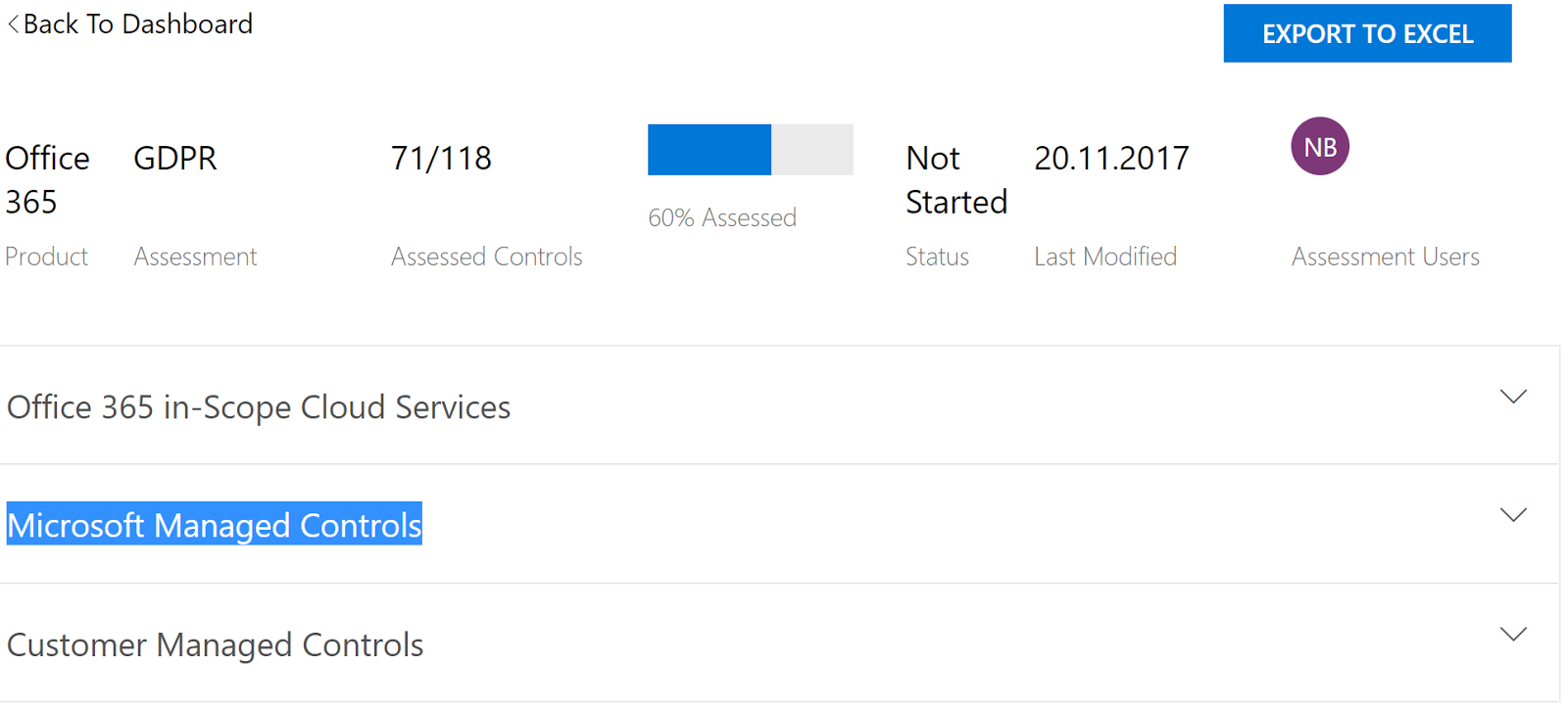
Services included in this cloud service assessment

SharePoint Online, Exchange Online, Microsoft Booking, Microsoft Graph API, Microsoft Analytics, Microsoft Planner, Microsoft Stream, Office Delve, Office 365 Groups, Office 365 Video, Sway, Microsoft StaffHub, Microsoft PowerApps, Microsoft Teams, Skype for Business

Microsoft Managed Controls

Article 4 Number 8 of the GDPR defines that an entity that processes data on behalf of another is considered to be a contract data processor. Therefore Microsoft, with its services Office 365 & Azure is clearly a contract data processor within the meaning of Article 4 Number 8 of the GDPR.


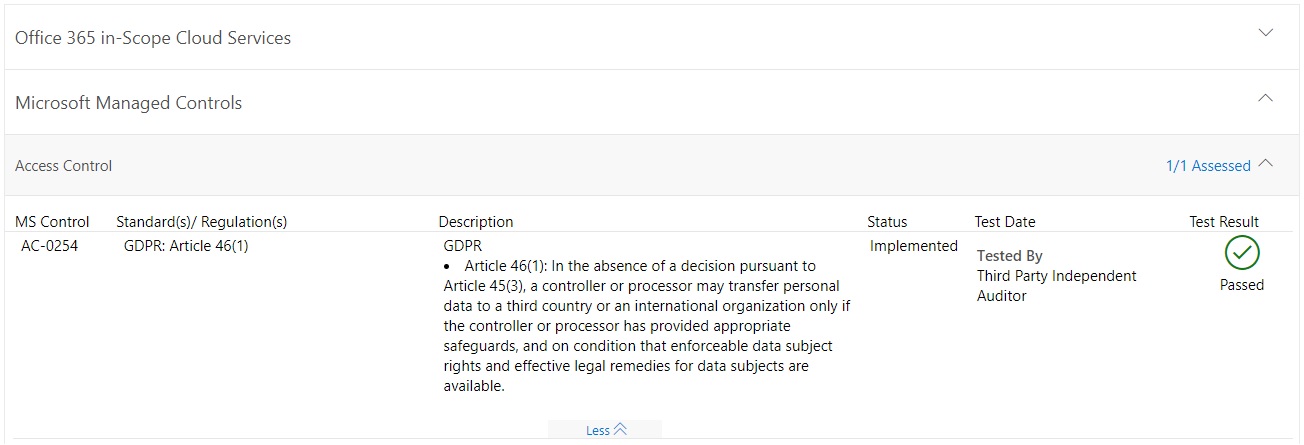
Because of this there are also topics that Microsoft has to fulfill and the contracting entity had to check. These topics are aggregated in the “Microsoft Managed Controls” section of Compliance Manager.

The topics in this section are passed and tested by a third party independent auditor. We can get the details about every topic in the Compliance Manager as you can see in this example:

Customer Managed Controls

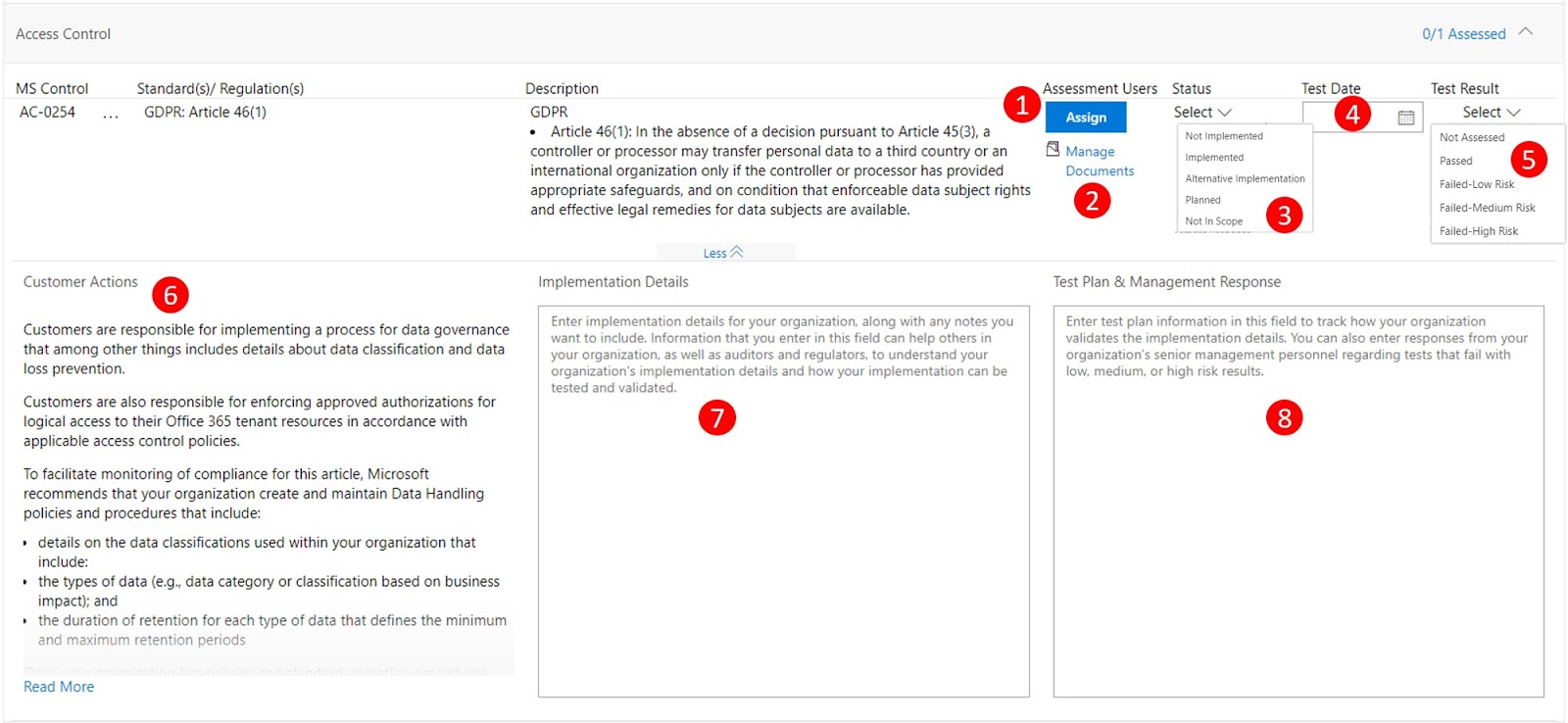
Not every GDPR article is about IT systems. Because of this not every article is covered by theCompliance Manager framework. In the section “Customer Managed Controls” Microsoft offers an audit tool that can be used to organize you GDPR compliance journey for Office 365 & Azure.

Features to organize GDPR compliance journey

  1. Assessment a topic to a responsible person
  2. Upload and manage documents
  3. Track status
  4. Test date
  5. Track test result
  6. Detailed description for each topic
  7. Documentation about your implementation details
  8. Documentation about your test plan & management response


Example:


You can use the Compliance Manager framework web UI to work with an auditor or you can also export the results as an Excel files.

Mapping

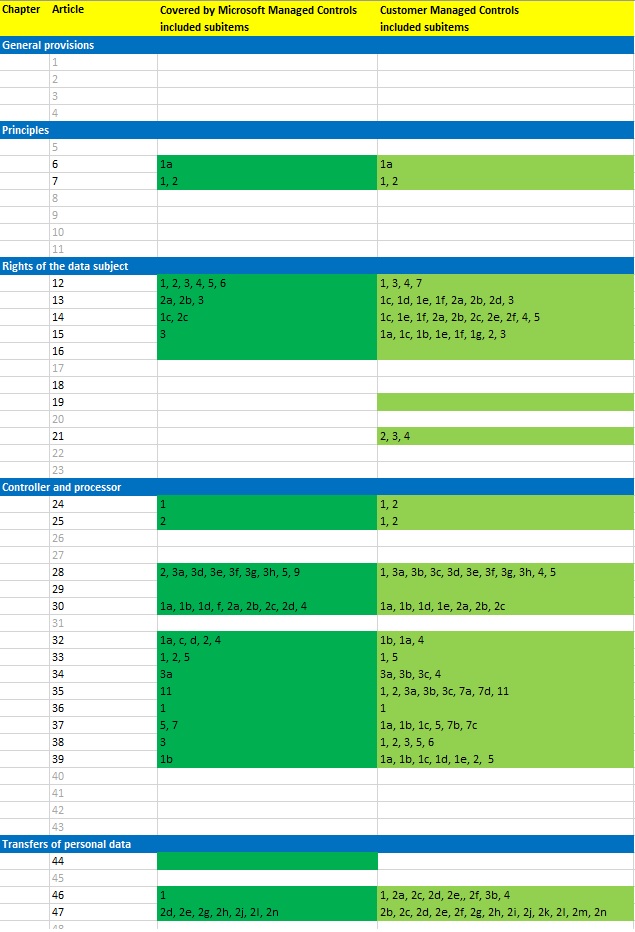
The GDPR is structured by the following topics:

  • General provisions (Article 1 – 4)
  • Principles (Article 5 – 11)
  • Rights of the data subject (Article 12 – 23)
  • Controller and processor (Article 24 -43)
  • Transfers of personal data to third countries or international organisations (Article 44 – 50)
  • Independent supervisory authorities (Article 51 – 59)
  • Cooperation and consistency (Article 60 – 76)
  • Remedies, liability and penalties (Article 77 – 84)
  • Provisions relating to specific processing situations (Article 85 – 91)
  • Delegated acts and implementing acts (Article 92 – 93)
  • Final provisions (Article 94 – 99)

(only the highlighted topics are covered by the Compliance Manager framework)

Microsoft as a Software company is using different topics:

  • Discover
  • Manage
  • Protect
  • Report

Even the Compliance Manager framework is using a different structure. The framework is separated in:

  •  Office 365 in-Scope Cloud Services (List of covered services)
  • Microsoft Managed Controls (Topics Microsoft has to fulfill)
  • Customer Managed Controls (Topics the customer has to fulfill)


So we need to do a mapping.

The following matrix is showing the chapters, the articles and the subitems covered by Compliance Manager framework. You can use this in you company-wider GDPR audit to get a clear overview of what is relevant in the context of Office 365

& Azure and what is covered by the Microsoft Compliance Manager framework.

File can be downloaded here -> LINK

Remarks:

Not every article need to be fulfilled by every company. In detail it depends on your company structure and what you do in detail with personal data. A general evaluation of which of these articles apply in a specific individual case, must be analyzed in a legally robust manner.

This article and the Excel Matrix was created to the best of the author’s knowledge and according to careful research. However it cannot and does not intend to replace an in-depth legal, process, and technical assessment.

The post Microsoft Compliance Manager framework appeared first on European SharePoint, Office 365 & Azure Conference, 2018, Copenhagen, Denmark.

19 Dec 09:39

Mastering the three top tenets of digital transformation

The practice of managing content will effectively help organizations take operational control of their data and intellectual property in order to fully deliver on growth potential.
19 Dec 09:38

Designing Results-Oriented Leadership Development Programmes

by Camelia Ilie, Dean of Executive Education at INCAE Business School, and Guillermo Cardoza, Professor, INCAE Business School
Two often-overlooked elements have a significant impact on both individual leaders and organisations.
14 Dec 14:58

Innovating Pedagogy 2017

by mweller

The Open University’s annual Innovating Pedagogy report is out, this time in collaboration with the Learning In a NetworKed Society (LINKS) Israeli Center of Research Excellence (I-CORE). It’s the sixth year we’ve done one (well done to Rebecca Ferguson and Mike Sharples on pushing this through). When we started the intention was to make it distinct from the NMC New Horizon reports by focusing on pedagogy. I think, to be honest, in those early ones there was probably a technology focus still, but as it’s progressed it has really moved away from this to more pedagogy, socially focused issues.

I’d also add I’ve found it increasingly useful as a resource. I’m occasionally asked to contribute something on current developments in ed tech, and I use the IP reports as a good starting point. Basically, they allow you to sound very knowledgeable, and impress people.

The ten trends covered this year are as follows (you can guess which one I contributed). The Times Higher take is here.

Spaced learning
Based on research into brain activity and human learning, this involves teaching in short blocks with breaks between them. This fast-paced approach has been tested, showing that 90 minutes of spaced learning could have the same outcomes as months of study.
Learners making science
Experiencing how science is made can enhance skills and develop critical thinking. Taking part in crowdsourced activities and participating in citizen science projects have the potential to change how young people think and act in relation to their surroundings.
Open textbooks
Initially established to reduce costs (HE books can account for a quarter of a student’s expenses), Open Textbooks are a form of Open Educational Resource, providing adaptable content which students can add to and edit.
Navigating post-truth societies
New information sources diversify the information available but have created new challenges as people make daily decisions about where to get information and who to trust. Taking account of this in the curriculum helps people evaluate information, reflect on their own assumptions and seek a diversity of knowledge to cut through ‘fake news’.
Intergroup empathy
Projects such as ‘Humans of New York’ show the value of constructive contact between people from various cultural backgrounds. New approaches use technology and gaming to develop empathy with people from different groups.
Immersive learning
Fast-developing technologies such as virtual reality and augmented reality offer learners opportunities to immerse themselves in situations that would be difficult, dangerous or impossible in everyday life. Learning in this way can be engaging, stimulating and memorable for learners.
Student-led analytics
Moving away from teachers and institutions using analytics to help students, this trend focuses on analytics helping learners to specify their own goals and ambitions. Particularly useful for those with limited study time, this approach puts learners in control and allows them to, for example, shift their goals and priorities or request feedback.
Big-data inquiry
In today’s data-driven world, students need to learn to work and think with data from an early age so they are well prepared with the skills society needs. To do this, they need opportunities that encourage them to be active in exploring data, managing and analysing it.
Learning with internal values
People are motivated to learn when they have important questions to answer or problems to address. When learning is linked to goals that learners value, they take ownership of their work and put in the effort needed.
Humanistic knowledge-building communities
This unites two approaches to learning, encouraging students to be creative and open to experience as well as willing to work together to develop new ideas and knowledge.

13 Dec 13:57

HIGHER EDUCATION FUNDING COUNCIL FOR ENGLAND: Senior Higher Education Policy Adviser - Learning and Teaching

£45,992 - £48,292: HIGHER EDUCATION FUNDING COUNCIL FOR ENGLAND: We’re looking for a talented leader of people and projects to head up our exciting work on Learning Gain. City of Bristol
12 Dec 15:24

New GDPR-compliant data protection documents

XpertHR adds 10 new data protection documents to use in your organisation's General Data Protection Regulation (GDPR) compliance efforts.
05 Dec 11:13

Gagne's 9 dull Commandments - why they cripple learning design...

by Donald Clark
I.gardner.gb

This!

50 year old theory
It is over 50 years since Gagne, a closet behaviourist, published The Conditions of Learning (1965). In 1968 we got his article Learning Hierarchies, then Domains of Learning in 1972. Gagne’s theory has five categories of learning; Intellectual Skills, Cognitive strategies, Verbal information, Motor skills and Attitudes. OK, I quite like these – better than the oft-quoted Bloom trilogy (1956). Then something horrible happened.

Nine Commandments
He claimed to have found the Nine Commandments of learning. A single method of instruction that applies to all five categories of learning, the secret code for divine instructional design. Follow the linear recipe and learning will surely follow.

1 Gaining attention
2 Stating the objective
3 Stimulating recall of prior learning
4 Presenting the stimulus
5 Providing learning guidance
6 Eliciting performance
7 Providing feedback
8 Assessing performance
9 Enhancing retention and transfer to other contexts

Instructional designers often quote Gagne, and these nine steps in proposals for e-learning and other training courses, but let me present an alternative version of this list:

1 Gaining attention
Normally an overlong animation, coporate intro or dull talking head, rarely an engaging interactive event. You need to grab attention not make the learner sit back in their chair and mind.
2 Stating the objective
Now bore the learner stupid with a list of learning objectives (really trainerspeak). Give the plot away and remind them of how really boring this course is going to be.
3 Stimulating recall of prior learning
Can you think of the last time you considered the details of the Data Protection Act?
4 Presenting the stimulus
Is this a behaviourist I see before me? Yip. Click on Mary, Abdul or Nigel to see wht they think of te data Protection Act - cue speech bubble... or worse some awful game where you collect coins or play the role of Sherlock Holmes....
5 Providing learning guidance
We’ve finally got to some content.
6 Eliciting performance
True/False or Multiple-choice questions each with at least one really stupid option (cheat list for MC here).
7 Providing feedback
Yes/no, right/wrong, correct/incorrect…try again.
8 Assessing performance
Use your short-term memory to choose options in the final multiple-choice quiz.
9 Enhancing retention and transfer to other contexts
Never happens! The course ends here, you’re on your own mate….

Banal and dull
First, much of this is banal – get their attention, elicit performance, give feedback, assess. It’s also an instructional ladder that leads straight to Dullsville, a straightjacket that strips away any sense of build and wonder, almost guaranteed to bore more than enlighten. What other form of presentation would give the game away at the start. Would you go to the cinema and expect to hear the objectives of the film before you start?
It’s time we moved on from this old and now dated theory using what we’ve learnt about the brain and the clever use of media. We have AI-driven approaches such as WildFire and CogBooks that personalise learning.....

And don’t get me started on Maslow, Mager or Kirkpatrick!
04 Dec 18:44

Poland: grants to increase employer participation in training

I.gardner.gb

Another interesting European initiative considering English attempts to get schools and employers working together more.

Employer participation in training is a government priority. VET schools and companies need better cooperation to allow learners to acquire skills and knowledge needed in the labour market.

04 Dec 12:19

Germany: national decade for literacy and basic skills 2016-26

I.gardner.gb

Interesting development considering UK concerns in this space.

The Federal Government and Federal States have joined forces to instigate a

04 Dec 12:08

Discovering Instructional Design Part 1: Foundations

by Michael Hanley
I.gardner.gb

Good intro for anyone not familiar with the term.

Instructional DesignInstructional Design (ID) is the practice of maximizing the effectiveness, efficiency and accessibility of instruction and other learning experiences. Continue Reading →

The post Discovering Instructional Design Part 1: Foundations appeared first on E-Learning Curve Blog.

04 Dec 11:29

OPEN CALL for guests on a new podcast series. ...

by Experiential Simulations

podcast1

OPEN CALL for guests on a new podcast series.

Hosted by James Bowen and Wiley&Sons

The theme of the podcast is an exchange of actionable best practices between academics and practitioners, academics and academics, practitioners and practitioners. The podcast discussion is practical in focus conveying thought leadership ideas which the listeners can implement.

Guests will include practitioners or academics with best practices ideas for either practitioners and/or academics.

The podcast will be interview style and be approximately 30 minutes. The format will be for the guest to:

  •         introduce themselves and the issues or problem that they will be addressing in the podcast this might also cover trends,
  •         outline their best practice idea, its implications and implementation suggestions,
  •        discuss future possible directions for the issue and best practices,
  •         summarize with actionable takeaways for the audience.

Themes can include:

  •          Business topics such as project management, supply chain management, globalization, ethics, corporate governance, environmentalism, marketing, human resources, entrepreneurship, technology, strategy, leadership, organizational culture, motivation, sales, finance, accounting, investing.
  •         Structures to thought such as creative and innovative thinking, the ability to be adaptive, risk, metrics, processes, analytics, transparency, accountability and implementation approaches of ideas.
  •          Academic learning topics such as experiential learning, student evaluation, knowledge application, continuous learning, learning aids such as videos, simulations and books.

The podcast is not academic or a tutorial in nature but focuses on insights that are actionable by the audience.

If you have an interesting set of insights, drop me line.

Click here to read some more of my articles


04 Dec 11:11

MWL Newsletter No 42

by Jane Hart
News and articles about Modern Workplace Learning (MWL) selected by Jane Hart for the week 26 November – 2 December 2017.
29 Nov 16:46

10 Ways HR Can Prepare For Annual Review Season

I.gardner.gb

Pretty depressing that "Annual Review Season" can genuinely still be seen as a thing.

It’s that time of year again. Performance review season is here (for most organizations), so, as HR pros, it’s time to ask ourselves a question: Are we ready? A lot goes into a company-wide performance review process, and it can be stressful getting everything set. So, we’re going to set up our mise en place for appraisal season. We’re going to get organized.
29 Nov 14:06

Evaluation of Instructional Design Capabilities of Asynchronous and Synchronous Instruction

Fall 2017 - Volume 20 Issue 3

by Kristi N. Garrett and Angela D. Benson

From a quantitative perspective, this study examined the instructional design knowledge of higher education instructors and others within the instructional design/technology arena who are members of a global educational based Internet forum. Results showed significant difference in opinions between genders, where males were more inclined to incorporate instructional technology into their asynchronous and synchronous teaching environments. Based on the results, providing training for gender specific groups could foster a more collaborative learning environment. Whether male or female, designing and developing quality instruction for use in online and face-to-face environments is paramount in order to give students an engaging learning experience.