Shared posts

26 Jul 12:31

Without A Community Strategy….

by Richard Millington

Most people running a community aren’t working from a strategy.

Without a community strategy, you’re letting yourself and your community down.

You’re making it more difficult for others to take you seriously.

You’re making it impossible for your colleagues to know how the community helps them and what help they need to offer in return.

You’re making it impossible for your boss and her boss to know what resources you’ll need and when you will need them.

You’re not accountable to any metrics and can’t prove the success of anything you do.

You’re not leading your community, you’re following it.

You’re not deciding what you need members to do, you’re reacting to what they already do.

You have no idea what motivates your members or how to amplify those motivations.

You resort to using a rising number of tactics instead of narrowing down your tactics to those that matter.

You collect a lot of data without any idea how to use it to improve your results.

Without a good community strategy, you’re not treating your work with the professionalism and thought with which it deserves to be treated.

Next week we’re going to open registrations for the Autumn semester of our Strategic Community Management course.

It’s helped over 200 community professionals create, rebuild, and rethink their community strategies. If your strategy isn’t driving your community forward today, I strongly recommend you consider it.

26 Jul 10:38

University of Phoenix Goes ‘Ultra’ With Blackboard SaaS

by Cristian T. Duque
I.gardner.gb

Very interesting!

Hybrid secondary education pioneer and one of the largest providers of online education in North America, the University of Phoenix has chosen to leverage the Blackboard ecosystem to “enable a...
21 Jul 18:26

NHS to receive £487m technology boost

by Press Association

Matt Hancock lists top three priorities as tech, workforce and illness prevention

The health and social care secretary has pledged almost half a billion pounds to transform technology in the NHS in an attempt to reduce staff workloads and improve patient care.

In his first speech since being appointed to the post, Matt Hancock listed technology as one of his top three initial priorities and evangelised about how it could help achieve improvements in the other two – workforce and prevention of illness.

Continue reading...
21 Jul 18:26

NHS body ‘wastes millions on flawed financial advice’

by Josephine Moulds

North West London Clinical Commissioning Group under fire as cost of implementing management consultants’ plan soars to £1.3bn

A large NHS body has spent millions of pounds on management consultants for a plan designed to save money – but which could cost more than £1bn to put into practice.

Over the past six years, the North West London Clinical Commissioning Groups has spent £66m on 41 different management consulting firms – including the big four: McKinsey, EY, Deloitte and PwC – for a five-year programme to improve healthcare in the area while closing a £1.4bn budget gap forecast by 2021. However, costs have ballooned and the trust said it now needs £1.3bn to implement the programme. It declined to quantify the savings that have been made to date.

Between 2010-11 and 2016-17, health spending increased by an average of 1.2% above inflation and increases are due to continue in real terms at a similar rate until the end of this parliament. This is far below the annual inflation-proof growth rate that the NHS enjoyed before 2010 of almost 4% stretching back to the 1950s. As budgets tighten, NHS organisations have been struggling to live within their means. In the financial year 2015-16, acute trusts recorded a deficit of £2.6bn. This was reduced to £800m last year, though only after a £1.8bn bung from the Department of Health, which shows the deficit remained the same year on year.

This article was amended on 21 July 2018 to remove incorrect references to the London North West NHS trust

Continue reading...
17 Jul 15:37

The future of AI in learning: what we learned from Microsoft at NextSteps 2018

by Ben Miller

NextSteps, NetDimensions’ global users conference, gave us the chance to hear from Nigel Willson, Global Strategist at Microsoft. He told us about the vast potential of AI in learning.

A photo of Nigel Willson, of Microsoft, talking about AI in learning at NetDimensions' NextSteps 2018 event

The rapid rate of change in business and technologies is exponential. When you use technology, the level of acceleration increases even more – leading to unprecedented change.

In the transportation industry, to name one of the sectors witnessing a learning revolution, new technologies such as self-driving vehicles and piloting assistance are transforming business, products and training.

So how can Artificial Intelligence (AI) help us to find learning solutions and work more effectively? In a fascinating and wide-ranging talk at NetDimensions’ NextSteps 2018 conference in London, Microsoft Global Strategist Nigel Willson outlined a few of the ways AI will profoundly change the future of learning.

Here are a few things we learned from his exciting insights.

Where are we on the AI journey?

As many people who have experienced AI know, we are only really at an early stage of developing the technology around AI in learning.

However, when we look back and think about what didn’t exist ten years ago, such as iPhones and Uber, we can reflect on seismic progress in AI and broader technologies.

Nigel has seen a huge amount change in his 20 years at Microsoft, but little compares to the pace of new technologies emerging and advancing during the past three or four years.

This is demonstrated by Microsoft’s investments in areas such as the Internet of Things – the name given to the Internet-powered network of computing devices embedded in everyday objects.

A photo of a human eye as part of AI in learning

AI’s powerful recognition capabilities

Nigel’s opening question, asking how his audience members were enjoying their day, would usually be taken rhetorically.

AI’s photo recognition capabilities, though, could genuinely have allowed him to ascertain how people in the room were feeling.

As well as reading faces, AI’s recognition capabilities offer all sorts of potential, even being able to tell the age of those in attendance.

And it doesn’t stop there. Some of the other capabilities of AI in learning include:

  • Language translation
  • Speech recognition
  • Gesture recognition
  • Speech synthesis and transcription

With a success rate above 95%, technology is now more accurate at recognizing human speech than people are. Bearing that in mind, it’s understandable that inventions such as Amazon’s virtual assistant, Alexa, have proved so successful.

It’s also unsurprising that AI is permeating our smartphones, technologies and everyday services and products.

As further impressive examples, you could use your voice to tell your computer to save a Powerpoint deck in another language, or deploy AI to translate a speech while the speaker is talking.

Another intriguing aside is the ways in which AI can work when recognizing people in videos. When it sees a well-known person, for example, AI can automatically create a biography based on Internet pages, as well as adding a timestamp to show where that person appears in the video.

A photo of a network of constellations as part of AI in learning

How will AI in learning affect jobs?

Despite high-profile stories about how robots will replace workers, the truth for organizations and employees is likely to be rather less intimidating.

The most notable change, if there is to be one, will probably see people who don’t embrace technology and AI in learning replaced by those who do.

Continual learning has a crucial role to play in this – working with technologies such as AI requires a new approach in which learning becomes a lifelong process, rather than something we do only when we are studying or in a new job.

This is a mindset Satya Nadella, who became CEO of Microsoft in 2014, emphasized in shifting the company from a ‘knowing’ to a ‘learning’ organisation.

Technology will also create jobs that don’t exist yet. For example, quantum engineers are likely to be in high demand from companies within the next five or 10 years.

A photo of a FitBit used for AI in learning

AI in learning offers dazzling possibilities

Whether we’re working, keeping active or resting, we all exude data. The amount of data now available is creating more personalized experiences than ever before.

FitBit trackers, for example, were used to carry out analysis of six million nights’ worth of sleep. With this data, they were able to analyze different states and work out the optimal time to wake up users based on their sleep patterns.

Together with this, the power of cloud services allows information to be collected about who learners are, what they’re connected to and their preferences.

In a working environment, this could allow employee’s calendars to be analyzed in order to decide whether they have sufficient time in the month to carry out a piece of learning.

If AI shows that they don’t, the amount of time allocated for the training could be increased, leading to higher completion rates.

Personalized learning can greatly improve training programs. Research has shown that learners who receive personalized instruction outperform 98% of those who don’t [1].

The cloud, meanwhile, provides organizations with highly cost-effective data storage and constantly updated functionality.

A photo of Nigel Willson, of Microsoft, talking about AI in learning at NetDimensions' NextSteps 2018 event

AI in learning: from the shock of the new to an everyday asset

From data stored on synthetic DNA to a suit you can wear that allows you to feel sensations from an online game, AI has already led to some incredible developments.

As the technology becomes faster and more accurate, the pace of change will quicken. Rather than being something we buy, AI will simply become part and parcel of organizational learning.

Making the most of this opportunity, as Nigel adroitly showed our NextSteps 2018 guests, offers huge potential for organizations on the path to successful learning.

Excited by the potential of innovative technologies? Contact us today to find out about NetDimensions’ connected learning solutions.

Additional source:
[1] Benjamin S Bloom (June 1984), ‘The 2 sigma problem: the search for methods of group instruction as effective as one-to-one tutoring’. Educational Researcher, volume 13 (6).

The post The future of AI in learning: what we learned from Microsoft at NextSteps 2018 appeared first on Connected Learning Solutions.

17 Jul 15:28

Two Frameworks for 21st-Century Skills

by JimS

Lynn ZimmermannBy Lynn Zimmerman
Associate Editor
Editor, Teacher Education

Globally there is a call for learners and workers to develop 21st-century skills. Two common frameworks are from the Organisation for Economic Co-operation and Development (OECD), a group which has members from 35 countries worldwide, and DigComp developed by the European Union (EU).

The OECD states that “[o]ne approach to organizing 21st-century skills focuses on cognitive skills, intrapersonal skills, interpersonal skills, and technical skills (Ananiadou & Claro, 2009 in Geisinger, 2016).” These skills are geared toward the educational context, the work environment, and commerce. Skills such as collaboration, teamwork, and cross-cultural sensitivity are seen as key to participation and problem-solving in the global economy. Underlying all of these skills is a need for digital knowledge and proficiency.

The DigComp frameworks, now presented as DigComp 2.1, focuses on competencies related specifically to technology knowledge and skills for citizens, specifically in the workplace while DigCompEdu (Redecker, 2017) outlines educator-specific digital competences. DigComp 2.1’s eight (8) levels of competence are fitted to Bloom’s taxonomy. These range from remembering, e.g., being able to perform simple digital tasks with guidance, to creating, e.g., resolving complex problems and guiding others in high-level problem solving.

DigCompEdu presents educator-specific digital competences that are organized in six areas. These areas include educators engaging in their own growth by professional development to creating appropriate digital integration activities for their students.  

While the 21st-Century Skills framework and the DigComp frameworks are organized differently, they all have the same aim, to help everyone become more efficient and productive in the global marketplace.

What do you think about technology integration for these purposes? How and why do you integrate technology into your lessons?

References

Carretero, S., Vuorikari, R., and Punie, Y. (2017). DigComp 2.1 The Digital Competence Framework for Citizens with eight proficiency levels and examples. Luxembourg: Publications Office of the European Union. Retrieved from http://publications.jrc.ec.europa.eu/repository/bitstream/JRC106281/web-digcomp2.1pdf_(online).pdf

Geisinger, K. (2016). 21st Century Skills: What are they and how do we assess them? Applied Measurement in Education, 29 (4), 245-249.

Redecker, C. European Framework for the Digital Competence of Educators: DigCompEdu. Punie, Y. (ed). EUR 28775 EN. Publications Office of the European Union, Luxembourg, 2017, ISBN 978-92-79-73494-6, doi:10.2760/159770, JRC107466

16 Jul 15:52

Published today: What the OECD found when they asked half a million 15-year olds “What do you want to be when you grow up?”

by Caroline Bearpark

Launched today at the 5th International Conference on Employer Engagement in Education and Training is a new report from the OECD – “Career guidance and employer engagement”. The report was presented by Dr Anthony Mann, Head of VET and Adult Learning at the OECD, and former Director of Research at Education and Employers.

“What do you want to be when you grow up?” this is precisely the questions that the OECD asked to half a million 15-year olds in PISA 2015. A new OECD research paper looks at the results and found that most 15-year-olds already have career plans: only around 15% of them have not decided what they want to do. But one in three cited one of just ten jobs, and these aspirations rarely reflect labour market demand. Choosing is hard. But how to broaden young people’s horizon, and make them consider alternatives?

This is where employers come in. Through career talks, and job visits, and more, young people can be introduced to some of the choices they will face in their learning and professional pathways. The theoretical arguments are very clear: direct contacts with people in work are a good complement to other types of school-based guidance services (such as filling in and discussing a questionnaire about preferences and interests). People in work have the capacity to provide young people with insights and experiences which is difficult for schools to replicate. These contacts have a distinct value, and are valued by students and teachers, and rewarded by the labour market. Employers too value the opportunity to promote careers within their organisation or sector.

Choosing is hard, but it is harder for some more than others. At age 15, PISA data shows that career expectations are patterned, by social and immigrant background and by gender. Disadvantaged students are significantly less likely to want to work as professionals than their more advantaged peers – even after statistical controls are put in place for academic abilities. That means that young person from a working class background can be expected to have lower career ambitions than a peer who does just as well academically, but happens to be from a middle class background.

But employers’ engagement in career guidance can help address some negative stereotypes about different paths. Students and their parents often have few opportunities to observe and experience different jobs, and this is often the case in the more technical, technological and scientific fields. In practice, it can be challenging, and participation can be limited. In the PISA study, only 27% of students reported that they had participated in an internship programme and about 37% had shadowed a worker at his or her job.

Musset, P. and L. Mýtna Kureková (2018), “Working it out: Career guidance and employer engagement”, OECD Education Working Papers, No. 175, OECD Publishing, Paris, https://www.oecd-ilibrary.org/education/working-it-out_51c9d18d-en

03 Jul 09:20

An analysis of the global pharmacy workforce capacity trends from 2006 to 2012

by Ian Bates, Christopher John, Priyanka Seegobin and Andreia Bruno
I.gardner.gb

Interesting example of workforce planning, etc.

Human resources for health are at a critical low. The World Health Organization estimates that the current shortage of health workers, including pharmacists, is in excess of 7.2 million worldwide and that, by ...
03 Jul 09:11

Nurses – why degrees are not the answer for NHS crisis

by Donald Clark
I.gardner.gb

Vocational route of HCA, AP and bridging course.

The graduate demand for nursing is a filter excluding many who used to go into the profession. My mother was a nurse, my sister was a nurse for 30 plus years – neither would now have got into the profession because of the academic entrance demands. Working class youngsters, in particular, are being excluded and I do not believe for one minute that they are unsuitable. The nursing shortage is not only caused by this hurdle but it has been exacerbated by the need for a someone who wants to be a nurse to get University entrance qualifications, spend years at University, then exit into a relatively low paid profession, with a huge loan.

Alan Ryan, who was a nurse for 20 years, and knows a thing or two about training in the NHS, said something quite profound in Berlin recently. “All of our jobs (in NHS) are, in practice, apprenticehips, from consultants to cleaners”. His point was that healthcare is an eminently, practical affair. He supports alternative routes into healthcare professions.

In truth Higher Education in the UK has land-grabbed vocational education, mainly on the basis of increasing their revenues. What were adequate, shorter and more experiential, training courses are now degrees, making them longer and far more expensive, whether for the state or individual.

Universities may claim to be about critical thinking but a glance at some of the degrees on offer show that this is far from the truth – Dentists, Doctors, Nurses, Lawyers, Engineers and so on. In truth, as Roger Schank tells us, Universities are about “creating Scholars”, and, as he says “we have enough Scholars already”. I’d add that there may be a surplus, as shown by the ease at which adjuncts can be hired to do the ‘teaching’ even in top Universities. This is not the environment into which nursing easily fits.

We have many nurses from other countries, even the EU, such as Germany, who are hired without going through this University experience, so it is not as if it is a necessary condition for success. Those who deliver such courses will claim that a nurse’s job is more complex than it used to be and of that, I have no doubt. But complex does not necessarily mean more lecturing and theory. 'It is difficult to get a man to understand something, when his salary depends on his not understanding it’ said Upton Sinclair, and it is difficult to get something out of the world of lectures and essays once ‘Lecturers’ get a hold of it.


There are many causes to hte current nursing crisis:

  • failure to plan for demand
  • degree course entrance qualifications
  • abolishing bursaries
  • new English tests
  • agency costs
  • foreign country demands
  • working conditions

But part of the solution here is to reverse this policy of Nursing degrees, not by demolishing that option but opening up alternative routes, especially apprenticeships. A vocational route is badly needed, and should have been opened up years ago. In practice, we depended on migrant labour and extortionate agency fees. We didn’t have to pay for their education, which is neither good for us or the countries from which they came, but that is not a good excuse for the failure to train our own nurses. Brexit will at least slow that process bu we need an alternative route. The nursing assistant route is a start - we need much, much more.

03 Jul 09:07

Making France’s digital potential work for everyone

by Sundar Pichai
I.gardner.gb

Google to bring "the best digital training within easy reach of more than 100,000 people every year" to four regional French hubs.

When people think of “digital champions,” it’s natural to think of a highly trained computer scientist creating new technology.  There are many other kinds of digital champions, however. They can be small business owners accelerating their growth online or people finding better ways to do their jobs. To do this, people now need to easily learn digital skills throughout their lives.  


That’s important for countries as well as individuals. According to the European Commission, France ranks just 16th in the EU’s Digital Economy and Society Index. Yet France has all the assets to succeed. It has top engineers, great entrepreneurs, one of the best education systems in the world, great infrastructure, and successful global companies. Studies suggest that if France fully seized its digital potential, it could earn up to 10 percent of GDP from digital technology by 2025, creating 200-250 billion euros’ worth of additional value per year.


Achieving this will take significant digital transformation for both France’s citizens and its businesses. With the right approach and infrastructure, that transformation doesn’t need to be hard. Over the last three years, we’ve trained more than 3 million Europeans in digital skills. In France alone, more than 230,000 French students and professionals have attended digital-skills training sessions given by our teams and partners. We now want to do more.  


Grow with Google in France—“Les Ateliers Numériques Google”

We will open four local Google Hubs called “Les Ateliers Numériques” across France, run by a network of local partners from the digital sector. These physical spaces will provide a long-term Google presence in French cities, with a dedicated team setting up free trainings in online skills and digital literacy. With our partners, we intend to help people find better jobs, keep their families safe online, and develop their businesses or careers.  Brittany will be our pilot region, with the opening of a Google Hub in Rennes during first half of 2018; three other hubs will follow. This will bring the best digital training within easy reach of more than 100,000 people every year.


A new research center dedicated to AI

France has produced some truly heroic figures of science—like Louis Pasteur, Marie Curie, Blaise Pascal and Sophie Germain—and its educational system still produces amazing researchers. So it’s only natural that we set up a new research team in Google France around the age’s defining technology: artificial intelligence. Our new research team will work closely with the AI research community in France on issues like health, science, art and the environment. They will publish their research and open-source the code they  produce, so that everyone can use these insights to solve their own problems, in their own way.


Oh, and we’re going to need a bigger office, too.

To keep pace with this digital growth, we need to expand our presence in France. We announced recently that our staff in France will increase by 50 percent, bringing our total workforce to more than 1,000 Googlers. Our offices will also grow by 6,000 m2, via new buildings connected to our office today.


More than ever, we’re committed to help France find new ways to grow in this digital era—whether through helping people retrain, or growing a business, or using amazing talent to research and build new products for the world. We hope these new investments will help the country, academia and local businesses turn France into a true digital champion.

03 Jul 08:42

Modern L&D – more than organising and managing (e-)training

by Jane Hart
I.gardner.gb

Shared on twitter.

It is now clear that in a large number of organisations L&D and employees view learning at work very differently. Many in L&D still focus all their attention on creating and managing training or e-learning. For them, this is what workplace learning is all about – making sure people learn from the …
02 Jul 15:04

Change management perspective

I.gardner.gb

More time should have been dedicated to creating buy-in at the beginning of the process, communicating with the organization, identifying change zealots, realigning organization structures and incentives, making physical site visits, managing labor relations (as necessary), and taking preemptive legal/regulatory moves.

Managing change is a critical component of any major transformation. It is a necessary process that helps companies successfully implement new strategies. Change management gets results by building sponsorship from the top, creating leaders who will act as change agents, and by changing behaviors in frontline teams and individual employees in business units.
02 Jul 14:47

Six ways to use the Digital Workplace Radar

by Steve Bynghall

At Step Two we regularly produce tools and frameworks which intranet and digital workplace teams can use to help them with their planning and operations. You can use these frameworks however you like, adapting them for the needs of your own organisation.

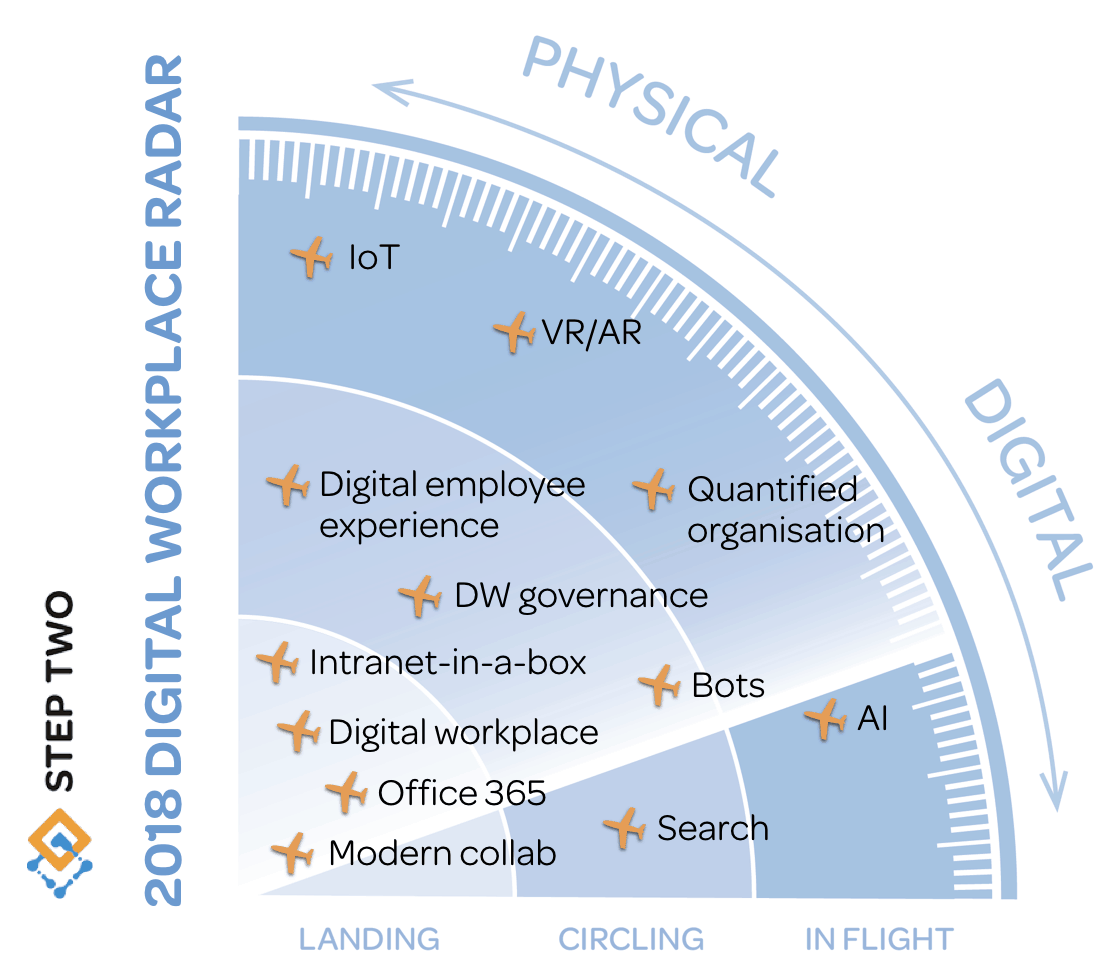
Each year we produce the Digital Workplace Radar, a tool for teams to track the upcoming ideas and technologies which we see impacting the digital workplace. The Digital Workplace Radar helps team and businesses to understand what changes are happening right now, and which ones are still in the distant future.

The Digital Workplace Radar charts what is:

  • Landing: technologies and ideas that are being deployed now, at scale, across many industries and countries.
  • Circling: coming in the near term, these technologies and approaches should be planned and budgeted for.
  • In flight: longer-term and more speculative, often offering the greatest potential for change.

The Radar can be used for all sorts of planning and tracking of activities, and you can easily modify it to create your own version of the Radar. Here are six ways to use the Digital Workplace Radar in your organisation.

1. Horizon scanning

Horizon scanning is an important activity which is sometimes neglected by intranet and digital workplace teams. It involves keeping on top of the latest developments on different topics and themes which can impact your digital workplace. Being aware of the likely opportunities and challenges means you adequately plan for the short, medium and long-term.

Most teams usually carry out some sort of horizon scanning but it tends to be unplanned, uncoordinated and up to individuals. This leads to a duplication of effort and gaps in knowledge. Usually a more structured, thorough and efficient approach to horizon scanning only happens when a new platform or strategy is planned, and that maybe too late.

The Digital Workplace Radar provides a framework to help coordinate horizon scanning on an ongoing basis. By recording the upcoming technology and ideas on the horizon the Radar provides clarity about which topics to cover. Individuals in your team can also start to assume responsibility for being knowledgeable in different areas, and the team can also identify new topics to put onto the Radar. Carrying out horizon scanning on an ongoing basis means digital workplace teams are better informed and therefore better prepared.

2. Starting meaningful conversations

The digital workplace is a relatively new concept for many and it can be quite abstract and hard for some stakeholders to grasp. It can also be misunderstood as purely something to do with IT and not something those in the business need to worry about.

We’ve found that the format of the Digital Workplace Radar is a very tangible and engaging way to communicate about the digital workplace and upcoming issues to senior stakeholders. You can use the Radar as a conversation starter with management either to discuss the whole concept or to focus on individual topics. It can help you get the digital workplace or a separate topic like Virtual Reality on the management agenda.

Creating your own Digital Workplace Radar can also work well as an exercise at a workshop, away day or planning session with stakeholders or even your immediate team.

3. Creating the Office 365 Radar

Planning around Office 365 implementations can be vastly complex, partly because of the wide range of tools on offer and the pace with which Microsoft continue to evolve and expand the Office 365 offering. While it is great that Microsoft are investing in improvements, in reality the pace of change tends to outstrip the ability of IT and other support teams to properly launch and then support these tools. Planning and governance are needed with an eye on what is coming next on Office 365.

Creating your own Digital Workplace Radar specifically for Office 365 and it’s constituent tools provides a simple framework for digital workplace teams to consider how to implement and then manage Office 365. Which tools like MS Teams are landing now and need support? What are circulating and need to be planned for? What’s further down the line? Establishing a Radar dedicated to the Office 365 suite can  can help your planning.

4. Driving an annual strategy or planning process

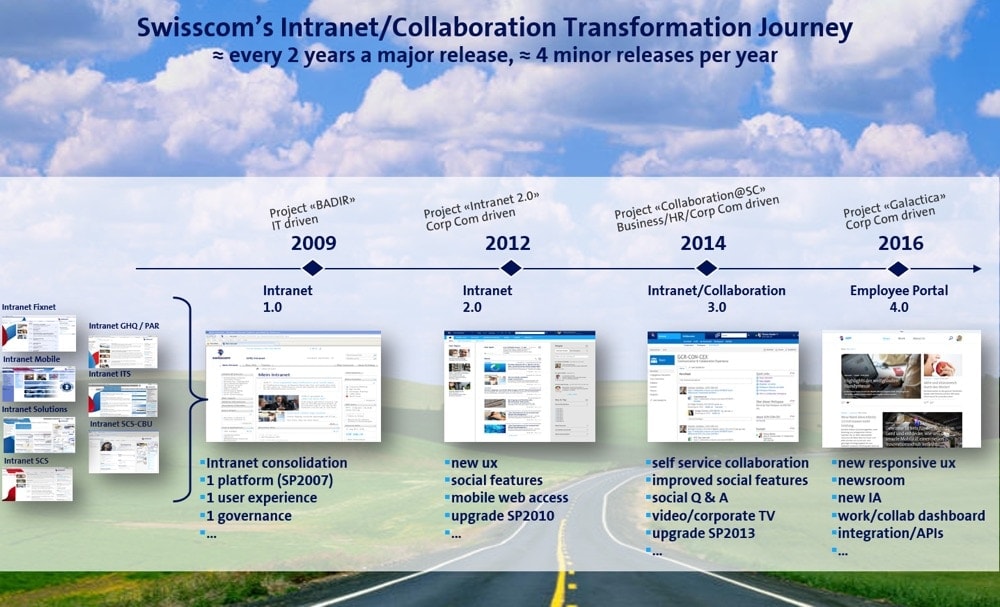
Some of the best intranets we’ve seen have evolved over a number of years. Swisscom has a great example of a beautiful looking and high value intranet which is continually improved through a series of quarterly releases and less frequent major upgrades.

Swisscom’s intranet and digital workplace journey. Screenshot courtesy of Swisscom.

A highly stable governance structure and a regular annual process to renew the intranet strategy allows the team to plan for the year ahead. As part of that strategy and planning process the intranet team review data including wider intranet, digital workplace and digital trends,as well as an internal information.

The Digital Workplace Radar is a tool which can help you to start thinking about general digital workplace trends and aid your own planning process.  For example you could look at what we consider to be the key areas, and then also plot your own. The completion of your own Digital Workplace Radar could be a standard exercise you carry out each year to identify priority actions, tactics and areas for investment.

5. Spotting innovation and monitoring early adopters

Most organisations have pockets of innovation and experimentation with different teams using emerging digital workplace tools, sometimes carrying out experiments and pilots, sometimes even operating “under the radar”.  These early adopters and experiments can give highly useful input into some of the emerging technologies in your digital workplace.

You can use the the Digital Workplace Radar as a framework to monitor this activity, particularly on those technologies which are circulating. This can help you to consider and identify:

  • what is working and what isn’t
  • particular use cases for different tools
  • what levels of support is needed
  • risks and issues

All this can help with operational planning, deciding what tool should be supported and prioritised. Examples of successful early adoption can also feed into business cases.

6. Tracking content and experts

Some companies use a standard set of keywords defined in a taxonomy to tag their content to help findability. Some intranets even allow users to subscribe to content based on different topics. Similar terminology might be used to describe areas of expertise on people profiles. Hashtags may also be used to tag conversations on your social network, although these terms are less likely to be controlled.

If your intranet, areas of expertise or conversations involve some of the areas on your Digital Workplace Radar consider mapping the terms used on your Radar to the way you tag content and describe experts. This can help you to identify the people, content and internal conversations within your own organisation which can help with horizon scanning or give input into planning for future technologies. For example, bots is a circulating topic which you need to be considering now. You may have experts and content tagged with the term “Artificial Intelligence” – mapping “bots” to Artificial Intelligence will help you to track the right people and content items.

Download our free whitepaper

The Digital Workplace Radar is a great tool to help you with your planning, so make sure you download our free whitepaper. Use some of the ideas in this article to to use the Radar to help your organisation with its digital workplace efforts. Good luck!


The post Six ways to use the Digital Workplace Radar appeared first on Step Two.

02 Jul 14:37

Building Modern Independent Lifelong Learners

by Jane Hart
In my previous article introducing the Employee-Centred Learning & Development model, I explained that everyone needs to become an independent lifelong learner in the new world of work where there is no such thing as a job for life, and that organizations need workers to be lifelong learners too, and bring …
02 Jul 14:36

business schools are a technology of the last century

by Harold Jarche

Our dominant models of how we organize and work as a society are fundamentally changing as we transition from an Information-Market economy to a Creative-Network economy. Charles Green succinctly explained the order in which this transition happens:

“Ideas lead technology. Technology leads organizations. Organizations lead institutions. Then ideology brings up the rear, lagging all the rest—that’s when things really get set in concrete.”

I broke this down in detail in a post on the new business ideology. This was further explained in Adapting to Perpetual Beta, my volume on leadership in the network era.
This week I had the pleasure of conducting a workshop and presenting to over 500 CEO’s of small and medium size businesses, all members of Le groupement des chefs d’entreprise, an organization with almost 2,000 members in several countries that has been in existence for about 30 years. One of the presenters was the co-vice president of a roof truss manufacturing company in northern Québec. Her story reflected the fact that “Organizations lead institutions”. Bénédict L-Deschamps explained her varied career before joining the company. She had worked as a hairdresser, first trying to distance herself from the family-operated business and later went to school to become a social worker, but quickly realized that the academic approach was not grounded in reality. Bénédict then went back to school to learn about business. There she studied F. Winslow Taylor and Henry Ford and their approaches to management. When she asked when she would learn about how to manage the company for the 21st century, the professor told her that was not part of the curriculum. Bénédict promptly walked out of the class and never returned. Shortly thereafter she found Le groupement, and has been an active member ever since. This is where she learns how to be a better professional.

“A professional is anyone who does work that cannot be standardized easily and who continuously welcomes challenges at the cutting edge of his or her expertise.” —David Williamson Shaffer

Business schools are a technology of the last century, initially created to meet the demands of new corporations to train middle managers. They no longer meet the requirements of managers and business owners to deal with the complexity of business in the network era. It is time for a change.

I have said before that a professional learning community, with its redundant connections, repetition of information, and indirect communications, is a much more resilient system than any designed professional development program can be. The bottom line is that learning faster is not about taking more courses or consuming more information. It’s about having better connections. Well-managed professional communities of practice with a good vision and a compass for the future can provide a trusted environment for making these connections. My experience with Le groupement this week showed how well this can be done. I have seen the future.

“The future is already here — it’s just not very evenly distributed.” —William Gibson

To complete Charles Green’s process, and set things in concrete, here is my vision for the next business ideology.
It is only through innovative and contextual methods, the self-selection of the most appropriate tools and work conditions, and willing cooperation that more creative work can be fostered. The duty of being transparent in our work and sharing our knowledge rests with all workers, especially management.

Merci Bénédict pour ton inspiration!

02 Jul 14:31

Crash Course for New Instructional Designers

by Jane Bozarth
Classroom trainers are often recruited to create eLearning content that is nothing more than a regurgitation of classroom materials. There are lots of reasons why this happens: Managers who don’t understand that “training” involves more than just presenting content; purchasers who believe an authoring tool will allow any user to magically crank out gorgeous, interactive programs; well-meaning classroom trainers who perhaps lack a background in design or have trouble making the leap from face-to-face to multimedia approaches; companies that can’t invest in external products or developers; and individuals who just won’t say, “No.” Whatever the reason, it happens. Often. This month in Learning Solutions I offer ideas for a "crash course" in learning design for those who may find themselves thrown into the role. https://www.learningsolutionsmag.com/articles/nuts-and-bolts-crash-course-for-new-elearning-designers
02 Jul 14:26

Lukewarm Grade To Moodle Course Overview In UX Survey

by Cristian T. Duque
I.gardner.gb

Moodle really starting to fall behind on UX?

100 respondents completed Moodle HQ’s set of questions about the Moodle Course Overview block (originally named “My Course Overview”), the visualization block that became the default student...
02 Jul 14:24

A Learning Designer Secondment: Moving to the ‘dark side’

by Rob Howe

Written by Dr. Jim Lusted, Learning Designer/Senior Lecturer in Sport Studies

In November 2017 I took up an 8 month secondment as a Learning Designer (LD) with the Learning Technology team. I had been a Senior Lecturer in Sport Studies at Northampton since 2009 and saw this as a great opportunity to try something new for a while. This blog gives you a flavour of my experience of the LD secondment, what I learned about working in professional services.

Why a Learning Designer secondment?

I was attracted to the secondment for three main reasons. First, I had really enjoyed working with the Learning Technology team as a lecturer and had valued their support – through things like CAIeRO course design workshops, ABL development sessions and helping me solve NILE problems. I felt I could fit quite nicely into their team and would enjoy working with them. Second, I had become more interested in teaching and learning practice – particularly as a result of the University’s shift towards ABL, and felt the secondment would be a great way to develop my own skills and knowledge in this area. Third, in my role as programme leader I had enjoyed mentoring new and less experienced colleagues, so I wanted to see what it would be like supporting staff in a more formal role. I must also admit that after 9 years of working in the same role I also fancied a change of scenery – I was eager to try something new.

“…I learned more about T&L practice in my LD role than I had probably done in my whole teaching career up to that point – I had the head space to think about my practice rather than just be chasing my tail teaching sessions every week.”

Download and read Jim’s full reflections

28 Jun 12:08

How to make mandatory training relevant

by Cathy Moore

By Cathy Moore

Compliance training sheep“How can we make mandatory training more than a tick box exercise?”

That’s the top topic voted by blog readers, so here’s my take.

For “mandatory training,” I’m picturing any material that says some version of “Follow these rules.”

It’s sheep-dip training. Everyone must be “exposed” to it, and a checkmark records that they have been exposed.

How can we make it more relevant?

1. Disobey

A client who says “Everyone must be trained on X” needs our resistance, not our obedience.

Help the client by asking questions, such as:

  • What problems are you seeing? Has something happened? Has someone sued?
  • Was this problem caused by one rogue employee, or is it a bigger issue? Is it limited to a group of employees, or is it really a problem that all employees are causing equally?
  • What are we currently measuring that will improve when everyone is “trained?”

If there’s really no problem, we shouldn’t create a solution. We need to focus on improving performance, not guarding against problems that experience has shown aren’t likely to occur.

2. Set a goal

If it’s clear there really is a need for “training,” or some force far outside your control insists on “training,” then put on your action mapping hat and push for a measurable goal. Here’s one model to follow.
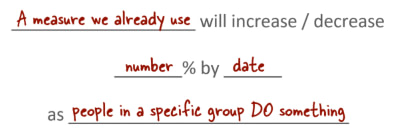
action mapping goal template

For details, see How to create a training goal in 2 quick steps.

3. Narrow your focus

Make sure your audience is specific. “All employees” is not specific.

If you’re required by forces beyond your control to create something for all employees, you can at least break down the audience by major job roles as described next.

4. Do the analysis. Really. DON’T SKIP THIS.

Focus on one job role in your audience. Ask your client and SME what these people need to do, in specific, observable terms, to meet the goal.

“Follow the data security policy” isn’t specific. This is specific:

  • When you must physically transfer data to another location, put the data on a BrandZ thumb drive using HakrPruf encryption and chain it to your left ankle.

Prioritize the actions. Choose a high-priority one, and ask, “What makes this one thing hard to do?” Use the flowchart.

Again, you’re doing this for a specific group of people in a specific job, and you’re focusing on specific, observable behaviors. You’re not asking this once for the entire “course,” and you’re not talking about all employees in every job everywhere.

If those forces far beyond your control insist on applying the same solution to everyone, do this analysis for the major job roles. You probably won’t have a ton of time to do this, but even two hours can save you and everyone else from a much bigger waste of time in the form of irrelevant and ignored materials.

Then, if training is part of the solution, you can have people use only the activities that apply to their job.

Don’t skip this.

If you skip this analysis, what do you have to work with? Generic rules that are guaranteed to become an information dump.

Instead, if you look closely at what people need to do and why they aren’t doing it, you get:

  • Ways to fix the problem that don’t require “training”
  • Ideas for ways to help people practice the tricky parts
  • Respect for the intelligence and experience of the people currently doing the job (notably lacking from most compliance training)

5. Base your design on job tasks, not information

Yes, people need to know stuff. But they need to know stuff in order to do stuff. Design first for what they need to do.

Provide the need-to-know information in the format it’s used on the job. Let people pull the information just like they will on the job.

Here’s a fictional example. Extraterrestrials have landed and are being incorporated into earthling families. As a result, employers have created alien leave policies. Here’s a mini-scenario for managers.
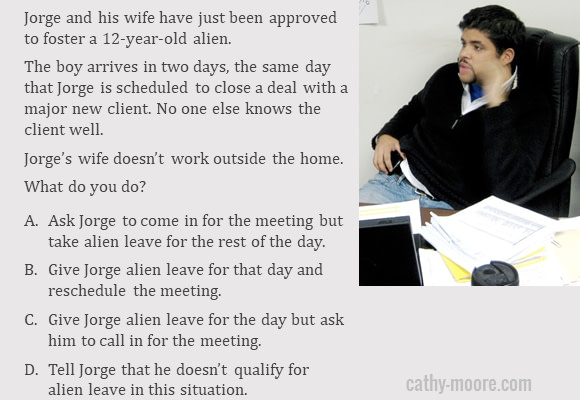
Mini-scenario for alien leave

To answer this question, what information does the manager need? The alien leave policy. How should we provide it?

The traditional approach would be to first present a bunch of slides about the policy. Then we’d give people a chance to “apply” what they’ve “learned” by having them use their short-term memory to answer the question.

Lots of slides followed by activity

But why design slides to present information that’s already in a policy on the intranet?

Instead, we can plunge people into the activity and let them use the policy just like they will on the job.

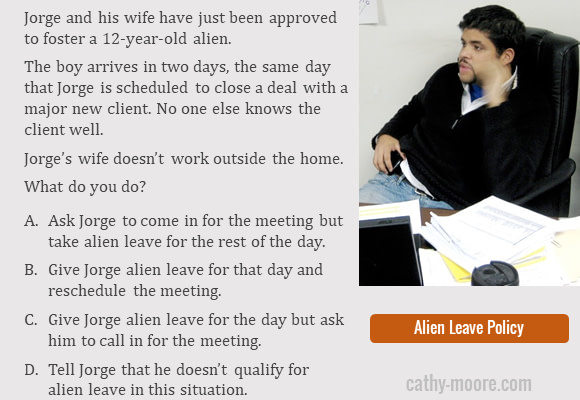
Instead of presentation, just an activity that links to info

Same activity with link to policy

And now that we aren’t developing lots of information slides, we can create more activities. Since they aren’t trapped inside an information presentation, they can travel alone. For example, we can provide them individually over time (spaced practice) as described in this post.

6. Sell it with a prototype

Create a prototype of one typical activity and show it to the stakeholders. Make clear that people will see only the activities that apply to their job. They’ll pull information rather than recognizing what they saw three slides ago, and they’ll learn from the consequences of their choices.

You’re letting the stakeholders see for themselves how you plan to provide the “training,” because then you’ll be in a good position to respond to the following common concerns.

“But everyone must be exposed to all the information!”

Give each option unique feedback. In that feedback, first show the consequence of the choice — continue the story.

Then show the snippet of information they should have looked at, as described in How to really involve learners. Do this for all consequences, not just the poor ones.

See more ideas and examples in Scenario mistakes to avoid: Eager-beaver feedback.

If you have a stakeholder who’s determined to expose everyone, you can point out that they are now exposed. They’re just exposed after making a relevant decision, rather than in a forgettable presentation.

By not presenting information first, you’re helping people see their own knowledge gaps. They’re not pulling stuff out of short-term memory, because you haven’t put anything there. They have to rummage around in their existing knowledge, look at the policy just like they would in real life, make a choice, and learn from the consequences. They get deeper learning, plus they’re dutifully “exposed” to the correct information.

“But they have to prove that they know it!”

Which approach is more likely to avoid lawsuits about misuse of the alien leave policy?

A. Present the policy over several slides. Then require a knowledge test to see if people can recognize a bit of information that they saw 5 minutes ago. If they can, they “pass.” If they can’t, they must put those same slides back in their short-term memory and try again.

B. Present challenges in which people need to make the same decisions they make on the job. Provide the information in the same format that people will have it on the job. Start with easy-ish decisions and increase the challenge. If people make good decisions in enough activities, they’re free to go. If they make not-good decisions, they get more activities and optional help until they make good decisions.

My point

Don’t design for “They should know the rules.” Design for “They should correctly apply the rules on the job.”

For lots more, see my book and just about everything in this blog, especially the following posts.

Credits

Photo of Jorge: David Boyle in DC via Compfight cc

All other images: Cathy Moore

25 Jun 10:36

Privatised training firm Learndirect sold in last-ditch rescue deal

by Nathalie Richards
A little-known education entrepreneur has swooped to seal an audacious takeover of Learndirect, Brit‎ain’s biggest provider of apprenticeships and adult training services.… Read the rest
05 Jun 14:57

20 important takeaways for learning world from Mary Meeker's brilliant tech trends

by Donald Clark
Mary Meeker’s slide deck has a reputation of being the Delphic Oracle of tech. But, at 294 slides it’s a lot to take in. Don’t worry, I’ve been through them all. It has tons on economic stuff that is of marginal interest to education and training but there's plenty to to get our teeth into. We're not immune to tech trends, indeed we tend to follow in lock-step, just a bit later than everyone else. Among the data are lots of fascinating insights that point the way forward in terms of what we're likely to be doing over the next decade.
So here’s a really quick, top-end summary for folk in the learning game.
1. AI is getting bigger

Large tech companies see AI as their core strategy and enterprise spend on AI will increase. Google’s machine learning word recognition has just equalled human levels of accuracy. We can expect this to happen in the learning world with AI tools and services being used across the learning journey from engagement, support, chatbots, content creation, content curation, consolidation, assessment and wellbeing. For more detail see these AI in learning articles.

2. Employment flux
Technology is causing employment to change. Job roles are changing with more tech jobs but it looks as though unemployment is falling and that massive unemployment through tech is not happening, at least in the US. No need to panic – yet and be careful of hyperbole in this area.

3. Personalisation

This is getting ubiquitous online with Google, newfeeds, social media, music, movies, advertising, navigation, transport and buying online. It will happen in learning with everyone getting a unique learning experience that suits their needs and progress. Adaptive learning, based on individual and aggregated data, really does matter. There's lots of opportunities for personalised learning.

4. Data matters

Data matters but big data really matters. The problem in the learning world is that we have relatively small amounts of data at the user, course and institutional level. Expect data advantages to be leveraged elsewhere in online learning, on a greater scale.

5. Lifelong learning

Unusually there are five slides (232-236) devoted to Lifelong Learni

ng. MOOCs continue to be popular, despite what critics claim. Top online courses, in general, are almost all in AI! 


6. Educational online ballooning

“Educational content usage online is ramping fast”with over 1 billion daily educational videos watched. There is evidence that use of the Internet for informal and formal learning is taking off.


7. Workplace learning and re-skilling getting big

Workforce online learning is getting big with increases in skills training and re-skilling. The need for skills training is rising along with employment needs, so workplace learning and re-skilling is increasing.

8. Voice the new UI

Voice is the new UI – Alexa led the way, so expect voice to become a way of interacting with learning materials. We’ve just completed a 100% voice led implementation of WildFire. The entire experience, navigation and voice interactions, means there’s no typing at all and there's lots of ways voice will change learning.

9. Messaging expanding

Messaging is going through the roof, so expect this to enter the learning game through more dialogue-like services. As learners use messaging as their primary way of communicating online, so this will be expected in online learning – hence the rise of the learning chatbot.

10. Chatbots

These are getting big. Increasing use in customer service is leading to their use elsewhere. There are many reasons to suppose that chatbots will be big in learning and lots of possible applications. They are already in the learning world, through Otto (Learning Pool), WildFire, Filter and others.

11. Video expanding

Use of video is increasing, as it will in learning. We can expect more adjunct products in learning around video, for example AI-created content produced automatically from video. We’ve been doing this with WildFire, where we use the automatically grabbed transcript and AI to create online learning, in minutes not months.

12. Workflow changing


Slack, Zoom and other tools transforming workflow and that is where learning and performance support has to be positioned, in those tools to catch people in the process of working, where they need help and support. Otto is a workflow chatbot that is integrated into many of these social platforms, accessible and on hand for performance support.

13. New content types emerging

Huge use of Twitch for watching games, signals new media types and genres. These could be used in learning. We will increasingly see messaging, chat, voice and other forms of UI enter the learning world.

14. Subscription service growth

People happy to pay subscriptions for services, as long as pricing is right. I can see this expanding in learning, especially on the use of smart, AI-like services, such as chatbots.

15. Big tech

Big Tech companies moving into new sectors – Google into retail, Amazon into advertising –  will continue and we can expect to see one of them move into the learning space some time soon. USA and China now the leading players. Europe’s role diminishing. My guess is that this will be on the back of the great strides they’re making on their core technical strategy - AI.

16. Tech saturation

As the world becomes saturated with mobile phones and other devices, sales growth is falling. They’re getting better, faster, smaller and cheaper. We can now get out of the ‘device-fetish’ era in learning and stop spending on devices to focus on services.

17. More online

People are spending more time online, up to 5.9 hours per day from 5.6 hours. If you want to get to learners you’ll increasingly find them online. This is borne out by the annual growth figures in online learning.

18. Physical retail sales declining

Physical retail sales de-accelerating as will physical delivery in classrooms, lecture theatres and training rooms. The pendulum swing to online will continue in retail and learning.

19. Privacy Paradox

As data becomes the new oil, oil leaks and spills also become a problem, so using data becomes more of a problem within the learning game. A curious but very real paradox. 

20. Warning for Europe

There’s an interesting little warning for Europe on slide 35, saying there’s a danger of unexpected consequences on too strict data regulation that restricts innovation and progress in Europe in particular. Interesting and, as you can see here, I agree.

04 Jun 15:16

Somebody, please put Google News out of its misery

by Karen Blakeman
I.gardner.gb

I still get some useful stuff via alerts but hard not to disagree with a lot of this.

I didn’t think Google News (http://news.google.co.uk/) could get any worse but I was wrong. The previous revamp was bad enough: no more advanced search, useless and irrelevant personalisation options, and don’t even think about trying to set up sensible alerts. Alerts were never that good at the best of times but were not improved one iota by the changes. And then they altered the structure of the RSS feed URLs so that, supposedly, your existing feeds no longer worked. I don’t know why, but my old feeds are still delivering news and contain better quality information than the new ones I set up. Google News

In the latest incarnation, Google News has lost most of my topics,  the “For You” is total rubbish as is “Local”, you can no longer manage and personalise the topics  (although that didn’t really work anyway), and the RSS feed buttons have gone. I can only assume that this is  all down to the real time AI/ML that Google recently announced was going to be used to organize the news. (The new Google News: AI meets human intelligence ).

Existing RSS feeds still work, though and you can create email alerts for a news search if you run it from within the general Google results page. Run your search in “All” and then click on the News link. There is a Create Alert button at the bottom of your results, but one wonders how long that will last.

Someone should put Google News out of its misery, close it down and leave news searchable via the link on the main page.

And they may as well ditch Google Finance as well. That is a  shadow of its former self : no more portfolios for monitoring stocks, no more historical data for viewing and download, no more news annotations on the price charts, and the comparison option only works for two stocks at a time. If you are interested in monitoring the stock markets or researching individual companies for free get thee hence to Yahoo! Finance (https://uk.finance.yahoo.com/).   There was some doubt over the future of Yahoo! Finance when Yahoo! was acquired by Verizon and became part of Oath but, charting oddities aside, there does seem to be some development going on. The new “Sustainability” tab for example shows environment, social and governance (ESG) ratings from Sustainalytics (https://www.sustainalytics.com/).  There was positive feedback on it from some business librarians who attended one of my recent workshops.

So many of Google’s services are going from bad to worse to totally pointless and unusable. No wonder, then, that people are starting to look seriously at alternative resources.

23 May 08:35

10 reasons why GDPR is a Kafkaesque mess….

by Donald Clark
I.gardner.gb

Great summary on some of the problems - add to this that we opted to go ahead when we could have pulled the plug.

I use the word ‘Kafkaesque’ deliberately, as in Kafka’s novel The Castle, the unknown authorities engage K in a never-ending, futile, bureaucratic process where he never really knows why he is being asked to do anything or by whom. So it is with GDPR. Organisations are sending out zillions of emails, just because they think someone told them to. Millions are receiving these emails, many unnecessary. Some may even be illegal breaking the very rules they are meant to be enforcing. Ironically GDPR phishing scams are already hitting our mailboxes, which spread malware or steal personal data. Emails containing other people's email addresses are being sent out. Some US newspapers have closed down access from EU. Tsunamis of emails are being sent out (and largely ignored), ironically to prevent emails being sent out.

GDPR is an EU regulation ((EU) 2016/679) and one of the worst regulations The EU Castle has ever come up with. In a typical top-down, centralised fashion, shaped by lobbyists and not common-sense, the EU has managed to turn what should have been a practical, workable idea into a bureaucratic nightmare. It must be the first law where the majority of organisations will be in breach of that law on the day it is implemented - on Friday!

1. Ambitious

The New York Times interviewed a range of data experts and found that even these experts found the regulations incomprehensible. It’s a massive tangle of badly worded regulation, completely over-engineered. The consequences for organisations of all sizes are horrific. More compulsory processes, more mandatory documentation, in some cases Data Protection Officers (DPO) and, of course, a slew of useless courses. It is the blind leading the blind.

2. Ambiguous

Worse still many experts warned that it was flawed. Its ambiguities are already being exposed. The badly written Eurospeak regulations are typically vague, written by people who have given little thought to its implementation; "undue delay", “likelihood of (high) risk to rights and freedoms" and "disproportionate effort" are just a few examples of the vagueness. This is a boon for lawyers and the vagueness will be played out in an ever-increasing Kafkaesque game played for years through the European Courts. Kafka’s The Trial will be the manual for this particular charade.

4. Myopic

Rather than work back from what is actually needed, based on user needs, actual structures and practical measures, they’ve gone for blanket fixes based on old assumptions. These are laws written by people who don’t really understand what data is, how it is stored and its use in leading edge technology. They see data as being stored like furniture in a storage facility. They ask for clear specifications on use, insensitive to how it is used in machine learning and more contemporary forms of AI, where the outputs may not be clear. We saw this gulf when Zuckerberg was interviewed by US Senators. This time, the gulf is written into bad law.

5. Massive hit for organisations

Organisations have to see this as a ‘project’ using real staff to create milestones for oodles of documentation and process that will not only incur a large initial cost but also on-going costs. Many people, who wouldn’t know a database if it were in their soup will become Data Tsars. Many organisations will not have data management clauses in contracts with subcontractors. Education is just one example, where most institutions are not ready and many are simply ignoring the problem as they don't have the resources to cope. This is a big problem. Expect some wildfires here. This is all real time and real money.

6. Small companies will suffer

The big boys will be fine. They have the resources to handle this hammer blow but small businesses will not. It will break many on the back of increased costs and fear of illegality. In a laughable exception the EU decided to exempt small businesses from having to hire a Data Protection Officer – really!

7. Hits on revenue

One unexpected consequence is the hit on revenues for charities who may not get reconsent replies. This may apply to all sorts of businesses, an unforeseen consequence of an ill-defined regulation. The effects on revenues have, I suspect been underestimated.

8. Users flooded

On the client side, users are receiving a ton of emails, most of which are being ignored, not because people are indifferent, but because they don’t have the time or inclination to respond. Rather than focussing on reconsent, the legislation would have been better formed if it simply informed existing users. Many organisations are being panicked into demanding actual consent when it is not necessary.

9. Fines

Fines of up to EUR 20,000,000 or 4% of the total worldwide turnover are payable (whichever is bigger), yet it is not clear how lenient or harsh they will be. Organisations are petrified and don’t really know how to quantify the risks. I can understand using this level of threat with the big boys, who will have the best of lawyers but what about the little companies who will read this stuff and have to live with the risks. The truth is, they really don’t actually know what it means and how to eliminate the risks. 

We’ve already had prosecutions bought against companies, by oddballs like Max Schrems. This could be a legislative nightmare with thousands of cases being brought to the courts.

10. Unforeseen consequences

It all comes into force on 25 May 2018. Of course, many are unprepared, many lack the resources to do what is demanded of them and some will suffer – badly. The suffering will be extra costs, lost revenues, lost opportunities and possibly going under. It should never have been like this. I can also see small-scale data theft as a tactic to put competitors out of business, as the reporting rules are draconian. I can see companies lose revenues through consent failure by lazy users. I can see a lot of problems here.

Conclusion


Everyone agrees that we need some consumer protection. You need a visible opt-in box, if I unsubscribe I want to know that you’ve done it. I don’t want you misusing my data. But that’s not what this ended up being. It’s ended up as a mess. Rather than KISS (Keep It Simple Stupid) they’ve gone for KICK (Keep it Complicated and Kafkaesque). Kafka died before he could finish The Castle – and many will certainly lose the will to live or be beaten into submission as this stupid piece of regulation exhausts us with it’s bureaucratic blunt-force.

22 May 13:13

Early Ofsted monitoring report highly critical of airports apprenticeship provider

by Paul Offord
I.gardner.gb

Interesting Ofsted feedback for other providers.

Ofsted has levelled stinging criticism at a provider that trains apprentices for Heathrow Airport, in a hard-hitting early monitoring inspection report.

The report on Birkenhead-based Mooreskills Limited was published today. It follows a report in March on Key6 Group, from the same town, that found its apprenticeships were “not fit for purpose”.

These have been part of a what is supposed to be a new wave of “monitoring visits to a sample of new apprenticeship training providers that are funded through the apprenticeship levy” announced before Christmas.

Attention will now turn to what action the DfE takes, after it was criticised for suspending Key6 from recruiting apprentices for just two months.

The latest report gives the impression that Mooreskills has not delivered apprenticeships before, even though FE Week’s investigations indicate otherwise.

For example they are listed as a subcontractor for 16-to-18 and 19-plus apprenticeships “pre-May 1 2017” for a company called Total People Limited in 2016/17, as well as for Joint Learning as far back as 2013/14.

Inspectors found “insufficient progress” had been made by management at Mooreskills in establishing and maintaining high-quality apprenticeship provision.

“Leaders and managers have not implemented effective quality monitoring processes to check that apprentices receive a high standard of training and make sufficient progress,” the report warned. “The progress of the vast majority of current apprentices is slow.”

The progress of the vast majority of current apprentices is slow

Apprentices who enrolled in February 2018 had not yet started their training programme, while leaders had failed to ensure “they have sufficient training staff” with the “required competencies and skills to deliver the programmes”.

“Far too many of the apprentices” at Heathrow were adversely affected by this shortage of qualified training staff.

Mooreskills started training apprentices funded through the apprenticeship levy in May 2017, “swiftly recruiting apprentices in a relatively short space of time”.

The company currently provides training for 223 apprentices. The vast majority are enrolled on new standards, mainly on retailing and wholesaling, administration, team leading, business management or leadership apprenticeships.

More than half are based at Heathrow, with the remainder at other airports and businesses around the country.

Key6 Group was the subject of Ofsted’s first early monitoring report on newcomers to the apprenticeship market, published in March.

It is thought to be the only newcomer to the provision reported on so far.

Its apprenticeships were found to be “not fit for purpose”, and most received “a poor standard of training”.

FE Week asked the DfE what action it will take against Mooreskills, but no detail was given.

“We will always take action to protect apprentices if a training provider is not fit for purpose,” a spokesperson replied. “We are currently assessing Ofsted’s findings and will be contacting Mooreskills to set out the action we will be taking in due course.”

Today’s report recognised that managers “ensure that the assessors they do recruit are suitably qualified and experienced”.

The firm’s assessors do not set and record personalised “detailed and useful training and development targets for their apprentices to help them to make timely progress”.

The quality of the assessment, and the recording and monitoring of apprentices’ progress were found to be “poor in most cases”.

Too few apprentices had a good understanding of their planned completion date, and many were found to be “unaware of what they need to do to complete their apprenticeship”.

Apprentices at Manchester Airport attended “well planned training days – for example, apprentices on the level three retail team leader programme develop their product knowledge of beauty and cosmetic products”.

But recording attendance at the workshops and other training sessions organised by the employer is “sporadic”.

At the end of last year, the directors of Mooreskills became concerned regarding the slow progress of some of its Levy learners

“At the end of last year, the directors of Mooreskills became concerned regarding the slow progress of some of its Levy learners,” said a spokesperson for the company.

“As a result, the directors immediately contracted with a quality Improvement specialist consultancy, as acknowledged by the Inspectors, for it to provide Mooreskills with an assessment of the quality of their apprenticeships.

“This identified a number of key areas that required improvement and for which action plans have been devised.”

22 May 13:12

Most popular apprenticeships face rate cuts in IfA ‘funding band review’

by Billy Camden

The funding rate for the controversial management degree apprenticeship is set to fall, following a review of the most popular standards.

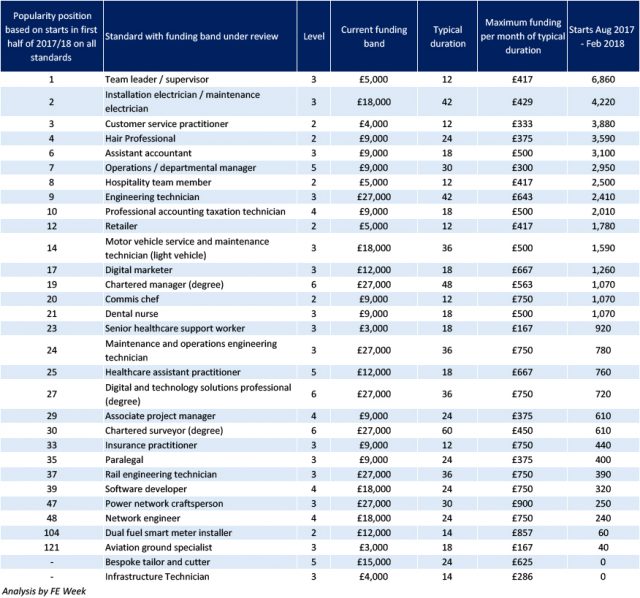
The Institute for Apprenticeships announced today that it will look at 31 standards (see table below), at request from the Department for Education.

The IfA will now have 30 funding bands to choose from – the maximum rate paid for from the levy – up from the current 15.

We will work collaboratively with trailblazers to carry out the review in an open and fair way

FE Week analysis shows that 21 of the 30 standards with the most starts this academic year are among those being reviewed by the IfA.

The 31 involved represents 64 per cent of all starts on standards in the first half of 2017/18 (45,900 out of 71,720).

The chartered management degree apprenticeship is one. Its funding band is already £27,000 – the maximum upper limit, meaning its rate can only fall, which is likely to infuriate the many universities offering the standard.

The team leader/supervisor apprenticeship has been the most popular standard this year with 6,680 starts from August 2017 to February 2018, yet its funding band is also under review.

The move to a 30-band structure gives the IfA more choice regarding the rate it applies to each standard.

Under the 15 structure, if the institute wanted to reduce a £9,000 band it had to drop it to £6,000, for example. But for starts from August it will have the option of setting this to to either £8,000 or £7,000.

Similarly, standards on £27,000 can now drop to £26,000 or £25,000 instead of falling all the way to the previous £24,000.

The IfA admitted in its release about the review that some of the standards involved are among the most popular, and said that others have a low number of starts and “employer feedback suggests” that take up may be restricted by their current funding band.

These are likely to include the infrastructure technician and bespoke tailor and cutter standards which have had no starts so far this year.

The IfA said it will work “collaboratively with trailblazers to carry out the review in an open and fair way”.

The review will “help make sure that employers can access high quality apprenticeships, and that funding bands represent good value for money for employers and government”.

Reviewed funding band recommendations will be made to the DfE, who “take the final decision on all funding bands”.

The DfE announced in February that it would review the funding-band structure, because employers did not “feel able” to negotiate with providers on price.

13 May 09:44

Google Duplex AI Assistant and the implications of AI for Career Development and Learning

by enzofsilva

If you haven’t read this article yet, you should: Google Duplex: An AI System for Accomplishing Real World Tasks Over the Phone

In summary, Google has been developing an Artificial Intelligence program in the true sense of the words: a bot that can make intelligent decisions by having voice conversations (via phone calls) on your behalf… and it sounds quite human.

What are some of the consequences this type of technology can have for the Learning & Development industry?

  • What voice-based about AI-supported coaching conversations (perhaps not to replace a “real” coach, but a quick go-to resource to have in your pocket?
  • AI-assisted aptitude testing?
  • Life-like simulations for training with a bot role-playing a situation with the learner (negotiation skills, anyone)?
  • On-the-job support for navigating systems, or even better, actually utilizing the systems on your behalf (imputing a deal on the CRM on behalf of a sales person, saving precious time)?

Share your thoughts.

Cite this article:
Silva E (2018-05-09 07:10:44). Google Duplex AI Assistant and the implications of AI for Career Development and Learning. Enzo Silva blog. Retrieved: Nov 09, 2024, from http://enzosilva.com/blog/2018/05/09/google-duplex-ai-assistant-and-the-implications-of-ai-for-career-development-and-learning/
23 Apr 11:09

KPMG sends its apprentices back to school

by Samantha Lauren King

Professional services giant KPMG has been sending its apprentices back to school in a scheme to boost their professional development, reports Samantha King.

Apprentices at KPMG are encouraged to go back to their former schools and talk about their career journey so far through the firm’s Back to Schools programme, developed after its first-ever cohort of apprentices in October 2015 asked how they could share their experiences of the world of work with their old teachers and schoolmates.

The scheme has had a revamp this year, and apprentices can use six allotted volunteering days to visit schools and deliver a presentation on their apprenticeship.

“We have a specific learning curriculum, aside from the professional qualification, to help them bridge that gap from college to corporate life,” explained Kevin Matthews, KPMG’s apprenticeships assistant manager.

“The programme helps apprentices looking to build their confidence with presentation skills and networking ability.”

Six of the company’s apprentices have been appointed apprentice champions in locations across the country to help run the programme, field questions from their peers and assist with facilitating school visits.

“We encourage the apprentices to make that initial contact with schools,” said Elizabeth Morris, assistant manager for student recruitment at KPMG. “We have copy that we provide them with and they’re able to tweak that, just to say hello, I came to this school or college, and I’m really interested in coming back and talking about my experience – is there an opportunity for me to do so?”

Before the Back to Schools programme was in place, the firm found that on outreach visits to schools, pupils were more interested in hearing the experiences of newer recruits than those in more established positions in the firm.

“Those apprentices are ultimately our best sales people. They’re enjoying themselves, they’re living the values of our firm and they can go out there and talk to those people in a much more meaningful and authentic way,” added Mr Matthews.

16 Apr 19:32

Assessing the value of “maturity models”

by Martin White

How I envy communications teams working on digital media marketing projects. They have a wealth of metrics to assess the performance of their digital channels and can also benchmark their efforts against those of direct and indirect competitors. Inside the enterprise the benefit is that every user has a name, position and usually some form of profile. The downside is that internal communications (and that covers intranets, social media, collaboration and search) usually have little or no idea of whether their efforts are good, bad or just indifferent. Employee engagement surveys are not a good diagnostic tool. In the case of intranets there is the excellent (and recently re-energised) Worldwide Intranet Challenge. This does provide a qualitative benchmark to help organisations decide on priorities, and of course it can be run again a year or two years later. It has the benefit of scale, with 80,000 responses from 250 organisations. No other benchmark survey that I know of gets anywhere close to this level of validation.

Digital workplace maturity models are becoming increasingly numerous. Probably the most rigorous is the Digital Workplace Group, though I’m guessing here because the methodology is not in the public domain. One of the early pioneers in both intranet and digital workplace benchmarking is Jane McConnell (NetJMC). Jane started out in 2006 with an intranet benchmark survey and then smoothly transitioned into digital workplace research in 2011. Typically around 300 organisations complete the survey, and it is about as close as we can get at present to a longitudinal survey in which the same cohort of respondents is tracked over a period of time. I must not forget the IntraTeam benchmarking service and there is also a digital workplace maturity report from Deloitte

Sometimes what appears to be a digital workplace maturity model turns out to be something else. An example would be the model developed by Swoop Analytics which turns out to be an enterprise social networking maturity model – an interesting approach but not what it says on the tin. I commented recently on the challenges of ESN metrics.  I’m also aware of a UX Maturity Model an Analytic Maturity Model and the Garter Enterprise Information Management Maturity model. In the case of collaboration Stan Garfield has published a list of over 30 maturity models. This list dates back to mid-2016 and I am sure that more have emerged since that time.

Most maturity models are designed around a set of heuristics that can be used by an organisation to provide a qualitative assessment of maturity.With any maturity model there is always the danger that the complexity of using the model is out of balance with the benefits that might be gained. I’ve been reading with interest The Virtual Team Maturity Model (VTMM) developed by Ralf Friedrich as a PhD project. He identified eleven processes that were factors in determining virtual team success. The rigour of the analysis, the development of the model and then the validation in practice is exceptional but Springer has done a serious disservice to the author in publishing it as a 364p trade paperback which because of the perfect binding is impossible to open flat and read. The quality of the English text is very good but it reads like a PhD thesis. There is no way I could recommend it to a client so I won’t be publishing a review.

It takes a substantial amount of effort to develop a maturity model. I can speak from personal experience as I have been working on an enterprise search maturity model since 2010! It does not help when I find myself asking what the value of a maturity model really is. Providing a metric for maturity is not the same as understanding what the requirements are (and will be) of employees and stakeholders. I often feel that a maturity model is a stand-in for not having the resources to assess these requirements not just on a one-off basis but as a way of measuring the impact of the actions taken, or not taken. If you need to have a maturity assessment undertaken to justify to stakeholders that investment in resources, tools and training is required then I fear you are never going to transform your organisation. The voice of the employee has to be heard above the noise of self-congratulation. It’s worth reading a very good opinion piece from Martin Fowler on the subject of maturity models in general.

If a maturity model starts a constructive discussion about visions and options then I can see the value. Using it as a way to shape a roadmap and a project plan and then measure progress is not sensible.

Martin White


16 Apr 19:07

Jisc secures future of a free online maths course

by kate.edser@jisc.ac.uk

A free online course designed for adults who want to improve their grasp of maths at GCSE level has been transferred to Jisc.

The move from Calderdale College means that the Citizen Maths course will remain freely available to all and will be updated and developed in the future.

Citizen Maths is a good match for our existing content for further education colleges, such hairdressing training and an e-books collection that includes text books for compulsory English and maths GCSE retakes.

The transfer of Citizen Maths took place earlier this year and our initial focus will be on ensuring the continuation of all its current features and on maintaining excellent support for learners and partners.

Service to be improved in the future

In the future, we plan to improve Citizen Maths to meet the needs of a wider range of learners.

Karla Youngs, head of digital content services for further education and skills at Jisc, said:

“This maths course is a good fit with Jisc’s existing offering to further and adult education and we have worked closely with Calderdale College to ensure a smooth transfer of the service and to make the transition invisible to learners and to partner organisations.

We now have a team in place to support the service into the future.”

Meeting the needs of a growing user base

John Rees, principal and chief executive of Calderdale College, said:

“We are pleased that Citizen Maths has now transferred to an organisation which provides digital solutions for the whole of UK education and research. We can’t think of a better long-term home for the project, which has seen steady growth in number of users since its launch.”  

Citizen Maths was developed in between 2014 and 2017 by Calderdale College, with funding from the Ufi charitable trust, working with the UCL Institute of Education and OCR.

Who is Citizen Maths for?

Citizen Maths is aimed at people who want to improve their grasp of maths, and become more confident in using these skills at work and in life.

Maths may have passed you by at school, or you may be rusty. Maybe you’ve passed maths exams, but find it hard to apply what you know to the types of problem you need to solve now – like using spreadsheets, judging amounts or assessing odds.

The course uses practical problems to help people learn and is pitched to meet the standard of maths that a 16-year-old should achieve.

There are five modules which should take between five and ten hours each to complete.

While the course does not result in a formal qualification, a statement of participation is available for people who successfully complete the whole course.

16 Apr 19:00

NHS facing a financial crisis ahead of GDPR implementation

by Hannah Mulea

New research from Digital Health Intelligence has revealed that only 55 percent of NHS Acute Trusts and 47 percent of mental health trusts have plans in place to comply with the upcoming General Data Protection Regulation (GDPR), thereby revealing that around half of such institutions are yet to create implementation plans for GDPR.

Information obtained by Digital Health Intelligence via a Freedom of Information request has revealed that 46 NHS Trusts have so far spent a combined £1,076,549 in order to implement GDPR, with the Luton and Dunstable Hospital Foundation Trust and the Lincolnshire Partnership NHS Foundation Trust spending in excess of £100,000 each.

Other NHS Trusts that also set aside significant sums for GDPR implementation included South Central Ambulance Service NHS Trust, St George’s University Hospitals NHS Foundation Trust, Sheffield Teaching Hospitals NHS Foundation Trust, and the Dorset HealthCare University. Most of their investments were geared towards training staff to effectively manage and secure sharing of confidential patient records and data.

Such NHS Trusts also spend a lot of money in the recent past on information security management systems, data flow mapping licences, software training, and configuration consultancy. However, there are also some NHS hospitals such as Royal Derby hospital, Goodmayes Hospital, and Alder Hey Children’s NHS Foundation Trust who spent as little as £500 each on securing email systems or staff training.

Impending financial crisis

Digital Health Intelligence added that even though the NHS has received generous funding over the years, with its expenses rising from £78.8 billion in 2006/07 to £120.51 billion in 2016/17 and £126.26 billion in 2018/19, it is still facing a financial crisis.

“Years of mismanagement, bloated administration and rising costs for social care, mean resources are at breaking point. It is against this backdrop that the NHS faces a new challenge which threatens to add further strain to its resources; the General Data Protection Regulation (GDPR).

“In addition, the complexities and legal landmines facing NHS chiefs as they implement changes to adhere to this regulation are immense,” the firm added.

It recommended that in order to avert a crisis in the near future, the NHS needs to establish a national programme for managing and funding the GDPR and should ask for additional funds from the Treasury to strengthen its cyber security. At the same time, the government should provide dedicated legal advice to enable all trusts to gain free consultancy on implementation.

“GDPR aside, the NHS will remain a high-value target for attackers due to the highly sensitive nature and the number of the patient healthcare records it holds. It must quickly get their house in order – not only to meet the GDPR but also to guard against the next ransomware attack. The WannaCry ransomware attack hit the NHS less than one year ago and its effects were devastating,” says Matt Lock, Director of Sales Engineers at Varonis.

“The challenges are real. Like many large healthcare systems, the NHS must deal with legacy infrastructure that was not designed to handle the volume of data and operating systems in use today. They’ve got to address and replace outdated and unsupported systems as a first step, and this costs money.

“Spending £1m seems like a large investment, but after this funding is distributed across hundreds of facilities throughout the UK, the amount is likely to be far than adequate given the challenges facing the NHS. Organisations must stand accountable, address these issues and move forward quickly, perhaps faster than they may be accustomed to. Today’s technology and threats demand nothing less,” he adds.

The post NHS facing a financial crisis ahead of GDPR implementation appeared first on Engage Employee.