Shared posts

04 Dec 00:02

RIP Every Frame a Painting

by Jason Kottke

Sad but expected news: Tony Zhou and Taylor Ramos have shut down their excellent video series on film, Every Frame a Painting. They wrote about their decision in the form of the script for a final episode that never got made:

(TONY) As many of you have guessed, the channel more or less ended in September 2016 with the release of the “Marvel Symphonic Universe” video. For the last year, Taylor and I have tinkered behind-the-scenes to see if there was anything else we wanted to do with this YouTube channel.

(TAYLOR) But in the past year, we’ve both started new jobs and taken on other freelance work. Things started piling up and it took all our energy to get through the work we’d agreed to do.

When we started this YouTube project, we gave ourselves one simple rule: if we ever stopped enjoying the videos, we’d also stop making them. And one day, we woke up and felt it was time.

I was a huge fan of the series and posted many episodes on kottke.org. Here are a few particular favorites:

Cheers to Tony and Taylor…you made a great thing and knew when to quit (unlike some people).

P.S. Poking around, I found a mini Every Frame a Painting that Zhou and Ramos did for Criterion about The Breaking Point, posted to YouTube back in August:

Gah, that just makes me miss it even more!

Tags: movies   Taylor Ramos   Tony Zhou   video
01 Dec 07:32

The American Football: How It Is Played | E.J. Sampson | Guardian | 29th November 2017

From the Guardian archive, an account first published in 1929, written by an English tennis player. “The ball is placed in the centre of the ‘line-up’, then held by the centre man of the side in possession, and at the chosen moment is passed by him between his legs to the chosen back. After each ‘down’ the same preliminaries are all religiously gone through, which makes matters very tedious at times. The game is divided into four quarters, each of 15 minutes”
21 Nov 00:58

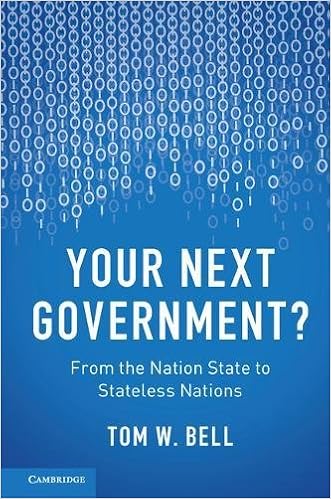
Your Next Government

by Alex Tabarrok

Google is building a small city within Toronto:

Toronto has about 800 acres of waterfront property awaiting redevelopment, a huge and prime stretch of land that amounts to one of the best opportunities in North America to rethink at scale how housing, streets and infrastructure are built. On Tuesday the government and the group overseeing the land announced that they were partnering with an Alphabet subsidiary, Sidewalk Labs, to develop the site.

Not to be outdone, Bill Gates is thinking even bigger, a 25,000 acre site for a new city near Phoenix that might take advantage of Arizona’s forward thinking rules on self-driving cars.

All over the world, we can see the beginnings of a move from nation-states to smaller, more decentralized and agile communities such as common interest developments, special economic zones and proprietary cities. Your Next Govenment is Tom W. Bell’s primer on this coming revolution. If you want to find out the latest on the Honduran Zede or the Polynesian seasteading project, both of which Bell has been involved with, YNG is your first stop. Bell also covers the history of these movements from Henry Ford’s failed Brazilian city, Fordlandia, to the use of special economic zones and foreign trade zones in the United States.

For anyone starting such a community, Bell has up-to-date recommendations on the principles of governance including how to adopt an appropriate legal code.

Recommended.

The post Your Next Government appeared first on Marginal REVOLUTION.

17 Nov 06:39

Nowcasting the Local Economy: Using Yelp Data to Measure Economic Activity -- by Edward L. Glaeser, Hyunjin Kim, Michael Luca

Can new data sources from online platforms help to measure local economic activity? Government datasets from agencies such as the U.S. Census Bureau provide the standard measures of local economic activity at the local level. However, these statistics typically appear only after multi-year lags, and the public-facing versions are aggregated to the county or ZIP code level. In contrast, crowdsourced data from online platforms such as Yelp are often contemporaneous and geographically finer than official government statistics. In this paper, we present evidence that Yelp data can complement government surveys by measuring economic activity in close to real time, at a granular level, and at almost any geographic scale. Changes in the number of businesses and restaurants reviewed on Yelp can predict changes in the number of overall establishments and restaurants in County Business Patterns. An algorithm using contemporaneous and lagged Yelp data can explain 29.2 percent of the residual variance after accounting for lagged CBP data, in a testing sample not used to generate the algorithm. The algorithm is more accurate for denser, wealthier, and more educated ZIP codes.
16 Nov 23:23

Dargahs | Madhavi Menon | Indian Quarterly | 16th November 2017

Notes on visiting a neglected tomb of astonishing beauty in Delhi. “The inside is magnificent in its rich blues and deep golds, entirely unexpected in the midst of overgrown grass, abandoned courtyards and haunted mosques. Often described as the gay Taj Mahal, Jamali-Kamali’s tomb commemorates a same-sex attachment as intense as the one that inspired Shah Jahan. Unlike the Taj Mahal, Jamali-Kamali’s dargah is not open for public viewing for fear of being defaced like the mosque next door”
16 Nov 23:11

“A Perfect Fit,” by Isaac Asimov

by Tyler Cowen

Gold said, “You underwent due process in great detail, and there was no reasonable doubt that you were guilty–”

“Even so!  Look!  We live in a computerized world.  I can’t do a thing anywhere — I can’t get information — I can’t be fed — I can’t amuse myself — I can’t pay for anything, or check on anything, or just plain do anything — without using a computer.  And I have been adjusted, as you surely know, so that I am incapable of looking at a computer without hurting my eyes, or touching one without blistering my fingers.  I can’t even handle my cash card or even think of using it without nausea.”

Gold said, “Yes, I know all that.  I also know you have been given ample funds for the duration of yoiur punishment, and that the general public has been asked to sympathize and be helpful.  I believe they do this.”

“I don’t want that.  I don’t want their help and their pity.  I don’t want to be a helpless child in a world of adults.  I don’t want to be an illiterate in a world of people who can read.  Help me end the punishment.  It’s been almost a month of hell.  I can’t go through eleven more.”

That is from the short story “A Perfect Fit,” from 1981, reproduced in the volume The Winds of Change and other stories.  I’ve been rereading some Asimov lately, in preparation for my chat with Andy Weir, and much of it has held up remarkably well.

The post “A Perfect Fit,” by Isaac Asimov appeared first on Marginal REVOLUTION.

16 Nov 22:47

Is Beauty Universal? | Anthony Brandt & David Eagleman | Nautilus | 10th November 2017

No. In the visual arts, symmetry seems to be generally pleasing, but great artworks depart from it. Newborns are fascinated by patterns that display some, but not much, complexity; these don’t offer much to grown-ups. Music ought to have some universal principles, by virtue of its abstraction, but tastes differ completely across cultures. The idea that babies prefer Mozart to dissonance is an artifact of bad experimental method, babies gravitate towards whatever they heard first
16 Nov 08:17

The Nightmare | Wang Yu | China Change | 13th November 2017

Chinese human-rights lawyer recounts her abduction and interrogation by Beijing police, who wanted her to confess to “subversion of state power”. First, she was shackled to a chair for five days. “I felt that I was dying. I had entered an empty state; a pain that is hard to describe. I couldn’t breathe. I felt pain in every part of my body. I felt that my soul had already drifted away. That day, I thought, I really was like a dead person. I spent another sleepless night strapped in the chair”
15 Nov 01:02

Your Reckoning And Mine | Rebecca Traister | The Cut | 12th November 2017

On the emerging balance of power between men and women in the wake of the Weinstein scandal. Men in the public eye feel vulnerable, and rightly so. Women are torn between truth and past friendship. “The anger window is open. It’s wild and not entirely fun. In the shock of the house lights having been suddenly brought up, we’ve had scant chance to parse what exactly is inflaming us and who. It’s our tormentors, obviously, but sometimes also our friends, our mentors, ourselves”
12 Nov 08:59

Does Age Bring Wisdom? | Scott Alexander | Less Wrong | 8th November 2017

Do we get wiser with age, or do we just get better socialised in our thinking? If we truly get wiser with age, why don’t we assume that even older people are even wiser? “It would be pretty awkward if everything we thought was ‘gaining wisdom with age’ was just ‘brain receptors consistently functioning differently with age’. Intuitively, going back to earlier habits of mind would feel inherently regressive, like going back to drawing on the wall with crayons. But I don’t have any proof”
12 Nov 02:06

Celebrating The Tech Revolution | Tyler Cowen | Bloomberg | 10th November 2017

“The major tech companies are growing their platforms quickly, supporting low prices with scale, product diversity, data ownership and superior service. Hardly anyone today worries about the eventual disappearance of competition and monopoly prices from Amazon or the other major tech companies. The tech companies have shown that their radical model of low price, high market share, high quality rapid expansion will keep them profitable for a long time to come”
03 Nov 05:21

Where Tech Is Going To Take Finance | Matt Levine & Tyler Cowen | Bloomberg | 31st October 2017

Conversation about prospects for social and technological change in finance over the next twenty years. One area ripe for innovation is that of identity — who validates who you are, and how they do so. “The idea that financial intermediaries should be the keepers of identity is pretty uncomfortable, but then, the idea of Facebook as keeper of identity seems like it would be uncomfortable, and Facebook has taken over a lot of the work of verifying identity, at least online”
31 Oct 11:44

Public Policy After Utopia | Will Wilkinson | Niskanen Center | 24th October 2017

An argument for less idealism in politics and ideology. Utopian visions inspire change and orient reform. But any Utopia is going be, almost by definition, radically different from any existing society; we cannot predict reliably the behaviour even of existing societies; so the Utopian vision is at best “a counter-factual social system that may or may not do especially well in delivering the goods”. Pragmatism is preferable. Compare existing systems and emulate those that work best
17 Oct 03:00

The Scale Of Tech Industry Winners | Benedict Evans | 13th October 2017

American tech as oligopoly. “The four leading companies of the current cycle — Google, Apple, Facebook, Amazon — have together over three times the revenue of Microsoft and Intel combined. This change is even more striking if you shift the timeline. If you compare GAFA in their current dominance with Wintel in their period of dominance, you see not a 3x difference in scale but a 10x difference. Being a big tech company means something different now to in the past”
17 Oct 02:56

One Person’s History Of Twitter | Mike Monteiro | Medium | 15th October 2017

A stylised and contestable account of Twitter’s failings, but interesting and informed. “When companies tell you they need to be more transparent it’s generally because they’ve been caught being transparent. You accidentally saw behind the curtain. Twitter is behaving exactly as it’s been designed to behave. Twitter, at this moment, is the sum of the choices it has made. Even when the coop is covered in chickenshit, the chickens will come home to roost”
17 Oct 01:28

Vox gets QWERTY wrong

by Joshua Gans

This video produced by Vox.com on why we have QWERTY-standard keyboards was interesting but it didn’t actually answer the question as to why QWERTY was over-rated. It’s claim is that it was the result of collusion from typewriter manufacturers and how typing was taught. Sure, that explains how it started, but it doesn’t explain why it persists when we don’t have typewriters. After all, there is no cartel now. There are no typewriting schools. There aren’t even any typewriters!

They don’t cite it but the video tracks fairly closely the history of QWERTY as told in this 1985 paper in the American Economic Review by Paul David. (Actually, it is one of the most famous economic history papers of all time). It is a short paper but the video actually stops just three pages in. They didn’t read on to the section “basic QWERTY-Nomics.”

If they had they would have been introduced to network effects (or as David called it ‘system-wide economies of scale.’ Why do we use QWERTY now? Because every keyboard we encounter as QWERTY. A few years ago, my son realised that he could change the keyboard on his computer. He read about the Dvorak design and so decided to switch. He figured it would take him about a month to get better and he measured his performance to make sure. This, of course, was David’s point — it actually wasn’t too hard to change keyboard designs. There was learning but the rate of return to switching was positive.

Much to my amusement (as I had read David), my son eventually ran into a problem. He was going to computer camp (of course) and realised that he would be using a different computer every day. He thought about bringing a Dvorak keyboard with him but then realised that uploading drivers each time to Windows machines would be a pain. So he gave up.

This illustrates why we have QWERTY. It is not that once-off switching costs are that high. It is that on-going switching costs are. So we have coordinated on QWERTY.

My point is that the Vox video misses this completely! I cannot figure out why. Moreover, in the process, it actually answers nothing let alone saying something new.

For instance, we have QWERTY keyboards on our smart phones. What we don’t know is if that has the same rate of return issues as we have on full sized keyboards. One theory I’d like to put forward is that QWERTY is now back to being close to optimal. Your phone keyboard isn’t a true keyboard because the keys are too small. Instead, it is a predictive text instrument that anticipates the key you have tried to hit by taking into account what you did previously. So if you type ‘t’ it figures there is a high chance you want to type ‘h’ next even if you finger hits ‘g’ or ‘j.’ This was an innovation from Apple in the original iPhone.

However, the whole point of QWERTY was to ensure that it was very unlikely that you would type two keys close to each other. The Dvorak keyboard is designed to have you type faster and doesn’t have that characteristic. Indeed, the vowels are altogether in that design which would diminish the ability for predictive typing to work. Consequently, it may well be that QWERTY is now optimal again and the puzzle both David and Vox talk about was a short-lived decades long affair.


17 Oct 01:27

How AI Could Change Amazon: A thought experiment

by Joshua Gans

[This post originally appeared in HBR online on 3rd October, 2017]

by Ajay Agrawal, Joshua Gans and Avi Goldfarb

How will AI change strategy? That’s the single most common question the three of us are asked from corporate executives, and it’s not trivial to answer. AI is fundamentally a prediction technology. As advances in AI make prediction cheaper, economic theory dictates that we’ll use prediction more frequently and widely, and the value of complements to prediction – like human judgment – will rise. But what does all this mean for strategy?

Here’s a thought experiment we’ve been using to answer that question. Most people are familiar with shopping at Amazon.  Like with most online retailers, you visit their website, shop for items, place them in your “basket,” pay for them, and then Amazon ships them to you. Right now, Amazon’s business model is shopping-then-shipping.

Most shoppers have noticed Amazon’s recommendation engine while they shop — it offers suggestions of items that their AI predicts you will want to buy. At present, Amazon’s AI does a reasonable job, considering the millions of items on offer. However, they are far from perfect. In our case, the AI accurately predicts what we want to buy about 5% of the time. In other words, we actually purchase about one out of every 20 items it recommends. Not bad!

Now for the thought experiment. Imagine the Amazon AI collects more information about us: in addition to our searching and purchasing behavior on their website, it also collects other data it finds online, including social media, as well as offline, such as our shopping behavior at Whole Foods. It knows not only what we buy, but also what time we go to the store, which location we shop at, how we pay, and more.

Now, imagine the AI uses that data to improve its predictions. We think of this sort of improvement as akin to turning up the volume knob on a speaker dial. But rather than volume, you’re turning up the AI’s prediction accuracy. What happens to Amazon’s strategy as their data scientists, engineers, and machine learning experts work tirelessly to dial up the accuracy on the prediction machine?

At some point, as they turn the knob, the AI’s prediction accuracy crosses a threshold, such that it becomes in Amazon’s interest to change its business model. The prediction becomes sufficiently accurate that it becomes more profitable for Amazon to ship you the goods that it predicts you will want rather than wait for you to order them. Every week, Amazon ships you boxes of items it predicts you will want, and then you shop in the comfort and convenience of your own home by choosing the items you wish to keep from the boxes they delivered.

This approach offers two benefits to Amazon. First, the convenience of predictive shipping makes it much less likely that you purchase the items from a competing retailer as the products are conveniently delivered to your home before you buy them elsewhere. Second, predictive shipping nudges you to buy items that you were considering purchasing but might not have gotten around to. In both cases, Amazon gains a higher share-of-wallet. Turning the prediction dial up far enough changes Amazon’s business model from shopping-then-shipping to shipping-then-shopping.

Of course, shoppers would not want to deal with the hassle of returning all the items they don’t want.  So, Amazon would invest in infrastructure for the product returns — perhaps a fleet of delivery-style trucks that do pick-ups once a week, conveniently collecting items that customers don’t want.

If this is a better business model, then why hasn’t Amazon done it already? Because if implemented today, the cost of collecting and handling returned items would outweigh the increase in revenue from a greater share-of-wallet. For example, today we would return 95% of the items it ships to us. That is annoying for us and costly for Amazon. The prediction isn’t good enough for Amazon to adopt the new model.

That said, one can imagine a scenario where Amazon adopts the new strategy even before the prediction accuracy is good enough to make it profitable because the company anticipates that at some point it will be profitable. By launching sooner, Amazon’s AI will get more data sooner, and improve faster. Amazon realizes that the sooner it gets started, the harder it will be for competitors to catch up. Better predictions will attract more shoppers, more shoppers will generate more data to train the AI, more data will lead to better predictions, and so on, creating a virtuous circle. In other words, there are increasing returns to AI, and thus the timing of adopting this kind of strategy matters. Adopting too early could be costly, but adopting too late could be fatal.

The key insight here is that turning the dial on the prediction machine has a significant impact on strategy. In this example, it shifts Amazon’s business model from shopping-then-shipping to shipping-then-shopping, generates the incentive to vertically integrate into operating a product-returns service (including a fleet of trucks), and accelerates the timing of investment due to first-mover advantage from increasing returns. All this is due to the single act of turning the dial on the prediction machine.

Most readers will be familiar with the outcome of companies like Blockbuster and Borders that underestimated how quickly the online consumer behavior dial would turn in the context of online shopping and the digital distribution of goods and services. Perhaps they were lulled into complacency by the initially slow adoption rate of this technology in the early days of the commercial internet (1995-1998).

Today, in the case of AI, some companies are making early bets anticipating that the dial on the prediction machine will start turning faster once it gains momentum. Most people are familiar with Google’s 2014 acquisition of DeepMind – over $500M for a company that had generated negligible revenue, but had developed an AI that learned to play certain Atari games at a super human performance level. Perhaps fewer readers are aware that more traditional companies are also making bets on the pace the dial will turn. In 2016, GM paid over $1B to acquire AI startup Cruise Automation, and in 2017, Ford invested $1B in AI startup Argo AI, and John Deere paid over $300M to acquire AI startup Blue River Technology – all three startups had generated negligible revenue relative to the price at the time of purchase. GM, Ford, and John Deere are each betting on an exponential speed up of AI performance and, at those prices, anticipating a significant impact on their business strategies.

Strategists face two questions in light of all of this. First, they must invest in developing a better understanding of how fast and how far the dial on their prediction machines will turn for their sector and applications. Second, they must invest in developing a thesis about the strategy options created by the shifting economics of their business that result from turning the dial, similar to the thought experiment we considered for Amazon.

So, the overarching theme for initiating an AI strategy? Close your eyes, imagine putting your fingers on the dial of your prediction machine, and, in the immortal words of Spinal Tap, turn it to eleven.

The ideas here are adapted from our forthcoming book “Prediction Machines: The Simple Economics of Artificial Intelligence.” (Harvard Business School Press, April 2018)


16 Oct 01:40

Self Driving

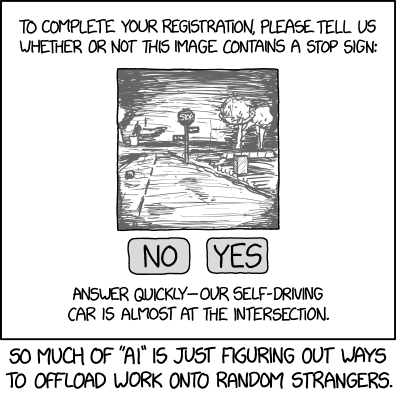
"Crowdsourced steering" doesn't sound quite as appealing as "self driving."
23 Sep 02:35

A Conversation With Larry Summers | Tyler Cowen | Mercatus Center | 20th September 2017

Interesting throughout. Topics include education, monopoly power, investment, philanthropy, unionisation, table tennis, immigration, bitcoin. “The understanding should be that if you immigrate to the United States you’re immigrating to the United States to become an American. That reflects acculturation, one crucial part of which is speaking English and understanding that you’re going to be learning English and that you’re going to be carrying on your life in English”
11 Sep 12:40

Countries conquer a lot less now

by James Choi
If you were to ask historians to name the most foolish treaty ever signed, odds are good that they would name the Kellogg-Briand Pact of 1928. The pact, which was joined by 63 nations, outlawed war. Ending war is an absurdly ambitious goal. To think it could be done by treaty? Not just absurd but dangerously naïve.

And the critics would seem to be right. Just over a decade later, every nation that had joined the pact, with the exception of Ireland, was at war. Not only did the treaty fail to stop World War II but it also failed to stop the Korean War, the Arab-Israeli conflict, the Indo-Pakistani wars, the Vietnam War, the Yugoslav civil war and the current conflicts in Ukraine, Syria and Yemen.

But the critics are wrong. Though the pact may not have ended all war, it was highly effective in ending the main reason countries had gone to war: conquest. ...

First, some context. Before 1928... international law also gave countries the right of conquest, meaning they could benefit from war by keeping its spoils, territory and, in some cases, people. ...

When it outlawed war, the Kellogg-Briand Pact changed nearly every rule that states had followed for centuries. Most important, countries could no longer establish right, justice or title by brute strength. Because war was now illegal, except in cases of self-defense, states lost the right of conquest. ...

With the research assistance of 18 Yale law students, we found that from 1816 until the Kellogg-Briand Pact was first signed in 1928, there was, on average, approximately one territorial conquest every 10 months. Put another way, the average state during this period had a 1.33 percent chance of being the victim of conquest in any given year. ...

A country with a 1.33 percent annual chance of conquest can expect to be conquered once in an ordinary human lifetime. And these conquests were not small. The average amount of territory seized between 1816 and 1928 was 114,088 square miles per year.

Since World War II, conquest has almost come to a full stop. The average number of conquests per year fell drastically — to 0.26 per year, or one every four years. The average size of the territory taken declined to a mere 5,772 square miles per year. And the likelihood that any individual state would suffer a conquest in an average year plummeted — from 1.33 percent to 0.17 percent, or once or twice a millennium. ...

The illegal annexation of Crimea by Russia in 2014 might seem to prove us wrong. But the seizure of Crimea is the exception that proves the rule, precisely because of how rare conquests are today. Consider that before 1928, the amount of territory conquered every year was equal to roughly 11 Crimeas. In addition, nearly every state in the world has rejected the 2014 annexation as illegal, refusing to recognize Crimea as part of Russia.
--Oona Hathaway and Scott Shapiro, NYT, on the power of norms
11 Sep 12:39

Posner vs. Sunstein writing deathmatch

by James Choi
In 1997, Ronald Dworkin, a fierce critic of [Richard] Posner’s, wrote an article that was in large part an attack on the two of us. Dworkin argued that we constituted a new “Chicago School,” that we were wrongly dismissive of high theory and philosophical questions, and that we were basically full of nonsense.

Posner suggested that we should do a joint reply, and I happily agreed. As I recall, it was a Friday, and I was determined to write the first draft, so as to shape both the tone and the content. Over the weekend, I worked as hard as I have ever done. On early Monday morning, probably around 7:45, I faxed him a 21-page, single-spaced draft. It lacked footnotes, and it was pretty rough, but, still, mission accomplished. I was pretty proud of myself.

When I got back to my office, I spotted something on my chair. It was from Posner. It had 35 pages. It was fully footnoted. It read like a dream. Needless to say, it was much more polished than mine, and better in every way.

As always, Judge Posner was ahead of the rest of us, even when we run as fast as we can.
--Cass Sunstein, Bloomberg, on pitting two of the fastest writers in legal academe against each other. HT: Marginal Revolution
02 Sep 12:51

100 Great Works of Dystopian Fiction

by Jason Kottke

Dystopian Books

Vulture has compiled a list of 100 Great Works of Dystopian Fiction, “tales about a world gone wrong”. Entries on the list include some of the earliest examples like Mary Shelley’s The Last Man and The Time Machine by H.G. Wells, classics like Huxley’s Brave New World and 1984, modern classics like Snow Crash by Neal Stephenson and William Gibson’s Neuromancer, and some newer books like On Such a Full Sea by Chang-Rae Lee and A Planet for Rent by Cuban author Yoss. Even Infinite Jest makes an appearance. As does It Can’t Happen Here, a 1935 novel by Sinclair Lewis that sounds particularly relevant right now:

As the old saying goes, “history doesn’t repeat itself, but it does rhyme” — and Lewis’s It Can’t Happen Here is proof. This 1935 satire chronicles the career of fictitious U.S. politician Buzz Windrip, a populist senator who wins the presidency. As it turns out, he’s a bit of a fascist, but more frightening than his actions is the speed — and eagerness — with which Americans join him in his authoritarian crusade. Lewis understood the American soul better than most, and he makes a compelling case that fascist tendencies would make a horrifyingly good fit for our polity if presented with the right amount of good, old-fashioned patriotism.

See also a reading list for the resistance.

Tags: books   lists
02 Sep 12:05

IPA’s weekly links

by Jeff Mosenkis (IPA)

Guest post by Jeff Mosenkis of Innovations for Poverty Action.

RedCrossPamphlet

A Red Cross pamphlet from WWI slogan (at the bottom): “Millions for Relief, but Not One Cent for Administration”

  • In a surprise ruling a few hours ago the Kenyan Supreme Court voided the outcome of the recent election, calling for a new one within 60 days. The Nairobi stock market dropped 10 percent right away, triggering a brief halt in trading. Follow Ken Opalo for the latest (and just in general).
  • Here’s one way to cut through IRB paperwork. Investor Peter Thiel had 17 patients flown to St. Kitts to inject them with an experimental herpes drug which couldn’t get funding or IRB approval in the United States. So next time the IRB does’t approve some of your survey questions, consider flying the village to the Caribbean to ask them there.
  • If you hadn’t heard about it yet, ProPublica and NPR some time ago did stories on the American Red Cross’ repeated failures and lack of financial transparency in disaster responses over the years. They included driving empty trucks around during Superstorm Sandy for news crews to film, and raising half a billion dollars for Haiti rebuilding, but only building 6 homes. You can get the history here, but I did not realize that 71% of their revenue is from for-profit blood services. That business has been squeezed in recent years by lowered demand, leading them to cut back on disaster staff.
  • Development Impact blog links are back from vacation!
  • Over at the Center for Global Development, an assessment of the state of health evaluations. In a blog postbrief, & full paper, Raifman, Lam, Keller, Radunsky & Savedoff describe finding 299 evaluations in the health sector and grading 37 of them in depth for quality. Results were disappointing.
  • The new Rough Translation podcast from NPR went to the DRC to look into what happened when NGOs started showing up looking to help survivors of highly publicized mass rapes. It created a cottage industry (they actually have a phrase that translates into that), of villages finding women to say they were raped to get the aid. But the show looks a little deeper with the journalist who originally investigated it into the morals of the issue. The NGOs aren’t going to question the veracity of a victim’s story, and both the NGOs and people there are afraid that if it comes out that the rape stories aren’t true, it will cut off the flow of aid to people who need it.
  • Kremer and Rao slides on behavioral economics in development are here if you missed them.

The economics to sociology phrasebook is fun (h/t Chris):

economics-sociology-phrasebook

The post IPA’s weekly links appeared first on Chris Blattman.

02 Sep 11:59

Disruption And E-Commerce | 13D Research | 31st August 2017

Time to re-calibrate expectations about shopping. Shops are back. The experience of Alibaba in China suggests that online-only and offline-only retail are both endangered species; and, of the two, online is the more vulnerable. Only Amazon has made a success of online-only — and even Amazon is now experimenting with physical stores. “The true threat to retail in China is that the country’s e-commerce giants will turn their attention to doing bricks-and-mortar — better”
02 Sep 11:59

What Is It Like To Be An Octopus? | Amia Srinivasan | London Review Of Books | 31st August 2017

Once you get used to having at least some of your brains in your arms, it’s probably quite fun. “They are sophisticated problem solvers; they learn, and can use tools; and they show a capacity for mimicry, deception and, some think, humour. Their very strangeness makes octopuses hard to study. Their intelligence is like ours, and utterly unlike ours. Octopuses are the closest we can come, on earth, to knowing what it might be like to encounter intelligent aliens”
28 Aug 08:20

Quantifying the Value of Flexibility for Uber’s Driver-Partners

by Uber Under the Hood

By Judy Chevalier (William S. Beinecke Professor of Finance and Economics at Yale University) and Emily Oehlsen (Uber)

We’re excited to share findings from the release of our paper jointly authored with UCLA professors Keith Chen and Peter Rossi, The Value of Flexible Work: Evidence from Uber Drivers. In this paper, we aim to understand the extent to which drivers benefit from Uber’s flexibility−the ability to work if, when, where, and for however long they choose.

We’ve heard from drivers that this flexibility matters to them and can be difficult to find in other forms of work[1], and we wanted to understand the benefits of Uber’s flexibility in quantitative terms. We consider two dimensions of flexibility: the ability to set a personalized schedule (or no specific schedule at all), and the ability to adjust that schedule in real time. In other words, flexibility is not only the opportunity to work the hours you see fit — perhaps around another job, college courses, or responsibilities at home — but also the ability to change your schedule at a moment’s notice with no penalty — perhaps to study for an upcoming test or take care of a sick child.

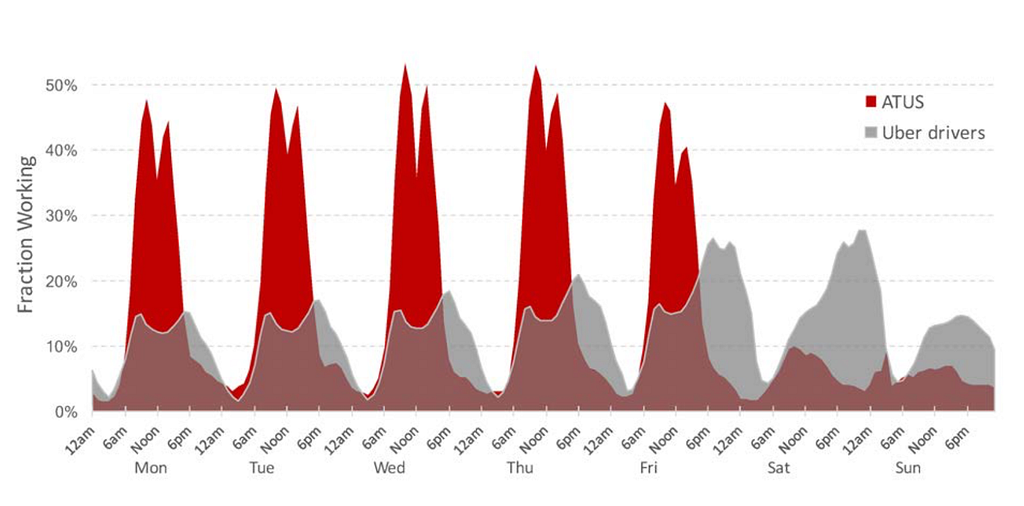
It has been widely reported that the typical Uber driver-partner does not drive conventional 9 to 5 hours, five days a week. Consider the picture below, which shows every hour of the week. In red, you can see the fraction of employed males working any particular hour according to the American Time Use Survey. In grey, you can see the driving patterns of Uber driver-partners who are active in a particular week. The fraction of Uber driver-partners driving peaks on Saturdays and evenings — the exact times when people are less likely to be working at conventional jobs.

Reservation Wage

Our paper uses the economic concept of a “reservation wage,” defined as the earnings level below which a person will not work. If a driver has a good idea of how lucrative different hours are going to be in her city — since earnings may vary by time of day — we can get a good measure of her reservation wage by looking at the pattern of hours she chooses to work. For example, if a driver tends to work in hours when she can make $20 an hour but never works in hours when she can make $15 an hour, the driver has a reservation wage between $15 and $20.

We can also look at whether drivers have different reservations wages at different times. Consider a driver who often drives during the day, but has children to care for from 3 to 5 pm, and thus, almost never drives in those hours. Even if those hours offer relatively high earnings, we estimate that the driver has an even higher reservation wage between 3 and 5 pm, but a lower reservation wage at other times during the day.

Quantifying Flexibility

Uber driver-partners can choose their hours, so they work only when the money they make from driving with Uber is larger than their reservation wages. This is not always possible in a traditional job: you are often committed to a predetermined schedule (e.g., 9 to 5 pm, Monday to Friday), and only in unusual circumstances can you miss an hour, day, or week of work because something else comes up (i.e., your reservation wage is high).

We use an econometric model to estimate reservation wages for U.S. drivers in the top 20 Uber cities between August 2015 and May 2016. We find that many Uber driver-partners do make an effort to drive more in lucrative hours. However, we also find that drivers have a lot of variation in their reservation wages over the course of the typical week. For a typical driver, there are relatively slow hours when she is still willing to work, and relatively lucrative hours when the same driver is not willing to work — indirectly revealing us to that the driver has a high reservation wage for that hour.

We calculate a measure that economists call surplus — that’s the difference between the wages the driver actually earns over a period of time and her reservation wages, the minimum it would have taken to induce the driver to work. After calculating this surplus, we then estimate how much it would change if drivers had to commit to their schedules at the start of the day or week and could not adjust, as is often the case in traditional jobs.

Key Findings

Driver Surplus

The median driver in our sample drove between 10 and 15 hours and earned about $400 per week. Of that $400, we estimate that 40%, or $160, is surplus — defined as any money earned above the absolute minimum that it would have taken to induce the driver to drive at the times she chose.

Constraints on Flexibility

We also find that this $160 surplus estimate falls dramatically (by two-thirds) if wages stay the same, but the driver is not able to adjust her schedule on an hourly basis. This is because we estimate that the typical driver has reservation wages that move around a lot — that is, there are some hours in which the driver’s outside activity is sufficiently important that she won’t drive, even if the payout is relatively high.

If drivers had to commit to pre-set schedules, we estimate they would end up driving hours they would not want to drive (earning less than the reservation wage they would require if they could choose to drive hour by hour). We also estimate that the typical driver would drive fewer hours than she drives now: she would not want to precommit to drive in an hour when her expected take-home was lower than her reservation wage for that hour.

We also examine alternative scenarios to determine what would happen if Uber were to put restrictions on driver schedules. For example, we find that most Uber driver-partners would simply not drive with Uber if they had to commit to driving full 8-hour shifts.

Summary

One of the attractions of Uber is the flexibility afforded to drivers. Our research documents an important source of value in flexible work arrangements — the ability to adapt work schedules to the demands of everyday life. Perhaps not surprisingly, this adaptability has high value to individuals who have chosen to drive and earn with the Uber platform.

The full paper, by Keith Chen (UCLA Anderson School of Management), Judy Chevalier (Yale School of Management), Peter Rossi (UCLA Anderson School of Management), and Emily Oehlsen (Uber Technologies), is available as an NBER Working Paper here

[1] For instance, in a 2014 survey drivers were asked to select major and minor reasons for partnering with Uber; combining major and minor reasons, 87 percent chose “to be my own boss and set my own schedule”, and 85 percent chose “to have more flexibility in my schedule and balance my work with my life and family” (for more details, see: Taking Another Look at the Labor Market for Uber’s Driver-Partners).


Quantifying the Value of Flexibility for Uber’s Driver-Partners was originally published in Uber Under the Hood on Medium, where people are continuing the conversation by highlighting and responding to this story.

26 Aug 03:49

Digital Economics -- by Avi Goldfarb, Catherine Tucker

Digital technology is the representation of information in bits. This technology has reduced the cost of storage, computation, and transmission of data. Research on digital economics examines whether and how digital technology changes economic activity. In this review, we emphasize the reduction in five distinct economic costs associated with digital economic activity: Search costs, replication costs, transportation costs, tracking costs, and verification costs.
23 Aug 23:54

Should Apple and Google Ban Gab?

by Alex Tabarrok

Gab is an app similar to twitter but it has a more permissive speech policy. According to company spokesman Utsav Sanduja, “Whatever is permissible under the First Amendment is what Gab allows onto its site.” Gab has attracted some users from the alt-right and seemingly for this reason Gab has been banned by both Google and Apple. I wouldn’t go so far as Aaron Renn who argues that “Google and Apple have used their duopoly status to revoke the First Amendment on mobile phones” but I do find these actions troubling.

I have no problem with Twitter or Facebook policing their sites for content they find objectionable, such as pornography or hate speech, even though these are permitted under the First Amendment. A free market in news doesn’t mean that every newspaper must cover every story. A free market in news means free entry. But free entry is exactly what is now at stake. Gab was created, in part, to combat what was seen as Facebook’s bias against conservative news and views. If Gab or services like cannot be accessed via the big platforms that is a significant barrier to entry.

When Facebook and Twitter regulate what can be said on their platforms and Google and Apple regulate who can provide a platform, we have a big problem. It’s as if the NYTimes and the Washington Post were the only major newspapers and the government regulated who could own a printing press.

In a pure libertarian world, I’d be inclined to say that Google and Apple can also police whom they allow on their platforms. But we live in a world in which Google and Apple are bound up with and in some ways beholden to the government. I worry when a lot of news travels through a handful of choke points.

I also fear that Google and Apple haven’t thought very far down the game tree. One of the arguments for leaving the meta-platforms alone is that they are facially neutral with respect to content. But if Google and Apple are explicitly exercising their power over speech on moral and political grounds then they open themselves up to regulation. If code is law then don’t be surprised when the legislators demand to write the code.

These problems are arising in many fields not just news. As Politico noted, OKCupid has banned users accused of being white supremacists and asked members to report “people involved in hate groups.” AirBnb took it even one step further and “jettisoned the accounts of users it suspected of renting rooms to attendees of the “Unite the Right” event.” So it wasn’t even white supremacists who were banned but people who rented to them. What is next? Will white supremacists be banned from lunch counters? Sure, that prospect might generate a frisson of excitement but is that the kind of society we want to live in? And are we so sure that the tables will never turn again?

Addendum: By the way, LBRY, the censorship-free “blockchain meets youtube” startup (I am an adviser), is up and running in beta. Check it out!

The post Should Apple and Google Ban Gab? appeared first on Marginal REVOLUTION.

20 Aug 05:05

The forgotten dimension of the SDG indicators – Social Capital

by Jos Verbeek

The 2030 Agenda for Sustainable Development rightfully points out that sustainability has three dimensions: economic, environmental, and social. The first two are well understood and well measured.
 
Economic sustainability has a whole strand of literature and the World Bank and IMF devote a lot of attention to debt and fiscal sustainability in their reports. Just open any Article 4 consultation or any public expenditure review and you will find some form of fiscal or debt sustainability analysis.
 
The same can be said about environmental sustainability. Since Cancun (COP16), countries prepare National Adaptation Plans, and since COP 21, they have prepared Nationally Determined Contributions (NDCs) which focus on domestic mitigation measures to address climate change. 

Yet, despite the 2030 Agenda’s inclusion of this dimension of sustainability, there is nothing, however, to measure, report, or evaluate social capital. In addition, if you evaluate the 169 SDG targets or the 230 or so indicators through which we are to monitor the SDGs, surprisingly few are focused on social sustainability.
 
Clearly social capital is an important contributor to development. In our opinion it is time to revive the measurement of social capital. Definitions vary but generally boil down to those networks of relationships among people who live and work in a particular society, who show trust in and solidarity with one another, all while enabling that society to cooperate and function effectively.

Without social cohesion, it will be difficult to attain the SDGs -- in particular the objective of leaving no one behind. Building support for financing the SDGs requires an enormous amount of solidarity within and across countries. Hence, like most concepts in development, it will be important to measure it, to understand what influences it, and then to design policies and actions that influence it.

Luckily we do not have to start from scratch. In the past, the World Bank and others have sought to measure social capital and its impact and importance for successful development. It is time to revive those efforts and invest in measuring social capital. We should learn from the past, start modestly and build on efforts that are ongoing instead of trying to build a Ferrari as was done in the early 2000.

The most recent attempt to measuring Social Capital within the UN SDGs Partnerships is the World Social Capital Monitor (see table 1), that allows stakeholders to score eight characteristics of social capital. The template allows this to be done online or on any mobile device, in 37 languages and in 141 countries. We invite you to participate and it takes only a few minutes. The more people who participate, the more relevant its outcomes.

The survey already shows some surprising results: the willingness to co-finance public goods in countries such as Afghanistan, Bangladesh, and Cambodia (see table 2) is basically at the same level as in many industrialized countries. Meanwhile, hospitality and friendliness -- core assets to achieving peace and reconciliation -- reach a top level in regions of conflict such as in Afghanistan, Palestine, and Pakistan.


The full inclusion of these social capital measurements is necessary to meet the standards set in the 2030 Agenda. It is also a critical step toward helping countries reach their goals to end extreme poverty, fight hunger, promote health and employment, and meet all the ambitious objectives embedded in the Sustainable Development Goals.
 
Alexander Dill is founder and CEO of Basel Institute of Commons and Economics.
 
Jos Verbeek is manager and Special Representative to the WTO and UN in Geneva.


12 Aug 07:26

Tough Broads | Elaine Showalter | TLS | 8th August 2017

Discussion of Tough Enough, by Deborah Nelson of the University of Chicago, about the ideas and attitudes of six modern intellectuals: Simone Weil, Hannah Arendt, Mary McCarthy, Susan Sontag, Diane Arbus and Joan Didion. “Nelson originally titled her book Tough Broads … Their tone of unemotional clarity on the most traumatic events made them respected and feared; but crossing the line between detachment and heartlessness made them seem out of step with their times”