Shared posts

07 Jul 15:24

Indiana Just Started Installing Drop Boxes for Parents to Leave Their Babies In

image baby adoption Indiana Just Started Installing Drop Boxes for Parents to Leave Their Babies In

For the first time ever in Indiana, you can return your new baby to the proper authorities like a video rental (remember those?). America has "safe haven" laws which makes it legal for people to surrender unwanted children, as long as the baby is unharmed and given to the proper authorities or a hospital. 

These climate controlled boxes are meant to allow people to drop off their kid anonymously, knowing that it will be taken care of by emergency services who will arrive within minutes of an automatic alarm. 


It's a controversial issue, with some people questioning how safe it would be to leave a baby in a drop box for several minutes alone. Other people are just glad that babies who might otherwise have been left where they wouldn't get help will be able to have a safe spot to wait for a pickup by a medical professional. 

Submitted by: (via wncn)

Tagged: baby , adoption , image
26 May 20:09

A new wave of interrogation

by vaughanbell
Codsmack

This is really interesting. I find it odd that nobody has noticed how modern interrogation techniques are also modern interview techniques. I'd have thought this would have been brought up in the 80s or earlier.

Wired has an excellent article that tracks the development of police interrogation techniques from the dark days of physical violence, to the largely hand-me-down techniques depicted in classic cop shows, to a new era of interrogation developed and researched in secret.

It’s probably one of the best pieces you’ll read on interrogation psychology for, well, a very long time, because they don’t come around very often. This one is brilliantly written.

One key part tracks the influence of still-secret interrogation techniques from the US Government’s High-Value Detainee Interrogation Group or HIG as they have filtered through from the ‘war on terror’ to civilian law enforcement.

In 2010, to make good on a campaign promise that he would end the use of torture in US terror investigations, President Obama announced the formation of the High-Value Detainee Interrogation Group, a joint effort of the FBI, the CIA, and the Pentagon. In place of the waterboarding and coercion that took place at facilities like Abu Ghraib during the Bush years, the HIG was created to conduct noncoercive interrogations. Much of that work is top secret. HIG-trained interrogators, for instance, are said to have questioned would-be Times Square bomber Faisal Shahzad and convicted Boston Marathon bomber Dzhokhar Tsarnaev. The public knows nothing about how those interrogations, or the dozen or so others the HIG is said to have conducted, unfolded. Even the specific training methods the HIG employs—and that it has introduced to investigators in the Air Force, Navy, and elsewhere—have never been divulged.

At the same time, however, the HIG has become one of the most powerful funders of public research on interrogations in America.

A fascinating and compelling read.

 
Linked to Wired article on the new wave of interrogation.


26 May 19:55

Reconstructing through altered states

by vaughanbell

Yesterday, I had the pleasure of doing a post-screening Q&A with the film-makers of an amazing documentary called My Beautiful Broken Brain.

One of the many remarkable things about the documentary is that one of the film-makers is also the subject, as she began making the film a few days after her life-threatening brain injury.

The documentary follows Lotje Sodderland who experienced a major brain haemorrhage at the age of 34.

She started filming herself a few days afterwards on her iPhone, initially to make sense of her suddenly fragmented life, but soon contacted film-maker Sophie Robinson to get an external perspective.

It’s interesting both as a record of an emotional journey through recovery, but also because Lotje spent a lot of time working with a special effects designer to capture her altered experience of the world and make it available to the audience.

I also really recommend a long-form article Lotje wrote about her experience of brain injury for The Guardian.

It’s notable because it’s written so beautifully. But Lotje told me she while she had regained the ability to write and type after her injury, she has been left unable to read. So the whole article was written through a process of typing text and getting Siri on her iPhone to read it back to her.

The documentary is available on Netflix.
 

Link to My Beautiful Broken Brain on Wikipedia.
Link to full documentary on Netflix.
Link to long-form article in The Guardian.


26 May 19:55

Good tests make children fail – here’s why

by tomstafford
Codsmack

The concept of an adaptive test - one where the questions asked changed based on previous questions - as a SAT or graduation ranking test or some such - appeals greatly to me. Though, I doubt it'd fly in society.

Many parents and teachers are critical of the Standardised Assessment Tests (SATs) that have recently been taken by primary school children. One common complaint is that they are too hard. Teachers at my son’s school sent children home with example questions to quiz their parents on, hoping to show that getting full marks is next to impossible.

Invariably, when parents try out these tests, they focus on the most difficult or confusing items. Some parents and teachers can be heard complaining on social media that if they get questions wrong, surely the tests are too hard for ten-year-olds.

But how hard should tests for children be?

As a psychologist, I know we have some well-developed principles that can help us address the question. If we look at the SATs as measures of some kind of underlying ability, then we can turn to one of the oldest branches of psychology – “psychometrics” – for some guidance.

Getting it just right

A good test shouldn’t be too hard. If most people get most questions wrong, then you have what is called a “floor effect”. The result is that you can’t tell any difference in ability between the people taking the test.

If we started the school sports day high jump with the bar at two metres high (close to the world record), then we’d finish sports day with everybody getting the same – zero successful jumps – and no information about how good anyone is at the high jump.

But at the same time, a good test shouldn’t be too easy. If most people get everything right, then the effect is, as you might expected, called a “ceiling effect”. If everybody gets everything right then again we don’t get any information from the test.

The key idea is that tests must discriminate. In psychometric terms, the value of a test is about the match between the thing it is supposed to measure and the difficulty of the items on the test. If I wanted to gauge maths ability in six-year-olds and I gave them all an A-Level paper, we can presume that nearly everyone would score zero. Although the A-Level paper might be a good test, it is completely uninformative if it is badly matched to the ability of the people taking the test.

Here’s the rub: for a test to be sensitive to differences in ability, it must contain items which people get wrong. Actually, there’s a precise answer to the proportion that you should get wrong – in the most sensitive test it should be half of the items. Questions which you are 50% likely to get right are the ones which are most informative.

How we feel about measuring and labelling children according to their skill at taking these tests is a big issue, but it is important that we recognise that this is what tests do. A well designed test will make all children get some items wrong – it is inherent in their design. It is up to us how we conceptualise that: whether tests are an unnecessary distraction from true education, or a necessary challenge we all need to be exposed to.

Better tests?

If you adopt this psychometric perspective, it becomes clear that the tests we use are an inefficient way of measuring any individual child’s particular ability to do the test. Most children will be asked a bunch of questions which are too easy for them, before they get to the informative ones which are at the edge of their ability. Then they will go on to attempt a bunch of questions which are far too hard. And pity the people for who the test is poorly matched to their ability and consists mostly of questions they’ll get wrong – which is both uninformative in psychometric terms, and dispiriting emotionally.

A hundred years ago, when we began our modern fixation with testing and measuring, it was hard to avoid the waste where many uninformative and potentially depressing questions were asked. This was simply because all children had to take the same exam paper.

Nowadays, however, examiners can administer tests via computer, and algorithmically identify the most informative questions for each child’s ability – making the tests shorter, more accurate, and less focused on the experience of failure. You could throw in enough easy questions that no child would ever have the experience of getting most of the questions wrong. But still there’s no getting around the fact that an informative test has to contain questions most people sitting it will get wrong.

Even a good test can measure an educationally irrelevant ability (such as merely the ability to do the test, or memorise abstract grammar rules), or be used in ways that harm children. But having difficult items isn’t a problem with the SATs, it’s a problem with all tests.

The Conversation

This article was originally published on The Conversation. Read the original article.


17 May 20:11

S&P500 Cycle Trend, 1997-2016

by Barry Ritholtz

One of my favorite quarterly chart books, updated for Q2, from JPM:


S&P500 Cycle Trend, 1997-2016
spx long
Source: JPM


Go enjoy all 71 pages of wonky fun!


The post S&P500 Cycle Trend, 1997-2016 appeared first on The Big Picture.

17 May 19:51

Charting the Automation Potential of U.S. Jobs

by Barry Ritholtz

Click for the interactive graphic.

Source: Visual Capitalist

The post Charting the Automation Potential of U.S. Jobs appeared first on The Big Picture.

17 May 19:22

Amazing Dad Builds Robotic Pancreas for His Son

by John Farrier
Codsmack

SCIENCE!!

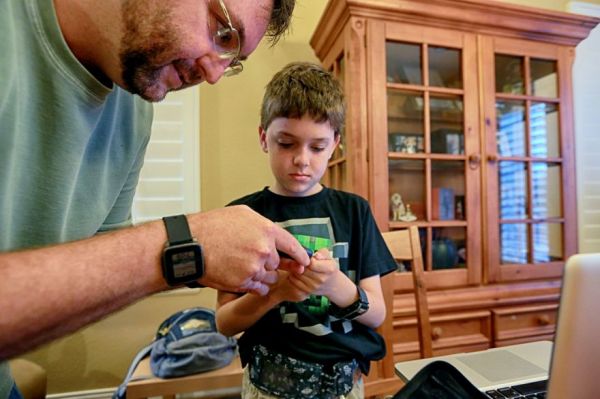
(Photo: Sandy Huffaker/Wall Street Journal)

Third-grader Andrew Calabrese of San Diego, California has Type 1 diabetes. Everywhere he goes, he carries with him a robotic pancreas to regulate his blood sugar.

Designs for these machines exist, but the Food and Drug Administraton won't approve them for manufacture. So Andrew's father, Jason Calabrese, built it himself. The Wall Street Journal reports:

Jason Calabrese, a software engineer, followed instructions that had been shared online to hack an old insulin pump so it could automatically dose the hormone in response to his son’s blood-sugar levels. Mr. Calabrese got the approval of Andrew’s doctor for his son to take the home-built device to school. […]

Initially, Mr. Calabrese worried about the safety of the do-it-yourself project. He built it over two months, and spent weeks testing. At first, he only tried it out on his son on weekends and at night. Once it performed well enough, he said it felt irresponsible not to use it on his 9-year-old son.

“Diabetes is dangerous anyway. Insulin is dangerous. I think what we are doing is actually improving that and lowering the risk,” Mr. Calabrese, 41, said.

Andrew's artificial pancreas is one of about 50 in the United States that individuals have built themselves.

-via Marginal Revolution

13 May 13:31

Footage of security lines snaking out the airport

by Rob Beschizza
Codsmack

I wonder when the line will be bombed.

tsa line

https://www.youtube.com/watch?v=byUVR04CMBU&feature=youtu.be

Incredible footage of the TSA line at Chicago Midway airport yesterday, which snakes out the airport atrium and into the surrounding transit hallways -- it's hundreds of yards long.

It follows news of massive layoffs at the TSA, though apparently most of the planned firings haven't happened yet, so it's only going to get worse.

The only bright spot is that the airlines themselves appear to be at the end of their tether: the lines are depriving them of passengers who must be rebooked. And, thanks to the Brussels attacks, everyone knows that the compressed packs of humans created by airport security theater are a prime target in their own right.

Good to know no dangerous breast milk got on those half-empty flights, though.

12 May 21:15

Little Owl Uses Mushroom as Umbrella

by John Farrier

This is Poldi, a pet owl. He's just one and a half years old.

Poldi lives with Tanya Brandt, a photographer. Recently, when Poldi and Brandt went out together, it started to train. Poldi sought shelter under a mushroom. The resulting photo is like something out of a fantasy movie!

You can see more photos of Poldi at play at Bored Panda.

-via My Modern Met

12 May 21:15

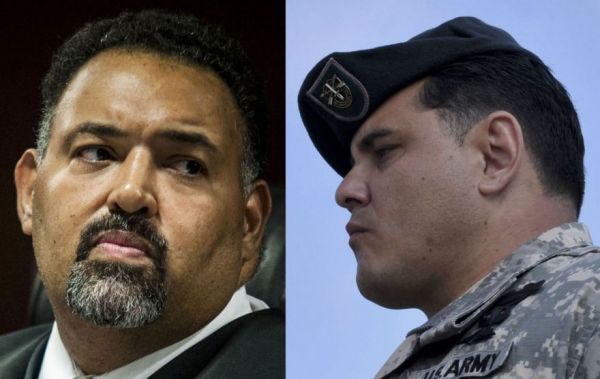
Compassionate Judge Sentences Veteran to 24 Hours in Jail, Then Joins Him behind Bars

by John Farrier


(Photos: Fayetteville Observer)

Sgt. Joseph Serna of the US Army Special Forces served 3 combat tours in Afghanistan. He had a very rough time there, experiencing the full horrors of war.

When Serna got out of the Army, he took those horrors with him.

Serna was arrested and charged with driving under the influence in Fayetteville, North Carolina. He got probation and entered a treatment program. He had to regularly report to the court on his treatment. During one of those court appearances, he confessed to Judge Lou Olivera that he had lied about a recent urine test.

Judge Olivera was himself a veteran, having served during the Gulf War. He understood that though Serna had broken the law, he was not a criminal by nature.

But he had to do his duty, so Judge Olivera sentenced Serna to spent 24 hours in jail. Then he took off his robe and joined Serna in his cell for the full 24 hours. The Fayetteville Observer reports:

"Where are we going, judge?" Serna asked.

"We're going to turn ourselves in," Olivera said.

"He said he was going to stay with me," Serna said. "I couldn't process a judge being my cellmate.

"They take me to the cell, and I'm sitting on my bunk. And, then, in walks the judge.

And then the two veterans talked:

Mostly, from five in the afternoon on April 13 until 6:30 a.m. the next day, the judge and the veteran talked about their respective military service, Serna's post-traumatic stress disorder from three tours of duty in Afghanistan and how the inmate could turn around his downward spiral that had resulted in a driving-while-impaired charge and other serious traffic offenses. […]

"We talked for hours about our families and our military service," Olivera says. "Our dreams for us and our families, and the road to take us there."

The judge wanted to help Serna climb out of the hole:

"I thought about a story that I once read," Olivera says. "It talked about a soldier with PTSD in a hole," he says. "A family member, a therapist and a friend all throw down a rope to help the veteran suffering. Finally, a fellow veteran climbs into the hole with him.

"The soldier suffering with PTSD asks, 'Why are you down here?' The fellow veteran replied, 'I am here to climb out with you.'

-via Glenn Reynolds

25 Apr 19:53

cannabis in ancient africa -- 4/20/16

Today's selection -- from Smoke Signals by Martin A. Lee. Historically, marijuana was used in Africa for medicinal and ritualistic purposes:

"Pollen samples indicate the presence of cannabis in sub-Saharan Africa for at least two millennia. Introduced by overland traders from the Arab Middle East and later by Portuguese seamen traveling from India, the herb quickly spread throughout the continent. Black Africans employed a variety of devices -- clay pipes, gourds, bamboo stalks, coconut bowls -- for inhaling 'dagga' as marijuana was called by several tribes, who regarded it as a 'plant of insight.' According to the Tsongas of southern Africa, 'Dagga deepens and makes men wiser.'

"Earth-smoking, which entailed sucking cannabis fumes directly through a hole in a dirt mound, was an ancient tradition among Pygmies in the equato­rial forest. The Zulus ingested psychoactive hemp via steam baths and enemas in addition to smoking it for pleasure; they also smoked it to boost their cour­age before going into battle. A Bantu tribe in the Congo dispensed cannabis as a means of punishment -- miscreants were compelled to smoke a large quantity of marijuana until they either confessed to a crime or keeled over.

"Cannabis had a medicinal reputation in Africa that varied from region to region. Cultivated as a source of fiber as well as for its remarkable resin, the versatile herb served as a remedy for a wide range of ailments, including dysentery, malaria, diarrhea, typhus, and rheumatism. The Hottentots, who applied it as a salve for snakebites, deemed dagga more valuable than gold. Sotho women used marijuana to facilitate childbirth, and Sotho children were fed ground-up hempseed paste while weaning. In West Africa, from whence Armstrong's ancestors hailed, cannabis was utilized as a treatment for asthma."

12 Apr 12:38

The sound financial advice hidden in plain sight in an “Onion” article

by Joey deVilla

onion billionaire

The Onion may have been playing it up for laughs when they wrote the article titled Billionaire Reading Name In Panama Papers Totally Forgot He Even Had Funds In Seychelles, but like some of their best articles, there’s a surprisingly big nugget of truth in it.

fidelity

Fidelity Investments did a study of their customers’ investment accounts that performed the best, and one key factor they had in common was that their owners had forgotten about them. Or at the very least, the customers acted as if they’d forgotten about them and simply left them alone.

A lot of this stems from the fact that by and large, we’re terrible at investing. The chart below shows the performance of the “average investor” was below most markets. Even cash — in the form of 3-month T-bills) did better:

average investor

It may seem weird to get real-world-applicable truth from a comedy site, but remember that these days…

truth politicans comedians

08 Apr 16:55

Sports journalist has awesome t-shirt

by Jason Weisberger

rzzkftng6umlgijrbkgc-2

Clearly ESPN's Bomani Jones has great taste in t-shirts. I'm a little surprised the network had him cover the shirt, it is awesome.

The hypocrisy the shirt points out, is not awesome.

Via Deadspin:

After saying that he chose to wear the shirt because “it was clean,” Jones discussed the idea behind it: It would be weird to have the Caucasians as a sports mascot, so why is a baseball team still called the Indians?

A partial transcript:

Jones: The reason they won’t get rid of Chief Wahoo, which is completely indefensible, is they could still sell stuff with it. They can say they’re gonna de-emphasize it, but they’re not just gonna set money on fire. I thought [the shirt] was the exact same thing, and I could see the value in the design, so I was like, hey, we might as well give this a run.

Qerim: I think more thought went into it. I think you were trying to make some kind of statement.

Jones: The statement is obvious. This [shirt] is the same thing. What we have here, this is the same thing that goes on with the logo for the Cleveland Indians, right? So, to have a problem with the logo of this, would be to have a problem with the Indians, but if you’re quiet about the Indians, and you got something to say about my shirt, I think it’s time for introspection. I think that’s a fair thing to ask.

08 Apr 16:54

Awesome Animation Imagines the Nightmare That's Happening Around You When You Sleep

by Casey Chan on Sploid, shared by Cheryl Eddy to io9
Awesome Animation Imagines the Nightmare That's Happening Around You When You Sleep

The scariest place to be when you’re a kid? Alone, at night, in your bed, right before you sleep. You just know right when you close your eyes, all the stuff of nightmares is going to come alive and scare any chance of sleep out of you. And it’s probably all true! Who knows what’s going on around you when you sleep. Andy Kennedy played on that fear by showing sleep disturbances from outside and within in his animated short Slow Wave.

Read more...


06 Apr 21:49

the rise of the taliban -- 4/06/16

Today's selection -- from Fields of Blood by Karen Armstrong. The roots of the Taliban are in the Soviet invasion of Afghanistan and the aftermath:

"After the Soviet withdrawal [from Afghanistan], the West lost interest in the region, but both Afghanistan and Pakistan had been gravely derailed by the long con­flict. A flood of money and weapons had flowed into Pakistan from the United States as well as from the Persian Gulf, giving extremist groups access to advanced armaments, which were simply stolen as they were being unloaded. These heavily armed extremists had therefore broken the state's monopoly on violence and henceforth could operate outside the law. To defend themselves, nearly all groups in the country, religious and secular, developed paramilitary wings. Moreover, after the Iranian Revolution, Saudi Arabia, aware of the significant Shii community in Pakistan, had stepped up its funding of Deobandi [Sunni fundamentalist] madrassas to counter Shii influence. This enabled the Deobandis to educate even more students from poorer backgrounds, and they sheltered the children of impover­ished peasants, who were tenants of Shii landlords. These entered the madrassas, therefore, with an anti-Shii bias that was greatly enhanced by their education there.


Soviet withdrawal from Afghanistan

"Isolated from the rest of Pakistani society, these 'students' (taliban) bonded tightly with the three million Afghan children who had been orphaned during the war and were brought to Pakistan as refugees. They had all arrived traumatized by war and poverty and were introduced to a rule-bound, restricted, and highly intolerant form of Islam. They had no training in critical thought, were shielded from outside influence, and became rabidly anti-Shii. In 1985 the Deobandis founded the Soldiers of the Companions of the Prophet in Pakistan (SCPP) specifically to harass the Shii, and in the mid-1990s two even more violent Deobandi move­ments emerged: the Army of Jhangvi, which specialized in assassinat­ing Shiis, and the Partisan Movement, which fought for the liberation of Kashmir. As a result of this onslaught, the Shii formed the Soldiers of the Prophet in Pakistan (SPP), which killed a number of Sunnis. For centuries the Shiis and Sunnis had coexisted amicably in the region. Thanks to the United States' Cold War struggle in Afghanistan and to Saudi-Iranian rivalry, they were now tearing the country apart in what amounted to a civil war.

The Afghan Taliban combined their Pashtun tribal chauvinism with Deobandi rigorism, an unholy hybrid and maverick form of Islam that expressed itself in violent opposition to any rival ideology. After the Soviet withdrawal, Afghanistan had descended into chaos, and when the Taliban managed to take control, they seemed to both the Pakistanis and the Americans to be an acceptable alternative to anarchy. Their leader, Mullah Omar, believed that human beings were naturally virtu­ous and, if placed on the right path, needed no government coercion, social services, or public health care. There was therefore no centralized government, and the population was ruled by local Taliban komitehs, whose punishments for the smallest infringement of Islamic law were so draconian that a degree of order was indeed restored. Fiercely opposed to modernity, which had, after all, come to them in the form of Soviet guns and air strikes, the Taliban ruled by their traditional tribal norms, which they identified with the rule of God. Their focus was purely local, and they had no sympathy with Bin Laden's global vision. But Mullah Omar was grateful to the Arab-Afghans for their support during the war, and when Bin Laden was expelled from Sudan, he admitted him to Afghanistan, in return for which Bin Laden improved the country's infrastructure."

06 Apr 21:45

These "Adorable" Easter Bunnies Will Haunt Your Dreams

Codsmack

when did Kaz get easter critters that weren't peeps?

easter,scary,FAIL,list,bunny

Sometimes kids are afraid of the Easter bunny but eventually we all grow out of that. Lots of people have pictures of their smaller selves crying on the lap of an adorable, smiling bunny. Unfortunately, some of us were right to be afraid as a child. These bunnies with make you have Easter nightmares all over again.

Submitted by:

Tagged: easter , scary , FAIL , list , bunny
06 Apr 21:42

That Moment You Check Social Media and Realize How Much Stupid is There

funny fail tweets Winslow's seen enough meme

Winslow's seen enough on Twitter

Submitted by: (via indirectMW)

04 Apr 21:12

ESPN's attempt to shame Cuba for its slums backfires

by Mark Frauenfelder

yheprayvwzlmjpzgzntd-1

ESPN SportsCenter tweeted this photo of a poor urban area next to the Havana stadium where Obama attended a baseball game. The photo was accompanied by the caption, “Meanwhile, next to the stadium in Havana...”

People responded by sending a barrage of photos of areas next to stadiums in US cities:

[via]

24 Mar 18:27

Moving GIF Cube Illusion

by CJ Edwards

I was just thinking yesterday that we haven’t had any good moving GIF illusions lately. Lo and behold, when I checked the Mighty Optical Illusion Facebook messages this morning (yes, I’m behind) guess what I found? A follower sent us a link to a pretty awesome moving GIF cube illusion!

You have to see this one to believe it…

moving gif cube illusion

Pretty cool, right? At first, it looks like the 3D checkered cube is just hovering in mid air, which is pretty amazing in and of itself. When we reach the end of the moving GIF, though, we can see that it wasn’t an actual cube at all. It was sort of 3D, but the sides and corner of the cube are actually sunk in instead of sticking out. If that makes sense; my mind isn’t working well this morning, but I’m sure you know what I mean.

Please don’t forget to rate this awesome moving GIF cube illusion with the stars below! It only takes a second…

After you’re done being dazzled by this moving GIF cube illusion, head over and check out the making of a hole illusion!

The post Moving GIF Cube Illusion appeared first on Mighty Optical Illusions.

24 Mar 18:07

steve martin tries to write -- 3/17/16

Today's encore selection - from Born Standing Up by Steve Martin. A young Steve Martin, still struggling for even modest success and confronted by the striking originality of contemporary comedians Mike Nichols and Elaine May, Lenny Bruce and Tom Lehrer realizes that he will have to try to write original material to succeed:

"In logic class, I opened my textbook -- the last place I was expecting to find comic inspiration -- and was startled to find that Lewis Carroll, the supremely witty author of Alice's Adventures in Wonderland, was also a logician. He wrote logic textbooks and included argument forms based on the syllogism, normally presented in logic books this way:

All men are mortal. Socrates is a man. Therefore, Socrates is mortal.

"But Carroll's were more convoluted and they struck me as funny in a new way:

1) Babies are illogical.
2) Nobody is despised who can manage a crocodile.
3) Illogical persons are despised.

Therefore, babies cannot manage crocodiles.

"And:

1) No interesting poems are unpopular among people of real taste.
2) No modern poetry is free from affectation.
3) All your poems are on the subject of soap bubbles.
4) No affected poetry is popular among people of taste.
5) Only a modern poem would be on the subject of soap bubbles.

Therefore, all your poems are uninteresting.

"These word games bothered and intrigued me. Appearing to be silly nonsense, on examination they were absolutely logical -- yet they were still funny. The comedy doors opened wide, and Lewis Carroll's clever fancies from the nineteenth century expanded my notion of what comedy could be. I began closing my show by announcing, 'I'm not going home tonight; I'm going to Bananaland, a place where only two things are true, only two things: One, all chairs are green; and two, no chairs are green.' Not at Lewis Carroll's level, but the line worked for my contemporaries and I loved implying that the one thing I believed in was contradiction."

24 Mar 18:03

Curved lines, Dani Olivier


Curved lines, Dani Olivier

24 Mar 17:56

An open letter to Sec. Ashton Carter

by noreply@blogger.com (Robert Graham)
Hi.

For security research, I regularly "mass scan" the entire Internet. For example, my latest scan shows between 250,000 and 300,000 devices still vulnerable to Heartbleed. This is legal. This is necessary security research. Yet, I still happily remove those who complain and want me to stop scanning them.

The Department of Defense didn't merely complain, but made threats, forcing me to stop scanning them. You guys were quite nasty about it, forcing me to figure out for myself which address ranges belong to the DoD.

These threats are likely standard procedure at the DoD, investigating every major source of scans and shutting down those you might have power over. But the effect of this is typical government corruption, preventing me from reporting the embarrassing detail of how many DoD systems are still vulnerable to Heartbleed (but without stopping the Chinese or Russians from knowing this detail).

Please remove your threats, so that I can scan the DoD in the same way I scan the rest of the Internet. This weekend I'll be scanning the Internet for system susceptible to the DROWN attack. I would like to include DoD in those scans.

I write to you now because you are making overtures to Silicon Valley, and offering bug bounties. Fixing this problem would help in this process.

Regards,
Robert Graham


24 Mar 15:14

Companies Handing Source Code Over to Governments

by schneier

ZDNet has an article on US government pressure on software companies to hand over copies of their source code. There's no details because no one is talking on the record, but I also believe that this is happening.

When asked, a spokesperson for the Justice Dept. acknowledged that the department has demanded source code and private encryption keys before.

These orders would probably come from the FISA Court:

These orders are so highly classified that simply acknowledging an order's existence is illegal, even a company's chief executive or members of the board may not be told. Only those who are necessary to execute the order would know, and would be subject to the same secrecy provisions.

Given that Federighi heads the division, it would be almost impossible to keep from him the existence of a FISA order demanding the company's source code.

It would not be the first time that the US government has reportedly used proprietary code and technology from American companies to further its surveillance efforts.

Top secret NSA documents leaked by whistleblower Edward Snowden, reported in German magazine Der Spiegel in late-2013, have suggested some hardware and software makers were compelled to hand over source code to assist in government surveillance.

The NSA's catalog of implants and software backdoors suggest that some companies, including Dell, Huawei, and Juniper -- which was publicly linked to an "unauthorized" backdoor -- had their servers and firewall products targeted and attacked through various exploits. Other exploits were able to infiltrate firmware of hard drives manufactured by Western Digital, Seagate, Maxtor, and Samsung.

Last year, antivirus maker and security firm Kaspersky later found evidence that the NSA had obtained source code from a number of prominent hard drive makers -- a claim the NSA denied -- to quietly install software used to eavesdrop on the majority of the world's computers.

"There is zero chance that someone could rewrite the [hard drive] operating system using public information," said one of the researchers.

The problem is, of course, is that any company forced by the US to hand over their source code would also be forbidden from talking about it.

It's the sort of thing China does:

For most computing and networking equipment, the chart says, source code must be turned over to Chinese officials. But many foreign companies would be unwilling to disclose code because of concerns about intellectual property, security and, in some cases, United States export law.

The chart also calls for companies that want to sell to banks to set up research and development centers in China, obtain permits for workers servicing technology equipment and build "ports" to allow Chinese officials to manage and monitor data processed by their hardware.

The draft antiterrorism law pushes even further, calling for companies to store all data related to Chinese users on servers in China, create methods for monitoring content for terror threats and provide keys to encryption to public security authorities.

Slashdot thread.

24 Mar 15:12

Research on Balancing Privacy with Surveillance

by schneier

Interesting research: Michael Kearns, Aaron Roth, Zhiewi Steven Wu, and Grigory Yaroslavtsev, "Private algorithms for the protected in social network search," PNAS, Jan 2016:

Abstract: Motivated by tensions between data privacy for individual citizens and societal priorities such as counterterrorism and the containment of infectious disease, we introduce a computational model that distinguishes between parties for whom privacy is explicitly protected, and those for whom it is not (the targeted subpopulation). The goal is the development of algorithms that can effectively identify and take action upon members of the targeted subpopulation in a way that minimally compromises the privacy of the protected, while simultaneously limiting the expense of distinguishing members of the two groups via costly mechanisms such as surveillance, background checks, or medical testing. Within this framework, we provide provably privacy-preserving algorithms for targeted search in social networks. These algorithms are natural variants of common graph search methods, and ensure privacy for the protected by the careful injection of noise in the prioritization of potential targets. We validate the utility of our algorithms with extensive computational experiments on two large-scale social network datasets.
24 Mar 15:11

Practical TEMPEST Attack

by schneier

Four researchers have demonstrated a TEMPEST attack against a laptop, recovering its keys by listening to its electrical emanations. The cost for the attack hardware was about $3,000.

News article:

To test the hack, the researchers first sent the target a specific ciphertext -- ­in other words, an encrypted message.

"During the decryption of the chosen ciphertext, we measure the EM leakage of the target laptop, focusing on a narrow frequency band," the paper reads. The signal is then processed, and "a clean trace is produced which reveals information about the operands used in the elliptic curve cryptography," it continues, which in turn "is used in order to reveal the secret key."

The equipment used included an antenna, amplifiers, a software-defined radio, and a laptop. This process was being carried out through a 15cm thick wall, reinforced with metal studs, according to the paper.

The researchers obtained the secret key after observing 66 decryption processes, each lasting around 0.05 seconds. "This yields a total measurement time of about 3.3 sec," the paper reads. It's important to note that when the researchers say that the secret key was obtained in "seconds," that's the total measurement time, and not necessarily how long it would take for the attack to actually be carried out. A real world attacker would still need to factor in other things, such as the target reliably decrypting the sent ciphertext, because observing that process is naturally required for the attack to be successful.

For half a century this has been a nation-state-level espionage technique. The cost is continually falling.

03 Mar 03:45

Absolutely Amazing 3 Art!

by CJ Edwards

3d artToday’s 3D art illusion is just absolutely amazing! No words are really even necessary to introduce this video, since it pretty much speaks for itself. Check out the video below and prepare to be amazed…


Looking at this 3D art from the sides, it looks like a few 3D pyramids sticking out of the picture frame. Start walking around the piece, though, and it transforms into what looks like hallways filled with art when you look at it straight on.

I would love to see this 3D artwork
in person, so if anyone’s headed to the Birmingham Art Gallery, pick me up on the way. I’ll pay at the pump.

If you loved this art illusion as much as I did, be sure to give it 5 big fat stars below!

Love this 3D art? You won’t want to miss this square to circle piece of art then!

The post Absolutely Amazing 3 Art! appeared first on Mighty Optical Illusions.

23 Feb 14:13

the mucking fuppets -- 2/22/16

Today's selection -- from Jim Henson: The Biography by Brian Jay Jones. Flush with the success of Sesame Street, but before the launch of the Muppet Show, Jim Henson and his Muppets were invited to be a regular part of a bold new comedy program called Saturday Night Live. The result was far less than successful:

"At the same time [Hollywood super agent Bernie] Brillstein was circulating the Muppet Show pitch reel, he was also lining up an opportunity for Jim and the Muppets to become a regular part of a new late night sketch comedy series being developed by another of Brillstein's clients, a thirty-year-old producer and former Laugh-In writer named Lorne Michaels. 'He described the show, and I really loved it,' said Jim. In August, then, Jim began meeting regularly with Michaels's writers in preparation for the weekly late night series Jim referred to on his desk calendar only as the 'NBC Show,' but which Michaels was calling Saturday Night -- and then, eventually, Saturday Night Live.

"Saturday Night Live was a comedy variety show, but, as envi­sioned by Michaels and his scrappy team of writers, one unlike any variety show that had ever been seen before. 'We wanted to redefine comedy the way the Beatles redefined what being a pop star was,' Michaels said later. The very idea of it -- an unpredictable live show unafraid of taking on politicians, presidents, or pop culture -- ­terrified the network even months before it ever went before the cam­eras. 'NBC was so scared of what Lorne ... was doing that they insisted on Jim Henson and the Muppets [to] soften it,' said Brillstein. Jim's inclusion, in fact, had been one of the network's non-­negotiables. 'In the first contract for SNL, there were three essential factors,' said Brillstein, who had brokered the deal with NBC: 'Lorne Michaels, Jim Henson and the Muppets, and Albert Brooks's [short] films.'

"For his part, Michaels was delighted to have Jim's involvement. 'I'd always liked and been a fan of [the Muppets] and Jim's work,' Michaels said. 'When we were starting Saturday Night, I knew that I wanted as many different styles of comedy as I could possibly have, and I knew some of what the ingredients would be .... I just assumed that the Muppets under Jim would be able to do one segment a week.'

"Nestled safely in the deep end of late night television, Jim wanted to do something dramatically different with his segments, as far re­moved from the look and feel of Sesame Street -- which, he knew, was still what audiences thought of when they heard the word Muppets -- as he could possibly get. For Jim, the characters them­selves were always the easy part: he knew he wanted monsters of some sort, scrawling out rough descriptions of five characters for a segment he was initially thinking of calling 'Muppet Night Crea­tures.'

"At noon on Wednesday, October 8, Jim and his team entered the soaring building at 30 Rockefeller Plaza and headed for Studio 8H, where they would participate in the read-through for the first show with the entire SNL cast, an immensely talented -- and largely unknown -- set of young performers skilled in improv and hungry for success. On Friday night, the Muppet team attended a party thrown by cast member John Belushi, mingling casually with the show's eclectic crew of writers and performers and sizing each other up. After three days of rehearsal, one thing was clear: 'They had their style, we had ours,' said Oz -- a distinction that would only become more and more obvious in the coming weeks. ...

"Under Writers Guild rules, only writers hired for SNL could write SNL sketches -- and it was quickly apparent that the Muppets and SNL's writers weren't a good fit. ... No one wanted to write for the Muppets. 'Whoever drew the short straw that week had to write the Muppet sketch,' said writer Alan Zweibel. The frustration of the SNL writers was often palpable; during one meeting in Michaels's office, volatile head writer Michael O'Donoghue angrily wrapped the cords of the venetian blinds around the neck of a Big Bird doll and stalked out of the room. 'I won't write for felt,' he declared blackly.

"Compounding the problem was that many of SNL's writers were also performers on the show -- and every minute of airtime devoted to the Muppets meant one less minute that could be spent on cast members, who were rapidly developing their own personalities and break-out characters. 'They weren't interested in the Muppets be­cause it kept them off the air,' Juhl said plainly. 'The Muppets were known, but they weren't,' agreed Oz. 'So they wanted every mo­ment they could get.' Even John Belushi, who was otherwise friendly with the Muppet performers, would sneer derisively about giving up his airtime to the 'mucking Fuppets.' "

22 Feb 23:12

[Orin Kerr] Preliminary thoughts on the Apple iPhone order in the San Bernardino case: Part 2, the All Writs Act

by Orin Kerr

Yesterday, I posted my first set of thoughts on the pending Apple challenge to the iPhone assistance order in the San Bernardino case. This is the second post in the series. It focuses on the existing law on whether a court has the power under All Writs Act to order Apple’s assistance. I had hoped also to address the policy questions raised by the case, but this post turned out to be long enough. I’ll save the really interesting policy questions for a future post and focus here only on the issue of existing law.

Apple’s challenge will likely focus on the scope of a judge’s power under a federal law called the All Writs Act (AWA). This post explores what we know and don’t know about whether the AWA authorizes the Apple order. Because this post is long, I’ll repeat now what I say in the conclusion: The scope of authority under the AWA is just very unclear as applied to the Apple case. This case is like a crazy-hard law school exam hypothetical in which a professor gives students an unanswerable problem just to see how they do.

I. Introduction to the AWA

The AWA has been around for a long time. It was passed as part of the Judiciary Act of 1789. Here’s what it says:

[A federal court] may issue all writs necessary or appropriate in aid of their respective jurisdictions and agreeable to the usages and principles of law.

The historical idea of the AWA is that when a federal court has jurisdiction over a matter, the court has the power to issue additional orders (“writs,” in the ancient language of the English common law) to assist the court in adjudicating the matter properly. Historically, it acted as a catch-all authority to make sure federal judges could keep the trains running on time.

Some suggest that because the All Writs Act is 227 years old, it shouldn’t be relevant to a case involving modern high-tech surveillance. Whatever you think of the AWA, the focus on its age seems misplaced. The AWA is still part of the United States Code. Its role in the Apple case is framed by a 1977 Supreme Court case, United States v. New York Telephone, which I’ll address in detail below. That 1977 case is, of course, binding on lower courts.

If you’ll allow me a point that is more thematic than doctrinal, it’s also interesting that the AWA was enacted the same week that Congress proposed the Fourth Amendment. The Judiciary Act of 1789, which included the AWA, was signed into law by George Washington on Sept. 24, 1789. The next day, on Sept. 25, Congress passed a joint resolution proposing the Bill of Rights that included the Fourth Amendment. In my experience, those who say the AWA is too old to be relevant also tend to believe that the Fourth Amendment should be interpreted expansively in our technological age. But it’s not obvious why one ages like a fine wine while the other ages more like milk.

But what does the AWA actually do? To answer that, we need to take a closer look at New York Telephone.

II. The New York Telephone Case: The Second Circuit’s Decision

In United States v. New York Telephone, the federal government had a warrant to monitor the phone usage of a group suspected of illegal gambling. The warrant authorized the installation of a “pen register,” a device that recorded the outdoing numbers dialed from a particular phone line. The government couldn’t figure out where to install the pen register without tipping off the suspects. In response, the court used the authority of the AWA to order the phone company to lend the FBI a telephone line and to help them install the monitoring device at the phone company.

The phone company refused to assist, mostly out of fear that the government would engage in “indiscriminate invasions of privacy” if the government had access to the network.

Before the case reached the Supreme Court, the Second Circuit ruled that federal courts should not compel innocent third parties such as the phone company to render assistance in such cases, at least “in the absence of specific and properly limited Congressional action.” There was no natural stopping point to such a power if authorized under the All Writs Act, the Second Circuit ruled. Such an order would interfere with the phone company’s autonomy and was insufficient to protect privacy. Here’s the key passage from the Second Circuit’s opinion:

Perhaps the most important factor weighing against the propriety of the order is that without Congressional authority, such an order could establish a most undesirable, if not dangerous and unwise, precedent for the authority of federal courts to impress unwilling aid on private third parties. We were told by counsel for the Telephone Company on the oral argument of this appeal that a principal basis for the opposition of the Telephone Company to an order compelling it to give technical aid and assistance is the danger of indiscriminate invasions of privacy. In this best of all possible worlds it is a law of nature that one thing leads to another. It is better not to take the first step.

While the Congress can clearly limit authorization for such orders to specific types of assistance and to federal law enforcement investigations of certain specified crimes, limitations by the courts cannot so easily be drawn, as our authority must be derived from the very general All Writs Act or the even more amorphous notion of inherent judicial power. We must be concerned not only with the Fourth Amendment rights of those whose telephone calls are monitored by pen register surveillance, but with the privacy rights of those third parties, communication common carriers and private parties alike, who might be called upon to aid the Government in its law enforcement endeavors. While a court may immunize such a third party from criminal or civil liability for its technical assistance, there is no assurance that the court will always be able to protect that third party from excessive or overzealous Government activity or compulsion. The potential dangers inherent in such a judicial order, and the future orders it spawns, compel us to conclude that if indeed the Government requires technical assistance, it is far better to have the authority for ordering that assistance clearly defined by statute.

III. The Supreme Court Reverses the Second Circuit

The Supreme Court disagreed. In an opinion by Justice White, the Court reversed the Second Circuit and held that the trial judge could order the phone company to assist the government. According to Justice White, the AWA authorizes “a federal court to issue such commands under the All Writs Act as may be necessary or appropriate to effectuate and prevent the frustration of orders it has previously issued in its exercise of jurisdiction otherwise obtained.” The government had obtained a valid warrant, and “[t]he assistance of the Company was required here to implement” the warrant.

It was not a problem that phone company was an innocent third party: “The power conferred by the Act extends, under appropriate circumstances, to persons who, though not parties to the original action or engaged in wrongdoing, are in a position to frustrate the implementation of a court order or the proper administration of justice, and encompasses even those who have not taken any affirmative action to hinder justice.” The phone company had argued that it is “extraordinary” to force citizens to help the government. But the Court disagreed. According to the Justice White, “citizens have a duty to assist in enforcement of the laws.” White cited a 1928 decision by Justice Cardozo, then a state court judge, in which he had written: “As in the days of Edward I, the citizenry may be called upon to enforce the justice of the state, not faintly and with lagging steps, but honestly and bravely and with whatever implements and facilities are convenient and at hand.”

The tricky part of New York Telephone is that the Court left the actual test for what the AWA allows frustratingly murky. The Court was comparatively clear about one essential limit on a Court’s power under the AWA: “We agree that the power of federal courts to impose duties upon third parties is not without limits; unreasonable burdens may not be imposed.” Okay. But the rest of what the Court says is really unclear. Here’s the key passage:

Turning to the facts of this case, we do not think that the Company was a third party so far removed from the underlying controversy that its assistance could not be permissibly compelled. A United States District Court found that there was probable cause to believe that the Company’s facilities were being employed to facilitate a criminal enterprise on a continuing basis. For the Company, with this knowledge, to refuse to supply the meager assistance required by the FBI in its efforts to put an end to this venture threatened obstruction of an investigation which would determine whether the Company’s facilities were being lawfully used. Moreover, it can hardly be contended that the Company, a highly regulated public utility with a duty to serve the public, had a substantial interest in not providing assistance. Certainly the use of pen registers is by no means offensive to it. The Company concedes that it regularly employs such devices without court order for the purposes of checking billing operations, detecting fraud, and preventing violations of law. It also agreed to supply the FBI with all the information required to install its own pen registers. Nor was the District Court’s order in any way burdensome. The order provided that the Company be fully reimbursed at prevailing rates, and compliance with it required minimal effort on the part of the Company and no disruption to its operations.

The paragraph above is pretty confusing. It begins with the idea that the AWA doesn’t apply to someone “so far removed” from the controversy; then turns to the need for the phone company’s help; then talks about what is “offensive” to the company; and then covers the burden to the phone company, focusing on how much it cost the business and interfered with it. But the paragraph doesn’t link these ideas or say how they relate to one another. It doesn’t say what the standard is for each idea or how much weight to give it.

To make matters more confusing, the Court then looked beyond the AWA to see whether the order was “consistent with the intent of Congress.”

The order compelling the Company to provide assistance was not only consistent with the [AWA] but also with more recent congressional actions. As established in Part II, supra, Congress clearly intended to permit the use of pen registers by federal law enforcement officials. Without the assistance of the Company in circumstances such as those presented here, however, these devices simply cannot be effectively employed. Moreover, Congress provided in a 1970 amendment to Title III that “[a]n order authorizing the interception of a wire or oral communication shall, upon request of the applicant, direct that a communication common carrier . . . shall furnish the applicant forthwith all information, facilities, and technical assistance necessary to accomplish the interception unobtrusively. . . .” 18 U. S. C. § 2518 (4). In light of this direct command to federal courts to compel, upon request, any assistance necessary to accomplish an electronic interception, it would be remarkable if Congress thought it beyond the power of the federal courts to exercise, where required, a discretionary authority to order telephone companies to assist in the installation and operation of pen registers, which accomplish a far lesser invasion of privacy. We are convinced that to prohibit the order challenged here would frustrate the clear indication by Congress that the pen register is a permissible law enforcement tool by enabling a public utility to thwart a judicial determination that its use is required to apprehend and prosecute successfully those employing the utility’s facilities to conduct a criminal venture.

I find this passage confusing, too. Is the Court simply invoking the doctrine, developed in other AWA cases, that the AWA doesn’t apply where there is a separate statute that addresses the issue? See Pennsylvania Bureau of Correction v. U.S. Marshals Service, 474 U.S. 34, 43 (1985) (“Where a statute specifically addresses the particular issue at hand, it is that authority, and not the All Writs Act, that is controlling.”). Alternatively, is this passage some kind of pre-Scalia effort at purposivist statutory interpretation, in which the Court is trying to divine the scope of statutory law based on what it imagines Congress probably would want if it had this problem before it? Maybe I’m just missing something obvious, but I’m not sure.

IV. Applying New York Telephone

Let’s finally turn to the difficulty of applying New York Telephone to the Apple case. You might think that in the 39 years since the case was handed down, there is a lot of caselaw interpreting it. Not so. Congress enacted individual assistance laws for the other surveillance statutes. As a result, they are no longer matters for the AWA. And most communications providers haven’t been particularly adversarial with the government. There’s just not a lot of caselaw on what the AWA allows.

We’re mostly left with the uncertainty of the New York Telephone case itself. Beyond the “unreasonable burden” test, it’s not clear what to make of the other matters that the court mentions. Are they all just factors in a grand multi-factor test? Are they actually parts of the undue burden standard, just not explicitly labeled that way? Are they parts of what makes the order “appropriate”?

Once you figure that out — if you can — there’s the uncertainty about what each mentioned standard means.

Take the unreasonable burden test, the one test that New York Telephone clearly establishes. What does it mean? One possible answer is that the Court intended to incorporate the Fourth Amendment test used to determine when a third party’s compliance with a subpoena is “unduly burdensome.” As the Supreme Court summarized in See v. City of Seattle, “when an administrative agency subpoenas corporate books or records, the Fourth Amendment requires that the subpoena be sufficiently limited in scope, relevant in purpose, and specific in directive so that compliance will not be unreasonably burdensome.” Is that the test?

On the other hand, at times it seems like New York Telephone treats unreasonable burden as a matter of how much the order would interfere with the third party’s business affairs. Remember the language: “The order provided that the Company be fully reimbursed at prevailing rates, and compliance with it required minimal effort on the part of the Company and no disruption to its operations.” Are each of those just factors to consider, or does the test not apply if any one of those tests isn’t satisfied? Assume the FBI will reimburse Apple, but it would require a lot of effort on the part of the company to comply. Is that enough?

Even individual parts of this language seem confusing. Consider how you might decide how much an order “burdens” a company. Is that an absolute question? Or is it relative to the size of the company? As a company gets bigger and has more resources, does the amount of effort that can be required from it go up?

Another question is how much the application of the “unreasonable burden” standard changes if the subject company has a business strategy that includes opposing government surveillance requests. A company might intentionally design its products so that government surveillance is costly and difficult. Does the “unreasonable burden” test factor in those design decisions? Does the court measure the burden as it exists on the day that the application was made? Should a court factor in burdens that exist because the company specifically wanted them to exist? If, as here, the burden might be high in the first case but then low in later cases — once the software is created, it might be reused — do you consider just the cost in the one isolated case or do you amortize burdens over the expected future cases?

Finally, as if the picture wasn’t unclear enough, some of criteria mentioned in New York Telephone appear to favor the government and some appear to favor Apple. On one hand, the government’s case for necessity is strong. Apple has apparently designed its software so that Apple’s help is required to disable the features that block password-guessing. If the government’s worries of being observed in New York Telephone were enough to create necessity in that case, Apple’s design decisions seem to have created necessity here.

On the other hand, there’s a big difference between Apple’s business and New York Telephone’s business. Remember how the Supreme Court discussed the telephone company’s view of pen registers. True, the phone company didn’t want to help the government for privacy reasons. Nonetheless, the Supreme Court wrote,

it can hardly be contended that the Company, a highly regulated public utility with a duty to serve the public, had a substantial interest in not providing assistance. Certainly the use of pen registers is by no means offensive to it. The Company concedes that it regularly employs such devices without court order for the purposes of checking billing operations, detecting fraud, and preventing violations of law.

In contrast, Apple is not a public utility with a duty to serve. See also In Re Application, 1616 F.2d 1122 (9th Cir. 1980) (applying New York Telephone, and concluding that the phone company’s “highly regulated, public nature” is “to a great extent” responsible for the AWA allowing an assistance order).

And perhaps more importantly, the creation of the software that the government wants Apple to write is extremely “offensive” to it. Apple does not have this software, and Apple considers it extremely important that it not be created. In Apple’s view, complying even just once with the Court’s order would have profound implications that would hurt its product and “undermine the very freedoms and liberty our government is meant to protect.” Recall chief executive Tim Cook’s open letter:

The government is asking Apple to hack our own users and undermine decades of security advancements that protect our customers — including tens of millions of American citizens — from sophisticated hackers and cybercriminals. The same engineers who built strong encryption into the iPhone to protect our users would, ironically, be ordered to weaken those protections and make our users less safe.

V. Conclusion

As I mentioned in my first post, I don’t know which side should win. Part of the reason is that I’m waiting on development of the facts. But as this post has showed, part of the problem is that the scope of authority under the AWA is just very unclear as applied to the Apple case. This case is like a crazy-hard law school exam hypothetical in which a professor gives students an unanswerable problem just to see how they do.

My next post will cover some of the policy questions that the case raises. In a lot of ways, those are the most interesting parts of the case. Time permitting, I will have that up sometime next week.


22 Feb 22:37

A Spinning Gyroscope in Zero Gravity is Mesmerizing

Science is rad.

Submitted by: (via BBC News)

Tagged: spinning , toys , science , Video , space , win
18 Feb 22:38

[Orin Kerr] Preliminary thoughts on the Apple iPhone order in the San Bernardino case (Part 1)

by Orin Kerr
Codsmack

While I really think I want Apple to win for many reasons not relating to this article, I find this to be a proper legal discussion of some of the aspects.

A lot of people are talking about a court order in California requiring Apple to help the FBI disable features of the iPhone used by the San Bernardino, Calif., terrorist/shooter Syed Farook. Apple chief executive Tim Cook released an unusual public statement vowing to fight the order. A lot of readers have asked me what I think about the situation.

My plan is to offer preliminary thoughts about the case in two posts. This first post will make three points: First, it’s too early to say who should win; second, this case involves an existing security vulnerability in older iPhones; and third, there are no Fourth Amendment issues in the case. In the next post, which I hope to write later today and post tomorrow, I’ll take on the application of the All Writs Act, the law that the government wants to use to compel Apple to help. Tomorrow’s post also will address some of the broader policy issues the San Bernardino case raises.

1. It’s too early to tell who should win. Let’s start with the bottom line: Should the government win or should Apple win? I think it’s too early to know. We are only at the beginning of what is likely to be a long legal process. All that has happened so far is that the government obtained a search warrant and then sought and obtained a separate ex parte order — that is, an order after the court heard only from one side — requiring Apple’s assistance. The order, obtained from a federal magistrate judge, is pretty tentative. It explicitly invites Apple to file legal objections to the proposed order before having to comply with it. (As a matter of due process, Apple has a legal right to a hearing to dispute the lawfulness of the order.) Apple’s objections haven’t been filed yet.

At this point, I think it’s too early to make strong conclusions about which side has the better argument. Partly that is because we don’t yet have adversarial briefing. We have the government’s application and the judge’s order, plus the public statement from Apple’s chief executive. But Apple hasn’t even made its case in court yet.

And importantly, there has been no fact-finding yet. The All Writs Act is very context-specific, with mushy standards such as whether the order would impose an “unreasonable burden” on the third-party. You can’t apply the law without knowing all the facts. And we don’t know the facts yet. There hasn’t been a decision, even just from the magistrate judge, about which side has the better legal argument. And however the magistrate judge ultimately rules, the losing side is guaranteed to seek further review. So this is probably an issue that will lead to a hearing and then will work its way from the magistrate judge to a district judge and then to the court of appeals. Ordinarily, that would take around two years.

Of course, some people have strong opinions already about which side has the better legal argument. But I don’t, at least not yet. I’ll go into more detail on that in tomorrow’s post.

2. The government wants Apple to exploit a security vulnerability built in to older iPhones. There’s a lot of public discussion about whether the order would require Apple to create a “backdoor” into the iPhone. I think it’s probably more accurate to say that this particular model phone, the iPhone 5C, has a built-in security weakness — depending on how you define the term, a kind of backdoor — already. The government’s order would require Apple to exploit the potential backdoor in Apple’s design. Importantly, though, Apple redesigned its phones after the iPhone 5C to close this potential backdoor. Later phones, starting with the iPhone 5S, have apparently eliminated this potential way in. As a result, the specifics of the order in the San Bernardino case probably only involve certain older iPhones.

Here’s some background. The order in this case does not require Apple to decrypt the phone for the government. The phone used the iOS9 operating system. Apple intentionally designed that operating system in a way that Apple can’t decrypt the phone even with a warrant. (That was the big issue back in 2014, when Apple introduced the earlier iOS8.) Instead, the order obtained in this case requires Apple to disable features on the phone that were designed to frustrate password-guessing as a way to break into the phone.

Specifically, the government knows that this particular phone had the iOS9 “auto erase” function turned on before the time of the attacks. Although no one can be sure, that feature was probably still on when the attacks occurred. Apple designed the auto-erase feature to thwart passcode-guessing. If someone guesses the passcode 10 times incorrectly, the phone permanently destroys the data in the phone needed to decrypt the phone. The government wants to keep guessing passcodes until it finds the right one — what is usually called a brute-force attack. But it can’t do that because of the features Apple designed, and that Farook apparently had on, to thwart passcode-guessing.

But there is another way in for this particular model phone. Apparently, Apple has the technical capability to send a software update to the phone that will disable the auto-erase function and some other similar features. Apple designed its system so that the update has to come from Apple, using its unique cryptographic signature, in order for it to work. The Apple software update could let the phone run with the passcode-guessing-frustrating features turned off. The FBI could then use a fast computer to guess passcodes to try to find the one that Farook used. That might allow the FBI to find the passcode quickly, or it might take them years. How long it might take just depends on what kind of passcode Farook used.

But here’s an interesting technical twist. It appears that Apple redesigned its later phones so Apple can’t send a software update to the phone without the user first entering in the passcode. Starting with the iPhone 5S, Apple designed the phones so that this feature is embedded in the hardware. The idea was for Apple to take away its own power to send a software update without the user’s authorization. If the phone Farook used had been an iPhone 5S or an iPhone 6, Apple probably would have been unable to disable the password-guessing features. (I say probably, because there is some speculation that it would still be possible.) But because this phone is an iPhone 5C, it’s at least technically possible for Apple to write a software update that will disable the features that Apple created — and Farook apparently used — to thwart password-guessing.

The “backdoor,” if you want to call it that, is that Apple retains the technical ability to send a software update to the phone that would disable the optional password-guessing-thwarting functions that Farook probably used. Apple hasn’t written that software update, and it strongly opposes being required to write it.

3. There are no Fourth Amendment issues in the case. Some have speculated that it might violate the Fourth Amendment to require Apple to assist the government’s efforts to break into the phone. That’s not correct. The search here would comply with the Fourth Amendment for at least two independent reasons. Most obviously, the government has a search warrant. The assistance order is based on that; it seeks Apple’s help in carrying out the warrant that the government already has.

Second, even if the government didn’t have a warrant, the government has the consent of the phone owner. The phone in this case was owned by the San Bernardino County Department of Public Health, Farook’s employer. Farook used it, but the county owned it. The county has already consented to a search of the phone. Some have speculated that the people who communicated with Farook may have Fourth Amendment rights in their communications on the phone. Not so. When you send a communication to someone, you lose Fourth Amendment rights in the communication when the message arrives at its intended recipient. As a result, you have no Fourth Amendment rights in someone else’s phone just because you sent them messages. And even if you did have such rights, either the warrant or the phone owner’s valid consent — or here, both — would ordinarily trump them.

For these reasons, the legal issues in this case are not about the Fourth Amendment. Instead, they’re about the use of the All Writs Act to compel Apple to help the FBI so the FBI can try to guess the passcode to the phone. I’ll discuss the application of the All Writs Act, and the broader policy issues it raises, in my next post.