Shared posts

08 Sep 08:20

Putin Regrets Awarding Tillerson With Russian "Order of Friendship"

by Tyler Durden

After reports surfaced last month that President Donald Trump was becoming “frustrated” with his Secretary of State Rex Tillerson, another world leader has expressed regret at honoring the former ExxonMobil CEO. Russian President Vladimir Putin joked during public remarks on Thursday that Tillerson had “fallen in with the wrong company” since being awarded with a Russian state honor for his contribution to Russian-U.S. relations, according to Reuters.

The remark was emblematic of the deterioration in relations between the Trump administration and Putin’s government:

Late last month, the White House ordered the closure of three Russian consulates – purportedly to achieve “parity” between the two countries’ diplomatic missions, saying the missions needed to be closed by Sept. 2. The decision, a response to Russia kicking out dozens of US diplomats earlier in the summer, provoked outrage in Russia.

Addressing a US citizens at a plenary session of an economic forum in Vladivostok, Putin said: “We awarded your compatriot Mr. Tillerson the Order of Friendship, but he seems to have fallen in with the wrong company and to be steering in the other direction,” according to Reuters.

“I hope that the wind of cooperation, friendship and reciprocity will eventually put him on the right path,” Putin added, drawing cheers from the crowd.

Back in 2013, Putin awarded Tillerson, then CEO of Exxon Mobil, the Order of Friendship for his “significant contribution to strengthening cooperation in the energy sector.”

Under Trump, the US has expanded its economic sanctions against Moscow – measures that were passed by Congress over the explicit objections of the administration, which warned that they would imperil a détente between the two world powers. Russia is, of course, still at the center of multiple probes into whether it meddled in the US presidential election. Trump had widely praised Putin during the campaign, saying he wanted to improve ties between Russia and the US to focus on areas of “mutual interest” like fighting ISIS.
 

31 Mar 07:26

Quantocracy’s Daily Wrap for 03/30/2017

by Quantocracy

This is a summary of links featured on Quantocracy on Thursday, 03/30/2017. To see our most recent links, visit the Quant Mashup. Read on readers!

  • Free Friday #14 and #14a [Build Alpha]
    Happy Friday. The trader in me could not risk doing Free Friday #13 so I decided to release 2 strategies this week (14 and 14a). The first strategy shorts $GDX, the Gold Miners ETF, and the second strategy goes long $GLD, the Gold ETF. ff14a gdx_ff14 The strategy above is the GDX short strategy. The left chart is from Build Alpha (which now highlights out of sample trades – new feature) and the
  • Why have asset price properties changed so little in 200 years? [Quantpedia]
    We first review empirical evidence that asset prices have had episodes of large fluctuations and been inefficient for at least 200 years. We briefly review recent theoretical results as well as the neurological basis of trend following and finally argue that these asset price properties can be attributed to two fundamental mechanisms that have not changed for many centuries: an innate preference

The post Quantocracy’s Daily Wrap for 03/30/2017 appeared first on Quantocracy.

19 May 11:03

DCF Myth 3.1: The Margin of Safety - Tool for Action or Excuse for Inaction?

by Aswath Damodaran
In my last post on dealing with uncertainty, I brought up the margin of safety, the tool that many value investors claim to use to protect themselves against uncertainty. While there are certainly some in the value investing community who have found a good way to incorporate MOS into their investing process, there are many more who seem to have misconceptions about what it does for them as well as the trade off from using it. 


The Margin of Safety: Definition and Rationale

While the margin of safety has always been around, in one form or another, in investing, it was Ben Graham who brought the term into value investing in The Intelligent Investor, when he argued that the secret of sound investment is to have a margin of safety, with the margin of safety defined as the difference between the value of an asset and its price. The definitive book on MOS was written by Seth Klarman, a value investing icon. Klarman’s book has acquired a cult following, partly because of its content and partly because it has been out of print now for years; a quick check of Amazon indicates a second-hand copy can be acquired for about $1600. Klarman’s take on margin of safety is similar in spirit to Graham’s measure, with an asset-based focus on value, which is captured in his argument that investors gain the margin of safety by “buying at a significant discount to underlying business value and giving preference to tangible assets over intangibles”.


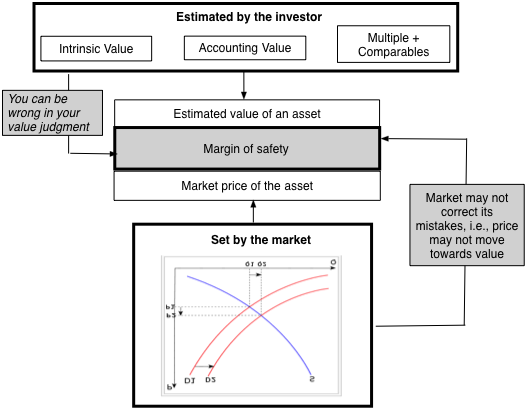
There are many reasons offered for maintaining a margin of safety. The first is that the value of an asset is always measured with error and investors, no matter how well versed they are in valuation techniques, have to recognize that they can be wrong in their judgments. The second is that the market price is determined by demand and supply and if it diverges from value, its pathway back is neither quick nor guaranteed. The proponents of margin of safety point to its benefits. By holding back on making investment decisions (buy or sell) until you feel that you have a margin of safety, they argue that you improve your odds of making successful investments. In addition, They also make the point that having a healthy margin of safety will reduce the potential downside on your investments and help protect and preserve your capital. 

The Margin of Safety: Divergence across Investors
As a concept, I not only understand the logic of the MOS, but also its allure, and I am sure that many investors adopt some variant of it in active investing, but there are differences in how it is employed:
  1. Valuation Basis: While MOS is often defined it as the difference between value and price, the way in which investors estimate value varies widely. The first approach is intrinsic value, either in its dividend discount model format or a more expansive DCF version. The second approach estimates value from accounting balance sheets, using either unadjusted book value or variants thereof (tangible book value, for instance). The third approach is to use a pricing multiple (PE, EV to EBITDA), in conjunction with peer group pricing, to estimate “a fair price” for the company. While I would contest even calling this number a value, it is still used by many investors as their estimated value.
  2. Magnitude and Variability: Among investors who use MOS in investing, there seems to be no consensus on what constitutes a sufficient margin. Even among investors who are explicit about their MOS, the follow up question becomes whether it should be a constant (say 15% for all investments) or whether it should be greater for some investments (say in risky sectors or growth stocks) than for others (utilities or MLPs).
The bottom line is that a room full of investors who all claim to use margin of safety can contain a group with vast disagreements on how the MOS is computed, how large it should be and whether it should vary across investments and time.

Myths about Margin of Safety
When talking about value, I am often challenged by value investors on how I control for risk and asked why I don’t explicitly build in a MOS. Those are fair questions but I do think that some of the investors who are most enamored with the concept fundamentally misunderstand it. So, at the risk of provoking their wrath, here is my list of MOS misconceptions.

Myth 1: Having a MOS is costless
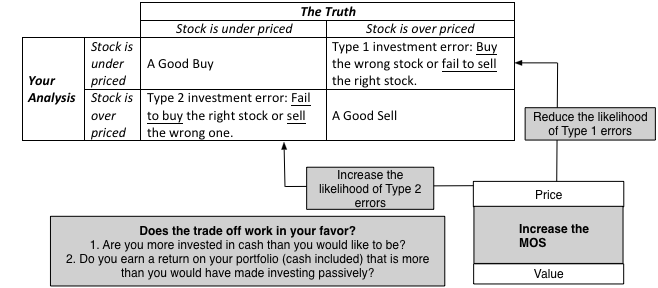
There are some investors who believe that their investment returns will always be improved by using a margin of safety on their investments and that using a larger margin of safety is costless. There are very few actions in investing that don’t create costs and benefits and MOS is not an exception. In fact, the best way to understand the trade off between costs and benefits is to think about type 1 and type 2 errors in statistical analysis. If type 1 errors refer to the fact that you have a false positive, type 2 errors reflect the opposite problem, where you have a false negative. Translating this proposition into investing, let’s categorize type 1 errors as buying an expensive stock, because you mistake it to be under valued, and type 2 errors as not buying a bargain-priced stock, because you perceive it wrongly to be over valued. Increasing your MOS will reduce your type 1 errors but will increase your type 2 errors. 

Many risk averse value investors would accept this trade off but there is a cost to being too conservative and  if that cost exceeds the benefits of being careful in your investment choice, it will show up as sub-par returns on your portfolio over extended periods. So, will using a MOS yield a positive or negative payoff? I cannot answer that question for you, because each investor has to make his or her own judgment on the question, but there are simple tests that you can run on your own portfolios that will lead you to the truth (though you may not want to see it). If you find yourself consistently holding more of your overall portfolio in cash than your natural risk aversion and liquidity needs would lead you to, and/or you don't generate enough returns on your portfolio to beat what you would have earned investing passively (in index funds, for instance), your investment process, no matter what its pedigree, is generating net costs for you. The problems may be in any of the three steps in the process: your valuations may be badly off, your judgment on market catalysts can be wrong or you may be using too large a MOS.

Myth 2: If you use a MOS, you can be sloppy in your valuations
Value investors who spend all of their time coming up with the right MOS and little on valuation are doing themselves a disservice. If your valuations are incomplete, badly done or biased, having a MOS on that value will provide little protection and can only hurt you in the investment process (since you are creating type 2 errors, without the benefit of reducing type 1 errors). Given a choice between an investor with high quality valuations and no/little MOS and one with poorly done valuations and a sophisticated MOS, I would take the former over the latter every single time.

I am also uncomfortable with investors who start with conservative estimates of value and then apply the MOS to that conservative value. In intrinsic valuation, conservative values will usually mean haircutting cash flows below expectations, using high discount rates and not counting in growth that is uncertain. In asset-based valuation, it can take the form of counting only some of the assets because they are tangible, liquid or both. Remember that you are already double counting risk, when you use MOS, even if your valuation is a fair value (and not a conservative estimate of value), because that value is computed on a risk-adjusted basis. If you are using a conservative value estimate, you may be triple or even quadruple counting the same risk when making investment decisions. If you are using this process, I am amazed that any investment manages to make it through your risk gauntlets to emerge as a good investment, and it does not surprise me that nothing in the market looks cheap to you.

Myth 3: The MOS should be the same across all investments 
I have always been puzzled by the notion that one MOS fits all investments. How can a 15% margin of safety be sufficient for both an investment in a regulated utility as well as a money-losing start-up? Perhaps, the defense that would be offered is that the investors who use MOS as their risk breakers would not look at companies like the latter, but I would still expect that even in the value investing spectrum, different investments would evoke different degrees of uncertainty (and different MOS).

Myth 4: The MOS on your portfolio = MOS on individual investments in the portfolio
I know that those who use MOS are skeptics when it comes to modern portfolio theory, but modern portfolio theory is built on the law of large numbers, and that law is robust. Put simply, you can aggregate a large number of risky investments to create a relatively safe portfolio, as long as the risks in the individual stocks are not perfectly correlated. In MOS terms, this would mean that an investor with a concentrated portfolio (who invests in three, four or five stocks) would need a much larger MOS on individual investments than one who spreads his or her bets across more investments, sectors and markets.

Expanding on this point, using a MOS will create biases in your portfolio. Using the MOS to pick investment will then lead you away from investments that are more exposed to firm-specific risks, which loom large on an individual company basis but fade in your portfolio. Thus, biotechnology firms (where the primary risk lies in an FDA approval process) will never make your MOS cut, but food processing firms will, for all the wrong reasons. In the same vein, Valeant and Volkswagen will not make your MOS cut, even though the risk you face on either stock will be lowered if they are parts of larger portfolios. 

Myth 5: The MOS is an alternative risk measure
I know that many investors abhor betas, and believe it or not, I understand. In fact, I have long argued that there are replacements available for portfolio theory-based risk measures and that not only is intrinsic value robust enough to work with these alternative risk measures but that the discount rate is not (and should not) be the ultimate driver of value in most companies. That said, there are some in the value investing community who like to use their dislike of betas as a bludgeon against all financial theory and after they have beaten that straw horse to death, they will offer MOS as their alternative risk measure. That suggests a fundamental misunderstanding of MOS. To use MOS, you need an estimate of value and I am not aware of any intrinsic value model that does not require a risk adjustment to get to value. In other words, MOS is not an alternative to any existing risk measure used in valuation but an add-on, a way in which risk averse investors can add a second layer of risk protection.

There is one possible way in which the MOS may be your primary risk adjustment mechanism and that is if you use a constant discount rate when doing valuation (a cost of capital of 8% for all companies or even a risk free rate) and then apply a MOS to that valuation to capture risk. If that is your approach, you should definitely be using different MOS for different investments (see Myth 3), with a larger MOS being used on riskier investments. I would also be curious about how exactly you make this MOS adjustment for risk, including what risks you bring in and how you make the conversion.

Margin of Safety – Incorporating into a Strategy
I would not put myself in the MOS camp but I recognize its use in investing and believe that it can be incorporated into a good investing strategy. To do so, though, you would need to do the following:
  1. Self examination: Even if you believe that MOS is a good way of picking investments, it is not for everyone. Before you adopt it, you have to assess not only your own standing (including how much you have to invest, how risk averse you are) but also your faith (in your valuation prowess and that markets correct their mistakes). Once you have adopted it, you still need the effects it has on your portfolio, including how often you choose not to invest (and hold cash instead) and whether it makes a material difference to the returns you generate on your portfolio.
  2. Sound Value Judgments: As I noted in the last section, a MOS is useful only if it is an addendum to sound valuations. This may be a reflection of my biases but I believe that this requires intrinsic valuation, though I am willing to concede that there are multiple ways of doing it right. Accounting valuations seem to be built on the twin presumptions that book value is an approximation of liquidation value and that accounting fair value actually means what it says, and I have little faith in either. As for passing of pricing as value, it strikes me as inconsistent to use the market to get your pricing number (by using multiples and comparable firms) and then argue that the same market misprices the asset in question.
  3. A Flexible MOS: Tailor the MOS to the investment that you are looking at: There are two reasons for using a MOS in the first place. The first is an acceptance that, no matter how hard you try, your estimate of value can be wrong and the second is that even if the value estimate is right, there is uncertainty about whether the market will correct its mistakes over your time horizon. If you buy into these two reasons, it follows that your MOS should vary across investments, with the following determinants.
  • Valuation Uncertainty: The more uncertain you are about your estimated value for an asset, other things remaining equal, the larger the MOS should be. Thus, you should use a smaller MOS when investing in mature businesses and during stable markets, than when putting your money in young, riskier business or in markets in crises.
  • Portfolio Tailoring: The MOS that you use should also be tailored to your portfolio choices. If you are a concentrated investor, who invests in a four or five companies, you should use a much higher MOS than an investor who has a more diversified portfolio, and if you the latter, perhaps even modify the MOS to be larger for companies that are exposed to macroeconomic risks (interest rates, inflation, commodity prices or economic cycles) than to company-specific risks (regulatory approval, legal jeopardy, management flux).
  • Market Efficiency: I know that these are fighting words to an active investor, red flags that call forth intemperate responses. The truth, though, is that even the most rabid critics of market efficiency ultimately believe in their own versions of market efficiency, since if markets never corrected their mistakes, you would never make money of even your canniest investments. Consequently, you should settle for a smaller MOS when investing in stocks in markets that you perceive to be more liquid and efficient than in assets, where the corrections will presumably happen more quickly than in inefficient, illiquid markets where the wait can be longer.
  • Pricing Catalysts: Since you make money from the price adjusting to value, the presence of catalysts that can lead to this adjustment will allow you to settle for a lower MOS. Thus, if you believe that a stock has been mispriced ahead of an earnings report, a regulatory finding or a legal judgment, you should demand a lower MOS than when you invest in a stock that you believe is misvalued but with no obvious pricing catalyst in sight. 
Finally, if MOS is good enough to use when you buy a stock, it should be good enough to use when you sell that stock. Thus, if you need a stock to be under valued by at least 15%, to buy it, should you also not wait until it is at least 15% over valued, to sell it? This will require you to abandon another nostrum of value investing, which is that once you buy a great company, you should hold it forever, but that is not just unwise but is inconsistent with true value investing.
    Conclusion
    Would I prefer to buy a stock at a 50% discount on value rather than at just below fair value? Of course, and I would be even happier if you made that a 75% discount. Would I feel even more comfortable if you estimated value very conservatively. Yes and I would be delighted if all you counted was liquid assets. That said, I don't live in a  world where I see too many of these investments and when I do, it is usually the front for a scam rather than a legitimate bargain.  That is the reason that  I have never formally used a MOS in investing. I did buy Valeant at $32, because my valuation of the stock yielded $45 for the company. Would I have still bought the stock, if my value estimate had been only $35 or if it was a big chunk of my portfolio? Perhaps not, but I have bought stocks that were priced at my estimated fair value and have held back on investments that I have found to be under valued by 25% or more. Why? That has to wait for my coming post on simulations, since this one has run its course.
    1. If you have a D(discount rate) and a CF (cash flow), you have a DCF.  
    2. A DCF is an exercise in modeling & number crunching. 
    3. You cannot do a DCF when there is too much uncertainty.
    4. The most critical input in a DCF is the discount rate and if you don’t believe in modern portfolio theory (or beta), you cannot use a DCF.
    5. If most of your value in a DCF comes from the terminal value, there is something wrong with your DCF.
    6. A DCF requires too many assumptions and can be manipulated to yield any value you want.
    7. A DCF cannot value brand name or other intangibles. 
    8. A DCF yields a conservative estimate of value. 
    9. If your DCF value changes significantly over time, there is either something wrong with your valuation.
    10. A DCF is an academic exercise.
    11 Apr 18:13

    The Small Cap Premium: Where is the beef?

    by Aswath Damodaran
    For decades, analysts and investor have bought into the idea of a small cap premium, i.e., that stocks with low market capitalizations can be expected to earn higher returns than stocks with higher market capitalizations. For investors, this has led to the pursuit of small cap stocks and funds for their portfolios, and for analysts, it has translated into the addition of "small cap" premiums of between 3-5% to traditional model-based expected returns, for companies that they classify as small cap. While I understand the origins of the practice, I question the adjustment for three reasons: 
    1. On closer scrutiny, the historical data, which has been used as the basis of the argument, is yielding more ambiguous results and leading us to question the original judgment that there is a small cap premium.
    2. The forward-looking risk premiums, where we look at the market pricing of stocks to get a measure of what investors are demanding as expected returns, are yielding no premiums for small cap stocks. 
    3. If the justification is intuitive, i.e., that smaller firms are riskier than larger firms, much of that additional risk is either diversifiable, better adjusted for in the expected cash flows (instead of the discount rate) or double counted.
    The small cap premium is a testimonial to the power of inertia in corporate finance and valuation, where once a practice becomes established, it becomes difficult to challenge, even if the original reasons for it have long since disappeared.

    The Basis
    The first studies that uncovered the phenomenon of the small cap premium came out in the 1970s. They broke companies down into deciles, based on market capitalization, and found that companies in the lowest decile earned higher returns, after adjusting for conventional risk measures, than companies in the highest decile. I updated those studies through the end of 2014, and the small cap premium seems intact (at least at first sight). In summary, looking at returns from 1926 to 2014, the smallest cap stocks (in the lowest decile) earned 4.33% more than the market, after adjusting for risk.
    Source: Ken French's online data
    This is the strongest (and perhaps) only evidence for a small cap premium and it is reproduced in data services that try to estimate historical risk premiums (Ibbotson, Duff and Phelps etc.).  This historical premium has become the foundation for both valuation and investment practice. In valuation, analysts have referenced this table to estimate a small cap premium (4-5%) that they then add to the required return from conventional risk and return models to estimate discount rates. For instance, in the conventional capital asset pricing model, it plays out as follows:
    Expected Return = Risk free rate + Beta * Equity Risk Premium + Small Cap Premium
    That discount rate is used to estimate the value of future cash flows, and not surprisingly, the use of a small cap premium lowers the value of smaller companies. 

    In investing, it has been used as a weapon both for and against active investing. Those who favor active investing have pointed to the small cap premium as a justification for their activity, and during the periods of history when small cap companies outperformed the market, it did make them look like heroes but it quickly gave rise to a counterforce, where performance measurement services (like Morningstar) started incorporating portfolio tilts, comparing small cap funds against small cap indices. Since almost all of the "excess returns" disappeared on this comparison, it was only a matter of time before index funds entered the arena, creating small-cap index funds for investors who wanted to claim the premium, without paying large management fees.

    The Problem with the Historical Premium
    In the decades since the original small cap premium study, the data on stocks has become richer and deeper, allowing us to take a closer look at the phenomenon. There are some serious questions that can be raised about whether the premium exists and if so, what exactly it is measuring:
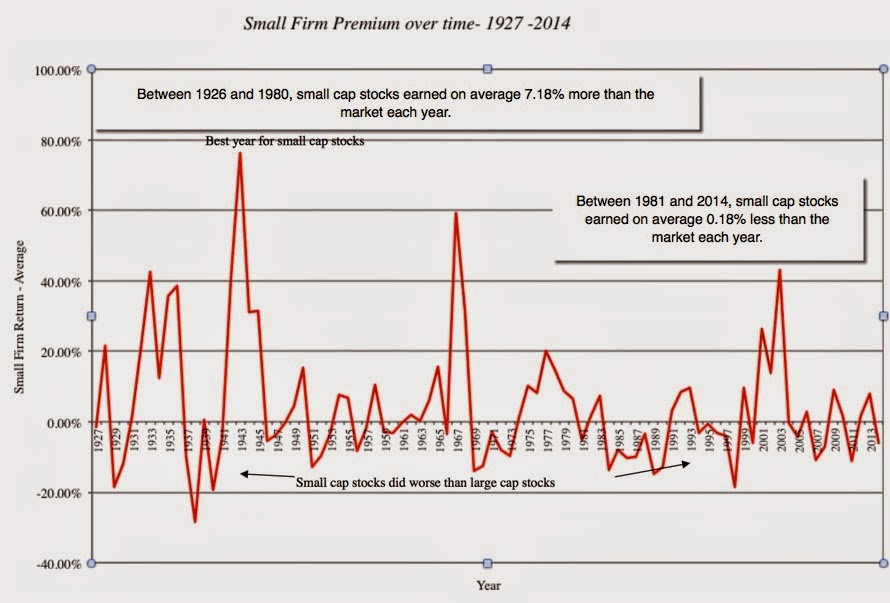
    1. Trend lines and Time Periods: Small cap stocks have earned higher returns than large cap stocks between 1928 and 2014 but the premium has been volatile over history, disappearing for decades and reappearing again. While the premium was strong prior to 1980, it seems to have dissipated since 1981. One reason may be that the small cap premium studies drew attention and investor money to small cap stocks, and in the process led to a repricing of these stocks. Another is that the small cap premium is a side effect of larger macroeconomic variables (inflation, real growth etc.) and that the behavior of those variables has changed since 1980.
      Source: Ken French's online data
    2. Microcap, not small cap premium: Even over the long time period that provides the strongest support for existence of a small cap premium, one study finds that removing stocks with less than $5 million in market cap causes the small firm effect to vanish. In effect, what you have is microcap premium, isolated in the smallest of stocks, not just small stocks.
    3. Standard Error: Historical equity returns are noisy and any estimates of risk premium from that data will reflect the noise in the form of large standard errors on estimates. I have made this point about the overall historical equity risk premium but it becomes magnified when you dice and slice historical data into sub-classes. The table below lists standard errors in excess returns by decile class and reinforce the notion that the small cap premium is fragile, barely making the threshold for statistical significance over the entire period.
      Source: Ken French's online data
    4. The January Effect: One of the most puzzling aspects of the small cap premium is that almost all of it is earned in one month of the year, January, and removing that month makes it disappear. So what? If your argument for the small cap premium is that small cap stocks are riskier, you now have the onus of explaining why that risk shows up only in the first month of every year. 
      Source: Ken French's online data
    5. Weaker globally: The small cap premium seems to be smaller in non-US markets than in US markets and is non-existent in some. In contrast, the value effect (where low price to book stocks outperform the market) is strong globally. 
    6. Proxy for other factors: A host of papers argue that the bulk or all of the small size effect can be attributed to a liquidity effect and that putting in a proxy for illiquidity makes the size effect disappear or diminishes it.
    7. Works only with market cap: Finally, you can take issue with the use of a market-priced based measure of size in a study of returns. Others have tried other non-price size measures such as income or revenues but there seems to be no size effect in those variables. 
    A recent working paper by Asness, Frazini, Israel, Moskowitz and Pedersen tries to resurrect the size effect, but accomplishes it only by removing the subset of small companies that they classify as "low quality" or "junk". While the results are interesting and can be used by active small-cap fund managers as a justification for their activity, they are in no way a basis for adding a small cap premium to every small company, and asking analysts to add it on only for small, high quality companies is problematic. In summary, if the only justification that you can offer for the addition of a small cap premium to your discount rate is the historical risk premium, you are on thin ice. 


    Market-Implied Small Cap Premium

    If the historical data ceases to support the use of a historical risk premium, can we then draw on intuition and argue that since small companies tend to be riskier (or we perceive them to be), investors must require higher return when they invest in them? You can, but the onus is then on you to back up that intuition. In fact, you can check to see whether investors are demanding a forward looking "small cap" premium, by looking at how they price small as opposed to large companies, and backing out what investors are demanding as expected returns. Put simply, if small cap stocks are viewed by investors as riskier and that risk is being priced in, you should expect to see, other things remaining equal, higher expected returns on small cap stocks than large cap stocks.

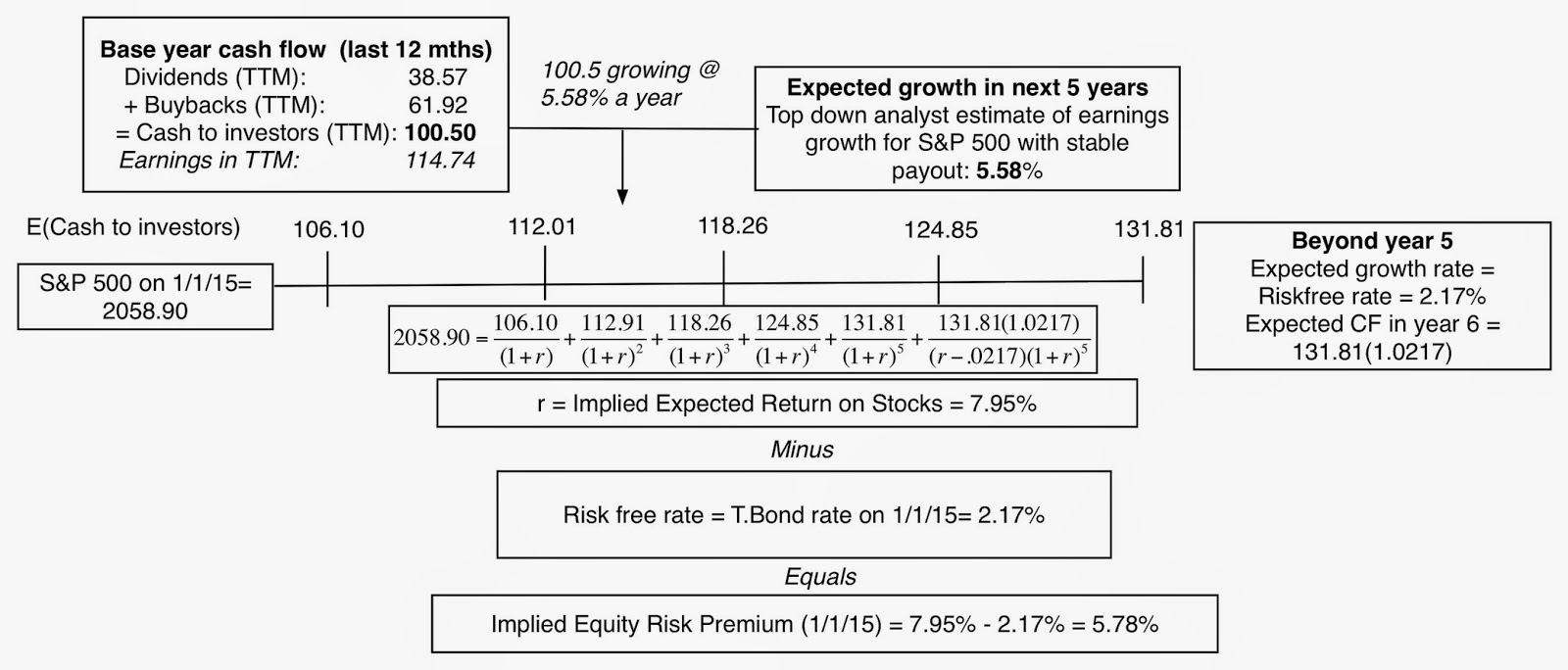
    As some of you are aware, I compute a forward-looking equity premium for the S&P 500 at the start of each year, backing out the number from the current level of the index and expected cash flows. On January 1, 2015, this is what I found:

    In effect, to the extent that my base year cash flows are reasonable and my expected growth rate reflects market expectations, the expected return on large cap stocks on January 1, 2015 was 7.95% in the US (yielding an overall equity risk premium of 5.78% on that day).

    To get a measure of the forward-looking small cap premium, I computed the expected return implied in the S&P 600 Small Cap Index, using the same approach that I used for S&P 500. In spite of using a higher expected earnings growth for small cap stocks, the expected return that I estimate is only 7.61%:


    In effect, the market is attaching a smaller expected return for small cap stocks than large ones, stories and intuition notwithstanding. 

    I am not surprised that the market does not seem to buy into the small cap premiums that academics and practitioners are so attached to. After all, if the proponents of small cap premiums are right, bundling together small companies into a larger company should instantly generate a bonus, since you are replacing the much higher required returns of smaller companies with the lower expected return of a larger one. In fact, small companies should disappear from the market.

    The Illiquidity Fig Leaf
    Looking at the data, the only argument left, as I see it, for the use of the small cap premium is as a premium for illiquidity, and even on that basis, it fails at one of these four levels:
    1. If illiquidity is your bogey man in valuation, why use market capitalization as a stand-in for it? Market capitalization and illiquidity don't always go hand in hand, since there are small, liquid companies and large, illiquid ones in the market. Four decades ago, your excuse would have been that the data on illiquidity was either inaccessible or unavailable and that market capitalization was the best proxy you could find for illiquidity. That is no longer the case and there are studies that categorize companies based on measures of illiquidity (bid ask spread, trading volume) and find an "liquidity premium" for illiquid companies.
    2. If illiquidity is what you are adjusting for in the small cap premium, why is it a constant across companies, buyers and time? Even if your defense is that the small cap premium is an imperfect (but reasonable) measure of the illiquidity premium, it is unreasonable to expect it to be the same for every company. Thus, even if you are valuing just privately owned businesses (where illiquidity is a clear and present danger), that illiquidity should be greater in some businesses than in others and the illiquidity (or small cap) premium should be larger for the former than the latter. Furthermore, the premium you add to the discount rate should be higher in some periods (during market crises and liquidity crunches) than others and for some buyers (cash poor, impatient) than others (patient, cash rich).
    3. Even if you can argue that illiquidity is your rationale for the small cap premium and that it is the same across companies, why is it not changing over the time horizon of your valuation (and especially in your terminal value)? In any valuation, you assume through your company's cash flows and growth rates that your company will change over time and it is inconsistent (with your own narrative) to lock in an illiquidity premium into your discount rate that does not change as your company does. Thus, if you are using a 30% expected growth rate on your company, your "small" company is getting bigger (at least according to your estimates) and presumably more liquid over time. Should your illiquidity premium therefore not follow your own reasoning and decrease over time?
    4. If your argument is that size is a good proxy for illiquidity, that all small companies are equally illiquid and that that illiquidity does not change as you make them bigger, why are you reducing your end value by an illiquidity discount? This question is directed at private company appraisers who routinely use small cap premiums to increase discount rates and  also reduce the end (DCF) value by 25% or more, because of illiquidity. You can show me data to back up your discount (I have seen restricted stock and IPO studies) but none of them can justify the double counting of illiquidity in valuation.
    Why are we slow to give up on the “small cap” premium?

    It is true that the small cap premium is established practice at many appraisal firms, investment banks and companies. Given the shaky base on which it is built and how much that base has been chipped away in the last two decades, you would think that analysts would reconsider their use of small cap premiums, but there are three powerful forces that keep it in play.
    1. Intuition: Analysts and investors not only start of with the presumption that the discount rates for small companies should be higher than large companies, but also have a “number’ in mind. When risk and return models deliver a much lower number, the urge to add to it to make it "more reasonable" is almost unstoppable. Consequently, an analyst who arrives at an 8% cost of equity for a small company feels much more comfortable after adding a 5% small cap premium. It is entirely possible that you are an idiot savant with the uncanny capacity to assess the right discount rate for companies, but if that is the case, why go through this charade of using risk and return models and adding premiums to get to your "intuited" discount rate? For most of us, gut feeling and instinct are not good guides to estimating discount rates and here is why. Not all risk is meant for the discount rate, with some risk (like management skills) being diversifiable (and thus lessened in portfolios) and other risks (like risk of failure or regulatory approval) better reflected in probabilities an expected cash flow. A discount rate cannot and is not meant to be a receptacle for all your hopes and fears, a number that you can tweak until your get to your comfort zone. 
    2. Inertia (institutional and individual): The strongest force in corporate finance practice is inertia, where much of what companies, investors and analysts do reflects past practice. The same is true in the use of the small cap premium, where a generation of analysts has been brought up to believe (by valuation handbooks and teaching) that it is the right adjustment to make and now do it by rote. That inertia is reinforced in the legal arena (where many valuations end up, either as part of business or tax disputes) by the legal system’s respect for precedence and general practice. You may view this as harsh, but I believe that you will have an easier time defending the use of a bad, widely used practice of long standing in court than you would arguing for an innovative better practice.
    3. Bias: My experiences with many analysts who use small cap premiums suggest to me that one motive is to get a “lower” value". Why would they want a lower value? First, in accounting and tax valuation, the client that you are doing the valuation for might be made better off with a lower value than a higher one. Consequently, you will do everything you can to pump up the discount rate with the small cap premium being only one of the many premiums that you use to “build up” your cost of capital. Second, there seems to be a (misplaced) belief that it is better to arrive at too low a value than one that is too high. If you buy into this “conservative” valuation approach, you will view adding a small cap premium as costless, since even it does not exist, all you have done is arrived at “too low” a value. At the risk of bringing up the memories of statistics classes past, there is always a cost. While “over estimating” discount rates reduces type 1 errors (that you will buy an over valued stock), it comes at the expense of type 2 errors (that you will hold off on buying an under valued stock).
    A Requiem for the Small Cap Premium?

    I have never used a small cap premium, when valuing a company and I don’t plan to start now. Needless to say, I am often asked to justify my non-use of a premium and here are my reasons. First, I am not convinced by either the historical data or by current market behavior that a small cap premium exists. Second, I do believe that small cap companies are more exposed to some risks than large cap companies but there are other more effective devices to bring these risks into valuation. If it is that they are capital constrained (i.e., that it is more difficult for small companies to raise new capital), I will limit their reinvestment and expected growth (thus lowering value). If it is that they have a greater chance of failure, I will estimate a probability of failure and reflect that in my expected value (as I do in my standard DCF model). If it is illiquidity that is your concern, it is worth recognizing that one size will not fit all and that the effect on value will vary across investors and across time and will be better captured in a  discount on value.

    To illustrate how distorted this debate has become, note that those who routinely add small cap premiums to their discount rates are not put to the same test of justifying its use. So, at the risk of opening analysts up to uncomfortable questions, here are some questions that you should pose to anyone who is using a small cap premium (and that includes yourself):
    1. What is your justification for using a small cap premium? If the defense is pointing to history (or a data table in a service), it is paper thin, since that historical premium defense seems to have more holes in it than Swiss cheese. If it is intuitive, i.e., that small companies are riskier and markets must see them as such, I don't see the basis for the intuition, since the implied costs of equity for small companies are no higher than those of large companies. If the argument is that everyone does it, I am sorry but just because something is established practice does not make it right. 
    2. What are the additional risks that you see in small companies that you don't see in large ones? I am sure that you can come up with a laundry list that is a mile long, but most of the risks on the list either don't belong in the discount rate (either because they are diversifiable or because they are discrete risks) or can be captured through probability estimates. If it is illiquidity that you are concerned about, see the section on illiquidity above for my response.
    If you are investors, here are the lessons I draw from looking at the data. If you are following a strategy of buying small cap stocks, expecting to be rewarded with a premium for just doing that, you will be disappointed. Even the most favorable papers on the small cap premium suggest that you have to add refinements, with some suggesting that these refinements should screen out the least liquid, riskiest small cap stocks and others arguing for value characteristics (stable earnings, high returns on equity & capital, solid growth). I do think that there is a glimmer of hope in the recent research that the payoff to looking for under valued stocks may be greater with small companies, partly because they are more likely to be overlooked, but it will take more work on your part and it won't be easy!

    Data sets

    Spreadsheets
    03 Sep 21:42

    MOOCs and Books: Spanning the Digital Divide

    by Aswath Damodaran
    As those of you who have followed my blog for awhile know, I post just before the start of a new semester about my upcoming classes and ways in which you can, if you so desire, be part of the experience.  In just under a week, on September 4, I will start the fifty first iteration of my valuation class to the second year MBAs at the Stern School of Business at New York University.  I am just as excited today, as I was when I taught my first version of this class in the 1980s, and I have learned and continue to learn about valuation, each time I teach this class.

    Looking back, though, I am struck by both how little and how much technology has changed my classes over the last three decades. The place where there has been the least change is in the classroom, where, as an old fashioned lecturer, my requirements have remained constant: a podium (though I hardly ever stand behind one), a working microphone and a willing/curious audience. I still prepare for classes, exactly the way I did for my very first class, running through the lecture in my head and getting my narrative in place. The slides I use may look slightly more polished than the hand written slides I used twenty five years ago and the projectors may be brighter & sleeker, but they remain props that I can live without. It is true that I have to compete for the attention of my stiudents against more powerful distractions (as tablets, smartphones and computers stay propped open), but that is a challenge I relish (and sometimes lose).  

    So, what has technology changed? First, it has given me richer ways of explaining the nuts and bolts of number crunching to those who are interested. Last semester, I put a series of webcasts on valuation/corporate finance practice (from creating trailing 12-month financials, converting leases to debt, computing implied equity risk premiums). Second, it has allowed me to roam the world without leaving the confines of my office. Today, I used Skype Premium to give a two-hour live talk on teaching to a group of freshly minted doctoral students in Hyderbad, India, where they were able to see me (and my presentation) and interact. Third, it has allowed me to package the classroom experience and offer it to a much wider audience. This semester, as in the last few, I will be putting my valuation class online, with nothing held back. In the 26 sessions, starting September 4 and ending December 13, I will try to package and present through everything I know or have learned about valuation, while also revealing to you the great deal that I have left to learn. The class is meant for second year MBAs but if you have the basics of accounting, like working in the numbers and are willing to put in the time, you should not find it too steep a climb. If you so desire, you can watch every lecture, review every slide, do every exam/project and even read every email I send the class. There are three forums you can use:

    My site: http://people.stern.nyu.edu/adamodar/New_Home_Page/webcasteqfall13.htm 
    Entry requirements: None. There should be no password required to watch the webcasts or download material. 
    Description: If you have a computer and a decent broadband connection, you can use the link above to access all of the resources that my regular class has access to. The slides are posted at the top of the page (and are downloadable) and the sessions will be posted sequentially as I teach them. You can watch them in one of three ways:
    1. If you don't want large video files (125-200 MB) inhabiting your computer, you can stream them from the NYU server. (Warning: The files are big and can hang up, if your connection is slow).
    2. If you don't mind downloading the files on to your computer, you can download the video file (usually in mp3 format) and watch it either in your browser or later on your media player of choice. 
    3. If you prefer just an audio file, you can download the lecture in just audio format and then use the slides that you have downloaded to supplement the lectures.
    With each session, I will list (and you can download) the slides that I used for the session, the pre-class test that I usually start each session with and a post-class test that you can take, if you want to see if you "get" the material from the session.

    Lore: http://lore.com
    Entry requirements: Once on the site, click on Join your course, and enter the code DMR44Z. It will let you audit the class.
    Description: Lore is an online education company that I have used for more than two years now which marshals what is on my website into more bite-sized and organized pieces. As with the website, you will be able to watch the lectures through Lore and download the slides. One advantage that Lore has is that is has a discussion board where you can can post questions (or answer them) and articles/news for discussion.


    iTunes U: https://itunesu.itunes.apple.com/audit/COJN7B8T55 (Link works only from Apple device, not computer).
    Entry requirements: An Apple iPad or iPhone with the iTunes U app (free) installed, An Android tablet/phone with the Tunesviewer app (free). First, download the iTunes U app on to your device. Then, click on the link above from your device. Alternative, click on Catalog, and then click on the ENROLL button at the bottom of the Catalog page and enter J7R-DK5-BM3 when prompted.
    Description: This is the latest addition to my online choices and it has the smoothest interface. The lectures open up on your iPad and the lecture notes and tests can be viewed on the device as well. The best (and worst) feature of the iTunes U version is that it sends you a notification when something is added to the class; this can of course be irritating and you can turn it off.

    I know that some of you are wondering why I am not using Udacity, Coursera or EdX to put my lectures online, but there are two impediments. The first is that will require agreement at the university level, which I cannot (and have no desire to) force. The second is that these entities have their own long term interests to think about (which I respect) but those interests may not be congruent with yours and mine.

    I know that some of you have started on my class, in earlier semesters, with the intent of finishing but life has got in the way. If you feel up to it, give it another shot and see if you can get a little further this time. Remember also that while the classes will be posted as they occur, the webcasts and material will stay online for a year and you can catch up over time. In fact, for those of you who prefer to see the complete packaged version of the entire class, my classes on corporate finance and valuation from the spring are on iTunes U as well in archived form:
    Archived Corporate Finance class (Spring 2013)
    Archived Valuation class (Spring 2013)

    In my other avatar, I like writing about what I teach, and just as technology is delivering change (often disruptive) to the education business, it is starting to make itself felt in the publishing business. A few months ago, I finished my second edition of one of my books on investments (Investment Philosophies) and as I readied the e-Book version, I realized how little I was using the power of technology, since the eBook was nothing more than the onscreen version of my physical book. Consequently, my publisher (John Wiley & Sons), Symynd (a company that carried my valuation class online last semester) and I got together a few months ago on new project, where we tried to expand the digital reach for the book by combining it with the key aspects of an online class. Since I have always wanted to teach the investment philosophies class (and have never had a chance to do so), I was on board, and created 38 webcasts (about 15 minutes apiece), tied to chapters in the book. The bundled product, containing the book, webcasts, slides and post-class exercises, is now available on Symynd's website. The book/course costs $75, but you can get it for $45 until September 16, 2013, if you enter the promo code PROMO75.  Since the book alone costs about the same, you can think of the course as being icing on the cake for free. In the next few months, Symynd/Wiley/I are planning to do the same with my applied corporate finance and valuation books. If you are budget constrained and are unable to spend the $45, I have created both an online version and an iTunes U course around the webcasts, slides and exercises. It is not as polished as the Wiley/Symynd version and it does not come with the book, but it does provide the essence of the class.

    I consider myself lucky to be in two businesses, education and publishing, that are in the midst of disruptive change. For those in both businesses who are defenders of the status quo, the change that is coming will threaten many long standing (and indefensible) privileges including tenure, bundling and lack of accountability. For the rest of the world, though, who have have had to shell out outlandish amounts of money as college tuition and to pay absurd sums for "new" editions of college text books, I hope that the change delivers much needed good news (and power).
    30 Aug 19:58

    The Mighty (but humble) Micro-Genetic Algorithm (mGA)

    by david varadi

    dna

    A Gentle Introduction to Optimization

    The field of optimization has evolved significantly over the past few decades. Several new theoretical, algorithmic, and computational methods for optimization have been proposed to solve complex problems in diverse fields such as finance, engineering and molecular biology. In finance, optimization is required to solve portfolio problems, model/predict time series data, create trading systems, and for implementing trade execution.

    Optimization methods can be divided into two primary categories; deterministic and heuristic approaches. Both methods are essential for quantitative finance applications. Deterministic optimization is a highly mathematical and gradient-based form of optimization that is most suitable for well-defined problems that contain a smooth and continuous search space. Some examples of deterministic optimization would be conjugate gradient, simplex, gradient descent, quadratic- programming (used for Markowitz-type portfolio problems),non-linear solvers, and quasi-Newton or Newton methods. These methods are greedy and highly efficient, and if used for the appropriate application they are guaranteed to find the global optimum. Deterministic methods are analogous to Formula One race cars: they are very fast and precise and will find the finish line as long as they are used on a race track in good weather conditions. You wouldn’t want to drive them through the forest without a map. Below is an example of the ideal type of optimization search space- a convex function:

    convex function

    Heuristic approaches in contrast are either algorithmic (ie a closed-form computation that approximates a feasible solution such as the “Minimum Correlation Algorithm”) or stochastic (rely on clever manipulations of random number generation to find a solution) and can be used for highly complex problems without the need for expert knowledge. Traditional examples of heuristic methods would be Monte Carlo (MC), particle-swarm optimization (PSO), genetic algorithms (GA), simulated annealing (SA), and differential evolution.  The class of algorithmic heuristic approaches are typically domain specific (or even specific purpose) and less generalizable than stochastic methods. Most scientists and engineers find heuristic methods to be more flexible and efficient than deterministic approaches for complex real-world problems, but finding the global optimum cannot be guaranteed. However, in a typical large-scale application a true exhaustive search is either not possible or practical from a computation standpoint. Heuristic methods are like a team of Hummers that can communicate or compete with one another to find the end goal. This provides greater chances of success through complex and unknown terrain that is often encountered when dealing with noisy time series data. An example of a search space that is only tractable with a heuristic approach (typically a GA) is the Rastrigin function:

    rastrigin function

    The Swiss Army Knife: The Micro-Genetic Algorithm (mGA)

    The Micro Genetic Algorithm is a very simple but powerful approach that can solve the most complex problems with greater speed than most pure (non-hybrid) heuristic methods. Virtually any problem in finance can be solved using this method  as a building block. mGA is much faster than traditional Genetic Algorithms (SGA) and produces superior solutions without the need for estimating several additional parameter inputs such as the mutation rate. mGA are also ideal for parallel processing and can dramatically reduce both programming and processing time as well as memory requirements. In the next post, I will  break down the steps to create an mGA application in more detail. For now here is a flow chart of how the mGA works:

    micro genetic algorithm


    26 Aug 18:13

    k-NN Candlestick Pattern Search Extensions: Combining Forecasts

    by admin

    The second, and probably final, followup to the Mining for Three Day Candlestick Patterns post. Previously, we improved performance by adding more data to the search. In this post we’ll try to improve the system further by combining multiple predictors. The central question is how to combine the forecasts. I test averaging, weighted averaging, regression, and a voting scheme and compare them against a baseline one-predictor strategy.

    Set-Up

    Combining predictors is a standard tactic in machine learning, but the case of k-NN predictors is a bit of an outlier. Typical ensemble methods depend on generating variations in the data set in order to generate different and complementary predictors (as in the cases of boosting and bagging). This doesn’t work very well with nearest neighbor predictors, however, because they tend to be insensitive to variations in the data set. So what can we vary? The choice of k, the choice of inputs, the choice of distance measure for the nearest neighbors, and some pre-processing options such as whether to adjust for volatility or not.

    I am not going to make any variation in outputs as that’s reserved for a post of its own. The idea is pretty simple: it’s essentially a random forest with k-NN predictors instead of decision trees (here’s an interesting paper on it).

    So we’re left with k, sum of absolute or sum of square distances, and volatility adjustment. I picked 10 combinations of these options:

    choices

    The k values were picked at random and I’m sure it’s possible to do better by optimizing them using cross validation.

    The signals obviously overlap significantly, and have similar stats when used one-by-one:

    Long position threshold: forecast > 5 basis points & IBS < 0.5.

    Long signal stats. Long position threshold: forecast > 5 basis points & IBS < 0.5.

    asdf

    Short signal stats. Short position threshold: forecast < -10 basis points & IBS > 0.5.

    The instrument traded is SPY. Additional data is taken from the following instruments for the pattern search: EWY, EWD, EWC, EWQ, EWU, EWA, EWP, EWH, EWL, EFA, EPP, EWM, EWI, EWG, EWO, IWM, QQQ, EWS, EWT, and EWJ. The thresholds in each case are adjusted to result in a similar length of time spent in the market. Position sizing is done based on the 10-day realized volatility of SPY, as described in this post: leverage is equal to 20% divided by 10-day realized annualized standard deviation, with a maximum leverage of 200%. Finally, an IBS filter is applied that allows long positions only when IBS < 0.5 and short positions only when IBS > 0.5.

    The baseline is the PF3 predictor: k = 75, square distance measure, no volatility adjustment. Here’s the equity curve:

    asdf

    PF3 predictor equity curve. $0.005 per share in commissions.


    Averaging

    The simplest approach is obviously to just average the 10 forecasts and then use the average value to generate trades. A long position is taken when the average forecast is greater than 15 basis points, and a short position when the average is smaller than -12.5 basis points. Here’s what the equity curve looks like:

    Equity curve using average forecast. $0.005 per share in commissions.

    Equity curve using average forecast. $0.005 per share in commissions.

    It’s interesting to note that the dispersion of forecasts is inversely related to the accuracy of the average: the smaller the standard deviation of the forecasts, the more accurate they are. Unfortunately effect is marginal and thus not particularly useful for improving the strategy.


    Weighted Averaging

    A simple extension, that generates slightly better stats, is to weigh each forecast before averaging. There’s a wide array of stats one can use here (Sharpe/Sortino/MAR ratios are obvious candidates); I picked the mean square error. The inverse of the MSE becomes the forecast’s weight, so that smaller errors result in greater weights. The same thresholds as above are used to generate signals. The weights provide a slight improvement both in terms of Sharpe and MAR ratios. The equity curve:

    Weighted average

    Equity curve using weighted average forecast, with weights equal to the inverse of the mean square error. $0.005 per share in commissions.


    Voting

    Using a threshold for each forecast, (>5 basis points for a “long” vote, and <-10 basis points for a “short” vote), each predictor is assigned a long or short vote. The overlap between the votes is significant, between 88% and 97% for different estimators. How many votes should we require for a trade? It quickly becomes obvious that simple majority voting isn’t enough, as only near-unanimous decisions provide worthwhile predictions. The average next-day return when there are between 1 and 8 long votes is 0.4 basis points. The average return after 9 or 10 long votes is 23 basis points.

    The resulting equity curve looks like this:

    asdf

    Equity curve using voting system. 9 or more votes required to take a position. $0.005 per share in commissions.


    Ordinary Least Squares

    It’s also possible to combine the forecasts using regression, with next-day returns as the dependent variable and the k-NN predictor forecasts as the independent ones.

    The distribution of forecasts with OLS is very tightly clustered around 0, and for some reason higher forecasts are not associated with higher next-day returns (as they are for the 3 methods above). I don’t really understand why this is the case. The thresholds for trades are 0.5 basis points for a long trade, and -0.5 basis points for a short trade.

    An issue here is, of course, multicollinearity due to the similarity of the independent variables. This can lead to, among other problems, overfitting (which is usually characterized by very large absolute values of the coefficients). Using ridge regression solves that issue by limiting the absolute value of coefficients.

    A potentially interesting idea would be to constrain the coefficients to positive values, which might lessen the overfitting effects and also make much more sense on an intuitive level (after all, we know all the forecasts are similarly accurate, so negative coefficients don’t make much sense).

    asdf

    Equity curve using OLS regression. $0.005 per share in commissions.


    Ridge Regression

    If multicollinearity is a significant problem, we can use ridge regression to solve it. It offer significant improvement over the OLS approach, but it still fares badly compared to the one-predictor case. The same thresholds as in the OLS approach are used. Here’s the equity curve:

    asdf

    Equity curve using ridge regression. $0.005 per share in commissions.


    Stats

    Here are the stats for the single-predictor base case and all the combination methods:

    stats

    All of them other than the voting failed horribly. I’m not sure why, but it’s good to know. The improvement provided by the voting system is sizable, however. Not only does the voting-based strategy achieve significantly higher risk-adjusted returns, it does it while spending 15% less time in the market. Those results are also easy to improve on by simply adding more predictors. The marginal gain from each new predictor will be diminishing, but there is definitely more value to wring out of it. And this is just with 3-day patterns: we can easily add 2 and 4 day patterns into the mix as well.

    Other Possibilities

    A wide array of machine learning methods can be used to combine predictions. Especially if the number of forecasts grew larger, techniques such as random forests or ANNs would be interesting to investigate. As long as simpler methods work very well I think there is little reason to increase the complexity (not to mention the opaqueness) of the strategy.

    21 Aug 12:21

    Guest Post: A qualitative review of VIX F&O pricing and hedging models

    by Ernie Chan
    By Azouz Gmach

    VIX Futures & Options are one of the most actively traded index derivatives series on the Chicago Board Options Exchange (CBOE). These derivatives are written on S&P 500 volatility index and their popularity has made volatility a widely accepted asset class for trading, diversifying and hedging instrument since their launch. VIX Futures started trading on March 26th, 2004 on CFE (CBOE Future Exchange) and VIX Options were introduced on Feb 24th, 2006.


    VIX Futures & Options


    VIX (Volatility Index) or the ‘Fear Index’ is based on the S&P 500 options volatility. Spot VIX can be defined as square root of 30 day variance swap of S&P 500 index (SPX) or in simple terms it is the 30-day average implied volatility of S&P 500 index options. The VIX F&O are based on this spot VIX and is similar to the equity indexes in general modus operandi. But structurally they have far more differences than similarities. While, in case of equity indices (for example SPX), the index is a weighted average of the components, in case of the VIX it is sum of squares of the components. This non-linear relationship makes the spot VIX non-tradable but at the same time the derivatives of spot VIX are tradable. This can be better understood with the analogy of Interest Rate Derivatives. The derivatives based on the interest rates are traded worldwide but the underlying asset: interest rate itself cannot be traded.


    The different relation between the VIX derivatives and the underlying VIX makes it unique in the sense that the overall behavior of the instruments and their pricing is quite different from the equity index derivatives. This also makes the pricing of VIX F&O a complicated process. A proper statistical approach incorporating the various aspects like the strength of trend, mean reversion and volatility etc. is needed for modeling the pricing and behavior of VIX derivatives.


    Research on Pricing Models


    There has been a lot of research in deriving models for the VIX F&O pricing based on different approaches. These models have their own merits and demerits and it becomes a tough decision to decide on the most optimum model. In this regards, I find the work of Mr. Qunfang Bao titled ‘Mean-Reverting Logarithmic Modeling of VIX’ quite interesting. In his research, Bao not only revisits the existing models and work by other prominent researchers but also comes out with suggestive models after a careful observation of the limitations of the already proposed models. The basic thesis of Bao’s work involves mean-reverting logarithmic dynamics as an essential aspect of Spot VIX.


    VIX F&O contracts don’t necessarily track the underlying in the same way in which equity futures track their indices. VIX Futures have a dynamic relationship with the VIX index and do not exactly follow its index. This correlation is weaker and evolves over time. Close to expiration, the correlation improves and the futures might move in sync with the index. On the other hand VIX Options are more related to the futures and can be priced off the VIX futures in a much better way than the VIX index itself.


    Pricing Models


    As a volatility index, VIX shares the properties of mean reversion, large upward jumps & stochastic volatility (aka stochastic vol-of-vol). A good model is expected to take into consideration, most of these factors.


    There are roughly two categories of approaches for VIX modeling. One is the Consistent approach and the other being Standalone approach.


            I.            Consistent Approach: - This is the pure diffusion model wherein the inherent relationship between S&P 500 & VIX is used in deriving the expression for spot VIX which by definition is square root of forward realized variance of SPX.


          II.            Standalone Approach: - In this approach, the VIX dynamics are directly specified and thus the VIX derivatives can be priced in a much simpler way. This approach only focuses on pricing derivatives written on VIX index without considering SPX option.

    Bao in his paper mentions that the standalone approach is comparatively better and simpler than the consistent approach.


    MRLR model


    The most widely proposed model under the standalone approach is MRLR (Mean Reverting Logarithmic Model) model which assumes that the spot VIX follows a Geometric Brownian motion process. The MRLR model fits well for VIX Future pricing but appears to be unsuited for the VIX Options pricing because of the fact that this model generates no skew for VIX option. In contrast, this model is a good model for VIX futures.


    MRLRJ model


    Since the MRLR model is unable to produce implied volatility skew for VIX options, Bao further tries to modify the MRLR model by adding jump into the mean reverting logarithmic dynamics obtaining the Mean Reverting Logarithmic Jump Model (MRLRJ). By adding upward jump into spot VIX, this model is able to capture the positive skew observed in VIX options market.


    MRLRSV model


    Another way in which the implied volatility skew can be produced for VIX Options is by including stochastic volatility into the spot VIX dynamics. This model of Mean Reverting Logarithmic model with stochastic volatility (MRLRSV) is based on the aforesaid process of skew appropriation.

    Both, MRLRJ and MRLRSV models perform equally well in appropriating positive skew observed in case of VIX options.


    MRLRSVJ model


    Bao further combines the MRLRJ and MRLRSV models together to form MRLRSVJ model. He mentions that this combined model becomes somewhat complicated and in return adds little value to the MRLRJ or MRLRSV models. Also extra parameters are needed to be estimated in case of MRLRSVJ model.


    MRLRJ & MRLRSV models serve better than the other models that have been proposed for pricing the VIX F&O. Bao in his paper, additionally derives and calibrates the mathematical expressions for the models he proposes and derives the hedging strategies based on these models as well. Quantifying the Volatility skew has been an active area of interest for researchers and this research paper addresses the same in a very scientific way, keeping in view the convexity adjustments, future correlation and numerical analysis of the models etc. While further validation and back testing of the models may be required, but Bao’s work definitely answers a lot of anomalous features of the VIX and its derivatives.

    ---
    Azouz Gmach works for QuantShare, a technical/fundamental analysis software.

    ===
    My online Mean Reversion Strategies workshop will be offered in September. Please visit epchan.com/my-workshops for registration details.

    Also, I will be teaching a new course Millisecond Frequency Trading (MFT) in London this October.

    -Ernie


    11 Aug 15:25

    Dynamic Asset Allocation for Practitioners Part 3: Momentum Weighting

    by GestaltU
    Atomaniac

    TO READ LATER

    In the first two articles of our Dynamic Asset Allocation for Practitioners series (Article 1 and Article 2), we explored a wide variety of ways to measure the raw, and risk adjusted, momentum of a universe of global asset classes for the purpose of ranking and allocation. We described the mathematics behind each metric, and subjected each approach to a variety of robustness checks.

    Most studies of momentum based portfolios focus on a certain level of portfolio concentration, such that the portfolio always holds the top 2, 3, 4, or n assets. This is a source of potential curve fitting, as the choice of the optimal number of assets is usually made by evaluating ex post test results, and what worked best in the past may not work best in the future. In our first two posts we examined the distribution of results across portfolio concentrations ranging from 2 through 5 assets out of a 10 asset universe to provide a more comprehensive and realistic illustration of what investors might expect out of sample.

    Another potential source of curve fitting relates to the asset class universe. To address this, we ran tests on 11 variations of our 10 asset class universe, whereby one asset was removed from the universe in each run to avoid cases where one asset happens to contribute an outsized amount to total performance over the test period. We showed the distribution of results across asset universes, again to give a better sense of what out of sample results might look like.

    Another approach to reduce the risk of curve fitting by specifying a fixed number of portfolio holdings is to examine the distribution of momentum across asset classes at each rebalance period, and simply eliminate assets where their momentum score falls below a certain threshold relative to all of the other assets. For example, an asset might be eliminated if its momentum score falls below the average momentum score across all assets in the universe. Or we might screen for assets in the top quartile, etc.

    By filtering assets based on their score relative to the other assets at each rebalance, the number of portfolio holdings is not fixed through time. Some periods may have a narrow concentration of strong assets with a majority of very weak assets, which would result in a portfolio that was more heavily concentrated in the few strong assets. In other periods, many assets might be performing well at the same time while a couple of assets lag dramatically. In this case the portfolio would hold many assets and only eliminate extreme laggards. This approach allows the portfolio the ‘breathe’ based on the concentration of momentum in the asset universe.

    Chart 1. illustrates how the number of assets held at each rebalance changes through time in response to the distribution of momentum across asset classes at each rebalance date when we filter assets with a Guassian score <0.5.  The number of holdings ranges from 7 during a rebalance in 2003 to as few as 2 assets in several periods. Not surprisingly, the portfolio averages 5 assets over the full test period.

    num_assets_article_3

    Data source: Bloomberg

    In addition to its role as a filtering mechanism, momentum score can also be used as a weighting tool. This constitutes a more direct approach to tests of portfolio concentration because each asset contributes to the portfolio in proportion to its observed momentum relative to other assets in the universe. We will call this approach ‘momentum weighting’. We will explore filtering with equal weighting, as well as momentum weighting below, and provide performance tests for each.

    Momentum Weights

    There are many ways to apportion momentum weight, but in our testing we have found that applying a Gaussian transform to the cross sectional momentum across lookback horizons is quite effective. Essentially, this process uses a Gaussian transform to standardize relative momentum scores at each lookback horizon, such that the final momentum score for each asset is the average of the Gaussian score at each lookback. The following formulas describe the process we use to determine the weights of each asset in the portfolio.

    Gaussian_Weight_Transform2


    LRL_Weights3

    In the above equations, G is the Gaussian value of asset i using lookback horizon l. Θ signifies that we are imposing a Gaussian transform on the value in brackets, which is simply the momentum of asset i at lookback horizon l minus the average momentum of all assets at that horizon, all divided by the standard deviation of momentum values at that horizon. The function in brackets is a z-score calculation, and the Gaussian transform translates the z score into a percentile value between 0 and 1.

    Once we have transformed the raw momentum vectors for each lookback horizon into vectors of Gaussian values, we average the vectors across lookbacks to derive the final Gaussian score vector. Finally, we need to releverage the Gaussian weights so that the final weights add up to 100%. The second function accomplishes this by dividing each average Gaussian asset score by the sum of all average Gaussian scores across all assets.

    This may be a little esoteric for many readers, so we have translated the formulas above into an Excel implementation below. If we assume the momentum metrics at lookback horizon l for assets 1 through 10 are in cells A20 through J20, the Gaussian transform for asset 1 is calculated as:

    =NORMSDIST((A20-AVERAGE($A20:$J20))/STDEV($A20:$J20))

    Once we have translated the momentum scores at each lookback horizon into Gaussian vectors, we average the vectors across all lookback horizons to find the average Gaussian momentum score for each asset. Finally, we releverage the Gaussian weights so that they add up to 100%. If the Gaussian vector is located in A21:J21, then the final weight for asset 1 is:

    =A21/SUM($A21:$J21)

    We now have a vector of positive momentum weights which we can use as weights in the portfolio at each rebalance.

    If we do not apply any filter to the assets in the portfolio, we could theoretically hold all assets in proportion to their momentum weight. Alternatively, as discussed above we could choose to hold all assets with a Gaussian score above a certain percentile. For example, we might choose to hold all assets whose return is above the average return across all assets, in which case we would filter out assets with a score <0.5 and then releverage the final holding weights so that they total 100%. Or we could hold the top quartile (Gaussian score >0.75) for a portfolio that is more concentrated in the top assets.

    For each of the raw momentum indicators from Article 1, and again for all of the risk adjusted metrics examined in Article 2, we will show results for portfolios where assets with average Gaussian momentum scores below 0.5 (the average score for all assets) are eliminated at each rebalance. While the use of a Guassian score threshold obviates the need to examine portfolio performance at different levels of portfolio concentration, we must still be conscious of the potential for one asset in our chosen universe to dominate our results. We follow the same process as in articles 1 and 2 to test each indicator against 11 different universe combinations to reduce this curve fitting risk, so performance statistics in the tables below are median values across the 11 universe tests.

    Tables 1 and 2 show results from tests where portfolio assets with average Gaussian scores <0.5 are eliminated, and all remaining assets are held in equal weight.

    Table 1. Raw momentum weight portfolios holding assets with Gaussian score >0.5, equal weight

    RAW 

    Data Source: Bloomberg

    Table 2. Risk adjusted momentum weight portfolios holding assets with Gaussian score >0.5, equal weight

    RADJ

    Data Source: Bloomberg

    Tables 3 and 4 show results from tests where portfolio assets with average Gaussian scores <0.5 are eliminated, and all remaining positions are weighted according to their relative momentum score.

    Table 3. Risk adjusted momentum weight portfolios holding all assets, rebalanced monthly

     RAW_MOM

    Data Source: Bloomberg

    Table 4. Risk adjusted momentum weight portfolios holdings assets with score >0.5

    Radj

    Data Source: Bloomberg

    There are some noteworthy observations from these results. First, in comparison to the results in articles 1 and 2 where we published the median performance across portfolio concentrations ranging from 2 assets to 5 assets, we see a material improvement in Sharpe ratios and drawdowns from the use of a 0.5 Guassian score threshold. Clearly, by allowing the portfolio concentration to expand and contract in response to changes in the distribution of momentum across assets, the portfolio is more adaptive and this is reflected in improved performance metrics.

    Further, in comparing tables 1 and 2 with tables 3 and 4, we observe that Sharpe ratios and drawdown character further improves when we weight assets in proportion to their momentum weight rather than holding the assets in equal weight.

    Conclusion

    The purpose of this post was to introduce a methodology to avoid specifying a fixed number of asset holdings in the portfolio, and to introduce an alternative to simple equal weighting in the form of proportional asset weights. Test results indicate that, while we have reduced the potential for curve fitting and therefore have greater confidence in these results, this methodology also produces stronger risk adjusted performance.

    In our next post, we will apply similar Guassian threshold techniques to filter out weak assets, but instead of weighting assets by their proportional momentum, we will introduce a variety of ways to weight portfolio asset according to their individual risk contribution in portfolios. You will see a substantial improvement in portfolio performance once we begin to manage the distribution of portfolio risk. Table 5. offers a sneak peak at the results from one of the risk sizing methods we will introduce in article 4; note Sharpe ratios near 1.6 and nearly 100% positive rolling 12 month periods.

     RPVAR_Radj_Mom_Top50

    Data Source: Bloomberg

    The post Dynamic Asset Allocation for Practitioners Part 3: Momentum Weighting appeared first on GestaltU.

    12 Jun 08:26

    Volatility-Based Position Sizing of SPY Swing Trades: Realized vs VIX vs GARCH

    by admin

    A simple post on position sizing, comparing three similar volatility-based approaches. In order test the different sizing techniques I’ve set up a long-only strategy applied to SPY, with 4 different signals:

    On top of that sits an IBS filter, allowing long positions only when IBS is below 50%. A position is taken if any of the signals is triggered. Entries and exits at the close of the day, no stops or targets. Results include commissions of 1 cent per share.

    Sizing based on realized volatility uses the 10-day realized volatility, and then adjusts the size of the position such that, if volatility remains unchanged, the portfolio would have an annualized standard deviation of 17%. The fact that the strategy is not always in the market decreases volatility, which is why to get close to the ~11.5% standard deviation of the fixed fraction sizing we need to “overshoot” by a fair bit.

    The same idea is used with the GARCH model, which is used to forecast volatility 3 days ahead. That value is then used to adjust size. And again the same concept is used with VIX, but of course option implied volatility tends to be greater than realized volatility, so we need to overshoot by even more, in this case to 23%.

    Let’s take a look at the strategy results with the simplest sizing approach (allocating all available capital):

    fixed fraction

    Top panel: equity curve. Middle panel: drawdown. Bottom panel: leverage.

    Returns are the highest during volatile periods, and so are drawdowns. This results in an uneven equity curve, and highly uneven risk exposure. There is, of course, no reason to let the market decide these things for us. Let’s compare the fixed fraction approach to the realized volatility- and VIX-based sizing approaches:

    comparison

    These results are obviously unrealistic: nobody in their right mind would use 600% leverage in this type of trade. A Black Monday would very simply wipe you out. These extremes are rather infrequent, however, and leverage can be capped to a lower value without much effect.

    With the increased leverage comes an increase in average drawdown, with >5% drawdowns becoming far more frequent. The average time to recovery is also slightly increased. Given the benefits, I don’t see this as a significant drawback. If you’re willing to tolerate  a 20% drawdown, the frequency of 5% drawdowns is not that important.

    On the other hand, the deepest drawdowns naturally tend to come during volatile periods, and the decrease of leverage also results in a slight decrease of the max drawdown. Returns are also improved, leading to better risk-adjusted returns across the board for the volatility-based sizing approaches.

    The VIX approach underperforms, and the main reason is obviously that it’s not a good measure of expected future volatility. There is also the mismatch between the VIX’s 30-day horizon and the much shorter horizon of the trades. GARCH and realized volatility result in very similar sizing, so the realized volatility approach is preferable due to its simplicity.

    stats