Aszilvasy
Shared posts
13 Jul 04:36
Progressive Charter School Doesn’t Have Students
ATLANTA—One year into its founding as the purported “bold next step in education reform,” administrators on Monday sang the praises of Forest Gates Academy, a progressive new charter school that practices an innovative philosophy of not ...
firehose likes this
13 Jul 04:35
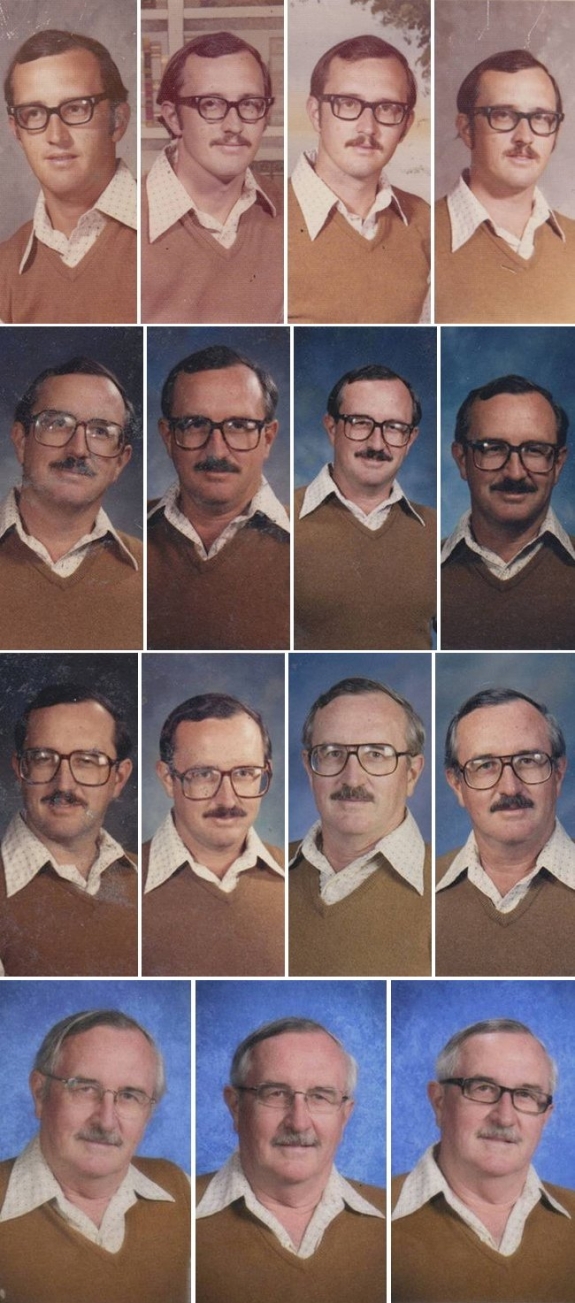
Dale Irby is a school teacher from Dallas, who has been receiving some viral attention lately for wearing the same polyester shirt and vest for his yearbook photo for all 40 years of his career.
Teacher wears same outfit in yearbook photos for 40 years
by noreply@blogger.com (biotv)

Dale Irby is a school teacher from Dallas, who has been receiving some viral attention lately for wearing the same polyester shirt and vest for his yearbook photo for all 40 years of his career.
Irby said what started off as an accident became a running joke that never got old.News.com.au
A sports teacher, Irby usually wore athletic clothes suitable for exercise.
He picked the vest and shirt combination in order to look presentable for his first yearbook photo in 1973 and accidentally repeated the outfit the following year.
"I was so embarrassed when I got the school pictures back that second year and realised I had worn the very same thing as the first year,” he told the Dallas Morning News.
Irby's wife, Cathy dared him to repeat the outfit for a third year. In the spirit of one-upmanship Irby continued the joke for a further five years, after which he thought "why stop?"
13 Jul 04:30


Quit For America?
by Andrew Sullivan
AszilvasyWho's going to write...
Chicago educator Katie Osgood implores Teach For America (TFA) recruits to leave before the school year starts:
TFA claims to fight to end educational inequality and yet ends up exacerbating one of the greatest inequalities in education today: that low-income children of color are much more likely to be given inexperienced, uncertified teachers. TFA’s five weeks of Institute are simply not enough time to prepare anyone, no matter how dedicated or intelligent, to have the skills necessary to help our neediest children. This fall, on that first day of school, you will be alone with kids who need so much more. You will represent one more inequality in our education system denying kids from low-income backgrounds equitable educational opportunities.
She notes that Chicago, where Teach For America places a corps of 500, recently shuttered 50 schools:
As a result, we have thousands of displaced teachers looking for jobs, we have dozens of quality schools of education producing certified teacher candidates-many from the neighborhoods they hope to teach in-all looking for work in Chicago and other urban centers around the country. Just yesterday, I spoke with a fully-qualified new teacher who reported that she will likely have to take substitute positions or do after-school tutoring as there are no full-time jobs being offered in the Chicago Public Schools. Like so many other cities (New York City, Detroit, and Philadelphia to name a few) we have no teacher shortages. We have teacher surpluses. And yet, TFA is still placing first year novice corps members in places like Chicago. To put it bluntly, the last thing our students undergoing mass school closings, budget cuts, and chaotic school policy need is short-term, poorly-trained novices. Teach for America is not needed in Chicago. Teach for America is not needed in most places.
Michael Noll pushes back:
[T]he average classroom experience for U.S. teachers is one year–as per Diane Ravitch, who is no TFA fan. The larger point is that teachers all over the country, regardless of region, are leaving the profession almost immediately after entering it. Partly, they’re leaving because of the lack of union support. But they’re also leaving because schools are, by and large, not supportive environments, either intellectually or professionally or financially. Low-income schools are, of course, hit hardest by this trend. TFA may have imperfect means, but the intentions, I believe, are pure. If teachers leave after two years, that means they spend one more year in the schools than the average U.S. teacher.
Recent Dish on education here, here, and here.
13 Jul 04:26
Dzhokhar Tsarnaev Rushes Out Of Summer Class To Make Court Hearing
AszilvasyThe Onion has been ruthless with these Dzhokhar jokes, I presume parodying those who felt even a twinge of sympathy for the kid. Which always makes me awkwardly laugh, given that I knew the kid and, while thinking he should should spend the rest of his life in prison and wanting him to be caught and suffer the full brunt of the law (Jones, take note--this would be Ablative Absolute in Latin), felt at least a twinge of sadness for him.
BOSTON—After hurriedly gathering papers from his desk and giving a quick nod to his professor, Boston Marathon bombing suspect Dzhokhar Tsarnaev rushed out of his summer engineering class at the University of Massachusetts Dartmouth this morning to ...
12 Jul 11:43


Mental Health Break
by Andrew Sullivan
A quick tour of 26 music genres:
Blindenmuth and -1 others like this
10 Jul 10:15
Legoland Scared of 63-yr.old Man
by lskenazy
Readers — When 63-year-old Lego-lovin’ John St-Onge made the 3-hour drive to Toronto’s Legoland Discovery Centre, he was looking forward to seeing the fantastic displays. Instead, he became one: A perfect display of our society’s Predator Panic.
Arriving without any young kids in tow (though accompanied by his grown daughter), he was barred from entering. That’s the rule. As a spokeswoman later explained: “It is a child attraction so we do have this in place to protect the families and children that visit.”
So…if adults are there on their own, children are automatically at risk? The assumption being that even if not ALL adults are predators, all predators are adults, so let’s ban ‘em?
By that logic, should we allow teachers into school if they don’t bring their offspring with them? Should kids avoid anywhere adults roam free?
In Legoland, all adults are guilty until proven otherwise.
And there’s no way to prove otherwise. – L.

Lego of common sense and treat all men as perverts, including John St-Onge, seen here with a Lego contraption he built.
Pattiparham, Steven Davis likes this
08 Jul 16:39


Now We Should Add FA To LGBT? Ctd
by Andrew Sullivan
Readers push back against the notion that Fat Acceptance (FA) be treated like an oppressed group:
I take issue with Anna Mollow comparing fatness to sexual orientation: “Body size is determined primarily by genetics”. This statement is missing half of the equation. Genetics plus caloric intake determine body size; the two halves necessarily go together. Compare that to sexual orientation: you can be gay and celibate but you’re still gay. If you’re genetically predisposed to fatness but your calorie intake is low (because of food availability, quality, poverty, or whatever), you won’t be fat.
Fat attraction is different. That sounds more like another sexual interest along the great spectrum of human sexuality.
Another reader:
I’m sorry, but give me a freaking break. Do we need a separate acceptance movement for short people?
Or people with ugly noses? With bacne? What about an acceptance movement for unintelligent people with lousy personalities? I mean, why should I have to try and not be a stupid asshole towards people; shouldn’t the onus be on them to accept me for the stupid asshole I am? After all, it’s not like I can control my stupid genes or asshole-ish upbringing!
Look, nobody’s perfect. Some of those imperfections can be fixed, mitigated or papered-over. But sometimes, we just gotta do the best we can with the hand that the good lord dealt us, and hope to meet people who either don’t mind the imperfection or to whom it’s not an imperfection, but a bonus. Demanding that everyone ignore your particular imperfections or be branded some kind of bigot is both unrealistic and a bit self-centered.
And I say this as a fat person whose family is full of fat people. No “thin privilege” here.
Another:
“Body size is determined primarily by genetics.” Anyone who wants to convince us of that needs to explain why our genetic pool has changed so drastically in the past half century to produce the dramatic rise in obesity within the US. Fat-shaming is not cool and may well be counter productive. But if one is going to make extraordinary scientific claims about genetics, one needs to produce extraordinary evidence to back them up.
Another:
If obesity was primarily a genetic disease, you’d see it all over the world, not just in large numbers in the United States. In most other countries in the world, people simply don’t get as fat as they do here. And more interestingly, immigrants from those same countries to the US become obese at the same rates as Americans. Unless people have conditions like hypothyroidism or the rare Prader-Willi syndrome (most obese people don’t), making a comparison between gay people and fat people is irresponsible and unfair to both.
01 Jul 19:56
It's Expensive to Be Poor
by Matthew Yglesias
When I need some cash, I just point my card at the nearest ATM fee and get it. Wells Fargo doesn't charge me fees for withdrawal and they cover the cost of surcharges that non-Wells Fargo banks assess on my withdrawals. But they do that because I have enough money in different Wells Fargo accounts to qualify for a high-end PMA Checking Package in which decent service is provided to valuable customers. If you're too poor to feasibly qualify for a deluxe account, then you're going to get hit by all kinds of fees.
This gets to be a huge problem when your employer decides that it'd be simpler to pay low-level hourly workers by handing them prepaid debit cards, rather than the (apparently more expensive for employers) traditional options.
There's a strong case, I think, for the creation of a "postal banking" system (though I wouldn't actually want the USPS to do it) in which every American would be given a government-run zero-interest no-fee bank account that came equipped with a debit card and in which employers were legally required to offer direct deposit as an option. People would still end up hit with fees when they wanted to withdraw cash from ATMs, but for bill paying and non-cash transactions they could use the debit card and you'd undercut both the traditional high-fee check-cashing industry and the newfangled high-fee prepaid debit card industry. In the long run we should be looking to get rid of paper money altogether, but that means we need to lay the groundwork for a utility-like electronic payments system. For-profit entities could and should build money-making services on top of a free bare-bones government-run utility bank, but it should be possible for low-income people to get paid and go buy groceries without getting held up by fees.
Roger Dufour and -1 others like this
27 Jun 02:18
Scalia, Thomas, Roberts, Alito Suddenly Realize They Will Be Villains In Oscar-Winning Movie One Day
WASHINGTON—Shortly after turning in dissenting opinions in landmark federal rulings today that struck down the Defense of Marriage Act and conferred full federal benefits to married same-sex couples, Supreme Court justices Antonin Scalia, Clarence T...
Yawgmothisking and -1 others like this
22 Jun 00:21
What Cop T-Shirts Tell Us About Police Culture
by Radley Balko
Earlier this week, an anonymous public defender sent Gothamist this photo of an NYPD warrant squad officer wearing a t-shirt with a pretty disturbing quote from Ernest Hemingway:
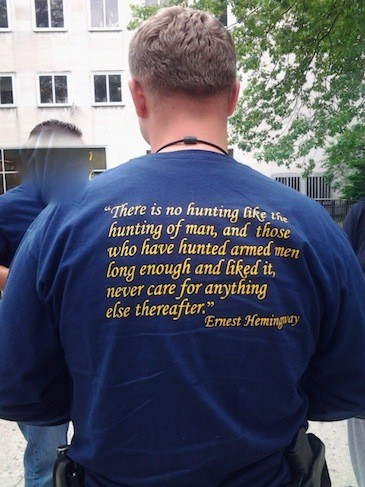
The Village Voice reports that the quote was also printed on t-shirts worn by NYPD's infamous Street Crimes Unit, which was disbanded after shooting unarmed immigrant Amadou Diallo 41 times in 1999 as Diallo reached for his wallet. The Voice also reports that at least two NYPD police commissioners have used the phrase "hunter of men" to describe police work -- Bernard Kerik and Howard Safir.
There have been a number of other incidents over the years in which cops have donned t-shirts that reflect a mentality somewhat less lofty than "protect and serve." Most recently, a Northern California union for school police officers came under fire for printing up and selling these shirts as a fundraiser:
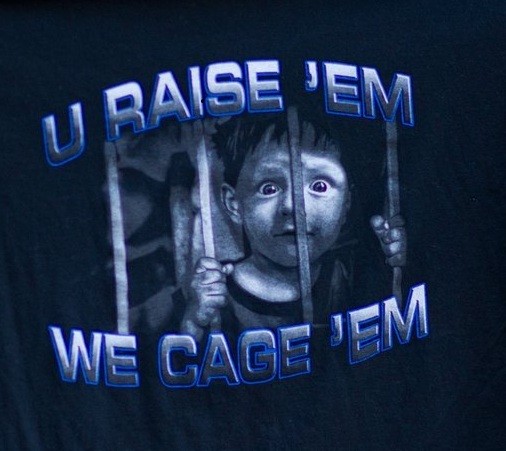
The head of the union later apologized and stopped selling the shirts. In 2008, the Denver police union was caught selling these shirts in advance of the Democratic National Convention, and the accompanying protests the city was expecting:

Charming, no? Police were spotted wearing similar shirts at the 2012 NATO summit in Chicago.
Just before the 1996 DNC in Chicago, a local printer made up a batch of shirts that read, "We kicked your father's ass in 1968 . . . Wait 'til you see what we do to you." The front read: "Chicago Police," and then, "Democratic National Convention Chicago--1996." The shirt wasn't endorsed by Chicago PD or the police union, but it became so popular with city cops that Chicago Mayor Richard Daley issued a warning that any officer seen wearing one would be disciplined. And not just in Chicago. The Chicago Tribune reported at the time that the shirts were also a huge hit at "Police Week," the annual convention of cops in Washington, D.C. They were such a hit in fact, that when "a Washington newspaper tried to do a story on them, the only shirt the paper could find [for sale] to photograph was a bootleg version."
In a 2011 investigative series on police shootings, the Las Vegas Review-Journal revisited a 2003 case in which LVPD Officer Brian Hartman shot and killed a man named Orlando Barlow. Hartman shot Barlow in the back, as he was on his knees, unarmed, and attempting to surrender. According to the Review-Journal, Hartman and the other officers in his unit celebrated the shooting by printing up t-shirts "depicting Hartman's rifle and the initials B.D.R.T. (Baby's Daddy Removal Team), a racially charged term and reference to Barlow, who was black and who was watching his girlfriend's children before he was shot."
That phrase, "Baby Daddy Removal Team," lives on in police culture. In 2011, officers with the Panama City, Florida, Police Department adopted the acronym as the name for their police league kickball team. You can still buy a t-shirt with the slogan from a number of online stores that sell police-themed clothing.
In 1997, police in East Haven, Connecticut, called their own softball team "Boys on the Hood," a cop-ified take on the 1991 John Singleton film. According to the New York Times, the shirts included an image of "officers pressing the heads of two grimacing gang members onto a car hood." The shirts became a source of controversy after a white officer with the department shot black motorist Malik Jones four times at close range, killing him. The officer said Jones' car was rolling backward toward him, and he feared for his life. The department has had a slew of racially-tinged incidents since, most notably in 2009, when a video of police harassment taken by a Hispanic priest was posted online and went viral. Latinos in the area had been reporting frequent incidents of police abuse, and the priest was trying to capture one such incident on camera. Instead, he was arrested. The charges were dropped when his video directly contradicted the officers' account of the incident. Meanwhile, "Boys on the Hood" continues to be a popular slogan for cop-themed t-shirts.
In 2003, officers with the Kern County, California ,Sheriff's Department went beyond t-shirts and put the slogan "We'll Kick Your Ass" directly on the department's squad cars. The sheriff later had them removed. That department too has frequently been in the headlines over the years, most recently in March after deputies beat an unarmed man to death, then attempted to seize the cell phones of witnesses who recorded the beating. It has since been alleged that they deleted some of the captured footage.
In the late 2000s, Daytona Beach, Florida, Police Chief Mike Chitwood sold t-shirts depicting his department as a "scumbag eradication team." Proceeds from the shirts went to fund a mentor program for teens who want to become cops. That department too has had its problems, including questionable dog shootings, a cop accused of shaking down a local Starbucks, and a highly-publicized incident in which an officer Tased a woman at a Best Buy store. In 2012, Florida Circuit Judge Joseph Will called Daytona Beach officers "liars" in dismissing evidence obtained during a drug search.
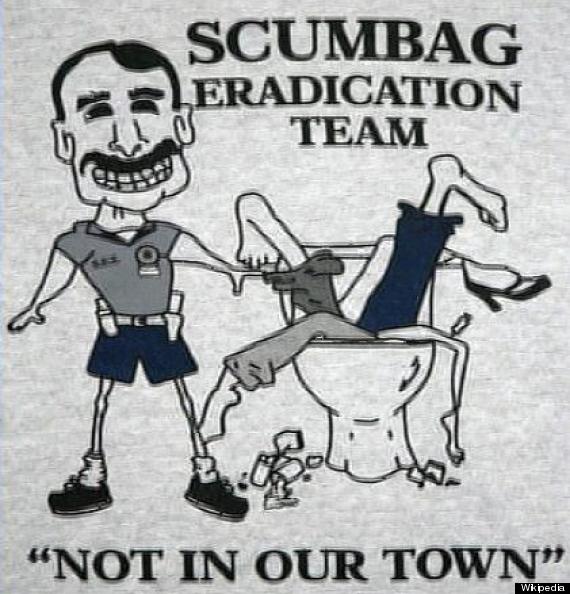
It's no coincidence that the same departments and units caught wearing shirts displaying this sort of attitude tend to also get caught up in controversial beatings, shootings, and other allegations of misconduct and excessive force. The "us vs. them" mindset has become so common in U.S. police culture that we almost take it for granted. In my new book, I argue that this is the result of a generation of incessant rhetoric from politicians who treat cops as if they were soldiers, and policies that train and equip them as if they were fighting a war. The imagery and language depicted on the shirts in these stories are little different than the way pop culture, the military, and government propaganda have depicted the citizens of the countries we've fought in wars over the years.
Within the more militarized units of police departments, the imagery can be even stronger. Former San Jose, California police chief Joseph McNamara told National Journal in 2000 that he was alarmed when he attended a SWAT team conference the previous year and saw “officers . . . wearing these very disturbing shirts. On the front, there were pictures of SWAT officers dressed in dark uniforms, wearing helmets, and holding submachine guns. Below was written: ‘We don’t do drive-by shootings.’ On the back, there was a picture of a demolished house. Below was written: ‘We stop.’” In his 1999 ethnography on police culture, criminologist Peter Kraska writes that one SWAT team member he spent time with "wore a T-shirt that carried a picture of a burning city with gunship helicopters flying overhead and the caption Operation Ghetto Storm."
More recently, the San Jose, California PD's tactical unit (McNamara retired in the 1990s) has received criticism for printing up shirts with this logo:

The message gets even more disturbing in the broader police culture with the gear that's marketed to cops. The police-gear retailer Bullet-50, which according to its out-of-date information page is run by San Fransisco PD officer Joseph Salazar, features shirts that label the wearer a "death dealer," and a "thug hunter."

This shirt is for sale at a number of online shops that cater to police, although it's unclear if it actually originated with anyone from the Chicago Police Department:
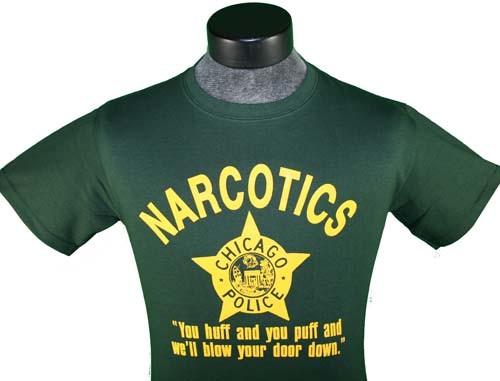
As I've reported here at HuffPost, the shirt isn't wrong -- Chicago cops will indeed blow down your door for smoking pot. And at the same time, it can be difficult to get them interested in, say, investigating an actual assault.
This comment thread at the online police forum PoliceLink has more examples of t-shirts the law enforcement commenters found amusing. Among the comments:
-- "In God we trust, all others get searched,"
-- "A picture of an electric chair with the caption: JUSTICE: Regular or Crispy"
-- "B.D.R.T Baby Daddy Removal Team on the back and the initials on front with handcuffs. You should see peoples faces when I wear it....HAHAHAHA"
-- "Human trash collector. ( above a pair of handcuffs )"
-- "Take No Guff, Cut No Slack, Hook'em, Book'em and Don't Look Back!"
-- "'Boys on the Hood' Pic had two gangbangers jacked up on the hood of a patrol car with two officers."
-- "SWAT T-shirt: 'Happiness is getting the green light!'"
-- "I have one that sates "SWAT SNIPER" on the front and on back it has a picure of a "terrorist" with a shell ripping through his skull and the "pink mist" spraying from the back of his head. Below the picture it reads, "Guerillas in the mist".
-- "Save the police time, beat yourself up"
-- "An ounce of prevention is fine and dandy........ But we prefer 168 grains of cure."
-- "Be good or you might get a visit from the bullet fairy."
-- "Sniper - When you only have 1 shot at an opportunity......We'll make it count"
-- "Law Enforcement......Helping perps slip down stairs since 1766"
-- "Math for Cops.........2 to the chest + 1 to the head = problem solved"
-- "I had a couple of 'em a loooong time ago....1 showed a cop leaning on his rather long nightstick, saying "Police Brutality....the fun part of policework."......obviously not very PC....another was a picture of a LEO with smoke coming from the muzzle of his pistol, with a badguy falling backwards (lookin' like swiss cheese) with the caption.....The best action is OVERREACTION....also not very PC...."
-- "Cops make good roommates...they're used to taking out the trash."
-- "There was also one I saw where there was a big burly looking Sarge behind his desk and the cation read 'It doesn't say kindness and sympathy on the badge.'"
-- "happiness is a confirmed kill"
-- "Park Ranger T-shirt: One of funniest I ever saw: Picture of Smokey the Bear with Riot Gear and he's just poked a protester in the chest with a riot baton. The Caption Reads: "Smokey Don't Play That". Funny!"
-- "My Daddy can Taser your Daddy"
-- "School Patrol - You fail em, we jail em"
-- "Got one that says, "You have the right to remain silent. Anything you say will be misquoted and used against you."
It's worth noting that policing is a high-stress job, and one that often puts officers in contact with some pretty awful things, and in some dangerous situations. Like other high-stress professions, and professions that encounter difficult subject matter -- defense attorneys, medical examiners, emergency room doctors and nurses -- cops often develop a morbid sense of humor. It's a coping mechanism. But it's one thing to crack jokes inside the department, or at the bar after work. It's quite another to openly advertise and promote a culture of abuse. As with most police abuse issues, the real failure here is on the part of the elected officials. They're the ones who can't resist the urge to incessantly declare "war" on things, who are responsible for setting the policies that have given rise to this culture, and who have done little to nothing to rein it in.
Radley Balko is author of the forthcoming book, Rise of the Warrior Cop: The Militarization of America's Police Forces.
The Village Voice reports that the quote was also printed on t-shirts worn by NYPD's infamous Street Crimes Unit, which was disbanded after shooting unarmed immigrant Amadou Diallo 41 times in 1999 as Diallo reached for his wallet. The Voice also reports that at least two NYPD police commissioners have used the phrase "hunter of men" to describe police work -- Bernard Kerik and Howard Safir.
There have been a number of other incidents over the years in which cops have donned t-shirts that reflect a mentality somewhat less lofty than "protect and serve." Most recently, a Northern California union for school police officers came under fire for printing up and selling these shirts as a fundraiser:
The head of the union later apologized and stopped selling the shirts. In 2008, the Denver police union was caught selling these shirts in advance of the Democratic National Convention, and the accompanying protests the city was expecting:
Charming, no? Police were spotted wearing similar shirts at the 2012 NATO summit in Chicago.
Just before the 1996 DNC in Chicago, a local printer made up a batch of shirts that read, "We kicked your father's ass in 1968 . . . Wait 'til you see what we do to you." The front read: "Chicago Police," and then, "Democratic National Convention Chicago--1996." The shirt wasn't endorsed by Chicago PD or the police union, but it became so popular with city cops that Chicago Mayor Richard Daley issued a warning that any officer seen wearing one would be disciplined. And not just in Chicago. The Chicago Tribune reported at the time that the shirts were also a huge hit at "Police Week," the annual convention of cops in Washington, D.C. They were such a hit in fact, that when "a Washington newspaper tried to do a story on them, the only shirt the paper could find [for sale] to photograph was a bootleg version."
In a 2011 investigative series on police shootings, the Las Vegas Review-Journal revisited a 2003 case in which LVPD Officer Brian Hartman shot and killed a man named Orlando Barlow. Hartman shot Barlow in the back, as he was on his knees, unarmed, and attempting to surrender. According to the Review-Journal, Hartman and the other officers in his unit celebrated the shooting by printing up t-shirts "depicting Hartman's rifle and the initials B.D.R.T. (Baby's Daddy Removal Team), a racially charged term and reference to Barlow, who was black and who was watching his girlfriend's children before he was shot."
That phrase, "Baby Daddy Removal Team," lives on in police culture. In 2011, officers with the Panama City, Florida, Police Department adopted the acronym as the name for their police league kickball team. You can still buy a t-shirt with the slogan from a number of online stores that sell police-themed clothing.
In 1997, police in East Haven, Connecticut, called their own softball team "Boys on the Hood," a cop-ified take on the 1991 John Singleton film. According to the New York Times, the shirts included an image of "officers pressing the heads of two grimacing gang members onto a car hood." The shirts became a source of controversy after a white officer with the department shot black motorist Malik Jones four times at close range, killing him. The officer said Jones' car was rolling backward toward him, and he feared for his life. The department has had a slew of racially-tinged incidents since, most notably in 2009, when a video of police harassment taken by a Hispanic priest was posted online and went viral. Latinos in the area had been reporting frequent incidents of police abuse, and the priest was trying to capture one such incident on camera. Instead, he was arrested. The charges were dropped when his video directly contradicted the officers' account of the incident. Meanwhile, "Boys on the Hood" continues to be a popular slogan for cop-themed t-shirts.
In 2003, officers with the Kern County, California ,Sheriff's Department went beyond t-shirts and put the slogan "We'll Kick Your Ass" directly on the department's squad cars. The sheriff later had them removed. That department too has frequently been in the headlines over the years, most recently in March after deputies beat an unarmed man to death, then attempted to seize the cell phones of witnesses who recorded the beating. It has since been alleged that they deleted some of the captured footage.
In the late 2000s, Daytona Beach, Florida, Police Chief Mike Chitwood sold t-shirts depicting his department as a "scumbag eradication team." Proceeds from the shirts went to fund a mentor program for teens who want to become cops. That department too has had its problems, including questionable dog shootings, a cop accused of shaking down a local Starbucks, and a highly-publicized incident in which an officer Tased a woman at a Best Buy store. In 2012, Florida Circuit Judge Joseph Will called Daytona Beach officers "liars" in dismissing evidence obtained during a drug search.
It's no coincidence that the same departments and units caught wearing shirts displaying this sort of attitude tend to also get caught up in controversial beatings, shootings, and other allegations of misconduct and excessive force. The "us vs. them" mindset has become so common in U.S. police culture that we almost take it for granted. In my new book, I argue that this is the result of a generation of incessant rhetoric from politicians who treat cops as if they were soldiers, and policies that train and equip them as if they were fighting a war. The imagery and language depicted on the shirts in these stories are little different than the way pop culture, the military, and government propaganda have depicted the citizens of the countries we've fought in wars over the years.
Within the more militarized units of police departments, the imagery can be even stronger. Former San Jose, California police chief Joseph McNamara told National Journal in 2000 that he was alarmed when he attended a SWAT team conference the previous year and saw “officers . . . wearing these very disturbing shirts. On the front, there were pictures of SWAT officers dressed in dark uniforms, wearing helmets, and holding submachine guns. Below was written: ‘We don’t do drive-by shootings.’ On the back, there was a picture of a demolished house. Below was written: ‘We stop.’” In his 1999 ethnography on police culture, criminologist Peter Kraska writes that one SWAT team member he spent time with "wore a T-shirt that carried a picture of a burning city with gunship helicopters flying overhead and the caption Operation Ghetto Storm."
More recently, the San Jose, California PD's tactical unit (McNamara retired in the 1990s) has received criticism for printing up shirts with this logo:
The message gets even more disturbing in the broader police culture with the gear that's marketed to cops. The police-gear retailer Bullet-50, which according to its out-of-date information page is run by San Fransisco PD officer Joseph Salazar, features shirts that label the wearer a "death dealer," and a "thug hunter."
This shirt is for sale at a number of online shops that cater to police, although it's unclear if it actually originated with anyone from the Chicago Police Department:
As I've reported here at HuffPost, the shirt isn't wrong -- Chicago cops will indeed blow down your door for smoking pot. And at the same time, it can be difficult to get them interested in, say, investigating an actual assault.
This comment thread at the online police forum PoliceLink has more examples of t-shirts the law enforcement commenters found amusing. Among the comments:
-- "In God we trust, all others get searched,"
-- "A picture of an electric chair with the caption: JUSTICE: Regular or Crispy"
-- "B.D.R.T Baby Daddy Removal Team on the back and the initials on front with handcuffs. You should see peoples faces when I wear it....HAHAHAHA"
-- "Human trash collector. ( above a pair of handcuffs )"
-- "Take No Guff, Cut No Slack, Hook'em, Book'em and Don't Look Back!"
-- "'Boys on the Hood' Pic had two gangbangers jacked up on the hood of a patrol car with two officers."
-- "SWAT T-shirt: 'Happiness is getting the green light!'"
-- "I have one that sates "SWAT SNIPER" on the front and on back it has a picure of a "terrorist" with a shell ripping through his skull and the "pink mist" spraying from the back of his head. Below the picture it reads, "Guerillas in the mist".
-- "Save the police time, beat yourself up"
-- "An ounce of prevention is fine and dandy........ But we prefer 168 grains of cure."
-- "Be good or you might get a visit from the bullet fairy."
-- "Sniper - When you only have 1 shot at an opportunity......We'll make it count"
-- "Law Enforcement......Helping perps slip down stairs since 1766"
-- "Math for Cops.........2 to the chest + 1 to the head = problem solved"
-- "I had a couple of 'em a loooong time ago....1 showed a cop leaning on his rather long nightstick, saying "Police Brutality....the fun part of policework."......obviously not very PC....another was a picture of a LEO with smoke coming from the muzzle of his pistol, with a badguy falling backwards (lookin' like swiss cheese) with the caption.....The best action is OVERREACTION....also not very PC...."
-- "Cops make good roommates...they're used to taking out the trash."
-- "There was also one I saw where there was a big burly looking Sarge behind his desk and the cation read 'It doesn't say kindness and sympathy on the badge.'"
-- "happiness is a confirmed kill"
-- "Park Ranger T-shirt: One of funniest I ever saw: Picture of Smokey the Bear with Riot Gear and he's just poked a protester in the chest with a riot baton. The Caption Reads: "Smokey Don't Play That". Funny!"
-- "My Daddy can Taser your Daddy"
-- "School Patrol - You fail em, we jail em"
-- "Got one that says, "You have the right to remain silent. Anything you say will be misquoted and used against you."
It's worth noting that policing is a high-stress job, and one that often puts officers in contact with some pretty awful things, and in some dangerous situations. Like other high-stress professions, and professions that encounter difficult subject matter -- defense attorneys, medical examiners, emergency room doctors and nurses -- cops often develop a morbid sense of humor. It's a coping mechanism. But it's one thing to crack jokes inside the department, or at the bar after work. It's quite another to openly advertise and promote a culture of abuse. As with most police abuse issues, the real failure here is on the part of the elected officials. They're the ones who can't resist the urge to incessantly declare "war" on things, who are responsible for setting the policies that have given rise to this culture, and who have done little to nothing to rein it in.
Radley Balko is author of the forthcoming book, Rise of the Warrior Cop: The Militarization of America's Police Forces.
21 Jun 19:58
5 True Stories That Shatter Your Image of Famous Rock Icons
AszilvasyHaha. Tommy HF beat up Alx Rose...
By Adam Tod Brown Published: April 30th, 2013
Music history is littered with rebellious figures who courted controversy at every turn in their career. Some of the more troubled of these souls succumbed to their respective demons and left us while their badassery was still in its relative prime a


21 Jun 14:25

Elvert Barnes/Flickr
Did you catch the controversial Melissa Harris-Perry TV spot? The MSNBC personality has been ridiculed by conservatives and libertarians since she suggested that the United States hasn't invested as much in public education as we should have because we have "this private notion of children." We think, "Your kid is yours, and totally your responsibility," she argued, rather than "these are our children." She went on to argue that a necessary remedy is to "break through" the "private idea" that "kids belong to their parents, or kids belong to their families," and to recognize that kids belong to whole communities. "Once it's everybody's responsibility, and not just the household's," she concluded, "then we start making better investments."
Hmm.
Did she really mean that kids don't belong to their parents or families, but to the community at large? Or did she do a terrible job of expressing the distinct argument that members of communities have some obligations to all the children within them, not just the members of their own families? It's hard to say. Her follow-up post conflates distinct concepts so much I can't tell.
What I can do is to explain why, as someone who supports well-funded public schools, a social safety net, neighborhoods with "eyes on the street" (per Jane Jacobs), charitable work on behalf of needy kids, and an ethos of looking out for any kid who finds him or herself in need of adult assistance, I emphatically believe that "your kid is yours, and totally your responsibility," that "kids belong to their families," not to their communities, and that the converse formulation is dangerous.
It is dangerous in part because children are raised by individuals, not diffuse collectives. Mother and father are in fact responsible for getting baby her shots, strapping her into the car seat, childproofing the house, noticing her allergic reaction to peanuts, and enrolling her in primary school. If they fail to do these things, or to find someone who'll do them on their behalf, baby suffers. A kindly passerby won't peek through the living-room window, notice the child crying, and attend to it. I suspect that if a young couple leaving the hospital, newborn in arms, were to ask Harris-Perry for advice, she would not tell them, "Don't worry, this kid isn't all your responsibility." The fact that most parents feel this responsibility deep within them is literally indispensable to our civilization. Kids whose parents don't feel or ignore it are often seriously disadvantaged.
Recognizing that parents bear primary responsibility for their children's well-being isn't just important for most families. It is a collective necessity in any pluralistic society. Progressives are prone to talking as if optimal policies and methods can be agreed upon if only right-thinking people vest trust in appropriately enlightened technocrats. But outside the wonk bubble, Americans have deep, legitimate disagreements about what ought to happen. Child rearing is no exception. If kids belong to their families, some can spend their Saturdays taking piano lessons, others can mark the Jewish Sabbath, and still others can play baseball or attend Chinese or Korean school.
"Can you believe the Nguyens let Johnny race dirt bikes?"
"I don't care if Caitlin's mom is letting her go."
"My son will not be one of those Muslims who never learns the Koran."
Parents raising their own children as they see fit can disagree vehemently, even on deeply held values, and coexist with nothing more dramatic than incredulous bitching to their spouses about other nearby parents. Conceive of the community as ultimately responsible for raising kids and see how suddenly, intractably contentious and upsetting a formerly thriving place becomes. A secular progressive parent put in a small town of devout Mormons would be the first to tell you that he gets to decide how to raise his kids, not the community. He would be exactly right. Parents get to decide how to raise their kids. Their neighbors ought to help them succeed, but have no claim to the kids.
There are, of course, unfit parents. Fathers who beat their sons. Mothers who get their three-year-olds high. Those kids should be taken away. Like all humans, they possess individual rights. But what those children then want and need -- much more than a community that feels collective responsibility for its children -- is to be placed in a specific family with individuals who'll love them like family. That is far more valuable to them than a community with an abstract investment in them. If their adopted parents love them as their own -- which is to say, prefer them to all other children, and are willing to sacrifice more for them than anyone else -- that is a beautiful thing. Better two loving parents than 200,000 taxpayers with an impersonal responsibility for one's welfare.
You can only have both if the family is in charge.
****
Free Range Kids is one parents' movement I follow with interest. It's a reaction against helicopter parenting. Its adherents believe that by giving their children extra independence at an early age, encouraging them to solve their own problems, and permitting them to take reasonable risks rather than being overprotective to the point of paranoia, they'll raise happier, healthier, more confident, independent people. They all put a great deal of thought into their parenting.
The group's blog recently featured a story written by a parent who reported that Child Protective Services wants to take custody of their daughter. It is both relevant and worthy of attention in its own right.
"We've taught our six-year-old, whom I'll call Emily, about crossing the street, reading maps, etc. As she's learned these skills we've let her try them out, first with supervision, and then on her own, to make short trips around the neighborhood," the parent writes. "We live in a fairly average residential neighborhood that has a mixture of stop signs, stop lights, and crosswalks. The state that we live in does not have any laws regarding a minimum age for a child to be unattended."
Here is his saga:


Thank Goodness Kids Do Belong to Their Parents
by Conor Friedersdorf
AszilvasyTouches on some topics--and, for two of you, current or soon-to-be current issues.
Elvert Barnes/Flickr
Did you catch the controversial Melissa Harris-Perry TV spot? The MSNBC personality has been ridiculed by conservatives and libertarians since she suggested that the United States hasn't invested as much in public education as we should have because we have "this private notion of children." We think, "Your kid is yours, and totally your responsibility," she argued, rather than "these are our children." She went on to argue that a necessary remedy is to "break through" the "private idea" that "kids belong to their parents, or kids belong to their families," and to recognize that kids belong to whole communities. "Once it's everybody's responsibility, and not just the household's," she concluded, "then we start making better investments."
Hmm.
Did she really mean that kids don't belong to their parents or families, but to the community at large? Or did she do a terrible job of expressing the distinct argument that members of communities have some obligations to all the children within them, not just the members of their own families? It's hard to say. Her follow-up post conflates distinct concepts so much I can't tell.
What I can do is to explain why, as someone who supports well-funded public schools, a social safety net, neighborhoods with "eyes on the street" (per Jane Jacobs), charitable work on behalf of needy kids, and an ethos of looking out for any kid who finds him or herself in need of adult assistance, I emphatically believe that "your kid is yours, and totally your responsibility," that "kids belong to their families," not to their communities, and that the converse formulation is dangerous.
It is dangerous in part because children are raised by individuals, not diffuse collectives. Mother and father are in fact responsible for getting baby her shots, strapping her into the car seat, childproofing the house, noticing her allergic reaction to peanuts, and enrolling her in primary school. If they fail to do these things, or to find someone who'll do them on their behalf, baby suffers. A kindly passerby won't peek through the living-room window, notice the child crying, and attend to it. I suspect that if a young couple leaving the hospital, newborn in arms, were to ask Harris-Perry for advice, she would not tell them, "Don't worry, this kid isn't all your responsibility." The fact that most parents feel this responsibility deep within them is literally indispensable to our civilization. Kids whose parents don't feel or ignore it are often seriously disadvantaged.
Recognizing that parents bear primary responsibility for their children's well-being isn't just important for most families. It is a collective necessity in any pluralistic society. Progressives are prone to talking as if optimal policies and methods can be agreed upon if only right-thinking people vest trust in appropriately enlightened technocrats. But outside the wonk bubble, Americans have deep, legitimate disagreements about what ought to happen. Child rearing is no exception. If kids belong to their families, some can spend their Saturdays taking piano lessons, others can mark the Jewish Sabbath, and still others can play baseball or attend Chinese or Korean school.
"Can you believe the Nguyens let Johnny race dirt bikes?"
"I don't care if Caitlin's mom is letting her go."
"My son will not be one of those Muslims who never learns the Koran."
Parents raising their own children as they see fit can disagree vehemently, even on deeply held values, and coexist with nothing more dramatic than incredulous bitching to their spouses about other nearby parents. Conceive of the community as ultimately responsible for raising kids and see how suddenly, intractably contentious and upsetting a formerly thriving place becomes. A secular progressive parent put in a small town of devout Mormons would be the first to tell you that he gets to decide how to raise his kids, not the community. He would be exactly right. Parents get to decide how to raise their kids. Their neighbors ought to help them succeed, but have no claim to the kids.
There are, of course, unfit parents. Fathers who beat their sons. Mothers who get their three-year-olds high. Those kids should be taken away. Like all humans, they possess individual rights. But what those children then want and need -- much more than a community that feels collective responsibility for its children -- is to be placed in a specific family with individuals who'll love them like family. That is far more valuable to them than a community with an abstract investment in them. If their adopted parents love them as their own -- which is to say, prefer them to all other children, and are willing to sacrifice more for them than anyone else -- that is a beautiful thing. Better two loving parents than 200,000 taxpayers with an impersonal responsibility for one's welfare.
You can only have both if the family is in charge.
****
Free Range Kids is one parents' movement I follow with interest. It's a reaction against helicopter parenting. Its adherents believe that by giving their children extra independence at an early age, encouraging them to solve their own problems, and permitting them to take reasonable risks rather than being overprotective to the point of paranoia, they'll raise happier, healthier, more confident, independent people. They all put a great deal of thought into their parenting.
The group's blog recently featured a story written by a parent who reported that Child Protective Services wants to take custody of their daughter. It is both relevant and worthy of attention in its own right.
"We've taught our six-year-old, whom I'll call Emily, about crossing the street, reading maps, etc. As she's learned these skills we've let her try them out, first with supervision, and then on her own, to make short trips around the neighborhood," the parent writes. "We live in a fairly average residential neighborhood that has a mixture of stop signs, stop lights, and crosswalks. The state that we live in does not have any laws regarding a minimum age for a child to be unattended."
Here is his saga:
Day 1: Six-year-old "Emily" walks three blocks by herself to the post office for the second time. This is after having made the trip with her many times in past through our quiet, residential neighborhood. All the streets have sidewalks, and the walk requires crossing one 'T' intersection that has a stop sign and crossing at a traffic light.
Day 2: "Emily" and I are both walking back from the library. She wants to do it herself, so I let her walk separate from me some of the time. The cops get a phone call from a concerned citizen who says there's a strange guy talking to a little girl. Three officers respond and cite a concern for Emily's safety in crossing the street. I confirm that I am her father and give my name, as is required by law. They refuse to state any reasonable suspicion of a crime being committed or say what law has been broken, and so, in accordance with my 5th amendment rights, I refuse to answer any questions. We are detained for over half an hour before being released. (I asked many times over the course of the detention whether I was "free to go" and I was told that I was not. We were told that we were being held for an "investigative detention.") The sergeant who responded to the scene stated over the radio that he wanted to "hook this guy" for child endangerment. (The recording of radio traffic during the encounter was later received through a public records request that I made.)
Day 6: I call the sergeant who reported on Day 2 to ask if we were still under investigation. He responded that we were not and that an "incident supplement" had been filed by the reporting officer and "that was all." He confirms that there is no law prohibiting a school-age child from crossing residential streets. That afternoon we let Emily walk to the post office to mail a letter. The same officers who responded on Day 2 remove Emily from the post office and detain her. Contrary to the complaint that is filed later, they do not contact me -- I go looking for her when she doesn't come right back home -- and they refuse many times to release her. According to the complaint, Emily, who has known her phone number and address for quite some time, refuses to give them to the officers, but the officers know who she is, who I am, and where we live.
Day 7: A social worker with CPS leaves a letter at my door addressed to a different person than anyone in my family. I mail it back.
Day 12: CPS leaves a letter addressed to my wife and I that cites unspecified concerns about the children.
Day 13: I call CPS twice and leave a message. The phone call is not returned for two days.
Day 14: We give Emily the Free Range Kid ID card to function as a sort of "permission slip" so that she can demonstrate to other people that she has not merely escaped unnoticed. Then we let Emily go to the post office again. When she is just around the corner from the house on her way home, she is stopped by a city utility worker and a school bus driver (though she is not enrolled in public school). She calls me on the cell phone since the bus driver is preventing her from leaving, so I go get her. That night two officers knock on the door, but we do not answer.
Day 15: I talk with the supervisor at CPS on a recorded phone call. I refuse to answer any questions or make any statements. Though he did relay that he was concerned about a child "roaming the streets of [Our City, OH]," he refuses to tell me what law has been broken. We go around and around for about 25 minutes. I find out through my employer shortly after the phone call that if I do not "cooperate" CPS is threatening to seek an ex parte* order, which would allow CPS to take custody without a hearing, to separate us that Friday (and then keep Emily all weekend since a hearing would not have to be held until close of business on Monday). Note that I have cooperated to the full extent required by law. The Home School Legal Defense Assn. is very helpful in getting CPS to agree not to seek an ex parte order so long as Emily does not go outside again by herself.
Since then CPS has knocked on the door many times. I did answer the door when the CPS supervisor came by -- I thought that he was a delivery guy or what not since he didn't have a uniformed police officer with him -- but otherwise we have simply ignored them. There is no law requiring someone to answer their door, and since I had no interest in talking to them or getting detained by the cops simply ignoring them seemed the best course of action.
Day 41: We are served with a complaint alleging neglect and dependency. The County wants to take Emily into "protective supervision" or "temporary custody." The complaint contains many factual errors and inaccuracies. There is also a motion for "pre-dispositional interim orders." As I understand it, this is a mechanism by which CPS can intervene even before the merits of the case against us for neglect are even heard, but less decided. It is scheduled to take place more than a month before the hearing on the neglect charge. It asks the court to force my wife and I to "allow ______ County Children Services to complete an assessment with the family. This is including allowing the agency access in the home, allowing the agency to interview the children, and participate openly in the assessment process." In other words, they want to search our house, interrogate the children, and force us to testify.
He concludes, "We are trying our best to raise Emily to be responsible, curious, and capable. We have chosen to include teaching her about using the library, navigating the neighborhood, and mailing letters as elements of her homeschooling. Needless to say, this entire ordeal has been quite distressing for the entire family, and we view it as a threat to our homeschooling, our parental rights, and both my and Emily's civil liberties. Since our family is being threatened by legal action, I have tried to confine my comments to a dispassionate statement of known facts."
I suspect opinions about the wisdom of this man's parenting will be sharply divided, as will opinions on the particular way that he handled the bureaucratic requests made of him. His case is interesting for our purposes because he very much wants to take full responsibility for raising his child -- and his community very much wants to take responsibility too. Who should win in this conflict? I emphatically side with the parents. I suspect some left-leaning readers will side against the parents in the abstract (though I hope I'm wrong about that). But does any reader think that little Emily would be better off being cared for by Child Protective Services or the foster system?
Does Harris-Perry? If not, why?
It sounds warm and fuzzy to say, abstractly, that a child belongs "to the entire community." What that means, concretely, is being shuffled from family court judge to bureaucrat to group house. Save in extraordinary circumstances, the "private idea" that "kids belong to their parents" serves them best, and doesn't at all preclude helping parents who struggle to fulfill their responsibility.
    
|
Ibktim likes this
21 Jun 14:08


Does Your Child Belong To You?
by Andrew Sullivan
AszilvasyAttempting to destroy (while perhaps oversimplifying?) the earlier one.
Responding to Melissa Harris-Perry’s TV spot for MSNBC (seen above), Friedersdorf pushes back against the idea of collective or communal responsibility for children:
Parents raising their own children as they see fit can disagree vehemently, even on deeply held values, and coexist with nothing more dramatic than incredulous bitching to their spouses about other nearby parents. Conceive of the community as ultimately responsible for raising kids and see how suddenly, intractably contentious and upsetting a formerly thriving place becomes. A secular progressive parent put in a small town of devout Mormons would be the first to tell you that he gets to decide how to raise his kids, not the community. He would be exactly right. Parents get to decide how to raise their kids. Their neighbors ought to help them succeed, but have no claim to the kids.
Harris-Perry responds to critics here. Update from a reader:
I saw the criticisms of this video making the rounds on my conservative in-laws’ facebook pages, and their angry rants about how no else can make decisions about their children, a more vitriolic version of Friedersdorf’s comments. Their interpretation of Harris-Perry’s video is entirely misguided. She is not saying that anyone has a LEGAL interest in your kids.
Look, none of us want your kids, okay? None of us want to take them away from you, or force you to make certain decisions. She is saying that we all need to think of children as a collective asset of our society. I don’t want your kids, but I do want your kids to grow up educated, productive, and thoughtful members of society. That’s good for me, for my kids, and everyone else. That’s why we need to vote to fund schools, to keep funding for school lunches and other programs that benefit less well-off kids, not mention public preschools and all-day kindergartens, programs that are proven effective.
My in-laws would probably vote to cut funding for public education because their kids don’t go to public schools, and anyway they think the curriculum is extremely suspect because it doesn’t involve enough Christian(ist!) values. They think that raising their kids is a private endeavor, and increasingly try to do it away from society. This intensely private mindset is what Harris-Perry is railing against. Society has an interest in the welfare of our kids, and we should continue to try to support them as best we can. It’s called a civilization. Everybody should try it.
Another:
Conor thinks communal parenting is a nonstarter. I believe this is because he has not raised kids yet. We were fortunate to move to a great neighborhood when our kids were young and we are still there. All of our kids are grown and we are so glad we had all the help we did raising them. Our educational, career and religious backgrounds were all over the place. We were Catholic, Jewish, black, Hispanic, blue and white collar. We helped raise each other’s kids in the sense that we made the neighborhood safe, we participated in Scouts, baseball and the PTA. When we saw our kids out in public acting like fools we admonished them and then called their parents. We put them in our cars with wet swim suits and bloody noses. They slept on our floors and cried on our shoulders.
We didn’t interfere with the parenting of other houses nor them ours. The values each parent imparted were theirs alone. No one criticized or belittled anyone. That is your prerogative as a parent and we were not intent on sabotaging that.
As a result our kids are all grown. When they came home from college or the Army they reveled in being in the neighborhood where everyone knew and loved them. When a set of parents died we unofficially adopted the three kids (all in their 20s) so they would have Christmas, birthdays etc. Last weekend we went to a wedding of one of the neighborhood kids. It was a lot of fun as we don’t see each other as often. What touched me the most was all of our kids said to us and each other that they hope when they get married and have kids they will end up in a neighborhood like ours. They want help raising their kids just like we had.
Another:
Don’t feed the trolls. Friedersdorf is placing himself as one among many of the continually offended wing-nuts. This is just a retread of the “you didn’t build that” bullshit taken completely out of context and spun to put the perpetually panicked pundits into overdrive. “OUTRAGE!™”
The reader you quote is 100% correct in their assessment. Even when I was in my early 30s and wasn’t sure if I’d marry much less ever have kids, I recognized the importance of a well-funded school system even while many around me had determined that since they had no kids (or they had already completed their public education), they shouldn’t have to pay taxes for schools. I recognized how a knowledgable, educated, well-rounded citizenry benefits everyone in the society. Lacking any real semblance of empathy or even the ability to see beyond their noses is the hallmark of today’s Republicans and libertarians. Their childish and simplistic policy proposals stem from their childish and simplistic views of life.
21 Jun 13:54
 Reuters
Rand Paul's Wednesday speech at Howard University is significant mostly because it's a very public attempt by an ambitious Republican to engage black voters, a core Democratic constituency. For analysis on that angle, don't miss Jordan Bloom at The American Conservative, Dave Weigel at Slate, Adam Serwer at Mother Jones, Jack White at The Root, and Josh Kraushaar at National Journal. The speech showcased some of the Kentucky senator's strengths and too many avoidable weaknesses to be considered a total success, but efforts like these will pay dividends for Paul if he keeps making them and learns something from each outing. This small beginning is enough to establish him as better on outreach than most in his party.
But I'd like to focus on a passage that could be found in any speech that Paul gives and suggest a different approach. Summing up the Republican philosophy about government, he bundles a bunch of policy stances together that GOP candidates would be wise to disaggregate. Said Paul:
Put another way, it is irrational for Republicans to be ambivalent about the difference between Denmark and France. But neither the GOP nor the conservative movement seems able or willing to distinguish them from one another. They're conceived in the popular imagination of right-leaning Americans as bastions of big-government socialism that might as well be identical. I'd rather live in America than Denmark or France. But as Jason Brennan once put it in his book Libertarianism, "There's a difference between the administrative state -- which tries to control, regulate, and manage the economy (and everything else), and the social insurance state, which taxes citizens and provides publicly-funded social insurance. Hard libertarians oppose both the administrative state and the social insurance state, because they believe both violate people's rights. Classical liberals and neoclassical liberals dislike the administrative state for a variety of reasons. But they are more open to the social insurance state. The social insurance state, by itself, if run properly, still allows citizens an expansive range of economic freedom."
The GOP can expand that range of freedom even if it loses on social insurance. The proof:
It's also possible that voters would prefer generous social insurance and a smaller administrative state ... but that forced to choose between shrinking or growing both they'd grow 'em.
The distinction I'm suggesting would seem to make particular sense for a Republican Party that never in fact cuts major entitlement spending anyway. Paul Ryan, who is held up within the GOP as an allegedly courageous fiscal conservative, insists that the current cohort of seniors shouldn't see any reductions in Social Security or Medicare spending -- his cuts are always scheduled to take place many election cycles from now in a distant year when, according to the life plan I can't imagine he doesn't have, he's president or a senator or a game-the-system executive.
"I disagree with my Democratic colleagues about how sustainable our entitlement spending is, and how much any one person should be asked to pay in taxes," Senator Paul or one of his GOP colleagues could say, "and we'll probably continue agreeing to disagree about those questions. What I can't understand is why Democrats won't work with me to make it as easy to open and run a business here as it is in Denmark. Why they won't help me to reform a regulatory regime that advantages big corporations that can navigate the red tape and hurts upstart entrepreneurs who can't afford to compete in a way that is required for a healthy economy?"
There are a dozen similar digs someone like Paul could make, and a dozen sharp Democratic retorts. The upshot might be, "We'd agree to a freer market if you'd agree to take better care of its inevitable losers." Even Republicans who'd regard that as a hard compromise to swallow should ponder whether it would in fact be an improvement on the status quo. I think it would be, especially if conservatives made a concurrent attempt at manifesting the sort of social safety net Matt Yglesias once described: "Typically when you see a safety net in place, you're not really looking at someone who's trying to be safe. You're looking at someone who's trying to do something dangerous. Because it's dangerous, there's a safety net in place. But the main point of the net is to facilitate risk-taking behavior not to make you safer than the average person."
Friedrich Hayek, who showed that support for a safety net can co-exist with a deep appreciation for the freedom and utility of markets, has more to offer the right at present than Ayn Rand.


A Less Intrusive Government Could Still Maintain a Safety Net
by Conor Friedersdorf
Reuters Rand Paul's Wednesday speech at Howard University is significant mostly because it's a very public attempt by an ambitious Republican to engage black voters, a core Democratic constituency. For analysis on that angle, don't miss Jordan Bloom at The American Conservative, Dave Weigel at Slate, Adam Serwer at Mother Jones, Jack White at The Root, and Josh Kraushaar at National Journal. The speech showcased some of the Kentucky senator's strengths and too many avoidable weaknesses to be considered a total success, but efforts like these will pay dividends for Paul if he keeps making them and learns something from each outing. This small beginning is enough to establish him as better on outreach than most in his party.
But I'd like to focus on a passage that could be found in any speech that Paul gives and suggest a different approach. Summing up the Republican philosophy about government, he bundles a bunch of policy stances together that GOP candidates would be wise to disaggregate. Said Paul:
Democrats still promise unlimited federal assistance and Republicans promise free markets, low taxes, and less regulations that we believe will create more jobs. The Democrat promise is tangible and puts food on the table, but too often doesn't lead to jobs or meaningful success. The Republican promise is for policies that create economic growth. Republicans believe lower taxes, less regulation, balanced budgets, a solvent Social Security and Medicare will stimulate economic growth.What I'd love to see Republicans do, for political and substantive reasons, is to emphasize the distinctness of these questions: (1) How generous and expansive should the safety net be? and (2) How free should the market be? The safety net's size, the level of taxation it requires, and the attendant affect on the economy are vital subjects, and can't be totally separated from the balance of economic policy -- a safety net that provided any layabout with a $100,000 annual living stipend would quickly distort incentives and bankrupt the nation. Still, you'd never know from Republican Party rhetoric that a nation can choose, for better or worse, to have a relatively generous safety net and a government that doesn't otherwise intrude unduly into the free market.
... High taxes and excessive regulation and massive debt are not working. The economy has been growing at less than 1 percent and actually contracted in the fourth quarter. If you are struggling to get ahead, if you have school loans and personal debt, you should choose a political party that wants to leave more money in the private sector so you will get a job when the time comes.
Put another way, it is irrational for Republicans to be ambivalent about the difference between Denmark and France. But neither the GOP nor the conservative movement seems able or willing to distinguish them from one another. They're conceived in the popular imagination of right-leaning Americans as bastions of big-government socialism that might as well be identical. I'd rather live in America than Denmark or France. But as Jason Brennan once put it in his book Libertarianism, "There's a difference between the administrative state -- which tries to control, regulate, and manage the economy (and everything else), and the social insurance state, which taxes citizens and provides publicly-funded social insurance. Hard libertarians oppose both the administrative state and the social insurance state, because they believe both violate people's rights. Classical liberals and neoclassical liberals dislike the administrative state for a variety of reasons. But they are more open to the social insurance state. The social insurance state, by itself, if run properly, still allows citizens an expansive range of economic freedom."
The GOP can expand that range of freedom even if it loses on social insurance. The proof:
Denmark ranks much higher than the United States on property rights, freedom from corruption, business freedom, monetary freedom, trade freedom, investment freedom, and financial freedom. Denmark also rates 99.1 in business freedom, 90.0 in investment freedom, and 90.0 in financial freedom. In comparison, the US scores 91.1, 70.0, and 70.0 respectively on these measures.It's plausible to imagine an America where citizens preferred a social-insurance state like what we have now, or slightly bigger, but an administrative state that is smaller and more constrained. My instinct is certainly that Republicans would have more success at this particular moment attacking and reforming the administrative state than significantly shrinking Medicare and Social Security. And administrative-state reforms could help stimulate significant economic growth.
It's also possible that voters would prefer generous social insurance and a smaller administrative state ... but that forced to choose between shrinking or growing both they'd grow 'em.
The distinction I'm suggesting would seem to make particular sense for a Republican Party that never in fact cuts major entitlement spending anyway. Paul Ryan, who is held up within the GOP as an allegedly courageous fiscal conservative, insists that the current cohort of seniors shouldn't see any reductions in Social Security or Medicare spending -- his cuts are always scheduled to take place many election cycles from now in a distant year when, according to the life plan I can't imagine he doesn't have, he's president or a senator or a game-the-system executive.
"I disagree with my Democratic colleagues about how sustainable our entitlement spending is, and how much any one person should be asked to pay in taxes," Senator Paul or one of his GOP colleagues could say, "and we'll probably continue agreeing to disagree about those questions. What I can't understand is why Democrats won't work with me to make it as easy to open and run a business here as it is in Denmark. Why they won't help me to reform a regulatory regime that advantages big corporations that can navigate the red tape and hurts upstart entrepreneurs who can't afford to compete in a way that is required for a healthy economy?"
There are a dozen similar digs someone like Paul could make, and a dozen sharp Democratic retorts. The upshot might be, "We'd agree to a freer market if you'd agree to take better care of its inevitable losers." Even Republicans who'd regard that as a hard compromise to swallow should ponder whether it would in fact be an improvement on the status quo. I think it would be, especially if conservatives made a concurrent attempt at manifesting the sort of social safety net Matt Yglesias once described: "Typically when you see a safety net in place, you're not really looking at someone who's trying to be safe. You're looking at someone who's trying to do something dangerous. Because it's dangerous, there's a safety net in place. But the main point of the net is to facilitate risk-taking behavior not to make you safer than the average person."
Friedrich Hayek, who showed that support for a safety net can co-exist with a deep appreciation for the freedom and utility of markets, has more to offer the right at present than Ayn Rand.
|
|
21 Jun 13:12


Teachers: Deasy Killing Off Crenshaw High School
by dianerav
Teachers at Crenshaw High School are trying to stop the executioners’ axe from falling on their school, as it has fallen on so many others. Is it too late?
They write:
“The last few days have been hard to bear—especially for those of us who want UTLA to become an organizing union, which puts forth our vision for how we can best educate our kids. Last night, teachers at Crenshaw High School—who, despite the most valiant and strategic fight we’ve seen yet against a reconstitution, had been forced to reapply for their jobs under the district’s “magnet conversion”—began receiving news about whether they’d been rehired for year. The news has been very bad.
“More than 30 teachers at Crenshaw — half the faculty — have been “rejected” by the hiring committee so far, including UTLA Chair Cathy Garcia, West Area UTLA Board member Alex Caputo-Pearl, and multiple veteran African-American teachers, who not only teach at Crenshaw, but make the area their home, and who, now, will not be allowed back to teach the kids at their own “home school.”
“In addition to being a part of militant actions against the reconstitution, once the re-application process started, the faculty organized the majority of teachers to re-apply, believing that “that this is our school, we are part of this community, and we won’t be pushed out without going through every piece of this struggle we can, even a re-application process.” Everyone was clear-eyed about the process – that it would be a kangaroo court, with decisions essentially a forgone conclusion. But teachers agreed to go through it anyway, and push it into the light of day, because stability was important for the students. They’re why we’re all here in the first place.
“This news about Crenshaw is devastating, not only because it further destabilizes another inner-city school that serves students of color. It’s worse because Crenshaw, despite ongoing district neglect, had worked, through years of organizing and investment in instructional innovation, to become a model for bottom-up, genuine reform. The teachers at Crenshaw, working in partnership with students, parents, community members, and university scholars, had created a nationally-recognized model for educating students of color: The Extended Learning Cultural Model (ELCM).
“The ELCM is the single most groundbreaking, all-encompassing model for genuine education transformation attempted at an urban high school. The ELCM combines cutting edge instructional pedagogy with community-based internships, leadership opportunities, and activities that connect to the students’ classroom learning. This “extends learning” out into the community. The model also included parent workshops to further support student learning and development. The ELCM was a model to educate the whole child in each and every one of his/her ecosystems: classroom, home, and community.
“And the model was working! The work of the students, teachers, parents, and community members at Crenshaw had garnered the attention of the Ford Foundation, who awarded Crenshaw a $250,000.00 grant to pilot their work, with the promise of more money to come. In addition, WASC, the accrediting board, who threatened to remove Crenshaw’s accreditation just a few years before, praised the work of the faculty and staff, and the newly created stability and “espirit d’corps” of the entire Crenshaw community under this new model. Test scores rose significantly in 2011-12. All of this success occurred in spite of years of district neglect, and a virtual revolving door of administrators (more than 30 in the seven years since Crenshaw’s accreditation was threatened). The ELCM was turning Crenshaw around. All that was needed was stability, and perhaps (dare we say it) even some district support.
“What did LAUSD do instead? They destroyed it. Superintendent Deasy went after Crenshaw this past year, ignoring all of the gains recognized by the Ford Foundation, WASC, and the actual data (which spoke for itself). Deasy HAD to destroy the Extended Learning Cultural Model. And, he made Crenshaw High School a huge political priority. The ELCM was a direct threat to him, his top-down philosophy of education, and his authority as superintendent. The ELCM was not created by him or the District. It operated largely independently of him and the District (though the school invited him to be involved in a positive manner, several times over the last two years). Teachers and parents raised their own money for it, which must have been upsetting for our superintendent—to know that peon teachers and parents had direct lines to international foundations over him. The ELCM is based on education as a tool for critical thinking and contribution to social justice, not education to create more workers for a market and business model, as Deasy promotes. It had the support of prominent academics of color, with whom Deasy could not stand toe-to-toe. It was led by progressive unionists, not District hacks. The ELCM was, pure and simple, a direct threat to Deasy, and he knew he had to destroy it. So he did.
“Deasy blamed the years of inadequate progress not on district ineptitude (as WASC clearly noted), but on the teachers. He called the school a failure, and decided to institute more of the same: reconstitution. This time – cleverly, because it brings in more resources and connotes positive change — under the guise of a “magnet conversion.” He very specifically obliterated the Social Justice and Law Academy, by rejecting ALL of its architect teachers – this was the Academy that had planted the seeds for the ELCM more than any.
“The results so far have been the same as at Fremont, Jordan, Manual Arts, and Muir: teachers were forced to reapply for their jobs, and almost all of the veteran/activist teachers have not been rehired. And just like all the other reconstitutions that came before it, big UTLA did not have the power or strategy to stop it. While some officers have provided valuable but limited support in communicating with District officials, the two big things that the Crenshaw community needed UTLA’s help with were not able to be put together – help to organize the other 6 schools that are being magnetized so that the relatively strong 7th school, Crenshaw, won’t be left out on a limb; and investment in public relations, community ads, etc., to frame the whole “magnet conversion” city-wide as a destabilizer. Just like with Public School Choice, teacher evaluations, etc. – when UTLA goes issue by issue, one by one, school by school, we lost.
“The ELC Model at Crenshaw is what the Schools LA Students Deserve Campaign is really about. This is the kind of work community partners and UTLA can be showcasing. But as dark as this time has been, the fight is not yet over. We may have lost a key part of this battle at Crenshaw, but the fight to preserve the ELCM is just beginning. And, students and parents, again, are finding their footing after this blow. Again, this is an incredibly innovative, student-centered educational model. It was attempted by teachers, working in partnership with students, parents, and community members. And it worked. Remember that. Remember what WE can do to counter the fake reform proposed by the district, the billionaire Boys Club, and the neoliberals who want to impose a corporate model on public education.”
More to come on the ELCM soon.
In Unity,
Cathy Garcia
UTLA Chapter Chair, Crenshaw High School
Joseph Zeccola
UTLA Year-Round Director
Design Team Leader, The Social Justice Schools at Maya Angelou Community High School
18 Jun 15:47
Improv Everywhere: The 1860's Bar
by noreply@blogger.com (biotv)
In Improv Everywhere's latest stunt, two unsuspecting customers walk into the Black Rabbit Bar in Greenpoint, Brooklyn, NYC, to find they suddenly went back in time about 150 years.
Improv Everywhere
Improv Everywhere
17 Jun 17:30
Update on Case of Mom Charged with Homicide After her Son Ran Into the Street
by lskenazy
Hi Readers! Remember the horrifying 2011 case of a mom convicted of vehicular homicide after her son ran into the street and was hit by a drunk driver? (Who was NOT charged with homicide?) She was facing a possible three years’ jail time. As I wrote at the time:
In brief: An Atlanta mom and her three kids got off a bus stop that is across a busy highway from her home. She COULD have dragged everyone to the next light, three tenths of a mile up the road, but it seemed to make sense to try to cross. Not only was her apartment in sight across the way, but the other passengers who disembarked were crossing the highway right there, too. So she and her kids made it to the median, but then the 4-year-old squirmed away and got killed by a drunk driver. The driver was convicted of a hit and run. The mom was convicted of vehicular manslaughter. Yep. But as [Transportation for America's David] Goldberg says:
What about the highway designers, traffic engineers, transit planners and land use regulators who allowed a bus stop to be placed so far from a signal and made no other provision for a safe crossing; who allowed – even encouraged, with wide, straight lanes – prevailing speeds of 50-plus on a road flanked by houses and apartments; who carved a fifth lane out of a wider median that could have provided more of a safe refuge for pedestrians; who designed the entire landscape to be hostile to people trying to get to work and groceries despite having no access to a car? They are as innocent as the day is long, according to the solicitor general’s office.
Now the story has a new ending. The judge offered the mom a second trial (not sure how that works) and this time, she was allowed to plead guilty only to jaywalking, with a $200 fine. And there is even some hope that this heart wrenching example is leading Georgia to take note of the need for safe road-crossings at bus stops.
Let’s hope it also leads folks to stop automatically blaming parents when a child tragedy occurs. Said in 2011 and I’ll say it again:
When we prosecute parents who are trying their hardest, who make mistakes, or who misjudge a situation, we are prosecuting them for being what parents have always been: human. Not superheroes with super strength, judgment, fortitude and foresight.
A human parent is what I am and what we all are. Let’s not make that a crime. — Lenore
Steven Davis likes this
12 Jun 20:20
Weird Porno Stops At Kissing
PASADENA, CA—A local 46-year-old man expressed confusion and disappointment Wednesday after watching what he described as a “really weird” pornographic movie that featured no nudity of any kind and contained only a few brief kissing scen...
Ibktim likes this
11 Jun 18:58


One of the Dumbest NY Times’ Opinion Pieces Ever
by dianerav
AszilvasyI'm totally buying her new book when it comes out in September.
Also, @Tim and @Sam, I need to know your favorite books on education, because I'm tired of not feeling entirely comfortable arguing with people.
Today, the New York Times gave a lot of column inches to an article by a Harvard professor who claims to know how to fix the teaching profession.
He begins with the assertion that despite the many reforms of the past 30 years, the performance of our K-12 education system “remains stubbornly mediocre.”
His “evidence” is the test scores on the 2009 PISA in which the US scored about average.
Wouldn’t you expect a Harvard professor to check out the socioeconomic breakdown of the PISA scores which showed that US students in low poverty schools had scores higher than those of Japan, Finland, and other high scoring nations and that our average scores fell as the poverty level of the school increased? (Table 6, p. 15.)
Wouldn’t you expect a Harvard professor to cite the far better US scores on the 2011 TIMSS tests, where black eighth grade students in Massachusetts tied with their peers in Finland in math? If the Daily Howler noticed, why didn’t a Harvard professor?
He then goes on to say this, as though both Rhee and I are extremists and equally wrong:
“The debate over school reform has become a false polarization between figures like Michelle Rhee, the former Washington, D.C., schools chancellor, who emphasizes testing and teacher evaluation, and the education historian Diane Ravitch, who decries the long-run effort to privatize public education and emphasizes structural impediments to student achievement, like poverty.”
Wouldn’t you think that a Harvard professor would see some relationship between the scandalously high rate of child poverty in the United States–about 23%–and low scores on international tests?
The rest of the article is an effort to shift the blame to teachers for what he claims is mediocrity. If only we could get “the best and the brightest!”
If only the professor would explain how the teaching profession will improve when state after state is demoralizing teachers with unproven evaluations based on test scores, stripping away protection for academic freedom, cutting benefits, and lowering standards for new teachers.
Grrrr.
11 Jun 14:23


TV: Newswire: Mister Rogers biopic to expose the real Mister Rogers, as a very nice man who didn't do things that would normally be in a biopic
by Sean O'Neal
Hoping to test the unspoken rule that your subject must be deeply flawed in order to make for an interesting biopic, a movie is in the works about the life of Fred Rogers, a man so unfailingly gentle and beloved that his middle name was “McFeely” and yet no one ever gave him shit about it. Fittingly titled A Beautiful Day In The Neighborhood, the film from Ellen DeGeneres Show staff writer Alexis Jolly—who, again with the apt names—will tell the story of the Presbyterian Church minister who found fame and inspired generations with his children’s show, only to spiral into a hellish cycle of drug abuse and sexual depravity, sparked by harrowing flashbacks to his blood-soaked days as a Marine sniper.
Just kidding: Absolutely none of that happened, and by all accounts Mister Rogers was as soft-spoken and earnest in his personal life as he was ...
Read more
11 Jun 14:16


The End of the University?
by dianerav
AszilvasyMatt Yglesias seems to keep hinting at things like this. I just don't think we're going to get to a point where learning is all automated, at least not in our lifetimes.
In this article, the author predicts that technology will make the university obsolete.
He asks, why should anyone pay for a degree from Nowhere State University when they can go online and get a degree from an elite university for free? Or go online and learn whatever they want for free?
The underlying idea, at least for me, is the commodification of the higher learning.
If all we want from a university is a credential, we can buy it without going to the trouble of actually learning anything.
Inspired by this article, I logged on to Yale Online and picked out a course that interested me, offered by a very distinguished professor whose works I have read and admired. After 15 minutes, I found my attention waning, then wandering. I got so bored, I turned it off.
There are many good reasons to use technology to learn things that we can’t get out of a book or a lecture.
But technology is no substitute for human contact.
11 Jun 14:04


Court Sides With Monsanto, Rules Against Farmer Over Seed Patent
by ASSOCIATED PRESS
Updated May 13, 2013 11:05 A.M. E.T.
WASHINGTON (AP) -- The Supreme Court has sustained Monsanto Co.'s claim that an Indiana farmer violated the company's patents on soybean seeds that are resistant to its weed-killer.
The justices, in a unanimous vote Monday, rejected the farmer's argument that cheap soybeans he bought from a grain elevator are not covered by the Monsanto patents, even though most of them also were genetically modified to resist the company's Roundup herbicide.
Justice Elena Kagan says a farmer who buys patented seeds must have the patent holder's permission. More than 90 percent of American soybean farms use Monsanto's "Roundup Ready" seeds, which first came on the market in 1996.
Monsanto has a policy to protect its investment in seed development that prohibits farmers from saving or reusing the seeds once the crop is grown. Farmers must buy new seeds every year.
The case had been closely watched by researchers and businesses holding patents on DNA molecules, nanotechnologies and other self-replicating technologies. But Kagan said the court's holding only "addresses the situation before us."
Farmer Vernon Hugh Bowman bought the expensive, patented seeds for his main crop of soybeans, but decided to look for something cheaper for a risky, late-season soybean planting.
He went to a grain elevator that held soybeans it typically sells for feed, milling and other uses, but not as seed.
Bowman reasoned that most of those soybeans also would be resistant to weed killers, as they initially came from herbicide-resistant seeds too. He was right, and he repeated the practice over eight years. In 2007, Monsanto sued and won an $84,456 judgment.
Bowman said he should not be liable, in part, because soybeans naturally sprout when planted.
Kagan said the court did not buy that argument. "We think the blame-the-bean defense tough to credit," she said.
In other decisions:
-- Justices said unanimously that use of the bankruptcy term "defalcation" requires an intentional wrong. This came in a case where an Illinois man took improper loans from his father's trust, the first at his father's direction.
-- They also unanimously said that federal law does not pre-empt a state law claim against a New Hampshire towing company that towed, stored and then disposed of a car owned by a man who was seriously ill in a hospital.
The soybean case is Bowman v. Monsanto Co., 11-796.
Copyright 2013 The Associated Press.
|
|
11 Jun 13:57
Charter school teachers vote in union | Pocono Record
by NPE News Briefs
by Jenna Ebersole – Pocono Mountain Charter School teachers, crowded into the school’s dance studio Wednesday afternoon, broke into applause. The tabulation was in — the teachers would be unionizing. They voted 35-1 in favor of joining the Pennsylvania State Education Association even as the status of the school’s future remains uncertain. After votes were ...read more
The post Charter school teachers vote in union | Pocono Record appeared first on NPE News Briefs.
08 Jun 22:22
Parents Present Pearson With $38 Million Invoice for Use of Child Labor for Field Tests | Ed Notes Online
by NPE News Briefs
by NYC school parents; posted by Norm Scott – Concerned parents, who wonder why it should be assumed that their children would serve as uncompensated research subjects in a commercial R & D product development process, have drawn up a bill, payable to the people of New York State, for the creator of the stand-alone ...read more
The post Parents Present Pearson With $38 Million Invoice for Use of Child Labor for Field Tests | Ed Notes Online appeared first on NPE News Briefs.
08 Jun 14:33


How Much Does Campaign Cash Really Matter?
by Andrew Sullivan
AszilvasyThe other thing: it may not get that person elected, but it shapes what gets talked about. That's almost more important than who gets elected. Because no money is coming in to talk about a number of issues, they are ignored, and corporations get to run wild, even if their taxes go up marginally, in areas they can feel certain no politician will touch.

Lee Drutman uses one of the Koch brothers to illustrate the difficulty of tracking political donations:
The case of Charles G. Koch is a nice lesson in just how hard it is to determine who is breaking and who is abiding by campaign finance limits. It’s hard to make accurate tallies of individual aggregate campaign contributions when the Federal Elections Commission doesn’t require donors to have a unique ID, and when campaigns don’t always reliably report donor names. … It’s also challenging because recount funds are exempted from aggregate individual donation limits, but the FEC doesn’t provide data in a form that makes it easy to separate out those contributions from ones that do count. The only way to effectively enforce the law is to spend endless hours hand-verifying individual FEC records. It’s almost as if the system were designed to make enforcement impossible.
Seth Masket, in contrast, wonders why we’re “still getting worked up over the Citizens United decision”:
A lot of political commentary, particularly that emanating from the combination of journalists, politicians, and activists he calls the “campaign finance community,” claimed that the growth of Super PACs and other well-heeled political organizations in the wake of the Citizens United case would overwhelm the voters’ voice. Yet despite unprecedented sums spent by these groups on behalf of Mitt Romney and many Republican congressional candidates, the votes ended up going almost exactly as we would have otherwise expected.
This isn’t a new pattern. It has generally been very difficult to pinpoint any specific effect of campaign spending on a general election outcome. … Now, none of this means that campaign spending doesn’t matter at all, of course. Even with very small effects, an absurdly huge expenditure of money could be critical. But there is a saturation point where you just can’t get any more ads in front of people’s eyes. And we really don’t have a sense of whether the ads put together by Super PACs are as effective as those aired by the campaigns themselves. … But the idea that voters can be bought with enough money just doesn’t hold water. And given that recent efforts to make campaign finance more fair just seem to result in more byzantine rules and less transparency, maybe we should stop trying to do that for a while.
I tend to agree that the wave of Super-PAC money didn’t alter the core dynamics of the campaign – a major relief, as well as a major blow to campaign finance reformers. Meanwhile, Kay Steiger makes the case that ”the Citizens United ruling has led to to the unprecedented amount of state-level anti-choice legislation in the last several years”:
[Crow After Roe author Jessica Mason] Pieklo explained [on Democracy Now] that National Right to Life, Americans United for Life, Liberty Council and the Tomas Moore Center are groups whose goals are either to overturn Roe v. Wade, making abortion once again illegal, or to make abortion so inaccessible that abortion is legal “in name only.”
“One of the reasons that the book looks at the onslaught of legislation after 2010 is that there is an explosion at the state level, and that is in large part due to one of the driving forces, and that is James Bopp Jr., who is one of the legal forces behind the challenge that created the Citizens United decision,” Pieklo said. “He sparked — and his group, National Right to Life — sparked a lot of the initial campaign finance challenges through conservative groups, so as a result of unrestricted funding at the state level, that’s where we’re at right now as a result of it.”
(Photo: US business magnate Sheldon Adelson speaks on the phone after attending the first presidential debate between US President Barack Obama and Republican challenger Mitt Romney in Denver, Colorado on October 3, 2012. By Nicholas Kamm/AFP/Getty Images. Adelson shelled out more than $100 million on failed GOP candidates during the 2012 cycle.)
06 Jun 12:57


American Kids Aren’t Slackers
by Andrew Sullivan
AszilvasyI've grown to really dislike Duncan. He's either a shallow thinker, or a liar, and I am disposed to think of him as the latter.
Despite what you might hear:
One problem with the “eliminate summer vacation so we can compete with the rest of the world” philosophy is that it isn’t really a reflection of reality. Arne Duncan, a few years ago: “Our students today are competing against children in India and China. Those students are going to school 25 to 30 percent longer than we are. Our students, I think, are at a competitive disadvantage.” Not really.
While students in Europe and Asia many have different education schedules, they don’t really spend more time in school. That’s because of the distinction between the number of days spent in the classroom and the hours in a day devoted to actual instruction. When one combines these numbers it appears Americans are spending just as much time in school as students in most other countries. American students living in some of the most populous states—California, Florida, New York, Texas, and Massachusetts—spend about 900 hours a year in school. India requires 800 to 900 instructional hours per year, depending on the grade. China, too, provides about 900 hours of instruction per year.
03 Jun 17:31

Laser Space Cat Leggings
by Diego
It seems the collective will of the entire internet was responsible for the design of the laser space cat leggings. Some may call it tacky, we call it awesome. Cute and lovable cats shooting freaking lasers out of their eyes?! What more could we ask for from an article of clothing.
$58.99
03 Jun 17:18


In Search Of Universal Truths
by Andrew Sullivan
AszilvasyAgain, this is a scenario where I don't think Sully has fully thought through the implications of something like "then create and teach a better one."
Kevin Hartnett traces a line from today’s massive open online courses (MOOCs) controversies to the dawn of education by textbook:
Before textbooks, learning typically happened through the dialogic method—exchanges between students and professors. But beginning in the 18th-century, scholars began redacting blocks of information into standardized books that laid out content in logical, easily digestible fashion. The goal of the textbook, according to one 18th-century French pedagogue, was to “make all truths universally familiar, and spare [ourselves] any useless effort in learning.”
The modern day textbook wars have taught us, of course, that one man’s universal truth can be another man’s heresy. [Scholar Hansun] Hsiung explains that these types of concerns were present with textbooks from the start. 18th-century Europeans worried about who had the authority to write textbooks and, as textbooks took hold, there was a backlash against the idea that a real education could take place through a book. In this way, textbooks spawned similar concerns to the ones we grapple with around MOOCs— that it’s dangerous to have a single, massively popular online course dominate the way a particular subject is taught, and that there’s only so much learning that can take place through a computer.
A couple weeks ago, Nathan Heller reported from inside the academy on views towards MOOCs:
To [historian Peter K. Bol], MOOCs look like a victory for open-access scholarship. “The question for us here was: How do you take what you’re teaching to a very small group and make it accessible to a large group?” Bol told me late one morning in his office, a kind of paper jungle piled with journals, manuscripts, and books. “Unless I’m writing popular books, I’m not reaching those people. I’m not telling them stuff that I’ve worked hard to try to understand.”
Others, like my ex-boyfriend Andy Conway at Princeton, are suddenly Internet stars – because they’re good at teaching. But not everyone is enthused:
In mid-April, the faculty at Amherst voted against joining a MOOC program. Two weeks ago, the philosophy department at San José State wrote an open letter of protest to Michael J. Sandel, a Harvard professor whose flagship college course, Justice, became JusticeX, a MOOC, this spring. “There is no pedagogical problem in our department that JusticeX solves,” the letter said. The philosophers worried that the course would make the San José State professor at the head of the classroom nothing more than “a glorified teaching assistant.” They wrote, “The thought of the exact same social justice course being taught in various philosophy departments across the country is downright scary.”
Then create and teach a better one.
03 Jun 16:48
Ben Bernanke Demolishes Meritocracy and Shows Us All Why We Should Eagerly Await Professor Bernanke's Return
by Matthew Yglesias
Ben Bernanke delivered a great talk at Princeton University over the weekend as part of the graduation festivities, and the section on so-called "meritocracy" was the best:
3. The concept of success leads me to consider so-called meritocracies and their implications. We have been taught that meritocratic institutions and societies are fair. Putting aside the reality that no system, including our own, is really entirely meritocratic, meritocracies may be fairer and more efficient than some alternatives. But fair in an absolute sense? Think about it. A meritocracy is a system in which the people who are the luckiest in their health and genetic endowment; luckiest in terms of family support, encouragement, and, probably, income; luckiest in their educational and career opportunities; and luckiest in so many other ways difficult to enumerate—these are the folks who reap the largest rewards. The only way for even a putative meritocracy to hope to pass ethical muster, to be considered fair, is if those who are the luckiest in all of those respects also have the greatest responsibility to work hard, to contribute to the betterment of the world, and to share their luck with others. As the Gospel of Luke says (and I am sure my rabbi will forgive me for quoting the New Testament in a good cause): "From everyone to whom much has been given, much will be required; and from the one to whom much has been entrusted, even more will be demanded" (Luke 12:48, New Revised Standard Version Bible). Kind of grading on the curve, you might say.
Would-be social critics, it seems to me, far too often look at existing society and point the finger at the various respects in which it fails to live up to meritocratic ideals. Bernanke here is offering the far deeper and smarter criticism that those ideals don't really make sense, and a world in which benefits "fairly" flowed to some kind of genetic elite (or whatever) would be horrifying. This is a point to which I was introduced a bit more than 10 years ago by Timothy Noah in Slate and that I think continues to be underappreciated.
The entire speech, I must say, is a potent reminder that I'm really looking forward to having professor Ben Bernanke back. Before becoming chairman of the Federal Reserve, Bernanke was absolutely the best writer and thinker on monetary policy around. And as Federal Reserve chairman, he's certainly outpaced his counterparts in the eurozone and (until recently) the Bank of Japan. But judged by the standards of professor Bernanke, chairman Bernanke has been far too timid perhaps because the role is as much a political and administrative one as an analytic one. I'm looking forward to hearing more (and more candid) thoughts from Bernanke when he's back in civilian life, and hoping Bernanke's successor at the Fed will be a bit more of a risk-taker and a bit less of a consensus-builder in her (or perhaps his) political role.
Matthew McCormick likes this
03 Jun 16:12


Malkin Award Nominee
by Andrew Sullivan
“What good is it to save the planet if humanity suffers?” – Exxon Mobil CEO Rex Tillerson, at the company’s annual shareholders’ meeting yesterday.