Journal of the American Chemical Society
DOI: 10.1021/jacs.7b12910
The last decade has witnessed multiple helicenes arising as an interesting class of nonplanar polycyclic aromatics of inherent multihelicity. These molecules present esthetic structures and interesting properties not available to helicenes of single helicity. Herein an overview of multiple helicenes with respect to structures, stereochemical dynamics, synthesis, and applications is provided. Recently reported multiple helicenes are surveyed with an emphasis on molecular structures and stereochemistry of multiple carbohelicenes. After this survey, the synthesis of multiple helicenes through the Scholl reaction is discussed and recent applications of multiple helicenes in organic electronics are summarized. On the basis of these discussions, conclusions are reached on the current status of multiple helicenes and an outlook for this field is provided.

Future for twists and turns: This review provides an overview of recent progress in multiple helicenes, which are an interesting class of nonplanar polycyclic aromatics with inherent multihelicity. Structures, stereochemical dynamics, synthesis through the Scholl reaction, and applications in organic electronics are discussed (see figure).


The chemistry of 2D materials and in particular that of single-layer 2D-sheet polymers is a currently emerging field at the interface of synthetic chemistry, physics, and materials science. In this Review, the most important concepts for the chemical functionalization of graphene, molybdenum disulfide, and black phosphorus are featured.
[Review]
Andreas Hirsch, Frank Hauke
Angew. Chem. Int. Ed., February 08, 2018, https://doi.org/10.1002/anie.201708211 Read article
Dr. Hsing-An Lin, Dr. Yoshikatsu Sato, Prof. Dr. Yasutomo Segawa, Dr. Taishi Nishihara, Nagisa Sugimoto, Prof. Dr. Lawrence T. Scott, Prof. Dr. Tetsuya Higashiyama and Prof. Dr. Kenichiro Itami

Water-soluble warped nanographene was easily synthesized by sequential regioselective C−H borylation and cross-coupling reactions of the saddle-shaped WNG core structure. The nanographene was successfully internalized into HeLa cells and promoted photoinduced cell death.

Multiple photoluminescence, which included monomer emission, excimer emission, and charge-transfer emission processes, has been observed from new pyrene-fused hexaarylbenzene (HAB) compounds, which were synthesized in high yields through a Diels–Alder reaction between bis(2-tert-butylpyren-6-yl)acetylene and tetraphenylcyclopentadienone. Although the differentiation between the two molecules only arose from the geometrical position of one of the pyrenes, the NMR spectra, crystal packing, and physicochemical properties of these pyrene-based HAB hybrids were distinctly different in both the solution and aggregate states. X-ray diffraction analysis clearly indicated that the pyrene moieties adopted different crystal packing arrangements in the crystalline state that could induce a multiple-photoluminescence phenomenon.

Checking into reHAB: Multiple photoluminescence, which included monomer emission, excimer emission, and charge-transfer emission processes, has been observed from new pyrene-fused hexaarylbenzenes (HABs). X-ray diffraction analysis clearly indicated that the pyrene moieties adopted different crystal packing arrangements in the crystalline state that could induce a multiple-photoluminescence phenomenon.
Since the discovery by Ullmann and Bielecki in 1901, reductive dimerization (or homocoupling) of aryl halides has been extensively exploited for the generation of a range of biaryl-based functional molecules. In contrast to the single-point connection in these products, edge-sharing fused aromatic systems have not generally been accessible from simple aryl halides via annulation cascades. Here we report a single-step synthesis of fused aromatics with a triphenylene core by the palladium-catalyzed annulative dimerization of structurally and functionally diverse chlorophenylenes through double carbon-hydrogen bond activation. The partially fused polyaromatics can be transformed into fully fused, small graphene nanoribbons, which are otherwise difficult to synthesize. This simple, yet powerful, method allows access to functional -systems of interest in optoelectronics research.

teropyrenophane](http://onlinelibrary.wiley.com/store/10.1002/anie.201713067/asset/image_m/anie201713067-toc-0001-m.png?v=1&s=6d886efed5865641aa7a32d3359bc64f4611fbec "Gram‐Scale Synthesis and Highly Regioselective Bromination of 1,1,9,9‐Tetramethyl[9](2,11)teropyrenophane")
Go big or stay home! The title compound can now be synthesized on a gram scale by an improved synthetic pathway. The EPR spectroscopy of its radical cation provides a rationale for the completely regioselective fourfold bromination of the severely bent teropyrene system.
[Communication]
Kiran Sagar Unikela, Tracey L. Roemmele, Václav Houska, Kaitlin E. McGrath, David M. Tobin, Louise N. Dawe, René T. Boeré, Graham J. Bodwell
Angew. Chem. Int. Ed., January 16, 2018, https://doi.org/10.1002/anie.201713067 Read article
The synthesis and characterization of a new type of a highly conjugated heterocyclic π-chromophore, consisting of a central triphenylene core fused with three perylene monoimide units (star-shaped molecules), is described. By judicious bay functionalization with tert-butylphenoxy substituents, aggregation was completely prevented by using 1,1,2,2-tetrachloroethane, allowing for a straightforward purification and, for the very first time, the complete separation of the constitutional isomers by HPLC. Both isomers can be easily distinguished by means of several conventional spectroscopic techniques. Furthermore, we have illustrated the absence of supramolecular aggregates and enhanced processability by noncovalent functionalization of graphene substrates, showing an outstanding homogeneity and demonstrating a different doping behavior in both isomers, making it possible to distinguish them by Raman spectroscopy.

Star hybrid: A highly conjugated heterocyclic π-chromophore, consisting of a central triphenylene core fused with three perylene monoimide arms, is reported. An unprecedented separation of the constitutional isomers was achieved by HPLC, with the isomers being characterized by 1H NMR, ATR-FTIR, UV/Vis, fluorescence, and Raman spectroscopy. Its outstanding processability was demonstrated by the noncovalent functionalization of graphene.
Singlet fission (SF) involves the spontaneous splitting of a photoexcited singlet state into a pair of triplets, and it holds great promise toward the realization of more efficient solar cells. Although the process of SF has been known since the 1960s, debate regarding the underlying mechanism continues to this day, especially for molecular materials. A number of different chromophores have been synthesized and studied in order to better understand the process of SF. These previous reports have established that pentacene and its derivatives are especially well-suited for the study of SF, since the energetic requirement E(S1)≥2E(T1) is fulfilled rendering the process exothermic and unidirectional. Dimeric pentacene derivatives, in which individual pentacene chromophores are tethered by a “spacer”, have emerged as the system of choice toward exploring the mechanism of intramolecular singlet fission (iSF). The dimeric structure, and in particular the spacer, allows for controlling and tuning the distance, geometric relationship, and electronic coupling between the two pentacene moieties. This Minireview describes recent advances using pentacene dimers for the investigation of iSF.

Singlet fission: Pentacene derivatives play a crucial role in understanding the mechanism of singlet fission. The synthesis of pentacene dimers to probe specific aspects of singlet fission is reviewed

Class of 86: A type of negatively curved nanographene with an unprecedented pattern of heptagons in a polycyclic framework of 86 sp2 carbon atoms was successfully synthesized with ring expansion as a key step. The saddle-shaped π-backbone was revealed by X-ray crystallography, and its stereochemical dynamics were studied by DFT calculations. (Picture: substituents in crystal structure removed for clarity.)
[Communication]
Sai Ho Pun, Chi Kit Chan, Jiye Luo, Zhifeng Liu, Qian Miao
Angew. Chem. Int. Ed., January 10, 2018, https://doi.org/10.1002/anie.201711437 Read article
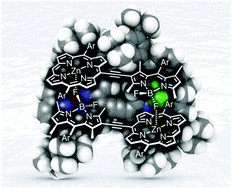
The focal point of this work is the photophysical characterization of three meso–meso two-atom-bridged diporphyrins. Detailed investigations by means of cyclic voltammetry, absorption, fluorescence, and femto-/nanosecond transient absorption spectroscopy revealed the discrepancy in electronic communication in a series of meso–meso two-atom-bridged porphyrins in the ground state and in the excited state. In the ground state, the azo bridge facilitates the strongest electronic communication between the two porphyrins. In the excited state, however, the ethene bridge induces the strongest coupling, followed by the imine and azo bridges.

Building bridges: Discrepancy in electronic communication in a series of meso–meso two-atom-bridged diporphyrins is reported. Detailed physicochemical investigation revealed unique differences between diporphyrins linked by ethene, imine, or azo bridging units.


An assembly line for nanoribbons! An iterative approach is presented that assembles a small and carefully designed molecular building block into nanoribbons constituted of 10, 20, and 30 conjugated linearly fused rings.
[Communication]
Diego Cortizo-Lacalle, Juan P. Mora-Fuentes, Karol Strutyński, Akinori Saeki, Manuel Melle-Franco, Aurelio Mateo-Alonso
Angew. Chem. Int. Ed., December 18, 2017, https://doi.org/10.1002/anie.201710467 Read article
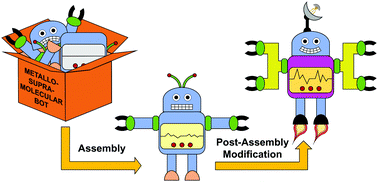
As the macromolecular version of mechanically interlocked molecules, mechanically interlocked polymers are promising candidates for the creation of sophisticated molecular machines and smart soft materials. Poly[n]catenanes, where the molecular chains consist solely of interlocked macrocycles, contain one of the highest concentrations of topological bonds. We report, herein, a synthetic approach toward this distinctive polymer architecture in high yield (~75%) via efficient ring closing of rationally designed metallosupramolecular polymers. Light-scattering, mass spectrometric, and nuclear magnetic resonance characterization of fractionated samples support assignment of the high–molar mass product (number-average molar mass ~21.4 kilograms per mole) to a mixture of linear poly[7–26]catenanes, branched poly[13–130]catenanes, and cyclic poly[4–7]catenanes. Increased hydrodynamic radius (in solution) and glass transition temperature (in bulk materials) were observed upon metallation with Zn2+.

An electro- and photo-active rotaxane incorporating ten peripheral Zn(II)-porphyrin moieties and a free-base porphyrin stopper has been prepared. Electrochemical measurements revealed that this compound is capable of mimicking the blooming of a flower. On the other hand, steady state investigations have shown that the multi-porphyrinic rotaxane is a light-harvesting device mimicking the antennae of the natural photosynthetic system. More information can be found in the Full Paper by B. Delavaux-Nicot, E. Maisonhaute, J.-F. Nierengarten et al. (DOI: 10.1002/chem.201704124).
A major bottleneck delaying the further commercialization of thin-film solar cells based on hybrid organohalide lead perovskites is interface loss in state-of-the-art devices. We present a generic interface architecture that combines solution-processed, reliable, and cost-efficient hole-transporting materials without compromising efficiency, stability, or scalability of perovskite solar cells. Tantalum-doped tungsten oxide (Ta-WOx)/conjugated polymer multilayers offer a surprisingly small interface barrier and form quasi-ohmic contacts universally with various scalable conjugated polymers. In a simple device with regular planar architecture and a self-assembled monolayer, Ta-WOx–doped interface–based perovskite solar cells achieve maximum efficiencies of 21.2% and offer more than 1000 hours of light stability. By eliminating additional ionic dopants, these findings open up the entire class of organics as scalable hole-transporting materials for perovskite solar cells.
Stable helical radicals are promising multi-functional molecules in light of intriguing magnetic and chiroptical properties. Attempts were made to extend diphenylmethyl-fused NiII porphyrin radical to helical system as the first air-stable organic neutral helical radicals. Intramolecular Pd-catalyzed twofold C−H arylation of methyl- or methoxy-introduced meso-diphenylmethyl NiII porphyrins gave a mixture of the target and rearranged radicals. Oxidative fusion reaction of meso-(bis(1-naphthyl)methyl) NiII porphyrins provided doubly fused NiII porphyrin radicals. One of the helical radicals was separated into enantiomers that showed mirror-image circular dichroism (CD) spectra up to 1300 nm. The helical dinaphthylmethyl-fused NiII porphyrin radical displayed solid-state magnetic property mostly arising from monomeric radicals, different from the parent diphenylmethyl-fused NiII porphyrin radical that showed antiferromagnetic coupling due to π-stacked pairing.

Radical behavior: Diarylmethyl-fused NiII porphyrin radicals have been extended to a helical system as the first air-stable organic neutral helical radicals. Di(1-naphthyl)methyl-fused NiII porphyrin radicals thus synthesized were separated into enantiomers that showed mirror-image CD spectra up to 1300 nm, indicating the effective desymmetrization of the frontier molecular orbitals.
Michael Wiesinger, Dr. Brant Maitland, Dr. Christian Färber, Gerd Ballmann, Christian Fischer, Holger Elsen and Prof. Dr. Sjoerd Harder

A barium hydride cluster was prepared by reaction of Ba[N(SiMe3)2]2 with PhSiH3 in toluene. Despite lack of additional Lewis bases, Ba7H7[N(SiMe3)2]7 is remarkably soluble in aromatic solvents. The cluster is retained in solution, and no coalescence of hydride signals is observed by NMR spectroscopy even at 95 °C. The benzene-solubilized cluster is strongly reducing and reacts at room temperature with isolated alkenes, including ethylene.


Seven longitudinally twisted acenes (an anthracene, two tetracenes, three pentacenes, and a hexacene) have been synthesized by the addition of aryllithium reagents to the appropriate quinone precursors, followed by SnCl2-mediated reduction of their diol intermediates, and several of these acenes have been crystallographically characterized. The new syntheses of the three previously reported twisted acenes, decaphenylanthracene (1), 9,10,11,20,21,22-hexaphenyltetrabenzo[a,c,l,n]pentacene (2), and 9,10,11,12,13,14,15,16-octaphenyldibenzo[a,c]tetracene (14), resulted in a reduction of the number of synthetic steps. As a consequence their overall yields were increased by factors of 50-, 24-, and 66-fold, respectively. All of the twisted acene syntheses reported here are suitable for the synthesis of at least gram quantities of these remarkable hydrocarbon materials.

Let′s twist again: The addition of several aryllithium reagents to a variety of sterically congested polycyclic quinones followed by SnCl2-mediated reduction allowed relatively easy access to a large number of longitudinally twisted acenes. This facile approach also allows the preparation of these remarkable hydrocarbons in gram-scale quantities.