08 Nov 06:49
by Liangbing Gan, Zishuo Zhou, Nana Xin
Abstract
An open-cage C60 derivative 9 with anilino, hemiketal, and lactone moieties on the edge of the opening was prepared through a fullerene-mixed peroxide procedure. Key steps include decarbonylation, intramolecular Friedel–Crafts reaction and oxetane ring opening rearrangement. The open-cage compound 9 readily reacts with various metal salts. A nickel complex was obtained by treating 9 with NiCl2 at r.t. followed by purification on a silica gel column. Single-crystal X-ray diffraction analysis showed that the nickel ion is coordinated to two ligands with an octahedral geometry.

Let′s play ball: An open-cage C60 derivative with anilino, hemiketal, and lactone moieties on the edge of the opening was prepared through a fullerene-mixed peroxide procedure. The open-cage compound readily reacts with various metal salts. Single-crystal X-ray characterization of the nickel complex showed that the nickel ion has an octahedral geometry.
07 Nov 06:27
by Wade Perkins, Felix Raoul Fischer
Abstract
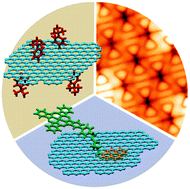
Diels–Alder copolymerization of tetraphenylcyclopentadienone, a precursor for cove graphene nanoribbons (cGNRs), with bifunctional porphyrins yields defined nanostructures comprised of a single cGNR-porphyrin-cGNR heterojunction within each ribbon. 13C NMR labeling and high-resolution mass spectrometry of solubilized polymer intermediates indicates that every porphyrin is covalently linked to two extended segments of cGNRs. UV/Vis absorption and fluorescence emission spectroscopy reveal a strong electronic correlation between the porphyrin and the adjacent cGNR segments that can be attenuated through reversible metalation of the porphyrin core. This versatile bottom-up synthetic strategy provides access to structurally well-defined, functional GNR-quantum dot-GNR heterostructures within a single graphene nanoribbon.

The bottom-up solution-based synthesis and selective fractionation of graphene nanoribbon-porphyrin-graphene nanoribbon heterostructures is reported. Absorption and fluorescence spectroscopy reveal a strong coupling between the graphene nanoribbon and the central porphyrin quantum dot.
01 Nov 10:11
by Hitoshi Ube, Ryo Yamada, Jun-ichi Ishida, Hiroyasu Sato, Motoo Shiro and Mitsuhiko Shionoya

Journal of the American Chemical Society
DOI: 10.1021/jacs.7b09439

28 Oct 07:47
![Synthesis of the Unknown Indeno[1,2‐a]fluorene Regioisomer: Crystallographic Characterization of Its Dianion](http://onlinelibrary.wiley.com/store/10.1002/anie.201709282/asset/image_n/anie201709282-toc-0001.png?v=1&s=1db0f2c34037c1745f8e85c8b7741d24f46ea238 "Synthesis of the Unknown Indeno[1,2‐a]fluorene Regioisomer: Crystallographic Characterization of Its Dianion")
Not a matter of IF but when: Described is the preparation of the last elusive indenofluorene (IF) regioisomer. While the body of circumstantial spectroscopic data support formation of the highly reactive triplet diradicaloid, definitive structural proof is provided by X-ray diffraction analysis of crystals of the dianion, obtained by reduction of the indeno[1,2-a]fluorene with Cs metal.
[Communication]
Justin J. Dressler, Zheng Zhou, Jonathan L. Marshall, Ryohei Kishi, Shota Takamuku, Zheng Wei, Sarah N. Spisak, Masayoshi Nakano, Marina A. Petrukhina, Michael M. Haley
Angew. Chem. Int. Ed., October 24, 2017, https://doi.org/10.1002/anie.201709282 Read article
17 Oct 20:38
by Lisa Müller, Eike G. Hübner, Nicolai Burzlaff
In 1982, Buckley et al. reported on the hydroxy-functionalized derivative of 6,13-diazapentacene (DAP), namely 5,12-dihydroxo-6,13-diazapentacene. In an attempt to reproduce the synthetic procedure, 1H NMR and 13C{1H} NMR spectroscopic data revealed the formation of a constitutional isomer of the supposed compound. A single-crystal X-ray structure determination revealed that the actual structure of the dark-violet product was 6-amino-5H-dibenzo[a,h]phenoxazin-5-one (2), a benzo[a]phenoxazine derivative. These kinds of compounds are, along with a wide range of pharmacological applications, known for their specific fluorescent properties, which were analyzed for compound 2. Furthermore, it was shown that 2 can be utilized as reagent for the synthesis of other benzo[a]phenoxazine derivatives, herein 6-(dimethylamino)-5H-dibenzo[a,h]phenoxazin-5-one (3).

In an attempt to reproduce the literature synthesis of 5,12-dihydroxo-6,13-diazapentacene, a benzo[a]phenoxazine derivative was obtained as the sole product instead.
12 Oct 05:41
![Closed Pentaaza[9]helicene and Hexathia[9]/[5]helicene: Oxidative Fusion Reactions of ortho‐Phenylene‐Bridged Cyclic Hexapyrroles and Hexathiophenes](http://onlinelibrary.wiley.com/store/10.1002/anie.201708429/asset/image_n/anie201708429-toc-0001.png?v=1&s=19bcad8251fcd9921221c3e8d2ef78f1fae5b55f "Closed Pentaaza[9]helicene and Hexathia[9]/[5]helicene: Oxidative Fusion Reactions of ortho‐Phenylene‐Bridged Cyclic Hexapyrroles and Hexathiophenes")
Case closed: Oxidative fusion reactions of ortho-phenylene-bridged cyclic oligomers furnished novel closed heterohelicenes in a selective manner. X-ray diffraction analysis revealed the structures to be the closed pentaaza[9]helicene and hexathia[9]/[5]helicene, rare examples of a heteroaromatic closed helicene and an asymmetric double helicene, respectively. Their optical properties were studied and the enantiomeric separation was performed by chiral-phase HPLC.
[Communication]
Fengkun Chen, Takayuki Tanaka, Yong Seok Hong, Tadashi Mori, Dongho Kim, Atsuhiro Osuka
Angew. Chem. Int. Ed., October 10, 2017, https://doi.org/10.1002/anie.201708429 Read article
12 Oct 05:38

The HF-zipping strategy allows an unprecedentedly challenging transformation to be performed. It consists of “zipping” virtually linear fluorinated oligophenylenes together to give “preprogrammed” nanographenes via domino-like cyclodehydrofluorination. In their Communication (DOI: 10.1002/anie.201707272), A.-K. Steiner and K. Y. Amsharov demonstrate that fluorine positions in the precursor structure unambiguously dictate the running of the “zipping-program” leading exclusively to the target atomically precise nanographene.
[Cover Picture]
Ann-Kristin Steiner, Konstantin Y. Amsharov
Angew. Chem. Int. Ed., October 11, 2017, https://doi.org/10.1002/anie.201710002 Read article
09 Oct 05:58
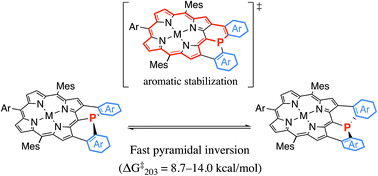
Chem. Sci., 2017, 8,8231-8239
DOI: 10.1039/C7SC03882H, Edge Article

Open Access
Keisuke Fujimoto, Atsuhiro Osuka
Planar phosphorus(III) centers were effectively stabilized by structural constraint as well as aromatic stabilization in porphyrin-based fused [small pi]-conjugated frameworks.
The content of this RSS Feed (c) The Royal Society of Chemistry

05 Oct 12:26
by Tomoka Hosokawa, Yusuke Takahashi, Tomoya Matsushima, Soichiro Watanabe, Shoko Kikkawa, Isao Azumaya, Akihiro Tsurusaki and Ken Kamikawa

Journal of the American Chemical Society
DOI: 10.1021/jacs.7b07113

25 Sep 16:22
by Xian-Sheng Ke, Taeyeon Kim, Vincent M. Lynch, Dongho Kim and Jonathan L. Sessler

Journal of the American Chemical Society
DOI: 10.1021/jacs.7b08611

Hi and -1 others like this
04 Sep 06:00
by Ben S. Pilgrim

Nature Chemistry.
doi:10.1038/nchem.2839
Authors: Ben S. Pilgrim, Derrick A. Roberts, Thorsten G. Lohr, Tanya K. Ronson & Jonathan R. Nitschke
Two coordination cages have been devised that undergo covalent modification during a cascade of two orthogonal Diels–Alder reactions. This results in increased lipophilicity for the second cage, enabling its phase transfer and separation from the first. The trigger, relay and inhibition features of this cascade system mimic key aspects of natural post-translational modification cascades.
17 Aug 06:32

A bowl-shaped antiaromatic molecule was synthesized by deformation of a planar antiaromatic π-conjugation system upon insertion of palladium into the small cavity of a metal-free norcorrole. The latter was prepared from demetalation of a copper norcorrole obtained from the intramolecular coupling of a bis(diiododipyrrin) copper complex with copper thiophenecarboxylate.
[Communication]
Tsubasa Yonezawa, Siham A. Shafie, Satoru Hiroto, Hiroshi Shinokubo
Angew. Chem. Int. Ed., August 16, 2017, https://doi.org/10.1002/anie.201706134 Read article
16 Aug 05:04
by Maximilian Wolf, Astrid Herrmann, Andreas Hirsch and Dirk M. Guldi

Journal of the American Chemical Society
DOI: 10.1021/jacs.7b04589

16 Aug 04:58
by Sabine Richert, Bart Limburg, Harry L. Anderson and Christiane R. Timmel

Journal of the American Chemical Society
DOI: 10.1021/jacs.7b06518

16 Aug 04:44
by Andrew J. Musser, Prakash P. Neelakandan, Johannes M. Richter, Hirotaka Mori, Richard H. Friend and Jonathan R. Nitschke

Journal of the American Chemical Society
DOI: 10.1021/jacs.7b06709

10 Aug 13:17

Porphyrin Tautomerism In their Communication on page 10088 ff., A. Ghosh et al. report the isolation of the elusive cis tautomer of a free-base porphyrin.
[Frontispiece]
Kolle E. Thomas, Laura J. McCormick, Hugo Vazquez-Lima, Abhik Ghosh
Angew. Chem. Int. Ed., August 09, 2017, https://doi.org/10.1002/anie.201783461 Read article
10 Aug 13:03
by Gregory J. P. Perry, Jacob M. Quibell, Adyasha Panigrahi and Igor Larrosa

Journal of the American Chemical Society
DOI: 10.1021/jacs.7b05155

10 Aug 09:01
by Nanda Kishore M. V., Pradeepta K. Panda
Butadiyne-bridged bipyrroles were prepared from 2-iodopyrroles and trimethylsilylacetylene through a facile one-pot synthesis involving a modified Sonogashira coupling reaction and in situ aerobic oxidative coupling of the acetylenic pyrroles; the products were obtained in yields of 31–72 % depending on the substituents on the pyrrole. The acetylene-bridged diacids obtained from the hydrolysis of the corresponding ester derivatives are highly stable, unlike most reported oligopyrrolic diacids. This protocol could be easily extended towards the synthesis of butadiyne-bridged bisporphyrins.

Butadiyne-bridged bipyrroles are obtained from the corresponding iodopyrroles through a one-pot strategy, which is subsequently applied to the synthesis of butadiyne-bridged bisporphyrin in good yield. DBU = 1,8-diazabicyclo[5.4.0]undec-7-ene, TMSA = trimethylsilylacetylene.
05 Aug 09:11
by Felix J. Rizzuto, Daniel M. Wood, Tanya K. Ronson and Jonathan R. Nitschke

Journal of the American Chemical Society
DOI: 10.1021/jacs.7b05788

29 Jul 10:57

The latest ultrahigh-field NMR spectrometers are a huge technological challenge that require large financial investments. In his Guest Editorial, Harald Schwalbe justifies the need for spectrometers with higher magnetic field strengths. The important results from previous generations of high-field NMR spectrometers are discussed, and research areas are identified that will benefit from the latest spectrometers.
[Editorial]
Harald Schwalbe
Angew. Chem. Int. Ed., July 24, 2017, https://doi.org/10.1002/anie.201705936 Read article
28 Jul 05:55
Bastian Dumslaff, Anna N. Reuss, Dr. Manfred Wagner, Prof. Dr. Xinliang Feng, Dr. Akimitsu Narita, Prof. Dr. George Fytas and Prof. Dr. Klaus Müllen

Essentially strain-free and thermally stable paddlewheel polyphenylenes consisting of two covalently interlocked cyclohexa-m-phenylenes have been synthesized. Tuning of the solubility allowed the hierarchical formation of three-dimensional carbon nanostructures to be monitored.
Read more now
25 Jul 05:45
by Bingzhe Wang, Shushu Zheng, Avishek Saha, Lipiao Bao, Xing Lu and Dirk M. Guldi

Journal of the American Chemical Society
DOI: 10.1021/jacs.7b06162

25 Jul 05:40
by Martin D. Peeks, Claudia E. Tait, Patrik Neuhaus, Georg M. Fischer, Markus Hoffmann, Renée Haver, Arjen Cnossen, Jeffrey R. Harmer, Christiane R. Timmel and Harry L. Anderson

Journal of the American Chemical Society
DOI: 10.1021/jacs.7b05386

16 Jul 15:05
Chem. Soc. Rev., 2017, 46,4464-4500
DOI: 10.1039/C7CS00229G, Review Article
Giovanni Bottari, M
a
Angeles Herranz, Leonie Wibmer, Michel Volland, Laura Rodriguez-Perez, Dirk M. Guldi, Andreas Hirsch, Nazario Martin, Francis D'Souza, Tomas Torres
This review offers an overview on the chemical functionalization, characterization and applications of graphene-based materials.
The content of this RSS Feed (c) The Royal Society of Chemistry

14 Jul 06:12
by Takao Fujikawa, Yasutomo Segawa and Kenichiro Itami

The Journal of Organic Chemistry
DOI: 10.1021/acs.joc.7b01540

14 Jul 06:03
by Ruobing Wang, Alexander M. Brugh, Jeff Rawson, Michael J. Therien and Malcolm D. E. Forbes

Journal of the American Chemical Society
DOI: 10.1021/jacs.7b03252

07 Jul 06:53
Chem. Commun., 2017, 53,8207-8210
DOI: 10.1039/C7CC04182A, Communication
Michael Lepper, Julia Kobl, Tobias Schmitt, Martin Gurrath, Abner de Siervo, M. Alexander Schneider, Hans-Peter Steinruck, Bernd Meyer, Hubertus Marbach, Wolfgang Hieringer
Peculiar "inverted" intramolecular conformation of a free-base porphyrin due to specific attractive molecule-substrate interaction.
The content of this RSS Feed (c) The Royal Society of Chemistry

07 Jul 06:13
by Declan Butler
Qatar blockade hits helium supply
Nature 547, 7661 (2017). http://www.nature.com/doifinder/10.1038/547016a
Author: Declan Butler
Researchers braced for shortages as Gulf state forced to close its refineries.
06 Jul 05:50
by Kohei Yazaki
Polyaromatic molecular peanuts
Nature Communications, Published online: 28 June 2017; doi:10.1038/ncomms15914
The complex, multicomponent structures often found in nature are difficult to mimic synthetically. Here, the authors assemble a molecular analogue of a peanut through coordinative and π-stacking interactions, in which a polyaromatic double capsule ‘pod’ held together by metal ions encapsulates fullerene ‘beans’.

04 Jul 13:30
by Norihito Fukui, Taeyeon Kim, Dongho Kim and Atsuhiro Osuka

Journal of the American Chemical Society
DOI: 10.1021/jacs.7b05332


![Synthesis of the Unknown Indeno[1,2‐a]fluorene Regioisomer: Crystallographic Characterization of Its Dianion](http://onlinelibrary.wiley.com/store/10.1002/anie.201709282/asset/image_m/anie201709282-toc-0001-m.png?v=1&s=3091b15dfcee911baee4e6a8e491f213bc2d301f "Synthesis of the Unknown Indeno[1,2‐a]fluorene Regioisomer: Crystallographic Characterization of Its Dianion")

![Closed Pentaaza[9]helicene and Hexathia[9]/[5]helicene: Oxidative Fusion Reactions of ortho‐Phenylene‐Bridged Cyclic Hexapyrroles and Hexathiophenes](http://onlinelibrary.wiley.com/store/10.1002/anie.201708429/asset/image_m/anie201708429-toc-0001-m.png?v=1&s=938cf72ff4e93ff5110ad92ff1ec4e0e83ec2913 "Closed Pentaaza[9]helicene and Hexathia[9]/[5]helicene: Oxidative Fusion Reactions of ortho‐Phenylene‐Bridged Cyclic Hexapyrroles and Hexathiophenes")