26 May 12:23
by Samuel R. Peurifoy, Edison Castro, Fang Liu, X.-Y. Zhu, Fay Ng, Steffen Jockusch, Michael L. Steigerwald, Luis Echegoyen, Colin Nuckolls, Thomas J. Sisto

Journal of the American Chemical Society
DOI: 10.1021/jacs.8b04119

26 May 11:52
by Jason Melidonie, Junzhi Liu, Yubin Fu, Jan J. Weigand, Reinhard Berger, Xinliang Feng

The Journal of Organic Chemistry
DOI: 10.1021/acs.joc.8b00925

25 May 05:33
by Bartlomiej Sadowski, Khaled Hassanein, Barbara Ventura, Daniel T. Gryko

Organic Letters
DOI: 10.1021/acs.orglett.8b01011

21 May 08:18
Chem. Sci., 2018, 9,5100-5105
DOI: 10.1039/C8SC01388H, Edge Article

Open Access
Qing Wang, Pan Hu, Takayuki Tanaka, Tullimilli Y. Gopalakrishna, Tun Seng Herng, Hoa Phan, Wangdong Zeng, Jun Ding, Atsuhiro Osuka, Chunyan Chi, Jay Siegel, Jishan Wu
Curved [small pi]-conjugated diradicaloids based on bridged corannulene dimers were synthesized, showing 3D spin delocalization and global aromaticity for their dianions.
The content of this RSS Feed (c) The Royal Society of Chemistry

21 May 06:41
Chem. Commun., 2018, 54,6705-6718
DOI: 10.1039/C8CC02325E, Feature Article
Irene R. Marquez, Silvia Castro-Fernandez, Alba Millan, Araceli G. Campana
We highlight recent progress in bottom-up synthesis of well-defined distorted polyaromatic hydrocarbons with saddle shapes containing heptagonal and octagonal carbocycles.
The content of this RSS Feed (c) The Royal Society of Chemistry

20 May 10:48
by Rajesh
Pudi
,
Cristina
Rodríguez‐Seco
,
Anton
Vidal‐Ferran
,
Pablo
Ballester
,
Emilio
Palomares
European Journal of Organic Chemistry,
Volume 2018, Issue 18, Page 2064-2070, May 15, 2018.
20 May 10:29
by Katerina L.
Maxouti
,
Andreas
Hirsch
European Journal of Organic Chemistry,
Volume 2018, Issue 20-21, Page 2579-2586, June 7, 2018.
18 May 12:45
by Kento
Ueta
,
Masaya
Fukuda
,
Gakhyun
Kim
,
Prof. Dr.
Soji
Shimizu
,
Prof. Dr.
Takayuki
Tanaka
,
Prof. Dr.
Dongho
Kim
,
Prof. Dr.
Atsuhiro
Osuka
Chemistry – A European Journal, EarlyView.
18 May 12:32
by Koki
Kise
,
Yongseok
Hong
,
Norihito
Fukui
,
Daiki
Shimizu
,
Prof. Dr.
Dongho
Kim
,
Prof. Dr.
Atsuhiro
Osuka
Chemistry – A European Journal, EarlyView.
17 May 09:13
by Nathaniel J. Schuster, Raúl Hernández Sánchez, Daria Bukharina, Nicholas A. Kotov, Nina Berova, Fay Ng, Michael L. Steigerwald, Colin Nuckolls

Journal of the American Chemical Society
DOI: 10.1021/jacs.8b03535

17 May 08:34
by M. R. Ajayakumar, Yubin Fu, Ji Ma, Felix Hennersdorf, Hartmut Komber, Jan J. Weigand, Alexey Alfonsov, Alexey A. Popov, Reinhard Berger, Junzhi Liu, Klaus Müllen, Xinliang Feng

Journal of the American Chemical Society
DOI: 10.1021/jacs.8b03711

29 Apr 07:41
by Dr.
Fengkun
Chen
,
Prof. Dr.
Takayuki
Tanaka
,
Prof. Dr.
Tadashi
Mori
,
Prof. Dr.
Atsuhiro
Osuka
Chemistry – A European Journal, EarlyView.
29 Apr 07:29
by Motoki Takeda, Satoru Hiroto, Hiroki Yokoi, Sangsu Lee, Dongho Kim, Hiroshi Shinokubo

Journal of the American Chemical Society
DOI: 10.1021/jacs.8b02327

26 Apr 19:08
Chem. Commun., 2018, 54,5414-5417
DOI: 10.1039/C8CC01375F, Communication
Mathieu Berthelot, Guillaume Hoffmann, Asmae Bousfiha, Julie Echaubard, Julien Roger, Helene Cattey, Anthony Romieu, Dominique Lucas, Paul Fleurat-Lessard, Charles H. Devillers
New cationic C-N fused porphyrins are synthesized under very mild conditions via chemical and electrochemical oxidation of their pyridinyl-based-porphyrin precursors.
The content of this RSS Feed (c) The Royal Society of Chemistry

19 Apr 09:10
by Wanle Sheng, Yayang Wu, Changjiang Yu, Petia Bobadova-Parvanova, Erhong Hao, Lijuan Jiao

Organic Letters
DOI: 10.1021/acs.orglett.8b00820

18 Apr 08:14
by Keisuke
Fujimoto
,
Prof. Dr.
Atsuhiro
Osuka
Chemistry – A European Journal,
Volume 24, Issue 25, Page 6530-6533, May 2, 2018.
18 Apr 08:07
by Jonathan Cremers, Renée Haver, Michel Rickhaus, Juliane Q. Gong, Ludovic Favereau, Martin D. Peeks, Tim D. W. Claridge, Laura M. Herz, Harry L. Anderson

Journal of the American Chemical Society
DOI: 10.1021/jacs.8b02552

13 Apr 05:42
by Moreno, C., Vilas-Varela, M., Kretz, B., Garcia-Lekue, A., Costache, M. V., Paradinas, M., Panighel, M., Ceballos, G., Valenzuela, S. O., Pena, D., Mugarza, A.
Nanosize pores can turn semimetallic graphene into a semiconductor and, from being impermeable, into the most efficient molecular-sieve membrane. However, scaling the pores down to the nanometer, while fulfilling the tight structural constraints imposed by applications, represents an enormous challenge for present top-down strategies. Here we report a bottom-up method to synthesize nanoporous graphene comprising an ordered array of pores separated by ribbons, which can be tuned down to the 1-nanometer range. The size, density, morphology, and chemical composition of the pores are defined with atomic precision by the design of the molecular precursors. Our electronic characterization further reveals a highly anisotropic electronic structure, where orthogonal one-dimensional electronic bands with an energy gap of ~1 electron volt coexist with confined pore states, making the nanoporous graphene a highly versatile semiconductor for simultaneous sieving and electrical sensing of molecular species.
10 Apr 07:05
Chem. Commun., 2018, 54,5307-5310
DOI: 10.1039/C8CC01993B, Communication
Sven Gratz, Doreen Beyer, Valeriya Tkachova, Sarah Hellmann, Reinhard Berger, Xinliang Feng, Lars Borchardt
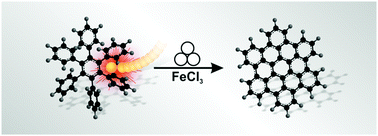
Ball milling was applied to a Scholl reaction of dendritic oligophenylene precursors to produce benchmark nanographenes under solvent-free conditions.
The content of this RSS Feed (c) The Royal Society of Chemistry

10 Apr 06:43
by Yihui Yang, Kunmu Cheng, Yao Lu, Dandan Ma, Donghui Shi, Yixun Sun, Mingyu Yang, Jing Li, Junfa Wei

Organic Letters
DOI: 10.1021/acs.orglett.8b00306

20 Mar 09:44
by Khrystofor Khokhlov, Nathaniel J. Schuster, Fay Ng and Colin Nuckolls

Organic Letters
DOI: 10.1021/acs.orglett.8b00541

20 Mar 09:26
by Yanpeng Zhu, Zeming Xia, Zeying Cai, Ziyong Yuan, Nianqiang Jiang, Tao Li, Yonggen Wang, Xiaoyu Guo, Zhihao Li, Shuang Ma, Dingyong Zhong, Yang Li and Jiaobing Wang

Journal of the American Chemical Society
DOI: 10.1021/jacs.8b01447

14 Mar 13:39
by Fengkun Chen, Takayuki Tanaka, Tadashi Mori, Atsuhiro Osuka
Polycyclic heteroaromatic compounds including pyrrole units are promising functional scaffolds owing to their electron-rich nature, bright fluorescence, and applicability to anion recognition at the pyrrolic hydrogen. We report herein the effective synthesis of pseudo-aza[5]helicene and aza[7]helicene derivatives, and unexpected formation of azahepta[8]circulenes by oxidative fusion reactions. By choosing reaction conditions and peripheral substituents attached at the terminal indole moieties, we obtained aza[7]helicenes 10a-c and azahepta[8]circulenes 11a,c selectively in moderate to good yields. Their solid-state structures have been revealed by X-ray diffraction analysis. UV/Vis absorption, emission, and cyclic voltammetry of these compounds were studied in comparison with those of previously reported tetraaza[8]circulene (TA8C), a symmetric and planar molecule. Furthermore, the enantiomeric separation of dimethyl-substituted aza[7]helicene 10b was achieved, and the racemization kinetics have been elucidated both theoretically and experimentally. This work illustrates a wealth of advantages of pyrrole incorporation into the polycyclic aromatic scaffolds in terms of synthetic aspects, structural variation and optical tuning.
14 Mar 06:37

A twist of graphene: An inherently chiral bilayer nanographene with a helicene linker has been synthesized as the racemate and the M isomer with 93 % ee. This first member of a new family of twisted double-layer polyaromatic hydrocarbons is characterized, and its electrochemical and photophysical properties explored.
[Communication]
Paul J. Evans, Jiangkun Ouyang, Ludovic Favereau, Jeanne Crassous, Israel Fernández, Josefina Perles, Nazario Martín
Angew. Chem. Int. Ed., March 13, 2018, https://doi.org/10.1002/anie.201800798 Read article
08 Mar 06:24

In a spin: A benzene-1,3,5-triaminyl radical fused with three ZnII-porphyrins was synthesized, and was shown to possess a quartet ground state by ESR and superconducting quantum interference device (SQUID) studies. Despite its high-spin nature, this triradical is remarkably stable under ambient conditions. The high stability of the triradical is attributed mainly to effective spin delocalization over the porphyrin segments.
[Communication]
Daiki Shimizu, Atsuhiro Osuka
Angew. Chem. Int. Ed., March 06, 2018, https://doi.org/10.1002/anie.201801080 Read article
07 Mar 20:18
by Maciej Krzeszewski, Keisuke Sahara, Yevgen M. Poronik, Takashi Kubo and Daniel T. Gryko

Organic Letters
DOI: 10.1021/acs.orglett.8b00223

06 Mar 19:19
by David Reger, Philipp Haines, Frank W. Heinemann, Dirk M. Guldi, Norbert Jux
Herein, we report on the synthesis of a novel π-extended "superhelicene" based on hexa-peri-hexabenzocoronenes (HBC) via an efficient four-step synthetic procedure starting from diphenylether. Comprehensive structural analyses were performed by means of NMR and mass spectrometry measurements together with X-ray analysis. Physico-chemical analysis of the superhelicene and suitable HBC references revealed among others outstanding fluorescent features with quantum yields of over 80%.
27 Feb 20:51
by Lipiao Bao, Ping Peng and Xing Lu

Accounts of Chemical Research
DOI: 10.1021/acs.accounts.8b00014

26 Feb 20:19
by Andreas Hirsch, Katerina Maxouti
The design of a novel concept for the synthesis of [3:2] pentakisadducts of fullerene C60 is presented. A sequential tether-directed remote functionalization approach is introduced for the construction of pentakisadducts. This fullerene derivative embellished with two different addends in two different directions can be considered as a valuable tecton for further functionalization. The stepwise cyclopropanation of C60 with a macrocyclic trismalonate and a bis(β-ketoester) yielded the corresponding pentakisadduct with an incomplete octahedral addition pattern. The reaction sequence gave access to two pairs of enantiomers that were easily separated by column chromatography on achiral stationary phase and characterized.
   This article is licensed under a Creative Commons Attribution 3.0 Unported Licence.