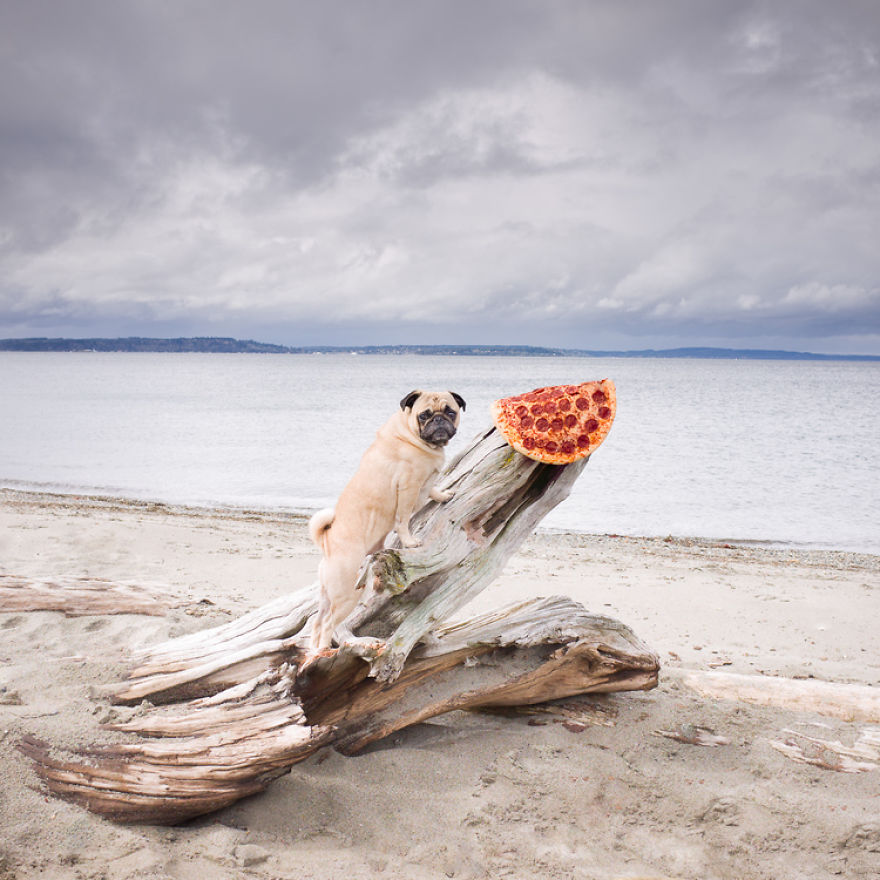
What is this, a stealth game?

This is an ongoing series I’ve been working on for about a year now. Yes, these are real pizzas. They are the $5 variety from Little Caesars. I order two fresh uncut large pepperonis each outing. Sometimes I keep the pizzas so that they harden and then I can easily stand them up or lean them against things. I would often eat them, and they would rarely go to waste.
Over time this series really took on a life of it’s own. I never really imagined creating this many pizza photos, but once it got moving I just had to make more. I don’t like making pointed statements on what these photos mean. I think just like me people enjoy simply looking at them and maybe getting a chuckle or two. Yet some people don’t find them funny at all. Love it or hate, most people recognize there is something here worth their attention.
More info: jonpauldouglass.com









Everyone collides with the medical system at some point in their lives. As health reporters with a combined decade of experience on the beat, we encounter it every single day.
The lessons we've learned on the job have carried over into our personal lives, and transformed the way we view medicine. Some of the changes have been practical — informing what kind of insurance to buy or what birth control method to use. Others are a little more abstract, changing how we decide which health sources to trust or how we think about diseases such as cancer.
Before we started reporting on health, we had no medical training. We came at this beat with fresh eyes and lots of questions. More than ever, we appreciate how complex — and sometimes opaque — medicine can seem. This daily study has deepened our understanding, and here we wanted to share some of what we learned with you.
As a neophyte health reporter, I wrote about new diet fads as, well, fads, sometimes uncritically. As the years passed, and I learned more about the science of weight loss (and saw many diets come and go), I now think about diets of the moment in an entirely new way: as lies, wastes of money, and threats to public health.
The billion-dollar diet industry pushes short-term thinking and promises quick results. It tells people that if they just eat a certain way, or try a particular shake, supplement, or pill, they'll be thin. In reality, of course, there are no miracle pills. Very restrictive diets that require people to cut out major food groups or deviate in the extreme from what they normally eat are mostly unsustainable — and even cause people to put on more weight in the long run.
This insight is liberating. It means you can save your money and tune out the fads that will inevitably come in and out of fashion. There's no need to wedge your habits and preferences into an unreasonable diet plan that time has shown will fail. Instead,the leading weight loss and obesity researchers and thinkers I've spoken to over the years have consistently shared one clear message: cut calories in a way you like and can sustain, focus on eating more healthfully, and redesign your lifestyle in a way that encourages healthy habits. Think long term: do it slowly, and don't expect miracles.
This doesn't mean losing weight will be easy; but it means you'll probably have more success in the long run if you find a program that fits your lifestyle and preferences. You'll also save a lot of money.
–Julia Belluz
Before I started exclusively reporting on medicine and public health, I had little appreciation for the quality and limitations of particular medical studies. I thought it was up to the scientific community to police the quality of research, and if something was published it could probably be trusted.
Now I know that was wrong. First of all, some studies are just poorly designed or hopelessly biased. Second, even the best individual studies have their flaws and limitations. This isn't because all science is bad or untrustworthy. It's because it's an iterative process, and it takes many studies to get at the truth of the matter. Individual studies will almost never give the final word on a particular question. That's just how science works.
So, more often than not, single studies contradict one another — such as the research on foods that cause or prevent cancer. For a study on whether everything we eat is associated with cancer, academics randomly selected 50 ingredients from recipes in The Boston Cooking-School Cook Book. Most of those ingredients had studies behind them claiming both positive and negative results.
The truth can be found somewhere in the totality of the research. I now rely less and less on single studies and more on meta analyses of systematic reviews that bring together the best research to come to more fully supported conclusions. (You can read more about why you can't trust single studies here, and see here to learn about different types of studies.)
–Julia Belluz
Medical errors kill more people than car crashes or new disease outbreaks. They kill more people annually than breast cancer, AIDS, plane crashes, or drug overdoses. Depending on which estimate you use, medical errors are either the third or ninth leading cause of death in the United States. Those left dead as a result of their medical care could fill an average-size Major League Baseball stadium — sometimes twice over.
We typically think of hospitals as places where we go to get better. And that's definitely true; we've seen lifespans extended and diseases cured as a direct result of advances in modern medicine.
At the same time, hospitals are dangerous places. This is something I've learned a lot about in the past six months, as I've been working on a yearlong series about fatal medical harm. I've come to understand that every trip we take to the doctor's office and every stay in the hospital comes with the risk of something going wrong.
The doctor could prescribe us the wrong drug, or the wrong dose of the right drug (this happens about 1.5 million times each year). Improper hygiene practices — a nurse who forgets to wash her hands before accessing a central line catheter, for example — could lead to a deadly blood infection. This happens about 30,000 times each year.
This is not to say health-care professionals are trying to harm patients. Quite the opposite — every doctor I've ever met is trying to do his or her absolute best to help patients. That is, after all, why they went into medicine in the first place.
Medical harm reflects the fact that medicine is complicated and humans are fallible. Doctors will make mistakes if their hospitals don't set up the proper systems to safeguard against harm — if they don't, for example, create a checklist that reminds a nurse to wash her hands before accessing a central line, or switch to a digital prescribing system that makes it way harder for a pharmacist to misread a doctor's scribbled drug prescription.
Modern medicine can do incredible things, and the work providers do day in and day out is humbling. But each trip to the hospital is a chance for something to go wrong, too — something I keep in mind thinking about my own care decisions.
–Sarah Kliff
When we're sick, many of us turn to Dr. Google. In fact, searching for health information is one of the most popular online activities. The problem is that the top hits in search aren't always the best ones. Some come from sources that aren't trustworthy, have industry ties (such as WebMD), or are out of date. Also, when we Google to self-diagnose, we often get a false impression of the relative weight of possibilities. So it seems our stomach pain could stem from cancer just as likely as from indigestion, or that the rash on our back could be dryness — or a flesh-eating disease.
This is not a recipe for empowering ourselves with good information; it's a recipe for driving ourselves crazy. Now I rarely hit Google for health information. I got to these alternatives instead. You should consider them, too.
–Julia Belluz
Writing about and researching different contraceptives led me to change my mind, and I quit my birth control pills a few months ago in favor of an intrauterine device, or IUD: a small, T-shaped device that a doctor inserts into the uterus.
Here's why: birth control pills have to be taken regularly, and are susceptible to human error. This is why the pill has a 6 percent failure rate; out of 1,000 women on the pill, 60 will become pregnant in a typical year.
/cdn0.vox-cdn.com/uploads/chorus_asset/file/2486264/shutterstock_174194342.0.jpg)
IUDs are a way more reliable birth control than pills. (Shutterstock)
Among women who use an IUD, that number will be much lower — between 2 and 8, depending on which IUD they use. The failure rate for IUDs is low because they don't leave space for human error: once inserted by a doctor, they can last for as long as 12 years. (They can also be removed earlier, if a woman decides she wants to become pregnant).
Getting an IUD inserted can be painful; for me, at least, it was an intense pain of about 15 seconds or so. One study found that 72 percent of women describe the experience as "moderately painful." That was, for me, the one downside. But the upside: multiple years of pregnancy protection, no space for human error, and a very low chance of side effects. That's a trade that, after researching my options, I'm happy I made.
–Sarah Kliff
I grew up within the "more health care is better" paradigm. And part of this meant that antibiotics should be given for anything, at any time. But we know antibiotics can't fight viral infections — like flu, bronchitis, and many ear infections — and that overusing antibiotics can actually cause a lot of harm. Still, many of us misuse these drugs.
/cdn0.vox-cdn.com/uploads/chorus_asset/file/3708500/shutterstock_71153212.0.0.0.jpg)
Tips from 20 experts about how to lose weight and keep it off
Medical errors in America kill more people than AIDS or drug overdoses. Here's why.
Take bronchitis, which can't be treated with antibiotics. Recent research showed that doctors still prescribe antibiotics for 71 percent of bronchitis cases — an outrageous number that actually increased between 1996 and 2010.
When we use antibiotics unnecessarily, not only do we expose ourselves to unnecessary side effects, but we also contribute to the broader "superbug" problem. That is, the more we consume antibiotics, the more quickly they stop working. In recent years we've sped up the natural process of antibiotic resistance, causing bacteria to build up defenses against the drugs we have available and rendering some of them useless. This is really frightening; it's not an overstatement to say much of modern medicine would be undone without antibiotics. Routine procedures like hip replacements, c-sections, and chemotherapy would become infinitely more dangerous or even too potentially harmful to undertake.
So now, for my own health and the health of others, I avoid taking antibiotics when I don't really need them. To learn more about how to use antibiotics judiciously, see this page at the Centers for Disease Control and Prevention.
–Julia Belluz
Growing up in Canada, I knew of a doctor who prescribed full-body scans in the US for all of his patients. The purpose: to detect potential health problems brewing, particularly abnormalities that could be early cancer. At first, this sounded sort of reasonable: why not get checked annually to make sure your cells are healthy? But as I learned about the benefits and risks of screening — especially with no indication, family history, or prior health problem — I realized this was ridiculous.
That's because in many cases, screening doesn't actually help people. Instead, it turns healthy people into patients unnecessarily, leading them to needless treatment and hospitalization, panicking them, and creating "cancer survivors" who actually would have lived even if their cancers were left untouched.
This chart shows that while more thyroid cancers were diagnosed in South Korea after a mass screening program was introduced, it didn't actually improve the mortality rate. (New England Journal of Medicine)
Consider a recent study in the New England Journal of Medicine on thyroid cancer in South Korea. In 1999, the country launched an ambitious campaign to improve health by finding and treating diseases like cancer. Part of this effort included a state-subsidized mass screening program. In two decades, the number of South Koreans diagnosed with thyroid cancer rose 15-fold. While this might sound like a great success, the country didn't actually succeed at its mission: improving health. Thyroid cancer deaths remained stubbornly stable as the incidence of the disease skyrocketed. The additional screenings were leading to the discovery of many more cases, but those additional diagnoses — and the invasive courses of treatment that came along with them — weren't making thyroid cancer any less deadly.
There's also evidence of overdiagnosis in other cancers, from breast and kidney to melanoma and lung. Population-based screening for prostate cancer even had to be scaled back after the realization that most men with the disease will die with, not of, the disease.
Mammography didn't improve the rate of breast cancer death. (Harding Center for Risk Literacy)
To be clear: not all mass screening programs are bad. Colorectal cancer screening, for example, has been shown to save lives as a result of early detection, and the Pap test transformed cervical cancer into a treatable disease. And, of course, mass screening is different from using technologies like ultrasounds to diagnose people at risk of a disease or who have symptoms that require investigation.
But everyone should talk to their doctors about their particular risk profiles, and then screen accordingly. More screening isn't necessarily better, and it can send you into a cascade of care that won't actually improve your health — and could make you sicker.
–Julia Belluz
/cdn0.vox-cdn.com/uploads/chorus_asset/file/2544484/shutterstock_149644169.0.jpg)
Narrow networks don't always mean it's harder to see the doctor (Shutterstock)
The idea of narrow networks — health insurance plans that limit enrollees to a small set of doctors — is not a concept that's especially popular with consumers. Who wants a health insurance plan, after all, that tells you your favorite doctor is one it won't cover?
Narrow networks are common on Obamacare's new exchanges, as health insurers try to hold down premium prices by contracting with fewer doctors. McKinsey and Co. estimates that more than a third of the plans sold on the new marketplaces didn't include 70 percent of the region's large hospitals. This, unsurprisingly, led to a barrage of negative headlines about insurers leaving well-known hospitals out of network.
But narrow networks aren't all bad. Health economists actually tend to be quite fond of these products, as they help hold down spending. And as a consumer, I would generally prefer this type of plan.
Here's why: narrow network plans tend to have lower premiums. They do this by refusing to contract with really expensive doctors. And, to be clear, these are not the best doctors: there is a huge body of health-care research showing no connection between how much doctors charge and the quality of the care they provide. We often conflate price and quality; usually more expensive things are better. In health care, however, that's not the case.
One recent study in Massachusetts showed that when people switched to narrow network plans, their health spending fell by a third — and the quality of the care they received didn't change.
There are some narrow network plans that have really great reputations, too, like Kaiser Permanente. Kaiser is a health-care system that limits patients to a very small set of doctors — but makes it easier for all those doctors to share records and communicate with one another. That's a hidden advantage of small plans: they can help facilitate the coordination of care.
Narrow networks aren't for everyone, particularly those who need access to one specific specialist. But for many people, I've become convinced they're a much better option than typically thought — and that they don't always sacrifice quality of care while limiting choice.
–Sarah Kliff


Bridgetfull version here https://www.youtube.com/watch?v=zs7xO5P3Az4&feature=share
Game of Thrones The Musical

Bagels outside New York generally taste like poor imitations of the real thing. And sometimes that gets chalked up to some magical quality of New York City tap water.
Not so, the American Chemical Society says. The secret, instead, is in the technique.
Making a traditional New York bagel requires two steps that are sometimes skipped: you have to keep the bagels somewhere cool for a while to deepen the flavors before baking, and you have to boil them before you bake them. In other words, you don't need New York tap water — you just need a good recipe. (I like this one.)
There's been a spate of inquiries into bagel science lately: Cooks Illustrated wrote in its latest issue that "the vast majority" of tasters couldn't taste the difference between bagels made with water from New York and bagels made with water from Brookline, Massachusetts. Coincidentally, over the weekend I tried it myself with tap water from New York and DC, and found the same result.
(For the record, Montreal bagels are also very good, and you have to boil them too.)

I've been plowing my way through the excellent Double Fine Adventure documentary recently, and if you care about the video game industry in any way shape or form, it's a treasure. Seriously, go get it.
There are a ton of really excellent, informative moments in the series, but none has stuck with me more than the above clip, wherein Double Fine boss Tim Schafer recalls what marketing research had to say about focus group feedback on Psychonauts. Go, watch the clip, it's a minute long, I'll still be here when you get back.
Like any sane person, I initially found the above video horrifying. Marketers wanted to make the humor secondary, wanted to axe the summer camp theme and thought the story was the weakest element. Basically, anything...

Glugging a glacial drink could become the new hit trend, thanks to 12,000-year-old icebergs and the rise of ice hunters brave enough to catch them.
Naturally splitting off from colossal icebergs in the Arctic, smaller blocks drift south into the waters of Canada at speeds of 0.7 kilometers per hour (0.4 miles per hour). Off the coast of Newfoundland, iceberg hunters sail to retrieve these sometimes enormous blocks.
Bridgetthe hive has mites though :(

Watch bees hatch right before your eyes in this stunningly clear time lapse that tracks the growth from larva to pupa to the full grown bee. You can see the entire transformation from nearly transparent organisms that swim around in fluid to hairy bees with lots of color. It’s really stunning.


We are apparently so desperate as a civilization for news of the next iPhone that there are Apple diviners who specialize in predicting when it will come. Now the best of these diviners, KGI Securities analyst Ming-Chi Kuo, says he’s convinced the new iPhone is coming in August.

:strip_icc(1)/https%3A%2F%2Fs3.amazonaws.com%2Fpolicymic-images%2Fhh9xhrubjgjz1zl4oijnybroq0xwxhs5rqsjpmnjmqutugsacbkdrczmgturynfl.jpg)

There’s no word on whether the below couple enjoying a nice walk through the mall together are doing some sort of art project or participating in something sexual, but concerned folks in Staten Island are shaking their heads at the photo of a man walking a woman on a leash. The shot, which was snapped on Saturday, has gone viral after the man and woman were kicked out of the mall due to their unnatural behavior.


Currently showing at Jonathan LeVine Gallery in New York City is artist Scott Musgrove’s solo show of brand new paintings, drawings and sculptures entitled “Wilder.” Focusing on conservation, exploration and discovery Musgrove molds these ideas into surreal situations featuring extinct animals both real and imagined.
The sculpture “Walktopus” above, by itself, does it for me. That thing is beautiful.
Continue below for more work from “Wilder” and if you’re in New York City the show is on display until June 13th, 2015.


Scott Musgrove: Website
Bridgeti probably won't be done with it by then, so right on. this game is turning into the best investment i've made in ages

A downloadable expansion is coming to From Software's Bloodborne, Sony Computer Entertainment Worldwide Studios president Shuhei Yoshida said on Twitter today. Details on the forthcoming expansion will come later this year, Yoshida said.
Bloodborne producer Masaaki Yamagiwa added that that downloadable content is currently under production, and that a new update for Bloodborne — version 1.04 — is expected on May 25.
So I have been asked by many people if we are making DLC for Bloodborne. I can say... An expansion is coming. More info later this year. :D
— Shuhei Yoshida (@yosp) May 21, 2015
#Bloodborne の今後についてお知らせです。ご要望の多かったDLCを現在制作中です。続報にご期待ください。またアップデート1.04を5/25に配信予定です。今後ともBloodborne(ブラッドボーン)をよろしくお願いします h...
Bridgetwow you couldn't combine two worse geek things

Star Wars: The Force Awakens' new stormtrooper uniforms have Apple to thank for their sleek new look, costume designer Michael Kaplan told Vanity Fair.
When asked if he created "some kind of fashion back-story ... to explain how the look of this galaxy might have evolved," Kaplan cited the company behind the iPod, iPhone and Apple Watch.
"Maybe subconsciously, but with the stormtroopers it was more of a simplification, almost like, 'What would Apple do?'," Kaplan said of the design that leaked last August. "J.J. wanted them to look like stormtroopers at a glance but also be different enough to kind of wow people and get them excited...
Bridgetthey also do one with the guy who plays jamie that is pretty awesome

Game of Thrones: The Musical, an upcoming fundraising event for Red Nose Day, gets a bit of a teaser in this wonderful song by Peter Dinklage.
The show's Tyrion Lannister takes to a recording studio to sing about surviving to season five in this music video hosted on YouTube by Coldplay.
Coldplay and Dinklage join forces for the band's musical adaptation of HBO's Game of Thrones as part of Red Nose Day. You'll be able to watch it on May 21 on NBC.
Bridgetthis is so much better than the virgin video

The health insurer CareFirst BlueCross BlueShield has announced that a cyber attack has stolen 1.1 million records of both current and former members.

Bridgetthat sounds horrible
![The Rolling Stones Play The Fonda Tonight, Tickets On Sale At Noon [UPDATE]](http://laist.com/attachments/laist_emma/rolling_stones_2012_restrict_width_110.jpg) They might be the biggest rock band in the world, but the Rolling Stones are going quasi-intimate tonight and playing a show at the Henry Fonda Theater. [ more › ]
They might be the biggest rock band in the world, but the Rolling Stones are going quasi-intimate tonight and playing a show at the Henry Fonda Theater. [ more › ]
okay so remember that black haired boy that Cersei told Cat she lost? she then later on talks about it with Robert so we know that this is 100% one of her kids on the show and that she wasn’t lying to Cat
in the books Cersei would have never allowed a child of Robert’s to come out of her womb. in a very dramatic Lannister fashion she states that she used to eat his heirs (aka swallowing, for those of you not in the know)
now all of that is fine and well, in the books she had three kids, on the show 4
however, one of the most most famous lines from the books is the prophesy given to Cersei about her children (gold shall be their crowns yadda yadda yadda) where Maggy mentions the fact that Cersei will have 3 kids
the show runners just went with the line, including the three kids, having completely forgotten their own canon

Being part of a marginalized group and looking for representation in pop culture can be both entertaining and incredibly frustrating. Because there are so few explicit examples, there’s lots of fun to be had devising headcanons–that is, one’s own interpretation of content never made explicit in the text.
But as much fun as that can be, it can be disheartening thinking about all your favorite (in my case) autistic characters and then realizing 90% of them were never confirmed as such. It’s even worse when the creator actively contradicts them–witness Hannibal showrunner Bryan Fuller’s vociferous insistence, despite earlier hints, that show protagonist Will Graham is definitely not autistic, in a manner reminiscent of how a young man from South Boston would react if you said you had sex with his mother.

When I started watching Daredevil, Marvel’s first foray into the Netflix format, I’d already heard high praise for pretty much every aspect of it, but particularly Vincent D’Onofrio’s performance as Wilson Fisk, the central antagonist. Fisk had never been a particularly compelling villain to me growing up; I especially resented how the ‘90s-era Spider-Man cartoon (yes, the one so beholden to Standards & Practices that the NYPD all carried laser guns) presented him as Spider-Man’s archnemesis, like a mob boss presents the greatest possible threat to a guy whose other enemies control electricity or have metal arms. When glowering possessed fedora Frank Miller reframed him as Daredevil’s nemesis, it was a better fit, but he still never seemed like Daredevil’s dark side the way characters like Elektra and Bullseye did.

D’Onofrio’s performance changed all that. Far from the eloquent mastermind who publicly presents as a well-established philanthropist who rubs shoulders with the elite, D’Onofrio’s Fisk is a semi-recluse with a precise, choreographed daily routine who has noticeable difficulty with eye contact, and whose speech patterns are clipped and rehearsed-sounding, as though talking to people makes him deeply uncomfortable. Around Vanessa, the art dealer who wins his heart, he’s almost Ben Wyatt-esque in his endearing awkwardness. He’s the most heavily autistic-coded character I’ve seen on television since Abed Nadir. The facts that this is also a common interpretation of Robert Goren, D’Onofrio’s character on Law & Order: Criminal Intent and that D’Onofrio is likely autistic himself only add fuel to the fire.

A disabled villain is always a dicey proposition–obviously disabled people are perfectly capable of being bad people, but for years, a villain’s disability has either been used as shorthand for othering them or making them scarier (Mason Verger from Hannibal, Two-Face’s ill-defined schizoid disorder, basically every portrayal of albinism ever) or a motivation for their villainy (the Lizard, Aldrich Killian in Iron Man 3). D’Onofrio’s Fisk is the exact inverse: he’s a very bad man whose apparent disability humanizes him, showing us just how vulnerable he is emotionally. It also makes him a villain who complements Daredevil, his disabled nemesis, in a way his comic counterpart never did.
The closest thing I’ve seen in an onscreen villain is Peter Dinklage’s performance as Bolivar Trask in the most recent X-Men film, whose dwarfism is never presented as a motivating factor, but parallels him with the mutants he fears. And on top of everything else, I absolutely love the idea of a villain keeping to the shadows not because he’s a secretive, Avon Barksdale-esque string-puller, but because he’s got no social skills. It’s no coincidence that, with this kind of fleshing-out, Fisk has been praised in numerous reviews as the Marvel Cinematic Universe’s most compelling villain since Loki (which is silly, because Loki is only “compelling” in that he kills lots of people without remorse but is sometimes sad about unrelated things, but I digress).

Disabled representation has struggled with finding a happy medium between portraying us as disturbing monsters and people whose very existence is a series of inspirational moments without the burden of a distinct personality. Both portrayals are dehumanizing, and moreover, both focus on how we affect abled people. It’s great to see strides being made lately with characters like Tyrion Lannister and Mr. Wrench from Fargo (both of whom, like Fisk, are played by actors who share their disabilities) and Fisk, in particular, gives me hope because he represents a creative process that can acknowledge disabled characters as complex, flawed and yes, evil, because that’s what people are like.
In one scene, Matt Murdock, Daredevil’s civilian alter ego, confesses to a priest that, while he feels he must kill Fisk, Fisk’s love for Vanessa prevents Murdock from seeing him as inhuman enough to do the deed. This is a tense, brilliantly-written scene on its own merits, but it also works astoundingly well as a metaphor for disabled representation. Let characters like us have their good moments, their bad moments, hell, in Fisk’s case, their murderous moments. But please, give us more of a chance to see ourselves reflected onscreen in the first place.
Zack Budryk is a Washington, D.C-based journalist who writes about healthcare, feminism, autism and pop culture. His work has appeared in Quail Bell Magazine, Ravishly, Jezebel, Inside Higher Ed and Style Weekly and he is currently working on a novel, but don’t hold that against him. He lives in Alexandria, Virginia with his wife, Raychel, who pretends out of sheer modesty that she was not the model for Ygritte, and two cats. If you don’t think Molly Solverson from “Fargo” is the best he will fight you. He blogs at autisticbobsaginowski.tumblr.com and tweets as ZackBudryk, appropriately enough.
—Please make note of The Mary Sue’s general comment policy.—
Do you follow The Mary Sue on Twitter, Facebook, Tumblr, Pinterest, & Google +?
Bridgetgod i love her

Miley Cyrus once had a pet blowfish named Pablow, whom she loved very very much. One day, not too long ago, Pablow the Blowfish died. His death made Miley very very sad, so she wrote a song in his memory. On Monday Cyrus shared a video of herself performing the song as part of her Happy Hippy Foundation’s Backyard Sessions, adding:


Naoto Hattori’s ‘Kirin’ 6.3 x 9 inches, acrylic on wood panel is showing as part of the “New Beginnings" group show at Heart ‘N’ Soul Gallery
May 16th - June 20th, 2015

Incredible sculpture/installation by Cai Guo-Qiang