
The air is thick... with competition . Get in there and cast your vote for the best humidifier.


It’s been more than 15 years since the Institute of Medicine released its seminal 1997 report detailing the suffering many Americans experience at the end of life and offering sweeping recommendations on how to improve care.
So has dying in America gotten any less painful?
Despite efforts to build hospice and palliative care programs across the country, the answer seems to be a resounding no. The number of Americans experiencing pain in the last year of life actually increased by nearly 12 percent between 1998 and 2010, according to a study released Monday in the Annals of Internal Medicine. In addition, depression in the last year of life increased by more than 26 percent.
That’s the case even though guidelines and quality measures for end-of-life care were developed, the number of palliative care programs rose and hospice use doubled between 2000 and 2009.
"We’ve put a lot of work into this and it’s not yielding what we thought it should be yielding. So what do we do now?" asked study author Dr. Joanne Lynn, who directs the Center for Elder Care and Advanced Illness at the Altarum Institute.
The study looked at 7,204 patients who died while enrolled in the national Health and Retirement study, a survey of Americans over age 50. After each participant’s death, a family member was asked questions about the person’s end-of-life experience, including whether the person suffered pain, depression or periodic confusion. Those three symptoms were all found to have become more prevalent over the 10-year analysis.
One reason, Lynn said, is that doctors are using a greater range of high-tech treatments, which can lengthen the process of dying without curing the patient. "We throw more medical treatment at patients who are on their way to dying, which keeps them in a difficult situation for much, much longer," she said. "We’ve increased the number of people put on ventilators and kept in hospitals, and we simply have more treatments that are possible to offer."
The majority of our research, she added, focuses on wiping out diseases, rather than long-term supports or symptom management for people with chronic conditions or disabilities associated with aging: "Think about how much we invest in curing Alzheimer’s disease, and how little we put into making the course of Alzheimer’s better."
Most physicians tend to under-treat pain and other symptoms at the end of life because they don’t recognize them or are hesitant to talk candidly about the process of dying and the pain associated with it, said Dr. Tim Ihrig, a palliative care physician at UnityPoint Health in Fort Dodge, Iowa.
"A lot of practitioners aren’t honest. We fail to empower patients with the truth," said Ihrig. "In that setting, it’s easier to continue to do procedures and diagnostics rather than having that conversation, which is very honest and very difficult."
Take a cancer patient who has stopped eating and is writhing in pain, he said. An oncologist might recognize the person is going to die, but rather than telling the patient, he or she begins another round of treatment that causes more pain and suffering.
"We don’t have the vernacular in our society to have the conversation about the end of life. People say, ‘I don’t want to take away someone’s hope.’ But in a metastatic pancreatic cancer, for example, we have to redefine what we mean by hope," he said, citing one of the most deadly cancers.
Often, those conversations aren’t happening until the last days or hours of life, according to Ihrig.
Jonathan Keyserling, a senior vice president with the National Hospice and Palliative Care Organization, points out that half of all hospice patients receive hospice care for less than 30 days.
"If these patients had been under the care of a hospice or palliative care program [earlier], their pain and symptoms could have been brought under control for a much longer and sustained period of time," Keyserling said via email.
It’s possible, however, that caregivers interviewed in the study simply reported more suffering, reflecting Americans’ changing awareness of pain and depression over the past decade.
"We’ve raised the expectation of better pain management over the years, which may make [the caregivers interviewed] more likely to report it," says Rosemary Gibson, author of The Treatment Trap and senior advisor at The Hastings Center, a bioethics think tank based in New York. There are many more Americans diagnosed with depression today than in 1998, she added, "so it’s not surprising that people would report it more."
Nonetheless, Gibson said, the country has a long way to go in improving care at the end of life. The increase in palliative care and hospice use over the last decade was just "an oasis in the desert. We did nothing to stop the tsunami of overuse [of aggressive treatments] and doing things to people at the end of life that have no benefit."
It’s time to pick up the speed of change, said study author Joann Lynn.
"We are all going to pass through this part of our lives, and we have a strong interest in its not being awful. So let’s buckle down and get it right."
This article was produced by Kaiser Health News, a nonprofit national health policy news service, with support from The SCAN Foundation.

A giant photo walk in Los Angeles was broken up this past week by the Los Angeles Police Department after authorities mistook it for a rave.
The event was actually a gathering organized by FlaskMob, which gets photographers together once a month to take a picture of a city.
NBC4 reports that roughly 300 people showed up for the photo walk, which attracted the attention of the LAPD. Officers and an air unit arrived on the scene at around 7PM on Saturday and dispersed the crowd.
Police report that photographers had “lit objects on fire so they could take pictures of them.” Footage captured by local news crews show the participants using burning steel wool for long exposure spark photographs.


The group did disband after briefly holding up some traffic in the area, according to ABC7. There were no reported arrests or injuries.
Image credits: Video and still frames by NBC4 and ACB7

Cancer is big news; we often hear of some kind of cure for some version of the illness. But whether it’s a “natural cure” or a promising molecule on its way to becoming a new medicine, there are ways non-scientists can assess if the research underlying the big claims stacks up.
Here are some tips to help you evaluate whether a cure claim is justifiable (spoiler: the evidence is rarely robust enough).
Cell Line Testing
As anticipation ramps up for “Breaking Bad” spinoff “Better Call Saul,” Walt Jr. (a.k.a. actor R.J. Mitte) is determined to show the world that Saul Goodman’s not the only one who knows how to choose a rousing tune.
According to Mixmag, Mixmaster Mitte will make his DJ debut at a “Breaking Bad”-themed party at BB King’s Blues Club in Manhattan — aptly called “Breaking BeAtS.” It’s presented by the same corruptors of innocence who brought you DJ Hodor (a.k.a. Kristain Nairn)’s 2014 “Rave of Thrones” tour.

As depicted in the above flier, this party will double as a second “Breaking Bad” spinoff wherein, sick of being kept in the dark and force-fed pancakes for five seasons, Walter “Flynn” Junior makes off with his dad’s suitcase of cash to start a new life as a DJ in Saint-Tropez. (He leaves in a hurry, which is why it’s all spilling out.) It’s not long before his boyish good looks and facility with sick drops land him an opening spot at one of Paris Hilton’s foam parties, in which he dismantles his heretofore wholesome image by blowing lines of maple syrup off Lindsay Lohan’s ass. Next stop: New York City!
In all seriousness, though, how attractive is Walt Jr. now that he’s out from under the tyranny of family drama and desperate breakfasts and into a well-tailored suit? He’s 22, so it’s not at all creepy to say that.
[Mixmag]

I'm a sucker for found footage films. Ever since The Blair Witch Project wrecked an entire summer for me, the genre has been my go-to source for quick'n easy jump scares. Now, an editor has taken a playthrough of P.T. and transformed it into a horror flick I'd "happily" watch.


For a second, I literally thought that the shark on the left was being executed, and the shark on the right was being comforted.
:strip_icc(1)/https%3A%2F%2Fs3.amazonaws.com%2Fpolicymic-images%2Fbwpxvwwgews1pbkafxzov5hmhwdfwf8jfkcd2hkihm59hfs9lzwcv6l5ge2di1so.jpg)
[body_image width='1246' height='1198' path='images/content-images/2015/02/03/' crop='images/content-images-crops/2015/02/03/' filename='iceland-to-build-a-pagan-temple-followers-of-odin-freya-and-thor-rejoice-271-body-image-1423004484.jpg' id='23945']
Odin, straight lampin'. Image via Wikicommons
After floating their intentions in January, a group of pagans in Iceland earlier this week announced that they would break ground on a new temple to the old Nordic gods within the month. It will be the first such religious site built on the island since the nation's legendary conversion to Christianity around 1000 AD.
The structure will be built into Öskjuhlíð Hill in Reykjavik. A half-buried dome sinking 13 feet into the slope, the circular temple will measure in at 3,767 square feet and accommodate up to 250 people. Designed by Magnús Jensson, a local architect, the temple will align with the sun and incorporate the golden ratio as well as the numbers 9 and 432,000, sacred in this pagan group's rites. Its price tag will be around $975,000.
Rather than a space for any old schmoe with an interest in Viking deities via Chris Hemsworth's Thor or Nordic death metal, the temple will be a headquarters for a particular set of pagans: the Ásatrúarfélagið.
People tend to lump all pagans together, but there are a vast array of groups and ideologies across the world, from druids to neo-shamans to Wiccans, with all sorts of idiosyncratic individual practitioners, spiritualists, and splinter groups in between. Some focus on paganism as a vehicle for new age beliefs, some for environmentalism, some for an escape from Christian mores, and some for rabid, far-right return-to-purity nationalism, but all have been increasing in numbers over the past century or so. Some groups literally believe in the old gods and practice ancient rituals, while others see them as metaphors. And despite their hippy-dippy reputation, some avowedly non-dogmatic groups deny others their pagan identity because they refuse to share the same conception of nature or order, or worship the wrong metaphorical gods.
Here's how Ásatrúarfélagið fits into the squidgy mass of paganisms: They are reconstructionists, using ancient texts like the Icelandic Edda poems to rebuild lost traditions and worldviews rather than inventing new and nebulous mythologies piecemeal. Within reconstructionism, they practice heathenry, the belief in pre-Christian Northern European myths, worldviews, and rites, along with sects like Northern Tradition, Odinism, Forn Sed, and Germanic Pagan Reconstruction.
Technically Ásatrúarfélagið is just the Icelandic branch of the larger Ásatrú brand of heathenry. But after their founding in 1972 (and recognition by the Icelandic government in 1973 as an official faith), they broke off in the 1980s, believing that in many nations the ideology was being used as a backdoor for far-right, neo-Nazi activities, which they wanted nothing to do with.
As to their own beliefs, according to the group's fourth Allsherjargoði (high priest—since 2003) and Sigur Rós collaborator Hilmar Örn Hilmarsson, who joined the movement at its inception when he was just 16, they're a little bit of everything. They're partially an attempt to purge Christian influence and revive a romantic-yet-progressive nationalist identity, partially anti-modern, counterculture environmentalists, and partially the living continuation of a series of ideas and beliefs they say never really died out as an undercurrent within Icelandic society. This identity revolves around fairly progressive politics and a healthy dose of pantheistic environmentalism—respecting one's place as part of but not the master over the earth and finding some divinity within everything.
"I don't believe anyone believes in a one-eyed man who is riding about on a horse with eight feet," Business Insider quoted Hilmarsson as saying of the actual deities involved. "We see the stories as poetic metaphors and a manifestation of the forces of nature and human psychology."
However, some members of Ásatrúarfélagið do honestly believe in the gods, and others are agnostic—which is OK, because their movement is non-dogmatic. Beyond acknowledging some manner of hidden force in nature and respecting Icelandic culture, you can do whatever the hell you want.
For years they've organized religious ceremonies (as of 2006, the Icelandic government allows five pagan priests to officiate legally binding marriages, burials, and so on), like feasting days (sans the old animal sacrifices) and name-givings, without their own base. They've even managed to organize campaigns against environmentally unfriendly developments and for marriage equality and the separation of religion and state. But as the faith has grown to 2,400 active members (out of a nationwide population of 330,000), tripling their ranks over the past decade, the need for a long-desired central temple at which to perform rites and hold meetings has grown dire. The group applied for state land in 2006, received their hillside plot in 2008, and have since been working on drawing up plans, working through procedure, and raising the money to make the creation of a home for their bourgeoning and active community a reality.
Ásatrúarfélagið's temple is one of the biggest jumps in legitimacy and visibility for European paganism in recent memory. In 2008, the Hellenic Reconstructionists of Greece drew national attention for hosting a prayer to Athena on the Acropolis (to protest the creation of a new museum on the site), but their gathering was a onetime affair of just 200 people. For Iceland's pagans to have regular meetings of about that size in a prominent location in a dedicated space in a European capital is a true sign of the growth and broad acceptance of pagan traditions.
Yet as pagan groups grow, their newfound exposure has in the past invited some nasty backlash. In America, where as of 2004 we had between 200,000 and 400,000 pagans of one type or another (by one conservative estimate), there have been several underreported hate crimes against believers and their holy spaces. In 2010, someone put a giant cross on a pagan worship space at the US Air Force Academy (yes, the US government recognizes paganism) in El Paso County, Colorado. In 2013, a pagan family in New Port Rickey, Florida, suffered drive-by acid bombings by people who shouted "fucking witch" as they rolled down the street. And most recently, much closer to Iceland, in Northern Ireland, some folks stole a statue of the Irish pagan sea deity Manannán Mac Lir, replacing it with a cross inscribed with the words "You shall have no other gods before me." Although the statue was installed by the Game of Thrones set designer as one of five tourist-promoting statues in 2013, the founder and leader of the Order of the Golden River (the local pagan big noise) Patrick Carberry still views the theft as a hate crime.
It's unclear whether there's any risk of Ásatrúarfélagið's newfound visibility bringing them any trouble. But given the group's friction with and attempts to end the constitutional special status of the National Church of Iceland and the clear risk of the growing faith poaching off some of the Christians' members, there's always a chance that their high profile will inspire some ire.
Follow Mark on Twitter.
An earlier version of this article said that Christianity came to Iceland around 1000 BC. It was, of course, 1000 AD.
Whenceforth cometh that unusual guitar shred? What is this strange device that makes a guitar sound like the budget score to a 80s video game? Let me explain.

Arthur C. Clarke made it his business to look into the future. And just like the dozens of prognosticators who would come before and after him, he got a few things right and a few things wrong.


"I will never forget this meme from early 2015. I will not allow myself to forget this shit"

Amazing drawing by Sail Uselessarm, whose work was included in the Blanc Noir group featured in the current issue of #beautifulbizarre

I’ll wait for all the anti #blacklivesmatter people to start crying about how no one could get anywhere and how this discredits the sports team movement. Not gonna hold my breath because it won’t happen since it’s permissible to block traffic for sports teams but not to raise awareness to the fact that black people keep getting killed by those sworn to serve and protect.. but.. there’s that.

“Chet Zar presents Conjoined V at Copro Gallery, a collaborative series in its fifth year featuring the works from over a 120 artists.”
Exhibit Dates: January 24 – February 14, 2015
Today on the #beautifulbizarre website! https://beautifulbizarre.net/2015/02/03/conjoined-v-copro-gallery/
TL;DR- As the first AAA title of the year, Techland’s Dying Light manages to come out swinging as an impressive new IP for the former developer of the Dead Island franchise. Aside from a lackluster story, the seamless addition of parkour into the zombie universe, along with fun-filled co-op makes this game worth surviving.

After being briefed by the GRE on his mission to recover a top-secret file from a rogue operative hiding somewhere in Harran, Kyle Crane leaps out of a plane and finds himself in the middle of a zombie-infested city on a quest to find out which of two factions of survivors has the key to the cure. Despite being one of the coolest introductions to a video game in quite some time, this first sequence reveals that you’re probably in for a pretty predictable undead experience. If you couldn’t tell by the set-up, our fearless protagonist and glorified errand boy winds up running back and forth between the two main groups of the city– Brecken’s survivors at the tower and Rais’ bandit-like rebels– completing missions for each and reporting back to the GRE on his progress. While there’s no surprise as to who the real bad guys are here, the saving grace for Dying Light’s blasé plot are the characters themselves.
Although Crane is given no back story, except for maybe the fact that he’s naturally gifted at parkour, the supporting cast and the things they’re involved in manage to keep you invested in their lives. Without going into spoiler territory, two of the NPCs Crane encounters in the game are involved in some of the more interesting parts of the plot. Even the characters from the seemingly boring side missions make you feel like the fetch quests have more gravity and importance than they actually do. A lot of this is in large part due to the character designs and how the voice actors deliver their performances.
It’s also a bit odd how tonally confused the game is. In contrast to Techland’s wackier zombie franchise Dead Island, Dying Light paints a far darker picture. Unfortunately, even though the grittier vibe is present, the developers couldn’t help but slip in jokes that often broke the game’s immersion factor. One of the first areas that harbored misplaced humor was actually at the very beginning when Crane is being shown how to jump, free-run and leap to victory. After completing an obstacle course, the other character points out how Crane is a parkour prodigy. It is also consistently pointed out, thanks in large part to Rais, how Crane is just a dancing monkey who doesn’t make his own choices. Although this is funny and sort of charmingly self aware, it makes you wonder what sort of experience you are supposed to be getting from the game.

Aside from the story, there are a lot of things to do in the game that more than validate the experience. For starters, parkour (aka free-running) is the highlight here and is implemented impressively. Though not perfect, once you become more adept at it, you will be effortlessly flying from building to building, across roof tops, over fences, by traps and away (or into a horde of) zombies. While using the bumper to jump may seem a bit cumbersome at first, once you adjust, it becomes apparent how perfect it is. Dedicating the right bumper as the jump button allows your thumb to focus on the right stick instead, which you’ll use for looking where you need to go next. It is a bit of a learning curve if you’re not used to it mostly because you actually have to look at what you are trying to climb before you take a leap of faith. This makes climbing sky-high towers quite frustrating at times, especially when you are not sure where you need to go next. With that being said, it is definitely nice to have so much control over your parkour traversal without sticking to absolutely everything like in other games that involve free-running (*cough Assassin’s Creed cough*). Add in three of your friends, and you have four flying ninjas taking down hoards of zombies together. I cannot stress enough how much having other people with you amplifies how much of a fun filled adventure this is.
The entire 30+ hour campaign is co-op compatible, outside of the opening missions, which serves as tutorials. With up to three friends playing, I didn’t spot any real issues except some noticeable frame-rate drops when you have a full team of players and the screen is full of zombies. Another cool addition is the on-the-fly challenges, which occasionally pop up and allow you to create competitions with your friends. These include who can kill the most zombies, collect the most loot, who can reach an objective the fastest, and many more. This is an excellent gameplay element that adds some excitement to the game during its some slow moments. Unfortunately, there isn’t enough variety in the challenges to keep you coming back for more. Great idea, but subpar execution.

Another high point in the game that sets it apart from other titles is the variety in gameplay that the day and night cycle bring to the table. Day time, which is probably when most people will spend most of their time, features a wide variety of zombies, which are actually referred to as “zombies” in this game and not some abstract scientific term. You’ll encounter everything from the cultural flagship slow zombies, to screamers that will attract hoards of enemies, to hazmat suit wearing undead with explosive tanks on their backs. Once the sun goes down, however, undead creatures that were once slow become fast and rabid. There are also new enemies called volatiles appear and aim vigilantly to track you down. As if the darkness making it a bit difficult to see wasn’t tough enough. The first time I was caught out of a safe zone at night was beyond terrifying. It was difficult keeping my eye on climbable objects, oncoming enemies, and my onscreen map. Luckily, once you get stronger through upgrades and wield better weapons, completing missions at night isn’t as impossible as it once seemed. The other great thing about completing missions after dark is that you gain double the XP that you would have earned if it was light outside.
While you start off with a rusty wrench and a couple of rotted floor boards, the weapon variety later on is pretty expansive. Anything from wrenches, hammers, swords, machetes, guns and ninja stars can be found throughout Dying Light‘s environment. There are a lot of weapons, and all of them are customizable with the likes of fire, poison, bleed damage, etc, and can be given stat boosts that increase their ability. You will also have to take care of the items and be wary of how quickly they wear down because most of them can only be repaired a limited amount of times. These weapons, along with the skill trees, will help you master the combat.

The skill trees at first seem a bit overwhelming with how far they branch out. They’re also a bit confusing because there are different ways of increasing each. For example, killing zombies will grant you skill points for the power tree, reaching supply drops first and completing story missions will give you survivor skill points, and free-running around the map and scaling buildings will give you options in the agility tree. Thankfully, though power-ups are really meaningful, they aren’t absolutely necessary if you don’t want them. The hands-down best upgrade is the grappling hook, which is made available once you hit level 12 on the power skill tree. This invaluable tool makes getting across the expansive map, which is split into two main areas, a lot easier. This comes especially welcomed when you consider the fact that there is no fast travel between safe houses. It makes the annoyance of traveling between the two locations a little bit easier.
A cool tidbit that made the PS4 version more enjoyable was the brilliant utilization of the Dual Shock 4. Hearing constant radio interaction come out of the controller and seeing the LED actually light up when you turn on Crane’s flashlight helped further immerse me into the game. Also, during co-op mode, holding down the touch pad warps you to your partners. This was extremely useful when new players entered the game or when the team was scattered while searching for items. Hitting the touch pad also brought up the menu, which isn’t anything special but a nice touch.
All in all, despite having a mediocre story and a few frame-rate issues during online co-op, Dying Light shines in many other areas. The realistic parkour, four player co-op, and meaningful skill trees made journeying across Harran and massacring hoards of the evil dead more fun than ever.
Pros:
– Realistic parkour
– Online co op is a lot of fun
– Meaningful skill tree upgrades
– Day and Night cycle is unique
Cons:
– Predictable Story
– Gameplay chugs during online co-op
4 out of 5 burritos

—
This review was completed using a PS4 copy of Dying Light. The game hit stores January 27, 2015 for PS4, Xbox One, and PC.
 A day care at Santa Monica High School was shut down today because of a baby who contracted measles. [ more › ]
Cubism’s heyday was in the early 20th century, but there are at least two people trying to revive it today – with other people’s skin for a canvas. Jade Tomlinson and Kev James, the artistic duo behind Expanded Eye, create beautiful cubist tattoos that give this once-revolutionary art movement a new modern following.
They have a beautiful explanation of their creative process on their website; “Each and every unique tattoo we create is our visual interpretation of concepts and stories provided by the client which hold significant meaning to the individual. We encompass as much personal detail as possible whilst allowing each design to evolve organically into a contemporary piece of art, which we then transfer from paper to skin.”
Their style is especially appropriate given how much modern tattoo enthusiasts like line and geometric tattoos. Read under the photos for some of the stories behind these tattoos!
More info: cargocollective.com | Facebook | Blogspot (h/t: colossal)
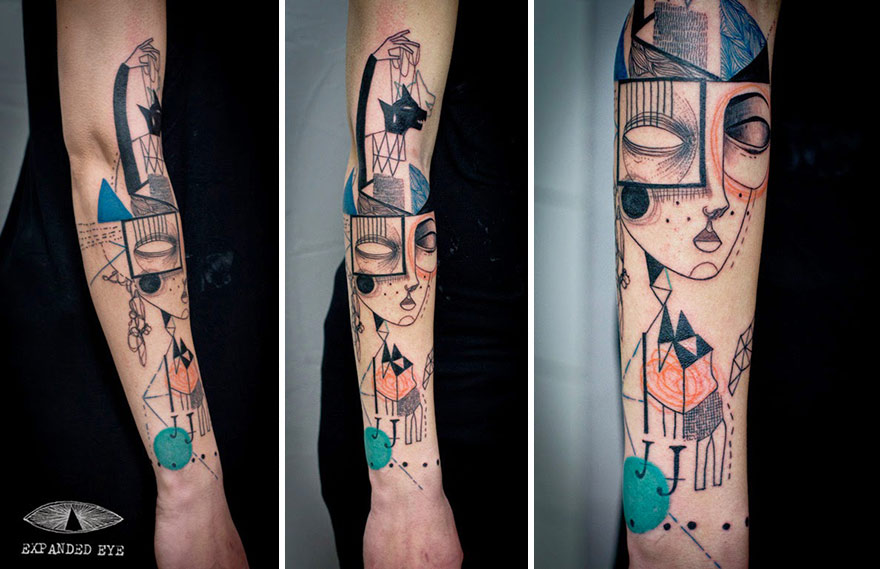
“Slovenian illustrator and puppet maker Zala’s tattoo is concerned with intuition and the power of the beautiful mind. Exploring the positive and negative aspects of the notion that, whilst we have the power to unconsciously dream things into life, at the same time we are able to paralyze ourselves with fear”

“The tattoo and memories of his father are Illias’ survival guide for existence. Wishing to find a harmony between living in a modern city whilst experiencing his dependence to nature to its fullest, Illias hopes his tattoo will give him the energy to go on, pursuing the freedom his father gave to him”


“Juliane from Germany, having grown up on the sea, requested a piece to symbolise the unfortunate parting of ways of her ocean-obsessed parents. We depicted the circle of life as her mother, who she describes as an Esmerelda-esque travelling soul, and calm and quiet silver fox of a father, both of whom still live on the sea”

“This piece depicts Judith’s unconditional love for her identical twin sister and the complexities and importance of discovering ones own identity as a twin. Judith learned to separate from the person she loves most in the world and affirm herself as a single being”

“The [above] piece serves as a reminder to Carlos that we need to fight to make the most of what we’ve been given. That involves exploring, discovering, participating, sharing and most importantly, being constantly curious about every detail of life”
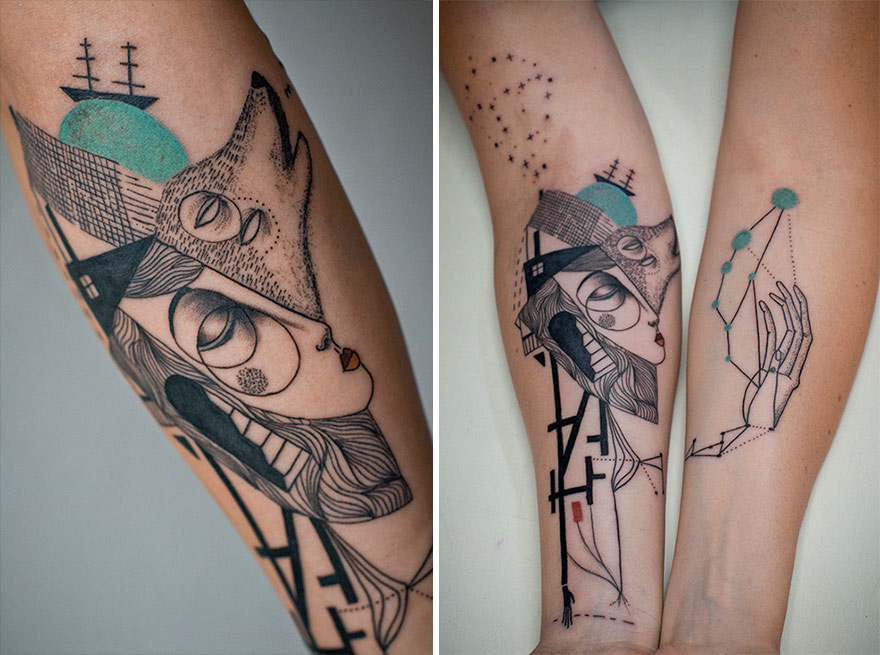
“Namkha’s tattoo depicts an empowered woman/animal metamorphosing. The transformation symbolising the duality between the everyday woman and the ‘Creatura’, expressing the creative force carried throughout her life which gives her the strength to transcend herself”

“The Cry of the Earth depicts our current man-made ecological crisis. As a lover of nature and active participant in his local ecological association, Noille contributes his efforts to halt mankind’s ever-increasing destruction of our natural environment”

“Fashion photographer Naura’s tattoo tells the story of a very personal and distressing incident in her life. The tattoo serves as a reminder of the decisions she has made, as she now begins a new chapter of her life. Feeling now as though she has been resurrected, emerging from the dark clouds that have been hanging over her for so long”


“This piece tells the tale of fox-girl Maren’s adventure across the north atlantic to find her ultimate happiness in Iceland”


“The leaves in the above piece symbolise the four members of Paolo’s family. Despite no longer being together physically and the sadness of dealing with this detachment, they will always be a part of one another”


“We depicted Erik’s love for his girlfriend, who he described as his reason for living, as well as the happiness found through raising a glass to life and dreams with his nearest and dearest“

Here is a map that is the only map you will ever need ever again in your entire map. Delete all your Google Map links, burn all your Rand McNally maps and take that stupid globe and chuck it in the dumpsters. Because none of those maps include goats and are therefor entirely irrelevant.









 This is the quick and easy way to make the latest trend in clean eating. [


.jpg)