Shared posts

04 Jun 06:54

Representation of Behavioral Tactics and Tactics-Action Transformation in the Primate Medial Prefrontal Cortex

by Matsuzaka, Y., Tanji, J., Mushiake, H.

To expedite the selection of action under a structured behavioral context, we develop an expedient to promote its efficiency: tactics for action selection. Setting up a behavioral condition for subhuman primates (Macaca fuscata) that induced the development of a behavioral tactics, we explored neuronal representation of tactics in the medial frontal cortex. Here we show that neurons in the posterior medial prefrontal cortex, but not much in the medial premotor cortex, exhibit activity representing the behavioral tactics, in advance of action-selective activity. Such activity appeared during behavioral epochs of its retrieval from instruction cues, maintenance in short-term memory, and its implementation for the achievement of action selection. At a population level, posterior medial prefrontal cortex neurons take part in transforming the tactics information into the information representing action selection. The tactics representation revealed an aspect of neural mechanisms for an adaptive behavioral control, taking place in the medial prefrontal cortex.

SIGNIFICANCE STATEMENT We studied behavioral significance of neuronal activity in the posterior medial prefrontal cortex (pmPFC) and found the representation of behavioral tactics defined as specific and efficient ways to achieve objectives of actions. Neuronal activity appeared during behavioral epochs of its retrieval from instruction cues, maintenance in short-term memory, and its use preceding the achievement of action selection. We found further that pmPFC neurons take part in transforming the tactics information into the information representing action selection. A majority of individual neurons was recruited during a limited period in each behavioral epoch, constituting, as a whole, a temporal cascade of activity. Such dynamics found in behavioral-tactics specific activity characterize the participation of pmPFC neurons in executive control of purposeful behavior.
02 Jun 00:09

Dark satanic wings

Dark satanic wings

Nature 534, 7605 (2016). doi:10.1038/534005a

Just as the dark-coloured pepper moth disappears from northern England, researchers are finally getting to the bottom of how it gained its colour.

19 Apr 14:19

Neuroscience: A transformative tool for trans-synaptic tracing

Nature Methods 13, 290 (2016). doi:10.1038/nmeth.3822

03 Feb 15:52

Brain–computer interfaces for dissecting cognitive processes underlying sensorimotor control

Publication date: April 2016
Source:Current Opinion in Neurobiology, Volume 37
Author(s): Matthew D Golub, Steven M Chase, Aaron P Batista, Byron M Yu
Sensorimotor control engages cognitive processes such as prediction, learning, and multisensory integration. Understanding the neural mechanisms underlying these cognitive processes with arm reaching is challenging because we currently record only a fraction of the relevant neurons, the arm has nonlinear dynamics, and multiple modalities of sensory feedback contribute to control. A brain–computer interface (BCI) is a well-defined sensorimotor loop with key simplifying advantages that address each of these challenges, while engaging similar cognitive processes. As a result, BCI is becoming recognized as a powerful tool for basic scientific studies of sensorimotor control. Here, we describe the benefits of BCI for basic scientific inquiries and review recent BCI studies that have uncovered new insights into the neural mechanisms underlying sensorimotor control.

14 Jan 00:17

Causal contribution of primate auditory cortex to auditory perceptual decision-making

by Joji Tsunada

Nature Neuroscience. doi:10.1038/nn.4195

Authors: Joji Tsunada, Andrew S K Liu, Joshua I Gold & Yale E Cohen

10 Sep 08:39

Neural constraints on learning

by Patrick T. Sadtler

Neural constraints on learning

Nature 512, 7515 (2014). doi:10.1038/nature13665

Authors: Patrick T. Sadtler, Kristin M. Quick, Matthew D. Golub, Steven M. Chase, Stephen I. Ryu, Elizabeth C. Tyler-Kabara, Byron M. Yu & Aaron P. Batista

Learning, whether motor, sensory or cognitive, requires networks of neurons to generate new activity patterns. As some behaviours are easier to learn than others, we asked if some neural activity patterns are easier to generate than others. Here we investigate whether an existing network constrains the patterns that a subset of its neurons is capable of exhibiting, and if so, what principles define this constraint. We employed a closed-loop intracortical brain–computer interface learning paradigm in which Rhesus macaques (Macaca mulatta) controlled a computer cursor by modulating neural activity patterns in the primary motor cortex. Using the brain–computer interface paradigm, we could specify and alter how neural activity mapped to cursor velocity. At the start of each session, we observed the characteristic activity patterns of the recorded neural population. The activity of a neural population can be represented in a high-dimensional space (termed the neural space), wherein each dimension corresponds to the activity of one neuron. These characteristic activity patterns comprise a low-dimensional subspace (termed the intrinsic manifold) within the neural space. The intrinsic manifold presumably reflects constraints imposed by the underlying neural circuitry. Here we show that the animals could readily learn to proficiently control the cursor using neural activity patterns that were within the intrinsic manifold. However, animals were less able to learn to proficiently control the cursor using activity patterns that were outside of the intrinsic manifold. These results suggest that the existing structure of a network can shape learning. On a timescale of hours, it seems to be difficult to learn to generate neural activity patterns that are not consistent with the existing network structure. These findings offer a network-level explanation for the observation that we are more readily able to learn new skills when they are related to the skills that we already possess.

20 Jun 23:28

Two distinct layer-specific dynamics of cortical ensembles during learning of a motor task

by Yoshito Masamizu
Eric Trautmann

Relevant for NeuroFAST - More motor/imaging

Nature Neuroscience. doi:10.1038/nn.3739

Authors: Yoshito Masamizu, Yasuhiro R Tanaka, Yasuyo H Tanaka, Riichiro Hira, Fuki Ohkubo, Kazuo Kitamura, Yoshikazu Isomura, Takashi Okada & Masanori Matsuzaki

30 May 18:31

[Editorial] The hunt for MH370

by Marcia McNutt
In a world that is increasingly connected, that grows smaller every day, and where so many human actions are exposed to prying eyes, it seems almost incomprehensible that the world's largest twinjet aircraft, with 239 passengers and crew, could vanish for more than 2 months. Determining the crash site of Malaysia Airlines Flight 370 (MH370) has become a scientific detective story, emerging through a combination of scientific technologies used to address problems for which they were never designed. The search for MH370 illustrates a humanitarian dividend from past investments in science as searchers attempt to bring closure to the families and friends of the victims of the tragedy. Author: Marcia McNutt
04 May 16:06

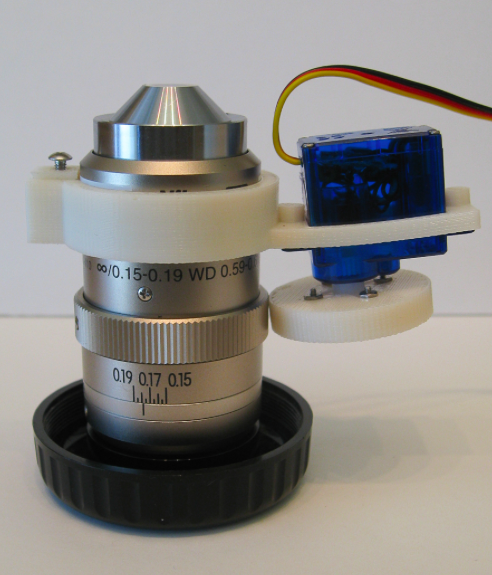
3D printed servo mount for motorizing a correction collar

by L.
Eric Trautmann

We'll need something like this

cc

This is from Kurt’s Microscopy Blog.

Just this month we could have made use of something like this.
source

PrintFacebookTwitterGoogle BookmarksSlashdotemailLinkedInReddit

31 Mar 00:49

Biomedical research: Publish results from volunteer computing

by Herman Tse

Biomedical research: Publish results from volunteer computing

Nature 507, 7493 (2014). doi:10.1038/507431b

Author: Herman Tse

In your discussion of waning participation in volunteer computing projects (Nature506, 16–17; 10.1038/506016a2014), you omit to mention the most important motivator of all — contribution to scientific progress.For instance, a review of completed projects on IBM's

05 Mar 20:27

Dynamic sensory cues shape song structure in Drosophila

by Philip Coen
Eric Trautmann

Looks interesting

Nature advance online publication 05 March 2014. doi:10.1038/nature13131

Authors: Philip Coen, Jan Clemens, Andrew J. Weinstein, Diego A. Pacheco, Yi Deng & Mala Murthy

The generation of acoustic communication signals is widespread across the animal kingdom, and males of many species, including Drosophilidae, produce patterned courtship songs to increase their chance of success with a female. For some animals, song structure can vary considerably from one rendition to the next; neural noise within pattern generating circuits is widely assumed to be the primary source of such variability, and statistical models that incorporate neural noise are successful at reproducing the full variation present in natural songs. In direct contrast, here we demonstrate that much of the pattern variability in Drosophila courtship song can be explained by taking into account the dynamic sensory experience of the male. In particular, using a quantitative behavioural assay combined with computational modelling, we find that males use fast modulations in visual and self-motion signals to pattern their songs, a relationship that we show is evolutionarily conserved. Using neural circuit manipulations, we also identify the pathways involved in song patterning choices and show that females are sensitive to song features. Our data not only demonstrate that Drosophila song production is not a fixed action pattern, but establish Drosophila as a valuable new model for studies of rapid decision-making under both social and naturalistic conditions.

10 Feb 00:05

Rapid Online Selection between Multiple Motor Plans

by Nashed, J. Y., Crevecoeur, F., Scott, S. H.

Recent theories of voluntary control predict that multiple motor strategies can be precomputed and expressed throughout movement. We examined online decisional processing in humans by asking them to make reaching movements with obstacles located just to the sides of a direct path between start and end targets. On random trials, the limb was perturbed with one of four mechanical loads that varied in direction and amplitude. Notably, we observed two different strategies when we applied a perturbation (left medium-sized) that deviated the participants' hand directly toward an obstacle. In some trials, subjects directed their hand between the obstacles and in other trials to the left of the obstacles. Importantly, changes in the muscle stretch response between these two strategies were observed in <60 ms after perturbation, during the R2 long-latency epoch (~45–75 ms). As predicted, the selected strategy depended on the estimated position of the limb when it was perturbed. In our second experiment, we presented either one or three potential goal targets. Movements initially directed to the closest target could be quickly redirected to other potential targets after a perturbation. Differences in muscle stretch responses for redirected movements were observed ~75 ms after perturbation during the R3 long-latency epoch (~75–105 ms). The results show that decisional processes are rapidly implemented during movement execution. In addition, our data suggest a hierarchical process with corrective responses on "how" to attain a behavioral goal expressed during the R2 epoch and responses on "what" goal to attain during the R3 epoch.

09 Feb 21:31

ACQ4: A Python-based open source system for neurophysiology

by L.
Eric Trautmann

Worth evaluating

a1

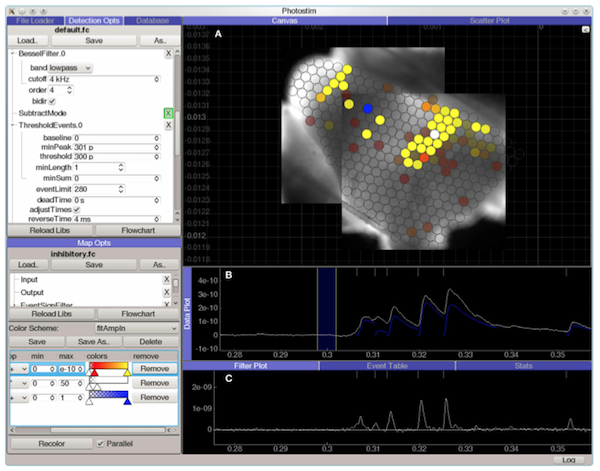
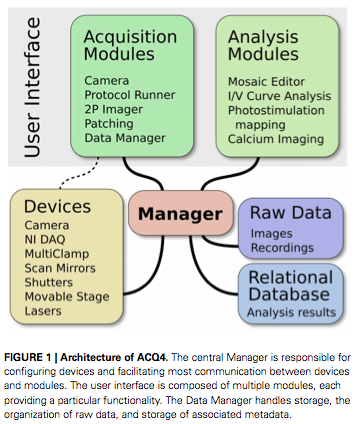
Luke Campagnola, Megan Kratz, and Paul Manis recently published their in-house software for neurophysiology experiments. It’s an extensive set of tools, including multiphoton imaging, photostimulation mapping, image mosaic construction, electrophysiology, and more.

Website: acq4.org

a2

PrintFacebookTwitterGoogle BookmarksSlashdotemailLinkedInReddit

24 Jan 20:53

Reactive Gliosis and the Multicellular Response to CNS Damage and Disease

Joshua E. Burda, Michael V. Sofroniew. The CNS is prone to heterogeneous insults of diverse etiologies that elicit multifaceted responses. Acute and focal injuries trigger wound repair with tissue replacement. Diffuse and chronic disea....
09 Jan 20:00

From Perception to Action: A Spatiotemporal Cortical Map

Sylvain Crochet, Carl C.H. Petersen. In this issue of Neuron, Guo et al. (2014) optogenetically probe contributions of different cortical regions to tactile sensory perception, finding that somatosensory cortex is necessary fo....
09 Jan 18:33

Dendritic spikes enhance stimulus selectivity in cortical neurons in vivo

by Spencer L. Smith

Nature advance online publication 27 October 2013. doi:10.1038/nature12600

Authors: Spencer L. Smith, Ikuko T. Smith, Tiago Branco & Michael Häusser

Neuronal dendrites are electrically excitable: they can generate regenerative events such as dendritic spikes in response to sufficiently strong synaptic input. Although such events have been observed in many neuronal types, it is not well understood how active dendrites contribute to the tuning of neuronal output in vivo. Here we show that dendritic spikes increase the selectivity of neuronal responses to the orientation of a visual stimulus (orientation tuning). We performed direct patch-clamp recordings from the dendrites of pyramidal neurons in the primary visual cortex of lightly anaesthetized and awake mice, during sensory processing. Visual stimulation triggered regenerative local dendritic spikes that were distinct from back-propagating action potentials. These events were orientation tuned and were suppressed by either hyperpolarization of membrane potential or intracellular blockade of NMDA (N-methyl-d-aspartate) receptors. Both of these manipulations also decreased the selectivity of subthreshold orientation tuning measured at the soma, thus linking dendritic regenerative events to somatic orientation tuning. Together, our results suggest that dendritic spikes that are triggered by visual input contribute to a fundamental cortical computation: enhancing orientation selectivity in the visual cortex. Thus, dendritic excitability is an essential component of behaviourally relevant computations in neurons.