Shared posts

07 Mar 16:49

New Me: Understanding Expert and Non-Expert Perceptions and Usage of the Tor Anonymity Network

Tor is an anonymizing network originally built by researchers in 2002. Today it is used by over 1.7 million people daily for anonymization, the evasion of security controls, and other use cases. While some Tor users have a background in cybersecurity or software, many of its users are not especially technologically savvy.

In Gallagher2017, researchers sought to understand the difference in use-cases and in understanding across this spectrum of users. The first step to gaining this insight was to recruit Tor users to interview, which is a difficult task since Tor users are a population very sensitive to observation. Despite this difficulty, 17 subjects were recruited and interviewed. Then, using a 5 question post-interview test, the participants were categorized as either "expert" or "non-expert/novice" and the two groups were analyzed separately.

Many of the findings were not surprising:

  • Experts reported using Tor as a tool for multiple use cases while novices typically had one use case. Some novices believed that their use case was all Tor was built for.
  • When asked to "draw what happens when you use the Tor Browser Bundle" experts tended to draw technical diagrams, detailing the path Tor takes through the Tor network.

Other findings were less intuitive:

  • Many novices described how Tor worked through metaphors primarily concerned with the social good. Some metaphors used were the "Tree of Knowledge", "Fort Knox", or "the Statue of Liberty".
  • No major differences were found between the two groups in their understanding of the trade-offs between national security and Tor.

Despite the small sample size of the paper, the authors were able to observe some interesting contrasts that enabled them to make meaningful recommendations to assist novices' understanding or to address comments made by all users. For example, a recommendation given to the Tor project was to include more detailed route information in the browser to make it obvious that Tor is not a centralized service but one that uses nodes owned by different entities.

Gallagher2017 Kevin Gallagher, Sameer Patil and Nasir Memon: New Me: Understanding Expert and Non-Expert Perceptions and Usage of the Tor Anonymity Network. Proc. SOUPS 2017, 10.5555/3235924.3235955.

Proper use of an anonymity system requires adequate understanding of how it functions. Yet, there is surprisingly little research that looks into user understanding and usage of anonymity software. Improper use stemming from a lack of sufficient knowledge of the system has the potential to lead to deanonymization, which may hold severe personal consequences for the user. We report on the understanding and the use of the Tor anonymity system. Via semi-structured interviews with 17 individuals (6 experts and 11 non-experts) we found that experts and non-experts view, understand, and use Tor in notably different ways. Moreover, both groups exhibit behavior as well as gaps in understanding that could potentially compromise anonymity. Based on these findings, we provide several suggestions for improving the user experience of Tor to facilitate better user understanding of its operation, threat model, and limitations.
05 Nov 15:14

Should We Leave Cameras on During Video Lectures?

by Cindy Nebel

by Cindy Nebel

Image from Pixabay

In a world of virtual learning, there have been many considerations about whether students should be required to keep their videos on or off while in class. There have been debates centered around issues of privacy and equity related to students displaying their home environments or broadband connectivity differences. Some have also argued that seeing oneself on screen can increase monitoring of our appearance and leads to increased zoom fatigue.

On the other hand, students report that seeing their classmates creates a better sense of connection and leads to better engagement and learning. It can also lead to more accountability as both the instructor and peers can see off-task behaviors.

While the reasons above for perhaps keeping cameras off are legitimate, the question of whether or not keeping them on or off benefits learning is mostly theoretical or anecdotal. There is very little empirical evidence on this topic. However, one recent study investigated exactly this issue (1).

Image from Pixabay

Researchers had all participants watch a video lecture on Zoom and then take a quiz. The participants were split into three conditions. Group 1 had all screens off (no one in the class could see themselves or anyone else). Group 2 had only their own screen off (they could see the rest of the class). Group 3 had screens on (they could see themselves and others).

If seeing others is distracting or causes anxiety because of equity issues, then Groups 2 and 3 should be negatively affected. If seeing yourself causes Zoom fatigue because of monitoring, then Group 3 should be really affected. But if, instead, seeing others increases engagement, then Groups 2 and 3 should do a bit better and if seeing yourself increases accountability then Group 3 should do a lot better.

It should be noted that there might be multiple different effects at play here. What these researchers were asking was not about the why this happens. They were asking if there is a difference first.

The lecture itself was part of an introductory psychology course and was pre-recorded. The instructor was unfamiliar to the students and was not visible on screen. After about a half hour lecture, the students were told to immediately switch over to their LMS to take the 15-item multiple-choice quiz.

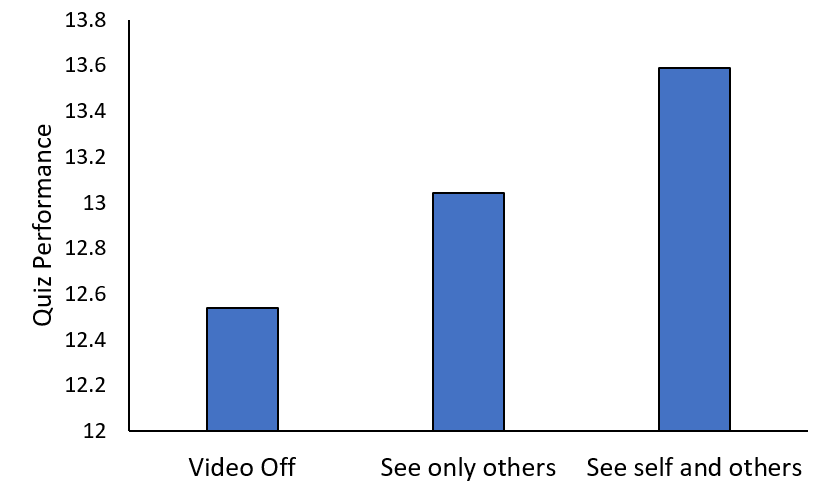
The researchers found that those students who could see themselves and their peers scored highest on the quiz and significantly higher than those who had video off.

Data from cited study

What this indicates is that asking students to keep their videos on is probably ok and it might actually be helpful. But there are some major limitations to this study. The issues of equity described above are not, in any way, addressed as part of this study. It is very possible that significant individual differences exist for who will benefit from having video on. As I explained above, this also doesn’t really give us an answer for why we see this effect. There are a lot of reasons why seeing others and yourself could be beneficial and understanding why is important to determine when this effect will persist.

There were also some really artificial things about this experiment. If engagement and feelings of connectedness drive this effect, then seeing the instructor and having a relationship with that individual would likely boost these results considerably. Having taught solely online for 3 full years now, I feel confident saying that the student experience is enhanced when we can see each other. I see reactions and can adjust my discussion or review concepts in real time, knowing when there is confusion, surprise, etc. These factors weren’t tested in the current study, but likely increase the effects seen here.

What does this mean for you:

  1. As an educator, consider encouraging (but perhaps not requiring) students to keep their cameras on. It likely will not hurt their learning in a significant way.

    • I would, on a personal note, recommend that you acknowledge that there are many reasons why someone might turn their video off on a certain day or that they might want to leave it off all the time for a particular reason… and that’s ok. In my own courses, I ask everyone to keep them on as part of behavioral norms at the beginning of the course and to let me know if there is a reason why they cannot. There are a LOT of reasons why students like to keep their cameras off occasionally, and I respect them.

  2. As a student, turn on your camera during synchronous sessions, but also consider how you behave in asynchronous sessions. These data suggest that when learning from video, it’s likely beneficial to have some peers with you. Maybe consider having a watch party so you can all get together, eat some popcorn, and watch your lecture! Or jump on zoom and have someone share screen so you can all watch together and see yourself too! (Popcorn optional.)


Reference:

(1) Austin, M. R., Fogler, K. A., & Daniel, D. B. (2021). Seeing self and others on-screen does not negatively impact learning in virtual classrooms. Scholarship of Teaching and Learning in Psychology, Advance Online Publication.

16 Dec 08:50

You can figure out the approximate length of our blog lag now.

by Andrew

Sekhar Ramakrishnan writes:

I wanted to relate an episode of informal probabilistic reasoning that occurred this morning, which I thought you might find entertaining.

Jan 6th is the Christian feast day of the Epiphany, which is known as Dreikönigstag (Three Kings’ Day), here in Zürich, Switzerland, where I live (I work at ETH). There is a tradition to have a dish called three kings’ cake in which a plastic king is hidden in one of the pieces of the cake. Whoever finds the king gets some privileges that day (like deciding what’s for dinner).

Two years ago, the bakery we get our three kings’ cake from decided to put a king in *every* piece of cake. They received many complaints about this, and last year they returned to the normal tradition of one king per cake. Today, we were speculating on whether they were going to try their every-piece-a-king experiment again this year.

My 12-year-old son picked the first piece of cake: he had a king! He said, “It looks like they probably did put a king in every piece again this year.” We had a cake with 5 pieces, so, assuming that one king per cake and five kings per cake are equally likely, I get a posterior probability of 5/6 that there was a king in every piece. I thought it was interesting that my son intuitively concluded that a king in every piece was more likely as well, even though he hasn’t had any formal exposure to statistics or statistical reasoning.

As it turns out, though, there was only one king in the cake — my son just got lucky!

Indeed, there are some settings where probabilistic reasoning is intuitive.