Shared posts

03 Jan 02:52

The best walking shoes for women, tested over 50 miles

by rschultz@insider.com (Rachael Schultz)

When you buy through our links, Business Insider may earn an affiliate commission. Learn more

Left: The author wearing the most walking shoes for women. Right: The co-author wearing travel sneakers for women.
We tested women's walking shoes on neighborhood strolls and exploring new cities abroad. Here are the most comfortable pairs that prevented achy joints and fatigue.

Rachael Schultz, Gabrielle Chase/Business Insider

A proper pair of walking shoes can make a major difference in your health. I've easily racked up 20,000 steps in a single day without any protest from my feet, and it's all because I had comfortable sneakers on.

According to podiatrist Elizabeth Daughtry, DPM, FACFAS, women are more prone to developing stress fractures. So by wearing proper sneakers, you could actually be saving your future-self from a torn tendon or muscle strain.

No matter what, you should look for supportive shoes with cushioned midsoles and flexible footbeds. But your choice should also depend on your specific foot structure — overall, I found the best pair for most people are the Asics GEL-Nimbus 27s, which proved to be proved to be stylish, well-cushioned, and worth the price.

For this guide, I tested over 30 sneakers on walks totaling over 50 miles. These long-distance trials let me gauge which pairs felt the most comfortable and durable, whether I was hiking trails with my dog, speed-walking through errands, or exploring a new city.

For an excellent under-$100 pick, I suggest Rykä's Devotion X — they're reliably comfy and surprisingly affordable. Style editor Gabrielle Chase wore hers on a trip to Europe, where they held up over four 7-mile days in a row.

The top walking shoes for women, at a glance:

How I tested the best walking shoes for women

I'm a fitness gear expert covering fitness topics ranging from orthopedic footwear to running watches. Over the past two years, I've personally tested over 30 pairs of sneakers, 30 winter boots, and 10 walking sandals. Each pair I wore on at least three walks (though many have seen dozens more) on surfaces like sidewalk asphalt, concrete flooring, dirt and gravel trails, and airport corridors. To test shoes with technical elements like waterproofing or all-terrain lugs, I walked in rainy and slushy conditions near my home in Colorado.

I also consulted a board-certified podiatrist, Elizabeth Daughtry, DPM, FACFAS from the Foot & Ankle Specialists of the Mid-Atlantic, for tips on what to look for. Ultimately, the criteria for choosing the best walking shoes for women differs across members of our team.

I myself have semi-wide feet and high arches, but cumulatively, our team has tested a total 40 pairs made for narrow, wide, flat, and petite sizes.

Initial comfort and shape: The right fit for your foot shouldn't feel like it's rubbing anywhere or like it's tight in the toe box or on the top of your foot (called foot volume), and your heel should feel snug and secure in the back. I chose walking shoes that were comfortable right out of the box. Most of our team members have medium to wide width feet, with medium to high arches. The best shape for any foot will have a wide base and roomy toe box to let your toes spread naturally. This shoe shape will help distribute your body weight more evenly and avoid any muscle strains in your foot.

Arch support: Women with higher arches usually need more support in their shoes or more stability in the midfoot area to prevent excessive flattening of the foot and arch, Daughtry says. I myself have high arches, so I walked at least three miles in each shoe to gauge for achiness.

Stability: Cushioning level and heel counter stiffness were easy to feel early on: A more cushion gives a plush, walking-on-air feel, while a firm heel counter adds feels more rigid under the back of your foot, and provides ankle support over time.

Weight: I tested shoes that weigh between 8 and 13 ounces, which is the ideal range to feel light on long walks and slow foot fatigue. Two of the lightest pairs we recommend are the Merrell Morphlites and On Cloudtilts.

Durability: Some insoles can flatten after consistent pounding on pavement, which weakens the shoes' shock absorption. After testing the shoes on a long walk, I took out the insoles and held them at eye level to see whether they looked deflated in any areas.

Traction: For the majority of the shoes, I walked in each pair for at least 2 miles, both outdoors on pavement and indoors. I used a treadmill or my walking desk. I felt for whether their tread felt slippery on smooth surfaces, versus how well it grips onto rough terrain. For outdoor-oriented shoes (trail runners, winter walking shoes), I tested the traction by wearing the shoes on icy, snowy, and loose trail surfaces in wet and muddy weather, and gauged which shoes offered the most secure footing.

Breathability: I chose walking shoes with wide toe boxes and mesh uppers that allowed for more airflow, an attribute that's pretty clear after just one mile. If my feet felt swollen and hot, or the shoes were damp with sweat after my walk, I nixed them from this list. Leather shoes like loafers and dress sneakers were the only exceptions.

Learn more about how the Reviews team tests shoes at BI.

Our top sneaker picks compared:

Shoe Weight (oz per shoe) Cushion Stability Price Best for
Asics Gel-Nimbus 27 9.3 High Stability $$ Plantar fasciitis
Ryka Devotion X 8.7 Moderate Neutral $ Under $100
Adidas Ultraboost Light 9.2 Moderate Neutral $$ Lightweight travel
On Cloudtilt 8 Moderate Neutral $$ Better balance
Hoka Gaviota 8.6 High Stability $$ High arches, wide feet
Puma Magnify Nitro 8.9 High Neutral $$ Injury prone
Hoka Transport GTX 10 Moderate Neutral $$ Rain and mud
Merrell Morphlite 7.6 Low/Mod Neutral $ Uneven terrain
Sorel Kinetic Caribou 13.3 Low/Mod Neutral $$ Winter walking
Allbirds Strider 9.4 Low Neutral $$ Smart packing
OOFOS Oomy Zen 12.5 Moderate Neutral $$ Wide feet
Vionic Uptown Loafer 17 Low Stability $$ Work commutes
Frankie4 Nat III 10.6 Low Neutral $$$ Office wear
Under Armour Essential Runner 12 Low Neutral $ Retro style
Best overall: Asics GEL-Nimbus 27
The author wearing Asics GEL-Nimbus 27s, the top overall walking shoes for women.

Rachael Schultz/Business Insider

Asics' GEL-Nimbus 27s weigh just 9.9 ounces, are highly breathable, and very well-cushioned. I've worn them on dozens of occasions where I walked for over 8 hours, and my feet, calves, and knees still felt supported and fresh at the end of the day. Though they are a high-cushion shoe, the FF Blast Plus foam doesn't get packed down or muddy after 5+ hours like many other brands, and the shoe is shaped so your foot doesn't trip up on the generous 2 inches of foam underfoot.

The GEL-Nimbus 27 has a structured sole, supportive heel counter, and a uniquely firm midsole which all work to support and limit movement in the tendons of your foot — great for minimizing tendon issues (they're one of the best shoes for plantar fasciitis, in fact). This structure on top of lightweight foam gives these shoes a slightly springy feel with each step.

As someone with high arches and a slight overpronation, I appreciate that Asics uses adaptive stability technology in these shoes to provide the amount of support your foot needs without overcorrecting; for me, these are one of the few shoes that don't leave my arches aching after a long day of walking. This adaptive technology also means this shoe is a great pick for most people since it supports everything from a neutral gate or strong overpronation.

The final check mark for me: They're also quite stylish — in an oversized, heritage-track-club kind of way. They pair well with everything from shorts to exercise dresses to dress pants, which means you really can feel supported wherever you're walking.

They are a bit bulky to pack (I always wear them on the airplane) and if you don't like a high-cushion, adaptive technology shoe, you might be happier with something like the Adidas Ultraboost Light. But these are what I consider the best walking shoes for most people, thanks to their perfect balance of support and comfort.

Best budget: Rykä Devotion X
Two co-authors wearing Ryka Devotion X walking shoes.

Rachael Schultz, Gabrielle Chase/Business Insider

Rykä's sneakers are proof that you don't have to spend big to find supportive shoes for your feet. For just $80, the Devotion Xs have all of Daughtry's must-haves: a roomy knit upper for breathability on long, hot miles; responsive cushioning for shock absorption; an EVA proprietary foam that provides soft cushioning, including built-up cushioning in the midfoot for stability and arch support; and a padded heel. They even boast the Seal of Acceptance by the American Podiatric Medical Association.

These are one of the few shoes on our list designed specifically for walking, which means they don't have a meta-rocker or any unnecessary design features that come with some running shoes.

After a 3-mile walk, I found these shoes to be incredibly comfortable. The knit upper is very soft and formed to my foot shape, so these shoes felt like a light hug but not at all tight. They were also extremely breathable and kept my feet from building up heat after multiple miles.

"The Devotion X sneakers have been my preferred walking shoes for about two years now," writes senior associate style editor Gabrielle Chase. Most recently she wore them on a 10-day trip across central Europe, walking an average seven miles a day. "They're perfectly cushioned and light, and made my ankles feel supported even as I navigated uneven cobblestone streets."

"By far my favorite feature of these is the layers of foamy padding on the outsole," adds style editor Samantha Crozier. "It actually feels like walking on pillows — and each step is so bouncy these are downright buoyant."

The design isn't revolutionary so these shoes won't earn you a ton of compliments, but they're not noticeably unattractive. 

The main downsides are that if you underpronate (supinate), the stability design for these shoes might throw off your biomechanics. Also, while the construction matches the price point here, these shoes aren't the most durable with minimal reinforcements in the knit upper, so if you wear through your shoes quickly, a budget option might not equal value for you.

Read more in our full Rykä shoes review.

Best arch support: Hoka Gaviota 6
The author wearing Hoka Gaviota 6

Rachael Schultz/Business Insider

The Bondis and Gaviotas have similar cushion levels, but the Gaviotas have a wider toe box, a more breathable upper, and are better for stabilizing your gait. The Bondis are a bit lighter with a less steep heel-to-toe drop, and are better optimized for running.

People who roll their feet inward as they step, or “overpronate,” should choose the Gaviotas. Those with a neutral gait should choose the Bondis.

I've tried all the best Hokas that have come out over the past decade. After walking in the Gaviota 5s for years and testing the Hoka Gaviota 6 for a few months, I can confirm this update is indeed an upgrade. This new version is the perfect blend of comfort, support, and arch support, with a more plush collar, highly breathable mesh uppers, improved traction, and a wider overall design. Plus, the new Gaviota 6s weigh about a half ounce less than their predecessor. They also come in a Wide or X-Wide option for those who need more toebox space.

Stability shoes like these are helpful if your foot rolls inward as it strikes and pushes off the ground (also known as "overpronation"). Hoka's enhanced stabilizing H-Frame helps level out your foot while keeping the shoe lightweight. This in turn can help you avoid pain and collapsed arches in the long run.

You can't feel the H-frame when you run, but it keeps your foot feeling firm and controlled with your arches supported. At the same time, the Gaviota 6 is designed with a softer, EVA foam to give a plush and forgiving ride underfoot akin to their popular Bondis.

The Gaviota 6s are constructed with a new, breathable engineered upper, which I found to be more flexible and durable than the jacquard upper of the Gaviota 5s. I also really like the addition of an internal ghillie lacing system, which makes them feel more locked in and secure.

If you need arch support, prefer solid cushioning underfoot, and have a wider-than-average foot like I do, you'll love the fit and ride of the Gaviota 6. And if you stand or walk a lot all day, you'll love their flexible, breathable feel.

Best for standing all day: On Cloudtilt
A pair of purple On Cloudtilt sneakers.

Rachael Schultz/Business Insider

After testing the best shoes for standing all day, I found that the On Cloudtilts strike a perfect balance between cushioned and supportive. On's signature technology, CloudTec, builds the midsole out of firm foam cutouts, or "clouds," to provide structured support. These clouds are organized in a sequential collapse pattern, so they compress gradually in a way that offers just the right amount of give. This allows for better balance and disperses the impact of walking all day, thereby reducing fatigue in your legs.

The Cloudtilts use a knit upper made from 100% recycled polyester that feels more elastic and forgiving — especially if your feet tend to swell. It hugs your foot like a sock without trapping heat. One downside: The sock-like upper means you lose some structure and lateral stability, so it's not ideal if you pivot a lot on the job.

Priya Parthasarathy, DPM, is a Maryland-based podiatric surgeon with Foot Ankle Specialists of the Mid-Atlantic. She told me finds lace up shoes are more supportive for standing and walking all day compared to one-size-fits-all slip ons. That said, sometimes you want a shoe that slips on and off easily. I love that this lace system lets you tighten across the top of the foot as needed, but has enough stretch and a simple stopper knot. This way you can slip them off without having to untie and re-tie every time.

Best for travel: Allbirds Striders
The author wearing Allbirds Striders sneakers.

Gabrielle Chase/Business Insider

Any pair good of walking shoes should feel lightweight, but especially so when you're packing for a trip. Sneakers with heavy cushioning are often too clunky to fit neatly in a weekender bag, but we found the Allbirds Striders easy to tamp down flat thanks to their flexible "Tree Knit" uppers. A women's size 7 weights 9.4 ounces — another testament to their packability.

"The sculpted mesh pops back into its original shape, even after I crammed them to the bottom of my tote," writes style editor Gabrielle Chase. "But what makes them really stand out is that I could comfortably wear them without socks. The padded heel and stretchy collar fit flush against my skin without rubbing, and the breathable uppers prevented my feet from becoming sweaty. If you're headed anywhere warm and plan to do a lot of sightseeing, these are the shoes to bring."

The springy sneakers have a sporty, polished design that's versatile enough to wear out and about without looking too out of place. Wear them with your airport cozies or as you explore a new city — either way, their firm midsoles can support you on the long haul.

"I have a regular width foot and I didn't find them too narrow, despite what the brand says," continues Gabrielle. "You do sacrifice some arch support and ankle stability with these, but the contoured silhouette worked for me throughout an entire day of walking. Plus, the flared footbed beneath the toebox and reinforced toe caps made me feel grounded on downhill cobblestone sidewalks."

Read more in our full Allbirds review.

Honorable mention: Reef Neptune

Travel writer Emily Hochberg walked hundreds of miles in her Reef Neptunes, noting their collapsible design and slim, easy silhouette as the perfect combo for busy travel days. "Simply put, I've never worn a more comfortable sneaker," she says. "The fact that these shoes look good with everything, pack down ultra light, and remain comfy through miles of walking, has made them a true VIP in my closet (and suitcase)."

Best waterproof: Hoka Transport GTX
The author in beige waterproof walking shoes.

Rachael Schultz/Business Insider

These waterproof sneakers are my choice for a lightweight alternative to rain boots. I wore them on multiple walks and hikes and found them to be very comfortable. The Transport GTX isn't as cushioned as other Hokas —more balanced than plush — but the EVA midsole felt comfortable for 1- to 3-mile walks.

Most of all, the waterproofing is a 10/10: I tromped through a pile of snow on one early spring testing walk and, where my husband's feet were soaked in normal sneakers, mine remained bone dry. That's because the upper is treated with GORE-TEX, which notably does cost you some breathability. But I loved that the upper was mesh for a roomy fit, while also being strategically reinforced to last against the elements. 

I really liked the functionality of these shoes. The main laces are a pull-tab design so they're easy to secure or loosen, but unlike a lot of other similar designs, Hoka's quick-toggle lace neatly tucks away so the tail isn't flopping around. I also love that the shoes come with traditional laces, in case you don't like the quick-toggle design.

Note that these shoes have neutral stability, so they may not be supportive enough for people with high arches. And if you like a plush walking shoe, these might be too stiff on you.

Best lightweight: Adidas Ultraboost Light
Side by side images of the author wearing Adidas walking shoes.

Rachael Schultz/Business Insider

True to the name, the Adidas Ultraboost Light are one of the lightest shoes on our list weighing just 9.2 ounces. But they're also incredibly well designed and kept my feet cool and supported walking for hours at a time.

The Ultraboost Light have a soft, textile upper, which Daughtry says is crucial in a great walking shoe as it offers more space and breathability for your foot.

The midsole is well-cushioned, which Daughtry also highlights to help with shock absorption and minimize added stress. After walking all day in these shoes, my feet felt pain-free and well-supported. The BOOST technology in the midsole offers a little bounce with every step. Though they are technically a neutral shoe, my high arches felt well-supported on long miles, so they seem to be a good fit for all pronation types.

The weight and more minimal design of these shoes make them great for packing to travel — and it's a bonus that they're good-looking. They're also made from at least 20% recycled materials, sometimes more depending on which color you buy.

I know some people with wide feet who've found the plastic lace closures in this shoe dig into the top of their foot since that upper isn't rigid, but my feet are on the regular-to-wide side of the spectrum and I didn't find any issue with this. Otherwise, the major downside is these shoes are pricey (unless you catch them on sale).

Read more in my full Adidas Ultraboost Light review.

Best cushioned: Puma Magnify Nitro 2
The author in black walking shoes.

Rachael Schultz/Business Insider

Cushioned walking shoes are great for anyone with special needs in their feet, be it extra high arches, flat feet, overpronation, or achy knees. Puma's Magnify Nitro 2 have the thickest piece of foam among all the shoes in Puma's line-up. Yet they're still very lightweight at just 8.07 ounces overall. 

During testing, I found these shoes to be far less stiff and more comfortable across the entire foot on long-distance walks, compared to the high-cushion competitors I tested (like Hoka's Bondis).

Instead, the Puma's knit upper is breathable, forms to the foot, and feels very durable, as it's reinforced with its proprietary seamless tape. The molded heel collars were especially comfortable on long, hot walks. In my opinion, Puma has inserted highly-engineered features in all the right places while keeping the shoe streamlined overall to keep that weight down.

It's worth noting these shoes run a full size small, so I wore an 8.5 instead of my regular 7.5. And while I found the toe box to be very comfortable with my standard-to-wide feet, they might feel slightly too snug on wide feet.

Best pull-on: OOFOS Oomy Zen
OOFOS Oomy Zen walking shoes.

Gabrielle Chase/Business Insider

During testing, I appreciated not only how fatigue-fighting Oofos' shoes are — the support feels incredibly rejuvenating on tired feet — but also that all of their styles, from slides to sneakers, are really easy to slip on and off.

"Oofos are unlike any other sneaker I've tried. The shock-absorbent foam outsole makes for the bounciest, squishiest bottom of all. They feel like what I imagine Moon Shoes, the springy early 2000s product that was constantly featured on commercials, might feel like to wear.

The bowed shape of the footbed also puts a pleasurable pressure on the arch of your foot, which is the source of many of the shoe's exercise-recovery benefits. But even as someone who isn't running long distances each day, I love slipping these on to help my feet recover from wearing heels.

The only drawback with Oofos is that they aren't the most fashion-forward footwear. The slip on sneaker passes the function test with flying colors, but I'd love to see the same footbed on a trendier silhouette in the future." — Samantha Crozier, style editor, Insider Reviews

"I agree with Sam: these laceless shoes are pretty swagless, but they're so comfy to wear on long city walks that it's forgivable. They fit true to size with an extra wide toe box. Thanks to their seamless upper, I can pull them on and they fit as snugly as a sock. The foam footbeds have a meta-rocker design that propels you as you walk, but I don't feel wobbly when I'm at a standstill because it flexes with my foot.

If you have a really high arch and weak ankles, these are probably not the walking shoes for you. They engage your heels more than anywhere else. Still, I find them really bouncy and light, and noticed my feet don't get fatigued as easily, even after miles of stepping on concrete." — Gabrielle Chase, senior associate style editor, Insider Reviews

Best dress sneaker: Frankie4 Nat III
The co-author wearing white sneakers.

Gabrielle Chase/Business Insider

"When you imagine a classic low-top, cap-toed sneaker, you probably think of Chuck Taylors. But most Converse sneakers are simply not comfortable to walk in. They have zero arch or heel support, their soles are rock hard, and their toe boxes too narrow for most people. Instead, here's a similar style that's actually made for prolonged wear.

The Nat III's gussets are elastic, so they allow you to forgo laces if you rather wear them as slip-ons, as I do. You can also choose from a set of podiatrist-approved insoles in the included "Sole Saver Pack," which each have different levels of padding in the forefoot and heels.

I have high arches, so I was thankful for their supportive, spongy padding when I broke them in on a long neighborhood walk. Their shock absorption is leagues ahead of most flat-soled sneakers. And if you have weak ankles, these have high heel counters and collars to help stabilize you.

I could actually wear these comfortably without socks because the leather interior is so padded and smooth. I also liked how the toe boxes, though slightly narrow, became more flexible the more I broke them in. I got them in a size 8 and they fit true to size. They were stark white, but this summer I've roughed them up on the city sidewalks." — Gabrielle Chase, senior associate style editor, Insider Reviews

Most stylish: Under Armour Essential Runner Shoes
The author in retro white and purple walking shoes.

Rachael Schultz/Business Insider

I lost count of the number of times friends complimented me on these shoes, only to follow with, "They're Under Armour!?" If you're looking for supportive walking shoes that will look just as good as they feel walking around cities and airports, the Under Armour Essential Runner Shoes are for you. 

These retro-inspired walking shoes have a cushioned EVA midsole that feels perfectly supportive. They're not overly cushioned or stabilized as with the running-based shoes on this list, but they're also not stiff or cramped like with fashion sneakers of a similar design. The heel cup is cushy with a foam sockliner for extra comfort. The exterior is designed with a lightweight, breathable nylon upper and suede overlays strategically placed to not restrict the natural shape of your foot.

These shoes come in four colorways (some certainly more attractive than others). At 12 ounces, these sneakers aren't as light as some shoes on our list, but they're definitely not heavy, either. I've walked over two miles in them, and wore them for eight hours straight while traveling. The comfort and design of these shoes earned them top spot as my favorite city sneaker — especially considering they're very affordable.

Best trail hybrid: Merrell Morphlite
The author in green and pink walking shoes.

Rachael Schultz/Business Insider

I could not be more thrilled with the performance, fit, and purpose of this dark horse shoe. Merrell has long been a leader in the hiking shoe space, but in 2022, the brand renewed its place in the trail shoe category. The Morphlite is an incredibly lightweight, comfortable shoe that felt so good on long walks, I only wanted to keep wearing them.

These shoes are technically a road-to-trail shoe, which means their centers have shorter lugs for road running, and their perimeters have slightly-deeper lugs (2mm) to grip slippery trails. If you often walk from pavement to dirt or gravel trails like I do living in a Colorado mountain town, this shoe is wonderfully comfortable and balanced on both surfaces.

While wearing a true trail shoe on concrete can often feel like a cleat, I found the Morphlite's lugs are short enough to not klomp on hard ground, and also just toothy enough to have some grab on less-technical trails. The proprietary foam midsole has a nice, balanced plushness between lightly foamy and firm that helps to offer light cushion underfoot.

After an hour of walking in these shoes, I did feel a bit of strain in the back of my arch and front of my heel, so they probably aren't ideal if you have extremely high arches or plantar fasciitis. But for the average foot, they're very comfortable.

The Morphlite's Jacquard recycled knit upper encases the foot for a very close fit. I like that this knit is strategically reinforced for harder trail wear. But if you have a high-volume foot, they might be too snug.

Best loafer: Vionic Uptown Loafer
The co-author wearing brown leather loafers.

Gabrielle Chase/Business Insider

One of our favorite loafers for women we tested is ideal for those who commute on foot. Halfway between a sneaker and a loafer, this shoe is backed by Heeluxe's rigorous assessment that tests for fit, stability, cushioning, and flexibility. It comes in suede or leather in both medium and wide sizes.

"When I first put these on, I was impressed by the sturdiness around my ankles from the deep heel cups. These help weak ankles feel much more supported," says style editor Gabrielle Chase.

"The leather upper was very stiff to start with, but it softened after five or six wears. These are great if you have high arches, because the padding reaches all the way up the inner wall of the shoe," she adds. "

You can wear the Uptown Loafers just as you would walking sneakers — the lightweight, flexible soles can fold in half, and they have enough traction for stepping on uneven or slippery terrain.

The accordion design means I can flex my foot, and the shoe will flex with me. Still, they have enough structure to correct the position of my instep, meaning my arches are less sore at the end of a long day spent on foot."

Best winter walking boot: Sorel Kinetic Impact Caribou Plus
The author wearing women's winter walking boots.

Rachael Schultz/Business Insider

In our guide to the best winter boots for women, freelance style reporter and outdoor gear expert Rachael Schultz tested out comfortable winter boots for long travel days and those dreaded "wintry mix" forecasts.

"They look and fit like a supportive sneaker, but offer the protection and warmth of a winter boot," she said of the Sorel Caribous. "I wore these on long and short winter walks, as well as two full days of airport travel. My feet never grew tired or achy throughout the hours of wear and movement, thanks to the lightweight, molded Livelyfoam midsole and supportive molded EVA footbed.

"The laces work well to ensure a snug fit that locks your foot in place for long walks, and the microfleece lining makes for a cozy wear without any moisture build up. Also, they're pretty lightweight for a winter boot at just 15.5 ounces, which helps minimize exhaustion."

How to pick the best walking shoes for women

What to avoid

Even though most of us walk in whatever sneakers we already have on hand, there are certain categories of shoes that, according to Daughtry, you shouldn't wear walking more than 10 minutes:

  • Fashion sneakers: Most stylish sneakers are designed with a more narrow toe box and low to no cushioning or support for better aesthetics. But the trade-off is zero shock absorption and more strain on your foot when walking.
  • Certain running sneakers: Rocker-design running shoes tend to have higher heel drops. This design gives better propulsion and bounce when running but disrupts the natural stride while walking. Daughtry explains that a good walking shoe is less bouncy and gives a more natural cadence to your stride during the gait cycle.

What to look for

  • Cushioning: This is the most important aspect of a walking shoe, Daughtry says. Sufficient cushioning will absorb the shock from repetitive pounding that our feet undergo with every step. If you know you have tender heels, see our guide to the best shoes for plantar fasciitis.
  • Arch support: If you have high arches, you'll want a shoe with extra arch support to maintain ideal biomechanics (and avoid achy arches at the end of the day). Technically, you can add inserts to any shoe, but that can change the way the shoe fits overall, so often it's best to just opt for a shoe with great arch support from the start.
  • Your gait: The way your feet strike the ground, or "pronate," influences where you need extra support in a shoe, as the goal is to have even pressure across your foot with each step. See our FAQ section below to learn what your shoes' wear pattern means.
  • Support and stability: All shoes should feel supportive, but this is relative to whether you overpronate or remain neutral. If you overpronate, look for a stability shoe versus a neutral shoe.
  • Tread: Most people are wearing a walking shoe on pavement, so any level traction will work. If you're looking for a walking shoe to wear on trails, look for one with more tread.
  • Ventilation: A mesh upper is great in a walking shoe, as it offers more space and breathability compared to rigid leather. 

Meet the experts behind this guide

Rachael Schultz is a fitness gear expert and style contributor based in Colorado, and formerly the Health Editor at Insider Reviews. Based on her conversations with medical professionals and several months personally testing over 30 pairs of the internet's top-rated sneakers, she knows how to spot a well-designed walking shoe. With a stylish approach to comfort, she focused on brands that specialize in sensible footwear and determined how well their designs fit into the modern woman's wardrobe.

Dr. Elizabeth Daughtry is a podiatrist board-certified by the American Board of Foot and Ankle Surgery in Foot Surgery, recognized for her expertise in foot-friendly footwear and foot health.

Dr. Priya Parthasarathy is a Maryland-based podiatric surgeon with Foot Ankle Specialists of the Mid-Atlantic and a spokesperson for the American Podiatric Medical Association.

FAQs on the best walking shoes for women

What should women look for in walking shoes?

Women should look for walking shoes with plenty of cushioning to absorb shock, solid arch support, and a supportive-yet-breathable design that matches their gait and the surface they'll be walking on. A secure, stable, and breathable fit are the most important factors to minimizing fatigue.

Which walking shoes are best for flat feet?

According to our podiatrists, people with flat feet need more support through the arch and possibly some form of motion control to prevent pronation. We recommend the Hoka Gaviota 6s, which have great arch support and stabilizing H-Frame technology to keep your foot from rolling inward as you walk.

What's the difference between neutral and stability walking shoes?

A stability shoe is built with technology inside the shoe (usually strategic padding) to keep your foot from rolling inward, or overpronating, as you walk or run, which can help minimize injuries and aches (you can find more shoes for overpronators in our guide to the best shoes for standing all day, where we tested sneakers such as the popular Brooks Ghost 16s). A neutral walking shoe doesn't interfere with the way your foot lands and works better for those with neutral gaits.

Are running shoes good for walking?

It depends on the running shoe — you shouldn't walk in shoes with a rocker design and high heel drop, because these mechanisms propel your feet forward in an unnatural way. A good walking shoe should be less bouncy and follow your natural foot-strike cadence when walking, Daughtry says.

What is supination vs. overpronation?

Pronation is a bio-mechanical term that describes the way your feet roll and distribute impact as you step. There are three ways your foot may strike the ground: overpronation, supination, and neutral. Overpronators step with their heels rolled inward at a severe angle (putting them at a higher risk for twisted joints). Those who supinate, or underpronate, step without any significant inward roll of the heels, putting more pressure on the legs. People with neutral gaits hit the ground at a flat angle and should wear a stabilizing shoe that supports the midsoles.

How do I know if I supinate or overpronate?

Take a look at the soles of your most-worn shoes. Wherever they're the most faded, that's where you want extra cushioning in a walking shoe. If you overpronate, you'll see the tread is mostly rubbed off around the inner heels and edges. If you supinate, they'll be most worn down around the outer heels and perimeter of the soles. Neutral pronation shows the most wear at the ball of the foot and center of the heels.

Are Hokas worth it?

Yes, and our guide to the best Hokas lists all the top styles from the last decade that we've found worth the spend. For example, the best Hokas for those who need extra stability are the Gaviota 6s. They're especially comfortable for overpronators with wide feet. Another top recommendation from this guide is the ultra-cushioned Bondi 9s, which also come in wide sizes and work great for people who spend most of their day on their feet.


Read the original article on Business Insider
14 Oct 15:08

I'm the CEO of a remote-first company. I'll never ask my employees to return to the office.

by jmann@insider.com (Jyoti Mann)
Park My Fleet founder and CEO Mike Landau
Mike Landau started Park My Fleet as a remote-first company.

Park My Fleet

  • Park My Fleet launched as a remote-first company during the pandemic.
  • CEO Mike Landau told BI that it has a work-from-anywhere policy, and he doesn't plan to change it.
  • Landau used to be pro-office but says remote working has helped his employees' work-life balance.

This as-told-to essay is based on a conversation with Mike Landau, the founder and CEO of Park My Fleet, a remote-first company that provides services to commercial vehicle fleets. Business Insider has verified his identity and employment. The following has been edited for length and clarity.

I launched Park My Fleet during the coronavirus pandemic and lockdown. That gave me no choice but to start the company remotely and rely on the experience and maturity of the people we were hiring to get the job done right from home.

Before that, I firmly believed that you need to be in the office to build the team and have cohesion, but my thoughts on that changed completely during the pandemic. I was no longer geographically restricted to recruiting and acquiring talent.

Since then, I've found that you don't need to be in the office to have cohesion among teams and execute; you can be successful without being together physically.

The world is my oyster for recruitment

As the company grew, I became increasingly enamored with remote work. From a recruitment perspective, the world is my oyster. I like that employees don't have to think about their commute or can still do the school pickup, which helps their work-life balance.

It also doesn't matter to me how you spend your work break time, and I believe we've had a very high employee retention rate because of this flexibility.

Most Park My Fleet employees are US-based, but we have tech teams in Costa Rica and Israel. Aside from that, we have some physical locations that require people to work on vehicles, and sales employees carry out client visits, but everyone else is remote. I trust people are disciplined enough to work from home and do the job.

We have a camera-on policy

Even though I was initially kind of forced to operate a remote-first company, I continue to see the significant benefits of being able to recruit people from all over the world.

We still try to get together and have quarterly team-building events or at least twice a year so people get some face time with their colleagues. We also have a camera-on policy, so everyone can put a face to a name.

I find it a lot easier to collaborate remotely, especially with things like sharing a screen online, rather than having people huddled around one screen and looking at something or trying to connect to a projector in a conference room.

I have an office in my house, making it a comfortable and enjoyable workplace. We have a work-from-anywhere policy, too; as long as employees comply with local employment laws, then I'm happy for them to do that. I've worked from hotels on the beach and in Europe while vacationing.

The one downside that I see with remote working is that it could be daunting for new hires, particularly if they are used to an office environment. Also, it might be challenging to get everybody up to speed, familiarize them with the organizational chart, and help them understand how the internal plumbing of the business works.

But we try to overcome that with face-to-face video calls. There are people we've interviewed for various roles who said they wanted to be in an office and would thrive better in that environment, which I respect.

RTO probably makes sense for Amazon

Large organizations like Amazon may need that level of connectivity, and that's probably the right decision for them. I don't think there's anything wrong with in-person office work; it makes sense in certain environments.

However, remote working is best for me as the CEO of a company growing nimbly and trying to get the right people in the right roles quickly and efficiently.

As an employee who joined a company as a remote worker, it would feel like a bait-and-switch move if the CEO then decided to change the remote work policy. I would find that very disconcerting.

I think it would not be good for company morale, and I have no intention of mandating a return to the office. While there are pros and cons to both, the pros outweigh the cons for us as an organization.

Read the original article on Business Insider
19 Jul 16:53

Ryan Serhant, who's sold $10 billion in real estate over 16 years, swears by his '1,000-minute rule'

by dlatu@insider.com (Dan Latu)
embargoed Ryan Serhant
Ryan Serhant poses at the headquarters of his namesake brokerage in Manhattan.

Crystal Cox/Insider

  • In his early real estate career, Ryan Serhant was overwhelmed by the requirement to be his own boss.
  • He said he uses a tool he invented called the "1,000-minute rule" to manage his time effectively. 
  • It helps him block out times in his workday for both shorter- and longer-term goals.

When Ryan Serhant started his career in 2008, he had a daunting realization: Real-estate agents are entirely on their own.

Unlike in the corporate world, where a boss might dictate your schedule, agents are responsible for structuring their own days to find new clients, hunt down leads, and close deals.

"There's no boss, there's no mentor," Serhant recalled to Business Insider. "You eat what you kill."

The high-stakes environment crystallized for Serhant exactly what he needed to prioritize: his time.

As his career progressed — earning $10 billion in sales over 16 years as an agent, opening his namesake brokerage, and listing the most expensive apartment in New York City, among other achievements — Serhant developed a north-star strategy: the 1,000-minute rule.

As Serhant sees it, everyone is given 24 hours, or 1,440 minutes, in a day. About 440 of those minutes (7.5 hours) are taken up by eating, sleeping, and family time. The remaining 1,000 minutes are the waking time each day anyone can apply to advancing their career and achieving their goals.

"The 1,000-minute rule helps me stay quick in my decision tree," Serhant explained.

He broke down how it works.

View each day as a time bank, with a fresh $1,000 deposit

With 1,000 minutes at his disposal each day, Serhant views his day in 15-minute chunks.

Those segments are then stacked to best meet Serhant's short-term goals, like business he needs to attend to for the upkeep of his firm, as well as long-term goals.

Running your own business, Serhant explained, involves both big ambitions, like his desire to become New York's top brokerage, and quick tasks.

"You always have to make small decisions, like, 'Do I eat now or do I eat later?'" Serhant told BI.

Ryan Serhant
Serhant.

Crystal Cox/Business Insider

But critically, Serhant said it's important not to get too caught up in the small chunks of time.

Serhant sets major goals for his business at the beginning of the year, like a certain sales volume for his brokerage, and estimates the number of hours it will take to achieve those goals, he explained on his YouTube channel.

When it comes to allotting his time each day, he ties the 15-minute chunks back to those top-line goals.

The key premise of the 1,000 minutes is not to let any one obstacle derail your day.

Serhant likes to compare minutes to dollars. When something goes wrong, like a meeting that went nowhere or a showing that didn't result in a deal, he doesn't waste the whole day ruminating on the disappointment.

"If someone ruins $15, you're not throwing out $985, that's stupid," he explained. Similarly, if someone asks for an hour of Serhant's time, he thinks about its value in his overall day.

"Like, that's 60 Ryan dollars, you know?" he said.

The 1,000-minute rule can be grueling and rewarding

The biggest downside to the 1,000-minute rule is its inflexibility, Serhant told BI.

"Sometimes it is nice to have an hour-long conversation with somebody and not be as beholden to your calendar," he said. "Maybe one day I'll get there."

Ryan Serhant poses in front of the modern gray SoHo offices of his namesake brokerage.
Serhant opened the headquarters of his brokerage, in Manhattan's Soho neighborhood, in 2021.

Courtesy of Netflix.

But for now, it's important for the star broker to stay on the grind.

Serhant predicts that as young people embrace freelancing and earn multiple income streams, the 1,000-minute rule could help deal with the time-management challenges required to be your own boss.

Serhant hopes up-and-comers see the 1,000-minute rule as "a path towards greater honesty and authenticity about what you really want in life and where you want to be — in one, three, and five years from now."

Read the original article on Business Insider
16 Jul 18:18

After testing 20 pairs, the Adidas Ultra boost Lights are still my most comfortable walking shoes — and they're now on sale for Prime Day at half off

by rschultz@insider.com (Rachael Schultz)

When you buy through our links, Business Insider may earn an affiliate commission. Learn more

Original graphic of Prime Day 2024 deals showing a shoe on a brightly colored background next to the author wearing Adidas Ultraboost Light walking shoes.

Rachael Schultz/Business Insider

Whether running errands, hitting your hot girl walk, or exploring a new city for hours on end, we've all felt the pain of walking around in fashion sneakers that just aren't up to the challenge. The good news is that this Prime Day, there's a great deal on truly comfortable walking shoes that help your feet feel supported for hours on end and minimize impact on your joints. I tested 20 pairs of shoes over 50 miles to determine the best walking shoes for women, and in the end, the Adidas Ultraboost Lights are the one pair I kept reaching for when headed out the door. 

They consistently pulled ahead of the competition thanks to their roomy, breathable knit upper, incredibly lightweight design, and cushy midsole that kept my feet from feeling tired after hours walking in them.

The main downside of this shoe is its $190 price tag. But during Amazon Prime Day, you can snag them in select colorways for over 50% off.

Amazon Prime Day shoe deals

  • Adidas: Save up to 60% on athletic shoes and gear
  • Merrell: Save up to 40% on on shoes for men, women and kids
  • Keds: Save over 60% on sneakers and slip-ons
  • Salomon: Save up to 40% on hiking boots and trail running sneakers
  • New Balance: Save up to 30% on select sneakers and athletic gear

Weight and durability

The first thing I noticed about the Adidas Ultraboost Light is just how incredibly lightweight they are. Clocking in at just 9.2 ounces, these shoes feel almost weightless in your hands — and then on your feet. The average running shoe weighs around 10-13 ounces; while a few ounces may not seem like a big deal, every extra ounce underfoot begins to weigh on you (literally) after a long day of walking.

These shoes feel breathable and comfortable all day long, with ample space for my foot's natural shape — all key features Elizabeth Daughtry, DPM, FACFAS, podiatrist with Foot & Ankle Specialists of the Mid-Atlantic, highlighted as marks of a supportive walking shoe. This is largely because the Ultraboost Light uses a Primeknit+ textile upper, a soft, malleable material that leaves room for expansion if you have a high-volume foot or wider toe box, while also molding to the shape of your foot. The flexible material is then combined with a rigid lacing system to give you a snug yet comfortable fit, no matter your foot shape.

Comfort and cushioning

The author holding a women's Adidas Ultraboost Light sneaker.

Rachael Schultz/Business Insider

After spending entire days walking in these sneakers, I realized the Adidas Ultraboost Lights weren't just comfortable to put on — they were also comfortable to walk all day in. These shoes have excellent midsole cushioning, equipped with Adidas' BOOST technology to provide great shock absorption and reduce stress on your feet after long miles. 

These shoes are technically a neutral shoe, but I had no issues with my high arches, which often start to ache with less-supportive shoes after just one mile. With the Ultraboost Lights, my feet felt supported and pain-free after miles of walking, which speaks volumes about their design and effectiveness.

The BOOST technology also adds a slight bounce to each step, which I found made walks feel more energetic and less tiring.

Sizing and fit 

Overall, the Adidas Ultraboost Light fit true to size and width, thought folks with markedly narrow or wide feet may not find these to be comfortable or secure enough. The roomy knit upper may feel too loose for narrow feet, and you'd probably be happier with a brand that runs narrow, like Nike or New Balance. 

On the other end of the spectrum, some people with wide feet have reported the plastic lace closures can dig into the top of the foot. That being said, my feet fall on the regular-to-wide side of the spectrum and I didn't have this issue.

Design and aesthetics

The author holding a women's Adidas Ultraboost Light sneaker.

Rachael Schultz/Business Insider

Beyond functionality, it's important to many of us that any shoe we wear, including a walking shoe, looks good. The Adidas Ultraboost Light is a simple design, but it's stylish and versatile. Available in 25 colorways, there's pretty much a pair for every type of personal style. 

As a cherry on top, I love that these shoes are made from at least 20% recycled materials (depending on the colorway). The shoe's upper is made with a yarn containing at least 50% Parley Ocean Plastic and 50% recycled polyester, while the rubber used throughout the shoe is Continental Better, a compound made from 70% natural rubber.

The bottom line

If you're walking for more than 15 minutes, you want a supportive and comfortable walking shoe, Dr. Daughtry told Business Insider. The Adidas Ultraboost Lights are super lightweight for less fatigue, have a well-cushioned midsole to absorb shock and reduce stress on your joints, and feature a stylish design in a ton of colorways. 

The toe box and upper design might not be a good fit for people with decidedly narrow or wide feet, and the knit upper might not be durable enough for people who regularly blow out their sneakers. But the universal fit of these shoes means your feet will stay comfortable, even after walking long miles in them. And while they aren't cheap, you can snag the Adidas Ultraboost Lights in select colorways for over half off during Prime Day 2024.

Check out our roundup of all the best Prime Day deals here, or browse Amazon's website for more.

Read the original article on Business Insider
03 Mar 20:16

Have Hip Issues? Here's The Beginner Yoga Pose This Trainer Swears By

by Sarah Regan
"Simple" doesn't equal "easy," especially in yoga.
23 Jul 13:11

The Obama administration is giving a major boost to the electric car industry

Electric Car ChargeFlickr / Hakan Dahlstrom

The White House has just given a boost to the e-car business.

Unless you live in an area of the U.S. with plentiful electric vehicle chargers, buying an EV is a nonstarter, or at best a tough choice. Even if you can charge your car at your house, who wants to face the prospect of needing a tow home if you run out of juice?

A wide and dense network infrastructure of electric car charging stations is absolutely essential to the dreams and intentions of car manufacturers, government regulators, and anyone else hoping for the shift from fossil fuel dependency. Thursday’s expansion by the federal government of a $4.5 billion guaranteed loan program to support large-scale deployment of electric vehicle charging facilities and other actions in support of EVs is a big step in that direction.

The federal action took place just after this week’s U.S. Department of Energy’s first Sustainable Transport Summit. Six additional announcements supporting electric vehicle development were made. A new FAST Act process will identify zero-emission and alternative fuel corridors to determine where it makes the most sense to build out the fast-charging infrastructure.

The feds are also calling on local, county, and state governments to procure electric-powered fleets. The DOE will publish a guide to federal programs for funding, financing, and providing technical assistance for e-vehicle and charging stations. There will also be an “Electric Vehicle Hackathon” to discover, share, and develop new charging solutions.

Thirty-five businesses, nonprofits, universities, and utilities signed the DOE’s Workplace Charging Challenge to provide charging access for their employees. And last, nearly 50 utilities, vehicle manufacturers, charging companies, states, and organizations signed up to collaborate on building out the electric vehicle infrastructure. The collaboration agreement is called the “Guiding Principles to Promote Electric Vehicles and Charging Infrastructure.”

NOW WATCH: GREEN BERET: This is how we're different from US Navy SEALs

16 May 16:16

A look inside the AC-130 — one of the most powerful military aircraft of all time

by Alex Lockie

AC 130H_Spectre_jettisons_flares

The AC-130 has humble origins. Essentially it is a 1950s cargo plane, the C-130 Hercules, decked out with guns, advanced avionics, guns, and more guns. 

Able to fly faster and higher than a helicopter, but with excellent range and loiter time, the AC-130 is one of the most effective platforms for delivering devastation downrange available on air, sea, or land. 

The magic of the AC-130 is it's ability to slowly bank and fly in cricles, while the side mounted guns rain down destruction on a single central point. 

Recent footage from Warleaks takes us inside this mighty gunship, as we'll explore in the slides below.

Here we see the AC-130U ripping it's 25 mm Gatling gun.

RAW Embed


Here's what that looks like from the crew's point of view.

RAW Embed


Here we see the view from the ground.

RAW Embed


See the rest of the story at Business Insider
15 May 15:42

Here's the dirty little secret contractors don't want you know

by Graham Flanagan

Scott McGillivray specializes in helping homeowners transform their properties into "income properties" that can be rented out to create an additional source of income. His HGTV show "Income Property" is now in its tenth season.

McGillivray has a massive amount of experience working with contractors, and he strives to educate his audience about how they can maintain a level playing field with the people they're paying to renovate their properties.

Produced by Graham Flanagan

Follow BI Video: on Facebook

Join the conversation about this story »


23 Feb 22:54

Bollywood romcom gets extension on almost 20-year run

The romantic comedy

Mumbai (AFP) - A Bollywood film that was ending its record-breaking 1,009-week run at a Mumbai cinema is to keep rolling after a public outcry for its continued screening.

The romantic comedy "Dilwale Dulhania Le Jayenge", which translates as "The Brave-Hearted Will Take The Bride", first began showing at Mumbai's Maratha Mandir cinema on October 20, 1995 when its star Shah Rukh Khan was still a relative unknown.

The movie went on to become one of the best-loved of all Bollywood blockbusters, but following celebrations marking the 1,000-week landmark, it was decided to halt the show's unprecedented run after a reported drop-off in audiences.

The news of the last screening however prompted a flood of requests to keep it going, said production house Yash Raj Films in a statement over the weekend.

The announcement "resulted in a spontaneous and an overwhelming outcry from the cinema-going audience, as well as dedicated fans of the movie, expressing their shock and disappointment".

Due to the surge of requests received by the cinema's management, "it has been mutually decided to continue the screening in the same 11:30 AM morning show," the statement said.

Join the conversation about this story »


31 Jan 22:01

How to get rid of that song stuck in your head

by Amy-Mae Elliott
Earworm
Feed-twFeed-fb

It will ruin your concentration, kill your productivity and drive you to absolute distraction. When you get a song stuck in your head it can really affect your mental state and ruin your mood

We take a look at the what, how and why of "earworms," and ask, "Is there a cure?"

Can you get a stubborn song "unstuck" from your brain? Find out below.

What is an earworm?

An "earworm" is the common term for having a tune, or part of a tune, stuck on loop in your head. The scientific name is "involuntary musical imagery," abbreviated to INMI. You can also call it "stuck-song syndrome," but "earworm" really does seem to sum up the condition. The term comes from the German word "ohrwurm" which has no direct English translation — hence its bastardization. Read more...

More about Music, Features, Science, Psychology, and Lifestyle
02 Sep 17:36

Banks: Credit Card Breach at Home Depot

by BrianKrebs

Multiple banks say they are seeing evidence that Home Depot stores may be the source of a massive new batch of stolen credit and debit cards that went on sale this morning in the cybercrime underground. Home Depot says that it is working with banks and law enforcement agencies to investigate reports of suspicious activity.

Contacted by this reporter about information shared from several financial institutions, Home Depot spokesperson Paula Drake confirmed that the company is investigating.

“I can confirm we are looking into some unusual activity and we are working with our banking partners and law enforcement to investigate,” Drake said, reading from a prepared statement. “Protecting our customers’ information is something we take extremely seriously, and we are aggressively gathering facts at this point while working to protect customers. If we confirm that a breach has occurred, we will make sure customers are notified immediately. Right now, for security reasons, it would be inappropriate for us to speculate further – but we will provide further information as soon as possible.”

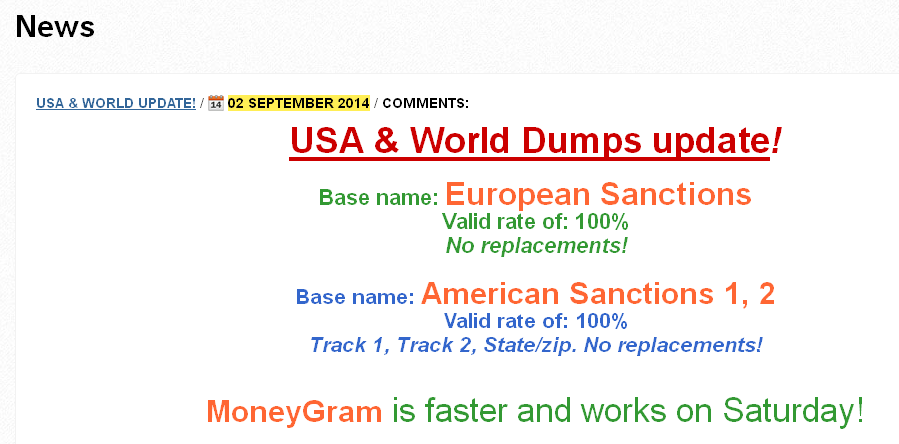
There are signs that the perpetrators of this apparent breach may be the same group of Russian and Ukrainian hackers responsible for the data breaches at Target, Sally Beauty and P.F. Chang’s, among others. The banks contacted by this reporter all purchased their customers’ cards from the same underground store – rescator[dot]cc — which on Sept. 2 moved two massive new batches of stolen cards onto the market.

A massive new batch of cards labeled "American Sanctions" and "European Sanctions" went on sale Tuesday, Sept. 2, 2014.

A massive new batch of cards labeled “American Sanctions” and “European Sanctions” went on sale Tuesday, Sept. 2, 2014.

In what can only be interpreted as intended retribution for U.S. and European sanctions against Russia for its aggressive actions in Ukraine, this crime shop has named its newest batch of cards “American Sanctions.” Stolen cards issued by European banks that were used in compromised US store locations are being sold under a new batch of cards labled “European Sanctions.”

It is not clear at this time how many stores may have been impacted, but preliminary analysis indicates the breach may extend across all 2,200 Home Depot stores in the United States. Home Depot also operates some 287 stores outside the U.S. including in Canada, Guam, Mexico, and Puerto Rico.

This is likely to be a fast-moving story with several updates as more information becomes available. Stay tuned.

Update: 1:50 p.m. ET: Several banks contacted by this reporter said they believe this breach may extend back to late April or early May 2014. If that is accurate — and if even a majority of Home Depot stores were compromised — this breach could be many times larger than Target, which had 40 million credit and debit cards stolen over a three-week period.

01 Sep 13:59

Azure: New DocumentDB NoSQL Service, New Search Service, New SQL AlwaysOn VM Template, and more

Today we released a major set of updates to Microsoft Azure. Today’s updates include:

  • DocumentDB: Preview of a New NoSQL Document Service for Azure
  • Search: Preview of a New Search-as-a-Service offering for Azure
  • Virtual Machines: Portal support for SQL Server AlwaysOn + community-driven VMs
  • Web Sites: Support for Web Jobs and Web Site processes in the Preview Portal
  • Azure Insights: General Availability of Microsoft Azure Monitoring Services Management Library
  • API Management: Support for API Management REST APIs

All of these improvements are now available to use immediately (note that some features are still in preview).  Below are more details about them:

DocumentDB: Announcing a New NoSQL Document Service for Azure

I’m excited to announce the preview of our new DocumentDB service - a NoSQL document database service designed for scalable and high performance modern applications.  DocumentDB is delivered as a fully managed service (meaning you don’t have to manage any infrastructure or VMs yourself) with an enterprise grade SLA.

As a NoSQL store, DocumentDB is truly schema-free. It allows you to store and query any JSON document, regardless of schema. The service provides built-in automatic indexing support – which means you can write JSON documents to the store and immediately query them using a familiar document oriented SQL query grammar. You can optionally extend the query grammar to perform service side evaluation of user defined functions (UDFs) written in server-side JavaScript as well. 

DocumentDB is designed to linearly scale to meet the needs of your application. The DocumentDB service is purchased in capacity units, each offering a reservation of high performance storage and dedicated performance throughput. Capacity units can be easily added or removed via the Azure portal or REST based management API based on your scale needs. This allows you to elastically scale databases in fine grained increments with predictable performance and no application downtime simply by increasing or decreasing capacity units.

Over the last year, we have used DocumentDB internally within Microsoft for several high-profile services.  We now have DocumentDB databases that are each 100s of TBs in size, each processing millions of complex DocumentDB queries per day, with predictable performance of low single digit ms latency.  DocumentDB provides a great way to scale applications and solutions like this to an incredible size.

DocumentDB also enables you to tune performance further by customizing the index policies and consistency levels you want for a particular application or scenario, making it an incredibly flexible and powerful data service for your applications.   For queries and read operations, DocumentDB offers four distinct consistency levels - Strong, Bounded Staleness, Session, and Eventual. These consistency levels allow you to make sound tradeoffs between consistency and performance. Each consistency level is backed by a predictable performance level ensuring you can achieve reliable results for your application.

DocumentDB has made a significant bet on ubiquitous formats like JSON, HTTP and REST – which makes it easy to start taking advantage of from any Web or Mobile applications.  With today’s release we are also distributing .NET, Node.js, JavaScript and Python SDKs.  The service can also be accessed through RESTful HTTP interfaces and is simple to manage through the Azure preview portal.

Provisioning a DocumentDB account

To get started with DocumentDB you provision a new database account. To do this, use the new Azure Preview Portal (http://portal.azure.com), click the Azure gallery and select the Data, storage, cache + backup category, and locate the DocumentDB gallery item.

image

Once you select the DocumentDB item, choose the Create command to bring up the Create blade for it.

In the create blade, specify the name of the service you wish to create, the amount of capacity you wish to scale your DocumentDB instance to, and the location around the world that you want to deploy it (e.g. the West US Azure region):

image

Once provisioning is complete, you can start to manage your DocumentDB account by clicking the new instance icon on your Azure portal dashboard. 

image

The keys tile can be used to retrieve the security keys to use to access the DocumentDB service programmatically.

Developing with DocumentDB

DocumentDB provides a number of different ways to program against it. You can use the REST API directly over HTTPS, or you can choose from either the .NET, Node.js, JavaScript or Python client SDKs.

The JSON data I am going to use for this example are two families:

// AndersonFamily.json file

{

    "id": "AndersenFamily",

    "lastName": "Andersen",

    "parents": [

        { "firstName": "Thomas" },

        { "firstName": "Mary Kay" }

    ],

    "children": [

        { "firstName": "John", "gender": "male", "grade": 7 }

    ],

    "pets": [

        { "givenName": "Fluffy" }

    ],

    "address": { "country": "USA", "state": "WA", "city": "Seattle" }

}

and

// WakefieldFamily.json file

{

    "id": "WakefieldFamily",

    "parents": [

        { "familyName": "Wakefield", "givenName": "Robin" },

        { "familyName": "Miller", "givenName": "Ben" }

    ],

    "children": [

        {

            "familyName": "Wakefield",

            "givenName": "Jesse",

            "gender": "female",

            "grade": 1

        },

        {

            "familyName": "Miller",

            "givenName": "Lisa",

            "gender": "female",

            "grade": 8

        }

    ],

    "pets": [

        { "givenName": "Goofy" },

        { "givenName": "Shadow" }

    ],

    "address": { "country": "USA", "state": "NY", "county": "Manhattan", "city": "NY" }

}

Using the NuGet package manager in Visual Studio, I can search for and install the DocumentDB .NET package into any .NET application. With the URI and Authentication Keys for the DocumentDB service that I retrieved earlier from the Azure Management portal, I can then connect to the DocumentDB service I just provisioned, create a Database, create a Collection, Insert some JSON documents and immediately start querying for them:

using (client = new DocumentClient(new Uri(endpoint), authKey))

{

    var database = new Database { Id = "ScottsDemoDB" };

    database = await client.CreateDatabaseAsync(database);


    var collection = new DocumentCollection { Id = "Families" };

    collection = await client.CreateDocumentCollectionAsync(database.SelfLink, collection);


    //DocumentDB supports strongly typed POCO objects and also dynamic objects

    dynamic andersonFamily =  JsonConvert.DeserializeObject(File.ReadAllText(@".\Data\AndersonFamily.json"));

    dynamic wakefieldFamily = JsonConvert.DeserializeObject(File.ReadAllText(@".\Data\WakefieldFamily.json"));


    //persist the documents in DocumentDB

    await client.CreateDocumentAsync(collection.SelfLink, andersonFamily);

    await client.CreateDocumentAsync(collection.SelfLink, wakefieldFamily);


    //very simple query returning the full JSON document matching a simple WHERE clause

    var query = client.CreateDocumentQuery(collection.SelfLink, "SELECT * FROM Families f WHERE f.id = 'AndersenFamily'");

    var family = query.AsEnumerable().FirstOrDefault();


    Console.WriteLine("The Anderson family have the following pets:");              

    foreach (var pet in family.pets)

    {

        Console.WriteLine(pet.givenName);

    }


    //select JUST the child record out of the Family record where the child's gender is male

    query = client.CreateDocumentQuery(collection.DocumentsLink, "SELECT * FROM c IN Families.children WHERE c.gender='male'");

    var child = query.AsEnumerable().FirstOrDefault();


    Console.WriteLine("The Andersons have a son named {0} in grade {1} ", child.firstName, child.grade);


    //cleanup test database

    await client.DeleteDatabaseAsync(database.SelfLink);

}

As you can see above – the .NET API for DocumentDB fully supports the .NET async pattern, which makes it ideal for use with applications you want to scale well. 

Server-side JavaScript Stored Procedures

If I wanted to perform some updates affecting multiple documents within a transaction, I can define a stored procedure using JavaScript that swapped pets between families. In this scenario it would be important to ensure that one family didn’t end up with all the pets and another ended up with none due to something unexpected happening. Therefore if an error occurred during the swap process, it would be crucial that the database rollback the transaction and leave things in a consistent state.  I can do this with the following stored procedure that I run within the DocumentDB service:

function SwapPets(family1Id, family2Id) {

    var context = getContext();

    var collection = context.getCollection();

    var response = context.getResponse();


    collection.queryDocuments(collection.getSelfLink(), 'SELECT * FROM Families f where f.id  = "' + family1Id + '"', {},

    function (err, documents, responseOptions) {

        var family1 = documents[0];


        collection.queryDocuments(collection.getSelfLink(), 'SELECT * FROM Families f where f.id = "' + family2Id + '"', {},

        function (err2, documents2, responseOptions2) {

            var family2 = documents2[0];


            var itemSave = family1.pets;

            family1.pets = family2.pets;

            family2.pets = itemSave;


            collection.replaceDocument(family1._self, family1,

                function (err, docReplaced) {

                    collection.replaceDocument(family2._self, family2, {});

                });


            response.setBody(true);

        });

    });

}


If an exception is thrown in the JavaScript function due to for instance a concurrency violation when updating a record, the transaction is reversed and system is returned to the state it was in before the function began.

It’s easy to register the stored procedure in code like below (for example: in a deployment script or app startup code):

    //register a stored procedure

    StoredProcedure storedProcedure = new StoredProcedure

    {

        Id = "SwapPets",

        Body = File.ReadAllText(@".\JS\SwapPets.js")

    };


    storedProcedure = await client.CreateStoredProcedureAsync(collection.SelfLink, storedProcedure);


And just as easy to execute the stored procedure from within your application:

    //execute stored procedure passing in the two family documents involved in the pet swap              

    dynamic result = await client.ExecuteStoredProcedureAsync<dynamic>(storedProcedure.SelfLink, "AndersenFamily", "WakefieldFamily");

If we checked the pets now linked to the Anderson Family we’d see they have been swapped.

Learning More

It’s really easy to get started with DocumentDB and create a simple working application in a couple of minutes.  The above was but one simple example of how to start using it.  Because DocumentDB is schema-less you can use it with literally any JSON document.  Because it performs automatic indexing on every JSON document stored within it, you get screaming performance when querying those JSON documents later. Because it scales linearly with consistent performance, it is ideal for applications you think might get large.

You can learn more about DocumentDB from the new DocumentDB development center here.

Search: Announcing preview of new Search as a Service for Azure

I’m excited to announce the preview of our new Azure Search service.  Azure Search makes it easy for developers to add great search experiences to any web or mobile application.   

Azure Search provides developers with all of the features needed to build out their search experience without having to deal with the typical complexities that come with managing, tuning and scaling a real-world search service.  It is delivered as a fully managed service with an enterprise grade SLA.  We also are releasing a Free tier of the service today that enables you to use it with small-scale solutions on Azure at no cost.

Provisioning a Search Service

To get started, let’s create a new search service.  In the Azure Preview Portal (http://portal.azure.com), navigate to the Azure Gallery, and choose the Data storage, cache + backup category, and locate the Azure Search gallery item.

image

Locate the “Search” service icon and select Create to create an instance of the service:

image

You can choose from two Pricing Tier options: Standard which provides dedicated capacity for your search service, and a Free option that allows every Azure subscription to get a free small search service in a shared environment.

The standard tier can be easily scaled up or down and provides dedicated capacity guarantees to ensure that search performance is predictable for your application.  It also supports the ability to index 10s of millions of documents with lots of indexes.

The free tier is limited to 10,000 documents, up to 3 indexes and has no dedicated capacity guarantees. However it is also totally free, and also provides a great way to learn and experiment with all of the features of Azure Search.

Managing your Azure Search service

After provisioning your Search service, you will land in the Search blade within the portal - which allows you to manage the service, view usage data and tune the performance of the service:

image

I can click on the Scale tile above to bring up the details of the number of resources allocated to my search service. If I had created a Standard search service, I could use this to increase the number of replicas allocated to my service to support more searches per second (or to provide higher availability) and the number of partitions to give me support for higher numbers of documents within my search service.

Creating a Search Index

Now that the search service is created, I need to create a search index that will hold the documents (data) that will be searched. To get started, I need two pieces of information from the Azure Portal, the service URL to access my Azure Search service (accessed via the Properties tile) and the Admin Key to authenticate against the service (accessed via the Keys title).

image

Using this search service URL and admin key, I can start using the search service APIs to create an index and later upload data and issue search requests. I will be sending HTTP requests against the API using that key, so I’ll setup a .NET HttpClient object to do this as follows:

HttpClient client = new HttpClient();

client.DefaultRequestHeaders.Add("api-key", "19F1BACDCD154F4D3918504CBF24CA1F");

I’ll start by creating the search index. In this case I want an index I can use to search for contacts in my dataset, so I want searchable fields for their names and tags; I also want to track the last contact date (so I can filter or sort on that later on) and their address as a lat/long location so I can use it in filters as well. To make things easy I will be using JSON.NET (to do this, add the NuGet package to your VS project) to serialize objects to JSON.

var index = new

{

    name = "contacts",

    fields = new[]

    {

        new { name = "id", type = "Edm.String", key = true },

        new { name = "fullname", type = "Edm.String", key = false },

        new { name = "tags", type = "Collection(Edm.String)", key = false },

        new { name = "lastcontacted", type = "Edm.DateTimeOffset", key = false },

        new { name = "worklocation", type = "Edm.GeographyPoint", key = false },

    }

};


var response = client.PostAsync("https://scottgu-dev.search.windows.net/indexes/?api-version=2014-07-31-Preview",

                                new StringContent(JsonConvert.SerializeObject(index), Encoding.UTF8, "application/json")).Result;

response.EnsureSuccessStatusCode();

You can run this code as part of your deployment code or as part of application initialization.

Populating a Search Index

Azure Search uses a push API for indexing data. You can call this API with batches of up to 1000 documents to be indexed at a time. Since it’s your code that pushes data into the index, the original data may be anywhere: in a SQL Database in Azure, DocumentDb database, blob/table storage, etc.  You can even populate it with data stored on-premises or in a non-Azure cloud provider.

Note that indexing is rarely a one-time operation. You will probably have an initial set of data to load from your data source, but then you will want to push new documents as well as update and delete existing ones. If you use Azure Websites, this is a natural scenario for Webjobs that can run your indexing code regularly in the background.

Regardless of where you host it, the code to index data needs to pull data from the source and push it into Azure Search. In the example below I’m just making up data, but you can see how I could be using the result of a SQL or LINQ query or anything that produces a set of objects that match the index fields we identified above.

var batch = new

24 Mar 18:28

A Chemist Has Developed A Brilliant Way To Survive The Zombie Apocalypse

by Dina Spector

zombie the walking dead

The folks at the American Chemical Society want us to be prepared for a zombie apocalypse. Since zombies — like those in "The Walking Dead" — are attracted to the smell of live humans, chemist Raychelle Burks suggests using chemicals to mimic the smells of rotting flesh, which should ward off living corpses in the event of a siege.

It sounds like it would really work for certain zombie futures. For example, characters in AMC's "The Walking Dead" use jaw-less and armless zombies on leashes to camouflage their scent from other zombies. 

The so-called "death cologne" would be made from a combination of three stinky molecules found in rotting flesh: putrescine, cadaverine, and methanethiol.

zombie chemicalsDead human bodies naturally produce putrescine and cadaverine early in the decomposition process, Burks says in the video. Methanethiol provides the rotting-egg, cabbage smell.

By modifying the bacteria e.coli and growing them in large colonies in the lab, scientists can isolate the nasty-smelling compounds. All you need it a little genetically engineered bacteria and a petri dish!

You can learn more about the smelly solution in the video below, from the American Chemical Society's Reactions series:

SEE ALSO: 10 Foods That Will Survive In A Post-Apocalyptic World

You might also be interested in: 19 Scientists Tell Us Their Favorite Element

Join the conversation about this story »


18 Mar 18:05

The Capital Grille brings big Texas personalities to new downtown restaurant

by Jan Buchholz
When it opens next month in the space formerly occupied by the Spaghetti Warehouse, The Capital Grille will reflect some big Texas personalities. In a recent tour with the Austin Business Journal, the management for the upscale restaurant showed off the new digs, including a diverse range of artwork featuring portraits of President Lyndon Baines Johnson, Texas Gov. Ann Richards and Hollywood starlet Farrah Fawcett, who attended the University of Texas. Western landscapes and taxidermy are prevalent…

04 Mar 01:01

11 Things You Should Be Doing On LinkedIn But Probably Aren't

by Richard Feloni

LinkedIn Obama

With 277 million users and counting, LinkedIn has become the definitive business networking site. If you're just using the site as a place to keep your resume online, however, then you're missing out on some great opportunities.

LinkedIn has been rolling out several new features in the past year, including a new publishing platform and a revamped "Who's Viewed Your Profile" function

Here's a look at 11 ways you can make LinkedIn a more valuable tool for keeping in touch with your network and getting recruiters to come to you.

Follow your favorite "Influencers" in Pulse.

You may not have been paying attention, but LinkedIn has been churning out original content from thought leaders around the world. The site's Pulse page collects posts from handpicked "Influencers" like Richard Branson, Martha Stewart, and Bill Gates. There are now about 500 Influencers from a wide variety of industries, and their stories are often collected in packages, like the recent "Best Advice" collection. 

You can choose to follow your favorites to have their posts appear in your updates feed, and check out Pulse to explore other motivational articles. The Influencers you follow appear on your profile, so not only will you get the latest insights from incredibly successful people, but it also shows recruiters your interests and aspirations.

Share relevant articles with your network, and consider writing your own.

While Facebook and Twitter are great outlets for sharing lighthearted viral content with friends, LinkedIn is the place to share articles and videos relevant to your industry and business in general.

And soon, all users will be able to use LinkedIn as a blog. On Feb. 19, LinkedIn opened up its publishing platform to 25,000 regular users. Within the next several weeks, all users will be able to use the tool. If you don't have access yet but want to, you can apply for early access here.

You can use your LinkedIn blog to add a new level of personality and expertise to your page. Share details about your new job, showcase a new project you're working on, or share some professional insight that your network could learn from.

Weed out connections that are no longer useful.

LinkedIn's developers initially skipped a "block user" feature in an attempt to be a truly open networking site, but they finally gave in to users' demands for one. If someone you don't know is being pushy or you simply don't want them to access your information anymore, you can go to that user's page and select "Block or report" in the dropdown box next to the "Endorse" icon.

Monitor who's seeing your page, and adjust accordingly.

Soon all users will also be able to use the revamped "Who's Viewed Your Profile" feature. Even non-Premium users will be able to see how users are finding them, and what industries these users belong to. It will additionally provide personalized suggestions on how to attract more attention to your page. Here's an example of what it will look like, via LinkedIn's official blog:linkedin view page

Join groups to improve your visibility.

LinkedIn says that active group users get four times as many profile views as those who don't use this resource. A good place to start is to join your alma mater's official group and see what discussions are going on. And if you're on a job hunt, it could be a good place to reach out to alumni.

Use the "Relationship" tab to keep track of your contacts.

If you would like to add someone you don't personally know, send them a personalized message explaining why you would like to connect and how sharing your business network can be beneficial. As your network grows, you can use the "Relationship" tab on a user's page to remind yourself of details regarding your professional relationship (and only you will be able to see it).

Endorse and recommend your connections.

Don't forget to make use of endorsements and recommendations. It helps your connections build credibility and makes them more likely to return the favor. LinkedIn is also a perfect place to recommend colleagues with a brief anecdote, as well as ask for recommendations from previous employers. Don't waste your time with generic compliments — the only recommendations that matter to recruiters on LinkedIn are specific and to the point.

Tap into the job listings.

There's an easy-to-use job listings tool that's helpful if you are either looking for a job or looking for an employee. All of your searches are kept private, so feel free to browse the listings LinkedIn recommends for you based on information in your profile, search for keywords, and find opportunities within your networks.

Use a professional headshot and a customized URL.

Multiple reports have shown that LinkedIn pages with profile pictures get more views than those that don't. Your photo should be clear, not include other people, and be appropriate for your industry. If you don't have access to a professional headshot, use one where you look your best in proper business attire. Likewise, a customized URL will make you much easier to search, and it looks better than a jumble of numbers when you share your link.

Make your page easy to scan.

The worst thing you can do is have your profile be one long list. Recruiters won't bother learning about you if your page is a chore to read. Make sure you distribute your information across each of the sections LinkedIn offers, and arrange them in an order you consider most relevant to your industry and the job you're seeking. For example, if you have experience in the non-profit sector, highlight it in "Volunteer Experience & Causes" rather than the main "Experience" list.

Be sure to write a summary.

Finally, don't neglect the crucial "Summary" box. Think of it as a first impression of your professional profile. It is also the perfect place for keywords that will enhance search engine optimization (SEO) benefits for your page.

SEE ALSO: 45 Successful People Share The Best Advice They've Ever Received

Join the conversation about this story »


10 Nov 23:43

Atheist Mega Churches Are Taking Root All Over The World

by Gillian Flaccus

Athiest megachurch

LOS ANGELES (AP) — It looked like a typical Sunday morning at any mega-church. Hundreds packed in for more than an hour of rousing music, an inspirational sermon, a reading and some quiet reflection. The only thing missing was God.

Dozens of gatherings dubbed "atheist mega-churches" by supporters and detractors are springing up around the U.S. after finding success in Great Britain earlier this year. The movement fueled by social media and spearheaded by two prominent British comedians is no joke.

On Sunday, the inaugural Sunday Assembly in Los Angeles attracted more than 400 attendees, all bound by their belief in non-belief. Similar gatherings in San Diego, Nashville, New York and other U.S. cities have drawn hundreds of atheists seeking the camaraderie of a congregation without religion or ritual.

The founders, British duo Sanderson Jones and Pippa Evans, are currently on a tongue-in-cheek "40 Dates, 40 Nights" tour around the U.S. and Australia to drum up donations and help launch dozens of Sunday Assemblies. They hope to raise more than $800,000 that will help atheists launch their pop-up congregations around the world.

They don't bash believers but want to find a new way to meet likeminded people, engage in the community and make their presence more visible in a landscape dominated by faith.

Jones got the first inkling for the idea while leaving a Christmas carol concert six years ago.

"There was so much about it that I loved, but it's a shame because at the heart of it, it's something I don't believe in," Jones said. "If you think about church, there's very little that's bad. It's singing awesome songs, hearing interesting talks, thinking about improving yourself and helping other people — and doing that in a community with wonderful relationships. What part of that is not to like?"

The movement dovetails with new studies showing an increasing number of Americans are drifting from any religious affiliation.

The Pew Forum on Religion & Public Life released a study last year that found 20 percent of Americans say they have no religious affiliation, an increase from 15 percent in the last five years. Pew researchers stressed, however, that the category also encompassed majorities of people who said they believed in God but had no ties with organized religion and people who consider themselves "spiritual" but not "religious."

Sunday Assembly — whose motto is Live Better, Help Often, Wonder More — taps into that universe of people who left their faith but now miss the community church provided, said Phil Zuckerman, a professor of secular studies at Pitzer College in Claremont.

It also plays into a feeling among some atheists that they should make themselves more visible. For example, last December, an atheist in Santa Monica created an uproar — and triggered a lawsuit — when he set up a godless display amid Christian nativity scenes that were part of a beloved, decades-old tradition.

"In the U.S., there's a little bit of a feeling that if you're not religious, you're not patriotic. I think a lot of secular people say, 'Hey, wait a minute. We are charitable, we are good people, we're good parents and we are just as good citizens as you and we're going to start a church to prove it," said Zuckerman. "It's still a minority, but there's enough of them now."

That impulse, however, has raised the ire of those who have spent years pushing back against the idea that atheism itself is a religion.

"The idea that you're building an entire organization based on what you don't believe, to me, sounds like an offense against sensibility," said Michael Luciano, a self-described atheist who was raised Roman Catholic but left when he became disillusioned.

"There's something not OK with appropriating all of this religious language, imagery and ritual for atheism."

That sentiment didn't seem to detract from the excitement Sunday at the inaugural meeting in Los Angeles.

Hundreds of atheists and atheist-curious packed into a Hollywood auditorium for a boisterous service filled with live music, moments of reflection and an "inspirational talk, " and some stand-up comedy by Jones, the movement's co-founder.

During the service, attendees stomped their feet, clapped their hands and cheered as Jones and Evans led the group through rousing renditions of "Lean on Me," ''Here Comes the Sun" and other hits that took the place of gospel songs. Congregants dissolved into laughter at a get-to-know-you game that involved clapping and slapping the hands of the person next to them and applauded as members of the audience spoke about community service projects they had started in LA.

At the end, volunteers passed cardboard boxes for donations as attendees mingled over coffee and pastries and children played on the floor.

For atheist Elijah Senn, the morning was perfect.

"I think the image that we have put forward in a lot of ways has been a scary, mean, we want to tear down the walls, we want to do destructive things kind of image is what a lot of people have of us," he said. "I'm really excited to be able to come together and show that it's not about destruction. It's about making things and making things better."

___

On the Web:

Sunday Assembly: http://www.SundayAssembly.com

___

Follow Gillian Flaccus on Twitter at http://www.twitter.com/gflaccus

Copyright (2013) Associated Press. All rights reserved. This material may not be published, broadcast, rewritten, or redistributed.

Join the conversation about this story »

22 Jul 17:19

3 Things You Should Never Say When Negotiating Salary

by Jessica Sager

money, payday, raise, salary, girl, happy

The three most typical responses during salary negotiations are also the three most likely to screw you out of the pay that you deserve. And you deserve pay that covers both your rent and, you know, food and stuff. (But not pants. Who cares about pants?)

Here are the three kisses of death and why they will doom you to less pay than you’re worth, courtesy of Colette Ellis of InStep Consulting and CBS News. Pretend saying these phrases will elicit the same effect as, say, repeating “Bloody Mary” in the mirror or saying “Beetlejuice” three times. Unless you really like Michael Keaton (and who doesn’t?), in which case you can just act like each of these contains the C-word.

“What does this position typically pay?”
This means a few things: One, you haven’t done a ton of research, which makes you look lazy and uninformed. Two, you’re leaving the ball entirely in your potential employers’ court to start your career. Three, you’re not assertive. Employers only like the second part of this deadly salary equation, because it can save them a few bucks.

“Yes, that sounds good.”
A starting number is just that: a starting number. If you accept the first figure your potential employer throws at you, you’re saving them way too much money–and you also look a bit like a pushover. Chances are their starting number is lower than what they’re actually expecting to pay you, and accepting the first offer you get nixes the very negotiations that salary negotiations are all about. They’re expecting you to want more cash and to meet you in the middle. Show your worth, explain why you’re more valuable and ask for a higher number than you expect (without being absurd)–and work something out.

“… But I’m flexible on that.”
Why is this a problem? Well, that number you just talked about essentially means nothing once you throw this tidbit in. Stick to your guns, and if they can’t offer you a salary within that range, ask if additional benefits, stock options or perks (like working from home one day a week to avoid wearing pants) can pick up the slack. Just like a guy who adores you, if they really want you, they’ll do the best that they can to make you happy.

Now go get your money!

Join the conversation about this story »