


Read more of this story at Slashdot.

Read more of this story at Slashdot.
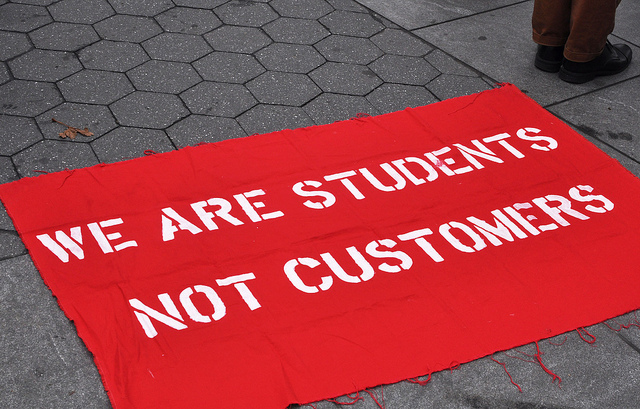
In Rolling Stone, Matt Taibbi takes a long, in-depth look at the scandal of student loans and tuition hikes, a two-headed parasite sucking America's working class and middle class dry as they plunge their children into a lifetime of ballooning debt in the vain hope of a better, college-educated future. The feds keep backing student loans, and the states keep cutting university funding, so the difference is made up by cranking up tuition and shifting the burden to future grads. Meanwhile, the laws that prohibit discharging student debt in bankruptcy, combined with ballooning default penalties (your $30K debt can rocket to $120K if you have a heart-attack and are bedridden and can't make payments) and the most ruthless, unsupervised, criminal collection agencies means that tens of millions of Americans are trapped in a nightmare that never ends -- student debt being the only debt that can be taken out of your Social Security check. Matt Taibbi is a national treasure, and Rolling Stone does us all a service by keeping him working.
If this piece moves you and you want to learn more, Don't miss "Generation of Debt," an important pamphlet on the subject from UC students.
They all take responsibility for their own mistakes. They know they didn't arrive at gorgeous campuses for four golden years of boozing, balling and bong hits by way of anybody's cattle car. But they're angry, too, and they should be. Because the underlying cause of all that later-life distress and heartache – the reason they carry such crushing, life-alteringly huge college debt – is that our university-tuition system really is exploitative and unfair, designed primarily to benefit two major actors.
First in line are the colleges and universities, and the contractors who build their extravagant athletic complexes, hotel-like dormitories and God knows what other campus embellishments. For these little regional economic empires, the federal student-loan system is essentially a massive and ongoing government subsidy, once funded mostly by emotionally vulnerable parents, but now increasingly paid for in the form of federally backed loans to a political constituency – low- and middle-income students – that has virtually no lobby in Washington.
Next up is the government itself. While it's not commonly discussed on the Hill, the government actually stands to make an enormous profit on the president's new federal student-loan system, an estimated $184 billion over 10 years, a boondoggle paid for by hyperinflated tuition costs and fueled by a government-sponsored predatory-lending program that makes even the most ruthless private credit-card company seem like a "Save the Panda" charity. Why is this happening? The answer lies in a sociopathic marriage of private-sector greed and government force that will make you shake your head in wonder at the way modern America sucks blood out of its young.
In the early 2000s, a thirtysomething scientist named Alan Collinge seemed to be going places. He had graduated from USC in 1999 with a degree in aerospace engineering and landed a research job at Caltech. Then he made a mistake: He asked for a raise, didn't get it, lost his job and soon found himself underemployed and with no way to repay the roughly $38,000 in loans he'd taken out to get his degree.
Collinge's creditor, Sallie Mae, which originally had been a quasi-public institution but, in the late Nineties, had begun transforming into a wholly private lender, didn't answer his requests for a forbearance or a restructuring. So in 2001, he went into default. Soon enough, his original $38,000 loan had ballooned to more than $100,000 in debt, thanks to fees, penalties and accrued interest. He had a job as a military contractor, but he lost it when his employer ran a credit check on him. His whole life was now about his student debt.
Ripping Off Young America: The College-Loan Scandal [Matt Taibbi/Rolling Stone]
(Image: cooperunion_dec08_DSC_0195, a Creative Commons Attribution Share-Alike (2.0) image from fleshmanpix's photostream) 
    
|

![[link]](http://i.imgur.com/b7iQVEr.jpg)