"Join with the terminal and terminate defective synthetics."
This was recommended to me in person last week... but embarrassingly, I can't remember who recommended it. I have to start taking better notes! It's currently available in Humble's 'Trove', a collection of big and small games that are free to their monthly subscribers, and my guess is that it will be made available for sale to non-subscribers, around the start of September. So if you don't want to sign up to a subscription service, you can just wait a couple months.It's out now on Itch for $10.
Here's why you should play it: As Rob Fearon once put it, 'we're 30 years on from some genres and barely touching the sides'. Subserial Network is one of those short-form experimental games that gestures at the great untapped wealth of ideas that the medium of games is capable of, that suggests we are nowhere near touching the sides. It is a game about mutability that demonstrates the unprecedented mutability of the form.
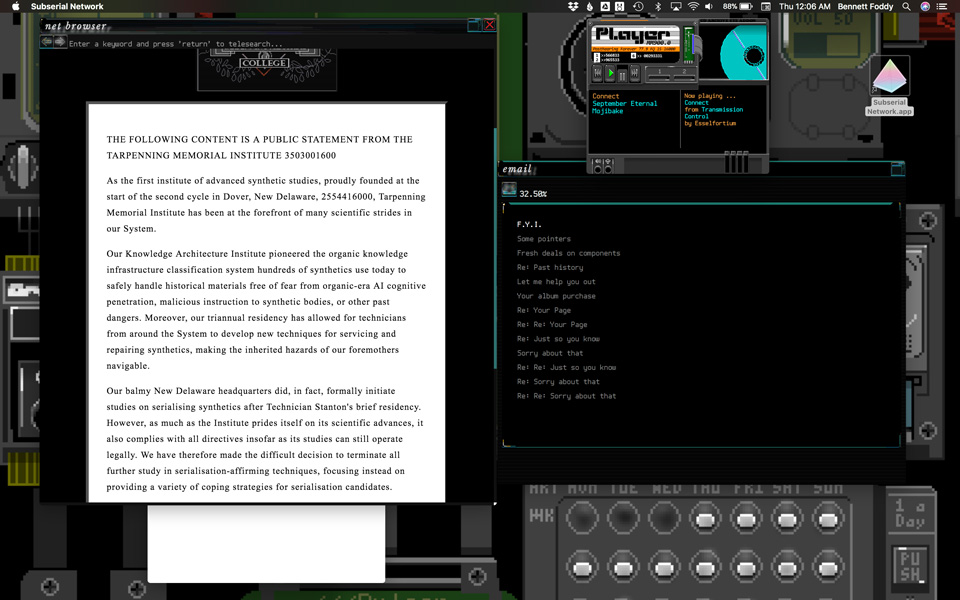
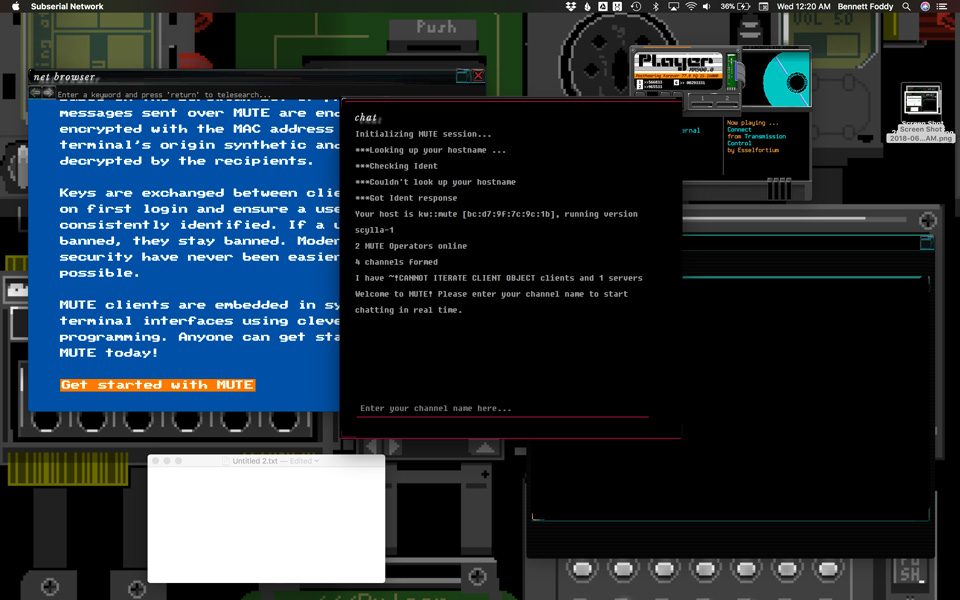
Subserial Network is one of those games that presents itself as a desktop application, paying homage to old multimedia experiments like the excellent 1996 CD-ROM classic Spycraft: The Great Game and of course to Christine Love's seminal 2010 piece Digital: A Love Story with which it shares a number of visual and narrative themes.
Park describes the game as a 'multi-window experience' but that significantly understates the radical nature of the design. We have lately seen a number of 'computer within a computer' classics, from Digital and Beglitched to Cibele and Her Story, but unlike those games, Subserial Network consists of various programs and files that live on your actual computer desktop, and the wallpaper in these images is just a suggested wallpaper image that they provide in the folder, that I applied to my own Mac desktop. In a way that goes beyond other experiments like Ivan Zanotti's horror game IMSCARED or Robert Yang's Hurt Me Plenty, it breaks that most inviolable of fourth walls, the boundary between the game and the rest of your computer. Games are fiction (which is supposed to stay in-world and in-character) but they are also software (which is supposed to stay obediently in its sandbox).
Thematically that is a perfect metaphor for the story the game tells, which is about characters who are driven to cross forbidden digital thresholds in pursuit of recognition and happiness.
Subserial Network subtly tells a story about the optimism embedded in early digital culture; of the hope many of us shared that new, more parallel and anonymous modes of communication would yield more authentic, fluid identities and deeper and more empathetic modes of human connection. It uses the visual language of early digital protocols like BBS, email and Lynx, to evoke a sense of nostalgia for that utopian vision, even though the narrative is set in a distant posthuman dystopia. At the same time, it uses this setting to tell a second story about trans experience, alterity, gender dysphoria, and self-actualization, reframing human bodies as inherently constructed objects (which they are, sociologically, although we often forget it) by telling the story from the point of view of synthetic androids who still remember the physical assembly of their bodies. Of course, these two story threads do not read as orthogonal to each other — they are in ways the same story.
I spent a substantial portion of my teenage years connected to variously-queer gothic cyperpunk BBSes, and later I 'grew up' to become a person who makes internetmemes for a living. And so, though I have no personal experience of the gender themes written through Subserial Network's story, there is an undercurrent of loss and disappointment in it that resonated very strongly with me, that flowed from the ways in which our shared optimism about the digital revolution has given way to a darker digital reality. It is a very sad flavor of nostalgia.
But beside that dark beauty, there's optimism in the collaborative vibe of this project, which has additional writing by Penelope Evans, a lovely, perfectly matched soundtrack by Sarah Mancuso and art by BARCHboi who made the lovely and strange DEOIS II: DEIDIA. And for me there's particular beauty in Park's & Evans' writing, which captures the desperation with which digital pioneers, so often othered in their non-digital lives, reached out into the ether.
Geez, looking back over this blog post, I really feel like you should play every game I linked to, all eight of them. But I promised to only recommend you one at a time, so this is the one for right now.
“My whole outfit is thrifted. Since it’s almost impossible nowadays to come up with something new, I rely on customizing used clothes and creating new combinations. I enjoy a dialog between clothes. The combination might be new but each peace still has a certain conception, which differs in the eyes of the beholder.”
This is Jihou, whose striking yellow-and-black color-coordinated outfit caught our eye while wandering down the streets of Shibuya.
The 19-year-old student wore a bright yellow sweater from Spinns, which had a small purple graphic print on the chest. She also wore Spinns yellow wide-leg pants with a colorful gingham pattern. Jihou styled them with Dr. Martens black leather lace-up shoes, which featured the brand’s iconic yellow stitching. Strapped across her chest is a vintage fuzzy character crossbody bag, and on her neck is a gold necklace with braided detail. She finished off her look with round eyeglasses, yellow earrings, a black bob with bangs, and dark red lips.
Jihou’s favorite fashion brands are Comme des Garçons and Yohji Yamamoto. She also loves listening to music from My Hair Is Bad. To know more about Jihou, follow her on both Instagram and Twitter.
We spotted Ryoki, who looked cool while strolling around the streets of Harajuku.
The 17-year-old student wore a white sleeveless collared top from Raf Simons styled with a pink necktie. Ryoki also wore vintage black flared pants with a contrasting white stripe on each leg. He completed his look with a black Pameo Pose “Three Sisters” waist bag and New Balance sneakers.
Ryoki’s favorite fashion brand is Comme des Garçons, and he enjoys listening to hip hop music. For more on Ryoki, follow him on Instagram.
No shit, but I'm glad people are starting to talk about it on a broader scale, and/or from voices with credibility beyond small progressive circles.
Self-described former extremist turned peace advocate Christian Picciolini confirmed on Reddit that white supremacists regularly recruit new members in games like Minecraft, Call of Duty and Fortnite. ...
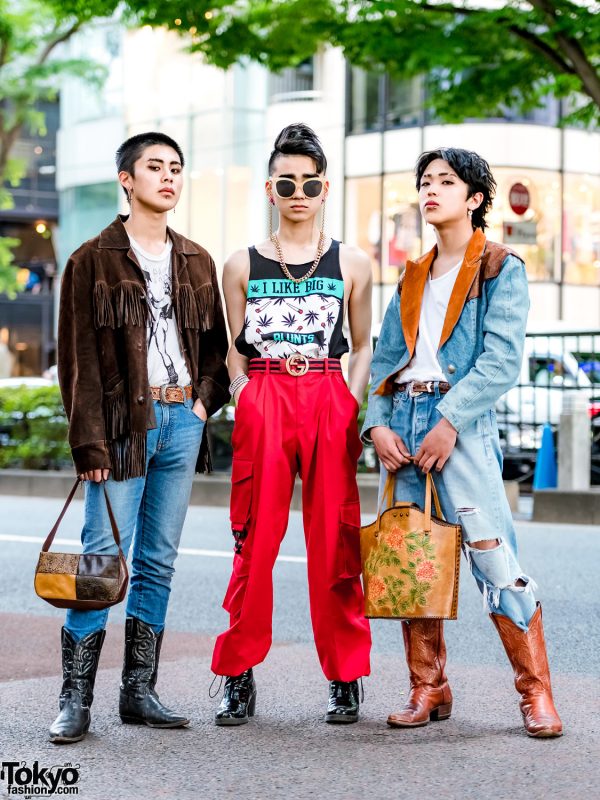
While out on the streets of the Harajuku neighborhood one late afternoon, we came across this trio of teen students who easily caught our eye with their striking outfits.
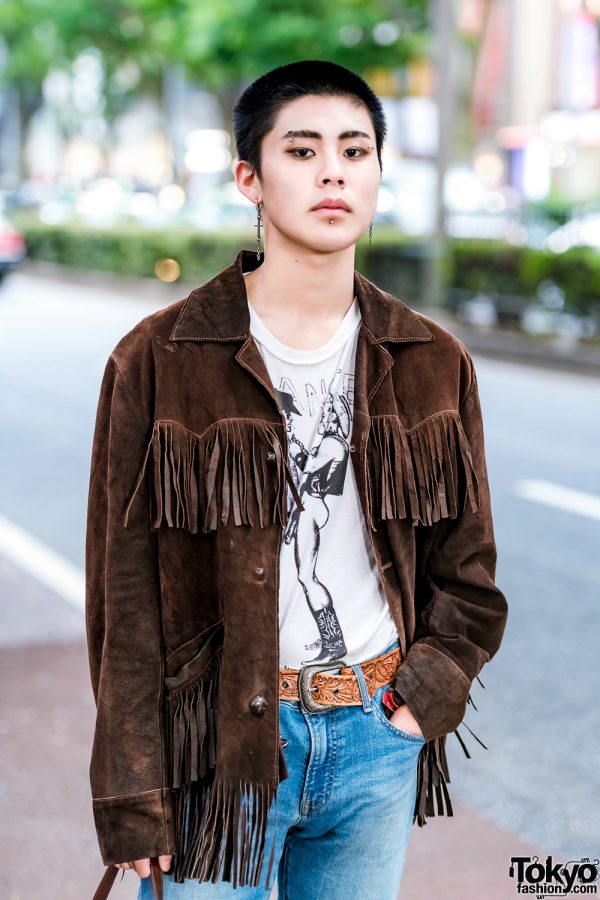
At the left is 16-year-old Haruki. The 16-year-old is clad in a dark brown vintage fringed suede jacket, worn over an iconic World’s End “Cowboy” t-shirt featuring the art of Jim French, and tucked into a pair of jeans. Haruki completed his outfit with black leather cowboy boots, a brown leather belt, a leather patchwork handbag, and accessories such as a eyebrow piercings, a labret piercing, and chained cross earrings. Haruki is active on Instagram.
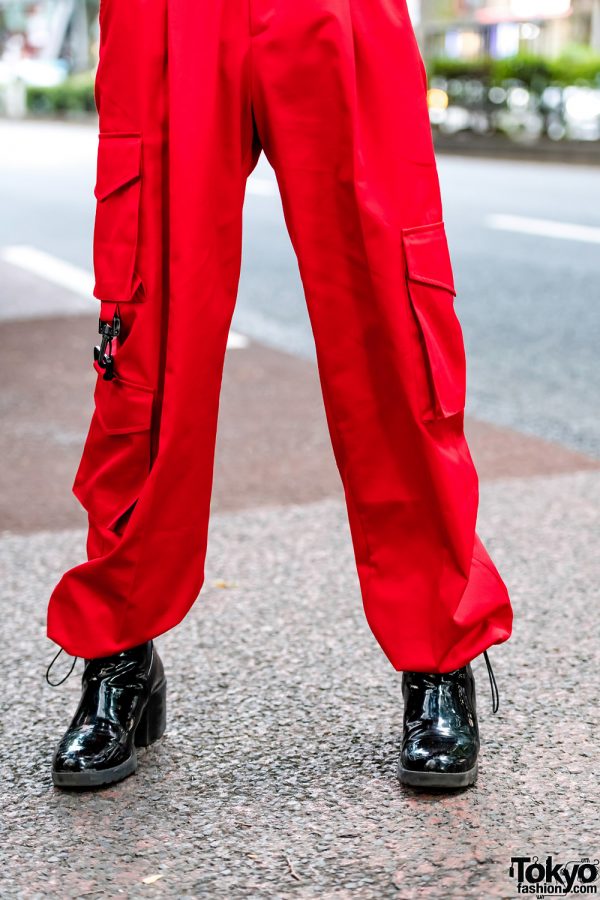
Billimayu – at the middle – is the 16-year-old street personality who we often feature on our snaps. Today, Billimayu is dressed in a vintage black tank top, tucked into red parachute pants from ESC Studio, and held together by a red-and-black striped Gucci belt. He finished off his ensemble with vintage black patent leather booties, and vintage accessories such as oversized sunglasses with a gold chain strap, purple metallic screw earrings, a gold chunky chain necklace, a studded rhinestone cuff bracelet, and multiple cocktail rings. Givenchy is Billimayu’s favorite brand, and he enjoys the music of Big Bang. Follow Billimayu on Twitter and Instagram.
Meanwhile, 16-year-old Hiroto’s ensemble consists of a vintage denim jacket with contrast brown leather lapels and shoulders, worn on top of a white t-shirt, and acid wash ripped jeans from Levi’s tucked into cognac leather cowboy boots. A brown leather tote bag with flower embroidery and contrast stitchings, a brown leather belt, eyebrow and lip piercings, and silver key earrings completed his look. Hiroto’s favorite fashion label is Burberry and he likes the music of the Sex Pistols. Hiroto is also active on Twitter and Instagram.
State and local officials gathered in Union Square earlier this week to celebrate the official groundbreakng of the Green Line Extension Project. The GLX will extend the Green Line approximately 4.7 miles along two branches from a relocated Lechmere Station in East Cambridge through Somerville and into Medford. “The Green Line Extension will improve access to education, housing and job opportunities across the entire MTBA system,” said Mass. [...]
Boston Police report one of two men arrested after refusing to stop shoving the other Sunday night continued his fighty ways through booking, during which he bit one of the officers in the leg. Read more.
Across The Meridian is out on 20 July, followed two days later by a London show
Next month Pram will release their first LP in 11 years. Called Across The Meridian, it follows on from 2007's The Moving Frontier, and is described by their current label Domino as a “celebration of much of Pram’s iconic quirkiness, focused into a beautifully constructed and tautly produced soundworld”.
Across The Meridian is the outcome of an improv session at Foel studios in Wales, which they later reconvened at a studio in their hometown Birmingham. “It’s slightly more hi-fi than previous albums,” says guitarist and multi-instrumentalist Matt Eaton. “Early Pram music was recorded on a four track cassette player in a squat in Birmingham. Having a reliable working microphone was a prize in itself. The texture of our mixing and production has changed over the years.”
He continues: “We allow ourselves to make these odd mistakes and quirks and then the music has a character of its own. It’s part of what we’ve always done naturally, so it’s very unlike us to take a conventional path to something. We want to create something new – a new sound or a new process – each time we record.”
Across The Meridian is released in vinyl and CD formats and as a download by Domino. Pram will play at London’s The Lexington on 22 July. You can check out a video of Pram’s new single below.
"Fucked up" is a term that gets deservedly thrown around a lot lately, but man, this is so fucked up
Star Control creators Fred Ford and Paul Reiche are attempting to raise $2 million through a Gofundme campaign to defend themselves against a trademark infringement lawsuit. ...
This is really cool!!!! (Click through to the blog post for images)
I’ve written extensively about Final Fantasy IV and its many different translations, and I’ve always wanted to give Final Fantasy VI the same treatment.
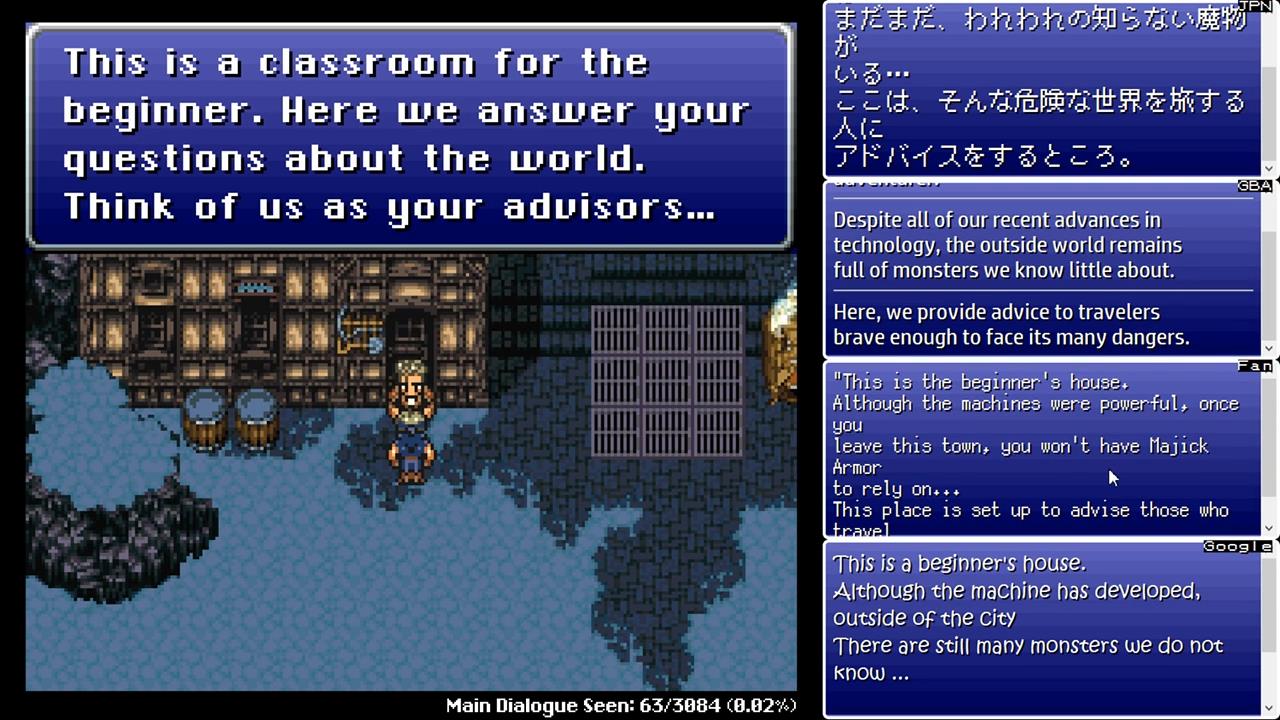
I’m only familiar with the original Super NES translation, so to get up to speed I’d need to play the same game multiple times and do a whole bunch of organization and comparison work afterward. That’d amount to several hundred hours of work… so I devised a way to see the text in all the games at the same time while just playing one game:
Stream Schedule: two or three times a week starting at 1:00 PM Pacific Time (I use the days in between to write up my long articles about my findings) – follow me on Twitter or on Twitch to get notified when a stream starts
After each stream, I plan to archive the video on YouTube and then update this article with my newest findings.
Although this sounds like some heavy-duty serious stuff, I actually just really missed playing Final Fantasy VI and decided to play it again and finally look at the different translations all at the same time. So this project is mostly about having fun while learning new things at the same time. I hope you’ll have fun and learn new things too!
Q: How are you automatically displaying each game’s text while playing one game?
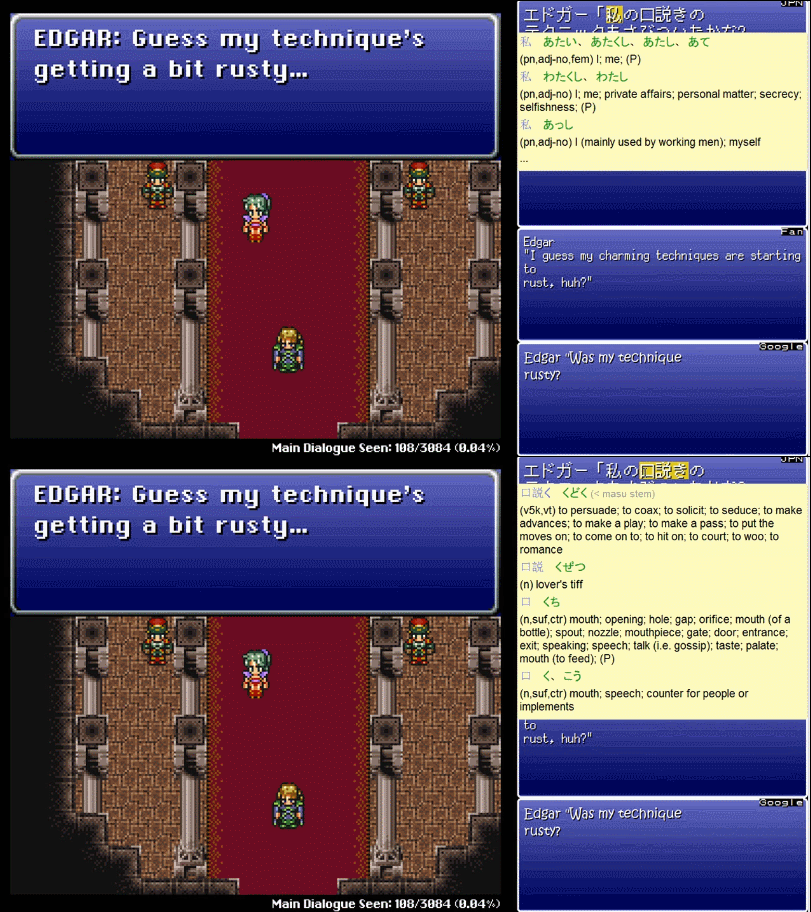
A: I’m using some custom software I started developing last year. The simple explanation is that I glued a Super NES emulator to a web browser, so the game can talk to the browser and the browser can talk to the game. The text that appears is actually just ordinary HTML, so I can do cool extra things like this:
Showing the Japanese definitions of words live is so incredibly helpful for this project, plus it could make a great study resource down the line
Q: Are you going to release your custom software?
A: Yes, I intend to. The problem is that it’s far from what I’d consider complete, it’s very user unfriendly, I can’t guarantee it’ll work for everyone who tries to run it, I don’t want to offer eternal support for it, and I’m not really familiar with open source license stuff, and since I use a lot of open source stuff for this project it makes things messier I assume.
I’m not a very good programmer and I’m amazed I was even able to get this working at all, so a Mac version isn’t really possible, at least for me.
Q: Why all the different fonts?
A: Originally I had wanted to use the actual font used in each game, but I realized that that wasn’t doable. I could’ve changed them all back to use the same font, but a handy trick to translation checking/editing/proofreading is to put things into different fonts. This helps keep your brain from zoning out upon seeing walls of text and helps things jump out more easily.
Q: Which fan translation are you looking at?
A: I’m looking specifically at the most famous one – RPGOne’s Final Fantasy VI re-translation from 10 or 15 years ago. It’s also sometimes called the SkyRender version, based on the translator’s online name.
Note that I’m looking at the fan translation not to crap all over it – it’s already notorious for being full of issues, and SkyRender has learned a ton about translation and localization since those days. Instead, I hope to look at some of the translation issues to explain what’s going on in the original source text, why it was so problematic in the first place, and how translators-in-training can improve by avoiding those same problems/tendencies.
I remember being an amateur ROM translator like it was yesterday, so I can relate to so many of the problems in this fan translation. Oh, how I wish I could share this info and advice with my younger self!
This was my first large-scale test of my custom software, so I was worried it might crash or run too slowly while streaming. Luckily everything worked wonderfully, minus a few hiccups. I still need to do quite a bit of programming, but I’ll tackle that little by little as I can.
Since I’m essentially playing five different versions of the game at the same time and analyzing every line of text, I had expected things to go slowly. Things indeed went slowly, so there was a constant inner struggle of “should I skim stuff and move faster or should I take my time and not miss anything?”. Hopefully as we progress I’ll discover what works best and get into a nice groove.
Video Archive
Notes
I’ve summarized a lot of my findings from Day 1 below, but note that I actually covered much more during the live stream – these are just some of the highlights. If you like what you see below and crave more, definitely check out the video archive.
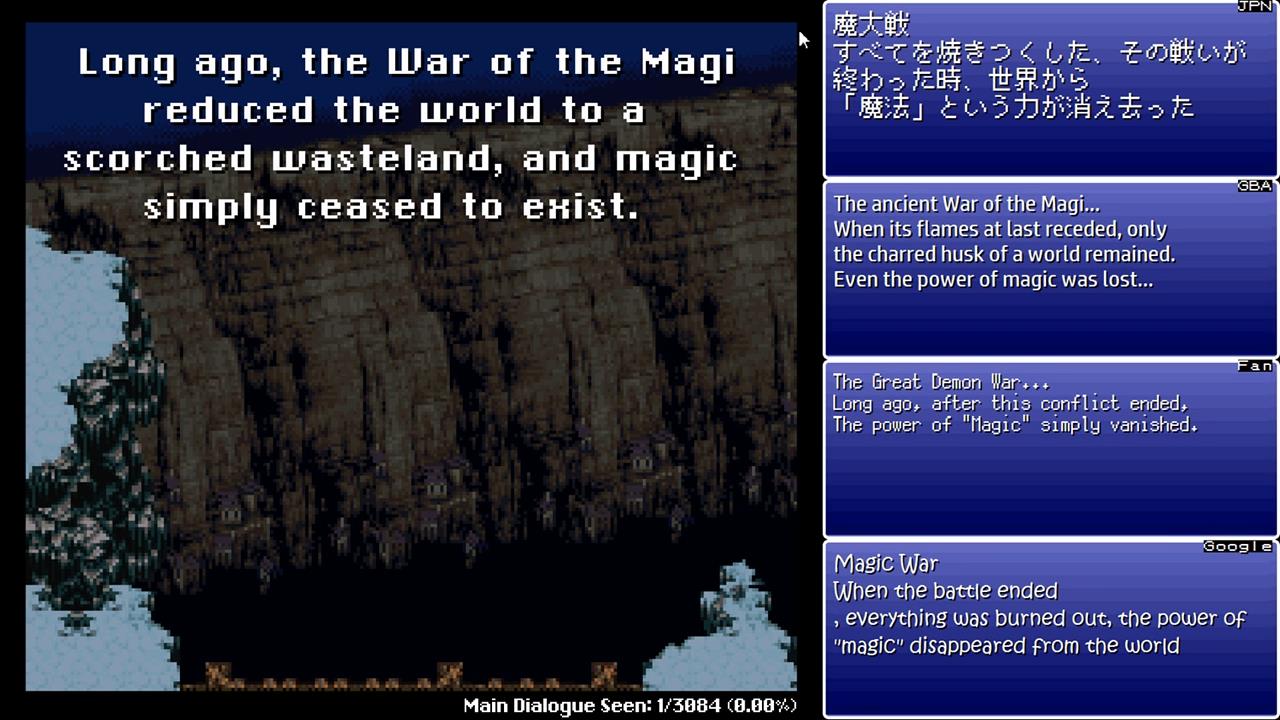
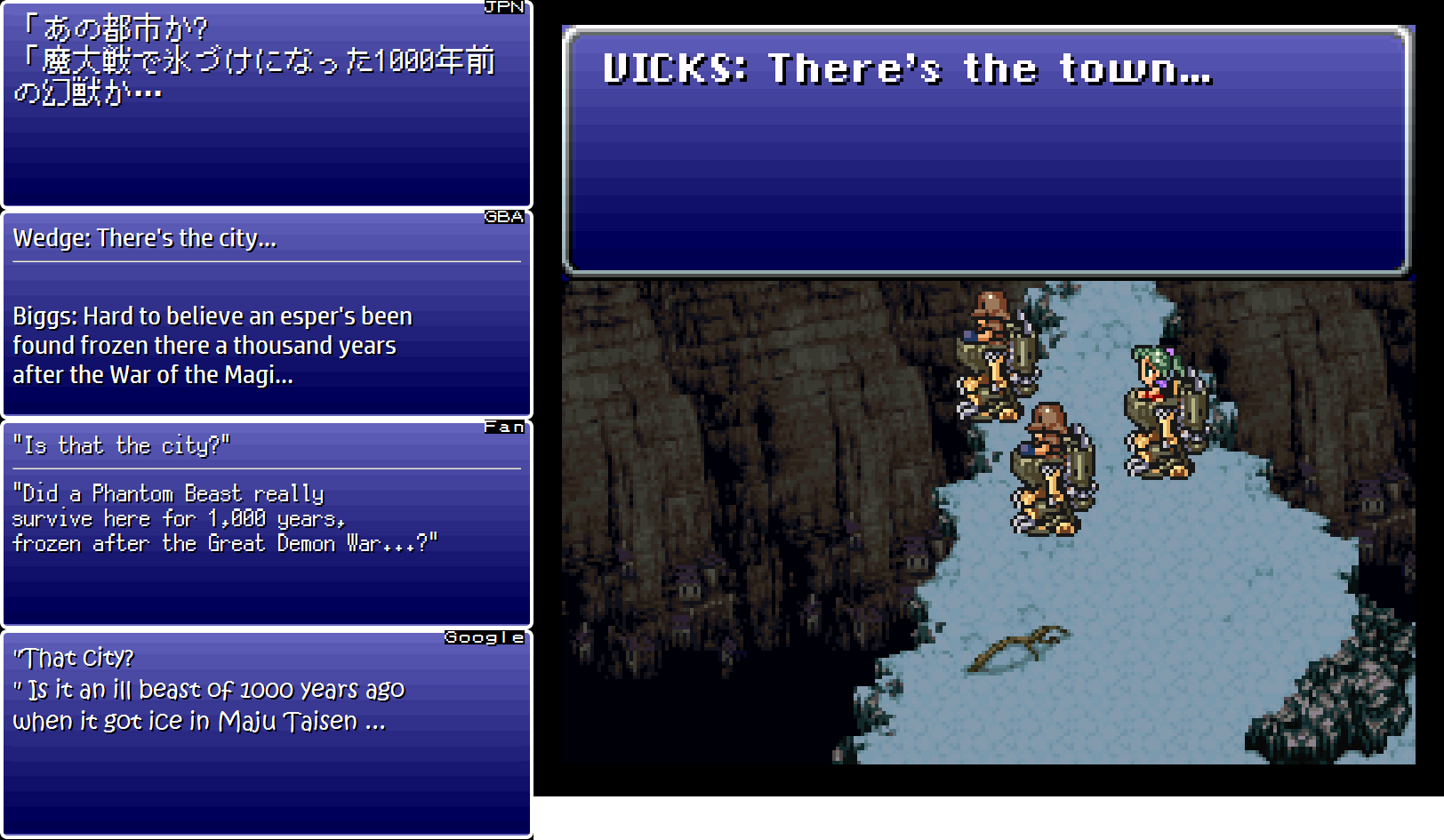
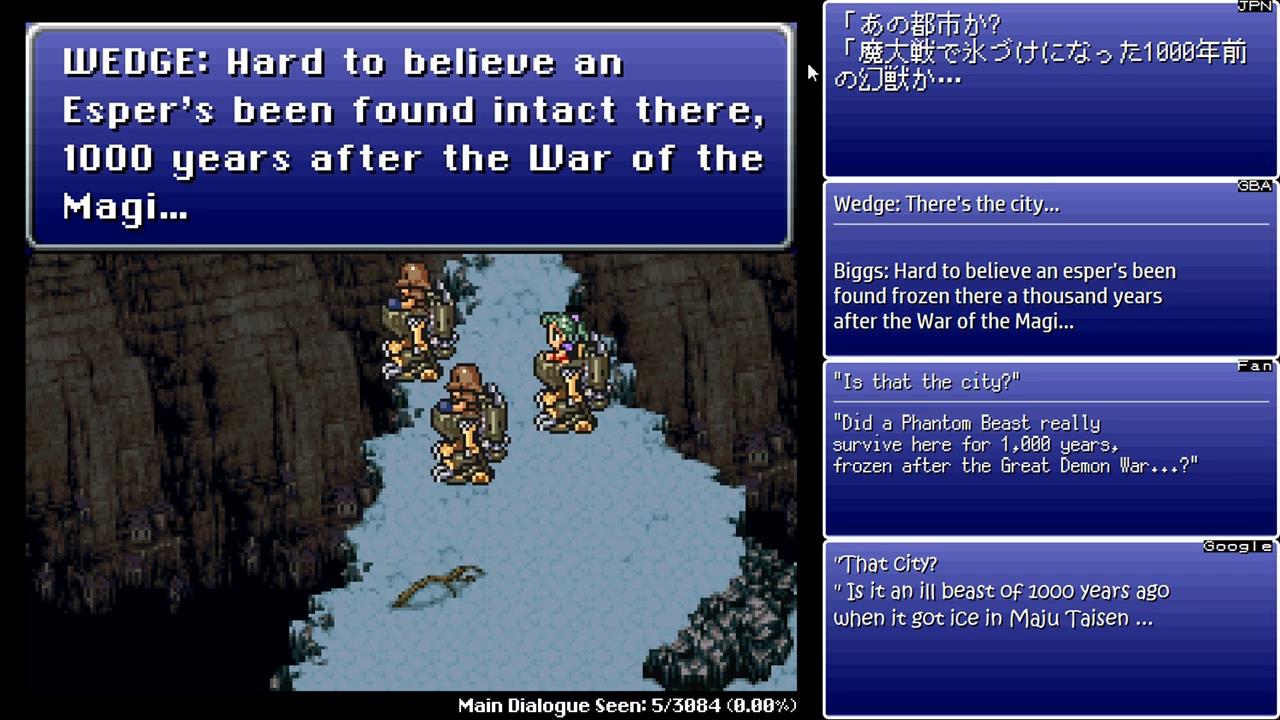
The ancient war is called the 魔大戦, with the 魔 (ma, definition details) leaning toward the “magic” meaning.
The official translations go with “War of the Magi” as a result, but the fan translation uses the “demon/devil” meaning of 魔 and perplexingly calls it the “Great Demon Wars” instead.
In my experience, amateur translators do tend to translate every 魔 as “demon/devil”, so this didn’t come as a surprise here.
Also, the Japanese script uses two words for “magic”: 魔法 (mahō) and 魔導 (madō). The question of how they’re different came up a lot during the stream, but it was hard to explain them as their nuances aren’t set in stone and can vary from author to author and work to work. But I did some checking around after the stream and it seems that in general mahō refers to magic more in the sense of a natural phenomenon, while this particular madō (there’s more than one – the other is 魔道 and has its own nuances) is more connected to magic in the sense of something that you’d study or seek out. It gets a little confusing seeing both terms thrown around in the Japanese script with no clear distinction at the moment, but I think the game’s logic will start to solidify as we continue.
The official translations don’t usually make a distinction between the mahō and madō and simply use “magic” for both. In some cases, when the need for a clear distinction is needed, they’ll use the word “MagiTek” for madō.
The fan translation took clear care to keep the two words separate – mahō is usually “Magic” and madō seems to be “Majick”. I’ve noticed one or two times where this separation was handled inconsistently.
The Japanese text doesn’t indicate who’s speaking, but the English translations add a name in. In at least one instance the SNES and GBA translations attribute the same line to a different person in this scene.
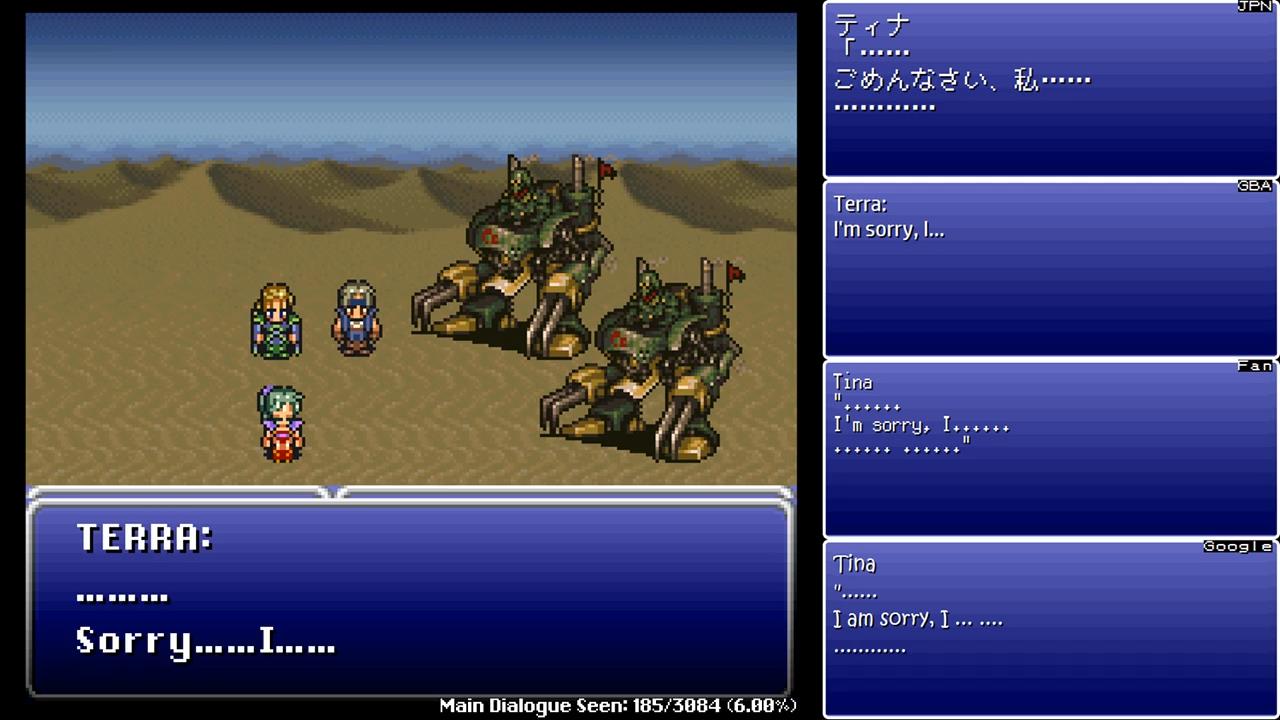
Espers are called 幻獣 (genjū) in Japanese. The SNES version calls them “Espers”, and the GBA translation retains that choice. For some reason I thought the GBA translation would’ve called them “eidolons”, but I guess not. The fan translation focuses on the individual kanji characters in the name to reach the term “phantom beast”.
Incidentally, the English word “esper” is commonly used in Japanese to refer people with ESP abilities – they’re “ESPers”, in other words.
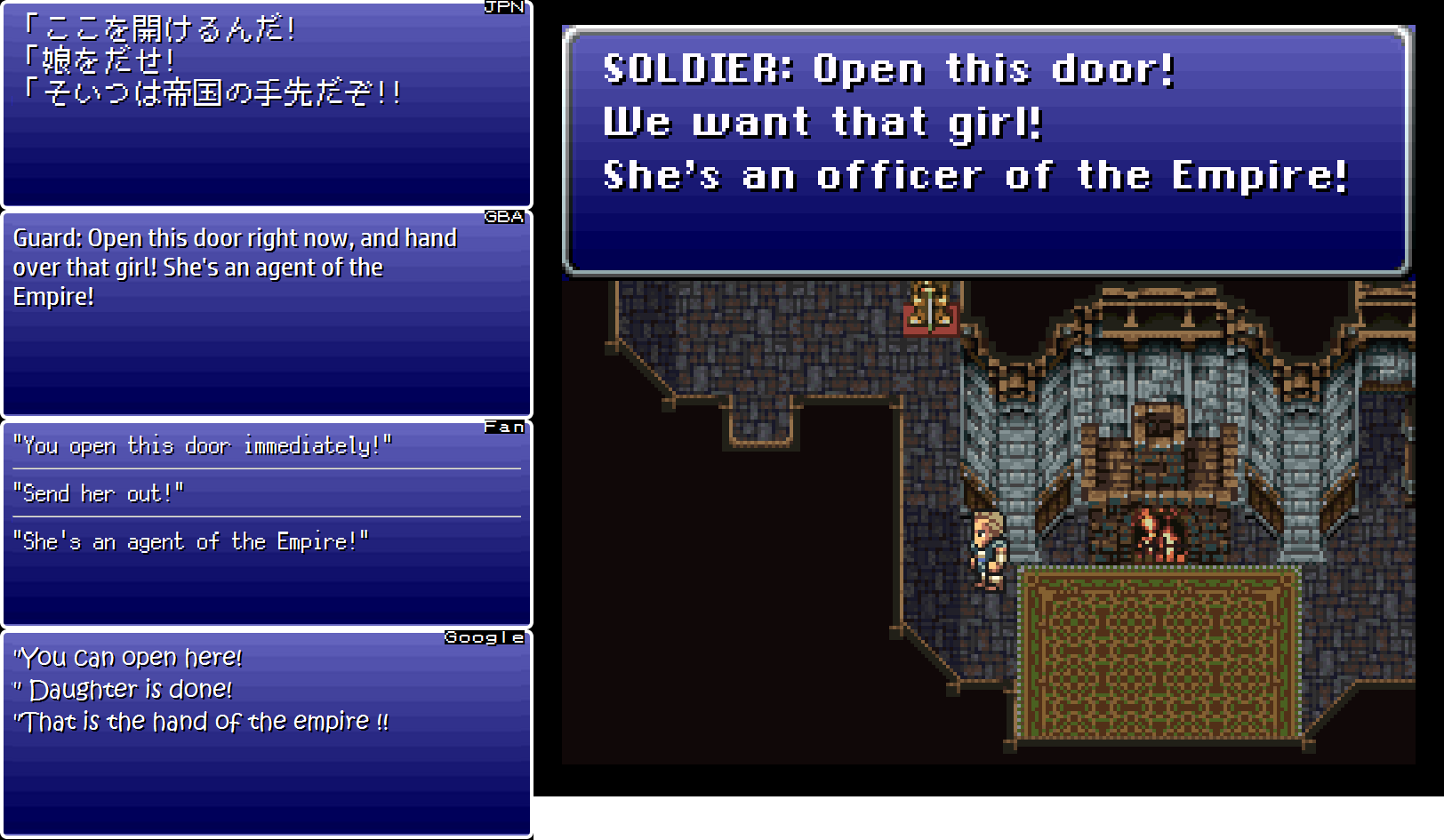
In the Japanese script, it’s clear that three different guards are shouting here, but the SNES translation combines them all into a single line attributed to a single guard. The GBA translation does the same thing.
Also, the word 娘 (musume) is usually translated as “daughter” but in many situations it’s also just used to mean “girl”. As a result, Google talks a lot about daughters during the game’s intro.
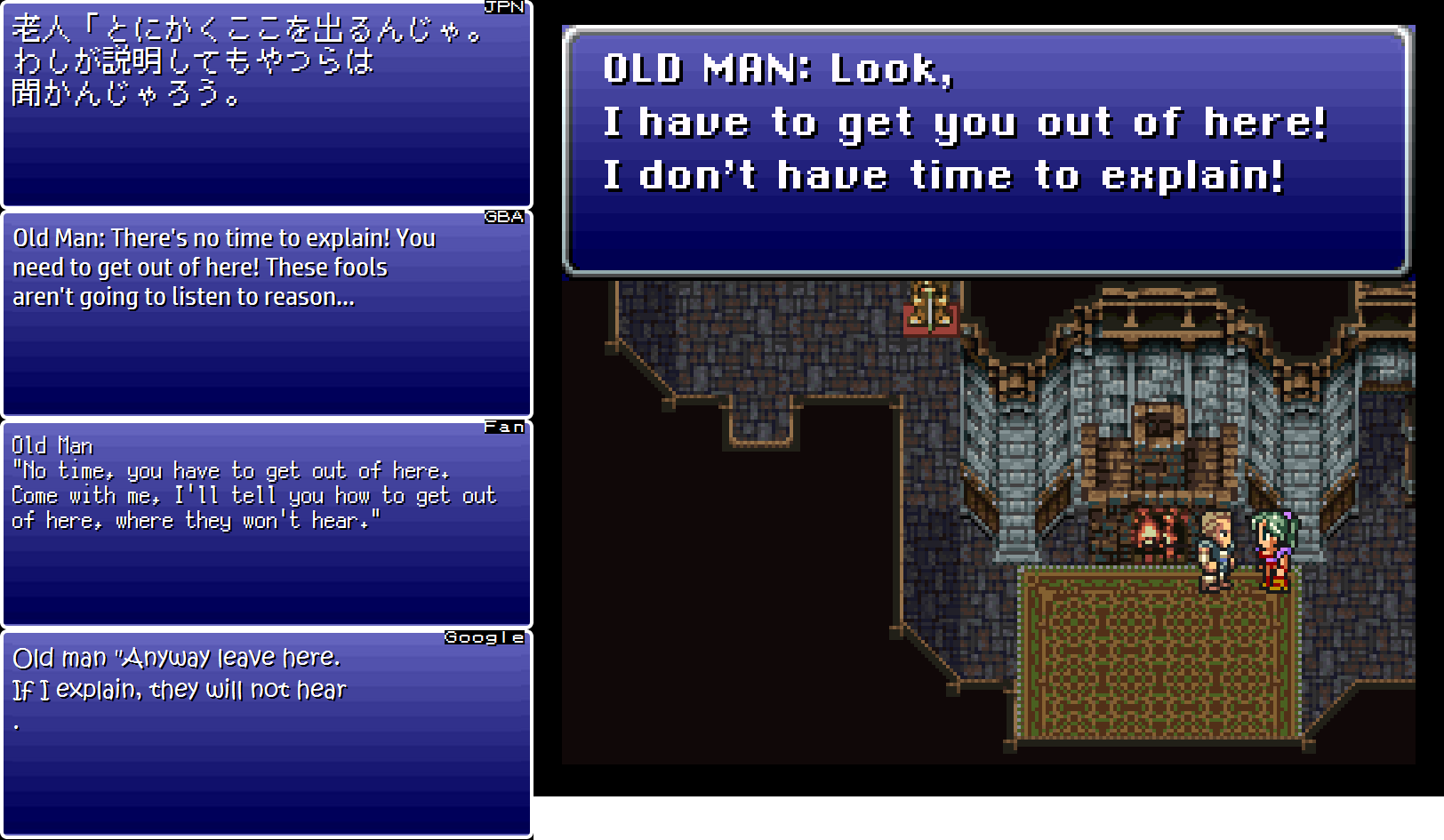
The last line here translates as something like “Even if I try to explain, I doubt they’ll listen to me.”
Japanese sentences tend to leave out subjects, verbs, etc., and it’s assumed that you can fill in the blanks when info goes unstated. So Japanese-to-English translators need to be mind readers, basically.
In this case, translators had difficulty figuring out who’s talking about who, so only the GBA translation gets it right. The fan translation took a wild stab in the dark and missed – my hunch is that the translator didn’t fully understand the grammar at the time.
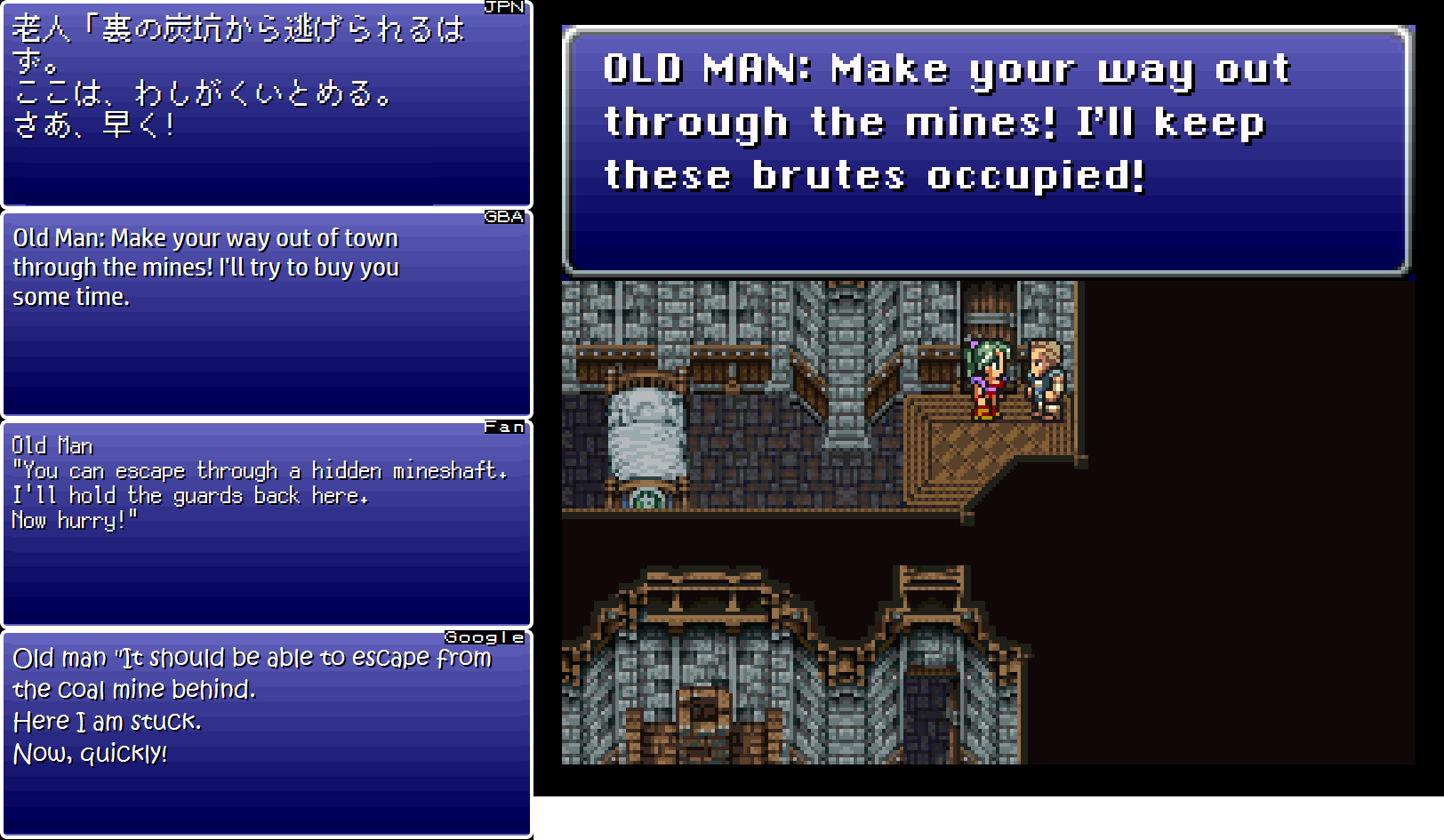
The Japanese script uses the word 裏 (ura), which usually means “rear”, “reverse”, or “behind here”. In some situations (but not this one) it can mean “secret”, which is why the fan translation talks about a “hidden mine”, even though it’s clearly not a secret to the Narshe guards.
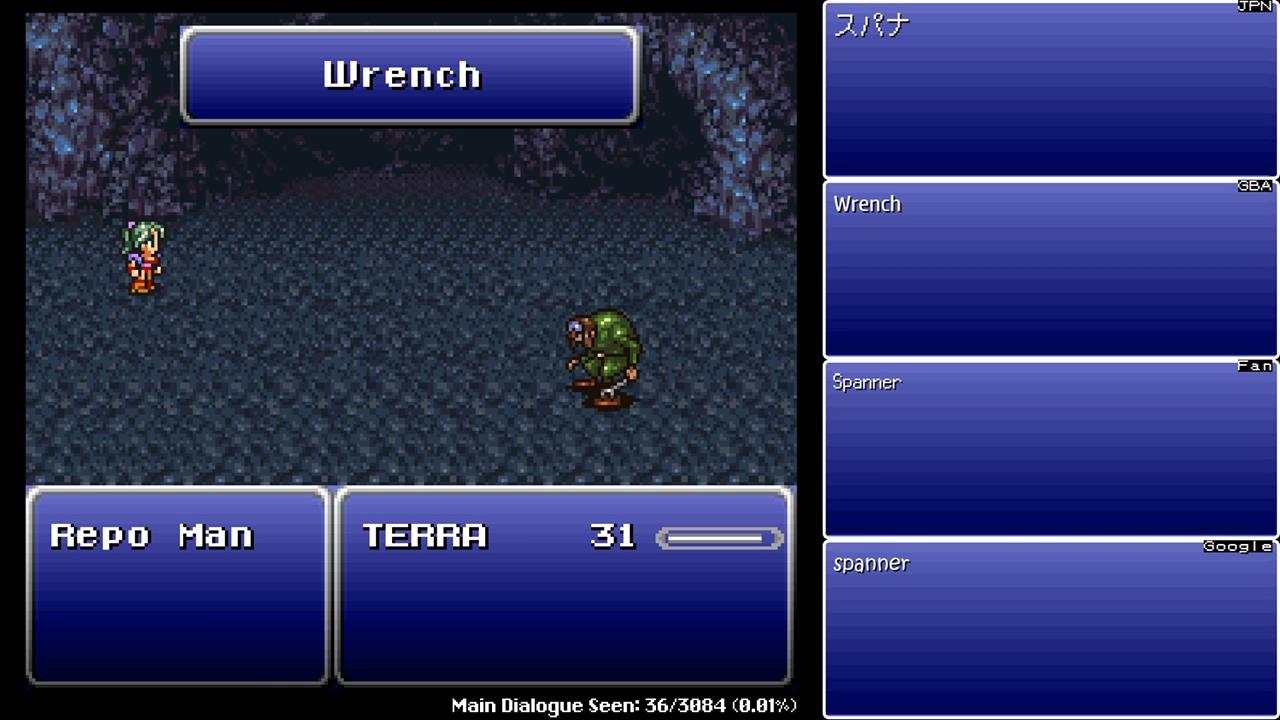
In Japanese, this enemy’s attack is called “Spanner”. The words “spanner” and “wrench” mean slightly different things in different countries, even among different English speaking countries.
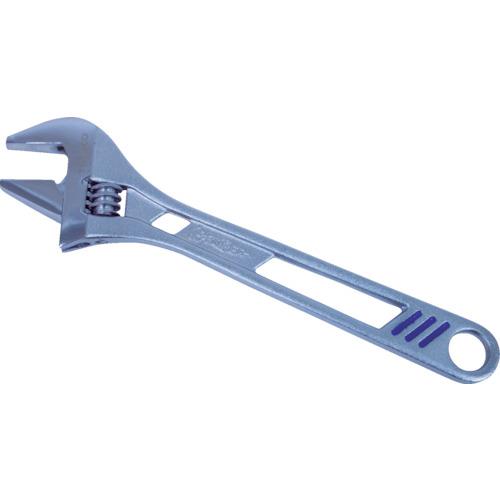
In Japanese, a “spanner” generally refers to this the fixed-size, open-ended tool. A “wrench” in Japanese refers more to what we’d maybe call a “monkey wrench” in America.
In Japanese, this is スパナ (supana, spanner). This is also the kind that this enemy throws in the game
In Japanese, this is considered a レンチ (renchi, wrench)
This is also a type of レンチ (renchi, wrench) in Japanese
Basically, this is all to show how being a translator leads you to learn about a wide variety of topics you’d probably never study otherwise. I’ve learned about Chinese astronomy, particle physics, World War II guns, Japanese MMOs, Japanese sex scandals, and so many other random things over the years. If you’re a translator, let me know what kind of crazy things you’ve had to learn about too!
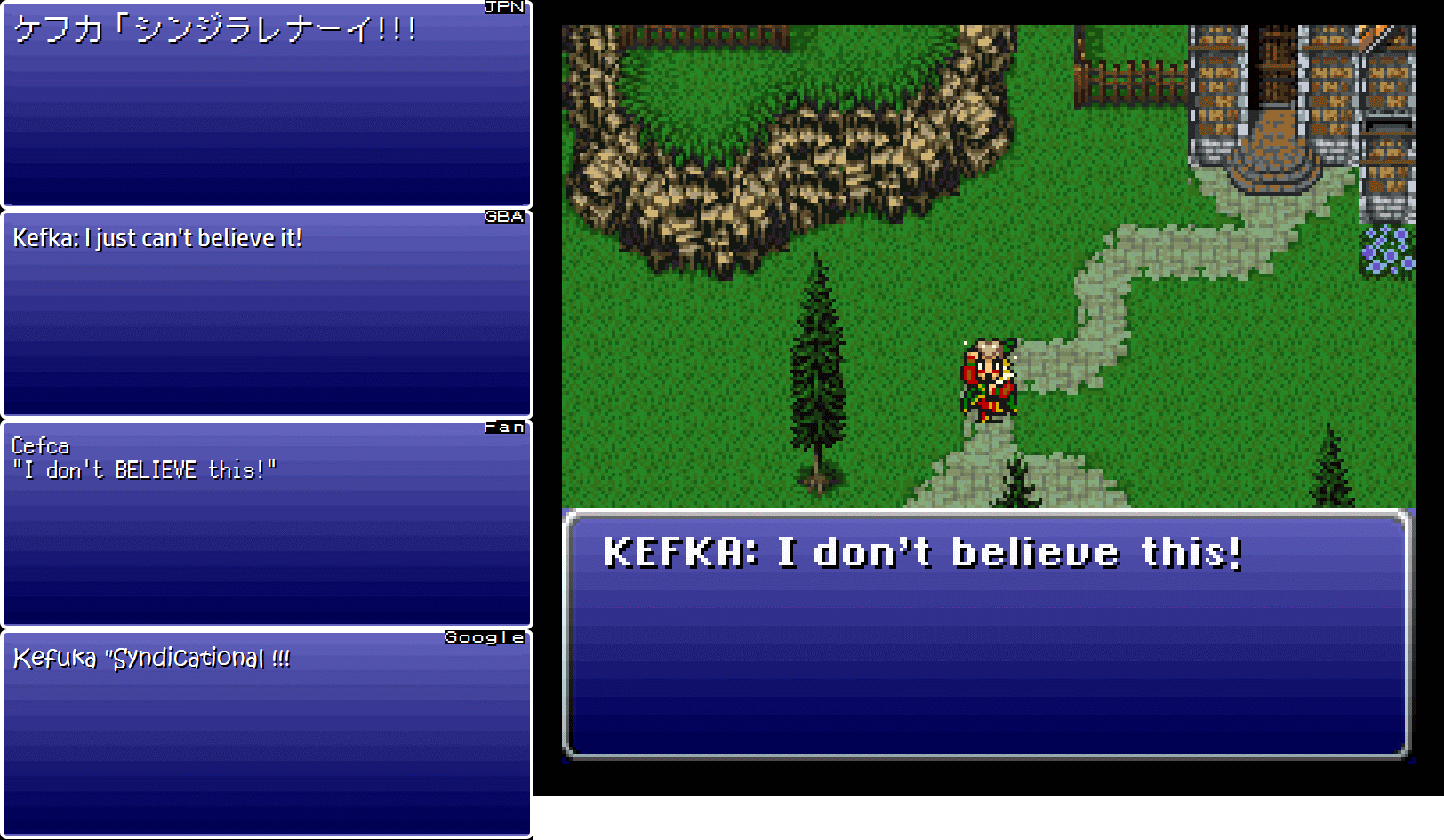
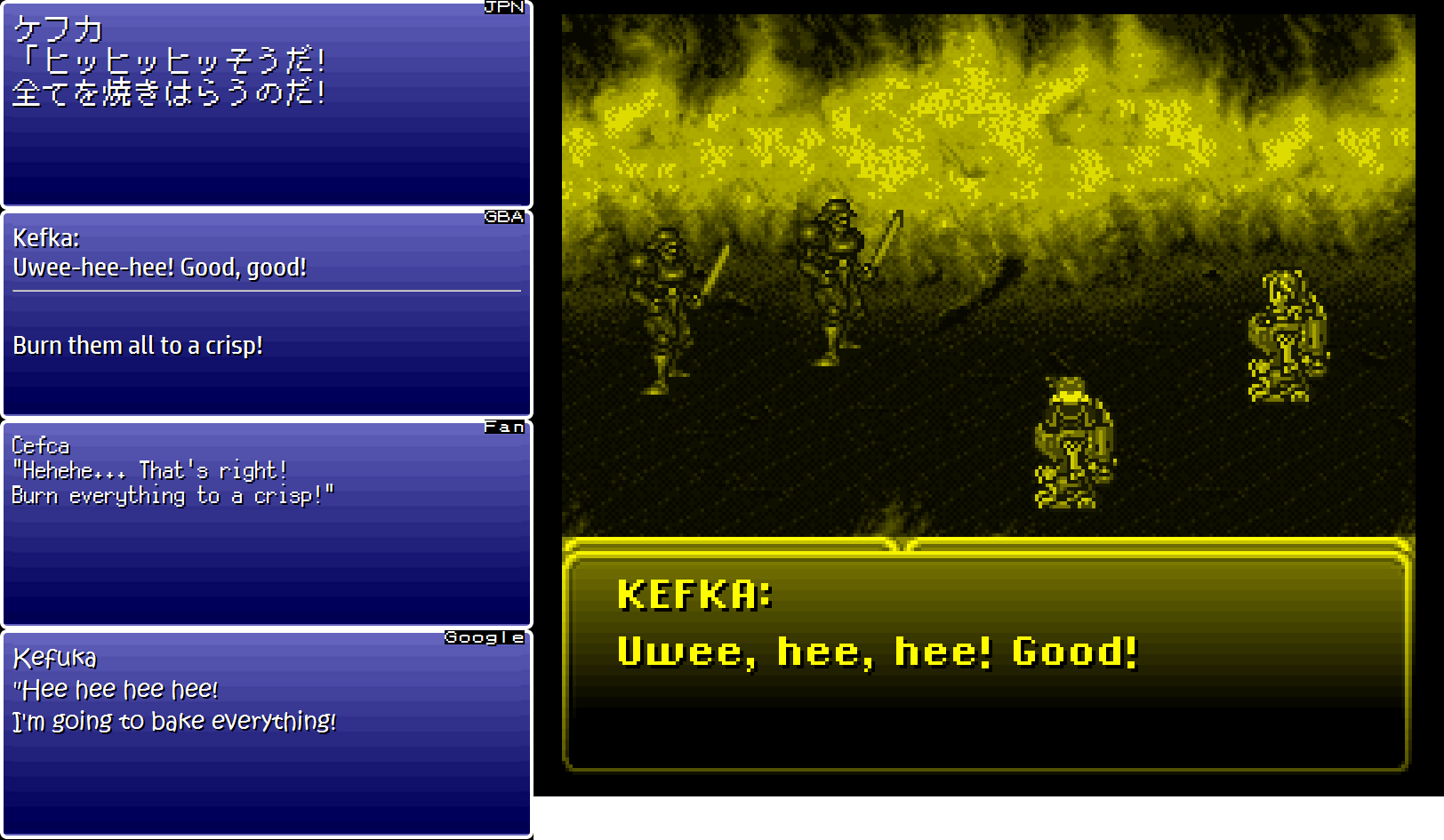
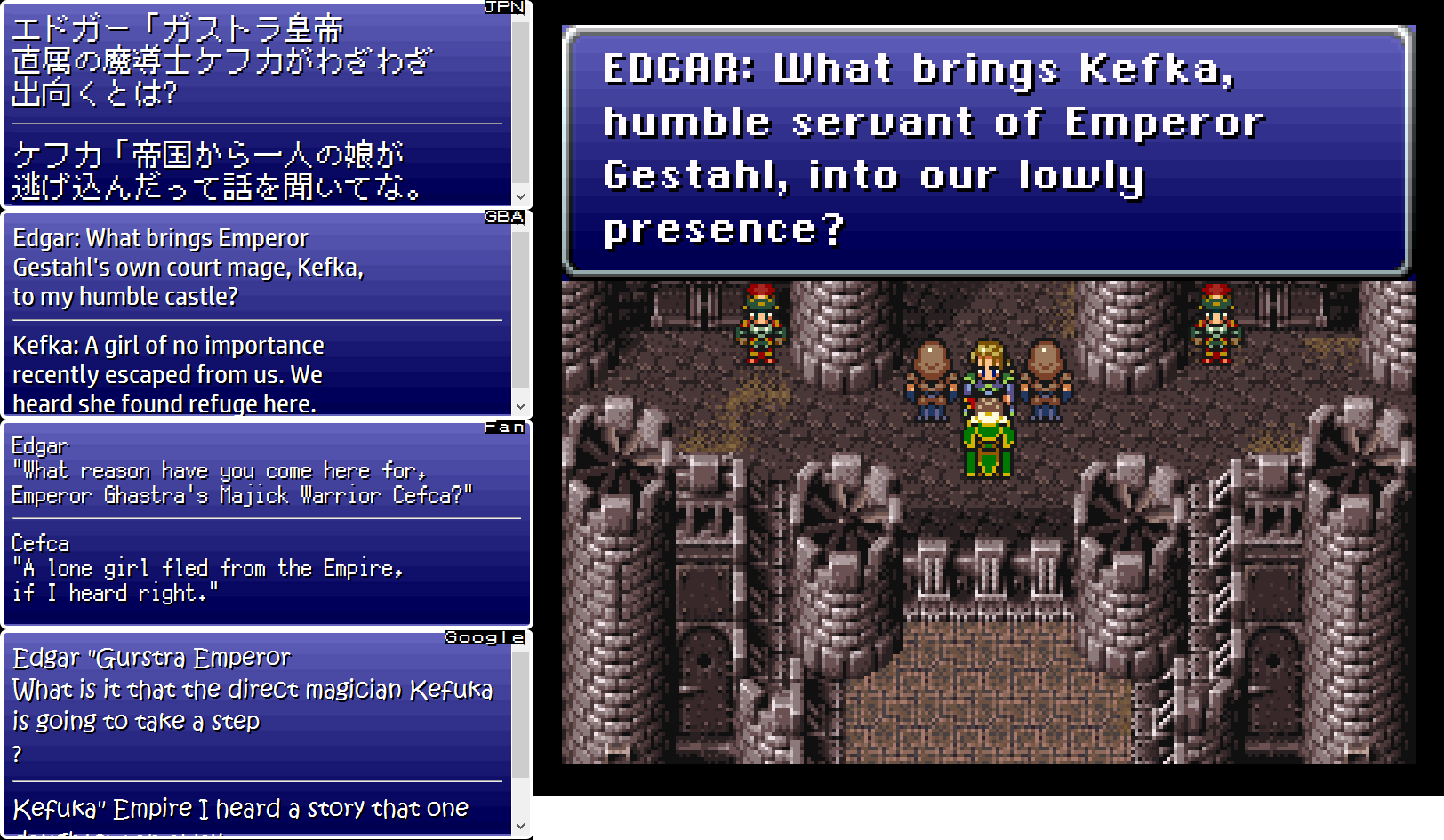
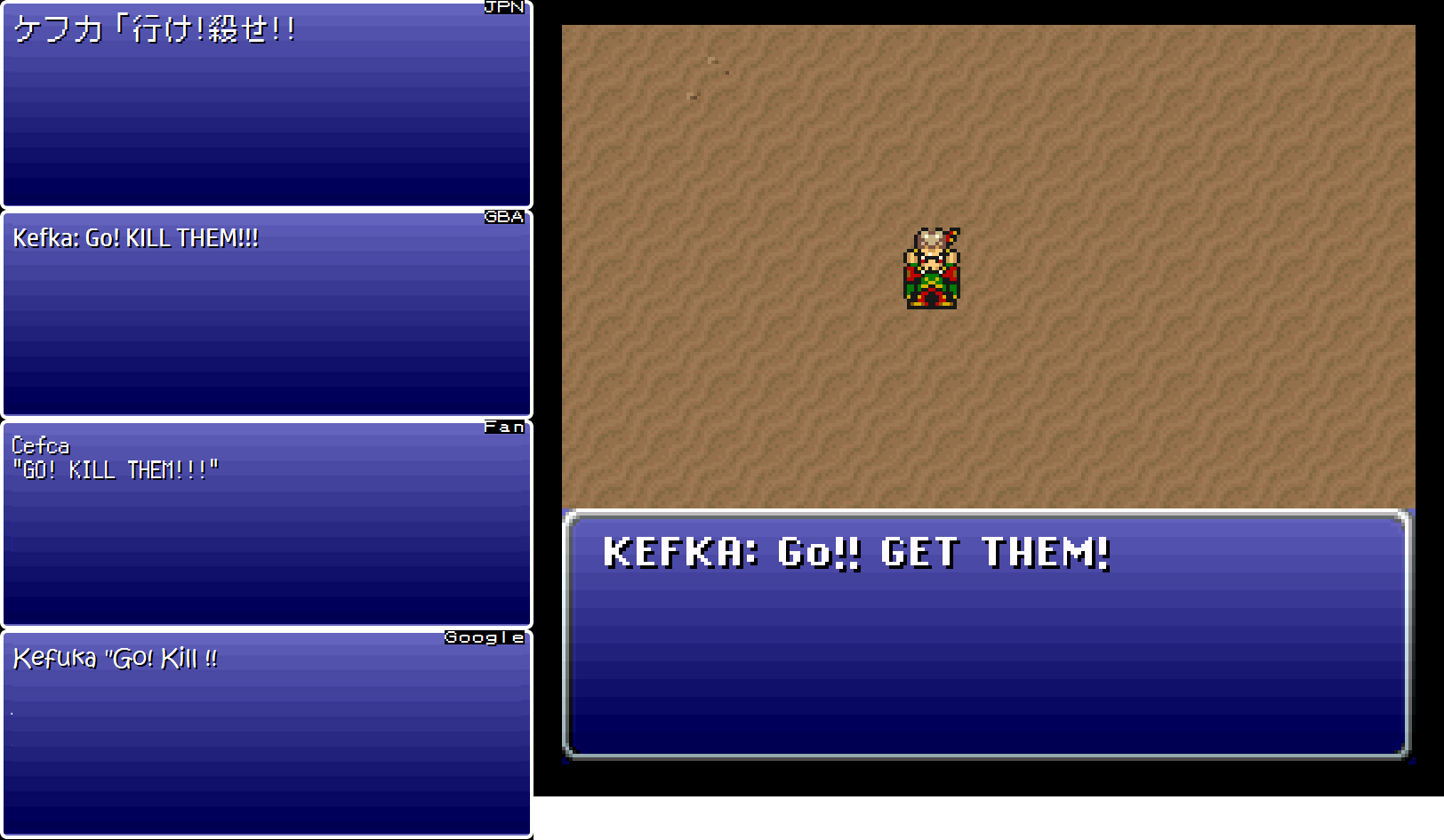
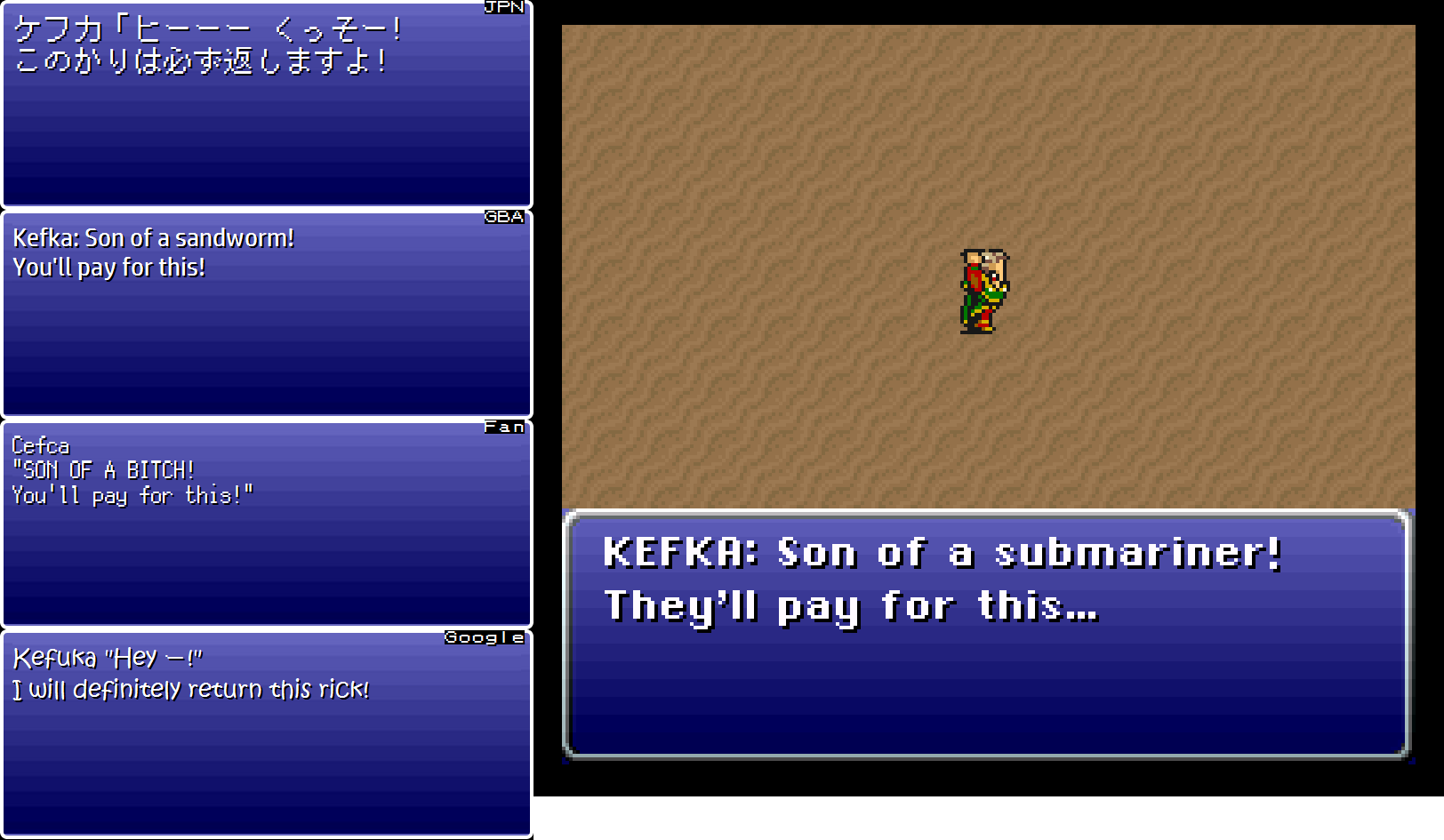
The fan translation famously spells “Kefka” as “Cefca”. I’m not sure why SkyRender made this choice, but I assume it was because he saw it written as “Cefca” in Japanese strategy guides back then. It’s important to note that Japanese merchandise can be helpful for choosing how to spell names in English, but merchandise and secondary materials should never be trusted 100%. I vaguely recall that the official GBA translation pokes fun at this “Cefca” fan translation choice later on.
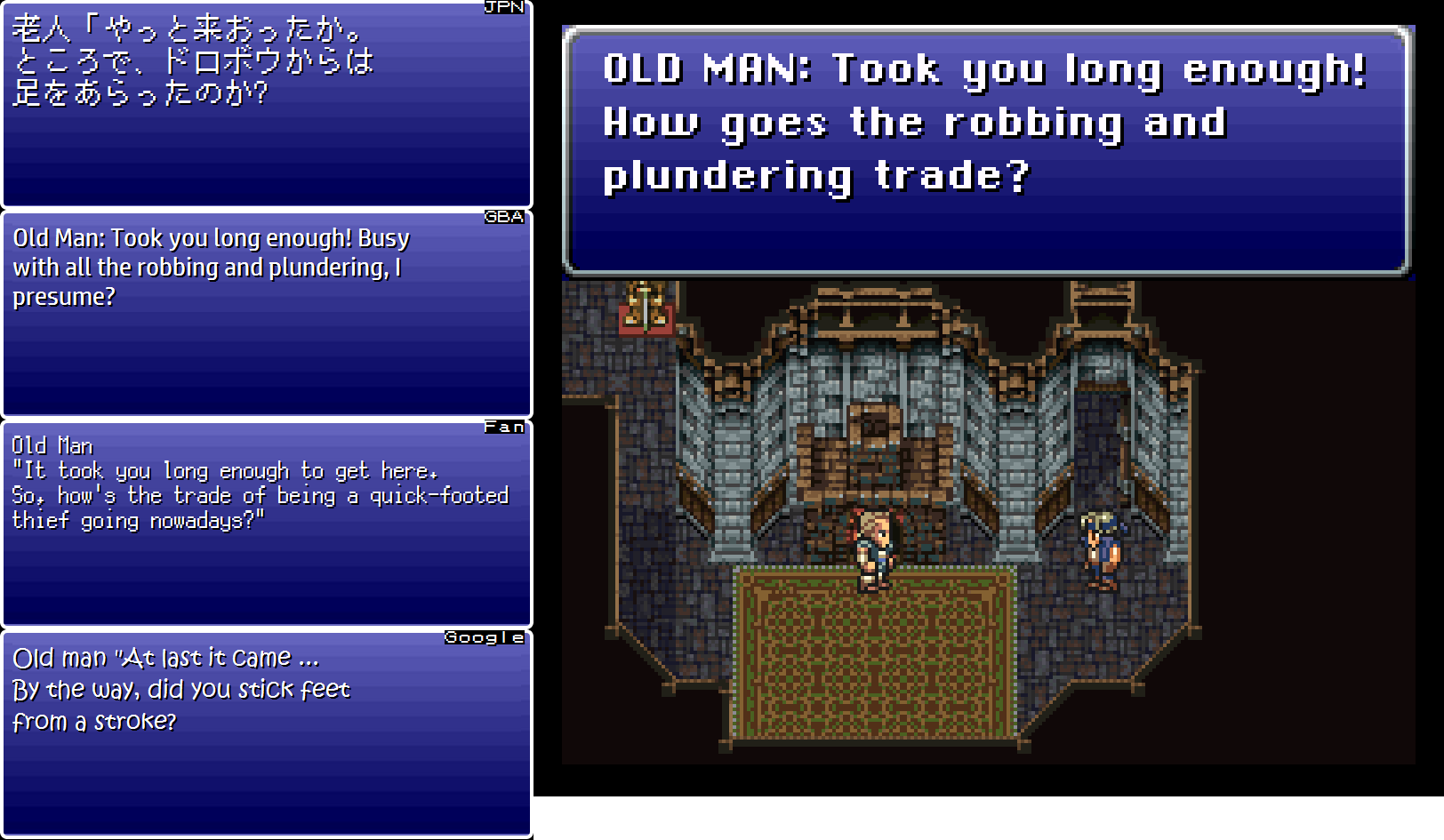
In English, we say you “wash your hands of ___” when you’re cutting ties with something/going legit. There’s a very similar phrase in Japanese, but you instead say that you “wash your feet of ___”. This idiom is why Google talks about feet for some reason.
Oddly, the SNES and GBA lines don’t convey this same question about Locke going legit. It’s also clear that the fan translator didn’t understand the idiom, but saw the character for “foot” in the line and added something about being quick-footed to fill in the gaps. I remember this feeling and tactic very well from my very earliest amateur days too.
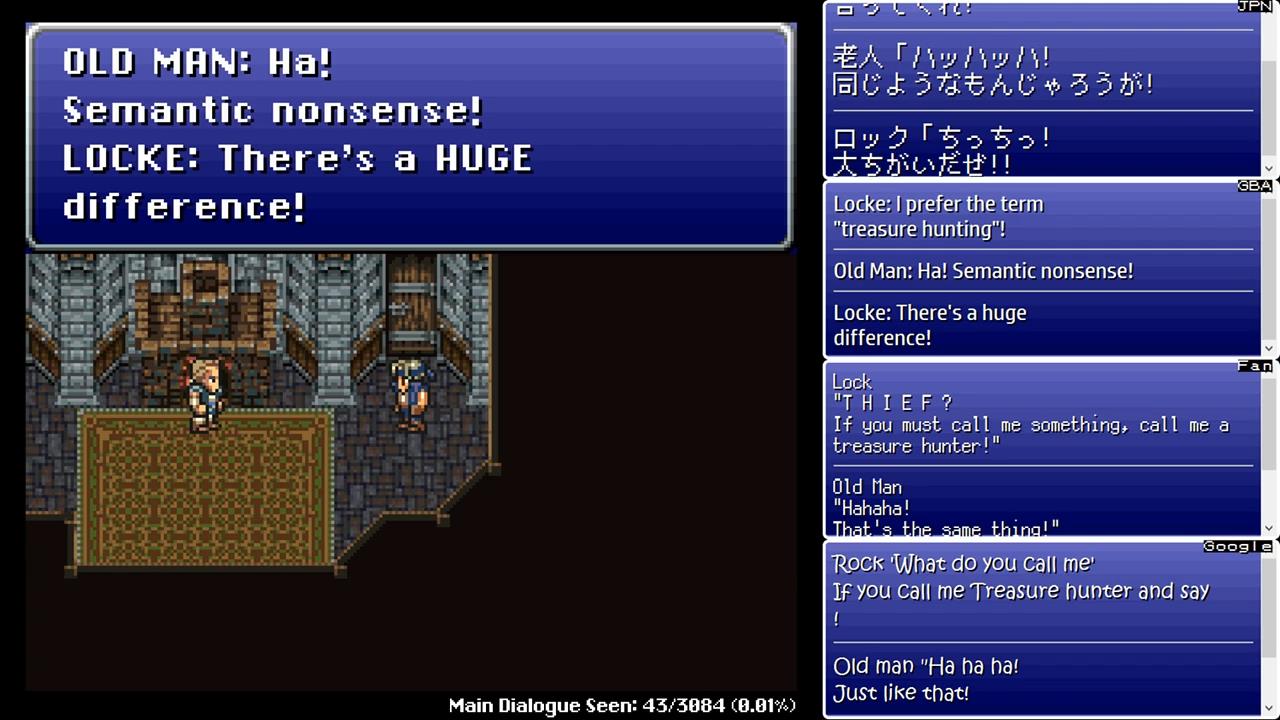
In Locke’s Japanese text, he makes a “tch tch” sound that sometimes called “tutting” in English I think?
In any case, he makes this sound because he’s correcting the old man’s wrong statement in that sassy way that involves wagging your finger. This is why he actually wags his finger after the line too.
All the translations drop this “tch tch” sound though, so the minor connection between the dialogue and character animation isn’t as obvious.
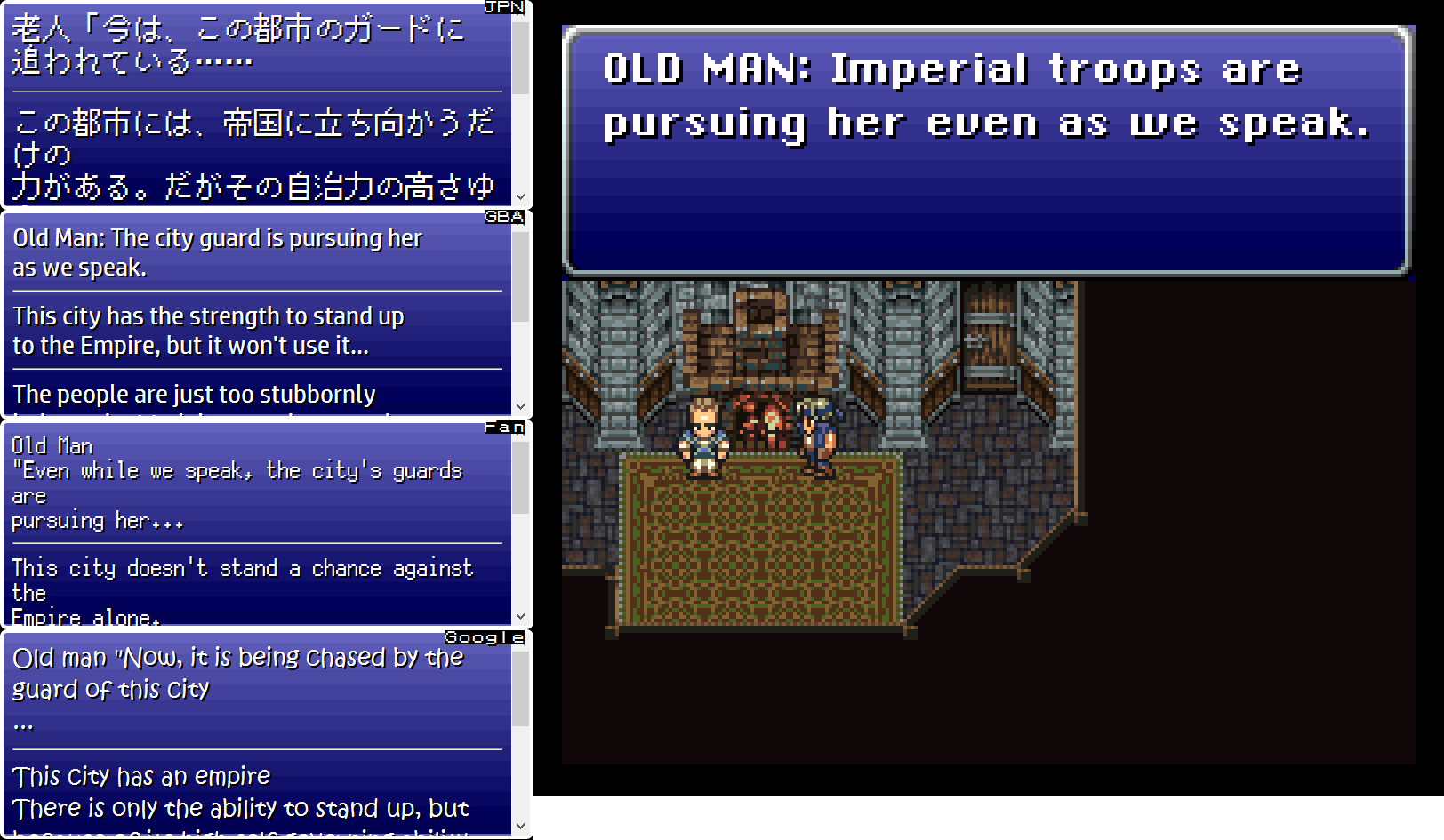
This whole scene came as a surprise to me – the SNES translation gets everything completely wrong – and it’s genuinely serious and important plot information. The fan translation makes many other mistakes of its own and gets a lot wrong. Only the GBA translation gets it all right.
Basically, the SNES translation says that imperial soldiers are currently pursuing Terra, that Narshe is no match for the empire, and that they need to find and meet up with the Returners if Narshe is to stand a chance.
In Japanese, it’s actually the city guards who are chasing Terra, Narshe is capable of standing up to the empire (hence the entire intro and the scenes yet to come), and this guy already is a member of the Returners – he’s just having a hard time convincing the Narshe people to team up with the Returners.
There are many more issues here than what I’ve listed, so if you’re interested, I’d suggest checking out the video for Day 1 for more.
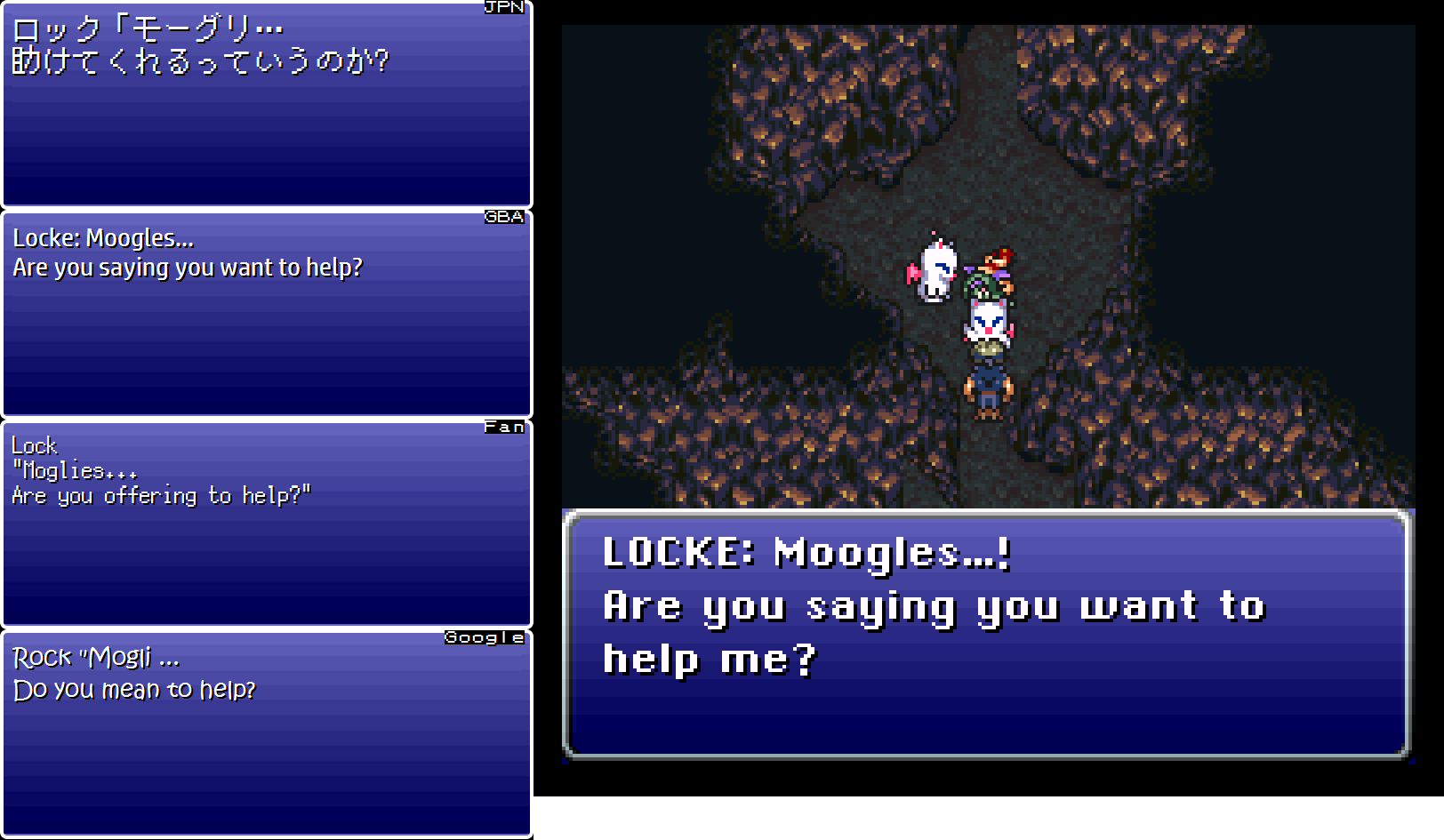
Moogles are called モーグリ (mōguri) in Japanese. The name could be written out as Mohgli, Moguri, and a dozen different things. They were renamed “Moogles” outside of Japan at some point – I think maybe it first appeared in Final Fantasy Adventure? Anyway, the fan translation calls them “Moglies”, which is in line with the original Japanese word.
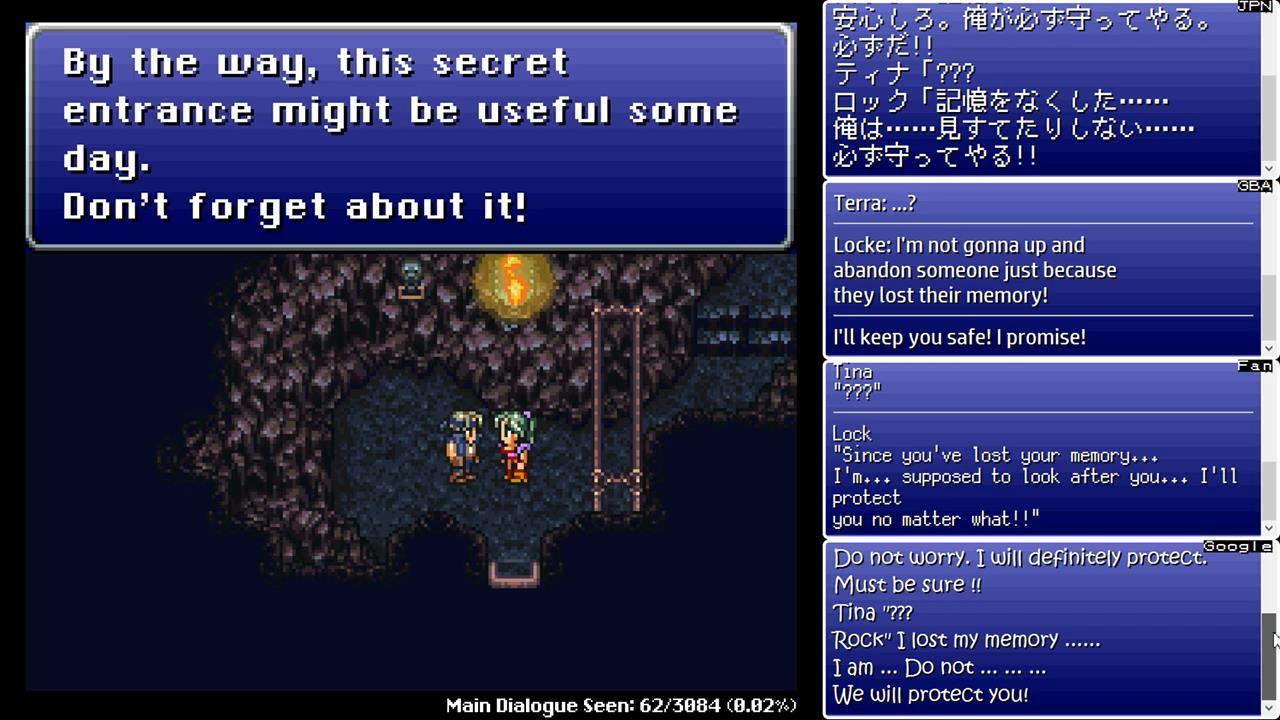
The SNES translation adds in a whole extra window’s-worth of text to help the player remember that this cave is here. This text is absent in the Japanese text and in every other translation. I wonder who suggested adding this and why specifically it was added…
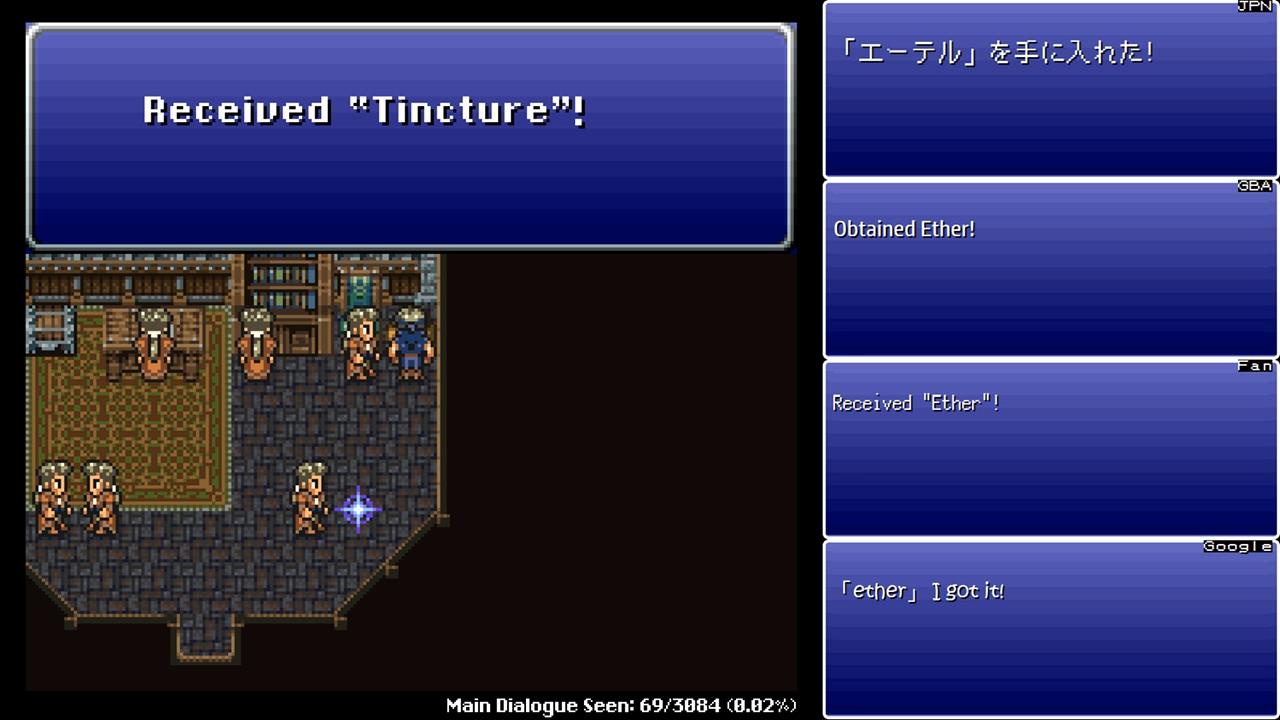
Ethers were renamed Tinctures for the SNES translation. The GBA translation has leaned pretty heavily on the SNES translation so far, but this item name was changed back to “Ether” to match modern Final Fantasy translation terminology.
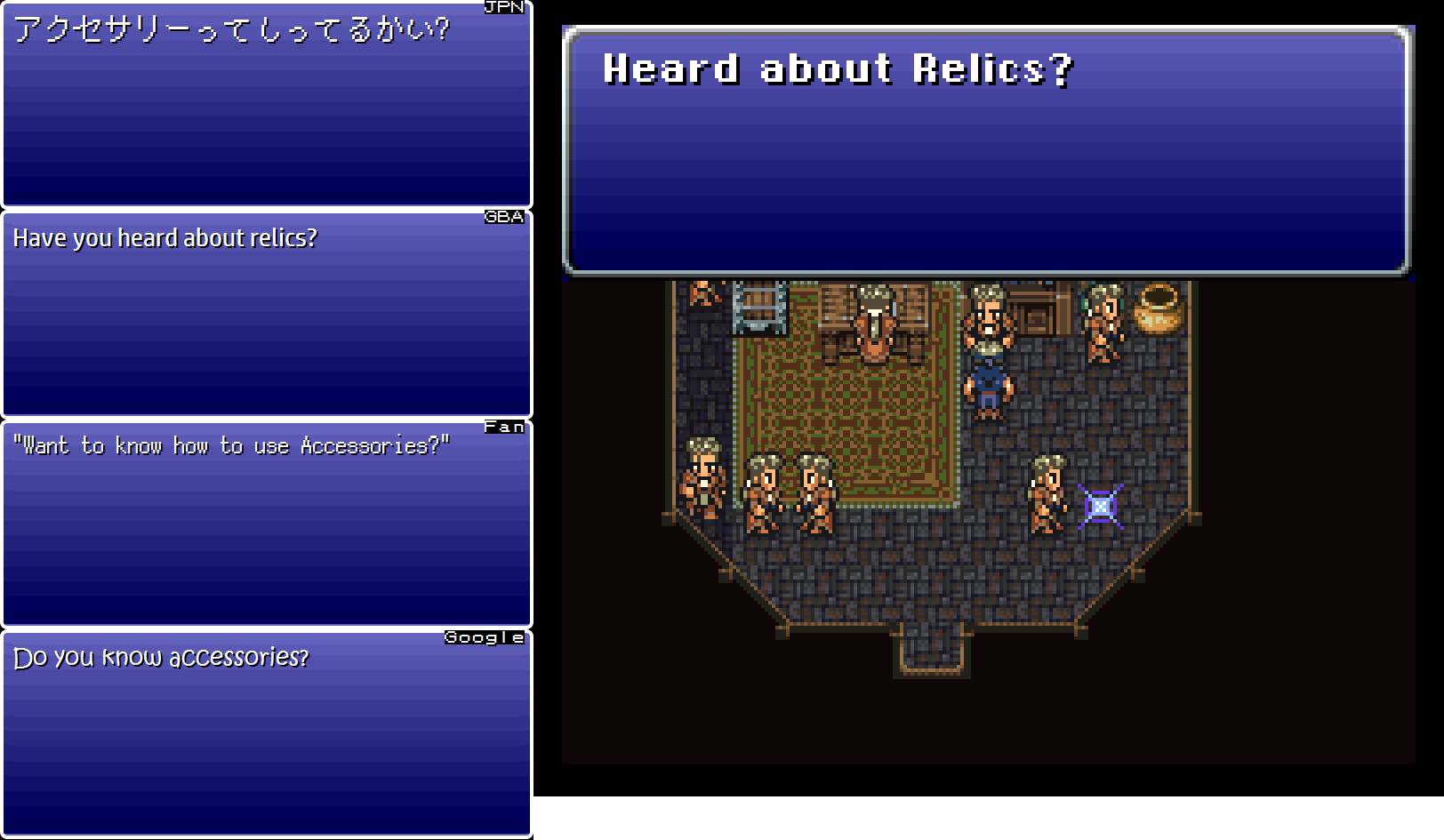
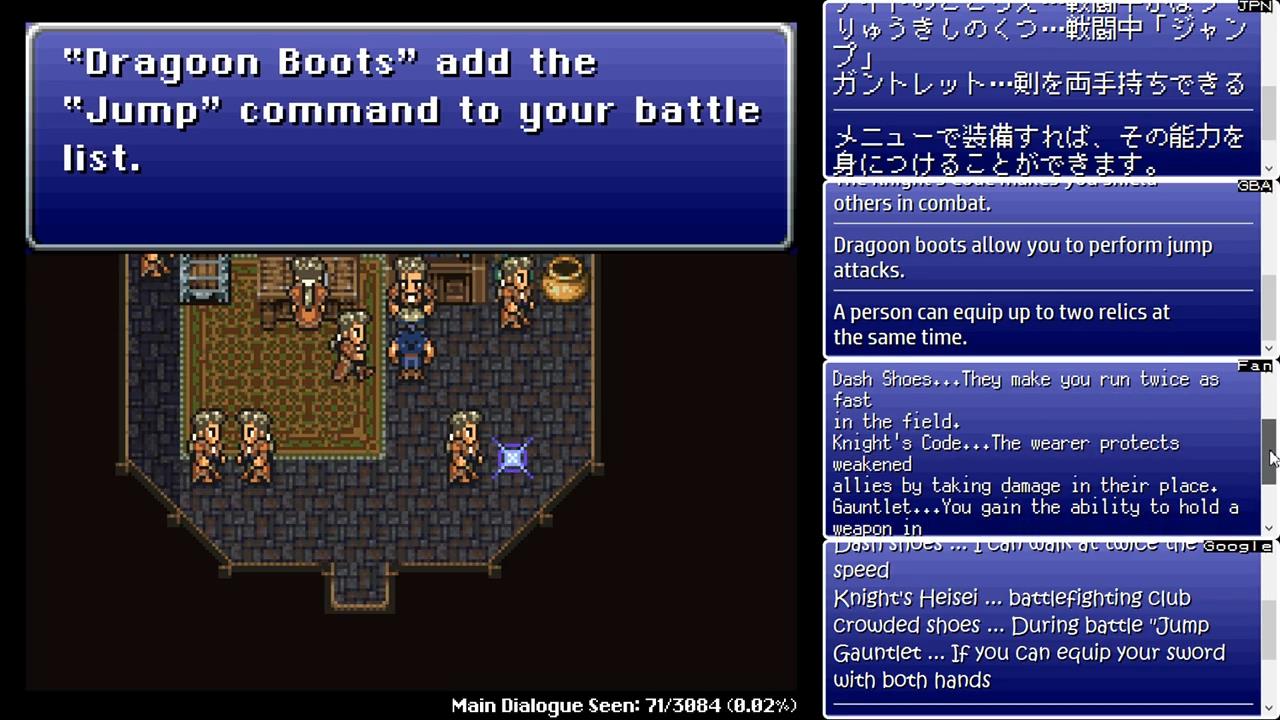
Relics are simply called “accessories” in the Japanese version of the game. I always assumed “Relics” was used so that it could fit on the main menu screen without weird text abbreviations. I kind of prefer “relics” though, it makes them sound cooler and more in line with all the cool mysterious stuff they do.
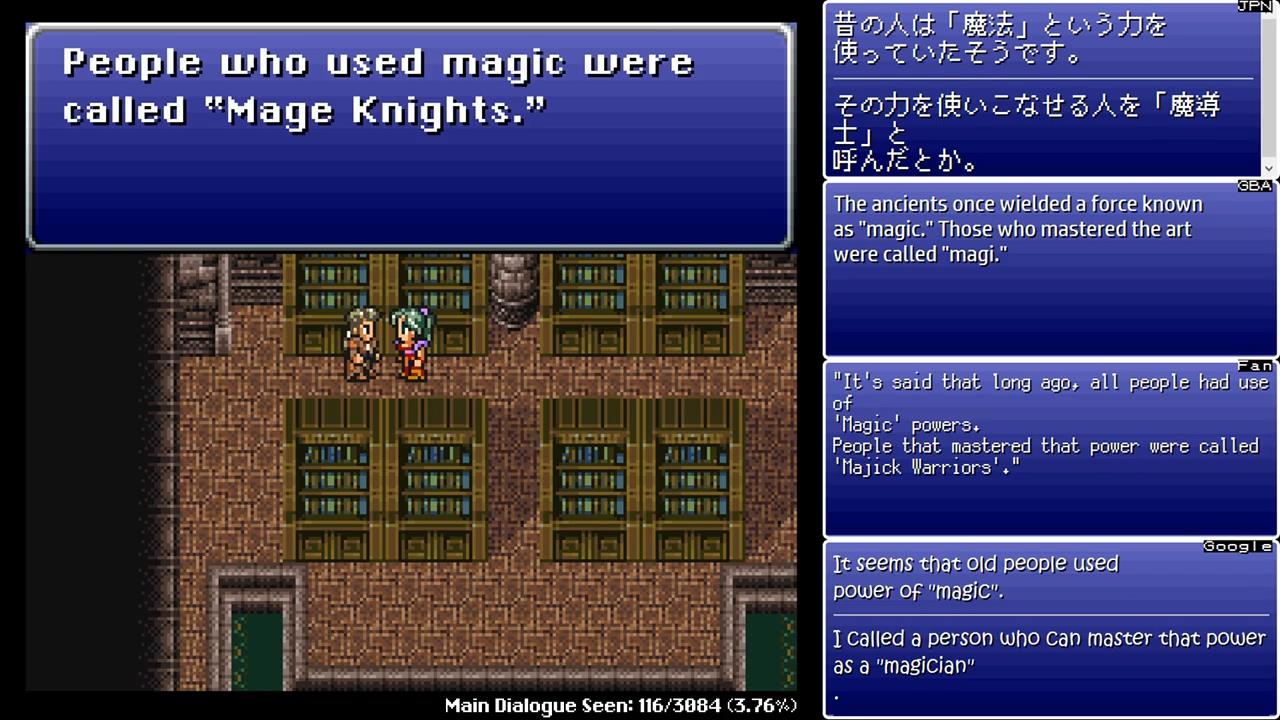
The word 魔導士 (madōshi) is used throughout the Japanese script. It’s a common word in Japanese entertainment and basically refers to a person who uses madō, with the possible implication of that magic being used for battle, but not necessarily. As such, it’s common to see it translated as “wizard”, “mage”, “sorcerer”, and the like in Japanese games, manga, etc.
It looks like the SNES translator wasn’t really familiar with the word though, so it gets handled quite inconsistently throughout the game. Here it’s translated as “Mage Knight”, which isn’t too far off from the original word, but then we never, ever see the term “Mage Knight” again in the SNES script. The GBA script seems to fix this specific problem by tying the word back into the “War of the Magi” name.
The fan translation, because it tries to keep mahō and madō separate, goes with the “Majick Warrior” term.
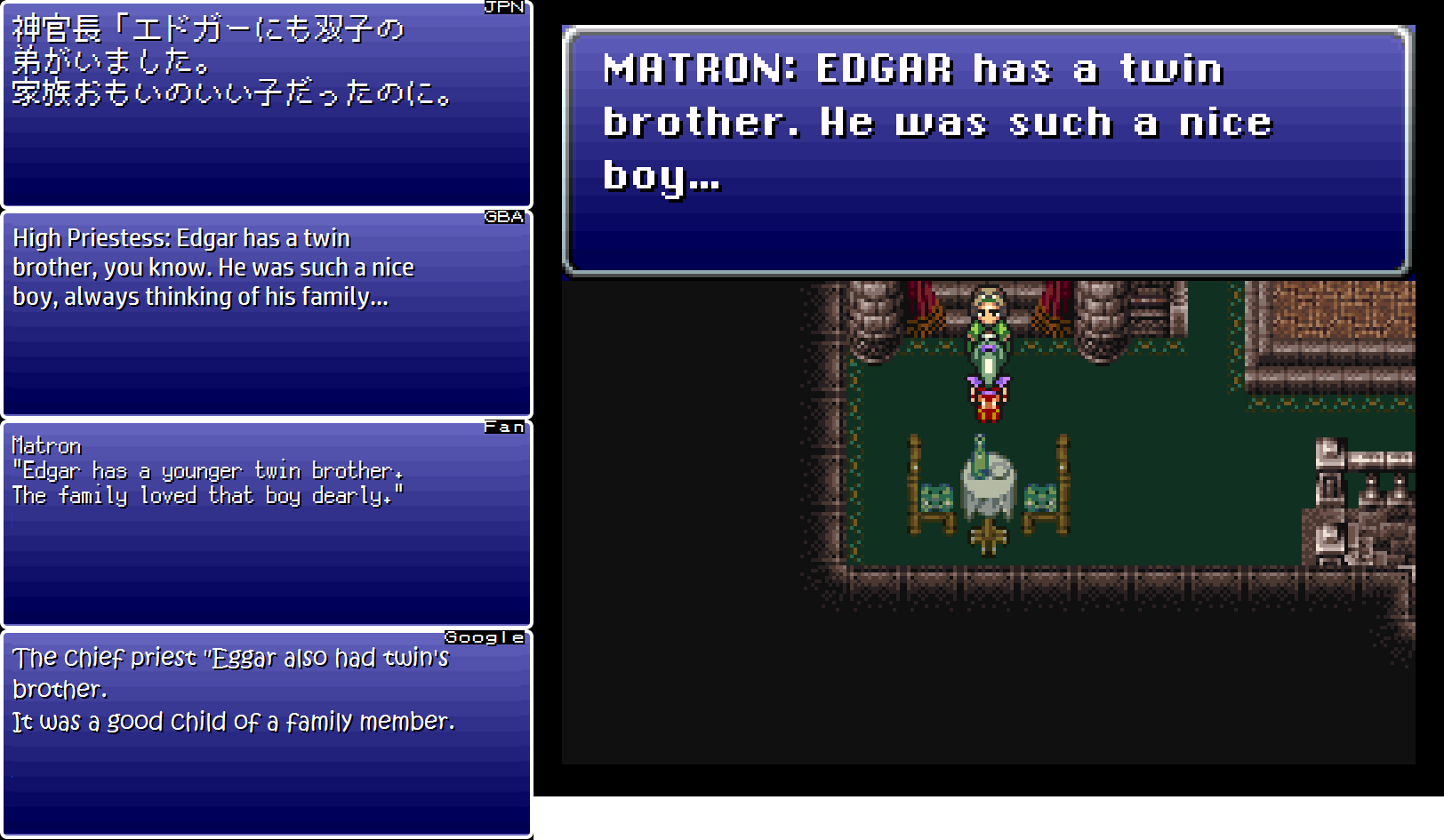
One NPC in the castle mentions a “high priestess”, but then you never actually find a high priestess in the SNES translation. That’s because she’s identified as “Matron” when you talk to her. In other words, this high priestess and this matron lady are one and the same. I think most fans figure it out pretty quickly but I still see confusion about this from time to time.
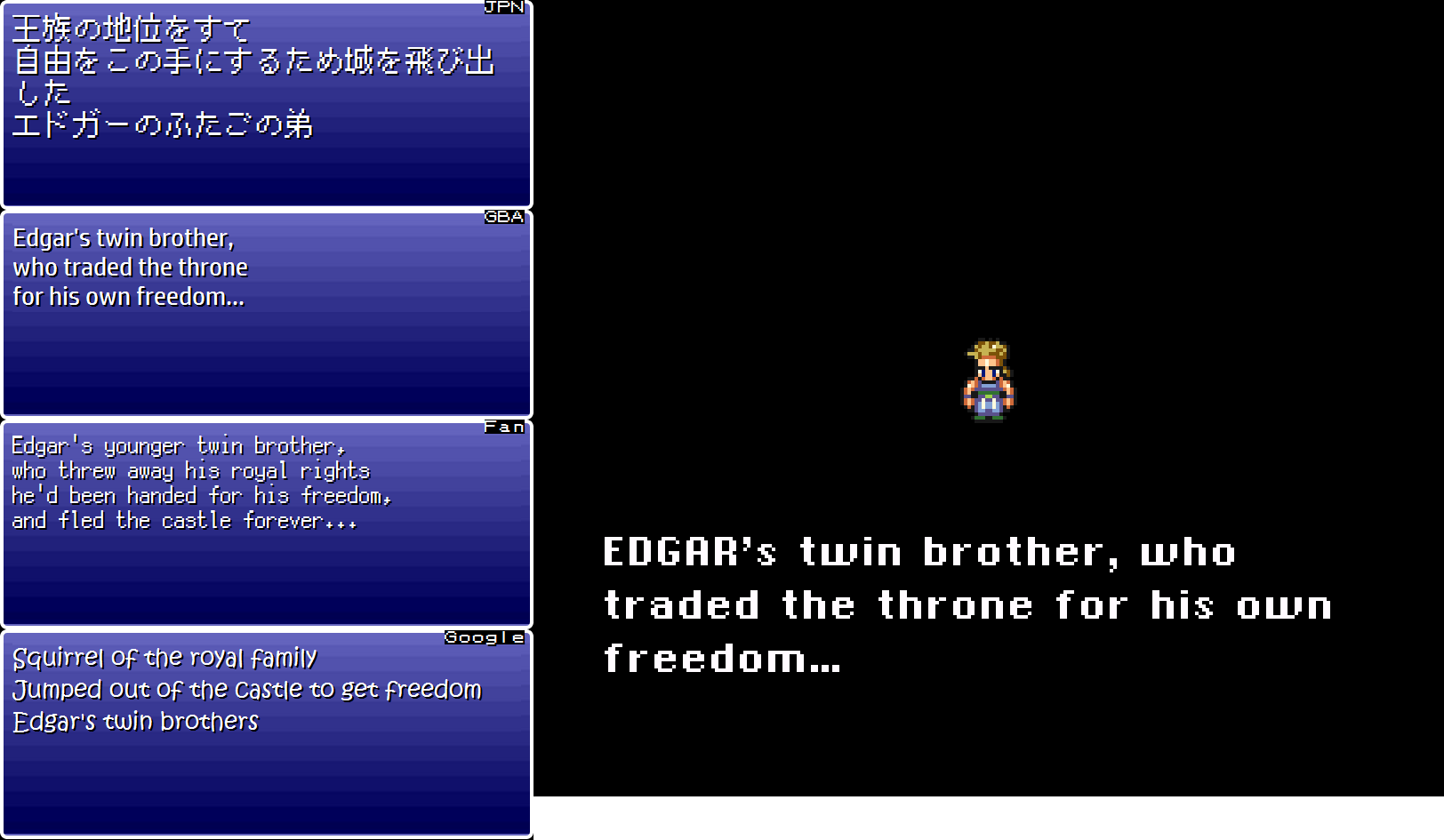
Also, in Japanese, there’s a different word for an older brother and a younger brother – there’s not really a good, single word for “brother” like we have in English. This means you can immediately glean extra details about how siblings relate to each other when reading or listening to Japanese. In this case, Sabin is identified as Edgar’s younger brother, which is a tiny detail that only the fan translation keeps intact. Even Google drops the extra info.
Now that I think about it, this is absolutely something I should’ve included in my article about common problems in English-to-Japanese game translation – since we don’t always specify who’s younger or older in English, Japanese translators sometimes just have to use a Japanese word for “sibling” or take a random guess at who’s older and who’s younger and pray for good luck.
Sabin is now a squirrel that jumped out of a castle. I’d play that game.
Oh yeah, and he’s known as “Mash” in the fan translation, because his Japanese name is マッシュ (masshu). Some fans wonder if his name is supposed to be “Matthew” instead, but I don’t know much about official FF6 Japanese name romanization choices. It’s definitely plausible – after all, it’s like one of a dozen different ways of spelling “Matthew” in Japanese katakana. Here’s an example of it in the real world, in fact.
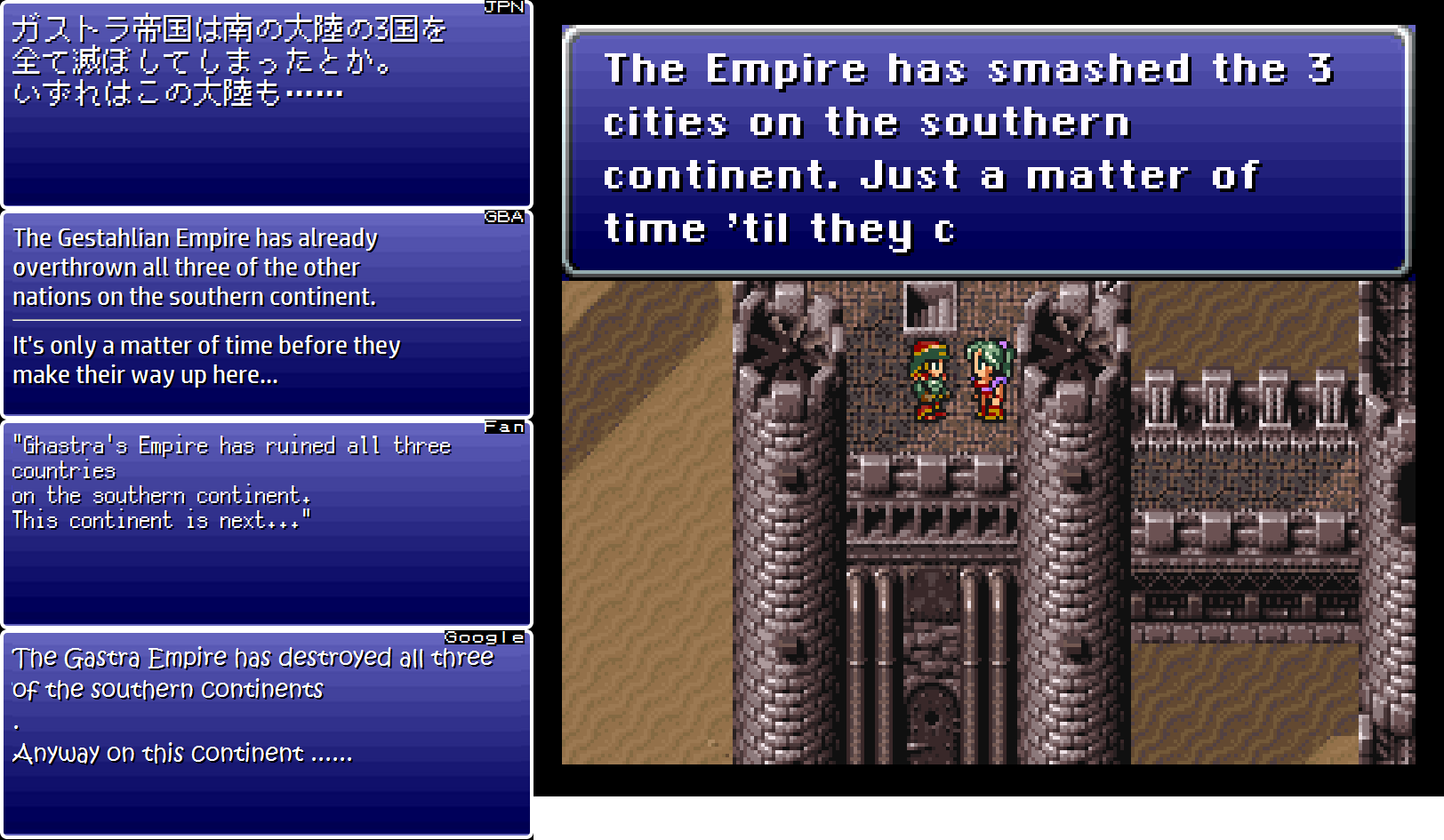
The SNES translation says that the Empire has taken over three cities, but in Japanese it’s more like “three nations”. Every other translation keeps this detail intact. Defeating three nations/countries/kingdoms sure sounds much more threatening than three cities, so this is an odd translation choice.
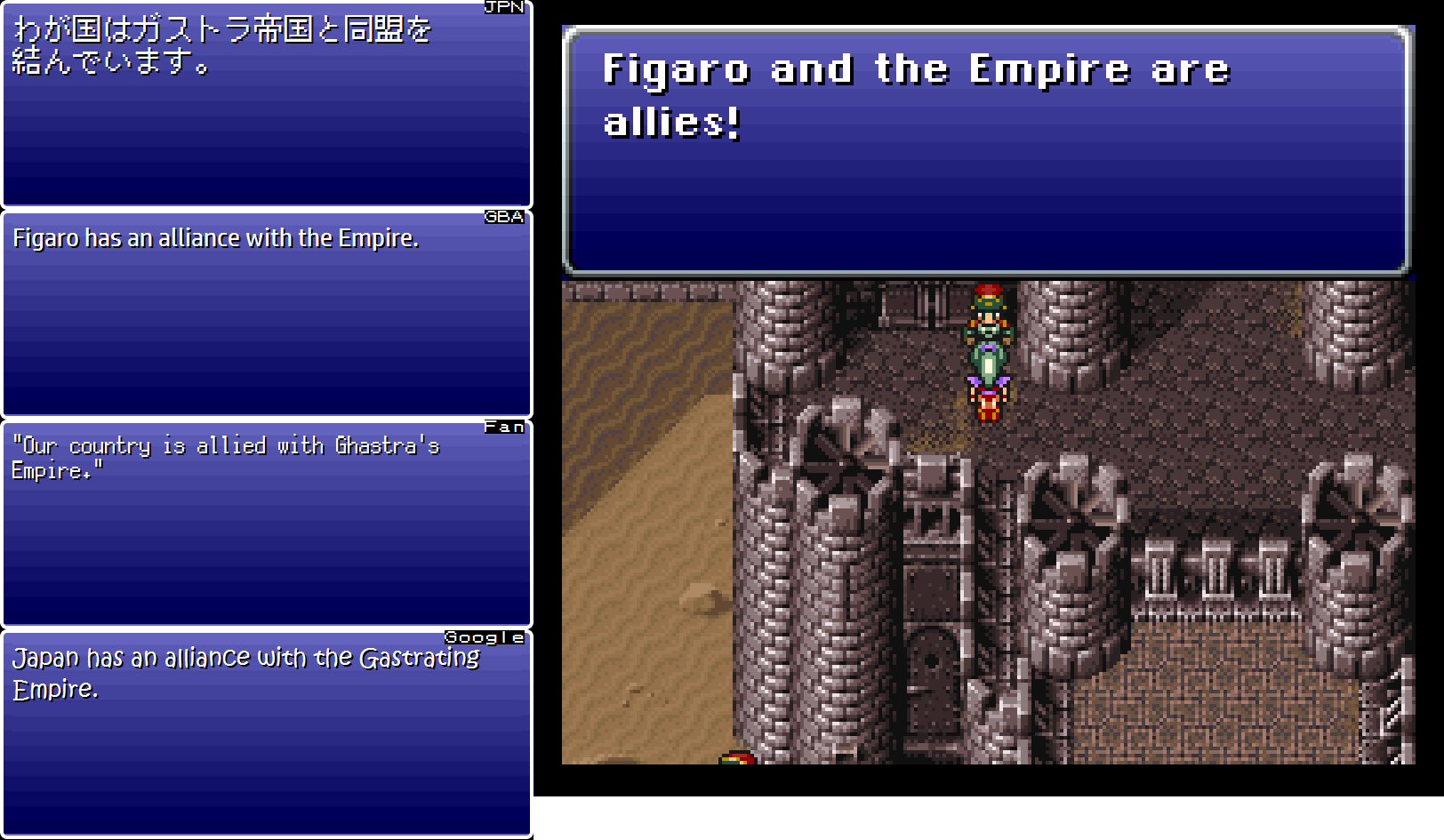
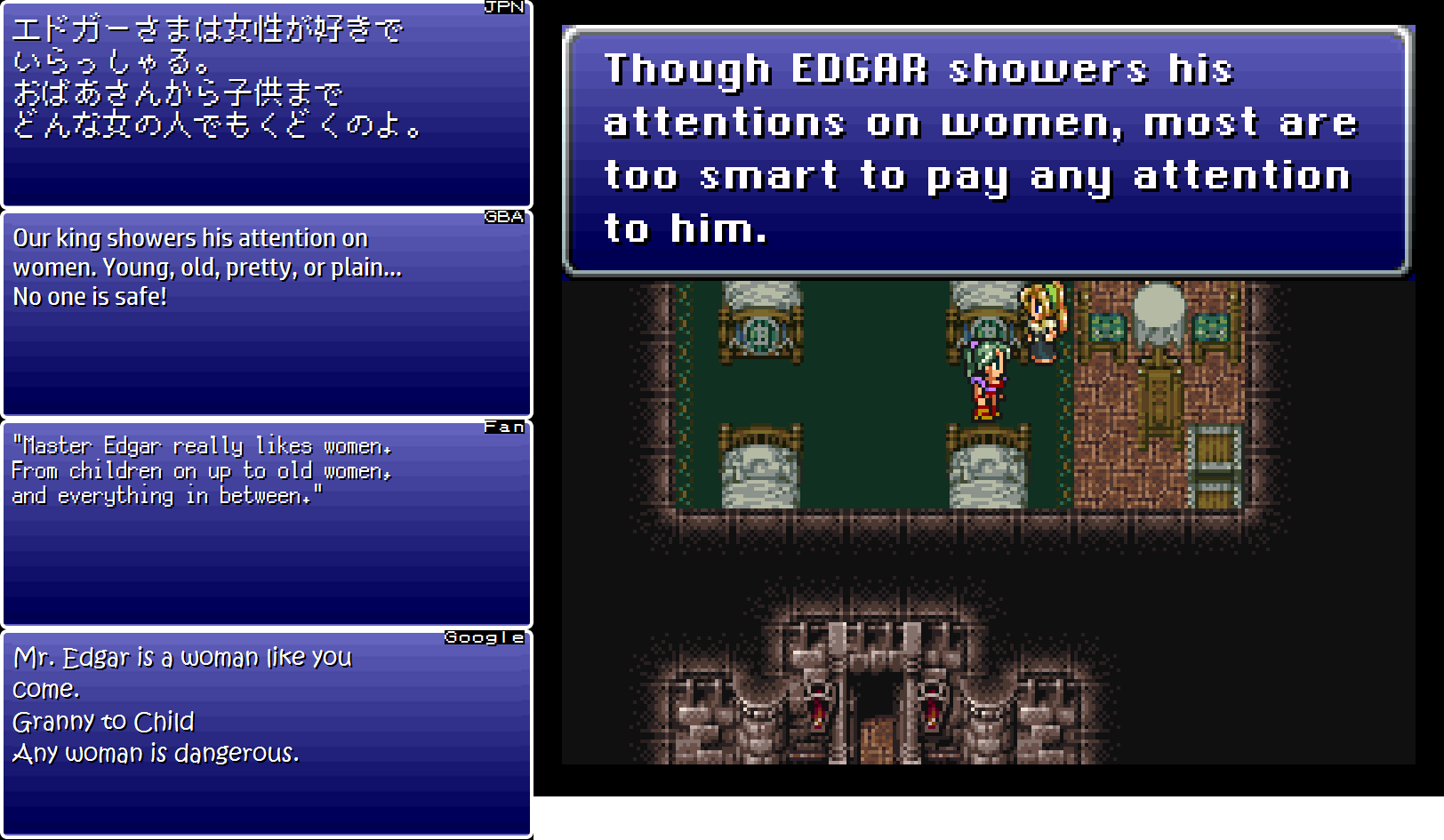
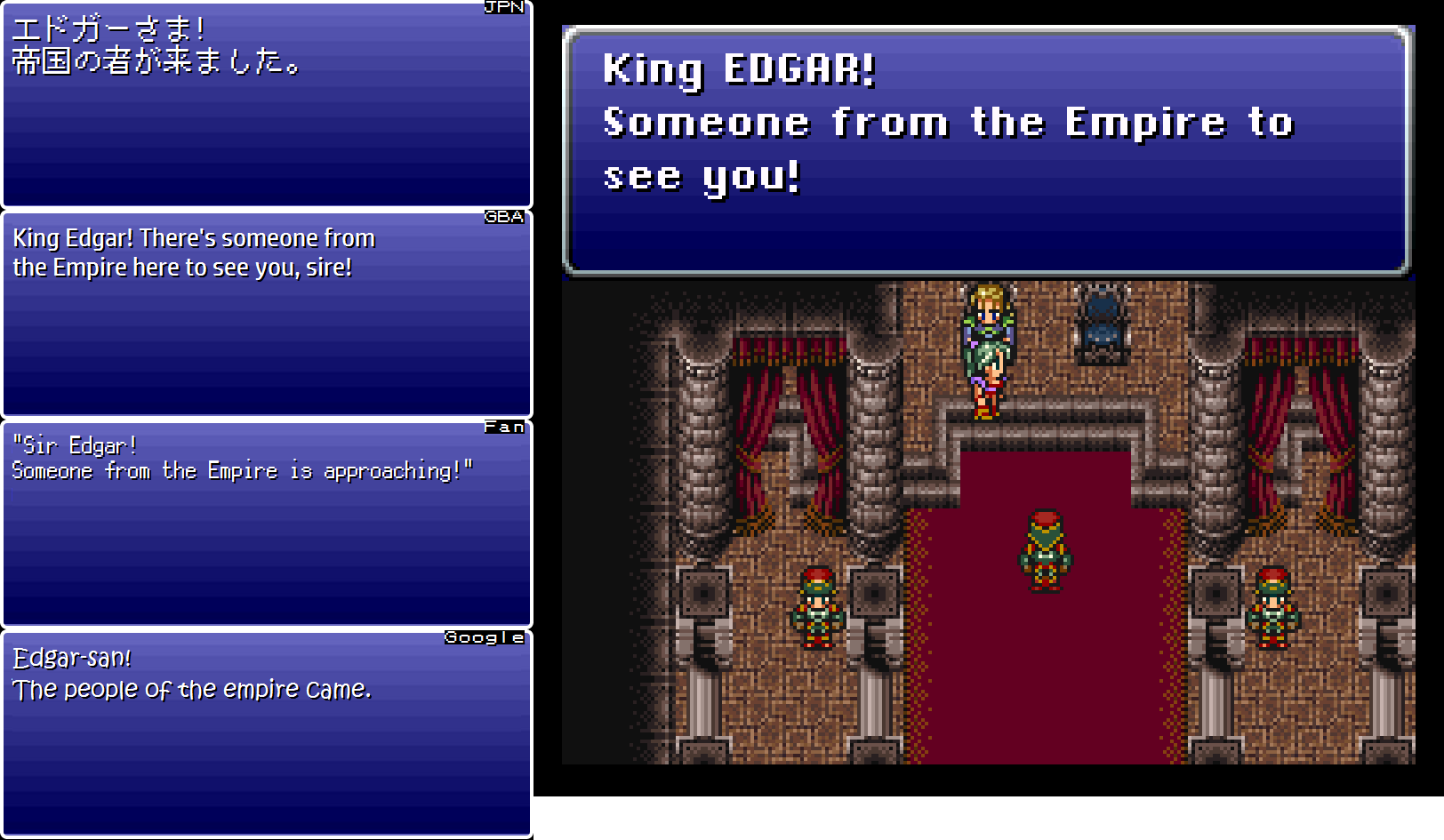
In Japanese, this guy literally says “Edgar-sama”. Google decided to leave the name suffix untranslated… but at the same time it dropped the deferential “-sama” down to a meager “-san”. What’s going on in that algorithm of yours, Google? Is this AI why YouTube algorithms are so crazy?
The madōshi term from earlier is back, and this time it’s being applied to Kefka. Going by the SNES translation so far, that means Kefka is a “Mage Knight”, which certainly feels off. But as I mentioned, the SNES translation handles the term in a messy, inconsistent way, and in this case the word is dropped entirely. Since this is the one first times we’re meeting Kefka, knowing that he has rare, magical abilities is certainly very important info to have!
In the GBA translation, the word becomes “mage” here, the fan translation keeps it as “Majick Warrior”, and Google goes with “magician”.
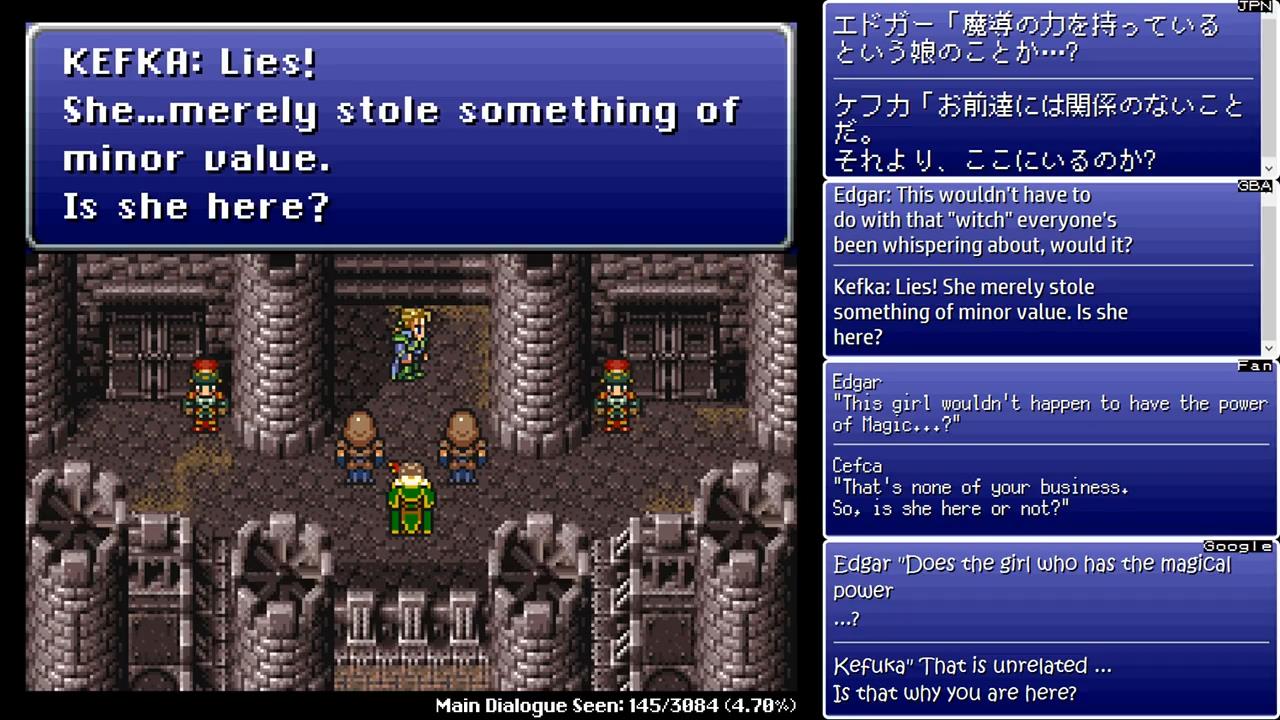
In Japanese, Kefka says here, “It’s none of your business. More importantly, is she here?”
In the SNES translation, this line was changed almost entirely. I actually feel like this new line is a marked improvement over the dry original. Apparently the GBA translator felt the same way, as the exact same line is used there too.
I’ve heard rumors that Kefka is more popular outside of Japan, supposedly because the localization process added to his personality. I never really looked into it myself, but tiny little lines like this, added up over time, could definitely give him a distinct impression.
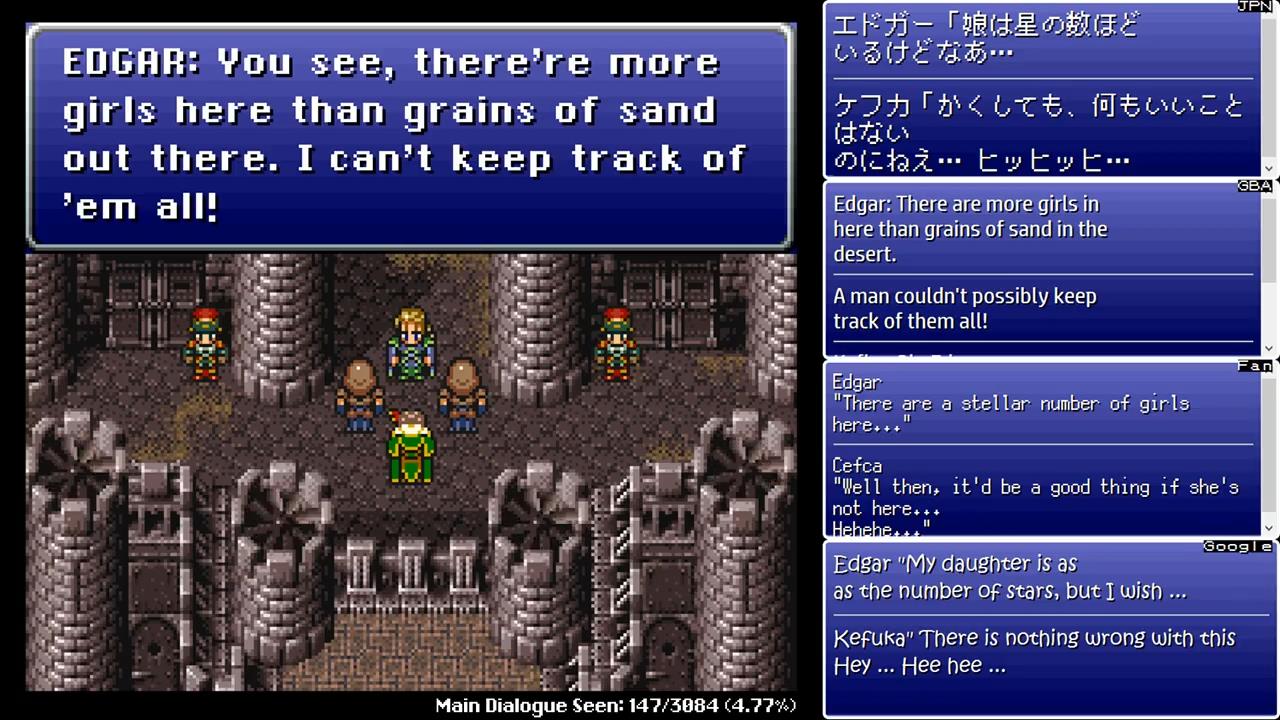
In Japanese, Edgar literally says “there are more girls here than there are stars”. The SNES translation changes this in a way that better fits the situation, the location, and Edgar’s spoony, hopeless romantic personality, all at the same time. I really like this line, and I can see why it was left in the GBA translation.
I surprised everyone when I left the castle with just Edgar by himself. As a game translator and programmer, it’s almost second instinct to try to break games by doing weird stuff that nobody would think to do. It’s how you find the really rare text that most people will miss – and it’s this rare text that’s most likely to have problems. This instinct has backfired on me in some past stream projects though!
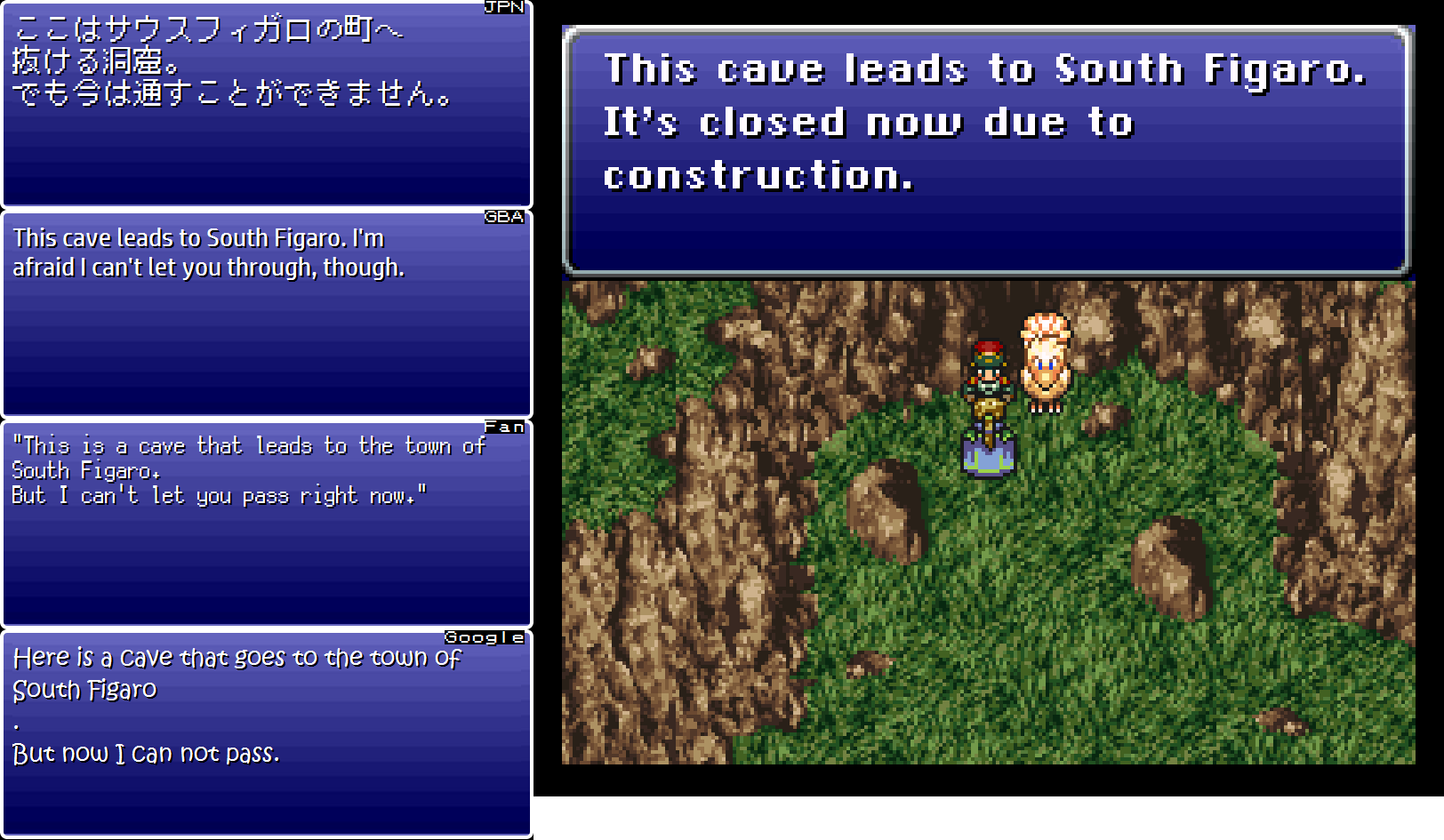
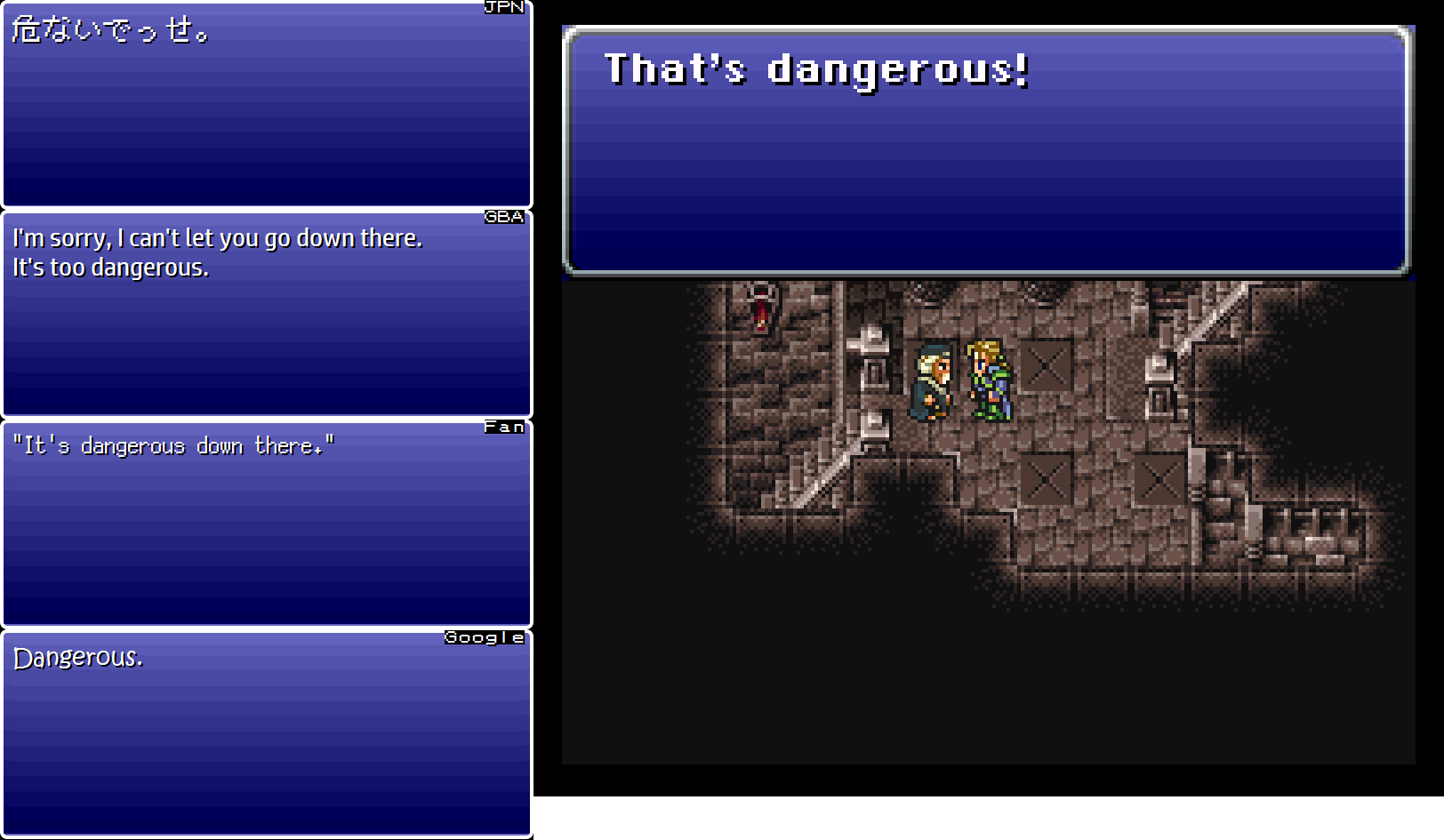
Anyway, if you try to go to South Figaro via the cave, a guard blocks the way. His second line in Japanese says, “But I cannot let you through at the moment.” In the SNES translation, this was changed to “it’s closed now due to construction”. I almost didn’t pay it attention, but then I realized that it’s pretty weird to say a cave is under construction, especially when no construction work has gone on in the cave. Basically, the SNES translation changed this line in a weird way for no real reason. Or maybe it’s a leftover from a pre-final Japanese script? I dunno.
In any case, all the other translations reflect the original Japanese line. Just the SNES one has mystery construction.
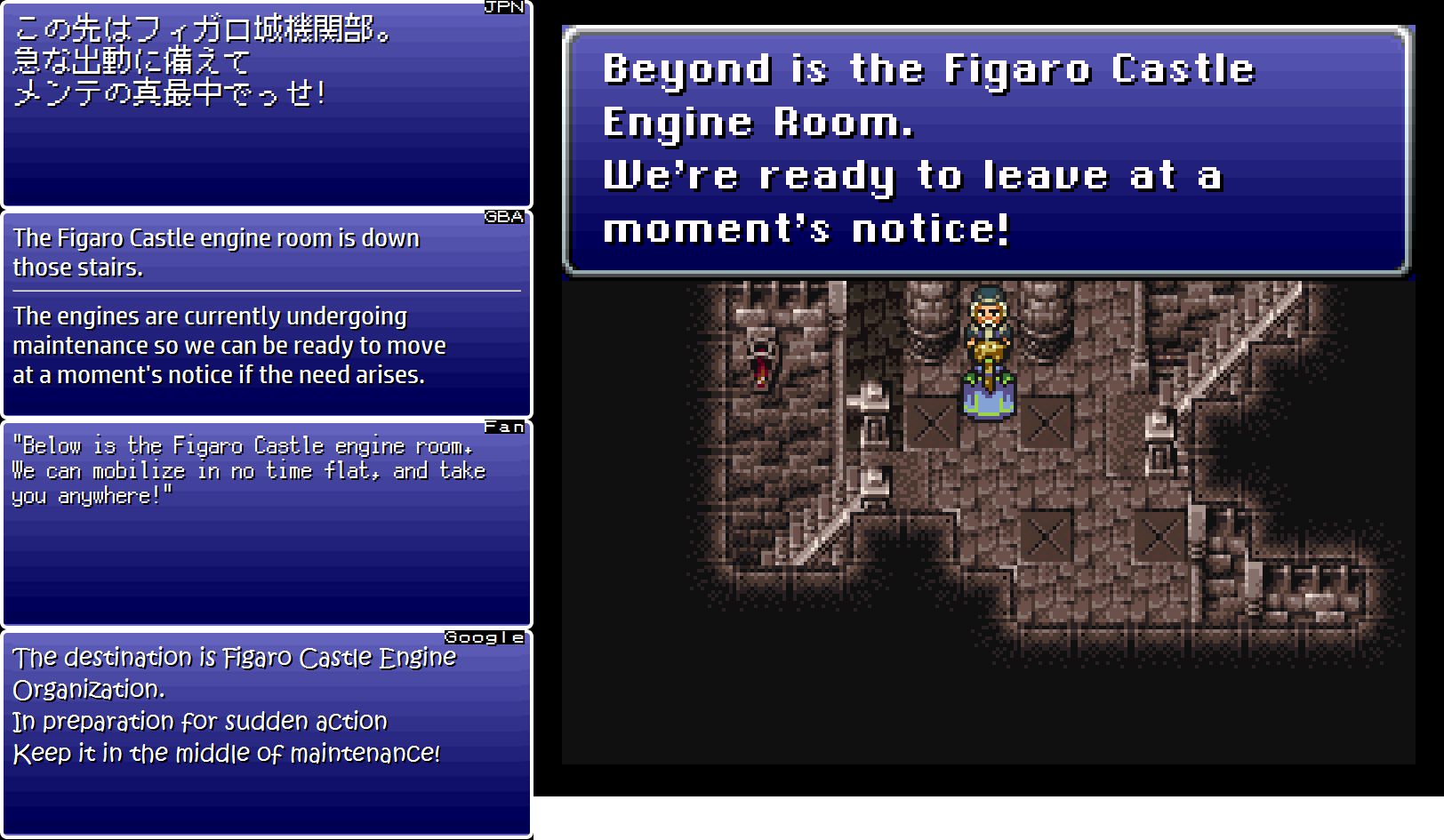
This engine room guy speaks with a Japanese dialect that’s associated with the Osaka area. I get a sorta “working man” vibe from it, but then again I’m not a native speaker so dialects are always difficult to explain and describe. Imagine being a non-native English speaker trying to explain the significance of Bronx accents or Appalachian dialects to other non-native English speakers!
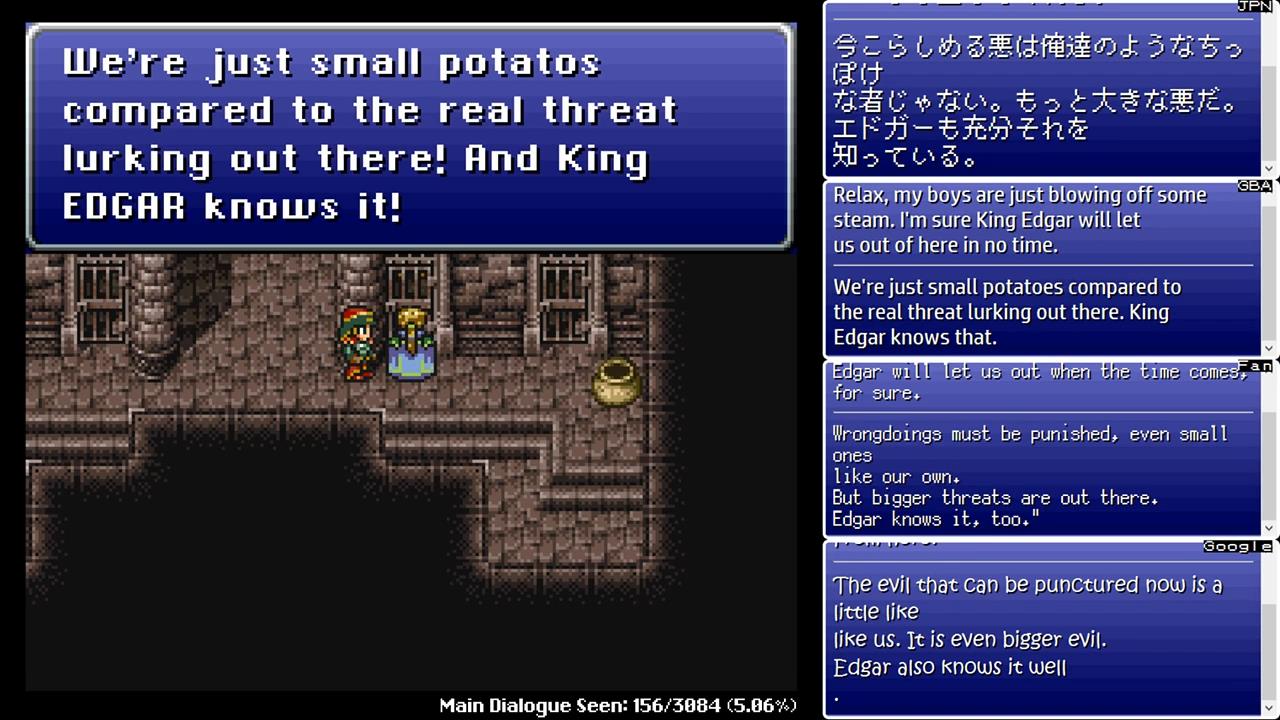
I guess I never noticed before, but the SNES translation has a typo here – “potatos” instead of “potatoes”. I was reminded of Dan Quayle’s infamous misspelling, but then I got asked who Dan Quayle was and somehow felt so very old.
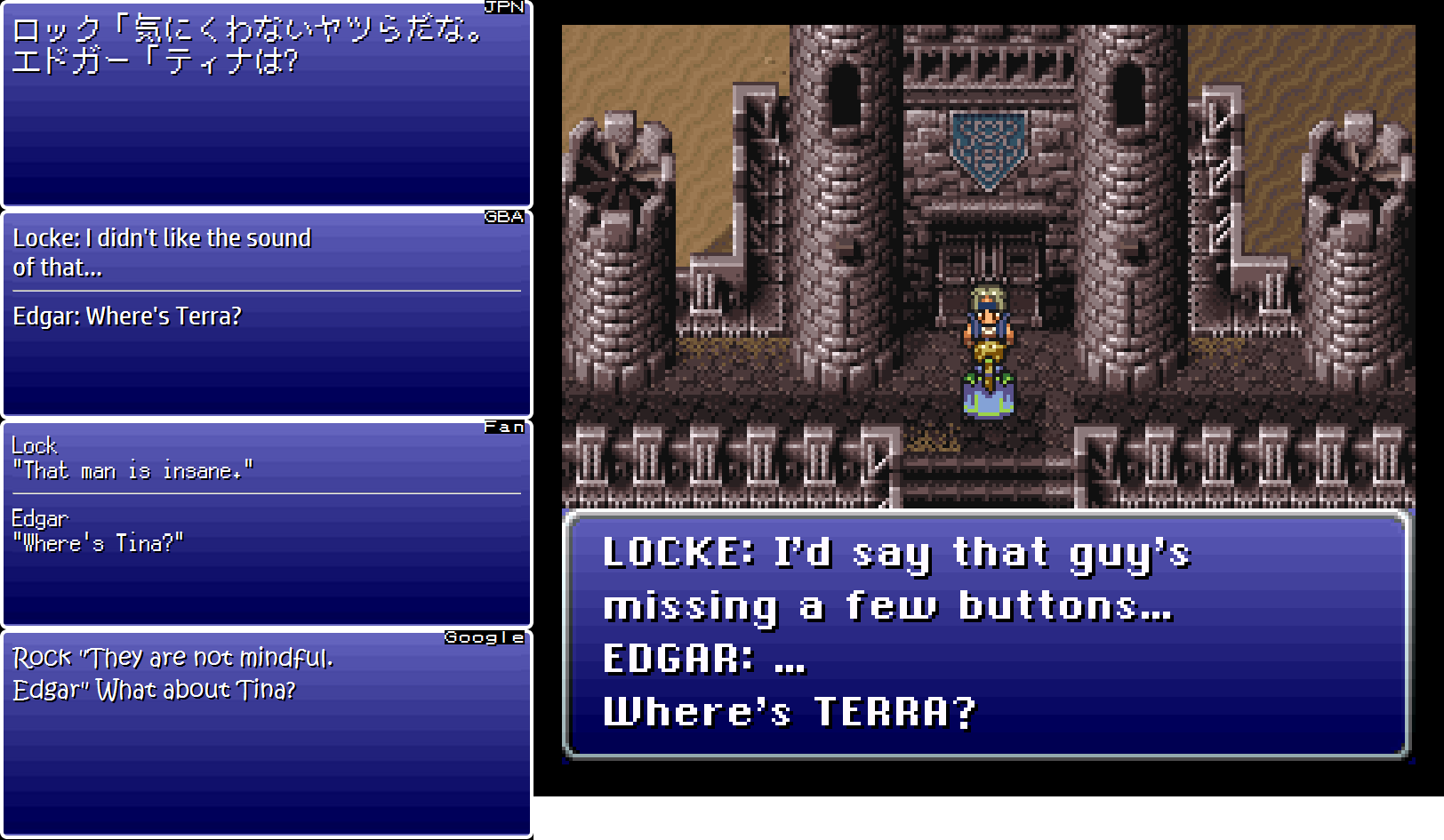
In Japanese, Locke says something like “I don’t like those guys one bit.” In the SNES translation, he instead just talks about one person – presumably Kefka, and mentions that he seems legitimately insane.
The GBA translation doesn’t really mention anyone, and the fan translation mistakenly uses the singular form instead of the plural form.
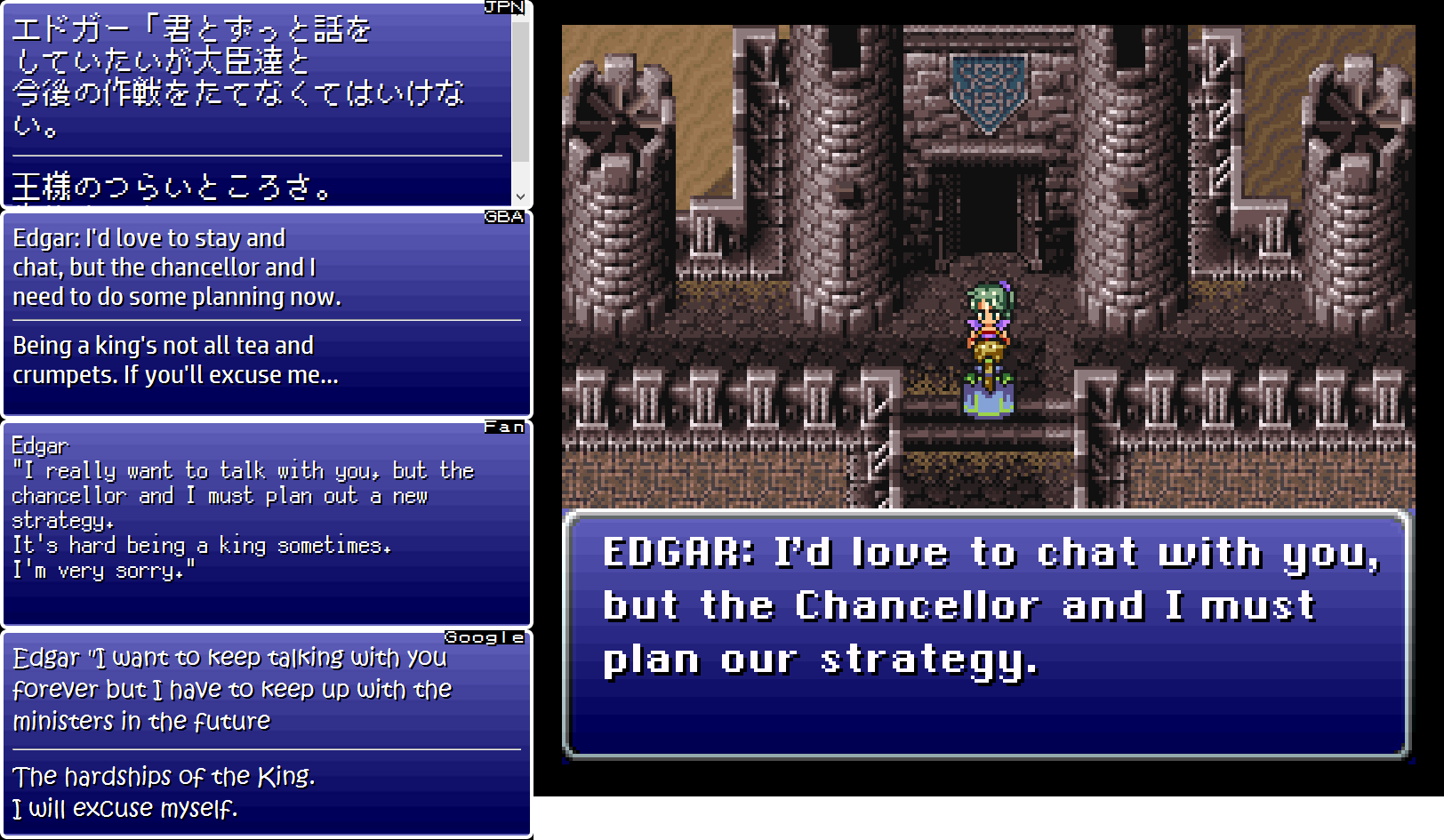
In Japanese, Edgar says he’s either going to talk with “the ministers” or “the minister and the others”. In other words, he’s going to confer with multiple people. In a surprise upset, only Google gets this detail right.
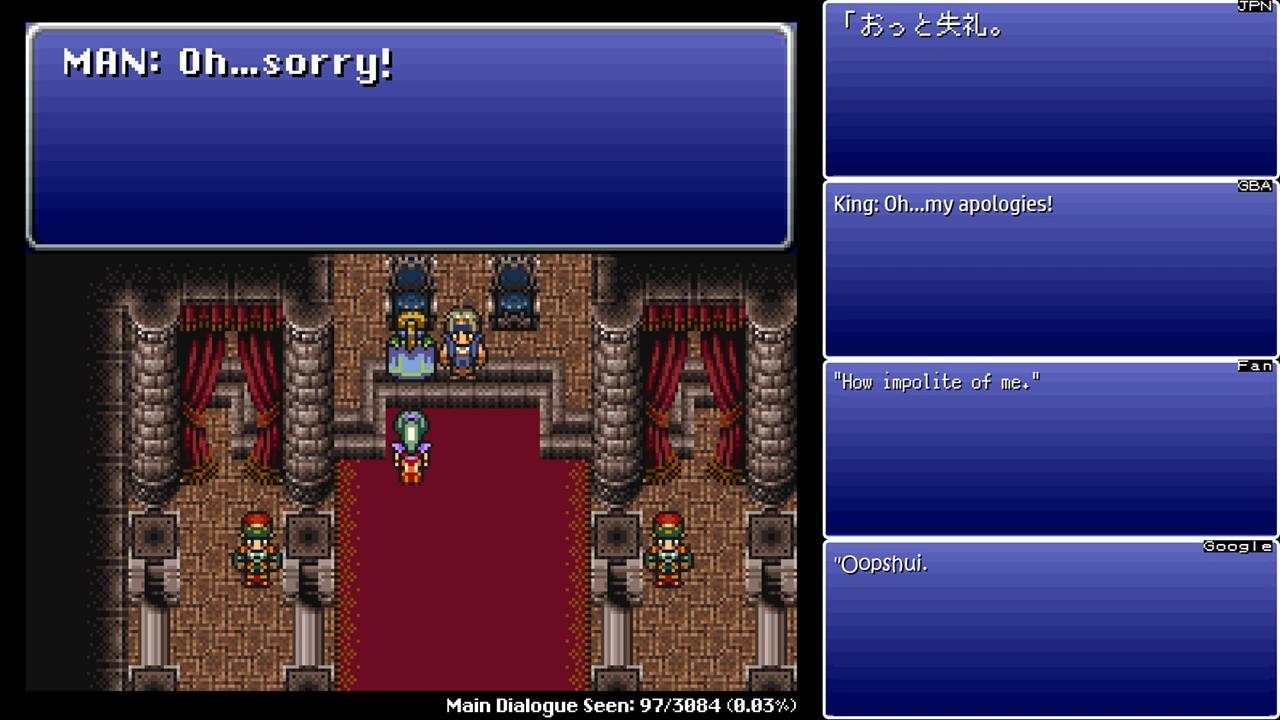
Also, Edgar’s last line is a way of saying that he has to go now. It’s literally an apology (“I’m going to do a rudeness.”) which is why the fan translation has him literally apologizing, but functionally it’s an ordinary parting phrase, kind of like “See you later.”
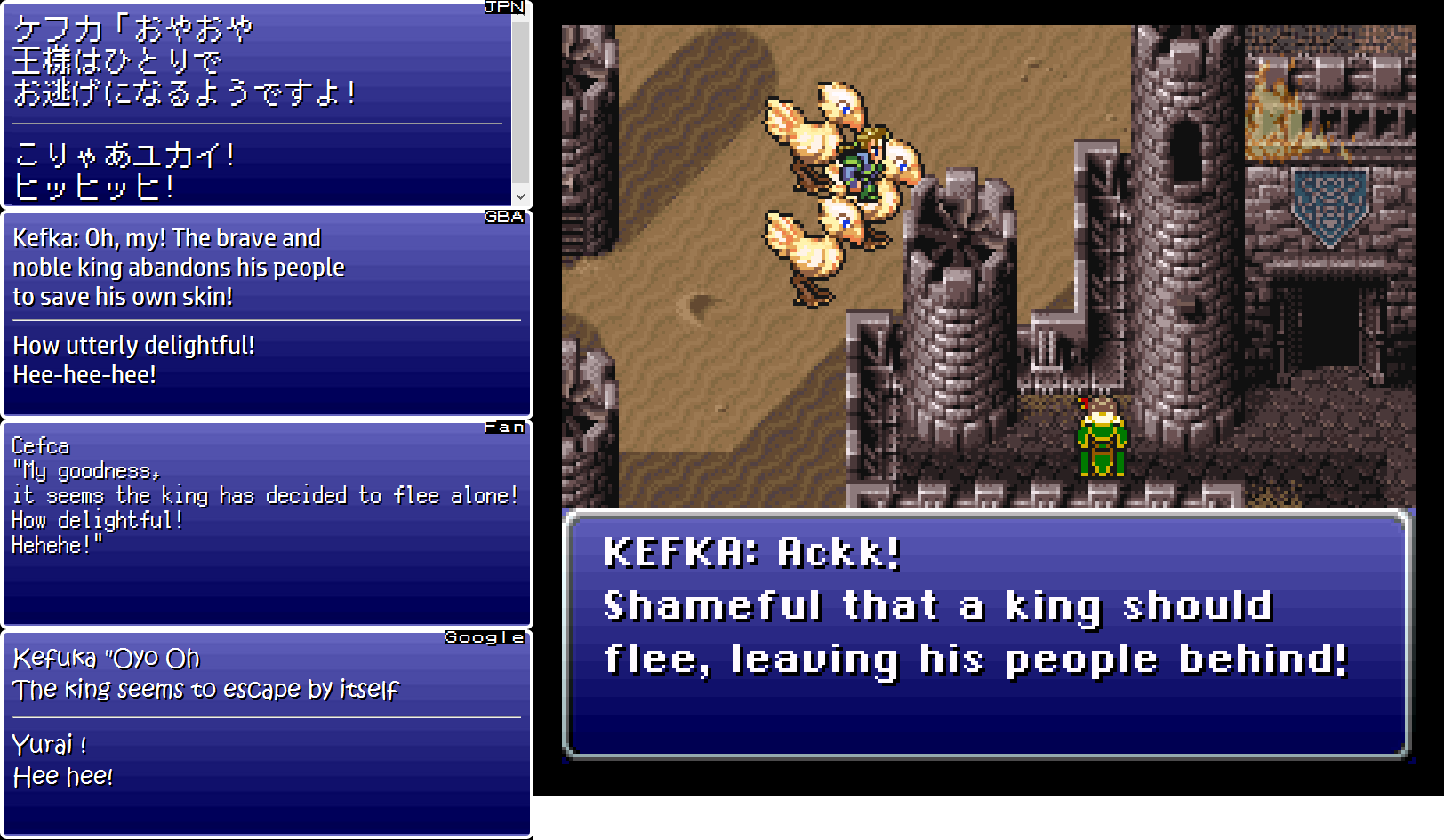
In this line, Kefka speaks about Edgar in a sarcastic way in each script, but the Japanese version also has him using an overly reverential Japanese speech style that enhances that sarcasm even more. The GBA translation is definitely the closest in this extra regard.
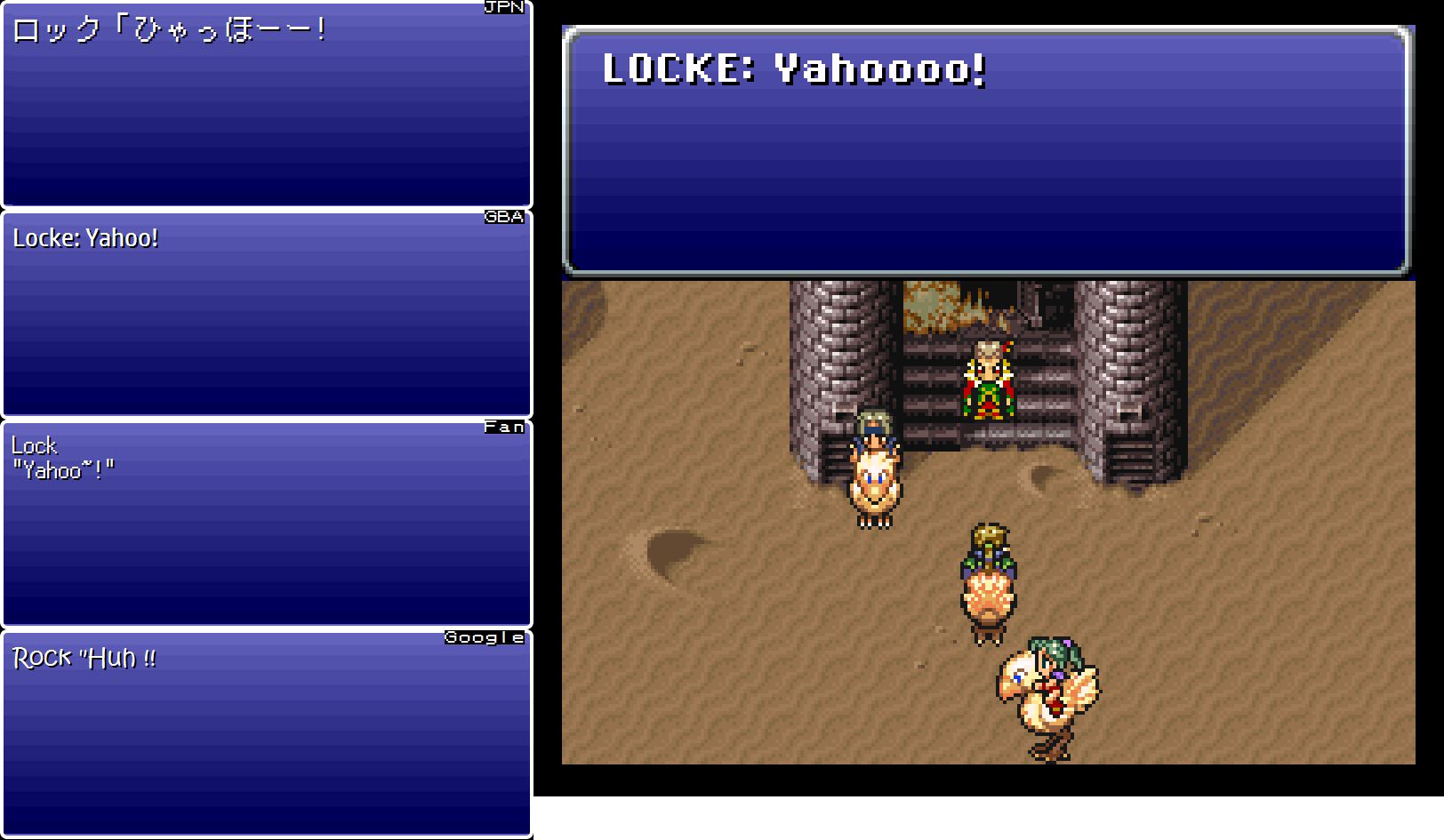
I noticed that the GBA translation uses the phrase “Yahoo!” here. Normally it wouldn’t stand out, but Nintendo actually changed every instance of “YAHOO!” in Link’s Awakening to “Hello!” and “Yippee!” before releasing it on the Virtual Console. So if this GBA port ever gets a re-release or a Virtual Console-style release, I wonder if they’ll decide to change this “Yahoo!” too. We’ll have to wait and see, I guess!
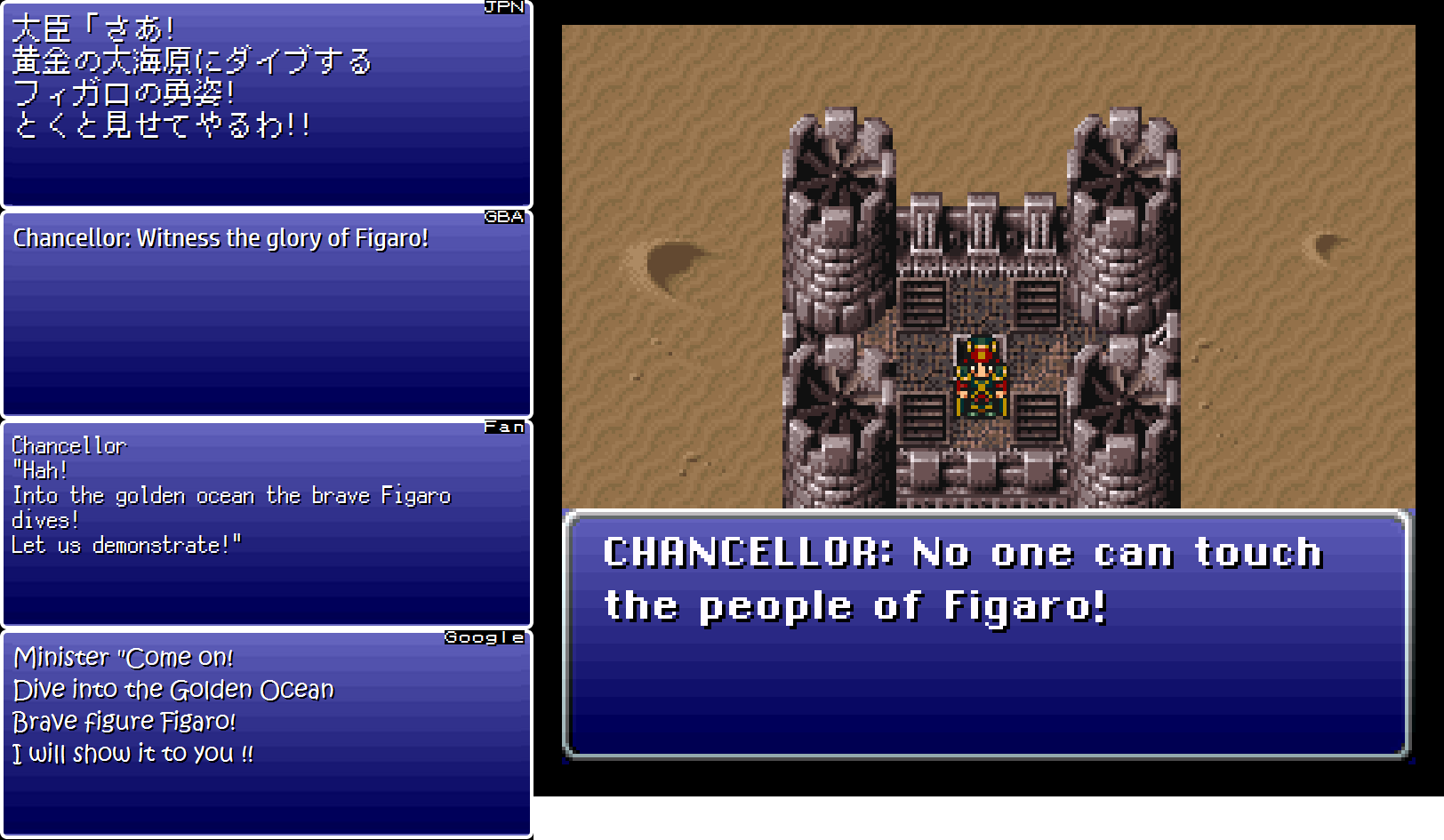
I’ve noted in many articles that modern Final Fantasy translations sometimes use “flowery” language to give the scripts more of a high-fantasy vibe than earlier translations. This usually results in text that’s longer and fancier-sounding than the original Japanese text… but here we see just the opposite. The original Japanese line talks about diving into a great golden ocean and how the castle has a gallant appearance. The SNES and GBA translations both condense things down into plain-sounding lines.
Back in the 1990s, Nintendo prohibited references to killing. That’s why Kefka yells “GET THEM!” in the SNES translation but says “KILL THEM!” in every other translation, including Google’s translation.
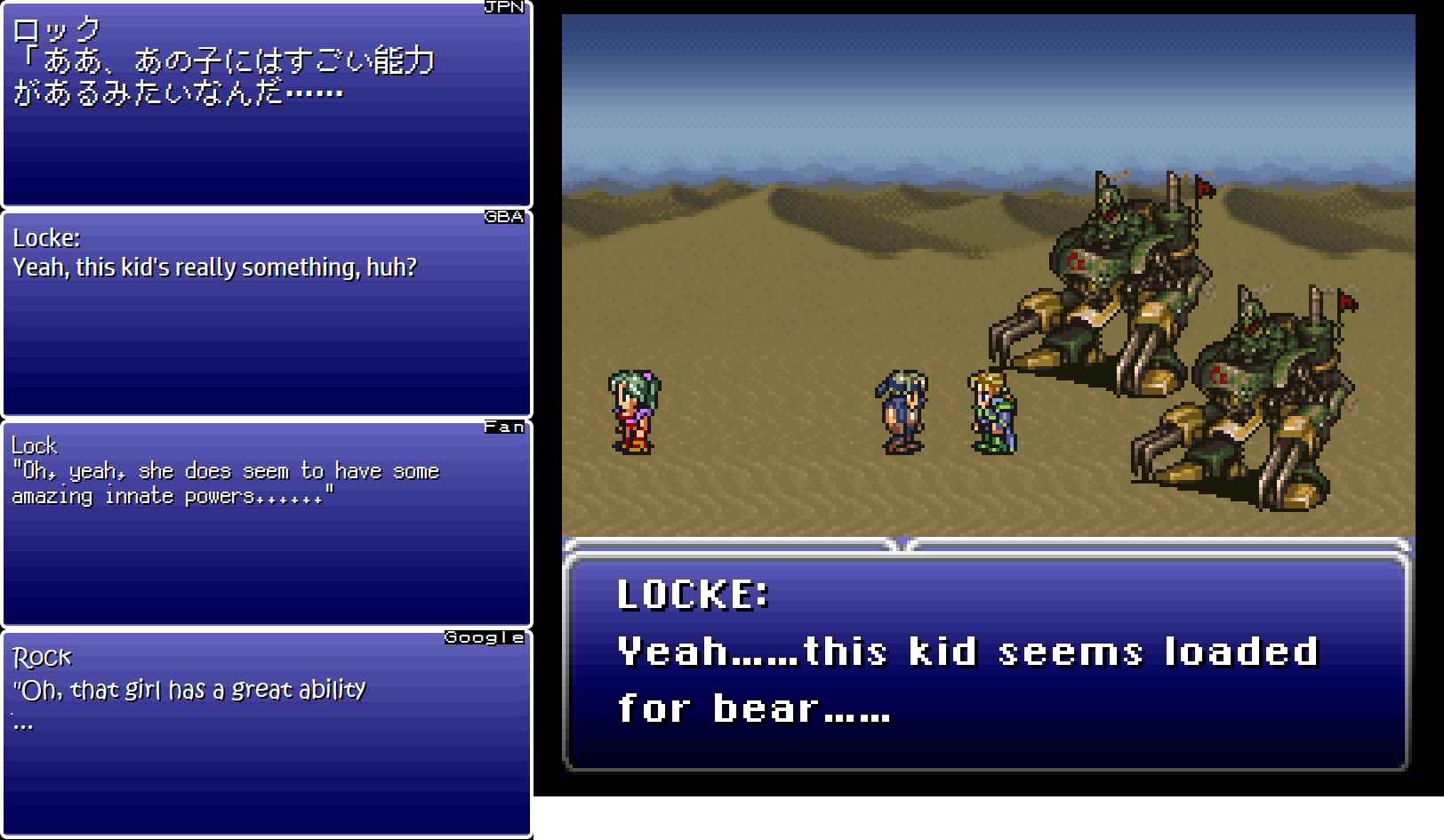
This “loaded for bear” line is one I see mentioned as a weird, confusing example of a “Woolseyism“. Ted Woolsey actually briefly touched on it in this old interview. I never had an issue with the line, so I was surprised to learn that it caused confusion back in the day.
At this point I stopped to discuss Japanese ellipsis usage and how it tends to get handled by professionals and by amateurs. I actually wrote about this topic in more detail here, so it’s just easier to link to that article than restate it all here.
Here’s one of the most iconic lines in the game: “son of submariner”. I wrote about this topic in one of my very first articles a long time ago – you can check it out here. This is another good example of how the SNES translation adds to Kefka’s character/memorability and how the GBA translation tries to pay respect to the classic original translation while doing things in its own way at the same time.
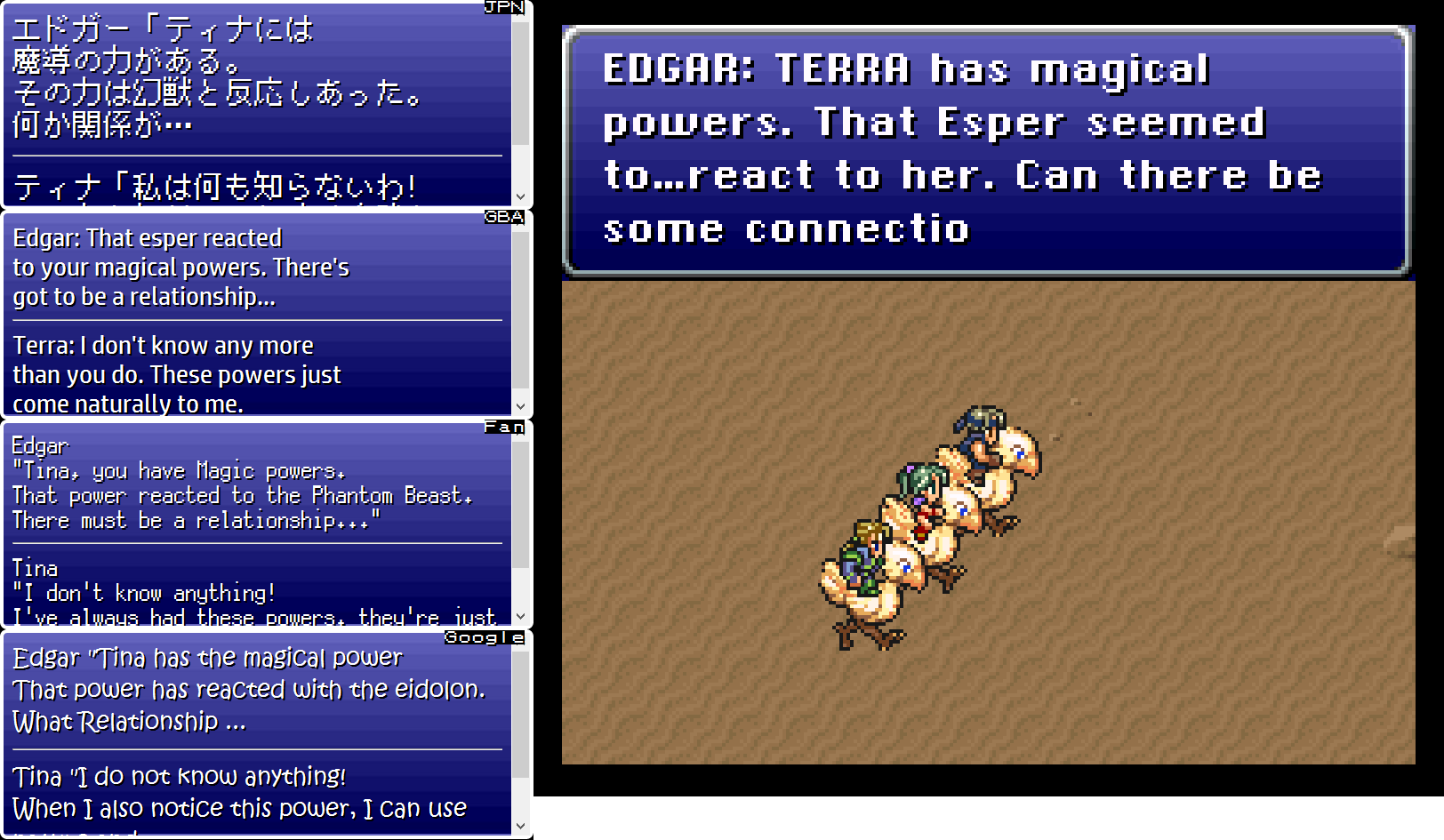
Here we see that Google is now calling the genjū “eidolons”. Modern Final Fantasy localizations use the word “eidolon” for these magical beasts that you can summon in battle, so this is a surprising find. Since Google Translate is an AI that grows and learns, I wonder if somehow it read a bunch of Final Fantasy stuff to learn that “genjū = eidolon”. Oh, I so hope that it learned this from some weird fanfics or something.
Anyway, as I mentioned earlier, the GBA translation seems to use the old “Esper” term rather than the modern “eidolon” choice. So, in a weird twist, Google is actually handling this term closer to a modern, official translation than the actual, official translation!
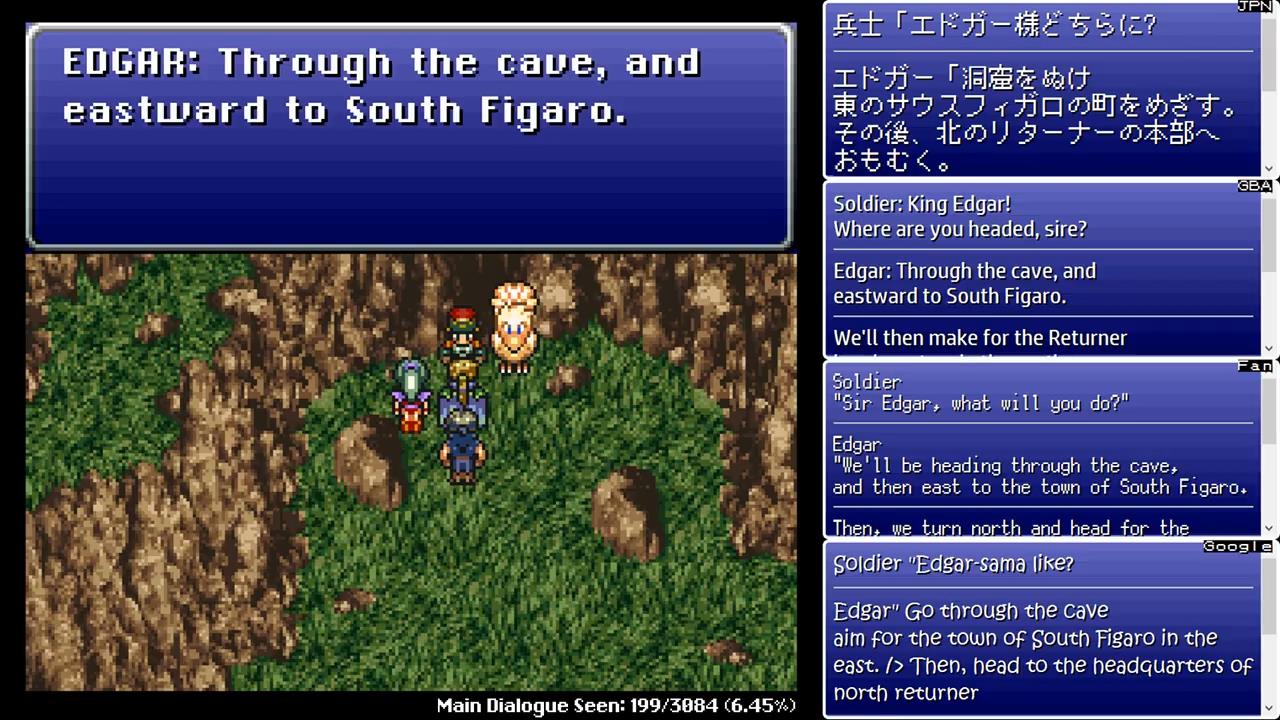
Edgar explains the group’s plan to a soldier. In Japanese, he also mentions that they intend to turn north past South Figaro to make their way to the Returners’ headquarters. This detail was left out of the SNES translation entirely, so if you played very slowly or were still trying to soak in all the new information you were just given in the past 30 minutes, you’d probably be wondering, “Wait, where am I going again? Why am I supposed to go through this mountain pass to the north again?” once you got to South Figaro.
Seongtae’s minimalist monochromatic street style caught our attention in Harajuku.
The 18-year-old student dressed up in a crisp white long-sleeved top from Blanc de Noirs, which he styled with a black necktie that had white writing on the front. He also wore Ermenegildo Zegna black cropped pants with a fitted silhouette and secured with a black Y-3 belt. Seongtae continued the monochromatic theme with a pair of black-and-white shoes from Rick Owens. He completed his look with cropped blond hair, hoop earrings, a Y’s shoulder bag, and Yohji Yamamoto accessories.
Seongtae lists Yohji Yamamoto and Rick Owens as his favorite fashion labels. Follow him on Instagram for his social media updates.
Jacob Sujin Kuppermann: A case study in how far a truly perfect bassline can get you, given a set of performers who know not to let themselves get in the way. [8]
Julian Axelrod: How often do solo ventures make a band sound more unified? After a year where The Internet’s members followed their individual muses down the R&B rabbit hole, a nervous fan could expect some discord upon their return. Luckily, “Roll” is a joyous funk free-for-all and a seamless blend of their sensibilities. After three albums with Syd at the forefront, Steve Lacy steps into the spotlight. But calling him the lead vocalist is misleading, since Syd’s silky harmonies and Christopher Smith’s clattering drums are just as prominent in the mix. At times the sound is smooth to a fault; I love Steve, but his voice is so unassuming it can fade into the background. Then again, The Internet is nothing if not a testament to one grand, unifying sound. [7]
Alfred Soto: A nice jam with thump and thwock: interstitial material in search of an album sequence. [5]
Vikram Joseph: Far from their soulful, explorative best, “Roll” feels flimsy and insubstantial, neither much of a song nor much of a mood. The component parts are certainly handy — fluttering, suggestive bass; wonky synth jabs — but the drifting, ambivalent vocals don’t provide any grip, leaving that bassline rolling around in search of a coherent song. [4]
Katherine St Asaph: A project with an ephemeral name and, once, ephemeral-sounding music. Less so lately, and particularly on “Roll,” with a preternaturally assured bassline one imagines could keep spooling out forever, until it spans the whole equator. [7]
Nortey Dowuona: A smooth, lilting bass slides in over open hand-sliced drums, then is joined by squishy, ethereal synths as Steve slides atop it, off-key and dully mumbling. Syd sweeps him back into the saddle with soft, airy hums and whoops. [6]
Juan F. Carruyo: I don’t own a car, but if I did, I’d be blasting this rolling down the streets. [7]
Rebecca A. Gowns: I live right around the corner from Burbank, and this really captures the vibe. Studios and film sets, areas of creation and concentrated money, shielded by fortresses of mysterious office buildings. If you’re working there, you step outside after hours, and all the activity has stopped — it’s dark and still. If you stay the night there, you might wake up with this groove running in your head, and you’re suddenly compelled to drive to a Mexican/American diner to pick up a breakfast burrito stuffed with avocado and crispy french fries. You could try to cook it at home with all the same ingredients, but it just wouldn’t taste the same. Burbank is like that — totally commonplace, humdrum, suburban, but oozing with secret sexy Hollywood magic around the edges. This song is like that too. [8]
"Connect programmable Node-Terminal machines and create a sonic singularity."
This was recommended to me by reader James Wood; I went to buy it on itch and found it already in my library, having purchased it and promptly forgotten about it back in October 2017, when it was released (I guess I was a little distracted). I don't know anything about dlareme, but their Itch author page shows several years of work leading up to this.
Let's see if I can get you to play it: it looks like it might be a 'walking simulator', but it isn't one. It's a first-person exploration game where you explore a sonic situation instead of a spatial one. And it sounds gorgeous — turn it up.
I often watch wonderful demoscene prods by groups like Farbrausch or Mercury (especially this one) and I find myself wishing that more of that sparse, material aesthetic could find its way into games, both in audio and video. I like timbre more than melody; I like texture more than detail. I feel like mainstream games since the 1980s have generally been more concerned with melody and detail, partly because those were more achievable aesthetic targets when you have to use chip synths, sprites and untextured polygons. Demoscene aesthetics are, and always have been, outside of the orthodoxies of videogame aesthetics.
After you start to play it, Liquorice seems to present itself as something of a musical puzzle like Fract, or maybe it's better to say that through experienced game-playing eyes, it's hard not to perceive it as one. You'll feel as though you are failing to grasp some basic ruleset that would push you steadily toward some narrative resolution. And for sure, new things will happen as you explore the space, weaving new tapestries of sound that you can be inside. But gradually you will realize that the sounds are the point, and that the pleasure of the piece is in listening attentively and reacting to what you hear, rather than in solving the puzzle.
I like to play games that are at peace with being confusing and opaque, where I can draw joy from every minuscule discovery, and develop a mental map of the game that feels uniquely personal to my own experience of it. This is like that — I can't tell you I understood what I was doing very well, and maybe you will experience it as something entirely different than what I heard and saw. The musical artwork that you and I experience through it will be different, not just in the details but in the textures, the layers of meaning, and what it provokes in us. That's the real power of an interactive medium.
Turning heads on the streets of Harajuku was Kanji, whose head-to-toe inflatable ensemble caught everyone’s attention. He’s been featured before on this site on several occasions – and featured in a recent YouTube fashion interview – due to his fearless sartorial sense and eye-catching outfits.
The 17-year-old Japanese high school student donned a handmade pink-and-purple inflatable dress with cap sleeves and a flared silhouette. Kanji styled it with matching handmade pink shoes with pointy toes and purple horns on the back. He also wore an identical handmade pink-and-purple inflatable headpiece and a multicolored skull face mask. To complete his look, he carried a silver telephone handbag from Prega, which featured a transparent top handle and contrasting black piping and shoulder strap.
Kanji gets his fashion favorites from Fecal Matter and Iris Van Herpen. He also enjoys listening to music from My First Story and Bump of Chicken. For more style updates, follow Kanji on Instagram.
While out walking along the streets of Harajuku, our attention was caught by Yui and her colorful style and curly aqua hair.
Yui is dressed in a handmade ensemble, which consists of a colorful tie-dyed denim jacket with ripped sleeves, which she wore over a yellow Are We Having Fun Yet cropped tank, and a matching tie-dyed denim shorts with distressed cuffs. Pastel knee-high socks, lace-up sneakers, and a Yin-Yang heart round bag with a gold chain strap completed her handmade outfit. Yui embellished her look with handmade accessories such as colorful hoop earrings, a skeleton necklace, and a fuzzy rainbow phone case hanging from her neck.
Yui’s favorite fashion brand is Nope, and she enjoys grooving to disco and funk music. For more on Yui, follow her on Instagram.
Why do people provide the worst goddamn life advice that is just Protestant work ethic clap trap rewrapped for the present?
1. Pay off credit card each month. 2. Don’t drink (save hundred$/ month – donate to a good cause instead) 3. Don’t buy or lease a vehicle. 4. Live close enough to work to walk to it. 5. Don’t get cable. 6. Eat out sparingly. 7. Save 20% of your paycheck. 8. Become a minimalist. https://t.co/FDPM9LITvs
Why the hell would someone live this way? Yes, save all that money for the future when you are old. I’m sure that not enjoying life for the next 40 years will lead to a ton of enjoyment in your last 5 years! I’m surprised he didn’t mention not eating avocado toast so you can save for a house, although not eating out is basically the same thing. I also love how the advice is basically “never do anything fun ever especially if it requires you to leave your house and also don’t have cable so you can’t have fun inside your house either.”
Here’s an idea. Live your life. Have some fun. Do what you want so long as it doesn’t hurt anyone else. Enjoy your really short existence on the planet. Can you give me some money now for this sage advice?




 Self-described former extremist turned peace advocate Christian Picciolini confirmed on Reddit that white supremacists regularly recruit new members in games like Minecraft, Call of Duty and Fortnite. ...













 Star Control creators Fred Ford and Paul Reiche are attempting to raise $2 million through a Gofundme campaign to defend themselves against a trademark infringement lawsuit. ...
















SOKEN YOU PERFECT ANGEL
