Taylor Swift
Shared posts
Monster Hunter World Details All 14 Weapon Types In Video
"Roaring Streets!" (cottontrek)

"A hardboiled noir detective shoots his inner demons away..." - Author's description
Download on itch.io (Windows)
emu-coop
SNES hack makes single-player games into two-player games by sharing inventory over IRC
An off-putting sound effect led to PlayerUnknown's Battlegrounds' third-person combat
Taylor SwiftAll you need here is this pullquote: "There was third-person because in Arma 3 first-person there was a grunting noise I didn't like and I didn't want everyone to play with the grunting noise."
 PlayerUnknown Brendan Greene explains how the mod origins of PlayerUnknown's Battlegrounds influenced the game's standalone release. ...
This Absurdist Courtroom Sim Takes Justice Out of the System
At Play in the Carceral State is a week-long series investigating play in, around, and about prisons and prison culture. Learn more here.
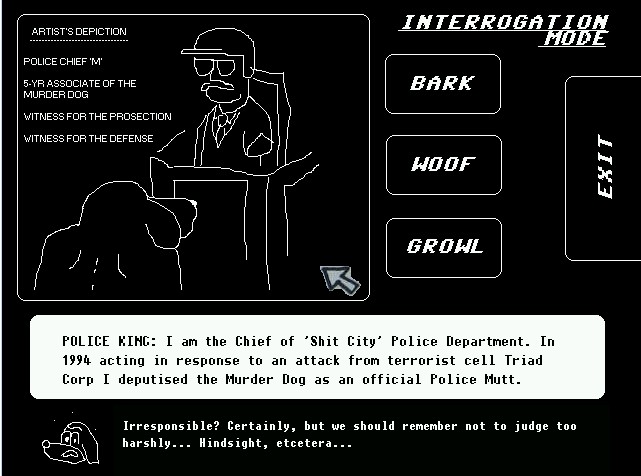
When thecatemites's Murder Dog IV: The Trial of Murder Dog begins, our "hero" is on trial at the Hague for crimes against humanity. The Murder Dog has committed over 1,500 brutal instances of homicide and maiming, and the world has finally gotten enough evidence together to put him behind bars. The player, who acts on behalf of Murder Dog during this fateful 15 minutes or so, has the job of figuring out how the trial goes down.
Playing the game is a simple maneuver of pointing and clicking your way around a few different screens of evidence, witness cross-examination, and interpreting photographs. It is important to note that Murder Dog is certainly guilty, and at every turn he mentions his insatiable lust for chaos and murder. It's an absurd exercise to prove Murder Dog innocent, but The Trial of Murder Dog is clear that this operation has nothing to do with innocence and guilt. It has to do with how you bend rules.
"The legal system must make a distinction between what we 'know' as individuals and what can be demonstrated as evidence in this bizarre ritualistic setting."
"The legal system must make a distinction between what we 'know' as individuals and what can be demonstrated as evidence in this bizarre ritualistic setting." That comes from a little dog at the bottom of the screen who provides conceptual commentary on the events of the game. It sits down there, Slavoj Žižek-like, and tells us that the opposite of what we see is happening.
The Trial of Murder Dog revels in the arbitrariness of justice. Like a Terry Gilliam film, Trial takes the core logic of an idea and pushes it to its limit. For instance, there is a photo of Murder Dog clearly tearing someone in half. At the trial, however, the player can argue that Murder Dog was simply putting the person back together. There's no way of knowing, and within the structure of state justice, that's as valid as any other argument.
That's silly, right? Except something eerily similar happened in the Rodney King trial of the early 1990s when the footage shown to the jury had been "slowed down the tape, enhanced the sound, stabilized the picture and experimented with a variety of digitally enhanced exposures." That tape was famously used to craft a new narrative, one which portrayed him as struggling to stand up and attack the officers who were brutally beating him. It turned someone who was plainly a victim into a criminal who had to be subdued.
The Trial of Murder Dog meditates on these real-world ideas in a strange, chaotic, and overly-violent way. It puts pressure on the things we take for granted about the justice system, and about the notion of justice period. The "brutalist id-Dog," as he's called, demands a wider range of thinking.
You can download Murder Dog IV: The Trial of Murder Dog for Windows over at GameJolt.

A Lesson in Media
A report from the demonstration(s) in Hackney last night in response to the police murder of Rashan Charles
A lesson in media: last night was sad and extraordinary. For the last days the videos of the murder of Rashan Charles at the hands of the police have been circulating widely. Yesterday the SWP (disguised under the name of their front organisation "Stand Up to Racism") called a vigil outside Stoke Newington Police Station. They did this without speaking to Rashan's family or friends. During the course of the day a number of us argued with them on social media about this, to no avail. I didn't much want to go to the protest, but since for a while I've been involved in police monitoring, and helping people in situations of police violence on the street, I decided to go as a Legal Observer, aware that if shit kicked off (because the police attacked the crowd, as they so often do) there would likely be many young people - and mainly local young people of colour - who would be violently apprehended by the police. Despite hating the conditions under which the protest was called, supporting those people at times when police violence is at its most brutal and most unchecked, is important.
The vigil became a march and we went down Kingsland Road to the shop in Haggerston where Rashan was killed. After a short time the SWP tried to drag everyone back to the police station. Thankfully it was mainly just the SWP who left, taking the 70 odd police officers who had accompanied the protest in military style with them. What remained was a much more interesting crowd: a whole range of local people from friends of Rashan, to people who worked and lived close by, and everyone from teenagers to pensioners. I spoke with one man for a while about his life for forty years in the area. He said his partner was pregnant and he is terrified about what the police could do to his child one day, and how unbearable the thought is that someone could turn up at his house to tell him his child had been murdered just because they were black.
Once the SWP had gone the police mainly kept a distance. A couple of helicopters hovered above us, and vans were parked up a couple of hundred metres away. If this crowd had a single aim it was to keep the police away, and to find some time to express their anger, to grieve and mourn away from the spectre of police violence. At times the police tried to bait the crowd, by driving seven motorbikes up and parking them on the corner, although they quickly retreated after the anger made it clear they were unwelcome. As a gesture towards keeping this space small road blocks were set up with rubbish, old oil cans, a mattress. An ambulance was let through when it needed it. When a police car tried to drive through it was stopped, but no-one tried to attack it as a close family friend had told everyone they didn't want this. Outside the barber shop sits a memorial of flowers and candles in plastic cups.

At some point some white anarchist squatters came past. They decided it would be a good idea to wheel out a massive wheelybin into the middle of the junction and set it on fire. The rest of the crowd were furious with them for this: they said that these were random white people doing something which inevitably the black community would be blamed for. The community didn't want fires and these people had done something which signified that this protest was something quite different from what it was. A number of heated arguments ensued - about blackness and whiteness, about media recriminations. Sensibly a number of people told those who had lit the fire to leave. They explained to the white woman her privilege in the situation and about how the media was wanting to paint the local community, and how it had done this for decades. Her useless response was to just shout at people about about how she "understood her privilege" but would set fires everywhere. Eventually she left.
I think there was probably some cultural misunderstanding on the part of those anarchists: elsewhere in Europe making barricades with burning wheelybins is much more everyday, and they had clearly misread the situation. To everyone it seemed they were coffin-chasing in their hatred of the police as much as the SWP had been coffin chasing earlier in their love of bland rallies and signing up new members to their stupid organisation, all the time taking over and wrecking local resistance. I know that I too am often averse to politics of "radical community" that might need pushing away from inertias that are in fact conservative and authoritarian. But here that was not the case and the anarchists totally misread the situation. Everyone at the protest confronted them and the fire was quickly put out.
 \
\
Later some members of Rashan's family drove up, because they had heard reports of violence on the BBC. We reassured them that things had been angry but not as the BBC had said. The BBC like all the other media outlets seem intent on telling a story - of justifying the police killing Rashan, if not by saying he swallowed something, then by trying to incriminate the entire community of which he was a part.
The media whitewash goes on today. Both the Evening Standard and the Telegraph led the story with pictures of that burning bin. None mentioned the subsequent confrontation or the steam as the fire was put out. Almost all of the papers and news agencies give press to the SWP/Stand Up to Racism. In the media the politics of the street last night, where people came together to express their anger and their sorrow, where real disagreements were negotiated, where resistance took place, is extinguished. At the end of the night I spoke to two women about this media situation, set up to blame Rashan for his own murder. The only way is for us to make our own media, and to tell people what is happening.
People Are About to Look Very Stylish While Murdering in 'Battlegrounds'
Taylor SwiftYooooo
Though it'll be months before PlayerUnknown's Battlegrounds exits early access on Steam, the developers are keen to take advantage of the game's increasing popularity. On August 3, Battlegrounds will receive a series of Battle Royale-inspired loot crates—Wanderer, Survivor, Gamescom Invitational—that will give players a chance to score some very stylish clothing. The Gamescom crate, however, will require players to purchase a $2.50 key to be opened.
Look at these fuckin' clothes, man. They're slick:


(Battlegrounds was inspired by the Japanese dystopian horror film Battle Royale.)
Battlegrounds doesn't charge for anything but $30 for the base game. You can't buy custom looks for your character, guns, or anything else. It always made sense Battlegrounds would add more revenue streams, only a question of when and how much; the "crate and key" system is very common for games like this.
The first two crates—Wanderer, Survivor—don't cost anything. You'll purchase them using the in-game "Battle Points" earned by winning matches and killing players. The Gamescom crate, the one requiring the purchase of a key, will have "the most diverse pool of themed clothing," explaining the cost.
These clothing options are important because, at the moment, you can't do much to look different in Battlegrounds. Everyone looks extremely similar because the customization tools are extremely limited. I wanna be a stylish killer. The developers have promised a robust character creation system, but it's not coming "until [they] move out of early access," which could be later this year or sometime in 2018. The addition of any new options, paid or free, are likely to be welcomed.
It's possible crates will later be used as a way to make more money from their incredibly popular game, for this test run, it's not being used for profit. Instead, everything raised from the sale of those $2.50 keys will be used in three ways:
- To provide funds needed to organize the event
- To provide a prize pool for the invitational winners
- To support a selection of charities
That's pretty damn cool?
At five-million copies sold, there's likely a perception, warranted or not, the game's developers don't need more money right this second, especially when the game hasn't left early access. By funneling the money into good causes, both related to the game and outside of it, it helps blunt criticisms about greed and exploitation.
Follow Patrick on Twitter. If you have a tip or a story idea, drop him an email here.

This Awkward FMV Game Will Be Shown at the Smithsonian
The Awkward Steve Duology, by game developer Paul Franzen, is a wonderfully weird creation. It's basically an FMV game—two games in one, actually—where the protagonist, an awkward dude named Steve, tries to exist. He has to deal with such existential crises as "what to do when there's an unexpected knock at the door" and "what to do at a party." It's all about social anxiety and trying to be a normal human, whatever that means.
The game will be part of the Smithsonian American Art Museum's SAAM Arcade exhibition later in the summer.
I caught up with the game's sole developer, Paul Franzen, about FMV, the recognition that comes with the SAAM exhibition, and hiding in the bathroom at parties.

Have you always wanted to do an FMV game, or was FMV just the right fit for this sort of project?
Franzen: It was a combination of a lot of things, but yeah, I was definitely going through an FMV kick at the time!
I'd recently acquired my in-law's circa 1992 Gateway computer, and was playing all kinds of weird old games from the thrift store on it. Games like Star Trek: Borg and Critical Path (seriously, every time I'd go to the thrift store they'd have like four more copies of Critical Path) that didn't have "puzzles" so much as they had decision points, and if you made the wrong move, you died instantly. As someone who's generally Bad at Video Games, I was into it—the campy acting, the simple gameplay, the silly storylines that are taken way too seriously.
Meanwhile, I'd been brainstorming new game ideas with a friend, and one of the ideas that stuck was a game about a person who's just minding their own business when they hear a loud knocking at their front door, and they're wholly unequipped to deal with this situation. Do they pretend they're not home? Do they inch behind a wall so the person can't see them? Do they call the cops?
I enjoy mundanity like that. When I was a kid, I made my parents take me to the vacuum cleaner museum. I once took a road trip to Massachusetts to see "the world's most nearly perfect sphere." I don't even like spheres. So the mundanity of a game about answering your front door—that's it; that's the whole game—appealed to that weird part of my brain.
I was messing around with Ren'py at the time, so originally the game was going to be a visual novel. And then I realized that Ren'py could play video files, very easily. And that was that.
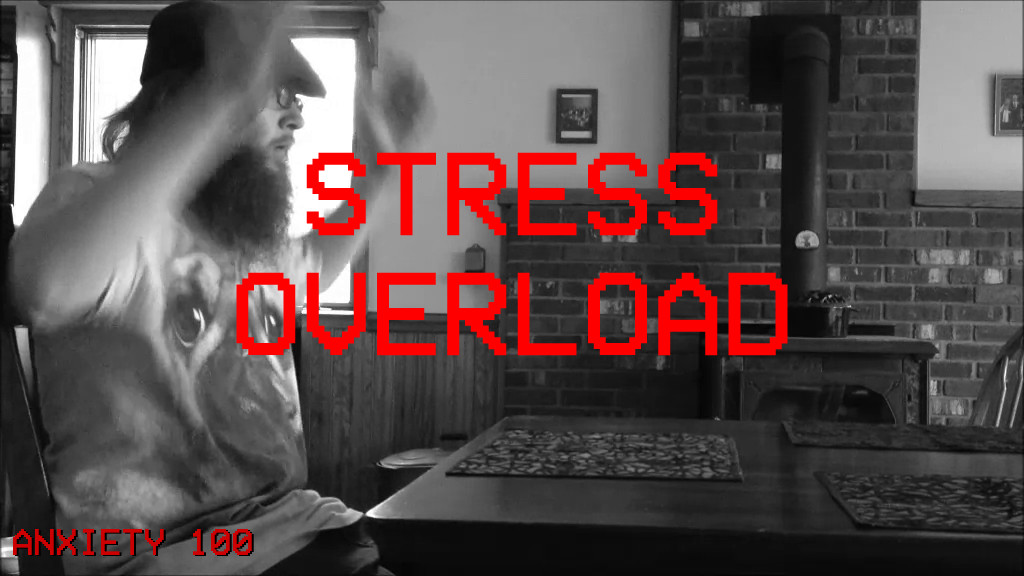
Content-wise, the game feels pretty grounded in feelings of social anxiety (the party, or being scared to answer the door). Is that something you wanted to tackle directly?
It was always going to be a game about dealing very badly with social situations, mostly because I tend to deal very badly with social situations. It's sort of like that old pro-wrestling adage about how the best characters are the performers' own personalities, turned up to 11. That's what Steve is for me—I definitely, definitely start to freak when someone's knocking on the door and I'm not expecting anyone (and sometimes even when I am). I think a lot of people do.
I tend to put personal themes into my games like that. The first game I worked on, Life in the Dorms, was essentially an adventure game about how much I hated my roommates. The Beard in the Mirror (at least the parts I wrote) has strong themes of not understanding where your life was going and not liking where it was, because that's where I was at the time. Awkward Steve, then, is a game by someone who works from home and doesn't have a lot of day-to-day interactions with people, and the sorts of things that can do to your brain.
Can you talk about how the project was chosen for the Smithsonian exhibition?
So I'd actually submitted three of my games for the exhibition. Of the three I figured this was dark horse candidate, with The Beard in the Mirror being the much more traditional, clearly-identifiable-as-a-game game, and Cat President: A More Purrfect Union (my dating sim about cat politicians) perhaps sneaking in as a political-themed game—a perfect fit for a convention being held in D.C.? Maybe? But really I didn't think any of them would get accepted. I mostly just submitted because it's the Smithsonian, and I have family in D.C., and why not; it would be ridiculous and amazing if it actually happened.
And then it did—they actually accepted one of my games! And it was the WEIRD one!! And after I picked myself up off the floor I had this exchange with my mom (because of course the first thing I had to do was call my mom and tell her one of my games was going to be featured at the Smithsonian):
Mom: "And you're sure it's going to be at the ART museum?"
Me: "YES, BECAUSE IT'S ART MOM!!"
Mom: "But the ART museum???"
I'm actually pretty nervous about it, to be honest; I already have trouble clearly explaining what the game is to people when I'm behind a keyboard, let alone when I'm in person, and they're sitting down to play it, and they're in a museum, and I have to justify why this weird dumb thing is in a museum and why they should play that instead of the VR game next booth over where you hug a teddy bear to jump. After dozens of Steam Greenlight comments about how this is "hipster trash" that "isn't even a game" and you're hurting Steam" it feels weird to get this kind of recognition. Gratifying, and exciting, but also very weird.

According to Waka Flocka, Dota 2 Would be 'Great on a Blunt'
Taylor Swift:thinking face emoji:
As esports' audience grows, celebrity cameos at major tournaments are becoming more common. NBA star Jeremy Lin occasionally shows up on Dota 2 streams, while retired NFL kicker and Teemo enthusiast Chris Kluwe appears at the LCS every few seasons. This weekend, DreamHack Atlanta got some local talent on stream when rapper and producer Waka Flocka Flame crashed the vaguely Star Trek-themed Dota 2 panel at the DreamLeague LAN finals. (Hilariously, the DreamLeague chyron initially misspells his name as "Wacka," which for all I know may be intentional.)
Waka Flocka Flame's enthusiasm for games in general helps explain why he's at DreamHack in the first place, but he's a novice when it comes to Dota 2. That's a good thing for two reasons. One, it provides an opportunity for the panel to dispense some DotA history (in return, Waka offers a brief lesson on flow).
Two, it gives Waka the chance to render his own "review" of Dota 2, making him, along with Braid aficionado Soulja Boy, one of the few rappers to moonlight as a game critic. And while Waka Flocka's verdict that Dota 2 is "an alien invasion meets Gargoyles" might not be true in a narrow sense, it's definitely better than the drivel mainstream journalists come up with (e.g. "Teams of video gamers playing characters ranging from wizards to monsters exchanged virtual punches, fireballs and lightning strikes over the past six days, battling at the main event of the Dota 2 International 2015 tournament in Seattle," as one hapless Reuters reporter put it).
Plus, Waka's instinct that Dota 2 would be "great on a blunt"—with or without Snoop Dogg—is extremely correct. So, Waka, if you're reading this… hello.

'Splatoon 2' Fans Can't Stop Talking About One Thing: 'Knack 2'
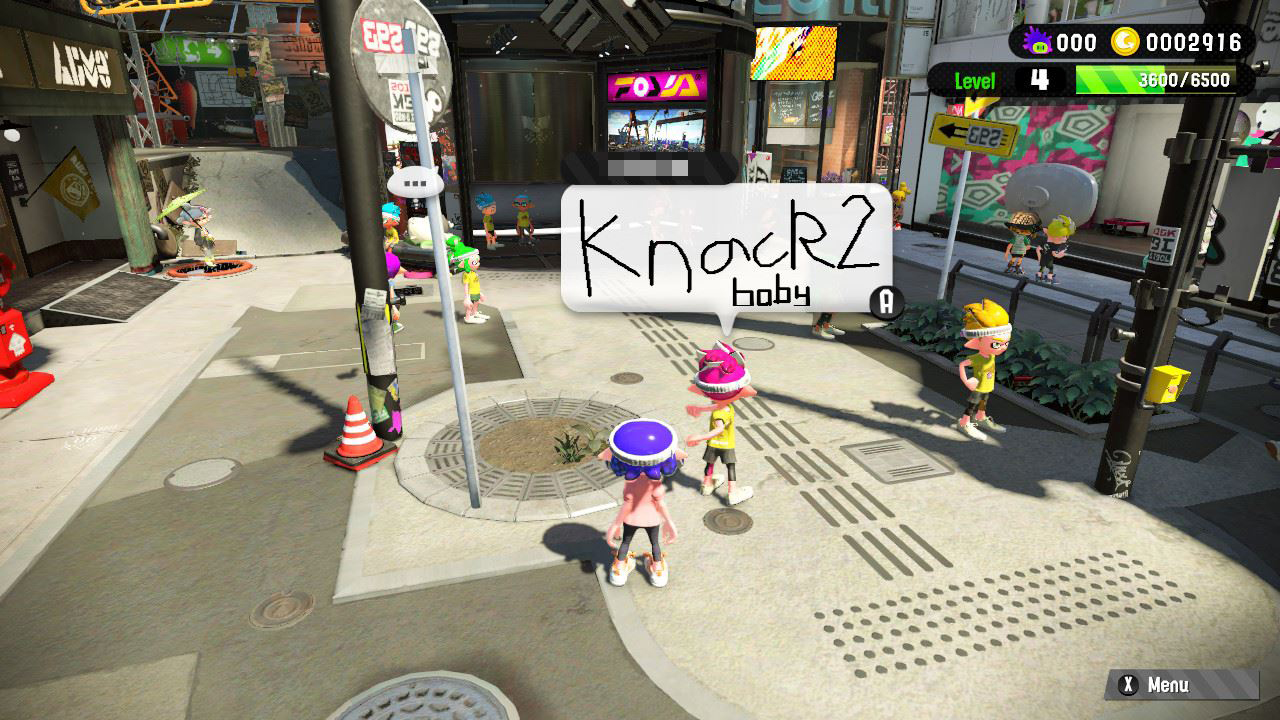
The hype for Knack 2 is real, if the artwork being shared in the game's Inkopolis Plaza, where players hang out between matches, is to be believed. Nearly every time I've logged on to play a few matches, I've witnessed Splatoon fans sharing their collective desire to play the impending sequel to the 2013 cult platformer.
Like this:
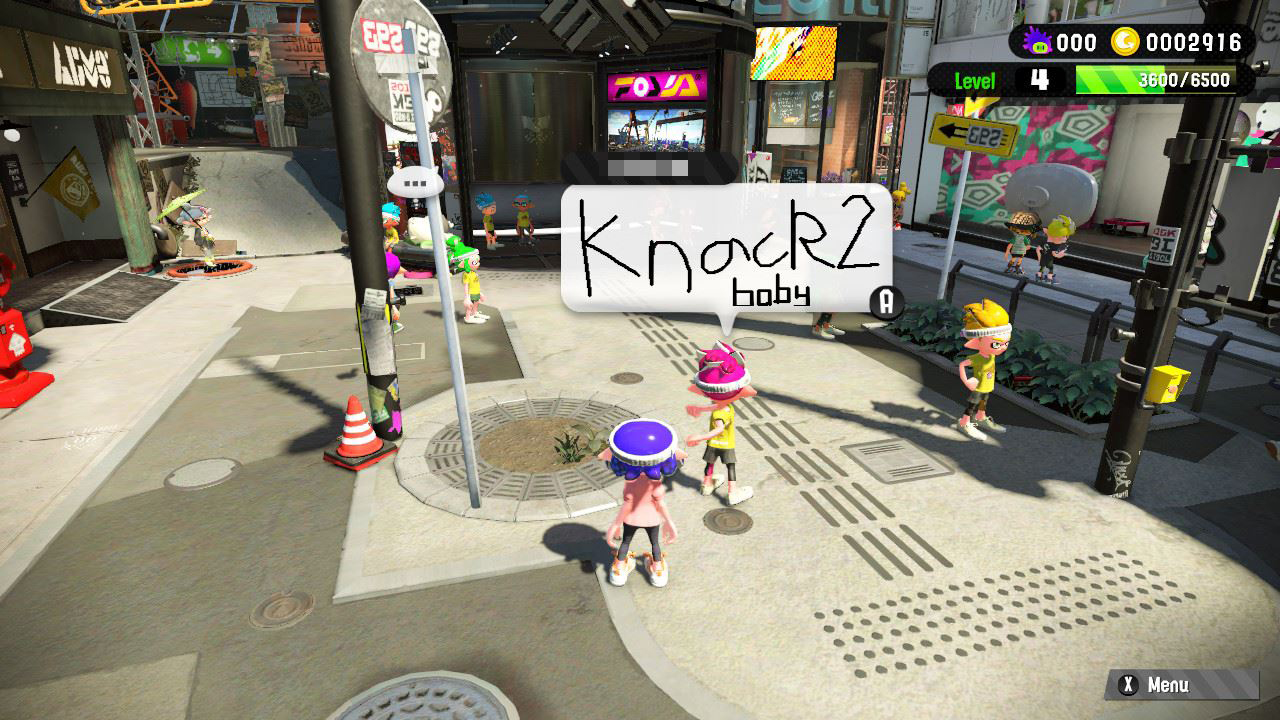
And this:
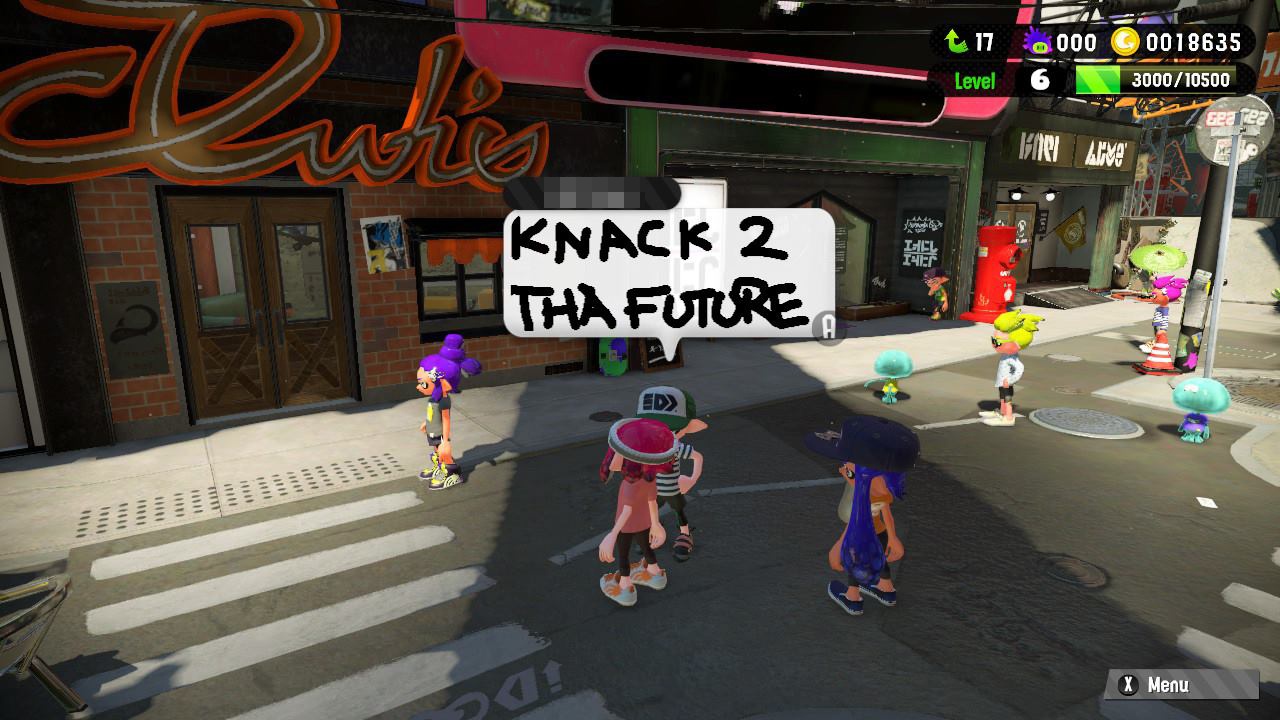
And also this:
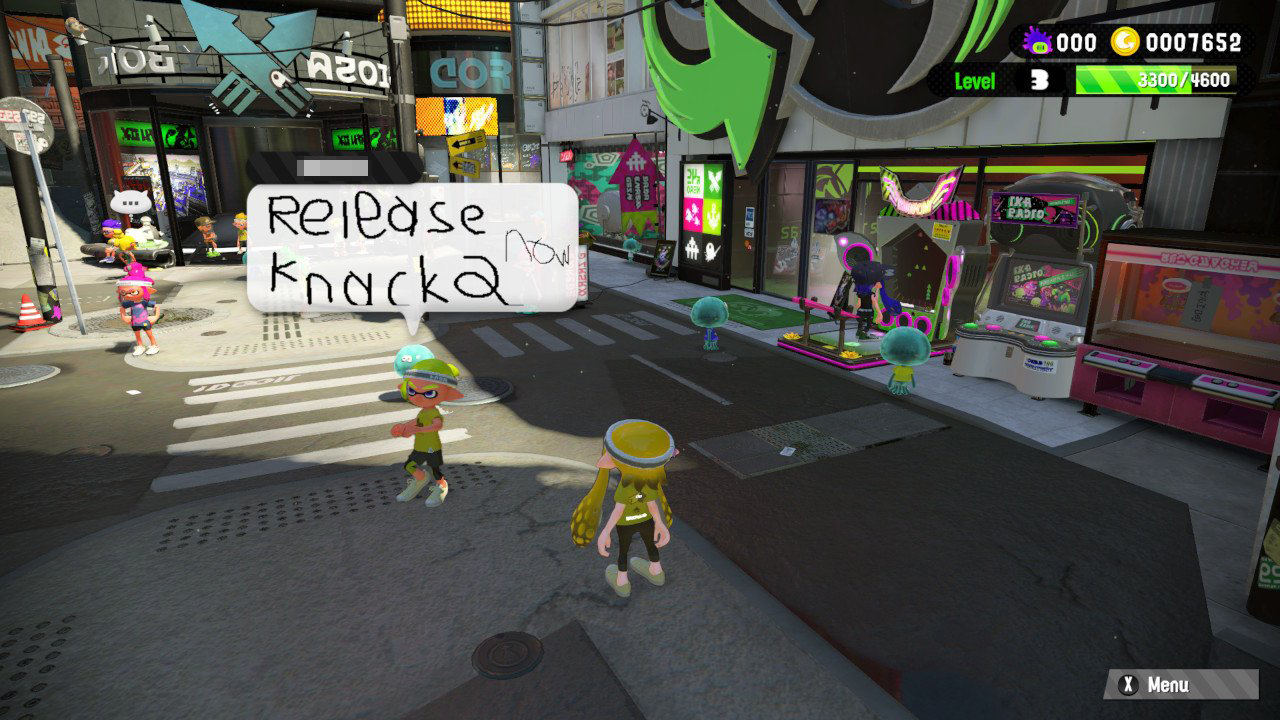
I'm not the only one who's noticed this; a quick search on Twitter shows an equal amount of confusion and excitement over the surprisingly viral (and cross-platform) nature of fan anticipation for Knack 2.
"Imagine being the Splatoon developer and expecting all the miiverse art to be about Splatoon," said one Twitter user, "but no, it's all about Knack 2."
And while there's no proof Sony's purposely infiltrated Splatoon 2, there's no doubt that some are going out of their way to inform more people about Knack 2.
"Yo if anyone else sees my Splatoon 2 posts in YouTube videos," said one user, "send em my way, we need to spread the word about Knack."
It can only escalate from here, as we move toward its September 5th release date.
"Glad the Splatoon/Knack cross promotion is going well," reads a tweet from the definitely-not-official @Knack2Official account. "We're totally not going to put any Inklings in our game though. Don't tell Nintendo."
Follow Patrick on Twitter. If you have a tip or a story idea, drop him an email here.
Tokyo Fashion Snaps at Fanatic Magazine Party, Summer 2017
Fanatic Tokyo – a new Japanese street style print magazine launched this spring – released their second issue last week. To celebrate, they held a release party at the famous club WOMB in Shibuya. The suggested dress code of the second Fanatic party was summer fashion.
The crowd was a mix of fashion students (the founders of Fanatic attend Japan’s most famous fashion school, Bunka Fashion College), designers and shop staff from around Tokyo, and other young people interested in fashion. Parties like this give people from different parts of the Tokyo fashion scene a chance to mingle and make new friends.
We headed out to WOMB to show our support for the Fanatic Tokyo project, and to get fashion snaps at the party to share with those of you that couldn’t make it in person. Enjoy the fashion snaps and hope to see you at the next Fanatic Tokyo party!
Follow Fanatic on Instagram and Twitter.





Click on any fashion photo to enlarge it.
Juho, 27
Taylor SwiftI was at Savers in Chicopee this weekend and like 90% of the button-up short-sleeved men's section was like this, and I saw this outfit in my mind's eye, and reader, I could not commit

“I’m wearing a vintage RL shirt, old Porter bag & Teva sandals that are all from my store Variety Vintage. Pants are CDG.”
29 June 2017, Eerikinkatu
Red & Black Japanese Street Style w/ Otoe & Tokyo Bopper Platform Sandals
Taylor SwiftThis whole thing owns
Yama works at the famous Tokyo Bopper footwear boutique in Harajuku. She stood out on the street in a red and black ensemble.
Yuma’s outfit features a black popcorn shirt, vintage polka dot wide leg pants with bow print from Otoe, red lace ruffle socks, black Tokyo Bopper platform sandals, and a faux leather tote bag, also from Tokyo Bopper. Her accessories include a smiley face pendant necklace and a black watch.
Tokyo Bopper is Yama’s favorite fashion brand, and she likes to listen to Baby Metal. Follow her latest social media updates on Twitter and Instagram.


Click on any photo to enlarge it.
Leon Chang
Taylor SwiftLeon is the nicest dude and I am so happy seeing him thrive

Who are you, and what do you do?
I'm Leon. I post online (Twitter), I make art (Tumblr), and I make music (Spotify, SoundCloud, Bandcamp).
What hardware do you use?
I do everything on my laptop, an ASUS K501U I bought a couple years ago. I like it because it was cheap, and I can play video games on it. Last year I purchased a pair of ATH-M50x headphones, which is probably the best thing that's happened to my music making ability. I was making music through Apple in-ear headphones before that! I don't use much else when composing music, but when I play live I use an M-Audio Trigger Finger that I got from Guitar Center ten years ago. My most recent purchase since then is the Midi Fighter 3D I bought with the money from my first album, which I just released in May! I also play around on my Janssen player piano I got off Craigslist for $250 that I've had for a few years.
And what software?
I use Adobe Photoshop CC pretty much every day, and have some experience in using Adobe Premiere Pro CC now that you can post longer videos on Twitter. For music making I only use Ableton Live. There's so many free resources, tutorials, and tips online that I have been able to learn everything myself over the last two years. One of my favorite VSTs I've discovered is the C700, created by some person in Japan who goes by Osoumen. It emulates the SPC700, which is the audio processor from the Super Nintendo. It features on a few tracks in Bird World, my first album.
What would be your dream setup?
I don't need anything crazy computer-wise, the ASUS plays Overwatch and can handle Ableton/Photoshop so I'm pretty happy. It would be cool to have a nice sound system (surround sound, speaker, monitors, etc), maybe after I set up a real desk and office. I work on my kitchen table and on the piano. I want to buy a trumpet, a flute, an accordion, and a harp. And if I can't get that, I would get the Emperor and put it in a mech suit.
Thanks for reading! If you're enjoying the interviews, you can help keep this nerdy lil' site independent for as little as $1 a month!

BlazBlue's Next Is a Crossover With Persona 4, Under Night In-Birth, and RWBY
Christopher Allan Webber
Taylor SwiftThe "dream setup" bit here took me by surprise and also rules

Who are you, and what do you do?
My name is Christopher Allan Webber, or Chris Webber for short. (Though there's another Chris Webber in the FLOSS space that does devops things... if you see me expand my name all the time, now you know why!) You can find me at my personal website, or on the federated social web on identi.ca which runs pump.io and octodon.social which runs Mastodon. (Sadly you'll see those federated social web examples don't interoperably federate, but that's something we're working on... see the ActivityPub stuff later.) If you must, I'm also available on the birdsite.
I've done a few things of possible note; I co-founded GNU MediaGoblin which is a distributed media hosting platform along the lines of Flickr/SoundCloud/YouTube. I'm co-editor of the ActivityPub specification for federation (which is how you get distributed websites to talk to each other) which is being done as part of the W3C Social Working Group. I'm co-chair of the W3C Social Web Incubator Community Group which you can view as carrying on the work of the Social Working Group. I also occasionally contribute to GNU Guix and GNU Guile, as well as various miscellaneous projects. A number of years ago, before I went to do the decentralized web stuff full time, I was a programmer and at one point tech lead of Creative Commons.
ActivityPub is taking up most of my time these days, but I think is pretty important. The social web is an enormous part of peoples' lives these days, and for the most part, it's controlled by a handful of small companies. I think we can do better, and ActivityPub hopes to unite the federated social web... it looks like we might even succeed (there's been an uptake in interest from the existing federated social web places, eg Mastodon and Nextcloud and probably GNU Social and diaspora, and MediaGoblin and Pump.io have long dedicated themselves to adopt the standard). But time will tell. At this very moment I'm trying to get the standards test suite done, which is super boring, so I'm taking any distraction I can seemingly. A good time to follow up on this thread!
I have a good number of side projects which I don't find enough time for mainly because the ActivityPub stuff is taking up so much of my time. I think the most fun of these is GNU 8sync, which is an implementation of the actor model in Guile. There's a video on the 8sync homepage that shows me doing a demonstration of 8sync where the talk was itself a MUD (multi-user-dungeon) that the audience was able to play as I discussed it. That kind of stuff is super fun to me and I hope I can find some time to get back to it soon.
What hardware do you use?
At the moment, a ThinkPad X200 laptop flashed with Libreboot which I usually have docked. It's upgraded with 8 gigs of RAM and a larger hard drive which makes things pretty manageable, but I wish it had a better graphics card. For whatever reason, even though I can run OpenGL blob-free on this, it was one of Intel's earlier graphics cards, and the performance has gotten pretty bad for anything 3D. (I miss being able to do artwork in Blender..) For everything else though it's surprisingly a pretty robust machine for something nearly a decade old. (That's probably due to computers not having improved that much CPU-wise over the last decade.)
I used to have a ThinkPad X220 but then I was in a talk given by John Sullivan a couple years ago and he talked about Intel ME / AMT and I was like "Whaaaaat??? How have I not heard of this? A low-level backdoor into nearly every modern computer?" I started to do research into that and was shocked to find out that they exposed a web interface from which you could compromise the machine even when it's off. I guess this was for corporate deployment purposes but I found it to be pretty alarming. I checked my BIOS and found out that it was turned on, along with something called CompuTrace which, as best as I could tell, was for some anti-theft purpose which reported information about your computer's whereabouts. It was run by a car anti-theft company named LoJack. I turned off both of those (to the extent you can be sure they're actually turned off, but since there's no source code to that, I couldn't really), but was pretty spooked by the whole thing. IIRC there's even a single key deployed by default for all these machines, and while you can change it, that seems like a really easy way to exploit a whole lot of hardware out there.
For a while I would tell people about this and I think the average person was pretty skeptical that this was a concern to the extent that I was expressing (the Cassandra Complex is high in FLOSS people I think, for better or worse). Well, there was the news a while ago about Intel AMT having a really terrible bug that allows for super easy exploit so I guess people generally recognize it as a problem now. Will Intel or AMT release new chips without these problems? I'm not sure. People really want it though.
I also have a Kinesis Advantage2 keyboard because a few years ago I had serious repetitive strain issue problems. At one point I also used foot pedals for ctrl and alt but I kind of stopped doing that, but I'm not sure why. (Why not use your feet for programming? They're just sitting there.)
And what software?
I mostly live in GNU Emacs, where I program, read my mail using mu4e, and organize my life using the incredible org-mode.
I'm running the GNU/Linux distribution GuixSD. (Guix is the userspace package manager, which can run on any distribution, and GuixSD is Guix turned into full-on distro form.) It's pretty incredible for a few reasons: it's a functional package manager, which I think doesn't say much to most people, so I like to say "it's like Git for your whole operating system". Ever had an upgrade that went badly? No problem in Guix... you can always just roll back. It also solves the disconnect between language package managers for development, where people want to have isolated environments to just work with/on certain packages, and distro package management, which people want to be fairly stable and to be the bedrock of their system. In Guix you have a nice "environment" feature, which if you're familiar with Python development workflows is kind of like a "universal virtualenv". In all my new projects I put a guix.scm file and if you have Guix, you can just run guix environment -l guix.scm and it opens up a shell with everything you need to get hacking already set up for you.
There's one more really thrilling thing about Guix, and that's that the whole thing is written in Guile, which is a kind of Scheme, which is a kind of Lisp, which is a kind of programming language with lots of parentheses everywhere. This is (aside from the libre-pureness) the distinguishing feature between Guix and Nix. Guix is written entirely in the same language, including in package definitions. It does a really nice job of taking advantage of the "code is data and data is code" aspect of Lisp. This means that your whole operating system is heavily programmable. More on why this matters later.
I currently run the window manager StumpWM which I consider to be the most tolerable of the tiling window managers, but I do envision something better. It's nice that it's written in Lisp; it's my personal opinion that as many things as possible should be written in Lisps. I used to run GNOME, and I still think GNOME is pretty great and beautiful, but I found it was pretty hard to configure to do what I wanted and I got a bit frustrated with extensions breaking between releases. The main reason I moved to StumpWM though is that GNOME 3 is pretty heavy on OpenGL usage, and as I said, this laptop doesn't really do OpenGL well. I still think the GNOME people are doing good work in general though, and I'm glad it's there for most people.
Back in the day I used to do artwork in Blender and in The GIMP for fun. I haven't had time for that, but I really miss it. Some day maybe I'll learn to use Krita, which seems pretty cool. I'd also like to do more game development.
What would be your dream setup?
Wow, lots to unpack there. Let's start with me personally, and then broaden to social stuff.
You said "dream setup", so I'm going to go on the "dream big" setup. Dreaming big, I'd have my own personal computer attached to my body which ran completely libre software/hardware from top to bottom. It would have a visual overlay over my normal vision, but not a camera; I don't want to surveil everyone. (If it had a camera, it would at least have a physical shutter which could be visible whether open/closed.) I'd like to run something as configurable as Emacs, but maybe not necessarily Emacs, but definitely configurable in Lisp. Instead of keystrokes, I'd like to be able to fire off commands just by thinking of them, but be able to bind them to any procedure I control, similar to keystrokes being bound to commands in Emacs. Once I had this I'd throw my phone right into the garbage. (Actually I'd probably donate it or recycle it.)
The operating system running on this dream-machine might be a lot more Lisp-like from the ground up. I gave a talk on the Lisp Machine and GNU not too long ago, maybe that gives you some ideas of what the dream setup looks like to me. It would probably use a microkernel architecture and have a capability-based security design, which it turns out is pretty much the same design as GNU Hurd, but the Hurd is widely ridiculed, except now that it looks like Google is working on an OS design that looks an awful lot like the Hurd people think maybe it's a good design again.
Of course, it's dangerous to dream big! Anyone who knows about the perils of Worse is Better vs The Right Thing knows what I'm talking about. And there's some real lessons to learn that the best designs are not necessarily the ones that survive. But eventually most of the good ideas from them survive, in mangled forms. See also Greenspun's Tenth Rule and the fact that nearly every every good concept from Lisp has become popularly adopted elsewhere ages after the fact, except for the parenthetical notation that permitted developing all those good ideas to be so feasible. Oh well. But you asked me to dream, so there are the dreams.
So socially! Short term, I think we're currently in a crisis as in terms of peoples' ability to deploy servers. I've been in this decentralized social web space for a while, and part of the problem is that it's a huge curve to start deploying, and then they struggle to keep their servers running. That includes me, even as an advocate in this space. My friend Deb Nicholson and I came up with the term UserOps which I like to contrast with DevOps. Right now, deployment is focused on enterprise'y and startup'y teams which have a ton of highly skilled, highly technical resources which are paid to be highly available to keep things running. Well, if we want to get self-hosting into the hands of people, those assumptions can't be true. Not everyone is a technical expert, and most people don't have that much time.
Well, I know a bunch of people who agree on UserOps being important, but not everyone agrees on the solution. Personally (did you guess it?), I think the right decision has to do with Guix. I mentioned before that Guix is highly programmable, and that's what distinguishes it from Nix. I think this is going to be really important, because we're currently in a terrible crisis where it's very difficult for people to deploy and upgrade and keep to date their systems. I think Guix can help, and I've given a talk on this with my friend David Thompson. People are afraid to upgrade machines, and we already have that solved, and it's also hard to develop enough expertise to start and administer machine deployment. For that latter part we haven't yet built enough (my friend Aeva likes to say that Guix is currently like "Gentoo for adults") but the highly programmable nature of Guix gives me hope that we can; since everything is written in Guile, you can write programs that write programs, and even programs that write out package definitions and even programs that write out operating system definitions, declaratively. Maybe you can see where I'm going with this: imagine having a web interface where you select installing MediaGoblin and Prosody and Wordpress and fill in your domain name and etc, and the web interface just sets up the whole thing. Well you can get that very cleanly with GuixSD as the root design. Plus, you can do an upgrade, and if things go badly, you can always just roll back! (Well, minus any migrations made to the state of your databases and etc. Hopefully we can make backups easy too.)
Okay, great. So people are now able to deploy libre network services, and that's great. So on top of that, hopefully we're all speaking the same network protocol... maybe ActivityPub? Now we've got a decentralized social network. Woot, we're on track! Though there's still things to be tweaked in that setup; currently all the examples in ActivityPub show using https:// type links (however, we don't mandate that; it might be possible that people could start federating with a different uri scheme that's more peer to peer). It would be even nicer to have a network what doesn't rely on DNS, something much more distributed. Now attach public keys to everyone's profile, and... now we're really getting somewhere.
Gosh, doing all this would take a lot of work! What's the point of all this technology though? What'd the point of this "ideal setup"? Is technology for technology, or is it for the embetterment of human kind? Well golly, I sure hope it's the latter. We used to have this Jetsons and Star Trek optimistic idea of the future that when we automated all this stuff away that people would be able to persue creative endeavors. I know some people think that without a profit motivation nobody is willing to do anything, but those people probably don't have any artist friends. There's a lot of stuff to get done that really matters and is even crazy hard to fund (math, science, humanities, some kinds of engineering, art, literature, environmental, social service stuff, or even good ol' fashioned free software authoring). Well what is the point of all this automation if we aren't freeing up resources for that stuff? I don't know what the right solution is; it could be minimum basic income, or it could be something else, but which future do you want, an automated future where people have time to explore humanity and improve the world, or an automated future where all the money is poured into the pockets of just a few people while everyone else is unemployed and desperate?
Here's a free startup idea (and I'm dead serious about this): a company that automates away executive positions. Target shareholders, tell them that your AI-plus-deskworkers are able to generate dramatically better performance for a fraction of the expense, which means extra money for shareholders from all those costly executive positions. Do that, and you'll see how fast the upper crust who are against social services and minimum basic income turn their butts around.
Speaking of that, the stuff I work on is myself pretty hard to fund. You can support me on Patreon or by donating to MediaGoblin through the FSF or by hiring me as a contractor for some free software project... I'm easy to contact!
Thanks for reading! If you're enjoying the interviews, you can help keep this nerdy lil' site independent for as little as $1 a month!
Italian Meats Aren't Ruining American Education
Open Thread is Waypoint's daily check in about games, culture, politics, and the world at large. Share your thoughts with us over in the forums!
Over on the New York Times today, columnist David Brooks lays out a peculiar argument for America's education gap in a piece ominously titled "How We Are Ruining America." In his search for what separates the children of upper middle class parents from those of the working class, Brooks finds an answer in the language of the ruling class (and also, Italian—but not Mexican—meats):
Recently I took a friend with only a high school degree to lunch. Insensitively, I led her into a gourmet sandwich shop. Suddenly I saw her face freeze up as she was confronted with sandwiches named "Padrino" and "Pomodoro" and ingredients like soppressata, capicollo and a striata baguette. I quickly asked her if she wanted to go somewhere else and she anxiously nodded yes and we ate Mexican.
American upper-middle-class culture (where the opportunities are) is now laced with cultural signifiers that are completely illegible unless you happen to have grown up in this class. They play on the normal human fear of humiliation and exclusion. Their chief message is, "You are not welcome here."
As Jamelle Bouie said over on Twitter, "clowning on David Brooks is pretty rote at this point," and yet, here I am, living my best life by being mad on the internet. But I think it's worth digging into this, because there's actually something pretty insidious about the argument that Brooks lays out here.
Words like "artisanal" do not contain power. The cultural signifiers of the wealth reflect the power relations that already exist in the world.
I'm not frustrated because there isn't any cultural gatekeeping. There is, and it's deployed across not only class boundaries, but also across race, gender, sexuality, nationality, and other identity groups. Cultural signifiers—phrases, styles of dress, appropriate musical tastes—work to signify some societal identities as primary and to dismiss others. Brooks and I are in agreement there—as are a long line of social scientists and political philosophers.
Brooks talks about Italian deli meats and organic grocery store products as if they were code words arrived at a priori, as if from a void. "Braised artichoke," says the Brooksian protagonist, finally cracking the code and securing access to the hallowed halls of Harvard for their progeny. But this is, obviously, fiction. If you're a working class parent, whispering "Whole Foods" to the superintendent of the neighboring school district won't let your child in, but hearing someone ask you if you shop organic will remind you that there isn't even a decent grocery store near your home.
Words like "artisanal" do not contain power. The cultural signifiers of the wealth reflect the power relations that already exist in the world. In the case of education, those relationships are often about one's economic and geographic conditions, two things that, in America, are historically caught up with racial and class position.
There is one, special way in which the cultural signifiers of the rich do actively maintain the inequitable status quo, though: They trick people into thinking that they are the difference instead of just reflecting it. They cloak the material causes of oppression and poverty, and instead factor in cultural difference. If only you knew how to tie a windsor knot, son.
In arguing for the primacy of these differences—even when putting the blame on upper middle class moms (of course)—Brooks is doubling down on this by arguing that they're what separates the poor from good education. The (unintentional? who knows) subtext to his piece is that what separates the haves from the have-nots is cultural knowledge and the flexibility required to act adequately in spaces where you do not have it. Those are qualities that an individual person can achieve, and that brings us back to a familiar conservative ideology of personal responsibility.
It also allows Brooks—and anyone else who parrots this line of argument—to feign concern with inequality without ever talking about distribution of resources, quality of schools, redlining, and all the other real ways that the marginalized are kept from good education and equitable living. It lets them write articles with titles like "How We Are Ruining America" without ever engaging in the real ways that the lives of Americans have been ruined.
This argument fundamentally isn't about how cultural norms can keep the poor poor. It is a cultural norm that aids in that very task. It provides easy alibis for "compassionate conservatives" who do not want to redistrict, downplays the material reality of being working class in order to put personal responsibility at the forefront, and offers intellectual soap for those who want to wash their hands of the whole thing.

Goo goo g’joob, baby
Taylor SwiftWhat the FUCK is HAPPENING in MARK TRAIL
| Ads by Project Wonderful! Your ad could be here, right now. |
Mark Trail, 7/10/17

Ahhhh, finally we get the payoff to this long story of the Great Water-World Disaster, a delightful panel depicting our wayward walrus giving birth in the shattered, water-logged shell of a formerly high-prestige sport utility vehicle. Given Mark’s previous downplaying of the disastrous nature of this episode, you’d think that he’d be a lot cheerier about helping this majestic sea-beast in its time of need; but instead, he and Johnny are watching the birth process with expressions of open horror. One suspects that this is the first time they’ve become truly acquainted with the procedure through which baby walruses are born, and are beginning to connect the dots to the human children they occasionally encounter as well.
Lesley, meanwhile, has purported throughout her retelling of this anecdote to be in a high dudgeon, but her expression and body language in today’s strip resemble nothing so much as Bernini’s frankly erotic depiction of Saint Teresa in ecstacy, so maybe we need to re-evaluate everything we thought we know about her attitude towards Mark and her obviously complex inner life.
Pluggers, 7/10/17

Pluggers may leave a trail of pollution wherever they go, but by God they aren’t going to SHARE THEIR CAR with SOMEBODY ELSE like BIG GOVERNMENT WANTS THEM TO like some kind of COMMUNIST
| Ads by Project Wonderful! Your ad here, right now: $0 | ||
Devs tell the tale of making NBA Jam: 'I was down on the monster dunks'
Taylor SwiftLmao
 "I was down on the monster dunks," former Midway dev John Carlton recalls in a new Sports Illustrated oral history. "I loved the NBA for what it was; I didn't want to turn this into a clown show." ...
Mondo Grosso – Labyrinth
First TSJ appearance in this Japanese producer-DJ’s 20+ year career…

[Video]
[8.00]Kalani Leblanc: Hikari Mitsuhara’s opening “Mitsumenaide kanash? kata” line rings and repeats itself in your ears no matter how far she reaches in “Labyrinth”–and it speaks volume to her significance in this Mondo Grosso single. There’s a familiarity lurking under the bubbling house surface, but the harm in the deju-vu becomes blurred by Hikari’s soft prancing lingers. Both Osawa and Mitsuhara circle and tug at each other with their lush yet never dramatic outputs, creating a perfect mutualistic relationship. By the end, the familiarity morphs into nostalgia for either some dramatic event or the moment “Labyrinth” began.
[9]
Iain Mew: “Don’t stare in that sad direction” — for all its promises of paradise, this is the sound of standing just outside of a party, trying as hard as possible to lose everything in the moment, because the prospects of going back in or leaving it completely behind are equally incomprehensible. Its bruised house sounds like good times happening the other side of a solid wall and Hikari Mitsushima sounds like she’s singing to herself as much as to the indistinct other person, vulnerability always there but held at a distance too, dancing to avoid what happens when she stops.
[9]
Maxwell Cavaseno: Somber dance-pop that reminds of Discovery-era Daft Punk is certainly a good way to play with the idea of dance as disconnect. It’s funny how often we hear songs about the dance as invitation and unification, but not enough about how you should make sure to keep oneself at a reasonable distance to oneself in order not to kill the fun. The idea that the dance has to end and should be kept sacred and safe, not instantly result in the collision and grasp of desire. You don’t hear enough pleas for serenity in this day and age.
[8]
Alfred Soto: A sensuous deep house track that rides on piano runes, a shimmer of a percussion track, and an ethereal vocal. Not a labyrinth — it’s a backyard party after midnight with your closest friends.
[8]
Thomas Inskeep: Seriously lovely deep house track with airy-yet-grounded vocals from Mitsushima Hikari. The BPMs are fast, but the vibe isn’t.
[7]
Joshua Minsoo Kim: Undeniably reminiscent of Mondo Grosso’s jazzy lounge music from two decades ago except far more palatable. It starts off with a processed guitar riff that sounds like it’s straight out of a disco edit, catching you in its locked groove before plunging into a world of late night house. Folder5 singer Hikari (who most Westerners will recognize as Yoko from Love Exposure) appears and her voice amplifies the song’s specific mood–one filled with hope and yearning, the sort of thing that captures the desire to make an ephemeral moment indelible.
[8]
Ryo Miyauchi: The analog warmth of Mondo Grosso’s trance groove gives off a balmy air of nostalgia, a perfect excuse to take a vacation down one’s precious memories. But Hikari Mitsushima snaps you out of the mirage to focus instead in the moment. Her brittle voice comes off too passive for her words to truly hit like a demand. Yet her insistent instructions, and a private kiss wagered as a reward, puts her at an arm’s length — the perfect distance to keep you following her down this rabbit hole.
[7]
Let It Die is 'Supremely Shitty,' And GungHo's CEO Couldn't Be Happier
Japanese Pair Look Street Styles in Harajuku w/ Galaxxxy & Rasvoa
While walking on the street in Harajuku, our attention was caught by 19-year-olds Nene and Yuzuki, both beauty school students. They are wearing colorful identical (pair look in Japanese) styles.
Nene and Yuzuki’s pair look ensembles feature printed cropped tops and skirts from the kawaii Japanese brand Galaxxxy, pink socks, and platform sandals from Rasvoa. Their accessories include ear studs, dangling earrings, tattoo and ribbon chokers, and hair ties as bracelets.
Nene and Yuzuki’s favorite brand is Galaxxxy and they listen to News.


Click on any photo to enlarge it.
Harajuku Guy in Handmade & Resale Fashion w/ Bernhard Willhelm, Number Nine & N.Hoolywood
Taylor SwiftCan't believe someone stole my July 4th fit
Yuma is a 19-year-old student we spotted in Harajuku wearing a unique handmade and resale fashion ensemble that caught our attention. He was recently featured on our street snaps last March.
Yuma’s outfit consists of a white resale Tweety Bird tank top underneath a handmade deconstructed jacket, flag leggings from Number Nine, sandals from N.Hoolywood, and a blue belt bag from Bernhard Willhelm. Accessories include a black head scarf.
Yuma’s favorite fashion brand is Bernhard Willhelm and he loves the music of Lorde. Follow him on Instagram!


Click on any photo to enlarge it.
Lucky Poker this isn’t, just plain lucky it certainly is.
The following item was sold on eBay. If you look at the text on the block to the left it says ‘Lucky Poker’ so it was assumed by the seller, and even the buyer (Brian Troha) to be a mostly ROM based version of the Deco Cassette game ‘Lucky Poker’ and sold as such (Luky Poker, for parts)

Now, what actually escaped everybody’s attention at the time is firstly, there’s no way that’s a functioning setup, there’s no such thing as a ROM-only Deco Cassette game unless you install one of Dave Widel’s multigame kits, and furthermore the ROM board pictured to the right is actually something we’ve seen before, it’s the same ROM board used for a ROM overlay on the cassette version of Treasure Island, however Treasure Island only uses 4 roms, this is fully populated.
Now, this detail wasn’t even picked up on even after the PCB has been purchased and dumped, however, since nobody had actually looked at the dump for a few weeks Osso decided to forward details to me and asked if I’d like a look at it.
Since I’d been working on the Deco Cassette driver recently (including working on Treasure Island specifically to decrypt an additional set) a couple of things were fresh in my mind, firstly that this was a ROM overlay board, there are no code roms on it, and secondly that there are only 2 games known to be using such a board: Treasure Island, for which the board has been dumped for years and Explorer, which has proven to be elusive since Al Kossow dumped the cassette back in 2001 (MAME 0.37b13!)
At this point evidence was starting to mount. A closer look at the picture above shows all the roms have stickers with the number ’18’ on them. 18 is the game code for Explorer. At this point I was certain, somehow, almost by complete chance, we’d ended up with one of the hardest to find Data East ROM boards, the missing part of something that had been sat in MAME as non-working for 16 years.
With this in mind I decided to task myself with getting it working in the driver. This wasn’t too tricky, just requiring an additional bank bit to be handled (as Treasure Island only used half the roms so it was never implemented) and a quick change to a bad assumption in the driver that prevent RAM writes when the ROM was banked in. With that done it started working.






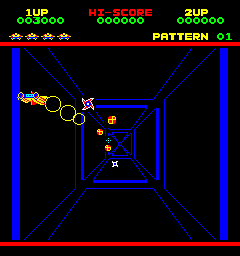




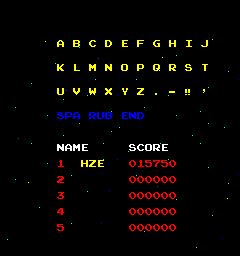
So there you have it, a story 16 years in the making with a healthy dose of good luck. Here’s a video.
Japanese Style Styles w/ Bed J.W.Ford, Comme des Garcons, Banny Store, Yoshio Kubo, Kappa & Paul Smith
While walking in Harajuku, our attention was caught with 19-year-old Maroi and 18-year-old Risa’s colorful and eclectic fashion styles.
Blue-haired Maroi’s outfit features a gray Kappa vest over a yellow Bed J.W. Ford button down shirt, pink zipper pants from Paul Smith, heeled ankle boots from Comme des Garcons, and a transparent belt bag from Banny Store. His accessories include a yellow cap, yellow sunglasses, safety pin earrings, and multiple rings. Maroi’s favorite brands/shops are Ganryu, Illig, Tripp NYC, and Banny Store. His favorite music includes BTS and Sekai No Owari. Maroi is active on Twitter and Instagram.
Risa’s ensemble consists of a Yoshio Kubo denim coat over a striped button down shirt and black shirt, a black skirt from Kappa, fishnet stockings, white socks, Dr. Martens high cut boots, and blue belt bag from Banny Store. Her accessories -some from Christian Dior- include a newsboy hat, layered necklaces, a black belt, baller band rings, and a silver bracelet. Risa’s favorite brands are Kenzo, Yoshio Kubo, Fred Perry & Christian Dior. Her favorite music are EXO and Wednesday Campanella. Follow her on Twitter and Instagram.












Click on any photo to enlarge it.
Star Fox 2 Programmer on SNES Classic Release: "It's Bloody Awesome"
Taylor Swiftawww!!!!!!

Custom, Embeddable Site Search with Swiftype
Taylor SwiftFor a brief horrible second I thought I was the last to know that I had a (həd)p.e. cover band

As hard as we try to make our website navigation and content structure as logical as possible, a large percentage of users would prefer a simple search box to find what they need. That being the case, we need to ensure that site search is as accurate and smart as possible. Oftentimes developers will try to roll their own site search (yuck), use an open source utility (usually yuck), or reach to Google Site Search, which will soon be unavailable. Search is hard but that’s where a service like Swiftype can come to the rescue. Swiftype is a site search and third party content search service that allows you to provide incredible search capabilities to your users in very little time.
Quick Hits
- Free to sign up!
- Create your own site search and web crawler for any URL for improved search
- Full analytics to monitor what users are searching for
- Conversion tracking to get insight on what is and isn’t working in your marketing and page structure
- Result customization allows you to promote certain pages over others in search results
- Provides a WordPress plugin for easy integration
- Direct Swiftype to recrawl your site at any time
- Enterprise search service allows you to index third party services (Dropbox, GitHub, Box, etc.) so you can search multiple services in one place
Site Search Setup
After you’ve signed up for a free trial account at Swiftype, the first step is creating a search property. Simply provide a URL to the website and a name and Swiftype will immediately start indexing the site contents.
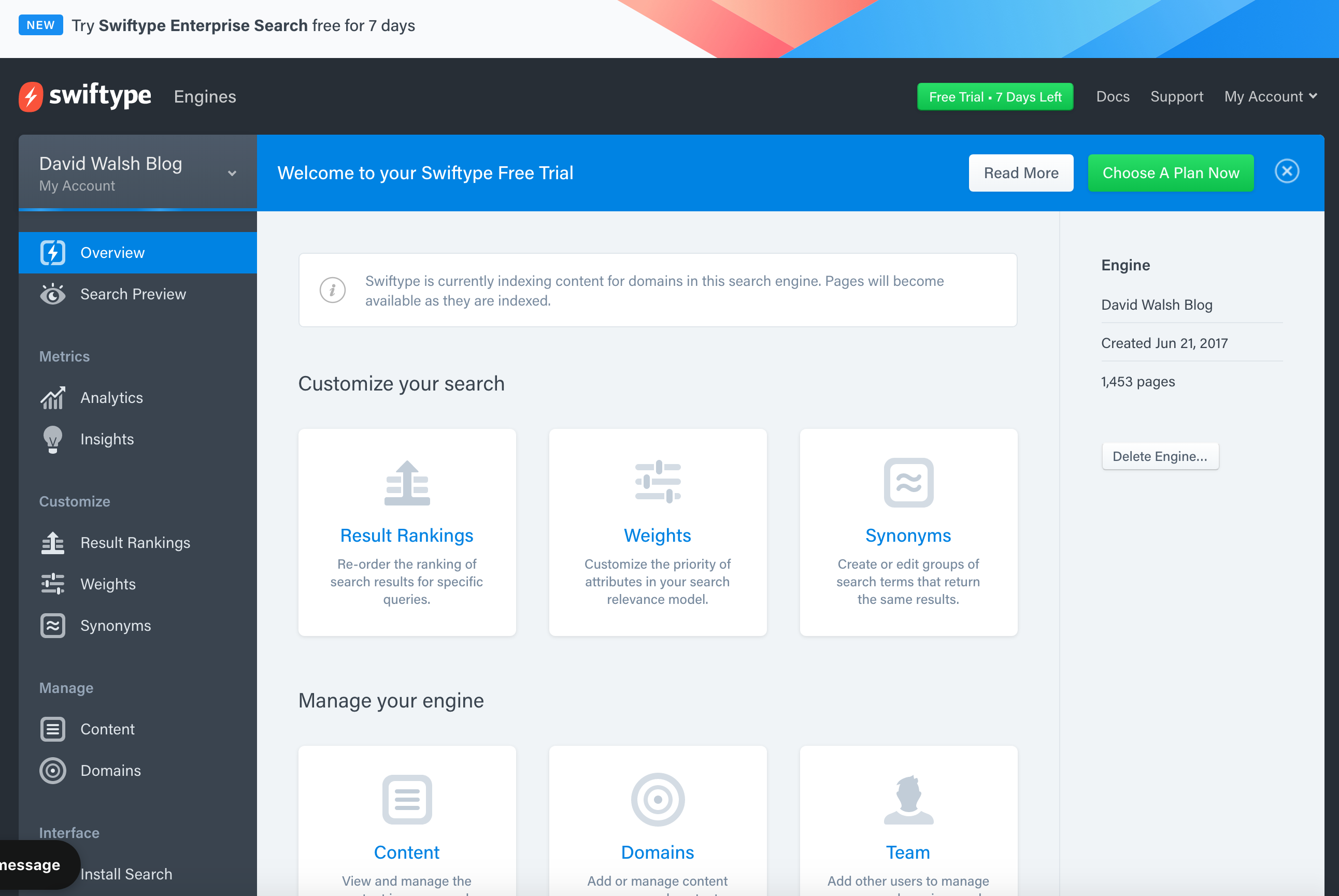
You can preview search results at any time with Search Preview feature. I executed dozens of searches I thought would be popular and was really happy with search result order. There were a few searches, however, where I would prefer one result was a bit higher than another, and that’s where I found the Result Rankings feature very helpful!
Modifying Result Rankings
Swiftype does an excellent job of indexing content and providing the most relevant results but there may be cases where you’d like to manually modifying the order of search results based on keyword. For example, one of my site’s most popular posts is about upgrading Node.js but I’d much, much prefer my post on Using NVM to Manage Node.js Versions showed up first, since the first post provides legacy information. Google Webmaster Tools doesn’t allow me to modify result order so I’m somewhat helpless in correcting the issue on Google, but Swiftype allows me to correct the issue for my own site search:
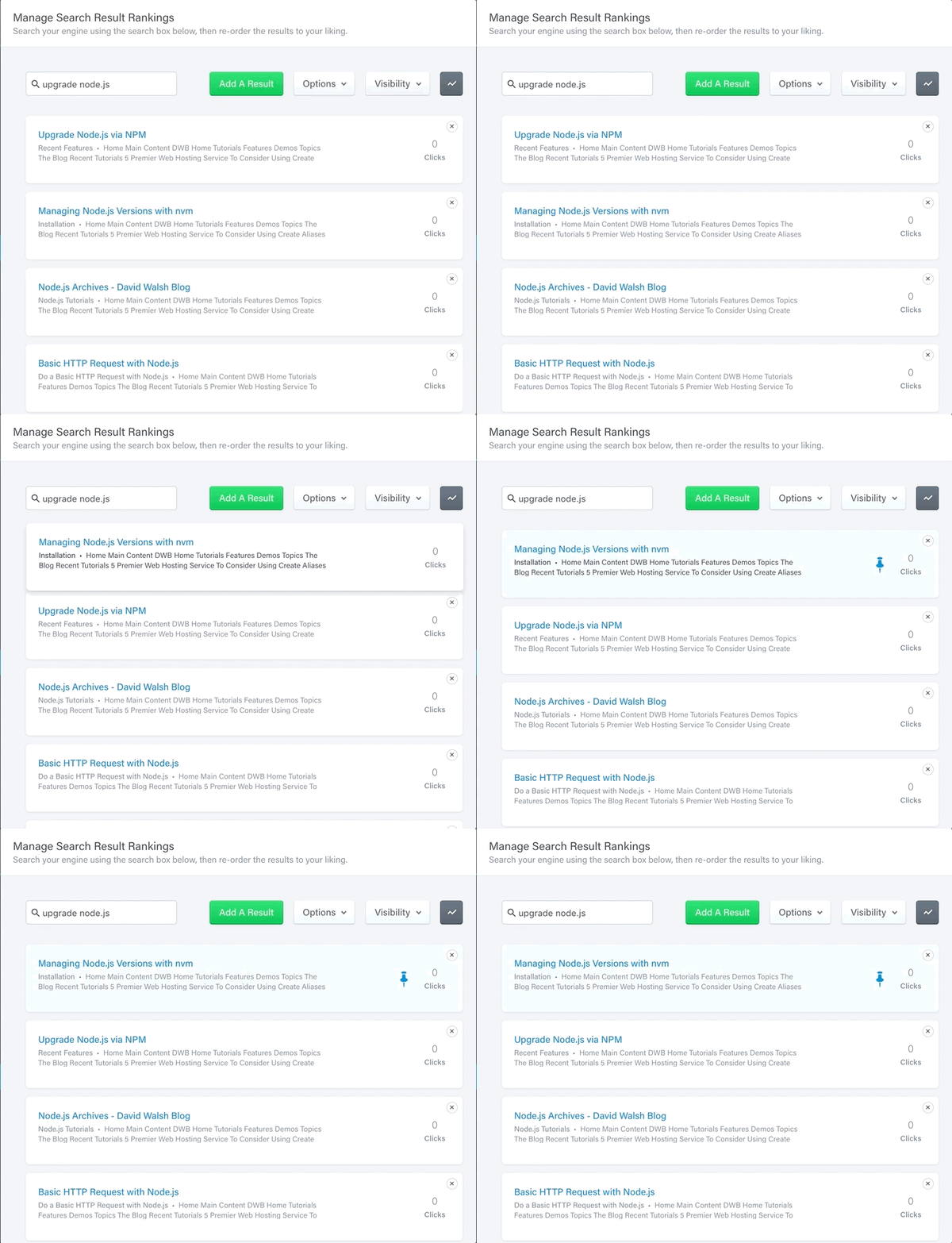
All I need to do is drag and drop the result times and Swiftype remembers the preferred result order. You can provide any warnings or notices on the legacy page but there’s nothing like the user never seeing that page because the preferred search result is first!
Customize Keyword Weights
Since you probably know your content structure better than Swiftype does, Swiftype offers you the ability to experiment with custom weighting of keywords in different sections of the content, including headings, body content, images, etc:

Once you’ve played with the weighting of different aspects of site content, you can preview search results based on those weights. If you find better weighting — awesome! If not it means Swiftype’s done an excellent job with their default weighting system.
Analytics and Conversion Tracking
Analytics and conversion tracking are a huge part of marketing and sales analysis. Google Analytics can provide you with that information but the variable they don’t account for is the ability to custom weight search results as well as the ability to modify search ranking; Swiftype lets you control more of search so that user searches can turn into conversions!

All you have to do is add the conversion tracking code provided by Swiftype and you instantly have conversion tracking!
Enterprise Search
While exploring Swiftype’s capabilities, I found Enterprise Search and was blown away. Web development has gotten so big that we’ve broken off into a number of specialties like ops, front end, back end, and so on. At the same time we’ve started using more specialized web services. There are team tools like HipChat, Slack, and a variety of other tools for text and video communication. We have file storage and hosting services like Google Drive, Dropbox, Box, and Microsoft’s OneDrive. We have so many focused services now, however, that we run info a frequent problem: where the hell do we find anything?
Which service did I upload those files to? What site or git repository had the code and documentation for the API I need to use? Choice is good but it also complicates our ability to find what we need. Swiftype’s enterprise search service allows you to search between multiple external services so you can find what you need faster.
Adding Sources
After you’ve signed up for a free trial account, the next step will be adding “sources” (services to index for search) via Swiftype’s elegant interface. Swiftype offers a bunch of sources for services I use frequently, including GitHub, Dropbox, etc.:

Click on each service to authorize Swiftype (via traditional OAuth which we’re all used to). Swiftype indexes each service to make search for its contents quick and easy!

Adding a Web Crawler
While Swiftype features a number of popular services, if you have any website you’d like to add to your search result pool, you can easily do so using Swiftype’s Web Crawler Source feature. You may want to add your websites, your intranet, a documentation site, or any site for that matter. Simply provide Swiftype the URL to crawl and Swiftype will immediately start indexing the website. I added my website:

Web Crawler sources, much like Swiftype’s preconfigured sources, are synced periodically to ensure the latest content is available for search:

No information other than the base URL is required so adding any website you wish to be indexed is simple and convenient. You don’t even need to be the website owner — you can choose which content providers you believe are trustworthy for yourself, your teammates, and your organization.
Verdict
Both of Swiftype’s awesome offerings, Site Search and Enterprise Search, are really impressive. The amount of control you can take over your own site’s search is amazing; no mystery box of logic or frustration over search result order — you can customize all of that, making the search experience much more effective than Google. I enjoyed using Enterprise Search as well. I was instantly able to search a host of GitHub source, my blog, and Dropbox code samples at the same time; no more wondering which service was hosting the information I wanted.
Instead of rolling your own search or using a lacking free alternative, give Swiftype a shot. I’ve found WordPress’ search underwhelming so I look forward to using Swiftype in my upcoming redesign. Users demand to get to the information they need faster — Swiftype gets them there!
The post Custom, Embeddable Site Search with Swiftype appeared first on David Walsh Blog.

Harajuku Guy in Jean Paul Gaultier Padded Shoulder Blazer, Valentino & Balenciaga
Manaya is a 19-year-old Bunka Fashion College student who we often see around the streets of Harajuku.
Manaya’s look features a wide padded shoulder blazer by Jean Paul Gaultier over a Knave top, UNIQLO skinny jeans and Yosuke USA black leather boots. Accessories include PINNAP Harajuku sunglasses, a Balenciaga belt, a Valentino necktie, and Jouetie patent hand bag.
Follow Manaya on Instagram and Twitter.


Click on any photo to enlarge it.