Shared posts

16 Apr 18:47

The Best Carbon Steel Pan

by Lesley Stockton
Three of the carbon steel frying pans that we tested to find the best, each holding a different kind of metal utensil and cooked food.

It seems like many people are looking for that holy-grail frying pan—one that is nonstick, lightweight, relatively affordable, great at searing, and magically clean at the end of the night. Sadly, that pan doesn’t exist, mainly because washing up is a part of life.

But if those other features appeal to you, and you’re tired of replacing nonstick-coated pans when they go dull, consider getting a carbon steel pan. Of the nine pans we tested, the OXO Obsidian Carbon Steel Frypan with Silicone Sleeve checks all the boxes. (Except for the self-cleaning part—but four out of five isn’t bad, right?)

15 Apr 22:12

Embezzlers Are Nice People (2017)

by VHRanger
12 Apr 03:55

How to Be Less Self-Critical When Perfectionism Is a Trap

by Christina Caron
Perfectionism among young people has skyrocketed, but experts say there are ways to quiet your inner critic.
11 Apr 02:40

Cow Magnets

by Tomte
11 Apr 02:27

Double-entry bookkeeping as a directed graph

by mportela
07 Apr 06:10

A Tidal Wetland Restoration of Epic Proportions

by Nicole Gluckstern

Water may be life, but without salt, the human body cannot retain its benefits. And for thousands of years, a stretch of coastline south of San Francisco has been a vital source of salt. 

The South Bay Salt Ponds, as they’re now known, were once thousands of acres of thriving tidal marsh, which formed a natural barrier against regional flooding and provided an important stopover site for migratory birds and habitat for estuary-dwelling flora and fauna. The Ohlone peoples historically harvested salt from the area’s natural deposits, a resource later exploited first by German immigrant John Johnson in the mid-1800s and then by salt-harvesting companies including Cargill, which still operates in the area. 

Today, saltwater evaporation ponds sprawl across the area, forming a man-made waterscape that resembles an artist’s palette — courtesy of saline-loving microorganisms that give each pond its richly saturated hue.

The post A Tidal Wetland Restoration of Epic Proportions appeared first on Reasons to be Cheerful.

03 Apr 04:54

This Device Saved My House From an Electrical Fire. And You Might Be Able to Get It for Free.

by Grant Clauser
A Ting electricity monitoring device plugged into an electrical wall outlet.

I was in my car, miles from home, when a panicky phone alert shook me out of my NPR haze: An electrical fire hazard had been detected at my house. Immediately I called my wife, who told me the house wasn’t burning. Then I called the number in the alert to determine what it was all about.

The alert came from Ting, an electricity-monitoring service whose device I’d plugged into an outlet a few weeks earlier and almost forgotten about. The Ting agent who answered my call calmed me down a little but also assured me that the device had detected a serious fire hazard. He even told me where the hazard was located and said I should call my utility company right away.

The next morning I had a visit from my electric company. The electrician gave me a skeptical harrumph when I showed him the information on the Ting smartphone app, but he inspected the issue anyway. About 20 minutes later he came back to me, quite surprised, and confirmed that the Ting Sensor had indeed found a big problem. A team returned that day to put a temporary fix on it, and over the next several weeks, contractors dug up my front yard to replace the main power line, at no expense to me.

Dismiss
28 Mar 20:56

Two nights of broken sleep can make people feel years older, finds study

by Brajeshwar
28 Mar 20:52

Bold Tiles in 64 Different Shades

by Gisela Williams
Plus: a Venetian retreat, hand-knotted rugs and more recommendations from T Magazine.
27 Mar 17:44

Daniel Kahneman, Who Plumbed the Psychology of Economics, Dies at 90

by Robert D. Hershey Jr.
He helped pioneer a branch of the field that exposed hard-wired mental biases in people’s economic behavior. The work led to a Nobel.
21 Mar 20:25

Things that don’t work

by dynomight

(Or: Things where there’s a case worth considering that they don’t work all that well for most people.)

  1. Acupuncture. (link)

  2. Phenylephrine. (link)

  3. Multivitamins. (link)

  4. Phosphoric acid. (for nausea; link)

  5. Tree-based knowledge organization. The physical world whispers to us to organize information into “trees”. For example, say you write something on a piece of paper, put the paper into a binder, put the binder into a box, put the box into a closet: OK. But on my computer, I have some folders that look sort of like this: (You’re reading “A”) The problem is, most projects end up needing some writing. And writing often needs some “projecting” like making plots. And sometimes I don’t get paid for stuff I thought I would and usually projects bleed into each other and sometimes I split something I was writing into pieces and I neglect the last piece and it remains in limbo for years. Every level of the hierarchy feels forced and artificial. Maybe there’s a better way, but my guess is that life is just too messy.

  6. Graph-based knowledge organization. If trees are too rigid, why not graphs? Wikis and Zettelkasten systems let you organize information into “nodes” of content that you can link to each other however you want. Some people love these. But I reckon that of those who try them—already a select group—95% quit within a month. I suspect the reason is partly that more flexibility means more decisions and partly that flexibility is a curse as well as a blessing—it allows you to better represent the messy world, yes, but it also makes your representation less predictable and legible.

  7. Elegant mathematical notation. Why write matrix multiplication as Aij = Σk BikCkj with all the ugly indices when you can just write A=BC? Well, what if you wanted to write Xnij = yn Σk BnikCnkj?

  8. Doing math via symbol manipulation. Say you’re trying to prove something. If moving symbols around on the page using some symbol manipulation rules you’ve memorized doesn’t give you the answer within an hour or two, you may have to resort to thinking.

  9. AI methods that don’t leverage computation. (link)

  10. Expecting people to follow written instructions. Sufficiently motivated people will climb any mountain and walk over any length of broken glass. But in most situations, if you send most people written instructions, they simply will not follow them and quite possibly will not even read them. This is true even when instructions are simple and stakes are high, like taking medication.

    I’m not sure why this is true, but it explains the age-old question of, “Why did we have this meeting when it could have been an email?” And if you can follow moderately complicated instructions, that’s almost a minor super-power.

  11. Tearing your hair out because people don’t follow written instructions. You can fill your instructions with BOLD CAPS and rend your garments when this too fails. A more pleasant option is to craft supportive interfaces where people don’t need instructions. I’m convinced the best interface in history is the beginning of Super Mario Brothers. You just start.

    When I first made my MBTI test I had a paragraph of instructions at the top. I never liked how it looked so I kept making it shorter. After 10 revisions I was left with something like “please answer these questions” which I just deleted.

  12. Explaining board games. Here’s how people usually seem to teach board games:

    1. Someone spends 5-30 agonizing minutes explaining how the game works.
    2. No one understands anything.
    3. The game starts.
    4. As each game mechanic arises, people ask, “Hold on, how does this work?”

    You can skip to step 3.

  13. Jokes. Probably less than 1 in 10 people can tell jokes with punchlines. But lots of people can tell funny stories.

  14. Fixing relationship problems by having a baby.

  15. Pulling Out. (link)

  16. Telling people something they think is obvious is actually surprising. If you’d like to fail to convince people that something is non-obvious, here are some of my favorites: (1) that the world is made out of atoms, (2) that sexual reproduction is based on two sexes rather than three, (3) why there are seasons, (4) where the atoms in trees come from, (5) that 80 years after their invention nuclear weapons would remain really hard to make.

  17. Arguing with people. Say Alice strongly believes X. You give devastating evidence that X is in false. How often will Alice turn around and say, “You’re right, I’m wrong, X is wrong.”?

    Words do not exist that will make people do that. (Aside from a few weirdos who’ve intentionally cultivated the habit.) But if you make a good case and leave her some room for retreat, you may find that Alice’s position is a bit softer the next time X comes up in conversation.

  18. Subsidizing undesired behavior. Say you’re waiting at a busy intersection and someone walks between the lanes of cars asking for money, putting themselves at risk and blocking traffic for a bit after the light turns green. If you give them money, it’s unlikely this will convince them they should stop doing this.

  19. Doing unto others as you would have them do unto you. This is a beautiful idea, but often other people simply don’t have the same needs you do.

  20. Making sense of interactions with crazy people.

  21. Wanting to be liked.

  22. Getting closure with your parents for how you were treated as a child.

  23. Thinking about your life like a movie. Most good lives don’t have compelling plots and almost all of them have bad endings.

  24. Saying the right thing. When someone you care about is in crisis, you may not know what to say. But don’t let that stop you. You don’t have to find the right words. No one expects you to. Probably they don’t exist.

  25. Warby Parker Multiverse. (Apparently)

  26. Communism.

  27. Picking stocks. You don’t just have to beat the market, you also have to beat all the extra taxes you pay for trading more. You may ask—what about hedge funds? Don’t they beat the market? Sure, but think about where their margin comes from.

  28. Counting calories. Say your weight is stable and you start eating a single extra piece of sandwich bread every day. After a year, you’ll gain 3.8 kg (8.3 lb) of fat. Almost no one counts calories that accurately.

  29. Dieting. In some sense, dieting works great. As far as I can tell, you can lose weight by following any diet, be it carnivore, vegan, Mediterranean, low-fat, low-carb, low-protein, potato, grapefruit, or baby food. The simplest explanation is that you eat less when you have fewer food options. But when you go back to having lots of options, you eat more again and gain all the weight back. The only way to lose weight permanently is to permanently change your food environment. Or, you know, drugs.

  30. Nonfiction books. Arguably? How much do we really retain?

  31. Waiting. Most people in history never had any forks in their road. “Following your dreams” was such an alien concept that it wouldn’t occur to anyone to be upset for not being able to do it. I suspect this wasn’t all that bad. (Sea otter dreams range from “eat some good gastropods” to “eat some good echinoderms” and they sure look happy.) That said, if you really want to do something, don’t wait for some unspecified time when it’s more convenient and then watch that time recede before you.

  32. Quality over quantity. I often worry that I write too much on this blog. After all, the world has a lot of text. Does it need more? Shouldn’t I pick some small number of essays and really perfect them?

    Arguably, no. You’ve perhaps heard of the pottery class where students graded on quantity produced more quality than those graded on quality. (It was actually a photography class.) For scientists, the best predictor of having a highly cited paper is just writing lots of papers. As I write these words, I have no idea if any of this is good and I try not to think about it.

  33. Solving supply shortages with consumption subsidies. Say rent is expensive and the government gives everyone a $500/month rent voucher. What happens? Well, why is rent expensive? If people really want to live somewhere, they keep bidding with each other until the price hurts enough that some give up and live elsewhere. The subsidy shifts the “hurt curve” $500 to the right. Unless it’s possible to make new buildings, most of the money will just end up in the pockets of landlords.

  34. Religion without the G word. (link)

  35. Rewriting your code from scratch. Your code is a horror, but if you start over maybe you can avoid all the mistakes. Many claim this is a fantasy—you’ll just make new mistakes and create a different kind of horror. Better to just improve what you have.

  36. Trying to figure it all out ahead of time. For hard problems, you can sit around trying to see around all corners and anticipate all possibilities. This can work—when Apollo 11 landed on the moon, everything worked the first time. But it’s really hard. If you can, it’s easier to build a prototype, learn from the flaws, and then build another one. (This, of course, contradicts the previous point.)

  37. Algorithmic ranking. Arguably?

  38. Chimpanzees as pets.

  39. Controlling for a variable. (link)

  40. Controlling for a variable. (link)

  41. Controlling for a variable. (link)

  42. Controlling for a variable. (link)

  43. Controlling for a variable. (link)

Things that work: Dogs, vegetables, index funds, jogging, sleep, lists, learning to cook, drinking less alcohol, surrounding yourself with people you trust and admire.

18 Mar 04:57

Vancouver’s new mega-development is big, ambitious and Indigenous

by luu
15 Mar 19:51

The Perks of Virtual Coworking With Strangers

by Anna Patton

From a young age, Alexis Haselberger’s son always asked someone to stick around when he needed to get chores or homework done. At first, she wondered why he needed help.

“Then I realized that he didn’t need me to engage with him, he just needed to know that my body was there,” says Haselberger, a time management and productivity coach in San Francisco. 

Though they were not initially aware of it, Haselberger and her son were practicing “body doubling,” which involves having someone alongside to help you focus on a task. The term was first coined in the 1990s by a coach specializing in attention deficit hyperactivity disorder (ADHD). Haselberger’s now-13-year-old son has not been diagnosed with ADHD, but he continues to find body doubling helpful. So does Haselberger, who does have ADHD. She asks her husband to be around while she completes certain tasks, and she organizes regular video calls with work peers to make progress on “important but not urgent” goals. They start by sharing objectives, then switch off cameras and focus for an hour. 

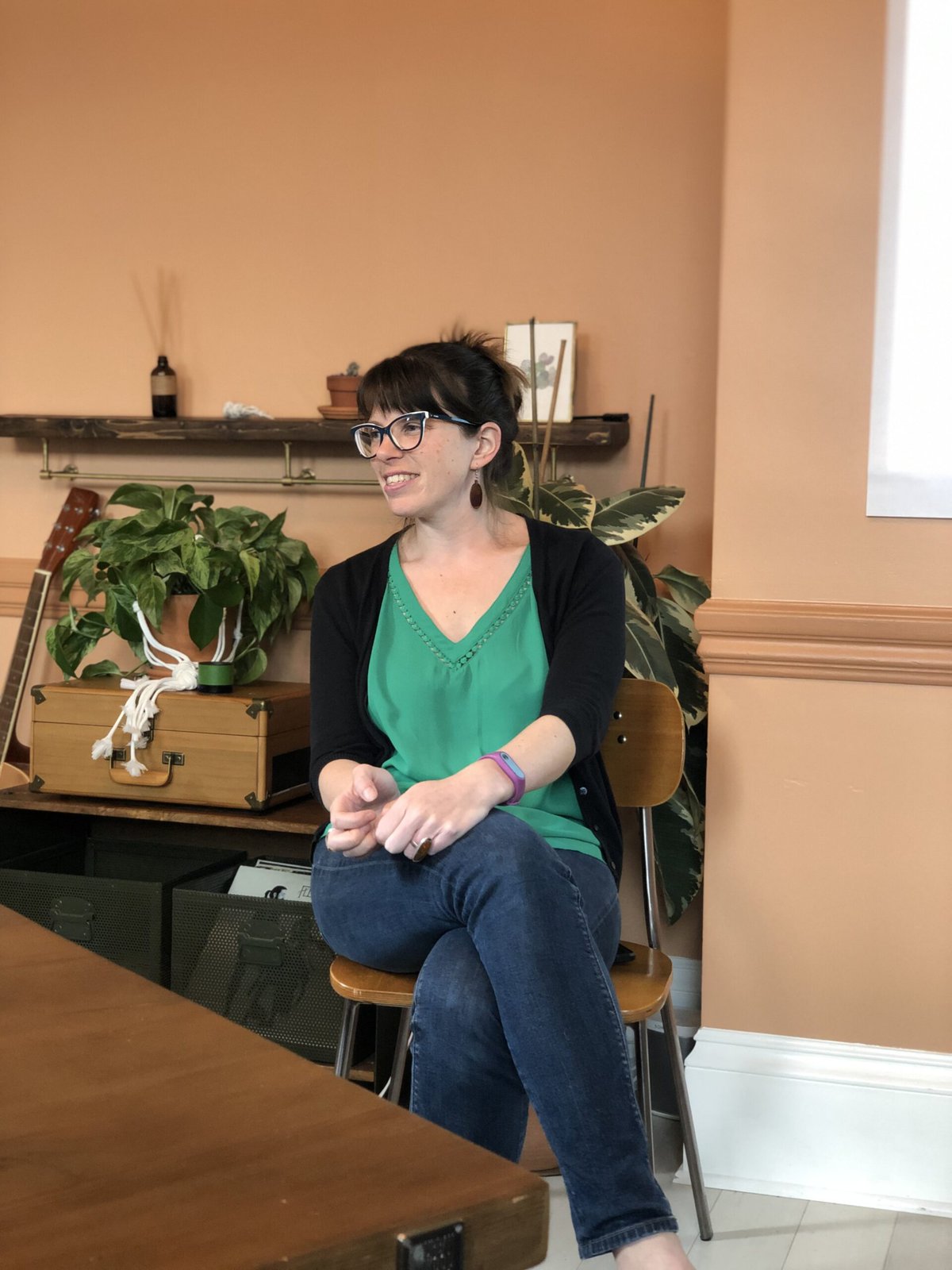
Alexis Haselberger sitting in a chair at a table, about to speak.
Alexis Haselberger began practicing body doubling before she knew the term. Courtesy of Alexis Haselberger

Video calls like these are part of a growing trend: structured online sessions, in groups or in pairs, for anyone who wants to resist distractions and get things done.

In focus

The exact cause of ADHD, which affects an estimated five to eight percent of children globally and often continues into adulthood, is unknown. Among adults, it can create problems with time management, following instructions, and focusing or completing tasks. Although more commonly diagnosed in children, diagnoses are rising rapidly among adults in some countries, particularly among women.  

Kirsty Baggs-Morgan, 50, who lives in Malta and runs a business supporting HR professionals, describes herself as “an absolute shocker” for delaying boring tasks until the last minute. For a while, she would ask her assistant to join her on a call when she needed to complete a task, “but we’d end up just chatting for the whole hour.” 

Crushed by negative news?

Sign up for the Reasons to be Cheerful newsletter.
[contact-form-7]

That changed with Baggs-Morgan’s ADHD diagnosis in August 2023. A coach recommended Flow Club, a company that hosts “virtual coworking sessions designed to drop you into productive flow.” As in Haselberger’s video calls, participants join a session and share their intentions, then get on with their work until the allotted time is up. In addition to multiple daily sessions, Flow Club users benefit from a supportive community — well over half of users are neurodivergent — and special features to aid focus, such as optional music and the choice of verbal or non-verbal sessions. 

Already, Baggs-Morgan has racked up well over 130 Flow Club sessions — often while sitting in a physical coworking space. “For me it’s been an absolute game-changer,” she says. While the physical community provides real-life interaction, the online one helps her to get work done, and even to stick to a regular morning routine. “I like step-by-step instructions. I’ll actually do it because it’s written down,” she says, referring to the to-do list that every participant fills in at the start of a session. Other users might be doing anything from decluttering to writing a book — Baggs-Morgan even recalls someone using a session to take a nap.

Kirsty Baggs-Morgan sits at her computer.
Kirsty Baggs-Morgan often participates in online coworking sessions while also in a physical coworking space. Credit: Andreea Tufescu

Focusmate is similar to Flow Club, but puts users into pairs instead of groups. It was founded in 2016 by Taylor Jacobson, who had long fought procrastination himself. In 2011, he asked to work remotely — “and then I got fired from my job,” he explains, “because I just could not focus.” When he later got into coaching, he discovered the power of virtual coworking, and was convinced it could help millions of others like him.

Focusmate has now hosted over five million sessions, with users in over 150 countries. Like Flow Club, it was not designed with neurodivergence in mind (nor was Jacobson initially aware of the concept of body doubling), although more than a third of current users identify as neurodivergent and about 28 percent have an ADHD diagnosis. And while Focusmate is billed as being for “anyone who wants to get things done,” Jacobson suggests its value is much deeper, as he knows from experience: “When we say procrastination… you’re not living the life you want to live. ‘Procrastination’ sounds kind of trite, but it’s not. It’s really demoralizing and sad.” 

Feedback from Focusmate users backs that up, Jacobson says: “It’s insane how life-changing this is for people.” A recent company survey among 212 regular users with ADHD found that their productivity increased by an average of 152 percent. Ninety-eight percent said Focusmate helped them make good use of their time, 82 percent that it helped them feel less lonely and isolated, and 88 percent that it improved their well-being. Flow Club does not have data specific to ADHD users, but co-founder Ricky Yean points to its “exuberant” testimonials and the fact that users attend an average of 10 to 11 sessions weekly.  

CEO of the brain

Joining strangers online to get work done has become increasingly common, particularly since the Covid-19 pandemic. Caveday and Flown offer virtual coworking for anyone; other services target particular audiences, like Writers’ Hour or Preacher’s Block. Online “study rooms” for students are also widespread. 

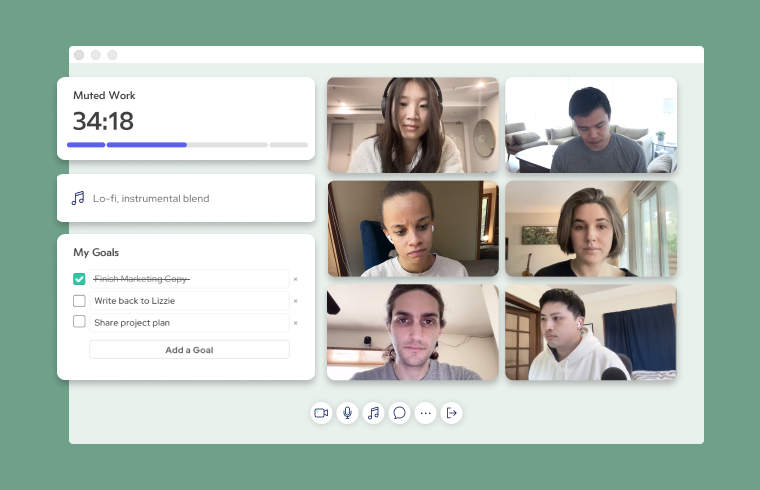
Screenshot of a Flow Club session.
Flow Club sessions include features to aid focus, such as optional music and goal lists. Credit: Flow Club

But why do they work? Focusmate cites research on the benefit of “precommitment” and social pressure. Yean points out that even brief social interactions unleash dopamine, which drives motivation (dopamine levels can be lower among people with ADHD). Other research finds that we may change behavior when we know we’re being observed, that company can have a calming effect, and that our performance improves when we train alongside others.

For Haselberger, joining a body doubling session provides that small but important push to get started. “We know from the research that action begets motivation, and not the other way around,” she says. “If you are body doubling, then you’re saying, ‘Okay, I’m going to do this thing.’” 

Zareen Ali, the London-based co-founder of Cogs, a mental well-being app for neurodiverse people, suggests body doubling is a way of outsourcing the “CEO of the brain” — the part that’s telling you what to do. “Having someone else take on that role acts as an external motivator,” says Ali. 

Belonging matters

For neurodivergent people, there’s also the benefit of feeling less judged. Neurodivergent young people still face “a lot of bullying,” notes Ali, who studied educational neuroscience, and they often value peer support.

Kirsty Holden, 37, echoes the importance of finding like-minded people. She is awaiting an ADHD diagnosis, following years of feeling that something wasn’t right. “I grew up not really feeling a part of anything,” she says. 

Become a sustaining member today!

Join the Reasons to be Cheerful community by supporting our nonprofit publication and giving what you can.

Join

Holden, an online business manager based in Yorkshire, England, was not tempted by platforms like Focusmate or Flow Club, but joined the ADHD Business Collective, a coach-led program that includes body doubling sessions. She values the personal element: “Just knowing that those people get me and know my name… that’s what I really like.”

“For a lot of ADHD-ers, we haven’t felt safe to share what is going on in our minds,” Holden adds. But that is changing. “There are people out there that understand this, there are places where we belong.”

More scaffolding

Online body doubling is unlikely to work for everyone. Neurodiversity is “a massive, umbrella term,” Ali points out, and even people with the same diagnosis may be very different. She herself is autistic and finds body doubling distracting.

One of the barriers highlighted by both Focusmate and Flow Club is apprehension about meeting new people. Asking for a body double might also feel like admitting you need help, says Jacobson. Users of both platforms are majority women; Yean wonders if men find it harder to show some vulnerability.

FlowClub founders David Tran and Ricky Yean sitting on cement steps.
Flow Club founders David Tran and Ricky Yean. Credit: Flow Club

Things have come a long way since the pandemic-prompted surge of remote working. Tools like Zoom expanded what was possible, but there was a lack of tech to properly support new ways of working, says Yean. People were “burning out like crazy” as they struggled with more responsibilities than ever and blurred boundaries between work and personal life.

“We went from ‘we can’t’ to ‘we can,’ but that’s such a low bar!” says Yean. “Are we thriving? Are we happy? … And are we able to manage all this?”

Flow Club — which aims to create a space of positivity and friendliness — is “in our little corner of the internet, which is trying to create a little bit more support, a little bit more scaffolding, a little bit more camaraderie with other people who share your mission or share your goals,” Yean continues. “I think we have learned that there’s ample opportunity to create more of these types of spaces that are much more supportive. And I think you can define ‘supportive’ in so many different ways.”

The post The Perks of Virtual Coworking With Strangers appeared first on Reasons to be Cheerful.

12 Mar 16:06

What to Know About Islamic, Muslim, Halal, Sharia-Compliant Investing

by The White Coat Investor

By Dr. Jim Dahle, WCI Founder

I am not Muslim, I do not speak Arabic, and I am certainly no expert on the Quran or Islamic investing. I have only spent five months of my life in a Muslim country, and I'm not sure I actually spoke to a single Muslim while I was there, locked down on one-quarter of a square mile on an Air Force base. Thus, there's a decent chance of an error somewhere in this post (which I'm sure will be rapidly corrected in the comments below).

However, this post about Halal investing is in response to a question I have been receiving regularly from white coat investors for years. I thought it was time to get something up on the blog about it. Even if you are not Muslim, you can hopefully find something interesting to take away from this post. As always, take what you find useful and leave the rest.


What Is Halal Investing?

Before we get too far, let's start with some definitions.

  • Islam—Religion of the Muslims, a monotheistic faith regarded as revealed through Muhammed as the prophet of Allah
  • Islamic—Relating to Islam
  • Muslim—As a noun, a follower of Islam. As an adjective, relating to Muslims or their religion.
  • Sharia—A set of Islamic religious laws that governs aspects of day-to-day life for Muslims in addition to religious rituals.
  • Halal—Permissible, compliant with Islamic law
  • Haram—Forbidden or proscribed by Islamic law
  • Riba—To increase or exceed, referring to unequal exchanges or charges for borrowing—effectively interest, the paying or charging of which is considered a sin in Islam
  • Maisir—Speculation or gambling, also considered a sin in Islam
  • Sukuk—A Sharia-complaint bond-like instrument, aka “Islamic bonds”
  • Zakat—An obligatory payment made annually under Islamic law on certain kinds of property and used for religious purposes, somewhat equivalent to “tithing” for Christians
  • Sadaqah—A non-obligatory religious payment, somewhat equivalent to “offerings” for Christians
  • Murabaha—The practice of paying (more) over time instead of paying interest

Whether you want to call it Islamic investing, Sharia investing, Sharia-compliant investing, or Halal investing, we're talking about the same thing here.


What Does the Quran Say About Investment?

What does Islam have to do with investing? Lots of religions are anti-debt, but none of them take it to the extreme that Islam does. The longest verse in the Quran is about debt:

“When you contract a debt for a stated term, put it down in writing . . . let the debtor dictate, and let him fear God, his Lord, and not diminish [the debt] at all. Call in two men as witnesses . . . Do not disdain to write the debt down, be it small or large, along with the time it falls due: this way is more equitable in God’s eyes, more reliable as testimony, and more likely to prevent doubts arising between you.” (2:282)

Another verse says:

“Allah will deprive usury of all blessing, but will give increase for deeds of charity.” (2:276)

More significantly, the prophet Muhammad said:

“If a man was killed in battle for the sake of Allah, then brought back to life and he owed a debt, he would not enter Paradise until his debt was paid off.”

“A dirham of Riba (interest) knowingly taken by a man is a sin worse than committing Zina (fornication) 36 times.”

Basically, devout Muslims don't do debt. They don't lend. They don't borrow. This wasn't too big of a deal until modern times. Most people didn't have much to do with debt until the last couple of centuries. However, in our modern financial world, avoiding debt and the interest that goes with it is becoming more and more difficult each year.

med school scholarship sponsor

Devout Muslims find ways around it as best they can. For instance, they use “Islamic mortgages” to buy a house. You're not borrowing to buy that house; you're just paying more for it on an installment plan. No interest is involved. Semantics? Maybe. But it matters to them, so it matters to me. Paying for an expensive education such as medical or dental school can also be problematic, given that three-fourths of doctors graduate with student loans. It turns a lot of devout Muslims away from an expensive education, while others are lucky enough to have a well-to-do family member, obtain scholarships, or get money from riba-free charities. Or some just feel terribly guilty for a few years.


How Devout Are You? 

In every religion, some people are more devout than others. Among Christians, some view a tithe as a strict mandatory contribution of 10% of everything they earn while others view it as any donation made to a church or even a non-church organization. Huge variation. There is some variation among Muslims as well. While all view interest as a bad thing, some might simply try to minimize it by borrowing as little as possible and paying it back as quickly as they can. Perhaps they stay away entirely from fixed-income investments like bonds and CDs, but they're OK with stocks, even for companies that carry debt or charge interest.

If you are a Muslim interested in investing, the first question I would ask is how strongly you feel about avoiding riba. If the answer is not that strongly, you have lots of options. If you are particularly devout on this point, your options will be much more limited.

More information here:

How Much Should I Tithe to My Church?

How to Give Away Money Better (Instead of Tithing)


What Is Sharia-Compliant or Halal Investing?

Sharia-compliant or Halal investing is simply investing in a way that is compliant with the laws and rules of Islam. That primarily means that you are not receiving riba.


What Is Riba?

Riba is interest. Technically, it refers to an unequal exchange, but the English word for what is being referred to is interest or, perhaps more negatively, usury. Accepting it is a more severe sin than fornication, according to the writings of the Prophet. Riba is generally forbidden in Islamic finance. That rules out most interest-bearing investments, including CDs, Treasury bills, bonds, savings accounts, money market funds, bond funds, preferred stock, convertible bonds, and the mutual funds that invest in these asset classes. There are alternatives to these low-risk investments that are acceptable to Muslims, including Islamic bank deposits and sukuk.


What Is Maisir (Maysir)?

Maisir is speculation or gambling. Maisir is forbidden in Islamic finance because it creates wealth from chance rather than productive activity. Sharia does not, however, prohibit the ordinary commercial speculation involved in a business enterprise, because commercial risk-taking is an integral part of Islamic finance transactions. Because of the prohibition against maisir, certain financial products—such as options, futures, and other derivatives—are not generally used in Islamic finance. A widely viewed exception is owning (not trading) stock options in a company that employs you.


Halal Investing Definition

Halal investing requires investment decisions to be made in accordance with Islamic principles. As a faith-based approach to investment management, investors often consider Halal investing to be a category of ethical or socially responsible investing.

Islamic sharia compliant finance


Islamic Investing Principles

Practically speaking, four things are prohibited when it comes to investing in a Sharia-complaint way:

  1. Bonds and other interest-based investments (riba)
  2. Stocks in companies with high debt
  3. Stocks in companies in industries that do not adhere to Islamic principles, such as liquor, gambling, pornography, pork, insurance, and banks
  4. Derivatives such as options and futures (maisir)

Even Halal stocks may require you to pay “purification dues.” Essentially, you give the impure income away to charity. Typically, if a stock has less than 5% of its income from “impermissible sources,” it is considered OK to invest in, but you still have to pay purification dues on that impermissible income. If the dividend is 2% and 3% of the income is from impermissible sources, you would need to donate 2% * 3 % = 0.06% to charity. Interestingly, you don't have to pay purification dues on capital gains.


What Makes an Investment Halal?

There is obviously a lot of gray area here. However, the Accounting and Auditing Organization for Islamic Financial Institutions (AAOIFI) was founded in 1990 to bring together Islamic scholars with extensive backgrounds in finance and transactions to issue some guidelines. The scholars are from all over the world and from different schools of thought. Their guidelines can help the individual Muslim decide if their investments are Halal. Don't worry, the guidelines are only 1,264 pages long. They deal with everything from the trading of currencies, commodities, commercial paper, Islamic insurance, the conversion of a traditional bank to an Islamic one, and earnest money. If you're looking for a comprehensive source of what's OK and what isn't, this is it. There's plenty of interesting stuff, such as the fact that Muslim financial professionals are required to be fiduciaries.

 

Shariah fiduciary


AAOIFI is not the only regulatory body. For instance, the “Shariah Advisory Council of Securities Commission Malaysia” announces when stocks are no longer Halal. If you sell these newly forbidden stocks right away, you get to keep your capital gains. If you wait, any additional gains are to be given to charity. Interestingly, if you're underwater when the stock becomes non-Halal, you are allowed to hold on to it until its share price gets back to what you paid for it.


Achieving Sharia Compliance

There are obviously a lot of rules to follow when the guidelines are 1,264 pages long. You can get help, though. In fact, CIMA (Certified Investment Management Analysts) offered four certificates in Islamic finance:

  • Islamic commercial law
  • Banking and Takaful
  • Islamic capital markets and instruments
  • Accounting for Islamic financial institutions

It might be worth it to you to hire a qualified advisor to help you maintain compliance with Sharia. No, I don't have a list, but CIMA might.


Difficulties in Islamic Investing

If you thought it was tough getting through medical school while remaining compliant, it doesn't get much easier once you are out and start investing for your future. The vast majority of investments out there are not Halal. If this all feels very hard to you, you're not alone. In fact, the whole concept behind Islamic finance and investing is a little murky. It has been criticized by Muslims and non-Muslims alike.

Even some Islamic financial scholars say the majority of Islamic banking and Islamic bonds are un-Islamic, and if that's what those who know it best are saying, what is the average Muslim to do? Do you just go by the labels and call it good? Do you have a responsibility to dig deeper? Is it even possible in today's world to be fully Sharia-compliant AND be a successful investor? How do you maintain diversification, keep costs down, and achieve excellent returns while also having to comply with 1,264 pages of guidelines and contradictory recommendations from authorities? Can you invest “normally” and just pay a little extra purification tax, Zakat, and Sadaqah to make up for it?

More information here:

Faith, Family, and Finances with Rogue Dad, MD

What the Bible Can Teach You About Money


Best Halal Investment Options

Let's review again what most think is OK and what most think is not OK.
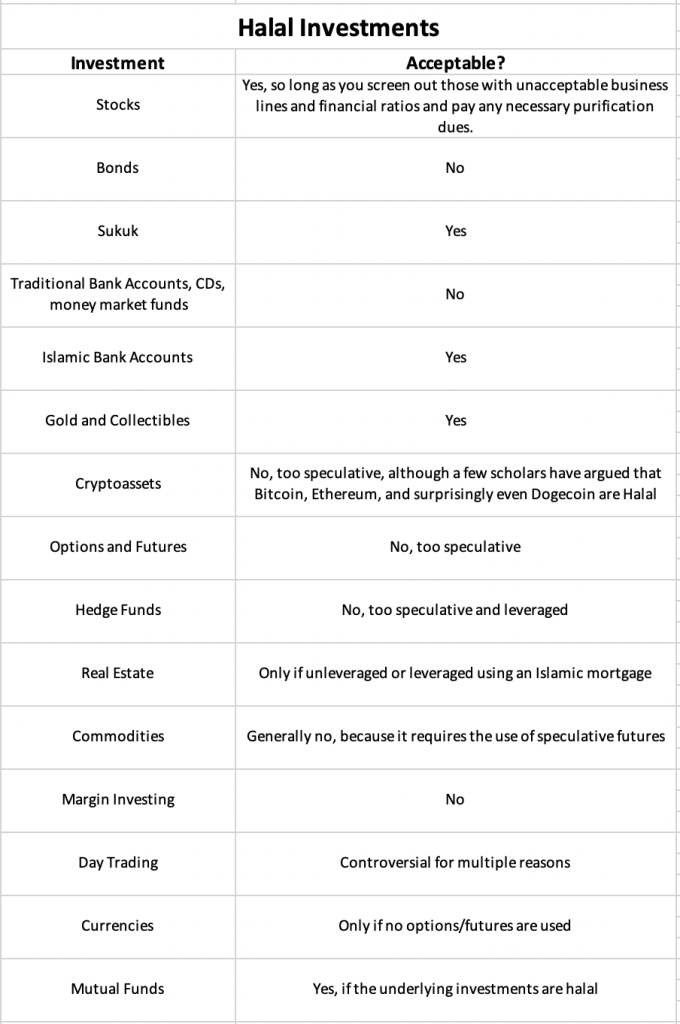
 

Halal Investments


What can you do? Here are your best options.


#1 Islamic Mutual Funds and ETFs

There are lots of Muslims in the world, and Wall Street wants to sell them investments just as much as anyone else. So, investments are designed to meet their needs. They're not always the best investments and they are rarely the cheapest, but that's the price you pay to get exactly what you want. It's a bit like Environmental, Social, Governance (ESG) investing. Higher expense ratios and generally lower performance. There is also a lot of overlap between these funds, and they tend to be pretty tech-heavy. Just as tech stocks seem to do well on ESG measures, they also tend to do well on Sharia measures. But there are a lot more funds than there used to be. Here are some funds to consider:

iShares is the one that jumps right out at me, but when I look at the Islamic US stocks ETF up there, I see that it charges 0.3%, contains only 125 stocks, and has over 20% of the portfolio in Microsoft. By comparison, VTI charges 0.03%, contains 3,941 stocks, and has < 5% of the fund in Microsoft. Performance-wise, the Islamic ETF has done just fine (better than both VTI and VUG over the last five years), but the track record isn't long.

I was very surprised to see a REIT ETF (SPRE) on this list. It seems to contain many of the typical big REITs, which I'm sure are using plenty of conventional leverage/mortgages. I'm not really sure how that is Sharia-compliant, given that its top holding is 43% leveraged. I wasn't surprised to see an expense ratio of 0.69, about six times as high as the Vanguard REIT Index ETF. Again, the track record is very short. VNQ outperformed SPRE by 3 percentage points in 2022, and though SPRE was ahead by a few percentage points in the first three quarters of 2023, VNQ outperformed SPRE by the end of the year.


#2 Pick Individual Stocks

I'm not a big fan of individual stocks, but if your definition of a Sharia-compliant stock is different from that of a mutual fund manager, you can build your own. There are lists of Sharia-compliant stock out there that you can use.


#3 Invest in Direct Real Estate

Whether you use an Islamic mortgage or none at all, direct real estate can be a great investment. It is going to be tough to find a syndication or fund that uses Islamic mortgages, though.


What About Workplace Retirement Accounts?

What if your employer offers you a 401(k), 403(b), or 457(b) that doesn't have any of these Islamic funds or ETFs in it? First, check to see if there is a “brokerage window” option, such as the Schwab PCRA in the 401(k). If there is, you should be able to just buy whatever ETF or stocks you please there. If not, I would suggest lobbying HR to add an Islamic fund or two. It might help if you suggest they are breaching their fiduciary duty by not providing that sort of investment, but I don't know that you would have a strong case to sue since most 401(k)s do not offer these new and untested funds. It might work better to argue that they are discriminating against you because of your religion. If they won't change the 401(k), you might just be out of luck. You will miss out on that asset protection, tax-protected growth, and possibly even the employer match.


Islamic finance is relatively new. However, it is becoming easier and easier every year to ensure your investments are aligned with your religion.

What do you think? Is your portfolio Sharia-compliant? What's in it? How difficult is it to maintain? Comment below!

The post What to Know About Islamic, Muslim, Halal, Sharia-Compliant Investing appeared first on The White Coat Investor - Investing & Personal Finance for Doctors.

08 Mar 00:26

It Was Like the Vigor Had Suddenly Been Sucked Out of His Body. What Was It?

by Lisa Sanders, M.D.
The 70-year-old man rapidly went from walking 10 to 15 miles a day to being nearly helpless. His wife wondered if he’d had a stroke.
06 Mar 22:07

I spend £8,500 a year to live on a train

by surprisetalk
04 Mar 18:55

Lampang: a Thai City With Charm and Without the Crowds

by Patrick Scott
Centuries-old wooden temples, a graceful river and an unexpected chicken fixation make Lampang, in Northern Thailand, a delightful destination away from the crowds.
27 Feb 20:02

A Doctor’s Lifelong Quest to Solve One of Pediatric Medicine’s Greatest Mysteries

by Emily Baumgaertner and Ariana Drehsler
For 40 years, Dr. Jane Burns has been working to find the cause of Kawasaki disease, an illness that can lead to aneurysms and heart attacks. Her work has brought together a most unlikely team.
23 Feb 06:15

Niklaus Wirth, Visionary Software Architect, Dies at 89

by Michael S. Rosenwald
Pascal, the programming language he created in the early days of personal computing, offered a simpler alternative to other languages in use at the time.
21 Feb 22:27

Study of Patients With a Chronic Fatigue Condition May Offer Clues to Long Covid

by Pam Belluck
N.I.H. researchers found notable differences between the immune systems and other physiological functions of patients with ME/CFS and those of healthy patients.
14 Feb 22:44

Braving the Winter to Visit a Valley Shrouded in Snow and Secrets

by Showkat Nanda
Compelled by stories he’d heard as a child, the photographer Showkat Nanda traveled to the high Himalayas to see Gurez, a valley long off-limits to most travelers.
08 Feb 18:51

He Had Severe Heartburn. Could His Trouble With Balance Be Related?

by Lisa Sanders, M.D.
His mouth always tasted like metal and he vomited several times a week. Nothing seemed to help. Then his sister got him the help he needed.
07 Feb 18:53

A Two-Ton Lifeguard That Saved a Young Pup

by Darren Incorvaia
In an unlikely act of altruism observed two years ago, a male elephant seal prevented a younger animal from drowning.
05 Feb 21:51

Gödel, Escher, Bach is the most influential book in my life (2022)

by drcwpl
05 Feb 18:47

Why Some Therapists Are Taking Their Clients Outdoors

by Christina Caron
Mental health practitioners are hiking, camping and braving the elements with their clients — all in an effort to help them connect with the Earth, and with themselves.
05 Feb 18:39

Touring Ghana’s Growing Arts Scene

by Grace Linden
A globalized art market has brought attention to Ghanaian artists like Ibrahim Mahama. On an arts-focused trip to the West African country, a writer finds a thriving scene following its own agenda.
02 Feb 00:51

Why Do Women Have More Autoimmune Diseases? Study Points to X Chromosome

by Carl Zimmer
The molecules that silence a woman’s second X chromosome can confuse the immune system, a new study suggests.
27 Jan 02:19

Fast Radio Bursts

Dr. Petroff has also shown that the Higgs boson signal was actually sparks from someone microwaving grapes, the EHT black hole photo was a frozen bagel someone left in too long, and the LIGO detection was just someone slamming the microwave door too hard.
23 Jan 19:40

Make Money Decisions Like You’re 70

by Chris Reining

I walked into a tattoo shop down the street to get my first tattoo. It was going to say memento mori. In latin: “Remember you will die.” It’d be a permanent reminder that time is precious.

Nobody working in the shop says anything to me. I sit down and start leafing through those books of ready-made tattoos.

Tattoo machines are buzzing away in the background, laying down lines of permanent ink, and...

KEEP READING

23 Jan 01:02

Arno A. Penzias, 90, Dies; Nobel Physicist Confirmed Big Bang Theory

by Katie Hafner
His 1964 discovery with Robert W. Wilson settled a debate over the origin and evolution of the universe.