R.P. Aditya
Shared posts
Fulfilled: More Women in Their 60s and 70s Are Having ‘Way Too Much Fun’ to Retire
What It's Really Like to Live in a 'Dorm for Adults'
I’m a 31-year-old female, and I live in what’s billed as a “hacker house”—a large home on the edge of Lake Union in Seattle, designed to accommodate up to 18 residents at once. Though the name implies a house full of young tech workers, those “disruptor” types really only flood in during the summer, when the local tech giants run internship programs. Right now, everyone on this floor is a graduate student, and all except myself are from elsewhere—some as far away as Argentina and Estonia.
Essays
Urban life, in the first person
Many of my roommates stick around for a year or more, and are exploring new ways to innovate—whether that's artistic, in the sciences, or like myself, in journalism.
The roommate routine is different at 31 than it is a decade earlier. Our setup isn’t quite like a college dorm. We only have a couple of rules: Do your own dishes, alert the "house manager" (essentially a peer version of a college resident advisor) if a toilet gets clogged. Our cohort of 30-somethings is typically in bed by 10 p.m. and out of the house by 7 a.m. We don’t throw ragers that annoy the neighbors. Around 8 p.m. on a Monday night, four of my five housemates were gathered around desks in what would likely be a living room of our sprawling, six-bedroom house. We were cracking away at homework or fellowship applications, blasting a playlist of ‘90s ballads.
I moved in near the end of 2016, soon after I split with my then-husband. I was trying to get back into the swing of freelancing, and I didn’t have much income. I needed something closer to the city—I had been living 2 hours south—and a space that allowed me to easily connect with others who were like-minded. My room is tiny—about 10 feet by 10 feet (I can touch the bed and wall at the same time!)—and outfitted with bunk beds. I was a little wary of sharing it with a stranger, but I have it to myself for now since demand lags in the winter.
The reasons for wanting to move into a setup like this are pretty obvious: Shared living situations are a good option for people in areas where cost of living is rising faster than salaries, says Shauna Causey, a local real estate investor.
This cuts across professions. Take teachers, for instance. They often “can’t afford to live near where they work,” Causey says. “They’re being priced out.” In general, Millennials aren’t buying houses, and we’re struggling to make rent in areas that are notoriously tough to afford. Then there’s the added burden of utilities and internet bills. With student loans and consumer debt, finances have been tight for me the past few years, and that pinch is a reason so many of my friends are opting to move back in with their parents.
Stuffing a bunch of 30-somethings into bunk beds is, of course, one solution to a much bigger problem: the missing middle in the housing market, or a gap in apartments accessible to young people without kids. Seattle is building in an effort to meet the demand fueled by out-of-towners flocking in for jobs. Writing in the Seattle Times last month, Mike Rosenberg noted that the housing market explosion is driving up rents—they’ve soared 43 percent over the last four years. And the new units coming on the market this year will be largely luxury apartments, he added, instead of the low-rise, mid-density units that aren’t quite profitable enough. The result, Rosenberg noted, “won’t help lower-income renters much, while some middle-class renters are turned off by the mundane similarity of many of the new buildings."
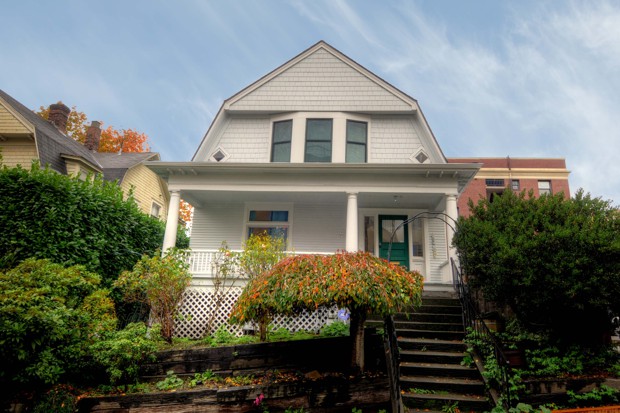
Our house is a way around that. It sits in the quaint Wallingford neighborhood, about 30 yards from the famous Burke-Gilman bike trail. The nearby houses are priced to sell for around $1 million, so my monthly rent of $800 feels like quite a steal. Across the city, the average rent for a 1-bedroom apartment would clock in at 170 percent above the cost of shared room like mine, estimates Causey. In my West Coast city, “when it comes to owning a home and paying a mortgage, you’ll pay 300 percent more than what you’d pay for shared housing," she adds.
I don’t pay for much other than food: My $800 covers all utilities and supplies, including laundry detergent, and housemates regularly share milk, cereal, or homemade snacks. That said, what I give up in costs I also give up in space: My tiny room features nothing but a bunk and bookshelf. To wrangle clutter, I ordered a clothing rack and plan to purchase some type of storage unit for other clothes and personal items. Still, the cramped quarters feel like a very small price to pay for how much living here saves me.
It’s no surprise, then, that similar setups are cropping up in areas that are also home to an influx of young workers looking for a place to crash while doing minimal damage to their savings. In NYC and San Francisco, some of the more trendy shared housing options are operated by WeLive and Common. (They’ve got different vibes: In Brooklyn, for instance, one communal living arrangement boasts group meditation.) Bunks in my house are available for rent via Airbnb, skirting a lease and meaning that I can stick around to keep saving for an apartment—maybe through September—or leave earlier if my income picks up. House managers have also been known to allow early cancellations of long-term rentals if, say, you fall in love with another resident and decide to move out together. (Hey, we're all adults here.)
Despite its perks, sharing space involves a pretty big shift in habits and assumptions. Sharing a room with someone boosts the chances of a naked run-in—but everyone’s schedules are so out-of-sync that it’s not really a problem. We have the usual roommate squabbles over dirty plates on the counter and piled in the sink, and sometimes a roommate’s snoring drives other people to the couch. Still, there’s an underlying sense of, well, neighborliness: roommates will bring leftovers home from a meet-up or make a communal pot of chili or pasta for dinner.
A decade after crashing in a college dorm, it’s fun to share a space with a group of other adults my age—also single, also focused on their careers, yet down to make chocolate fondue for dinner.
Women’s Work: How to Close a Gender Gap: Let Employees Control Their Schedules

The lost letters of the English alphabet
Article URL: https://omgfacts.com/we-used-to-have-6-more-letters-in-our-alphabet-a7e1a165853d#.cevdf6hzw
Comments URL: https://news.ycombinator.com/item?id=13408797
Points: 516
# Comments: 191
The Uncanny Power of a City Without Cars
Like the War Against the Machines that spans the Terminator franchise, the War on Cars that urbanists are supposedly waging is unavoidable, and essentially unresolvable. Battles are won and lost, the hardware changes, but drivers and their pedestrianist foes are fated to forever be at each other’s throats, vying for control of the city streets. Perhaps because it’s a conflict that, like so many others, has become bitterly politicized, it’s hard not to despair of the final outcome.
I recently spent time in Venice, Italy, which was like entering some alternative timeline where this war never happened. Venice’s Centro Storico is Europe’s largest car-free space, a medieval city that somehow managed to make it into the 21st century nearly untouched by internal combustion. And, lemme tell you, it’s weird.
This is not exactly news, of course, but it was news to me. I was hilariously unprepared for this trip, one of those bucket-list events involving my family, my brother’s family, and my 87-year-old wheelchair-using mom. Despite months of planning, somehow it still snuck up on me, right up until the moment we showed up at the airport.
The guidebooks I skimmed on the flight failed to convey the alien quality of Venice, a place that aggressively defies time, geography, and the elements in a way that often left me weak with confusion and amazement. Once the seat of a vast maritime empire, modern historic Venice is a UNESCO World Heritage Site that draws 20 million tourists a year, but it’s also—just barely—a “real” city, not a theme park, with a dwindling core of permanent residents (perhaps 50,000 today, less than half its 1970s population). Like many European cities, it’s dense and medieval and old and strange, made stranger by self-imposed aquatic isolation: The central city is really an agglomeration of built-up islands sitting in the middle of a salt-water lagoon. There’s a bridge to the mainland carrying rail lines, buses, and motorists who pay $22 a day to deposit their cars in an island-sized parking garage. After that, no more motors.
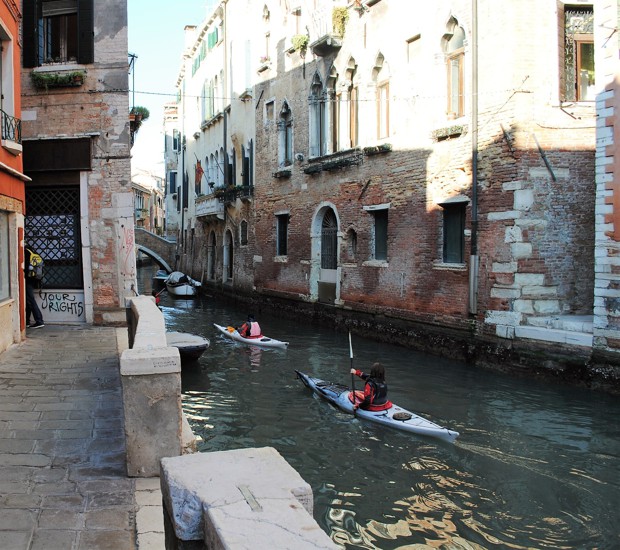
Well, the boats have motors. But the land part of Venice functions largely without powered vehicles. Or, really, without wheels. The city’s 438 bridges, 183 canals, impossibly narrow streets, and countless steps make motorcycles, scooters, bicycles, wheelchairs, hoverboards, rollerblades, and just about anything else that rolls useless, if not illegal. So intense is the Venetian animus toward rolling things that the city mulled banning rolling suitcases, because the clatter of hard wheels on paving stones makes such a din in tourist-laden areas.
It’s hard to convey just how awesomely inconvenient this layout is, until you have to figure out how to push a wheelchair around it. Disability access is all but nonexistent; taking Mom out to dinner in a restaurant one neighborhood over required threading a labyrinth of narrow alleys in order to avoid a bridge that was only accessible by stairs. This delightful 18-minute video from the municipal government does a great job of explaining how Venice got this way, as well as delving into the nerdy inner workings of how a floating city stitched together from 124 islands manages to run utilities and deal with stuff like sewage.
Other curiosities: Municipal garbage collection is done by hand—which means you have to do it all the time—6 days a week. The trash truck is a dude pushing a little cart, which eventually goes to garbage barge. (Luckily, if you have to lug your groceries home by hand every day, you’re probably not generating the same amount of refuse.) Other barges deliver the goods that a city of 20 million tourists needs to consume, from cases of prosecco for Venetian Spritz cocktails to Chinese-made plastic gondolas.
All the stuff, good and bad, that one takes for granted in American cities—from car infrastructure like parking lots and beltways to shiny downtown office towers and parks—is just not there. As UNESCO says, “the whole urban system has maintained the same layout, settlement patterns and organization of open spaces from medieval times and the Renaissance.”
It takes a while for the reality of that idea to settle in. Other old cities in Europe and beyond share some of these characteristics, and many have large (and growing) car-free zones. Venice, however, operates on a scale that makes its carlessness and pre-modern vibe feel immersive: There are no highways in the distance to break the spell, no blocks of ‘70s office towers or apartment buildings nibbling on the edge of the quaint historic core. After a few days wandering around this space, it’s easy to forget such stuff still exists.
And the silence! The ever-present roar of traffic—the Great American Background Noise—is nonexistent, and the city is so hushed that even streets thronged with pedestrians are basically peaceful. Turn a corner after dark, when most tourists have left, and the alleys of Venice could be haunted by the same wintry forces that stalked Donald Sutherland and Julie Christie in the 1973 horror flick Don’t Look Now. When our troupe took a wrong turn after a Christmas dinner at an off-the-beaten-track osteria, we might as well have been lost in the forest primeval.
This de-mechanization of public space has all manner of impacts upon how people live, some less obvious than others. Venice lacks the sort of throbby nightlife scene of other great European cities, in part because, well, it’s just too damn quiet—the whump whump whump of a dance club here would be heard for miles around. On the other hand, Venetians seem to enjoy a more relaxed attitude toward day-drinking. All afternoon, the piazzas and alleys seem to be filled with neighbors enjoying cocktails passed though the windows of tiny corner bars called bàcari. Nobody has to drive home. The intimacy of the street life can be overpowering; turning a corner and happening upon a knot of gabbing Venetians feels like barging into their living room.
The expectation of having to walk everywhere also re-calibrates one’s sense of space and time. The historic city is a tiny thing, only 3 miles long—you could walk from stem to stern in 45 minutes, probably, if you knew where you were going. But it’s so densely built and anarchically organized that one could spend a happy lifetime learning all its blind alleys and dead ends.
In other words, it’s a city where the scale of existence is still aligned with human bodies instead of machines (even human-powered ones). This vibe may not seem radical, except it makes one realize how rarely American cities achieve it, even in places made as respites from the urban tumult. Venice boasts little in the way of official green space, for example, save for a patch of garden on the eastern edge of the city that came courtesy of Napoleon, who ended 1,100 years of independence for the Venetian Republic when he invaded in 1797. He then went all Robert Moses on the place, demolishing older neighborhoods and filling in a canal to make a park and a wide Parisian-style boulevard.
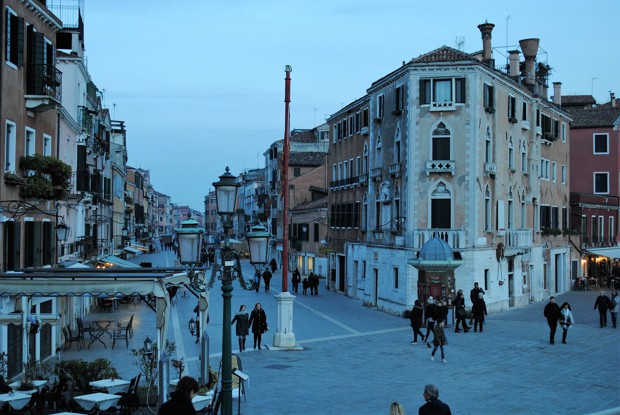
This newer part of the city offers a novel strolling break from the steady diet of narrow passages, but the city’s brush with Napoleonic urban renewal didn’t really change things much; unlike the canals of California’s Venice, most of which became regular streets once private cars became popular in the 1920s, the original Venice didn’t really have to fend off the efforts of highway builders and other civic visionaries of the 20th century. It just works, the way it always did.
For now, at least. The Venice that endures now is a stupendously fragile place, menaced by rising sea levels and natural subsidence. The city struggles to control motondoso—damaging wave motion churned up by motorboats, which erodes the foundations of buildings and swamps the delicate wetlands. Its big defense against the future superfloods of our warmed world is the MOSE project, a crazy-expensive and untested system of sea walls that is still under construction (and probably won’t work anyway). Last year, UNESCO threatened to put Venice on its World Heritage in Danger list unless the city’s leaders showed signs of getting a handle on things. The impact of climate change is just one of the all-too-real regular-city problems often overlooked amid the tourist-related threats. Venice is also dogged by an affordable housing crisis, a recent mayoral corruption scandal, and all manner of workaday economic woes. In some ways, it’s not such an unusual place at all.
And maybe this strange medieval tourist trap offers a useful vantage to ponder the challenges of more modern cities; in its ingenuity in the face of ridiculous circumstances, it’s an urban community that has demonstrated an enviable capacity for resilience. If the Venetians manage to keep this impossible place afloat, perhaps the rest of us are on firmer ground than we think.
And that, kids, is why we call it a “Patch”
Article URL: https://twitter.com/Codealike/status/819990490774904833
Comments URL: https://news.ycombinator.com/item?id=13403991
Points: 329
# Comments: 56
The Chemistry Behind Your Home’s Water Supply
ABC Source: Compound Interest
The post The Chemistry Behind Your Home’s Water Supply appeared first on The Big Picture.
Millennials in the Workplace
This is interesting: Simon Sinek on Millennials in the Workplace Via Inside Quest: Simon Sinek understands leadership. He combines aspects of biology and psychology, within the context of the human condition. This approach gives Simon’s insights unparalleled potency and usability. His lessons on leadership ring true, not only because he spent the better part of…
The post Millennials in the Workplace appeared first on The Big Picture.
Car allergic to vanilla ice cream (2000)
Article URL: http://www.cgl.uwaterloo.ca/smann/IceCream/humor.html
Comments URL: https://news.ycombinator.com/item?id=13347852
Points: 740
# Comments: 133
Security Risks of TSA PreCheck
Former TSA Administrator Kip Hawley wrote an op-ed pointing out the security vulnerabilities in the TSA's PreCheck program:
The first vulnerability in the system is its enrollment process, which seeks to verify an applicant's identity. We know verification is a challenge: A 2011 Government Accountability Office report on TSA's system for checking airport workers' identities concluded that it was "not designed to provide reasonable assurance that only qualified applicants" got approved. It's not a stretch to believe a reasonably competent terrorist could construct an identity that would pass PreCheck's front end.
The other step in PreCheck's "intelligence-driven, risk-based security strategy" is absurd on its face: The absence of negative information about a person doesn't mean he or she is trustworthy. News reports are filled with stories of people who seemed to be perfectly normal right up to the moment they committed a heinous act. There is no screening algorithm and no database check that can accurately predict human behavior -- especially on the scale of millions. It is axiomatic that terrorist organizations recruit operatives who have clean backgrounds and interview well.
None of this is news.
Back in 2004, I wrote:
Imagine you're a terrorist plotter with half a dozen potential terrorists at your disposal. They all apply for a card, and three get one. Guess which are going on the mission? And they'll buy round-trip tickets with credit cards and have a "normal" amount of luggage with them.
What the Trusted Traveler program does is create two different access paths into the airport: high security and low security. The intent is that only good guys will take the low-security path, and the bad guys will be forced to take the high-security path, but it rarely works out that way. You have to assume that the bad guys will find a way to take the low-security path.
The Trusted Traveler program is based on the dangerous myth that terrorists match a particular profile and that we can somehow pick terrorists out of a crowd if we only can identify everyone. That's simply not true. Most of the 9/11 terrorists were unknown and not on any watch list. Timothy McVeigh was an upstanding US citizen before he blew up the Oklahoma City Federal Building. Palestinian suicide bombers in Israel are normal, nondescript people. Intelligence reports indicate that Al Qaeda is recruiting non-Arab terrorists for US operations.
I wrote much the same thing in 2007:
Background checks are based on the dangerous myth that we can somehow pick terrorists out of a crowd if we could identify everyone. Unfortunately, there isn't any terrorist profile that prescreening can uncover. Timothy McVeigh could probably have gotten one of these cards. So could have Eric Rudolph, the pipe bomber at the 1996 Olympic Games in Atlanta. There isn't even a good list of known terrorists to check people against; the government list used by the airlines has been the butt of jokes for years.
And have we forgotten how prevalent identity theft is these days? If you think having a criminal impersonating you to your bank is bad, wait until they start impersonating you to the Transportation Security Administration.
The truth is that whenever you create two paths through security -- a high-security path and a low-security path -- you have to assume that the bad guys will find a way to exploit the low-security path. It may be counterintuitive, but we are all safer if the people chosen for more thorough screening are truly random and not based on an error-filled database or a cursory background check.
In a companion blog post, Hawley has more details about why the program doesn't work:
In the sense that PreCheck bars people who were identified by intelligence or law enforcement agencies as possible terrorists, then it was intelligence-driven. But using that standard for PreCheck is ridiculous since those people already get extra screening or are on the No-Fly list. The movie Patriots Day, out now, reminds us of the tragic and preventable Boston Marathon bombing. The FBI sent agents to talk to the Tsarnaev brothers and investigate them as possible terror suspects. And cleared them. Even they did not meet the "intelligence-driven" definition used in PreCheck.
The other problem with "intelligence-driven" in the PreCheck context is that intelligence actually tells us the opposite; specifically that terrorists pick clean operatives. If TSA uses current intelligence to evaluate risk, it would not be out enrolling everybody they can into pre-9/11 security for everybody not flagged by the security services.
Hawley and I may agree on the problem, but we have completely opposite solutions. The op-ed was too short to include details, but they're in a companion blog post. Basically, he wants to screen PreCheck passengers more:
In the interests of space, I left out details of what I would suggest as short-and medium-term solutions. Here are a few ideas:
- Immediately scrub the PreCheck enrollees for false identities. That can probably be accomplished best and most quickly by getting permission from members, and then using, commercial data. If the results show that PreCheck has already been penetrated, the program should be suspended.
- Deploy K-9 teams at PreCheck lanes.
- Use Behaviorally trained officers to interact with and check the credentials of PreCheck passengers.
- Use Explosives Trace Detection cotton swabs on PreCheck passengers at a much higher rate. Same with removing shoes.
- Turn on the body scanners and keep them fully utilized.
- Allow liquids to stay in the carry-on since TSA scanners can detect threat liquids.
- Work with the airlines to keep the PreCheck experience positive.
- Work with airports to place PreCheck lanes away from regular checkpoints so as not to diminish lane capacity for non-PreCheck passengers. Rental Car check-in areas could be one alternative. Also, downtown check-in and screening (with secure transport to the airport) is a possibility.
These solutions completely ignore the data from the real-world experiment PreCheck has been. Hawley writes that PreCheck tells us that "terrorists pick clean operatives." That's exactly wrong. PreCheck tells us that, basically, there are no terrorists. If 1) it's an easier way through airport security that terrorists will invariably use, and 2) there have been no instances of terrorists using it in the 10+ years it and its predecessors have been in operation, then the inescapable conclusion is that the threat is minimal. Instead of screening PreCheck passengers more, we should screen everybody else less. This is me in 2012: "I think the PreCheck level of airport screening is what everyone should get, and that the no-fly list and the photo ID check add nothing to security."
I agree with Hawley that we need to overhaul airport security. Me in 2010: "Airport security is the last line of defense, and it's not a very good one." We need to recognize that the actual risk is much lower than we fear, and ratchet airport security down accordingly. And then we need to continue to invest in investigation and intelligence: security measures that work regardless of the tactic or target.
Cornerstone: The Rise and Fall of a Health Care Experiment
Robot Revolution: The Long-Term Jobs Killer Is Not China. It’s Automation.
State of the Art: For Millions of Immigrants, a Common Language: WhatsApp
Human Touch: How Social Isolation Is Killing Us
How not to be ignorant about the world
How much do you know about the world? Hans Rosling, with his famous charts of global population, health and income data (and an extra-extra-long pointer), demonstrates that you have a high statistical chance of being quite wrong about what you think you know. How not to be ignorant about the world | Hans and Ola…
The post How not to be ignorant about the world appeared first on The Big Picture.
Your Money: Six Ways to Give the Gift of Generosity to Children and Teenagers
Op-ed: Passing the torch – Intergenerational equity and the housing crisis
In August 1945, the US dropped two nuclear bombs on Hiroshima and Nagasaki, killing 150,000 people, mostly civilians. On September 2nd, Japan surrendered and World War II was over.
Nine months later, Donald Trump was born.
We all know that, as the son of a wealthy real estate developer, Trump was “born on third base and thought he hit a triple”. But you can also say that about his entire generation. When Trump’s fellow Baby Boomers began arriving in 1946, the US controlled half of all global industrial output, thanks largely to the destruction in Europe and Asia. This made it easy for folks to glide into middle-class life, particularly if you were white and benefitted from racist immigration laws, racial real estate covenants, redlining, and Jim Crow.
A year later, Hillary Clinton was born.
Donald and Hillary have more in common than just being wealthy New Yorkers. As white Baby Boomers, they are part of the most privileged cohort of humans in history.
Many Boomers came to UC Berkeley for college, where in-state tuition was free to attend the best public university in the world. Housing was abundant and cheap — Berkeley rent averaged $128/month, or $910/month in 2016 dollars, compared to $3,526 today. Students could fight for free speech and free love, thanks to free tuition and (nearly) free rent.
Many grads liked it here and decided to stick around. It was pretty easy to put down roots — the median Berkeley home price in 1970 was $26,300, or $186,960 in today’s dollars, compared to over $1 million now.
The contrast with Millennials is stark. Instead of free college, the next generation got $1.3 trillion in student debt. Instead of abundant housing, the next generation got a massive housing affordability crisis. Some current Cal students, particularly kids of immigrants and students of color, have to forego meals to pay rent.
In last month’s local election, Berkeley started passing the torch to a new, more diverse generation of Millennials, with Jesse Arreguín becoming mayor, and younger voices like Ben Bartlett joining the council. Given that there are now more Millennials than Baby Boomers in the US, Berkeley is again positioned to show the country a new path.
While the torch is being passed politically, Boomers still control the resource that matters most — money. In addition to the $11.6 trillion that the Boomers inherited from the WWII generation, California Boomers who bought homes when they were cheap have seen a second windfall: enormous unearned home equity from property values inflated by a constrained housing supply, combined with dirt cheap property taxes thanks to Proposition 13.
Certainly most liberal Berkeley homeowners oppose Prop. 13, which was a giant subsidy for property owners passed in 1978 by a lobbyist for the LA Apartment Owners Association, and has helped decimate public education in California. That opposition is nice and all, but we who are lucky enough to own a home still put that subsidy into our own pockets every time we pay property taxes.
While not all Baby Boomers have benefitted from these trends, many are sitting on unearned windfalls. A family in the Elmwood who bought in the early 1970s now has over $1 million in “bonus” home equity and over $10,000/year in Prop. 13 subsidies, while Millennials either pay full property taxes, or more typically can’t afford Berkeley at all.
In a city where we are committed to equity, the implication is clear: those who have benefitted the most have a moral obligation to help address our housing crisis, so the next generation can have some of the opportunities they did.
Thanks to Measure U1, Berkeley landlords will pay a share of their windfall profits from the housing crisis into the City’s Housing Trust Fund to create more subsidized housing. Now Berkeley’s homeowners should do the same. U1 is a good start, but not nearly enough given the severity of our housing crisis, and the cuts to affordable housing coming under Trump and the Republican congress.
There are many ways to accomplish this. For example, some countries in Europe tax the “imputed rent” that homeowners earn.
My suggestion: a “Pay It Forward” program where homeowners give back a portion of their Prop. 13 subsidies to the Housing Trust Fund, with low-income homeowners exempted. If state law says it can’t be a formal property tax, we could just send folks an invoice, and assume their progressive Berkeley values will compel them to do the right thing. Some back-of-the-envelope math indicates that well-off, long-time homeowners sharing a quarter of their subsidies could raise over $15 million annually for affordable housing – five times more than Measure U1. We can leverage that with county, state and federal dollars many times over to fuel a massive affordable housing renaissance in Berkeley, and demonstrate a model that could generate billions statewide.
It would be interesting to see if this would get support, particularly from Berkeleyans who are committed to addressing our housing crisis, but are uncomfortable with the strategy of funding affordable housing through market-rate development because of its impact on neighborhood character. With subsidized housing, the subsidy has to come from somewhere, and every option involves trade-offs. Let’s put our money where our values are.
One way or another, we’re all going to need to compromise and make sacrifices if we want a diverse Berkeley that all of our kids can afford to live in. And at a minimum, I’d ask our Berkeley Boomer friends: please stop suing to kill projects that make major investments in the Housing Trust Fund. My older daughter is a 6th grader at Willard, and on the way home from school the other day I mentioned how there are people in Berkeley who sue to stop new housing projects, even after they’ve been approved through an extensive public process. She said, “That sounds like Donald Trump.”
Smart kid with a bright future. Reminds me why I try to defer to the next generation whenever possible.
Berkeleyside welcomes submissions of op-ed articles. We ask that we are given first refusal to publish. Topics should be Berkeley-related, local authors are preferred, and we don’t publish anonymous pieces. Email submissions, as Word documents or embedded in the email, to editors@berkeleyside.com. The recommended length is 500-800 words. Please include your name and a one-line bio that includes full, relevant disclosures. Berkeleyside will publish op-ed pieces at its discretion.
By guest. |
Permalink |
13 comments |
Post tags: Berkeley affordable housing, Berkeley housing
The pros and cons of taxing foods based on their sugar content
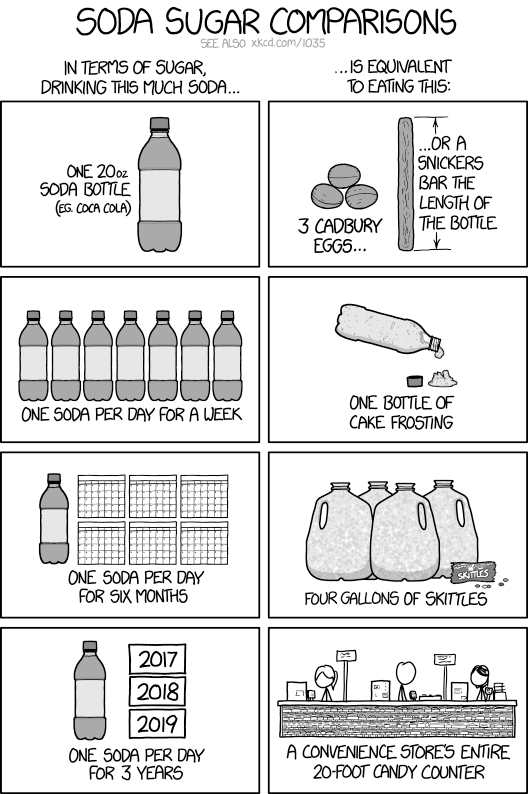
The Urban Institute has just published The Pros and Cons of Taxing Sweetened Beverages Based on Sugar Content.
The report is funded by the American Heart Association and others. The AHA issued a press release.
The sections of the report state its conclusions:
- Taxing Sugar Content Is the Least Costly Way to Reduce Sugar Consumption
- Taxing Based on Sugar Content Is Feasible at the National Level
- Taxing Based on Sugar Content Raises More Issues at the State and Local Level but Is Generally Feasible As Well
The report concludes:
We conclude that taxing based on the amount of added sugar a drink contains, either by taxing sugar content directly or by levying higher volume taxes on drinks with more sugar, is feasible in many jurisdictions and reduces sugar consumption more effectively than comparable taxes on drink volume.
Broad-based volume or sales taxes on all soft drinks, however, raise revenue more efficiently.
Federal, state, and local policymakers thus face trade-offs between using sweetened-beverage taxes to raise revenue and to discourage consumption of added sugars.
Keep this in mind when trying to do this in your community.
Home Truths: How the presidential election is affecting the Bay Area housing market
R.P. Adityasure seems like realtors want to drum up interest using a negative...

Photo: Courtesy Red Oak Realty
 Home Truths, a quarterly report on the state of the Berkeley real estate market, is brought to you by Red Oak Realty.
A few weeks ago, Mary Parker* was considering moving to Berkeley from Scottsdale, Arizona. She and her British-Irish husband, who currently lives in Bahrain, had been planning on retiring in Scottsdale after having lived abroad for 19 years, but for Parker something never felt right about the area. On the other hand, she was familiar with the Bay Area, having attended both Stanford and UC Berkeley and started her career here, and she liked the intellectual atmosphere and relatively good weather. She was contemplating a neighborhood near the Cal campus. But she was waiting to make a move until the presidential election on Nov. 8.
When the results came in, Parker changed her plans. “Unfortunately, Trump’s presidency means moving back to London, UK for us,” she wrote in an email to her realtor, Ana Forest of Red Oak Realty, the morning after the election. “At least until Trump’s presidency is over.”
Such responses have not been unusual in the days and weeks following the election of Donald Trump. Realtors at Red Oak Realty say buyers and sellers have been more cautious — and in some cases deciding not to move at all — because of election-related reasons, real or imagined.
Forest said the election has made buyers “skittish.” She cited an example of a 1,200-square foot, two-bedroom, two-bathroom condo near Jack London Square that was listed for $760,000 before the election.(...)
Read the rest of Home Truths: How the presidential election is affecting the Bay Area housing market (805 words)
By Red Oak Realty. |
Permalink |
2 comments |
Post tags: Bay Area real estate, Berkeley real estate, East Bay real estate, Home Truths, Red Oak Realty
Portland's Answer to Climate Denial? Local Action
As cities around the U.S. consider how they’ll battle climate change in the Trump years, Portland, Oregon, Mayor Charlie Hales sees plenty of room for local governments to lead the way. Facing a federal government in climate denial, he says, cities can still flex their zoning codes.
“Cities can declare things, and that’s nice and helpful, but when you put it into your zoning code, that’s the ultimate authority of local government,” Hales tells CityLab. “Frankly it’s an authority that is very difficult for the federal government, or anyone else, to trample on. ...[It’s] the law of the land, and that’s local control as it should be.”
On the environmental front, Portland is taking two notable moves this year. In November it implemented a law boosting a greener alternative to demolition. And this week, the city council is expected to approve a ban on any new bulk fossil fuel storage facilities within city limits—the first of its kind in the U.S. Proponents hope the ban will reduce greenhouse gas emissions and address safety risks that the facilities pose in case of an earthquake.
There’s heft to these measures, and they add to the building momentum of local-level leadership fighting climate change. Hales says he hopes the policy, in tandem with other climate initiatives in Seattle, San Francisco, and Vancouver, will begin building a “green wall” of West Coast cities that want to be “part of responsible climate action, and not part of climate denial.”
CityLab talked to Hales about Portland’s moves to ban fossil fuel storage facilities, and about how cities can continue to take climate action under a federal government that denies the existence of climate change. This interview has been edited and condensed.
What is it about Portland, or these other West Coast cities that you mention that makes them fertile for taking meaningful climate action?
I think we have very high-functioning local democracies. The ideas that we’re talking about here, whether it’s human rights or environmental policy or economic growth that helps everyone, those are actually American values that are broadly shared. They’re not unique to Portland. It would be wrong to conclude, “Oh, those West Coast cities, they’re just so different from everywhere else.” No, we’re not. I would believe it’s wrong to say “Well, those West Coast cities just have a different political philosophy.”
What is true is that we have a very strong civic tradition, in the American West, of people who want to shape their own future, and have local governments that are responsive to that. The people that live in these cities are used to activist city government that actually listens to them.
And how do you see that moving forward during a Trump administration?
I think it’s going to be more important than ever. Because if the national government is in climate denial, that’s not going to be helpful, but it should not dissuade us—I don’t believe it will dissuade us—from continuing to take local action that matters. That’s the whole premise of the C40 organization. Here are dozens of cities around the world that are changing their local economies, changing their energy use, changing their transportation systems to have meaningful impacts on global emissions. Most of the carbon dioxide generation is in cities, and the decreases are happening because of local action more than because of national policy.
Was there pushback on the new fossil fuel zoning rules? Who was fighting against the proposed changes?
Oh yeah. Our local traditional business organization, the Portland Business Alliance, opposed it. Some of the waterfront industrial groups opposed it. But I think they knew they were swimming upstream on this issue.
Separating corporate interests and people’s interests has been a hot topic for some time now. How do you think that challenge will continue?
I think that’s another difference between city governments and state and certainly congressional politics. City governments again are more connected and responsive to what voters actually want. There’s less influence by paid lobbyists and PACs; they have a much smaller effect on the political equation than they do in D.C., where they are utterly dominant, or in state legislatures. That’s one of the benefits of being a mayor. You’re not surrounded by lobbyists and you’re not hammered by special interest expenditures at every turn. That’s a blessing of being in local government.
What role do non-governmental organizations play in climate leadership? How do you think that people who live in cities can most effectively advocate for change?
This is something I’ve been urging Portlanders to think about. Hey, maybe you haven’t been politically active in the past. Maybe you are very concerned about where we’re going as a country. Demonstrate, by all means, if that’s what you want to do, but then turn to action. If you care about the environment, get involved in the Sierra Club or Defenders of Wildlife, or in our case, Willamette River Keepers or Friends of Trees. There’s a lot that people can do as active citizens and community members, as well as encourage their local government to do good stuff. There’s a voter responsibility piece here, which is don’t just vote in the next election; get involved.
Are there any specific initiatives that you think might be threatened or made more difficult after the end of the Obama administration?
I think a lot of things are going to be more difficult. One, a lot of cities—this is certainly true in Portland—have seen large demographic changes, through more and more immigrants and refugees coming to our cities, and now many of these people are very fearful about the future. And yet these cities have also been very thoughtful about how to integrate these new residents into community life. We’ll need to keep doing that on our own. We’ll need to redouble what we’re doing locally, through everything from city government to Catholic charities to neighborhood organizations, because we may have a national government that’s openly hostile to immigrants. That’s going to be challenging.
We need the federal government to invest in infrastructure, and not just highways. In fact, most of us don’t have any room for any more highways. It’s not a matter of political philosophy, you just can’t do it. Because the land is too valuable and too occupied by dense development to even contemplating driving new freeways or new freeway lanes through existing urban areas. So the solution for those urban areas—it’s not a matter of ideology, it’s just practical engineering—is transit, walking, and bicycling. And yet if the national government thinks of transportation as highways only, that will be a problem for cities.
Now, we’re capable of financing some things on our own. L.A. is building a very large transit network, mostly with local funds. I built the first couple of phases of the Portland streetcar, the prototype for streetcar projects all over the country, with only local funds. So we can get some things done on our own. But it has been extremely helpful to have the federal government, and it’s not just the Obama administration. Transit has been a bipartisan federal commitment for decades. I accompanied Republican house transportation chairs on tours of light rail construction projects in Portland. Our Republican U.S. senator brought home a large appropriation for one of those light rail lines. Those have been bipartisan commitments for a long time. I hope that will still be true, but again, there’s a lot of things that have question marks attached to them right now.
You say city governments are more connected to the voters and what people actually want. How do you make that be the case?
I literally see my constituents in the grocery store, at the transit stop on my way to city hall. You get a lot of direct conversation with the people you work for when you’re a mayor. Secondly, you’re always focused on practical realities. To fantasize that climate change isn’t happening when you’re having sea level rise in your city, or you’re in the middle of a drought, that’s pretty unlikely, because you’re going to have to deal with the reality that there’s not enough water for the people in Santa Barbara to drink, or that the ocean is lapping over street surfaces in Miami.
It’s pretty hard for mayors to be ideological in the face of that kind of reality. We manage public works departments, police departments, and planning departments. The reality that we have fossil fuel tanks in an earthquake hazard area on fill is something that obviously is in my mind. I know we’re on borrowed time, waiting for those tanks to be replaced—hopefully the number of them reduced—and the ones we do have made resistant to an earthquake before it comes. You can’t live in an ideological dream world if you’re worried about the next emergency in your city, and you have those practical responsibilities of having the city actually function.
So you think by calling attention to these practical concerns, you can work to build unity?
Absolutely. And the facts are close at hand. Somebody could claim that we’ve got to set the oil industry free to have more jobs in this country. That’s the kind of national rhetoric we’ve heard. Well we’ve got 47,000 jobs in our city that have to do with clean tech and green technology and green design. 47,000 jobs in the climate-friendly sector, and 280 jobs in fossil fuel terminals. We’re a prosperous city, and we’re not prosperous because of the old economy. We’re prosperous because of the new economy.
The CEO of Standard Insurance, across the street from my office? I don’t know if he’s a Republican or a Democrat, but he’s a CEO, and I bet he’s pretty happy that we’ve got 47,000 people working in all those companies that his company can insure.
We can look out the window at Portland and say, “The air is so clear! How did that happen? Oh, that’s right, we built that transit system that means we burn a billion fewer gallons of gasoline a year than we would have. Oh, that’s right, we’ve had strong environmental regulations that require that auto emissions be curbed. It’s sure nice to look out my office window and see Mt. Hood.” Again, the grounding in real life that comes with city government is at least an opportunity to bring people together and find common ground.
Sprawl Will Cost India $1.8 Trillion Per Year by 2050
Indian cities, like several others around the world, are growing in a concerning manner: They’re expanding outward at a rate that outpaces their population growth, and they’re doing so haphazardly—without heed to principles of urban planning, without adequate water, electrical, waste management, or transportation infrastructure and services, and without a regard for the environment.
The price that the country stands to pay for this pattern of urbanization, if it continues, is enormous: $330 billion to $1.8 trillion every year by 2050, according to new working paper from the New Climate Economy. This is the flagship research project of the Global Commission on the Economy and Climate, an international initiative looking into the pathways to sustainable economic growth. For India’s GDP, that translates into a loss of 1.2 to 6.3 percent shaved off annually.
On the other hand, the country stands to add 6 percent of its GDP to its bottom line if it adopted smart growth policies.
As the authors put it:
Getting urbanisation wrong—through an unplanned, sprawled urban growth model—could be very costly for India.
How sprawl manifests in Indian cities like Delhi and Mumbai is different than, say, Houston or Phoenix. Ani Dasgupta, global director of the Ross Center for Sustainable Cities at the World Resources Institute (a managing parter of New Climate Economy) explains in CityFix:
India isn’t “sprawled” in the traditional way—Indian cities are among the densest in the world. But the problem is that it is not productive density. Instead of multi-level buildings organized into accessible neighborhoods, many Indian cities are filled with short, overcrowded buildings, and lack public transit and pedestrian spaces. So for each square mile of space, there’s a lot less room to live.
But just like American-style sprawl, Indian urban dispersion has negative economic consequences. The NCE report analyzes 479 Indian cities using information from satellite images, as well as demographic, environmental, and economic data. They find that even after accounting for size and level of development, Indian cities that were more compact in 2002 saw greater economic growth in the following decade. A 10 percent increase in compact urban growth (defined as development in existing urban area relative to newly urbanized area) was associated with a 0.5 percent point increase in economic activity in the following decade. Whereas a 10 percent point increase in the “dispersion index,” a measure of sprawl, resulted in up to 0.9 percent decrease in economic output.
So why are these cities, which had dense cores to begin with, now spreading out? Current land use and urban planning regulations are partly to blame. For one, Indian cities have encouraged low-density development by restricting the total floor area that can be built on each unit of land through something called the Floor Space Index (FSI). (In Mumbai, exceptions have recently been proposed to the otherwise low FSI for retail structures and affordable housing.) Real estate costs are high, in part because registering land for development is difficult and permits are expensive. Plus, incentives to build outside the city core have led to “leapfrog development”—when disconnected urban clusters sprout up outside city borders.
The second part of the story is that investment in urban infrastructure is abysmally low on the national priority list—not unlike in the U.S. Most of the current money is aimed at creating more, wider roads and subsidized parking, instead of multi-modal, interconnected public transit within the city, the paper’s authors argue. Apart from being a bad idea, economically speaking, prioritizing car-centric infrastructure in a nation where only around 20 people out of every 1,000 owned cars in 2016 raises questions of equity. Via the paper:
The city’s poorest, who are left to fend for themselves to access even the most fundamental of services—but who lack economic resources—tend to end up bearing the highest burden of service deficits in terms of social, health, time, and monetary costs.
The effects of this kind of unregulated urbanization are already clear. Delhi, India’s capital city, is experiencing the worst smog it’s ever seen, which has disrupted flights, trains, and interstate traffic. Inside the city, traffic congestion is appalling—a 20-minute drive can take several two hours at certain times of the day. India’s financial capital of Mumbai, on the other hand, is hollowing out, with prohibitively expensive high-rises mushrooming in the city’s core and shoddily built residential housing for the poor at the periphery.
As these conditions worsen, they’ll get more expensive. Sprawl will consume land needed for agricultural activity and environmental preservation, and as communities live further and further apart, the costs of providing them with infrastructure and services will likewise inch up. Car-centric development also brings more traffic casualties, more congestion, and more public health problems—all of which can cripple the workforce to an extent.
The poor, as usual, will bear the brunt of this, but every Indian—rich or poor, rural or urban—stands to lose if reshaping the urban future of the country isn’t seen as a moral and economic imperative.
A Dozen Things I’ve Learned About Negotiation
Once upon a time I wrote a book on negotiation with my friend Russell Daggatt. The book is mostly a collection of real stories about our experiences working and living abroad. I lived in Seoul for four years and for a year in Sydney. Russell lived in Tokyo. The book was published by Harper Collins, but few years after the paperback was on the market we bought back the copyright. It is available to read for free on my web site https://25iq.com/ If you want a paper copy of The Global Negotiator, try Amazon.
1. Establish Trust


2. Do Research about the other Negotiator

3. Be Creative:

4. Be Humble About Your Skill Level

5. Some Days are better Than Others


6. Get the Other side to Make the First Offer


7. Build relationships. Don’t do Deals.

8. Keep the Relationship Mutually Beneficial by Sharing value

9. Counter Gamesmanship

10. Focus on Interests, Not Positions


11. Create and Claim value

12. Know Yourself and the Other Negotiator


Wealth Matters: Investing in Creativity, and in the Greater Good
Efficiency is the Highest Form of Beauty
 This year, I’ve been spending a lot more time at the local elementary school, as our boy has rejoined his friends in fifth grade after two years of homeschooling. Through the daily bike rides to and from school, and my weekly gig as a volunteer math/engineering teacher for a small group of boisterous advanced learners, I get to meet a lot more new people from the community than I had in the preceding two years.
As a not-all-that-normal person, it is always a delicate challenge to spark up casual relationships with brand new people. For one thing, there’s the whole issue of being 11 years into semi-retirement, which makes any discussion of work schedules, mortgages and debt, or even overall goals in life a challenge: you either make up a superficial cover story or you open up a huge can of worms that will take an hour to explain.
Unless you are lucky enough to be conversing with another highly abnormal person, this conversation can quickly turn to a blank stare – the normal people don’t quite understand the idea of deliberately working hard even if you don’t have to, or not buying stuff even when you can afford to buy it. When you get the blank stare, it’s time for a quick, cheery wrap-up with a reference to the weather or how great the school staff is this year.
So the superficial story usually wins: “Well, these days I’m mostly a Dad, and I do some carpentry while he’s in school.”
But an even bigger disconnect comes during my travels around town. Strangers don’t seem to know quite what to make of the just slightly imposing flannel-shirt man in his 40s who is always zooming around on a bike at the highest speed his legs can manage at any given moment. Usually with a slightly overstuffed backpack that might be filled with cucumbers, 10-packs of electrical outlets, beer, or even smooth rocks from the creek for use in ornamental gardens. On special occasions, maybe even a trailer with some lumber. “Is he homeless? A hooligan? He’s definitely not as well-off as me, as I hold my mobile phone like a tray in one hand and use the other to operate the steering wheel of my GMC Envoy.”
At Home Depot I sometimes slip up and start discussing my unorthodox plans for the materials I am buying – an underground conduit to run some solar-heated water between the main house and some external collector, or an off-grid charger for an electric car, because nobody makes these things cost-effectively on the real market and they should be doing it. But that blank stare comes back to remind you that this is not the place to open up such a can of ideas.
Personally, I enjoy this little disconnect between me and most people. There are enough friends around here (and Mustachians out there) for all of us to find plenty of community as well as plenty of time to dabble in our own little science labs.
But what I don’t enjoy, is how the rest of our society is missing the beauty of this endeavor. It bugs me to see people standing on the airport escalators when they could be sprinting up the adjacent stairs with a suitcase in each hand. I’m annoyed that people still trundle around in cars they can’t afford, wasting fuel and asphalt that wrecks all of our living spaces, just because they can’t be bothered to swing their leg over a 25 pound aluminum sculpture with wheels that makes most of our fattening 20-trillion-dollar urban infrastructure unnecessary. Then they fight, with lobbying groups and misinformation, if anybody dares to tell them there’s a better way.
It also bugs me that high spending is still considered a desirable thing, and that living on less money is assumed to come with a reduction in happiness. When really, measuring life by your spending level is like judging a town by the size of its parking lots. Is your goal to maximize the amount of asphalt and SUVs you can spread out across the land, or would you rather just get into that damned grocery store so you can get yourself some nice stuff for dinner?
Spending is a skill: a Mustachian can buy the same lifestyle with $25,000 that might cost a Consumer Sucka $100,000 per year. If you can cultivate this skill, the Art of the 75% reduction, at any income level, you can go from a lifetime of being in debt, to being rich enough to retire in less than 10 years. Similarly, a company that can operate with this level of skill will quickly become the most successful company in history, and a similarly efficient government would find the world sitting peacefully in its palm.
The reason I pursue and love the idea of finding new ways to live life in an industrialized world, is the same reason I love music, and art, and writing and all of the beautiful, advanced, inspiring things that people do. It’s because Efficiency is Beauty.
Think about it. What is it that has allowed humans, despite our soft and weak bodies, dull noses and eyes, inability to swim or fly, and mostly-hairless skin that is only really comfortable unprotected in the tropics? Tigers, Owls, and Sharks would mock us ceaselessly if they were smart enough to open Twitter accounts. But of course they cannot, because we are the only ones with these kickass brains that have allowed us to overcome all obstacles to take over this entire planet – with more planets soon to come.
This domination has been entirely the fruit of our efficiency. I mean, sure, monkeys will seek out straight sticks and use them as tools to harvest bugs from a nest, but early humans sought out even more specialized sticks, arranged them into better shelters, weapons and animal traps. We caught animals and used every part for ingenious purposes, to create even more advanced tools, weapons, and methods of preserving information.
On and on through the generations, our survival and advancements have been won only as we became more efficient with our resources. Even our ability to create art, music, literature, and the social structures like laws and governments that allowed us to stop killing each other so often, was only made possible by buying ourselves free time – by efficiently securing food, which gave us time to play at night.
This uncontroversial history lesson could have come straight out of the pages of the Duhh Journal or Obvious Magazine. But yet, the idea of efficiency has been consistently ignored in our more recent society, and this is the source of most of our current problems.
For example, the accepted norm is that as we get richer, we spend more, borrow more, and work harder than ever to beat each other in the highly-competitive economy. The richest people earn the right to consume the largest share of natural resources.
However if we still valued our efficiency, the very thing that got us here and the biggest gift of being a human, the opposite would be true. The wealthiest people could afford to be the most efficient. They would find ways to have the largest amount of fun, but with the added dimension of seeing nothing going to waste. We could live with a zero or negative environmental footprint, and enjoy this incredibly prosperous, engaged lifestyle without even needing to step on anybody else’s head to enjoy it.
The added dimension of knowing we were accomplishing this rich life on two dimensions would take the satisfaction level to a new level as well. While the beginner rich person is a corpulent businessman who buys himself thrones and treats to emulate the life of ancient kings, the advanced rich person is one measured by how much better they left the world, after subtracting any value they destroyed along the way.
In a more efficient, rational world, the rich people would be the ones least concerned about advancing or preserving their own personal wealth, because that is obviously not an efficient use of time when you’re already rich.
Yeah, But How Could We Actually Create Such a World?
I can see you nodding there, but you don’t really think this is possible. If you’re a scientist and into evolutionary motivations, you will remind me that efficiency is only a human priority in times of scarcity. After that, we branch out because it is actually more efficient to chill out, and in fact making a show of waste is a show of genetic superiority. “Look at me! I can afford to grow all these impractical colorful feathers! Or dump water on this big green lawn and pay servants to water it, and I’m not even here because I’m in Monaco this month. Now, come have sex with me because you know you want some of these superior genes.”
This is indeed a problem, and it’s what drives most of the ugliest problems in the world. The world wars and the cold war. Dictators and politicians who seek personal power over society’s advancement. Certain CEOs and their followers who teach themselves not to understand climate change because they fear it would hurt their superficial profits. It’s all the byproduct of when we throw our energy into our simpler ape-like instincts, instead of the more beautiful instinct of Efficiency that got us out of those tree branches and into this much richer life in the first place.
But rather than surrendering our world to the simple dictators who cater to their own ape-like instincts, we can actually hijack their weakness for our own benefit. Because in a world where our material needs are met, the ultimate competition is for status. And status means emulating the richest, most powerful beings of your particular species. If you happen to be one of the richest and most powerful beings, this means everybody else will emulate you.
I hereby suggest that you, the self-selected curious and generally very wealthy people that happen to be reading this article, represent a significant portion of the world’s most powerful people – the ones with the status. People are watching you, wondering how you got all that money, maybe how you manage to run such a successful company, and why you seem to have your life together, with free time to spend with your kids or the motivation to stay in such good shape. They want what you have, and thus they will do what you do.
If you happen to agree with me that efficiency is beauty, the world would be a better place if we became more efficient, and that most of our biggest problems come from too many people missing that obvious fact, you can fix the whole problem by doing just one thing: demonstrating and celebrating efficiency in your own life.
As your peers and the more junior members of your tribe see you riding your bike to work, not moving to an even bigger house, playing with your own kids in the public park and raking your own leaves, and packing up your hiking boots and a tent instead of getting picked up by an airport limousine to begin every vacation, that’s the life they will want for themselves.
You’ll note the obvious similarities to the Tesla Motors master plan here, which the company has used to go from a 3-person garage experiment to the world’s most sought-after luxury automaker, while simultaneously ditching the 150-year tradition of the gasoline engine all in only 10 years: Start by attracting the top of society, allow them to demonstrate that your idea is desirable, then watch the rest of the world follow.
However, as a collection of the world’s highest-status trend setters, we can outdo even Elon Musk. Rather than just upgrading our existing infrastructure to be more efficient, we can upgrade the entire culture.
Instead of just building a billion autonomous electric cars to drive (or fly) us through our trillion dollar sprawling networks of concrete, we can choose to live closer together in the first place in beautiful, verdant neighborhoods that can be traversed in bare feet. Instead of just building solar arrays and storage batteries to cleanly power our gluttonous yet slovenly and unsatisfying lifestyles, we can upgrade to badass, muscular outdoor lifestyles of deep human and natural connection – while also putting up as many solar panels and batteries as it takes to keep the good music playing all night long.
And as we dance in this utopian environment, we’ll note that efficiency has again proven its beauty. Because while it is brilliant and noble to strive towards advancing the efficiency of our technology, it’s even more efficient to directly to change our culture.
I can’t do that all by myself just by riding my bike around town. But you can.
Dumb Security Survey Questions
According to a Harris poll, 39% of Americans would give up sex for a year in exchange for perfect computer security:
According to an online survey among over 2,000 U.S. adults conducted by Harris Poll on behalf of Dashlane, the leader in online identity and password management, nearly four in ten Americans (39%) would sacrifice sex for one year if it meant they never had to worry about being hacked, having their identity stolen, or their accounts breached. With a new hack or breach making news almost daily, people are constantly being reminded about the importance of secure passwords, yet some are still not following proper password protocol.
Does anyone think that this hypothetical survey question means anything? What, are they bored at Harris? Oh, I see. This is a paid survey by a computer company looking for some publicity.
Four in 10 people (41%) would rather give up their favorite food for a month than go through the password reset process for all their online accounts.
I guess it's more fun to ask these questions than to poll the election.
Amazing Deals to Europe for ~$400+ and Coast to Coast for $216+!
Via SecretFlying and Mommy Points, you can fly coach round-trip from a number of big (and small!) US cities like Seattle, Los Angeles, and New York, to cities in Europe, like Madrid, London, and Paris, for only ~$400+!
And via The Points Guy, you can fly round-trip from New York (JFK) to Los Angeles and San Francisco for only ~$216+!
These deals are good for flights on airlines like Delta, American Airlines, United Airlines, JetBlue, Virgin America, and more!
I found flights from Seattle to Madrid for ~$406 leaving February 3, 2017, and returning February 11, 2017.
And a flight leaving New York (JFK) on January 14, 2017, and returning from San Francisco on January 21, 2017, for ~$267!
There are cheap fares available on various routes through May 2017.

Fly From the US to Madrid for Only ~$400!
Here are the details. And how to search for deals from your city!
How to Book It
Link: ITA Matrix
Link: Google Flights
You can check The Points Guy, Mommy Points, or SecretFlying, for how to book. Or see my posts for how to use Google Flights and ITA Matrix to find sale dates.
Then book directly on the airline website, like Delta or Virgin America, or through a site like Orbitz.
If you book a ticket with an online travel agency like Orbitz, Expedia, or Priceline you may be eligible for a refund within a short time of booking your ticket. Check out my post on cancellation policies for airlines and online travel agencies for more details!
American Airlines Tips
Folks with the Citi Prestige can use Citi ThankYou points to purchase tickets at a rate of 1.6 cents per point on American Airlines (and partners) through July 23, 2017. (New cardholders aren’t eligible). Check the Citi Travel Portal to see if the same fares are available!
And on domestic itineraries, you’ll get the first bag checked free for yourself and up to 8 travel companions with the Citi Executive AAdvantage MasterCard or Barclays Aviator Silver card (not available for new sign-ups). You do NOT have to use the card to pay for your ticket!
Folks with the Citi® Platinum Select® AAdvantage® World MasterCard® can get their first bag checked free for themselves and up to 4 traveling companions. Also, only on domestic itineraries.
Note: You can hold a reservation on American Airlines for up to 24 hours and cancel without penalty if you change your mind.
Delta Tips
Folks with AMEX Delta SkyMiles cards can get 1 free checked bag for yourself and up to 8 traveling companions on the same reservation.
Note: You can cancel a Delta booking by midnight the day after you bought your ticket and get a full refund.
JetBlue Tips
Folks with the JetBlue Plus Card from Barclaycard or JetBlue Business Card from Barclaycard get a free first checked bag for the cardholder and up to 3 companions on the same reservation when you use your card to pay for your ticket.
Keep in mind you have 24 hours to cancel a reservation if the flight is at least 7 days away. So, you can take advantage of these extremely cheap fares and finalize plans later.
United Airlines Tips
Don’t forget to use your Chase United Explorer card to pay for your tickets if you want your first bag checked for free.
The free bag applies to the cardholder and 1 traveling companion, but you have to travel together on the same reservation.
Note: You can cancel a United Airlines booking 24 hours after you book to get a full refund.
Hotel Information
If you book a sale flight, remember there are lots of ways to get cheap or free hotel rooms with points from credit card bonuses and spending.
Check out my favorite Hilton, Hyatt, IHG, and Starwood hotels in Europe!
To find hotels that can be booked with points, I use Hotel Hustle (which even shows you if rooms are actually available!) or AwardMapper.
Remember, you can transfer flexible points like Chase Ultimate Rewards or American Express Membership Rewards to different hotel programs.
Note: If you prefer to book paid stays, check out discount sites like Orbitz, Expedia, or TravelPony for deals. But remember you won’t get stay credits or points (and might not have your elite status recognized!).
Airbnb is another terrific way to save money on accommodations, especially for longer stays. Here are some tips on how to negotiate a better Airbnb price, and how to find a safe and comfortable Airbnb.
Use a Credit Card That Earns Bonus Miles & Points
These cards earn bonus miles or points for paid airfare:
| Card Name | What It Earns |
|---|---|
The Business Gold Rewards Card from American Express OPEN |
- Earn 3X American Express Membership Rewards points on airfare purchased directly from airlines when you choose this as your 3X category (otherwise earn 2X points)
- Here's my review of the card |
Premier Rewards Gold Card from American Express
 |
- Earn 3X American Express Membership Rewards points for airfare purchased directly from airlines
- $100 Airline fee credit. Up to $100 a year for incidental fees with your selected airline - Here's my review of the card |
SimplyCash® Plus Business Credit Card from American Express
 |
- 3% cash back on airfare purchased directly from airlines when you choose this as your 3% cash back category
- Here's my review of the card |
The Platinum Card® from American Express
 |
- Earn 5X American Express Membership Rewards points for flights booked directly with airlines or with American Express Travel
- $200 Airline Fee Credit. Up to $200 a year in baggage fees and more at 1 airline - Here's my review of the card |
Barclaycard Arrival Plus™ World Elite MasterCard®

|
- Earn 2 miles per $1 on all purchases
- Use miles for travel statement credits (minimum 10,000 miles for $100) - Here's my review of the card |
Chase Sapphire Preferred® Card
 |
- Earn 2X Chase Ultimate Rewards points on travel, including airfare
- Here's my review of the card |
| Citi Prestige® Card | - Earn 3X ThankYou points for airfare & hotels
- $250 statement credit for airfare & baggage fees each calendar year - Here's my review of the card |
Ink Business Preferred℠ Credit Card

|
- Earn 3X Chase Ultimate Rewards points on the first $150,000 spent on travel, including airfare each year
- Here's my review of the card |
| Citi ThankYou® Premier Card | - Earn 3X ThankYou points for travel, including airfare
- Here's my review of the card |
| Or pay with an airline credit card for specific perks! |
And if you book a hotel, don’t forget to use one of these cards:
| Card Name | What It Earns |
|---|---|
| SimplyCash® Plus Business Credit Card from American Express
|
- 3% cash back on hotel rooms purchased directly from hotels when you choose this as your 3% cash back category
- Here's my review of the card |
|
Barclaycard Arrival Plus™ World Elite MasterCard®
|
- Earn 2 miles per $1 on all purchases
- Use miles for travel statement credits (minimum 10,000 miles for $100) - Here's my review of the card |
| Chase Sapphire Preferred® Card
|
- Earn 2X Chase Ultimate Rewards points on travel, including hotels
- Here's my review of the card |
| Citi Prestige® Card | - Earn 3X ThankYou points for airfare & hotels
- Extend your trip with a complimentary 4th night stay at any hotel of your choice - Here's my review of the card |
|
Ink Business Preferred℠ Credit Card
|
- Earn 3X Chase Ultimate Rewards points on the first $150,000 spent on travel, including airfare & hotels each year
- Here's my review of the card |
| Citi ThankYou® Premier Card | - Earn 3X ThankYou points for travel, including hotels
- Here's my review of the card |
| Or pay with a hotel credit card for specific perks! |
Let me know if you find a good deal!
* If you liked this post, why don’t you join the 20,000+ readers who have signed-up to receive free blog posts via email (only 1 email per day!) or in an RSS reader …because then you’ll never miss another update!


Comments
- We like citing the source of our findings. I'm confused, but ... by Million Mile Secrets
- So basically you are reading other blogs and posting links to ... by Ed Z
Related Stories
Fighting Loneliness With Public Living Rooms
Crumbs and stripes of jam are left behind on plates, sitting on a polka-dot tablecloth. Clusters of people lounge and chat on sofas and armchairs sprayed with floral patterns or stripes. The space “probably looks a lot like your grandma’s house,” says Maff Potts. “I don’t know if that’s a compliment.” It’s cozy and unpretentious; it invites plopping down and staying put for a while.
Last spring, in cooperation with the local city council, Potts launched the space he calls the Living Room in a public library in Blackpool, England; another location opened last month in the town of Rotherham. Now, the campaign is expanding across the ocean. Two locations are slated to open in New York City this winter: one in Manhattan, and one in Brooklyn. Potts calls the spots a “hub of kindness,” pivotal places to fend off loneliness and build community around shared struggles.
Related Story

In a Lonely City, This Group Is Here to Listen
Urban Confessional lends a helping ear to strangers on the street.
The Living Rooms are a project of Potts’s organization, Camerados, which derived its moniker from a line in the Walt Whitman poem “Song of the Open Road,” in which the speaker hails a buddy to join him on a journey. The nonprofit is committed to ending social isolation, which can sink and settle, rippling out to exacerbate other issues in someone’s life, Potts says.
Potts spent decades working in social services, and noticed a common denominator underlying the push to connect folks with concrete services: a cloud of loneliness and a harried pace. People struggling with homelessness, addiction, or health problems often feel hustled through the process of filling out forms or rushed through medical appointments, Potts says. The Living Rooms offer another model: “You can come sit all day,” he adds. “It’s up to you to engage with it as much as you want.”
Looking for solace from strangers can be a tricky thing to navigate in public spaces: it can be hard to figure out how much empathy to dole out, and to gauge when you’re overstepping boundaries. Potts hopes the Living Rooms will be neutral spaces to seek and receive support. There are conversation prompts, he says, but no pressure and no to-do list. But if you’re going to hang out, you’ve got to pitch in. Potts believes in fostering empathy and agency through mutual aid; people buckling under their own stresses might find a bit of relief from helping others. “We’ll also put an apron on you and ask you to make a coffee for someone else and talk to them,” Potts says.
One regular who spent most of his time sequestered indoors used to dial 999—an emergency hotline—multiple times a day just to hear a human voice, Potts says. Another frequent Living Room visitor sunk into a depression after getting sober; for a long stretch, he rarely ventured out of his apartment. Visiting the Living Room helped him re-acclimate to social settings, because he could duck out whenever he felt overwhelmed, he told the Washington Post.
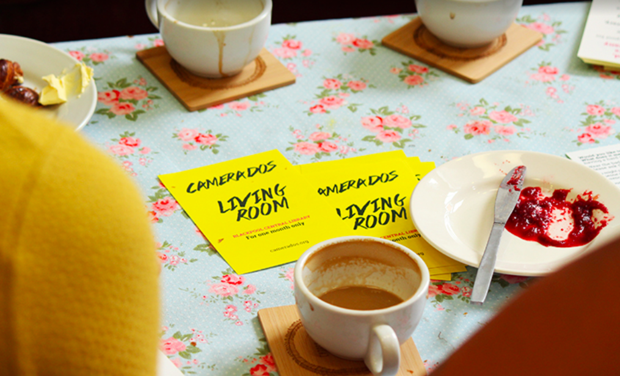
To bring the Living Room concept to New York, Camerados is teaming up with Kindness.org, a platform dedicated to encouraging people to do nice things for each other. This site, which launched this fall, invites users to tackle some easy challenges: leaving a sketch or hand-drawn card for someone to find, or dropping a copy of a favorite book, hoping that a stranger will connect with the story held in its pages.
Intuitively, kindness seems like a no-brainer, but it’s a bit nebulous. Kindness has been shown to cement relationships, predicting marital satisfaction—but on a broader scale, its benefits are more difficult to quantify. The Kindness.org founder Jaclyn Lindsey says the group is setting itself to the task of gauging exactly what kindness can accomplish. To tease out the effects of kindness, Lindsey’s organization partnered with Oliver Scott Curry, director of the Oxford Morals Project at University of Oxford. Curry and collaborators recently conducted a literature review of 21 studies examining kindness—many of which didn’t stand up well to scrutiny. “Our research suggests performing acts of kindness will not change your life, but might help nudge it in the right direction,” Curry said in a statement. Lindsey says she’s hoping to conduct more research in the future, in an effort to tease out how kindness might have long-term reverberations.
Acts of kindness aren’t an alternative to interventions that aim to curb homelessness and other issues. In fact, Potts thinks they can operate in concert with more granular policy. In England, he collaborated with hospital emergency departments, encouraging medical staff to spread the word that discharged patients could stop in and talk about their stresses.
Small gestures, Lindsey adds, might not repair a person’s life, but they can shift the course of someone’s day and—for a moment, at least—“tie us together across our differences” over a cup of tea.