Shared posts

07 Apr 02:07

What Did Ancient Romans Do Without Toilet Paper?

by Stephen E. Nash

We’ve all been caught unawares by our digestive tract at one time or another.

It happened to the Nash family several months ago. We were nearing the end of an extended road trip, driving down a secondary highway through a sparsely populated area of Colorado at night, when one of my 9-year-old twin sons had to use the bathroom. Despite my pleading, he said he couldn’t make it to the next town. (He had to poop.) So we pulled over and headed for the bushes. After he took care of his business, we realized that we didn’t have toilet paper with us.

The whole dramatic episode got me thinking, and for the next couple of hours, I pondered toilet paper and the cultural nature of bathroom routines. (Cut me some slack. It was a long drive.)

Toilet paper is now such a routine part of our lives that we rarely give it any thought. That boring reality, however, should make us think—because toilet paper is an artifact, a technology, and is therefore grounded in culture.

As we finally re-entered Denver—my wife and kids blissfully asleep—I saw the Colorado state capitol building, beautifully lit on the horizon. I started thinking about the ancient Romans. With tall columns, colonnades, and a high, golden dome, the capitol is nothing if not a Roman temple to civics.

Modern American society, and Western societies more generally, tend to look back on ancient Rome as the pinnacle of Western civilization. We emulate their institutions and cultural practices. Why? Are they worth it?

When I thought more about their everyday habits, I realized that, despite all of their accomplishments, ancient Romans engaged in some practices that many people today would find thoroughly revolting. Take a minute to consider, for example, what many of those supposedly “civilized” people did when they had to go to the bathroom.

When Mt. Vesuvius erupted on August 24 in A.D. 79, Pompeii, Herculaneum, and other Roman settlements were sealed as time capsules. They were first excavated in the 18th century, and since then these sites have given us a wonderful view into ancient Roman society.

Many of the bathrooms uncovered at Pompeii and elsewhere were communal. In many cases, they were beautiful, with frescoes on the walls, sculptures in the corners, and rows of holes carved into cold, Italian marble slabs.

ancient roman bathrooms - To ancient Romans, the practice of sitting on a shared toilet in an open room full of people was entirely ordinary.

To ancient Romans, the practice of sitting on a shared toilet in an open room full of people was entirely ordinary. Fubar Obfusco/Wikimedia Commons

Roman toilets didn’t flush. Some of them were tied into internal plumbing and sewer systems, which often consisted of just a small stream of water running continuously beneath the toilet seats.

In the same way that we use an American-style toilet, a Roman user would sit down, take care of business, and watch number two float blissfully away down the sewer system. But instead of reaching for a roll of toilet paper, an ancient Roman would often grab a tersorium (or, in my technical terms, a “toilet brush for your butt”). A tersorium is an ingenious little device made by attaching a natural sponge (from the Mediterranean Sea, of course) to the end of a stick. Our ancient Roman would simply wipe him- or herself, rinse the tersorium in whatever was available (running water and/or a bucket of vinegar or salt water), and leave it for the next person to use. That’s right, it was a shared butt cleaner. (And of course, there were other means of wiping as well, such as the use of abrasive ceramic discs called pessoi.)

OK, so ancient Roman pooping habits seem strange, but what about their customs around pee?

As best we can tell from historic and archaeological data, ancient Romans peed in small pots in their homes, offices, and shops. When those small pots became full, they dumped them into large jars out in the street. Just like with your garbage, a crew came by once a week to collect those hefty pots of pee and bring them to the laundromat. Why? Because ancient Romans washed their togas and tunics in pee!

Tersoriums, used by ancient Romans to clean themselves after defecating, took the idea of “communal” toilets to a whole new level.

Tersoria, used by ancient Romans to clean themselves after defecating, took the idea of “communal” toilets to a whole new level. IV.PA-5334/DMNS

Human urine is full of ammonia and other chemicals that are great natural detergents. If you worked in a Roman laundromat, your job was to stomp on clothes all day long—barefoot and ankle deep in colossal vats of human pee.

(Frankly, I wonder why we haven’t emulated this aspect of Roman culture in our age of green, eco-friendly, and sustainable businesses. I’m thinking of opening a chain called Urine-Urout All-Natural Laundromat. It’s a sparkling business opportunity!)

As peculiar as personal hygiene practices in ancient Rome may seem to us, the historical fact is that many Romans successfully and sustainably used tersoria and washed their clothes in pee for several centuries—far longer than we’ve used toilet paper. Indeed, toilet paper is not a universal technology even today, as any trip to India, rural Ethiopia, or remote areas of China will make abundantly clear.

The memorable stop we made for my son in rural Colorado will always remind me of our culture’s widespread dependence on toilet paper. We’ve become so accustomed to the stuff that we are loath to consider widely used alternatives. (Heck, even the elegant bidet gets short shrift in our society.)

As an archaeologist, this is surprising to me, especially because toilet paper was formally introduced in this country only in 1857, a comparatively short time ago. At that time, New York entrepreneur Joseph Gayetty first created commercial toilet paper; each individual paper sheet bore his name. He claimed that, in addition to their novel utilitarian function, they were medicinal and prevented hemorrhoids.

In 1890, Clarence and E. Irvin Scott developed the first toilet paper on rolls; their brand thrives today. (It happens to be my favorite. Too much information?) Like Gayetty’s sheets, Scott tissue was originally marketed as a medicinal product. In the late 1920s, Hoberg Paper Company marketed Charmin brand toilet paper to women, with an emphasis on softness (thank goodness) and femininity, rather than medicinal properties that didn’t actually work.

Today, toilet paper is ubiquitous in Western cultures; it’s a US$9.5 billion-a-year industry in the United States. Americans, in their typical excess, use more than 50 pounds per person per year! About 1.75 tons of raw fiber are required to manufacture each ton of toilet paper. That doesn’t seem sustainable, and frankly, I’m surprised that people haven’t protested more as a result.

Given these numbers and the marketing efforts behind them, it’s hard to argue that the use of toilet paper is somehow natural. On the contrary, toilet paper is nothing more than a technology. So the next time you’re enjoying a morning constitutional, think about the fact that defecation and urination are more than biological functions; they are cultural activities that involve artifacts and technologies that change through time.

Speaking of which, it’s high time that we consider changing how we clean ourselves after we use the toilet. Tersorium, anyone?


Correction: April 6, 2018

An earlier version of this piece used the term “tersoriums” for the plural form of “tersorium.” After scrubbing for more information, we confirmed that “tersoria” is the correct plural form of the term. The text has also been updated to clarify that the butt-brush “cleaning” ritual varied and to note that tersoria were certainly not the only means ancient Romans used to clean themselves after defecation. We don’t mean to be abrasive, but it’s impossible to convey all the minutiae of personal hygiene practiced by the ancient Romans. (And would you really want to know more?)

The post What Did Ancient Romans Do Without Toilet Paper? appeared first on SAPIENS.

04 Apr 18:54

Homework Therapists’ Job: Help Solve Math Problems, and Emotional Ones

by KYLE SPENCER
The tutors deal not in plain-old schoolwork or straight-up counseling, but in a blend of the two, offering academic and psychological support, at a price.
31 Mar 22:09

50 Most Important Life-Saving Advancements

by Barry Ritholtz

click for ginormous graphic Source: Visual Capitalist      

The post 50 Most Important Life-Saving Advancements appeared first on The Big Picture.

31 Mar 16:48

SURFACING: For the Compton Cowboys, Horseback Riding Is a Legacy, and Protection

by WALTER THOMPSON-HERNÁNDEZ
A group of childhood friends wants to create a safer community and challenge the notion that African-Americans can’t be cowboys.
30 Mar 22:48

To Raise Resilient Kids, Be a Resilient Parent

by EMILY F. POPEK
Parents who don’t fear emotions like anger have a greater capacity to absorb challenging interactions with their children, experts say.
27 Mar 22:34

Op-Ed Contributor: John Paul Stevens: Repeal the Second Amendment

by JOHN PAUL STEVENS
This weekend’s marches make it clear: To enact real gun control, we need to change the Constitution.
25 Mar 22:33

How to Fall Asleep in Two Minutes or Less

by rhapsodic
22 Mar 06:04

Dan Geer on the Dangers of Computer-Only Systems

by Bruce Schneier

A good warning, delivered in classic Dan Geer style.

22 Mar 05:33

Global Health: Palliative Care Film Challenges Stereotypes About Opioids

by DONALD G. McNEIL Jr.
“Hippocratic,” a documentary about Dr. M.R. Rajagopal, who helps India’s dying, shows the desperate need for the same drugs maligned for causing overdoses.
17 Mar 04:44

Contributing Op-Ed Writer: How the Irish Could Still Save Civilization

by TIMOTHY EGAN
Ireland’s leader, Leo Varadkar, the gay son of a Hindu father of Indian descent, tries to nudge the United States back to the moral high ground.
16 Mar 20:14

Who’s Greener? California Housing Plan Splits Would-Be Allies

by CONOR DOUGHERTY and BRAD PLUMER
Legislation would allow more home building along transit routes to reduce gas-guzzling commutes. Some who support the goal have denounced the method.
09 Mar 17:42

India’s top court recognises the right to die with dignity

by Maria Thomas
India-supreme-court-euthanasia-death-dignity

Over a decade after NGO Common Clause filed a petition seeking the right for terminally-ill patients “to die with dignity,” India’s supreme court has decreed that passive euthanasia is legally valid across the country.

In a judgment delivered on March 09, the court said patients have the right to refuse life-support instead of prolonging their pain, and that a “living will,” in which they can authorise family members in advance to let them die, should be recognised. The judgment was made by a bench consisting of chief justice Dipak Misra and justices AK Sikri, AM Khanwilkar, DY Chandrachud, and Ashok Bhushanin.

In India, the debate over euthanasia began years ago after the case of Aruna Shanbaug captured national attention. Shanbaug, a nurse, had been left in a vegetative state after being brutally raped and strangled in 1973 at the Mumbai hospital she worked at. For decades after this, she remained in hospital and was fed through her nose twice a day. In 2009, activist and journalist Pinki Virani took up her case and appealed to the supreme court to allow Shanbaugh to die. Though it ultimately refused to do so in 2011, it did pass a landmark judgment back then that opened the door for passive euthanasia in the rarest of rare cases. Shanbaugh herself passed away after 42 years in hospital in May 2015.

Years later, the rules have finally been expanded to take into account the patient’s wishes. Though the Indian government had earlier voiced reservations regarding living wills, saying they could be misused, the court said it will lay down the guidelines for how they should be drafted and implemented.

Meanwhile, the government had said last year that it had prepared a draft bill to allow passive euthanasia. So far, the countries that allow this include the Netherlands and Belgium.

07 Mar 18:40

Continuing frequency deviation in the Continental European Power System

by Aissen
06 Mar 01:57

The Checkup: To Help Children Sleep, Go Dark

by PERRI KLASS, M.D.
A new study suggests that exposure to bright light before bedtime can throw children’s body clocks out of whack.
05 Mar 17:35

Dorm Living for Professionals Comes to San Francisco

by NELLIE BOWLES
San Francisco's middle class, including teachers, copywriters and others, are engaging in an unusual experiment in communal living. Starcity, a new developer, is creating dorm rooms expressly for them.
04 Mar 21:08

Diagnosis: A Painful Bruise Wouldn’t Heal. It Took Several Hospital Visits to Discover Why.

by LISA SANDERS, M.D.
It started when a paint can fell on the patient’s foot. But it got worse and worse from there.
01 Mar 22:50

Westport Journal: Success of Irish Trail Shows That Maybe You Can Eat the Scenery

by ED O’LOUGHLIN
The Great Western Greenway, a cycling and walking trail on a disused railway, has helped bring jobs and recreation — whatever the weather.
01 Mar 06:27

Op-Ed Contributor: The Cruel Ploy of Taking Immigrant Kids From Their Parents

by DORA GALACATOS, ALAN SHAPIRO and BRETT STARK
Using children as bargaining chips with parents who seek refuge in America is horrifying.
26 Feb 23:51

The New Health Care: What Happens When You Let Babies Feed Themselves?

by AARON E. CARROLL
The hope was that they would naturally eat the right amount, and that fewer would be overweight, but a study didn’t support that.
26 Feb 16:21

How to Fight 'Chill Girl' Teen Culture

by Leigh Anderson

High school and college students are suffering from unprecedented levels of anxiety, and anyone raising teenagers these days knows they’re coping with huge amounts of stress. This goes double for girls, who have what Rachel Simmons calls “role overload” in her new book Enough as She Is: How to Help Girls Move Beyond

Read more...

24 Feb 04:59

Op-Ed Contributor: The Case for Allowing Felons to Vote

by DANIEL NICHANIAN
23 Feb 22:26

Olympic Cross-Country Skiers Eat 8,000 Calories a Day. It’s Exhausting.

by TARA PARKER-POPE
Cross-country skiers require, on average, more daily calories than any other type of athlete. But the constant need to eat can take over their lives.
23 Feb 01:44

Nasty, Brutish and Trump

by By PAUL KRUGMAN
America’s gun madness is part of an assault on the very idea of community.
22 Feb 19:46

Sunday Review: London’s Concrete Ladders

by KATHERINE RUNDELL
The city is wilder than we think; that’s what’s clear from up above.
22 Feb 17:47

When America's Basic Housing Unit Was a Bed, Not a House

by Ariel Aberg-Riger

This month, CityLab visual storyteller Ariel Aberg-Riger takes a look back at the critical role Single Room Occupancy housing played in early 20th century urban life.

What is a home and who does it hold?
In the afterglow of the American suburban blast,
We tend to see the home as a house
And its hold as a family. "Singly family home"
That's the unit. But it wasn't always that way. In the late 19th and early 20th centuries housing was much more flexible,
fluid, and communal - especially in America's booming cities.
The ravenous, metastasizing downtowns needed people so many people to fuel them
single people, foreign people, day laborers, seafarers, migrant workers, factory workers, newly minted women workers
and every worker, no matter how industrious, had to sleep somewhere.
Boarding houses, rooming houses, lodging houses, flop houses. The bed - not the home - was the most basic unit.
You could have a "hot bed" you shift-shared with others, a bed to yourself without a room.
A room without a bathroom, a bathroom without a kitchen. You could live in a hotel,
board in a house, rent by the night, the week, the month, the season.
At the turn of the century, San Francisco was known as "Hotel City" because "vast numbers" lived in hotels and ate only in restaurants.
In New York, an 1892 guide to the city claimed that when it came to housing, every individual caprice and purse can find something to suit.
In Boston's South End, rooming-house residents were: "A great army of clerks, salesmen, bookeepers, shop girls, stenographers, dressmakers, milliners, barbers, restaurant keepers, black railroad porters and stewards, policemen, nurses, journeymen, carpenters, painters, machinists and electricians." - Sociologist Albert Wolfe, 1906
Chicago had different districts known for different types of residential hotels: Near North Side "the city's most extensive roominghouse district." Main stem area "nationally famous for cheap lodging houses."
In his seminal work on the subject, living downtown, Paul Groth wrote: "Boarding and lodging so pervaded American family life... in a conservative estimate for those years, 1/3-1/2 of all urban Americans either boarded or took boarders at some time in their lives."
Where you lept was of course defined by what you could pay (as well as your skin color and country of birth) conferring both social status and social life.
Just as residence clubs like NYC's Barbizon provided an exclusive platform for ambitious wealthy white women, the International Hotel in San Francisco provided an affordable haven and shared culture for poor Filipino families,
and the Chicago Beach Hotel provided its Jewish residents (80% of tenants) a chance to socially mix with gentiles in a way they couldn't have otherwise.
Living with the bed as the unit meant that housewives renting out rooms often had more reliable income than their husbands, single workers (especially women) could work without the crushing burden of housework, the great depression's "newly poor" could keep a roof over their head as they tried to claw their way back up, and everyone who wanted (or needed) could shed personal living rooms and even kitchens and bathrooms, in order to live closer to the downtown and adopt it as an outflow of their "home."
In the 1930s, the term SRO - single room occupancy - bubbled up,
scooping up all styles of flexible housing in its definition. Throughout World War II, loads of wartime workers flowed into SROs and when they ebbed out, wounded soliders washed in.
The elderly, disabled, the mentally ill being booted out of pyschiatric hospitals in droves, all sought out their single rooms. By the 1950s, there were 200,000 SROs in NYC - over 10% of the city's rental stock at the time -
making them a very visible part of the city. As postwar middle class norms became established, there was increasingly little acceptance for a place where all kinds of people would stream in and out, room by room, bed by bed.
SROs became branded as "poor people housing" and cities started strangling them out.
In 1955, NYC banned new construction of SROs and made it illegal to chop up houses. By the mid- to late-1970s, reporters were writing about the "SRO crisis" as NYC gave landords tax breaks to convert SROs to higher-priced apartments, and San Francisco was battling protesters protecting long-term SRO residents.
and modern homelessness was in full bloom.
Cities quickly realized they had razed rooms that had been integral to their citizens' survival with no backup plan. What's worse, by uprooting legal SROs, the city seeded illegal SROs.
In 2013, half a million New Yorkers were thought to live in potentially dangerous and illegal SRO-esuqe units (a year later investor interest continued to "surge" in SROs because they flipped so nicely into condos). Today, cooperative living is big business again,
with everyone Airbnb-ing and We-Living. Single-room living is coming back too, but it's mainly of the luxury micro-apartment set - like Ollie's Carmel Place in NYC which will rent you a 300 sq. ft. white closet life for
$3,000/month. There is some truly supportive single-room housing,
like Capitol Hall on west 87th street - an SRO that was bought by neighbors in the 1980s and recently underwent an extensive renovation. Its 200 tenants
pay no more than 30% of their income on rent, and have access to weekly visits from social workers and nurse practicioners. But even though the daily cost of operating
A supportive housing unit is 1/3 less than the cost of a shelter, 2/3 less than jail, and a fraction of the cost of a hospital. Cities are still lagging in providing adequate options for residents who need them.
The number of people living alone is rising. The number of people over 65 is rising. The number of people who don't have access to affordable housing is rising.
the number of people without a home at all is rising. How will we make room for them?

21 Feb 22:14

Tech Fix: In an Era of ‘Smart’ Things, Sometimes Dumb Stuff Is Better

by BRIAN X. CHEN
It can be tempting to hook up everything you love to the internet. But take a moment to appreciate some of the objects that can remain unplugged.
21 Feb 22:14

Growing a company that sells miniature construction supplies to $17k a month

by patwalls
21 Feb 18:26

Sketch Guy: Feeling the Urge to Spend? Stop, Ponder and Let it Pass

by CARL RICHARDS
We all feel urges and impulses when something shiny is in front of us. But we are not the sum of our spending thoughts, and pausing does not hurt.
21 Feb 18:25

Where American Kids Are In Crisis

by Mimi Kirk

After last week’s school shooting in Parkland, Florida, the young survivors underwent a routine that has become all too familiar: Teams of crisis counselors were dispatched, vigils and funerals were held, and local officials debated what to do about the physical aftermath of the massacre: inspecting the school’s buildings and deciding when (and if) the campus would re-open for classes. The psychological damage may be harder to assess. Among kids exposed to traumatic violence, short-term symptoms immediately after such incidents include trouble focusing, managing emotions, and negotiating relationships. The effects of childhood trauma also show up later in life: As adults, children who witnessed violence will be more likely to suffer from depression, deal with substance abuse, and struggle with obesity.

American school shootings are a comparatively rare form of childhood trauma—albeit less so than they used to be. But many other experiences that can cause lasting psychological damage, such as parental incarceration and economic hardship, are relatively common. Indeed, a new report from Child Trends, a Bethesda, Maryland, nonprofit that conducts research on improving children’s lives, says that almost half of all American children have experienced at least one potentially traumatic “adverse childhood experience,” or ACE.

In “The Prevalence of Adverse Childhood Experiences, Nationally, by State, and by Race or Ethnicity,” authors Vanessa Sacks and David Murphey used data from the 2016 National Survey of Children’s Health to determine which children 17 and under are more likely to experience trauma, and where these children live.

They looked at the data regarding eight ACEs:

  • Parental divorce or separation
  • Parental death
  • Parental incarceration
  • Violence among adults in the home
  • Victim or witness to neighborhood violence
  • Living with a mentally ill adult
  • Living with someone who has a substance abuse problem
  • Experiencing economic hardship often, such as the family finding it difficult to afford food and housing

ACEs aren’t limited to this set, Sacks noted, and they also change over time as scholars better understand trauma. For instance, experiencing violence in one’s neighborhood and homelessness didn’t used to be considered ACEs; they are now. Some researchers are calling for racism to be designated one as well. But one thing is clear: The more ACEs a child experiences, rather than any particular one, the more likely they are to struggle later.

The most prevalent ACEs that American children experience are economic hardship and divorce or separation of a parent or guardian. Nationally, one in every ten kids has experienced three or more of them. Maryland, Massachusetts, and Minnesota had the most children with no ACEs, while in Arizona, Arkansas, Montana, New Mexico, and Ohio as many as one in seven children had experienced three or more. Arkansas had the most ACEs, with 56 percent of all children experiencing at least one, and Minnesota had the least at 37 percent—which is still more than a third of the state’s children.

While Sacks said it’s difficult to ascertain what causes such stark differences among states, one factor stands out: Some of the states with the most ACEs are also those with a high rate of child poverty. And though Sacks and Murphy didn’t look at differences between urban and rural children, the 2011-2012 National Survey of Children’s Health found that rural children were more likely to experience ACEs than urban children—due in part to the fact that rural children are more likely to live in poverty than their urban counterparts.  

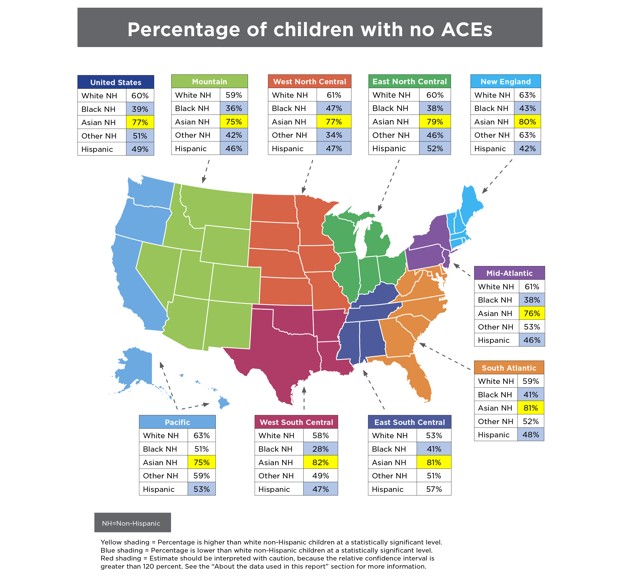
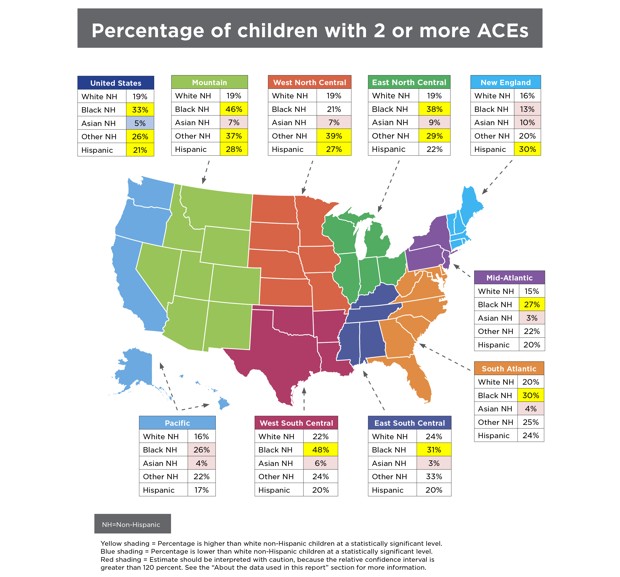
Race is also a strong indicator of whether a child is likely to experience ACEs. “In almost every group of states we looked at, as well as nationally, white and Asian children have the lowest rates of ACEs, while black and Hispanic children tend to have the highest,” said Sacks. In numbers, this translates to 61 percent of black children, 51 percent of Latino children, 40 percent of white children, and 23 percent of Asian children having at least one adverse experience.

(Courtesy of Child Trends)

After economic hardship and divorce or separation, white children are most likely to experience an adult living with mental illness or dealing with substance abuse, while for black children parental incarceration is the next most-common ACE. African-American kids are also the most likely to have experienced the death of a parent or guardian. For Hispanic children, the next most-common ACEs are living with an adult with a substance abuse issue and parental incarceration.

The last Survey of Children’s Health was conducted in 2011-2012, but ACE statistics have remained fairly consistent. “This is sobering,” said Sacks. “The persistent percentage of children with three or more ACEs is particularly distressing, because we know the host of negative outcomes associated with having multiple experiences.”

To better address the daunting scope of the problem, the American Academy of Pediatrics has called for pediatricians to screen their young patients for potentially traumatic experiences, even publishing guides on how to do so. Screening can involve looking for signs of stress, such as recurring nightmares or thoughts, or re-enacting trauma through play. Children can also appear withdrawn or preoccupied. “Teachers will tell parents [their child] seems to be in a daze in the classroom,” Stanford University child psychologist Hilit Kletter told NPR.

(Courtesy of Child Trends)

Pediatricians, social workers, or other professionals working with children can then refer those families who they identify as struggling with ACEs to appropriate services, such as counselors to help with a parent’s mental illness or the proper office through which to apply for food aid. But there’s also another, perhaps more straightforward means of help: If a child has just one caring, trusted adult in their life, research shows that the relationship can buffer the effects of trauma.

Breaking the cycle of ACEs is key. When a parent has experienced a high number of ACEs, chances are their children will as well—often the same ones, such as depression or substance abuse. And studies even indicate that when a woman experiences toxic stress during pregnancy, it acts as a kind of prenatal ACE, interfering with the fetal development and negatively affecting outcomes later in life, such as educational attainment and income. “When pediatricians are screening the child,” said Sacks, “they’re really screening the household.”

Most pediatricians don’t routinely screen for ACEs. But Sacks is optimistic, as legislators and policymakers—whether at the state, county, or city level—are increasingly calling for more awareness of youth trauma. And as of 2017, 20 states had passed or had pending legislation that mentions ACEs, including bills that set aside funds for research and prevention of social problems like opioid addiction. “There’s an increasing awareness that these experiences are a really important public health issue,” said Sacks.

As the potential policy effects of Parkland continue to ripple out, this mounting attention given to ACEs suggests that the long-term effects of childhood trauma—both from horrific incidents like school shootings and from chronic exposure to poverty, hunger, and homelessness—need to be part of the conversation.

20 Feb 17:43

The Stone: What We Owe to Others: Simone Weil’s Radical Reminder

by ROBERT ZARETSKY
She believed we have obligations to attend to our fellow humans. How could that spirit change our politics?