Article URL: https://www.vitavonni.de/blog/201503/2015031201-the-sad-state-of-sysadmin-in-the-age-of-containers.html
Comments URL: https://news.ycombinator.com/item?id=17083436
Points: 552
# Comments: 419
Article URL: https://www.vitavonni.de/blog/201503/2015031201-the-sad-state-of-sysadmin-in-the-age-of-containers.html
Comments URL: https://news.ycombinator.com/item?id=17083436
Points: 552
# Comments: 419
 Dozens have died from carbon monoxide poisoning because people leave their cars running.

You knew it was coming eventually, now, suddenly, your child is a teen, and everything about you is annoying or embarrassing—the shirt you’re wearing, the way you walk, the questions you ask, the gifts you buy, the pace at which you spread cream cheese on your bagel. The kid can’t stand being around you. Yes, this …
Article URL: https://hackernoon.com/12-manager-readmes-from-silicon-valleys-top-tech-companies-26588a660afe
Comments URL: https://news.ycombinator.com/item?id=17001521
Points: 375
# Comments: 91
Article URL: http://www.bbc.com/future/story/20180424-what-i-learnt-by-living-without-artificial-light
Comments URL: https://news.ycombinator.com/item?id=16929470
Points: 310
# Comments: 271

When I go to Berkeley Bowl with Laura McLively, I immediately feel like a tourist, too delighted to keep my cool among the rows of citrus and loose leafy greens. Used to produce sold in hard plastic clamshells at my Los Angeles Trader Joe’s, I marvel at the wall of eggplants, not just purple but white, green, and some—like the tiny, speckled Indian graffiti eggplant—all three colors at once. In the mushroom section, McLively walks me through the different varieties: the honeycomb morel, the ramen strand emperor’s club, the golden ear that looks like cauliflower, and the cauliflower that looks like lace. I want to taste them all.
 The first time McLively visited the Bowl, as a freshman at Cal in 2002, she had the same reaction. Growing up in Rohnert Park, only 50 miles from Berkeley, she knew of Berkeley Bowl’s reputation as “the produce emporium,” so one day in September, she took the bus from campus to see it. On her way into the market, she noticed a bin full of yellow watermelon and, amazed, had to have one. Inside, she filled her cart with tomatoes and cucumbers and peppers and French bread. Only when she checked out did she realize how heavy all those groceries were. But she found a solution. The next time, she brought a rolling suitcase.
More than a decade later, McLively still feels excited when she shops at Berkeley Bowl, and her love for the grocery store and its produce permeates her first recipe collection, The Berkeley Bowl Cookbook (Parallax Press). Based on the blog she began in 2015, called My Berkeley Bowl, the cookbook features simple recipes made with produce you won’t find at Safeway, like banana blossoms, burdock root, and chayote squash.
“We all grow up with a set of ingredients that we’re comfortable cooking with,” says McLively, whose mother came from Spain and raised her children on vegetable-rich Mediterranean dishes like gazpacho, pisto, and white bean stew. “And it’s just so fun and rewarding to go outside that perimeter and start incorporating some new things in familiar ways and in unfamiliar ways. I had so much fun doing it. And now some of these things are my favorite fruits and vegetables. They look intimidating, but they’re really not, once you get to know them.”
If you’re looking to get acquainted with unfamiliar produce, The Berkeley Bowl Cookbook is an ideal place to start. Its organization, based on plant type, gives it the feel of a field guide. In Erin Scott’s photography, ingredients appear not just in their final, cooked form but also sprawled out raw, juicy, and colorful. Each chapter divider looks like a Renaissance painting, a crowded mingling. While not marketed as “vegetarian,” the cookbook is meatless, and it shows that a plant-based diet doesn’t have be about abstinence but about pleasure and discovery.
In the month that I’ve had the cookbook, I’ve tried several of the recipes. Each one includes notes on where else you might be able to find its star ingredient, in case you live beyond shopping distance from Berkeley Bowl, as well as how to select, store, and substitute for it. I’ve learned that the Catalan-Style Gai Lan with Raisins and Pine Nuts tastes just as good with kale or broccolini, the raisins, lemon juice, and pine nuts working together in sweet-tart-salty harmony. The Wood Ear and Israeli Couscous Consommé looks impressive but takes less time to make than the average vegetable soup. And Beans and Greens has already become a new standby because each part of it invites infinite substitution. Like my favorite cookbooks, The Berkeley Bowl Cookbook offers not just recipes but formulas for experimentation.
+++
McLively learned she had a knack for recipe development in college. Compared to her mother’s healthy cooking, college food was meat-centric, with vegetables reduced to an afterthought. By the end of her first year, she’d gained 30 pounds and realized she wanted to change her diet. After she began dating her now-husband, they made a deal: he’d pay for all their groceries and she’d cook all their meals. When they went out to eat and found new dishes they liked, she’d go home and try to recreate them and was surprised to learn she could figure out the ingredient combinations by taste.
One day, she brought home a beautiful taro leaf, about a foot and a half long. She made a sofrito…It was delicious. Then, moments later, both she and her husband felt their throats closing up.
In 2013, she and her husband took a year’s leave from their jobs to live in Madrid, where her mother had grown up. By then, McLively had received a B.A. in Public Health at UC Berkeley, gone on to the University of Virginia to become a registered dietician, and found a job as a clinic dietician at the Native American Health Center in Oakland. In Spain, she lived in a pedestrian-friendly neighborhood with a large population of seniors and began volunteering with a group that walked older people on their grocery rounds. Inspired by the municipal markets of Madrid, she and a friend started a cooking club. Once a week, they’d pick up an ingredient she didn’t recognize and go back to his house to cook it together. He taught her how to steam pinky-sized berberecho clams with sherry and simmer squid in a sofrito with its own ink. At the same time, she taught him how to make American food, usually desserts, like carrot cake, which he found just as strange and exciting.
When she came home at the end of the year, she returned to Berkeley Bowl with a new sense of adventure and empowerment. This time, when she saw an odd and tempting thing, she brought it home and tried cooking it, and eventually, she issued herself a challenge: to try all the store’s unfamiliar produce and develop recipes for it on a blog. Among the first fruits and veggies featured on MyBerkeleyBowl.com are black Spanish radish, cherimoya, and African horned melon, a spiny orange fruit with neon green guts once featured on Star Trek: Deep Space Nine.
In the beginning, she experimented freely, not always researching the produce she bought before cooking it. One day, she brought home a beautiful taro leaf, about a foot and a half long. She made a sofrito with onions, mushroom, and rice, wrapped it up in the leaf with tomatoes, covered the whole thing in coconut broth, and baked it. It was delicious. Then, moments later, both she and her husband felt their throats closing up.
“Do you feel like you’re eating glass?” she asked him.
 Panicking, she turned to the internet and found that taro, like many tropical roots, contains insoluble calcium oxalate, tiny needle-shaped crystals that were at that moment scraping their way down McLively and her husband’s throats. Removing the irritating oxalates requires careful soaking or boiling, but luckily, while the compound can lead to kidney stones, it’s not deadly. The McLivelys tried to stay calm, and eventually the stinging feeling went away.
From then on, she researched carefully. When she bought something new, she’d ask a produce stocker at the Bowl how they’d cook it, and even if they didn’t know, someone else in the store usually did. Meanwhile, one of Berkeley Bowl’s owners, Diane Yasuda, learned about My Berkeley Bowl. A fellow dietician and Cal grad, she was flattered that someone wanted to blog about her store without asking for anything in return and reached out to McLively to invite her to the Bowl’s staff meeting at Sconehenge Bakery across the street. When McLively began work on The Berkeley Bowl Cookbook, Diane lent her archival photos and helped coordinate her interviews with staff members.
McLively is just one of the many cult followers of the independent grocery store, which began in 1977 as a converted bowling alley in the building that now houses Sconehenge. (Since then, it’s moved and grown into a chain of two: the Oregon Street location I visit with McLively and Berkeley Bowl West, a mile and a half across town.) With its niche produce, Berkeley Bowl appeals to serious foodies (Michael Pollan and Yotam Ottolenghi have both given it public shout-outs) as well as people seeking a taste of home in a sour plum or a peppery galangal. Its fresh, diverse offerings fit in with the ethos of California cuisine and the slow food movement, epitomized by Alice Waters, whose restaurant Chez Panisse opened six years before Berkeley Bowl. It also has a reputation for eccentric, sometimes combative shoppers: a Los Angeles Times article from 2008 mentions avocados thrown at line-cutters and granola dumped in passive-aggressive protest on the floor. On internet forums, people search for similar stores in other cities but to no avail. One Chowhound commenter who moved from the East Bay to Los Angeles writes, “I am going through withdrawals.”
+++
In person, Laura McLively is warm and friendly. Within minutes of meeting, at her house on a rainy spring day, she offers me tea, and as she leaves the room, she tells me to feel free to hold her baby, who is three months old and sits propped up in the corner of the couch, smiley and mellow. When McLively talks about food, her excitement sweeps me along with it. At one point, she pages through her cookbook, taking me on a tour of the plants she finds the most beautiful, like the lotus, an “ugly little tuber on the outside,” striking lacework on the inside.
“Fruit is just so amazing to me,” she says, explaining how her interest began. “I remember from a young age slicing into an orange and sitting there and studying up close those tiny jewel packets of juice. And I remember being like, ‘This is God.’ How could something this amazing exist naturally? We don’t have to do anything, it just is there. And all these fruits make me feel that way.”
 McLively learned about food from her mother, who had her doing simple prep work, like snapping the ends off asparagus, from the age of three. In their house, they didn’t have separate dishes for kids, so McLively and her sister ate what their parents ate. While McLively worked on her cookbook, her mother came over to help her shop and test recipes. She remembers one day when they bought a bagful of garbanzos still in their pods and shelled them together for hours. Her mother always had ideas for how to incorporate the new veggies into her favorite recipes, and later, she was one of McLively’s main recipe testers. Then, before the cookbook came out, she passed away.
“Now in retrospect, I’m so glad that I got that time with her,” says McLively. “Because we were working, but looking back, there were really special memories we made in our kitchen, and I wrote that in the acknowledgements not knowing that she would pass. But it was all true. I will cherish those memories forever.”
We drive to Berkeley Bowl in the pouring rain. It’s early afternoon on a Friday and the parking lot is already full. As McLively chooses fruits for me to try, she balances them on the front bar of her daughter’s stroller. I ask her for a produce tour, and we walk along the aisles, looking, poking, and smelling. She tells me that some of her recipes were especially difficult to test because the season for their ingredients is so short. Fiddleheads and ramps, for example, last only for a few weeks of spring.
“How is a big grocery franchise going to source, purchase, get it to the central warehouse, and get it out to their stores in a way that would be lucrative?” she says. “Even creating the label for it, if it’s a store where it’s like things are printed. In Berkeley Bowl, everything is just scrawled out because it’s such a transient little revolving door of produce.”
We’re standing by the fresh beans when a woman nearby, in her 50s, maybe, with a long bob and a scarf tied around her neck, looks at us like we’re in her way. But when we move over a few feet to talk about the cranberry beans, her expression softens and she angles her ear towards us, obviously eavesdropping. Finally, she speaks up to agree about how beautiful the beans are. Decades ago, she says, she learned how to cook them from a fellow shopper at the Bowl, a stranger from France who said his mother boiled them with butter. McLively hopes her cookbook will inspire more moments like these, of people moving beyond their own comfort foods to give someone else’s a try.
Mia Nakaji Monnier is a Los Angeles-based freelance writer and essayist whose work has appeared in the Boston Globe, Buzzfeed, and Los Angeles Magazine, among other publications.

Did you know that beryllium is transparent to X-rays? Or yttrium is found in moon rocks and bullet-proof glass? Or that curium was named after Pierre and Marie Curie? Or that because tantalum is used in cell phones, the demand for it has become so immense that wars have erupted in central Africa? I did, because I’ve…

It's a dream-like house with somewhat unusual space configurations, just as the author of the seminal book 'A Pattern Language,' wanted it.
The post Christopher Alexander-designed house with ‘dreamlike’ qualities for sale in Albany appeared first on Berkeleyside.
 It's not just about the fire either; it's also about flame retardants and health.

Small amounts of peanut protein can stave off peanut allergies, according to a landmark 2015 trial that found this approach reduced the risk of developing a peanut allergy by 80 percent in susceptible kids. You can now buy expensive peanut powders for your baby, but you know what works at least as well? A 99 cent…
By early spring, Seattleites are over the rain. Winter is a very long, very gray tunnel, during which the city sees most of its annual 150 wet days.
This is not surprising for anyone familiar with the Emerald City. What is surprising, though, is that a place synonymous with precipitation may not be prepared for the rain that’s coming.
Thunderstorms and downpours are historically rare in Seattle, which actually receives less annual rainfall than Miami. Most of its precipitation comes in the form of an inescapable drizzle. More of a mist, really. The city’s stormwater infrastructure is built with these steady, low volumes in mind.
However, a recent study found a significant rise in the number of heavy rains in recent decades, and climate models predict an increase in both the frequency and intensity of what officials call extreme weather events: deadly deluges that, within 24 hours, are capable of overwhelming water drainage infrastructure to cause flooding and send raw sewage into nearby waterways.
“We’ve got challenges including affordability and homelessness, but climate change and extreme weather events are right up there,” said James Rufo-Hill, a meteorologist with Seattle Public Utility who was involved in the study. The city has been collecting rainfall data through a network of rain gauges since the late 1970s. In the past 14 years, he said, “the stats have changed such that the definition of an extreme event has changed.” A storm that was previously expected only once in 100 years is now likely in 25.
One of the worst events on record occurred in early December 2007, when two storms flooded the Washington and Oregon coasts and brought wind gusts that topped 100 miles per hour. Seattle registered 5.61 inches of rain in only 24 hours. Just a year before, the city’s low-lying neighborhoods had flooded when a storm overwhelmed a drainage system clogged with debris, and claimed the life of a woman trapped in a windowless basement. The region again saw significant rain events in 2010, 2012, and 2014.
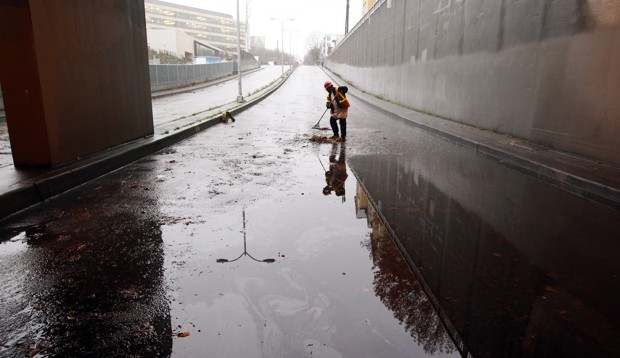
Most storms come to the Pacific Northwest by way of the Pineapple Express, a narrow band of atmosphere that draws moisture from warm tropical waters around Hawaii and delivers it northward. These atmospheric rivers are known to be responsible for up to half of the total rainfall of western North America and are the main source of heavy rain throughout Washington state, said University of Washington climatologist Guillaume Mauger.
What’s less understood is how climate change will affect them—although we know that warmer air holds more water, and the Puget Sound region is expected to grow warmer in coming decades. The heaviest 24-hour rain events in western Oregon and Washington are projected to intensify by about 20 percent by the 2080s, and flooding is predicted to worsen, according to a University of Washington climate assessment.
“Cities don’t have the luxury of climate denial and cannot wait for federal leaders to embrace science. The effect of inaction is already at our doorstep,” said Mayor Jenny Durkan in a statement following the release of the rainfall report. A massive stormwater storage project is already underway in one of the city’s most iconic neighborhoods.
Ballard, which sits just northwest of downtown, is representative of the city’s vulnerabilities. It is both low-lying and served by an outdated system that combines sewage and stormwater drainage. Polluted runoff shed by neighboring hills frequently floods this hip, lock-side borough. With pipes too small to manage, the system is forced to offload a mix of rainwater and sewage into nearby Lake Union—a serious public health and environmental hazard.
Using a massive boring machine fresh from digging the city’s latest light-rail expansion tunnel, Seattle Public Utility and King County plan to burrow an underground storage tank three miles long and more than 18 feet in diameter to capture water during heavy rains. Once this $430 million project is operational in 2026, the city estimates it will save more than 60 million gallons of raw sewage and polluted runoff from overflowing annually.
Seattle came together through a patchwork of annexation, and so there is no single citywide solution. Managers are replacing old and small pipes and retrofitting facilities as needed. They’re also installing remote sensors to monitor and control flows in real time during storms. On a smaller scale, businesses and homeowners can receive rebates for installing green infrastructure—think spongy rain gardens and large cisterns—to help slow runoff.
All this is happening in preparation for a storm that Rufo-Hill refers to as Seattle’s Hurricane Harvey: a worst-case-scenario, 1,000-year-event in which an atmospheric river loaded with moisture slides in off the Pacific and stalls above Seattle for a week.
The impacts to the city and especially to its surrounding rivers, which could see 25 inches of rain, would be catastrophic, he said—and “we are very much due.”