R.P. Aditya
Shared posts
Trilobites: The Evolutionary Origin of Descending Testicles

Personalisation Is Asymmetric Psychological Warfare
Article URL: https://shkspr.mobi/blog/2018/06/personalisation-is-asymmetric-psychological-warfare/
Comments URL: https://news.ycombinator.com/item?id=17373363
Points: 307
# Comments: 125
Sleep Scientist Warns Against Walking Through Life 'In an Underslept State'
When There’s a Snake in the House, These Guys Can Help
MADURAI, INDIA—On a humid summer evening last July, Srinivasan Venkataswamy, 42, a property consultant in the South Indian city of Madurai, was lowered an inch at a time into a 30-foot well. When he reached 15 feet, a wave of dizziness and nausea engulfed him. The air was sparse, but he needed to focus.
Clinging to the sides of the well, he trained the beam of light from his head torch into the inky darkness below and listened in rapt attention. He could hear a faint hiss. The people who had alerted him a few days ago were right: A snake had somehow found its way into this abandoned well, probably fallen headlong while hunting for prey. The children in the area were throwing stones at it; it was a miracle the snake had survived.
Venkataswamy was no stranger to panic-stricken summons from all over the city whenever locals spotted a snake. But this was one of his toughest rescues yet.
When Venkataswamy couldn’t breathe, he had to be hauled out. Twenty minutes later, once he’d had a drink of water and filled his lungs with air, he was ready to try again. For the second time, the men lowered him into the five-foot-wide opening. In one hand, he clutched a thick gunny sack, the mouth of which was tied tightly over a plastic pipe. He brandished a long metal hook in the other.
This time around, he was better prepared when the waves of dizziness hit. At the very bottom of the well, he spotted it—a spectacled cobra. Left to itself, it could have starved here. It didn’t take Venkataswamy long to guide the cobra into his sack with the hook, ensuring that it slid through the pipe. The entire operation had taken two hours.
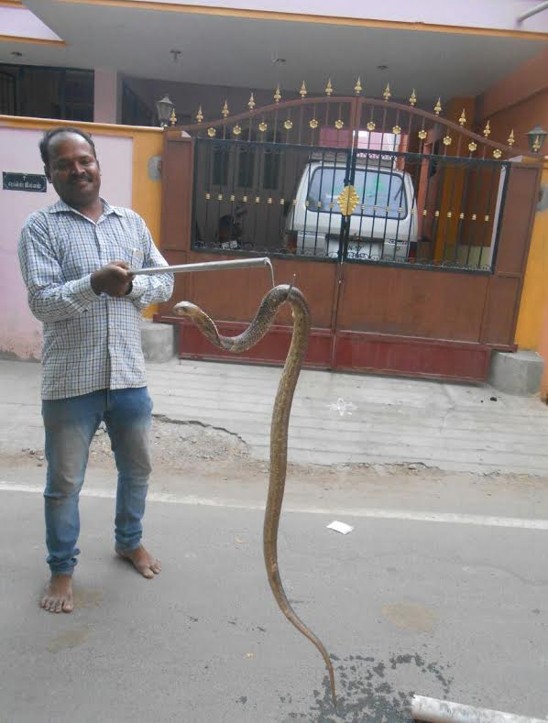
Venkataswamy is the head of a volunteer group called Isha Serpent. It was established in Madurai in 2009, when training was provided by the Isha Foundation, a large yoga center based four hours from Madurai in the city of Coimbatore. (The Isha Foundation’s spiritual leader is a lover of snakes.) Since then, the group has been engaged not only in snake rescues, but in warding off other man-animal conflict as well.
Over the past few months, the volunteers have relocated beehives without using chemical pesticides or smoke; caught a monitor lizard and several turtles that had strayed into local homes; nursed injured eaglets back to health; and rescued a cat from a well.
Most of their work, however, involves attending to distress calls from locals and ensuring the safe capture and release of snakes. On average, they receive three to five calls a day.
Over the years, the group has rescued 2,200 snakes in and around Madurai, a city of about 3 million people located 100 miles from the Western Ghats, a mountain range that runs parallel to India’s western peninsular coast. The Western Ghats is a UNESCO World Heritage site and one of the eight most biodiverse regions in the world.
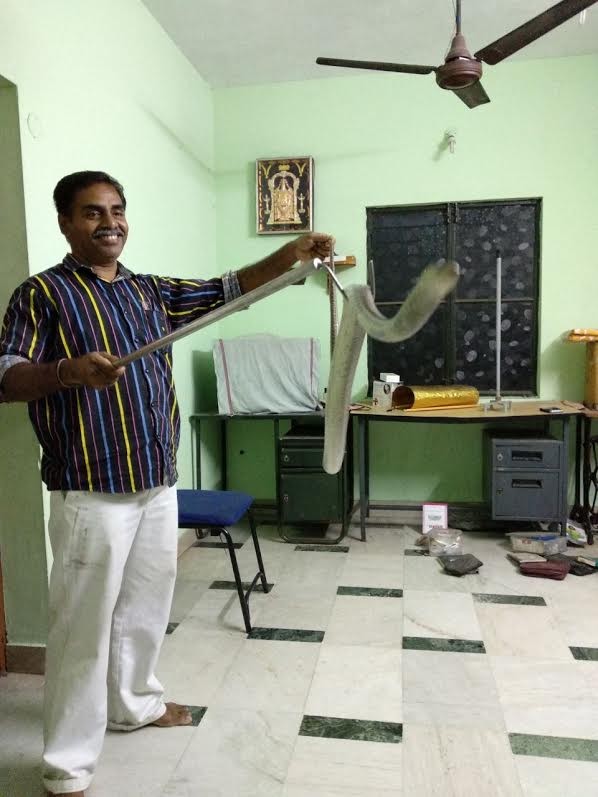
The Indian subcontinent is home to more than 300 species of snakes, but a few venomous species abound in this area. They’re often referred to as the Big Four: the spectacled (or Indian) cobra, the common krait, Russell’s viper, and the saw-scaled viper. “I’ve seen all of the Big Four within city parameters,” said herpetologist Krishna Chaitanya, who has studied the area’s reptiles extensively.
As the city’s borders bleed into surrounding scrub area, the loss of habitat, heavy rains, and extreme temperatures are driving snakes indoors, Chaitanya said. “In rural areas, people more tolerant of snakes—even the venomous ones,” he said. “I’ve heard that villagers in the Agumbe rain forests leave their homes when a venomous snake occupies it, and live with a neighbor until it retreats.” But that kind of accommodation is difficult in an urban context, and fearful Madurai residents often kill reptile intruders.
It is this fear that the members of Isha Serpent, brought together by their love for snakes, try to dispel. “Our work is as much about rescuing the snake from people as it is about protecting the people from snakes,” Venkataswamy said. “People don’t understand that snakes have always lived in close proximity to humans. They are secretive creatures and will not attack unless provoked.”
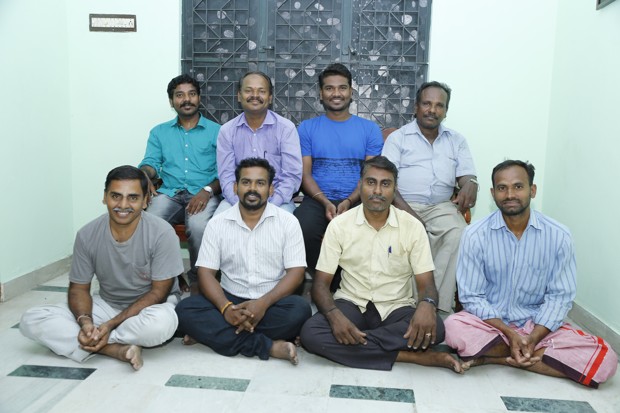
In their meetings twice a month, the group’s eight active members—who are all men, and include a shopkeeper, a TV mechanic, and a computer-graphics instructor—compare notes and share experiences. The team has encountered cobras and Russell’s vipers in offices, curled up in pipes in homes, slithering through toilets and gardens, and hiding under tiles.
Shivan Pandi Nagaraj, 33, a teacher who lived for many years on the outskirts of a forest, says he joined the group because snakes are misunderstood and persecuted. “People would beat a snake the moment they set eyes on it, even though most of the species found in and around Madurai are non-venomous,” he said. Many snakes are not just harmless to humans, but beneficial—they keep the rodent population in check.
Volunteers release the snakes they capture in a nearby area with water tanks on the outskirts of the city. “We always check for a water source and the availability of prey before releasing the snake,” said Venkataswamy. They document each incident and file forms with the local forest department.
No one has been bitten so far, the men say. “Someone who knows what they’re doing will never suffer snake bite,” said Venkataswamy. However, he added, “I always warn new volunteers that one careless mistake ... could cost them their lives.” Members have invested their own money in strong, breathable sacks to trap the snakes and a snake hook for venomous species. They receive no payment for their services, except for an occasional 100 rupees (about $1.40) to cover fuel costs.
Bragging and posting snake pictures on social media are out-of-bounds. Members find it unethical to treat snakes like trophies; also, it can lead to dangerous situations. (Earlier this month, an Indian forest ranger posed for photos with a python around his neck, and was caught on camera as the snake started to choke him.)
In recent years, snake rescue has come under fire from conservationists. Rescuers may release snakes too far from their original home or in an area where prey is in short supply. Janaki Lenin, a wildlife researcher and writer, and her husband, the herpetologist Romulus Whitaker, have studied the habits of Indian snakes, particularly the king cobra, for many years. “Remove a snake from its home, and 75 percent will probably die,” Lenin said. “They try to return home, get reckless in their distress, [and] are run over or killed by people.”
Home territory is central to the snake’s existence. “To teach people to recognize venomous and non-venomous species and to avoid confrontation with snakes is ideal,” Lenin said. This is an uphill battle in cities.
But fear of snakes is not all bad—as Chaitanya points out, the fear arises naturally in humans (and dogs and monkeys, too) from generations of conflict with snakes, and it helps keep us safe. Excessive fear can be overcome through knowledge and experience.
When I met the members of Isha Serpent, I didn’t know that they had recently bagged a harmless rat snake. Venkataswamy held it in his hands, and I backed out of the room—it was only four feet long but flicking its tongue rapidly. Snakes tend to do that when they’re agitated, he explained.
Once the snake was calmer, he urged me to touch it. I swallowed and ran a finger gingerly over its scales. I expected it to be rough or slimy, but it felt smooth as silk. “You wouldn’t fear it so much if you realized that it’s just another life form, trying to survive,” he said.
Overlooked No More: An Artist Known as the Indian Frida Kahlo

Bengaluru’s water crisis is the result of over 130 years of mismanagement

On hot summer days in Bengaluru, India, it is common to see public water taps on roadsides hissing and spurting as water struggles to come out. People crowd around the tap with pots of brightly coloured plastic, burnished brass, or steel, waiting for their turn. Many of these people have come from homes without such luxuries as indoor plumbing and will return carrying enough water to last several days. More privileged citizens have water piped to their houses in larger quantities—and more frequently. But even for them, interrupted water supply and rationing have always been a fact of daily life.
Bengaluru is perhaps one of India’s most globally visible cities, owing to its reputation as India’s Silicon Valley. Corporate buildings and malls with shimmering glass facades vie for space with residential high rises and villas, bolstering the city’s popular image as a vibrant and booming metropolis with an entrepreneurial young population. But informal settlements and slums coexist alongside this image of prosperity, and residents—poor and affluent alike—face the trials of living in a city starved of water: a legacy of colonial policies that relied on vast Droughts are shaped by each city’s development over time. technological solutions to solve local problems.
Bengaluru is not alone in its water woes—cities across the globe struggle to meet water requirements every day. Although Cape Town’s water crisis has eased, residents are still limited to using 50 litres of water each, per day. Other settlements are also affected. In Mexico City, water supply is frequently interrupted while, in Brazil, São Paulo’s main water reserves were below 15% as of 2017. Indonesia’s capital Jakarta, meanwhile, is facing severe groundwater depletion. Droughts are shaped by each city’s development over time—and these recent shortages have shown just how shaky the infrastructure which supplies their water has become.
A history of water
Take Bengaluru, for example—the city tends to be naturally arid, because of its location in the rain shadow of the Western Ghats hill range. Records from the 6th century onwards show that successive rulers of the city invested in creating an interconnected, community-managed system of tanks and open wells. The shallow aquifers of the wells were recharged by the tanks across an elevation gradient that harvested rainwater.
Since around 1799, different authorities took control of the tanks—first the colonial state, and later on the independent Indian government. These tanks were the main water supply infrastructure for almost a century, though they faltered during periods of drought and famine. To meet the rising demand, the Municipal and Public Works Departments considered deepening reservoirs or building new ones. By 1885, the city’s water supply was running low, and the colonial government responded by setting up piped infrastructure, bringing water from sources 30km away including the Hesarghatta and then the TG Halli reservoirs. But none of these fixes could meet demand for very long.
Meanwhile, given the new dependency on piped water infrastructure, the old tanks and wells became disused, polluted, or built over. After India gained independence in 1947, the Bangalore Water Supply and Sewerage Board (BWSSB) was established. In response to the city’s water supply issues, the board floated the idea of pumping in water from the river Cauvery—more than 100km upstream from Bengaluru. The project started in 1974 and continues to this day, reaching its fifth stage in 2018.
With the threat that water would run out still looming large, authorities have since explored other possibilities. In 2016, the state government proposed to divert water from the Yettinahole river, 300kms from Bengaluru. Scientists also explored the feasibility of constructing a reservoir under the Arabian Sea to impound that water for supply. The central government of India went a step further and considered transferring surplus water from the north flowing river Godavari into the southern Cauvery.
Given the new dependency on piped water, the old tanks and wells became disused. The estimated costs of these large-scale proposals were massive—billions of dollars could be spent without delivering guaranteed water security. Instead, the authorities seek to reallocate limited supplies of water—though even that is done unfairly and unevenly.
Piped water supply systems cater only to central Bengaluru, while the outskirts rely on alternatives including domestic bore wells or private water tankers, tapping into and depleting deep groundwater aquifers. These services are typically used by the urban poor, but operated on a for-profit basis, which means they actually come at higher costs than the heavily subsidised centralised water supply system.
An alternative approach
While governments have floundered, Bengaluru has seen a resurgence of citizen-led collectives working to protect and rejuvenate the old tanks and open wells—and open them up to poor and disadvantaged citizens. These collectives have also innovated, exploring how treated sewage can contribute to the supply. In Jakkur Lake, for instance, treated sewage is filtered through a human-made wetland and into the lake itself, fostering a healthy ecosystem as well as helping to recharge groundwater.
Initiatives have blossomed online, too: the Facebook page Open wells of India and the world is a place where members can upload photographs of any open wells they encounter, along with their location. By documenting many little known open wells which survive across the city and beyond, it provides a fascinating glimpse into the potential such options hold for harnessing and storing rain water. One particularly poignant image was shared by local man Vishwanath Srikantaiah: a massive open well, recharged by the Jakkur lake.

An open well near Jakkur lake, replenished.
The efforts of Biome, India Cares Foundation and Friends of Lakes—combined with the local expertise of traditional well diggers—have restored seven public wells within the city’s well-known Cubbon Park. Thanks to an approach that combines local knowledge and innovative problem solving, the wells now produce about 65,000 litres of water per day and help to meet the water demands of the park.
 Grand technological visions have proved incapable of meeting Bengaluru’s needs since colonial times. But local, community-led measures to manage and replenish water have a good chance of creating a water-secure, resilient city: an object lesson for those planning cities for the future.
Hita Unnikrishnan, Newton International fellow, University of Sheffield; Harini Nagendra, professor of sustainability, Azim Premji University, and Vanesa Castán Broto, professorial fellow, University of Sheffield. This article was originally published on The Conversation. Read the original article. We welcome your comments at ideas.india@qz.com.
Heads Up: From Pyramids to Chocolate, Mexico City Through the Eyes of Children

Futurology: A new study looks at the design of the home in 2050
 It seems that sometimes it goes too far, and in other ways doesn't go far enough.
Seizing Children From Parents at the Border Is Immoral. Here’s What We Can Do About It.

‘This Ruling Gives Us Hope’: Supreme Court Sides With Tribe in Salmon Case

Personal Health: The Dangers of Belly Fat

How Children in a Maya Village Do Chores
Article URL: https://www.npr.org/sections/goatsandsoda/2018/06/09/616928895/how-to-get-your-kids-to-do-chores-without-resenting-it
Comments URL: https://news.ycombinator.com/item?id=17280710
Points: 376
# Comments: 195
Sometimes You Have to Quit to Get Ahead

The Cost of Developers
Article URL: https://stratechery.com/2018/the-cost-of-developers/
Comments URL: https://news.ycombinator.com/item?id=17236187
Points: 390
# Comments: 226
The Marshmallow Test: What Does It Really Measure?
R.P. Adityawe found that low-income parents are more likely than more-affluent parents to give in to their kids’ requests for sweet treats.
These findings point to the idea that poorer parents try to indulge their kids when they can, while more-affluent parents tend to make their kids wait for bigger rewards. Hair dye and sweet treats might seem frivolous, but purchases like these are often the only indulgences poor families can afford. And for poor children, indulging in a small bit of joy today can make life feel more bearable, especially when there’s no guarantee of more joy tomorrow.
Article URL: https://www.theatlantic.com/family/archive/2018/06/marshmallow-test/561779/?single_page=true
Comments URL: https://news.ycombinator.com/item?id=17218250
Points: 351
# Comments: 265
The Long History of Child-Snatching

Critic’s Notebook: Farm-to-Table in the Shadow of Downtown Detroit

The Saturday Profile: The College Student Who Has France’s Secularists Fulminating

How I Accidentally Made My Mom a Bollywood Star

One of India’s oldest cookbooks offers solid lessons on life and third-rate vegetables

It seems to me that S Meenakshi Ammal usually appears to one under duress. You won’t find her until you need her.
In the 1960s, Tamil Brahmins migrating overseas carried her cookbook along with a pressure cooker each to cure homesickness with food from home. As the book gained popularity, the norm was to hand it to young brides who’d often have to move to the north of the country with their husbands and learn to cook without the support of the ever-present maamis (aunts). More recently, families have taken to gifting their sons the book as they leave their homes for idli-less shores.
A theme of reassurance runs through this iconic cookbook from the Tamil Brahmin community. “Cook and See,” says the title, implying it isn’t so hard really. The instructions inside provide alternative suggestions and steps to take care of kitchen disasters. But even that reassurance is mildly stern, like this particular note for making Butter Milk Sambar:
For this drumstick, brinjal and lady’s finger are best. Potatoes, chow chow and ashgourds are second best. Any other vegetable is third rate.
Strangely I can hear my dad in this book, perhaps because “third rate” is a word he uses quite often. And also because the book reminds me of his particular brand of “strict reassurance”—this will annoy you but this is ultimately good for you. For instance, there was a time when my father would find me dreaming serenely on Sunday afternoons and attempt to break my reverie by asking me stuff like, “what is 1,67,395 minus 578?” His is a lifelong mission to make me alert, either by shocking me with mental mathematics or dark warnings of potential accidents that would most certainly occur, thanks to incessant daydreaming.
“Cook and See” is similarly packed with sudden instructions and underlying threats. In a completely unexpected sentence in the fifth paragraph of a recipe you are warned of pulse balls that might break from wrongly shaped spoons, sweet kosumalli that must be cooked “soft as a flower” but not too soft or else…, pongal that must only be served on Sankranthi and never otherwise, and so on and so forth.
Someone learning to cook might find this book mildly terrifying because the instructions flow like a stream of consciousness narrative, albeit with slightly obsessive details. But for a seasoned cook, the book is full of nuggets that no YouTube video or, for that matter, a cookbook can offer. Ultimately if you use the book well, you could end up with a dish that tastes as authentic as something only your Paati (grandmother) could make.
Take for instance this neat little tempering trick for Stuffed Brinjal or Ennai Curry:
If the brinjal is not very tender and has seeds inside, soak a little tamarind (marble size) in a handful of water, prepare juice and sprinkle, instead of sprinkling plain water.
I found Ammal in the old way; my father gave me the book when I moved to Mumbai as a 20-year-old copywriter. I only opened it 10 years later when I was left without a cook and with 10 days of takeout plastic. Being stupidly ambitious, I decided to start my cooking journey with my favourite Tamil Brahmin dish, Vatha Kuzhambu, a thick, tangy, and richly spicy broth of dried, salted vegetables that can make certain parts of your brain buzz with pleasure.
When I reopen the book to that recipe now, I find it stained with turmeric and paranoia. Masalas seem to have been scattered in confusion and terror. When it finally got made, I remember the kuzhambu tasted like poison flavoured with tamarind. The scars were such that I haven’t attempted making it ever again.
After that disaster, I finally found my cooking chops online in a website called “Padhu’s Kitchen“. Here the recipes of my childhood are broken down with a simplicity that is perfect for men and women who have never ventured into the kitchen except to drop their used plates. No shocks lie in wait for you, there are step-by-step photographs and assurances that so-and-so thing is “a very simple dish to make.” A fitting tone for a website where the blogger describes herself as an “optimist.”
But as I get better at cooking, I am inclined to drop my online wanderings for the seasoned and in-depth lessons of Ammal. Here, even filter coffee is an elaborate recipe filled with helpful details like this note:
If necessary, the second decoction may be mixed with the first. Two and a half cups of water will give two cups of decoction to serve four people.
It is only natural that Meenakshi Ammal is stern, I realise. Her life has not been the easiest and sometimes reads like the melodramatic script of an old Tamil movie. Ammal, who lost her husband at 18, lived with a mother-in-law, her younger brother-in-law, and her young son in what could not have been the best of circumstances. However, her cooking was sublime and she was constantly pestered for recipes and instructions from friends and family. Relatives going abroad would request Ammal for specifics and she would answer them with succinct recipes in blue inland letters.
Known for her managerial skills just as much as her cooking, she would command parties of young women at weddings, instructing them on the nuances of communal cooking, even preventing squabbles between them. I found it rather sweet that as a treat she would often take these young ladies to the cinema.
When her son was finally older, her uncle KV Krishnaswami Aiyer convinced her to compile a book of her recipes. And she did, writing down everything she knew about cooking. If you notice, all her recipes are meant to serve four, the exact number of people in her own family.
But since her life seemed to be fraught with difficulties, Ammal didn’t have it easy there either. She had to sell her jewellery to raise capital for publishing. And just publishing wasn’t enough because who would want instructions to make home food? The story goes that her son walked shop-to-shop requesting owners to stock the book, finally convincing Higginbothams to display one as well.
It took a few years for “Samaithu Paar” to gain popularity. But when it did, it became something of a legend. The book has now been translated into various languages and although the vintage illustrated cover featuring a dreamy young bride cooking has been replaced by a photo of idlis and vadas, the book still commands an ever-growing audience.
And I can see why the instructions that once instilled paranoia in me seem considerate now. When I started out, everything about the process of cooking would terrorise me: the crackling mustard, the occasional bouts of fire from damp curry leaves in hot oil, incendiary tomato chutney bursting out of the mixie in rebellion leaving blood red streaks all over my kitchen. Yes, all very dramatic and inclined to leave me dispirited.
But it’s been two years since then and now I find myself singing when I cook.
That cooking teaches you patience should seem obvious, but what I found is it also gives you a strange sort of confidence. I may not know what 1,67,395 minus 578 is without a calculator, but I do know how many cups of rice would feed a table of four, I know every masala in my little box of spices by scent and texture, and I can guess how much pepper must be ground for a particularly piquant milagu rasam. And so it occurs to me that just like the early migrants from the 1960s, I have also found courage and solace in food from home.
This post first appeared on Soup. We welcome your comments at ideas.india@qz.com.
Diet and cancer risk: the latest research evidence
The World Cancer Research Fund and the American Institute for Cancer Research have published their third compendium of information about diet and cancer risk.
By this time, their research base is so enormous that it takes them 12,000 pages to cover it. The summary alone is more than 100 pages.
Consequently, they have created an online toolkit with a matrix for dealing with the information.
The matrix provides an interactive summary of dietary correlates . Here is a clip from the section on factors that decrease cancer risk, convincingly or probably.

And here is a clip from the section on dietary correlates of increased cancer risk.

On the website, you can click on the bubbles to be directed to pages discussing the evidence for each of these factors.
The bottom line? Eat your veggies. Don’t gain excess weight. Avoid excess alcohol and processed meats. Be active.
Very handy, this.
The site also provides further information about these particular factors:
- Wholegrains, vegetables and fruit – PDF (2.7MB, 140 pages) | Toolkit.zip (7.4mb)
- Meat, fish and dairy products – PDF (2.5MB, 80 pages) | Toolkit.zip (4.4mb)
- Preservation and processing of foods – PDF (1.3mb, 53 pages) | Toolkit.zip (2.6mb)
- Non-alcoholic drinks – PDF (1.7mb, 64 pages) | Toolkit.zip (2.8mb)
- Alcoholic drinks – PDF (2.6mb, 85 pages) | Toolkit.zip (5.5mb)
- Other dietary exposures – PDF (1.9mb, 74 pages) | Toolkit.zip (3.4mb)
- Physical activity – PDF (1.6mb, 64 pages) | Toolkit.zip (3.8mb)
- Body fatness and weight gain – PDF (2.8mb, 142 pages) | Toolkit.zip (7.7mb)
- Height and birthweight – PDF (1.5mb, 70 pages) | Toolkit.zip (4mb)
- Lactation – PDF (1mb, 33 pages) | Toolkit.zip (1.6mb)
Skipping School for Cheap Flights? You Could Be Fined in Germany
R.P. Adityaso much for flexible learning, but it is a problem for the rich set...

Matter: Every Cell in Your Body Has the Same DNA. Except It Doesn’t.

Explorer: A D.I.Y. Trip Through Alaska’s Inside Passage

Is This the World’s Most Diverse National Park?

Don’t Let Ego Make You Buy A Bigger House Than You Need
I have a confession to make.
Despite swearing off buying more property in an expensive coastal city like San Francisco, I recently submitted an offer for a single family home. Why would I do such a thing, especially given I had just gone through the difficult process of selling a single-family home rental the other year?
Ego and maybe a little bit of real estate addiction.
In 2014, we downsized from a 4 bedroom, 3.5 bathroom, 2,300 sqft house to a 3 bedroom, 2 bathroom, 1,920 sqft house with a small office. Not only that, we downgraded from a well-known and expensive neighborhood to a relatively unknown neighborhood.
We took our ego squashing quest even further by buying a Honda Fit as well. With simple clothes, a compact car, and a modest house, we successfully completed our mission to go completely Stealth Wealth. It felt wonderful being nobodies!
Then things started to change once our son was born.
Ego Starts Getting In The Way
My wife and I haven’t cared about status for a very long time. If we did, we’d still be plugged into society so that we could make more money and boost our identities with our job titles. But even with Financial Samurai, we don’t actively promote ourselves because we don’t care. We’ve always just done our own thing, regardless of whether people think we’re strange or not.
In 2014, we could have bought a house 2X more expensive than the one we live in now with cash, but instead chose to purchase a 40% cheaper house. But after four years, I’ve begun wondering whether we should start living in a bigger house with more amenities for the sake of our boy.
After all, the median size of a new home today is about 2,400 sqft on a 8,400 sqft lot. Our house is only 1,920 sqft on a 5,000 sqft lot. Shouldn’t we at least live a middle class lifestyle given we earn more than the median household income of $80,000 in SF? Why are we being so frugal when our lives are half over and we have a precious little one to take care of?

Given our house size is below the median, by definition, most homeowners will have larger house sizes than ours. One close friend just built a sweet 5,000 square foot house and he doesn’t have kids yet. Another friend remodeled his 7,800 square foot house for his wife and three kids. I live in a hut by comparison.
It’s strange to suddenly care about our house size since our kid doesn’t care about the size or cost of our house at all. All a child cares about is whether he’ll be safe and loved and supported by family and friends. We’re providing this as stay at home parents.
Maybe we’ve taken frugality too far. My ego is saying I’ve worked hard for my money and we deserve better. But my sensibility is saying we don’t really need anything more than what we have right now.
The Desire For Profit
The house I wanted to buy is almost 4,000 square feet with five bedrooms and four bathrooms. I saw the house as an insurance policy just in case we have another child and my parents or in-laws finally decide they want to live close to us. It’s a house that I’d be proud of, no matter who came over.
The other enticing thing about the house was that at $2.2M, it was priced about 40% lower on a price per square foot basis than all other houses in the neighborhood. The main reason was that it needed around $500,000 of work – we’re talking new electrical wiring, new bathrooms, new kitchen, new windows, and probably new floors because many areas were buckled. It’s also next to a haunted looking house that’s been neglected. But the owner has been gradually fixing it up.
Not being someone who can resist a deal, I put in a lowball offer for $1.95M all cash and figured if I won, I’d spend the next 8 months remodeling the house and be all in for $2.45M. If I were to flip the home, I could probably get $2.7M with 95% confidence, $2.8M with 75% confidence, and $2.9M with 60% confidence.
A $250K – $450K gross profit before fees and taxes is not bad for one year’s worth of work. With these type of expected returns, the only thing stopping me is laziness.
If I don’t flip the house, my family and I could move into this home and happily live there for the next 10 years no problem.
So no. It wasn’t just ego that drove me to make an offer on this house. It was also the possibility of profit that made me want to take on this project. How could I give up so much expected profit when I don’t see any other investment besides real estate crowdfunding that could potentially give me as high of a return?
Alas, despite putting an all-cash offer with a 14 day close and a lovely letter, the seller countered us at $2.3M, a $350,000 difference! There is no way we would ever pay that price, so we rejected the counter and the house still remains unsold weeks later.
Reflecting On Our Rejection: Family
I wasn’t too disappointed with our rejection because the counter price had been so far away from our offer price. Besides $500,000 in remodeling cost, my contractor friend said I might have to spend an extra $100,000 for foundation work if the city passed a law that requires single-family homes to be retrofitted for earthquakes.
It’s so weird how easily I could rationalize going through the pain of remodeling again. In this case, I told myself I wouldn’t be as stressed because this time I wouldn’t be living in the house while it was being remodeling. My wife reminded me of all the times I told her, “I swear I will never remodel or buy another fixer in my lifetime,” between 2014 and 2015.
As I reflect on this desired house purchase, I realize that immediate family played a big role in my decision. Because our house is small, housing two parents for longer than a week starts to feel a little strained. We all have our own schedules, sleeping habits, eating habits, and ways of doing things.
If I could own a bigger house with a whole separate floor for my parents to stay, I think this would be a good situation. They’d have their own kitchen, TV, living room, and bathroom. Not only could I spend more time with my parents, they could see their grandson grow up, and we can be there for them in case of an emergency. This is a scenario I’ve dreamed of for a long time.
I don’t think anybody has ever regretted spending a lot of time with their parents.
Reasons To Fight Your Ego
Despite ego, the desire for profit, and the hope of having a large enough home to house my parents, I’m relieved our offer was rejected. We have a perfectly fine house we love that will serve our family well for at least another five years, even if we have a second child. We just won’t have guests stay for longer than a week, otherwise, we’d all go crazy.
If you find your ego trying to get you to buy a bigger house than you really need, remind yourself of the following benefits of owning a smaller house:
1) Fewer maintenance headaches. The more windows you have, the more potential leaks. The more wiring you have, the higher potential for fires, especially if you have old wiring. The larger the roof, the more costly it is to replace. The bigger the yard, the more time and money needed to maintain. The more customized your home, the harder it is to fix.
2) Quicker and cheaper to clean. Why spend hours cleaning your home when you can spend minutes? Why pay $500 to clean your home when you can pay $80.
3) Maximum utilization. If you live in a house with un-utilized rooms, after a while you’ll start feeling stupid having so much wasted space. This is partly the reason why empty nesters tend to downsize. Conversely, if you’re using each room every day, you will feel like you are getting the maximum amount of return for your money.
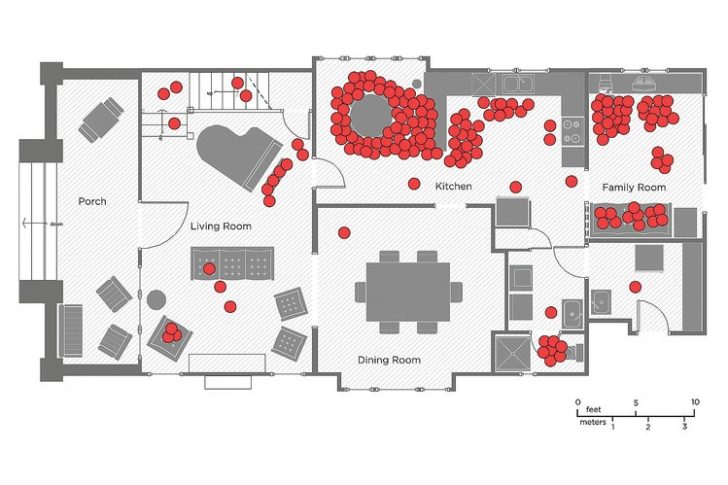
Source: WSJ
4) Less guilt traveling for extended periods of time. Given larger houses tend to have higher ownership costs, every time you go away on vacation or extended travel, you’re wasting more money than you would owning a smaller house. You won’t feel as married to your house, which makes you more free.
5) Fewer property taxes. Property tax is a wealth tax that lasts forever. It makes me ill when I think that if I were to buy this new house, I’d be paying an additional $25,000 a year in property taxes while there’s still massive homelessness, poor public transportation infrastructure, and a public school lottery system. I’d be so pissed if my son couldn’t get into the local elementary school after paying $100,000 in property taxes.
6) More passive income. With the price difference between the bigger house you want to buy and the smaller home you purchased, you can use that money to earn passive income. Since we won’t be spending $2M on this house which we don’t need, we get to earn at least $50,000 a year in risk-free income. See: How To Building Passive Income For Financial Independence
7) No remodeling nightmares. If you end up buying a fixer, you will want to remodel the house. Unfortunately, remodeling is an absolute nightmare, even if you have a great contractor because delays and surprise costs always come up. See: To Make Money In Real Estate, Focus On Expansion
8) Nobody really cares how you live. Unless you’re constantly entertaining guests or run a blog about interior design, nobody will know or care how nice your house is. The only thing that matters is whether or not your home fits your lifestyle. We’d much rather use the $8,000 a month we save on ownership costs for travel and education than spend it on living in a much larger house and one more full bathroom.
9) Less of a target. My friends who live in 6,000+ square foot houses are much more worried about stalkers and burglars than my friends who live in <2,000 square foot houses. After all, if you’re going to steal, you might as well steal from the rich instead of the middle class or poor. One such friend has a neighborhood security guard who the neighborhood association pays to sit in his car all evening. Another friend built a panic room with a 10 inch thick steel door. All of them have extremely expensive security systems.
10) Kids can go wild no problem. When you buy a cheaper house, you aren’t as stressed about kids scratching the floors, drawing on the walls, breaking handles, or spilling food and drink on the floor. My friend who just finished remodeling his 6,000 sqft house told me he had a lot of anxiety when another friend came over with their toddler and the kid started putting his hands all over his white walls! My friend even frowned at me when I sat on his new sofa after a game of tennis! You don’t want to live in a museum. You want to live in a home.
11) Smaller environmental footprint. It’s always funny to hear extremely wealthy people talk about the importance of the environment while they live in mega-mansions and consume massive amounts of water and electricity. Related: The Ideal House Size And Layout To Raise A Family
12) Help alleviate a housing shortage. If everybody drove a bus to and from work with nobody else inside, there would be a traffic crisis beyond imagination. By living in a home that is being fully utilized, we maximize existing inventory and make housing more affordable by reducing demand.
Instead of buying a house two sizes too big, buy a house that’s just the right size with a spare bedroom for visitors or a new addition. When your ego clamors to come out, take solace in knowing you can afford to buy a much larger house and you don’t have to deal with any of the headaches that go along with living in a mansion.
Wealth Building Recommendations
Explore Real Estate Crowdfunding: If you don’t have the downpayment to buy a larger property, don’t want to tie up your liquidity in physical real estate and don’t want to deal with tenants, take a look at RealtyShares, one of the largest real estate crowdsourcing companies today. Real estate crowdsourcing also allows you to be more flexible in your real estate investments by investing beyond just where you live for the best returns possible. I’m happy living in a right-sized house while investing excess capital in the heartland of America where rental yields are 4-5X higher.
Stay On Top Of Your Money: Sign up for Personal Capital, the web’s #1 free wealth management tool to get a better handle on your finances. In addition to better money oversight, run your investments through their award-winning Investment Checkup tool to see exactly how much you are paying in fees. I was paying $1,700 a year in fees I had no idea I was paying. After you link all your accounts, use their Retirement Planning calculator that pulls your real data to give you as pure an estimation of your financial future as possible using Monte Carlo simulation algorithms.
The post Don’t Let Ego Make You Buy A Bigger House Than You Need appeared first on Financial Samurai.
Diagnosis: Why Did the Young Woman’s Heartburn Keep Getting Worse?

The Jewish superstars who once ruled Bollywood

In 2006, the Melbourne-based documentary filmmaker Danny Ben-Moshe was given a newspaper clipping by his Indian research assistant. Spotted by the girl’s father, who knew Ben-Moshe was Jewish, it was an obituary for a veteran Indian actress who had made her name playing the vamp in Bollywood movies of the 1950s and 1960s. Ben-Moshe was shocked to discover that the woman known by her stage name Nadira was born Florence Ezekiel in Israel, and that she was Jewish.
“I’d always known there were Indian Jews but I had no idea there was an Indian Jewish superstar,” he recalled in a recent interview with Quartz.
Ben-Moshe had never watched a Bollywood movie before, but he knew that the lesser-known story of an Indian Jewish superstar would make for a fascinating film. So, he set out to India to do some research. Over the next 10 years, he would learn about a number of other forgotten Jewish stars, from Pramila to Rose Ezra to the pioneer who blazed a trail for them all: Sulochana, otherwise known as Ruby Myers.

Sulochana was a pioneer in Bollywood.
His documentary, Shalom Bollywood, came out in 2017, and it traces the rise of Jewish girls in the cinema industry at a time when most Indian women, notably Hindu and Muslim ones, couldn’t even dream of being seen on the silver screen. Because of India’s conservative culture, it was men who played women’s roles in the early days of Bollywood.
But with the dawn of the silent era in the 1920s, things began to change as Sulochana become India’s very first female superstar, known for movies such as Wildcat of Bombay, in which she played eight different roles, as well as for being among the first in the country to own a Rolls Royce.
Like Rose Ezra (popularly known as Miss Rose in the movies), who would also go on to become a star, Sulochana was from the cosmopolitan Baghdadi Jew community, which traced its history in India back to the late 18th century. Rose’s cousin, Esther Abraham, would also join the industry, going by the more stage-friendly name of Pramila. In the 1930s and 1940s, these Jewish starlets would redefine Indian cinema, besides becoming the heart of the party scene.
Ben-Moshe’s documentary shows how India’s independence from British rule in 1947 marked the beginning of a golden era in the movies. The 1952 hit Aan introduced Indians to a new Jewish star, Nadira, who would go on to establish herself as the “quintessential vamp,” the bad-girl foil to the docile heroine, decked up in a glamorous dress and smoking a cigarette. And the 1950s would also see the rise of Uncle David (David Abraham), a lawyer-turned-cinema legend who would act in over 100 movies. His breakthrough role was in the 1954 film Boot Polish, in which he played a handicapped Christian man who teaches two abandoned children how to earn a living by shining shoes.

Nadira in the 1952 movie Aan, which was released as The Savage Princess in the UK and US.
The stories of these improbable stars are told through conversations with their descendants scattered all over the world, including Pramila’s son, the actor and screenwriter Haider Ali, and Rachel Reuben Cohen, Rose Ezra’s granddaughter, who now works as a film editor. Ben-Moshe says it took years to track these relatives down, but the other struggle was finding archival footage of the Jewish stars’ classic films.
“It was really a nightmare in terms of dealing with institutions in India,” he said. “They either wouldn’t help me or would want a bribe.” He added that it took a long time to find out who had master copies of the films, and there were many that he wanted to get but simply couldn’t.
Nevertheless, the documentary does feature some fascinating black and white clips from the golden era of Jewish stars in Bollywood. But it also explains how the good times came to an end in the 1960s and 1970s, as Bollywood became a more popular career choice among other Indian women. Now, there was a lot of competition, and the legendary Jewish starlets found themselves older and less in demand. The 1980s and 1990s were marked by the deaths of Sulochana and Rose, but by then they had been largely forgotten by the industry they helped transform. And the Jewish community itself had become tiny, as many emigrated away from India.
Today, there’s hardly any trace of Bollywood’s Jewish connection, a quirk of historical and cultural circumstance, as Ben-Moshe puts it, that couldn’t possibly have happened at any other time or place. Modern-day Bollywood is now full of female superstars, but the era of Jewish ones is long gone.
“I did look (if) was there anyone up and coming, (any) aspiring Jewish Bollywood star,” Ben-Moshe said. “I didn’t find anybody.”
Phys Ed: Broke Your Right Arm? Exercise Your Left. It May Help, Really.

The fifth hyperfactorial: 5⁵×4⁴×3³×2²×1¹=86400000 milliseconds is exactly 1 day
Article URL: https://twitter.com/fermatslibrary/status/996736533511266304
Comments URL: https://news.ycombinator.com/item?id=17082652
Points: 356
# Comments: 187
hnrss is a labor of love, but if the project has made your job or hobby project easier and you want to show some gratitude, donations are very much appreciated. Thanks!