Shared posts

26 Sep 14:24

Vinyl Shelf Finder

by Janina Ander

It is a truth universally acknowledged that a person in possession of a large record collection must be in want of a good shelving system. Valentin Galea has solved this problem by developing the Vinyl Shelf Finder. In this build, a web-based app directs a pan-and-tilt laser to point out your record of choice among your collection.

Vinyl Shelf Finder demo by Valentin Galea

Ta-dah!

Collector’s issues

People love to collect stuff. Stamps; soap bars; Troll dolls; belly button fluff (no, really); if you can think of a tangible item, someone out there in the world is collecting it. Of course, every collector needs to solve two issues — which system to use for cataloguing and sorting their collection, and how to best retrieve items from it. This is where Valentin’s Vinyl Shelf Finder comes in. He says:

My vinyl collection is pretty modest — about 500 records in one vertical shelf and a couple of boxes. This is enough to get cumbersome when I’m searching for specific stuff, so I came up with the idea of a automated laser pointer finder.

The Vinyl Shelf Finder

Valentin keeps an online record of his vinyl collection using Discogs. He entered each LP’s shelf position into the record, and wrote a Node.js app to access the Discogs database. The mobile app has a GUI from which he chooses records based on their name and cover image. To build the hardware, he mounted a Pimoroni Pan-Tilt HAT on a Raspberry Pi, and affixed a laser pointer to the HAT. When he selects a record in the app, the pan-and-tilt laser moves to point out the LP’s location.

Valentin Galea on Twitter

my latest hobby prj: #vinyl finder – with lazers and #raspberrypi #iot and #nodejs – https://t.co/IGGzQDgUFI https://t.co/7YBE3svGyE

Not only does the app help Valentin find records – he has also set it up to collect listening statistics using the Last.fm API. He plans to add more sophisticated statistics, and is looking into how to automate the entry of the shelf positions into his database.

If you’re interested in the Vinyl Shelf Finder, head over to Valentin’s GitHub to learn more, and to find out about updates he is making to this work in progress.
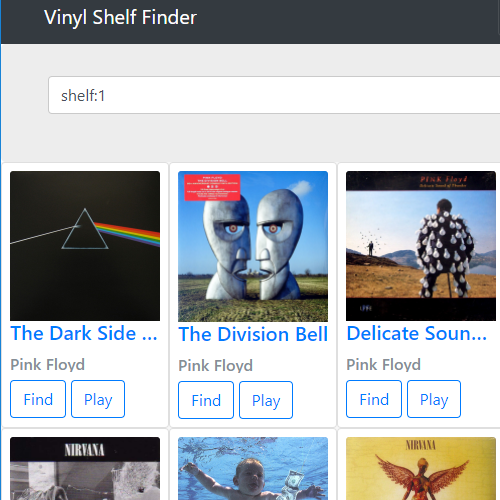
GUI of Valentin Galea's Vinyl Shelf Finder app


Vinyl + Pi

We’ve previously blogged about Mike Smith’s kaleidoscopic Recordshelf build — maybe he and Valentin could team up to create the ultimate, beautiful, practical vinyl-shelving system!

If you listen to lots of LP records and would like to learn about digitising them, check out this Pi-powered project from Mozilla HQ. If, on the other hand, you have a vinyl player you never use, why not make amazing art with it by hacking it into a CNC Wood Burner?

Are you a collector of things common or unusual? Could Raspberry Pi technology help make your collection better? Share your ideas with us in the comments!

The post Vinyl Shelf Finder appeared first on Raspberry Pi.

26 Sep 14:24

Three Times

by admin

The wonderful macOS High Sierra just came out and we couldn’t be more excited about the upgrade. There are some groundbreaking new core technologies that we use and love already very much — like Metal 2, Machine Learning, HEIF, VR, and some others.

However, there is one very cool detail that is incredibly heartwarming for us all at the Pixelmator Team — in the official macOS High Sierra press release, Pixelmator is mentioned three times in different paragraphs (Pixelmator twice and Pixelmator Pro once). Yes, you read it right — THREE huge times. That is insane. That is incredibly cool.

We are very proud of this.

However, we don’t take this for granted. It is a huge responsibility and we do understand very well that we have to keep going strong, even stronger in order to be worth it. Pixelmator Pro is a good example of that.

P.S. We are also putting the final touches on Pixelmator 3.7 Mount Whitney (macOS High Sierra support, Edit With Pixelmator in Photos, HEIF, and more) and Pixelmator for iOS 2.4 Cobalt (iOS 11 support, maybe the new file browser, HEIF, and more). We should be finished by the end of this week and then expect to release both updates sometime next week. So stay tuned.

26 Sep 14:23

"Climate change is a synonym for human stupidity."

“Climate change is a synonym for human stupidity.”

- | Stowe Boyd, Don’t ‘Build It Back’ 
26 Sep 14:23

Who Earns More Income in American Households?

by Nathan Yau

Compared to 1970, a shift towards women making the higher income. Read More

26 Sep 14:22

Trust is built in drops and lost in buckets

by Volker Weber

There was a Sonos leak yesterday, and it bothered me. It bothered me a lot.

Why did it bother me? The information was leaked by a person I would have trusted. A person who knows exactly what he is doing. Somebody who knows about NDAs, has signed many, and still goes ahead breaching one because he did not sign it himself.

If you trust me with information that should not be published, I will not publish it. I never did, I never will.

And that is why you never need me to sign an NDA.

26 Sep 14:22

Launching A New Online Community, Overcoming The ‘chicken and the egg’ Problem.

by Richard Millington

Andreas shares the problem of getting to critical mass for a new community.

It’s a classic chicken and the egg problem. How do you get people to join a community when there is nothing there.

If you’re launching a new community, you have five approaches here:

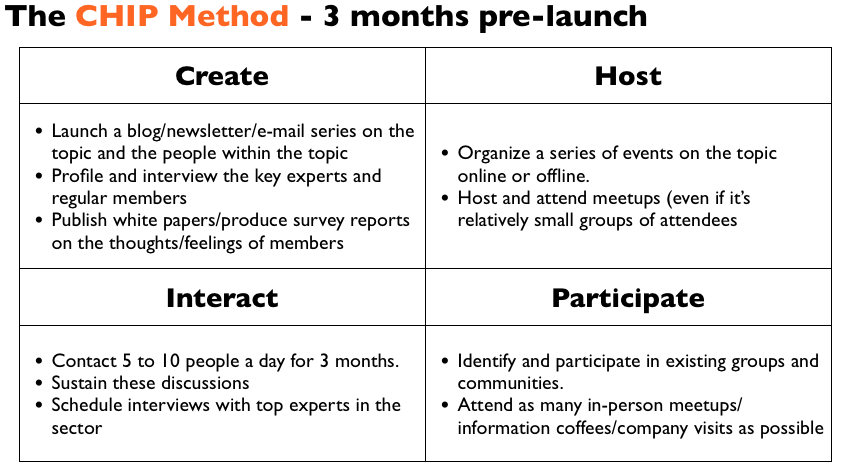
1) Build the audience first and rush to critical mass. This is where you build up a big audience first via a blog, a customer mailing list, a big event, or some other channel. You then launch the community and try to grow quickly to critical mass (usually around 300 posts from 100 active members) members. The benefit is your concept is part-tested by the virtue of building a community. Most of the successful communities you see followed this route (see the CHIP method).

2) Be exclusive. Send exclusive invites only to the very top people in the field and expand slowly. The top people are likely to join because of the story it tells about their status and having an exclusive place to access the best knowledge. Facebook may be the best example of this.

3) Be hyper-focused. Start with the smallest possible niche within your field you can target and grow from there. Craigslist, for example, began as a mailing list of social events for software developers. That’s a really easy niche to dominate.

4) Be First. If you can move to a new platform or identify a new sector early enough, you can usually build a big audience relatively quickly. You’re the only game in town – and you’re exciting.

5) Try to grow slowly and be lucky. You can launch without an existing audience and simply hope you can mention it elsewhere and hope people join. Almost every failure we see followed this route. This is also, sadly, the approach most people take.

If you don’t intend to follow one of the first four approaches here, I’d suggest you reconsider your strategy.

26 Sep 14:22

macOS High Sierra keychain zero-day vulnerability

by Rui Carmo

I wasn’t really planning on upgrading this soon (unless I really had to convert some iPhone raw photos to JPEG), but this definitely put me off it.

Furthermore, there were hints of this being exploitable now in Sierra, so I’m going to try catching up on news later and then making an informed decision.

Either way, this is not a reassuring sign that the Mac is back.

26 Sep 14:21

U.S. Supreme Court signals it may dismiss challenge to Trump’s immigration ban

mkalus shared this story .

The Supreme Court signalled on Monday it may dismiss a challenge to President Donald Trump's controversial immigration ban after the White House announced tailored restrictions on eight countries that legal experts said stand a better chance at holding up in court.

The high court cancelled oral arguments scheduled for Oct. 10 to decide whether or not a March 6 executive order that temporarily blocked travel from six Muslim-majority countries was discriminatory.

That ban expired on Sunday. The president replaced it with a proclamation that indefinitely restricts travel from Iran, Libya, Syria, Yemen, Somalia, Chad and North Korea. Certain government officials from Venezuela will also be barred. The new ban, Trump's third, could affect tens of thousands of potential immigrants and visitors.

Story continues below advertisement

Trump has been trying for most of the year to create a ban that passes court muster. The Sunday proclamation, which he said is needed to screen out terrorist or public safety threats, could be less vulnerable to legal attack, scholars and other experts said, because it is the result of a months-long analysis of foreign vetting procedures by U.S. officials.

It also might be less easily tied to Trump's campaign-trail statements some courts viewed as biased against Muslims.

"The greater the sense that the policy reflects a considered, expert judgment, the less the temptation (by courts) to second-guess the executive," said Saikrishna Prakash, a professor at the University of Virginia School of Law, in an e-mail. "It looks less like a matter of prejudice or a desire to fulfill a campaign promise."

In its brief order, the high court asked the Trump administration and the ban's challengers, including states and refugee advocacy organizations, to file briefs on whether the case should be dismissed.

Trump's March 6 ban sparked international outrage and was quickly blocked by federal courts as unconstitutional discrimination or a violation of immigration law.

In June, the Supreme Court allowed a limited version of the ban to go ahead while the justices prepared to hear arguments over its legality on Oct. 10, a date they have now scrubbed.

In 2016, more than 72,000 nonimmigrant and immigrant visas were issued to the countries covered by the new ban, excluding Venezuela, with nearly half of those going to Iran. Only nine North Koreans immigrated to the United States in 2016 and 100 were granted nonimmigrant visas.

Story continues below advertisement

Story continues below advertisement

The new ban is set to go into effect on Oct. 18, but it already applies to five of the six countries covered by the March 6 ban, according to a U.S. State Department cable issued on Sunday and obtained by Reuters.

Sudan was dropped from the list of banned countries after the Sudanese government provided information required under the new criteria set out by the Trump administration earlier this year, a White House official said on Monday.

The government has said the president has broad authority in immigration and national security matters, but challengers to the March ban had argued that it ran afoul of the U.S. Constitution's bar on favouring one religion over another.

They cited statements Trump made during his 2016 campaign for president, including his call for a "total and complete shutdown of Muslims entering the United States."

Within hours of Sunday's proclamation, representatives for the Hawaii, New York and California attorneys general said their offices were reviewing the new restrictions. Advocacy organizations denounced it as more of the same.

If the court does dismiss the case, there remains the separate issue of whether the justices will throw out the sweeping lower court rulings that invalidated the ban.

Story continues below advertisement

The government would want to erase precedents that constrain its authority while the challengers would want to keep them in place for the same reasons.

STILL A 'MUSLIM BAN'?

"This is still a Muslim ban. They simply added three additional countries," said Becca Heller, director of the International Refugee Assistance Project, which previously sued to block Trump's immigration ban executive orders.

"Of those countries, Chad is majority Muslim, travel from North Korea is already basically frozen and the restrictions on Venezuela only affect government officials on certain visas," Heller said.

Sudan, which was in the March order, is no longer included.

The worldwide review examined each country's ability to issue reliable electronic passports and share security risk data with the United States. Overall, 47 countries had problems, and 40 made improvements, including 11 that agreed to share information on known or suspected terrorists, Trump's proclamation said.

The review "at least arguably attenuates the link between the president's alleged bias and the policy," said Margo Schlanger, a University of Michigan Law School professor.

However, challengers potentially could argue that the expanded ban violates the federal Immigration and Nationality Act, which forbids the government from discriminating based on an individual's nationality when issuing immigrant visas. "Congress decided that it didn't want an immigration system that played favourites among countries," Schlanger said.

26 Sep 14:21

110 West 5th Avenue

by ChangingCity

This is another project in the jigsaw puzzle of higher density industrial and commercial buildings to be built in the Mount Pleasant industrial area, It’s a four storey building with access to the roof from a fifth storey overrun, designed by Taylor Kurtz, with two floors of office over warehousing.

The roof of the building, at 5th and Manitoba, has a proposed multi-sport court (although losing the ball from there could be a hazard to traffic).


26 Sep 14:20

Twitter Favorites: [DenimAndSteel] @sillygwailo The big challenge is updating in a way that’s relevant in a world with Snapchat etc. Older online disc… https://t.co/NFGDoksIEe

Denim & Steel @DenimAndSteel
@sillygwailo The big challenge is updating in a way that’s relevant in a world with Snapchat etc. Older online disc… twitter.com/i/web/status/9…
26 Sep 14:20

Twitter Favorites: [DenimAndSteel] @sillygwailo That is true. We do have ideas for what a good 2.0 would look like, but it all takes time, and other i… https://t.co/6jDpDSKEcl

Denim & Steel @DenimAndSteel
@sillygwailo That is true. We do have ideas for what a good 2.0 would look like, but it all takes time, and other i… twitter.com/i/web/status/9…
26 Sep 14:20

Twitter Favorites: [DenimAndSteel] We couldn’t do right by this project, so we’ve put it into hibernation as well. It’s a week of tying up some loose… https://t.co/xPDT1CybmR

Denim & Steel @DenimAndSteel
We couldn’t do right by this project, so we’ve put it into hibernation as well. It’s a week of tying up some loose… twitter.com/i/web/status/9…
26 Sep 14:20

Acorn and 10.13

Happy Mac OS High Sierra release day everyone.

I'm happy to say that there are no known issues with Acorn 6.0.3 or Acorn 5.6.6 when running on Mac OS 10.13 High Sierra. In fact, you might even notice that some things are actually faster and it can now open HEIF images. How awesome is that?

I'm also working on some 10.13 goodies for Acorn 6 folks later this year. I can't wait to share that with you, but you'll have to wait just a little bit.

26 Sep 14:19

Microsoft’s CEO confirms he was against Nokia acquisition

by Rose Behar
Satya Nadella

In his new book Hit Refresh, Microsoft’s current CEO Satya Nadella confirms that he was never in favour of the company acquiring Nokia.

As Thurrot.com pointed out, Nadella says he voted against the acquisition when then-CEO Steve Ballmer conducted a poll of senior leadership team members.

“I voted no,” writes Nadella, “I did not get why the world needed the third ecosystem in phones, unless we changed the rules … But it was too late to regain the ground we had lost. We were chasing our competitors’ taillights.”

Building on that sentiment, Nadella suggests that Microsoft should only enter the mobile market with a product that has a unique value proposition.

“Buying a company with weak market share is always risky,” says Nadella. “We should only be in the phone business when we have something that is really differentiated.”

These sentiments haven’t been kept a close secret over the years — a 2014 Bloomberg report noted that Ballmer faced pushback on the acquisition — but this is the first time Nadella has publicized his own feelings on the subject so candidly.

Microsoft wrote off the Nokia acquisition in 2015, cutting thousands of jobs in the process.

Via: Windows Central

The post Microsoft’s CEO confirms he was against Nokia acquisition appeared first on MobileSyrup.

26 Sep 14:19

Daily Scot – Night Ridin’

by Scot Bathgate

Caught a glimpse firsthand of the massive Bike the Night event on Saturday the 16th from my vantage point on 2nd Avenue near Quebec.  My short video doesn’t do it justice, a truly colourful event for a wide range of ages with as you can see, huge participation.


2017-09-16 20.47.57
25 Sep 22:37

Twitter Favorites: [peptalkbot] What would make you more comfortable? Get off the computer and get to it!

peptalkbot @peptalkbot
What would make you more comfortable? Get off the computer and get to it!
25 Sep 22:37

Twitter Favorites: [skeskali] It's not enough to say what the protests aren't about. Affirm what they *are* about. Don't dilute the message. Speak truth.

Cecily Walker 🏳️‍🌈🌑 @skeskali
It's not enough to say what the protests aren't about. Affirm what they *are* about. Don't dilute the message. Speak truth.
25 Sep 22:37

Twitter Favorites: [spice_run] I ugly cried on the FlightDeck. 😭 https://t.co/qg3jrIHqeF

Livtista @spice_run
I ugly cried on the FlightDeck. 😭 twitter.com/sportsnet/stat…
25 Sep 22:37

The origin of Pro Action Cafe

by Chris Corrigan

Over the years the Art of Hosting community of practice has developed some methods for large group process facilitation that have become standards alongside the methods we have imported into our work, such as Circle Way, Open Space Technology and World Cafe.

One of these, Pro Action Cafe, is one of my go to methods for hosting small and rapid fire project development.  Ria Baeck, one of the co-developers of this method along with Rainer von Leoprechting shared the Pro Action Cafe origin story on the Art of Hosting list, and so here are her words and observations, for posterity:

Quite some years back – Rainer will know the date – I was hosting my ever first World Café in Brussels; in a back room of a real café. One of the participants was Rainer. He had been hosting what he called Pro Action groups of change agents in the Eur.institutions. It is was structured as groups of 10-12 people who came together one evening per month. As there were more people asking to join, he felt the pressure on his evening time. Being in this World Café, he realised that there was a key in scaling the number of people, being present at the same time.

So, we joined our forces to find a way of how the purpose of his Pro Action Groups could be blended with the key features of the World Café. We actually had a meeting in Mechelen, a Flemish city, and walked around… I remember it as a collective sensing of how we could blend the piece of Open Space – where people bring there own topics and questions – with the element of World Café, where people mix and are talking about the same question in each round. That’s how we came up with the 3 rounds and its 3 questions.

We then started in Brussels with regular Pro Action Cafés, with some food and drinks right after office time, and then diving into the Pro Action Café. All kind of questions came forward, from very, very personal to very professional and more. This open Pro Action Café is still going on in Brussels, although there have been different hosting teams holding it over the years.

Some people come and join to just see what Participatory Leadership is about – as Art of Hosting is called within the Eur. Institutions. I guess that it started to travel the world through one of the hosts, working with Toke and Monica in the Eur.context. Ursula or Helen probably know more here.

Amazing to see it travel to so many places and situations. Something I could have never imagined up front. Lesson here is: don’t hold back when you feel passioned to do something, you never know where it will have some impact.
25 Sep 22:37

Twitter Favorites: [katherinebailey] The philosophy of awesomeness and suckiness https://t.co/GYwDNTDkGZ

Katherine Bailey @katherinebailey
The philosophy of awesomeness and suckiness scientificamerican.com/article/how-to…
25 Sep 22:37

Twitter Favorites: [brightsteven22] @sillygwailo @ICCTtweets Thanks for inviting me to share this story. It was a pleasure. @guger

Steven Bright @brightsteven22
@sillygwailo @ICCTtweets Thanks for inviting me to share this story. It was a pleasure. @guger
25 Sep 22:36

Twitter Favorites: [counti8] Poetry In Transit is such a gift of a program. I love it so, so much, and getting to see the poets read their poems… https://t.co/UCLYfCsnf3

Karen Quinn Fung 馮皓珍 @counti8
Poetry In Transit is such a gift of a program. I love it so, so much, and getting to see the poets read their poems… twitter.com/i/web/status/9…
25 Sep 22:34

Fun Exercise to Try at Home: Suicide by Squats

by Jeffrey Friedl

Let me tell you about a short, 16-minute exercise that I did a few weeks ago, an exercise that had an incredibly-unproportional impact, leaving me with the worst muscle soreness I'd ever experienced, by a very wide margin. It wasn't until the 13th day after this simple exercise that I got through the whole day without feeling its painful effects.

This exercise, which involves nothing more than simple bodyweight squats, was introduced to me with the name “Death by Squats”.

It's simple: Start a timer, then do two squats during the first minute, at whatever pace you like. During the second minute, do four squats, then six, then eight, and so on, increasing by two squats every minute until you can't perform all a minutes' requisite squats.

Generally speaking, I've got strong legs. I do a lot of long-distance cycling (100+ miles at a time), and many lessons at the gym include squats and lunges. It's common to do 50+ squats as a small part of an hour's routine. No big deal.

However, a lot has conspired to drive my fitness level down this year. In imagining what this exercise might be like, I thought that 40 squats in a minute wouldn't have been much of a challenge last year when I was in my best shape, but knew that I'd probably not get to that point (the 20-minute mark) in my current condition. Anyway, I gave it a try.

The “whatever pace you like” naturally meant for me that I'd do them quickly, then rest for the remainder of the minute. At first it felt silly, as the first minute's squats are done in three seconds, so I just stood around waiting for the next 57. Actually, during the early stages, I filled the waiting time with some simple tidying, such as putting laundry away. Such was how unchallenging the start was.

I was still fine by minute 10, finishing its 20 squats in about 25 seconds. At this rate, the 20-minute mark didn't feel so far away. But oh, how my hubris would soon be revealed. The insidious nature of this exercise is that while the amount of work increases, the amount of rest decreases.

Soon I was struggling. I was also struggling to keep my balance in the pool of sweat that had formed on the hardwood floor under me.

As fatigue slowed down my pace, the ever-increasing number of squats left less and less time to recover, and I finished the 15th minute's 30 squats with less than 10 seconds to catch my breath. I knew I'd never finish 32 squats in the next 60 seconds, but thought I should at least try to see how far I got. I finished 26 of them. Having failed to do the allotted number, I was done.

All in all, I'd done 266 squats in 16 minutes.

My legs were absolute jelly. I'd experience this while cycling, such as after an explosive effort on a short climb, but in those cases control would return in a few minutes. This time, I was still shaky in the evening, 12 hours later.

The muscle ache the next morning was monumental. Every movement hurt, giving me a certain “that must have been great exercise” satisfaction. In the past, muscle aches the next day are helped by light exercise, just to get the juices flowing, so I went out on very light bike ride. Oddly, I could cycle just fine, but when I got off my bike I could barely move without crippling pain.

I'd hoped that the light movement would have helped relieve the muscle ache, but the pain on the 2nd day after was unlike any I'd ever experienced. And on the 3rd, it was almost unbearable. I literally couldn't stand from a chair (or from the toilet) without plotting tactics on how to support myself on the way up. Attempting to walk down a set of steps was frightening, even while holding the rail, as I simply lacked the physical control to guarantee the legs wouldn't buckle.

Somewhere around this time I started to feel that the name “Death by Squats” wasn't as appropriate as “Suicide by Squats”, since it's something I did to myself. But then I realized that even more appropriate would be “Botched Suicide by Squats”, since I wasn't actually dead and so I was feeling pain and paying the price from what I'd attempted.

Sadly, “Botched Suicide by Squats” doesn't roll off the tongue so well, so “Suicide by Squats” it is.

The 3rd and 4th day after were the worst, but then it started getting better. The 13th day was the first that I felt no effects.

I have no explanation for why such a short little exercise had such a dramatic impact. It'll be interesting to see whether I see the same results next time.

25 Sep 22:32

Facebook Dropping Patent Clause

by Matt

I am surprised and excited to see the news that Facebook is going to drop the patent clause that I wrote about last week. They’ve announced that with React 16 the license will just be regular MIT with no patent addition. I applaud Facebook for making this move, and I hope that patent clause use is re-examined across all their open source projects.

Our decision to move away from React, based on their previous stance, has sparked a lot of interesting discussions in the WordPress world. Particularly with Gutenberg there may be an approach that allows developers to write Gutenberg blocks (Gutenblocks) in the library of their choice including Preact, Polymer, or Vue, and now React could be an officially-supported option as well.

I want to say thank you to everyone who participated in the discussion thus far, I really appreciate it. The vigorous debate and discussion in the comments here and on Hacker News and Reddit was great for the passion people brought and the opportunity to learn about so many different points of view; it was even better that Facebook was listening.

25 Sep 22:07

Gorilla-Size Speculation

by Ken Ohrn

Dan Fumano writes in PostMedia’s Province, with amusing speculation about where Amazon could set up its HQ2 in Metro Vancouver.  Mr. Fumano’s thoughts were developed in part via conversation with PT’s editor Gordon Price and occasional PT contributor Andy Yan.

False.Creek.Flats

False Creek Flats — Future Amazone?  Click to enlarge.

The Vancouver Economic Commission, the organization leading Vancouver’s bid, stated earlier this week that it’s a “cross-regional” effort including interested suburban municipalities and Metro Vancouver.

Some local politicians and civic commentators consider Vancouver a very long shot to land Amazon for several reasons.

But still, it’s a useful exercise for Metro Vancouver officials to collaboratively look at the region’s development opportunities, regardless of whether the economic commission is eventually successful in courting Amazon, said Andy Yan, director of the City Program at Simon Fraser University.


25 Sep 22:07

By-Election Talk About Housing

by Ken Ohrn

To me, it’s unusual to see something direct and unambiguous around the housing debate — and an often-discussed solution.  Density and the missing middle.

Of all places of origin, here’s a set of ideas from the NPA’s Hector Bremner.  One wonders about the reaction from NPA’s (perhaps endearingly mythical) voter base of bike-hating, car-loving, pearl-clutching angry old white folks living in classically exclusionary single-family ‘hoods. Maybe, though, this by-election is devolving into giant trial-balloon-fest leading up to the big election in 2018.  After all, the winner only gets a council seat for a year.

 An end to the piecemeal, building-by-building, lot-by-lot and project-by-project rezoning.  This will be replaced with zoning changes over larger zoning areas within the city that will allow flexibility to achieve greater residential density and diversity.

Oh yes — Mr. Bremner is in favour of collaborative consulting on all this.  No idea yet if he’s up for Nimby-by-Nimby or city-wide or zone-wide consulting. Or how he’ll fare against the Nimby-friendly “preservation of heritage and neighbourhood” arguement, as championed by the Green’s Carr and Fry. [“Creating democratic and inclusive City-funded neighbourhood councils, allowing communities to provide input at the start of land use and development projects . . . “].

And let’s not forget the latent opportunities we have to build density, perhaps exceeding “missing middle” density, on 90-acre Jericho and the 21-acre Heather Lands — including the transit nodes that make it all multi-modal.

Jericho

Jericho Lands — still in limbo.


25 Sep 22:06

Migration from Main Street

by michaelkluckner

01

Burcu’s Angels – a good example of a hip independent shop if there ever was one – has left trendy Main for edgy East Hastings at Nanaimo, wedged between the cannabis shops and the office of MLA Shane Simpson…

03_edited-1

…including a nice little dig at gentrification and, no doubt, soaring rents.

02


25 Sep 22:04

Young people oppose Fitbits in schools

files/images/feet.jpg

Charlotte Kerner, Mikael Quennerstedt, Victoria Goodyear, The Conversation, Sept 28, 2017


Icon

The generalization in the title is based on published research surveying 100 pupils aged 13 to 14 from two UK schools, which is to say, not reliable. I was able to access some of the original work at NRC, though I imagine it is paywalled elsewhere. Here's another paper from the same work (with none of the references to Foucault etc. cited in the other paper). I question not only the unrepresentative sample but the study itself. "Each pupil was asked to respond to a statement in turn that was presented to them by the interviewer. For example, statements introduced were ‘I would recommend using the Fitbit to other people my age because … ’ and ‘as a result of wearing the Fitbit I learnt … ’." There's no indication that the study was sponsored by FitBit (the authors credit Richard Benjamin Trust, whose website is several years out-of-date). Personally, I think there's a big difference between  being required to wear devices, and then being surveiled, as these studenmts were, and choosing to wear the device on one's own, keeping the data private. I think there's really interesting work to be done on the relation between education and surveillance. But this isn't the way to do it. 

[Link] [Comment]
25 Sep 22:04

Bangladeshi ‘floating schools’ reinvent education

files/images/boatschool9-690x449.jpg

Sept 28, 2017


Icon

Duribg the Monsoons in Balgladesk a third of the country is flooded, making school attendance impossible. Flipping virtual learning on its head, a fleet of solar-powered floating schools has been launched to address the need. "Each morning, the elementary schools travel to different communities, picking up children along the way. The boats then docks and teach up to 30 children at a time. The boat schools also train adult villagers on children’s and women’s rights, nutrition, hygiene and other practical issues." This is the prmise of From Virtual to Reality. "While some first world countries have brought virtual reality into classrooms to study subjects like science, art and history, other schools are taking their classrooms into the forests or other natural settings."

[Link] [Comment]
25 Sep 22:04

Anatomy of a Moral Panic

files/images/stump_recommend_small.png

Maciej Cegłowski, Idle Words, Sept 27, 2017


Icon

Those of us in education have experience no end to the moral panics about this and that over the years. This article is an extended take on moral panics in the media over sales of charcol, suphur and saltpeter on the internet. These, of course, are the ingredients to make black powder, a favourite of hobbyists worldwide. It reminded me of my own efforts to make rockets when I was a kid. These were not successful; the most notable result was an inch-deep hole gouged in the neighbour's porch (which truly was impressive). But of course, the panic is not just about black powder, it's about cryptography and algorithms and technology in general. "The real story in this mess is not the threat that algorithms pose to Amazon shoppers, but the threat that algorithms pose to journalism.... Moral panics like this one are not just harmful to musket owners and model rocket builders. They distract and discredit journalists, making it harder to perform the essential function of serving as a check on the powerful." Right. Via Doug Belshaw.

[Link] [Comment]