Shared posts

04 Oct 20:01

Porn Copyright Trolls Terrify 60-Year-Old But Age Shouldn’t Matter

by Andy
mkalus shared this story from TorrentFreak.

Of all the anti-piracy tactics deployed over the years, the one that has proven most controversial is so-called copyright-trolling.

The idea is that rather than take content down, copyright holders make use of its online availability to watch people who are sharing that material while gathering their IP addresses.

From there it’s possible to file a lawsuit to obtain that person’s identity but these days they’re more likely to short-cut the system, by asking ISPs to forward notices with cash settlement demands attached.

When subscribers receive these demands, many feel compelled to pay. However, copyright trolls are cunning beasts, and while they initially ask for payment for a single download, they very often have several other claims up their sleeves. Once people have paid one, others come out of the woodwork.

That’s what appears to have happened to a 60-year-old Canadian woman called ‘Debra’. In an email sent via her ISP, she was contacted by local anti-piracy outfit Canipre, who accused her of downloading and sharing porn. With threats that she could be ‘fined’ up to CAD$20,000 for her alleged actions, she paid the company $257.40, despite claiming her innocence.

Of course, at this point the company knew her name and address and this week the company contacted her again, accusing her of another five illegal porn downloads alongside demands for more cash.

“I’m not sleeping,” Debra told CBC. “I have depression already and this is sending me over the edge.”

If the public weren’t so fatigued by this kind of story, people in Debra’s position might get more attention and more help, but they don’t. To be absolutely brutal, the only reason why this story is getting press is due to a few factors.

Firstly, we’re talking here about a woman accused of downloading porn. While far from impossible, it’s at least statistically less likely than if it was a man. Two, Debra is 60-years-old. That doesn’t preclude her from being Internet savvy but it does tip the odds in her favor somewhat. Thirdly, Debra suffers from depression and claims she didn’t carry out those downloads.

On the balance of probabilities, on which these cases live or die, she sounds believable. Had she been a 20-year-old man, however, few people would believe ‘him’ and this is exactly the environment companies like Canipre, Rightscorp, and similar companies bank on.

Debra says she won’t pay the additional fines but Canipre is adamant that someone in her house pirated the porn, despite her husband not being savvy enough to download. The important part here is that Debra says she did not commit an offense and with all the technology in the world, Canpire cannot prove that she did.

“How long is this going to terrorize me?” Debra says. “I’m a good Canadian citizen.”

But Debra isn’t on her own and she’s positively spritely compared to Christine McMillan, who last year at the age of 86-years-old was accused of illegally downloading zombie game Metro 2033. Again, those accusations came from Canipre and while the case eventually went quiet, you can safely bet the company backed off.

So who is to blame for situations like Debra’s and Christine’s? It’s a difficult question.

Clearly, copyright holders feel they’re within their rights to try and claw back compensation for their perceived losses but they already have a legal system available to them, if they want to use it. Instead, however, in Canada they’re abusing the so-called notice-and-notice system, which requires ISPs to forward infringement notices from copyright holders to subscribers.

The government knows there is a problem. Law professor Michael Geist previously obtained a government report, which expresses concern over the practice. Its summary is shown below.

Advice summary

While the notice-and-notice regime requires ISPs to forward educational copyright infringement notices, most ISPs complain that companies like Canipre add on cash settlement demands.

“Internet intermediaries complain…that the current legislative framework does not expressly prohibit this practice and that they feel compelled to forward on such notices to their subscribers when they receive them from copyright holders,” recent advice to the Minister of Innovation, Science and Economic Development reads.

That being said, there’s nothing stopping ISPs from passing on the educational notices as required by law but insisting that all demands for cash payments are removed. It’s a position that could even get support from the government, if enough pressure was applied.

“The sending of such notices could lead to abuses, given that consumers may be pressured into making payments even in situations where they have not engaged in any acts that violate copyright laws,” government advice notes.

Given the growing problem, it appears that ISPs have the power here so maybe it’s time they protected their customers. In the meantime, consumers have responsibilities too, not only by refraining from infringing copyright, but by becoming informed of their rights.

“[T]here is no legal obligation to pay any settlement offered by a copyright owner, and the regime does not impose any obligations on a subscriber who receives a notice, including no obligation to contact the copyright owner or the Internet intermediary,” government advice notes.

Hopefully, in future, people won’t have to be old or ill to receive sympathy for being wrongly accused and threatened in their own homes. But until then, people should pressure their ISPs to do more while staying informed.

Source: TF, for the latest info on copyright, file-sharing, torrent sites and ANONYMOUS VPN services.

04 Oct 20:00

Accessibility

As a young developer I didn’t pay that much attention to accessibility. I figured that most people didn’t need those features, and it was something I could get to later. Plus: adding those features wasn’t easy back in those days.

Things have changed.

For one thing, supporting accessibility features — at least on Macs and iOS — has gotten much easier. It’s almost delightful with how much you get for free and how easy it is to add what’s missing. Apple deserves a huge amount of credit for this.

But there are two bigger things I keep thinking of.

First thing: I want to say that access to computing and communications power is a human right. It’s not, not really — but it would be wrong to deny someone access when, with a little extra work, you could make it work for them.

(Would you be lost without your iPhone? I would be.)

Second thing: accessibility is not just for some small number of people with one specific issue. It’s a diverse set of features and solutions. And everybody — even the youngest and healthiest of us — will eventually rely on some accessibility features if they live long enough.

You may not need it now, in other words, but you will, if you’re lucky. And future-you will be proud of past-you if you cared about it before it was personal.

It’s personal to me now, by the way, at age 49: I use the Dynamic Type feature on my iOS devices to bump up the font size. Though I run into layout bugs from time to time (reported: rdar://34791630), I’m still utterly grateful that the feature exists and that so many developers have adopted it (or done the equivalent in their apps).

Without that feature I’d be an iOS programmer who has a hard time actually using an iPhone. Which would be dumb.

04 Oct 18:28

[For Members] How I Made That: Interactive Beeswarm Chart to Compare Distributions

by Nathan Yau

The histogram is my favorite chart type, but it's unintuitive for many. So I've been using the less accurate but less abstract beeswarm. Read More

04 Oct 18:27

Verizon Now Says That All Yahoo Accounts Were Probably Compromised By Massive Hack

by Chris Morran
mkalus shared this story from Consumerist.

Last year, Yahoo revealed that some 1.5 billion accounts — representing about 1 billion users — had been compromised by a data breach going back years. Now that Yahoo’s new parent company Verizon has had a chance to investigate it turns out that the number of accounts compromised by the hack was… well, every single one of them.

Verizon disclosed the results of its internal investigation into the breach, which began in Aug. 2013, this afternoon in a filing [PDF] with the Securities and Exchange Commission.

According to the filing, Verizon now has reason to believe that the number of compromised accounts includes “all Yahoo user accounts.” That would put the total number of affected accounts at around 3 billion — about 40% of the world’s population.

Yahoo, which still exists but is part of Verizon’s new “Oath” media division, says it will blast out new email notifications to every account that was not part of the earlier group of compromised accounts.

Verizon says the thieves in this case did not include unencrypted passwords, or any bank/payment card data.

“Verizon is committed to the highest standards of accountability and transparency, and we proactively work to ensure the safety and security of our users and networks in an evolving landscape of online threats,” said Chandra McMahon, Chief Information Security Officer, Verizon. “Our investment in Yahoo is allowing that team to continue to take significant steps to enhance their security, as well as benefit from Verizon’s experience and resources.”

When reached for comment by Consumerist, a rep for Oath referred us back to the statement included in the SEC filing.


04 Oct 18:27

The Bicycle Diaries: Episode 12

by Stephen Rees

Where I live there is only one flat route out of Arbutus Village park – north west along Valley Drive. In any other direction there is a hill. In fact to get up to the Arbutus Corridor I have to get off and push. So when I saw a crowd funder for an electric wheel, that provides assistance when cycling, I decided to take a chance. It has taken six months from making my payment through KickStarter for the first of two wheels to arrive. I got one for myself and am still waiting for the one for my partner.

In the intervening period the name of the project had to be changed from UrbanX to UrbaNext.

Via Kickstarter the team reported

We received notification from BMW Auto Group that our product name UrbanX was too close to their venture fund called URBAN-X which focuses on helping emerging and start-up companies in the fields of technology and design for urban environments. You can read more about the program here. Despite our best efforts in researching our product name, we were unaware of similarity to their program and program name. The program does seem very cool in its mission to work with small businesses and help fund new innovation in urban environments.

KickStarter provided regular project updates and this video about installation

So that all looks pretty straightforward I thought. Once my wheel arrived, I unpacked it and took it down to the basement. Taking off the existing front wheel is easy, but the new wheel was a real problem. Some time ago, after renting a very comfortable bike in San Francisco, I had my Trek 800 upgraded by fitting suspension forks and a sprung saddle post. The forks were simply too fat to admit the wheel properly – and the bracket for a disc brake got in the way of inserting the battery. I took the bike with the wheel to West Point Cycles in Kerrisdale, and they replaced the forks (no suspension) and installed the new wheel for me. I then spent a while hooking up the cables and installing the control and the phone carrier – as the functioning of the electric wheel is controlled through an app. No, that installation video does not mention that – but you do get an instruction manual with the wheel. That includes a QR code for the app which is called iMortor. If you go to YouTube you will see other videos about iMortor and another UrbanX user called Edgar Cornejo who has made a number of youtube videos about his experiences.

I first tried out the new wheel in our underground garage. That really did not get me enough space to get up to speed (5km/hr), and I also missed the point that you are supposed to hold the throttle open for ten seconds, while pedalling, to get the motor to kick in. My next trip was to take the bike up to the Greenway by the hill on King Edward Avenue. This gave me enough distance to get up to speed and to hold the throttle open for long enough – and I knew the motor had kicked in as I did not have to get off and push. The app allows for three speed settings, and all of my first trip was in speed 1. The ride up to Kerrisdale by the Greenway is actually not a problem for me, I just gear down and keep twiddling. This time I did not have to gear down. As long as I was pedalling the bike kept going – and that seemed to be true even when I let go the throttle. I tried other speeds too, but that is not so easy when trying to hit the very small button on the app while moving.

Of course, no-one needs help to ride downhill. What is missing from the UrbaNext is a regenerative brake setting, which could act as a retarder and recharge the battery. Not only that but as I was in speed 1 and the app and motor was stilled turned on even pedalling downhill on King Edward, hoping to keep up with traffic, all I could manage was 12 km/hr.

Today I decided to venture further afield, so I added a bottle of water and some Cliff bars to the pannier and headed  south on the Greenway to Burrard, hoping to use the new bikeway across the bridge. The east side of the bridge was closed by barriers, and a sign instructing “use West walkway”. I rode wrong way in the bike lane – and noticed that there might have been room to ride in the vehicle lane if I had been daring enough. Then down Beach Avenue and round Stanley Park (via the Chilco Loop). By now I was getting used to riding with and without assistance. In fact there were times when, with the throttle closed, I wished it was not “helping”. Equally there were times when I was below the 5km/hr when help starts and I would have appreciated it much sooner!

I had a pleasant break near the Lumberman’s arch, with a view of the Lions’ Gate Bridge and some charming company. By the time I got to the Second Beach pool, the lights on the control box were showing red – or 30% of capacity. So I stopped using the motor by simply hitting the off button, hoping to conserve power. The bike was much heavier, thanks to the wheel and its battery, but there also seemed to be significant rolling resistance when there was no power available. Given the lack of regenerative braking I found that puzzling. By the time I got to Cornwall, I decided I had had enough, and waited for the #2 bus. Getting the bike on the bus wasn’t easy before the new wheel. Now it was beyond my ability unaided. Fortunately a very strong young chap who was passing offered assistance, and the bus driver got out too! I had taken the phone off the bike to use the transit app to find out how long I had to wait, so I just shoved the phone into my pocket when the bus arrived.

The #2 was short turning at 16th Avenue, so the driver was not pressed for time, and told me she would help me get the bike off. What with the ratchet on the bike rack’s bracket and the weight of the front wheel I was very glad of her help.

I set off home along the familiar nearly flat Valley Drive route, and just out of curiosity flicked on the throttle to see how much power was left. Amazingly the bike took off like a rocket. There was no phone controlling the app – I had taken it off the bike, and hit the iPhone’s power off button reflexively when putting it in my pocket. I even stopped pedalling altogether and the motor actually accelerated! I used no muscle power at all to get home, and in fact did a lap of honour round the garage all unaided by pedalling!

It has taken only an hour or so to recharge the battery. I should also point out that getting the battery out of the wheel is in itself no mean feat. It really helps to wait awhile for it to cool down first. Then you have to hold down the two top latches while pulling evenly on both sides.

As I was an initial funder through KickStarter I paid $800 – plus $200 shipping – for two wheels. That is considerably cheaper than other electric assist bikes – or wheel conversions. However you only get what you pay for – and while others are expensive they can also be installed for you. Their offered range is considerably greater than the UrbaNext. They do have a facebook page and currently offer the wheel at $319. If you click on the Shop Now link on that page it takes you to IndieGoGo – where the “60 second conversion” claim is repeated. Sorry, that 60 seconds is not actually possible. Even if your front forks do fit first time! Allow at least an hour to set it up properly.

POSTSCRIPT I should have mentioned that I got the 350W version: there is also a 250W which is a bit cheaper.


Filed under: bicycles Tagged: assisted cycling, Bicycle, bike, technology, UrbaNext, UrbanX
04 Oct 18:25

Burrard Bridge: Everything in Its Place

by pricetags

A model comes to life.

Models don’t predict the future.  Models compare versions of the future.  And here in concrete, asphalt and paint is the one chosen for movement on the Burrard Bridge and all the flows that feed it. If it works well, the crossing should be easier, safer and maybe even faster.

Burrard Bridge has two of the first fully separated intersections in North America.  All the movements for vehicles, bikes and pedestrians have their own lanes and spaces.  They intersect with clarity, properly signed and signaled.  Users know where they should be and how they should proceed.  Together and separate.

No more free rights:

For instance, the southwest corner of Pacific and Burrard.  No more straining your neck to see what’s coming from the left while edging the vehicle, angled right, into sporadic traffic careening down Burrard or swinging into a conflicted lane from the east.  And then missing the cyclist careening down Burrard or the runner darting in from the right.

Now, there’s a place and a time for everyone.


04 Oct 18:24

The Best Emergency Weather Radio

by Thom
The Best Emergency Weather Radio
After 12 hours of research, considering dozens of emergency weather radios and testing eight popular models, we’re confident the Midland ER210 is the best choice for most people. It has better reception, a brighter flashlight, and more-effective charging options than the other models we tested, including the ability to charge from dead by solar power or hand-cranking.
04 Oct 18:24

Discover the Wonders of Cycling in Dublin

by Average Joe Cyclist

Dublin, the capital city of Ireland, is known for its vibrant nightlife, the green color that invades every corner, and the hospitality of its inhabitants. Less well known is the fact that Dublin is a great city for cycling - so why not explore Dublin by bike, and really get to know it?

The post Discover the Wonders of Cycling in Dublin appeared first on Average Joe Cyclist.

04 Oct 18:24

Beneath And Beyond Corporate Culture

by Stowe Boyd

A Working Knowledge chapter about half-truths, pretense, and fragmentation in contemporary corporate culture

Continue reading on Medium »

04 Oct 18:24

Connected, Episode 162: Daily Dongle Carry

by Federico Viticci

Federico makes a confession, the trio considers how Apple could improve Do Not Disturb and then Myke forgets how Round Robins work.

On this week’s Connected, we talk about Alexa, iPhone dongles, and more iOS 11 app updates. You can listen here.

Sponsored by:

  • Balance: Find out more about Balance Open and get $2 in Ethereum.
  • Squarespace: Make your next move. Enter offer code WORLD at checkout to get 10% off your first purchase.
  • FlightLogger: Real-time flight tracking for worry-free travel.

→ Source: relay.fm

04 Oct 18:20

Roku unveils hardware refreshes, but no Canadian availability yet

by Rose Behar
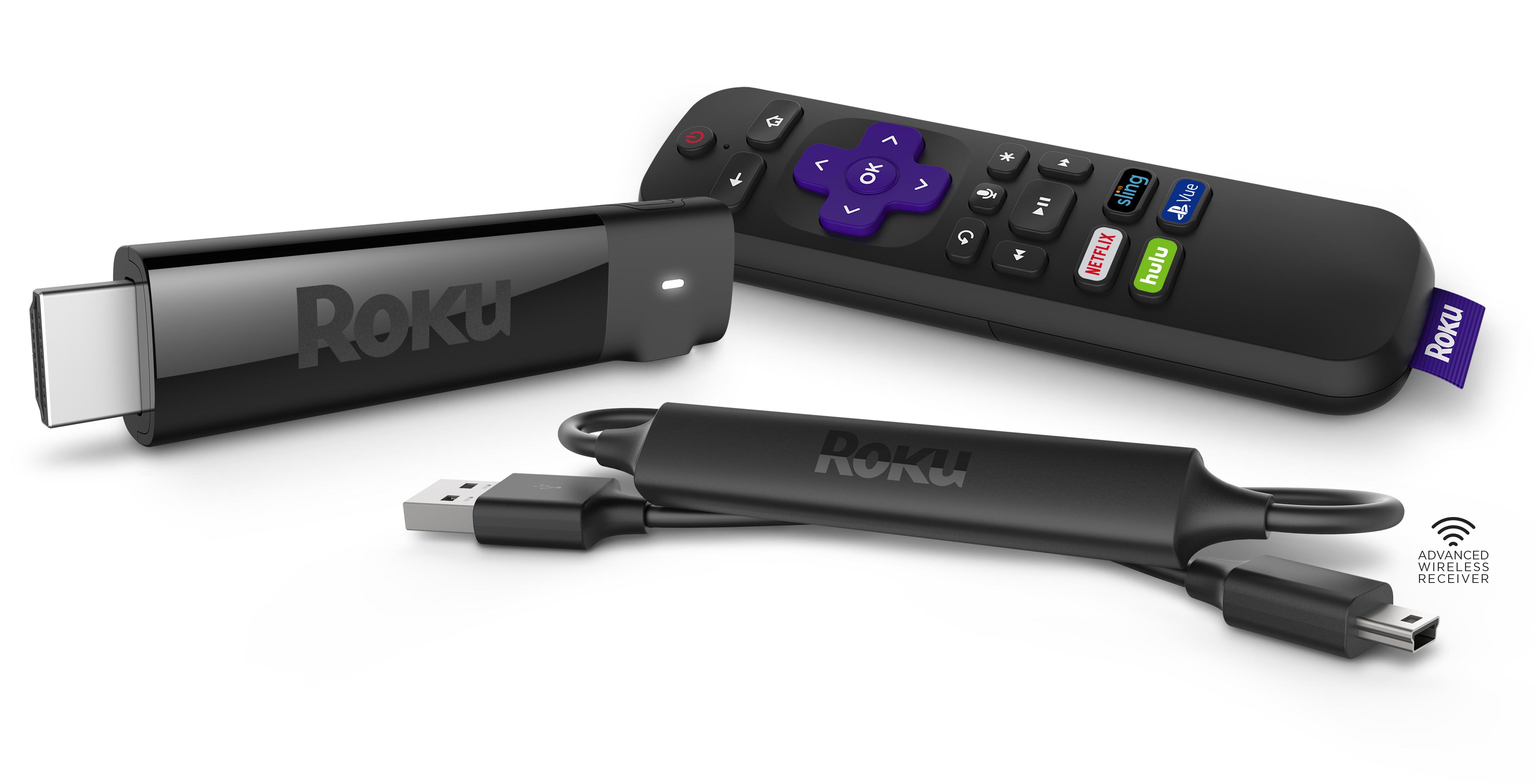
Roku Stick

Roku UltraRoku announced updates to five of its TV streaming products on October 2nd, but the company has confirmed to MobileSyrup that Canadian availability is still yet to come.

“[Yesterday’s] announcement is focused on the U.S. market. We will keep you informed as we have news in this region,” stated a Roku spokesperson.

Roku’s basic streaming stick is getting a 50 percent speed enhancement courtesy of a new processor, according to the company, but remaining at the same price as last year’s model — $49.99 USD (which is the same price as in Canada). It is also getting voice control functionality and power and volume buttons.

The new Roku Streaming Stick Plus supports HDR and 4K Ultra HD and promises four times the wireless range of the basic stick. It’s priced at $69.99 USD and effectively replaces the Premiere Box, which is priced at $69.99 in Canada.

The Roku Express ($29.99 USD) and Express Plus ($39.99) boxes are also receiving processor updates, but are selling for the same previous price. The previous generation devices cost $34.99 and $44.99 respectively in Canada.

roku new

Meanwhile, the Roku Ultra is $99 USD, down from its $130 USD price point last year, which may mean it gets a price reduction in Canada, too. Currently, the device is priced at $119.99 in Canada.

These refreshes come just after streaming box updates from rivals Apple and Amazon.

In addition, Roku announced OS 8, a new operating system version that adds a 4K Spotlight Channel to make it easier to find 4K, HDR and Dolby Vision content, as well as a feature for private listening via plug-in to the remote or app for over-the-air TV, among other things.

The update is free and will roll out in Canada before the end of the year, according to the company. Some of the features of the new OS version will be available in the U.S. only, however, such as enhanced voice controls and the smart guide listings for over-the-air antenna TV.

For more details, check the release notes here.

Via: The Verge

The post Roku unveils hardware refreshes, but no Canadian availability yet appeared first on MobileSyrup.

04 Oct 18:20

Samsung Galaxy Note 8 ties for best smartphone camera, says DxOMark

by Dean Daley
Samsung Galaxy Note 8

Less than two weeks ago DxoMark, a company that tests and scores smartphone cameras, crowned the iPhone 8 Plus’ shooter the best smartphone camera ever.

Now the iPhone 8 Plus’ leading competitor, the Samsung Galaxy Note 8, has been awarded the same score, thus tying its 12-megapixel dual rear-camera setup with the iPhone 8 Plus’s.

The key difference, however, is that DxOMark awarded the Note 8’s photo-taking quality a score of 100 and a video score of 84. Apple’s iPhone 8 Plus received a camera score of 96, which means the Note 8 is the best phone for taking photos.

What the Note 8 excels at is its zoom performance, low noise level in low light, bright and vivid colours and good detail in bright light conditions, according to DxOMark.

With an impressive overall score of 94, the lower video score shouldn’t deter many from getting the Note 8.

One should note, however, that DxOMark hasn’t tested the iPhone X’s camera, which it predicts will provide a better overall camera experience than the iPhone 8 Plus.

Additionally, Google is announcing its Pixel 2 XL tomorrow, and last year the unveiling came along with the announcement that the device had the highest DxOMark rating ever.

It’s possible that Google’s flagship will come with the same announcement, meaning the Pixel 2 XL might have a more highly-rated camera than both the  iPhone 8 Plus and Note 8.

It’s worth noting that, according to Android Central, DxOMark has previously partnered with other phone manufacturers, such as OnePlus and HTC, to “seed” scores before their devices were announced.

As of right now, the Note 8 and iPhone 8 Plus are both tied for first on DxOMark with 94, while the iPhone 8 is in third with the score of 92 and the HTC U11 and the Pixel are tied for fourth with a score of 90.

However, with two major contenders coming up, we’ll just have to see how long the Note 8 and iPhone 8 Plus can keep their crowns.

Additionally, some devices with lower scores are still capable of taking great photos and unless you’re a professional photographer purchasing the $549 CAD — on a two-year contract — Note 8 solely due to its DxOMark is completely unnecessary.

Source: DxOMark

The post Samsung Galaxy Note 8 ties for best smartphone camera, says DxOMark appeared first on MobileSyrup.

04 Oct 18:20

Quebec wants to charge provincial sales tax on Netflix

by Rose Behar
Netflix

While the federal government may have let Netflix off the hook when it comes to a so-called ‘Netflix Tax,’ Quebec is keen to impose its own sales tax.

“Netflix’s service is taxable and we intend to ensure that consumers pay the tax in the name of [tax] equity,” Finance Minister Carlos Leitao said Tuesday morning, October 3rd, according to La Presse.

“There is no question of abdicating anything,” he continued, reportedly adding that the government must nevertheless have Netflix’s collaboration to collect the province’s sales tax from Quebec customers.

Heritage Minister Mélanie Joly recently revealed Canada’s new cultural policy plan, which features as its centerpiece a $500 million CAD deal with Netflix that involves opening a permanent production “presence” in the country.

The plan doesn’t include new taxes on digital platforms, despite pressure from various stakeholders, including traditional television providers, to impose a levy on the popular streaming service that would potentially contribute to the Canadian Media Fund (CMF), commonly referred to as a ‘Netflix Tax.’

Minister Joly has since tweeted, however, that “Netflix’s Canadian production house is subject to the same corporate taxes as any other business” — though it’s likely that Netflix’s Canadian production division is not going to generate significant revenue given it’s producing original content for the streaming service and not earning subscriber revenue.

In addition to Leitao’s comments, Quebec’s Minister of Culture and Communications Luc Fortin has also been critical of the plan, stating at a press briefing following the announcement: “I am rather angry, I would say, and especially that we have abdicated on the question of language, among other things, that we are not assured that there is a definite portion of original French-language content, while the same is required of other Canadian platforms.”

La Presse reports that over the next few weeks Leitao will speak with his federal counterpart, Bill Morneau, to hear his opinion on the subject.

Source: La Presse

The post Quebec wants to charge provincial sales tax on Netflix appeared first on MobileSyrup.

03 Oct 22:02

Twitter Favorites: [brownpau] Five Guys puts a cup in the bag, then pours fries into the bag till full. If you ask for large fries, you get that… https://t.co/gWXN9VyuW1

how now @brownpau
Five Guys puts a cup in the bag, then pours fries into the bag till full. If you ask for large fries, you get that… twitter.com/i/web/status/9…
03 Oct 22:01

Analysis of the Top 200 Tools for Learning 2017

files/images/top_tools.JPG

Jane Hart, Oct 06, 2017


Icon

Jane Hart offers a brief analysis of the list of the top 200 tools for lerarning posted here yesterday. Mostly what we find is that pretty much everyone on the list is an educator or developer of some sort (ie., not a student). So these aren't tools for learning per se but tools for people who work in the education industry. She also points to top 3 risers: Unsplash (up 71 places), Grammarly (up 70 places) and Snapchat (up 64 places). I didn't list any of these because none of them are very high on the list. She notes, correctly I think, that "messaging apps and team tools are particularly on the rise." This to me points to a trend toward work (and maybe learning) taking place more frequently outside formal learning environments rather than inside them.

[Link] [Comment]
03 Oct 22:01

The Most Important Four Words a Leader Can Say

by djcoyle

When you think about great leadership, you tend to think about big moments: daring decisions and inspiring speeches; moments when a great leader shows the path forward.

But in my research, I kept seeing leaders deliver something different. They weren’t big moments, but rather little moments of confession, when they admitted to a mistake or a weakness. Dave Cooper, a Navy SEAL, put it this way: “The most important words a leader can say is, ‘I screwed that up.’”

At first, that seems strange. Shouldn’t leaders project unshakable confidence? Doesn’t admitting weakness risk creating more weakness? But when you look more closely, those words make deep sense. Because strong culture can only happen when its members feel safe enough to tell each other the truth. That starts with moments when the leaders show their fallibility.

There’s a name for this moment. It’s called a vulnerability loop, and it works like this: Person #1 vulnerable, and admits a mistake or a shortcoming. This allows Person #2 to do the same, creating high-candor exchanges that drive performance and build trust. Vulnerability loops determine whether a group is going to be about merely appearing strong, or about actually facing hard truths and learning together.

Vulnerability loops are most powerful in moments of stress — when something’s gone wrong, or when there’s a disagreement. “At those moments, people either dig in and become defensive, and start justifying, and a lot of tension gets created,” says Jeff Polzer, a Harvard business school professor who studies organizational behavior. “Or they say something like, ‘Hey, that’s interesting. I’m curious and want to talk about it some more.’ What happens in that moment helps set the pattern for everything that follows.”

For example, here’s Ed Catmull, president and co-founder of Pixar. The first time we met Catmull showed me around Pixar’s relatively new studio building, named Brooklyn. It is a sunlit box of glass and reclaimed wood, brimming with insanely cool touches like a speakeasy, a fireplace, a full-service café, and a roof deck. As we walked, I made an offhand remark — something like, “Wow, this building is amazing.”

Catmull stopped and turned to face me. “In fact, this building was a mistake.”

I leaned in, unsure I’d heard correctly.

“The reason it’s a mistake,” Catmull continued, “is that it doesn’t create the kinds of interactions we need to create. We should have made the hallways wider. We should have made the café bigger, to draw more people. We should have put the offices around the edges to create more shared space in the center. So it wasn’t like there was one mistake. There were really a lot of mistakes, along of course with the bigger mistake that we didn’t see most of the mistakes until it was too late.”

And here is Cooper, the SEALs master chief who trained the team that captured Osama bin Laden. Cooper constantly went out of his way to show his fallibility to his team, to admit error. A new team member who called him by his title was quickly corrected: “You can call me Coop, Dave, or F*ckface, it’s your choice.” When Cooper gave his opinion, he always attached phrases that provided a platform for someone to question him, like “Now let’s see if someone can poke holes in this” or “Tell me what’s wrong with this idea.” He steered away from giving orders and instead asked a lot of questions. Anybody have any ideas?

During missions, Cooper sought opportunities to spotlight the need for his men to speak up, especially with newer team members. He was not subtle. “For example, when you’re in an urban environment, windows are bad,” he tells me. “You stand in front of one, and you can get shot by a sniper and never know where it came from. So if you’re a new guy and you see me standing in front of a window in Fallujah, what are you going to say? Are you going to tell me to move my ass, or are you going to stand there quietly and let me get shot? When I ask new guys that question, they say, ‘I’ll tell you to move.’ So I tell them, ‘Well, that’s exactly how you should conduct yourself all the time around here, with every single decision.’”

By using vulnerability loops, Catmull, Cooper, and the other leaders are sending a crystal-clear message: we are about learning together. They are giving everyone in the group permission to tell the truth, thus generating high-candor exchanges that drive improvement and create a shared mental model on how to perform together. They shift the focus away from self-protective instincts, and toward the truly important questions: what’s really happening here? How can we get better together?

The post The Most Important Four Words a Leader Can Say appeared first on Daniel Coyle.

03 Oct 22:01

The Remedy for Bad Apples

by djcoyle

It’s the oldest problem: what should you do about bad apples in your group, those chronically negative, team-sabotaging people who possess a genius for dragging others down?

The most straightforward solution is to simply fire them. Many groups have zero tolerance for bad apples (“No Dickheads” is the way the New Zealand All-Blacks rugby team puts it.) The research is clear: bad apples are a severe drain on productivity, innovation, and cooperation.  But for many groups, firing bad apples may not be a simple option. So the question remains: what do you do?

One potential answer is to develop the skill in what might be called Bad Apple Neutralization. We find a good example of this approach in the research of Will Felps, who studies organizational behavior at the University of South Wales in Australia.

Here’s the story: Felps gathered 40 four-person groups to perform a task, then hired an actor named Nick to work inside those groups while portraying three negative archetypes: the Jerk (an aggressive, defiant deviant), the Slacker (a withholder of effort), and the Downer (a depressive Eeyore type). In effect, Felps injected Nick into the various groups the way a biologist might inject a virus into a body: to see how the system responds.

Nick was really good at being bad. In almost every group, his behavior reduced the quality of the group’s performance by 30 to 40 percent. The drop-off was consistent whether he plays the Jerk, the Slacker, or the Downer. Except for one group.

“It’s the outlier group,” Felps said. “They first came to my attention when Nick mentioned that there was one group that felt really different to him. This group performed well no matter what he did. Nick said it was mostly because of one guy.”

The guy’s name was Jonathan. He was a thin, curly-haired young man with a quiet, steady voice and an easy smile. Despite the bad apple’s efforts, Jonathan’s group was attentive and energetic, and they produced high-quality results. The more fascinating part, from Felps’s view, was how subtly Jonathan accomplished this.

“A lot of it was really simple stuff that is almost invisible at first,” Felps says. “Nick would start being a jerk, and [Jonathan] would lean forward, use body language, laugh and smile, never in a contemptuous way, but in a way that takes the danger out of the room and defuses the situation. It doesn’t seem all that different at first. But when you look more closely, it causes some incredible things to happen.”

Over and over Felps studied the video of Jonathan’s moves, analyzing them as if they were a tennis serve or a dance step. They followed a pattern: Nick behaved like a jerk, and Jonathan reacted instantly with warmth, deflecting the negativity and making a potentially unstable situation feel solid and safe. Then Jonathan pivoted and asked a simple question that drew the others out, and he listened intently and responds. Energy levels increased; people opened up and shared ideas, they cooperated beautifully.

“Basically, [Jonathan] makes it safe, then turns to the other people and asks, ‘Hey, what do you think of this?’” Felps said. “Sometimes he even asks Nick questions like, ‘How would you do that?’ Most of all he radiates an idea that is something like, Hey, this is all really comfortable and engaging, and I’m curious about what everybody else has to say about this. It was amazing how such simple, small behaviors kept everybody engaged and on task.” Even Nick, almost against his will, found himself being helpful.

The signals Jonathan used so successfully are called belonging cues. Belonging cues operate through a structure deep in the core of our brains called the amygdala. You’ve probably heard of the amygdala before: it’s our fight-or-flight alarm system that continually scans our environment for threats.

Science has recently discovered, however, that the amygdala also plays a vital role in building social connections. It works like this: when you receive a belonging cue, the amygdala switches roles and starts to use its immense unconscious neural horsepower to build and sustain your social bonds. It tracks members of your group, tunes in to their interactions, and sets the stage for meaningful engagement. In a heartbeat, it transforms from a growling guard dog into an energetic guide dog with a single-minded goal: to make sure you stay tightly connected with your people.

“The whole thing flips,” says Jay Van Bavel, social neuroscientist at New York University. “The moment you’re part of a group, the amygdala tunes in to who’s in that group and starts intensely tracking them. Because these people are valuable to you. They were strangers before, but they’re on your team now, and that changes the whole dynamic. It’s such a powerful switch—it’s a big top-down change, a total reconfiguration of the entire motivational and decision-making system.”

The key to dealing with bad apples, then, is to do what Jonathan did: to flood the zone with belonging cues. Here are some ways you can do that.

  • Overcommunicate your listening. Many people underestimate the importance of nonverbal communication when it comes to safety. “Posture and expression are incredibly important,” said Ben Waber, a former PhD student of Alex Pentland’s who founded Humanyze, a social analytics consulting firm. “It’s the way we prove that we’re in sync with someone.”
  • Preview future connection. Seek and find ways to make links between this moment and some larger, shared goal. It could be as inconsequential as a Christmas party, or as big as a championship game, so long as it spotlights the deeper truth: we are all in this together.
  • Ensure everyone has a voice. The best way to do this is use mechanisms that generate full-group contribution. For example, many groups follow the rule that no meeting can end without everyone sharing something. Others hold regular reviews of recent work in which anybody can offer their two cents. Others, like Google, establish regular forums where anyone can bring an issue or question before the group’s leaders, no matter how controversial it might be. But no matter how strong the rule, the underlying key is to have leaders who seek out connection and make sure voices are heard.

The post The Remedy for Bad Apples appeared first on Daniel Coyle.

03 Oct 22:00

iPhone Courage

by Neil Cybart

iPhone pricing has garnered more attention in recent months than any other Apple topic. However, pricing is not the most important variable impacting the iPhone business. With iPhone X, Apple is taking what previously worked with iPhone and throwing it away in an effort to create a better user experience. For Apple to take this much risk with the product responsible for the vast majority of its cash generation and new user growth is noteworthy. 

iPhone X

During its inaugural event at Steve Jobs Theater last month, Apple unveiled three flagship iPhones. Management dedicated 20 minutes of stage time to iPhone 8 and 8 Plus, models clearly positioned within the existing iPhone paradigm. Attention then turned to iPhone X, which garnered nearly twice as much stage time. While the "X" stands for ten, it could have very well stood for extreme. iPhone X will be the most radical iPhone Apple has sold to date. The home button has been removed to fit a larger screen in a smaller form factor. This change, which was years in the making, ushers in a completely new iPhone experience. Users will have to retrain their finger reflex to not press the bottom of the screen and instead, get used to swipes. In addition, the removal of fingerprint recognition in favor of facial recognition represents a very big change in how we will use iPhone. A strong argument can be made that removing the home button is the single-biggest change Apple has made to iPhone. The sheer amount of risk found in the move is being grossly underestimated. 

Screen Shot 2017-10-03 at 12.21.23 PM.png

iPhone Strategy

Apple is launching iPhone X at a critical juncture for the iPhone business. A slowing upgrade rate among existing iPhone users has led to overall unit sales plateauing, as highlighted in Exhibit 1. 

Exhibit 1: iPhone Unit Sales (Trailing Twelve Months)

Screen Shot 2017-10-03 at 12.29.56 PM.png

Despite weakening sales growth trends, Apple is still selling more than 200M iPhones per year, bringing in $140B of revenue and $60B of gross profit. In addition, the iPhone installed base grew by approximately 110 million users in 2017. iPhone remains Apple's most effective tool for grabbing new users. 

Apple's iPhone strategy can be broken into three parts:

  1. Pricing
  2. Product marketing
  3. Design

While much of the attention has been focused on Apple's move at the high-end of the iPhone pricing spectrum, the company is making just as interesting of a change at the low-end. Apple is following a consumer segmentation strategy. Management is cutting iPhone pricing at the low-end to improve accessibility. The $399 iPhone price floor that had been in existence for years was shattered last month. A $350 iPhone SE is the lowest-priced "new" iPhone Apple has sold to date. Management's decision to continue selling iPhone 6s and 6s Plus, and even iPhone 6 in select markets, positions additional SKUs for customers focused on value and price. Meanwhile, at the other end of the pricing spectrum, Apple is running with higher-priced models targeting consumers who value the latest and greatest technology. 

Underlying this pricing dynamic is a product marketing strategy focused on positioning the iPhone as the best camera people have ever owned. The dual-camera system found in iPhone 7 Plus is one of the more noteworthy iPhone features in years. With iPhone 8 Plus and iPhone X, Apple introduced Portrait Lighting, which adds a new element to Portrait mode. Apple then went further to include Portrait mode and Portrait Lighting on the iPhone X front-facing camera.

Apple saw how cameras are becoming much more than memory capture tools. Cameras are turning into smart eyes powering the dawn of the augmented reality era. Apple spent years dedicating resources to the effort and is now at the point where iPhone cameras are being powered by Apple silicon. This provides Apple's cameras additional differentiation and the ability to stand out from peers. 

Apple has seen quite a bit of success with its iPhone pricing and product marketing strategy over the years. However, these two variables are not the most important items impacting iPhone's evolution. Design, or the way consumers use the product, has a much larger impact on iPhone's future, and Apple is making big changes to how we will use iPhone going forward. 

The Headphone Jack

iPhone X demonstrates how Apple is willing to move beyond legacy design constraints and thinking. The home button has come to represent safety for hundreds of millions of people. In just a few years, Touch ID and fingerprint recognition became universally accepted because of their connection with the convenient iPhone home button. Apple is taking this familiar design and throwing it out the window in an attempt to push the iPhone experience forward. Although Apple is confident consumers will embrace the changes, the confidence sure isn't a result of consumers demanding or wishing for these changes. Instead, Apple designers and engineers are throwing away legacy thinking in order come up with something new. Upon closer examination, Apple has previously demonstrated this willingness to let go of legacy design. 

In September 2016, Apple unveiled iPhone 7 and 7 Plus. The two flagship models contained the typical assortment of new features and upgrades. However, one change stood out from the others. Apple removed the dedicated headphone jack despite no one having asked for such a move. Instead of including the traditional pair of EarPods in the box, Apple unveiled a new pair of EarPods that used the Lightning connector. In addition, Apple included a small adapter so that older headphones would connect with Lightning. 

When explaining Apple's decision, Phil Schiller, Apple SVP worldwide marketing, said "it really comes down to one word: courage. The courage to move on, do something new that betters all of us."

To say that removing the headphone jack was a controversial decision would be an understatement. The mere thought of removing the dedicated headphone jack from smartphones drove the tech community up a wall with some declaring the move as "user hostile" and "stupid." Schiller's explanation for the removal did not sit well with many. Some referred to it as tone-deaf, and others used arrogance and greed to describe the situation. There were then some who thought Schiller should have said "courage of convictions" in order to better encapsulate his meaning. 

In reality, Schiller was right in calling Apple's decision to remove the dedicated headphone jack courage. As it turns out, Apple displayed additional courage last month by removing the home button from iPhone X.

Courageous

The reason these iPhone design choices can be called courageous is that Apple is not afraid to risk sales in order to make technology more personal. It is not easy to take a product that is bringing in more than $140B of revenue per year and change the way people fundamentally use the device. While this situation may seem too self-centered to deserve being called courageous, iPhone is used by 800 million people. (The math behind my iPhone user base estimate is available for Above Avalon members here.) A design decision capable of improving or advancing the iPhone experience will have a tangible impact on many lives. It's not an exaggeration to say that society as a whole can benefit from these iPhone design choices. We are empowered by having a mobile computer in our pockets, and additional power will flow to users as smartphones evolve into augmented reality devices.

The headphone jack is one of a handful of examples of Apple displaying courage by taking what seemed to be working fine and throwing it away to improve the iPhone user experience.

  • 30-pin dock connector removal
  • Headphone jack removal
  • Home button removal

These design choices share a few common traits: 

  1. Deliberate. Apple doesn't make changes for the sake of making changes. Instead, the company is deliberate with its choices. A headphone jack is not removed in order to merely have iPhone 7 stand out from iPhone 6s. Instead, the move is an early step in Apple's long-term mission to remove wires from our lives. Schiller's inability to discuss the long-term goal found in removing the dedicated headphone jack is one reason his courageous comments came off as tone-deaf. A number of years and iPhone versions often have to pass before the motivation behind some of Apple's design decisions becomes clear. 
  2. Decisive. Apple doesn't sit on the fence when it comes to design. One should not bet on a dedicated headphone jack returning to iPhone. In what is still a raw and polarizing topic for some, dedicated home buttons with fingerprint readers are on their way out over the coming years. Dedicated home buttons don't have a future at Apple. 
  3. Design. All of these significant iPhone changes are made with design in mind. By removing the dedicated headphone jack and home button, Apple is changing the way we interact with iPhone. While some of these changes occur through a new user interface, other changes involve how we use iPhone in relation to other products. While the user experience change is less clear with some changes, such as Apple swapping the 30-pin dock connector with Lightning, other examples, like the home button removal, are much more apparent. 

It's All About Design

Avoiding change out of fear of angering users or customers can cripple an otherwise successful product and company. Fear of throwing away design artifacts and legacy tendencies represents one of the biggest risks facing iPhone today. This is why design, and not pricing or product marketing, is the most important variable when thinking about iPhone's future. 

Fear of embracing change would make it impossible for Apple to accomplish its long-term goal of making technology more personal. When it comes to iPhone, this goal manifests itself in a design that blends hardware and software. Apple's willingness to take big design bets allows iPhone to evolve over time. As buttons and ports are removed to make room for the latest camera, battery, and screen technology, iPhone morphs from a multi-touch computer into an augmented reality navigator controlled by glances and looks. 

This behavior of killing off features, components, ports, and technology in an effort to push the user experience forward is a carryover of Apple's approach with the Mac. The difference this time around is that Apple is making these changes to a product that is used by 8x more users. 

Samsung vs. Apple

Apple is not alone in pushing smartphone changes like removing a front-facing home button or dedicated headphone jack. In fact, making changes for the sake of change is relatively easy in the smartphone industry. The difficult part is leveraging these changes to push the user experience forward.

Samsung was able to beat Apple to market with an OLED smartphone lacking a front-facing home button. However, the difference in how Samsung and Apple leveraged these design changes is noteworthy. By removing the home button, both companies had to come up with an alternative to having a fingerprint reader positioned in a convenient location. Samsung chose to place the reader in a much more awkward location on the back of the device. Meanwhile, the company's facial recognition alternative ended up being a bust as it quickly became apparent it just wasn't as good as fingerprint recognition. It is tough to argue that the Samsung Galaxy user experience was improved with such changes. Instead, Samsung serves as an example of making changes for the sake of change

Meanwhile, Apple is positioning Face ID as the alternative to having Touch ID and the home button. If done correctly, Apple will be the company to bring facial recognition as a form of biometric authentication to the masses. Based on the company's success with Touch ID, Apple deserves the benefit of the doubt that Face ID can follow suit and see massive customer acceptance. In fact, Apple's removal of the home button and embrace of Face ID will likely kick off a new era at the company involving facial recognition. It is only a matter of time before every Apple product with a camera has the TrueDepth camera system. Such a development may seem trivial, but it will lead to a new era of health monitoring to which we haven't even contemplated the implications yet.

 TrueDepth camera system in iPhone X.

TrueDepth camera system in iPhone X.

The other implication found with Apple taking design risks is that unlike every other smartphone manufacturer, Apple sells very few smartphone models. The company does not have the benefit of taking risks with a much less popular model and only then bringing new features to the mass market once market adoption has been proven. Instead, Apple spends years and multiple iPhone versions systemically preparing for a major design change included in a flagship model.

Putting Fear Aside

The amount of risk Apple is taking with iPhone X should not be underestimated. There is a reason why management is positioning iPhone X as a glimpse of the next 10 years of iPhone. The model is dramatically different to iPhone 8 and 8 Plus. While Apple is confident that consumers will embrace these changes, it sure isn't due to consumers demanding or wishing for these changes. Instead, Apple designers, engineers, and marketers are showing a willingness to break down legacy thinking in order to come up with something new. By not letting fear of change and customer rejection dictate iPhone design decisions, Apple is displaying courage. While Apple stands to benefit financially from these design changes, iPhone users also stand to benefit. iPhone is empowering hundreds of millions of people in ways that were never before imagined. Courage is putting fear aside and taking bold risks in order to empower others.

Receive my analysis and perspective on Apple throughout the week via exclusive daily emails (2-3 stories a day, 10-12 stories a week). To sign up, visit the membership page.

03 Oct 21:59

De Stijl

by admin

Join us as we continue our artistic explorations. In this edition, we examine De Stijl — an influential artistic movement of the early 20th century.

03 Oct 21:59

Every Noise at Once 

files/images/every_noise.JPG

Oct 06, 2017


Icon

This has nothing to do with online learning, really, but it's too good to pass up: As Kottke says, " Every Noise at Once is a one-page map of playable audio samples for more than 1500 musical genres, from deep tech house to Finnish metal to smooth jazz to geek folk to klezmer to deep opera." Enjoy.

[Link] [Comment]
03 Oct 21:59

New BC Bus Pass for PWD

by Stephen Rees

InclusionBC just tweeted a link to a BC Government Fact Sheet – which is a pdf document. I decided to cut and paste the text of that here. Comments have been closed.

The Annual BC Bus Pass Program and the new Transportation Supplement for People on Disability Assistance

Beginning January 1, 2018, people receiving disability assistance, with the Person’s with Disabilities (PWD) designation, will get an extra $52 each month for a new transportation supplement.

The supplement creates fairness and will help people connect with their community, giving them freedom to work, shop, and participate in social activities.

How to use the Transportation Supplement for an annual bus pass:

 If someone with a disability who is on assistance would like an annual bus pass they can contact the Ministry of Social Development at 1-866-866-0800 or visit the BC Bus Pass Program website.

 If someone already has an annual BC Bus Pass and they want to keep it, they can. They don’t have to contact the ministry. Beginning with the January 2018 payment they will no longer have $52 deducted from their support payment.

 The BC Bus Pass can still be used in both TransLink and BC Transit areas.

How to use the Transportation Supplement for other transportation needs:

 If someone does not want or need a bus pass they can use the supplement to pay for other transportation costs (for example, HandyDART or a taxi).

 They don’t have to contact the ministry the $52 Transportation Supplement will be automatically added to the January 2018 payment.

More information about the supplement:

 As people’s needs may change over time the new supplement will provide flexibility. People can apply for the BC Bus Pass at any time during the year. They can also cancel their bus pass at any time and use their supplement for other transportation needs.

Why government made this change:

 Transportation is important to everyone on disability assistance.

 Government consulted with stakeholders and asked for their advice on the best approach to improve the system of transportation supports.

For more information:

Go to: www.buspass.gov.bc.ca or call: 1-866-866-0800


Filed under: Transportation
03 Oct 21:59

The truth under assault

by Josh Bernoff

In the wake of emotion comes an assault on the truth. Here are a few of the questionable or false things that surfaced in surprisingly authoritative places in the last week. The Las Vegas shooter was a liberal activist . . . except that he wasn’t. According to top search results on Google, Stephen Paddock, … Continued

The post The truth under assault appeared first on without bullshit.

03 Oct 21:58

Why Do CS Enrollments Surges End?

by Eugene Wallingford

The opening talk of the CS Education Summit this week considered the challenges facing CS education in a time of surging enrollments and continued concerns about the diversity of the CS student population. In the session that followed, Eric Roberts and Jodi Tims presented data that puts the current enrollment surge into perspective, in advance of a report from the National Academy of Science.

In terms of immediate takeaway, Eric Roberts's comments were gold. Eric opened with Stein's Law: If something is unsustainable, it will stop. Stein was an economist whose eponymous law expresses one of those obvious truths we all seem to forget about in periods of rapid change: If something cannot go on forever, it won't. You don't have to create a program to make it stop. A natural corollary is: If it can't go on for long, you don't need a program to deal with it. It will pass soon.

Why is that relevant to the summit? Even without continued growth, current enrollments in CS majors is unsustainable for many schools. If the past is any guide, we know that many schools will deal with unsustainable growth by limiting the number of students who start or remain in their major.

Roberts has studied the history of CS boom-and-bust cycles over the last thirty years, and he's identified a few common patterns:

  • Limiting enrollments is how departments respond to enrollment growth. They must: the big schools can't hire faculty fast enough, and most small schools can't hire new faculty at all.

  • The number of students graduating with CS degrees drops because we limit enrollments. Students do not stop enrolling because the number of job opportunities goes down or any other cause.

    After the dot-com bust, there was a lot of talk about offshoring and automation, but the effects of that were short-term and rather small. Roberts's data shows that enrollment crashes do not follow crashes in job openings; they follow enrollment caps. Enrollments remain strong wherever they are not strictly limited.

  • When we limit enrollments, the effect is bigger on women and members of underserved communities. These students are more likely to suffer from impostor syndrome, stereotype bias, and other fears, and the increased competitiveness among students for fewer openings combines with discourages them from continuing.

So the challenge of booming enrollments exacerbates the challenge to increase diversity. The boom might decrease diversity, but when it ends -- and it will, if we limit enrollments -- our diversity rarely recovers. That's the story of the last three booms.

In order to grow capacity, the most immediate solution is to hire more professors. I hope to write more about that soon, but for now I'll mention only that the problem of hiring enough faculty to teach all of our students has at east two facets. The first is that many schools simply don't have the money to hire more faculty right now. The second is that there aren't enough CS PhDs to go around. Roberts reported that, of last year's PhD grads, 83% took positions at R1 schools. That leaves 17% for the rest of us. "Non-R1 schools can expect to hire a CS PhD every 27 years." Everyone laughed, but I could see anxiety on more than a few faces.

The value of knowing this history is that, when we go to our deans and provosts, we can do more than argue for more resources. We can show the effect of not providing the resources needed to teach all the students coming our way. We won't just be putting the brakes on local growth; we may be helping to create the next enrollment crash. At a school like mine, if we teach the people of our state that we can't handle their CS students, then the people of our state will send their students elsewhere.

The problem for any one university, of course, is that it can act only based on its own resources and under local constraints. My dean and provost might care a lot about the global issues of demand for CS grads and need for greater diversity among CS students. But their job is to address local issues with their own (small) pool of money.

I'll have to re-read the papers Roberts has written about this topic. His remarks certainly gave us plenty to think about, and he was as engaging as ever.

03 Oct 20:19

Here’s the Commodore 64 mini no one is asking for

by Patrick O'Rourke
C64 Mini

Micro console nostalgia mania seems to have swept over the tech industry.

It began with flash consoles, which first started appearing a few years ago, and has culminated with the release of Nintendo’s ultra-successful NES Classic and subsequent SNES Classic.

Now, however, a company is working on a miniature version of 1982’s Commodore 64, dubbed the C64 Mini. While Commodore 64 games certainly haven’t stood the test of time as well as the Nintendo Entertainment System, this device still offers an interesting look into gaming’s past.

C64 Mini gam elist

The Commodore 64 is noted as the highest-selling ‘single computer model’ of all time and is one of the first home desktop devices to be widely available to consumers.

The C64 Mini measures in at roughly half the size of the original Commodore 64 and comes pre-installed with notable licensed games like Uridium, Pardroid and Hawkeye (for the record, I don’t remember any of these titles). The mini console is set to launch at some point in 2018 and also includes a classic joystick along with two USB ports and an HDMI cable, allowing the system to connect to any modern television.

Canadian pricing and availability for the C64 Mini hasn’t been revealed yet, but the system’s cost comes in at $69 USD (approximately $86 CAD).

The post Here’s the Commodore 64 mini no one is asking for appeared first on MobileSyrup.

03 Oct 20:19

Mozilla Awards Over Half a Million to Open Source Projects

by Gervase Markham

At Mozilla we were born out of, and remain a part of, the open source and free software movement. Through the Mozilla Open Source Support (MOSS) program, we recognize, celebrate, and support open source projects that contribute to our work and to the health of the Internet.

Our major initiative in the past few months has been the launch of “Global Mission Partners: India”, a pilot scheme to bring the Mission Partners track of MOSS to particular regions of the globe which have strong open source communities. The initial application period has just closed, and our India committee will shortly begin the work of assessing the over a dozen applications we have received.

We’ve also received updates from earlier awardees who have finished their work. We made an award last year to the Tor Project to improve their metrics; they’ve written a blog post and final report (PDF) on how that went. The Kea DHCP server project finished their configuration API, and ReadTheDocs have significantly improved the Python documentation ecosystem. Now that MOSS has been in action for a while, we are starting to amass a significant collection of ecosystem improvements which would not have happened without our support.

Additionally, since our last update, we have made a total of $539,000 in additional awards.

The biggest amount ($194,000) went to Ushahidi, an open source software platform for crowdsourcing, monitoring, visualizing, and responding to reports from people caught up in political turmoil or subject to governmental or vigilante abuse. They are working on making it easier to securely submit reports, and documentation on how to deploy Ushahidi while minimising risk to the hosts.

We have also agreed to support some other projects we believe will advance a free and healthy Internet:

  • $125,000 to the webpack project, a popular JavaScript module loader, to help them make the cross-browser WebAssembly format a first-class citizen in their ecosystem;
  • $100,000 to RiseUp, a coordination platform used by activists across the political spectrum, to improve the security of their email service;
  • $50,000 to Phaser, the open source HTML5 games engine, to allow them to complete the development of version 3;
  • $70,000 for creating mod_md, an Apache module which speaks ACME, the automated certificate issuance protocol, to make it easier for websites to deploy and use secure HTTP.

Under the Secure Open Source arm of MOSS, it’s been a good few months from a security perspective. We ran audits on the codebases of expat (an XML parser), and GNU libmicrohttpd (an embedded HTTP server). In neither of these cases did we find an issue more severe than Medium.

We also managed an audit on chrony, which is another NTP daemon, following on from our previous audits of ntp and ntpsec. This audit was funded by the Core Infrastructure Initiative, who have done a comparative write-up of the results from their perspective.

The experienced security auditors who evaluated chrony were particularly impressed, writing a ringing endorsement in their report: “Withstanding eleven full days of testing … means that Chrony is robust, strong, and developed with security in mind. The software boasts sound design and is secure across all tested areas. … While the functional scope of the software is quite wide, the actual implementation is surprisingly elegant and of a minimal and just necessary complexity. In sum, the Chrony NTP software stands solid and can be seen as trustworthy.”

Applications for “Foundational Technology”, “Mission Partners”, and “Global Mission Partners: India” remain open, with the next batch deadline being the end of October 2017 (January 2018 for India). Please consider whether a project you know of could benefit from a MOSS award.  Encourage them to apply! You can also submit a suggestion for a project which might benefit from an SOS audit.

The post Mozilla Awards Over Half a Million to Open Source Projects appeared first on The Mozilla Blog.

03 Oct 20:18

Twitter Favorites: [tylorsherman] Web services that lack undo are insanity, some take it further by also including autosave.

Tylor Canada @tylorsherman
Web services that lack undo are insanity, some take it further by also including autosave.
03 Oct 20:18

Stretch Shortening Cycle — Sirens & TItans Fitness

mkalus shared this story from Jacques Blog - Sirens & TItans Fitness.

Want to get bigger overloads in your power training?  Then you better understand the stretch shortening cycle. 

I remember when I was in high school trying to drop weight for wrestling. Our heavy weight would sit in the front seat of the car. Another wrestler and I would push the car in neutral for a couple of blocks, work up a sweat, and then jump into the car with the heater on wearing rubber sweats. Sitting here today this sounds crazy, but wrestlers are a little crazy.

When we were getting the car moving I remember leaning back as far as possible and then pushing into the car. What I did not realize at the time is why we would do this. By leaning back I was loading the opposing muscle group (antagonist) so that I would take advantage of the elastic effect of the muscle stretching and then subsequently shortening so that we could get the car moving from a dead stop. The farther I could lean back, the greater the pre-load stretch of the muscle.

This is called the Stretch Shortening Cycle. Your body will produce more power by pre-loading (stretch/shortening) those opposing muscles so that more power can be produced. As you train more the ability to load becomes greater and greater. I call this getting fit enough to get really fit. So be patient and take advantage of this natural choreography of muscles to get better and better at moving your body through space.

Truth in Fitness:
Jacques DeVore CSCS

03 Oct 20:18

An Open Letter to the media from crime experts regarding rampage shooters: Don't Name Them, Don't Show Them. goo.gl/sbZebs

by sapinker
mkalus shared this story from sapinker on Twitter:
They say this every time, the media promises to not do it again and then.... does it again.

An Open Letter to the media from crime experts regarding rampage shooters: Don't Name Them, Don't Show Them. goo.gl/sbZebs


Posted by sapinker on Tuesday, October 3rd, 2017 5:55pm


238 likes, 151 retweets
03 Oct 20:17

Facebook Launching Messenger Lite In The U.S. — But Only For Android Users

by Mary Beth Quirk
mkalus shared this story from Consumerist.

If you don’t need a special selfie lens that puts a wagging animals ears and a pink cartoon tongue onto your face when you’re communicating with your friends — or just want to save on mobile data — Facebook is now launching its Messenger Lite Android app in U.S.

Messenger Lite is expanding to the U.S., Canada, Ireland, and the U.K, after initially only being available in mostly developing countries.

The idea behind Messenger Lite is to cut down on how much data you need to use it, whether you’re somewhere without a reliable network connection or you have a tight monthly data budget.

“Messenger Lite is a slimmed-down version of Messenger that offers the core features of the app, while giving everyone the opportunity to stay connected to their friends and family, regardless of device or quality of internet connectivity,” a Facebook spokesperson told TechCrunch.

So what’s the difference? Lite doesn’t include all the bells and whistles of traditional Messenger — read: data draining functions — so you won’t have any selfie lenses or be able to access Facebook’s “Messenger Day” feature.

Instead, it simply allows users to send and receive messages, photos, links, and stickers. So it’s a lot like texting — but within the confines of Facebook instead of via traditional SMS. And that’s exactly how Facebook wants it.

Again, the app is only available for Android users at this point, so iOS users will simply have to rely on one of the plethora of other messaging options available.


03 Oct 20:14

IPython Magic for Controlling the V-REP Robot Simulator from Jupyter notebooks

by Tony Hirst

Whilst exploring how we might be able to use Jupyter notebooks hooked up to the Coppelia Robotics V-REP robot simulator, it struck me that we needed a fair amount of boilerplate stuff to get the simulator loaded with an appropriate scene file and the a connection made to the simulator from the notebook so we could script the robot actions from the notebooks.

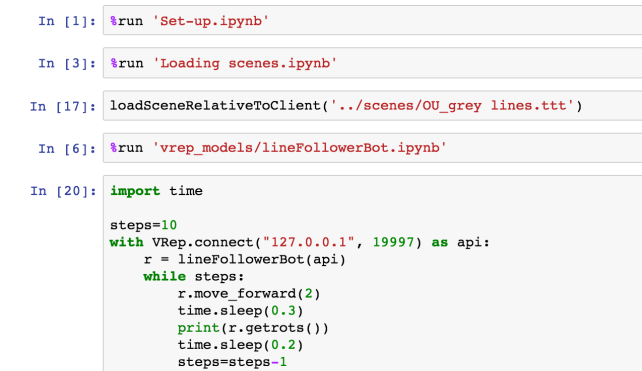
My first approach to trying to simplify presentation was to create some “self-documenting” notebooks that could be used to set-up necessary environmental variables and import default classes and functions:

The %run cell magic loads and runs the referenced notebooks, which can also be inspected (and modified) by students.

(To try to minimise the risk of students introducing breaking changes into the imported notebooks, we could also lock the cells as read-only in the notebooks. Whilst this requires an extension to be installed to implement the read-only behaviour, the intention is that we distribute a customised Jupyter notebook environment to students.)

The loadSceneRelativeToClient() function loads the specified scene into the simulator. Note that this scene should contain a robot model. Once the connection to the simulator is made, a robot object can be instantiated using the connection details. The robot class should contain the definitions required to control the robot model in the loaded in scene.

Setting up the connection to the simulator is a bit of a faff, and when code cell execution is stopped we can get an annoying KeyboardInterrupt report:

We can defend against the KeyboardInterrupt by wrapping the code execution in a try/except block:

try:
    with VRep.connect("127.0.0.1", 19997) as api:
        robot = PioneerP3DXL(api)
        while True:
            #do stuff
            pass
except KeyboardInterrupt:
    pass

But it struck me that it would be much nicer to be able to use some magic along the lines of the following, in which we set up the simulator with a scene, identify the robot we want to control, automatically connect to the simulator and then just run the robot control program:

So here’s a first attempt at some IPython cell magic to do that:

from pyrep import VRep
from __future__ import print_function
from IPython.core.magic import (Magics, magics_class, line_magic,
                                cell_magic, line_cell_magic)
import shlex

# The class MUST call this class decorator at creation time
@magics_class
class Vrep_Sim(Magics):

    @cell_magic
    def vrepsim(self, line, cell):
        "V-REP magic"

        #Use shlex.split to handle quoted strings containing a space character
        loadSceneRelativeToClient(shlex.split(line)[0])

        #Get the robot class from the string
        robotclass=eval(shlex.split(line)[1])

        #Handle default IP address and port settings; grab from globals if set
        ip = self.shell.user_ns['vrep_ip'] if 'vrep_ip' in self.shell.user_ns else '127.0.0.1'
        port = self.shell.user_ns['vrep_port'] if 'vrep_port' in self.shell.user_ns else 19997

        #The try/except block exits form a keyboard interrupt cleanly
        try:
            #Create a connection to the simulator
            with VRep.connect(ip, port) as api:
                #Set the robot variable to an instance of the desired robot class
                robot = robotclass(api)
                #Execute the cell code - define robot commands as calls on: robot
                exec(cell)
        except KeyboardInterrupt:
            pass

    #@line_cell_magic
    @line_magic
    def vrep_robot_methods(self, line):
        "Show methods"
        robotclass = eval(line)
        methods = [method for method in dir(robotclass) if not method.startswith('_')]
        print('Methods available in {}:\n\t{}'.format(robotclass.__name__ , '\n\t'.join(methods)))

#Could install as magic separately
ip = get_ipython()
ip.register_magics(Vrep_Sim)

I’ve also added a bit of line magic to display the methods defined on a robot model class:

The tension now is a pedagogical one: for example, should I be providing students with the robot model, or should they be building up the various control functions (.move_forwards(), .turn_left(), etc.) themselves?

I’m also wondering whether I should push the while True: component into the magic? On balance, I think students need to see it in their code block because getting them to think about control loops rather than one shot execution of command statements is something they often don’t get the first, or even second, time round. But for reducing clutter, it’d make for far cleaner cell block code.