Shared posts

04 Oct 20:06

Snap Has Sold Around 150K Pairs Of Video-Taking Sunglasses

by Laura Northrup
mkalus shared this story from Consumerist.

Last year, Snap, parent company of the app Snapchat, introduced a whimsical single-purpose product. Its Spectacles, originally available only from vending machines in a few major cities, cost $130 and record 10-second video clips to be posted on Snapchat. That’s it. Somehow, the company claims to have sold 150,000 of these devices.

The company’s CEO shared that number this week at a Vanity Fair event, and the important question is whether that’s a lot for a seemingly pointless device, or not very many, considering some 173 million people use the Snapchat app each day.
CEO Evan Spiegel looked at it from a different point of view, arguing that the Snap Spectacles have outsold the first-generation iPod. That was an early version of the device that only worked with Macintosh computers and had a crude version of the click wheel, but led to the development of improved products that would later sell hundreds of millions of units.

“Our view is that hardware is going to be an important vehicle for delivering our customer experience maybe in a decade,” CEO Evan Spiegel told the crowd, according to TechCrunch. “But if we believe it’s going to be important in a decade, we don’t want to be starting a decade from now.”

Yet there were recent cutbacks in Snap’s hardware division, with a new person in charge of the lab, and around a dozen people working on the project, mostly marketers, laid off.

What could be next for future versions of Snap Spectacles that would make people want to actually buy them? Snap’s patent applications hint that augmented reality could be next, giving users a non-creepy reason to wear the sunglasses by placing digital objects in the world around users.


04 Oct 20:06

"The first instinct of power is the retention of power."

“The first instinct of power is the retention of power.”

- | Antonin Scalia
04 Oct 20:05

A California School Crossing So Dangerous They Won’t Hire a Safety Guard~and a Vancouver School Crossing They Won’t Do Because it Slows Traffic.

by Sandy James Planner

fob_transportation-crossing_guard-elston_grace_bernard-900

This story from NBC San Diego shows how far motordom continues to dominate, even when there are youngsters trying to walk to school. In Solana Beach North County California, a busy intersection has been  “deemed too dangerous even for crossing guards, leaving parents alarmed.” 

mapofdangerousintersection

Officials at Skyline Elementary removed paid crossing guards by the 1-5 freeway exits on Loma Santa Fe because “the intersection was too hazardous and difficult to navigate.”
Getting rid of the crossing guard gives no other path for children walking or biking  to school to cross Interstate 5 without crossing freeway exits. The choices: Drive your kids or let them try crossing without an adult crossing guard. Parents being parents and thoughtful individuals, they have come up with some solutions to the problem, like getting a volunteer adult to assist at the intersection. They are also lobbying to prohibit right turns at some of the red lights to make the crossing easier and more understandable for children.

Meanwhile in Vancouver Denise Ryan in the Vancouver Sun reports on the independent school Stratford Hall located east of Commercial Drive between 14th and 16th Avenues. There are 500 kids, the drop-off for children is on Commercial Drive, and the kids cross the street to use Clark Park.  This is a bendy section of Commercial Drive, and despite the school asking for a school zone to be located here to slow drivers, the City has continually nixed the request. Why? The City of Vancouver in a written statement says “because Commercial Drive is an arterial road, “installing a 30-km/h school zone proves difficult,” and that “speed humps and other traffic-calming measures are not feasible options for arterials and collectors,” in part because of the impact it could have on “operations of a variety of key services, including buses and emergency-response vehicles.”

stratfordhall

Last time I checked this was a four lane road at this location, and every driver knows to pull over if they hear an emergency siren. Somehow I think bus schedules can also be adjusted to provide a safe crossing for kids in a two stretch block. It’s the 21st century~time to recognize that there are some schools on arterials and those kids deserve just as safe a crossing to school as does everyone else. It’s the exception that should be made for the safety and comfort of kids.

Thankfully a motivated group of  “Grade 5 and 10s at Stratford Hall has taken on the task of researching and gathering data to try to effect change as part of their governance studies. They’ve partnered with their school liaison officer, Const. Cheryl Leggett, to document traffic flow and safety, and, with the help of a donor, and a substantial discount from the Anson traffic group, rented an electronic traffic-speed reader so they can build a substantive, data-driven case to bring to the city.” 

And what does the school want? They want simple improvements, such as overhead lighting for the cross walk at 15th Avenue, and to have the stretch of street designated a 30-km/h zone. Is this really too much to ask for? Do we really need to trigger the ICBC warrant system by having someone die or be seriously injured at this site to get a change? A sustainable green city means taking care of the most vulnerable. That includes children crossing safely across the street to their school.

Kids fight for traffic safety


04 Oct 20:04

Burrard Bridge: Always Controversial

by pricetags

City Engineer Jerry Dobrovolny, when asked about controversy surrounding changes to the Burrard Bridge, notes that this has always been the case.

Prior to construction of the bridge in 1932, there was a referendum to approve the cost (probably in the late 1920s).  It was defeated.

Why?  Because the original design lacked room for pedestrian crossings and made no accommodation for streetcars.  Vancouverites weren’t going to settle for that.  The trestle across False Creek just to the east (removed in 1982) had been built only for the railway, and the people of Vancouver, even then, had higher priorities.  Like being able to cross False Creek on foot.

The Bartholomew Plan of 1929 proposed an extension of the streetcar system for a new bridge extending Burrard to Cedar Street (still the name of the road past 16th Avenue), providing for a new streetcar line along Cornwall to Stephens.

So the design by architect G.L. Thornton Sharp and engineer John Grant not only had sidewalks on the bridge deck but, in the piers below, cutaways to accommodate tracks for a streetcar line that, sadly, was never built.


04 Oct 20:04

The Birds at Olympic Village Going to Rejuvenation Camp

by Sandy James Planner

IMG_1988

Everyone has an opinion on those magnificently large and some say rather strange sparrows that hold down Olympic Square designed by Myfanwy MacLeod. And yes, apparently they were inspired by Alfred Hitchcock’s The Birds 1963 horror film. As Kevin Griffin with the Vancouver Sun observes  ” the shells have become significantly damaged, especially on the male bird. They are both used as ramps by skateboarders and bicycle riders, and people regularly climb over the two structures, which are 4.5 metres tall.”  The tail of the male sparrow has been badly compromised and is no longer water proof, and the steel frames of the birds will be replaced with more durable aluminum. If the success of a public art project is the degree of tactile interaction that users have with it, the sparrows have been a big hit.

A Barcelona engineer who is on the committee for the rebuilding and reproofing of  the famous promenade Las Ramblas came down to see The Birds public art work. He immediately referenced a  favourite, the “El Gato de Botero” bronze which is now housed in Raval Park and is beloved by children and adults alike for his proportions and his rather hulking anatomy. The Gato is also climbed over and played with, but is made of much sturdier material.  While polystyrene was used for the shell of the birds, the feet were cast in bronze and have had no damage.

barcelona863

Both birds will be taken down this fall and replaced in time for the-wait for it- 27th International Ornithological Congress next August. The City’s Public Art manager estimates the repairs at $425,000 which will be covered by a reserve fund for public art maintenance. Larger paving stones will also be installed below the male sparrow’s tail to reduce the likelihood of the public art continuing use as a skateboard and bike ramp.

As the artist states “People, especially kids, love to climb on stuff. You can’t stop people from being people. So you need to figure out how to make your work survive the realities of that.”

fullsizeoutput_8c2


04 Oct 20:03

New Quality Measurement Initiatives

files/images/about-quality-assurance.jpg

Alex Usher, Higher Education Strategy Associates, Oct 07, 2017


Icon

Interesting article describing to recent approaches to evaluations of institutional quality: one from the Netherlands called "Measuring and Comparing Achievements of Learning Outcomes in Higher Education in Europe" (CALOHEE) which (interestingly) assesses each institution measures outcomes according to the objectives set at each institution. The other, from the United States, is the A Multi-State Collaborative to Advance Learning Outcomes Assessment (MSC) which "samples of ordinary student course work are scored according to various rubrics designed over a decade or more (see here for more on the rubrics and here for a very good Chronicle article on the project as a whole)." Alex Usher also asserts, incorrectly, that "how none of it (measurable accountability) is happening in Canada, which is demonstrably false.

[Link] [Comment]
04 Oct 20:03

Time After Time

by Siobhan Leddy

Two candlelit faces look at me over bowls of pulpy tomatoes and pepper-flecked soups. They both look a certain kind of rich, the kind that unashamedly buys $180 “wellness products” from Goop. It’s nighttime in this picture, but a flick of the thumb reverts me back to day: a buttery white room bleached by sunlight, an aerial view of a flat white, some hard-to-source magazines. Flick further still and I’m back to nighttime — Saturday night, in fact — at a Brooklyn basement poetry reading, where a fledgling poet silently spills words to an unseen audience.

On our social media feeds we slip, frictionless, through time. Saturday is next to Tuesday is next to #tbt 2014. Where once chronology was king, now our feeds are mostly algorithmic timelines. Determined by prior clicks and likes, eager-to-please strings of code create custom feeds based on our preferences. It’s a boon for social media companies: We stick around longer on algorithmic timelines, engaging with more content and encountering more revenue-generating ads. Many users, however, claim to hate it.

Our attention, understood as a scarce commodity, is steered through small tweaks to our timeline

On Twitter, which moved over from chronology to algo-time last year, a process of collective mourning began under the hashtag #RIPTwitter. Only marginally less end-of-days, one TechCrunch author declared Instagram’s algorithmic feed to be “the worst thing to happen to me all summer.” Reasons for vitriol were varied, from the pragmatic to the abstract. Some users felt that the loss of temporal ordering also meant a loss of personal control. As actor Rob Lowe tweeted, “One of the great rewards of being an adult is deciding ON YOUR OWN who (and what) you should be interested in.” “No revisionist history for me,” another user tweeted, suggesting a concern for digital memory. Events and live-tweets would become harder to follow; the spontaneity of random, seemingly uncalculated juxtaposition would be lost. The anger was often tinted by nostalgia: Users begged for the old ways to remain, seemingly at a loss to imagine a world without the reassuring comfort of chronologically organized data.

Some of the antipathy toward algo-time seems justified. Where the algorithm organizing a chronological feed is simple, transparent, and understandable, algo-time is opaque and mysterious. Such opacity makes algo-time wide open to manipulation by platform providers. Our attention, understood as a scarce commodity, is steered through small tweaks to our timelines. The algorithmic shuffle is designed for “stickiness,” an oddly carnal corporate buzzword describing the likelihood that users will linger on a platform, and return as frequently as possible. Pushing the best stuff to the top — as any journalist struggling with a lede paragraph will tell you — increases stickiness. So too does an endless scroll: A chronological timeline meant that, if you last checked your feed three hours ago, when you next opened it you’d have three hours’ worth of content waiting for you. An algorithmic timeline suggests there is no limit to how much you can and should consume in three hours; you can get as just as much as you want as long as you keep refreshing. If chronological time imposes a sense of the “natural” amount of content for a given time frame, algo-time eliminates noise so that you can gorge on signal.

When we stick to a platform, we will — or so platform providers hope — stay for the sponsored content, which in turn increases the platform’s profitability. Opaque or otherwise, in this sense the algorithm’s overall agenda is entirely predictable.

Chronology, by contrast, reflected a more familiar order of things. Seductively simple, rational. It’s old Father Time, Saturn, El, Cronus, bearded and smiling, benevolently keeping watch. Like a Werther’s Original grandpa, he guides us gently by the hand away from the past and into the future. “Keep moving forward,” he whispers, echoed by a Greek chorus of life coaches and self-help gurus. Chronology allows us to feel a sense of control over time: The past is just history, a story we tell ourselves. Stop living in the past; just let it go! The only bearable kind of present, we’re assured, is one in which we recognize that the past is behind us.

But it’s better we keep our guard up when it comes to time. We should bear in mind that Cronus, often understood as time’s personification, brutally cannibalized his own sons. He castrated and then deposed his own father, Uranus. He carries a scythe everywhere. Chronology takes liberties with the past, present and future, and leads only to death.

The myth of progress has made the urgent issues of social injustice, inequality, and climate change problems that future generations will automatically sort out. The progress narrative means we may not even notice we’re bleeding

Chronology, like any other algorithm, is a mathematical abstraction, a set of rules for ordering data. It’s also a lazy algorithm, based entirely on an inherited shared belief system about the way time moves — progressing from past, to present, to future. For most of us, our lived experience of time is more a jumbled rat king of divergent thoughts and conflicting rhythms. More closely related to memory, lived time is therefore open to manipulation through factors including drugs, illness, or intense bursts of emotion. This is why it can feel like only yesterday that Beanie Babies were a veritable cultural phenomenon, but you have no idea what you had for breakfast this morning.

Nor should we assume that linear time is any more neutral than algorithmic-time. Sure, algo-time is a cynical adjustment by social media platforms, prioritizing the pursuit of profit over the demands of its users. But let’s not kid ourselves: linear time has no less served these exact same purposes. Time’s arrow has provided vital bedrock for the formation of contemporary capitalism.

Chronological time relegates the past to an increasingly remote distance from our present. It creates a feeling of scarcity, where the past, once lost, is lost forever. Such scarcity contributes to the capitalist commodification of time, in which time — through waged labour — is reified as a measurable unit, synonymous with its monetary value. If run out of time, we might pay someone to cook or clean or walk the dog on our behalf. Time is money, which can be invested, lost, or worst of all, wasted.

Linear time also suggests progress, a sense that the winds of history are inevitably hurtling us along the timeline from point A to point B, in which the B stands for “best of all possible worlds.” On the surface, it sounds nice. Why not advocate for a teleological view of history in which the world can become better, for everyone, all the time? Hegel, for his part, agreed: “The History of the world,” he wrote in his Philosophy of History, “is none other than the progress of the consciousness of Freedom.”

But Hegel’s story, as postcolonial theorists (among many others) have been at pains to point out, is infested with problems. Time as progress is a baggage-laden inheritance from the Great European Men of the 19th century — Hegel, Marx, and Darwin. It’s little surprise, then, that their theories can carry a cost for many outside that demographic. Take, for instance, Hegel’s spatial mapping, in which he attempts to apply his theory of progress to geographical locations. In first place, sitting closest to point B — or what Hegel describes as a state of Absolute Knowing — was America. Only a little behind was Germany, influenced as it was by Christian values. Africa, meanwhile, was “no historical part of the world.” And he wasn’t alone: Kant, Locke, and countless other white Western philosophers and thinkers, all claimed that Africa was in some way ahistorical. As postcolonial scholar Achille Mbembe writes in On the Postcolony, the “narrative about Africa is always a pretext for a comment about something else, some other place, some other people … Africa is the mediation that enables the West to accede to its own subconscious.” In other words, it was only through these constructed ideas about “Africa” that the West could sketch out its timeline: a point B was unthinkable without artificially constructing a point A to lend a veneer of moral respectability to the brutality, violence, and theft that go hand in hand with colonial projects. Cognitive gymnastics like Hegel’s were why America could be simultaneously hailed as the Land of the Free while its economic infrastructure was built on chattel slavery.

Darwin’s theory of evolution paved the way for what was to become evolutionary psychology — a pseudoscience with adherents like recently fired Google engineer James Damore, whose 10-page anti-diversity memo claimed that women were not biologically equipped for tech work. Evolutionary psychology is rooted in Darwin’s texts that conceptualize linear time biologically, based on the reproduction of offspring and the imagined innate passivity of women.

We are right to refuse social media’s monopoly and ask who benefits when a timeline is adjusted. But are there other, new algorithms for time that we can develop ourselves?

This understanding of linear time is not some specifically 19th century phenomenon. When, in 1992, neoliberal economist Francis Fukuyama announced the “end of history,” it sounded like an ode to Hegelian progress. The collapse of the Iron Curtain and, with it, Sovietism ended the global ideological binary, and neoliberalism was heralded as the timeline’s telos. Even for those who still believe in progress, we’re left with a shriveled and utterly useless passivity: The myth of progress has made the urgent issues of social injustice, inequality, and climate change problems that future generations will automatically sort out, minimizing the need for present action to mere perseverance. But not only are issues not solving themselves, the progress that has been made is now, in some cases, being reversed. Sometimes the arrow can turn back on us, cutting us deep, but the progress narrative means we may not even notice that we’re bleeding. “The slow cancellation of the future,” wrote Mark Fisher in Ghosts of My Life, “has been accompanied by a deflation of expectations.” It’s a miserable thought. In the face of a cancelled future, the only practical response to “what is to be done?” is to shrug your shoulders.

Linear time is an algorithm that has become so incontrovertible, so deeply foundational to our worldview, that it’s almost impossible to conceive of time any other way. It is unlikely that Facebook or Twitter or any other platform will change this with an algorithmic timeline, despite the concentration of power these platforms have. However, social media feeds do show that there are other ways of organizing temporal events. We are right to refuse social media’s monopoly and ask who benefits when a timeline is adjusted. But are there other, new algorithms for time that we can develop ourselves?

New temporal algorithms (algo-rhythms?) have been invented before. During the French Revolution, a new decimal calendar was introduced, stripped of all royal and religious references, It was in place for 12 years, until Napoléon abolished it in 1806. Or, take the recent rise of astrology, a vast cosmological system based on alternative temporal thought. Moving cyclically through space, planets always return to where they once began — there is no A to B movement, no linear progress. The appeal of astrology — particularly among queer and feminist communities —testifies to the desire for new ways of thinking about time, beyond those that have damaged us in the past. As queer feminist astrologer Chani Nicholas puts it, it’s in astrology “we see a clear reflection of ourselves.”

Perhaps time can be considered as protean lines of flight, mutant futures up for constant renegotiation. Or uncommodified, irregular, and co-existing alter-rhythms. Or time reconfigured as slime mold — “queer critters,” to borrow from Karen Barad — defying both taxonomy and the limits of “human nature.”  We need models of both human and environmental care; it’s crucial to think along with other kinds of planetary timescales, especially given the urgency of climate change.

We should work to reconfigure any ttemporal algorithm that opaquely shapes what we see for corporate ends — whether this is chronological time or the proprietary timeframes of Silicon Valley — should be contested. What we need is a diversity of algorithms and the power to shape them. If we acknowledge that the future isn’t some fixed and irrefutable point on a timeline but an exercise in collective imagination, perhaps we could begin to escape the ennui that defines our moment. The old future — the arrow’s point — might be cancelled at last.

04 Oct 20:03

AppStories, Episode 25 – iOS 11 Drag and Drop Apps

by John Voorhees

On this week's episode of AppStories, we talk about iOS 11’s drag and drop feature, examples of some of our favorite apps that implement it, and the apps we'd like to see add it next.

Sponsored by:

  • Balance - A wallet for all the worlds currencies and tokens.
  • Readdle – Redefining productivity.

→ Source: appstories.net

04 Oct 20:03

Stranger Things Retro-Style Game Launched

by John Voorhees

Season 2 of Netflix's original series Stranger Things will debut on October 27th. To promote the new season, a retro-style RPG game featuring the characters and scenes from the show has been released on the App Store.

The free game promises hours of gameplay with 7 playable characters, 6 dungeons, and 30 quests. There are two difficulty levels, 'Normal' and a punishing 'Classic' mode, and lots of in-game collectibles and puzzles to solve along the way.

I have only had a short time to start exploring Stranger Things: The Game, but anyone who enjoys the TV show and retro-style games should have fun playing through the Stranger Things world and listening to the excellent chiptune soundtrack.

Stranger Things: The Game is available on the App Store.


Support MacStories Directly

Club MacStories offers exclusive access to extra MacStories content, delivered every week; it's also a way to support us directly.

Club MacStories will help you discover the best apps for your devices and get the most out of your iPhone, iPad, and Mac. Plus, it's made in Italy.

Join Now
04 Oct 20:03

Spontaneous Place-Making

by Ken Ohrn

First posted on PT some time ago, this place has grown. It’s under the Burrard St. bridge, and you get a terrific view of the harbour & sunset. People, it seems, have added another chair, a tea trolley and bench of mostly driftwood and a flowerpot.

Sunset.Viewing

Click to enlarge


04 Oct 20:03

Anatomy of a Firefox Update

by chuttenc

Alessio (:Dexter) recently landed a new ping for Firefox 56: the “update” ping with reason “ready”. It lets us know when a client’s Firefox has downloaded and installed an update and is only waiting for the user to restart the browser for the update to take effect.

In Firefox 57 he added a second reason for the “update” ping: reason “success”. This lets us know when the user’s started their newly-updated Firefox.

I thought I might as well see what sort of information we could glean from this new data, using the recent shipping of the new Firefox Quantum Beta as a case study.

This is exploratory work and you know what that means[citation needed]: Lots of pretty graphs!

First: the data we knew before the “update” ping: Nothing.

Well, nothing specific. We would know when a given client would use a newly-released build because their Telemetry pings would suddenly have the new version number in them. Whenever the user got around to sending them to us.

We do have data about installs, though. Our stub installer lets us know how and when installs are downloaded and applied. We compile those notifications into a dataset called download_stats. (for anyone who’s interested: this particular data collection isn’t Telemetry. These data points are packaged and sent in different ways.) Its data looks like this:Screenshot-2017-9-29 Recent Beta Downloads.png

Whoops. Well that ain’t good.

On the left we have the tailing edge of users continuing to download installs for Firefox Beta 56 at the rate of 50-150 per hour… and then only a trace level of Firefox Beta 57 after the build was pushed.

It turns out that the stub installer notifications were being rejected as malformed. Luckily we kept the malformed reports around so that after we fixed the problem we could backfill the dataset:Screenshot-2017-10-4 Recent Beta Downloads

Now that’s better. We can see up to 4000 installs per hour of users migrating to Beta 57, with distinct time-of-day effects. Perfectly cromulent, though the volume seems a little low.

But that’s installs, not updates.

What do we get with “update” pings? Well, for one, we can run queries rather quickly. Querying “main” pings to find the one where a user switched versions requires sifting through terabytes of data. The query below took two minutes to run:

Screenshot-2017-10-3 Users Updating to Firefox Quantum Beta 57(1)

The red line is update/ready: the number of pings we received in that hour telling us that the user had downloaded an update to Beta 57 and it was ready to go. The blue line is update/success: the number of pings we received that hour telling us the user had started their new Firefox Quantum Beta instance.

And here it is per-minute, just because we can:Screenshot-2017-10-3 Users Updating to Firefox Quantum Beta 57(2).png

September 30 and October 1 were the weekend. As such, we’d expect their volumes to be lower than the weekdays surrounding them. However, looking at the per-minute graph for update/ready (red), why is Friday the 29th the same height as Saturday the 30th? Fridays are usually noticeably busier than Saturdays.

Friday was Navarati in India (one of our largest market for Beta) but that’s a multi-day festival that started on the Wednesday (and other sources for client data show only a 15% or so dip in user activity on that date in India), so it’s unlikely to have caused a single day’s dip. Friday wasn’t a holiday at all in any of our other larger markets. There weren’t any problems with the updater or “update” ping ingestion. There haven’t been any dataset failures that would explain it. So what gives?

It turns out that Friday’s numbers weren’t low: Saturday’s were high. In order to improve the stability of what was going to become the Firefox 56 release we began on the 26th to offer updates to the new Firefox Quantum Beta to only half of updating Firefox Beta users. To the other half we offered an update to the Firefox 56 Release Candidate.

What is a Release Candidate? Well, for Firefox it is the stabilized, optimized, rebuilt, rebranded version of Firefox that is just about ready to ship to our release population. It is the last chance we have to catch things before it reaches hundreds of millions of users.

It wasn’t until late on the 29th that we opened the floodgates and let the rest of the Beta users update to Beta 57. This contributed to a higher than expected update volume on the 30th, allowing the Saturday numbers to be nearly as voluminous as the Friday ones. You can actually see exactly when we made the change: there’s a sharp jump in the red line late on September 29 that you can see clearly on both “update”-ping-derived plots.

That’s something we wouldn’t see in “main” pings: they only report what version the user is running, not what version they downloaded and when. And that’s not all we get.

The “update”-ping-fueled graphs have two lines. This rather abruptly piques my curiosity about how they might relate to each other. Visually, the update/ready line (red) is almost always higher than the update/success line (blue). This means that we have more clients downloading and installing updates than we have clients restarting into the updated browser in those intervals. We can count these clients by subtracting the blue line from the red and summing over time:Screenshot-2017-10-3 Outstanding Updates for Users Updating to Firefox Quantum Beta 57

There are, as of the time I was drafting this post, about one half of one million Beta clients who have the new Firefox Quantum Beta… but haven’t run it yet.

Given the delicious quantity of improvements in the new Firefox Quantum Beta, they’re in for a pleasant surprise when they do.

And you can join in, if you’d like.

:chutten

(NOTE: earlier revisions of this post erroneously said download_stats counted updater notifications. It counts stub installer notifications. I have reworded the post to correct for this error. Many thanks to :ddurst for catching that)


04 Oct 20:03

How Communities of Inquiry Drive Teaching and Learning in the Digital Age

files/images/Revised_CoI.JPG

Terry Anderson, Contact North, Oct 07, 2017


Icon

Terry Anderson revisits the Community of Inquiry (CoI) model and looks at some more recent suggestions for extensions and revisions in this paper (16 page PDF) produced for Contact North in advance of the upcoming World Conference in Distance Learning in a couple of weeks (yes, I will be there). It's one of a series of insight reports being produced for the conference (yes, I contributed one, to be released soon). "Humans evolved in groups (mostly families and larger kin and tribal groups)" writes Anderson, "and these have evolved to create the social glue that facilitates learning and enhances motivation in the COI model. The continuing popularity of the model, through different technologies, shows that group based learning is still highly valued and the most common way in which at least young people engage in both formal and informal learning."

[Link] [Comment]
04 Oct 20:03

Twitter Favorites: [dale42] Do not feel like I stuck the landing for #100DaysOfCode, but I did drag myself across the finish line.

Dale McGladdery @dale42
Do not feel like I stuck the landing for #100DaysOfCode, but I did drag myself across the finish line.
04 Oct 20:02

The Best TVs

by Chris Heinonen
The Best TVs

We’ve spent hundreds of hours researching and testing TVs to find the best options for any space and budget. If you just want a great TV at a reasonable price, the Vizio P-Series F1—available in 55-, 65-, and 75-inch screen sizes—is the best overall TV. But if you want even better performance, a cheaper price, a brighter picture (for daytime sports), or something smaller, we have other recommendations as well.

04 Oct 20:02

The Best iPad Pro Keyboard Cases

by Dan Frakes
The Best iPad Pro Keyboard Cases

The best keyboard cases currently available for the 2018 iPad Pro models are Apple’s own Smart Keyboard Folio for 11‑inch iPad Pro and Smart Keyboard Folio for 12.9-inch iPad Pro (3rd generation). Both sizes offer a good typing experience and fully cover the tablet’s back, unlike older versions. But you should also consider a standalone Bluetooth keyboard, which is less convenient but far cheaper.

04 Oct 20:02

Filtered for integrity in visual representation

1.

Domino's pizza photos on Instagram are gross deliberately.

Realism. Quote: Imperfectly real. (Not quite sure when the real got relegated.)

Two possibilities for this shift:

Legitimacy in the age of conversation is not communicated via iconic images. I've covered legitimacy previously, in the context of the media:

"People trust us because we've spent years developing a relationship with them. We have been scrutinized and found not evil. Our legitimacy comes from honesty, not from cultural signals or institutions."

Second possibility is that this is the age of photoshop and everything mediated is manipulated. Hard to build trust.

It is also the age of marketing where "greed is good" and "might is right" have been joined by another tyranny: truth is what you can get people to believe.

So there's space for an approach that doesn't (appear to) dress up and doesn't (appear to) convince.

See also: the Instagram trend called the plandid, the planned candid -- where you look totally natural in your posing, like you've been caught in the act and just so happen to look triple-digit-Insta-likes amazing.

Examples are given.

2.

I grew up in the waning years of the Cold War, those happy days where apocalypse was total but distant, rather than continuous, partial, and immediate. The word "DEFCON" is engraved on my soul. Turns out each of the five levels has a code word associated with it too.

  • DEFCON 5, Fade Out. Normal readiness
  • DEFCON 4, Double Take. Above normal readiness
  • DEFCON 3, Round House. Air Force ready to mobilize in 15 minutes
  • DEFCON 2, Fast Pace. Armed Forces ready to deploy and engage in less than 6 hours.
  • DEFCON 1, Cocked Pistol. Nuclear war is imminent / Maximum readiness

From DEFCON on Wikipedia.

3.

The Triumphant Rise of the Shitpic, the patina that comes from cycles of screencapping and upload-compression as a picture is shared and shared again, the first non-numeric indicator of viral dissemination.

Wonder how long it'll take for Domino's to adopt this.

Wonder which version of the iPhone will have a computational photography mode to create pre-distressed selfies, for that already-shared look.

See also: this video of the LaserSharp Denim HD Abrasion System which creates identical pre-distressed jeans.

See also: Gudak, the disposable camera app. You get only 24 photos at a time; a roll of film takes three days to develop; the photos are grainy and the light that leaks over them is the colour of summer days that never ended, when you were still young and you still laughed and your life stretched out ahead of you and you could still be anything.

Fun app. Five stars.

4.

This oral history of the CGI visual effects in Terminator 2 is an awesome long read. So much of the use of computers was new, then.

Also awesome for this photo of Robert Patrick, almost naked, covered in a Sharpie grid, being filmed for motion capture.

Robert Patrick played the T-1000, the liquid metal morphing Terminator from the future.

Also, also awesome for the terminology of the engineers and artists:

So, we had what we called RP1 through to RP5. Robert Patrick - RP - that was the actual naming convention.

RP1 is the blob, an amorphous blob. RP2 is a humanoid smooth shape kinda like Silver Surfer. RP3 is a soft, sandblasted guy in a police uniform made out of metal, and RP4 is the sharp detail of the metallic liquid metal police guy, and then RP5 is live action.

Robert Patrick, the actor, the actual dude, gets relegated from his own name.

RP5. Fade Out.

04 Oct 20:02

Is it time for a Photoshop button on Instagram?

files/images/_98118044_39109a00-743f-49fc-9f30-5954317a362a.jpg

Isaac Fanin, BBC News, Oct 06, 2017


Icon

There is discussion this week about the role of Photoshop after a new French law stipulates that "it will be mandatory to use the label ‘retouched photo’ alongside any photo used for commercial purposes when the body of a model has been modified by an image-editing software to either slim or flesh out her figure." In this post British actress Mel Wells argues that the thinking should be extended. ""The aspirational body types are just not realistic for 95% of the population and because of that it's really damaging people's self-esteem." But almost all photographs are altered, without an editing history it's difficult to tell whether a body has been reshaped or whether a blue hue created by the camera has been corrected. But it's worth keeping this in mind: advertising is the original fake news.

[Link] [Comment]
04 Oct 20:01

RaspiReader: build your own fingerprint reader

by Janina Ander

Three researchers from Michigan State University have developed a low-cost, open-source fingerprint reader which can detect fake prints. They call it RaspiReader, and they’ve built it using a Raspberry Pi 3 and two Camera Modules. Joshua and his colleagues have just uploaded all the info you need to build your own version — let’s go!

GIF of fingerprint match points being aligned on fingerprint, not real output of RaspiReader software

Sadly not the real output of the RaspiReader

Falsified fingerprints

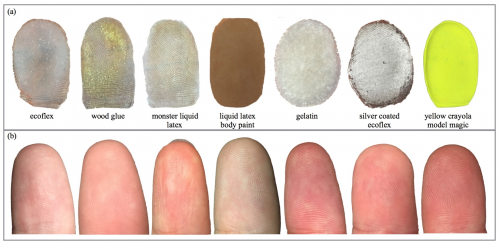
We’ve probably all seen a movie in which a burglar crosses a room full of laser tripwires and then enters the safe full of loot by tricking the fingerprint-secured lock with a fake print. Turns out, the second part is not that unrealistic: you can fake fingerprints using a range of materials, such as glue or latex.

Examples of live and fake fingerprints collected by the RaspiReader team

The RaspiReader team collected live and fake fingerprints to test the device

If the spoof print layer capping the spoofer’s finger is thin enough, it can even fool readers that detect blood flow, pulse, or temperature. This is becoming a significant security risk, not least for anyone who unlocks their smartphone using a fingerprint.

The RaspiReader

This is where Anil K. Jain comes in: Professor Jain leads a biometrics research group. Under his guidance, Joshua J. Engelsma and Kai Cao set out to develop a fingerprint reader with improved spoof-print detection. Ultimately, they aim to help the development of more secure commercial technologies. With their project, the team has also created an amazing resource for anyone who wants to build their own fingerprint reader.

So that replicating their device would be easy, they wanted to make it using inexpensive, readily available components, which is why they turned to Raspberry Pi technology.

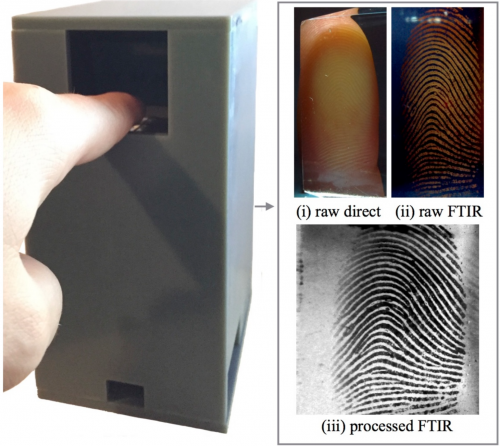
RaspiReader fingerprint scanner by PRIP lab

The Raspireader and its output

Inside the RaspiReader’s 3D-printed housing, LEDs shine light through an acrylic prism, on top of which the user rests their finger. The prism refracts the light so that the two Camera Modules can take images from different angles. The Pi receives these images via a Multi Camera Adapter Module feeding into the CSI port. Collecting two images means the researchers’ spoof detection algorithm has more information to work with.

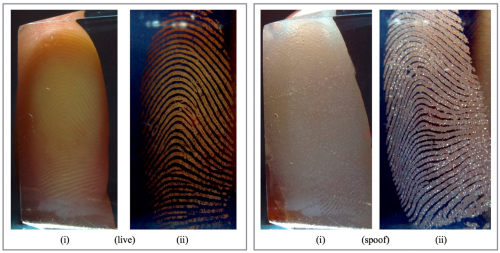
Comparison of live and spoof fingerprints

Real on the left, fake on the right

RaspiReader software

The Camera Adaptor uses the RPi.GPIO Python package. The RaspiReader performs image processing, and its spoof detection takes image colour and 3D friction ridge patterns into account. The detection algorithm extracts colour local binary patterns … please don’t ask me to explain! You can have a look at the researchers’ manuscript if you want to get stuck into the fine details of their project.

Build your own fingerprint reader

I’ve had my eyes glued to my inbox waiting for Josh to send me links to instructions and files for this build, and here they are (thanks, Josh)! Check out the video tutorial, which walks you through how to assemble the RaspiReader:

RaspiReader: Cost-Effective Open-Source Fingerprint Reader

Building a cost-effective, open-source, and spoof-resilient fingerprint reader for $160* in under an hour. Code: https://github.com/engelsjo/RaspiReader Links to parts: 1. PRISM – https://www.amazon.com/gp/product/B00WL3OBK4/ref=oh_aui_detailpage_o05_s00?ie=UTF8&psc=1 (Better fit) https://www.thorlabs.com/thorproduct.cfm?partnumber=PS611 2. RaspiCams – https://www.amazon.com/gp/product/B012V1HEP4/ref=oh_aui_detailpage_o00_s00?ie=UTF8&psc=1 3. Camera Multiplexer https://www.amazon.com/gp/product/B012UQWOOQ/ref=oh_aui_detailpage_o04_s01?ie=UTF8&psc=1 4. Raspberry Pi Kit: https://www.amazon.com/CanaKit-Raspberry-Clear-Power-Supply/dp/B01C6EQNNK/ref=sr_1_6?ie=UTF8&qid=1507058509&sr=8-6&keywords=raspberry+pi+3b Whitepaper: https://arxiv.org/abs/1708.07887 * Prices can vary based on Amazon’s pricing. P.s.

You can find a parts list with links to suppliers in the video description — the whole build costs around $160. All the STL files for the housing and the Python scripts you need to run on the Pi are available on Josh’s GitHub.

Enhance your home security

The RaspiReader is a great resource for researchers, and it would also be a terrific project to build at home! Is there a more impressive way to protect a treasured possession, or secure access to your computer, than with a DIY fingerprint scanner?

Check out this James-Bond-themed blog post for Raspberry Pi resources to help you build a high-security lair. If you want even more inspiration, watch this video about a laser-secured cookie jar which Estefannie made for us. And be sure to share your successful fingerprint scanner builds with us via social media!

The post RaspiReader: build your own fingerprint reader appeared first on Raspberry Pi.

04 Oct 20:01

Basic On An SBC With A Single Line 7-Segment Display

by Martin
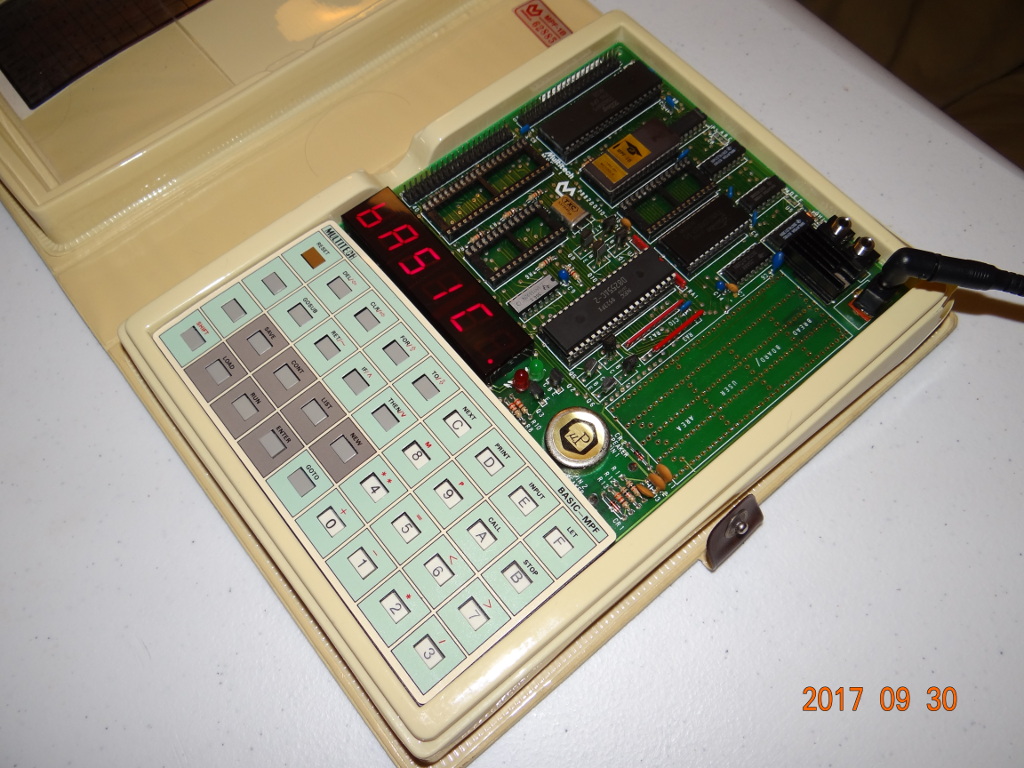
Microprofessor MPF-1b
The MPF-1b. Picture by Michael Wessel

Back in the 1980s the BASIC programming language was a must have feature on any home computer. Initially conceived in the mid-1960s it was swiftly adapted even for the first personal computer, the MITS Altair 8800 that became available in 1975. The freely available Tiny BASIC could fit into 2-3 kByte of memory and thus made it ideal for machines with only a few kilobytes of RAM and ROM. With additional features, BASIC then really took off in the 1980’s as the programming language for the masses on computers such as the Commodore 64, the Apple II and uncountable other platforms. They pretty much all had in common that programs were entered with line numbers and programs could be listed on the screen while programming and debugging. Editing code was nowhere near as easy as it is today but one could at least see a TV screen full of code at a time which helps a lot when coding algorithms with many variables and loops.

An interesting fact that is perhaps a bit forgotten is that BASIC also made it to much more restricted devices such as calculators that only had a single display line. The Sharp PC-1401 calculator that was released at the beginning of the 1980s is an interesting example. Being semi-conscious about such devices I was quite surprised when a friend recently showed me an even more restricted device that came with a BASIC interpreter but only had a single row of 7-segment digits instead of full ASCII characters and a non-ASCII keyboard.

The picture on the left shows the Microprofessor MPF-1 single board computer that was built to teach the basics of computing, hardware and assembly programming. Produced by Multitech in Taiwan and released in 1981, its capabilities were enhanced in 1983 with a 2 kByte add-on BASIC ROM chip. Take a closer look at the picture on the left to see just how restricted the platform is and how Multitech worked around this.

BASIC instructions were not typed in character by character. Instead, each BASIC instruction was represented by a key on the keypad for which an overlay template was delivered as the keys had a different meaning for assembly language programming. It also takes some imagination to read the contents of an instruction line on the display as there were only 6 numeric digits and thus not all characters could be printed. To adapt to the 6 numeric digits, instruction names were abbreviated to 3 characters and scrolling to the left was used when longer constructs were typed in. Apart from adapting to these physical limitations, however, it was a real basic with line numbers. Variable names were limited to a single character and a optional number and could only hold 16 bit signed integers. There were no strings and no arrays. However, values could be written to and read from any memory location so it was possible to interact with input and output ports mapped to specific memory addresses. Here’s a link to the manuals in case you would like to find out more.

So even though I was semi-aware about BASIC calculators, seeing the programming language on even more restricted machines was a real surprise. Thanks, Michael, for showing this machine to me, it has significantly enriched my understanding of the early days of personal computing!

04 Oct 20:01

The Runaway Community – Measuring And Improving An Online Community

by Richard Millington

We’ve been fortunate to consult with organizations whose communities we would define as runaway successes (Facebook, SAP, Oracle etc…). One major difference between these companies and those communities that are ‘doing ok’, is the former’s incredible commitment to constant improvement. The runaway successes are constantly benchmarking, testing, and refining what they do.

The organizations that aren’t doing so well will ask questions like “What should I measure?” or “What are some good benchmarks for [x]?”

In this post, I’m going to explain how we approach community measurement with these kinds of clients and some of the processes we put in place.

Remember, this is the final week you can sign up for our strategic community management course. We won’t be running this course again for a while, so I hope you can join us.


The Measurement Fallacy

Almost everyone we’ve worked with is measuring something.

But when we ask what they do with those measurements, the answers are either really vague “well, it tells us what’s working or not working” or redundant “I send them to my boss and colleagues”

Our clients (and course participants) will have an answer like:

“If the number of useful tips created by our top experts rises by 10% as expected next month, we’ll spend more time building relationships with the insider group and less time on our newsletters. If it rises by less than 10%, we’ll try pushing the leaderboard system as the core tactic instead”

This is the difference between having something you measure for fun and actually having a system to drive ongoing improvement. You should only measure the things you want to improve.

If you don’t know what to do with the data, why waste time collecting it? If you don’t know what will happen if a metric rises or falls, why measure it at all?


The Interpreting Problem

But interpreting data is a huge problem, even if you have benchmarks, to begin with.

Let’s imagine your goal is to increase customer satisfaction. You randomly survey a large group of active members each quarter and track results. You discover that customer satisfaction has stayed the same in the last three months. What would you do differently with this data?

Actually, take a second and think about it….

Some of you might conclude that the community isn’t working and may need to be scrapped. But what if customer satisfaction fell everywhere else except in the community? That could be a game-changing win.

You can’t make any decent analysis unless you have the right context. This means working on four levels; execution, tactics, strategy, and objectives.


Analyzing The Four Levels For Context

If customer satisfaction scores aren’t rising, is community the wrong approach? Or is it because you had the wrong objectives, strategy, and tactics?

Let’s imagine one of your objectives to increase customer satisfaction is to get more experts sharing product tips. Your strategy might be to build a sense of competition among them to generate the best tips (jealousy). One tactic to fulfill that strategy is to build a leaderboard of those that share the best tips ranking everyone with an expert badge.

But if customer satisfaction scores aren’t rising, did you have the wrong objective, strategy, or tactics? Or perhaps the tactics were just badly executed?

We tackle this by using a framework with four levels. At each level, you are constantly learning and refining what you do. It’s a campaign of hard work, but it helps turn a static community into a runaway success.


LEVEL 1: Was The Tactic Well Executed?

It’s impossible to know if you had the wrong objective, strategy, or tactic until you know if the tactic was well executed.

This means three things:

  1. Did it reach a large percentage of the target audience?
  2. Did it significantly change the behavior of the audience it did reach?
  3. Did that behavior change last for a long time?

You might look at how many people visited the leaderboard, how many of those visitors shared more tips and did they keep visiting the leaderboard to track their ranking (for example).

I’m often amazed how many great tactics were abandoned not because they were the wrong tactics but because they were badly executed. With a little refining (often more awareness), you can turn it into a great success.


LEVEL 2: Did You Use The Right Tactic?

If the goal of the leadership was to increase a sense of competition (and jealousy), you need to measure whether the increase in metrics related to the tactic (e.g. views of the leaderboard) tracked with any observable metric relating to jealousy (sentiment, stories captured, survey results, interviews etc…)

You can have a very successful tactic which fails to fulfill the strategy (you can also have an increase in strategy metrics that’s random and not connected to the tactic).

There should be a strong correlation between the two here. An increase in tactical metrics should be reflected by an increase in sentiment metrics that reflects your strategy.

If not, you want to move to a different tactic, e.g. interviewing or giving public prizes to the people who share the best tip each week.


LEVEL 3: Do You Have The Right Strategy?

Now you can move on to the bigger question.

Are you using the right strategy to achieve the objective in the first place?

What if you can survey experts and plenty more mention feeling competitive, but you don’t see any increase in the number of tips they’re sharing? You have the wrong strategy.

You might shift to a strategy based around getting members to feel a sense of satisfaction from helping each other or feeling a sense of pride in their own success and achievements etc…


LEVEL 4: Was It The Right Objective?

Now you need to check whether the objectives (members sharing more tips) does influence the goal (members sense of satisfaction). If the correlation between the two is positive and significant, you are using the right objectives. If the correlation is weak or negative, you might want to consider different objectives.

For example, instead of customers sharing tips, you might try answering product questions as quickly as possible.


Allocating Time To What Works

The entire purpose of the process is to gradually find and allocate time to the areas that work at the expense of those that don’t. It gives you the freedom to test while doubling down on the areas that are working.

You should also find you reach a point of diminishing returns for most efforts, this is the optimum amount of time and resources to spend on each task.


(LEVEL 5: Did You Have The Right Goal?)

We can also add a fifth level here. Did you have the right goal?

Was it a goal that drove useful results for your organization? Was it something a community could and should achieve?

The best method to measure this is to calculate your community ROI, in practice though, we’ve found very few organizations measure the financial return. Instead, it’s about the efficacy of the community compared with other channels to achieve the same goal. This is why you also need some idea of how effective other channels are.


Commitment Required

This process works if you commit to it. If you begin randomly making changes or ignoring your data, the framework fails. Work from the execution level upwards. Remember each level you go up means bigger and bigger changes.

You can improve the execution of a tactic a lot easier than you can change the strategic objective. Changing the strategic objective means a new strategy and a set of tactics to execute. That’s why you always work from the execution-level upwards.


Strategic Community Management Course – FINAL WEEK

This is the final post of our FeverBee Explains series. In the series, we tried to go deeper on some of the more complex topics of our work. If you’ve enjoyed it, I hope you will join us.

http://www.feverbee.com/SCM.

04 Oct 20:01

This Future Looks Familiar: Watching Blade Runner in 2017

mkalus shared this story from Comments on: This Future Looks Familiar: Watching Blade Runner in 2017.

I watched Blade Runner for the first time this week. Since I have apparently been living in a cave for the past few decades, I thought that Blade Runner was kind of like Tron but with more Harrison Ford, and less neon, and maybe a few more tricky questions about What Is The Nature Of Man.

That is the movie I was expecting.

That is not the movie I saw.

I told a lot of people that I was going to watch Blade Runner for the first time, because I know that people have opinions about Blade Runner. All of them gave me a few watery opinions to keep in mind going in—nothing that would spoil me, but things that would help me understand what they assured me would be a Very Strange Film.

None of them told me the right things, though. So, in case you are like me and have been living in a cave and have never seen Blade Runner before and are considering watching it, I will tell you a little about it.

There are cops, and there are little people.

There is a whole class of slaves. It is illegal for them to escape slavery. The cops are supposed to murder the slaves if they escape, because there is a risk that they will start to think they’re people. But the cops know that the slaves are not people, so it’s okay to murder them. The greatest danger, the thing the cops are supposed to prevent, is that the slaves will try to assimilate into the society that relies on their labor.

Assimilation is designed to be impossible. There are tests. Impossible tests with impossible questions and impossible answers. The tests measure empathy. It is not about having enough empathy, but about having empathy for the correct things. If you do not have enough empathy for the correct things, you will be murdered by a cop who does have empathy for the correct things.

In Blade Runner, an absurdly young Harrison Ford is a hard-boiled, world-weary kind of man named Deckard, and he is given a choice. He can be exactly as small as everyone is, or he can catch some escaped slaves for the police. He decides to catch the escaped slaves.

Except that ‘catch’ means ‘retire,’ and ‘retire’ means ‘murder.’

Deckard feels that he has no choice in this matter. He says it himself, and the person giving him the choice confirms that he is correct: no choice. But of course, there is always a choice. Certainly, the escaped slaves who he is chasing see that there is a choice. He can be power or he can be vulnerable to power. He chooses power. And power means murder.

The first such murder we witness is that of a woman who escaped slavery and came to Earth. She has found herself a job. It’s a degrading job, a job that even the hard-boiled, world-weary Deckard flinches away from watching. But it’s a job. She is participating in society. She is working. She’s doing the things that she has to do in order to be a part of the world that she risked everything to reach.

Deckard comes to her workplace. He finds her there, and he knows what she is, and she runs away from him because she knows what cops do to women like her. He chases her through the street and corners her. He aims his gun at her through a crowd of people. He squints. He takes a second too long to decide whether to shoot. She runs again.

(Nobody tells you about that part, when you tell them you’re about to watch Blade Runner for the first time. They tell you about all the different versions, and they tell you about the ambiguity of the ending, and they tell you about the fact that all the effects are practical effects. But nobody tells you about the part where a cop aims a loaded firearm into a crowd of people and tries to decide whether it’s worth risking their lives in order to murder an escaped slave.)

She runs, and then he corners her again, and then he shoots her. He shoots her in the back while she’s running away from him, running from death with so much panic that she crashes right through a shopfront window. Glass rains down around her, and she is dead. Not a dead person, of course. Because, as we have been told, she is not a person—they are not people. But she is dead, and when death happens in public, people will come to look. A small crowd begins to gather.

And then a police vehicle hovers overhead, and the police vehicle repeats the same two words over and over, in the same tone the crossing light uses to prompt those who can’t see the walk signal: Move on, move on, move on.

So the crowd moves on. The story moves on. And Deckard moves on.

He still has work to do. One down. The rest to go.

He murders other escaped slaves before the end of the film. He finds where they are hiding, and he murders them.

It is important, in the world of the film, to remember that the things he is murdering are not people. That it is their own fault for seeking free lives. That the cops are just doing their jobs.

It is important to remember to have empathy for the right things.

There is one escaped slave who Deckard does not murder. She asks him if he thinks she could escape to the North, and he says no. Whether that is true or not, we as the audience do not get to find out, because she does not escape. She does not escape because he decides to keep her. He is asked to murder her, and instead he decides to keep her for his own.

(Nobody warns you about that part when you tell them you’re about to watch Blade Runner for the first time. They tell you to watch for the origami, and they tell you that you won’t believe the cast, and they tell you about the celebrities who have been asked to take the Voight-Kampff test. But nobody warns you about the part where a cop convinces a slave that she cannot escape unless he is allowed to keep her. Nobody warns you about that part.)

Blade Runner does not ask us to sympathize with Deckard. At least, not in the version I watched, which was the Final Cut. I am told that there are other cuts which were deemed more palatable to theatre audiences at the time of release. Those cuts, I am told, reframe the man who chases a terrified escaped slave through the streets of a futuristic Los Angeles and then puts bullets into her back. They allow us to believe that he is a good guy doing a hard but necessary job, and that the hard but necessary job is hard because he is good. They allow us to believe that it is possible to be a good guy while doing that kind of a job.

This is a thing that it is very tempting to believe. It is a thing that we are accustomed to believing. It is as familiar as coming home.

Most people told me the same thing, when I said that I was going to come out of my cave and watch Blade Runner for the first time. When they were giving me their watery opinions so I’d be prepared for what I was about to see, they all said: “It’s a Very Strange Movie.”

They weren’t wrong. Not exactly. Not in the thing that they meant, which is that it is bizarre. They weren’t wrong about that. It is bizarre. The movie itself is ambiguous and nuanced and asks a lot of the audience. Asks too much of the audience, if you agree with the studio executives who released the original, theatrical cut. It is baffling and beautiful and terrible and tempting. It’s Surrealist Science Fiction Pulp Noir—it has to be weird and unsettling. That’s the genre.

But I would not call the world of Blade Runner strange, because it’s the opposite of strange. It’s familiar. If you subtract the flying cars and the jets of flame shooting out of the top of Los Angeles buildings, it’s not a far-off place. It’s fortunes earned off the backs of slaves, and deciding who gets to count as human. It’s impossible tests with impossible questions and impossible answers. It’s having empathy for the right things if you know what’s good for you. It’s death for those who seek freedom.

It’s a cop shooting a fleeing woman in the middle of the street, and a world where the city is subject to repeated klaxon call: move on, move on, move on.

It’s not so very strange to me.

Hugo and Campbell award finalist Sarah Gailey is an internationally-published writer of fiction and nonfiction. Her work has recently appeared in Mashable, the Boston Globe, and Fireside Fiction. She is a regular contributor for <a href="http://Tor.com" rel="nofollow">Tor.com</a> and Barnes & Noble. You can find links to her work here. She tweets @gaileyfrey. Her debut novella, River of Teeth, and its sequel Taste of Marrow, are available from <a href="http://Tor.com" rel="nofollow">Tor.com</a>.

04 Oct 18:23

Google unveils Clips, a tiny AI-powered camera

by Rose Behar

Alongside a variety of other hardware reveals, Google has announced Clips, a miniature wearable camera that uses AI to automatically snap pictures at opportune times.

It has a 12-megapixel sensor and 13-degree field-of-view lens. Users can export the recordings as video, photos or GIFs.

Whatever Google Clips records can be uploaded to Google Photos automatically.

The camera device can be connected to your smartphone, and comes with 16GB of onboard storage. Google Clips should be able to last three hours on a single charge

The concept is similar to the Narrative Clip 2, the product of a startup that is currently struggling to stay afloat.

In the U.S. it will be $249 USD, and is “coming soon.” There is no current information on Canadian pricing or availability.

The post Google unveils Clips, a tiny AI-powered camera appeared first on MobileSyrup.

04 Oct 18:23

Google shows off new wireless, Assistant-enabled Bluetooth Pixel Buds

by Patrick O'Rourke

Following the reveal of new Google Home products, as well as the Pixel 2 and Pixel 2 XL, Google also revealed new wireless bluetooth headphones called the Pixel Buds.

Google says the headphones will provide five hours of listening time on a single charge, with the headphone’s charging case capable of holding 24 hours worth of charging functionality. Unlike Apple’s AirPods, the Pixel Buds are Bluetooth earbuds attached by a single wire.

The right earbud is utilized for Google Assistant, while the other is used for navigation, including play/pause and swiping for volume controls.

Pixel Buds will be available later this year in Canada in blue, white and black for $219 CAD on The Google Store and Best Buy Canada. Pre-orders, meanwhile, are available starting today.

The post Google shows off new wireless, Assistant-enabled Bluetooth Pixel Buds appeared first on MobileSyrup.

04 Oct 18:23

Google announces new Daydream View virtual reality headset

by Bradly Shankar
new Google Daydream View

Google has revealed the new Daydream View virtual reality headset.

It will be available in three new colours –Charcoal, Coral and Fog — and is made up of an improved fabric material, compared to the original Daydream View’s cloth-like covering. As well, the lenses have been upgraded to offer the widest field of view yet.

Google says that 250 high-quality VR titles will be available at launch, compared to the 25 apps offered when the original Daydream View launched.

Google also confirmed a slate of premium video content coming to Daydream, including multiple new VR originals from YouTube. Pixel 2 owners will be able to Experience IMAX short films for free through Google Play Movies on Daydream View.

Finally, the new Daydream View features front-firing stereo speakers and the ability to cast the experience to a TV for friends and family to see what the headset user is seeing.

The new Daydream View is now available for pre-order in Canada for $139 CAD on The Google Store and retailers and set to be delivered by October 19th.

The post Google announces new Daydream View virtual reality headset appeared first on MobileSyrup.

04 Oct 18:22

Google announces the Pixel 2 and Pixel 2 XL

by Dean Daley
Google Pixel 2 and Pixel 2 XL

After the success of Google’s first self-branded smartphone — 2016’s Pixel and Pixel XL — the American search giant has come out in full force once again with the  announcement of the Pixel 2 and Pixel 2 XL.

While HTC is responsible for manufacturing the smaller Pixel 2 and LG manufactures the larger Pixel 2 XL, the two devices are actually quite similar — excluding their size, of course.

What’s on the outside

The Pixel 2 XL features a 6-inch Plastic OLED edge-to-edge screen, with 2880 x 1440 display resolution resulting in a 538 pixel density. The smartphone has rounded edges and corners. Naturally, the Pixel 2 XL also has very small top and bottom bezels.

Additionally the device supports and has an 18:9 aspect ratio, similar to the iPhone X and the Samsung Galaxy S8+. In contrast, the Pixel 2 shares a similar look to the original Pixel. It has a 5-inch display, square edges and features large — but still smaller than last year’s model — top and bottom bezel as well as a 16:9 aspect ratio.

Both devices are Daydream ready and both do not feature headphone jacks.

The Pixel 2 and Pixel 2 XL earned a DxOMark score of 98, higher than any other camera ever. The device features a 12.2-megapixel rear camera and an 8-megapixel front facing camera. The rear camera on both devices also utilize optical image stabilization and electronic image stabilization which should help with taking photos and videos. The device can take portrait photos like the iPhone X, however, it does so by utilizing two sensors instead of two lenses.

What’s on the Inside

The Pixel 2 and Pixel 2 XL carry a Snapdragon 835 chipset with an Adreno 540 GPU and octa-core CPU. Additionally, the Pixel 2 devices come in 64GB and 128GB storage options, and 4GB of RAM which the XL is powered by a 3,520mAh battery. The smaller variant on the other hand had a 2700mA battery, though both are IP67 water and dust resistant.

New features

The Pixel 2 and  2 XL both feature pressure-sensitive frames, which allow users to activate the phones’ ‘Active Edge’ functionality. A squeeze of the the frame activates the Active Edge feature — similar to the HTC U11’s Edge Sense — which can activate the device’s Google Assistant even with case.

Both Pixel 2 smartphones also come with the newest version of the Pixel Launcher, which includes the Google search bar widget near the bottom of the display, with the calendar, clock and weather combined into one at the top of the display.

Google Lens can help users contextualize something they’ve just taken a picture of with their smartphone. Google Lens uses Google to search through a variety of images through the web. Users can take a picture of a dog they don’t know about and Google Lens can identify what’s in the picture.

Google Lens will first appear in Google Photos before making its way to Google Assistant at a later date. Google Lens will launch first on the Pixel smartphones.

The Pixel 2 smartphones are also in competition with the Shazzam and SoundHound with the announced ‘Name That Tune’ feature which will tell users what’s playing, and show the information on the device’s Always On display.

The Google Pixel 2 also features some new AR capabilities.

Colour-wise the Pixel 2 comes in ‘Kinda Blue,’ ‘Just Black’ and ‘Clearly White,’ while the Pixel 2 XL comes in ‘Just Black’ and ‘Black and White’. The device will also ship with Google’s newest operating system Android Oreo, and will receive updates for the next three years until Android R.

Pricing and Availability

The 64GB and 128GB Pixel 2 models cost $899 CAD and $1,029, respectively. As for the Pixel 2 XL, the 64GB  model cost $1,159 and the 128GB variation cost $1,289. Pre-orders are now open.

The Pixel 2 should ship by October 17th, 2017, while the Pixel 2 XL should ship by December 2017.

Generally on a two year Premium Plus plan the Pixel 2 with 64GB of storage will cost $199.99, while 128GB model will cost $329.99. The larger variant will cost $449.99 for the lower storage option and the 128GB model on the other hand will cost a hefty $579.99.

For specific carrier information click here.

The post Google announces the Pixel 2 and Pixel 2 XL appeared first on MobileSyrup.

04 Oct 18:20

Google reveals the Pixelbook, a high-performance Chromebook

by Bradly Shankar
Google Pixelbook

Google has announced the Pixelbook, a new high-performance Chromebook. The laptop was designed with hardware, software and AI in mind.

It’s the thinnest, lightest laptop the company has ever made coming in at 10mm thick and 1 kg in weight.
The 4-in-1 design allows the owner to use it in a variety of ways, such as in tablet form to read a book or propped up in tent mode to follow a recipe in the kitchen.

The Pixelbook has the signature glass inlay 12.3″ display with backlit design and trackpad touch-pro for enhanced responsive controls.

The Pixelbook features an Intel Core i5, upgradable to a Core i7 processor, 16GB of RAM and 512GB of internal storage.
In addition, the Pixelbook will last for up to 10 hours of use on a single charge and support Google’s new instant tethering feature for immediate Wi-Fi connectivity.

To go alongside the Pixelbook, Google also confirmed the Pixelbook Pen, a smart, responsive companion for the laptop. This works in tandem with Assistant, which Google Pixelbook is the first laptop to feature built-in.

Google says a user can hold the button on the Pen and circle something on screen, with Assistant giving more information accordingly. Matt Vokoun cited circling a particular song for Assistant to give more information on, including the option to jump to the artist’s Instagram page to follow and see more.

Google says it worked with Wacom to develop the fastest and most responsive stylus to date, with 10ms of latency and 60 degrees of angular awareness.

The Pixelbook is available in three configurations starting at $1299 CAD, which Google says is “so you can choose the processing power, memory and storage you want.”

The Pixelbook Pen, meanwhile, costs $129 CAD. The Pixelbook and Pixel Pen will be available for pre-order later today in Canada, with the exception of Quebec, although Google says it is working to bring the device to the province in the future. Both will be sold The Google Store and select retailers; so far, Google’s website lists only Best Buy and Staples.

The post Google reveals the Pixelbook, a high-performance Chromebook appeared first on MobileSyrup.

04 Oct 18:20

Google reveals high-end Max smart home assistant speaker

by Patrick O'Rourke
Google Home Max

At the Google’s keynote presentation today, the company revealed a high-end version of its Home device called Home Max, along with a more affordable Mini smart home assistant. 

Google says the Max is 20 times more powerful than the Google Home and features new technology called ‘Smart Sound’ that’s capable of analyzing the room around the device for a more accurate acoustic experience, similar to Sonos’ high-end speakers, as well as modern surround sound systems and Apple’s upcoming HomePod. The speaker also includes far-field microphones that the company says will allow users to still give the Home Max voice commands when music is playing.

In terms of additional specs, Google says that the device works seamlessly with the Google Home family devices and that it features 4.5-inch subwoofers and “acoustically transparent fabric.”

Given the original Google Home’s speakers are one of the device’s most heavily criticized features, it makes sense for Google to release a higher-end version of its smart home assistant in an effort to compete with Amazon’s new line of Echo products.

Google Home Max is available in December for $399 USD (approximately $500 CAD), but only in the U.S., though Google mentions that “more regions are coming soon.”

The post Google reveals high-end Max smart home assistant speaker appeared first on MobileSyrup.

04 Oct 18:20

Sonos announces Sonos One smart speaker

by Igor Bonifacic

At an event today in New York City, Sonos announced the Sonos One smart speaker. It’s the first Sonos speaker to feature built-in hardware voice control.

The company positioned the Sonos One as the smart speaker for music lovers. Users can pair two Sonos One speakers to make them work as a pair of stereo speakers. The speaker uses echo cancellation technology, as well as six far field microphones, to isolate human voices. Like past Sonos speakers, Sonos One includes the company’s ‘true play’ technology to allow Sonos users to tune their Sonos One to the specific room they place it in.

At launch, Sonos One is only compatible with Amazon’s Alexa smart assistant. However, the company says it envisions the speaker working with other smart assistants in the future. In fact, starting next year, Sonos One will be compatible with Google Assistant. As with all of the company’s current speakers, Sonos One is compatible with more than 80 music streaming services, including Spotify.

The company was quick to point out that users that don’t want to use the speakers voice control functionality will be able to turn the feature off.

In Canada, Sonos One will cost $249.99 CAD. The speaker is set to be available in white and black, and can be pre-ordered starting today with delivery scheduled to start on October 24th.

In addition, Sonos announced that its others speakers are now compatible with Amazon’s Alexa personal helper. Alexa is available to current Sonos speaker owners starting today in a publicly available beta. Using Alexa, Sonos owners will be able to control the company’s speakers with their voice.

The beta is only available to Sonos owners in the U.S., U.K. and Germany. Sonos, however, promised that Alexa functionality will be available in additional countries as Amazon expands Alexa’s availability.

In 2018, Sonos speakers will also support Apple’s AirPlay 2 multi-room audio streaming functionality.

The post Sonos announces Sonos One smart speaker appeared first on MobileSyrup.

04 Oct 18:20

Qualcomm’s Vanitha Kumar on talking to your daughters about math [The Women Behind Wireless]

by Rose Behar
vanitha kumar

Vanitha Kumar knew she wanted to be an engineer from a very young age.

Since high school, the idea that she would be an engineer was pretty much cemented in her brain. From there, she got her bachelors degree in electronics and communication engineering at the PSG College of Technology in India and graduated with a 4.0 GPA from Northeastern University with a masters in Electrical and Computer Engineering.

Following her masters degree, Kumar worked her way up the ranks in the internationally dominant semiconductor and telecom equipment company Qualcomm over the course of 21 years to become vice-president of modem software engineering.

But while that may sound like a simple — if not effortless — process, that doesn’t mean that Kumar’s career in wireless hasn’t had its fair share of challenging moments and learning opportunities.

In this edition of MobileSyrup‘s The Women Behind Wireless series, we speak to Kumar about what challenges her, the best advice she’s received and her views on diversity in the tech industry.

Question: When did you first gain an interest in tech?

Vanitha Kumar: I grew up in a traditional middle-class Indian family and pretty much if you follow the stereotype of what a family like this focuses on, it’s a lot of science and math. It’s something you’re expected to be good at. My grandfather, in particular, really encouraged me a lot to participate in math Olympiads.

Q: What was it like when you first joined Qualcomm?

Kumar: I was lucky, even if at that time I didn’t realize it or appreciate it.

CDMA was then known as an emerging technology, we were focusing on the commercialization of CDMA. I worked on the base station side for about three years. The technology at that point was proven, so Qualcomm decided to sell the base station group to Ericsson.

I moved from the base station side to the mobile software side. Then I started working on CDMA2000, an evolution of CDMA that was the starting point of 3G.

Then there was Wimax, UMB and LTE.

Q: Why did LTE win out over UMB, which you initially worked on?

Kumar: LTE had a lot more backers than the others.

The thing with technology is, it can be a very self-fulfilling prophecy, if you put enough energy into, it might work, if not, it won’t work.

UMB didn’t live long enough to stand the test of time. It’s hard to say we did anything wrong by betting on LTE. I still look at LTE as my baby. From the very first line of code, I was there.

I’m not even thinking of 5G as my baby, I’m thinking of it as an evolution of LTE. You build a beautiful house and you think, next I want to do this to my living room, etc.

Q: What is some of the best advice you’ve received in your career?

Kumar: Some of the best advice I’ve received in my career is to believe in myself. I think every time I’ve gotten to the point where I’ve wondered “Should I do that?” or “That’s not my area of expertise” or “That’s not what I have done in the past,” family members or friends or colleagues at work gave me the extra boost saying “No, you can absolutely do it. Just go for it and believe in what you’re capable of.”

That’s pretty much what has kept me going all these years.

Q: What was one of your greatest challenges at work and how did you overcome it?

Kumar: I think for me, the technical skills were something that was very natural for me, because I always considered myself an engineer at heart from the time I was maybe a teenager.

But I was also, as a teenager, very socially awkward. In my family I was a social outcast. I didn’t have very many friends. I didn’t really develop that skill to talk to other people and get them to see things your way and all that. So, for me, when I transitioned into a work environment and eventually had to lead multiple teams, I really had to work a lot on my communication skills, and that’s something I had to do for myself very early on, so I kind of put myself through classes and figured out how to work with [people].

“…How do you harvest the strengths of multiple people and get them going towards a common purpose, even when you have conflicts…”

And not just working with people, but harnessing their full potential. How do you get them to lead effectively on a project? And how do you choose some people with the right skill-set for the right problem? Because you might have someone who is super good at something, but they may not want to either lead a team or be responsible for a huge area or they may not want to be customer facing.

So the question is, how do you harvest the strengths of multiple people and get them going towards a common purpose, even when you have conflicts between different personalities, people from different cultures, people with different beliefs, different backgrounds? And that’s something I really learned to do over the years.

Q: What’s something you wish more people knew about wireless?

Kumar: The commercial wireless systems deployed that enable people to make their voice calls, texts, data etc. is not actually one homogeneous worldwide network.

It actually consists of several generations of wireless standards like GSM, CDMA, WCDMA, LTE, Wi-Fi, all deployed in a heterogeneous fashion and in several RF [radio frequency] bands based on the network operators.
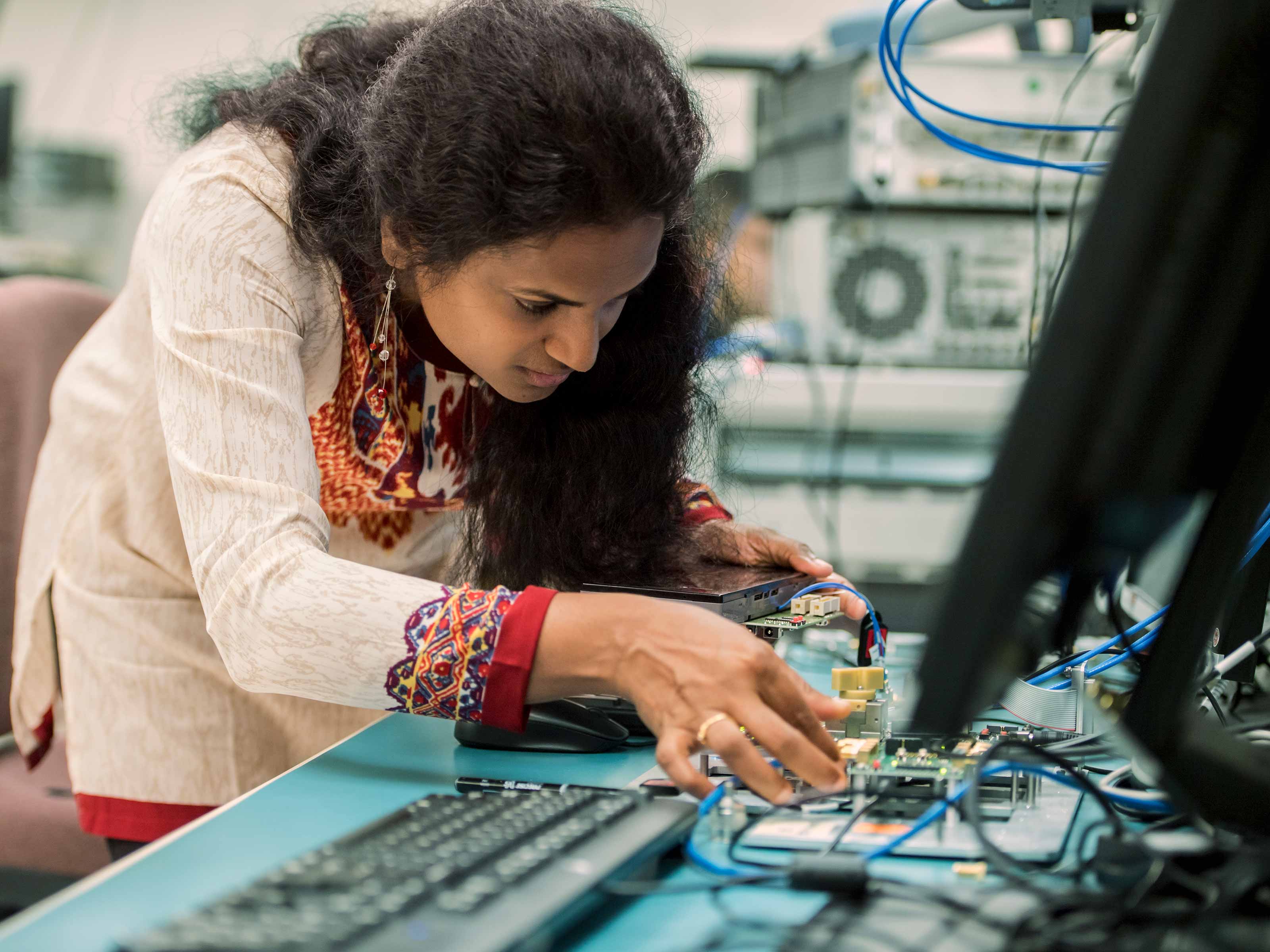
So for a phone bought in one city or country to seamlessly “roam” in another city, network, country to continue to deliver the voice and data services requires enormous work on the standards, device and network sides to make sure all these networks can interwork with each other and a phone can smoothly handover between these various standards and band combinations.

This is one of the biggest challenges we face when we move to newer revisions of existing technologies or new technologies like 5G to make it coexist so seamlessly with existing networks. I view this as one of the most under-appreciated problems by the end users.

Q: What are your thoughts on diversity in the tech industry?

Kumar: I don’t think the tech industry is that diverse at all. Even today, in Qualcomm we don’t have that many engineers who are women or who are African American, so diversity is definitely a challenge.

I have two school-age daughters and so I have started tracking this problem from elementary school.

For the longest time, I thought, oh we’re just not able to get the right engineers, and it’s just a problem in the industry, but actually — though we can definitely do more, have a more inclusive environment and make it really easy for women to stay — I really think the problem is actually in the pipeline and I think the problem starts way back in middle and even elementary school.

“I think the problem starts way back in middle and even elementary school.”

Because I see the conditioning happening in middle school and high school, there are a lot of girls that stay out of math and science because somehow they think “Oh, I’m not that good at it.” Kids get a ‘B’ in English all the time and they don’t think they’re bad in English because they get a ‘B’ but if they get a ‘B’ in math, they think “Oh my god, I must really be stupid. I’m not able to do it.”

Recently I went to one of my kids’ back-to-school night and the math teacher was telling all the parents, “If you guys have a problem with math, please don’t share that with your children. If your children come to you with math, don’t immediately go ‘Oh yeah, math, it’s so hard. I really struggled with this in school, I absolutely hated it.’ If you have your own opinions about math, don’t share that with your children, let them think it’s like any other subject, which if they put effort in it, they can excel.” I thought that was a very interesting point.

Q: How do you engage your daughters in math and science and engineering?

Kumar: Until about eighth grade or so, I work with them on my own math curriculum. Pretty much everyday that I can have something prepared for them — sometimes just as small as 15 minutes or half an hour, but I make sure I kind of keep them with my math time at least five days a week. Now my high schooler is on her own because she doesn’t need that anymore.

I do tell them a lot about what I do and what I make. […] They’re very, very proud to say “My Mom works at Qualcomm, and she does all this.” When we have projects going on in the lab I take them to the lab and show them “Look, these are all the engineers and they’re working on all this stuff.” So they actually have a good idea of what does a hardware engineer do, what does a software engineer do.

The other way I try to get them excited is I coach the math Olympiad team, I’m engaged in the robotics team…I make sure that if anything is telling them anything bad about math and science, I’m talking to them four times as much to [counteract] that.

Q: What do you think of people like James Damore who say there are biological differences that make women not interested in or not good at STEM subjects?

Kumar: I don’t even know what to say. That’s just crazy.

I think a lot of it is just the way girls are groomed. Right from when they are very small…many parents don’t mean to do it, but they get their daughter the Barbie doll and their son a building set. Right from the time they’re little, we tell them, “This is what you should be interested in.”

It’s very wrong to call that biological. I know a lot of engineers who are women and who are very, very smart and I work with a lot of high school kids and I see that the girls are just as smart, just as capable when it comes to solving those challenging problems — it’s just what are we telling them and how society is grooming them. I think society has a big role in it.

“It’s very wrong to call [this issue] biological.”

We’re constantly telling girls this is not what you’re made to do, this is not natural for you, this is not what you should be doing and that really sets a bad precedent.

I was talking to somebody recently who was sending her daughter to a school of pharmacy and I was asking her “Why pharmacy?” and she said, “Oh, it seems like such a good job for a girl…It’s a very light job and she can manage kids and home and making dinner for them.” I’m sure she’s not telling that to her sons.

That’s not the right way of thinking about it. You should tell your daughter, “What are you passionate about? What do you want to do? Go for it, and maybe eventually you will find a spouse you can be supportive in that role and encourage you to pursue your dreams.”

Q: Do you have any particular advice to give to girls or young women aiming to get into the wireless field?

Kumar: Focus on the fundamentals. My daughter said she wanted to come in and see all the different jobs that people do [so] she can decide if she wants to focus on this or that. But to focus on any of that stuff, fundamentals are very important — basic math, physics, chemistry. Elementary, middle school kids should really focus on math, middle school and high school kids should focus on math and science.

Getting into wireless after that is not really harder. They can get into wireless or AI or robotics. But the fundamentals, none of those are an option for them. The first step to get into wireless is to learn the basics.

This interview has been edited for length and clarity. Images were provided courtesy of Qualcomm.

The Women Behind Wireless is a series of profiles by MobileSyrup that aims to shine a spotlight on veteran women in the wireless industry, and what they’ve contributed to the field. Stay tuned for more profiles in the near future. 

Read more: Huawei’s Dr. Peiying Zhu explains why 4G was a hard sell

The post Qualcomm’s Vanitha Kumar on talking to your daughters about math [The Women Behind Wireless] appeared first on MobileSyrup.

04 Oct 18:20

HMD Global announces that its Nokia lineup will be updated to ‘Android P’

by Dean Daley
Nokia 8 Zeiss

Any Canadians who decided to purchase a Nokia smartphone this year from Amazon will be happy to know their device will get the updated to Android P.

HMD Global had already confirmed that each of its new smartphones, the Nokia 3, Nokia 5, Nokia 6 and Nokia 8 will receive the update to Android Oreo, but the company is going further and confirming that its new line of devices will also be updated to the inevitable next version of Google’s operating system, Android P.

HMD made the announcement today during the launch of its newest smartphone, the Nokia 8, in the Philippines, according to GSMArena.

While the company is looking far in the future for its newest lineup of devices, closer to the present, Nokia is currently doing internal testing for the Android Oreo update on the Nokia 8, with a stable build likely to launch by the end October. Nokia’s budget and midrange offerings they are likely to receive the Android update before the end of the year.

The Nokia series of smartphones are not widely available in Canada, though anyone interested can purchase the device outright via Amazon.ca.

Source: GSMArena

The post HMD Global announces that its Nokia lineup will be updated to ‘Android P’ appeared first on MobileSyrup.