Shared posts

11 Oct 18:20

Health For Hire

by Ricky Carr

Executive Summary

Spiraling healthcare costs have been of grave concern to prominent segments of industry, government, and the public for at least 50 years. And while the cross-sector battle rages on over the appropriate strategy for addressing them, there is one fact upon which clear-eyed industry analysts agree: There can be no solution to the healthcare crisis that does not address America’s unchecked epidemic of chronic disease, which afflicts more than half our citizens and consumes 86% of the exorbitant $3.2 trillion spent each year on care.

View our series on transforming healthcare.  

But our traditional healthcare delivery system, designed to excel at episodic acute care, has not made a dent in the problem. To prevent and reduce the cost of managing chronic disease, the system must learn to facilitate change in individual behavior, which has the greatest impact on health of any contributing factor, including healthcare. The Theory of Jobs to Be Done is a powerful tool toward this end.

Jobs Theory explains that everything people consciously choose to do (including doing nothing), they do to make progress according to their own priorities, in a particular set of circumstances. We call this progress a “job,” and it motivates individuals to search for solutions. Based on this insight, the theory asserts that the way to unleash patients’ potential to better manage their health is not to try to get them to prioritize health goals over the jobs they’re already striving to do. Instead, it’s to understand those jobs, and help patients accomplish them in ways that enhance their health, rather than detract from it.

For instance, a person striving to feel less lonely might “hire” a cat, a walking group, more hours on Instagram, or smoke breaks with colleagues to do that job. Each of these solutions has health consequences, ranging from positive to negative. Jobs Theory provides a framework for creating solutions for patients’ jobs that also have positive health consequences.

A jobs-based approach to healthcare delivery is particularly suited to chronic disease management, for five reasons:

  1. Takes into account patients’ full capacity to change, so patient and provider can establish realistic health improvement goals, and craft health solutions patients can absorb considering their unique circumstances.
  2. Works with patients’ existing beliefs about health, rather than requiring immediate change in perspective, and thus reduces barriers to adoption of health solutions.
  3. Illuminates the broader determinants of individual health status, enabling development of health solutions that address them, likely in partnership with experts in sectors beyond healthcare, such as social services.
  4. Clarifies the real competition to healthy behavior, so patients and providers can craft health solutions to patients’ jobs that outperform unhealthy alternatives.
  5. Shifts unit of performance from outcomes to progress. Chronic disease management is a long game, so progress in health improvement, not episodic care outcomes, must be the ultimate metric of success. Because jobs represent the progress people seek, organizations capable of delivering jobs-based health solutions are optimized to deliver on the metric of progress.

In researching a diverse range of organizations for this paper, we identified five core enablers of jobs-based healthcare delivery. The most fundamental of these is what we call a health-centric purpose. That’s an organizational purpose defined in terms of patient health and wellness impact, not the types of services provided.

Others include an explicit process for jobs discovery, and the practice of hot-spotting. The former enables accurate definition of the progress patients seek at a given life juncture, and the latter focuses innovation and resources with exceptional intensity on patients whose health improvement will yield the biggest cost savings.

Astute resource integration means organizational skill in mobilizing resources across functions, sectors and geography, and it’s essential for tailoring health solutions to patients’ unique circumstances. And finally, community interaction mechanisms help keep patients connected with peers in health improvement, and thereby with the overall care and self-management process.

There can be no remedy for America’s healthcare cost crisis that does not aggressively attack the scourge of chronic disease that drives so much suffering, and the majority of cost in our system today. But there’s a cavernous gap between the kind of care people need to avert or address chronic disease, and the episodic, acute care our traditional healthcare system is designed to provide. Using the Theory of Jobs to Be Done, innovators can bridge this gap by creating health solutions patients have the capacity to embrace, and which unleash their potential to manage their health more effectively and independently.

introduction

Spiraling healthcare costs have been of grave concern for prominent segments of industry, government, and the public for at least 50 years, and the Affordable Care Act is only the most recent of numerous attempts by policymakers to address this issue. While the battle rages on over government’s appropriate role in healthcare, and thus the landmark law’s fate, there is one fact upon which the clear-eyed industry analysts agree: There can be no solution to the healthcare crisis that does not address America’s unchecked epidemic of chronic disease.

At present, chronic disease consumes 86% of the exorbitant $3.2 trillion the U.S. spends each year on care. More than half of all Americans suffer from at least one chronic disease, with heart disease, obesity, cancer, and type 2 diabetes numbering among the most common conditions. The list of chronic diseases is likely to grow, as scientific advances continue to make healthcare providers wildly successful at transforming terminal conditions into ones people can live with for months or years, while progress in precision medicine remains slow. These trends, coupled with the ticking time bombs of a growing elderly population and increasingly expensive treatments, promise to increase the human and economic costs of chronic disease.

But our healthcare system has not made a dent in the problem. Designed primarily for acute care (and performing suboptimally at that ), the traditional healthcare delivery model applies the same tactics used to address episodes of acute illness and injury—reactive, transactional, hospital-centric, and impersonal—to address chronic disease.

To prevent and reduce the cost of managing chronic disease, the system must learn to facilitate change in individual behavior, which has the greatest impact on health status of any contributing factor, including healthcare, by a long shot. For despite proven, widely-known methods of ameliorating some of the most deadly, burdensome, and costly conditions of our time—quit smoking, drink less, eat nutritiously, exercise regularly, and take prescribed medications—millions of people fail, every day, to do what they know is good for them.

Why? It isn’t that people don’t care about their health. Surveys and the $500+ billion consumer health and wellness market say people do care, a lot. Rather, people and life are complicated. So people find themselves absorbed in other problems, swept up by other ambitions, or trying to work with healthcare regimes that don’t fit their circumstances, instead of making the changes that nobody else can make for them.

In such context, it’s not health that people want, per se. So simply educating or reminding them about the negative health consequences of their behavior will not, in isolation, drive required behavior change. It’s something more than health, and something more specific, that people want. They want progress in their lives, as they themselves define it. A tech entrepreneur’s idea of progress might be furnishing the office she just leased before employees start on Monday. Progress for a senior citizen might be staying involved in his temple despite having lost the ability to drive. For a Medicaid beneficiary, progress might be keeping the electricity on, so his family can make progress in other areas.

fig1Such desire for progress, in context with people’s unique circumstances, influences their day-to-day decisions not only about what to buy, but also about which activities to engage in. Any chronic disease intervention that depends on individual health behaviors, but ignores this fact, is doomed to failure. This is not to say that the desire for progress alone determines health behaviors. Other psychological, environmental, and social factors also influence them. For instance, a person might be highly motivated to improve her diet, but may have a difficult time doing so if she lives in a food desert, or is frequently subject to the priming effects of junk-food advertising.

Nor is it to say that all chronic diseases are equally sensitive to individual health behaviors. Medication adherence, nutritious eating, and regular exercise might slow progression of some diseases, while simply alleviating the symptoms of others. And there is new evidence that successful dieters have a hard time keeping weight off due to the body’s biological inclination to put it back on. We acknowledge the innumerable, interacting factors affecting both human behavior and chronic disease.

Our assertion is that healthcare innovators can unlock whatever potential individuals possess to consciously prevent or effectively manage chronic disease on their own by designing health solutions they’ll have the will and capacity to pull into their lives. The Theory of Jobs to Be Done is a powerful tool toward this end.

This paper represents our most extensive application of Jobs Theory in healthcare to date. For context, we begin with an overview of the theory as applied to the familiar world of consumer products. We then explain its use and benefits in the more complex realms of healthcare delivery and chronic disease management, and describe five organizational characteristics and capabilities, or enablers, that facilitate development of jobs-based chronic disease solutions.

Finally, we illustrate our observations throughout with examples from a diverse set of providers that implicitly take a jobs-based approach to care delivery. As such, we hope this paper serves as a comprehensive resource and inspiration for healthcare leaders and professionals innovating to meet the care delivery demands of the 21st century, and for the stakeholders across sectors aspiring to support them.

The Theory of Jobs to Be Done

Innovators the world over face the daily challenge of creating products that consumers will buy and use. Toward this end, many accumulate vast amounts of demographic, psychographic, and preference data on their target audience, and use it to infer “needs” those consumers are presumably trying to address, and product characteristics that will address those needs.


What is a job?

A “job” is the progress that an individual seeks in a given circumstance.

The progress sought encompasses a complex set of functional, social, and emotional needs and aspirations, which change in priority depending on the circumstances.

Successful innovations enable people to make desired progress. They perform jobs that formerly had inadequate solutions, or no solution at all.

Because jobs are driven by circumstance, the circumstance is the essential unit of innovation work – not user characteristics, product attributes, new technology, or trends.

Jobs to Be Done are usually ongoing or recurring. They are seldom “events.”


But knowing a woman is 38 years old, works in finance, and enjoys cooking doesn’t explain why she goes out to an Italian restaurant with friends one night, and orders in pasta bolognese at home the next. As the high rate of new product failure suggests, consumer characteristics, needs assessments and product preferences—which inform much product innovation—don’t explain purchase behavior. To improve their odds of success, innovators must understand the mechanism behind consumer choice so they can more predictably create products consumers will pull into their lives.

The Theory of Jobs to Be Done (JTBD) provides a framework for doing so. In keeping with Peter Drucker’s famous insight that customers rarely buy what the company thinks it is selling them, Jobs Theory explains that consumers don’t shop for brand promises, product categories, and features. Rather, they seek solutions for “jobs” that constantly arise in life—the progress they want to make in a given set of circumstances.

Nailing the job with coffee houses

To understand how these insights can help innovators predictably create products and services consumers will pull into their lives, consider the evolution of Starbucks retail locations.

Camp out for the day in an urban Starbucks, and you will see a continually morphing scene. First thing in the morning, professionals and students line up for a caffeine jolt en route to work or class. As that crowd dissipates, you notice a smattering of women and men in suits, sitting solo at tables, glancing between their newspapers and cell phone clocks. These are the job-hunters, killing time before an interview in the neighborhood.

Later, the stroller set rolls in—parents and babysitters looking for a few moments of relative calm and conversation after dropping an older kid off at school. The freelancers take over in late morning. Computers out, headphones in, they’re working for hours in their own world, while local workers swing through for a coffee break. By late afternoon, map-studying tourists and high-school kids ostensibly doing homework compete for space, and come evening it is a little bit of everything.

Each of these vignettes represents different consumers hiring Starbucks to do a different job. It isn’t easy to create one environment that can mean so many different things to so many different people, but that was CEO Howard Schultz’s intent from the beginning. Back in 1982 when he joined the young company, he saw the opportunity not only to bring quality coffee to America’s main streets, but to create a “third place” between consumers’ home and work, where they could do their own thing while feeling connected to a community.

In subsequent years, Starbucks integrated a wide range of assets and experiences to deliver on that vision. From a functional perspective, the company invested in its coffee through rigorous grower selection and greatest hits in product development like the often-imitated pumpkin spice latté. It furnished stores with comfy sofas and chairs for chatting friends to lounge on, and high tables with bar stools where freelancers could park, plug into a power outlet, and enjoy free WiFi. Carefully curated musical playlists suited the crowd and time of day.

Starbucks also pursued corporate strategies, such as ethical sourcing, and stock options and health benefits for qualified part-time employees, which nailed important jobs for people who care a lot about social responsibility, or just need to feel better about their premium-priced coffee habit. From an emotional standpoint, Starbucks strived to create a feeling of connectedness for its customers. For instance, employees are encouraged to engage in warm but professional communication with customers, and community groups who want to use Starbucks space for regular meetings are welcomed.

This approach—selling coffee by satisfying seemingly unrelated jobs—was new when Starbucks started down this path, but it’s been broadly emulated since. Starbucks has rigorously defended the space it created, however, and today boasts over 25,000 stores in 75 countries, a market capitalization of over $84 billion, and a growth strategy focused on new store formats tailored to the jobs of coffee-loving consumers.

Jobs are made of needs, but needs are not jobs

Given the virtually unchallenged assumption in innovation practice that needs are the primary motivation behind consumer purchase decisions, it’s important to understand the distinction between needs and jobs.

Needs persist over time, regardless of circumstances. For example, safety, food, water, and health are needs. People require these things their entire lives, no matter who they are, where they live, what’s happening around them, or how they feel. Yet nobody spends every second of every day trying to fulfill these needs. It’s not even possible to do so. People must prioritize needs along with all of life’s other daily demands, goals, and opportunities, and decide how to allocate fixed resources among them. Jobs Theory explains how this prioritization and allocation result in adoption of a new solution.

As the Starbucks story illustrates, jobs don’t exist entirely apart from needs. Rather, they comprise the bundle of functional, social, and emotional needs and aspirations that take priority for an individual in a particular set of circumstances. Therefore, as Christensen et al. explain in Competing Against Luck, a well-defined job is a more powerful target for innovation than a need because it provides a high degree of specificity about the problem consumers want to solve.

While needs are undeniably important to consumers, they are too generic to explain behavior. For instance, knowing that everyone needs food does not explain why different people eat different foods, why some people eat when they’re not hungry, and others eat food they don’t like. In isolation, needs do not yield the information innovators require to satisfy them—the who, what, when, where, and why of a situation that determines how consumers will evaluate potential solutions.

Jobs do contain this information. Hence, crucially for innovators, they explain why the very same product could be the perfect solution for a consumer in one situation, and useless to them in another—even while addressing an important need for them. Ultimately, they explain why a conscientious, penny-pinching college student chooses to study at a crowded Starbucks instead of the school library, and many other choices consumers make every day, from the most insignificant, to the monumental.

Harnessing the forces of progress

Jobs Theory also tells us that a proposed solution’s “job performance” is not the only factor influencing consumers’ hiring decisions. In Competing Against Luck, Christensen explains that there are always two opposing forces battling for dominance in a consumer’s moment of choice: those compelling the adoption of a new solution, and those opposing it.

The forces compelling change include the “push” of the situation, or the size of the problem a consumer wants to solve, and the “pull,” or attractiveness, of the new solution purporting to solve it. Both these forces must reach a certain threshold of materiality to compel change. For instance, a problem that is merely inconvenient or annoying will not, on its own, drive someone to seek and embrace a new solution.

fig3And if consumers can’t see exactly how a solution will help them make progress that improves their lives, it won’t even make their consideration set. Innovators typically focus their efforts on strengthening the latter force—the attractiveness of a new solution—and in doing so risk succumbing to the magical thinking of “build it and they will come” strategy.

The forces opposing change include “habits of the present,” which may be driven by comfort with familiar practices or resignation to living with a problem; and anxieties about adopting new solutions, which accompany even the most compelling solutions. The list of potential anxieties—cost, learning requirements, or the simple specter of the unknown—is almost endless, and often overwhelming.

One important reason habits of the present block change is that people’s psychological aversion to loss is twice as strong as their attraction to gains, as Daniel Kahneman and Amos Tversky have demonstrated.17 Giving up on routines and solutions, particularly those performing reasonably well on social and emotional dimensions of a job, most definitely represents a loss.

In fact, anxiety about “firing” a status quo solution often proves a formidable barrier to change. Astute observers of human behavior can detect this in consumers grappling with decisions ranging from the truly life-changing—such as choice of disease treatment, educational path, or home purchase—to the utterly mundane, such as whether or not to purchase a mattress.

Marie Kondo, author of The New York Times bestseller, The Life-Changing Magic of Tidying Up, is one such observer. Her “KonMari method” of decluttering homes has become an international sensation precisely because it recognizes people’s surprising, almost embarrassing anguish about discarding possessions they no longer want, and offers them a remarkably simple solution for overcoming it.

Kondo relieves people’s anxiety about discarding items they no longer want, but which retain some kind of value, by cleverly repositioning the “firing” process as a gracious retirement ceremony in which they thank their possessions for a job well done. Her method is undoubtedly unconventional, but clearly does an important job for millions of people around the world who have read her book, watch her television show, and pay for her consulting services.

So it’s not enough to create a product that nails a Job to Be Done. Innovators need to understand precisely how the forces of progress are acting on consumers looking to fill that job. They then need to create an end-to-end shopping and purchase experience that nets out in a “hire” decision, given the strength with which those respective forces are blowing. These forces are particularly relevant when the jobs and their solutions are functionally complex, and socially and emotionally significant—as we’ll see when exploring their role in healthcare decisions.

An organization equipped to satisfy consumers’ Jobs to Be Done, therefore, has a set of unique capabilities ingrained into its operations and culture: (1) uncovering jobs, (2) designing the purchase and use experiences that fulfill consumers’ functional, social, and emotional criteria for a solution, and (3) aligning internal processes to deliver those experiences, or “integrating around the job.”fig4

Jobs to Be Done in Healthcare

Over the last 50 years, the healthcare industry has undergone a gradual shift from a paternalistic “doctor knows best” attitude to a recognition that providers and patients must share responsibility in the quest to improve patient health. To help patients do their part in this new paradigm, providers must work with them to design treatments and self-care processes, or health solutions, that patients can realistically incorporate into their lives.

Jobs Theory is an important addition to the healthcare innovator’s toolkit toward this end. It explains that everything people do (including doing nothing), they do for a reason that’s valid to them, even when their behavior may seem self-defeating to others. That reason is to make progress according to their own priorities, in a particular set of circumstances. That is, to do a job.

Based on this insight, Jobs Theory asserts that the way to unleash patients’ potential to better manage their health is not to try to get them to prioritize health goals over the jobs they’re already striving to do. It’s to understand those jobs, and help patients find ways to do them that enhance their health, rather than detract from it.

As a very simple example, a person striving to feel less lonelymight hire a smoke break with colleagues each hour at work, log more hours on Instagram, adopt a cat, or join a walking group. Each of these “solutions” has health consequences, ranging from negative to positive. Only patients can ultimately identify the set of solutions competing for their attention, while providers must be expert in evaluating the solutions’ health consequences. Jobs Theory gives patients and providers a framework they can use together to identify, design, and facilitate patients’ adoption of solutions to their life jobs that have positive health consequences.

Iora Health, an innovative primary care provider operating across the U.S., offers important examples of how a jobs-based approach to healthcare delivery works in practice. Most fundamentally, as Iora’s Dr. Andrew Schutzbank explains, a jobs-based approach shifts the content of the provider-patient relationship from, “Here’s what you need to do, or else!” to “How can we help you live your life to solve more than one problem at a time?” And it transforms the interactions between provider and patient from a string of (often inefficient) transactions into a continuous, collaborative exploration of the patient’s circumstances, beliefs, values, and capabilities.

This exploration opens up a new universe of realistic health improvement opportunities that the provider, working in context of an innovative business model,22 can help the patient pursue. It also puts provider and patient on genuinely equal footing. Patients are expert in the primary realm of inquiry: their Jobs to Be Done, the success metrics for those jobs, the solutions they’re currently hiring to do them, and the kind of support they’d need to adopt healthier ones. Providers possess (or can develop) the scientific and practical expertise to help patients understand the patterns in, and health consequences of, their behavior; and to design health solutions that do patients’ jobs, while driving improvement in important clinical metrics.

Finally, stepping from the individual level to the system level of care delivery, Jobs Theory provides a “true north” for design of institutional processes, from resource allocation and performance measurement, to employee and external partnership development. When these are aligned with a jobs-based approach to care delivery, it’s not only a system’s health solutions that help patients make the progress they seek in life. Patients’ every encounter with the system contributes to that end as well.

Jobs Theory: A powerful tool in chronic disease management

A jobs-based approach to healthcare delivery is particularly suited to chronic disease management for five reasons.

1. Takes into account patients’ full capacity (not just willingness) to change. Asked if they want to improve their health, most people would say they do. But Jobs Theory helps healthcare providers get beyond those headlines to determine patients’ true capacity for change. This is the product not only of the patient’s will to change, but also of their unique circumstances and worldview. Analyzing jobs to discover and understand these interacting factors enables providers and patients to establish realistic health improvement goals, and craft health solutions patients can thoroughly absorb.

One provider explained to us how a jobs approach informed his interaction with a patient whose creeping weight gain, poor diet, and sedentary lifestyle put her at increasing risk of heart disease. He wanted to engage her in a health improvement plan. But instead of trying to cajole or guilt her into an all-consuming health improvement plan, he shared his clinical perspective about where she was on the health spectrum, where she should and could be, and what she would need to do to get there.

Then he began a dialogue with her about how much of that work she felt she could take on in the near term, while juggling a demanding career with parenting duties to three school-aged children. The result? “I can give you an effort of four out of 10 until the kids are out of high school. Then I can give you seven out of 10,” she said. With a clear understanding of the trade-offs the patient was willing to make for health within her particular circumstances, the physician could guide their collective efforts toward the most productive use of her current capacity for change.

2. Works with (not against) patients’ existing beliefs about health. Like consumer-goods purchase decisions, people’s health decisions are influenced by a constellation of factors beyond the objective merits of the solution under consideration. Our chronic care research and myriad provider interviews indicate that people’s unique beliefs about health—what it means, what it takes, whether it is desirable or attainable—are among the most influential of these. We’ve synthesized what we’ve learned about health beliefs into a notion we call the health reference point. A health reference point is the level of mental, emotional, and physical health people believe possible or necessary to make the progress they seek, at a particular life juncture, given their circumstances and the trade-offs they are willing to make.

Table1Everybody has a health reference point, whether they know it or not. It is the inner benchmark we measure ourselves against when someone asks, “How are you doing?” or when we’re considering whether we can (or need to) up our “health game.” The woman who could give her physician a “four out of 10” in health improvement effort arrived at this number by implicitly calculating her reference point—the amount of health improvement that was worth the amount of effort and compromise she was willing and able to make in her current circumstances.

The health reference point is shaped by an individual’s holistic inner and outer experience, including his or her clinical health status. And for each individual, it translates into a set of personal, circumstance-dependent health measures. In our research we learned about an elderly, wheelchairbound amputee on oxygen. While his physical condition was limiting, he managed to remain socially active, and enjoyed volunteering regularly for local causes. “As long as he can get out in the community and do all that, he feels healthy,” his physician told us. “So, if he’s up to it and his numbers are stable, I say, ‘You’re doing great!’”

Providers and patients collaborating to tackle chronic disease face a substantial challenge in understanding the interacting forces influencing patients’ health decisions, including the powerful health reference point. The forces of progress model provides a robust framework for doing so; coupled with the broader Jobs Theory, it illuminates options for designing health solutions that harness those forces in favor of health solution adoption.

3. Illuminates the broader determinants of individual health status. Jobs Theory provides a framework for uncovering the biological, psychological, and social factors driving an individual’s health behaviors, and integrating them into a holistic view. This enables a more complete view of people’s barriers to health, and development of whole-person solutions that address the broader determinants of health. The traditional healthcare delivery model has no explicit framework for doing this. Rather, it thwarts providers who seek it, and steers them toward clinical solutions for clinical problems.

Developing solutions that address the broader determinants of health is obviously difficult because no one stakeholder or discipline holds the expertise, means, or responsibility for doing so. But in enabling better, broader problem definition, Jobs Theory can help any stakeholder—from provider to family member to patient advocate—articulate unaddressed needs and find partners across disciplines in order to weave together solutions.

Such was the case with Angela, a patient at Iora Health.23 A recovering alcoholic, Angela was also seriously overweight and suffered from heart disease, arthritis, joint pain, and depression.

Iora’s implicitly jobs-based approach to developing health solutions prompted Angela’s care team to dig deeply into the circumstances behind these datapoints, and learn that Angela had no meaningful social support. Further, her recent job loss and resulting risk of losing her home were causing her great anxiety, and her estrangement from a beloved son had been a source of deep unhappiness for several years. What she wanted most was to get back into work. If she could do that, she felt, she might be able tackle the rest of her problems, health and otherwise.

With these insights, Iora was able to locate and help her enroll in a free local jobs training program. Once she began making progress on the Job to Be Done that was most important to her at that juncture, Angela’s anxiety began to abate, and her energy and emotional bandwidth for tackling other problems, including her health, expanded. In this manner, Angela and Iora continued to chip away at her particular barriers to health and introduce healthy habits into her life. Eighteen months later she was walking regularly, had dropped 20 pounds, and had begun interviewing for jobs.

4. Clarifies the real competition to healthy behavior. Jobs Theory enables providers to better understand what activities people are hiring instead of healthy behaviors. Such insights are critical so that providers can work with patients to craft health solutions that perform those jobs better than unhealthy alternatives.

Angela, the Iora patient we profiled above, again provides an instructive example. On Thanksgiving Day six months after engaging with Iora, Angela went on a drinking binge. Through a jobs lens, her healthcare team could see that this was not a case of alcohol in competition with sobriety— it was escapism in competition with heartache. Angela missed her son most acutely on holidays, when it seemed the rest of the world gathered in happy family units. Her job in those circumstances was thus to reduce the pain of that estrangement, and on this occasion, she hired alcohol to do it. Given the strong relationship she and her Iora care team had built to date, Angela felt comfortable telling them of her lapse, and the team was able to help her recognize other options for dealing with the pain holidays caused. The team introduced her to new approaches for managing the pain of separation without sabotaging her health, and techniques for opening up the lines of communication with her son. With her problem thus reframed, her solution set was too, and together they could address it. Six months later, Angela remained sober, and she and her son were slowly rebuilding their relationship.

5. Shifts unit of performance from “outcomes” to “progress.” Healthcare reform today places much hope on the shift from managing care transactions to managing care outcomes. While this will drive some positive benefits in terms of cost and quality, it won’t have a material impact on chronic disease. That’s because measuring success in terms of outcomes, as in terms of care transactions, trains an organization to focus on events that can be definitively resolved in the short term, in order to maximize easily quantified, reward-generating events.

But chronic disease prevention and management are very long games, so progress in continually improving health must be the metric of success. Such a focus trains an organization to solve for the long term, step by step, and illuminates a broader set of possible solutions. It puts short-term tactics having long-term health and cost pay-offs in scope, and encourages prudent innovation. And it allows tactics that might only work for a while, but could still have a material impact on reducing pain and cost.

Because jobs represent the progress people want to make in their lives, an organization designed to deliver health solutions that do people’s jobs is, by definition, set up to continually pursue and evaluate progress in a financially sustainable way.

Nailing the job with health solutions

A hypothetical case illustrates how these benefits of using Jobs Theory could play out in developing the chronic care plan for an individual.

Sabeena is 36 years old, 5’5” tall, and weighs 200 pounds. She has two young children and works as an IT service team leader. She used to play basketball in high school, but she gained the “freshman 15” at college, and another 30 pounds during each of her pregnancies. As a result, Sabeena has dangerously high blood pressure, difficulty breathing, poor mobility, and frequent pain in her knees. She remembers how good it felt to be fit, and worries she is now a bad example to her children. But having failed at weight loss many times before, she feels resigned to her poor condition.

Prevailing chronic care practices would lead physicians to classify Sabeena according to her clinical diagnoses—obese, hypertensive, pre-diabetic—and prescribe solutions proven effective for the “average” person with similar diagnoses. These might include medication to lower blood pressure and mitigate knee pain, coupled with exercise and healthy eating to promote weight loss. Then Sabeena would be expected to incorporate the new drug regimen into her life, and find and follow a weight-loss program on her own.

Hence the problem. These prescriptions require a high level of self-management that Sabeena would find difficult to attain, given the unique barriers to healthy behavior she grapples with every day. These include her parenting duties and varying shift schedule, which make promptly picking up medication renewals difficult, and routine exercise all but impossible. Then there are the free, cheesy hot lunch buffets wheeled into the staff lounge most weeks to reward team performance, which save her time and money. She lacks health-savvy friends and colleagues to mentor her in adopting healthy habits, and she’s afraid to try and fail again. And, at the end of the day, she lacks the emotional bandwidth to invest in anything beyond her highest priorities: her children and her work.

fig7Sabeena needs more than just clinical solutions. She needs holistic health solutions that help her make progress in context of this broader web of circumstances.

With an eye on improving Sabeena’s long-term health, how would a jobs-based approach to solution development differ from a traditional approach? It would uncover the jobs arising in Sabeena’s day-to-day life that cause her to hire competitive solutions having unhealthy or health-neutral consequences.

Then it would create healthy solutions that do those jobs and fit her unique circumstances so well that Sabeena will hire them over all their competitors. For example, one important job Sabeena is hiring for is “help me excel at training my team.” This is progress she wants to make because it will improve her and her team’s performance, make them feel successful, and hopefully protect their jobs in an increasingly competitive market.

To make this progress, Sabeena must be able (among other things) to absorb a constant stream of emerging technical knowledge. This requires a high level of mental alertness, which she currently drinks six cups of sugary coffee a day to attain. So from a functional perspective, a jobs-based health solution would offer Sabeena a healthier means of staying alert. Importantly, that solution would result from a robust dialogue between her and her provider about the reasons behind her unhealthy behaviors (such as drinking sugary coffee), which she must understand in order to consistently identify and embrace healthier alternatives.

Training also requires a compelling communication style that Sabeena has struggled to develop. A health solution for Sabeena’s Job to Be Done, then, might reduce her knee pain so she could comfortably walk around the training room to engage more directly with trainees, rather than teaching from a seat at the front. It might also seek to improve Sabeena’s breathing, which is labored due to her excess weight, so she could speak in a more audible and assured manner.

From a social standpoint, the health solution for Sabeena’s Job to Be Done would connect her with peers also trying to improve their health, so they could share encouragement and ideas for overcoming day-to-day obstacles to change. Emotionally, the health solution would feel achievable, and progress would lead not only to health improvements, but to a sense of accomplishment that could improve her confidence and performance on the job, too.

There are more conventional solutions Sabeena could hire to do the job of “help me excel at training my team.” She could hire “train the trainer” sessions from her technology vendors, or a public speaking course at the local community college. Or she could spend every evening reading online technology journals while eating take-out pizza. Providers committed to a jobs-based approach to care delivery would continually work with Sabeena to create, and help her adopt, health solutions for this and her other important Jobs to Be Done, so that she could make consistent progress in improving her health over time.

table2

Lessons from the field: Five enablers of jobs-based solutions

We have explored a number of organizations that, explicitly or implicitly, provide jobs-based health solutions. Spanning missions, disciplines, sectors, tax status (for- and nonprofit) and continents, these organizations illuminate the sheer breadth of innovation and impact that insightful application of Jobs Theory can enable. They further suggest five core enablers relevant to the development of jobs-based solutions for chronic disease. We describe these below, along with examples from representative organizations.

1. Health-centric purpose. An organization’s purpose determines both what it delivers to customers, and how it delivers it. Organizations best positioned to deliver jobs-based solutions for chronic disease ultimately define their purpose in terms of patient health and wellness, rather than primarily the types of services they provide. We call this a “health-centric” purpose.

A health-centric purpose allows organizations to innovate however necessary to create health solutions addressing patients’ ever-changing jobs. By contrast, organizations whose purpose is primarily defined by the services they provide, like many acute care hospitals or retail clinics, often find themselves in a continual loop of incremental innovations to optimize those services. And they have a devilishly hard time breaking out of it to understand and address patients’ jobs over time.

Drawing from the organizations we studied, examples of a health-centric purpose include Kaiser Permanente’s “Total Health” philosophy, which entails “helping members maximize their well-being and live happier, healthier lives.” In Britain, the Bromley by Bow Centre aims to help local residents “build up the skills and confidence they need to progress in life.”

Mission statements and external communications may fully articulate an organization’s health-centric purpose, or merely hint at it. But an organization’s business model tells a more complete story. A business model encompasses the resources, processes, and profit formula an organization creates and leverages to deliver on its value proposition to patients, as well as the organizational culture that emerges in context of the business model.

Intermountain Healthcare, a large nonprofit health system operating across Utah and Idaho, views the communities it serves as its shareholders, and its purpose to maximize value for them through delivery of high-value care. As Intermountain articulates it, “We’re brought together by our desire to preserve and restore health, and to help our patients live their lives to the fullest potential.”

Over the last three decades, Intermountain has intentionally evolved its mission statement, business model, and culture to enable its purpose, and the 1990s saw the first major strategic leap toward this end. “If you looked at our financial measures at that time, you would have to believe we were in the facilities management business,” recalled Dr. Brent James, executive director of Intermountain’s Institute for Healthcare Delivery Research. “That’s when we realized there was a big disconnect between the value we needed to deliver to our patients, and what we were paid and organized to do.”

To repair it, they analyzed more than 1,400 care processes to determine those having the biggest impact on the most patients. Then they spent over a decade building systems to capture the right data to manage and continually improve these. Concurrently, they began a shift away from fee-for-service payments toward a profit formula that would reward, rather than penalize, improvements in care effectiveness. Counting premiums from Intermountain’s own health insurance plans, capitated Medicare and Medicaid payments, and bundled payments from commercial insurers, Intermountain estimates that upwards of 70% of its payments today are tied to the value of care delivered.

Intermountain took another strategic leap in 2014 to extend its capabilities beyond traditional acute care delivery and into the realm of population health management. At the outset this entailed a new mission, “Helping people live the healthiest lives possible,” and comprehensive effort to shift organizational culture from a narrow focus on care quality and cost to a broader focus on long-term health and care affordability. It subsequently included explicit agreements between providers, insurers, and patients to share accountability for patients’ health; redesigned governance and care processes enabling them to do so; and more robust preventive care and chronic disease management capabilities.

2. Explicit process for jobs discovery. Organizations aiming to provide jobs-based solutions must consistently excel at identifying the jobs of the customers they serve. However, prevailing methods for gathering customer information—including qualitative focus groups, quantitative surveys, and big data analysis—are insufficient and even misleading in this task. That’s because jobs are circumstance-based, and no two human beings live in the exact same circumstances. Moreover, circumstances are always changing, so job discovery is a process, not an event.

At Iora Health, the core process for jobs discovery is ongoing communication between members and their personal Iora health coaches. This facilitates a robust and trusting relationship in which members feel comfortable revealing their thoughts, feelings and experiences. To support such communication, Iora “hires for empathy, trains for the job,” according to its CEO, Rushika Fernandopulle. Also, coaches use communication techniques informed by cognitive science, such as motivational interviewing, to help members articulate the progress they seek at a life juncture, and develop the mental perspective and daily habits needed to achieve them.

At the Culm Valley Integrated Centre for Health in Great Britain, a primary care practice is integrated with co-located complementary therapy practices, patient self-diagnostic facilities, public gardens, and a healthy café. Patients’ jobs are embedded in care processes by the patients themselves, who have formal and informal roles in running many aspects of the Centre. They participate in facilities planning and resource allocation, interview physician candidates, and conduct annual assessments of each partner in the practice. And they lead health education sessions, as well as fitness and wellness programs including garden walks, tai chi, and knitting socials.

With patient co-management as the mechanism for job discovery, physicians “encourage selfhelp and a wider approach to diagnosis and treatment based on the views of the patients themselves.” They appear to be succeeding, as England’s primary care regulator, the Care Quality Commission, rated the practice as outstanding in 2017.

3. Hot-spotting. Addressing chronic disease in a financially sustainable way requires some form of “hot-spotting”—focusing with exceptional intensity on patients in a population whose health improvement will yield the biggest savings. Hot-spotting facilitates a jobs-based approach because it demands that organizations gain a holistic view of patients’ circumstances. This in turn sheds light on both their Jobs to Be Done, and the medical and nonmedical factors affecting their health, so that the organization can develop health solutions that address both.

For more than 20 years, Boston-based social enterprise Health Leads has been helping healthcare organizations address patients’ unmet social needs in order to improve overall health. In 2015, Health Leads joined up with Kaiser Permanente (KP) to create a new care approach for the 1% of KP patients driving over 20% of the health system’s costs. Designed to reduce costly utilization by improving targeted patients’ holistic health and wellness, the KP Health Leads program not only provides KP’s standard, highly coordinated medical care. It also identifies patients’ unmet health-related social needs, and connects patients with community resources that can help fulfill them, from housing and transportation services to food banks and financial counselors. Program managers then stay in touch with patients to ensure they’re getting the help they need.

“We believe that adopting a ‘whole patient’ perspective for our high-cost, high-need patients will give us the best chance of improving their health outcomes,” Dr. Nirav Shah, KP’s senior vice president and chief operating officer of clinical operations, and colleagues wrote in the New England Journal of Medicin Catalyst.

At the time of this writing, KP and Health Leads had not published data regarding the impact of their efforts on the health and care costs of their targeted population. But significant results from other hot-spotting programs suggest its powerful potential to illuminate the jobs of highcost, high-need patients, and help providers address them with health solutions patients can embrace.

In another example, MedStar in Fort Worth, Texas focuses on high 9-1-1 and emergency department (ED) utilizers. Mobile healthcare providers proactively visit these people at home to perform medical assessments, coach them in health self-management, and refer them to local resources for additional health-related needs. Since 2009, the program has generated an estimated $9 million in savings due to reduction in ambulance transports, ED utilization, and hospital admissions.

4. Astute resource integration. Organizations that nail consumers’ Jobs to Be Done integrate resources across functions, sectors, and even geography to help consumers make the progress they seek. In healthcare, integration can encompass a wide range of resources, including clinical professionals, nonclinical professionals such as health coaches or peer mentors, data and Health Information Technology, physical space design, community social services, and patients’ social networks. Astute integration specifies how each of the relevant resources must work with every other resource to promote patients’ long-term health.

As American communities reel in response to epidemic opioid addiction, experts are increasingly viewing addiction as a chronic condition that can be effectively managed through integrated care. At Aware Recovery Care, a venture-funded start-up operating in the Northeast, “integration” means much more than primary care physicians and clinical specialists collaborating on care plans.

As described in a concept study by Dr. Ellen Lockard Edens, associate fellowship director of addiction psychiatry at Yale University, Aware’s addiction recovery program integrates care resources from numerous dimensions to help clients learn how to maintain sobriety in the real world. Unlike the dominant recovery model, which offers short stints of care in a controlled inpatient environment, Aware care lasts a full year, and takes place in the client’s home and community. This improves chances that Aware and the client will identify and address the full range of circumstances that enabled addiction to take root.

Further, a multidisciplinary medical team works with a highly-trained peer advisor to assess Aware clients’ physical, emotional, and social barriers to recovery, and craft a plan to tackle them. Then the treatments themselves combine medical intervention with psychological therapies, education in sobriety self-management, and wellness approaches like meditation and exercise. As reported by Kaiser Health News, Aware’s yearlong program costs about the same as a couple of months in a traditional program, but achieves approximately twice the sobriety rate.

5. Community interaction mechanisms. Human beings are social animals, so many people seek progress in the form of connection with others having similar passions, problems, or goals. It’s no surprise, then, that some of the most popular consumer fitness programs and digital applications today include functionality and forums to help users do that job. The resulting interactions give users pleasure, purpose, a sense of belonging, problemsolving support, and more. Innovators can make chronic care solutions more effective by incorporating community features that keep consumers engaged with their peers, and therefore the program, and which reinforce health-promoting ideas and behavior.

Weight Watchers, an international membership organization facilitating healthy weight loss, understands its members’ social Jobs to Be Done. Weekly member meetings facilitated by Weight Watchers employees, who have themselves succeeded at weight loss, are therefore core to the company’s strategy and impact.

Aransas Savas, a “super leader” at Weight Watchers, observes that peer interaction at meetings gives members reasons beyond self-interest to stay engaged in the program. She cites the example of members who find it so gratifying to support their peers that they continue to attend meetings despite feeling discouraged about their own progress, or even having met their goals. Doing so creates a virtuous circle in which helping others improves their confidence and self-esteem, which in turn facilitates their progress in achieving or maintaining a healthy weight.

Savas also says meeting interactions help members reframe their health challenges in a more positive, productive light. “You learn you’re not the only one,” she says. “You learn there are going to be hard times, and to appreciate them as part of the journey, not proof of failure. You get a sense of hope and belief that change can happen.” Such interaction also gives members the opportunity to shed entrenched views obstructing their progress, and embrace new solutions— when they’re ready. “After people have suggested a new approach 20 times, by the 21st time you might actually believe it’s worth a try!” Savas said.

Weight Watchers also offers a social media network for members, called Connect, within its mobile app. Gary Foster, Weight Watchers chief scientific officer, describes the peer support enabled by these community features as warm and nonjudgmental. “It’s also part of scalability,” he says. “It expands the treatment net so it’s not just leader to member, but member to member.”

Conclusion

There can be no remedy for America’s healthcare cost crisis that does not aggressively attack poor health itself, and specifically, the scourge of chronic disease that drives so much suffering and the majority of cost in our system today. But there’s a cavernous gap between the kind of care chronically ill people need, and the episodic, acute care our traditional healthcare system is designed to provide. Using the Theory of Jobs to Be Done, healthcare innovators can bridge this gap by creating health solutions that people have both the will and the capacity to embrace, and which unleash their potential to manage their health more effectively and independently.

Jobs-based innovation can flourish in all kinds of organizations. Those we studied for this paper are diverse—some are American, some are British; some are for-profit, others are nonprofit; some are rooted in the healthcare and consumer wellness industries, while others grew out of local communities. Collectively, they offer valuable insights into the optimal conditions for jobs-based innovation in healthcare, and its potential to mitigate the human and economic costs of chronic disease.


about the authors

Clay Christensen - Thumbnail - 130x130

Clayton Christensen is the Kim B. Clark professor of Business Administration at the Harvard Business school and co-founder of Innosight.


Andy Waldeck - Thumbnail - 130x130

Andy Waldeck is a senior partner at the growth strategy consulting firm Innosight, where he leads the firm’s healthcare practice.


rebecca-fogg

Rebecca Fogg is the senior research fellow in healthcare at the Clayton Christensen Institute, a nonprofit, nonpartisan think tank dedicated to improving the world through disruptive innovation.


The post Health For Hire appeared first on Innosight.

11 Oct 18:20

Podcast: Conserving the Future, Precipitate Ecologies and Architectures

by Michael Granzow

On Sept 29, 2017 Dr. Paulina Mickiewicz gave a talk entitled “Conserving the Future, Precipitate Ecologies and Architectures” for the Space and Culture Research Group at the University of Alberta. Below is a brief description of Dr. Mickiewicz’s talk, some related links, and an audio recording.

What does it mean to archive nature? The growing unease about cetaceans and other species in captivity echoes our increasing unrest and mounting need to reintroduce “nature” back into our urbanized, industrialized, and technologized lives. This presentation will explore the increasingly complex relationships between conservation and preservation, media technologies, architectural design and the reconceptualization of the environment, and how these issues are bound up with states of saturation that inevitably (and materially) precipitate novel organizational and architectural responses.

Before listening to the talk, check out this New York Times article on the race to preserve nature and Shannon Mattern’s website on infrastructure, architecture, libraries, etc…

11 Oct 18:20

Stealing Apple ID passwords on iOS by just asking

by Rui Carmo

This has been nagging me for years, and I suspect my kids are going to run afoul of it any day now, even with curated access to games and apps.

I have no idea why Apple hasn’t fixed the repetitive authentication prompt “glitch” in a more obviously “safe” way, like having the Settings app pop up a notification and taking the user to it (or the Store) to log in again.

The current behavior needs to go away, and has been a latent security risk for years because it fosters lousy, repetitive habits in unsuspecting users.

11 Oct 18:18

Recommended on Medium: The Rock Test: A Hack for Men Who Don’t Want To Be Accused of Sexual Harassment

Are you a man confused on how to treat the women you work with? Do you feel like if you can’t say or do *anything* you don’t know what to say or do at all? Well stress no more! This life hack will have you treating women like people in no time.

From Harvey Weinstein to like all of Uber, it seems each day a wealthy and powerful man is being brought down by accusations of sexual harassment or assault. And just today the New York Times reported that men are becoming less likely to mentor females out of fear:

“A big chill came across Silicon Valley in the wake of all these stories, and people are hyperaware and scared of behaving wrongly, so I think they’re drawing all kinds of parameters,” said a venture capitalist who spoke anonymously for the same reason.
Some are avoiding solo meetings with female entrepreneurs, potential recruits and those who ask for an informational or networking meeting.

While navigating professional relationships can often require that dreaded thing known as “any amount of work at all”, there is hope. You see, by following this one simple rule, you too can interact with women as people.

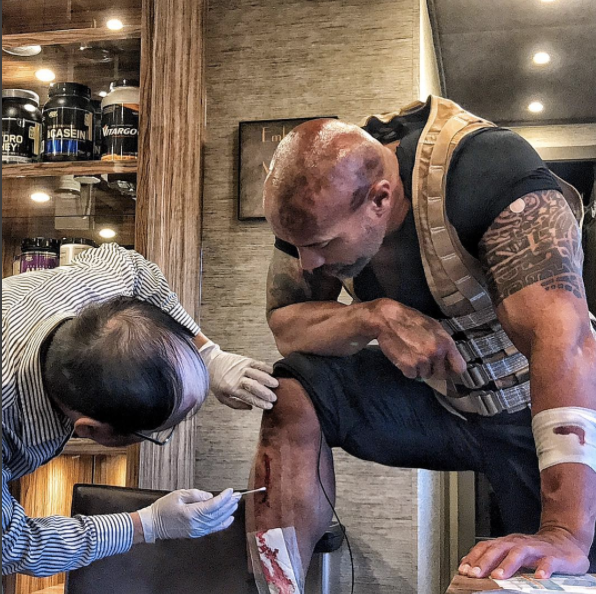
It’s as clear cut as this: Treat all women like you would treat Dwayne “The Rock” Johnson.

I know, this sounds weird, but trust me, this is a visualization exercise that will work wonders in your dealings with the women in your workplace. When a woman approaches you, just replace her in your mind with The Rock. Then, behave accordingly.

Still confused? Let’s try some dry runs.

Situation 1: Getting Coffee

Karen is a friend of a friend who recently moved to your city and wants to network in her chosen field, one in which you also work. She’s asked you if you’d be willing to get coffee with her, so she can “pick your brain.” There’s just one problem, Karen looks like this:

Oh shoot! She’s pretty! In the face, even. What to do?? I mean, you know it’d be inappropriate to treat the coffee meeting as a date, since her clearly stated intentions were professional. But on the other hand, she’s blonde, and so was your last girlfriend! This is so confusing! What a minefield you are in.

But navigating this sticky situation can be made easy by employing The Rock Test. Close your eyes, take a deep breath, and when you open them, pretend Karen looks like this:

Wow! Karen looks pretty tough and strong and sweaty! She looks like a person who is working very hard to achieve her goals, having left behind a situation that clearly wasn’t working, headed for bigger and better things. Maybe ask her about that? But definitely don’t hit on her. It looks like she could kill you with the chair you’re sitting on.

Situation 2: The Meeting

Amanda is your business colleague who has a few questions about the big project your department just took on. She’s asked you for a one on one meeting to go over some specifics. There’s just one problem:

Oh geez, Amanda looks not only fit and attractive and young, but also like she isn’t wearing a wedding ring. What if she’s open to talking about her (presumably) adventurous sex life, and yours?! Finally, someone to share your secret latex fetish with! How on Earth can you hope to keep this meeting, that has nothing at all to do with any of that, focused for a whole 45 minutes?

Again, close your eyes, clear your mind, and think of Amanda like this:

Wow! It looks like Amanda has been working really hard, but just needs some help with a small snag she’s hit. Luckily she knows enough to ask for assistance when she needs it, what a professional! You’re lucky to have Amanda in your corner. Unfortunately, it definitely looks like she has no time at all to hear about your latex thing, no matter how much those gloves turn you on.

Situation 3: The Outing

Your co-worker Jennifer and her team just launched a successful new project, and they’ve all invited you out for some drinks after work to celebrate. There’s just one problem. Yep, you guessed it:

Jennifer and her team are all card carrying Sephora shoppers. One of them is even wearing a skirt. ME-OW, right? How can you be expected to keep your hands to yourself when there are just so many young women smiling at you? Everyone knows when a woman smiles at you it means she likes you like that. At least that’s how all the movies you’ve seen and strip clubs you’ve been to have worked. How can you know if this is just drinks with co-workers or an opportunity to masturbate in front of a group like you’ve always dreamed?

Quickly replace this image in your mind with this:

Wow! Jennifer and her team look really professional and ready to take on anything! It’s no wonder their project succeeded and they’re looking to celebrate. Maybe you could trade war stories with them about projects past, or hear some of their stories about what it took to make it this far. One thing’s for sure though, no matter how drunk you get: do not masturbate in front of them. Seriously, the last kid I know who touched a cop unexpectedly ended up with his face in the cement. It was a bad night!

So there you go! You’ve learned the quick and easy way to interact with women without behaving inappropriately. Simply offer them the same respect, admiration, and healthy dose of fear you’d offer anyone who could completely destroy you should you deserve it.

11 Oct 18:18

Ofo launches in US capital, hopes to conquer US market within a year

by Timmy Shen

Ofo, China’s leading bike rental company, announced October 10 its launch in Washington, D.C., following Seattle and Massachusetts.

The fast-expanding firm will deploy 400 of its yellow bikes over the course of its first week, as the local government only allows 400 bikes on the streets during the “demonstration stage.” The local regulator appears to be extra cautious with the bike number, especially when ofo’s rival Mobike also launched in the same city last month.

“The US government is taking a more careful approach,” Grace Lin, Vice President of ofo US, told TechNode during a phone interview. “[The local government] want to make sure the dock-less operators can be a major part of the city instead of bringing in something they can’t control,” she said.

ofo launches in Washington, D.C., after its operation in Seattle and Massachusetts. (Image credit: ofo)

Ofo launches in Washington, D.C., follwing Seattle and Massachusetts. (Image credit: ofo)

Users in the US capital can now download the ofo app to locate nearby bikes, scan the QR code to unlock, and will be charged $1 for each one-hour ride.

“I believe we’re changing their way of transportation here,” said Lin, adding that the company’s operation in Seattle starting about two months ago has seen some positive feedback and has deployed about 2,000 bikes in the city. “We’ve seen so many adoptions. It’s very encouraging for us.”

“We anticipate that in all major cities and some smaller cities, dockless bike share will be one of their [the locals] major transportation methods,” said Lin. “I believe it’ll happen just in a year. We will try to make it happen.”

While ofo’s operation in China has been widely criticized for its vandalism issues and the uncontrollable amount of broken bikes, it may be a different story for the company’s US expansion.

“I don’t believe anything like this [vandalism] will happen in the United States,” said Lin. “For the US market, we will not start with a lot of bicycles, although each city will end up with a reasonable amount of bicycles to make the service convenient enough for users,” she said.

“The US is not a market where quantity is the most important thing,” said Lin.

Founded in 2014, ofo now operates in over 180 cities across 15 countries and generates more than 25 million daily transactions. Washington, D.C. marks the startup’s fourth official city in North America, in addition to Seattle, Washington; Worcester, Massachusetts; and Revere, Massachusetts. The company plans to expand to Aurora, Colorado and some more cities in Massachusetts within the month.

11 Oct 18:06

How Your Words Mask or Reveal Power and Compliance

mkalus shared this story .

In her book, English: Meaning and Culture (2006), linguist Anna Wierzbicka (link is external) zooms in on the many causative constructions in the English language that allow speakers to vary the extent of focus they place on how much a person tried to cause another person to do something. In other words, these causal constructions can mask or reveal how much someone imposed upon someone’s else’s autonomy. 

For example, she provides these 11 interpersonal causative construction types that use the keywords make, have, and let (Wierzbicka, 2006, page 172):

  1. X made Y do something intentionally (e.g., X made Y wash the dishes)
  2. X made Y do something unintentionally (e.g., X made Y cry)
  3. X made Y adjective (e.g., X made Y furious)
  4. X had Y do something (e.g., X had Y wash the dishes)
  5. X had something done to X’s Z (e.g., X had her boots mended)
  6. X had Y doing something (e.g., X had Y staying with her)
  7. X got Y to do something (e.g., X got Y to wash the dishes)
  8. X got Y adjective (e.g., X got Y furious)
  9. X got herself participle (e.g., X got herself kicked out)
  10. X verb-ed Y into doing Z (e.g., X talked/tricked Y into resigning)
  11. X verb-ed Y doing something (e.g., X kept Y waiting)

Wierzbicka suggests that these constructions convey key information about the causer (X) and the causee (Y), including their relative social positions, and Y's apparent compliance.

For example, both the make and have constructions imply that X outranked Y. Yet they differ in terms of Y’s apparent compliance.

Compare: “Mark made Allen close the deal,” and “Mark had Allen close the deal". The have-construction implies the causee Allen “cooperatively perform[ed] the causer’s will” (2006, p. 176). By contrast, the make-construction clearly implies that the causee Allen did not want to close that deal (2006). 

The encoded differences in compliance by the causee, or object (Y) have morally-relevant repercussions for the usage of the make and ­have constructions. 

article continues after advertisement

Whenever one uses the make construction, this suggests that X imposed upon Y’s personal autonomy in a forceful manner (because of the implied lack of compliance by Y). This will have the effect implicating X as blameworthy, and also potentially preserving Y’s dignity by removing Y from responsibility for whatever occurred.

But notice that "X had Y do something" does not suggest that X imposed upon Y’s personal autonomy with force. As such, this construction is not useful for blaming X or conveying that boundaries were forcefully overstepped but is handy for preserving an impression of peaceful hierarchical relations. Moreover, Y is still seemingly at least partly responsible for whatever X had him/her do.

What might other causative constructions mask and reveal? Number nine is a striking example of a disappeared agent. When one hears “Jack got himself evicted,” one might wish to consider (at least) another way of understanding such an event. Why has the agent of the eviction been disappeared from this sentence? What might be the speaker’s motivation in having me believe Jack and not the agent of the eviction caused the eviction? 

Wierzbicka argues that the abundance of causative constructions in modern English is linked to the development of democracy. She hypothesizes that a shift to democratic social functioning required ways for people to communicate in which many people could be managed, but not through orders. Instead, she speculates, there needed to be ways to convey that a person wanted something done that allowed for the person being asked to maintain their sense of personal autonomy (2006).

article continues after advertisement

The resulting multitude of ways that we can convey causation in English is both a blessing and a curse. It allows one to maintain a sense of self as a free agent. It also allows for tremendous wiggle room in meaning, such that it is can become troublingly unclear as to who made things happen, who was/is responsible, and who is at fault or to blame. Wierzbicka offers some linguistic guidance with her deep and fascinating social-cognitive, culture-specific account. 

File title: "Typifying American democracy at work."

Source: By Ann Rosener - This image is available from the United States Library of Congress's Prints and Photographs division under the digital ID fsa.8e11119. 

11 Oct 18:06

Pixelmator for iOS 2.4 Cobalt adds support for iOS 11

by admin

The Pixelmator Team today released a major update to its full-featured, powerful, and fast image editor for iPad and iPhone. Pixelmator for iOS 2.4, codenamed Cobalt, brings full support for iOS 11, adds support for Drag and Drop so you can move images and graphics between Pixelmator for iPad and other apps more easily than ever, includes support for importing HEIF images, and more. Pixelmator for iOS 2.4 Cobalt is available today as a free update from the App Store.

“The powerful new multitasking features in iOS 11 go great with Pixelmator for iPad,” said Saulius Dailide, one of the founders of the Pixelmator Team. “Pixelmator for iPad already includes support for Slide Over and Split View and now, with the addition of Drag and Drop, creating, enhancing, and sharing your images on the go becomes easier and more intuitive than ever.”

Pixelmator for iOS 2.4 Cobalt adds full support for iOS 11 and takes advantage of its powerful new multitasking features. With support for Drag and Drop, you can now move images and graphics between Pixelmator for iPad and other apps more easily than ever. You can use Multi-Touch to quickly add multiple images to your composition at once. And you can even move your entire composition into apps like Mail, Messages, and Keynote by simply touching and holding outside the image canvas, then dropping your image into the other app.

With support for HEIF images, Pixelmator for iOS users can now import images shot on the latest iPhone models, including iPhone X. HEIF, the High Efficiency Image File Format, is a new, much more efficient format that reduces file sizes without sacrificing quality and is used as the default on all the latest iPhone models, starting with iPhone 7 and iPhone 7 Plus.

Download Now

11 Oct 18:06

Pixelmator for iOS gets featured as the App of the Day

by admin

The new App Store on iOS 11 is really fun. Apps of the day, tips and tricks, and interesting posts make the whole experience of discovering apps much more enjoyable. So we were beyond thrilled to see that Pixelmator for iOS was featured as the App of the Day. And the accompanying text is just way too good to not repost (in full) here on our blog. Check it out:

You just had an amazing Saturday night. It was lit, it was hype, it was dope. But because so much happened, the memories are hazy. Thankfully, you managed to take a picture that captures the entire night.

The elephant in that kebab place is perfectly framed. (How did it even get in there?) And you even got the sword swallower doing his thing with the kebab skewer. Epic!

Shame that bummed out clown in the background is killing the vibe of the whole photo. Wait a minute… There must’ve been a circus in town, right?

Anyway, don’t worry! Just download Pixelmator. This powerful image editing app has a whole host of amazing features, but one stands out in particular: Repair. With this, you can remove nearly any element you don’t like in your picture.

That sad clown, for example. Just rub your finger over him and: Poof! He’s gone. The app intelligently fills in the gap so that it looks like he was never there to begin with. There’s a certain irony in cheering a picture up by erasing a clown, isn’t there?

Aside from that killer feature, Pixelmator contains everything you need to bring out the best in your pictures. Of course, there are the usual filters and endless possibilities to adjust the lighting, but with a multitude of retouching options you can also make changes to small areas of your photos — completely removing colour from objects using Desaturate or softening and sharpening sections of the image. You’ll look your best, even in the middle of the most epic night out ever.

And, in the event that your next night out isn’t so exciting, test out some of the features under the Distort tab and you’ll be able to warp, pinch and twist your pictures until they look just as bizarre as an elephant in a kebab shop.

View in App Store

11 Oct 17:45

Anderson Cooper | Shake Shack founder on changing the way restaurants do business

Anderson Cooper | Shake Shack founder on changing the way restaurants do business:

Is Danny Meyer a bellwether of where retail food is going?

Meyer’s most controversial innovation is also his riskiest. He is trying to eliminate tipping to combat pay inequities between servers – whose tips have gone up as menu prices have increased – and those who work in the kitchen, who under most state laws can’t share in gratuities.

ANDERSON COOPER: So the cooks, dishwashers, they don’t get any part of the tip?

DANNY MEYER: They don’t get any of it. And what I noticed after being a restaurateur for 30 years is that the growing disparity between what you can make in the dining room where tipping exists, and what you can make in the kitchen had the disparity had grown by 300 percent.

Meyer has so far eliminated tipping in nine of his restaurants. He’s increased the base pay of both servers and kitchen staff and in some restaurants gives waiters a share of the weekly revenue. He has raised menu prices significantly, on average, nearly 25 percent. But when the bill comes, there’s no line for leaving a tip.

ANDERSON COOPER: You call it “Hospitality included.” Wha– why? You don’t– you don’t say, “No tipping.”

DANNY MEYER: So by saying, “Hospitality included,” it’s basically saying, “You see that price that it costs to get the chicken? That includes everything. That includes not only the guy that bought the chicken and the guy that cooked the chicken, but it also includes the person who served it to you and how they made you feel.”  

ANDERSON COOPER: So for the customer, in the end, is the bill the same?

DANNY MEYER: The bill, by the time you get your bill, whatever shock you did or didn’t feel when you saw the menu prices should completely dissipate, because you should say, “That’s exactly what it would have been if they hadn’t had this new system"—

ANDERSON COOPER: Plus at the end of the meal, you don’t have to deal with the hassle of figuring out what to tip.

DANNY MEYER: That’s absolutely true and let’s face it, the end of the meal tends to be when people have had more wine than the beginning of the meal, and sometimes people make honest mistakes.

Sounds egalitarian, right? But his newest concept? Kiosks for ordering:

Last week, Shake Shack announced that it will test a new concept with its latest restaurant: opening in New York City this month.  There will be nobody taking orders or cash.  Instead, customers will order and pay at touch-screen kiosks or from the Shake Shack mobile app.

Automating the dining experience. 

What I expect is an automated bar, where if you get drunk you have to throw yourself out.

11 Oct 17:43

Future Apple smartwatches could support an adjustable band

by Dean Daley
Apple Watch Series 3

Apple could be working on an Apple Watch band that automatically adjusts to the wear’s wrist.

Apple has been granted a patent by the U.S. Patent and Trademark Office (Patent No. 9,781,984) for “Dynamic fit adjustment for wearable electronic devices.” The patent showcases a method which allows the Apple Series Watch to tighten or loosen with the help of an on-board tensioner.

The patent discusses how the Apple smartwatch bands would be more advanced than rubber or leather material, and would allow users to electronically adjust the bands’ tightness. Further, it discuss whether the user would be able to do this manually or automatically responding to biometric data from the smartwatch.

Within the patent, it explains that the band could be made from shape memory wiring like Nitinol, which would allow it to tighten or loosen through electrical current. Additionally, the patent reads that it might be possible to use gas or fluid-filled bladder component which would retract into the body of the Watch. Alternatively, it may have its band extend out toward the user’s skin, which will make the fit even tighter.

This is just a patent, however, and there is a chance that it will never actually be made or released to the public. That said, Apple has been looking into ways to make smartwatches more comfortable for fitness use and better heart rate tracking.

Source: Apple Insider

The post Future Apple smartwatches could support an adjustable band appeared first on MobileSyrup.

11 Oct 17:43

Snapchat is bringing contextual information to every Snap

by Sameer Chhabra
Snapchat

Snapchat users can now swipe up for more information about things in a Snap.

According to an October 10th, 2017 media release, users will be able to swipe up on any Snap that says ‘More’ to display what the company calls ‘Context Cards.’

Context Cards contain reviews, maps, tips and “more information about whatever you’re watching,” according to the release.

An image showing the Context Cards feature in use.

Snap Inc. — the company behind Snapchat — has partnered with companies like Tripadvisor, Foursquare, Michelin and goop, as well as Uber and OpenTable.

“The first Context Card that appears will contain basic information like the name of the place, category of venue (i.e. department store or restaurant), and partner’s rating, for example,” reads an excerpt from the media release.

Depending on the “type of venue and the information available at each location” users will be able to view additional cards that highlight reviews, hours of operation, reservations and phone numbers.

Context Cards will be available to Snapchat users on both Android and iOS.

The post Snapchat is bringing contextual information to every Snap appeared first on MobileSyrup.

11 Oct 17:43

Essential Phone Android Oreo public beta is coming soon, according to Reddit AMA

by Dean Daley
Essential Phone

A Reddit Ask Me Anything (AMA) with the Essential team revealed more information about upcoming software updates set to come to Andy Rubin’s Essential Phone.

First off, regarding the issue with the Essential’s laggy touch issues and “display touch scrolling jitteriness,” according to the team, there is already a fix that’s set to be available over-the-air (OTA) in a few weeks.

During the AMA the team revealed that the Essential Phone will receive Android Oreo, though there isn’t a release date yet for the update. However, the team is working on making a public beta of Oreo available at some point in the coming weeks.

The Essential team is also working on fingerprint reader gestures, which they expect will make it into the upcoming OTA update. Similarly, within the same AMA question, Essential revealed that it’s not working on double tap to wake functionality or LED notifications — though Essential suggests downloading an app on the Play Store with this feature. The company noted it’s also not yet working on adjusting the vibration intensity.

Essential discussed colour options for its device, as well. Those who have already reserved the white model should be getting it within the week. The team, however, is still working on the ‘Ocean Depths’ and ‘Stellar Grey’ variants, with no answer on an actual release date yet.

The AMA also briefly touched on the Essential Home — the company’s speaker product that is to challenge Google Home and the Amazon Echo products — which is still in development. Essential says it will have “something to show soon” regarding the Essential Home.

The team at Essential is also working on Live streaming with Facebook and Periscope, which is planned to arrive during the fall OTA for the Essential 360 camera.

The Essential team will be doing bi-weekly AMAs on Reddit with the next one being on October 18th. To check out the full AMA click here.

The post Essential Phone Android Oreo public beta is coming soon, according to Reddit AMA appeared first on MobileSyrup.

10 Oct 21:49

The Guard

by rands

The Old Guard is a set of humans who inhabit the early days of a start-up. As I’ve written about before, they define the culture in both obvious and non-obvious ways. Simply: the way they act and how they treat each other disproportionately affects the values of the company.

The Old Guard gets to be the Old Guard because they are successful and the team grows large enough to allow for the existence of the New Guard. The New Guard is not initially defined by their ability, age, or experience; they are defined by when they are hired. They are a population who was not there in the formative early days of the company, and they start their jobs at a distinct cultural disadvantage.

I’ve arrived at my last three jobs at roughly the same growth inflection point: the arrival, education, and integration of the New Guard. My job places me directly and strategically between these two populations and is the reason that much of my writing for the past decade debugs and documents how each group works, what they value, and how they interact (or fail to).

And in each company, the following seminal meeting has occurred…

The Disaster Meeting

A disaster has occurred. The specifics aren’t important. What is important is that neither the Old Guard nor the New Guard predicted the disaster, everyone was surprised, so someone called a meeting. I can tell the magnitude of the disaster because everyone is invited: Old Guard and New.

The meeting begins. The Old Guard as they always do starts talking confidently about disaster remediation steps. Other Old Guard chime in with helpful suggestions, someone steps up to be White Board Operator. We are getting shit done people.

After 10 minutes, a New Guard engineer, Jordan raises her hand and asks, “Can we go around the table and introduce ourselves?” It is this moment that makes this meeting memorable.

The silence is deafening. It’s the Old Guard realizing there are strangers in the room. That’s never happened before. It’s the New Guard breathing a mental sigh of relief, “Finally, I am going to figure out who these people are and what they do.”

And, finally, it’s me realizing, “Oh, these people don’t know each other. They’re not a team, yet.”

The Productive Team Rules

The core attributes of a productive team are so simple and obvious that we forget them. It’s like breathing, an act so essential that we forget we do it, but it remains essential to our existence.

A productive team knows itself. They know each other’s names, and they understand and appreciate each other’s respective strengths, weaknesses, and motivations.

With this essential understanding in place and with practice, a healthy team effortlessly and without ego call on each other when they need help. Then they do not care who gets the credit for the work they want to get the work done well by the most qualified humans with the best judgment.

This is a team that trusts itself and it is likely that you’ve spent most of your career not on this type of team. I’m sorry. Let’s talk about some of the reasons this hasn’t happened, yet.

Learned Helplessness

The acquired mindset of the New Guard is one of disappointment. They wouldn’t be here if they didn’t believe in the dream that was built by the Old Guard. Now that they’ve been here a bit, they don’t feel a part of the solution. They are distant observers. They watch the Old Guard’s borderline magical ability get things done (There is no magic). Each time they attempt to bring a new thing to the table, the Old Guard quickly points out “We already solved for that three months ago” (They haven’t. They solved for one case… not all cases.) The New Guard do know people’s name, but they don’t know who they are.

When you combine the New Guard’s basic lack of familiarity with the people and the product along with the Old Guard’s incessant repetition of some version of the mantra “Sink or Swim!”, the entire team enters a phase of learned helplessness where their respective rallying cries are:

• The Old Guard: “I feel empowered to fix everything.”
• The New Guard: “I don’t know how to fix anything.”

And things need fixing. Things are breaking in increasingly unfamiliar ways… faster. The Old Guard’s facade of calmly informed control weakens as they realize their ability to fix the things is limited by their number and they don’t ask for help from the New Guard because, as the New Guard, they don’t know who these people are.

The myriad ways a group of well-intentioned humans prevents themselves from trusting each other is just… mind-boggling.

Trust Falls for Everyone!

You know what the most ridiculed idea is for an offsite? Trust falls. The idea is that the team pairs up and each group performs an exercise where one person faces away from the other person, they fold their arms, and they fall back, where, hopefully, the other person catches them.

Trust falls are the rallying cry for the awkward offsite, but what makes them awkward? Why are they ridiculed? What is it about this exercise that makes them funny? Trust? What’s funny about that? Nothing. We giggle about trust falls because we don’t really know the complex mechanics of building trust in a work setting.

The Old Guard trust each other because through a combination of luck, smarts, blood, sweat, and tears they managed to bring a new thing into the world. Most teams fail at this effort, but this team did not. They think and talk fondly of those years now. The tales they tell of those formative times are becoming the myth. We were drunk at a bar, and Samuel threw out this throwaway feature idea. That is where this multi-billion dollar business came from… Sam’s drunk thought.

The Old Guard does not tell the story of when no one talked to each other for a week because of a disagreement over architecture. They don’t talk about those long 72 hours where if funding didn’t show up, they were done. They don’t tell these stories because they hurt to tell, they are shitty awful stories, but they are as important as the myths because they resulted in the construction of trust within the team. If we can get through that; we can get through anything.

Our fundamental discomfort with relying on another human being – NO QUESTIONS ASKED – is one reason the Old Guard and the New Guard exist. These two populations exist because they have not yet gone through the critical and often painful process of building trust.

But then Jordan raised her hand…

Never Waste a Disaster

“Can we go around the table and introduce ourselves?”

I jump in quickly because I’ve been in this meeting before and added, “Thanks, Jordan. Can we get your name, what you do here, and why you’re in this meeting?”

The disaster that forced this meeting is the beginning of a story about trust. The reasons this disaster occurred and the work we’ll do preventing future disasters from occurring is less important than the fact that we are doing the work together.

There is no Old Guard or New Guard. There is just The Guard. What are we guarding? Why are we here? We’re building approachable tools for humans to ask hard questions of their data. We’re building an infinite catalog of beautiful ideas. We’re building a new way of working together as a team. Yeah, we’re guarding those dreams, but we’re also going to learn about guarding and protecting each other because that is what teams do when they trust each other.

10 Oct 21:49

Re-Zoning: A Hot Button’s Heat Source

by Ken Ohrn

Within the by-election’s campaign yak-o-sphere, large-scale re-zoning gets a lot of air time.  Here are two thoughts on the expected push-back.  Both point to a powerful hot button, and make me wonder what the candidates are up to. Perhaps re-zoning at large scale platform planks are simply trial balloons, leading to poll-by-poll analysis of the by-election vote to see where and how party support has changed.  And whether anyone will make the big plunge in 2018.

First is UBC Prof. Thomas Davidoff in a letter to City Council about the upcoming small Ryerson development proposal and the ensuing big debate. Hinthe’s in favour.  Along the way, he tackles the big political boogeyman — local residents fearful of reduced property values. As we all know, it is a long-standing tradition for neighbourhoods to be fearful of any change. It might chop potential capital gains.

DavidoffCertain groups protest that property values will be destroyed by the new development. I have seen no evidence in support of that claim. The new community centre and open space will be a positive amenity that will enhance property values. . . .

. . . The neighbors of Ryerson are in an extraordinarily good position to absorb any damage that hypothetically might be done to property values, as each of the single family neighbors is sitting on millions of dollars of housing wealth. (That housing wealth would be greatly enhanced if the entire neighbourhood were brought up to an urban density, rather than the antiquated suburban density that prevails in the neighbourhood due to current zoning.)

[Ed:  hopefully PT’s readers can see the full text of the letter.  It’s published on the GooglePlex of products, in Google Docs, and seems to be somewhat in the clear.]

Here’s another look at this issue, from none other than PT’s founder, Gordon Price, in November 2014.  The focus may have changed somewhat, from heritage home policies to large-scale high-density re-zoning. But the big question to aspiring public servants and their political parties remains the same:

It’s basically the same question with respect to affordability:

Are you willing to bring in any policy that would, by design or result, negatively affect existing property values?

Because if you’re not, how can you address affordability generally – that is, beyond targeted non-market projects or special programs for rental housing?  If existing values don’t fall, won’t all new housing be just as expensive as determined by the market if not by the higher costs of new development?

Since it comes down to voters, not abstract questions, will you tell the couple above that their loss of half a million justifies your interventions for the greater long-term good?  That they should be happy with the incredible increase they’ve seen on their house, not the relatively minor loss.

And if you can’t, why should the rest of us believe that you intend to do anything that would bring down values enough to make this city ‘affordable’?


10 Oct 21:49

mapsontheweb:The new Authagraph map uses triangles to create a...


mapsontheweb:

The new Authagraph map uses triangles to create a more accurate rendition of the world.

10 Oct 21:48

"Suppose you had the revolution you are talking and dreaming about. Suppose your side had won, and..."

“Suppose you had the revolution you are talking and dreaming about. Suppose your side had won, and you had the kind of society you wanted. How would you live, you personally, in that society? Start living that way now!”

- | Paul Goodman
10 Oct 21:48

Pixelmator for iOS Adds Drag and Drop Support and HEIF Compatibility

by Ryan Christoffel

Following just a few days behind Pixelmator for Mac, which recently received support for HEIF and editing files stored in Apple Photos, Pixelmator for iOS was updated today with the aforementioned HEIF support – Apple’s new file format for images in iOS 11 – as well as drag and drop support on iPad.

Drag and drop enables, as you might expect, moving images and graphics out of or into Pixelmator. Dropping images into a work in progress will import them all as new layers. Depending on the size and number of images you’re dropping, there may be a brief delay before they appear in your working document, but overall this action works well. When it comes to dragging content out of Pixelmator, you’ll need to do it with a single layer at a time – once you’ve lifted a layer, you can’t use drag and drop to pick up any additional layers. In a document containing many different layers, this can be fairly limiting, but there is a type of workaround: you can merge layers together in the sidebar to then drag the newly merged layer out of the app as a single image. Unfortunately, this only solves the problem if you want both layers permanently combined into one when dropping them elsewhere.

This layer merge technique is the only way I’ve discovered to drag a final image, containing multiple layers, out of Pixelmator and into another app – if you don’t want to first merge all layers together, you’ll have to use a more traditional data transfer technique like the share sheet. I would have liked to see drag and drop enabled within Pixelmator’s main image browser for moving a completed image out of the app, or for importing photos into the app to edit later. Currently, long-pressing an item from the image browser simply engages rearrange mode.

One nice side effect of drag and drop support is that when dealing with layers that don’t fit inside your canvas – such as an image you’ve dragged in that’s larger than the canvas itself – previously it was difficult to easily determine how large the full layer was. But now, grabbing the layer and watching it lift from the screen will provide a view of the full image, regardless of canvas size. Once you start dragging the layer away, it will shrink into a smaller drag preview, but until that move is engaged, the lifted image will be shown in full.

Despite its limitations, drag and drop support in Pixelmator is definitely great to have; before today I have tried several times to drag images into the app only to remember I couldn’t do that yet. Perhaps when the upcoming Pixelmator Pro arrives on the iPad, it will include a richer implementation of drag and drop. Until then, I’m grateful to have one less app limiting my iPad drag and drop experience.


Support MacStories Directly

Club MacStories offers exclusive access to extra MacStories content, delivered every week; it's also a way to support us directly.

Club MacStories will help you discover the best apps for your devices and get the most out of your iPhone, iPad, and Mac. Plus, it's made in Italy.

Join Now
10 Oct 21:48

OpenEd MOOC Archive

files/images/open_road_318x210.1.jpg

Matt Crosslin, LINK Lab, Oct 13, 2017


Icon

Georghe Siemens and David Wiley are offering an open online course on open education. This page is a compendium of all the resources in the course - the videos from the course authors, guest contributions (including my own), and additional content and articles. It's all freely accessible - you don't need to log in to anything or pay a fee. The videos have transcriptions (yay!) . There's also a separate page with learner activity, linking to participant blog posts. And of course the Twitter discussion is ongoing. There are also email updates. This is what open education looks like. 

[Link] [Comment]
10 Oct 21:48

Your Apple Watch Band May Someday Adjust Itself

by Mary Beth Quirk
mkalus shared this story from Consumerist.

We truly are approaching a Jetsons-like future where the most quotidian tasks are fully automated, and where elderly Millennials will harrumph to their cloned grandchildren about the good old days when their watches — “we called ’em ‘smartwatches’ back then!” — came with bands that had to be adjusted by our own non-cyborg hands.

Apple has been granted a patent for a “Dynamic fit adjustment for wearable electronic devices,” also known as a watch band that adjusts itself.

A tensioner in the Watch or electronic device would tighten or loosen the band, without the wearer having to do anything.

Apple notes in the patent that watch bands often have limitations when it comes to adjusting, and not everyone may find the perfect fit as a result.

“Despite the prevalence of issues associated with improperly fit bands, adjusting the size or fit of conventional watch bands often requires multiple steps, specialized tools, and/or technical expertise,” Apple writes in its patent. “For example, a metal link band may require specialized tools to remove one or more links of the band to resize the band. In other cases, a leather band with a deployment clasp may need to be physically cut to size in order to resize the band.”

To address all of these things, Apple’s system would be capable of adjusting upon request, via an onscreen option, or doing it automatically depending on biometric sensor readings.

Of course, this is just a patent — it’s unclear if Apple will ever make self-adjusting bands a reality. However, it does makes sense for the company, which has been pushing its Watch’s fitness tracking capabilities.

If the Watch doesn’t fit so well, that could impact sensor readings, especially when you’re doing things like working out or otherwise being active. It’s likely that you may want your watch to fit one way when you’re jumping around in a workout class and another when you’re just sitting on the couch.

[h/t Apple Insider]


10 Oct 21:48

Twitterrific Is Back

Twitterrific for the Mac is back. It started out as a Kickstarter project, and the Iconfactory delivered on the goods. Good job.

It's nice to see another Twitter client on the Mac. And after you download it, make sure to click around in that About box too.

10 Oct 21:48

Twitter Favorites: [mrf] Remember when we had a president we were sure would do the right thing when faced with a morally unambiguous situation?

Mark Ferree @mrf
Remember when we had a president we were sure would do the right thing when faced with a morally unambiguous situation?
10 Oct 21:48

Vancouver, usually at forefront of hipster trends, finally catches up with outdoor ping-pong

by Frances Bula

A friend who visited Montreal recently commented on the number of outdoor ping-pong tables there when he came back. Out of idle curiosity, I asked on Twitter if there were any in the Lower Mainland.

The answers I got made me realize that, yes, there were some scattered around but, more fun, there seemed to be a lot more on the way.

Researching this (which included driving around to various new parks and tables) made me realize how much parks are changing — not just big empty fields with a tennis court on one side and a slide on the other. The Slidey-Slide Park next to the roller coaster is filled with different kinds of activities. (Also made me realize a lot of other cities hopped on the outdoor ping-pong thing quite a while ago.)

In the meantime, here’s the story I wrote for the Globe on this little urban trend.

10 Oct 21:48

Failing to distinguish between a tractor trailer and the bright white sky

by James Bridle

The title of this essay was the title of an exhibition of my work at Nome, Berlin, in April – July 2017. This is an edited version of a lecture given under the same title.

New York City, 1925. An empty touring car stands against the curb on Broadway. A man steps onto the running board and raises a hand. Without further intervention, the car starts its engine, shifts into gear, and lurches away from the sidewalk into thick traffic. It heads down Broadway, followed by police motorcycles, meandering uncertainly from side to side, narrowly missing a milk wagon, and then a fire engine.

Somewhere on Fifth Avenue, the car makes a wild swing, and the man on the running board lunges for the steering wheel. He’s too late, and they plough into another car. This one is full of photographers and movie men desperately trying to capture an image of the driverless vehicle. “The invention of the ship,” as Paul Virilio wrote, “was also the invention of the shipwreck”.

The car was called the American Wonder, and it was the invention of the man on the running board: an ex-Army engineer called Francis P. Houdina. The appearance of autonomy was produced by radio waves, broadcast from a car behind. In July of the same year, the illusionist Harry Houdini broke into the offices of Houdina Radio Control and smashed the furniture, accusing the company of using his name unlawfully and stealing his mail.

Francis Houdina protested in turn that use of the magician’s name would imply that his invention was a trick, rather than a genuine, working machine, but the network of associations is present from the very beginning: the car, the illusion, the image, and the crash.

This timeline of the self-driving car begins and ends – for now – with a crash. The second, unlike the first, is fatal. In May of 2016, a man called Joshua Brown was driving – or rather, being driven – along a highway in Florida when his Tesla Model S crashed into the side of a large truck.

The Model S was the first production car to offer something like full automation. It has a feature called Autopilot which offers limited autonomy. Using a combination of radar, sonar, video cameras, and machine intelligence, the car can drive itself for hours at a time under many different conditions. Drivers are required to keep their hands on the wheel at all times, and receive audio and visual warnings if they do not.

Joshua Brown was using Autopilot at the time of the crash. In a blog post a few days after his death, Tesla stated that a truck had turned to cross the highway in front of Mr Brown’s car, and the car’s sensors had failed to register it. “Neither Autopilot nor the driver”, they wrote, “noticed the white side of the tractor trailer against a brightly lit sky, so the brake was not applied.”

Mr Brown was a huge Tesla fan, and had posted a number of videos on YouTube showing off the features of his car. He posted his last video in April of last year, one month before his death, showing his car, under autopilot control, swerving to avoid a tow truck which drifted into his lane. It is called “Autopilot Saves Model S”, and you can still watch it online, and hear the Malcolm Gladwell audiobook Brown is listening to, and his exclamation of “Holy Shit!” as the car suddenly jerks to one side. Elon Musk retweeted the video, and Brown told a neighbour that ‘For something to catch Elon Musk’s eye, I can die and go to heaven now.’

Before the crash, investigators revealed, Brown had been driving for thirty-six minutes without his hands on the wheel, and had ignored seven separate warnings. While the truck should have been visible to the driver for a full seven seconds leading up to the crash, a portable DVD player was found in the wreckage, and the truck driver testified that Brown had been watching a Harry Potter movie when his car went under the truck. It was still playing in the wreckage.

In 1971, in an essay for the Automobile Associations’ magazine Drive, JG Ballard wrote: “If I were asked to condense the whole of the present century into one mental picture I would pick a familiar everyday sight: a man in a motor car, driving along a concrete highway to some unknown destination. […] I think that the 20th century reaches almost its purest expression on the highway. Here we see, all too clearly, the speed and violence of our age, its strange love affair with the machine and, conceivably, with its own death and destruction.”

It’s important to note that the self-driving car is not, in itself, dangerous. As Tesla noted: there is on average one fatality for every 60 million miles driven worldwide. Mr Brown was the first known fatality in over 130 million miles where Autopilot was in charge. But then, the danger posed by the self-driving car is not merely one of road death. It is one of lack of understanding, and lack of control.

As Ballard wrote in his essay, the appeal of older cars is that they are comprehensible. They are “rooted in the 19th Century – a visible and easily grasped technology of pistons, flywheels and steaming valves – […] a far cry from the new technologies of the late 20th century – a silent and mysterious realm of invisible circuitry.” This tendency has only accelerated in our own time, from black box devices to remote and inscrutable cloud platforms.

You may have heard the recent story about John Deere owners in the United States paying Ukrainian hackers to fix their tractors, because the machines are now driven primarily by computers, and the manufacturers prevent their owners from mending them themselves.

This aesthetic and technological obscurity breeds political unease, and corporate contempt. In recent weeks, much has been made of the battle between Transport for London and Uber, the taxi company which has become a byword for corporate greed and social irresponsibility. Beyond their well-documented sexism and disregard for local laws on taxes, employment rights, and the reporting of sexual assaults, Uber wields technological ambiguity as a weapon.

This ambiguity starts in the user interface, where the system at times creates what are known as “ghost cars” – fake rides in the user’s vicinity, which are generated to convince the user that the service is more active than it really is. Rides are tracked, without the user’s knowledge, and this God’s Eye View is used to stalk high-profile clients. A programme called Greyball is used to deny rides to government employees investigating the company’s numerous transgressions.

But perhaps Uber’s greatest perceived sin – and the one that takes us back to the self-driving car – is the social atomisation it produces. Taxi drivers are no longer employees but precarious contractors. Riders are alienated individuals, contributing to the offshoring of tax revenues, the decline of public transport services, and the class divisions and congestion of city streets. The ultimate goal of Uber’s business, whether that’s driving cars or delivering takeaways, is to replace its human workers entirely with machines. It’s own self-driving car programme is well advanced, and its retention of human employees is ultimately a matter of cost.

Unruly humans, despite their lingering desire for the freedoms of city life, are, for the moment, marginally cheaper than pliable machines. But this situation will not last much longer, and the self-driving car is a herald of all kinds of automation, which will deprive millions of work in the coming decades.

All of this was forecast by Ballard in that 1971 essay. Nationwide traffic reports, satellite navigation, direct debit toll roads and the remote electronic control of the vehicle – all are predicted. “Sooner or later,” he wrote, “it will become illegal to drive a car with a steering wheel. The private car will remain, but one by one its brake pedal, accelerator and control systems, like the atrophying organs of our own bodies, will be removed.” With those control systems goes the freedom that the twentieth century idea of the automobile entailed. It is the death drive, virtualised.

While Ballard’s forecast was accurate, it didn’t and doesn’t have to be inevitable. The deployment of self-driving cars and full automation to engender loss of control, alienation, and immiseration is hardly surprising, but not inescapable. Just because a technology – whether it’s autonomous vehicles, satellite communications, or the internet – has been captured by capital and turned against the populace, doesn’t mean it does not retain a seed of utopian possibility.

The self-driving car is in fact a fantastic example of this tendency. It is, properly regarded, the opposite of autonomous. Whereas the twentieth century automobile, equipped with a paper map and a couple of jerry cans of fossil fuel, could light out for parts unknown under the sole control of the rugged individualist, the self-driving car is enmeshed in an infrastructure of renewable energy, electrical power, satellite signals, slippy maps, over-the-air updates and messy human desires. It must continually re-examine and revise its view of the world, adapting to and learning from its environment and the experiences of other vehicles. Its perceived intelligence is always and utterly a networked intelligence.

Far from being a vehicle for individualism and selfish freedoms, the self-driving car necessitates a return to the communal and the social. The moral and regulatory obstacles faced by today’s exploitative, extractive corporate technologies – from Facebook, to Uber, to Google – exist not because of some residual technophobia or conservatism, but because those technologies are against nature – a nature that encompasses our own desires and our own creations. The role of the artist and the activist in such a system is thus to explore other possibilities for these technologies: not against them, but by working with and subverting them.

To give an example of transforming such a system from my own work, at the beginning of this year I spent several weeks driving around the mountains of central Greece in a car I had fitted out with several cheap webcams, and a home-made accelerometer fixed to the steering wheel. As I drove, a laptop on the passenger seat recorded my location, speed, steering angle, and the view from the windshield.

This information was subsequently fed into an open-source machine learning system similar to those used by Google, Tesla, Uber and others to train their self-driving cars. By watching my driving, the software learned to drive itself – and not on the freeways of Southern California, or the test tracks of Bavaria, but among the towns and villages of Greece, a place with a very different material, economic, and mythological history and present.

In this development process, I also emphasised certain, different behaviours. My car is designed to get lost. Rather than entering a desired destination and sitting back, surrendering decisions over routing to the machine, in return for a guaranteed arrival, my self-driving car plots a random course, taking every available exit, off-ramp and side-road in order to prioritise the journey over the destination. The end of the journey cannot be predicted, nor can the sights encountered along the way. The cognitive effects of such a journey are produced in collaboration between human and machine imaginations.

While sympathetic to histories of the flâneur and the dérive, this strategy is ultimately derived from technological approaches to complex problems, and particularly the random walk; a stochastic, algorithmic exploration of the problem space, which acknowledges the possibilities of multiple, contested and potentially infinite answers to any particular problem.

On the other hand, resistance and refusal remains one of the possible responses to the technologically-augmented assault directed at individual autonomy today: the off switch must remain within reach. In my research into autonomous vehicles and machine vision I have tried to develop several strategies for human-scale opposition to exploitative automation, such as the Autonomous Trap. This trap is constructed by drawing a pair of nested circles – one solid, one dashed – on the roadway. From the outside, the pattern denotes a right of way, from the inside, it means no entry. Thus any car, programmed to obey the rules of the road, may enter, but cannot leave, like a demon trapped within a magic circle.

The trap, while an unquestionably aggressive action, has the potentially emancipatory benefit of being legible to both the human and the machine – and thus it opens up a shared space of mutual communication, not buried within obscure lines of code and proprietary softwares, but painted directly on the street, for all to see. It uses for its material both the physical stuff of the world, and the networked, noumenal, meta-stuff of digital video and signal processing.

The Autonomous Trap was inspired in part by my favourite story about networked automotive systems – and resistance. In October 1978, the Italian premier Andreotti was scheduled to visit Bologna to give a speech, and the city’s Autonomists were discussing how to protest. A comrade named Pino arrived at the assembly and silenced the other speakers with a shout. “We must use technology to defeat capitalism!” he cried, and opened his long coat to reveal it was hung with tools and keys. One of these keys was the key to the city’s traffic lights. It was copied and distributed, and on the day of Andreotti’s speech the Autonomists used the keys to turn every light red, causing instant gridlock. Andreotti never left the airport. Such is the effect of an embedded, networked, and technologically-literate resistance.*

It must be hoped, however, that our future admits for greater collaboration with our technologies, instead of obstruction. Such an approach will require a radical rethinking of our cities and communities which is more, not less, in the image of our technologies – if we can free those technologies from the grasp of large corporations and opaque politics. Just as the internet itself is an unconsciously generated product of our unconsciously networked desires, so the most quotidian technological products reveal aspects of other, loving futures. This possibility exists even within the steel, glass, and gas of the self-driving car.

If we choose not to imagine and engage with such possibilities, we too are in danger of failing to distinguish between the tractor trailer and the bright white sky. Trapped in the automobile, hands off the wheel, being taken, in the most comfortable and efficient manner, straight into the side of the truck.

* This story is partially recounted in Autonomia: Post-Political Politics (Semiotexte, 1980). Additional details from conversation with Bifo Berardi.

10 Oct 21:48

What about Self-Determination?

I was reading about the declaration from France that they would refuse to recognize an independent Catalonia. And of course, France doesn’t want to hear about an independent Basque region, either. Likewise Turkey, Iran, Iraq, and Syria are deeply opposed to an independent Kurdistan, since they all have large numbers of resident Kurds.

It’s helpful to remember that the Resolution 1514 of the UN Charter states 

All peoples have the right to self-determination; by virtue of that right they freely determine their political status and freely pursue their economic, social and cultural development.

However, the target of that resolution was to midwife new countries into being at the end of worldwide colonialism, which was collapsing in the ‘60s and ‘70s. 

The same resolution offers this clause, which seems to be counter to the one above:

Any attempt aimed at the partial or total disruption of the national unity and the territorial integrity of a country is incompatible with the purposes and principles of the Charter of the United Nations.

So, which is it? Are the Catalans a people, and therefore should be able to determine their own political status? Or are they just a bunch of Spanish rabble-rousers, trying to disrupt national unity?

My belief is that self-determination should trump national unity, as it did with Kosovo. This is grounded in the principle of subsidiarity: 

Subsidiarity is an organizing principle that matters ought to be handled by the smallest, lowest or least centralized competent authority. Political decisions should be taken at a local level if possible, rather than by a central authority.

(via wikipedia)

And in this case, that would mean a people in a subsidiary region of a larger country should have the right to self-determination. 

Therefore the UN should support the desires of these ‘peoples’ to self-determination, but the entrenched power of the enclosing countries (like Spain in the case of Catalonia) and their network of relations with other countries who may similarly want to restrict self-determination means that most efforts for self-determination are blocked, and often lead to rebellion or revolution.

For your reference, here is the UN Resolution 1514. Take a look, and tell me, do the Catalonians have the right to an independent country, or not?

United Nations General Assembly Resolution 1514

Declaration on the Granting of Independence to Colonial Countries and Peoples

Adopted by the UN General Assembly Resolution 1514 (XV), 14 December 1960

The General Assembly,

Mindful of the determination proclaimed by the peoples of the world in the Charter of the United Nations to reaffirm faith in fundamental human rights, in the dignity and worth of the human person, in the equal rights of men and women and of nations large and small and to promote social progress and better standards of life in larger freedom,

Conscious of the need for the creation of conditions of stability and well-being and peaceful and friendly relations based on respect for the principles of equal rights and self-determination of all peoples, and of universal respect for, and observance of, human rights and fundamental freedoms for all without distinction as to race, sex, language or religion,

Recognizing the passionate yearning for freedom in all dependent peoples and the decisive role of such peoples in the attainment of their independence.

Aware of the increasing conflicts resulting from the denial of or impediments in the way of the freedom of such peoples, which constitute a serious threat to world peace,

Considering the important role of the United Nations in assisting the movement for independence in Trust and Non-Self-Governing Territories,

Recognising that the peoples of the world ardently desire the end of colonialism in all its manifestations,

Convinced that the continued existence of colonialism prevents the development of international economic co-operation, impedes the social, cultural and economic development of dependent peoples and militates against the United Nations ideal of universal peace,

Affirming that peoples may, for their own ends, freely dispose of their natural wealth and resources without prejudice to any obligations arising out of international economic co-operation, based upon the principle of mutual benefit, and international law,

Believing that the process of liberation is irresistible and irreversible and that, in order to avoid serious crises, an end must be put to colonialism and all practices of Segregation and discrimination associated therewith,

Welcoming the emergence in recent years of a large number of dependent territories into freedom and independence, and recognizing the increasingly powerful trends towards freedom in such territories which have not yet attained independence,

Convinced that all peoples have an inalienable right to complete freedom, the exercise of their sovereignty and the integrity of their national territory,

Solemnly proclaims the necessity of bringing to a speedy and unconditional end colonialism in all its forms and manifestations;

And to this end Declares that:

1. The subjection of peoples to alien subjugation, domination and exploitation constitutes a denial of fundamental human rights, is contrary to the Charter of the United Nations and is an impediment to the promotion of world peace and co-operation.

2. All peoples have the right to self-determination; by virtue of that right they freely determine their political status and freely pursue their economic, social and cultural development.

3. Inadequacy of political, economic, social or educational preparedness should never serve as a pretext for delaying independence.

4. All armed action or repressive measures of all kinds directed against dependent peoples shall cease in order to enable them to exercise peacefully and freely their right to complete independence, and the integrity of their national territory shall be respected.

5. Immediate steps shall be taken, in Trust and Non-Self-Governing Territories or all other territories which have not yet attained independence, to transfer all powers to the peoples of those territories, without any conditions or reservations, in accordance with their freely expressed will and desire, without any distinction as to race, creed or colour, in order to enable them to enjoy complete independence and freedom.

6. Any attempt aimed at the partial or total disruption of the national unity and the territorial integrity of a country is incompatible with the purposes and principles of the Charter of the United Nations.

7. All States shall observe faithfully and strictly the provisions of the Charter of the United Nations, the Universal Declaration of Human Rights and the present Declaration on the basis of equality, non- interference in the internal affairs of all States, and respect for the sovereign rights of all peoples and their territorial integrity.

Subquestions: Should the US have allowed the Confederacy to secede? Was Belgium’s secession from the Netherlands in 1830 legitimate? William of Orange didn’t think so: he invaded.

10 Oct 21:41

Google Canada announces Sabrina Geremia as new head of operations

by Sameer Chhabra
Google HQ

Google Canada has officially announced a brand new head of operations.

Sabrina Geremia, who took over from previous Google Canada head of operations Sam Sebastian on an interim basis, has been appointed to serve in the role in a full capacity.

Sebastian left Google Canada in July 2017, departing the company to become the president and CEO of Pelmorex Corp — the company that owns The Weather Network.

“I’m super excited to be doing this role for a number of reasons, but mostly just because of the stage that we are at and the moment Canada is having right now,” said Geremina in an exclusive interview with the Financial Post. “I’ve been in Canada now for 10 years and I don’t think I’ve ever seen such an exciting time in terms of everyone working together and having a shared vision of the future, and the ability for Google to really play a part in that.

Geremia has 22 years of international experience in marketing, public relations and sales. According to Reuters, Geremia has 10 years of experience at Google, having worked in various roles during her tenure with the American search giant.

The Financial Post also reports that Geremia is a board member with Ryerson University’s Digital Media Zone. She also sits on the City of Toronto’s innovation economy advisory council.

Source: Financial Post

The post Google Canada announces Sabrina Geremia as new head of operations appeared first on MobileSyrup.

10 Oct 21:41

Steven Spielberg’s ‘Amazing Stories’ is set to kickstart Apple’s original video content ambitions

by Patrick O'Rourke
Apple Event

New rumours surrounding Apple’s seemingly inevitable entry into the world of original streaming video content have surfaced, this time with The Wall Street Journal reporting the tech giant has struck a deal to revive Steve Spielberg’s Amazon Stories.

Spielberg’s Amblink Entertainment production company is set to produce 10 episodes in partnership with NBCUniversal’s television division, with a firm budget of $5 million per episode attached to the project. Few additional details, or even Spielberg’s actual involvement in Amazing Stories, have been revealed, though.

We do, however, know that Hannibal’s Bryan Fuller is set to serve as Amazon Stories’ showrunner. Amazon stories original ran from 1985 to 1987 and was Spielberg’s effort to create a more modern version of the Twilight Zone and The Outer Limits. The series won five Emmys over its two-year run, but was cancelled by NBC following the completion of its second season.

Apple is reportedly investing $1 billion USD in original content over the course of the next year. Back in June, the tech giant hired former Sony Pictures Television heads Jamie Erlicht and Zach Van Amburg to take charge of the new effort. During the duos’ tenure at Sony, the pair oversaw the creation AMC’s Breaking Bad.

Apple’s first original content efforts have been less than stellar, with both Carpool Karaoke and Planet of the Apps both being critically panned.

Recent rumours, though, have indicated that Apple’s original content ambitions have the service competing directly with Amazon, Netflix and U.S.-exclusive streaming platform, Hulu. Regardless, it will be interesting to see how Apple’s streaming platform pans out and when the company will finally discuss the entirety of its plans.

Source: The Wall Street Journal Via: The Verge

The post Steven Spielberg’s ‘Amazing Stories’ is set to kickstart Apple’s original video content ambitions appeared first on MobileSyrup.

10 Oct 21:41

The idea Microsoft is planing to kill its Surface division is ‘so far from the truth,’ says executive

by Patrick O'Rourke
Surface Studio

Panos Panay, Microsoft’s head of all things Surface, says that a discussion last week by a panel of PC industry executives regarding the future of Microsoft’s hardware business is “so far from the truth,” calling it the “tabloid rumour of the week.”

Executives, including those from Dell and Lenovo, predicted Microsoft has plans to kill its Surface line by 2019 during the presentation.

“Microsoft is making a lot of money on cloud, making a lot of money on Windows and Office, but losing a lot of money on devices,” said Gianfranco Lanci, Lenovo’s chief operating officer, according to the report. These executives argue that Microsoft is growing weary of the the low profit margins stemming from its devices business. To put this sentiment in perspective, the revenue of Microsoft’s Surface business fell two percent last quarter.

Panay, however, insists that Microsoft plans to stay the course with its Surface initiative and that the brand is not going anywhere. In some ways this is likely because Microsoft’s Surface products aren’t just about sales; they’re also designed to elevate the overall quality of Windows devices. Improvements Microsoft has made to the Surface Book and Surface Pro over the years, has led to a shift in quality across the PC market and the birth of the still powerful 2-in-1 laptop category.

Back in 2013, Microsoft also took a $900 million right-off of unsold Surface inventory for its failed Surface RT tablet. Earlier this week, Joe Belfiore, the corporate vice president of operating systems group at Microsoft, revealed that Windows 10 Mobile is no longer a “focus” for the tech giant, essentially admitting that the company no longer intends to support the platform.

MobileSyrup senior editors were impressed with the latest generation of products in Microsoft’s Surface line, including the new Surface Pro, Surface Laptop and Surface Studio. 

Source: The Register Via: Business Insider

The post The idea Microsoft is planing to kill its Surface division is ‘so far from the truth,’ says executive appeared first on MobileSyrup.

10 Oct 18:30

World Of Transport Tweets

by Ken Ohrn

Two bright lights from this part of the world weigh in on transportation.

First:  Nathan Pachal, Langley City Councilor and occasional PT contributor, writes in his South Fraser Blog “No tolls mean more congestion on Metro Vancouver roads“.  Hint:  he’s in favour of direct user fees, in the form of congestion-busting mobility pricing.

The current provincial government appears to be on board with expanding transit in our region. Will the province also move forward with implementing mobility pricing? Implementing such a system will take political courage. In the meantime, congestion will only continue to increase in our region.

Watching mobility pricing unfold and develop in local media is like waiting for something that never comes.  Coverage so far has been oddly positive on the idea and its rationale.  The expected apocalyptic outrage from motordom’s sacred guardians has not yet appeared. Has carmageddon fallen out of favour?

Second:  Todd Litman of the Victoria Transport Policy Institute has written in Planetizen —  “The Future of Mobility in Cities: Multimodal and Integrated“.  His article features ten principles for planning the transition to new mobility options, including this one:

7. We support fair user fees across all modes. Every vehicle and mode should pay their fair share for road use, congestion, pollution, and use of curb space. The fair share shall take the operating, maintenance and social costs into account.

Principle #10 looks forward to the inevitable emergence of fully-autonomous vehicles in our cities, with a surprisingly specific nod to shared fleets.  Hello Uber, let’s talk.


10 Oct 17:38

Twitter could soon let you bookmark tweets to read later

by Patrick O'Rourke
Twitter

In an effort to stay relevant in the ever-changing, hyper-competitive social media landscape, Twitter seems to have kicked its update cycle into overdrive.

An announcement stemming from the Twitter accounts of several high-level Twitter employees, including Keith Coleman, vice president of Product, indicates a “save it for later” feature could be headed to the social media platform.

Coleman says this feature has been a “top request” and Twitter is looking for user feedback before pushing it out to a wider audience.

‘Save it for later’ would allow users to file a tweet away they intend to read later. Currently, it’s possible to do this by favouriting a Tweet  — though most people likely don’t utilize favouriting this way anymore — or by direct messaging a tweet to their own account.

An early prototype of the functionality was even sent out by the social media platform’s product manager Jesar Shah (seen above).

Finally, it’s also possible Twitter will name the feature ‘Bookmarks.’ Just a few weeks ago Twitter made the controversial move of experimenting with a new 280 character limit for some users.

Source: Twitter Via: Mashable

The post Twitter could soon let you bookmark tweets to read later appeared first on MobileSyrup.

10 Oct 17:38

Netflix wants to ‘set the record straight’ on $500M Canadian deal

by Rose Behar
Netflix on phone - Chef's Table

In response to criticism lobbed at the federal government for its recent Netflix Canada deal, the streaming platform itself has released a blog post titled “What Netflix’s half a billion CAD investment in Canada is really about.”

In the post, the company states it is “setting the record straight” and asserts three major points: that the recent price increase is unrelated to the investment, that it has not made any tax deals and that Netflix is following tax laws.

“Some say Netflix got special treatment because the government didn’t force us to meet special content quotas as part of our investment — that’s wrong,” writes Corie Wright, director of global public policy at Netflix, in the post.

“Netflix is an online service, not a broadcaster. No online media service — foreign or domestic — is subject to traditional broadcast media regulations like quotas or content levies; they’re also not eligible for the regulatory benefits that traditional media enjoy.”

Those benefits include must-carry regulations for many Canadian channels and eligibility for Canadian funding programs and tax credits, among other things.

Canada’s Netflix deal

The five-year $500 million Netflix Canada deal came as the centrepiece of Heritage Minister Mélanie Joly’s recently revealed cultural policy plan.

The deal sees the creation of Netflix Canada, a production house for Netflix original content in Canada and the company’s first permanent production presence outside of the U.S.

Minister Joly’s overall plan, however, doesn’t include new taxes on digital platforms, despite pressure from traditional television providers to impose a levy on the popular streaming service that would potentially contribute to the Canadian Media Fund (CMF), commonly referred to as a ‘Netflix Tax.’

The Netflix Canada deal and refusal to create a so-called Netflix Tax drew criticism from many Canadian media companies and members of the Quebec provincial government following the announcement.

There were also a number of questions left somewhat unanswered, particularly if the content Netflix aims to produce will amount to more than what the streaming service already planned to create and whether the content will be considered truly Canadian-made under the strict guidelines of the Canadian Audio-Visual Certification Office (CAVCO).

Government response

In response to MobileSyrup‘s questions, the federal government has shed some light on those matters.

The government states that the productions will “include CAVCO-certified CanCon, in both English and French,” but did not guarantee that all productions would be CAVCO certified. Indeed, it seems from Netflix’s own wording in its blog post that not all productions included in the deal will be CAVCO certified.

“We will continue to invest in great Canadian content, and in other productions made in Canada like Hemlock Grove, A Series of Unfortunate Events, and Okja, that are not Canadian content but that make use of, and showcase to the world, Canada’s outstanding talent, facilities, resources and locations,” said the platform.

Another element that was previously somewhat unclear was whether the streaming giant would have a physical presence in the country, which would seem to necessitate its paying sales and corporate tax.

The government tells MobileSyrup the company will indeed have a physical presence here, stating: “Netflix is establishing Netflix Canada, a production company based and incorporated in Canada.”

The department of Canadian Heritage’s media spokesperson further added that, “As Netflix will be operating a production company in Canada, it will be required to comply with any GST rules that would apply to its production operations in Canada.”

Minister Joly also previously tweeted that Netflix’s Canadian production division will pay corporate taxes.

However, as Michael Geist, Canada Research Chair in internet and e-commerce law at the University of Ottawa, has pointed out, it’s likely that Netflix’s Canadian production division is not going to generate significant revenue given it’s producing original content for the streaming service and not earning subscriber revenue.

Netflix may speak further on its international expansion on October 16th, when the company reports its third-quarter earnings.

Source: Netflix

The post Netflix wants to ‘set the record straight’ on $500M Canadian deal appeared first on MobileSyrup.