Shared posts

13 Oct 01:25

Here’s what to do when Dow Jones says Google is buying Apple

by Josh Bernoff

Here’s a story that appeared on Dow Jones newswires yesterday: DJ Update: Google, Apple Join to Create Tech Giant By Josee Rose In a surprise move to everyone who is alive, Google said it’s going to buy Apple for $9 billion. Google Chief Executive Larry Page had secret talks with the now deceased Steve Jobs … Continued

The post Here’s what to do when Dow Jones says Google is buying Apple appeared first on without bullshit.

13 Oct 01:24

Bike to Work Week starts Oct 23

by pricetags

From HUB:

Bike to Work Week starts October 23rd. It’s not too late to start a team, join a team or ride solo. Register by October 11th and you’ll be entered to win our early bird prize give-away of a $500 gift card towards any Exodus Travels trip!

Register Now!


13 Oct 01:21

Hung up for good: Remote German forest depot where thousands of phone boxes go to die... and one could be yours for just £250

mkalus shared this story from News | Mail Online.

  • More than 3,000 pink and yellow booths are stored at the Deutsche Telekom site near Michendorf, eastern Germany
  • Buyers turn them into greenhouses, showers and libraries - but have to take home the 100kg beasts themselves
  • One buyer wanted to surprise his wife with a yellow phone box because they met next to one 35 years ago

By Dan Bloom

Published: 17:22 BST, 2 May 2014 | Updated: 17:22 BST, 2 May 2014

Its wares splayed in dazzlingly pink neat rows, this is the remote forest depot where thousands of phone booths go to die.

Some 3,000 pink and yellow boxes are stored at the secluded site near Berlin - and they are being sold to the public for as little as £250 each.

The sale has prompted a wave of nostalgia in Germany, where the dominance of mobile phones has rendered the booths largely useless and turned them instead into miniature libraries, personal mementos, custom-built showers and even a recording studio.

Hung up: Scattered in pink rows, these are the thousands of German phone booths which have reached the end of their useful life at a remote forest depot near Berlin. Deutsche Telekom is now selling them for as little as £250 each, but there's a catch - any buyers will have to lug the 100kg monsters home all by themselves
<img id="i-7f725fa3e98fa3fd" src="http://i.dailymail.co.uk/i/pix/2014/05/02/article-2618850-1D8585A300000578-717_964x684.jpg" height="684" width="964" alt="Hung up: Scattered in pink rows, these are the thousands of German phone booths which have reached the end of their useful life at a remote forest depot near Berlin. Deutsche Telekom is now selling them for as little as £250 each, but there's a catch - any buyers will have to lug the 100kg monsters home all by themselves" class="blkBorder img-share"/>

Hung up: Scattered in pink rows, these are the thousands of German phone booths which have reached the end of their useful life at a remote forest depot near Berlin. Deutsche Telekom is now selling them for as little as £250 each, but there's a catch - any buyers will have to lug the 100kg monsters home all by themselves

Strangely beautiful: The one and a half acre site is hidden in the forest near the town of Michendorf, eastern Germany. Yellow booths (top) are the oldest and cost most
<img id="i-57e750fda5568e9e" src="http://i.dailymail.co.uk/i/pix/2014/05/02/article-2618850-1D85895C00000578-98_964x707.jpg" height="707" width="964" alt="Strangely beautiful: The one and a half acre site is hidden in the forest near the town of Michendorf, eastern Germany. Yellow booths (top) are the oldest and cost most" class="blkBorder img-share"/>

Strangely beautiful: The one and a half acre site is hidden in the forest near the town of Michendorf, eastern Germany. Yellow booths (top) are the oldest and cost most

Vast: German photographer Ralf Hirschberger captured the incredible images of the depot for German newspapers, prompting a wave of nostalgia in the country
<img id="i-e653ea4ec8ef6b8" src="http://i.dailymail.co.uk/i/pix/2014/05/02/article-2618850-1D85856E00000578-654_964x640.jpg" height="640" width="964" alt="Vast: German photographer Ralf Hirschberger captured the incredible images of the depot for German newspapers, prompting a wave of nostalgia in the country" class="blkBorder img-share"/>

Vast: German photographer Ralf Hirschberger captured the incredible images of the depot for German newspapers, prompting a wave of nostalgia in the country

  • Copy link to paste in your message

  • Copy link to paste in your message

  • Copy link to paste in your message

The one-and-a-half acre site, buried deep in the woods near the town of Michendorf, is Germany's only mass phone box graveyard of its kind.

Nowadays it has few yellow boxes, which are the oldest types, and is full mainly of newer pink phone booths which have had to be discarded through lack of use by Deutsche Telekom.

Although some will be stored for reuse when other booths in prominent places break, they are being sold to the public for as little as 300 Euros (£250) each.

The 'vintage' yellow boxes command a higher price of 450 Euros (£370).

There is a catch, however - buyers must find a way to lug the 300lb (135kg) monsters home themselves.

Since the sale began the phone booths have found some quirky uses, Deutsche Telekom spokesman Georg von Wagner told Der Taggespiegel.

March of the phone booths: Those sold already have been turned into greenhouses, recording studios, showers, miniature libraries, movie props and beach shelters
<img id="i-e606dc1de34f2a7" src="http://i.dailymail.co.uk/i/pix/2014/05/02/article-2618850-1D85863E00000578-544_964x581.jpg" height="581" width="964" alt="March of the phone booths: Those sold already have been turned into greenhouses, recording studios, showers, miniature libraries, movie props and beach shelters" class="blkBorder img-share"/>

March of the phone booths: Those sold already have been turned into greenhouses, recording studios, showers, miniature libraries, movie props and beach shelters

Aerial of discarded phone boxes of German telecommunications giant Deutsche Telekom
<img id="i-7a189102cfc2329b" src="http://i.dailymail.co.uk/i/pix/2014/05/02/article-2618850-1D85879300000578-975_470x580.jpg" height="580" width="470" alt="Aerial of discarded phone boxes of German telecommunications giant Deutsche Telekom" class="blkBorder img-share"/>
  • Copy link to paste in your message

An aerial photo shows old Deutsche Telekom telephone booths
<img id="i-c0ff332ff0be139" src="http://i.dailymail.co.uk/i/pix/2014/05/02/article-2618850-1D85849B00000578-306_470x580.jpg" height="580" width="470" alt="An aerial photo shows old Deutsche Telekom telephone booths" class="blkBorder img-share"/>
  • Copy link to paste in your message

Deutsche Telekom employee Betina Kückels-Viehl said: 'A buyer met his wife 35 years ago against a yellow phone booth and he wanted to surprise her with a copy'

  • Copy link to paste in your message

'Often, they also serve as a shelter for technical equipment or be placed in museums,' he said - but several have been bought by artists.

Some people have put them in their gardens to be used as miniature greenhouses. Others have turned them into boutique shower rooms.

More still have become movie props, tiny recording studios, beach shelters and even a soundproof room to make phone calls - from mobiles.

It may sound surprising, but the firm said many office workers were finding their environment so distracting that it helped to have four metal and glass walls built up around them.

'Telephone booth awaken in many people fond memories,' said Deutsche Telekom employee Betina Kückels-Viehl - revealing one buyer even met his wife next to one of the booths.

She said: 'A prospective buyer had volunteered for example, because he had met his wife 35 years ago against a yellow phone booth and he wanted to surprise her with a copy.'

Overtaken by nature: Weighing more than 100kg each, many of the phone booths have languished at the depot for some time. Here, a tree appears to grow from one
<img id="i-7e1cd58a283f76de" src="http://i.dailymail.co.uk/i/pix/2014/05/02/article-2618850-1D85898200000578-869_964x584.jpg" height="584" width="964" alt="Overtaken by nature: Weighing more than 100kg each, many of the phone booths have languished at the depot for some time. Here, a tree appears to grow from one" class="blkBorder img-share"/>

Overtaken by nature: Weighing more than 100kg each, many of the phone booths have languished at the depot for some time. Here, a tree appears to grow from one

Spot the depot: This satellite image shows the sheer scale of the site compared to the nearby town of Michendorf, just outside Berlin. Once indispensable, such booths have been in terminal decline since the dawn of mobile phones, with the number across Germany dropping from 100,000 to 40,000 in just over a decade
<img id="i-f06642be374f1fd" src="http://i.dailymail.co.uk/i/pix/2014/05/02/article-2618850-1D86D9BD00000578-744_964x615.jpg" height="615" width="964" alt="Spot the depot: This satellite image shows the sheer scale of the site compared to the nearby town of Michendorf, just outside Berlin. Once indispensable, such booths have been in terminal decline since the dawn of mobile phones, with the number across Germany dropping from 100,000 to 40,000 in just over a decade" class="blkBorder img-share"/>

Spot the depot: This satellite image shows the sheer scale of the site compared to the nearby town of Michendorf, just outside Berlin. Once indispensable, such booths have been in terminal decline since the dawn of mobile phones, with the number across Germany dropping from 100,000 to 40,000 in just over a decade

  • Copy link to paste in your message

  • Copy link to paste in your message

But the most common idea of all, Mr Wagner told Der Taggespiegel, was to turn the booths into public libraries.

The sale began at the end of last year, and is likely to go on for some time as phone booths gradually vanish from public life.

Once the only way for children to tell parents they were alive or for jobseekers to apply for work, the metal boxes have been in terminal decline worldwide since the dawn of mobile phones.

In 2003, there were still more than 100,000 across Germany - but in many areas they have been gradually eliminated or replaced with cheaper, easier-to-run wall-mounted models.

Now there are only around 40,000 left.

13 Oct 01:21

Facebook Announces ‘Oculus Go,’ A Cheaper, Standalone VR Headset For $199

by Mary Beth Quirk
mkalus shared this story from Consumerist.

Despite the technological leaps forward in virtual reality, VR headsets have not yet caught on with the mass market. That may have something to do with the better ones being prohibitively priced and requiring a connection to a computer, while the less expensive ones require you to use your phone for the screen. Facebook is hoping to finally hoping to bring VR to a bigger audience with Oculus Go, a headset with a moderately affordable price point and no need to purchase a powerful PC or kill the battery on your phone.

Facebook CEO Mark Zuckerberg unveiled the $199 Go earlier today at the fourth Oculus developers conference. Much of what was announced today — the price point, the standalone nature — was really just confirming earlier rumors about the device.

According to Oculus, the device’s “high-resolution fast-switch LCD screen dramatically improves visual clarity and reduces screen door effect.

The Oculus Go has speakers with integrated spatial audio built into the headset, though there’s also a headphone jack for private listening. Facebook says the “best” of its mobile VR content library will be available when the devices start shipping in 2018.

On that note, the company didn’t offer up many more details about the ordering process, noting only that it “can’t wait to share more early next year.”

It’s worth noting that Oculus has also dropped the price of the Rift headset permanently, from $499 to $399, reports Ars Technica, after a successful promotion at that price this summer.


13 Oct 01:20

That Time When Men, Not Women, Wore High Heels

by TodayIFoundOut
mkalus shared this story from TodayIFoundOut's YouTube Videos.

From: TodayIFoundOut
Duration: 05:34

If you happen to like our videos and have a few bucks to spare to support our efforts, check out our Patreon page where we've got a variety of perks for our Patrons, including Simon's voice on your GPS and the ever requested Simon Whistler whistling package: https://www.patreon.com/TodayIFoundOut

→Subscribe for new videos every day!
https://www.youtube.com/user/TodayIFoundOut?sub_confirmation=1

Never run out of things to say at the water cooler with TodayIFoundOut! Brand new videos 7 days a week!

More from TodayIFoundOut

When Humans Started Shaving Different Parts of Our Bodies
https://youtu.be/Am7uIOSxSH4?list=PLR0XuDegDqP0GESJ0DgpgTcThLJVEbFs8

When Did Humans Start Wearing Clothes?
https://youtu.be/RA2xntE-kvE?list=PLR0XuDegDqP0GESJ0DgpgTcThLJVEbFs8

In this video:

The first high heel wearers are believed to have been Persian horseback warriors sometime around the ninth century. The extended heel was reportedly developed specifically for riding, to keep the rider’s foot from slipping out of the stirrups. It also helped to hold the rider steady when standing up in the stirrups and shooting arrows.

Want the text version?: http://www.todayifoundout.com/index.php/2013/06/high-heels-were-popular-among-men-before-women/

Sources:

http://www.bbc.co.uk/news/magazine-21151350
http://thesocietypages.org/socimages/2013/02/05/from-manly-to-sexy-the-history-of-the-high-heel/
http://en.wikipedia.org/wiki/High-heeled_footwear
http://www.collectorsweekly.com/articles/sex-power-and-high-heels-an-interview-with-shoe-curator-elizabeth-semmelhack/
http://www.phrases.org.uk/meanings/well-heeled.html
http://www.batashoemuseum.ca/

Image Credit:

https://commons.wikimedia.org/wiki/File:Persianhorseman_from_Modern_History_or,_the_Present_State_of_all_Nations_by_Thomas_Salmon.jpg
https://commons.wikimedia.org/wiki/File:18th_century_shoes_mules.jpg
https://en.wikipedia.org/wiki/Imelda_Marcos#/media/File:Imelda_Marcos_(1984).jpg
https://commons.wikimedia.org/wiki/File:Louis_XIV_by_Juste_d%27Egmont.jpg
https://commons.wikimedia.org/wiki/File:Rigaud_Hyacinthe_-_Louis_XIV,_roi_de_France.jpg
https://commons.wikimedia.org/wiki/File:Rigaud_Louis_XIV_1701.jpg
https://commons.wikimedia.org/wiki/File:Louis_XIV_of_France.jpg
https://commons.wikimedia.org/wiki/File:Woman%27s_embroidered_boots_1885.jpg
https://commons.wikimedia.org/wiki/File:AN205-French-postcard.jpg
https://commons.wikimedia.org/wiki/File:JA52-French-postcard.jpg
https://commons.wikimedia.org/wiki/File:Louis_XIV,_King_of_France,_after_Lefebvre_-_Les_collections_du_ch%C3%A2teau_de_Versailles.jpg
https://en.wikipedia.org/wiki/Isabella_I_of_Castile#/media/File:Isabel_la_Cat%C3%B3lica-2.jpg
https://www.bigstockphoto.com/ru/image-194892928/stock-photo-side-view-of-black-high-heel-shoes-with-open-toe-cross-strap-platform-sandals-with-brown-chunky-block-heel%2C-ankle-strap-fastens-with-metal-buckle-isolated-on-white

Music from Jukedeck - create your own at http://jukedeck.com.

13 Oct 01:17

Computational Tagging

by admin

In my SXSW panel this year, Ramesh Jain and Anna Dickson and I delved into the implications of Artificial Intelligence (AI) becoming a commodity, which will be a commonplace reality by the end of 2017.  We looked at several classes of services and considered what they were good for.

I’ve been spending a lot of time on the subject over the last few months writing The DAM Book 3. Clearly AI will be important in collection management and the deployment of images for various types of communication.

But I  hate using the term AI to describe the array of services that help you make sense of your photos. There’s actually a bunch of useful stuff that is not technically AI. Adding date or GPS info is definitely not AI. And linking to other data (like a wikipedia page) is not really AI. ( It’s actually just linking). Machine Learning and programmatic tagging comes in a lot of forms – some is really basic, and some is complex.

The term Computational Imaging was pretty obscure when the last version of The Dam Book was published, but it’s become a very common term. I think this is a useful concept to extend to the whole AI/Machine Learning/Data Scraping/Programmatic Tagging stack.

In The DAM Book 3, I’m using the term Computational Tagging to refer to all the computer-based tagging methods that involve some level of automation. This runs from the tags made by the computer in my camera to the sophisticated AI environments of the future. At the moment, it’s not widely-used term (Google shows 138 instances on the web), but I think it’s the best general description for the automatic and computer-assisted tagging that are becoming an essential part of working with images.

The post Computational Tagging appeared first on The DAM Book.

13 Oct 01:15

Apple releases iOS 11.0.3, includes fix for audio and haptic feedback on iPhone 7 and 7 Plus

by Sameer Chhabra
iOS 11.0.3

IPhone and iPad owners can now download the latest version of iOS 11: iOS11.0.3.

Similar to all iOS updates, iOS 11.0.3 includes a number of bug fixes aimed at improving the operating system’s overall useability.

The update also includes a fix for an audio and haptic feedback issue that was present on some iPhone 7 and 7 Plus devices.

The full update details are below:

  • Fixes an issue where audio and haptic feedback would not work on some iPhone 7 and 7 Plus devices
  • Addresses an issue where touch input was unresponsive on some iPhone 6s displays because they were not serviced with genuine apple parts.

To download the latest update, navigate to the Settings app on your iPhone or iPad, select ‘General,’ then select ‘Software Update.’

The post Apple releases iOS 11.0.3, includes fix for audio and haptic feedback on iPhone 7 and 7 Plus appeared first on MobileSyrup.

13 Oct 01:15

Oculus says Santa Cruz standalone headset features full motion control

by Patrick O'Rourke
Oculus Santa Cruz

Along with the reveal of the Oculus Go, a standalone $200 USD lower-end VR headset, the Facebook-owned company also showed off a new, more refined version of its high-end Project Santa Cruz prototype.

The updated prototype is sleeker than last year’s version, but more importantly, now includes six-degrees-of-freedom motion control, commonly referred to as room-scale.

Oculus says that its Santa Cruz prototype is the first headset to offer ‘inside-out’ tracking without the need for wires or additional sensors. Along with the new headset, Oculus also revealed a redesigned Touch controller called the Santa Cruz controller.

The gamepads look similar to the original Touch, only with a slightly more streamlined design that seems more compact. Additionally the controllers feature the same fought ultralight sensors utilized by the Santa Cruz for inside out tracking.

It’s unclear when Santa Cruz is set to be available to the public, though the device most certainly seems to be Oculus’ successor to the Rift.

Oculus says that a developer version of Santa Cruz is set to start shipping in 2018.

The post Oculus says Santa Cruz standalone headset features full motion control appeared first on MobileSyrup.

11 Oct 18:26

Facebook unveils new VR headset, the standalone Oculus Go

by Bradly Shankar
Oculus Go headset

Facebook has announced a new version of its Oculus Rift virtual reality headset, known as the Oculus Go, which the company will release early next year.

Facebook says it’s the most accessible headset yet, as it does not require cables or another device to run off of, such as a PC or smartphone. According to the official blog post, the device is also “super lightweight” and made of a new fabric that is “soft and breathable.”

The Oculus Go also features integrated spatial audio, built-in speakers and a 3.5mm headphone jack for private listening.

Notably, the Oculus Go also uses the same controller as the Samsung Gear VR, the South Korean tech giant’s Oculus-powered mobile-tethered headset. As a result, Facebook says the “developers building for Gear VR are already building for Oculus Go.”

Additionally, Facebook says the “best of [Samsung Gear VR’s] mobile VR content library” will be available on Oculus Go at launch, although specific titles weren’t specified.

The Oculus Go is set to cost $200 USD (which amounts to $248 CAD), with shipments beginning early next year.

A spokesperson for Facebook Canada has told MobileSyrup that there is no information on Canadian pricing and availability at this time. Facebook also revealed a new version of its high-end Santa Cruz virtual reality headset today.

The post Facebook unveils new VR headset, the standalone Oculus Go appeared first on MobileSyrup.

11 Oct 18:26

Darkness mapped in Puerto Rico

by Nathan Yau

Three weeks in, much of Puerto Rico is still without power. Denise Lu and Chris Alcantara for The Washington Post map the lights at night, based on satellite composite data from NASA.

With more than 80 percent of the island’s 3.4 million people still without power, residents have relied on portable generators as workers across the island try to repair the damaged electrical grid.

In the days after Maria, many residents struggled to access gasoline, food, water, money and a cellphone signal to contact family members.

Painful.

Tags: electricity, Puerto Rico, Washington Post

11 Oct 18:26

The Depression Thing

Are you getting enough physical activity? Are you going on any runs, playing any sports, or lifting any weights? I feel just great after a workout! You'll be happy in no time!

What is with it with people expecting that a quick run will sort out your life?

Like cool, activity releases endorphins and shit, but are endorphins going to pay this credit card bill? They going to patch things over with my friend? They going to find me a job? They going to fix my life?

The fuck is an endorphin anyway? Sounds like something invented by dolphins. Those creepy-ass mammalian fishes in disguise, I always knew those sneaky fucks were up to no good.

The answer, oh perpetually cheery friend of mine who probably couldn’t be able to pick out the definition of depression out of the dictionary if I pointed to it, is that goddamn, depression is hard. How the hell am I supposed to get out of the house to go running a few miles when I practically can’t get out off my couch? I mean, my couch is pretty comfy and shit on a normal day, but it really does sometimes feel like there’s a tremendous weight squishing you down, preventing any air, restricting any movement.

After all, whatever they are telling you today isn’t going to work this time, any more than it did the last time, and the time before that, and the time before that, and the time before that, and the time before that…

If I sit here, everyone will ignore me, everyone will forget me, and I’ll just get to drift away into lovely nothingness. Nothing is better than something. I can do nothing. In fact… I’d prefer nothing forever. Doing nothing, accomplishing nothing. It’s not that I don’t want to accomplish anything; it’s just that every fiber of my being is telling me that nothing matters anymore. It all turns shitty anyway. Nothing matters.

Nothing left for living.

Oh.

So I guess I’m suicidal.

Huh.

brains kill

You don’t really want to kill yourself; I mean, the whole premise seemed pretty off-putting in my mind. So many logistics and decisions. Ironically enough, a lot of what pushed suicide further away from me was that I was too depressed to think about it.

But that’s me. Part of what I found interesting, at least now that I’m on the other side of things, is that brains are completely fucking bonkers. We know a few things, but basically everything is still hella confusing and depends a lot on your particular brain chemistry. For me, I was on the far end of melancholic depression, which means a lack of movement in mood: I was always feeling pretty down, always feeling like my feet were cement. I’d go days without really realizing what I had done the previous few days. Even great days, which should have made me feel lovely, would be curtailed to just a dim spot in a dark room. And even then, that dim lightbulb would fade back to darkness quick. This led to the whole, “well, I never feel better afterwards, so everything’s useless anyway”. This dims the bulb further, so when you do light it up again, it isn’t as bright, and it fades even quicker.

All of this was (and continues to be) new to me; I just figured depression just sorta happened to everyone similarly. It was interesting to learn about and to see my own signs in all of this as I grew and learned more. Did you know that 90% of the serotonin, one of the Important Brain Things that we need to Feel Not Shitty, is manufactured in your gut? That also impacts what you eat, how your digestive tract is faring, whether you’re at an increased chance for different bowel and digestive syndromes and diseases….

Damn I knew depression was shitty but didn’t know it was shitty.

Sorry, bad joke. Joking about depression makes me laugh though, from time to time. Haha. Poop.

One of the more shocking things I’ve realized was that, even though I’ve been dealing with a lot of different things in my life the last few years, none of this was really new. I can backtrace the entire route of my depression directly back to high school, if not middle school. It’s been something like 10-15 years… pretty much my entire adult life.

It was a humbling realization. It also explained a lot. It made me realize that I caused a lot of undue stress on my relationships with basically everyone human I had associated with in the past. Which, you know, adds up, when you start thinking about all these old interactions that went sour and realizing that it didn’t have to be that way.

So I threw a wine glass and shattered my bathroom mirror.

breaking points

Same night, but separate incidents, mind you; I was not drinking wine in my bathroom. Just threw a glass down at the floor outside of a bar, and then slammed my mirror closed too hard at home.

Now, I hardly ever get that viscerally enraged when I drink, and that particular night I was drinking with a good friend — nothing that should have been wine-glass-and-broken-mirror levels of ragedom. But I did that night, over some stupid discussions that I don’t even care about now.

That was the beginning of the end, one way or another. Either I probably would have kept making shitty fucking decisions until I killed myself, or I’d start fixing myself.

Here’s a brief aside in this story: this tipping point was really helpful for me, as physically embarrassing it is for me to type about it right now (and believe me, all of this shit is embarrassing to talk about publicly… but here I am. But more on that later.) It was such an uncharacteristic thing for me, and so overtly self-destructive (and mirror-destructive!) that it was a kind of jolt to the system.

Until that point my count was up to three: three times I had actively started seeking out therapy, but didn’t for various reasons (traveling, health insurance problems (yay 🇺🇸, home of the brave, land of the shit health system), and my favorite was when I talked to someone on the phone and he said he doesn’t use the internet, email, or anything technological, and that I’d need to deal with that if he were my doctor. I think the conversation ran another thirty seconds before I hung up, swearing off therapists for what I thought was for good.)

There wouldn’t be a fourth, though; this time I was at the end of my rope, and my email to a somewhat random therapist selection demonstrated it:

I’ve never done therapy before, but I’m more or less at the end of my rope and figured I should give it a shot.

What would the next steps be?

Zach

I forgot I actually said “end of my rope” here too. Maybe I found depression coldly humorous at the time too, or maybe I was too depressed to really give a fuck at that point. Probably the latter.

And that was the start.

to therapy

I went to therapy for the first time a few days later, after talking briefly on the phone.

Dude, therapy’s weird af, especially if you fall into the “I ain’t talkin’ to nobody bout my problems, because shit, I don’t have the problems, EVERYBODY ELSE has the fuckin’ problems!” style of childhood.

I don’t remember a whole lot from that first session. I honestly don’t remember a whole lot from 2015-2016, because part of what really hit me hard during depression was my memory. I forgot a lot of things. It’s all kind of a weird blur. A lot of people worry that depression medication can cause you to float in a misty blur and feel out-of-touch from “the real you”, but goddamn, at least my case it was diametrically the opposite. Medication ain’t hold a candle to how far away from your true self you feel during depression.

The one thing I do remember from the first session is exhaustion. In a good way, of course, but it was a double session, covering my whole history, the things I had problems with, and the things I didn’t. I didn’t start to feel better until probably the second or third session, but I did.

That’s really weird to think about, and one of the major revelations I had with all this. It was that therapy can actually work. It sounds stupid to type it aloud right now — that’s kind of the reason I’m writing this whole damn article for you, because I’m absolutely not alone here — but I always thought therapy was for other people. Fuck, I told many, many other friends to go talk to a therapist for years, because I had seen it work for people and I had hoped it would work for them too. But this motherfucker right here, this Carnegie Mellon graduate, this alleged not-a-complete-idiot programmer type, couldn’t see that such an obvious thing could be relevant for themselves, too.

Depression’s funny like that. Not even depression, really; generally, we’re really good at analyzing other people, but can’t hold the mirror up to inspect ourselves quite as easily.

A huge reason behind that is that we probably already broke that mirror in a drunken rage.

haha.

Anyway, therapy worked fairly well for me. I’m not going to say it was a panacea, because it wasn’t, but it’s sort of like… well, it’s kinda like what Republicans thought about marijuana way back in 1992 (or 2017, depending on who you’re talking about). It’s a gateway drug. Maybe the therapy itself isn’t the answer, but it’s going to open doors for you to the harder stuff: the self-reflection, harder medication (yeah, this drugs metaphor is getting confusing), and leveling your therapy skills up so that therapy itself becomes more valuable to you. And yes, therapy is a skill. It takes courage to open yourself up to a stranger, but it takes fuckin’ courage to open yourself up to yourself.

I did therapy on Thursdays, but honestly, some of my biggest breakthroughs happened Monday to Wednesday. I had had the weekend to think about my previous week and my upcoming week, and I knew that Thursday was coming up quick and that one way or another, I’d be talking about my week with my therapist. So I found myself talking to myself fairly regularly — in the shower, brushing my teeth, sitting on the bus, walking on the street — and thinking about what was bothering me. Therapy basically got me rubber duck debugging myself. Even when I’m not programming I’m fucking programming, I can’t get away from it, ha. But it’s true: the mere notion that I’d have to discuss my life with someone else later meant that I became far better at self-analysis than I ever had been.

That was one of the many neat realizations I had during this whole experience. Therapy tricks you into becoming better at therapy.

✨ drugs ✨

One of the things my therapist told me I think on like, the second session, was that he thought I should see a psychiatrist too, and start on some medication.

I remember being flabbergasted that he would suggest it so nonchalantly. It was right at the end of a session, and I was like, wait, can we slow down and discuss the merits of this decision over the following like, what, one or two decades? I just assumed that drugs were such an extreme thing to do, and could have a crazy impact on what made me, well, me. Besides which, I didn’t even really understand the difference between a psychiatrist and a therapist (of which some still are psychologists- the whole damn thing is fucking confusing, and I think that plays a large part in why some people avoid seeking treatment. Anyway, a psychiatrist can prescribe and discuss medications, therapists do the more the “traditional” therapy you see on TV. Although all of them can kind of be all of the others, or none of the others, or some mixture. It’s confusing. tl;dr if you’re still confused: do what I did and start with a therapist, and he or she will definitely be able to help you out if you need a referral for specialization from there.)

Anyway, drugs. I find it kind of darkly amusing in retrospect that, ahem, some people will snort, chug, or smoke anything put in front of them as long as it’s between the hours of 11pm Friday - 5am Saturday, but when it comes to taking “actual” drugs they start getting cold feet. You’re changing your brain chemistry either way, and depending on the drug, sometimes permanently. So yeah, it’s worth having some concern about, of course, but presumably you’re at the point where you’re looking to make a permanent change anyway. I won’t be as pithy as to trot out the oft-quoted David Foster Wallace passage on suicide and burning buildings, but he has a point. Sometimes it’s easier to jump, even if the change is permanent.

I’m really, really, really lucky. I can’t really stress that enough. Therapy worked well for me, and in combination with the correct medication for me, things started dramatically changing in a matter of a month or three. I know this, because one of my friends was put on the exact same medication almost the exact same day for anxiety and we compared notes daily at first, then weekly, then after a month or two. I had fairly minimal side effects and was mostly seeing upside, but she was seeing all of the side effects that I just hadn’t seen at all. She eventually tapered off it (a process which unfortunately also can be less-than-stellar) and had to try something else.

So yeah, there’s a risk. And for some people, drugs just don’t work for them. Or therapy just doesn’t work for them. Some people are luckier than others and their brain just eats those new chemicals up and things change dramatically.

That was me. After slowly tapering up over a month or so, I hit a good dose for me: still on the low end of a therapeutical dose, so if I needed it I could luckily crank it up higher later on, but still high enough for me to feel a marked improvement.

I started feeling happy.

Things didn’t bother me as much. I become more productive. I did more things. Saw more people. Enjoyed more things.


I get why some people are worried about meds “taking over” and losing your true self, but I also know that the reverse can be true: I don’t think I was actually myself until starting about a year ago, a few months after I started therapy and drugs. Like… literally never, not in my adult life. I was always in a fog, and was always trying to make up for the signals that my brain was misfiring. Life became crisp and clear now. It was like getting your first pair of glasses. I mean, I’m assuming. My eyes are also turning to shit, so I should probably do something about that too sometime.

I went on the medium-level dose for about nine months and slowly started tapering off. I didn’t have many side effects, but the minor ones I had were worth seeing if I could go without. I tapered for something like three months, and took my last tiny dose last week. I’m still getting the occasional “brain shocks” some people get with withdrawal, but should be fairly free and clear in another week or so.

I would have been fine staying on it longer, and indeed I know some people will take medications for years, sometimes their whole life. I’m just giving you one data point here- the important thing to realize that it is one data point, and there’s no right answer. Everyone’s different, and everyone has different tradeoffs and motivations. Literally all that matters is that you’re a happier human, and fuck everything else.

happy?

I’m burying the lede here a bit, but ledes are for real journalists, pffft. The reason why I’m writing about all of this is the same reason I write about anything: this is a very important aspect of my life, and I think it can help others. So I talk about it.

Not depressed? Cool, I’m happy for you; I truly am. But you know someone who is. In fact, you know a lot of people who are. And once you include people coping with mental disorders, you realize that goddamn, there are a lot of people who could be better off if they could get help. Pretty much everyone would see some benefit from seeing a therapist at some point in their lives.

The stigma is real, of course. I’m still a little nervous about hitting the publish button on this one, even though I’ve never shied away from controversial posts in the past. (A post about enjoying JavaScript is probably about the most controversial you can get, after all. I still get hate mail from that one.)

I started a startup this year and, though it’s been going slower than I’d like since it’s a solo venture so far and I’ve been primarily focused on fixing me first, I realize that posting this might make some investors balk at giving me money, if I do ever decide to seek funding. This isn’t necessarily surprising, since the venture capital industry doesn’t have exactly have a sterling track record when it comes to being empathetic. Or even like, acting like a human being. But it’s not just them, of course; people I hire down the line, people I work with, business partners, hell, even some friends might even kind of subconsciously feel funny reading about this stuff and think about me different.

But still, I obviously think it’s worth talking about. People act so weirdly when it comes to this stuff, precisely because we don’t talk about it, even today, in 2017. Fuck flying cars and laser guns, I want transparent discussion of mental problems in society.

One of the weird things I realized throughout this whole process is how different people react with this. Some friends truly get it, and are fantastic resources for you to talk to. Some just don’t. I reached out to some of my closest friends and struck out (“get out of here with this shit, Holman, you’re fine”). I’ve alluded about it to other distant friends (some of which I didn’t previously even think of as a “friend”) and found myself in an immediate boat load of compassionate support. I’ve seen everything in between. Some people get it, some people don’t. (And it turns out that very happy people might really never really understand.) I think a huge part of it is whether they’ve experienced it themselves, or, barring that, if they’ve ever had a close friend or partner go through this. It’s truly night and day between the two extremes, and you don’t always have to seek your best friends out and lean on them for support. Support comes from a lot of people; if you drop the ball, you might be surprised at who helps you pick it back up.

Seek help.

You actually need to do something to get out of the hole that you’re in. Don’t worry; I’m not giving you the “run a mile, you’ll feel great!” advice. If you do something proactive, like seeing a therapist, or trying medication, or making major life changes that avoid things that make you feel shitty, great. If it’s something less proactive, like opening yourself up to a friend who’s interested in helping you make those first steps, then do that too. You can do some of these yourself, and some things you can allow yourself to be selfish and let someone help you. They’re out there. They want to help.

Seek help.

Notice and write down the achievements you actually do achieve. Keep a journal, or at the very least, keep a running todo list where you can check off even the basic things, like “clean my desk”. At the end of the day, you help yourself by seeing what you actually did. Sometimes doing the small things helps you start on doing the big things. My depression always prevented me from starting things, and from seeing what I did. That sucked, and was a self-defeating cycle.

Help others seek help.

I’m writing this primarily for people who are dealing with depression, but secondarily I’m writing it for you, the person who doesn’t have to cope with these feelings on a day-to-day basis, but who doesn’t really know how to help someone. A little bit of context goes a long way. You might feel unprepared to fix a friend’s problems, but you can do the leg work for them. Find a local therapist in their neighborhood that works with their insurance (if they’re an American like me, that is, otherwise just go have a health insurance party if you’re in other countries, you lucky bastards). Or just listen. Listening helps a lot, even if they don’t actually listen to you. Years ago, when I was at one of my worsts, two friends went way out of their way and came to my house to check on me. I didn’t really show them much gratefulness back then, but goddamn, that’s a debt that I still won’t ever be able to repay. The little things count. If not today, then they’ll count tomorrow, I promise you that.

Anyway, I hope I included enough puns and poop jokes in this so that this wall of text isn’t too inaccessible. It’s really weird to write all of this down, in large part because I do feel so much better today. It’s crazy how much better I feel. I’m happy. If Present Zach would have gone back in time and told Past Zach about all this, Past Zach would have told him to fuck right off with that shit, and probably would have thrown a wine glass at Present Zach. I was so far in the hole that getting better just didn’t seem feasible. Not only that, but it seemed so impossible that I stopped even wanting to feel better. Way down in that hole.

Last couple of things now that you’ve made it this far and I can bully you into some stuff:

  • Talk more about this. There’s so much science involved with depression, which is both wild, but also a bit of a relief. You are not a bad person… you’re not even flawed. Your brain just doesn’t have the correct levels of chemicals and shit. You can fix or adjust to that in a lot of different ways, both with meds and without. Your body doesn’t produce enough insulin? Bummer! Go to the doctor and get that shit checked out! No one says, “lol what a fucking weak-ass human because they can’t monitor their insulin levels”. Brain chemistry is the same way. We’re getting better as a society here, but this is something we need to address better and more often.
  • Donate and support. The world’s fucked up right now, but money can help change things. There’s a lot of really great organizations that can help here, but one I specifically want to plug to my primarily tech-oriented audience is Prompt. Prompt’s an organization specifically trying to help improve conversation about mental health in the tech industry. Every industry has its own problems, and tech is definitely no different, particularly when you talk about all-too-common problems in our industry, like burnout, and dealing with specific problems of making a living building internet-facing public products and software.

Very lastly, and most importantly… if this all hits you in a lot of very specific, very visceral ways, but you really don’t know how to even begin tackling all of this… talk to me. I mean that very, very eagerly and seriously. Shoot me an email at zach@zachholman.com and I will always get back to you when it comes to this stuff, day or night, local or across the world, we’ll figure it out. If my gender or orientation or race or work background or geographic location isn’t ideal or mesh up with what you’re facing, still feel comfortable in sending me an email. If I can’t help, I definitely can hook you up with someone who can.

Happier days are ahead for you. If you would have told me that, even a year ago… I just wouldn’t have believed you. Everything seemed so permanent.

But if that’s where you’re at, and you can’t bring yourself to believe in it… then I’ll believe in it for you, in the interim. At least until you can come around to that realization yourself. And I promise you can. ❤️

Take care.

11 Oct 18:23

How do you say iPhone X

by Volker Weber

Sketch

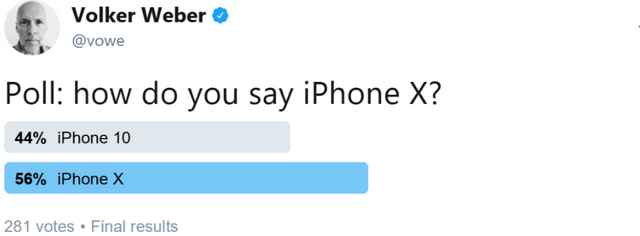
Last night I started this Twitter poll to find out how many people say 'iPhone 10' vs 'iPhone X'.

Apple reps are trained to say 'iPhone 10' and they will even correct you when you say 'iPhone X'. It's a fun game. You can try it as often as you like and they always respond with 'iPhone 10'. I did this recently in a briefing and then I confessed I was trolling them. We had a good laugh and one admitted it took her a while.

We have been there before with OS X, which followed OS 9. Apple went through 12 versions (10.0 to 10.11) until they called it macOS again. It is going to be interesting to see how Apple brands the successors to the iPhone 8 and iPhone X.

PS: Best comment was from Scott:

My initial reaction was to think "but they're both pronounced the same!" I guess Roman numerals are a bigger thing in the US than in Germany. :-)

Apple trying to make Germans say 10 seems futile. For Americans it's completely natural. The 51st Super Bowl was called Super Bowl LI and Americans have no difficulty decoding this as 50 plus 1.

Speaking of numbers: about one in ten people who saw the poll voted on it. And the results are stable after about 50 votes.

11 Oct 18:23

Wired Wednesday: Ring Protect, Google Clips & Snapchat Art Everywhere

11 Oct 18:23

Public Health & Pot Policy

by Ken Ohrn

Cannabis.Lessons

As we move steadily towards widespread legalization and distribution of cannabis, how can we learn more when setting policies?

Here’s a webinar, featuring a rear-view mirror look at what happened when pot became legal in Colorado, and in BC when liquor laws were loosened.

Wednesday, October 25th from 9:00-10:30 am PT. 

But the burning question on so many people’s minds right now, is what will happen when marijuana is finally legalized.  Are there healthier public policy approaches we can take that will reduce harms as marijuana goes mainstream?  Can we learn anything about access, pricing and regulation from alcohol? . . .

. . . Dr. Tista Ghosh is the Medical Health Officer of Colorado, one of the first two states in the USA to legalize the recreational use of marijuana.  She will share some of the lessons they learned and provide some advice on how public health can respond and inform policy as marijuana is legalized.

Dr. Tim Stockwell will speak about the recent loosening of alcohol laws in BC and the impact it has had on public health as well as some of the pricing measures that can reduce excessive consumption.

Thanks to the BC Alliance for Healthy Living.


11 Oct 18:22

French Fender Day

by noreply@blogger.com (VeloOrange)
by Igor


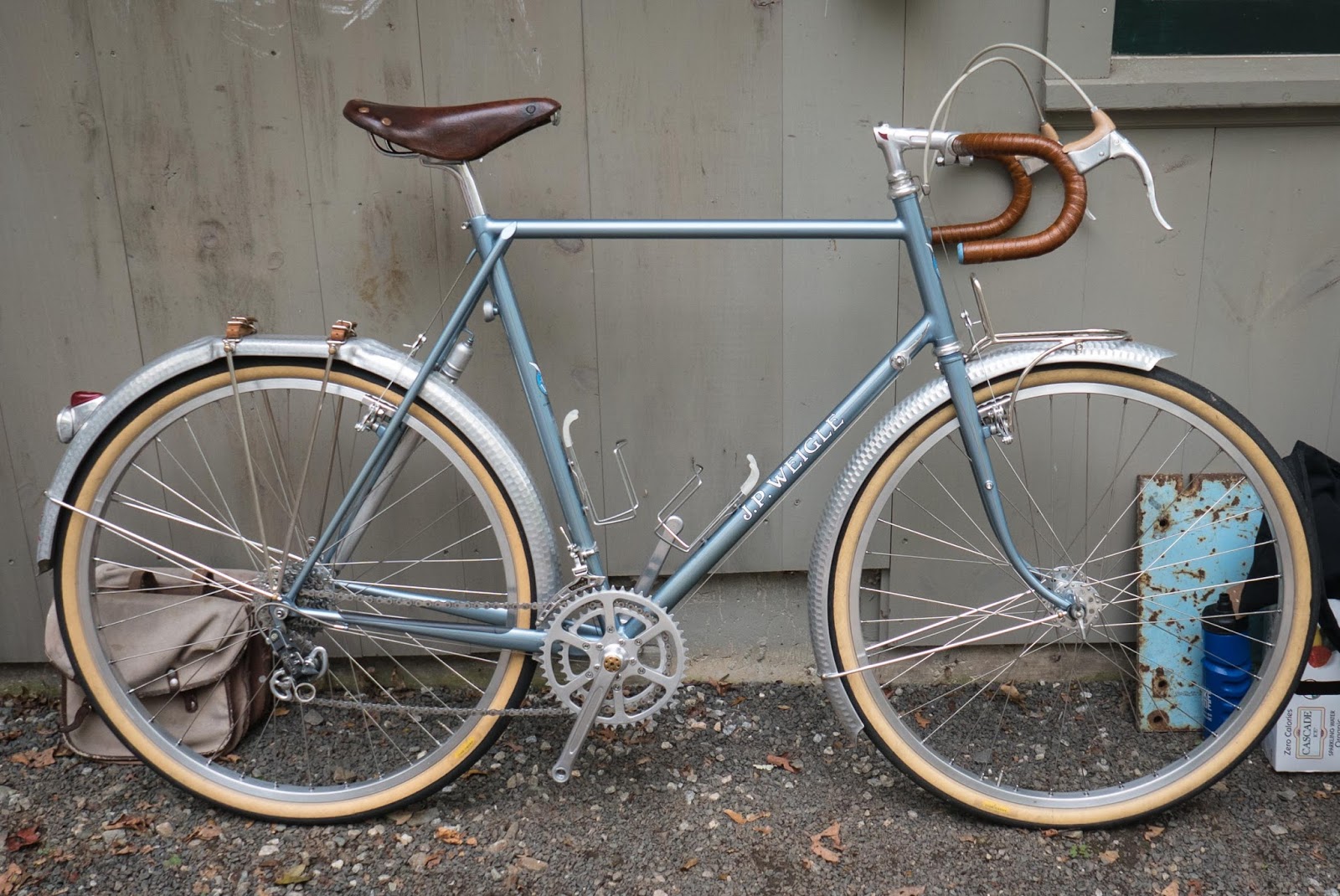
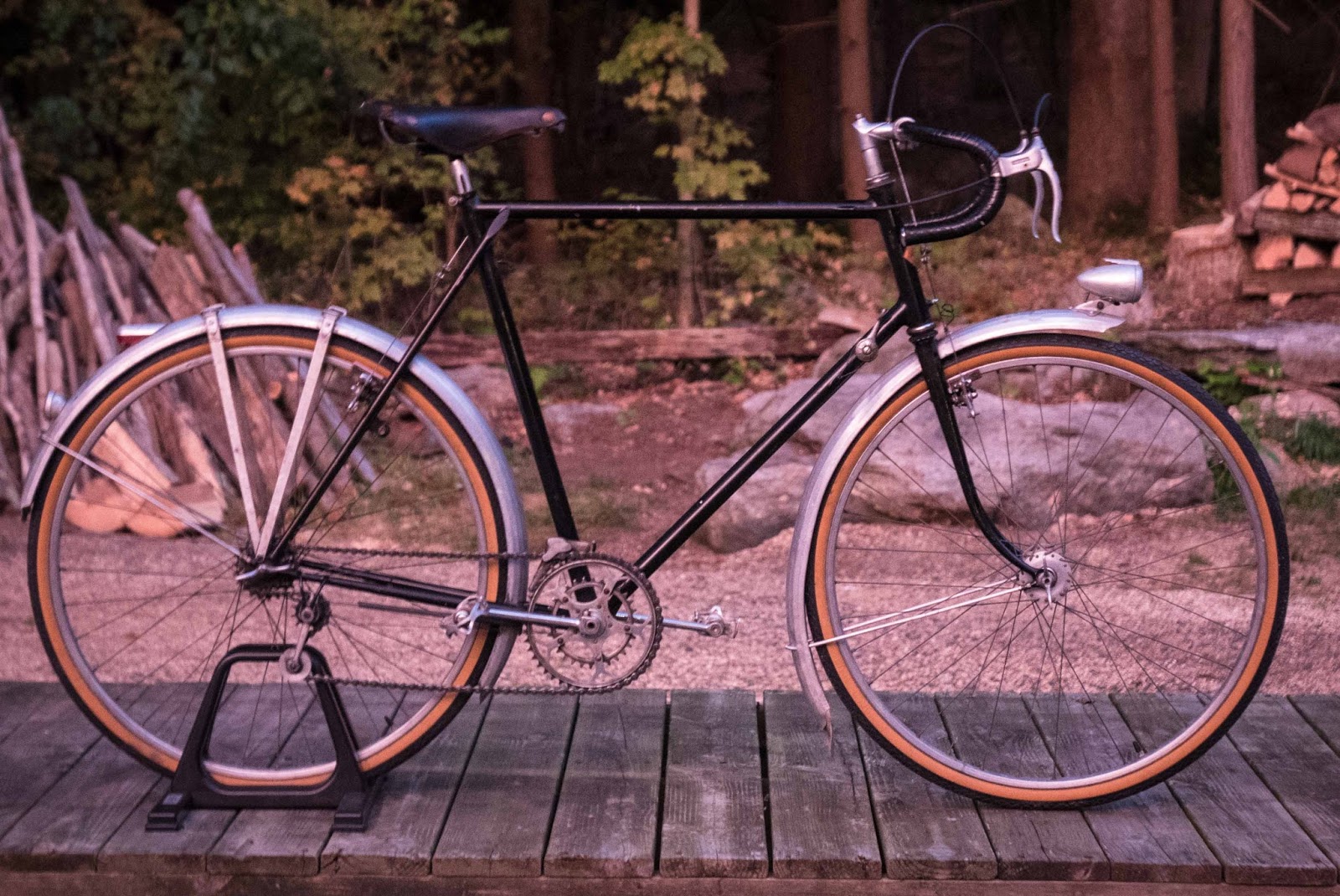
This past weekend, Adrian and I traveled up to Connecticut to check out one of our favorite events of the year: French Fender Day. It's an intimate event full of passionate cyclists, collectors, great potluck food, New England Autumn rides, and lots of beautiful bikes.


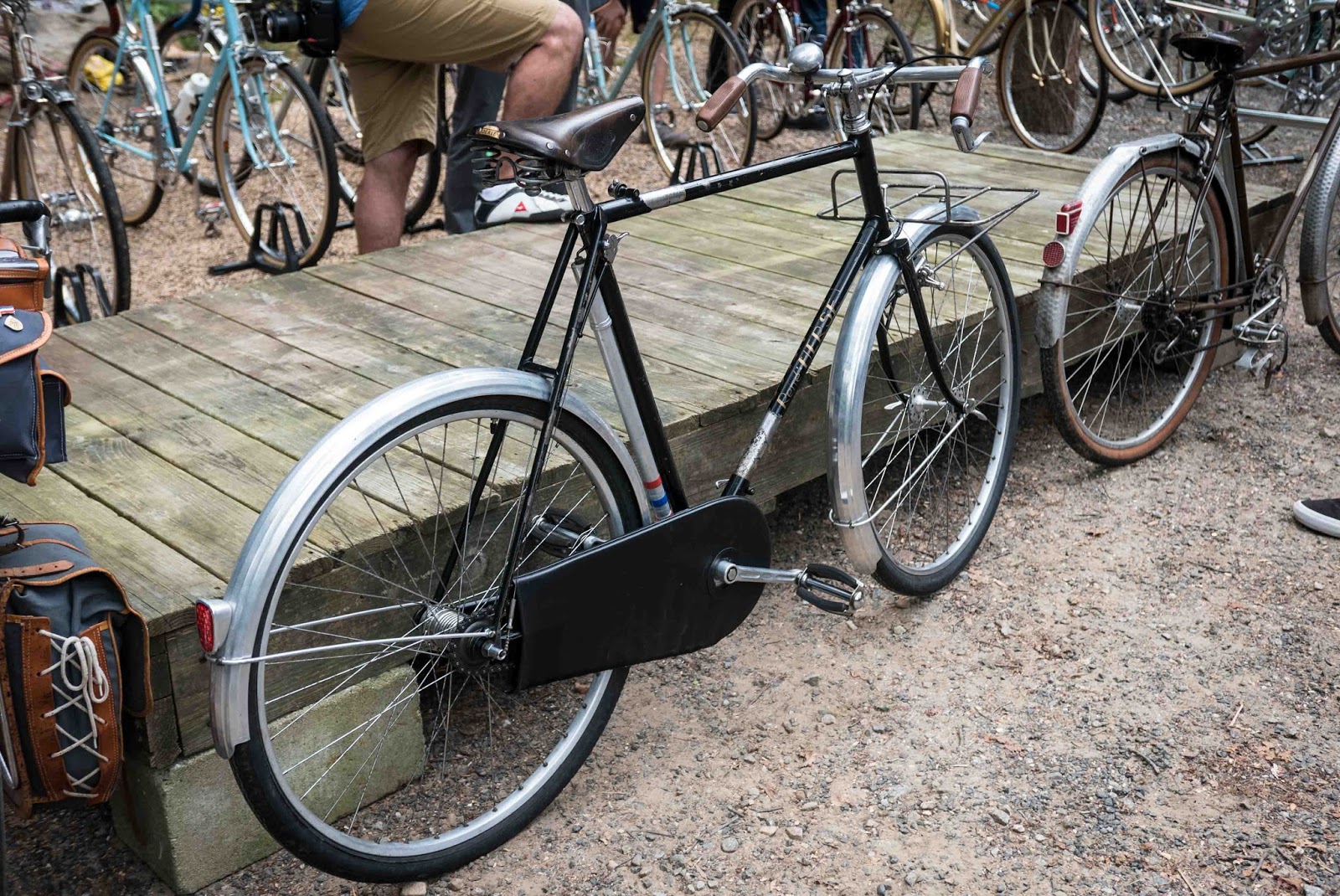
Each bike on display had to be in the traditional French style - randonneuse, porteur, city bike, etc... Some of these bikes were collection pieces to be preserved, but most were daily riders and tourers, just as these bikes were intended to be from their construction.

Rob traveled all the way from The Netherlands with his Alcyon tourer.


Peter's work is always a joy to behold in person. Exceptional lines and perfect integration. 


Embellishments


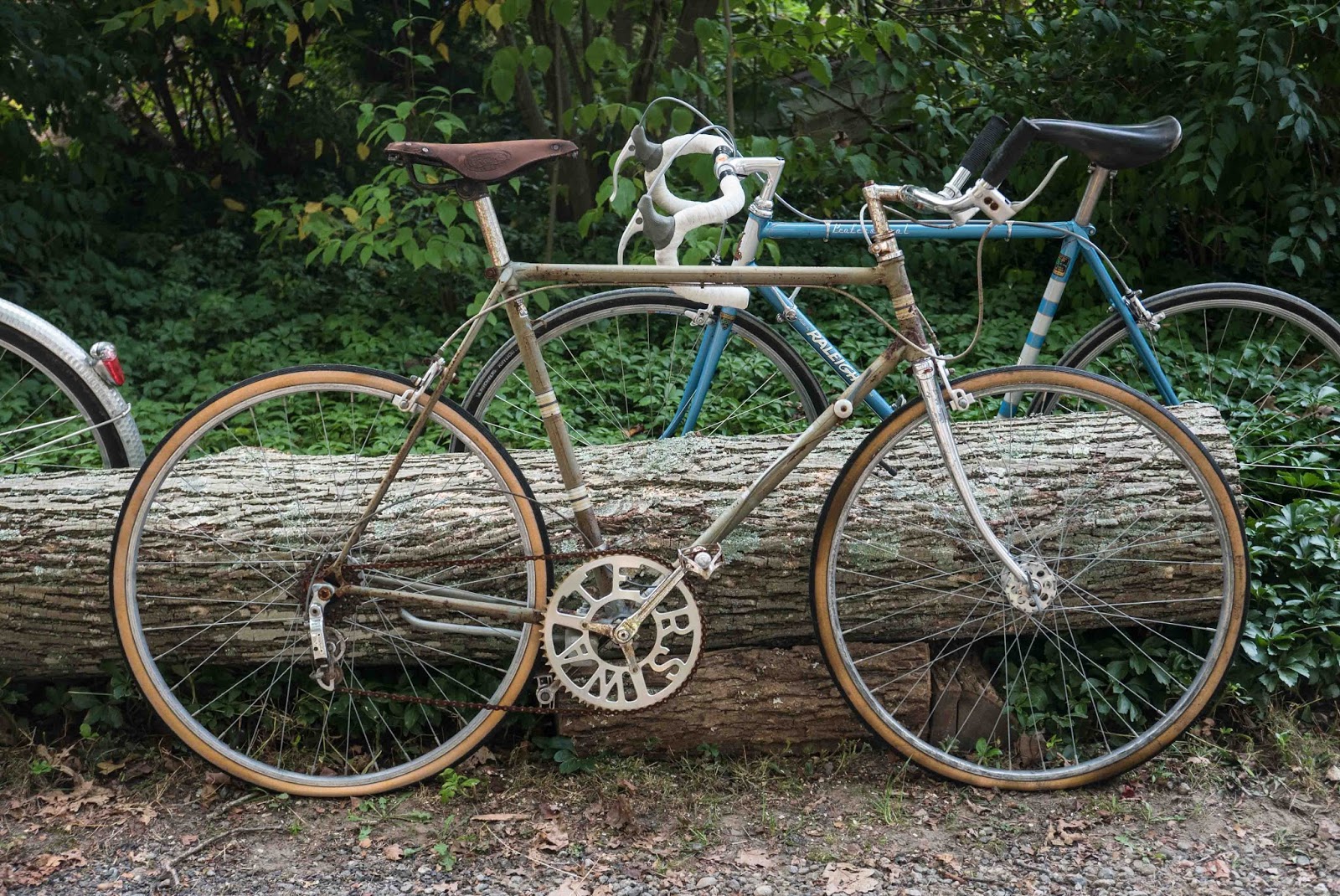
Even though it isn't French, this Raleigh was a favorite of mine. It's a bike that doesn't ask anything of you other than to be ridden. Peter commented that the Rustines grips on the drops are "like 650b for your hands!" It was spritely!


This Dujardine was just a lovely randonneuse.


Only his second frame, this Shu-Sin touring bike shows tremendous patience and clean craftmanship. It features lots of rinko accessories including custom racks.


René Herse Demountable Porteur with a proper leather chaincase.


Just before lunch, rides were had through New England's back roads. The changing of leaves and good company made for a wonderful time.


Adrian and the Nutmeg gang
A wild sorcerer appears!
VO fenders were fitted on a multitude of bikes. Many of them sported customizations including shaping of the fender ends, custom hardware, and dynamo lighting integration.


What kind of Francophile gathering would it be without cheese?


When one fender mount isn't enough.


Large format - What better way to capture such a classy day?

This was a pretty clever use of a fender stay as a bag support. I think I may try something like this on my Polyvalent to support a dry bag.


Always in the big ring
Wayne's hot pink Weigle was clearly the fastest of the bunch.


Loved this randonneur by Mitch Pryor. Super clean bi-lam construction and lovely box-lining.


As the day wound down, we were greeted with a magical golden hour. This Rene Herse tandem was beautifully bathed in the natural colors of New England.


You can see the rest of the album at full resolution here: https://www.flickr.com/photos/eccentricvelo/albums/72157686050295982
11 Oct 18:22

External Memory

by Madeleine Monson-Rosen

In 2010, the internet discovered Space Jam, although you could also say it was Space Jam that had earlier discovered the internet. Released in 1996, the film boasted one of the first movie marketing websites, and perhaps the first to actually take advantage of the technology of the web. In 2010, the site was still online and unchanged when it was found by a group of Reddit users who experienced a kind of Proustian memory, rediscovering a childhood and adolescence spent online at a time when that world seemed much smaller, and much friendlier, than it is now.

Our popular culture of the present moment is permeated with nostalgia for earlier iterations of the web, stories of a time when the internet was the milieu of the weird — of “wizards and geeks,” in the words of a 2006 Pew report. Yet these fictional expressions of internet nostalgia are often less concerned with real encounters with the past than with an imagined past that soothes our anxieties about the present a vision of the internet that never really existed. Depictions of the internet from the 1980s — most obviously William Gibson’s matrix, and Tron — imagined an expansive, topological world more visual than textual, a parallel universe or alternate dimension.

Fictional expressions of internet nostalgia are often less concerned with past encounters than with an imagined past that soothes our anxieties about the present

This idea of the internet as an immersive media environment, a created world, still haunts us. Ready Player One, the 2011 novel and soon-to-be Spielberg film, revels in ’80s kitsch, storming through every pop-culture version of cyberspace and imagining the future internet as much closer to Tron than to our present iteration. It suggests the distinction drawn by the Marxist literary critic György Lukács between bad historical fiction, which he characterized as “mere costumery,” and better, which wrestles with the specific “historical peculiarity” of the age represented by a work of fiction. It is increasingly obvious that the internet is less an immersive playground, less a virtual environment, than it is an archive — a Library of Babel that is sometimes incomprehensible, sometimes sinister, but occasionally beautiful. What we encounter in that archive is an experience that is distinctly embodied and stands in stark contrast to the fantasy of virtual space.


If we do think of the internet as an archive, we probably think of it as archiving us. Pieces of our real selves, the detritus of our communications, consumer choices, and other instantly forgettable acts are packaged and sold, the information revealed to us in the form of Facebook ads and sponsored tweets. Otherwise, the internet can seem hyper-ephemeral, with changing web-design aesthetics as distinctive to their eras as fashion trends seemed 30 years ago. (Will someone in 2030, I wonder, discover a Squarespace-style, endlessly scrolling website and find themselves overwhelmed by waves of memory? Will the hip minimalist landing page look as old fashioned as a command-line interface?)

The polymorphous ethos of the web would seem to reject the very idea of preservation. Facebook memories notwithstanding, Wikipedia and similar sites are tormented by “bit rot.” (“I for one can’t wait until academic research just consists of getting 404 errors on defunded websites,” wrote Simon Parsons, a University of London lecturer.) And yet, perhaps through simple neglect, much of this ephemera is preserved in ways that have proven difficult to predict. Archives, internet or otherwise, are full of the mistakes of the past, and those mistakes, the idiosyncrasies attendant in preservation, often tell us much more than do representations of the past that claim authenticity but fall into costumery.

Imagining the internet as an alternate dimension, a space that you could visit that — in the case of Ready Player One — you can shape according to your own or someone else’s childhood memories has perhaps emerged as an antidote to the reality of much of our lives online. This is something like what Sunny Moraine calls the “construction of the unruined past,” a fiction that enables visions of decline and dysfunction in the present. Ready Player One imagines the internet through a fog of nostalgia for a space that retains the consistency of a childhood memory, in contrast with our own experiences of an increasingly hostile web.

The very act of “entering” online space becomes a kind of fantasy of escape in AMC’s Halt and Catch Fire, a period drama about the birth of the personal computer and the world wide web. Halt and Catch Fire transforms nostalgia for 1980s and 1990s computer hardware into a kind of internet teleology, proclaiming that these technologies were created with the purpose of connecting us. During a strategy session where the main characters attempt to figure out how to capitalize on the not-yet-public internet, corporate visionary Joe MacMillan insists, in a dramatic set-piece monologue, “all we have to do is build a door, and let them inside.” That “inside” remains the province of memory and fantasy. The scene is nostalgia disguised as teleology — a product of the present projected onto the past. It retains none of the memory of experiencing the internet’s precursors, or the early web, and it reflects more what we’d like the internet to be than what it is.

It is increasingly obvious that the internet is less an immersive playground, less a virtual environment, than it is an archive: distinctly embodied and standing in stark contrast to the fantasy of virtual space

This focus on the space of the internet suggests that perhaps we have been wrong about the emphasis in the portmanteau cyberspace all along. “Cyber” has been synonymous with technology’s bleeding edge for a long time, but popular visions of the internet have been preoccupied with the second part: space. We remain enchanted by the notion of the internet as an environment, an open world whose constant renewal and revision is possible, and whose population is an endlessly reinvented parade of avatars, new selves created to suit each permutation of the internet’s environment: selves that are wholly plastic, wholly constructed, and serve to hide, obscure, or at the very least alter the identity of the user. But the risks of life online — and a few of the rewards — reside not in the malleability, and unreliability, of identity online, but in the fact that the internet is a repository of real information about our selves and our lives. Not as we’d like to imagine them, but as they’ve been inscribed and preserved by forces beyond our control.


This is, of course, mostly terrifying. But sometimes it can be beautiful, allowing us to re-encounter previous versions of ourselves, re-inhabit memories that were built when we used different tools to engage with the world. Encountering the internet as an archive perhaps supervenes nostalgia, taking us into a realm of memory in which we are the recording medium.

We don’t only inscribe information onto media; media also inscribes experiences onto us. Technologies, media theorist Wolfgang Ernst reminds us, record information, but they also record the technical and cultural proficiencies necessary to create and access such media. “The phonograph as media artifact not only carries cultural meanings like words and music but is at the same time an archive of cultural engineering by its very material fabrication.” The same is true of books, films and — if we learn how to see it — the internet.

Encountering the internet as an archive perhaps supervenes nostalgia, taking us into a realm of memory in which we are the recording medium

The user who posted about the Space Jam website on Reddit in 2010 wasn’t only enchanted by memories of the film, and the pleasure those memories inspired, but — with its gifs, Easter eggs, and games, not to mention in-jokes written into the code — the “material fabrication” of the site, which stood as a profound relic of the web technology of the 1990s. This user led a whole online community into a shared memory: By following a link, they collectively re-experienced an adolescence influenced by the film, but more profoundly shaped by the web of the 1990s, the years when many of us first came online; it wasn’t just the contents of that web, but the ways in which the muscle memories of navigating it were inscribed into them. That this was Proustian is not an exaggeration: “MY CHILDHOOD HAS RETURNED” proclaims one poster. “This must be how archaeologists feel,” wrote SBNation; “This is a genuine (and genuinely garish) piece of internet history, and it should be left preserved,” wrote Comics Alliance.

The redditors who followed the link rediscovered an abandoned corner of the web because those Warner Brothers servers were still running, frozen in time. But they didn’t just discover a preserved artifact, they rediscovered the way web technology circa 1996 engineered their own experiences: the experience of waiting five minutes for an image to download, waiting twenty for a video (and the rage if someone else in the house picked up the phone). In this archive, we are the memory device, too. While, to return to Lukács for a moment, fiction certainly has the capacity to transmit the “peculiarity” of history, so far, fictional versions of the internet often remain hung up on the costumery of the past and fail to access the memories formed by actually interfacing with the internet of another era.

Space Jam, the website, is an obscure, absurd relic that also precipitated the construction of a profound history, one that rewards reading. Reddit users tracked down the site’s original designers, and then, in 2015, Rolling Stone published a history of the site, interviewing those designers, who remain as surprised as ever that the site went and stayed online. Redditors’ memories opened the door to perhaps the first truly significant history of a website. And that, it seems to me, is remarkable: After 50 years (give or take) of life online, those of us who live here have started to find stories worth telling.

11 Oct 18:22

What Ivanka Trump Knows about Ed-Tech

Inside Higher Ed asked a group of “experts” “what should Ivanka Trump read in order to learn about education technology?” I submitted an answer but it was not what they were looking for. So I’m publishing my thoughts (or 500 words, at least) here.

Perhaps the better question is: what should Ivanka Trump not read in order to learn about education technology. It’s clear from her op-ed in The New York Post that she is quite familiar with the slogans and statistics that organizations like Code.org promote. She seems familiar too with the kinds of arguments readily found in tech and ed-tech industry publications and press releases: that computing is inevitable, and progress demands it. We have all heard these stories about the future: new technologies will make education more efficient, more accessible, more scalable; students’ education will become more “personalized”; and/or it will be increasingly oriented towards the demands of the technology industry and a “new economy” – “training” as Trump repeats five times in her op-ed.

“Learning” is only mentioned once. Lots of other words that might be used to describe the purpose of school – higher education or otherwise – are also missing from Trump’s essay. Curiosity. Civics. Citizenship. Scholarship. Research. The liberal arts. We can probably tell a lot already about her reading list by their absence, because again, this reflects the monomaniacal focus on framing education as about “skills” and jobs – a focus shared by the Trump administration and by the educational marketing and storytelling emanating from the tech industry.
Trump contends the White House will push for computer science to alter “not just what we teach, but how we teach.” This would require a shift not only in the curriculum but in the process, the pedagogy. But other than the repeated invocation of “training,” there’s no real sense of what a new pedagogical direction might involve – unless, that is, you read her call for more “problem solving” as some sort of twenty-first century update to “project-based learning.” But I don’t think Ivanka Trump has read much John Dewey.

Problem-solving, Trump suggests, is not being taught in schools today. Of course it is, but in her formulation – one that’s been repeated by former Obama administration officials recently as well – computer science is touted as “the universal language of problem solving.” This implies that all problems are technical problems; all problems are engineering problems. There are no problems of ethics, beauty, or justice – or rather, ethics, beauty, and justice are now subsumed under the realm of “code.” To see coding as a “universal language” also subsumes the needs to communities – scholarly and otherwise – to the needs of the tech industry, to the demands of global capital.

Trump has clearly read enough and knows enough already to recognize education technology is a perfect vehicle for Silicon Valley ideology. And there’s not much about much of that ideology – steeped in individualism and libertarianism – that she or her father oppose.

I’ve also written about Ivanka Trump’s ed-tech industry network – what we know about her ed-tech investments and the people who’ve also invested in the same (and same types of) companies. To claim that she’s uninformed about all this seems to be to be wildly naive.

11 Oct 18:22

The Best Lenses for iPhone Photography

by Erin Lodi
The Best Lenses for iPhone Photography

After conducting hands-on testing with 50 smartphone lenses over four years while traveling to the Grand Canyon, Hawaii, and the French countryside, we think Moment’s Wide 18mm and Tele 58mm lenses are the best for mobile-photography enthusiasts who use their smartphone as seriously as they use any other camera. For more casual smartphone shooters who enjoy taking snapshots, we also have a more budget-friendly pick.

11 Oct 18:21

My tour of the underground — underground Chinese restaurants, that is

by Frances Bula

One of the great pleasures of my life is connecting with a wide variety of students as a journalism teacher at the University of B.C. and Langara College.

International students, in particular, bring a different eye and an ability to connect with communities here that many of locals aren’t always capable of.

My students at UBC have come up with a number of interesting stories over the years that have opened my eyes to lives in sub-communities of Vancouver that I have known little about.

One story that one of my students came to me with last year was about underground Chinese restaurants. She had discovered that many of her fellow international students from China were getting their home-cooking fix from impromptu take-out restaurants around the city. The operation she patronized was being run by a couple of Chinese parents who were visiting their daughter, a student, long-term and who had decided to keep themselves busy by turning her kitchen into a take-out operation.

Yes, I know, illegal. Unlicenced. Just like the underground restaurant I used to go to in a bungalow off Commercial Drive, where an aspiring young chef served eight-course meals to select groups of foodies.

Anyway, my former student, Si Chen, tracked down information for me on how many of these there were in the region, what kinds of food, and how to get in touch. And, since my Mandarin is limited to counting to 10 and a few stray words like “central” and “people,” she ordered for me from one particular operation, whose mother/daughter team I got to meet.

Here is my little story that appeared recently in Vancouver magazine about my foray into this little-known (to us white people, anyway) world.


11 Oct 18:21

Frequency trails chart explainer

by Nathan Yau

Frequency trails, or currently better known as joyplots, is a visualization method to show multiple distributions at once. Taken individually, each distribution is shown as a density curve, and they overlap each other for a three-dimensional effect. Luis Carli provides an interactive explainer for the method.

I haven’t been able to put my finger on it, but I think there’s something about the overlapping that sort of serves as a visual signal to compare. It seems more direct than small multiples or non-overlapping densities? Or, are people just appreciating the novelty for now?

Tags: frequency trails, joyplot

11 Oct 18:20

@stoweboyd

@stoweboyd:
11 Oct 18:20

@stoweboyd

@stoweboyd:
11 Oct 18:20

Aerial Imagery Presentation at Dorkbot

by ekai

I was invited to give a presentation on advanced aerial imagery techniques using drones at dorkbotSF on September 20, 2017. Here’s the recored presentation, thanks to dorkbot videographer James Young.

Eddie Codel, Advanced Aerial Imagery Techniques with Drones, Dorkbot-SF, 2017-09-20.

11 Oct 18:20

Mind the Clap

11 Oct 18:18

Woher wissen die Amis eigentlich, dass die NSA-Tools ...

mkalus shared this story from Fefes Blog.

Woher wissen die Amis eigentlich, dass die NSA-Tools ihren Datenreichtum via Kaspersky hatten?

Na weil ihr Buddy Israel Kaspersky gehackt hat und da die NSA-Tools gefunden hat!

Das ist ja mal supergeil. Israel hackt Kaspersky, entdeckt dabei illegale Angriffstools der Amerikaner, aber Kaspersky sind jetzt die Bösen. Ja nee, klar.

11 Oct 18:09

Is There a Link Between a Lack of Play and Mass Shootings?

by lskenazy
mkalus shared this story from Free Range Kids:
That is an interesting thought....

Many, many of you have sent me this interesting piece: Thoughts on Vegas and Why Men Keep Doing This, by Charles Hoehn, author of Play It Away. (Free book here!) It ran on the blog Be Yourself. In trying to parse why Stephen Paddock and a few other men have unleashed massacres (something, thankfully, most men do NOT “keep doing”), Hoehn rolled around some ideas, including that the lack of play can lead to deep depression and pathology.

I, too, believe the drive to play is installed at birth by Mother Nature, for a reason: To teach us, in a way so fun it makes us ignore how hard it is, all the lessons that will serve us the rest of our lives. Lessons in empathy, communication, creativity, team-work, problem-solving, risk-taking, patience, focus, self-control, generosity — you name it. In play, you have to learn to get along with each other well enough to keep the game going. That is huge. Play connects us to people. Taking play out of kids’ lives, especially to give them more structured, supervised time,  is something I caution against.

BUT there are 320,000,000 people in America. And all but one did not unleash a massacre in Vegas. What’s more, the man was 64, so he grew up in the golden era when kids WERE allowed to play outside till the streetlights came on.

So yes to more connecting. Yes to less loneliness. And yes to Hoehn’s plea for more play. There are so any reasons to get back to playing. The fear of turning our kids into mass murderers is not on my list.

Thoughts on Vegas, and Why Men Keep Doing This

[Reason] 2- Men in the United States are deprived of play opportunities.

You might be offended by this suggestion.

How could this guy talk about play after a shooting?! Play is for kids!

Wrong.

Homo sapiens play more than any other species. It’s impossible to prevent a human from playing. We play shortly after we are born, and the healthiest (and least stressed) humans tend to play for their entire lives.

Play may be God’s greatest gift to mankind. It’s how we form friendships, and learn skills, and master difficult things that help us survive. Play is a release valve for stress, and an outlet for creativity. Play brings us music, comedy, dance, and everything we value.

Above all, play is how we bond with each other — it’s how we communicate “I am safe to be around, I am not a threat.” Play is how we form connections with other humans.

The irony is that loneliness would not be a problem if we all got ample time to play. Not only would we have deeper friendships, we’d also have better relationships with ourselves. Play allows us to enjoy our own company.

There is a strong correlation with play deprivation and mental illness.

When you deprive mammals of play, it leads to chronic depression. When you deprive a human child of play, their mental and emotional health deteriorate. Play suppression has enormous health consequences.

“But the Vegas shooter loved to gamble! He went on cruises!”

That’s not the type of play I’m talking about.

To better understand this dynamic, we need to look at the background of another mass shooter.

In 1966, Charles Whitman shot his wife and mother. Then, he climbed up the tower at the University of Texas in Austin, and shot 46 people. In total, he murdered 16 people. At the time, this was the biggest mass shooting of its kind in United States history.

Dr. Stuart Brown and his team of researchers were commissioned to find out what “The Texas Sniper” had in common with other mass murderers.

They gained a key insight when they examined their childhoods.

Brown recalls:

“None of them engaged in healthy rough-and-tumble play. The linkages that lead to Charles Whitman producing this crime was an unbelievable suppression of play behavior throughout his life by a very overbearing, very disturbed father.

Healthy and joyful play must be had in order to thrive. Boys need to wrestle with their dads, and they need to roughhouse with other boys. Parents and teachers need to play with their kids.

But more importantly, they need to encourage those kids to go out and play. And then, let them be.

It’s 10 o’clock. Do you know where your kids are?

Ever since that famous ad aired, parents have shamed each other into watching their kids like a hawk.

If you let your kid walk up the street alone, you’ll either get a call from another parent, or the cops will pick them up. Our kids are stripped of their right to experience life on their own terms.

In an effort to improve our kids’ test scores and beef up their future resumes, we’ve stripped away nearly all of their free play opportunities. Recess has been sacrificed in the name of Scantrons, and pills are prescribed to the kids whose bodies and minds cry out for play.

The result: A generation of the most anxious, depressed, and suicidal American children on record.

This is in alignment with Dr. Peter Gray’s research, who studied the epidemic of mental illness and the decline in play:

“Over the past half century, in the United States and other developed nations, children’s free play with other children has declined sharply. Over the same period, anxiety, depression, suicide, feelings of helplessness, and narcissism have increased sharply in children, adolescents, and young adults… The decline in play has contributed to the rise in the psychopathology of young people. 

This is why I believe mental illness may be the biggest health crisis of our lifetimes. Because those kids will grow up into isolated adults who don’t know how to play, or seek out their friends when they are lonely. They have no emotional support.

They are alone.

In the most memorable chapter of So You’ve Been Publicly Shamed, the author describes the research of James Gilligan, a young psychiatrist at Harvard Medical School in the 1970s.

Gilligan was invited to make sense of the Massachusetts’s prisons and mental hospitals, where he interviewed murderous inmates. He included in his notebook this heartbreaking observation:

“They would all say that they themselves had died before they started killing other people… They felt dead inside. They had no capacity for feelings. No emotional feelings. Or even physical feelings.

Universal among the violent criminals was the fact that they were keeping a secret. A central secret. And that secret was that they felt ashamed— deeply ashamed, chronically ashamed, acutely ashamed.

I have yet to see a serious act of violence that was not provoked by the experience of feeling shamed or humiliated, disrespected and ridiculed.”

ALL OF US will face difficult times in our lives where we will experience shame, humiliation, disrespect, and ridicule.

Do you know what gets us through those hard times?

Friendship: The love and support you get, from the people you play with.

Amen to the powerful effects of love, support and friendship. – L.

.

11 Oct 18:08

Apparently Dropbox Spam is a thing now

by jwz
mkalus shared this story from jwz.

A cursory glance didn't reveal an option for "Never allow anyone to send me a file ever", so I've uninstalled it again. The only thing I use it for is 1Password, but the last time I tried to make that work without Dropbox, I found that their "wifi sync" option was way too flaky. But now they can sync the vault through iCloud instead, so I'll give that a try.

Previously, previously, previously.

11 Oct 17:44

Microsoft was working on a nearly bezel-less Windows phone back in 2014

by Dean Daley
Microsoft store

It seems Microsoft was working on a bezel-less smartphone before Samsung, Google and Apple, all the way back in 2014, according to a new report.

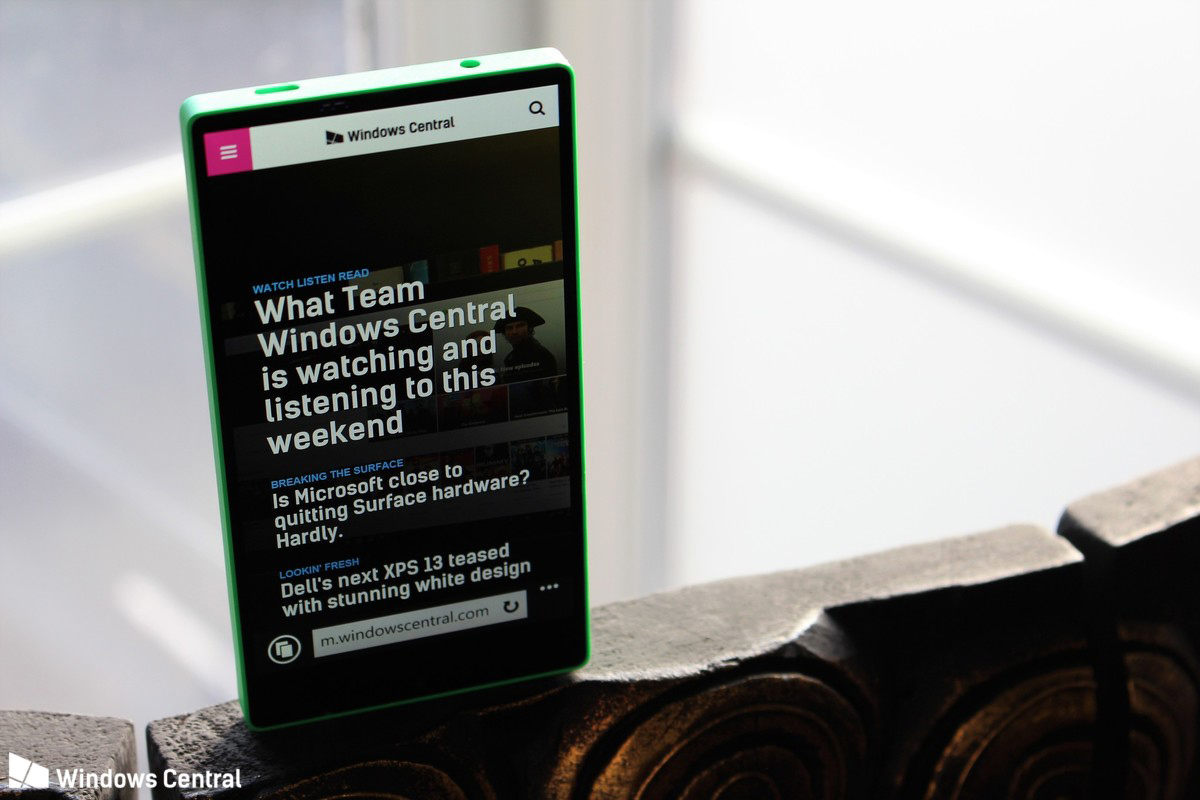
The Microsoft Lumia 435 was destined to be one of the industry’s first bezel-less smartphones, however, when that 4-inch Windows-powered device was officially released, it didn’t look like the image below.

Lumia 435 all screen prototype

The device, which was given the in-development codename of Vela, was going to cost under $200 USD. Microsoft, however, scrapped the idea of a nearly bezel-less phone in late 2014 and went with the less memorable 435 design some of us likely remember.

Microsoft’s prototype  for the phone featured a 5-inch 1280 x 720 pixel resolution display, with a 5-megapixel rear-facing camera. Qualcomm’s Snapdragon 200 processor, 4GB of storage and 1GB of RAM with a 1,800 mAh battery.

The thin top bezel had a speaker grill, while the lower bezel contained the smartphone’s front facing camera, similar to the Xiaomi Mi Mix devices.

Though this smartphone never made it to market, Windows Central — the source of this leak — gave the prototype a full review.

Source: Windows Central

The post Microsoft was working on a nearly bezel-less Windows phone back in 2014 appeared first on MobileSyrup.

11 Oct 17:44

Taylor Swift is launching her own social network, because nothing makes sense

by Patrick O'Rourke
Taylor Swift

Former country superstar Taylor Swift has plans to launch her own social network called ‘The Swift Life.’

No, you aren’t living in an alternative universe where major social networks like Facebook, Twitter, and Instagram have already existed for years.

The new app, which is developed through a partnership with Glu, the same studio that has worked on popular mobile games like Katy Perry Pop (which flopped and has been removed from app stores), Britney Spears: American Dream, Nicki Minaj: The Dream and one of the most lucrative mobile games on the market, Kim Kardashian: Hollywood. Fun Fact: Glu also has a Toronto-based office.

A press release about the game reveals few details regarding the project, though Nick Earl, Glu’s CEO, refers to the app as “a new digital entertainment project.” The app itself even goes so far as to borrow key design elements from social networks like Instagram and Tumblr, complete with pop-up ads that look liked they travelled to 2017 in a time capsule from 2005.

For fans of Taylor Switch, the app does have a few exclusive features that actually make sense, though details are scarce. For example, the app will offer what the press release calls “exclusive” content and photos, as well as direct engagement with Swift.

This isn’t the first time we’ve seen a celebrity release a bizarre, fan interaction-focused app either. Rihanna released a Samsung-branded promotional app called Anti a few months ago and even actor Jeremy Renner released a music-focused app earlier this year.

Rest assured that given Glu’s track record in the freemium, microtransaction department, The Swift Life will likely be full of in-app purchases. Currently, however, we only know that Swift will be getting her own set of emojis called ‘Taymojis.’

The announcement video was published directly to Swift’s YouTube account and has the star closing off the clip with the line, “I think you guys are really going to like this. I mean, I hope. It would be preferable if you did.”

The Swift Life is set to be available on both Android and iOS.

Look what we made her do.

The post Taylor Swift is launching her own social network, because nothing makes sense appeared first on MobileSyrup.

11 Oct 17:44

The new $390 Kindle Oasis has a 7-inch display and is waterproof

by Rose Behar

Amazon has unveiled its first waterproof Kindle, and it begins shipping to Canada on October 31st.

The new Kindle Oasis, which is available starting at $389.99 CAD, is IPX8-certified for immersion up to two meters of fresh water for up to 60 minutes. It also features a substantially larger display than the 2016 Kindle Oasis, coming in at seven inches. The company promises that the 300ppi Paperwhite display allows for over 30 percent more words per page.

If these features sound familiar, it’s because Amazon’s major competitor, Kobo, heavily marketed both of those features in the 2016 waterproof Aura One and recently-released Aura H2O.

The waterproof Oasis also features some distinctly Kindle traits, though. It features an ergonomic design like the much smaller 2016 Kindle Oasis, designed to shift the center of gravity to the reader’s palm. The dedicated page turn buttons also return, as does the feature that automatically rotates the page orientation depending on whether you hold it with your left or right hand.

The e-reader features a thin 3.4mm display and new aluminum back that boasts heightened durability. Despite this new casing, the device comes in at a relatively light 194 grams. In comparison, the 2017 Aura H2O is 207 grams.

The new Oasis comes in two storage options: 8GB and 32GB, the latter of which is designed to hold larger files like audiobooks, comics, newspapers and magazines.

As for software, Amazon is promising several updates such as new font sizes and bold settings, a new accessibility option for dyslexic readers, left-aligned text and automatic light settings facilitated by built-in ambient light sensors.

The new font settings and left-aligned text is also now rolling out as a free, over-the-air update to Kindle Paperwhite (Gen 6 released in 2013) and newer Kindle devices.

The 8GB model is the one priced at $389.99 and it comes with just Wi-Fi enabled, while the 32GB model has both Wi-Fi and cellular connectivity and is priced at $489.99. The company says both are going up for pre-order immediately, and will begin shipping October 31st.

Source: CNW

The post The new $390 Kindle Oasis has a 7-inch display and is waterproof appeared first on MobileSyrup.