Shared posts

12 Nov 18:27

Intuitive ‘instruction design’

by Lilia Efimova

It’s third season of the workshops for homeschoolers that we organise together with Wout Zweers, who works at an intersection of art, design and making. Today is another workshop and, being up early, I started to think about my role in the process.

The first part is logistical. I sort out the dates, write announcements, communicate with the participants and make sure that contributions get collected.

The second one is educational. It is a sort of intuitive ‘instruction design’ for something where you can’t really fix the sequence of steps. A workshop is a discovery environment around a theme, where exploring materials, learning techniques to work with them, producing an outcome and playing with it are mixed in different proportions for everyone.

I guess what I’m trying to do when we are preparing a workshop is something about boundaries, attractors and fitting facilitation.

Attractors are usually there – an interesting theme, materials, methods, tools, machines, Wout himself with all knowledge, skills and inspiration that he easily shares. The challenge here is to stay as open as possible without getting into a chaos (which is easy, given a multi-age group of kids that we usually have). So in a conversation with each other and tryouts with my kids we are sharpening the focus: what is essential for this particular workshop and what can be left for the others. Finding the attractors usually means removing distractors – materials, methods, tools and machines that are likely to result in too much diverging.

This is where the boundaries come into play. Time has to be set and managed, space needs to be organised in a way which helps us and the participants to stay focused, where what is needed can be easily accessed and put back, where the chances of an injury are minimised and the chances of learning and discovery are maximised.

And then comes the facilitation. For me a lot in these workshops is about a sort of apprenticeship – letting the participants to explore while being inspired by Wout and being able to learn “tricks of the trade” from him. So part of the process is creating an opportunity for everyone to “unpack” Wout’s expertise while freeing him from explaining the same thing again and again where it is not essential. The other part is creating conditions for a legitimate peripheral participation, so even smaller kids, who can’t easily do complex tasks (operate a laser cutter or use woodworking tool independently), can feel part of the group and create something meaningful within a theme. The same goes for the parents – we try to make sure that they have a chance to explore, create and learn and next to supporting their own kids.

13 Oct 01:44

"Our bodies are wild. The involuntary quick turn of the head at a shout, the vertigo at looking off a..."

“Our bodies are wild. The involuntary quick turn of the head at a shout, the vertigo at looking off a precipice, the heart-in-the-throat in a moment of danger, the catch of the breath, the quiet moments relaxing, staring, reflecting – all universal responses of this mammal body… The body does not require the intercession of some conscious intellect to make it breathe, to keep the heart beating. It is to a great extent self-regulating, it is a life of its own. The world is our consciousness, and it surrounds us. There are more things in the mind, in the imagination, than ‘you’ can keep track of – thoughts, memories, images, angers, delights, rise unbidden. The depths of the mind, the unconscious, are our inner wilderness areas, and that is where a bobcat is right now. I do not mean personal bobcats in personal psyches, but the bobcat that roams from dream to dream. The conscious agenda-planning ego occupies a very tiny territory, a little cubicle somewhere near the gate, keeping track of some of what goes in and out, and the rest takes care of itself. The body is, so to speak, in the mind. They are both wild.”

-

| Gary Snyder, The Practice of the Wild

The body does not require the intercession of some conscious intellect to make it breathe, to keep the heart beating. It is to a great extent self-regulating, it is a life of its own.

(h/t an-itinerant-poet,  Beyond the Fields We Knowcrashinglybeautiful)

13 Oct 01:44

"It is absurd to suggest reductions in corporate tax rate from current levels will call forth some..."

“It is absurd to suggest reductions in corporate tax rate from current levels will call forth some renaissance of hard work.”

- | Lawrence Saunders
13 Oct 01:44

@jasminegartner

@jasminegartner:
13 Oct 01:42

The Internet Archive Liberates a Mountain of Materials Published Between 1923-1941

by Rex Hammock

The Internet Archive (in my book, one of the few “wonders of the internet”) is now using a little known, and perhaps never used, provision of US copyright law (Section 108h) which allows libraries to scan and make available materials published 1923 to 1941 if they are not being actively sold. (Note: While I am not an anti-copyright advocate, I believe that certain types of copyrights should sunset in 14 years, renewable once if the copyright holder took actions to renew it. That’s 28 years. Okay, round it up to 30. But forever? At the bottom of this post, there’s a link to two articles I wrote on SmallBusiness.com about Ben Franklin and Thomas Jefferson and their beliefs on the topic.)

Quote from the Internet Archive blog:

Elizabeth Townsend Gard, a copyright scholar at Tulane University calls this “Library Public Domain.”  She and her students helped bring the first scanned books of this era available online in a collection named for the author of the bill making this necessary: The Sonny Bono Memorial Collection. Thousands more books will be added in the near future as we automate. We hope this will encourage libraries that have been reticent to scan beyond 1923 to start mass scanning their books and other works, at least up to 1942. (…)


If the Founding Fathers had their way, almost all works from the 20th century would be public domain by now (14-year copyright term, renewable once if you took extra actions).


Some corporations saw adding works to the public domain to be a problem, and when Sonny Bono got elected to the House of Representatives, representing part of Los Angeles, he helped push through a law extending copyright’s duration another 20 years to keep things locked-up back to 1923. This has been called the Mickey Mouse Protection Act due to one of the motivators behind the law, but it was also a result of Europe extending copyright terms an additional twenty years first. If not for this law, works from 1923 and beyond would have been in the public domain decades ago.


Today we announce the “Sonny Bono Memorial Collection” containing the first books to be liberated. Anyone can download, read, and enjoy these works that have been long out of print. We will add another 10,000 books and other works in the near future.


Professor Townsend Gard had two legal interns work with the Internet Archive last summer to find how we can automate finding appropriate scanned books that could be liberated, and hand-vetted the first books for the collection. Professor Townsend Gard has just released an in-depth paper giving libraries guidance as to how to implement Section 108(h) based on her work with the Archive and other libraries. Together, we have called them “Last Twenty” Collections, as libraries and archives can copy and distribute to the general public qualified works in the last twenty years of their copyright.

Sidenote by Rex: Here are a couple of articles I wrote a few years ago for SmallBusiness.com about the founding fathers, patents, and copyrights.

Benjamin Franklin Never Sought a Patent or Copyright

Thomas Jefferson’s Views on Patents and Intellectual Property Rights

13 Oct 01:42

Curiosity

by Bryan Mathers
einstein - i have no special talents

What if I just tweak it a little? Change the colours slightly, or make it into a repeating pattern? Or a character? If it could speak, what would it say? Curiosity is creativity’s playful little cousin (Tinker?) – always getting up to mischief…

I came across this quote on curiosity doing some work for Ada College, the UK’s National College for Digital Skills (I’m a big fan). I was invited to come along to the first day with the first cohort and create thinkery from conversations had with staff and students, who were, and are, brilliant.

The post Curiosity appeared first on Visual Thinkery.

13 Oct 01:42

Twitter Favorites: [chenoehart] Twitter must feel like a different experience for people who are powerful enough to not have anxiety about alienating their followers.

Chenoe Hart @chenoehart
Twitter must feel like a different experience for people who are powerful enough to not have anxiety about alienating their followers.
13 Oct 01:42

Pixelmator Pro Experience Film

by admin

We’ve just unveiled a film about Pixelmator Pro with an overview of its incredible user experience and interface. Check out the all-new film below.

13 Oct 01:40

Facebook Announces Oculus Go, a $199 Standalone VR Headset

by Ryan Whitwam
oculus

Oculus is preparing its first all-in-one VR headset known as the Oculus Go. It's coming to a face near you next year for a mere $199.

The post Facebook Announces Oculus Go, a $199 Standalone VR Headset appeared first on ExtremeTech.

13 Oct 01:40

I Hear That Asteroids Machine Calling My Name

I still remember the first time I ever touched an Asteroids machine. It was in a dark arcade in Vallejo, one of those ones that had popped up in an empty storefront in a shopping center. The machine was different than all the others in the arcade, it was a lone cocktail cabinet amid the uprights that were packed anywhere they could fit them. I dropped in a quarter to see if I could make sense of the game, and was amazed at how fun it was controlling the ship. Of course I died quickly because I...

13 Oct 01:29

If Being Concerned About AI-Driven Joblessness Is Extreme, I’m An Extremist

by Stowe Boyd

Dissecting the discourse about the likely impacts of automation, again

source: Moltec

The other day I encountered a post by Sam Lessin at The Information, entitled The Future of Work, which caught my attention since I think of the future of work as my beat.

Here’s his opening:

We are entering a period where machine learning is going to dramatically change the nature of work across a broad swath of service and knowledge industries.
Extremists see a world where all human work evaporates rapidly, driving a conversation about human dignity and equality in a world of technological unemployment. A more sober group believes we’re on the brink of eliminating a class of repetitive white-collar knowledge work — not unlike transitions we have gone through in the past.
My view is that this debate is several steps ahead of reality. Those that concentrate just on the elimination of some specific job categories underestimate the impact of new technology.

Oh, boy. Here’s the first paragraphs of comments I left there¹:

My hackles raised when you wrote ‘Extremists see a world where all human work evaporates rapidly, driving a conversation about human dignity and equality in a world of technological unemployment. A more sober group believes we’re on the brink of eliminating a class of repetitive white-collar knowledge work — not unlike transitions we have gone through in the past.’
You seem to be simply repeating the techno-utopian conventional wisdom, which you consider as ‘more sober’ in contrast to those who disagree — those who are deeply concerned about the potential for AI to lead to joblessness — those you castigate as ‘extremists’.
Notably, your piece is relatively free of facts or citations of others research that might support your opinions. As Daniel Moynihan observed, everyone’s entitled to their own opinion, but not their own facts. You’ve penned yet another fact-lite post along the lines of so many others published in silicon valley techland recently.
My recommendation to your subscribers is that they look to the news of what’s happening on the front lines instead of softsoap op-ed like this: the hedge funds that are laying off quants as their deploy AI as fund managers and firing human financial advisors and roll out AI in their place, the companies that are increasingly reliant on AI for hiring, and the coming deluge of basic innovations like hamburger-cooking robots, AI radiologists, and driverless taxis.

Lessin, a former Facebook guy, is deeply embedded in a start-up/entrepreneurial community that pooh-poohs AI as a job destroyer, a community that often makes the following argument:

We’ve had technology revolutions before where some jobs — horsewhip making and newspaper typesetters, for example — are eliminated, but the workers shifted to other, new sorts of jobs created by the new technology. AI is just another cycle of that sort of disruption.

The problem is that this jumps to a conclusion, avoiding the possibility that AI is different from earlier technological revolutions, like agriculture and industrialization, since those supplanted human physical labor. AI, on the other hand, is supplanting cognitive skills, which is a completely different game.

‘Aha!’, the techno-optimists like Lessin might respond, ‘if that is the case, how come unemployment isn’t higher? Where are the unemployed millions?’

Well, there’s a complex answer. In the US, at least, a very large proportion of formerly employed industrial workers have been sidelined by a shifting economy. As the Economic Policy Institute points out,

In today’s labor market, the unemployment rate drastically understates the weakness of job opportunities. This is due to the existence of a large pool of “missing workers”–potential workers who, because of weak job opportunities, are neither employed nor actively seeking a job. In other words, these are people who would be either working or looking for work if job opportunities were significantly stronger. Because jobless workers are only counted as unemployed if they are actively seeking work, these “missing workers” are not reflected in the unemployment rate.

The US labor participation rate is around 63% meaning 80 million or more possible workers are currently not seeking work, presumably because a/ wages are not high enough to motivate them, or b/ they are actually unemployable. (The latter category includes millions who would fail drug tests if they applied for work.) But still, millions are on the sidelines. Where are the jobs?

In manufacturing, we have been on a slide since the late ‘70s:

The manufacturing jobs delusion | The Economist
In 1979, the high point for American manufacturing jobs was reached at 19.5m. The subsequent recession of the early 1980s caused that number to fall but there were regularly 17m-18m jobs in the 1980s and 1990s. From the turn of the millennium, however, the total fell pretty remorselessly, with the 2008–09 recession proving the coup de grace. The low was just under 11.5m in early 2010. As the economy recovered, some jobs returned and a peak of 12.3m was reached early last year. But since then, the numbers have been drifting down again.

And one of the factors in manufacturing job decline is automation. Yes, it is the case that adding robots to a manufacturing plant does not always translate to layoffs there. However, something more complex happens. Let’s look at Germany, where significant increases in robots hasn’t led to a decrease in employment. But what does happen?

Jill Petzinger | Germany has way more industrial robots than the US, but they haven’t caused job losses²
While industrial robots haven’t reduced the total number of jobs in the German economy, the study found that on average one robot replaces two manufacturing jobs. Between 1994 and 2014, roughly 275,000 full-time manufacturing jobs were not created because of robots.
“It’s not like jobs were destroyed, in the sense that a manufacturing robot is installed and then the workers are fired because of the robots — that never really happened in Germany,” study co-author Jens Südekum, from Düsseldorf Institute for Competition Economics, told Quartz. “What happened instead is that in industries where they had more robots, they just created fewer jobs for entrants.”
“Typically around 25% of young labor market workers went into manufacturing and the rest did something else, and now more workers have immediately started in the service sector — so in a sense the robots blocked the entry into manufacturing jobs.”

So, aside from the extreme near-term, deploying more robots into manufacturing — and by extension, AI into other industries — may not translate into immediate layoffs. However, even in those cases the cumulative effect will be to divert workers out of those industries where robots and AI are deeply integrated, since exponential scale of production is provided by AI and robots, with at most a linear growth of human workers.

And others argue fairly conclusively that robots do lead to job losses:

George Dvorsky | Robots Are Already Replacing Human Workers at an Alarming Rate
Each additional robot in the US economy reduces employment by 5.6 workers, and every robot that is added to the workforce per 1,000 human workers causes wages to drop by as much as 0.25 to 0.5 percent. Such are the conclusions reached by MIT’s Daron Acemoglu and Boston University’s Pascual Restrepo, who published their findings at the National Bureau of Economic Research.

Going back to the observations from the Economist, we have a large number of prospective workers — a great deal of male blue collar workers who formerly worked in the merry-go-round of industrial trades, mining, manufacturing, construction, and so on — who have been displaced, and can’t easily shift to a services economy.

These are only a few data points, but there are dozens more, like this post about AI replacing fund managers at BlackRock, FoxConn’s plans to replace nearly all workers with robots, and the predictions of the devastating impact of driverless vehicles on the millions of truckers, delivery and taxi drivers.

So, as the title says, if being concerned about AI-driven joblessness is extreme, I’m an extremist. Call me what you want. But please offer up some research, some data, some economic analysis to support your claims, not just the rewarmed conventional wisdom of those deep in the Silicon Valley bubble, a community that identifies with the technologists and investors behind the greatest economic disruption of our time, and not those who are always the first to bear the blunt force trauma involved.

  1. I am dropping my The Information subscription for reasons unrelated to this post. Basically, I don’t think it’s all that innovative, and it’s pricey.
  2. Note that this title is misleading, since the story is about how young workers are being diverted to services jobs based on the growing reliance on robots in manufacturing.
13 Oct 01:29

Google Makes Video Calling Easier on Android by Integrating It into Phone, Contacts, and Messages App

by Rajesh Pandey
Google today announced that it is making video calling easier for certain Android devices by integrating it into the Phone, Contacts, and Android Messages app. And later this year, it will also allow one to upgrade their voice call to video with just a tap. Continue reading →
13 Oct 01:28

These Weeks in Firefox: Issue 25

by mconley

Highlights

Friends of the Firefox team

Project Updates

Add-ons

Activity Stream

  • Update on Activity Stream on about:home for 57
    • Landed patch to restore existing about:home in Nightly, preffed off by default
    • Starting a Shield pref flip study in Nightly to compare Activity Stream to existing about:home
    • Requested uplift for patch to 57 Beta so that same study can be run there
  • Started planning / landing for 58

Browser Architecture

  • XBL design review happened last week, next step is to share the plans more widely.
  • Experimenting with removing the XUL box model

Firefox Core Engineering

  • New projects († are subject to approval):
    • Adding a dummy crash reporter (en route to CFI-based stackwalking)
    • Jumping in to help with Chrome migration
    • Going to be creating a policy engine & API to support policy management in enterprises (not just Active Directory)†
    • Possibly revamping how we update the DLL blocklist† in parallel with some early injection mitigation changes

Form Autofill

  • Working with the SHIELD team to do the gradual rollout of address autofill in 56
    • One bug fix needs deployment first
  • Continuing work on credit card autofill for the US (not riding the trains yet)
  • “Clear” autofill item in progress

Photon

Performance

  • Been doing a deep-dive investigation on this bug where a user reports slower page load times due to the 60fps tab throbber
    • We’ve now got hardware where we can reproduce the problem on. The clock speed is really low on these machines (even worse when in battery-saving mode), which seems to be the main contributing factor.
  • Fixed a bug where logins / passwords weren’t being filled in via the context menu item – this was a regression from some perf work where the contextmenu sync IPC message was removed.
  • Patches will land shortly that will allow us to kill hanging JS more quickly in content processes when we’re shutting down or when all windows have disappeared. This should eliminate a class of slow shutdowns.

Structure

Animation

Visuals

Platform Audibles

Search and Navigation

Test Pilot

Here are the raw meeting notes that were used to derive this list.

Want to help us build Firefox? Get started here!

Here’s a tool to find some mentored, good first bugs to hack on.

13 Oct 01:28

Twitter Favorites: [caseorganic] First Evidence That Online Dating Is Changing the Nature of Society https://t.co/Kk60BjqFHy via @paigesaez

Amber Case @caseorganic
First Evidence That Online Dating Is Changing the Nature of Society technologyreview.com/s/609091/first… via @paigesaez
13 Oct 01:28

The evolution of Acquia's product strategy

by Dries

Four months ago, I shared that Acquia was on the verge of a shift equivalent to the decision to launch Acquia Fields and Drupal Gardens in 2008. As we entered Acquia's second decade, we outlined a goal to move from website management to data-driven customer journeys. Today, Acquia announced two new products that support this mission: Acquia Journey and Acquia Digital Asset Manager (DAM).

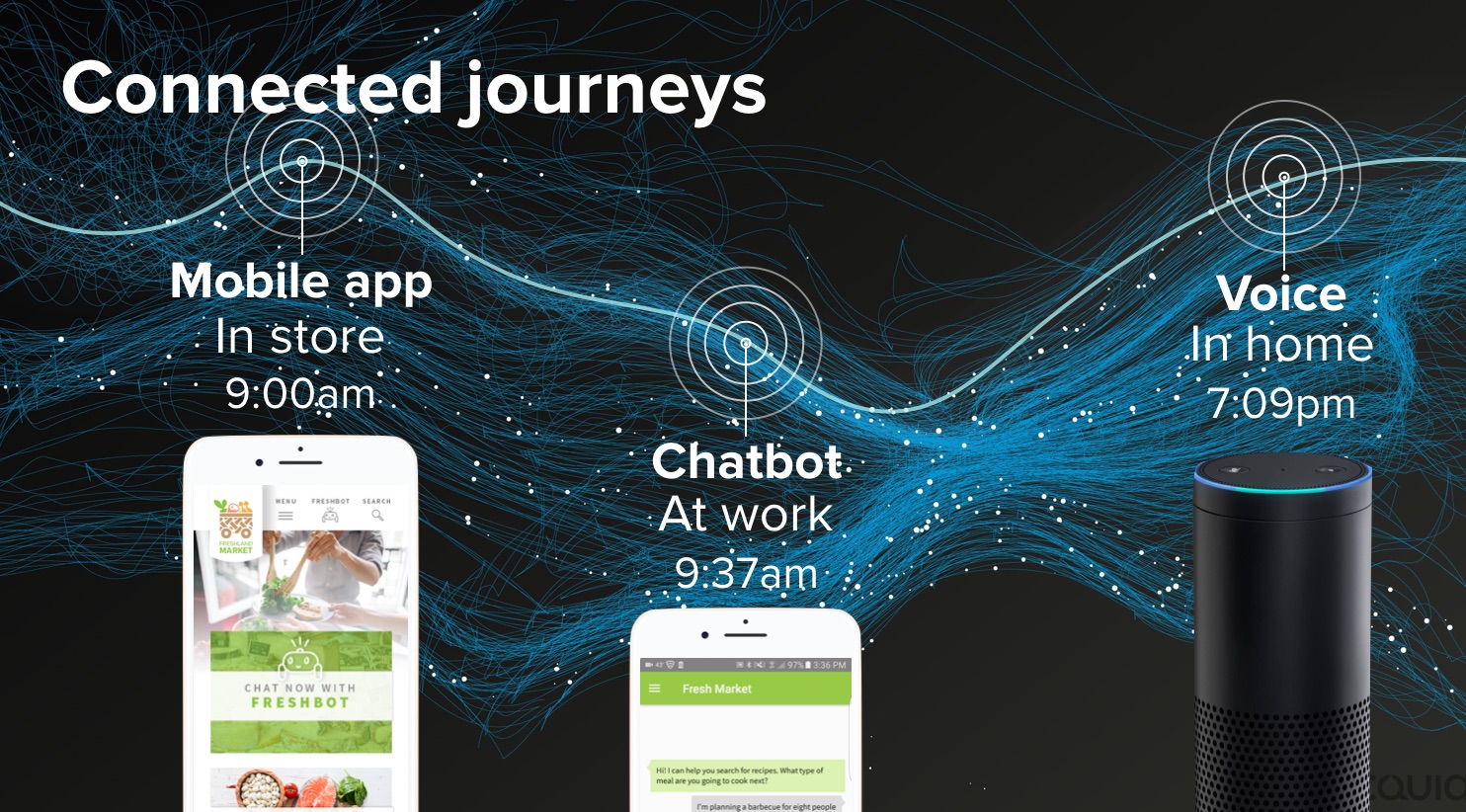
Last year on my blog, I shared a video that demonstrated what is possible with cross-channel user experiences and Drupal. We showed a sample supermarket chain called Gourmet Market. Gourmet Market wants its customers to not only shop online using its website, but to also use Amazon Echo or push notifications to do business with them. The Gourmet Market prototype showed an omnichannel customer experience that is both online and offline, in store and at home, and across multiple digital touchpoints. The Gourmet Market demo video was real, but required manual development and lacked easy customization. Today, the launch of Acquia Journey and Acquia DAM makes building these kind of customer experiences a lot easier. It marks an important milestone in Acquia's history, as it will accelerate our transition from website management to data-driven customer journeys.

A continuous journey across multiple digital touch points and devices

Introducing Acquia Journey

I've written a great deal about the Big Reverse of the Web, which describes the transition from "pull-based" delivery of the web, meaning we visit websites, to a "push-based" delivery, meaning the web comes to us. The Big Reverse forces a major re-architecture of the web to bring the right information, to the right person, at the right time, in the right context.

The Big Reverse also ushers in the shift from B2C to B2One, where organizations develop a one-to-one relationship with their customers, and contextual and personalized interactions are the norm. In the future, every organization will have to rethink how it interacts with customers.

Successfully delivering a B2One experience requires an understanding of your user's journey and matching the right information or service to the user's context. This alone is no easy feat, and many marketers and other digital experience builders often get frustrated with the challenge of rebuilding customer experiences. For example, although organizations can create brilliant campaigns and high-value content, it's difficult to effectively disseminate marketing efforts across multiple channels. When channels, data and marketing software act in different silos, it's nearly impossible to build a seamless customer experience. The inability to connect customer profiles and journey maps with various marketing tools can result in unsatisfied customers, failed conversion rates, and unrealized growth.

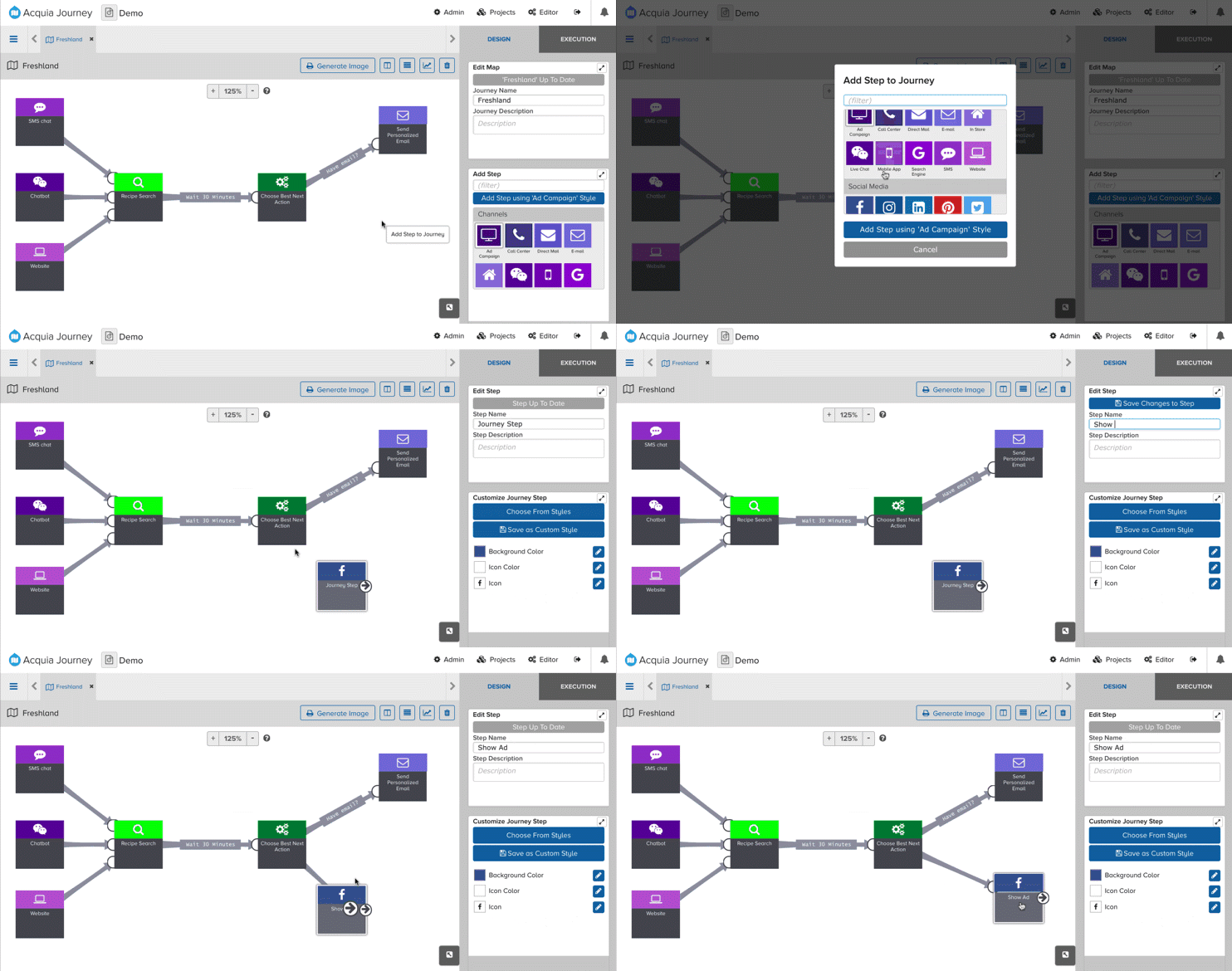
An animation showing Acquia's journey building solution

Acquia Journey delivers on this challenge by enabling marketers to build data-driven customer journeys. It allows marketers to easily map, assemble, orchestrate and manage customer experiences like the one we showed in our Gourmet Market prototype.

It's somewhat difficult to explain Acquia Journey in words — probably similar to trying to explain what a content management system does to someone who has never used one before. Acquia Journey provides a single interface to define and evaluate customer journeys across multiple interaction points. It combines a flowchart-style journey mapping tool with unified customer profiles and an automated decision engine. Rules-based triggers and logic select and deliver the best-next action for engaging customers.

One of the strengths of Acquia Journey is that it integrates many different technologies, from marketing and advertising technologies to CRM tools and commerce platforms. This makes it possible to quickly assemble powerful and complex customer journeys.

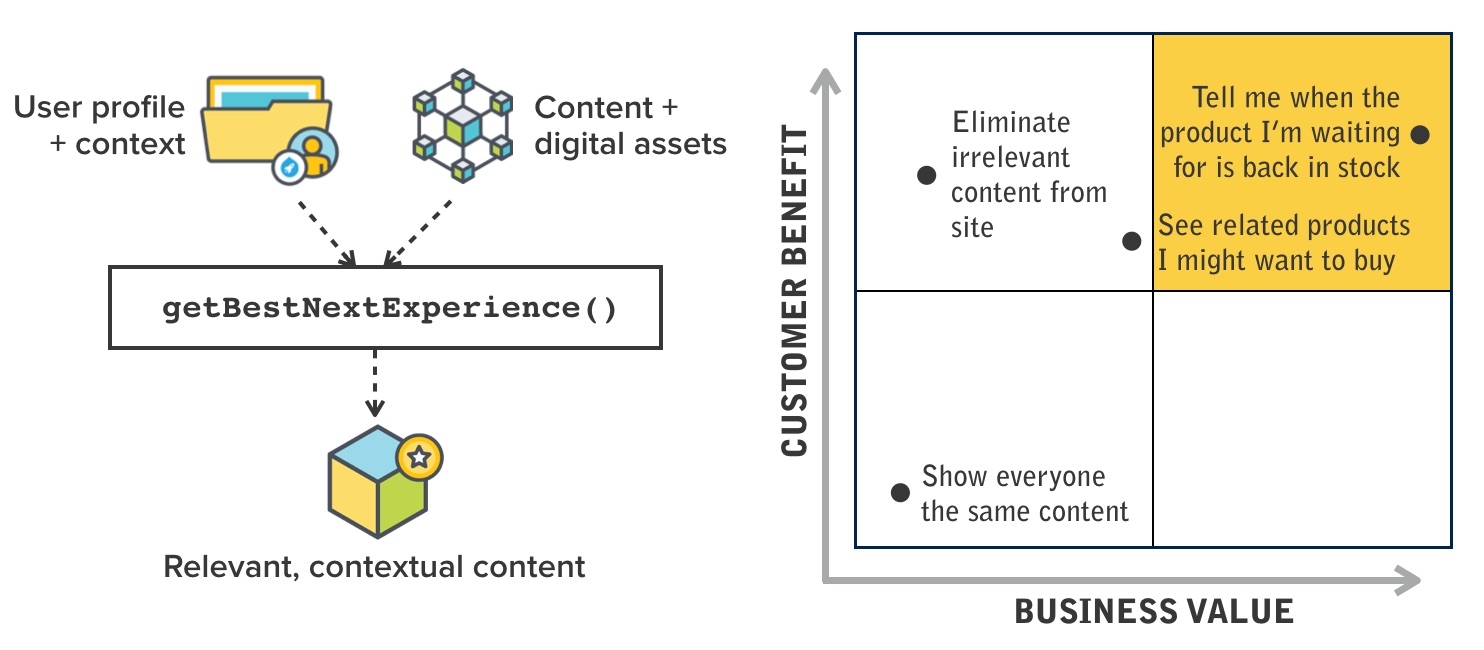
Implementing getBestNextExperience() creates both customer and business value

Acquia Journey will simplify how organizations deliver the "best next experience" for the customer. Providing users with the experience they not only want, but expect will increase conversion rates, grow brand awareness, and accelerate revenue. The ability for organizations to build more relevant user experiences not only aligns with our customers' needs but will enable them to make the biggest impact possible for their customers.

Acquia's evolving product offering also puts control of user data and experience back in the hands of the organization, instead of walled gardens. This is a step toward uniting the Open Web.

Introducing Acquia Digital Asset Manager (DAM)

Digital asset management systems have been around for a long time, and were originally hosted through on-premise servers. Today, most organizations have abandoned on-premise or do-it-yourself DAM solutions. After listening to our customers, it became clear that large organizations are seeking a digital asset management solution that centralizes control of creative assets for the entire company.

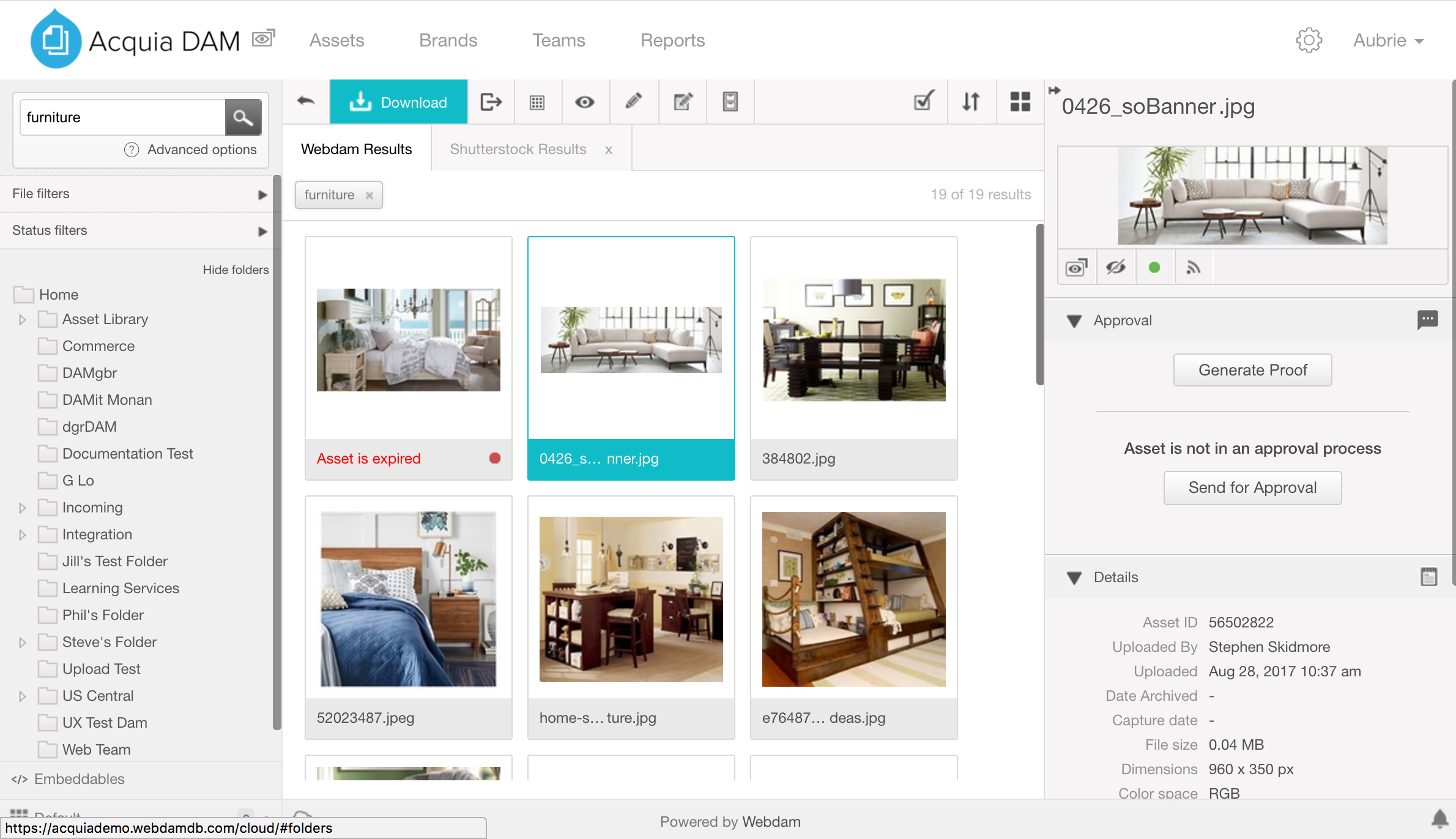
Many organizations lack a single-source of truth when it comes to managing digital assets. This challenge has been amplified as the number of assets has rapidly increased in a world with more devices, more channels, more campaigns, and more personalized and contextualized experiences. Acquia DAM provides a centralized repository for managing all rich media assets, including photos, videos, PDFs, and other corporate documents. Creative and marketing teams can upload and manage files in Acquia DAM, which can then be shared across the organization. Graphic designers, marketers and web managers all have a hand in translating creative concepts into experiences for their customers. With Acquia DAM, every team can rely on one dedicated application to gather requirements, share drafts, consolidate feedback and collect approvals for high-value marketing assets.

On top of Drupal's asset and media management capabilities, Acquia DAM provides various specialized functionality, such as automatic transcoding of assets upon download, image and video mark-up during approval workflows, and automated tagging for images using machine learning and image recognition.

A screenshot of Acquia's Digital Asset Management solution
By using a drag-and-drop interface on Acquia DAM, employees can easily publish approved assets in addition to searching the repository for what they need.

Acquia DAM seamlessly integrates with both Drupal 7 and Drupal 8 (using Drupal's "media entities"). In addition to Drupal, Acquia DAM is built to integrate with the entirety of the Acquia Platform. This includes Acquia Lift and Acquia Journey, which means that any asset managed in the Acquia DAM repository can be utilized to create personalized experiences across multiple Drupal sites. Additionally, through a REST API, Acquia DAM can also be integrated with other marketing technologies. For example, Acquia DAM supports designers with a plug in to Adobe Creative Cloud, which integrates with Photoshop, InDesign and Illustrator.

Acquia's roadmap to data-driven customer journeys

Some of the most important market trends in digital for 2017

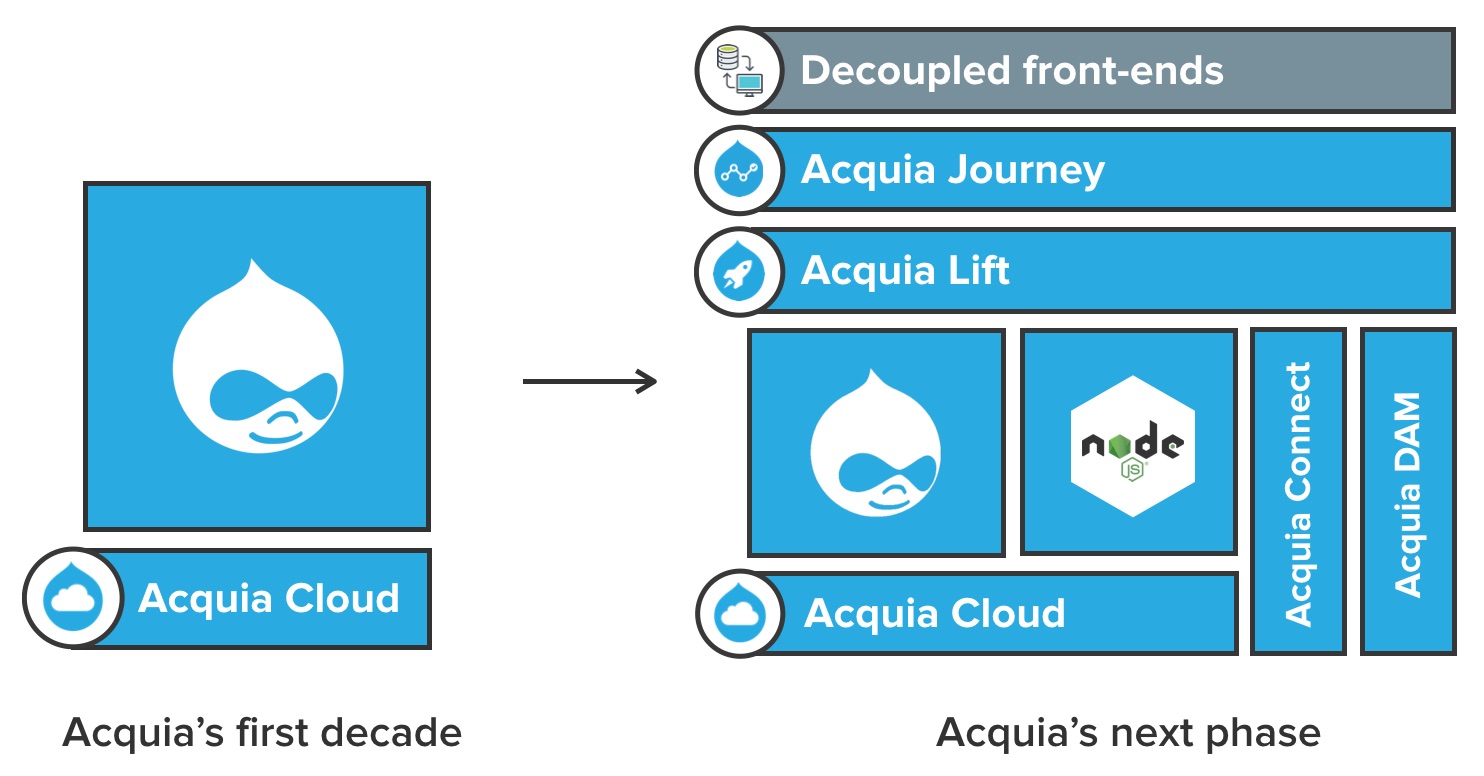
Throughout Acquia's first decade, we've been primarily focused on providing our customers with the tools and services necessary to scale and succeed with content management. We've been very successful with helping our customers scale and manage Drupal and cloud solutions. Drupal will remain a critical component to our customer's success, and we will continue to honor our history as committed supporters of open source, in addition to investing in Drupal's future.

However, many of our customers need more than content management to be digital winners. The ability to orchestrate customer experiences using content, user data, decisioning systems, analytics and more will be essential to an organization's success in the future. Acquia Journey and Acquia DAM will remove the complexity from how organizations build modern digital experiences and customer journeys. We believe that expanding our platform will be good not only for Acquia, but for our partners, the Drupal community, and our customers.

Acquia's product strategy for 2017 and beyond
13 Oct 01:27

Waterproof Kindles

The Verge on the new Kindle Oasis released today:

"Amazon has been selling Kindles for 10 years now, but “waterproof” hasn’t appear on its list of incremental technological advancements until now. The company just announced a new version of its popular e-reader that builds on last year’s Kindle design and now has an IPX8 waterproof rating."

I have a Kindle Voyage, and it's one of my favorite products right now (the AirPods being another favorite of mine). The Kindle UI is slow and not amazing, but I put up with it because I love the display so much. It's wonderful to read in sunlight and the dark. And it's light. And the Kindle charge lasts forever. I read a lot, and I probably wouldn't if it wasn't for the Kindle.

Will I get the new Oasis? Probably, eventually. My Voyage still works perfectly fine. But the rainy season just started here in the Pacific NW, and I wonder if that's going to push me towards it now. Also, hottubs I guess?

13 Oct 01:27

Twitter Favorites: [al3x] Twitter as “a rapid dialectical device” is maybe the most complimentary thing I’ve heard about the service in years https://t.co/VouuoxnbXs

Alex Payne @al3x
Twitter as “a rapid dialectical device” is maybe the most complimentary thing I’ve heard about the service in years philosophyofmoney.net/mmt-part-ii-sy…
13 Oct 01:27

Report shows Bloor business is flourishing with new bike lanes

by dandy
Bloor Street, in the vicinity of the bike lane pilot project, is economically healthy and experiencing growth, according to a new report released on October 11, 2017, by the Toronto Centre for Active Transportation (TCAT).
The study looked at four economic indicators – customer counts, visit frequency, spending, and vacancy rates in the Bloor Annex and Korea Town business districts – and found that, despite the removal of approximately 160 on-street parking spots and one traffic lane, business on Bloor Street continues to flourish.

While important, these findings should not be surprising. The study also examined the travel patterns of customers, both before and after the bike lane’s installation, and found that fewer than 10% drive. Walking remains the most popular travel choice (48%), but cycling almost tripled, growing from 7% to 20%. Over 90% of customers were thus unaffected by the reduced capacity for cars.

“Removing 160 parking spots to install a protected bike lane was, without question, a major change to Bloor Street. While the safety benefits are paramount and undeniable, the economic impact is important for the small businesses that line the street. This new research provides strong evidence that since most customers do not drive to Bloor, on-street parking is not essential to the street’s economic vitality,” says TCAT Director and project lead Nancy Smith Lea. “We also have confirmed that people who walk or bike are the best customers for small local business.”

The daily commutes of merchants, however, were significantly more impacted. Nearly half (49%) of merchants drive to work, meaning they face traffic and parking difficulties that their customers avoid by walking, cycling and taking transit. There was no increase in the number of merchants cycling to work, which, at 6%, remained their least popular travel choice.

The study was launched in 2015, nine months before the bike lane was installed, with funding provided by the City of Toronto, the Metcalf Foundation, the Bloor Annex Business Improvement Area (BIA), and the Korea Town BIA.

The research team worked together with the BIAs to develop an evidence-based methodology to assess economic impact, including deciding upon survey questions and economic indicators. Data was also collected on Danforth Avenue, a comparable shopping street with no bike lane, so that changes observed on Bloor could be placed in context.

TCAT partnered with academic researchers from the University of Toronto to design the study, and to collect, analyze, and interpret the data.

In total, the study collected estimated customer counts from 525 merchant surveys, estimated spending and visit frequency from 3,005 visitor surveys, and business vacancy counts from two street level scans.

"This study looks at multiple data sources to estimate economic impact — comparing estimated customer counts, estimated spending and visit frequency prior to and after the installation of the bike lanes. We didn’t ask businesses about sales because without solid point-of-sale data to verify their responses it would be insufficient, or subjective," Lea added.

Surveys and bike counts were conducted on Bloor and Danforth before and after the installation of the bike lane in three time periods: fall 2015, fall 2016, and spring 2017. The vacancy scans took place in July 2016 and again in July 2017.

“This study was expertly designed to capture representative and unbiased data on the economic vibrancy of Bloor Street in the Bloor Annex and Korea Town business districts, and how that has changed over time as a result of the bike lane,” says Dr. Steven Farber, a quantitative transportation geographer at the University of Toronto Scarborough, and the data analysis lead on the project. “The results are quite clear. Visitors to Bloor are cycling more, visiting more frequently, and spending more money in local businesses. All the while, a larger number of merchants are reporting higher customer counts when comparing 2015 to after the bike lane installation.”

The report is now headed to committee.

TCAT’s report is part of the City of Toronto’s comprehensive strategy to measure a host of potential impacts of the Bloor pilot bike lane, including traffic operations, travel time, parking utilization, mode share, attitudes, and economic activity. On October 18, the City of Toronto’s Public Works and Infrastructure Committee will review all the evidence that has been collected and make a recommendation about whether or not the Bloor bike lane should be made permanent.

Following the release of this report, and the concurrent City Staff report, Mayor John Tory was widely quoted as being in support of the bike lanes:

He told reporters that the bike lanes shows “a positive impact” on Bloor Street.

“And so I will support the staff recommendation to keep the bike lanes, with continued improvements to be made to safety, street design and practical improvements for local businesses,” he said.

Here's a Recap of the Key Findings:

Customer Counts
• The number of businesses that reported 100 customers or more per day increased in the study area on both streets. Reported spending increased on Bloor and Danforth at a similar rate.
• Both before and after the bike lane, customers who arrive by foot or on bike reported higher levels of spending on Bloor Street compared to those arriving by car or transit.
• On both streets, locals (those living or working in the area) were 2.6 times more likely than those coming from further away to spend more than $100 per month.
Customer Frequency and Vacancy Rates 
• After accounting for other contributing factors such as age, gender and proximity, visitors reported coming to Bloor three days more per month after the bike lane was installed, while on Danforth visit frequency was unchanged.
• People who arrived on foot or on bike visited Bloor the most often, and people who drove or took transit visited nearly four days less per month.
• Vacancy rates held steady at 6% in Bloor Annex and Korea Town. On Danforth, they declined from 10% to 7%.
Shifts in Travel Patterns and Parking 
• The percentage of customers cycling to Bloor nearly tripled (from 7% to 20%), a substantially higher increase than on Danforth Avenue, which has no bike lane.
• Walking remained the most popular travel choice, used by nearly half (48%) of visitors on Bloor, and driving is now the least (10%).
• Merchants on Bloor Street preferred to drive (49%) and there was no increase in cycling, which remained the least preferred travel choice (6%).
• The majority of merchants believed that at least 25% of their customers are driving to Bloor; however fewer than 10% of customers reported arriving by car.
• Parking difficulty increased on both streets for visitors who drove, growing by four times on Bloor (from 8% to 33%) and nearly doubling on Danforth (from 14% to 25%), though this street did not have any on-street parking removed.
•  When looking at all visitors, the percentage who needed to find car parking and experienced difficulty remained small: 3% of all visitors on Bloor and 4% on Danforth.
 Perceptions of Safety and Feedback on Bike Lane 
• After the installation of the bike lane, the proportion of visitors who perceived Bloor Street as safe for cycling more than tripled (from 17% to 61%), and doubled among merchants (from 13% to 27%), while perceptions of safety on Danforth dropped (22% to 10%).
• The percentage of women who reported they now feel safe cycling on Bloor increased significantly more than men, from 12% to 58%.
• The majority of visitors (86%) and merchants (90%) provided feedback in response to an open-ended question soliciting thoughts or comments about the bike lane.
• While visitor comments were generally positive, the most common feedback related to the bike lane’s configuration and safety. Merchants raised more concerns than visitors, especially over impacts to business, but safety, parking, and traffic were also important issues.
 The "Economic Impact Study of Bike Lanes in Toronto's Bloor Annex and Korea Town Neighbourhoods" (both the full report and summary) is available for download here
 
Related on dandyhorsemagazine.com:
13 Oct 01:26

Weekly Photo Challenge: Scale

by Stephen Rees

Downtown Vancouver aerial

“For this week’s challenge, make use of sizing, placement, and scale in your photos. Perhaps you live in a place with mountains, and want to highlight the size of the homes in relation to the dramatic landscape. ”

Downtown Vancouver has plenty of tall buildings – in fact quite a few taller ones now than when I took this picture in 2010 – but they are dwarfed by the Coast Mountains in the background. That’s Cypress Mountain in the middle of the skyline – this was in April but there was still snow on the ski runs.

Scale

Click on the image to be taken to the photo page on flickr. You can get a larger size if you like it – and you could, if you want to – click on the star to “fave” it.

POSTSCRIPT

Cypress Mountain is going to be open early this year


Filed under: photography, Vancouver Tagged: mountains, photo challenge, scale, WordPress, WPC
13 Oct 01:25

Daily Durning: From Chinatown to Metrotown

by pricetags

Durning picks up another piece from The Guardian by author Madeleine Thien:

Vancouver’s Chinatown came into being in the 1880s as Chinese migrants fled the region of the Pearl River Delta in the wake of political violence that claimed an estimated one million lives. In Canada, Chinese migrants took on the railway’s most dangerous jobs while earning less than half the salary of their white counterparts. When the railway was completed, the workers, intent on sending remittances home, found jobs in sawmills, coal mines, tanneries and brickyards. But their presence drew an ugly backlash from mainstream society. … 

The ‘Oriental city’

Across North America, Chinatowns developed a parallel civic society, providing schools, benevolent associations, libraries and a complex social organisation. Gradually, a self-protective architecture evolved: colourful facades that would satisfy an outsider’s desire for a contained, exotic experience – and an inner world that could meet the everyday needs of Chinese workers segregated into an increasingly crowded space.

It is a little known fact that the brightly painted facades of the oldest Chinatown in the US, in San Francisco, were designed in 1906 by the architect-engineers T Patterson Ross and AW Burgren, who were hired by Chinese merchants to dream up deliberately exoticised architecture.

In American Chinatown: A People’s History of Five Neighbourhoods, journalist Bonnie Tsui documents how the “oriental city of ‘veritable fairy palaces’, was a conscious, east-meets-west attempt by Chinese merchants to change the community’s image … and ensure its continuing survival.” The Chinese merchants wondered if their frontier-style buildings were livened by elaborate flourishes, would mainstream society’s fear of the outsider diminish? Might they even enter the colourful gates, drawn to the exotic world on their doorstep?

By 1910 Vancouver’s Chinatown began to incorporate flying eaves, glazed tiled roofs and other stately decorations. Ironically, the ornamentation which they hoped would convey dignity and social cohesion added to a pervasive misconception: that the Chinese utilised such details because theirs was a community of perpetual aliens, incapable of adapting to a new environment. Ross and Burgren’s architecture became emblematic around the world. …

From Chinatown to Metrotown

In the 1980s, many Chinese immigrants to Vancouver hoped to prosper and leave behind the struggles of Chinatown, but I suspect they believed, and hoped, the enclave would persist. Its sometimes kitschy atmosphere allowed for memory without sentimentality, nostalgia freed from rigid tradition. Its alleyways and buildings are the physical evidence of a discriminatory history, as well as a population that “has always flourished in a community form”, as the journalist Tsui observes.

That is all changing. The Chinese working class and poor communities are being displaced here, powerless against the unified forces of developers backed by city re-zoning and incentivising plans – the price of individual condos in two recent developments is between $1 and $2m.

In Everything Will Be, Julia Kwan’s powerful 2014 documentary on the demolitions and losses in Vancouver’s Chinatown, Bob Rennie, the owner of Vancouver’s largest real estate firm, insists that “the Chinatown that your parents enjoyed here is gone forever”, and says the city must look to the future.

Developers claim they are preserving the neighbourhood, but the fact remains that the heart of the community – meaning its people and their livelihoods – are currently fighting for their existence.

Meanwhile there is now a new Chinese enclave where Vancouver blurs into Burnaby. Where the old Chinatowns were low-rise shopfront streets and alleyways, this new area, with its glass skyscrapers, shopping malls and a plenitude of restaurants specialising in Chinese regional cuisines, reflects a shifting global order. The predominant language is Mandarin.

This area, Metrotown, has a strong resemblance to the urban live-work neighbourhoods built beside rapid transit stations, and near to vibrant green spaces in Shanghai, Hong Kong or Singapore. Architecturally, it resembles an Asian metropolis, rather than an imagined oriental aesthetic. Metrotown carries the tension of a new Chinatown, which is no longer an area with distinct borders, or something that can be contained by exotic gates.

Full story here.


13 Oct 01:23

Daily Scot – Westside Infill

by Scot Bathgate
mkalus shared this story from Price Tags.

Continuing on the small scale infill theme (see previous posts in the series here and here) we travel to the Westside of Vancouver where the Airey Groups Bishop Kerrisdale development makes the most of an unusual narrow sliver of land.

Site Plan

2017-09-22 13.02.24

The project mixes residential rowhomes with a classic brick clad retail space located on a unique wedge shape lot addressing the street with excellent scale and proportion.

2017-09-22 13.05.07

I had to check that this wasn’t an existing heritage structure as its seems most new developments bypass traditional materials and look in favour of more contemporary elements when designing commercial space.

2017-09-22 13.04.12

It all works and compliments the neighbourhood node of small scale shops across the street.  Development is located on W 57th Ave & East Blvd across from Choices Supermarket.


13 Oct 01:22

OmniGraffle 7.5: The Big Automation Update

by Derek Reiff
mkalus shared this story from The Omni Group.

In OmniGraffle 7.5 for Mac, new automation features are introduced, a whole lot of functions and classes are improved, and a lot of bugs are vanquished.

The release notes give all the details, but this is a big release if you’ve been working with (and sending feedback on—thanks, if that’s you!) Omni Automation.

As an aside, feel free to share your scripts and quick workspace improvements that Omni Automation brings to OmniGraffle—we’re working on a better way to share them, but if it’s worth sharing with others, let us know!

And don’t forget that Twitterrific for Mac is back!

13 Oct 01:22

The Brexiteers’ trade fantasies are crashing down around their ears | Molly Scott Cato

by Molly Scott Cato
mkalus shared this story from Brexit | The Guardian.

The events of the past few weeks have burst the Ripping Yarns bubble and cruelly exposed the shortcomings of political bluster and bravado

Nowhere did the slogan “take back control” resound more enthusiastically than in the ears of Tory free marketeers, who imagined themselves as modernist privateers, latter-day descendants of the proud tradition of Francis Drake and Walter Raleigh. During the referendum campaign you could almost hear them slapping their leather-clad thighs and looking eagerly ahead to a world where bluster and bravado replace the musty domain of the rule book and the bureaucrat.

Sadly, for these modern-day pirates of the high seas, trade in the 21st century is hedged by rules and restrictions, tariffs and quotas. Ruling the waves is going to require at least as much negotiation as finding our way out of the EU labyrinth. The events of the past few weeks have started to burst the Ripping Yarns bubble and brought the discussion down to Earth.

Continue reading...
13 Oct 01:22

DHS is not extending Jones Act waiver for Puerto Rico

mkalus shared this story .

The Trump administration is not extending its waiver of the Jones Act for Puerto Rico, after it expired Sunday night.

The Homeland Security Department (DHS) told CBS News in a statement that the department believes the waiver isn't necessary at this time. The act requires that goods shipped between U.S. ports be carried by ships built and operated by Americans, or be subject to tariffs and fees. 

"We believe that extending the waiver is unnecessary to support the humanitarian relief efforts on the island," Homeland Security Press Secretary David Lapan wrote. "There is an ample supply of Jones Act-qualified vessels to ensure that cargo is able to reach Puerto Rico."

That said, DHS said it will review requests for individual ships on a case-by-case basis and will "respond quickly if a non-Jones Act qualified vessel is needed for a 'national defense'-related need."

So far, says DHS, "14 vessels notified us and three have completed their movements." Under the waiver, they will still have until Oct. 18 to complete their deliveries. Just one of the vessels is under contract with FEMA, while most of the humanitarian relief supplies are being delivered by DHS, FEMA and DOD ships, or ships eligible under the Jones Act.

The administration had announced on Sept. 28 that the Jones Act would be waived for the island, which suffered enormous damage from Hurricane Maria. DHS had faced pressure from lawmakers including Sens. John McCain and Marco Rubio to waive the act in order to speed up the shipment of aid to Puerto Rico. However, CBS News' Major Garrett pointed out that the problem may not have been supply -- given that thousands of shipping containers filled with medicine, food and construction equipment sat at the ports for days because there were no trucks or truck drivers or open roads to distribute the supplies after the hurricane. 

© 2017 CBS Interactive Inc. All Rights Reserved.

13 Oct 01:22

How To Stop A North Korean Nuclear Missile

by Real Engineering
mkalus shared this story from Real Engineering's YouTube Videos.

From: Real Engineering
Duration: 06:40

Get 7 days of free stock footage, images, and graphics from Storyblocks: http://storyblocks.com/realengineering_1017

Listen to our new podcast at:
Showmakers YouTube channel at: https://goo.gl/Ks1WMp

Itunes: https://itun.es/us/YGA_ib.c
RSS and Libsyn Audio is available on our site: https://www.showmakers.fm/

Get your Real Engineering shirts at: https://store.dftba.com/collections/real-engineering

Editing Laptop: http://amzn.to/2tipgoI
Camera: http://amzn.to/2ucfWEa
Microphone: http://amzn.to/2uCF8pS

Patreon:
https://www.patreon.com/user?u=2825050&ty=h
Facebook:
http://facebook.com/realengineering1
Instagram:
https://www.instagram.com/brianjamesmcmanus
Twitter:
https://twitter.com/Fiosracht
Website:
https://www.RealEngineering.net

My Patreon Expense Report:
https://goo.gl/ZB7kvK

Thank you to my patreon supporters: Adam Flohr, darth patron, Zoltan Gramantik, Henning Basma, Karl Andersson, Mark Govea, Mershal Alshammari, Hank Green, Tony Kuchta, Jason A. Diegmueller, Chris Plays Games, William Leu, Frejden Jarrett, Vincent Mooney, Ian Dundore, John & Becki Johnston. Nevin Spoljaric

Long Note One by Kevin MacLeod is licensed under a Creative Commons Attribution license (https://creativecommons.org/licenses/by/4.0/)
Source: http://incompetech.com/music/royalty-free/index.html?isrc=USUAN1100418
Artist: http://incompetech.com/

Once again thank you to Maeson for his amazing music. Check out his soundcloud here: https://soundcloud.com/maeson-1/tracks

Credits:
MKV Image - Gizmodo
Missile Defense Multiple Kill Vehicle Hover Test - Lockheed Martin
Minuteman III VGI Animation - Northrop Grumman
THAAD Extended Range Animations - Lockheed Martin
Various THAAD Missile Launches & Interceptions - US Missile Defense Agency Flight Test Operational-02 (FTO-02) Event 2a
NATO Missile Defense Protection Network - Raytheon
Aegis SM-3 Missile Launch - Raytheon
Minuteman III Vintage Footage - United States Air Force
Kim Jong Un Propaganda Footage - BBC & Various

During 2017, North Korea performed multiple ICBM tests. This video will explain, how to stop a nuclear missile, how to stop a ballistic missile, how to stop an ICBM, and explain how THAAD works, how aegis works, and in general North Korea vs USA. Kim Jong Un recently tested a hydrogen bomb, meaning North Korea nukes are a real threat. So how will the US stop an ICBM?

13 Oct 01:21

Symantec will ihren Quellcode nicht mehr "ausländischen" ...

mkalus shared this story from Fefes Blog.

Symantec will ihren Quellcode nicht mehr "ausländischen" Regierungen zeigen. Weil der anscheinend so voller unfassbar krasser Sicherheitslücken ist, dass das bloße Zeigen des Quellcodes die Sicherheit ihrer Sicherheitsprodukte kompromittieren würde.

Bei allem Lachen über die offensichtlich unzureichende Codequalität bei Symantec: Ich wundere mich ehrlich gesagt schon die ganze Zeit, wieso irgendein Anbieter von Closed Source-Software jemals seinen Quellcode irgendwelchen Regierungen gezeigt hat. Wenn so eine Anfrage reinkommt, würde ich ja knallhart "No, fuck YOU" sagen. WTF? Ihr wollt also meinen Quellcode sehen, sonst kauft ihr es nicht? Na dann go fuck yourself! Wieso für Regierungen irgendwelche Ausnahmen machen?

Ich meine mal ehrlich, was glauben die denn, was passiert, wenn man Regierungen den Quellcode zeigt? Im besten Fall gucken ein paar Spezialisten drüber und melden kostenlos ein paar Bugs. Im zu erwartenden Fall gucken da ein paar inkompetente Sesselfurzer drüber und finden gar nichts, und im Hintergrund geben sie den Quellcode an die Geheimdienste weiter, die dir ganz sicher keine einzige der gefundenen Lücken melden würden.

Aber was weiß ich schon. Ich mach ja Open Source. Aus meiner Sicht ist es grotesk, wenn man die Sicherheit eines Systems darauf beruhen lässt, dass keiner weiß, wie es funktioniert. Deutlicher kann man "wir trauen unserem eigenen Scheiß nicht" nicht ansagen.

13 Oct 01:15

Stock Android SMS, dialer and contacts app will soon integrate Google Duo

by Dean Daley
Google Duo app

Duo, Google’s person-to-person video calling app that’s similar to Apple’s Facetime and Microsoft’s Skype, will soon be built into Android’s messages, phone dialer and contact app for Pixel, Nexus and Android One devices.

This means the pure Android smartphones will now see the video call option beside their contacts messages.

For Duo to work, the other person being called must also have the app installed and set up — Duo use isn’t as wide spread as other face-to-face apps.

Google has also announced that it will offer video over LTE (ViLTE) calling support, allowing calling without the need for Wi-Fi. However, this feature also needs to be supported by your carrier.

Having Duo integration with stock Android apps will likely help grow the apps user base. Now, however, Google needs to get its Allo running in its Android messaging app too.

Source: Google

The post Stock Android SMS, dialer and contacts app will soon integrate Google Duo appeared first on MobileSyrup.

13 Oct 01:15

Deepmind opens second international lab in Montreal

by MobileSyrup
Deepmind Montreal

Google’s DeepMind has announced the opening of its second international AI research laboratory in Montreal, just months after it opened its first Al Lab in Edmonton.

“Opening a second office is a natural next step for us in Canada, a country that is globally recognized as a leader in artificial intelligence research. We have always had strong links with the thriving research community in Canada and Montreal, where large companies, startups, incubators, and government come together with ground-breaking teams, such as those at the Montreal Institute for Learning Algorithms (MILA) and McGill University,” DeepMind says in a statement.

DeepMind’s partnership with McGill University will provide funding to AI research and sponsorship of PhD students.

This new DeepMind initiative in Montreal will be led by Doina Precup, associate professor in the school of computer science at McGill, who will be bringing her expertise in reinforcement learning to the project. Precup is also senior fellow of the Canadian Institute for Advanced Research and a member of MILA. Shibl Mourad will support Precup, heading up the engineering and program management teams at DeepMind Montreal and DeepMind Alberta.

DeepMind’s partnership with McGill University will provide funding to AI research and sponsorship of PhD students.

“DeepMind’s exceptional research accomplishments have helped focus the world’s attention on AI and to propel new scientific discoveries. The mission of DeepMind, solving intelligence, is perfectly aligned with my own research work and goals,” said Precup. “I am really excited to join forces with DeepMind and to help build the new Montreal team. At the same time, I look forward to continue training the next generations of machine learning researchers at MILA and McGill, fostering diversity and inclusion in the research community, through AI projects for social good, and building further the Montreal AI ecosystem.”

The new DeepMind AI lab in Montreal is part of a larger trend of global tech companies eager to snatch Canadian AI talent. If recent developments are any indication, FacebookSamsung, and Thales opening AI labs in the country show Canada’s AI industry shows no sign of slowing down.

This story was originally written by Aeman Ansari and published on BetaKit.

The post Deepmind opens second international lab in Montreal appeared first on MobileSyrup.

13 Oct 01:15

LG will produce foldable phone displays for Apple, says report

by Dean Daley
iphone x taking selfie

It’s possible that LG Display, LG’s display manufacturing division, will soon start making foldable OLED displays for Apple’s 2020 lineup of smartphones.

According to Korean site, The Investor, Apple will sever ties with its current subscriber Samsung, due to fears related to the South Korean tech giant learning about Apple’s sensitive technology.

The rumour also mentions that LG has set aside a task force solely to develop OLED displays for a new iPhone model, while sister company LG Innotek is also working on a rigid flexible printed circuit board (RFPCB) for the phone.

The report says the panel production could start in 2020, which would mean Samsung’s foldable smartphone is likely to beat Apple’s to the market.

Rumours as far back as last year indicate that LG will be making foldable displays for smartphones next year, though likely not for Apple.

While Samsung seems to have a large section of the market with its OLED displays LG is gaining strength with supplying the plastic OLED displays for the LG V30 and the Pixel 2 XL.

Though Samsung is reportedly supplying the display for next year’s Apple smartphones, Apple is also planning on investing in one of LG’s plants that’s set to supply OLED displays for the foldable Apple device, with a production date of early 2019.

Source: The Investor

The post LG will produce foldable phone displays for Apple, says report appeared first on MobileSyrup.

13 Oct 01:15

Distributel acquires ‘selected assets’ of Toronto-based TNW

by Sameer Chhabra
Telephone wires

Canadian telecom reseller Distributel is expanding its business once again.

In an October 11th, 2017 media release, the Ottawa-based telecom company announced that it had acquired the Navigata-Westel division of Toronto-based TNW.

The new division will function as Navigata Communications Limited — a wholly owned subsidiary of Distributel.

“Distributel is focused on consolidation in order to create a strong, competitive telecom choice for all Canadians,” said Matt Stein, CEO of Distributel, in the same release. “The acquisition of selected assets of TNW is critical, because it gives Distributel a substantial presence in western Canada and new west coast network assets.”

According to the media release, Distributel closed the deal on September 28th, 2017.

“This asset acquisition is good news for TNS customers,” said Stein, in the same release. “With the strength of the Distributel organization, we will provide much-needed stability to ensure the continuation of operations and will invest the financial and human resources to grow the newly combined business.”

The acquisition of parts of TNW’s business serves as yet another example of Distributel expanding its network and business. The company acquired Acanac in 2011, as well as Yak Communications in September 2016.

Source: CNW

The post Distributel acquires ‘selected assets’ of Toronto-based TNW appeared first on MobileSyrup.