Shared posts

03 Nov 22:35

Recommended on Medium: Growing Pains: Migrating Slack’s Desktop App to BrowserView

Recently Slack on the desktop has been going through an awkward adolescence. Instead of flailing limbs and pitch squeaks, ours has manifested in ways rather more grim: inexplicably failing to render content, reloading during common operations, and error screens that aren’t actionable. The only silver lining has been being on the receiving end of some absolutely savage burns:

In all seriousness, the experience some customers have had leaves us with a pit in our stomach, and we’ve been working tirelessly towards a more mature version of the app, dubbed Slack 3.0. The good news is that it’s available on our beta channel now. Before we dig into the specifics of 3.0 —why it was necessary and how we got there — we need to cover a little bit of Slack history.

Web vs Desktop: An Illustrated Primer

You’ll sometimes see us refer to “the webapp” vs “the desktop app;” what does this mean? How do they relate to one another? A picture might clear this up:
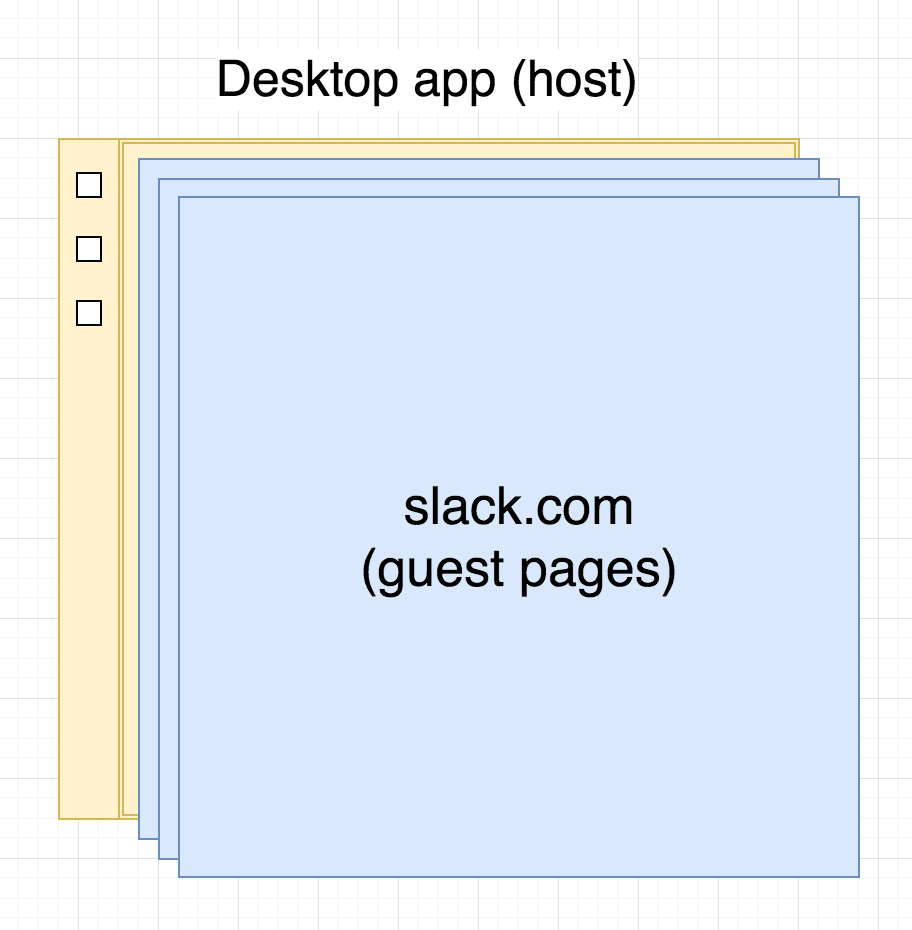
It’s like a browser that only takes you to Slack.com

The desktop app is a host for some number of guest pages. The guest pages are like browser tabs pointed at slack.com, which we call the webapp. Although the webapp is on its own quest for modernity, this post is about the Electron container around it.

You might think there’s not much to embedding a web page, but like the 1990 classic Tremors, there’s a lot happening underground. Support for multiple workspaces is the main customer-facing feature, but much of our codebase is devoted to creating a layer of native integration that most folks don’t notice until it’s gone:

  • Support for notifications across all platforms — even Windows 7
  • Support for spell-check and language detection
  • App, tray, taskbar, and context menus
  • Support for deep-linking, launch on login, taskbar and dock badging
  • Installers for all platforms — mainly Windows

With that distinction made, let’s talk about why we needed an overhaul.

I Can’t Believe It’s Not BrowserView

We host pages using an Electron feature called webview. You can think of the webview as a specialized iframe with concessions made for security: it runs out-of-process and lets you avoid polluting the guest page with Node. Although we (and others in the Electron community) have found it to be a spawn point for bugs, until recently it was the only secure way to embed content. Since it’s implemented in Chromium and imported wholesale into Electron, we can’t tinker with it as easily as other APIs. And since it’s used only by Chrome extensions — not the tabs themselves — issues filed against it can languish. Besides renderer crashes during drag & drop and a litany of focus issues, the worst problem we faced was that sometimes, after a webview was hidden, it would not render content the next time it was shown.

Unfortunately for Slack, the webview was the linchpin of the app. There’s a view for each workspace and switching between them is a visibility toggle.

Should be fine, right…?

Narrator: It wasn’t. (Photo in background by barackobamadotcom licensed under Creative Commons)

In hindsight, we spent more time than we should have trying to work around the problem on our end. We considered trade-offs no responsible engineer should face: should users sometimes see a blank page or always have idle CPU usage?

While we were exploring the boundaries of our creativity, the folks at Figma had already abandoned ship and begun on a new strategy for embedding web content. Enter BrowserView. Their post goes into more detail, but in a nutshell:

  • It behaves more like a Chrome tab than the webview does
  • It’s used more like a native window than a DOM element

What we mean by that is — unlike the webview — you can’t drop a BrowserView into the DOM and manipulate it with CSS. Similar to top-level windows, these views can only be created from the background Node process. Since our app was written as a set of React components that wrapped the webview, and — being React — those components lived in the DOM, this looked to be a full rewrite. But we needed to make haste, since users were encountering problems on a daily basis. So, how did we manage to pull the rug out from under our furniture without moving it first? Were there any design decisions that helped us out?

It turns out there were, or this would be a very short post. There are three parts of our client stack worth mentioning:

  1. How we manage Redux stores
  2. How we manage side-effects / async actions
  3. How we refactor code rapidly

🔄 Sync About It

Like every webapp written circa 2017, Slack uses Redux. But unlike most Redux apps, Slack sometimes has to synchronize data between stores. That’s because instead of one tidy little process, we’ve got oodles of them.

All Electron apps have a main process that runs Node, and some number of renderer processes that are old-fashioned, card-carrying web pages, complete with a document, a body, and stifling inconsistencies between Mac and Windows.
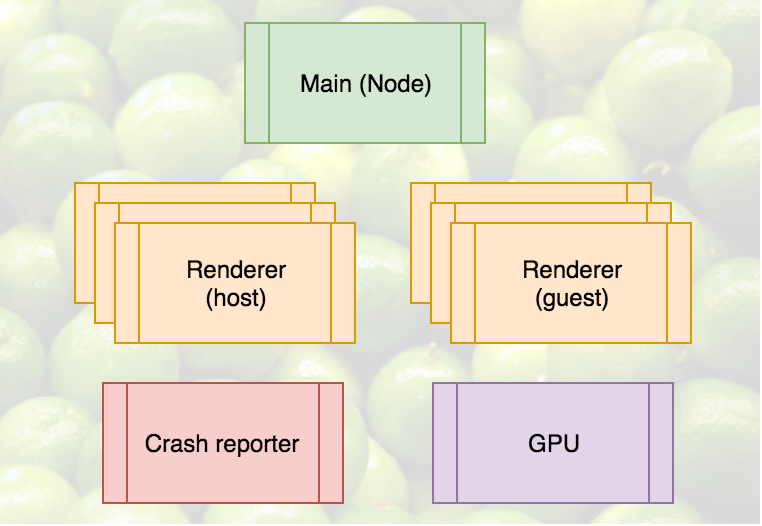
Tag yourself (Photo in background by Steve Hopson licensed under Creative Commons)
“How could you possibly need that many processes?” — every Slack customer, to us

Not only do we have one process per workspace, but we might also have a process for the modal dialog you’re interacting with, a process working quietly in the background, or a process to show you a notification when you’re on a platform that doesn’t support them (here’s to you, Windows 7). All these disparate processes often need access to the same state, so in a leap of faith, they each create a Redux store and set it up with a clever middleware called electron-redux. It uses Electron’s IPC to bounce actions between processes, like so:

  • If an action is dispatched in a renderer process, that renderer ignores it and forwards it to the main process
  • If an action is dispatched in the main process, it is handled there first, then replayed in the renderers

This makes the main process’ store the One True Store, and ensures that the others are eventually consistent. With this strategy, there’s no need to shuttle state or get into the serialization game. The only things that cross a process boundary are your actions, and hopefully those are already FSA-compliant. For us this means that our Redux code is virtually process-agnostic: the actions can come from any process; the reducers can live in any process; the work gets done all the same.

🚌 It Was Super (Side-)Effective!

One oft-expressed critique of Redux is that asynchronous actions — and their side-effects — are a bit of an afterthought. There are dozens of solutions out there and since none of them are included in Redux, it’s up to you to choose what best fits your app. Slack’s desktop app preaches the gospel of Observable, so redux-observable was a natural fit for us. If you’re acquainted with Observables, you may have heard the mantra Everything is a Stream. And lo, what is a store but a stream of actions?

In redux-observable, you’re given that stream of actions as an input, and you write “epics” (like a saga but more Homeric) that manipulate it. It’s worth noting that the values emitted by this stream are the actions, not the reduced state. Here’s a contrived example, where we show a sign-in BrowserWindow on startup, if we’re not signed into any workspaces:

https://medium.com/media/d86a9d13ac811d66c49ea06eea520d42/href

This lets us compose sequences of actions, which is sometimes more valuable than looking at the byproduct of the actions (the state). Any objects returned from the stream are automatically dispatched as actions, but nothing says you have to emit an action. Oftentimes we just want to call an Electron API. Redux refers to this as a “side-effect,” but I refer to it as “doing my job.” It becomes really powerful when combined with a Redux store in each process, because now we can kickoff main process side-effects from a renderer and vice-versa, in a decoupled way. It’s similar to an event bus or pub-sub, but across Chromium processes.

How about a more involved example — what if we needed to keep a running total of time spent in different workspaces, to determine which ones were most and least used? This could grow into a mess of timeouts and booleans, but since the stream of actions is an Observable, let’s leverage the suite of operators that come with it:

https://medium.com/media/50bb5a42b5b8ed7c2663601245a9fc9e/href

You might be like, “Charlie, that sure looks fancy, but aren’t Observables impossible to debug?” And you’d have been mostly right less than a year ago. But this is JavaScript and in JavaScript, the only const is change. rxjs-spy makes debugging (i.e. logging and visualizing) streams as simple as adding a tag. A tagged stream can be monitored, paused, and replayed, right from the console. Testing Observables is a delight too, with the help of the utilities in RxSandbox (by our own OJ Kwon):

https://medium.com/media/513d301c9e099fbd2fa412a970e56ed1/href

What we’re doing here is creating a mock stream of actions, and providing it as the input to the epic. We define the stream with a marble string, which looks odd but is quite simple: any letter represents an action, and a - represents 10ms of virtual time. We can make assertions about the action we expect from the epic, and there’s no need for async or callbacks here — flushing the scheduler runs the clock to completion.

🎯 Refactor feat. TypeScript (Club Mix)

With the exception of LSD, there’s no shorter path to questioning your reality than embarking on a large refactor in a JavaScript codebase. Here a linter is like an over eager sidekick: it means well, but is mostly a distraction. “Don’t put parentheses there,” it chides, while the bug slips away. A type-checker, particularly when integrated with an editor, is the Watson you deserve.

Of course there’s an upfront cost — one that we had already paid — but that investment saw major returns throughout this project. Much of the work involved rearranging existing features, and a type-checker helped us avoid what would have typically been a long tail of bug fixes. It also makes working with Observables more natural. Never again will you ponder over the output of a flatMap (do I get the array or just one item?), the argument order for a reduce, or the name of that one operator that’s like throttle but starts with a D… (it’s debounce). When coupled with autocomplete in VS Code, writing JavaScript feels a lot like writing, say, C#. And I mean that in the nicest way possible. 😬

💪 No Main (Process), No Gain

Sometimes, when you haven’t used a workspace in a long time, we take the same approach as Chrome and unload that “tab’s” webContents to save memory. We still need to show notifications and badges for that workspace, so previously we would navigate to a slim-Slack page that responds to a handful of web-socket messages. Once selected, we stealthily disposed of the intermediate page and spun up the full webapp in its place.

Somewhere along the way, we had a realization: why not run all of the slim-Slacks in the main process, instead of each having their own page (and incurring the overhead of a renderer process)? This dovetailed nicely with our effort to make Redux actions process-agnostic: we could just as easily dispatch actions from the main process to update badges or show notifications. All we needed to do was connect to the web-socket from Node, something our colleagues down the hall knew a thing or two about.

With this change, customers signed in to a lot of workspaces will see a drop in both memory usage and number of processes:
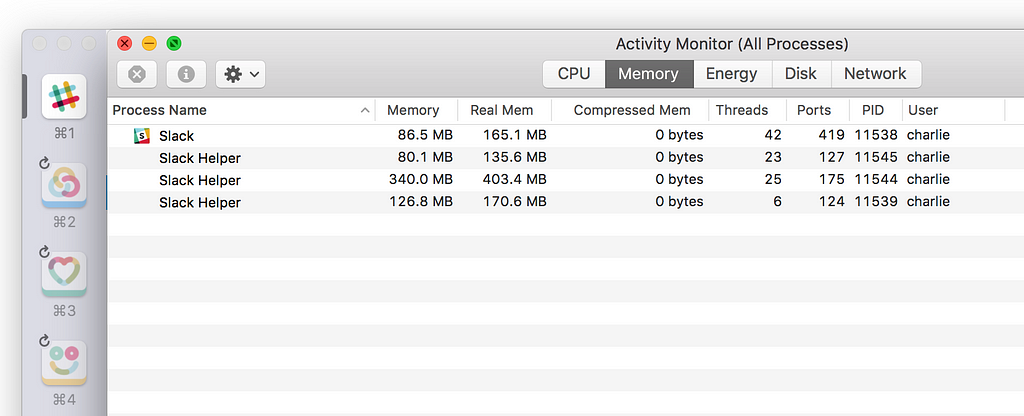
Four workspaces = seven processes? That’s just bad math.

🗣 TL;DR

So, to wrap it all up: we rewrote most of our Electron app to move from the janky webview to the new-fangled BrowserView. We managed to do it in a relatively short timeframe, thanks to a combination of elbow grease and reasonable choices in our client stack, like:

  1. Redux + redux-electron: Means we don’t have to think about where reducers live or where actions are dispatched
  2. Rx + redux-observable: Turns our store into an interprocess event bus with functional superpowers
  3. TypeScript: Helps us refactor code quickly and correctly

While it can be tempting to scrap a codebase and go back to green(field) pastures, particularly when faced with a mountain of bugs, this rarely works out for customers. When all was said and done, we reused more than 70% of our code, fixed most, if not all, of the webview’s shortcomings, doubled our test coverage, and substantially reduced memory usage. We think it’ll show in the user experience, but you, dear reader, can be the judge of that. ✌

If any of this sounds interesting and/or terrifying to you, come work with us!


Growing Pains: Migrating Slack’s Desktop App to BrowserView was originally published in Several People Are Coding on Medium, where people are continuing the conversation by highlighting and responding to this story.

03 Nov 22:33

Halloween Hot Spots

by Ken Ohrn

Thanks to SFU‘s Andy Yan, the Duke of Data, and occasional PT contributor.

Halloween.Hot.Spots

Halloween.Hot.Spots.2

As usual, click to enlarge.


03 Nov 22:33

Want Stronger Culture? Stop Leading, and Start Designing

by djcoyle

Every leader wants to create strong culture. After all, culture drives group performance (a tidy 756 percent increased in net revenue over 11 years). As the old saying goes, culture eats strategy for breakfast, lunch, dinner, and midnight snack.

The problem, of course, is that creating culture is a wildly mysterious process. It’s hard to measure, impossible to mandate, and easy to mess up. As such, it’s easy for leaders to fall into the trap of treating culture as something slightly beyond your control; to presume that certain people are born with the uncanny knack for creating culture; others aren’t.

There’s a better way. And I recently bumped into an excellent example, on the big island of Hawaii, home to a unique gathering called The Lobby.

The Lobby is a three-day gathering of 200 or so tech people and investors. It began eleven years ago when a venture capitalist named David Hornik grew weary of sitting in darkened rooms listening to people speak, while all the fun and useful conversations happened outside in the hallways. So Hornik hit upon an idea: to create a conference that flipped the conventional model on its head. No speakers, no auditorium, no official theme or agenda; just the lobby.

I can report that Hornik has succeeded to a wildly impressive extent. To put it simply, The Lobby is a complete blast: a high-energy gathering that leaves you brimming with new ideas and new friends. If my new book weren’t already written, I’d be tempted to include The Lobby as a case study because, to use the term that many longtime attendees use: it’s addictive. Hornik has built an amazing group culture, seemingly out of thin air.

The key is that Hornik doesn’t “lead” in the conventional sense of the word. He doesn’t outline a vision, or mandate actions from the top down. Instead, he thinks and behaves like a designer, engineering the culture from the bottom up. His main tool is a set of what psychologists call signaling behaviors: actions that carry the power to influence others.

Here’s how he does it:

• Before you go, Hornik’s team helps attendees create and share something personal with the entire group. It might be a postcard with biographical details and a photo of their favorite place, or short video tour of everyone’s office, or a baseball-type “trading card” — the only rule is that it conveys their personality and backstory.

• When you arrive, Hornik sets out the prime directive: everything said at The Lobby is 100 percent private. No social media, no journalists, no publicity.

• The first morning, you are randomly combined into six-person teams to play The Game, a three-hour series of puzzles and riddles. It’s silly, fun, complex, and creates high levels of cooperation, effort, and excitement.

• The core of the conference consists of “User-Generated Conversations.” These are questions, suggested by attendees, which focus on questions that people really want to talk about. (Examples: Is a 4-year college a waste of time and money? What does the future of work look like? How can we help kids deal with anxiety?)

• In the conversations, there are no chairs; just beanbags strewn on the lawn or in a room. People carry them to choose what conversations they want to be part of.

• Through it all, Hornik plays the role of pied piper, donning goofy outfits, connecting people, and modeling a kind of openness that creates more openness (he even brought along his parents).

When you look closer, Hornik is using two core signaling behaviors:

  • Signaling Behavior 1: You are safe.
  • Signaling Behavior 2: We share risks. 

Every element of the Lobby — the sharing of bios, the rule of secrecy, the shared games, the shared conversations, the beanbag chairs — toggle between two these core signals, either creating a sense of safety (we are connected; we share a future) or shared vulnerability (we take interpersonal risks together).

When combined, they create a feedback spiral of interactions that generates every-higher levels of group closeness and cooperation. Safety generates vulnerability, which generates even more safety, which generates even more vulnerability, and so on. The group chemistry and connection this creates might feel magical, but in fact it’s closer to inevitable.

So if you want to think like a culture designer, here are a few pointers:

• Make sure the leader is vulnerable first: this grants the group permission to do the same. One trusty method: share an embarrassing story.

• Ruthlessly eliminate default forms of status and power: the best way to do this: give each person a voice and a genuine opportunity to use it.

• Beware bad apples: they can destroy group safety in an instant. As Hornik puts it, all the social engineering in the world won’t fix a dysfunctional group of people.

PS – If you want to read more about Hornik, please check out Adam Grant’s terrific book, Give and Take).

The post Want Stronger Culture? Stop Leading, and Start Designing appeared first on Daniel Coyle.

03 Nov 22:33

Spotted: Autumnal views

by dandy

View from the William G. Davis Trail in Trillium Park at sunrise

What: Autumn finally arrives in Toronto.

Where: Richmond Street bike lane and the William G. Davis Trail in Trillium Park.

Why we think it's dandy: Changing colours and fallen leaves on some Toronto's bike lanes and trails give riders gorgeous views on their daily commutes or lake side rides. It the perfect time of year to catch a sunrise (around 7:45 am), before we settle into bare trees and frigid temperatures.

P.S. Don't forget your lights, layers (including gloves) and to take it slow when it rains. Leaves can make the roads extra slick this time of year.
In case you missed it, check out the post How not to fail at fall cycling.

Submission by: Amanda Giacomazzo

 The Richmond Street bike lane

03 Nov 22:33

@stoweboyd

@stoweboyd:
03 Nov 22:32

mapsontheweb:Percentage of Galician speakers in Galicia, 2001.


mapsontheweb:

Percentage of Galician speakers in Galicia, 2001.

03 Nov 22:32

The Missouri Compromise of 1820, which allowed Missouri to enter...


The Missouri Compromise of 1820, which allowed Missouri to enter the union as a slave state but otherwise forbade slavery above the 36th parallel, effectively drew the lines for the sectional battle to follow. (via A Refusal to Compromise? Civil War Historians Beg to Differ)

03 Nov 22:32

Breaking the Waves

by Olivia Rosane

I spent this summer wandering along the high-water mark of future floods. As part of a project to envision a climate-changed London, I walked through Thames-front neighborhoods, trying to determine which parks and buildings would be oversurged by storms and tides and which would rise high enough for survivors to use as shelter. My guide in this effort was a map, “Surging Seas, Mapping Choices,” designed in the run-up to the 2015 UN Climate Change Conference that resulted in the Paris Agreement (the accord that President Trump recently pulled the U.S. out of). The map — made by Stamen Design, a San Francisco firm, using research conducted by Climate Central, a climate reporting organization run by journalists and scientists — allows viewers to compare the water levels projected to result from various global warming scenarios. Just type the name of a coastal location into the search bar, and the map shows you water levels after two degrees Celsius of warming (a long-discussed international target) and four degrees Celsius (the predicted consequence of business as usual).

As its name implies, the map is intended as a warning and a call to action. Overlaid fonts in traffic-cone orange and yield-sign yellow try to visually mark the urgency. But on the map itself the still dry land is coded a calming slate-gray, while the rising water is a soothing middle blue. Zoom in close enough, and you can see transparent aquamarine washing over the satellite images of buildings, the new shoreline always composed of crisp, rational straight lines.

The map is too precise and attractive to instill fear. Instead, it makes an out-of-control future look exactly predictable: These buildings will be swallowed, but not those

The map is too precise and attractive to instill fear. Instead, it makes an out-of-control future look exactly predictable: These buildings will be swallowed, but not those. And the swallowing appears as such a clean process. The buildings beneath the waterline remain intact, merely covered with blue. There’s no suggestion of damage or debris. And the difference between water levels is the work of a mouse-click. The designers of the map hoped to encourage viewers to believe that they could determine the future by lobbying governments to push for lower emissions in Paris, but the map itself suggests that control over the climate could be much more direct and much less hard-fought. Don’t worry, the graphics say, even if the water rises, it will rise in a neat and orderly progression.

Wandering through London with this map in my palm, down streets without vistas bordered by rows of brick houses, I found it hard to imagine what the world it predicted would look like, unpixelated and in three dimensions. The district of Wapping, for example, whose Rose Garden will be an island after four degrees of warming, is a place of narrow cobblestone streets and quaint, light-blocking row homes. You can’t always see the river even when a map tells you you’re walking beside it. I found a gap between a brick pub and a private dock, and it was like a secret door to a different world: I descended a flight of seaweed-coated steps and stood on a beach of pebbles brightened with terra-cotta pottery shards, looking out at a gray river lapping at the stones with a sound like sleep-deep breathing.

The tranquility of the scene matched the calming lines and colors on the Surging Seas map. Looking from Thames to palm, it was possible to gently imagine this space expanded up to the green grass of the Rose Garden, the red brick and pale cobbles of the surrounding streets long since broken into pebbles and lapped by waves on a new beach. Neither image helped me visualize the violent transition that would occur between the two, the winds and waves that would break down the buildings and scatter the people inside them. There is no connection between the clear blue and crisp lines of the Climate Central map and the recent photographs of flooding I’ve seen coming out of Houston, Bangladesh, and Puerto Rico, of high-piled debris and streets turned into muddy rivers.

The Climate Central map was an invaluable resource, and I relied on it so heavily for my project that it feels ungrateful to reprimand it. And it is by no means unique in having an aesthetically pleasing presentation that runs counter to the devastating consequences it seeks to represent. National Geographic, for example, published a series of maps inviting readers to “explore what the world’s new coastlines would look like” if all the sea ice melted, depicting the continents in resplendent, earth-from-space jewel tones. Geology.com’s sea-level-rise map has a relatively primitive, early-web design, but it still allows you to zoom in on different locations and alter sea-level rise with a drop-down arrow key, as if you were playing a very basic computer game. Its colors are also pleasing cobalt blues for sea and pale greens or light ochres for land and not the turgid browns and grays of actual storm surges.

Temperature projections also can be surprisingly attractive. A map showing that the average summer temperature in North Africa and the Middle East will increase by five degrees Celsius by mid-century if business continues as usual paints the region in a vibrant crimson offset by patches of hotter maroon and cooler tangerine. The image is dotted with small black circles, which actually indicate that all 26 climate models used to predict the increase are in agreement, but aesthetically they still soften the visual impact of the map. The bright colors and regular pattern suggest the fabric for a child’s summer dress.

Designed to show inputs and outputs, maps and models can’t easily represent process. They tend to obscure the truth that the main danger of climate change is change: which means mess and violence and fleshy bodies against heat and water. The dominance of such maps in the visual culture of climate-change discourse makes the process of change appear much neater and more controllable than it actually has been or will be.

There is a delicate balance between depicting climate change as urgent enough of a problem to inspire action, and inundating viewers with paralyzing images of apocalypse. In “Communicating Climate Change: Closing the Science-Action Gap,” Susanne C. Moser and Lisa Dilling discuss how fear-based appeals without any accompanying action plan lead to “denial, numbing, and apathy.” The designers of these maps do not want to frighten people away from engaging. However, the false reassurance of the aesthetically pleasing images can lead to a different kind of paralysis: the false political reassurance that the panels of experts, private interests, and global summits that have been consistently convened to try to get us out of this crisis will eventually get it right without our having to do anything.

Take Mission 2020, which sets itself the laudable goal of “bending the curve” on carbon emissions by 2020, with an eye on reaching zero emissions by 2050. On its website one sees first a statement of purpose in bold white against a gradient of crimson and orange. The background choice is confusing, since it at once suggests the hotter temperatures the Mission hopes to avoid and makes them look surprisingly appealing. The white text laying out the goal is especially striking against the bright orange background; it does not look like a future to avoid at all costs. Scrolling down, one next sees a lineup of six hoped-for milestones in bright, primary colors: for example, “renewables outperform fossil fuels” and “heavy industry … commits to being Paris compliant.” There is apparently nothing the ordinary visitor needs to do to bring about this bright future but scroll down even further and buy a T-shirt that reads “Stubborn Climate Optimist.”

Mission 2020’s chances of success appear to rely entirely on the innovations of the well-educated and the actions of the powerful. Its website proclaims its benchmark to be “achievable” because “renewables are rapidly falling in price,” “technological progress on battery storage” is improving the performance of renewables and electric cars, and business leaders, cities, and the financial community are working on solutions. There is no mention of the fact that chasing cheaper, more efficient energy is how we warmed the planet in the first place. Nor does the website address the question of what happens when profits and climate action clash. The auto industry might be coming around on electric cars now, but in 2001 GM famously killed their own electric model after lobbying successfully to weaken the California legislation that had required they build it. And if renewables are doing well now, it is partly thanks to the activists who pushed for laws requiring states and countries get a certain percentage of their energy from clean sources; half the investments in Germany’s green energy boom came from individual citizens or citizens’ energy associations.

The mission is spearheaded by Christiana Figueres, the former executive secretary of the UN Framework Convention on Climate Change who helped broker the 2015 Paris Agreement, and I sincerely wish her every success in this endeavor. But it seems naive to expect business leaders, governments, and financial tycoons to turn the tide on climate change without massive grassroots pressure from the rest of us. Now is not the time to be lulled into the dream that we can sit back and watch the corporate PowerPoint presentation. Yet this is the aesthetic the Mission 2020 site most suggests.


Why do mainstream climate organizations rely on the visual language of data, focusing on representing “degrees hotter” and “meters higher” instead of lives lost or homes swallowed? By placing an emphasis on the facts of climate change rather than its human consequences, centrist liberals can turn climate denial into a bigger enemy than climate inaction. In a recent segment, for example, Samantha Bee led a group of climate skeptics through a “Hell House” of climate-change predictions. The punch line was that the one guest to change her mind changed it not from fear of any vision in the house but because the other invitees were so obviously ignorant, she feared to be publicly associated with their views. By focusing on changing minds, with a few jokes at the expense of the dummies thrown in, you never have to answer the truly frightening question of what to do once all the minds have been changed.

Now is not the time to be lulled into the dream that we can sit back and watch the corporate PowerPoint presentation

The centrist use of fact dissemination as a bulwark against radical action extends beyond climate change. Writing after Brexit and the election of Donald Trump, Bue Rubner Hansen and Rune Moller Stahl argue that liberals have emphasized a vision of government as fact-based administration. In fact, one of the great lies of the neoliberal era was the assurance that formerly political concerns could now be managed by experts rather than debated by real life stakeholders. In Francis Fukuyama’s “The End of History,” one of that era’s opening salvos, he claimed wistfully that, after the fall of the Berlin Wall, the “worldwide ideological struggle” would be replaced by “the endless solving of technical problems” and “environmental concerns.”

One example of this mentality in action is the graphic and map-filled election night coverage, which, up until 2017’s surprise, might have tricked viewers into thinking the results have more to do with Nate Silver’s projections than with door knocking. According to Politico, the Clinton campaign even ordered a group of SEIU members, who were anxious about Michigan and wanted to canvas there, to turn around and return to Iowa because the campaign’s models told them Michigan was safe.

Brexit and Trump prove definitively that the expert control of politics is over. But climate change still presents a special dilemma for anyone clinging to both fact-based leadership and neoliberal capitalism. All the smartest people in the relevant fields agree that climate change is happening and is caused by humans. And all those people haven’t been able to do anything about it because capitalism has gotten in the way. The first Intergovernmental Panel on Climate Change was established in 1988, a year before Fukuyama penned his essay. Five IPCCs later, and 2016 was the hottest year on record.

That is because climate change is not merely a technical problem; it is an inherently political one: a question of who has the power to profit from polluting and who is left to pay the price, in flooded homes, droughts, and worse. This is not to say that technology can’t help curb emissions, but its effectiveness will always be constrained by political forces. For instance, Naomi Klein, in an interview about her book This Changes Everything, discusses how Germany has managed to get 25 percent of its energy from renewable resources yet its emissions are still up because the country still mines and exports coal, and “Angela Merkel refuses to stand up to the coal lobby.” World Trade Organization rules often hamper green energy innovation. In another example from Klein’s book, a law designed to wean Ontario off coal by 2014 was struck down by the WTO because it allowed renewable energy companies to sell power back to the grid if 40 to 60 percent of their materials and workers were local, something that violated the organization’s ban on laws that distinguish between local and international companies.

Climate change will not be solved by appealing to the status quo because the status quo is designed to protect the profits of international firms above all else. No wonder then that centrist liberals, forced to choose between markets and facts, retreat into graphic fantasy. Stamen Design, the firm behind the Climate Central map, also did data visualization for Toyota i-Road, a sustainable, three-wheeled vehicle, ahead of its 2015 test drive by tech luminaries and car enthusiasts in San Francisco. When corporate greenwashing and climate-change models share a glossy visual language, all sense of struggle, in both the hopeful and harrowing sense of the word, is erased. Climate change then appears like something safely out of ordinary hands, when in fact it will take all hands to slow it and to care for those it has already displaced.

Scientist Brad Werner developed a computer model of interactions between humans and the environment that revealed that the one human action that had a chance against climate change was popular resistance on levels analogous to the civil rights or anti-slavery movements. According to the summary of his research at Slate, “every other element — environmental regulation, even science—is too embedded in the dominant economic system.” What’s needed is to jolt nonscientists, ordinary people, out of the illusion that they can rely on staid experts to resolve this crisis. In a small effort toward this end, Werner gave his presentation of this research at the 2012 American Geological Union meeting a pointed title: “Is Earth F**cked?” He said the irreverence of his title was sparked by his friends who were depressed not by the good climate science being done to predict the future “but by the seeming inability to respond appropriately to it.”

That doesn’t mean there isn’t an appropriate response. It’s a response that refuses to wait on politicians or technocrats. Klein refers to a “Blockadia” movement, a loose network of ordinary people putting their bodies in between the earth and new means of extracting fossil fuels, as at the protest camp at Standing Rock against the Dakota Access Pipeline. But this too is dangerous and messy, much harder than choosing a certain number of degrees of warming on an interactive map. When you look at the videos that emerged from the camp resisting the Dakota Access Pipeline, you see an eerie echo of the news images of floods and hurricanes: fleshy bodies against water.

It may be that recognizing ourselves as this vulnerable is the only way we will save ourselves. Right now, the communities leading the direct action fight against climate change are often, like the Standing Rock Sioux, indigenous groups who are fighting the encroachment of fossil fuel companies on their local environments. As the already vulnerable will disproportionately suffer from climate change itself, the already vulnerable pay a disproportionate price to fight it: 40 percent of those murdered for environmental activism in 2015 were from indigenous communities. For many of these groups, fighting climate change is not an abstract mission but part of the work of caring for and protecting their very specific homes.

It is that local detail that is partly missing in maps and models intended to synthesize data points into a single narrative. The neat images which summarize that work obscure the labor that went into them as well as the action needed to prevent them. In an interview in Art in the Anthropocene, Bruno Latour talks about how Charles Keeling, whose measurements of carbon dioxide in the atmosphere at the Mauna Loa Observatory in Hawaii first raised the possibility of anthropogenic climate change, got his data by “being there for everyday for 30 years, or even 50 years.” He calls this patient observation, “the science of care.” That sense of care is lost when you look at the zipper-like upsweep of the Keeling Curve.

But it is care that must be central to the discussion around climate change, because it is care that has been sidelined by the economic forces that unleashed it. Lowering emissions in time to avoid more hurricanes means committing to the belief that nothing — no invention, no profit motive, no growth opportunity — is more important than the preservation and flourishing of life, human and otherwise. Perhaps such care cannot be effectively mapped. It can only be enacted.

03 Nov 22:32

Why they call it Bayshore Gardens

by pricetags

Bayshore Gardens (once the parking lots of the Bayshore Hotel) was one of the six (or seven, or eight – depending what you count) of the megaprojects underway in 1990s Vancouver.

It was the least urban of the projects, with little mixed use, considerable setbacks and and abundance of parks and gardens.  Nor were the streets an extension of the existing grid; indeed one had a bit of a suburban jog in it to discourage through traffic. And even though they were a little too wide, they were heavily planted and landscaped, so the boulevards and setbacks bled into the gardens and parks.

Like this:

Michael Geller, the project manager, recalls the street trees being planted in 1994.  Jane Durante of Durante Kreuk, the landscape architects, believes them to be red maples, now almost a quarter century old.

It’s a great illustration of how to create a bucolic setting literally a few metres from one of the widest, busiest streets in the city.  Go here, where the images were taken, and explore the gardens for yourself.


03 Nov 22:31

Percentage of People Who Married, Given Your Age

by Nathan Yau

Or, given your age, the percentage of fish left in the sea. Here's a chart. Read More

03 Nov 22:14

A simple Google Sheets hack for project planning

by Josh Bernoff

If you’re working on a simple project with a small team, there’s no quicker way to keep track of everything than to use Google Sheets. All you need is a tiny bit of discipline. There are scores of sophisticated tools for project management. Or, you could link your to-dos lists together, provided your team all … Continued

The post A simple Google Sheets hack for project planning appeared first on without bullshit.

03 Nov 22:13

Daily Bonus

by Richard Millington

The strength of most community platforms is they are asynchronous.

If someone doesn’t login today, they don’t miss out on anything. They can catch up tomorrow.

But that strength is also a weakness. If you don’t need to visit today, then why bother? In fact, why not wait a few weeks?

A growing number of apps tackle this by incorporating the daily bonus.

If you don’t login that day, you miss out.

What would your daily bonus be? What piece of information, exclusive activity, or unique opportunity is only available today?

If you want someone to visit today, give them something that’s only available today.

03 Nov 22:12

Gauguin to Olive Garden

by Matt

[Gauguin] was penniless and adrift, trying to paint his way through the devastations of his dying marriage, his rejection by the cliques of the Parisian art establishment, and the precarity of his friendship with Vincent van Gogh, who shortly before Christmas had assaulted him with a razor and, after Gauguin’s departure that evening, used the same blade to cut off his own ear […] Despite the promises of the name, it can be a challenge to find actual olives at Olive Garden.

Probably my favorite food writing I've read this year is Helen Rosner's comprehensive review of Olive Garden for Eater.

03 Nov 22:09

The Best Men’s Base Layers and Thermal Underwear

by lbutcher
The Best Men’s Base Layers and Thermal Underwear
Testers appreciated that the Smartwool Men’s Merino 150 Base Layer Long Sleeve had raglan sleeves, which prevent seams from rubbing your shoulders when you have a pack on.
To find the best men’s base-layer top and bottom, we sent 11 testers skiing, running, mountaineering, rock climbing, and sports-game spectating in 20 long-sleeve tops and 16 bottoms for four months. The anti-stink Smartwool Men’s Merino 150 Base Layer Long Sleeve and Icebreaker Men’s BodyfitZone Zone Leggings both kept us toasty in the cold, yet cool when we were playing hard.
03 Nov 22:09

The Apple Watch Is the Best Smartwatch for iPhone Owners

by Nick Guy
The Apple Watch Is the Best Smartwatch for iPhone Owners
The larger screen of the Series 4 lets you see more information than on the Series 3.

After our tests of every version of the Apple Watch since the original, the Apple Watch Series 4 is the easiest smartwatch recommendation we’ve made. It’s the best option for iPhone owners who want to keep their phone in their pocket while keeping up with notifications, tracking their fitness, getting directions, and using apps. And the Series 4’s new, larger screen makes it worth splurging on.

03 Nov 21:13

Nimbys Nixed In Kerrisdale

by Ken Ohrn

Vancouver City council has unanimously approved the Ryerson development in Kerrisdale.

Justin McElroy writes on CBC News.

By a 10-0 vote, councillors approved rezoning parts of two blocks at West 45th Avenue and Yew Street to allow an eight-storey residential tower and five-storey addition to Dunbar Ryerson United Church. . .

. . .  But 74 per cent of correspondence the city received from residents prior to a public hearing was in support of the project, and 20 of 29 people who spoke at the public hearing also supported the project.

More on the project HERE.


03 Nov 21:13

The Best Android Tablets

by Ryan Whitwam
The Best Android Tablets

If you’re not already invested in Android, an iPad is a better tablet in general than any current Android tablet, even for people who need to use Google’s apps and services. But the best device for people who really do want an Android tablet right now to run specific apps or as a basic media device is the Huawei MediaPad M5 8.4. It’s not the cheapest or most powerful Android tablet, but it offers the best combination of speed, display quality, software, and affordability.

03 Nov 21:13

Did Kevin Spacey just post the worst apology ever?

by Josh Bernoff

Anthony Rapp, the actor now appearing on “Star Trek: Discovery,” says Kevin Spacey sexually assaulted him when he was 14. Kevin Spacey apologized by saying he was gay. This is wrong on so many levels. Rapp was a child actor appearing on Broadway in 1986. As he told BuzzFeed News, he remembers going to Spacey’s … Continued

The post Did Kevin Spacey just post the worst apology ever? appeared first on without bullshit.

03 Nov 21:13

Chuck Moore, Extreme Programmer

by Eugene Wallingford

If you have read any of Chuck Moore's work, you know that he is an extreme programmer in the literal sense of the word: a unique philosophy that embraces small, fast, self-contained programs in a spare language and an impressive development environment. But as I read the opening sections of Moore's book Programming a Problem-Oriented Language, I began to mistake him for an XP-style extreme programmer.

Here is You Aren't Gonna Need It or, as Moore says, Do Not Speculate!:

Do not put code in your program that might be used. Do not leave hooks on which you can hang extensions. The things you might want to do are infinite; that means that each one has 0 probability of realization. If you need an extension later, you can code it later - and probably do a better job than if you did it now. And if someone else adds the extension, will they notice the hooks you left? Will you document that aspect of your program?

Moore also has a corollary called Do It Yourself!, which encourages you, in general, to write your own subroutines rather than import one a canned subroutine from a library. That doesn't sound like Doing the Simplest Thing That Can Work, but his intent is similar: an external routine is a dependency, and it probably doesn't match the specific needs of the problem you are solving. Indeed, Moore closes this section with:

Let me take a stand: I can't solve the problems of the world. With luck, I can write a good program.

That could well be the manifesto of XP.

In the next section, a preview of the rest of the book, Moore tells his readers that they won't find flowcharts in the pages to come documenting the algorithms he describes:

I've never liked them, for they seem to include a useless amount of information - either too little or too much. Besides they imply a greater rigidity in program structure than usually exists. I will be quite specific about what I think you should do and how you should do it. But I will use words, and not diagrams. I doubt that you would give a diagram the attention it deserved, anyway. Or that I would in preparing it.

Other than using a few words, he lets the code stands for itself. Documentation would not add enough value to outweigh the cost of preparing it, or reading it. Usually, the best thing to do with Moore's books is to Listen To The Code: settle into your Forth environment, type the code in, run it, and learn from it.

There is no accounting for my weird fascination with stack-based languages. Chuck Moore always give me more to think about than I expected. I suspect that he would be at odds with some of the practices encouraged by XP, but I often feel the spirit of XP in his philosophy.

03 Nov 21:12

Twitter Favorites: [chenoehart] Periodically wishing I could block an individual viral tweet.

Chenoe Hart @chenoehart
Periodically wishing I could block an individual viral tweet.
03 Nov 21:12

New Book: The Monsters of Education Technology 4

The fourth book in my “Monsters of Education Technology” series is out. As with the other books in the series, it’s a collection of talks I’ve given through the course of the year.

E-book versions are available for purchase via the usual online retailers: Amazon and Smashwords. Even better (as far as my royalties go, at least): you can buy from me directly via Gumroad. You can purchase the e-book there (a ZIP file that contains the MOBI, EPUB, and PDF versions) for $4.99. You can, of course, just read most of the content here on Hack Education for free.

The Monsters of Technology 4 is likely the last book in the “Monsters” series, and as I’m switching my focus to finally finishing Teaching Machines, it’ll be my last book for a while. (I will try, however, to get print books and audio books of all four books in the series finalized – probably some time in mid–2018.)

03 Nov 21:12

Google Will Now Enable Pixel Visual Core on Pixel 2 in Android 8.1 Developer Preview 2

by Rajesh Pandey
Last month Google had revealed that the Pixel 2 and Pixel 2 XL feature a Pixel Visual Core chip for HDR+ processing purposes. The chip, however, was disabled by default and the company planned on enabling it with the Android 8.1 Developer Preview first. Continue reading →
03 Nov 21:10

Facebook reports $4.7 billion net income in Q3 earnings

by Sameer Chhabra
Facebook app on phone

Facebook is having a great financial year, reporting a 79 percent increase in year-over-year profits compared to 2016.

The Silicon Valley social networking giant — and quasi-media company — reported a net income of $4.71 billion USD in its 2017 third-quarter earnings, in comparison to the $2.63 billion USD it reported on September 30, 2016.

According to a November 1st, 2017 media release, the social network also enjoys 1.37 billion daily active users, as well as 2.07 billion monthly active users.

That’s a 16 percent increase in both daily and monthly active users.

Just to put Facebook’s user figures into perspective, the population of China is approximately 1.379 billion, while the population of India is approximately 1.32 billion.

“Our community continues to grow and our business is doing well,” said Mark Zuckerberg, Facebook’s founder and CEO. “But none of that matters if our services are used in ways that don’t bring people closer. We’re serious about preventing abuse on our platforms. We’re investing so much in security that it will impact our profitability. Protecting our community is more important than maximizing our profits.”

Facebook’s success is shadowed, however, by the ongoing U.S. investigations into Russian election manipulation.

Facebook — as well as other major American social networks and tech companies — are currently involved in U.S. Senate hearings to determine the full extent of Russia’s manipulation of the November 2016 presidential election.

The U.S. House of Representatives Permanent Select Committee on Intelligence released a series of social media posts connected to Russia-linked accounts, highlighting how Russia influenced American opinion through social media.

Facebook stock currently sits at $182.66 USD-per-share (roughly $234.96 CAD).

Source: Facebook

The post Facebook reports $4.7 billion net income in Q3 earnings appeared first on MobileSyrup.

02 Nov 16:24

Herb Auerbach on the Arbutus Greenway

by pricetags

Herb Auerbach, real-estate development consultant and author of “Placemakers” responded to this piece in the Sun on the Arbutus Greenway by Cheryl Chan:


“PLANS FOR ARBUTUS GREENWAY LACKS VISION AND IMAGINATION”

For over 10 years I have urged the City of Vancouver to recapture the Arbutus Right of Way from

CP Rail who I believed then, and believe now, that once they ceased running trains on it they were obliged under the Transportation Act to cede the rail right of way to the Crown.

So I was pleased to learn  the City had finally acquired the right of way but was disappointed to learn that they had to pay for it.  I was also glad to hear that the current installation of a pathway and bike lanes is temporary and plans are afoot to permanently enhance what is now dubbed the “Arbutus Greenway”

So I went by Point Gray School to view the results of the “Design Jam” and speak with a number of the City representatives there.

I found little inspiration, and was further disappointed to learn that the project is in the hands of the City’s Engineering Department and not the City Planning Department.  When I asked, “why not the Planning Department?”  I was told this is just a narrow strip and has little effect on the abutting property. Of course it has effect on the abuttifng proiperties, and the Planning Department should be taking the lead on a project of this magnitude and import.

I was also disappointed to learn that the City has not given up on the idea of developing a portion of the Greenway to generate income , and I was further disappointed  to learn that the City deal only transferred the CP right of way to the Fraser River and not all the way to Steveston. The whole approach to dealing with this extraordinary opportunity to create something unique and grand,  seems lacking innovation, inspiration, vision and imagination.

Imagine a vintage  trolley car (not rapid transit) running from Science World to Steveston (and not just Granville Island as it does now or to the Fraser River as planned) and the positive impact it would have on  points along the way and the attraction it would have for tourists, and like the street cars in San Francisco would pick up and transport commuters along the way.

Imagine this right of way planted with 10,000 cherry trees and walking or riding along it and under them when they are in bloom.

Imagine the Greenway having special illumination, walkable and rideable by day and night, with points along the way for cafes where folks can rest, meet and converse.

Imagine a design which is the product of more imagination. …


01 Nov 20:27

Designing Cities for Automation

by pricetags

It’s the hot topic at the National Association of City Transportation Officials conference in Chicago at the moment, which has produced a special guide 

Wired has a feature:

Urban planners talk about two visions of the future city: heaven and hell. Hell, in case it’s not clear, is bad—cities built for technologies, big companies, and vehicles instead of the humans who actually live in them. And hell, in some ways, is here. Today’s US cities are dominated by highways there were built by razing residential neighborhoods. Few sidewalks and fewer bike lanes. It’s all managed by public policies that incentivize commuting in your car. Alone. Trapped in traffic.

This special hell we’ve created for ourselves has tech companies and visionaries proposing heavenly ideals for our earthly woes. Uber and Alphabet want to unleash fleets of unmanned flying cars and drones upon the world. Elon Musk wants to tunnel beneath cities and build fast-moving hyperloops. And then there’s the dizzying spiderweb of companies racing to build autonomous vehicles to unshackle our ankles from the gas pedal.

But if humans no longer have to spend time piloting vehicles through traffic, what happens to cities? And what if autonomous vehicles actually make things worse? Yes, traveling will be easier, but that means everyone—even those without drivers licenses—will be able to do it. Maybe Americans will live farther apart, extending their commutes—no harm done when you can catch up with your shows instead of drive, right? The result could be a lot more trips and a lot more traffic. It would seem the old adage is true: The road to hell is paved with good intentions.

Which means cities need to start thinking now about how to incorporate AVs into future planning. To that end, on Monday, the National Association of City Transportation Officials, an international, 60-city organization of very serious transportation planners and engineers, published its own vision of the Promised Land, a 50-page blueprint outlining how to account for our autonomous future and build in flexible options that could result in less traffic for everyone, not just those riding on four wheels.

“We don’t just need new software running on our streets—we need to update the hardware of the streets themselves,” says Janette Sadik-Khan, a former transportation head in New York City during the Bloomberg administration who now serves on the board for NACTO. “That’s why we need a new roadmap that puts humans first.”

Full article here.

Urbanists must be engaging and debating issues related to automated vehicles and the impact they will have on cities now.  No one knows for sure what the impacts will be or how to best respond, but if voices for priorizing a humane city are not heard, the decisions will be made by and for those who will profit most from maximizing technology over community. 


01 Nov 20:21

Heather Street Lands – Another Step

by Ken Ohrn

The planning process moves along with documents and another open house about this 21-acre (8.5 hectare) site in the heart of Vancouver. What you read here (or see there) is likely to contain strong hints about other developments by this same group. Namely, the 92-acre Jericho Lands.

November 2 2017, 5:30 p.m. to 8:30 p.m.
VanDusen Garden Floral Hall, 5251 Oak St, Vancouver

City Planning Background:     HERE (10.4 MB PDF).

Owners’ Info (including 3 conceptual site plans):    HERE  (18.4 MB PDF)

Several things caught my attention, first from public input at the previous open house events, as captured in the City Planning Background PDF (above):

Housing types:  families, seniors, rental were top of the list

Transportation:  Pedestrian focus, limiting motor vehicle traffic, improved transit connections. (A Canada Line station at 33rd & Cambie is still visible as a “Future Potential Station”. Hardly very reassuring).

Design new public streets to prioritize people walking and cycling over motorized vehicles.  The site will be comfortably and safely accessed by people of all ages and abilities. Traffic will be highly calmed, with routes designed for vehicles heading to homes, shops, services and deliveries on the site, rather than for travel through.

Protect important cross town cycling routes from increased vehicle turning patterns. Maintain an efficient north-south cycling route on Heather Street that provides a safe environment for cyclists of all ages and abilities.

Cyclist routes through park space will be designed to enhance the cyclist and park user experiences, while maintaining efficiency for commuter cyclists.

From the Joint Venture Partnership Document (MST Partners-CLC) PDF (Above):

Potential for “attainable housing” (for essential services providers and Nations members).

Three conceptual site plans:   starting on p14 HERE.  There are larger site views, perspective (massing) views and specialized plan views on parks, mobility and land use.   Here’s a taste of the concepts:  “Gathering”.  Note building heights up to 18 stories, some retail, childcare, cultural centre and park land.  This is unlikely to be a car suburb full of McMansions, but rather a densely-populated site, integrated into the Cambie corridor’s transit-oriented Oakridge Municipal Town Centre (see City document, pages 6-8).

As usual, click either for a large slideshow view of both 


01 Nov 20:15

Google announces Fast Pair with Bluetooth devices on Android

by Dean Daley
Fast Pair GIF

Google has announced ‘Fast Pair,’ a process thatallows Bluetooth devices and Android products that run Google Play services 11.7+ with Android 6.0 or higher, to quickly pair with one another.

Currently, this can be done with the Google Pixel Buds or Libratone’s Q Adapt On-Ear and soon the Plantronics Voyager 8200.

The process uses Bluetooth Low Energy (BLE), reducing battery consumption. In the announcement Google explains the steps for using fast pairing:

  1. Turn on a Fast Pair enabled device, like the ones mentioned above, and put it in pairing mode. Note that the device you’re trying to pair with has to have its Bluetooth and location services turned on.
  2. The user’s smartphone or tablet, that’s in close proximity, will receive a high priority notification and it will ask them to ‘Tap to pair.’ The notification will also have the product name image.
  3. Following that, when the user taps on the notification, the device will setup a class Bluetooth connection.
  4. Afterwards, a success notification will appear, which will also have a link to download a companion app, if the device has one Google launched Fast Pair so that users can quickly pair their devices without needing to go into the Settings menu.

Apple offers a similar quick connecting feature with its Air Pods and a variety of Beats headphones through the company’s proprietary W1 chip.

Source: Android Developers Blog

The post Google announces Fast Pair with Bluetooth devices on Android appeared first on MobileSyrup.

01 Nov 20:15

Users are reporting freezing issues with the Galaxy Note 8

by Dean Daley
Samsung Note 8

Users of the Google Pixel 2 XL are not the only ones experiencing issues with their smartphone. Owners of the Samsung Galaxy Note 8 have also been noting some issues with the flagship device.

According to comments on the U.S. Community page, via Android Police, users have been noticing that certain apps will cause the Note 8 to freeze up.

A Note 8 user started a thread suggesting the issue was connected to calling, however others on thread had reported the issue happening with a number of other apps and functions, such as: using speed dial, tapping on contacts in the phone or messages app, loading an Excel spreadsheet, opening contacts, using Pokemon Go, Chrome, the Google app, charging over night, opening the phone app and more.

Additionally, it appears the problem is not connected to any carrier as it was reported that users from three of the major U.S. carriers had been experiencing problems. It also doesn’t seem to be related to any specific country as users from U.S., Hungary and Spain have reported issues of freezing.

No user on any of the threads reporting the issue has seem to mentioned if they are Canadian, however.

If you are experiencing the issue, let us know in the comments, go directly to Samsung’s contact page, or report your experience on the community thread. 

Source: User Community page, Android Police 

The post Users are reporting freezing issues with the Galaxy Note 8 appeared first on MobileSyrup.

01 Nov 20:14

Global LTE speeds stall, Canada drops lower in world rankings: OpenSignal

by Rose Behar
Canada LTE

Speed testing platform OpenSignal’s latest State of LTE report reveals the global 4G market is on the brink of an important transition from focusing on speed to availability.

In its global report for November 2017, the company says 4G speeds have stalled in the top-performing countries, and even begun to decrease in some cases.

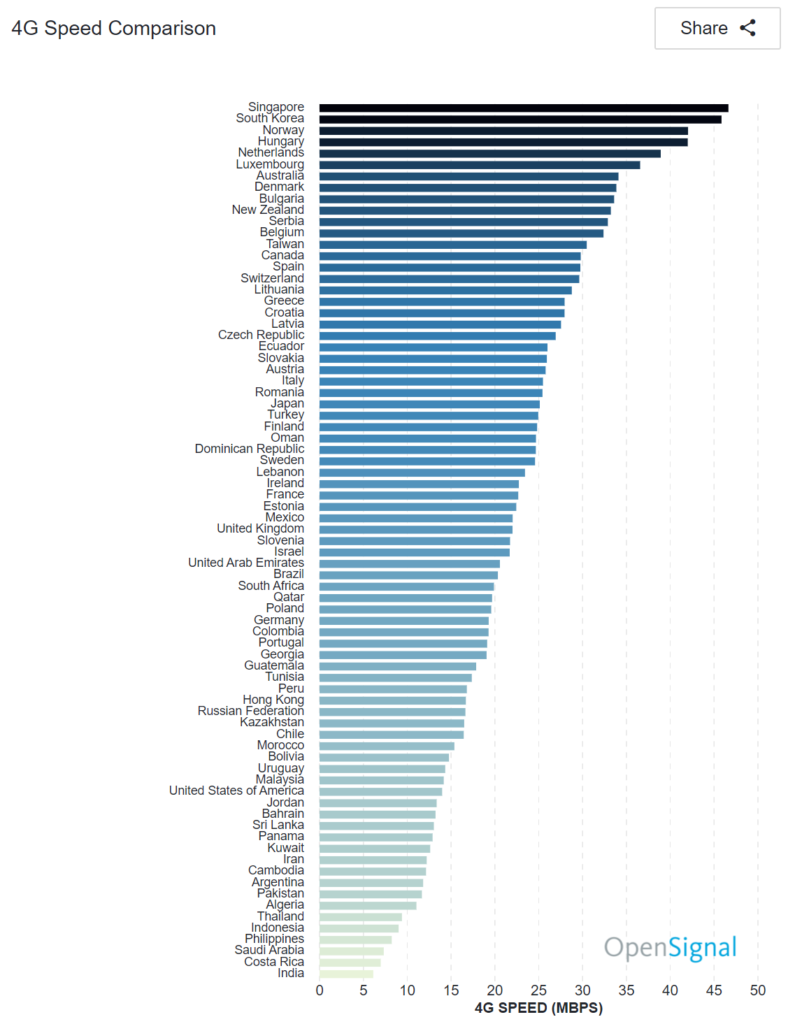
Canada is a prime example. In the company’s last report in June, Canada achieved an average speed of 30.58Mbps, and took 13th spot. Now it’s at 29.79Mbps and ranks 14th.

We’re not alone, either. Hungary, which ranks fourth with an average of 42Mbps, declined slightly from 42.61Mbps since the last report. Meanwhile, the top-ranked country, Singapore, has yet to break 50Mbps. It’s at 46.64Mbps, up from 45.62Mbps in June.

OpenSignal also points out that no new country has attained an average of 40Mbps for its LTE ecosystem since its last report in June, and the number of countries that averaged speeds greater than 20 Mbps has fallen to 42 from 45.

The company says this slow-down is likely temporary, but it also makes sense that the steady growth of 4G speeds are beginning to level off, now that this generation of wireless technology is around seven years old (in commercial years) and hitting maturity.

Speeds will increase drastically with 5G — those creating the standard are promising multi-Gbps connections — but for 4G, the focus for carriers now appears to be shifting towards availability.

That’s not to say consumers shouldn’t expect speed improvements before the expected 2019 roll-out of 5G, however.

Bell and Telus, in particular, are steadily making improvements with their LTE-Advanced services (often in tandem, due to the infrastructure-sharing agreement between the companies). Additionally, OpenSignal notes that the global average 4G download has increased slightly from 16.2 Mbps to 16.6 Mbps in the last six months, due to an influx of new users in developing countries.

This brings us back to availability. Instead of measuring LTE availability geographically, OpenSignal examines how consistently users of its mobile speed testing app can access an LTE network in their country.

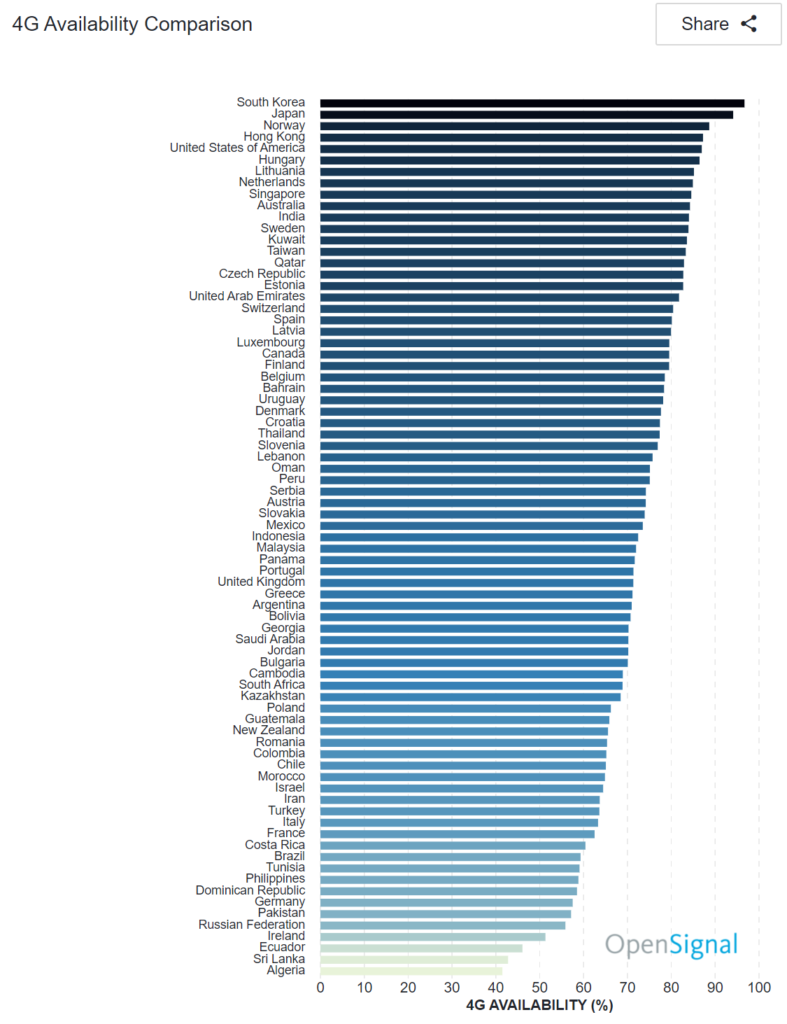
OpenSignal says that in this test period (between July 1st and October 1st), 50 of the 77 countries examined had 4G availability scores above 70 percent, compared to 33 countries six months ago.

Unfortunately, this increase in availability doesn’t quite hold true for Canada. Whereas it ranked 17th in June with a penetration of 81.10 percent, it dropped to 23rd in this report, with 79.52 percent. That’s still better than the U.K., which has 71.34 percent availability, but worse than the U.S., which has 86.94 percent.

To compile its rankings, OpenSignal uses data collected through its app from consumer smartphones around the world and recorded under “conditions of normal usage.”

For this particular report, over 50 billion datapoints were collected from 3.8 million users during the July 1st to October 1st testing period.

Source: OpenSignal

The post Global LTE speeds stall, Canada drops lower in world rankings: OpenSignal appeared first on MobileSyrup.

01 Nov 20:14

CanCon Podcast Ep. 91: Is Apple held to a double-standard?

by Bradly Shankar
Tim Cook iPhone event

There’s an ongoing fight for control between our tech and political bodies.

While the AI community is currently grasping with the concept of inherent bias, and Facebook is arguing that it can’t really direct its algorithms to seek and destroy fake news (even if it can turn off the reach of all news publications in a hot minute), the Frightful Five global tech companies — Apple, Google, Microsoft, Facebook and Amazon – is also recommending that governments remain cautious when attempting to regulate issues they may (or may not) be trying to solve. Bloomberg’s Gerrit De Vynck, who has been tracking the back-and-forth, joins the pod to discuss.

Is Apple held to a double-standard? Rumours abound about the reported concessions the company is making to get the iPhone X out in time to enough people to maintain its perception of leading tech innovation. The launch itself is a concession because it can’t produce enough of the device to satisfy the billions of people that crave the allure of Apple’s ‘it just works’ magic. Is Apple caught in the innovator’s dilemma or are we simply giving the company too hard a time?

Did you know that the Canadian video game industry is driving tech innovation? Did you know there was a Canadian video game industry? Patrick O’Rourke, Mayor of New Donk City, sheds light on an overlooked aspect of our tech sector (and $3 billion of our GDP).

Tune in as CanCon’s podcast crew – Patrick O’Rourke, MobileSyrup senior editor; Gerrit De Vynck, Bloomberg tech politics reporter; and Douglas Soltys, BetaKit editor-in-chief – ask if the current tech giants are too big to fail, or be regulated.

Have some hot takes on the topics that we covered? Maybe you want to suggest something for a future podcast! Perhaps you have a burning question about something you read in tech news that we didn’t cover. Email us, post a comment below with the answer or question, or better yet, rate CanCon 5-stars on iTunes and post your thoughts there.

Subscribe via: RSSiTunesStitcherGoogle Play

CanCon Podcast Episode 91 (10/30/17)

Big tech is getting antisocial with the government
Amazon, Google Lobbyists Warn Regulators to Keep Their Hands Off AI
Can Washington Stop Big Tech Companies? Don’t Bet on It
Twitter Announcement: RT and Sputnik Advertising

Microsoft Kinects with your iPhone?
Microsoft has officially discontinued the Kinect
Apple responds to report claiming iPhone X supplies are low because of Face ID issues
Apple is facing a double standard

Canadian gaming is great!
How the Canadian video game industry is pushing innovation in other sectors

Canadian Content music clip (under fair dealing): “Lollipop (Ode to Jim)” by Alvvays

This story was originally published on BetaKit.

The post CanCon Podcast Ep. 91: Is Apple held to a double-standard? appeared first on MobileSyrup.