Shared posts

12 Nov 22:13

iOS 11.1 Autocorrect Bug Explained

by John Voorhees

Jeremy Burge at Emojipedia explains what’s happening when iOS 11.1 replaces the letter 'I' with an 'A' followed by '⍰':

What's really going on is that the letter "I" is being appended with an invisible character known as Variation Selector 16 when auto-correct kicks in.
This VS-16 character is intended to be used to make the previous character have emoji appearance.1 When used in conjunction with the letter "I" it displays in some apps as "A ⍰".

The correct behaviour should be to ignore the invisible variation selector if the previous character doesn't have an emoji version.

The bug, which was a hot topic on Twitter over the weekend, only affects some users. Until a software update is issued by Apple to fix the issue, the company recommends setting up a text replacement rule that replaces a capital ‘I’ with a lower case ‘i’ as a workaround.


  1. eg: Snowman Without Snow is an old Unicode character ☃ but if you append Variation Selector 16 you get the emojified version: ⛄ ↩︎

→ Source: blog.emojipedia.org

12 Nov 22:12

PowerPoint history lesson

by Nathan Yau

David C. Brock writing for IEEE Spectrum delves into the origins of PowerPoint.

PowerPoint is so ingrained in modern life that the notion of it having a history at all may seem odd. But it does have a very definite lifetime as a commercial product that came onto the scene 30 years ago, in 1987. Remarkably, the founders of the Silicon Valley firm that created PowerPoint did not set out to make presentation software, let alone build a tool that would transform group communication throughout the world. Rather, PowerPoint was a recovery from dashed hopes that pulled a struggling startup back from the brink of failure—and succeeded beyond anything its creators could have imagined.

Little did the creators know, they would be responsible for so many kittens’ lives.

Tags: history, Powerpoint

12 Nov 22:11

Cycling the Trans Canada Trail with Edmund Aunger

by dandy

Update: On November 1, 2017, Pam Damoff (MP Oakville North-Burlington) presented Petition e-957 in the House of Commons, calling for the adoption of a Trans Canada Trail Act that will set minimum standards for safety and quality, and ensure that the trail is a genuinely non-motorized, and world-class greenway. The Minister of the Environment, Catherine McKenna, must now table a response within 45 days.

...

Cycling the Trans Canada Trail with Edmund Aunger


My decision to bicycle 12,500 kilometres on the Trans Canada Trail – from Victoria, British Columbia, to Charlottetown, Prince Edward Island – was not inspired by an adventuresome spirit; it was imposed by a heart-breaking trauma and a guilt-ridden conscience.


On July 14, 2012, my wife, Elizabeth Ann Sovis, was struck and killed by a drunk driver while we were on a three-week Trans Canada Trail cycling holiday in New Brunswick and Prince Edward Island. “No roads,” she had reminded me every year for a decade as I planned our summer bicycle tours. “I won’t ride anywhere near motorised vehicles. It’s too dangerous.” She trusted me to respect this fundamental rule and to keep her safe.

During our early travels, when I naively believed the Trans Canada Trail organisation’s much publicised commitment “to provide a safe and enjoyable trail experience on high quality trail,” maybe I could have been forgiven for putting her life in danger. But, after several years of harrowing and life-threatening incidents, I no longer had any excuses.

Three days after her death, I contacted the Trans Canada Trail headquarters in Montreal and volunteered to do whatever was needed – lobbying, campaigning, fundraising – to promote the completion of a national trail that would be safe and accessible for hikers and cyclists of all ages and abilities.

And on November 21, 2012, in an Edmonton coffee shop, I met with Deborah Apps, president and CEO of the Trans Canada Trail organisation, and explained my plan to bicycle the trail from coast to coast – from the Pacific to the Atlantic – over the next five summers. She promised full support with travel logistics, media communications and public relations.

The next spring, however, after learning that Elizabeth had strongly opposed the motorisation of the Trans Canada Trail, Deborah Apps had an abrupt change of heart. There would be no collaboration. I was on my own.


Trans Canada Trail, Otter Lake, British Columbia. Photo by Richard K. Aunger.


The Province of British Columbia owns over 2,000 kilometres of former rail corridor, including 600 kilometres designated as Trans Canada Trail, and various governments – federal, provincial and municipal – have invested more than $50 million to construct a quality tread surface suitable for cyclists. Unfortunately, off-road motorised vehicles have overrun these rail trails, causing environmental damage and threatening public safety.

Trans Canada Trail, Cochrane, Alberta. Photo by Edmund A. Aunger.
After witnessing a horrific accident that left three teenage cyclists dead and six injured near Cochrane, Alberta, founding president Bill Pratt promised that, in order to avoid such deadly collisions in the future, the Trans Canada Trail would be built as far as possible from motorised vehicles. The TCT organisation has now reneged on this pledge and placed more than 8,500 kilometres of “trail” on roads and highways.

Trans Canada Trail, Prince, Saskatchewan. Photo by Edmund A. Aunger.
In both Saskatchewan and Manitoba, the Trans Canada Trail commonly follows convoluted and unsigned routes on dirt and gravel country roads – or in the drainage ditches beside these roads. Although these routes usually carry less motorised traffic than paved highways, they are just as dangerous. And their harsh surfaces discourage hiking and cycling. Saskatchewan, alone, contains almost 6,000 kilometres of abandoned rail lines, but has shown little interest in acquiring any for trail development.

Trans Canada Trail, Jessica Lake, Manitoba. Photo by Edmund A. Aunger.
From Jessica Lake, Manitoba, the Trans Canada Trail splashes eastward along a 1,100-kilometre chain of rivers and lakes leading to Thunder Bay, Ontario. In 2009, the TCT organisation abandoned plans for a “costly” $6.5 million land route, deciding instead that this “blue trail” – christened the “Path of the Paddle” – would be cheaper. According to its designer, Hap Wilson, “There are long, arduous portages, violent white-water rapids, windswept lakes and seemingly endless swamps.”

Trans-Canada Highway, Nipigon, Ontario. Photo by Edmund A. Aunger.
At Thunder Bay, Ontario, the Trans Canada Trail plunges another 990 kilometres eastward through treacherous Lake Superior to Sault Ste. Marie. Hikers and cyclists have little option but to trek on the notoriously dangerous two-lane Trans-Canada Highway. In 2013, cross-country cyclists Robert and Irene Booth were struck and killed by a careless driver in Nipigon, Ontario, on a stretch travelled daily by 1,300 commercial trucks.

Trans Canada Trail, Kelly Lake, Ontario. Photo by Edmund A. Aunger.
As a rule of thumb, the annual outlay for trail maintenance should be about ten percent of the original construction costs. Unfortunately, in many provinces, few resources have been allocated for the upkeep and care of greenway trails. And, like this Kelly Lake section near Sudbury Ontario, they fall rapidly into disrepair, are soon overgrown and virtually impassable.

Trans Canada Trail, Tweed, Ontario. Photo by Edmund A. Aunger.
Bill Pratt and Pierre Camu, the founders of the Trans Canada Trail, vehemently opposed a 1999 decision to grant access to off-road motorised vehicles, arguing that it would effectively drive away the intended users – pedestrians and cyclists. They were right. But the Eastern Ontario Trails Alliance, like many trail associations, aggressively promotes motorised recreational activity as a money-making tourist attraction.

Trans Canada Trail, Mont-Laurier, Quebec. Photo by Edmund A. Aunger.
Long before the dream of a cross-country trail, Canada’s largest cities – Toronto, Montreal, Vancouver, Calgary, Edmonton – had already constructed separated tracks for cyclists and pedestrians. In many smaller communities like Mont-Laurier, however, no dedicated cycling tracks have yet been built, and the Trans Canada Trail shares the main street with cars and trucks. Not pleasant; not safe.

Trans Canada Trail, Piedmont, Quebec. Photo by Edmund A. Aunger.
More than any other Canadian province, Quebec has successfully converted decommissioned rail lines into an extensive network of linear parks. The ban on motorised vehicles is strictly enforced, tread surface is constantly maintained, tourist amenities are strategically located and, consequently, the trail is widely used by cyclists of all ages and abilities. In 2010, National Geographic rated Quebec’s cycling trails the best in the world. Cycling contributes $1.2 billion annually to the provincial economy.

Trans Canada Trail, Upper Dorchester, New Brunswick. Photo by Edmund A. Aunger.
In 2012, Elizabeth refused to ride her bicycle on the Trans Canada Trail passing through Upper Dorchester, New Brunswick, en route to Prince Edward Island. She said it was too dangerous. So we packed up our bikes and took the train from Moncton to Sackville. Two days later, after cycling less than three kilometres on a similar highway – where there were neither trains nor buses – she was struck and killed by a drunk driver.

Related on dandyhorsemagazine.com

The Trans Canada Trail has become a dangerous hoax

Pedalling in Electric City

12 Nov 22:09

Mobike rides the swell into Australia with surfboard racks and designated parking

by Frank Hersey
Mobike tries to catch up with China arch-rival ofo by announcing it will launch in Australia in January 2018. The company will put around 2,000 bikes onto the streets around Gold Coast, Queensland, but the bikes will have to be left in designated areas. The bikes have been designed for Australia with gears, a larger […]
12 Nov 22:07

iPhone X, Apple Watch and the Phantom Screen Syndrome

by Igor Faletski

Great innovation — especially in the Apple tradition — is defined by taking things away, rather than piling on lots and lots of new. In that vein, the current mobile product cycle from Apple has been its most innovative in years, and probably the most impactful since the release of the original iPhone ten years ago.

Something is Off

“Mobile is an extension of Self” has been a rallying call of technologists ever since the Nokia era. It’s hard to argue with that — for people today, the smartphone is something that is always around. As I enabled cellular connectivity on the new Apple Watch and intentionally left my phone behind, the “phantom limb” effect was on full display. On the way to Tim Hortons, I kept instinctively reaching into my right pocket, wondering where I left the phone and generally feeling a bit uneasy. After a while, though, it felt good — with full connectivity and enough computing power to react to anything urgent, the heavy smartphone became a distraction and anxiety faded. The “phantom screen” might not be that important, after all — especially as we likely see significant leaps forward in what the Watch can do with iMessage and voice.

Home Away from Home

No screen is less useful on the Apple Watch than its “app honeycomb” with dozens of microscopic app icons and no text. It looks great — but is far inferior to Siri in actual use. iPhone X takes big steps towards this voice-activated future, by dropping the Home button in favour of FaceID and prioritizing voice entry in its on-screen keyboard. With access to emoji — and the new Animoji — being the other shortcut, a QWERTY keyboard is beginning to fade into background as the secondary go-to for most casual communications. The Home button itself is something that takes less than 24 hours to completely disappear from muscle memory. Incredible execution by Apple.

The Future is Wireless — and perhaps, Screenless.

We are witnessing a watershed moment for Apple beginning to “unbundle” its legendary smartphone and moving towards three derivative categories: The Watch (which is certain to eventually get more sensors and FaceID), The Camera (where most innovation on the iPhone side happens) and The Screen, where advanced communication, media consumption and complex tasks will be completed (larger iPhones and iPads). In this world, voice and visual communications will add up to 80% of all of our device interactions. It’s a powerful vision that will set the stage for the next revolution in consumer hardware and software.


iPhone X, Apple Watch and the Phantom Screen Syndrome was originally published in igor on Medium, where people are continuing the conversation by highlighting and responding to this story.

12 Nov 22:07

dontbesodroopy: What would you change in the world if you...


dontbesodroopy:

What would you change in the world if you could?

We have advanced as a society, but there is still a long way to go, so I would have society buy into the notion that daughters are to be cherished as much as sons. I don’t want daughters to be held back by artificial barriers, rather they should be given the opportunity to grow, aspire, and achieve according to whatever talents they have. That is my dream for the world. I am convinced that we will all be better off when women and men are truly partners in society at every level. - Supreme Court Justice, and all round Supreme of everything, Ruth Bader Ginsburg.

12 Nov 22:05

Tabs and margins

by russell davies

Today's newsletter is below. Not a vintage issue TBH. I was excited when I was writing it in the cafe, scribbling in my notebook. It seemed interesting then. As it moved from notebook to Simplenote to Tinyletter it seemed to get more and more stilted. Ah well. It's OK.

Since it’s NaNoWriMo I too am not writing a novel. Instead I’ve been devoting a bit of time each day to getting down some more thoughts about PowerPoint, to see if there’s a book there.

Yesterday I was wondering why I like it so much. Apart from my contrariness and that professionally I’ve had to become reasonably facile with it, why do I find it so fascinating? One reason is that nothing so accessibly combines live performance, design, imagery and words. A really good PowerPoint presentation combines the visual and narrative assault of a movie with the unpredictable thrill of a gig. (I’m not talking about every presentation here, you understand, I’ve seen a couple this week that were definitely not Citizen Kane meets Live At Leeds.) Thinking about this always reminds me to try and watch Swimming To Cambodia again. I’ve not seen it for, maybe, 20 years, but in my head Spaulding Gray’s performances did a lot of what I imagine a great presentation does - did he ever use PowerPoint? I doubt it.

A great presentation combines some obvious things - performance and improvisation, great writing, good image making and/or selection, but also some subtleties. You’ve got to design a series of great posters, that’s what your slides are, and you can make different typographic decisions on every slide. Books don’t normally allow for that. You can say things with the development of your type, you can hide things in the backgrounds, you can bury tiny messages around the edges of your main point. You can incorporate music and video in all sorts of interesting ways. Then there are the little executional things that most people forget - what do you put on the end slide? (Often the one that stays up the longest while the Q&A drones on.)

So, speaking of Tiny Interesting Things About PowerPoint, have a look at this presentation by Bret Victor. The actual content is fascinating, but you’ll see that he’s through about one of the interesting little challenges of presentation design - how to communicate how far you’ve come and how far there is to go. He’s done it with little tabbed graphic chapter headings at the side of this slides. (There’s a good view at 11.07) I think that’s elegant and interesting.

Anyway.

12 Nov 22:03

One Way I'm Like Maurice Sendak

by Eugene Wallingford

In this conversation, the interviewer asked Maurice Sendak, then age eighty-three, how long he could work in one stretch. The illustrator said that two hours was a long stretch for him.

Because I'm older, I get tired and nap. I love napping. Working and napping and reading and seeing my students. They're awfully nice. They're young and they're hopeful.

I'm not quite eighty-three, but I agree with every sentence in Sendak's answer. I could do worse than be as productive and as cantankerous for as long as he was.

12 Nov 22:03

The Latest State of Mirrorless

For eight years now I've been using mirrorless cameras, and pretty much testing most variations that have come to market. Indeed, I've published reviews of 44 different mirrorless cameras, and by my count have used 72 different models. …

12 Nov 21:37

iPhone X oder 8 Plus :: Welcher Bildschirm ist größer

by Volker Weber

Sketch

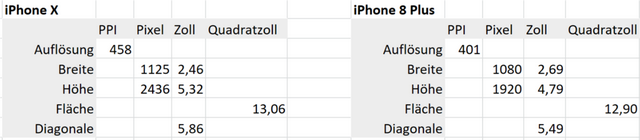
Es gibt Dinge, die lassen mir keine Ruhe. Und dann muss ich rechnen. So etwa bei den Displays von iPhone X und 8 Plus. Welches ist denn nun größer? Die Antwort ist wie so oft: es kommt darauf an.

Da Apple keine Angaben zu Höhe und Breite macht, habe ich aus den Angaben zu Pixel und Pixel pro Inch die Dimensionen in Zoll (Inch) gerechnet. Höhe mal Breite gibt dann die Fläche, die Diagonale kann man nach Pythagoras rechnen. Könnt Ihr noch, nicht wahr?

Wie man sehen kann, ist die Fläche des X nur unwesentlich größer als die des 8 Plus. Zieht man die Rundungen in den Ecken ab, sind sie noch dichter beieinander. Und dann ist da noch der Notch, der Bereich, wo die Sensoren sind. Zieht man den ab, dann ist das Display des X definitiv kleiner. Die Diagonale ist bis in die "gedachte" Ecke gerechnet. Entscheidender ist, was man sieht. Bei einem Youtube-Video etwa gibt es links und rechts Balken auf dem X-Display, weil es zu breit ist. Beim 8 Plus passt das übliche Seitenverhältnis 16:9. In jedem Fall ist das X-Video nur 2,46 Zoll hoch, das auf dem 8 Plus dagegen 2,69, über den Daumen gepeilt also 10%, in der Fläche sogar 20% mehr. Größere Diagonale, gleiche Fläche, kleineres Video. Wie schon gesagt, es kommt darauf an.

12 Nov 21:37

How to schedule an event when you don't want Americans to attend

by Volker Weber

In less than three weeks there is an opportunity to schedule events or meetings you don't want Americans to attend. Thursday, November 23rd, is Thanksgiving 2017. The day before until the Sunday of that week is the biggest travel season in the US because everybody needs to be home with their families. Friday after Thanksgiving is called Black Friday, because it is a huge shopping day where red ink turns into black.

This is your chance to fly under the radar and go completely unnoticed.

12 Nov 21:37

Huawei Mate 10 Pro vs. iPhone 8 Plus :: Impressive low light performance

by Volker Weber

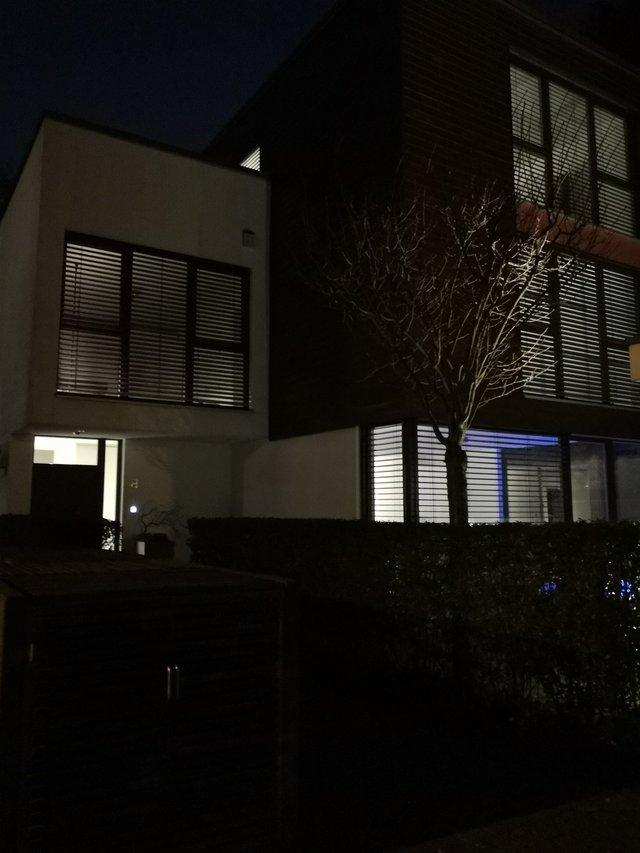
IMG 20171103 180250

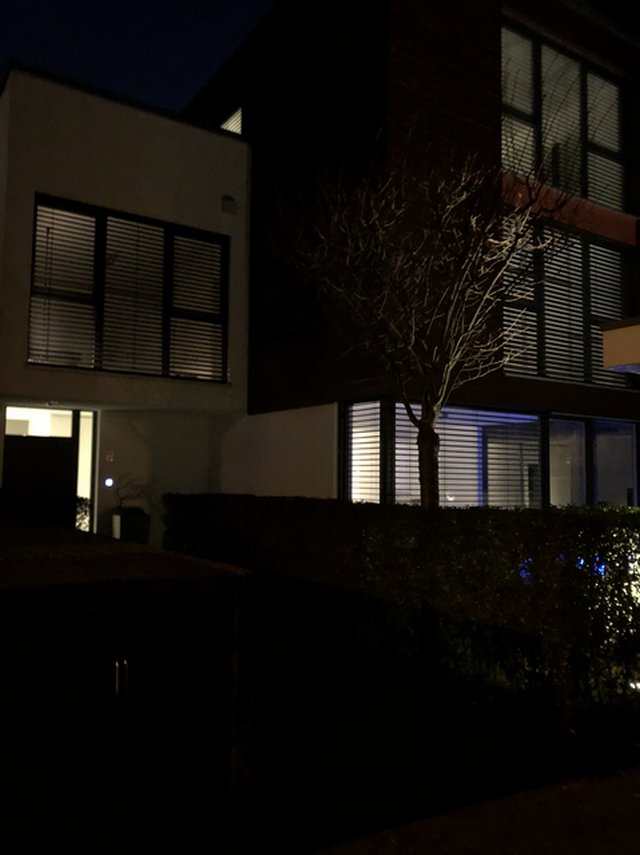
I tried two quick shots with the Mate 10 Pro (above) and iPhone 8 Plus (below). Both one handed with zero support in full automatic. The Mate 10 Pro shot with f/1.6, 1/4s and ISO1250, the iPhone has a slower lens with f/1.8, 1/4s and ISO800. That is why the iPhone photo turns out darker. Both are very impressive but I would give the Mate 10 Pro a slight edge over the iPhone 8 Plus.

IMG 1368

12 Nov 21:36

Vintage Nauticals

We keep our boat at Horseshoe Bay, a pretty little place when approached by land. Boaters inbound by ocean come face-to-face with a huge antique float/pier/breakwater kind of thing, whose ugliness I’ve long found magnificent and which today I took the time to tour and photograph.

Vintage Nautical

Turns out this huge steel thing is afloat, actually; here’s how it’s fastened to the land. Those are big chains and huge truck tires.

What happened was, I was out winterizing the boat. Vancouver missed autumn this year, snapped over from 18°C Indian-summer to basically zero more or less overnight. Today a few snowflakes drifted down and I was wearing a nontraditional Canadian boating toque. You can see snowflakes in all but one of today’s photos, if you look closely.

I’d neglected my camera and was thus shooting with the Pixel, really not much of a handicap for daylight photos when they’re close-ups and big landscapes. Here are one of each.

Vintage Nautical

Wow, this thing is, well, “going back to nature” doesn’t feel like the right phrase. But there’s definitely an entropy gradient.

Boat approaching Horseshoe Bay

I’ve been using the Lightroom camera app, which is a little on the slow side but has nice controls and pulls the raw bits off the sensor, and I like the app’s editing primitives. But in recent weeks it’s become unusably crashy — I’ve already cleared its data once to no effect — so my fallback is the well-regarded native Android Camera app. It’s quick and the pix look good, I have to say. And while Lightroom claims to be shooting RAW and indeed emits DNG’s, they don’t contain anything like the amount of hidden potential a good RAW file from a real camera exhibits. So the native Android JPEGs are not making me unhappy.

I have to shuffle them through DropBox to get them on the Mac so I can prettify them with Lightroom; I miss Adobe’s nice smooth mobile/PC sync. Anyhow, I thought Lightroom did a nice job on this monochrome.

Vintage Nautical

This float is quite a structure. It’s not solid, it’s sort of a frame so you can look down at the ocean in the middle. Well, you could, except for that piece of water is stacked up with old styrofoam, the kind that’s used to make floating docks float.

Vintage Nautical

This picture isn’t beautiful or anything, but
there’s a lot happening, top to bottom, left to right.

As for the boat, I installed its low-level winter heating apparatus, ran the engine for a bit, set up support poles to protect the canvas cover from heavy snow, and adjusted the lines against winter storms; then went for a burger and beer at the waterfront alehouse.

That’s a satisfying early-winter half-day.

12 Nov 21:36

The Web Began Dying in 2014, Here's How

files/images/referral-to-top-publishers_1.png

André Staltz, Nov 07, 2017


Icon

I don't think that the increasing market share of Facebook and Google by themselves mean that the web is dying, no more than the domination of Internet Explorer and netscape did back in the day. But these two giants have been exerting their influence in less than benign ways, and this is what is injuring - if not outright killing - the web. In both cases, a combination of marketing, the limiting of diversity, and the manipulation of public perception have combined to create a web designed to promote page views and attention to the trivial (and often, the false) instead of to allow us to forge genuine connections with each other.

[Link] [Comment]
12 Nov 21:34

The Best Bike Pump (Handheld)

by lbutcher
The Best Bike Pump (Handheld)
If you ride a bike, sooner or later you’re going to get a flat tire. When you do, and after you’ve swapped the tube for a fresh one, you’ll need an efficient, not-too-painful way to inflate it and get back on the road or trail. We spent more than 30 hours researching 90 different pumps, and used the 19 most promising ones to inflate the three most commonly used sizes of tire a total of more than 150 times. In the end, we found the Lezyne Sport Drive HP to be the best handheld pump for most people. It’s well-designed, well-made, well-priced, and, most important, outperforms the rest of the field.
12 Nov 21:34

The Future of Blogging and Communications - some thoughts

by Helen Keegan
I went to an interesting panel discussion on Thursday evening in London at WeWork near Old Street. It was organised by the #BlogClub team and the session was entitled 'How will AI and other disruptive forces affect and impact the world of blogging and communications?' The panel was led by Andy Bargery and the panellists were Katie King (CEO of Zoodikers and future author of a book on AI and Marketing for Publishers Kogan Page) Katie on TwitterLucy Hall (blogger at www.lucyshall.com) Lucy on Twitter, and Minter Dial (co-author of 'Futureproof- How To Get Your Business Ready For The Next Disruption'), Minter on Twitter.

As I've previously done quite a bit of work and thinking around the topic of AI, I was interested to revisit it with a different audience - i.e. not tech experts but writers, both professional and amateur. This made for an interesting evening and provoked me into thinking more deeply about the topic again.

Chatbots
One of the first things to be brought up was Chatbots. I've not had a great experience with Chatbots if I'm brutally honest. I've had a play with the Pizza Express one and the Dr Oetker one. Both crashed on me and both were nothing more than a weak IVR (interactive voice response) in a text format. They both took too long to interact with and what they achieved could have been done much more quickly via a webform or a bunch of tick boxes. The Pizza Express ones have been a bit cuter as it included some animation and video, but ultimately, they're not *that* clever. At least, not yet. Both of these chatbots were on Facebook Messenger.

Robot writing
The discussion moved on to automated writing. The ai-writer.com website was mentioned more than a few times and heralded as 'the future'. There have been robot poets in China, a Japanese robot fiction author who got through the first round in a literary contest, and this year, Google invested in AI to write local news. And I know that data driven news content like sports results, stocks and share information and weather is already automated so it's not so far-fetched to think that anyone who writes for a living may find themselves out of a job in the near future.

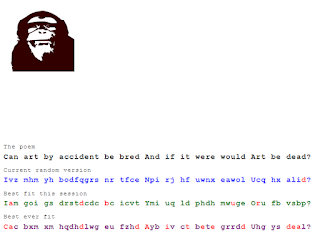
But let's not get too carried away with this. I tried ai-writer.com and it was pretty ropey. Check my previous post for an example article or try it for yourself here. Or take a look at Vic Keegan's Shakespeare's Monkey website (pictured above) which has been running for years and years and still it hasn't created anything worthy of a single line of Shakespeare. I realise that Vic's experiment is based on randomness whereas ai-writer's aim is specifically to generate content for blog writers - your only input is the blog title to generate the content.

Let the tools help you not replace you
That's not to say that there are AI tools out there that are very useful indeed, especially to a writer. Google Search being the most obvious one. Even things like AI Writer may have their uses to link to useful resources. There are other tools out there to help you plan your writing, do research for you and help you with readability, translation, distribution, and more. However, where creativity of any kind is a requirement, the human brain still wins out.

Nevertheless, there are a myriad of servers out there generating fake news and pictures and  automating content (that looks little better than gibberish) in order to either manipulate the public in the former and to make cash from advertising in the latter case. I won't touch on all the automated marketing tools, click fraudsters and fake (robot?) eyeballs out there at the moment who make this scenario even worse - I'll save that for another time. It's a big topic.

It did beg the question of what is the point of automated content if it's going to be robots that see it more than humans. Which also begged the question of why should we bother writing at all if it's going to be harder and harder to reach real eyeballs rather than robot ones. 
Minter stated that human + machine is better than machine alone. And in this context, I agree with him. With the tools we have available to us, we are able to do many more things and usually in a faster fashion.

So the good news is that if you're a writer, you still have a job if a creative element is required. Forget it if you're just churning out generic content based on data such as stocks and shares, football results or weather temperatures.

Some thoughts from the panellists

Video
But there are things we need to think about, whether you're involved in online content of any kind. Lucy reminded us that there's more to blogging than just words and that live video was one of the most effective types of content out there at the moment. She believes that's down to the human touch and the popularity of video. Lucy also stressed the importance of keeping up with your audience. They way they access content has changed, writers and content producers need to keep up with that.

Ethics
Katy was excited at the prospect of AI and how it can help us now and in the future with the range of tools available to us. Her caveat was that there is a need for ethics around AI.
I agree that ethics are a requirement and we need more thinkers from all walks of life contributing to the AI conversation so that we can remain human. I don't want our algorithm overlords making decisions about me and what I am able to or not able to do based on data that could be flawed, misinterpreted, wrong and worse still, not fixable because the algorithms become so convoluted or data that is completely out of my control as it's inferred from those around me rather than myself. I wrote last year about social scoring in China and Wired Magazine published an in-depth update recently.

How to futureproof being a writer
Minter's advice was that, as a writer, you need to find your niche and be very specific about it. He also believes strongly that you need to write from the heart  and aim to get energy from your writing. He suggests using the AI tools available to use to help with publishing, distribution, analysis and research. He sees SEO as 'Strategic Executive Opportunity' and said that if money is your objective, then you need to think about how much you will invest in these (AI) technologies.

My takeaway
I came away reassured that creativity is still a human trait that cannot yet effectively be copied by software. Nevertheless, there are tools out there that I could be making use of to improve my writing and help me be more efficient and more effective.
A big thank you to Andy and Bernie of #blogclub.
Day 4/30 NaBloPoMo

12 Nov 21:31

VocTech

by Bryan Mathers
UFI VocTech celebration

I was invited to attend an event celebrating the Vocational Technology (VocTech) projects funded by UFI Charitable Trust last night. I find it impossible now to sit through presentations without drawing out what I hear…

The post VocTech appeared first on Visual Thinkery.

12 Nov 21:30

Finding hope… and dissing Lin-Manuel… at the Obama Foundation Summit

by Ethan

I just spent two days at the inaugural summit of the Obama Foundation, and I’m coming back from Chicago more enthusiastic about the state of civics than I have been in the past year.

For several decades, US presidents have been working to make their time out of office part of their legacy. Jimmy Carter’s post-presidency has served as a model, both with the Carter Center’s work on elections and tropical diseases, and his personal commitment through volunteering with Habitat for Humanity. Bill Clinton build a massive operating foundation based on public/private partnerships that, despite some highly reported controversies, has done some excellent work around public health and climate change in the Global South.

Obama had previously announced that his foundation would focus on revitalizing civics and on engaged citizenship. Great! But what does that mean? I hosted some of the organizers of the foundation at the Media Lab a year ago and was worried that the foundation might feel like an on-ramp into democratic party organizing. My students and I made the case that many people are feeling alienated from conventional politics and its surrounding institutions, and that Obama’s foundation could make a significant impact by broadening the definition of what we consider engaged citizenship. My student Erhardt Graeff spent the summer with the foundation making this case and studying how wer might measure the impact of this new, broader vision of citizenship.

I don’t claim that our lab had anything to do with it, but the summit yesterday felt much less like the “mini-reunion” of the Obama campaign (as Politico reported) than an experiment in just how broad the concept of civic revitalization could be. There was almost no talk about politics – indeed, I don’t think Trump’s name was mentioned once – and anyone expecting talk of how the left takes back Congress, fights gerrymandering or revitalizes the two party system would have been deeply frustrated. But for people looking for models for how individuals are changing their communities, in the US and around the world, the program and the people participating in it, was a feast.

In 2010, I spoke at an event at the George W. Bush Presidential library on digital activism. I was struck by the fact that our program specified events to the minute, not the nearest quarter or half hour. Evidently, Presidential libraries celebrate one or more characteristics of their patron, and the Bush library celebrated the former president’s punctuality. Indeed, W joined us for precisely 12 minutes, just as the schedule specified.

It’s possible that the signature attribute of the Obama legacy projects will be diversity. I spent two days in perhaps the most diverse room I’ve ever encountered at a conference in the United States. 12 of 30 featured speakers in the program were women, 19 were people of color. Sitting down for lunch, I found myself between a Nigerian roboticist and an American Sikh scholar who’s writing a book on islamophobia and its side effects. I didn’t have a bad or boring conversation over two days – the staff packed the room with people doing mentoring of young men on the South Side of Chicago, or combatting racism against Afro-Brazilians. I was impressed that the organizers found people beyond the usual suspects – Elaine Diaz, whose brilliant Periodismo de Barrio is transforming Cuban independent journalism – instead of a more widely known figure like Yoani Sanchez. It suggested to me less interest in virtue signaling than in opening interesting conversations.

Some of the key takeaways from the summit for me:

Heather McGhee of Demos knit together issues of inequality, race and economics with greater clarity than I’d previously heard. She offered an analogy for the contemporary economy: a massively multiplayer game where those who are winning can change the rules.
“Our democracy has become as unequal as our economy,” she argued, citing voter suppression efforts and the ability of wealthy voters to influence elections through political giving. She traces the increasing unfairness of the economy to our increasing diversity: “It’s no coincidence that it’s become harder for the average American to get by as the face of the average American has changed.” My friend Micah Sifry referred to her as the next black president of the US and I think he’s got a point – linking questions of economic and political unfairness to a realization that fairness hasn’t been equally through American society strikes me as a viable direction for the Democratic party in response to the Trump presidency.

– Hamdi Ulukaya, the founder of Chobani Yogurt, won my heart with his passion for South Edmeston, NY, a small town in central New York that had lost much of its workforce due to plant closings. Ulukaya saw parallels between the rural Turkish community he’d grown up in and the community he moved to, and grew Chobani in a way that created not only jobs with livable wages, but a deep investment in community development and pride.

He shared the stage with Brian Alexander, who positioned himself as the anti-JD Vance: also passionate about the future of Appalachia, but sees the problem as structural and economic, not a problem of “hillbilly culture”. Asking us “What is capitalism for? Do we work for it, or does it work for us?” Alexander put forward a vision of a corporation’s role in a community that sounded both old-fashioned, and with Ulukaya’s example, worth returning to: “Companies used to be rooted in a place. Management used to play on softball teams.” Companies like that remain in their communities and work to support the people who depend on them, not just shareholders.

I’m used to community economics coming from inner cities, but it’s rare to see similar ideas coming from rural America. Exciting for me as the proud resident of a town of 3000. And, as Alexander pointed out, our communities are getting screwed over. Referencing the opioid epidemic and the dumping of drugs on West Virginia, then demanding people take responsibility for their addictions, he noted, “a culture of personal responsibility would mean demanding responsibility from the CEO who dumped 3.3 million doses of opiods into a county with 29,000 people.”

– In a workshop brainstorming the priorities of the Obama Foundation, one of the organizers asked a hard question about experts and expertise. (Despite the common root word, these often get put in opposition in social change circles – experts have degrees, while those with experience are people in beneficiary communities.) Introducing herself as a “sneakerhead”, she wondered how expertise in sussing out fake sneakers could translate to identifying and calling out fake news. “Sneakerheads are always calling out fakes. And I didn’t have to take an online course in ‘sneaker literacy’ – I got to know sneakers because I care about them.”

It’s an interesting point, not just about self-directed learning and about fake news. It’s a complicated point for people engaged in co-design, the practice of designing solutions in a way that deeply involves the beneficiaries in the planning and creation of projects intended to benefit them. When I’ve worked on co-design, I’ve had a tendency to think of communities I’m working with as experts on local conditions and priorities, while my teams tend to be experts on technologies and design methods. It’s an exciting challenge to think about how to work with community members not just as experts on their own problems, but on different ways of solving problems, of having insights that my students and staff are unlikely to have. How do people solve the problems they encounter in their lives, and how can those problemsolving skills change how we develop and design together?

– Listening matters. I have reached a point in my career where I rarely get to go to events unless I’m speaking. I’ve also developed the bad habit of dropping into conference to speak, and then heading to other engagements. I just got to spend two days listening, taking notes and tweeting and it was wonderful.

What was also wonderful was watching Obama listen. Half an hour into a fascinating conversation about the responsibility tech platforms have for the conversations they host, Obama stood up from the back of the room (none of us had seen him walk in), and asked a complex, nuanced question about how to balance principles of freedom of expression with the power of platforms to amplify misinformation. I watched him listening intently in another session, and saw him knit observations from two talks I’d been at into his closing remarks. If Obama can make time to listen this carefully, respectfully and closely, so can I.

The closing session featured two talks that I won’t forget for a long time. Lin Manuel Miranda, the creator of the musical Hamilton, and Chicago rapper Common took the stage together, and talked about how social issues inspired each of their work. Lin was clearly starstruck to be spending time with Common, who he credited as the inspiration for the flow of the rhymes he gave to George Washington – “Hamilton had to be the smartest guy in the room, so I had to model his flow on someone with the trickiest, most polysyllabic rhymes, like Eminem or Big Pun. But George Washington was respected by everybody, and so his flow had to be from someone everyone respects in hiphop: you.” When Common started a freestyle session, Lin was too flustered to bring his A game, leading to a tweet I’ll always cherish:

But the highlight for me was seeing my personal civic hero, Bryan Stevenson, founder of the Equal Justice Initiative and defender of countless youth trapped in the criminal justice system, offer his rules for engaged citizenship:

1) Get proximate and stay proximate to the problems you want to solve.

2) You can’t solve problems without changing the narrative – when it’s the war on drugs, we lost people we could save if we worked on treating addiction

3) Hope is your superpower. This isn’t about naiveté, but about finding strength to carry on when you encounter obstacles and frustration. “Hope is your superpower. Don’t let anyone take away your hope. Hopelessness is the enemy of justice.”

4) To make change, we have to be willing to do uncomfortable things. Bryan ended his talk with the story of a civil rights activist, an elderly man in a wheelchair, who showed him his scars from injuries during the protests of the 1960s. “These are not my cuts, my scars. These are my medals of honor.”

I’m grateful for the Obama Foundation for letting me take part, and I cannot wait to see what this will become.

12 Nov 21:07

Twitter Favorites: [katherinebailey] Speaking of bullshit, my Acquia Engage session on how not to be dazzled by it when it comes to ML is here: https://t.co/HEZGAB07gs

Katherine Bailey @katherinebailey
Speaking of bullshit, my Acquia Engage session on how not to be dazzled by it when it comes to ML is here: engage.acquia.com/baffled-brilli…
12 Nov 21:07

Twitter Favorites: [HarJournalist] The @UBC_Baseball event with special guest, @GreggZaun. He’s here to talk all things baseball. #BASE #JapanTrip… https://t.co/MovMJQitKF

Har Journalist @HarJournalist
The @ubc_baseball event with special guest, @GreggZaun. He’s here to talk all things baseball. #BASE #JapanTriptwitter.com/i/web/status/9…
12 Nov 21:06

Inbox Awesome: 9 Nov 2017

by Stowe Boyd

I’m planning to be blogging from the upcoming Inbox Awesome, 9 November 2017 in Brooklyn. The organizers shared these details with me:

Why Inbox Awesome?
It all started as a startup meetup in 2013, gathering leaders from NYC’s tech scene reinventing the inbox in all flavors — feeds, workflows, messaging, email. Since then, Inbox Awesome has diversified and grown into a conference. We still keep it boutique and create the kind of event we would like to attend ourselves, with 200+ people, 1 room, 1 stage, 1 day. No fear of missing out! We also completely reinvent the content every year by reaching out to the community and asking who and what are the cutting edge topics they want to see on stage. We also take a lot of pride in gender balance. It’s a heck of work for a small team, but it’s so worth it! Altogether, we really try to live up to the name and make your inbox more awesome — through the latest hacks, tools, designs and experts.
What makes it unique?
First of all, there is no other email and messaging conference in New York. Second, there are few events around this topic overall that are innovative, cutting edge and diverse. We try to open the spectrum to topics such as voice as a platform, chats and collaboration, hacking and leaks, and even political campaigning. Third, Inbox Awesome is converging people from the tech, media and enterprise in a unique way, with 70% c-level in the room, which makes it highly enjoyable for the attendees.
Who are some of the attendees we should know of?
The heads of email from Pinterest, Zillow and Adobe are flying in from the West Coast. The leaders behind the political messaging for the Trump, Hillary and Obama campaigns are coming up from D.C. Productivity gurus from Zappos and Atlassian are joining from Vegas and Austin. And then there is our New York community, a great bunch of leading VCs, media execs, aspiring tech founders and students from several universities.
Why is the location the “Venice of NYC”?
Inbox Awesome happens at a different location every year, thanks to our venue partner Knotel, a flexible headquarters company that knows NYC’s crazy real estate market inside out. They always tipp us off to unique spots that no conference has ever seen. Last year, we were on a rooftop by the Hudson river formerly owned by a hip-hop collective. This time around, we occupy a warehouse and former photo production studio including an illegally built-in apartment in Gowanus, Brooklyn. Probably the most up and coming neighborhood in the entire borough. It’s been dubbed the “venice of NYC” because of its canal, which used to be a dump and is slowly being revived. Around the corner from the venue, you get the best ice cream in NYC.

It’s a hip event, but shares the modern commitment to Calvinist principles with a kick off of 7:30am for breakfast, guided meditation at 8:00am, and then the real deal starts at 8:15am.

Originally published at stoweboyd.com.


Inbox Awesome: 9 Nov 2017 was originally published in Work Futures on Medium, where people are continuing the conversation by highlighting and responding to this story.

08 Nov 17:31

Broadcom Reportedly Interested in Acquiring Qualcomm for $100 Billion [Update: Official]

by Rajesh Pandey
A report claims that Broadcom is reportedly exploring a deal to acquire chip maker Qualcomm. The latter is known for its Snapdragon Mobile Platform which powers almost a billion smartphones out there. It also provides baseband to major OEMs like Samsung, LG, and Apple for their respective smartphones. Continue reading →
08 Nov 17:31

Purchase Google Wi-Fi and Google Home together and save $120

by Dean Daley
Google Home

Google has bundled its Google Home and its Google Wi-Fi mesh router system.

If a customer adds the Google Home and the Google Wi-Fi into their cart, the total cost drops from the usual $619.99 CAD plus tax to $499.99 plus tax.

Google Home is a Google-branded smartspeaker that utilizes the Google Assistant. Users can say “Okay Google” around the room to activate the Google Home and use it like an Android handset.

Google Wi-Fi is a mesh router system comprised of three signal boosters that connects to a normal modem. Once connected, Google Wi-Fi is capable of more evenly distributed a Wi-Fi signal throughout a home as it connects with each of the other boosters.

You can check out the bundle here. The promotion started on November 3rd, 2017 and ends November 22nd, 2017.

The post Purchase Google Wi-Fi and Google Home together and save $120 appeared first on MobileSyrup.

08 Nov 17:31

Poll: Do you care for a foldable smartphone?

by Ian Hardy
LG Display

Technology is moving fast and customer demands are moving even faster. The new trend, which has been hinted at for years, is a foldable/bendable smartphone.

We’ve seen trademark filing from most manufacturers, including Samsung, LG, Microsoft, and ASUS. This style of device was expected to be available late 2017 and it seems the goal was moved to sometime 2018.

With the current set of devices coming with edge-to-edge displays, is a foldable smartphone with two screens something that interests you? Let us know in the comments below!

Take Our Poll

The post Poll: Do you care for a foldable smartphone? appeared first on MobileSyrup.

08 Nov 17:30

Samsung’s latest commercial suggests iPhone users should grow up

by Ian Hardy
iphone x

Smartphone manufacturers have been battling it out for the past decade taking small, but very targeted, jabs at each other.

We’ve seen Samsung go after Apple, Nokia take on Sony and HTC. Even newcomer OnePlus recently hopped into the ring by stating it has the courage to keep the 3.5mm headphone jack.

The most recent commercial is once again Samsung with a hard sell towards Apple enthusiasts. In the ad ‘Growing up,’ Samsung takes the glory of the original iPhone launch in 2007 with a loyal owner sticking by the brand through 10 years.

The one-minute bit showcases how Samsung listens to its customers and highlights how the iPhone 3GS lack of internal storage, iPhone 5s omits its stylus and all the way up to the iPhone 7 for not being water-resistant, nor coming with a headphone jack or fast charging.

Eventually, the iPhone user gets bored and switches to the Galaxy Note 8 and casually walks past people lining up the iPhone X.

The post Samsung’s latest commercial suggests iPhone users should grow up appeared first on MobileSyrup.

08 Nov 17:30

Top Canadian mobile stories from the past week

by Ian Hardy
iPhone X

Every week we bring you the latest in Canadian mobile news. Listed below is a quick overview of the top stories from the past seven days.

  • Ontario MPP tables ‘zombie’ bill, aims to reduce distracted walking [Read here]
  • These are the devices that Bell and Virgin are currently selling unlocked [Read here]
  • iOS 11.1 now available, includes ‘mythical creature’ zombie emoji [Read here]
  • OnePlus confirms its next phone will be the OnePlus 5T [Read here]
  • Distributel continues acquisitions, purchases IPTV service provider Zazeen [Read here]
  • Amazon Canada kicks off Black Friday deals [Read here]
  • Best Buy Canada now offering financing for unlocked phones [Read here]
  • Xbox One X Review: Real 4K HDR gaming comes to consoles [Read here]
  • iPhone X’s launch was originally set for 2018, says Apple exec [Read here]
  • DJI asks for Transport Canada’s help with future drone pilot test [Read here]
  • HTC U11 Life is available in Canada now for $449 [Read here]
  • Bell is conducting 5G trials in the 28GHz and 3.5GHz with Huawei [Read here]
  • Bell has another strong quarter, wireless subscriber base tops 9 million [Read here]
  • LG Q6 Review: Prettiest budget phone with a mid-range price [Read here]
  • Global LTE speeds stall, Canada drops lower in world rankings [Read here]
  • Microsoft Surface Pro with LTE Advance launches in Canada this December [Read here]
  • Simplii customers can now bank online and on mobile devices [Read here]
  • Asus ZenFone 4 and ZenFone 4 Pro now available in Canada [Read here]
  • Amazon lobbied Canada’s Liberal government 99 times in the past 12 months [Read here]
  • BlackBerry Motion launching in Canada on November 10 [Read here]
  • iPhone X Review: Apple’s future [Read here]
  • Canadians registered 214,822 phone numbers on the National Do Not Call List between 2016 and 2017 [Read here]
  • Vidéotron launches VoLTE service for iPhone 7 and iPhone 7 Plus [Read here]

The post Top Canadian mobile stories from the past week appeared first on MobileSyrup.

08 Nov 17:29

Testing Begins for OmniOutliner 3 for iOS

by Derek Reiff
mkalus shared this story from The Omni Group.

Yesterday, we put OmniOutliner 3 for iOS in Public Test. We’ve spent a lot of time getting it to this point, and we’re looking for feedback specifically about new Pro features.

This is a major upgrade for OmniOutliner for iOS, and while the final version will have a focus on simplicity—3 will be the first version to include Essentials for iOS—right now we’re finishing up work on the Pro feature set.

So what’s new in 3? Omni Automation is the biggest addition: cross-platform scripting, using JavaScript, to automate nearly everything in OmniOutliner for iOS. If you’re familiar with the language and could stand to automate common tasks, try writing a script! Sal Soghoian’s website gives a great overview, and OmniOutliner provides an in-app API reference.

This version also includes support for Drag and Drop, encrypting documents with a password, a brand new implementation of our sidebar and inspectors (with major work ongoing for the filtering tab of the sidebar), row focus, section lists, printing, and PDF support.

Check out our signup page to learn about the latest features.

Putting OmniOutliner 3 through your paces

So what are we looking for input on?

  • How’s Pro working, on your iPad and iPhone, as your central repository for how you outline, write, and manage your ideas?
  • What doesn’t it have that you think it should?
  • How’s it working with your keyboard, your shortcuts, and everything that you’ve come to expect from the Mac?

Submitting Feedback: Use the Send Feedback button under the Document Browser’s Gear Menu. Or, say something on Twitter, via an email here, or talk about it on Discourse. (Or join our Slack Workspace! It’s brand new.)

04 Nov 01:51

Twitter Favorites: [adamrg] Was trying out Stage Lighting on the new iPhone X. Ended up with a #NewProfilePic https://t.co/NlDLYUfQ6O

Adam Gessaman @adamrg
Was trying out Stage Lighting on the new iPhone X. Ended up with a #NewProfilePic pic.twitter.com/NlDLYUfQ6O
04 Nov 01:51

Carrying a camera

by Tom MacWright

Grafitti on a school in SF

Every time that a new phone gets released, there’s a wave of buzz about the stunning photographs it produces. DXOMark created a rubric for photo quality, and phones keep improving. Today the iPhone X was released, and there’s yet more buzz around ‘shot on iPhone’ and articles about how it might be better than ‘real cameras’.

This is technically true, but it misses the point.

This morning I went on a quick hike to clear my mind (it didn’t work). But I brought my camera - my Olympus Pen F, with a pancake lens. Relative to the SLRs I used to carry, it’s lightweight and lovely. But it’s many times heavier and clunkier than a phone. As a result, I don’t carry it around all the time.

Which is supposed to be one of the golden rules of good photographers. Both Ken Rockwell and Casey Neistat agree: the best camera is the one you have on you. Don’t stash your camera in your backpack - hold it in your hands, and keep it with you.

Portland, on an Olympus

But is that all? Is the best camera the lightest thing with the highest number of megapixels?

This morning I saw some birds - Western Bluebirds, I think - and also wood. I think about wood a lot, because I care for a few trees. I have an apple tree that I grew from the seed of an apple I ate, and it’s just starting to get a thick, woody trunk. Another tree, a Ficus Microcarpa, I trunk chopped today. I took a bunch of photos of wood - of holes in wood, of places where the heartwood had rotted out or been excavated by insects.

Skate Day in DC

The way that I think about photos is probably moving farther away from the norm over time. Products like the Google Photo Clip are driving home a relentlessly objective idea about what photography is. Photos are well-exposed, clear, sharp images of your friends, children, and dogs. The machine learning algorithm will make sure of this. It may also enjoy sunsets.

Buildings in New York

Photos to me aren’t about beautiful objects or familiar things: they’re about beautiful arrangements of colors, feelings, symbols - they’re about how things end up once they’re projected on to a flat piece of paper or a screen. Photos are about capturing what you see. There are millions of mediocre photos of the Statue of Liberty or of people looking at the Mona Lisa, but an ordinary day through Stephen Shore’s eyes is truly remarkable.

Snowy scene

The thing is, when you’re looking for photographs, you’re looking for beauty: you aren’t just hiking, you’re trying to find things that fit your idea of beautiful. And what you look for is what you tend to find.

Developments in NY

With my iPhone 8, I could take a photo of anything at any time. I could also pull it out and browse the news, or Twitter, or receive a heartbreaking or heartwarming text message. It’s a device that’s filled with so much that it’s filled with nothing - a fact that’s only underscored by the design trends in smartphones. New phones are going ‘bezel-less’ and the concept art for future generations are simply unadorned glass rectangles. More than anything, this kind of technology is becoming inert in both design and emotion.

In contrast, a camera like the Pen F - or my Olympus XA2 - is richly suggestive of its purpose, and specific. Picking it up, with its knurled aperture controls and cold metal frame, puts you in the mode of seeing.

Having my phone in my pocket doesn’t trigger anything but distraction. It can do everything, and so I feel nothing in particular about it. A physical camera takes photos, but it also makes me think about seeing. And I like that.

03 Nov 22:43

New Backpack: Aer Fit Pack

by Matt

As an interim update to my 2017 gear post, I'd like to strongly endorse the Aer Fit Pack 2 as my new primary backpack, replacing the Lululemon bag I suggested before. It has better material, much better zippers, a logical design, more pocket distribution inside, and it's cheaper! I put this bag and its predecessor through all the rounds, including taking it to Burning Man, and it's been a champ. If you're reading this and work for Automattic, this bag is also now available as an official choice for your bag and it'll come embroidered with a cool logo. (Previously we only offered Timbuk2.)