Shared posts

27 Nov 21:29

Finally

by Richard

Being from Vancouver, I got by with rain jackets or, recently, an unhooded jacket1 from my employer that I initially hated got comfortable with and started loving. The inside jacket pocket fit my Kindle, and after that, I would bring it everywhere.

I moved to Toronto on Hallowe’en, 2015. About a month later, almost as if there were a city-wide memo sent out, everybody started wearing winter jackets. I called it Canada Goose Nation, after the brand that everybody seemed to be wearing. I thought I could survive the winter, and did. Twice. I wore scarf and a toque and gloves, and managed through -20° C (that’s -4° in American). Having enough, I walked into a store that sold winter jackets, and got sticker shock. $2,000 for higher end jackets scared me away from realizing there was a downstairs with more affordable options. Even when I saw the prices, around $800, they did not have my size. Just before a trip to Florida, my friend (let’s call her Lesley, which happens to be her real name) alerted her followers of a Rudsak sample sale at 99 Sudbury St. I hadn’t heard of the brand, but it seemed legit. She gave me a report from the scene that she hadn’t seen any XXL men’s jackets, but that she didn’t give that section a hard look.

When I got there, there were two colours to choose from: red or not-red. The not-red colours were all dark, and I had spend a few years wearing a black jacket, and wanted to stand out a little bit. It was less that I found a red jacket and more that it found me. It came with a liner that doubles as a vest jacket. I don’t need it to line the parka, since I’m a warm individual thanks to my Icelandic background. I tried it on, took a bad mirror shot that makes me look like Kenny from South Park, and decided to buy it. I only thought to ask the refund policy after I swiped my card.2

I finally have winter jacket. I wore it about town on errands before my trip to warmer climes. I can’t wait to wear it for real!


Footnotes:


1. I had recently joined Team Umbrella after spending my life up until then on Team Hooded Jacket.

2. Chip & PIN. You know what I meant.

14 Nov 18:26

What A Good Participant Needs

by Richard Millington

Does a newcomer have the information they need to be a good participant?

Do they know what good participation looks like?
Do they know how to look up and find information they can share with others?
Do they know what’s on the edge of domain of knowledge?
Do they know what the best examples, books, and resources are?
Do they know what tone of voice they should use when they participate?
Do they know they don’t need to be an expert to participate?
Do they know good questions are better than good answers?
Do they know the 20% of topics which account for 80% of discussions?
Do they know who the top people in the field are?
Do they know who’s in charge and who to contact for help?
Do they know you genuinely want them to succeed and will do everything you can to help?
Do they know how long a post should be, to self-disclose information about themselves and reveal their emotional state when they ask a question?

If the answer is no, you have some work to do.

14 Nov 18:26

A partner program update

support:

After experimenting with different approaches and formats for the last year or so, we’re putting an indefinite pause on the partner program that we announced last summer. We’re still excited by the possibilities of the project, and may revisit it in the future, but we haven’t quite figured out the best way to deliver on our goal.

For the time being, we’ve also taken down all the ads that were appearing on individual blogs across Tumblr while we determine how to deliver the best overall experience for both our users and our advertisers.

Thanks for being a part of all this, and we greatly appreciate your patience.  

❤️ Tumblr

I missed the announcement in July (!) of Tumblr abandoning its partner program – agreeing to ads on your Tumblr blogs – but they still are experimenting with ads.

Aside from adding all sorts of features to the mobile clients, Tumblr seems to be stuck in the past. Very little innovation going on.

14 Nov 18:20

Filtered for things to read on your tube ride home

1.

Seat 14C is a collection of short stories all with the same premise. Each is a first-person account of the passenger in Seat 14C, on ANA Flight #008, as this passenger discovers they've mysteriously been transported 20 years into the future. There are some biiiiig name authors.

Bruce Sterling's story is fantastic:

The planet, humankind, had undergone some huge, universal, metaphysical enlightenment. ... They no longer used mushy, mystical terms from 2017, vague words like "thoughts, "feelings," "moods," "souls," "intelligence." They had precise, scientific formulations for those phenomena, with about a million high-tech terms-of-art.

Read it: It Feels So Exponential.

2.

Line-us is a little robot drawing arm on Kickstarter by Durrell Bishop and Robert Poll. It is lovely.

However I am not here to say how lovely this robot arm is.

Rather, their Kickstarter updates are gold dust. They are experienced designers and manufacturers, and they are narrating their experience from prototype to production in Shenzhen with a clarity, transparency, and education which is rare as hens teeth. Many of the updates are open to the public, not locked down to project backers.

For example:

Read all the updates.

3.

Bret Easton Ellis on Living in the Cult of Likability.

Now all of us are used to rating movies, restaurants, books, even doctors, and we give out mostly positive reviews because, really, who wants to look like a hater? But increasingly, services are also rating us.

(Uber, Airbnb.)

Who wants to share a ride or a house or a doctor with someone who doesn't have a good online reputation? The reputation economy depends on everyone maintaining a reverentially conservative, imminently practical attitude: Keep your mouth shut and your skirt long, be modest and don't have an opinion. The reputation economy is yet another example of the blanding of culture, and yet the enforcing of groupthink has only increased anxiety and paranoia, because the people who embrace the reputation economy are, of course, the most scared.

Read it.

4.

This interview with Noel Gallagher in Esquire in 2015!

I mean Gallagher always gives good interview but this is great.

Also when he says this

I'm never going to write a song that connects with people as much as "Don't Look Back in Anger" has, but that doesn't stop me from going to the well every morning.

which he has impressively managed to reconcile with this

as a writer you surely always think that your best work is in front of you, even though I'm self-aware enough to realise it's probably fucking behind me.

Also, also he does good swearing.

Read it.

14 Nov 18:20

Avoiding “thin” pages when writing on MDN

by sheppy

Last week, I wrote about the results of our “thin pages” (that is, pages too short to be properly cataloged by search engines) SEO experiment, in which we found that while there appear to be gains in some cases when improving the pages considered to be too short, there was too much uncertainty and too few cases in which gains seemed to occur at all, to justify making a full-fledged effort to fix every thin page on MDN.

However, we do want to try to avoid thin pages going forward! Having content that people can actually find is obviously important. In addition, we encourage contributors working on articles for other reasons who find that they’re too short to go ahead and update them.

I’ve already updated our meta-documentation (that is, our documentation about writing documentation) to incorporate most of the recommendations for avoiding thin content. These changes are primarily in the writing style guide. I’ve also written the initial portions of a separate guide to writing for SEO on MDN.

For fun, let’s review the basics here today!

What’s a thin page?

A thin page is a page that’s too short for search engines to properly catalog and differentiate from other pages. Pages that are shorter than 250-300 words of content text do not provide enough context for search algorithms to reliably comprehend what the article is about, which means the page winds up not in the right place in search results.

For the purposes of computing the length of an article, the article’s length is the number of words of body content—that is, content that isn’t in headers, footers, sidebars, or similar constructs—plus the number of words located in alt text on <img> elements.

How to avoid thin pages

These tips are taken straight from the guidelines on MDN:

  • Keep an eye on the convenient word counter located in the top-right corner of the editor’s toolbar on MDN.
  • Obviously, if the article is a stub, or is missing material, add it. We try to avoid outright “stub” pages on MDN, although they do exist, but there are plenty of pages that are missing large portions of their content while not technically being a “stub.”
  • Generally review the page to ensure that it’s structured properly for the type of page it is. Be sure every section that it should have is present and has appropriate content.
  • Make sure every section is complete and up-to-date, with no information missing. Are all parameters listed and explained?
  • Be sure everything is fully fleshed-out. It’s easy to give a quick explanation of something, but make sure that all the nuances are covered. Are there special cases? Known restrictions that the reader might need to know about?
  • There should be examples covering all parameters or at least common sets of parameters. Each example should be preceded with an overview of what the example will do, what additional knowledge might be needed to understand it, and so forth. After the example (or interspersed among pieces of the example) should be text explaining how the code works. Don’t skimp on the details and the handling of errors in examples; readers will copy and paste your example to use in their own projects, and your code will wind up used on production sites! See Code examples and our Code sample guidelines for more useful information.
  • If there are particularly common use cases for the feature being described, talk about them! Instead of assuming the reader will figure out that the method being documented can be used to solve a common development problem, actually add a section with an example and text explaining how the example works.
  • Include proper alt text on all images and diagrams; this text counts, as do captions on tables and other figures.
  • Do not descend into adding repetitive, unhelpful material or blobs of keywords, in an attempt to improve the page’s size and search ranking. This does more harm than good, both to content readability and to our search results.

Reviewing the above guidelines and suggestions (some of which are admittedly pretty obvious) when confronted with pages that are just too short may help kick-start your creativity so you can write the needed material to ensure that MDN’s content drifts to the top of the turbid sea of web documentation and other content to be found on the Internet.

14 Nov 18:20

WebAssembly support now shipping in all major browsers

by Judy DeMocker

While Mozilla has been preparing to launch Firefox Quantum, its fastest browser yet, some notable developments have happened with WebAssembly, the binary file format (“wasm”) that works with JavaScript to run web applications at near-native speeds.

In the past weeks, both Apple and Microsoft have shipped new versions of Safari and Edge, respectively, that include support for WebAssembly. Since Mozilla Firefox and Google Chrome already support WebAssembly, that makes all four major browsers capable of running code compiled to the wasm format on the web.

“Google, Apple, and Microsoft had all committed to supporting WebAssembly in their browsers. To have that support in market today is a really exciting development,” said Luke Wagner, the Mozilla engineer who created WebAssembly’s precursor, asm.js, and spearheaded work on the WebAssembly specification.

For developers, broad client support means they can experiment with WebAssembly with assurance that most end users will be able to run super-fast wasm modules by default. Ubiquitous client support fueled the early success of asm.js. Since it is a pure subset of JavaScript, asm.js can run in any browser without modification. You can find asm.js on Facebook, where it powers popular games like Candy Crush Saga, Top Eleven, and Cloud Raiders.

A Growing Standard

What’s the big deal about WebAssembly? First, it’s on its way to becoming an industry standard. It’s a proven way to run large, complex applications on the web. And it gives web developers a number of options they’ve never had before. For instance, now you can:

  • Take advantage of the compact wasm format to transmit files quickly over the wire and load them as JavaScript modules
  • Get near-native performance without using a plug-in
  • Write code that is both performant and safe, because it executes within the browser’s security sandbox
  • Have a choice of languages besides JavaScript, using WebAssembly as a compiler target for C and C++, with additional language support to come.

How It’s Used Today

WebAssembly has caught the interest of a wide swath of technical folks, because it brings predictable performance to the web platform – something that’s been exceedingly difficult to achieve with JavaScript alone. Gaming companies were early adopters of WebAssembly and asm.js. Epic and Unity were first to put their industrial-strength game engines on the web without rewriting the C++ code bases in JavaScript.

Today, the use cases for WebAssembly and asm.js have grown beyond online gaming. As people experiment with the process of using the WebAssembly format and its cohort, the Emscripten compiler, they’re finding ways to move increasingly sophisticated applications to the web. Things like:

“Asm.js and WebAssembly were really no-brainers for the gaming industry, because they had all this investment in massive C++ programs that they didn’t want to rewrite for the web,” Wagner said. “Now we’re seeing people using WebAssembly for all kinds of new projects. So there’s this real promise that we will someday be able to run most any application on the web and have it perform just as it would if it were running locally on your PC.”

Want to learn more about WebAssembly? Developers can find resources on MDN Web Docs and on the WebAssembly.org project site.

Interactive Tools

You can also try out WebAssembly Explorer, an online tool which allows you play around with a C/C++ compiler and understand how WebAssembly code is produced, delivered, and ultimately consumed by the browser. Another online tool, WebAssembly Fiddle, lets you write, share, and run WebAssembly code snippets in the browser. For an even deeper dive, you can inspect WebAssembly binaries to understand how WebAssembly code is encoded at a binary level.


The post WebAssembly support now shipping in all major browsers appeared first on The Mozilla Blog.

14 Nov 18:20

iPhone X, OLED, and Dark Mode Battery Tests

by Federico Viticci

Neil Hughes ran some battery tests on the iPhone X comparing standard white-background UIs against the “dark mode” generated by iOS 11’s Smart Invert Colors in Safari. The results are remarkable:

Reddit normally features a white background and black text, but with Apple's smart invert colors option enabled, the back of the screen is now black and the text is white. This is important because black pixels in an OLED are essentially "turned off" and consume far less power — a stark contrast from LCD displays, where the backlight must illuminate all pixels, including black ones.

After three hours with maximum brightness and smart invert colors enabled, the iPhone X battery dropped from 100 percent to just 85 percent.

We then ran the exact same test with an iPhone X running in normal mode — that is to say, Reddit was loaded on Safari with a white background and black test. With the backlight turned up to maximum, the battery drained from 100 percent down to 28 percent.

It’s an extreme comparison, but it proves how dark interfaces could be marketed as beneficial for the iPhone X’s battery life. I wonder if the long-awaited system-wide iOS dark mode could be presented as an energy efficiency feature next year?

(Related: as we mentioned on last week’s Connected, if you have an iPhone app with a custom dark mode, you’ll want to update it so it offers a “pure black” option on the iPhone X. It looks so much better than gray or dark blue.)

→ Source: appleinsider.com

14 Nov 18:20

pause to reflect on your shadow added as a favorite.

by OneLushLIfe - Kaishin
OneLushLIfe - Kaishin added this as a favorite.

pause to reflect on your shadow

14 Nov 18:20

Twitter Favorites: [Lesley_NOPE] seee??? i buy a new parka and now i don't need it! @sillygwailo https://t.co/F0r2Io8tks

Fiercely SleeveLes @Lesley_NOPE
seee??? i buy a new parka and now i don't need it! @sillygwailo twitter.com/TorontoStar/st…
14 Nov 18:20

Rooms Full of Mirrors

by W. Sebastian Kamau

When I was eight, my mother took me to see the African-American a cappella ensemble Sweet Honey in the Rock perform a set curated for children in the small town we where we lived in Ohio. The climax of the show was an original composition called “No Mirrors in My Nana’s House.” In the song — and the accompanying children’s book — the narrator recounts a girlhood in which she didn’t see her reflection. The absence of mirrors meant she could not see that her “skin was too black,” her “nose was too flat,” or even that “her clothes didn’t fit.” Instead, she found out that “the beauty in everything was her [Nana’s] eyes.” The song presented a world where black beauty can exist only in a refuge.

As a migrant black child, I had a sense of disquiet when I saw this song performed again and again: In an animation of a children’s TV program, by Sister, Sister stars Tia and Tamera Mowry — and yet again whenever I looked in a mirror. Given my youth and the media accessible to me, I could not yet imagine another way of looking. It was hard to find instances where my lived experience was able to stand on its own, without justification or explanation. I was isolated and, for me, representation was defined in a negotiation with an other not like me. If I could abnegate my Afrocentric features and lift the financial outlook of my providers, my life could begin to resemble the life made desirable by the media. As much as it was memorable for me, “No Mirrors in My Nana’s House” also felt defeatist: It lacked imagination for a future that could be any different from what it already was.

To suppose VR is a solution to racism implies that racism is personal and not also a social pathology

Two recent virtual reality projects take up the latent messaging behind “No Mirrors in My Nana’s House” and reverse it: Rather than posit a world without mirrors to evoke a world where no one perceived race or class, these VR works confront both factors directly by placing viewers in the experience of a black person looking into a mirror.

Courtney Cogburn, an assistant professor of social work at Columbia University, leads a team developing a VR project called “1000 Cuts,” which has users embody an avatar of a black man through childhood, adolescence, midlife, and old age as he (you) experiences the way race affects how he (you) is treated — in an elementary classroom, by police as a teen, during the job interview process as an adult, and in retrospection on the sum of his lived experience in old age. As Cogburn says in her recent TEDx talk, her project asks, “Can we immerse people in a virtual experience of racism to get them to better understand the complexities of the realities of the racism?”

Another VR project, “NeuroSpeculative AfroFeminism,” a three-part installation by an interdisciplinary collective of women called Hyphen-Labs, has users enter into the avatar of a black woman in a futuristic neuro-cosmetology lab as she gets “Octavia Electrodes,” speculative extensions interwoven with brain-stimulating cables for heightened focus and alertness. The futurist salon highlights the necessity and joy of a self-care practice to ready a black, femme-presenting body for the outside world.

Both “1000 Cuts” and “NeuroSpeculative AfroFeminism” acclimatize viewers with opening sequences in front of mirrors reflecting a new virtual identity, highlighting one of the assumptions that drive the projects: that to wholly enter the world the people in the narratives live in, we have to fully leave ours. Both use virtual avatars to remove the participant from the infrastructure supporting their own identity, whether it aligns with the virtual one or not, to view the subject matter on its own terms to feel the multifacetedness of black life. And both underscore the underappreciated difference between observing subjugation and taking up a bodily form to purportedly experience what it’s like to live under it.

Proponents of virtual reality have touted this illusion of embodiment as somebody they are not as a means of generating empathy for the other whose body and experience viewers are consuming. The format can supposedly serve as a panacea for discrimination and bias: If folks enter the lived experience of those unlike themselves, they can come to a better understanding of others and thus act more compassionately. This is the framework that supports the mission behind VR content providers like Within, conferences like the Parsons School of Design’s VR for Change Summit, and VR consultants like Cathy Hackl. Excitement over the social ramifications of VR reaches its peak over the possibility of virtual bodies giving new insight on combatting stereotypes and prejudice. But does VR deliver on what is being asked of it?

Psychological research has long explored the link between our bodies and our sense of self. The “rubber-hand illusion” and enfacement illusions show how subjects can be made to sense a prosthetic as part of their body, or perceive another person’s face as their own. These illusions work across racial lines, and psychologists have used them to study how embodying a different race affects participants’ biases.

If the goal of VR becomes to more acutely and precisely tap into emotions in order to spur charity, charitable giving may become biased toward compelling VR rather than need

But immersive VR research has not definitively found that the more elaborate immersion in another’s experience simulated by VR also intensifies the reduction of bias. This past April, the Experimental Virtual Environments lab in Barcelona published a paper showing that while immersive VR increased mimicry behaviors when out-group race was embodied, there was no change in bias, as measured by the Implicit Association Test. While this no-change response corroborates an earlier study finding VR actually increased implicit racial bias, differences in experimental conditions make it difficult to draw definitive conclusions. The slew of research into virtual embodiment still leaves open questions into how long the effect of the embodiment lasts as well as whether or not different genders and races respond differently. But it’s telling that Manos Tsakiris, a professor at the Royal Holloway, University of London, and a leader in the field of immersive VR research, admits to Popular Science that virtual reality isn’t a solution to racism. To suppose VR is a solution to racism implies that racism is personal and not also a social pathology. And so, while VR addresses individuals, it does not fix the broader social systems of discrimination that feed and are fed by the individual feelings of animus.

Not every VR narrative asks users to inhabit the point of view of another. Some “outside looking in” pieces allow viewers to abandon corporeal form and become a floating eyewitness, whether, for example, in the living rooms of residents of the condominium complex where Trayvon Martin was shot (Emblematic’s “One Dark Night”) or a Syrian refugee camp in Jordan (Milk Studio’s “Clouds Over Sidra”). These use eye-level perspective and human-scale proportions to orient a participant close to yet voyeuristically removed from the scene taking place. They allow viewers to imagine what it would be like to be in those environments but unencumbered by a body, letting them have it both ways: They experience a new perspective without having to surrender their own.

There are lessons to be learned from keeping your own identity in the virtual world. The VR narrative chosen for this year’s Whitney Biennial, “Real Violence” by Jordan Wolfson, offers a useful example. The piece begins on a nondescript city sidewalk as two white men, one kneeling in front of the other, make intense eye-contact in the direction of the user, you, before the one standing uses first a baseball bat and then the sidewalk itself as implements to reduce the other to a bloody mess. The headset pumps the sound of the city street and the violence over a low monotonous drone of chanted Hebrew. While the message of this narrative is unclear, the feeling of powerless as the violence unfold sheds light on what complicity can look and feel like.

But works like “Clouds Over Sidra” invite something more akin to sympathy — a the feeling of pity or sorrow or distress of another — rather than empathy, the ability to identify with or understand another’s situation or feelings. Sympathy might be the point. Sympathy, like empathy, can be leveraged in an ask for time, money, or both. Indeed, “Clouds Over Sidra,” made in collaboration with the UN Millennium Campaign and UNICEF Jordan, has been screened at UNICEF face-to-face fundraisers and high-level donor meetings as a fundraising tool. The United Nations Virtual Reality Series claims that “preliminary evidence has shown that VR is twice as effective in raising funds.” Feeling greases the track to giving.

If the goal of VR becomes to more acutely and precisely tap into emotions in order to spur charity, charitable giving may become biased toward compelling VR rather than need. This echoes the argument of Yale psychologist Paul Bloom in his book Against Empathy: The Case for Rational Compassion: “Empathy,” he argues, “is surprisingly bad at making us good. It’s a spotlight focusing on certain people in the here and now. This makes us care more about them, but it leaves us insensitive to the long-term consequences of our acts and blind as well to the suffering of those we do not or cannot empathize with. Empathy is biased, pushing us in the direction of parochialism and racism.”

VR reworks a much simpler piece of technology: the mirror. Speculative mirrors give hope to a future not bound by the conditions of the present

Moreover, the psychologist and social theorist Franz Fanon warned of the effects of what he calls “epidermalization,” or the internalization of inferiority of one race in relation to the power of the other. As actions from those in one race are driven to emulate or curry favor from another, both are more tightly bound to the system that wrought the power dynamic in the first place. This dangerous quid pro quo of feeling for giving can lead to getting more than was bargained for.

This bias toward “parochialism and racism” is magnified by the inequity of backgrounds and experiences of who makes and uses VR. The technology is still in its infancy and has yet to fully realize itself, especially in terms of access to both production and viewership. Producing these stories requires a high amount of technical skill and the hardware used to view them are still cost-prohibitive. Bridges between creators and consumers of VR reflect the already represented divisions of class, digital literacy, and race in the tech sector. The museums, film festivals, and tech conferences where these experiences are shown amplify the identities that already occupy these spaces and the kind of work that comes out of them.

So where do we go from here? While it remains to be seen exactly how VR affects our attitudes and biases toward others, it can affect how we see ourselves, as Wolfson’s “Real Violence” shows. The boundary between our sense of responsibility outside and inside the virtual realm is surprisingly porous. It is an artifact that is explained not just by VR’S technical advances but by the reworking of a much simpler piece of technology: the mirror. As a conduit into an imagining of ourselves in the context of a new history, speculative mirrors give hope to a future not bound by the conditions of the present. The sadness of “No Mirrors in My Nana’s House” is that it’s a Stockholm Syndrome children’s story, where children are the captives and they are being held for life.

This reminds me of a riddle: How do you escape a windowless room with only a table and a mirror? The answer: Look into the mirror, see what you saw, take the saw, and cut the table in half. Two halves make a (w)hole and climb out.

As a bystander watching a VR experience, looking onto the mess of cables, headsets, and whirring computers, it’s hard to tell if the participants are becoming closer to understanding other people or machines. If anything, rather than tap a well of compassion, the experience creates half-human, half-machine cyborgs. We can thereby situate VR in a philosophical tradition of future-building as opposed to the commodification of feeling: Those with the most to gain from VR are those for whom the present world is not enough, if only for the reason that present world only works for a few. As Donna Haraway argued in the Cyborg Manifesto, a cyborg is a condensed image of both imagination and material reality, the two joined centers structuring any possibility of historical transformation.” While, as Audre Lorde said, “the master’s tools will never dismantle the master’s house,” a cyborgian view of VR lets it become a way to construct a speculative world vision, past and present, for what we want the future to be.

14 Nov 18:20

View From a Phone’s Camera: Winter in Autumn

by chuttenc
14 Nov 18:20

Inside a low budget consumer hardware espionage implant

Inside a low budget consumer hardware espionage implant

Fascinating break-down of a cheap ($25) USB charging cable with a hidden microphone and SIM that can be activated via SMS message or by calling the device.

14 Nov 18:20

Design Talk 41. UX of iPhone X; Steve Litchfield, producer, The Phones Show

by Marek Pawlowski
"You get used to the lack of home button on iPhone X instantly. It makes you wonder why Apple hasn't done it for the last 9 years." Steve Litchfield, producer, The Phones Show Episode 41, MEX Design Talk podcast

Just how significant are the user experience changes in iPhone X and what hints do they give us about the future of mobile innovation? Steve Litchfield, technology journalist and one of the world’s most experienced reviewers of smartphones, shares his hands-on impressions of Apple’s flagship with MEX founder Marek Pawlowski. Drawing on his experiences reviewing more than 200 mobile devices, Steve places iPhone X in the context of 20+ years of touchscreen interfaces. The conversation expands to discuss other pioneering mobile OS which may have ‘inspired’ some of Apple’s new UX and Steve’s thoughts on the future of mobile devices as creative tools. Get in touch with feedback and questions @mexfeed on Twitter or email designtalk@mobileuserexperience.com.

Listen via

On this edition

Links

About MEX Design Talk & how to get in touch

The podcast for the MEX community, interviewing UX pioneers, exploring emerging technologies, user behaviour and how to design better digital experiences.

Thanks

  • Jukedeck, for the artificial intelligence engine which provided the music
14 Nov 18:19

Android 8.1 Oreo Will Reduce the Size of Inactive Apps to Free up Storage Space

by Rajesh Pandey
Late last month, Google released the first Developer Preview of Android 8.1 Oreo for compatible Nexus and Pixel devices. At first glance, Android 8.1 seemed all about minor improvements and changes and bringing some Pixel-exclusive features to AOSP. While Google did provide a changelog of what’s new in Android 8.1, it did not talk about all the minor new features.  Continue reading →
14 Nov 18:18

Diversity, Equity and Inclusion in Open Research and Education

by Tara Robertson

It was such an honor to be invited to speak on a panel at OpenCon with Denisse Albornoz, Thomas Mboa, and Siko Bouterse. Lorraine Chuen did an amazing job putting the panel together and moderating.

Lorraine’s questions were:

  • How do the solutions put forth by the Open movements reinforce Western dominance, colonialism, as well as barriers on the basis of race, class, gender, ability, etc…?
  • How does exclusion and a lack of diversity impact their own Open advocacy work in their communities and/or institutions?
  • How might they begin to address this in their own communities?

This panel starts at 7h47m and here’s the group notes.

Here’s my slides and speaking notes.

Tara Robertson, Who is missing?Hello, my name is Tara Robertson. I am from Vancouver, Canada which is the unceded traditional territory of the Musqueam, Squamish and Tsleil-Waututh nations. Unceded means that the land was never sold, given, or released to any colonial government. In Canada we’re thinking a lot about relationships between settlers and First Nations in many areas of society, including education.

I am mixed race and queer, which means I’ve had a lot of life experiences where I don’t fit. Often being a misfit means that I’ve had a first hand personal view of power and group dynamics.

This month I changed careers and am part of the Diversity and Inclusion team at Mozilla, the organization that fights to keep the internet healthy, open, and accessible to all. Firefox Quantum launches on Tuesday, and if you’re not already using it as your web browser, you really should.

view from behind two people sitting at a board room table, across from 4 white people: 2 men and 2 women
Image credit: https://flic.kr/p/D1KCFw

In most social situations, I think it’s always interesting to observe:

  • Who is in the room?
  • Who is at the table?
  • Who speaks a lot?
  • Who has social capital?
  • Who feels welcome?
  • Whose ideas are respected and centered by default?

Who is missing?I think even more interesting is to note:

  • Who is missing?
  • Who isn’t even in the room?
  • Who doesn’t have a seat at the table?
  • Who is sitting on the margins?
  • Who doesn’t feel welcome?
  • Who has to fight to have their viewpoints respected?

I think this simple question is useful to keep in mind as we move into the do-a-thon tomorrow.

I’m going to share 2 short examples with you to illustrate this point.

Screenshot of http://opentextbc.ca/accessibilitytoolkit/ The first example I want to talk about is how I got involved in open textbooks.

For the last 5 years I was the Accessibility Librarian for an organization that serves students with print disabilities at 20 colleges and universities. We digitized their print textbooks and learning materials into digital and accessible versions. In Canada, students with disabilities can register with their Disability Service Office at their university. Students need to provide medical documentation or a psycho-educational assessment. Then they meet with a disability counselor who looks at the documentation, the academic program objectives and the course syllabus and then figures out what barriers exist and what the necessary accommodations are. All of this takes time, and often students with print disabilities don’t have access to the course materials until a couple of weeks after their classmates.

When I heard about the British Columbia open textbook project I saw an opportunity for us to move from remediating things that were broken to inserting ourselves at the beginning of the publishing workflow to make things that were accessible to everyone from the start.

As part of this process we worked with BCcampus and a group of students with print disabilities to test some of the first open textbooks that had been produced in British Columbia. Working with a group of students who were visually impaired or blind highlighted some access issues that we weren’t aware of.

Including students with visual impairments also made us think about how we worked and we learned some unexpected things. For example, when we were co-presenting at a conference I learned a lot about the lack of accessible signage in our light rail stations and the extra prep work that blind and visually impaired people need to do to travel somewhere new.

By including students with disabilities in this process we came up with a better product and we learned a lot about how to work in ways that are inclusive to people who are blind. The students said they felt like they were improving things for other students with visual impairments. The students were also paid and co-presented with us at a few conferences, which was awesome. It’s way more impactful for faculty to hear directly from students with disabilities, than for them to hear from me.

Amanda Coolidge, from BCcampus, Sue Doner, from Camosun College and I cowrote The BC Open Textbook Accessibility Toolkit as a resource for faculty writing open textbooks to help them understand why this is important, who might be in their classroom and what they need to do to ensure their content is accessible from the start. I’m really proud that we won The Open Education Consortium Creative Innovation award for this work. Josie Gray, who is here, is working on updating this tooklit and working on making sure all of the BC Open Textbooks are accessible. The Toolkit is CC-BY licensed and has been translated into French, so feel free to use, reuse or remix this content.

Whose voices are missing? Students with disabilitiesWhen working at the university, are you ensuring that things are accessible to students with disabilities from the start? What does it say about who belongs when we don’t design for inclusion?

Most universities in North America have a Disability Resource Centre. You can reach out and recruit students to help you user test for accessibility. It’s important that students with disabilities are paid for this work as they are experts in accessibility and often face economic exclusion as many student jobs aren’t accessible to them. Also, as most of us are paid for our work, it’s important to pay people who are co-designing with us.

Open Access logo

The second example is about open access.

I think that we would all agree that open access to information is a good thing. This is definitely one of my core values as a librarian. However, over the last couple of years I’ve come to realize that this isn’t an absolute and that there are some times where it’s not appropriate or ethical for information to be open to all.

Last spring I learned that Reveal Digital, a nonprofit that works with libraries, digitized On Our Backs, a lesbian porn magazine that ran from 1984-2004. It had actually been online for several years before I learned about it. For a brief moment I was really excited — porn that was nostalgic for me was online! Then I quickly thought about friends who appeared in this magazine before the internet existed. I was worried that this kind of exposure could be personally or professionally harmful for them. There are ethical issues with digitizing collections like this. Consenting to a porn shoot that would be in a queer print magazine with a limited run is a different thing to consenting to have your porn shoot be available online.

Over the last year I’ve been researching this topic—I visited Cornell University’s Rare Book and Manuscripts Collection and found the contributor contracts, learned a lot more about US copyright law, and most importantly I talked to queer women who modeled for On Our Backs about their thoughts and feelings about this.

"When I heard all the issues of the magazine are being digitized, my heart sank. I meant this work to be for my community and now I am being objectified in a way that I have no control over. People can cut up my body and make it a collage. My professional and public life can be high jacked. These are uses I never intended and I still don’t want."

When Reveal Digital digitized this collection, the content was licensed under a Creative Commons CC-BY license. This license allows feminist porn to be remixed in ways that could appropriate the content and demean women. This license allows for this content to be repackaged, in any format, and sold, as long as credit is given and a link to the license is provided.

This is a quote from one of the models from an email to me in July 2016. She writes: “People can cut up my body and make a collage. My professional and personal life can be highjacked. These are uses I never intended and still don’t want.” Whose voices are missing? Marginalized communities

This research project has also been very personal and transformative for me.

In the past year, in my professional life I’ve come out as a former sex worker. I know what it’s like to have content about myself online that I didn’t consent to. In my case, it’s a newspaper article that appeared in a major newspaper that identifies me as a sex worker and a librarian. Throughout my career I’ve been terrified that my employer or my colleagues would find this out. We live in a judgmental society where there are many negative stereotypes about sex workers. I was worried that this would undermine my professional reputation.

Coming out as a former sex worker is one of the scariest things I’ve done in my career and thankfully I’ve only experienced support from colleagues. By coming out I made this potentially theoretical conversation about ethics an honest and messy conversation and named my stake in the broader conversation about The Right To Be Forgotten.

This conversation is about how we do good work in and with our communities. Being both a librarian and someone with sex work experience I have the privilege to speak from within our institutions. I choose to use that privilege to engage other librarians to consider the lives and perspectives of other queer sex workers.

Whose voice is missing? And how do we include these voices? So, I offer you these questions for tomorrow and for your work after OpenCon.

Whose voice is missing? Whose voice are we leaving out? And how to we change how we work to really include diverse voices?


14 Nov 18:18

Week 143 of chemo complete: Big spike in cancer levels

by tyfn

My late Oct test results are 9 for my cancer levels. This is a big spike from early Oct, which was between 5 to 6. This means two things. First, dexamethasone (a steroid) was very effective in keeping my cancer levels low and stable when combined with Pomalyst chemo. Since I stopped dexamethasone in mid-July due to eye damage, my cancer levels have increased. Second, Pomalyst chemo alone appears ineffective in keeping my cancer levels low and stable.

M protein (g/L) ~ 0 is best
Late Oct = 9
Early Oct = between 5 to 6
Sept = less than 7.7
Aug = value missing
July = 3.0
June =3.2
May = value missing
Apr = 3.0
Mar = 3.0
Feb = 3.5
Jan 2017 = 3.3
Feb 2015 (pre chemo/dex) = 36.1

My m protein value is my cancer levels marker. Think of it as the amount of myeloma/cancer in my plasma cells. Plasma cells are white blood cells used to fight infection. That’s why multiple myeloma is a cancer of the immune system and also called a blood cancer. If my m protein is 0, then no cancer is detected in my bloodstream.

In Feb 2015 when I began treatment – Pomalyst chemo + dexamethasone, the value was 36.1. So my cancer levels dropped initially and then stabilized between 2 and 3 since that time. The actual m protein value isn’t so important really, what is key is stability, because that means the chemo is consistently working.

This news isn’t good as health issues are common with my disease, as well as more prevalent with higher cancer levels. In January, I will see my Myeloma Specialist to discuss further treatment options.

My Hematology profile (how my body responds overall to being on treatment) looks good.

Hematology Profile
Date WBC Hemoglobin Platelet Count Neutrophils
Reference Range 4.0 – 11.0 135 – 170 150 – 400 2.0 – 8.0
Late Oct 2017 4.3 125 277 2.3
Early Oct 2017 4.0 122 253 2.0
Sept 2017 4.4 126 285 2.6
Aug 2017 4.7 126 284 2.6
Jul 2017 4.6 136 323 3.6
Jun 2017 5.2 131 312 4.3
May 2017 5.1 132 303 4.1
Apr 2017 6.6 127 294 3.7
Mar 2017 5.1 130 303 4.2
Feb 2017 4.8 132 324 3.6
Jan 2017 4.8 136 304 3.7
Dec 2016 6.7 128 303 3.4

Staying positive!

Week 143 of chemo complete: Big spike in cancer levels

Self-portrait:
This was my second attempt at this location in Queen Elizabeth Park. On Tuesday, I spent time here, creating the setting and taking pictures. However, when I got home, I was disappointed with the final results. I realized that I had rushed the shots, because it was unseasonably cold that day, making it difficult to think, as chemo really affects my body temperature.

I decided that if the expected rain showers didn’t occur all week, I would go back for a redo. When I arrived Friday morning, my heart skipped a beat, because the leaves were being cleaned up close by, so I didn’t know if the leaves were still there. Thankfully they were, so I focused on my photography, with a smile on my face.

I enjoyed taking breaks to watch tourists create their own memories, around the tree. Queen Elizabeth Park never disappoints – a special place for me.

To recap: On Sunday, November 5th, I completed Cycle 36 Week 3. I have Multiple Myeloma and anemia, a rare cancer of the immune system. Multiple myeloma is a cancer of the plasma cells that affects the plasma cells, a type of immune cell that produces antibodies to fight infection. These plasma cells are found in the bone marrow. As a blood cancer, it is incurable, but treatable. Since February 9th 2015, I have been on Pomalyst and dexamethasone chemo treatment (Pom/dex). On July 16th, my dexamethasone treatment ended, due to eye damage, reported by my Glaucoma Specialist, from long-term use.

Weekly chemo-inspired self-portraits can be viewed in my flickr album.

The end of the trackMay 2014: Richmond

The post Week 143 of chemo complete: Big spike in cancer levels appeared first on Fade to Play.

14 Nov 18:16

Pixel 2 XL unresponsive edge issue will be fixed with an OTA update

by Dean Daley
Pixel 2 XL

New reports indicate that the Pixel 2 XL is experiencing yet another issue with its display.

A thread posted in the Pixel User Community forum suggests the Pixel 2 XL suffers from dead spots near the edges of its screen. Another user posted a video showing off the unresponsiveness of the edges — the edges seem to recognize swipes, but not taps.

The screen issue is occurring because of the smartphone’s accidental touch protection feature, according to Android Police.

With the problem stemming from the accidental touch protection functionality being too sensitive on the display, this means the issue is software related and not a hardware concern. A Google forum Community Manager replied to a thread stating that Google is investigating the problem and will release an over-the-air fix in the near future.

Many other issues with the Pixel 2 XL’s display have been reported, including premature screen burn-in and a bluish tint. Additionally, the device suffers from a clicking noise, random reboots, connectivity issues and a screeching sound when playing back a video recording.

For those who may have been initially interested in the Pixel 2 XL but are now considering buying another handset, here’s a roundup of viable smartphone alternatives.

Source: Pixel User Community Via: Android Police,

The post Pixel 2 XL unresponsive edge issue will be fixed with an OTA update appeared first on MobileSyrup.

14 Nov 18:16

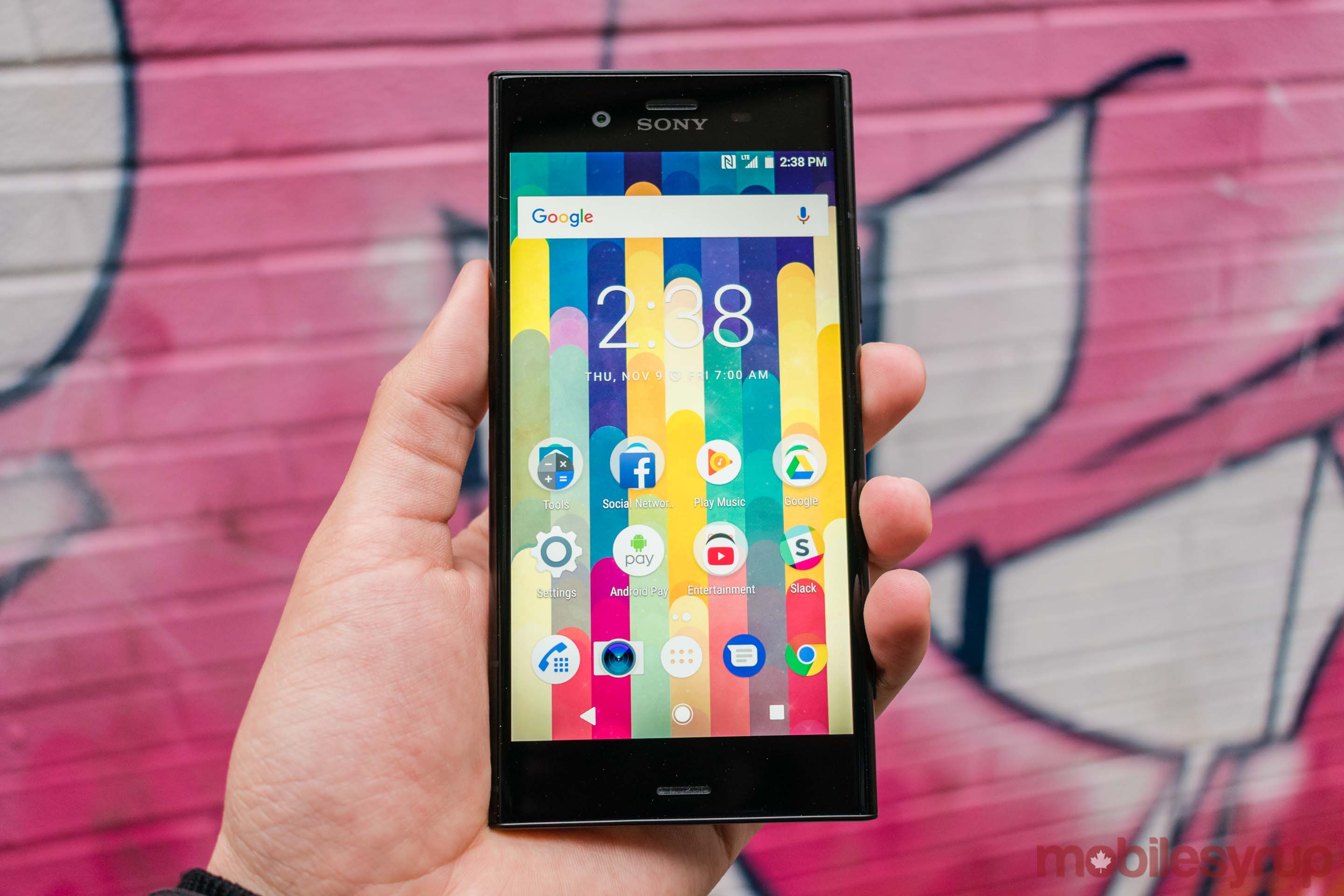
Sony Xperia XZ1 Review: Great just isn’t good enough

by Sameer Chhabra

Please understand that if you were to use Sony’s Xperia XZ1, you would most likely be completely satisfied by your experience.

It’s an attractive, sturdy, powerful machine, that is more than proficient at accomplishing almost any task you ask of it. Not to mention, the phone costs $1,000 CAD outright — which makes it one of the more affordable premium-tier Android flagships on the market.

It’s a phone that I’d be proud to wholeheartedly recommend, if it wasn’t for the fact that there are far better options on the market.

A screen that’s kinda boring, bezels you just can’t ignore and a design that’s attractive but dated

Let’s start with some quick numbers, right off the top.

The Xperia XZ1 features a 5.2-inch, 1920 x 1080 pixel Full HD IPS LCD display with an impressive pixel density of 424 pixels-per-inch. The screen is bright and HDR10 compliant, and it looks great. Sony boasts that it tried to transpose lessons learned from its Bravia televisions to build the XZ1’s display.

The phone features the company’s Triluminos display technology, and it’s safe to say that the screen is impressive. Colours pop and blacks are black, while television programs, movies and videos from Netflix and YouTube look great. The phone also allows users to customize the display’s colour gamut and contrast with three specific settings: ‘Professional mode,’ ‘Standard mode’ and ‘Super-vivid mode.’

When set to the Super-vivid mode, the phone’s display becomes — surprise, surprise — incredibly vivid. The differences between each mode aren’t incredibly noticeable at low brightness settings, but once you crank up the brightness, you really do start to notice how much deeper colours become in Super-vivid mode.

That being said — and this might sound strange to read — the XZ1 has a boring display. Again, the phone has a proficient screen that’s more than capable of rendering accurate colours across a wide range of use cases, but there’s ultimately nothing special about the XZ1 display that allows it to compete with devices like the Samsung Galaxy S8 or S8+, the Essential Phone, or even the Google Pixel 2 XL (issues and all).

All of those phones have more vibrant screens that reproduce colours more accurately — and more vividly — than the XZ1. To be clear, the XZ1 has a great screen, but great just doesn’t cut it anymore. Sadly, neither do the XZ1’s giant forehead and chin. Sony’s latest flagship has a design straight out of 2010, because modern Android smartphones don’t waste so much real estate on top and bottom bezels anymore.

Granted, those top and bottom bezels house dual front-facing speakers, so some might argue that the design choice is justified. At least, that’s what I would’ve said if Google didn’t also release an Android flagship smartphone with dual front-facing speakers this year. Sad for Sony, but there’s no excuse for bezels this large on a flagship smartphone anymore.Once you get over the fact that the phone looks like it was built with a different generation of smartphone design in mind, it’s hard to ignore just how attractive the phone really is. I’ve been using the black version of the XZ1 and even with my criticisms of the phone’s bezels, I still often find myself staring and taking in the sheer beauty of the device.

The XZ1’s curved sides mean that the phone rests comfortably in my hands. The aluminum finish gives the phone a distinguished heft and weight. The Corning Gorilla Glass 5 front panel melds almost seamlessly into the sides, tricking the user into believing that the glass curves as well. It doesn’t, but that’s not really the point. Good design in all matters is supposed to facilitate the use of a device without being overly intrusive or gaudy. And barring the obvious exception, there’s nothing intrusive about this device.

Sony has undeniably built a premium device and the quality of the XZ1 is noticeable as soon as you glance at it. Even the buttons — often an overlooked aspect of good phone design — feel tactile enough to be accessible but just mushy enough to be comfortable. Continuing a Sony tradition, the phone’s fingerprint sensor — and yes, scorned Canadian Sony fans, there is a fingerprint sensor — is built into the XZ1’s power button.

A quick tap wakes the screen so you can check notifications, while holding your thumb over the power button completely unlocks the device. Sadly, you do actually have to push the power button in order to unlock the device. Unlike certain other Android phones with rear- or front-facing fingerprint sensors, you can’t activate the XZ1’s sensor just by touching it.I’ll admit, I did find the fingerprint sensor a little annoying at first. I’m a bit of a notification nut and I also use my phone in place of a wristwatch, so the idea of needing to unlock my phone to check the time strained comprehension. Still, I figured out that a quick tap is all I need to wake the display without unlocking the phone in its entirety.

Stalwart processing power and acceptable battery life

To be perfectly honest, with a Snapdragon 835 processor powering the XZ1, as well as a premium-tier average of 4GB of RAM, I would have been shocked and disappointed if the XZ1 wasn’t able to deliver on performance. Thankfully, I was happy to find that the XZ1 breezed through resource-intensive apps and games — Deus Ex Go, Modern Combat, N.O.V.A. Legacy, and the like. I’m also happy to report that the phone maintained a reasonable temperature throughout all taxing processes. The phone never became hot or uncomfortable-to-hold, even during the most intense gaming sessions.

As for the subject of battery life, the XZ1’s 2,700mAh battery is capable of spitting out roughly one-and-one-quarter days worth of life with low to moderate use. This means checking emails and reading the news during my morning commute, sending text messages and making phone calls during work, and then playing some games on my way back from work.

However, moderate to heavy use — which in my case meant binging all of Stranger Things 2 using Wi-Fi in a single sitting — drained the battery in about four-and-a-half-or-so hours. Your mileage will certainly vary, but rest assured that should you decide to drain your battery, you won’t have to wait too long for the phone to charge, as the XZ1 features Qualcomm’s Quick Charge 3.0 tech.

Sound quality that actually sounds like quality

If there’s any one reason to truly consider purchasing the Sony Xperia XZ1, it’s the device’s two front-facing stereo speakers. Sony calls the XZ1’s speakers ‘S-Force Front Surround Sound’ speakers, which is really just a fancy way of saying that the device can project some serious sound power.

And make no mistake, the phone has some powerful sound. Whether you’re listening to music on Spotify or Google Play Music, watching videos on YouTube, or watching movies and television programs on Netflix or CraveTV, the XZ1’s speakers deliver some seriously great audio. Treble notes sound clear and pristine, midtones get the emphasis they deserve, while bass notes resonate and reverberate without sounding overbearing.

Sony’s marketing also emphasizes the fact that the phone features DSEE HX Hi-Res Audio, as well as LDAC technology, and digital noise cancelling that (when paired with noise cancelling headphones) delivers “up to 98 percent exterior noise reduction.” The phone also has ClearAudio+ that delivers on “enriched sound.” Furthermore, the XZ1 carries Qualcomm’s aptX HD audio standard, which means that Bluetooth headphones equipped to transmit and receive aptX HD information — like the Libratone Q Adapt headphones — offer even better sound quality.However, it’s important to cut through all of the marketing babble to deal with the simple facts. Most people will notice that the phone gets loud and that the phone’s audio quality is better than some of the other phones on the market. Additionally, most users will enjoy being able to set up custom audio profiles for use with wired and wireless headphones.

However, if you’re an audiophile, you probably already have a custom portable rig that’s more than capable of providing you with the sound quality you desire.

If you just so happen to be an audiophile looking for a phone capable of boosting and amplifying your music to desirable, then yes, the Xperia XZ1 will most likely meet your standards. Since audio is often a subject issue, however, maybe try the phone with your music first before making a purchase.

A camera that gets the job done, and that’s about it

Before you look at the XZ1 and criticize it for its lack of dual camera setup, it’s important to recognize that the phones with one of the best cameras ever released on a mobile device — the Pixel 2 and Pixel 2 XL — are both devices with a single rear shooter.

That being said, to suggest that the XZ1’s camera is comparable to that of the 2017 Pixel twins — or the 2016 Pixel twins for that matter — is a fallacy.

Don’t get me wrong, the XZ1’s 19-megapixel camera is good, but much like the device’s screen, the images that this phone produces are — for lack of a better word — a little boring. Colours don’t pop, blacks aren’t deep or vivid, the device struggles in especially bright and especially dark environments and it’s difficult to no notice quite a bit of processing once you zoom in on a photo.

Granted, users can fix some of these problems using the phone’s manual controls — which puts shutter speed, aperture, ISO and white balance control in humans hands.

The XZ1 can also shoot slow-motion video at 960-frames-per-second. This effect works quite well, but I’m not fully convinced that being able to shoot slow-motion video is enough of a reason to choose the XZ1 over other smartphones with better cameras.

Here’s the thing. The XZ1 takes good photos, but that’s something that can be said about every single premium-tier flagship phone on the market (except, if you listen to MobileSyrup’s Igor Bonifacic’s thoughts on the Essential Phone). The simple fact of the matter is that the XZ1’s camera doesn’t hold a candle to cameras on devices like the Samsung Galaxy S8/S8+ or the Galaxy Note 8, of the LG V30, and certainly not to the iPhone 8/8Plus, or the iPhone X.

In fact, the XZ1’s camera also isn’t a ‘serious contender’ like Huawei’s P10 or P10 Plus, which have repeatedly proven to be exceptional cameras on devices that are significantly cheaper than Sony’s latest.

There’s also an issue that the camera app is sometimes slow to open and sometimes crashes. These weren’t issues that occurred often enough to be a problem, but it’s still something to consider.

Ultimately, what should be an exceptional camera — since Sony’s standalone cameras are some of the finest products on the market — is simply adequate. For a device that costs as much as the XZ1 does, that’s disappointing.

Near-stock Android and very few gimmicks that are fit to print

In the world of modern Android, there exist two kinds of operating system philosophies. On one hand, there are manufacturers that load their phones with Google’s stock operating system; on the other hand, there are manufacturers that choose to lay a custom skin overtop of an already wonderful mobile OS. The interesting news is that Sony’s moved forward with its own third way: a blend of both stock Android and a custom skin.

Sony ships the phone with a custom Xperia launcher, as well as duplicates of most of the major Android apps, but not a custom skin. In the age of modern Android, however, you can not only install the Google Now launcher and Google Assistant on your phone, you can also disable quite a few of Sony’s stock apps and transform your phone into what is effectively a stock Android device. 

Yes, you still have to deal with the fact that your phone’s onboard storage is clogged with a series of irremovable Sony apps, but with 64GB of internal storage — as well as the ability to add an additional 256GB of storage thanks to a microSD card — you really don’t need to worry about running out of room on your phone.

In fact, all things considered, Sony’s latest flagship device is actually quite free of any additional apps or features that really distinguish it from its premium-tier flagship siblings. There’s a 3D scanner app that lets you scan faces, bodies, food and freeform objects, but that’s about it. The 3D scanner works adequately. In my tests, I’ve found that it takes quite a bit of practice to fully utilize this feature. As for its utility, I’m actually not sure who this 3D scanner is for.

You can import your scans into games or even 3D print them, but if you’re in the 3D printing business or you’re looking for a 3D scanner for medical purposes, you’re most likely not going to purchase this $1,000 phone.

A brief note for my fellow Freedom fighters

As a Freedom Mobile subscriber myself, I was very excited to pop in a Freedom SIM and use the XZ1’s band 66-capable LTE. As it turns out, and this might have been a direct result of the fact that I reviewed an XZ1 provided by Sony and not Freedom, the phone didn’t cling to Freedom’s ‘traffic-free’ LTE network.

The phone dipped down to 3G quite often. When it did connect to LTE, however, data speeds were incredible.

The post Sony Xperia XZ1 Review: Great just isn’t good enough appeared first on MobileSyrup.

14 Nov 18:14

Thank you farmer Adan Hernandez Amaya and family and prototypecoffee.ca for the beautiful delicious coffee! 20171112_144118 added as a favorite.

by ǝlɐǝq ˙M ʍǝɥʇʇɐW
13 Nov 00:24

Wolfenstein II: The New Colossus is one of the best shooters in years [This Week in Gaming]

by Bradly Shankar
Wolfenstein 2 dual-wield combat

In many ways, Wolfenstein II: The New Colossus — with its story-driven alternate history account of a Third Reich-conquered world — couldn’t have released at a better time. There’s an ongoing concern in the gaming industry that single-player games are on their way out, following Electronic Arts’ recent closure of Visceral Games, the makers of the Dead Space trilogy.

Visceral had been working on a highly anticipated Star Wars game, but EA shuttered the studio and terminated the project in favour of shifting to a “games as a service” model of multiplayer experience. Hence, the debate has raged on regarding what place the sort of narrative-driven, linear solo games old have in modern gaming.

That’s to say nothing of the more serious discussion surrounding the current political climate and accusations of Nazism being thrown around left and right — a fact that publisher Bethesda commendably did not shy away from in the marketing of the game.

In both cases, The New Colossus has some important things to say — quality single-player games are here to stay, and, more to the point, they’re capable of telling powerful stories touching on real-world issues like racism, fascism and despair. Because of that, Swedish developer MachineGames’ follow-up to its surprise hit 2014 shooter Wolfenstein: The New Order stands far above many of its single-player peers.

In fact, Wolfenstein II is quite simply one of the best shooters I’ve ever played, thanks to punchy first-person melee and gunplay combat, a gripping, surprisingly poignant narrative and a cast of well-rounded, believable characters.

Guess who’s back, back again

The New Colossus puts you once again in the shoes of longtime Wolfenstein protagonist B.J. Blazkowicz, who’s seen better days by the time the story begins. The New Colossus picks up immediately where The New Order left off, with B.J. gravely wounded from an explosion after defeating Nazi scientist Deathshead. Thankfully, his allies in the Kreisau Circle resistance group quickly swoop in and take the near-death B.J. to be treated on a U-boat known as the Eva’s Hammer, which they’ve commandeered and are using as a mobile base of operations.

B.J. awakes to find that Frau Engel, a ruthless Nazi commander, has discovered their boat and is gunning for him. Engel is hardly a complex villain, but what she lacks in character development she more than makes up for in gleeful sadism. She’s hellbent on getting revenge against B.J. following the events The New Order, leading her to do some profoundly horrible things in an attempt to psychologically break him. As a result, she’s rather reminiscent of Vaas Montenegro from Far Cry 3 — a captivating larger-than-life villain that steals every scene she’s in.

Wolfenstein 2 Frau Engel

Rendered immobile from his injuries, B.J. gets into a wheelchair, picks up a submachine gun and begins rolling around to find his friends and escaping. It’s a strong, zany opening chapter, starting you off feeling particularly vulnerable and hindered, but it sets the tone for what’s to come — namely, a fantastic amount of fun killing copious amounts of Nazis.

Later, B.J. learns that Anya, his partner from the first game, is pregnant with twins. The revelation is shocking to B.J., knowing that he’s on borrowed time due to his injuries. His body is unfortunately left broken, his life sustained only by a suit of armour, and his mind in a fragile emotional state. Every time he goes out in a mission, he prays to his fallen allies to give him the strength to keep fighting, lest he fail and leave Anya alone to raise two children during the Nazi’s fascist regime.

The New Colossus also features a number of flashbacks to B.J.’s childhood years, revealing a time of horrific physical and emotional abuse at the hands of his cruel, racist father. Only the consolation of his dog Bessie, his Jewish mother Zofia and childhood African-American friend Billie helped keep him whole during a tough upbringing. The heartwarming kindness shown to him from two kinds of people that were terribly mistreated during this time — and whom his father tells him he should hate — helps shape B.J. into the strong and righteous man he eventually becomes.

Wolfenstein 2 Kreisau Circle

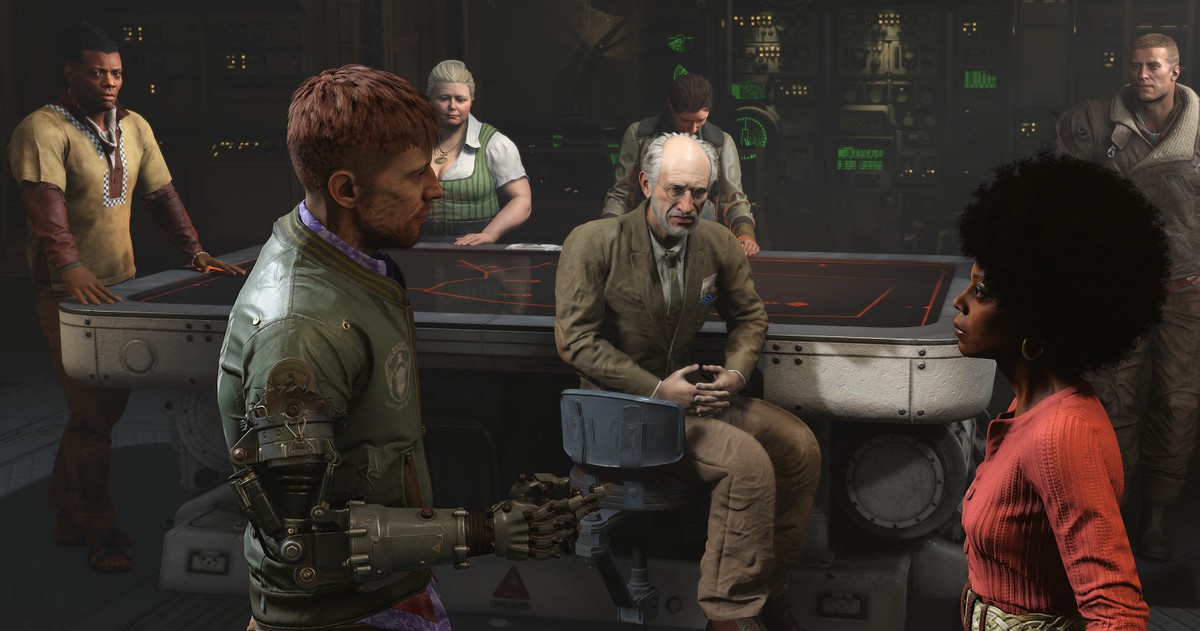
In turn, he helps bring together a diverse, strong cast of characters who you’ll interact with on the Eva’s Hammer in-between missions. The boat, which is vast and offers many floors to explore, truly feels alive thanks to such figures as African-American freedom fighter Grace Walker, cantankerous Scottish soldier Fergus Reid and even Engel’s own daughter Sigrun, who defected from the Nazis after being shamed by her mother over her disdain for violence and obesity.

Sigrun in particular proves to be a standout character, struggling to separate herself from the atrocities committed by her mother and the rest of the Nazis and show the Kreisau Circle that she can be a virtuous person in her own right. Each character has their own compelling, often tragic reason for being on the boat, with stellar dialogue and voice performances playing a big role in bringing their stories to life.

Wolfenstein 2 mechs

In one scenario, I found the South African Bombate talking with the mentally impaired Max Hass, whose speech capabilities are lamentably limited to his first and last name only. Bombate expresses his anguish over the fact that Max’s sad, childlike innocence is a constant reminder of the family that he lost, and in an attempt at projection, he angrily orders Max to smile. Another situation, meanwhile, shows the crew celebrating a birthday with lots of food, liquor and music to forget about the outside struggles, if however briefly. Placed in between the larger, harrowing warfare, these small moments are a welcome reminder of the humanity of the brave men and women fighting for a better world.

B.J.’s here to chew gum and shoot Nazis, and he’s all out of gum

But ultimately, that’s all a diversion from the real centre of the task at hand — taking down lots and lots of Nazis. In the years since they’ve won, the Third Reich has doubled down on its human and animal experimentation, leading to truly perverse and dangerous results. Many of the enemies you fight are tortured humans now adorned with mechanized suits, rocket propellors and lasers, making them far more machine than man.

You have the choice of stealth or full-frontal assaults, although based on the game’s rather difficult nature, I do recommend discretion. Specially-marked Nazi commanders are also capable of sounding alarms to bring in reinforcements, making it essential that you eliminate them quickly — whether you do that stealthily or otherwise.

Throughout the 14-hour campaign, you’ll experience some really great, over-the-top setpieces, ranging from a chase through the streets of New Orleans on a mechanized, flamethrower-equipped Panzerhund wolf to a Wizard of Oz-inspired encounter that needs to be seen to be believed. There’s a great mix of pistols, shotguns, machine guns and grenades, as well as scientifically enhanced lasers and other Nazi weaponry you can get your hands on.

Wolfenstein 2 Panzerhund gameplay

You can dual-wield any weapon for hilariously crazy combinations, such as a shotgun in one hand and a laser-beam blaster in the other. But as ridiculous as this may sound, there is also a tactical advantage to using two guns at once. At times, I would have my upgraded silenced Pistole in one hand and Shockhammer shotgun in the other, so I could quietly pick off enemies while also being ready for a possible firefight.

Doing so reduces the time it would take to navigate the weapon wheel, which is open in real-time, giving you precious extra seconds to shoot first at an alerted enemy. At the same time, dual-wielding removes the ability to aim down the sights, so you sacrifice accuracy for power, making it an appropriately balanced gameplay mechanic.

This type of combat readiness is particularly important since B.J. does not have the regenerating health ability that most first-person shooter heroes are lucky enough to have. As a result, he’s reliant on health packs and armour scattered throughout the levels. This made stealth a much more fulfilling (albeit very tense) option, as trying to get through groups of enemies quietly and without getting shot was tough, but also greatly reduced my chances of getting injured or killed.

The New Colossus also rewards you for experimenting with different combat options. There are three different categories of perks — Stealth, Mayhem and Tactical — and the more you perform specific maneuvers in each one, the more proficient you become in them. For example, racking up more kills with the throwable axes (Stealth) will increase the amount that you can carry at a given time, while defeating enemies in ways the involve flames (Tactical) will reduce the amount of damage you take from diesel-based weapons. It’s a satisfying loop that had me switching up my strategies whenever viable, making B.J. an increasingly more powerful Nazi-killing machine the more I played.

Wolfenstein 2 hatchet

Late game, you’ll also be able to go on Ubercommander assassination missions to take out high-ranking Nazi officials. These offer a nice change of pace from the major story missions and take you to some interesting locations. In one mission, I visited a film set modelled after B.J.’s childhood home, with actors paid to spread propaganda of how evil a man “Terror-Billy” really is. Another had me revisit the eerie dilapidated Manhattan subway system, avoiding large rocket-powered tin men along the way.

Unfortunately, some of the levels in both the story and Ubercommander missions can feel too claustrophobic to encourage stealth, making it far too easy to get spotted. I found myself quickly overcome by large swaths of enemies, making the game feel somewhat unforgiving at times. Particularly, The New Colossus‘ anthropomorphic robotic enemies move and shoot fast, downing me in several instances before I could even make it to cover.

Overall, though, areas are well-designed to encourage multiple approaches. This is especially true in the latter half of the game, when B.J. is given a sort of ‘super power’ augment to increase his strength, verticality or contorting capabilities. Environments are designed to accommodate all three abilities, so ultimately there is no ‘wrong’ choice, merely one that better fits your kind of play-style.

Wolfenstein 2 Roswell

In all of the game’s various locations, you can also find objects that reveal more about the world through some well-done environmental storytelling. An early New York level is filled with letters written by pinned soldiers who were sending well wishes back home to their families, while a note from Sigrun on the Eva’s Hammer recounts her first meeting with none other than Hitler himself. These are often heartbreaking reminders of how all life is torn apart by war, making B.J.’s cross-America journey feel all the more crucial.

However, despite the oftentimes dreadfully bleak outlook, the game still manages to maintain a steady stream of wit and levity. When he’s not going through solemn monologues, B.J. will make some rather humorous comments to help keep himself going. In one mission, when he’s tasked with infiltrating the Oberkommando base, he mentions that the base has a large amount of “Nazi assholes,” and once he clears them all out, he smugly remarks “Oberkommando, population: zero Nazi assholes.” The banter between the Kreisau Circle members, particular on the Eva’s Hammer, is similarly very amusing.

Vive la resistance

Wolfenstein II: The New Colossus is a single-player revelation. I initially came for what I thought would be rather bombastic Nazi killing, and I certainly got that in spades thanks to a wonderful mix of solid stealth and shooting. But what really kept me playing was a compelling story filled with an expertly written cast of likeable characters. B.J.’s story can be gruelling, but it’s nonetheless a thoroughly exhilarating ride with a surprising amount of heart to it, making it one of 2017’s must-play games.

Wolfenstein II: The New Colossus is now available on PlayStation 4, Xbox One and PC.
Note: the game also receives 4K enhancements on Xbox One X and PlayStation 4 ProEurogamer has a great in-depth breakdown of the technical improvements on both systems, but suffice it to say, the game looks better on both systems. For what it’s worth, I played half of The New Colossus on Xbox One X and the game — which already looked pretty to begin with — had a higher resolution and sharper overall picture.

A Nintendo Switch version has also been confirmed for release sometime in 2018.

Image credit: Bethesda

The post Wolfenstein II: The New Colossus is one of the best shooters in years [This Week in Gaming] appeared first on MobileSyrup.

13 Nov 00:23

on An “Open Pay Wall”, has Medium lost its mind? by Ploum

by Stowe Boyd

A few questions for Ploum:

  1. Do you think it likely that Medium will reverse the ‘open paywall’ model as currently envisioned? Is that what you hope will happen?
  2. Is a platform that is built around a paywall a good place for those publishing openly? Won’t Medium’s time and energy be directed to features and extensions linked to the paywalled/closed experience, and less so for the non-paywall/open experience? A two-speed platform, in essence?
  3. If I want to be paid for my writing, wouldn’t I be better off with a Patreon/SubStack approach, where I get the money people pay for my writing, and not some fraction of members monthly subscriptions based on how they divvy up their claps? Has Medium created a ‘worst of all worlds’ model that is a headache for readers and starvation for writers?
  4. Should Medium block a writer who is trying to make money on the Patreon/SubStack platforms, and who only writes on Medium to attract readers to subscribe on those platforms? Would Medium be justified to do so? Is such a writer unethical? A parasite?
  5. What do you think of this analogy? If writing is a craft, maybe we should think of it like glass blowing. I’m happy if folks come to my shop, and peer through to the workshop as I am blowing vases, cups, or bowls. They get to experience what’s going on. But I don’t just give the vases away for free: people have to pay to take home and use a vase in the manner that it is intended, to hold flowers, for example. The mix that makes sense to me is a mix of free/open and fee/closed writing. This sounds like Medium, but Medium’s model for payment is too diffused. Imagine if the glass blower was paid some share of all the money visitors paid to all the glassblowers in town, and the fraction was set by an algorithm based on applause, and not set by the glass blower directly. That’s sort of what Medium has done. They’ve created a guild of artisanal writers where the guild sets the price for goods, pools the money, and distributes it based on a complex and unverifiable algorithm.

Personally, I am trending toward a Patreon/Substack/Mighty Network approach, since the relationship between writer and subscribers/patrons is more direct, and I get to set prices directly too. And the writer is not limited to just free/fee. A variety of tiers of prices are possible, as well as different ranges of limited access to closed content. (For example, those participating in an open poll could be granted access to the write-up of the results, and a three month trial of a full subscriber account.)

I guess I feel that Medium could’ve created more obvious plumbing to help publishers and individuals make money on Medium, and put more of the controls in our hands, instead of creating a unitary, centralized model where they call all the shots. Currently, they pick the writers, (who are not employees, note, nor guaranteed a fee per post), they choose what to promote, and they set up the system for sharing the proceeds.

Sounds a lot like driving for Uber, come to think about it.

13 Nov 00:23

Ein Engländer, der im Jahr 1946 lebt

by Ronny
mkalus shared this story from Das Kraftfuttermischwerk.

Wir haben womöglich alle Sympathien für vergangene Jahrzehnte und schleppen aufgrund derer bestimmte Relikte dieser Zeit auch noch heute mit uns rum. Normal, denke ich. Der jetzt 39-jährige Engländer Ben Sansum ist dabei konsequenter und hat einen Teil seines Lebens so eingerichtet, dass es ihm das Gefühl gibt, er würde im Jahr 1946 leben. Das geht natürlich nicht in Gänze, aber er versucht so nahe wie möglich daran zu kommen. Oder versuchte es – das Video ist schon etwas älter. Dennoch interessant.


(Direktlink, via Laughing Squid)

13 Nov 00:23

Complex writing is good for you (or why I'm writing every day this month)

by Helen Keegan
There isn't a lot of routine to my home life. I'm not rigid when it comes to meal times (although I do like to cook from scratch). I'm not a morning person at the best of times so work related tasks drift into the evening, especially now that the weather is cold and miserable. My work tends to come in fits and starts - it's the well-known feast or famine scenario. I think that suits my personality most of the time but not necessarily all of the time.

In very busy times, or particularly stressful times, I can and do adopt a more regimented routine and I've used the Fabulous app successfully to help me with that. One of the tasks that it has you doing every day is a to do list. They recommend strongly that you write this down by hand and not on a computer or phone. There's something about the act of writing by hand that is perhaps more mindful than typing. And maybe it connects to the brain differently. I'm not sure. Either way, when I've done this routine, it does work and has helped me maintain focus and manage a heavy workload. 

Writing by hand is also a key part of the famous book, The Artist's Way. A friend recommended the book to me some years ago. I've never managed to work through the whole thing as it takes commitment and I'm not quite ready to commit to being an artist (What is my media? Will my work be good enough? How will I pay the bills? And lots of other questions immediately spring to mind. And yes, I know that's what the book can help you answer!). 

One of the key tasks of The Artist's Way is to write your morning pages, by hand, stream of consciousness style, until you have written at least 3 sides of paper. This can be about anything at all but it's a recognised way of dealing with whatever is on your mind at the time whether that's what the weather's doing or because you've had a run-in with someone. There are times when I've started the process and done a few days or a couple of weeks, but never stuck with it. And once I've dropped the ball on it, I've never picked it up. Oliver Burkeman writes more about how he used them and how they're being used by business people too.

Despite my penchant for Facebook, Instagram and Twitter, I have held on to this blog over the years and still see long form writing as important. That's one of the reasons why I committed to doing the NaBloPoMo thing this November by writing a blog post every day. I think it's healthy for me to write something every day, partly down to the routine and discipline of it but also because it helps me think things through in more depth.  

It turns out that complex thinking is inextricably intertwined with writing. According to this article from TES, if you discourage extended writing, you can damage deeper thought. And if we need anything right now in this age of instant gratification and algorithms making decisions for us, it is deeper thought! So on day 12 of this NaBloPoMo experiment, I'm reassured that I might just be on to something.

Day 12/30 NaBloPoMo 


13 Nov 00:23

What are the most popular Docker images for Python?

by Brett Cannon

There was a question at work about what the most popular Docker container image for running Python code was? I didn't have an answer, so I asked on Twitter to see if a clear answer could be gleaned.

The first poll asked what people's favourite Python Docker image, and the results were:

  1. Alpine: 54%
  2. Stretch (full or slim): 20%
  3. Jessie (full or slim): 15%
  4. Windows Server Core: 11%

Now this result surprised me. I wasn't expecting Alpine Linux to win out for two reasons. One is I honestly assumed that most people were not that familiar with the distribution since it isn't as well-known as Debian. The second is that Alpine isn't compatible with manylinux wheels from PyPI, but then again most people probably build their wheels from sdists once and then include them in their image, so the cost of creating the wheel is paid only once per version.

There were also some comments on Twitter that Python on Alpine Linux wasn't as fast as on Debian, with the assumption that musl just wasn't optimized for certain things that Python relied on (I have no idea if this is true in general or just for certain cases that the people who commented happened to run into).

After I ran this poll, though, someone mentioned I left out Anaconda images as options. So I ran the poll again with the following results:

  1. anaconda3:38%
  2. miniconda: 30%
  3. Alpine: 24%
  4. other: 8%

Now to start, these results are skewed heavily towards data science due to Anaconda Inc. and it's co-founder, Peter Wang retweeting the poll. But even with that skew, Alpine still does surprisingly well.

I was also pleasantly surprised at how well miniconda did. While the lighter-in-size miniconda would be better for download size of an image compared to a full-sized Anaconda image, I personally didn't expect miniconda to have that much exposure to lead to people preferring it enough to have that good of a showing.

So what does all of this mean? Technically nothing since this wasn't exactly a rigorous survey 😉. But as a core developer it does suggest that it would be useful if someone provided a buildbot that was running Alpine Linux. And as a Python user it suggests that I should at least consider using Alpine Linux.

13 Nov 00:22

My blockchain side project to 'give something back'

by Mark Watson, author and consultant
I am very busy with my new machine learning job but I always like to try to split off some of my own free time for occasional side projects that I think will help me learn new technologies. My latest side interest is in blockchain technologies and specifically I am interested in blockchain as a platform and environment for AI agents.

I liked Tim O’Reilley’s call for action for corporations and people to take a longer term view of working for things of long term value to society in his recent keynote speech: Our Skynet Moment 

While I consider myself to be a talented practitioner for building machine learning and general AI applications since 1982, I don't feel like I work at the level of creating any groundbreaking technologies myself. So, as far as 'giving something back' to society, it seems like my best bet is in putting some energy into distributed systems that push back against centralized control by corporations and governments, things that enpower people.

Although it is really early days, I think that the Hyperledger projects look very promising and I like how this organization is organized in a similar fashion as the Apache Foundation.

I would like to start slow (I don't have much free time right now!) and will record any open source experiments I do at my new site hyperledgerAI.com. I may or may not finish a book project on any open source software that I write: hyperledgerAI: Writing Combined Blockchain and Artificial Intelligence Applications. I will start with small well documented sample applications built on Hyperledger.
13 Nov 00:22

Unlocking the potential of technology: a photo essay

by Laura

Project: Photography
Date: 2010-2017 
Location: Madagascar - Bangladesh - India - Kenya - Brazil 
Position: Behind the camera

After 7 years working on innovative social impact projects with communities around the world, I have documented the usage of technology for learning, creating and communicating. My photo essay collaboration with the BBC illustrates the enormous undertaking of NGOs, corporations and governments to unlock the potential of technology in our ever-changing society.

12 Nov 23:47

Bloor bike lanes are approved by city council

by jnyyz

Cycle TO put out the word last night that the Bloor bike lanes were likely to be voted on today. I was able to attend the City Council meeting from after the lunch break, at 2 pm.

You can get a feel of what happened in the morning from Star transportation reporter Ben Spurr’s excellent twitter feed. (In fact if you just read his feed for the day, you’ll probably get a more coherent impression of the whole session than what I can provide from my sketchy notes to follow.)

IMG_7012

Cycle Toronto was well represented.

DSC01845The afternoon session started with quick consideration of some member motions.

MM34: TO as a nuclear free zone. Somewhat bizarrely, four councillors voted against this: Mammolitti, Colle, Burnside and Campbell.

After a few more quick motions, council returned to the discussion of the Bloor bike lanes.

Pasternak: has all the 800K allocated been spent? What is the incremental cost of making them permanent?

Jacquelyn Hayward-Gulati (JG): it depends on the nature of permanent features. Majority to be done as part of scheduled 2019 capital improvements.

Pasternak: How can we make bike funding to be more equitable.

JG: expanding to suburbs is a priority, but projects needed to be at a certain stage in order for the money to flow to it.

Shelley Carroll: clarified that the data was studied comprehensively. “We want to make sure that if we make a bike lane on a major arterial, that this would not justify removal of other bike lanes.”

Janet Davis: questions about the Danforth bike lane: original recommendation was to proceed with the major corridor study of the Danforth bike lane.  Should have taken place 2017-2019?

DSC01849

JG: council made some changes in the plan.

JD: Danforth was removed from the major corridor studies

JG: only those studies that were under way went ahead and the others were deferred, not just Danforth

JD: can bike lanes be recommended in the context of the avenue study that is currently underway rather than waiting for a major corridor study?

JG: Recommendation could come back in spring 2018, prior to a major corridor study.?

Mammolitti:

Can this decision be reversed at any point in time? (Others mutter about Jarvis)

How much money would be spending if this was approved now until the next election?

Barbara Grey (BG): no addition money will be spent before the election, if there is no removal of the bike lanes.

GM: what about winter months?

BG: we didn’t do counts in winter on Bloor.

JG: council commended timing of Bloor study.

GM: talking about wanting the video. making the claim once again that counts were inflated by the same cyclists going in a circle, “just as their wheels do.”

Cut off by speaker

MMM: on to some serious questions, logical questions,

Do different jurisdictions use major corridor studies?

JG: provincial requirements for environment studies have changed.

MMM: no longer have to do EA?

JG: depends on the nature of the project. In this case, the corridor study was sufficient.

Jaye Robinson: raises the concern to the City manager: in her opinion, the two bodies that conducted the study were known to be biased towards bike lanes

Moneris: only deals with big retailers, not mom and pop shops

BG: Moneris has largest share of POS in Canada. 1/3 of businesses uses it along Bloor.

JR: some questions about sales levels. 70 businesses are against, and they pointed out: no surveys in Chinese, Arabic or Persian. Just English and some Korean.

JR: some polling was done, responses not all by owners.

JG: city made best efforts. TCAT, up to four attempts per business door to door.

JR: told yesterday that in the past few weeks: ridership has dropped by half according to business.

JG:  cyclist count at Bloor & Castle Frank 22% of summer volume during winter, somewhat larger fraction on Sherbourne.

JR: near miss collisions: near misses between cyclists and pedestrians.

JG: overall number went down, but that particular category went up.

JG: plans for accessible loading spaces. Will work further with the community to determine improvements.

J Mihevic: Asked some questions that reinforced validity of study

DMW: Are you attributing the spending increase (by customers of Bloor businesses to this project?

JG: there are many factors that can affect sales.

DMW: are you saying that the bike lanes didn’t affect business

JG: we saw some go up , some go down

DMW: so you are just putting this data out there, but it doesn’t mean anything. And are you aware that Moneris says that Moneris spending is going up 36% over the past 12 months.

BG: survey and Moneris data: bike lanes did not have a signficant impact.

DMW: 2/3 do not use Moneris:  these are the businesses that lost business.

DMW: wintertime: 75% fewer cyclists in winter, and more cars on the roads if the weather is cold.

JG: benefits of safety, and even with a 70% reduction, Bloor would be in the top ten of cyclist facilities in the city.

Fletcher: we don;’t have the money to initiate the Danforth Major corridor student right now?

JG: given the workplan, there is not enough staff for it to begin before the 2 year review of the 10 year cyclist plan (2019)  There is an early stage plan for Danforth. Coxwell to Victoria Park is Phase 1. Phase 2 is Coxwell to Broadview.

Stephen Holyday: What is the bike speed limit on MGT?

BG: 20 kph

SH: can we make the same cycling speed limit on Bloor?

BG: bike lanes subject to speed limit of roadway, can deal with speed through design, cites Roncy, and Wellesley

SH: Would you Call this pilot a success?

BG: yes

SH four criteria: pass on safety: 3% cyclists increase, is that a success? Would one additional cyclist would be a success?

BG: trend is increasing,

SH: car counts decreased. Is that a success?

BG: perception of safety

SH: delays times a success?

BG: in the context of the study

SH: parking is now maxed out. Is that a success?

SH: business owners: would you say given the concerns about not polling cash receipts, is this a success for business?

BG: heard both positive and negative at PWIC.  this is the most extensively studied bike lane.

Karygiannis: how many businesses were spoken to? What is this going to cost to maintain annually? Special snow clearance?

JG: 95K annual, incorporated into snow clearance

Cressy: Is this the most comphrensively studied transportation project. Did the bike lane improve safety? Should we make this bike lanes permanent?

Now: speakers:

Cressy: thanking transportation services staff, residents, Cycle Toronto and Bells on Bloor. Working for 40 years on this.

“Bike lanes on Bloor should be here to stay” “Bike lanes in our city should not be divisive” We can make improvements in pedestrian safety, accessibility, etc when we make the bike lanes permanent. “Now is the time to make these lanes permanent”

JR: I want to some of the issues that I raised at PWIC: “ I feel strongly that the process is as important as the outcome”. Study was not independent. Moneris data biased towards big retailers.

MOTION: consult with ABBA on changes to the cycle track design in 2018, in advance of the 2019 redesign.

Wong Tam:

Thanking staff. Council has made much bigger decisions with much less information (allude to subway and Gardiner extension rebuild) 10 years ago, people had a different opinion on bike lanes, 10 years from now they will have a different opinion. Some asking for more data, more information, suggest to defeat all these other motions. We don’t need more data. “The modal shift is coming” Later on: we will be discussing the need for information on the Scarborough subway. How can you vote for more info on one and none on the other. Pushing for Danforth bike lane.

Mike Ford:

MOTION: move to refer back to transportation manager for detailed cost analysis and a winter bike count, and to report back by first quarter 2018.

IMG_7015

“ I do support cycling infrastructure, BUT I support cycling infrastructure that makes sense for my residents.” Concerned that there is not info on Gardiner extension and the subway as well.

Voting on referral motion:

DEFEATED 9-30

IMG_7016

Mammolitti: MOTION: no additional funding for Bloor bike lane until after next election

Businesses on Bloor are being intimidated. Where are the cyclists coming from?  We are being denied that video. “This doesn’t end here, folks”. “Bike lanes do not to be on our streets.”

John Campbell: MOTION: more information from businesses needed, reporting back to PWIC 4th quarter 2018.

“When you look at the numbers, there’s no change in cycling” Why am I supporting the bike lanes: I rode Bloor before and after, and it was much safer.

Chin Lee: the request of consulting with business is already in the original recommendation.

Norm Kelly: talking about the city of the future.

Shelly Carroll: will support the staff recommendations, and not the requests for more information.

Councillor Shan: We all share the streets. “Support for bike lanes should not be misconstrued as a war on the car”

Karygiannis: did not get clear answers.  “Let’s give it another year” “Thank you staff, but your figures are not always right”

S Holiday: MOTION: safe bike speed limit and/of bike speed calming measures along the Bloor Street West cycle tracks.

Presents a report card on the Bloor lanes.

DeBaeremaeker: “(the bike lanes) They work for everybody”. “Safety and peoples lives are first and foremost”

Davis:

Virtually everyone supported the bike lanes at PWIC. Talks about how the bike lane on Dundas E have not killed business. “What we need to do is to complete this network all the way to Scarborough”

Mihevic:

Points out that there is a shift taking place in mobility downtown.  We need the suburban councillors to recognize this.

DiGiorgio:

As the number of cyclists increase, they will need passing lanes, we need will need more showers.  The cost of sharing space on the roads. We need user fees for cyclists.

DMW: “I am not supporting the bike lanes. These bike lanes as a manifestation of taking a step back” “this city is drowning in congestion, and what are we doing, we are taking it worse”.  Says he put in bike lanes that work while on PWIC “We put them in Richmond and Adelaide”. 900% increase in cycling. 700% increase on Richmond. Put bike lanes on secondary streets, not on Bloor.

Perrruza “left safer driving on Bloor with the bike lanes” Heard everything at PWIC.

Bailao: in the near futures, how are an additional 450K people going to move around the city. “Just one more way of getting around.”

Perks: Three things

  • Peer reviewed economic data
  • Report card: the scores are not equally important. Cites two deaths in his ward this year (Morgan and Delos Santos
  • Council asked for data, they got it, The time for asking for more studies is gone.

Mary Margaret McMahon: simply howing pictures of cyclists killed in 2017. “Providing safe cycling infrastructure is the difference between life and death”

DSC01851

Layton: talking about safety.  “This community needs this bike lane” “Let’s show the world that Toronto is ready” Shows the page of the proposal to Amazon that shows the Bloor bike lanes.

Fletcher: “bikes are here to stay” Cites doctors for safe cycling, and FFSS. Disappointed that Danforth corridor study was delayed. “Bike lanes and roads go together”

Mayor Tory is the last speaker.

“We are not talking about a revolutionary change here.  It is an incremental change”. We are moving forward with a public consensus.

His favourite phrase is “Responsible balanced incremental change.”

Our aspirations are not those of a timid city, it is an ambitious city.  I believe this is the direction that the people want us to move in a responsible balanced incremental way.

There was a subtext to his remarks that we have studied this to death, and we need to get on with it, and one feels the same way about the Scarborough subway. Perhaps he figures that throwing the left a bone will ease passage of the 3.3 B subway extension.

Motion 1: Jaye Robinson (about consulting with ABBA)

IMG_7021

Carries narrowly (23-19). This motion is mostly harmless as a similar amendment was made at PWIC.

IMG_7022

Mammolitti motion on no more funding before next election:

IMG_7024

Defeated 5-37

IMG_7025

Campbell motion: more information from businesses needed, reporting back to PWIC 4th quarter 2018.

IMG_7026

Does not pass

IMG_7027

Hoyiday motion: bike speed limits.

IMG_7028

No 11-31

IMG_7029

Item as amended, i.e the staff recommendation that the Bloor bike lanes be made permanent.:

Passes, Good Perks voted no by mistake, so there was moment of hilarity followed by a revote. Final tally 36-6 in favour.

Screen Shot 2017-11-07 at 11.21.06 PM

Albert and Hamish looking elated immediately after the vote.

DSC01855

Layton and Cressy facing a scrum of reporters.

DSC01856

It was noted prior to the vote by several councillors that opponents pressed for more data, in spite of the extensive studies commissioned by the city. On the other hand, many of the same people will probably vote later this council meeting to press ahead with the one step Scarborough subway extension without considering additional information.


Many of us gathered afterwards at the Crafty Coyote, along the Bloor bike lane, naturally.

DSC01861

Riding home, it’s good to feel that these lanes won’t go away.

DSC01862

I wondered if my fellow cyclists were aware of what just happened, or if they have already taken the lanes for granted. The fact that they end at Shaw shows that we have more work to do, but for the moment, it has been a good day for bike advocacy in Toronto.

DSC01863

A summary was crossposted to bellsonbloor.org, with links to media coverage, and video of the final vote.



12 Nov 23:44

The Case for RSS

by Federico Viticci

David Sparks makes a good point about the strengths of RSS compared to, say, getting your news from Twitter or Facebook:

RSS is so easy to implement that it's a slippery slope between having RSS feeds for just a few websites and instead of having RSS feeds for hundreds of websites. If you’re not careful, every time you open your RSS reader, there will be 1,000 unread articles waiting for you, which completely defeats the purpose of using RSS. The trick to using RSS is to be brutal with your subscriptions. I think the key is looking for websites with high signal and low noise. Sites that publish one or two articles a day (or even one to two articles a week) but make them good articles are much more valuable and RSS feed than sites that published 30 articles a day.

Unlike Sparks, only a couple of my friends have moved on from RSS (and are using Twitter for news), but I agree otherwise – I don’t want to spend any more time on Twitter than absolutely necessary. I cherish the ability to subscribe to my favorite websites independently from social networks.

One thing I’d add: it’s possible to subscribe to high-volume feeds (and keep them alongside low-noise ones) if you take advantage of filters and muted keywords. Modern RSS services such as Feedly, Inoreader, and NewsBlur all come with advanced filtering features that mute specific articles directly on the server, so they don’t get pushed to clients on iOS or macOS at all. If you want to subscribe to a lot of sources but automatically hide topics you don’t care about, this is the only way to go.

→ Source: macsparky.com

12 Nov 21:27

Twitter Favorites: [DuaneStorey] Completed brisket (2 pieces). Total time smoking was 10 hours. https://t.co/v8w7hedboX

Duane Storey @DuaneStorey
Completed brisket (2 pieces). Total time smoking was 10 hours. pic.twitter.com/v8w7hedboX
12 Nov 21:27

Twitter Favorites: [MrSteveTweedale] "They helped the Allies win the war and they also helped to win the rights for all Chinese living in Canada." https://t.co/GQRmLsXDQv

Stephen Tweedale @MrSteveTweedale
"They helped the Allies win the war and they also helped to win the rights for all Chinese living in Canada." cbc.ca/news/canada/br…