
Forest cover map of Canada.
I’ve just finished setting up a new Mac (14" MBP, M2 Pro, 32G, 4T). It dawned on me that most of my really intense interactions with this thing involve looking at “monospace” (i.e. fixed-width) text; in Emacs where I write this blog, in my IDE, and in my terminal. The ones that came with the machine by default are, well, OK, but maybe we can do better. So I got on Mastodon and asked: “Dear LazyWeb: Setting up a new Mac, what are some groovy new monospace fonts for terminals and IDEs?”
[Update: This got a gazillion views and comments, the latter mostly along the lines of “you left out my favorite font!” So I wrote a follow-up with lots more fonts!]
Which was like throwing raw meat into the piranha pool. Obviously this is something that geeks care about deeply. I got a huge number of suggestions, of which I downloaded 16, basically all the ones that are free. In general I prefer to pay for things and am suspicious of anything that’s free on the Net, but when there are so many good free options I just don’t think there’s a business model.
Disclosure: In recent years I’ve been using Inconsolata, which has always pleased my eye, and also is the only font whose inventor I’ve met; I admire Raph Levien extremely. Can I replace it?
I loaded up the man page for ls(1) in the MacOS Terminal program, with size set to 18pt. By doing so I’m bypassing one important criterion: Readability at small size. I suspect that an increasing proportion of geeks, like me, in this era of 27-inch-and-up 4K screens, don’t really squish the letters the way we did when we were twentysomethings on screens with only a million dots. But if you still do, this piece probably won’t help you that much.
So let’s run through those screenshots. I’ll switch Emacs into each font as I write about it. I’ll pick the ones that I think are generally the most pleasing and do another screenshot of a moderately complex chunk of Go code as presented by JetBrains’ excellent GoLand IDE.
Here they are, in alphabetical order.
Start here.

Originally commissioned by Airbus as an
“Aeronautical Font” for use on aircraft cockpit
screens.
It has a few lower-case serifs, reasonably done. It’s little more vertically dense than my eyes like. Could live with it. Doesn’t advance.
Start here.

Commissioned by Google in 2007,
said to be optimized for small handset screens.
I lived in this typeface when I was in the Android group 2010-12. It’s perfectly OK but just uses too much horizontal space for me. While it looks nice in my Emacs buffer, it fails at the information-density bar and doesn’t advance.
Start here


“Programmers use a lot of symbols, often encoded with several characters. For the human brain, sequences like ->, <= or := are single logical tokens, even if they take two or three characters on the screen…”
This is an open-source thing by Nikita Prokopov, said to be optimized for code. Its big selling point is a set of ligatures, like “≠” for “!=”. Meh; all these years in, my eyes don’t care.
For a font that doesn’t market its typographic values much, it sure pleases my eye; light, clear, well balanced horizontally and vertically.
It comes with an ordinary selection of styles: Normal, Light, and so on. But then there’s also “Retina”. It’s difficult to find an explanation; one assumes some sort of optimization for high pixel density? Anyhow, it makes me happy; just the tiniest bit of extra weight that to my eye makes each character speak its nature a little louder.
The Retina style advances.
Start here.

By Bigelow & Holmes.
Wow, so many serifs. That strikes me as inconsistent with Go’s design aesthetic, which eschews decoration and fancy features. Also, it is notably more vertically compact than the average, which makes my Emacs editing screen look cramped; in code, which typically has shorter lines, that’s probably not so much of an issue?
Advance to the next round? Honestly, probably not. But I’m going to advance it anyhow because after all, stage 2 involves Go code, which this is said to excel at.
Start here.

“Designed for the screen. Open source. Libre.”
A little tighter vertically and looser horizontally. Which is arguably a good choice for code, with its shorter lines. Looks nice in my editor buffer too. Advances.
Start here, because IBM’s own page doesn’t seem to show off the mono weight.

The Plex family displaced Helvetica after
more than fifty years as the IBM corporate font.
Uh, no, it smells of mainframes. Look at some of those 90° serifs, right out of the 1950’s.
Start here.


“I was particularly struck by the beauty of Luc(as) de Groot's Consolas, which is his monospaced design for Microsoft’s upcoming Vista release. This font, similar to his earlier TheSansMono, demonstrated clearly to me that monospaced fonts do not have to suck.” —Raph Levien
Unfortunately I am failing to find the words to explain why this pleases my eyes so much; a screenful of it makes me happy. It suffers from several sins for which I fault other faces, but even so. More compact than this overview’s average but so graceful that I’ll take that and welcome the information density. Advances.
The Light variant also pleases my eyes — even more, a bit. But I don’t think it can quite carry the load of all-day every-day work.
Start here.

“Designed specifically for code by David Jonathan Ross.”
All other issues aside, there’s just not enough size differentiation between upper and lower case for me. Doesn’t advance.
Start here.

“A monospace programming typeface, built declaratively using custom typeface generation software, and with an emphasis on compatibility with CJK characters.”
It probably needs to be evaluated in a CJK-heavy application. It definitely, to my eye, has the look of technical printing I saw in Japan way back in the day. But for those of us whose coding lives are mostly in Latin characters, no.
Start here.

“A typeface for developers.”
And JetBrains knows a lot about developers. This font is so overwhelmingly clear that I can hardly even see it. I can’t think of anything to say, which means it’s doing what it’s designed to do. Advances.
Start here, I guess? Having trouble finding much commentary.

When I switch between this and JetBrains, the occupied space shrinks a little, but wow, other than that it looks really about the same. Density is good. Which do I prefer? Hmmmm… but it advances.
Start here.

“Inspired by Highway Gothic.”
Um, no, not really, the letterforms are just too stark, drawing attention to themselves. Doesn’t advance.
Start here (at Apple).

Derived from San Francisco, per Apple:
“This neutral, flexible, sans-serif typeface is
the system font
for iOS, iPad OS, macOS and tvOS.”
Yes, but not derived that well, I think. The lower-case letters are working too hard, mannered even; consider the “r”. I’m normally happy to take whatever Apple says is best for my general-purpose daily driver, but this one doesn’t meet my bar for a developer’s font.
Start here.

“Designed by Paul D. Hunt and Teo Tuominen.”
This is from Adobe, obviously a heavyweight in the world of design and typography; was authored in-house. Interestingly, when I switch back and forth between this and SF Pro, the shape of the text doesn’t change; the character metrics are identical. The glyphs do change in interesting ways. Source Code is simpler, less mannered, but neither does it really please my eyes nor get out of the way.
That leaves Fira Code Retina, Go Mono, Hack, Inconsolata, JetBrains Mono, and MesloLGS NF. Let’s go look at some actual code, from this file.
Here they are, but they’re not alphabetical, because I want you to look at them; scroll back and forth a bit. See if you draw any impressions before you check which is which.


In no particular order:
I cheated and included Inconsolata Light.
They all kind of look like each other. Which I guess shouldn’t be surprising.
In fact, they’re all pretty great.
There are several opportunities for a “≠” ligature in the code fragment. I don’t think it makes a damn bit of difference.
If you care about how many lines of code you can see, Hack squeezes the most into your window, JetBrains Mono the least. Um, I care.
You can tell which is which by click-to-enlarge and look at the labels, or the filenames.
I don’t think Go Mono really belongs in the top tier, even though it was designed for the language in the sample.
Nor does Inconsolata Light, actually, although I think it looks great.
I could be super-happy with any of Fira Code Retina, Hack, JetBrains Mono, or Inconsolata. Happy enough, I suspect, that the choice doesn’t matter.
The anatomy of visually-hidden
James Edwards provides a detailed breakdown of the current recommended CSS for hiding content while keeping it available for assistive technologies in the browser accessibility and render trees. Lots of accumulated tricks and screenreader special cases in this.
Via Ben Myers
I am travelling and yesterday my ISP had some problem, so this week’s posts are late and will also be light.
This article reports that Medicago, the only manufacturer of COVID-19 vaxes in Canada, is shutting down.  This article says that the governments of Quebec and Canada are trying to help find a buyer.
This paper from the US says that, while the death rate for doctors is always lower than for the general population, there were excess deaths for doctors early in the pandemic (although much lower than the general US level). There stopped being a significantly significant number of excess deaths after April 2021 — which I take as a sign that almost all doctors get vaccinated and that vaccines work.
This paper from USA says that people were about 2.3 times as likely to get a vaccine in April 2021 if they knew someone who got sick or died from COVID-19.
This paper from Taiwan found that Canadian men lost ~6.4 per 1000 disability-adjusted life years (DALYs) and Canadian women lost ~5.3 DALYs per 1000. It also estimated that Canada’s GDP took a COVID-19 hit of about 0.5% of the GDP in 2019.
This paper from USA says that people who had more healthy lifestyle habits were less likely to get Long COVID. The healthy lifestyle habits which they counted were:
People who had five or six healthy factors had half the risk of Long COVID.

This preprint from Germany found that people who got COVID-19 infections were at a 43% higher risk of developing an auto-immune disease. The list of autoimmune diseases that they were at higher risk for was very long, and included Hashimoto’s disease, diabetes, MS, Behcet’s disease, scaroidosis, Wegener’s disease, and vitiligo.
This paper from South Korea found that people’s intention to keep wearing masks after the pandemic correlated with how physically attractive they thought they were.
I am travelling and last night my ISP was down, so this is delayed and light.
As of today, the BC CDC weekly report said that in the week ending on 4 Feb there were: +278 reported (not confirmed!) cases, +88 hospital admissions, +21 ICU admissions, +20 thirty-day all-cause deaths.
As of today, the weekly report said that the previous week (data through 28 Jan) there were: +292 reported cases, +96 hospital admissions, +26 ICU admissions, +38 all-cause deaths.
Last week, the BC CDC weekly report said that in the week ending on 28 Jan there were: +293 confirmed cases, +73 hospital admissions, +26 ICU admissions, +30 all-cause deaths.
Last week, the weekly report said that the previous week (data through 21 Jan) there were: +408 confirmed cases, +123 hospital admissions, +19 ICU admissions, +40 all-cause deaths.
The BC CDC weekly report says that there are 188 in hospital / 25 in ICU as of 9 Feb 2023.
This article says that Island Health basically told health care workers not to test themselves for COVID-19!
This article says that more than 10K workers’ compensation claims in BC related to COVID-19 have been approved.
From Jeff’s wastewater spreadsheet using MetroVan data:


From the BC CDC Situation Report page as of 10 Feb (with data through 22 Jan):


The BC CDC VoC report has not been updated since 26 Jan. I don’t know if they are going to stop or what.
From the BC CDC Vaccination Coverage report as of 10 Feb (with data through 5 Feb):


Take an English-based nonsense word generator, enter its output into ChatGPT, and invite the Ai to create definitions for the nonsense words and we might actually be able to finally make English as expressive as German!
Here are 20 imaginary words with definitions provided by ChatGPT:
Happy Friday!
Ok, you all probably remember last fall, when the Muskening happened. When Mastodon saw a massive influx of new members. When Mastodon admins were struggling to keep up with the influx but ultimately showed that the network can, in fact, scale up. It was, in my view, the biggest stress on the ActivityPub protocol – and ActivityPub kicked ass. Millions of people signed up for Mastodon.
That’s the titular Mastodon “bump.”
Since I’ve published academic articles on Mastodon, during that Eternal Muskvember, I was approached by a lot of journalists (here, here, and here, for example) to talk about Mastodon, answering questions ranging from “what is it?” to “will it replace Twitter?” It was an exciting and sometimes exasperating time. I basically told myself, “Self, this sort of media attention is rare. Enjoy it, but know that it won’t last.” And indeed, a few weeks later, the story died down.
I also told myself to expect the inevitable follow-up. That’s what I’m writing about here.
As many readers of this blog are likely aware, after the new year, Mastodon’s active user base dropped off. As with every wave of social media movement from platform to platform, some percentage of people just don’t stick with the new site.
There’s the titular Mastodon “slump.”
Last week, I got an interview request from WIRED’s Amanda Hoover, who was working on a story about how Mastodon’s drop in active users signaled that it had failed in its mission to replace Twitter.
Now, before I go any further I will say Hoover’s reporting on Mastodon has been excellent. She asks great questions, and she does more than just interview Eugen Rochko – she talks to instance admins, lawyers, and academics like myself. And, in fact, the article I’m going to critique is quite good.
But I am going to use her latest WIRED article to illustrate an all-too-common trope in reporting on alternative social media: it’s what I call “The Killer Hype Cycle.”
So, here’s the Killer Hype Cycle, as a couple colleagues and I describe it in a New Media and Society article:
Killer Hype Cycles are often seen in tech reporting on alternatives to mainstream social media platforms, such as Facebook and Twitter. The Cycle goes like this: first, a journalist notices a fledgling alternative social media system. Looking for a click-worthy angle, the journalist declares it the next ‘Facebook Killer’ or ‘Twitter Killer,’ arguing that within months, the corporate social media giant will be ‘killed’ because its users will leave en masse for the new alternative. Later, when someone notices that Facebook or Twitter is still active despite the presence of the ‘Killer,’ another journalist (or even the original journalist) will declare the alternative a ‘failure’ or simply ‘dead,’ mainly because it did not attract hundreds of millions of new users in a matter of weeks. The cycle appears to end—that is, until another alternative is noticed by a tech reporter, and the cycle is repeated.
Our New Media and Society article provides citations, but here I’ll quickly cover some examples:
We can see the same thing over the past few months with Mastodon coverage. In the fall, journalists asked me if Mastodon will replace Twitter. My typical reply was something like this:
I’ve seen massive discontent over corporate social media many times (e.g., Emotional Contagion, Cambridge Analytica) and somehow people keep using Facebook and Twitter et al. So, probably not, although if Twitter went away, I’d be fine with it. Regardless, what Mastodon and its kin offer is an alternative to corporate social media for those of us concerned about surveillance, disinformation, and harassment.
But, no matter what I said, the very emphasis on “will it replace Twitter?” is not too far off of “will it kill Twitter?”.
Fast forward to last week, and WIRED’s Hoover asked me if I was concerned about the dropoff in Mastodon active users. I didn’t write down my exact reply, but I said something like this:
No, because these waves come and go, and while some percentage of new users might stop using Mastodon, Mastodon’s overall membership has gone up.
I also stressed the fact that the real lesson of the Fall of 2022 was that ActivityPub succeeded in scaling up.
Like I said, the resulting article is actually quite good. I commend Hoover for the article because it covered things like emerging questions about legal liability and the fact that the network did scale and because she interviewed a Mastodon admin.
But it does however imply that Mastodon is somehow failing because of the “slump.” It implies that Mastodon is dying.
And I know this because just a day after it came out, another reporter called to ask about Mastodon’s impending demise – and that reporter cited Hoover’s WIRED article. That second reporter was working on a story about… new and emerging alternatives to corporate social media. And they were starting with the premise that Mastodon failed and it was time to find something new.
In other words, that reporter was looking for the next Killer Hype Cycle.
I’d recommend to tech journalists covering alternative social media to push past the “Killer” trope and consider each alternative on its own terms, rather than strictly in opposition to a corporate counterpart. Yes, some comparison is inevitable – after all, we understand “alternative” in relation to a “mainstream.” But these are not 1:1 replacements – they have their own logics and cultures.
For example, part of the appeal of the alternatives is the refusal of the growth logics of corporate social media. Mastodon admins, for example, don’t really want to run instances on the scale of Twitter. They want small instances that are more easily moderated at a human scale. Because of this, growth of Mastodon as a whole depends on the establishment of many new instances, which takes time and effort. As I say over and over, it’s not a matter of signing up at a central site, like Twitter.com. This is purposeful building of democratic social media, and growth is not always the best thing.
Reporting in this space needs to focus on these nuances and eliminate the oversimplification “growth always equals good.” That’s hard to do when we’re conditioned by 20 years of corporate, venture capital, Silicon Valley thinking, but there is a world beyond the Valley.
As for the rest of us in Mastodon and across the fediverse, I probably don’t need to say this, but I will, anyway: don’t be fazed. Keep on doing what you’re doing.
La lucha sigue.
|
We're thinking of getting a heat pump so I've been watching lots of videos about them. (SATURDAY NIGHT FUN!)
It struck me that, having watched quite a few, I still didn't understand how they work. Lots of the videos say things like 'it's like a refrigerator in reverse' which is only helpful if you know how a fridge works and possibly not even then. I'm not convinced I need to know, I buy tons of things I don't understand, but, well, I probably should.
Having watched a lot of them I'd say this is the best one, though I'm not sure the marbles really help.
So, having learned that the best way to understand something is to see if you can explain it I have tried to write down 'how heat pumps work'.
It's probably not as simple as it should be while simultaneously being too simple for many of you. But here it is. I'd be grateful if any actual experts out there could let me know what you think. (Alby?)
I must have gotten something wrong. What is it?
The electricity in the system is used to run the fan and to compress the refrigerant - moving energy from air into home. This is normally much more efficient than using electricity (or another fuel) to directly heat up the water or air in the home. That’s how heat pumps can transform 1 unit of electricity into 3 or 4 units of heat.
Last year I almost stopped writing outside of friends-only circles in all of the online social spaces I inhabit. What I needed to say was often too raw, vulnerable, or controversial to be shared without a shared context. However, friends-only writing starts getting too tight, so it is time to share a bit more context for what you might see here, either coming up as I write it or backposted from the last few months.
End of October my partner Robert was diagnosed with a brain tumor. Unexpected, almost out of the blue, but putting lots of weak strange signals from earlier months in a retrospectively coherent picture. He had two operations, one planned and another one immediately after to deal with the complications, two days in the IC, and a few weeks of recovery, which went surprisingly well.
In the meantime, tumor cells were analysed and we’ve got the difficult news: the tumor is malignant and existing treatments are limited. The forecasts are uncertain – while there are protocols, statistics, and averages, a lot depends on how his body reacts to what is there to do. Robert has finished the first round of treatment, chemo-radiation, and getting ready for more. He is also getting support in a local rehabilitation center to relearn, adjust and figure out what shapes life and work can take from where he is.
As you can probably imagine, a health emergency of this scale turns the life of the whole family upside down. Having built many facets of our life as networked autonomy is a blessing and a curse. On one side we have a built-in resilience and capacity to adapt, as well as the networks to ask and receive help. On another, it still has to be managed by the core of two adults, one of whom has to deal with a life-threatening disease.
This is where I am at the moment.

The morning after we heard about the first signs of what was there to unfold, Robert told me that he found lots of tumor humor online. I like this combination of words as a tag – it brings my attention to all of the other layers of the experience.
The post Where I am at the moment appeared first on Mathemagenic.
Vancouver writer Helga Hatvany’s father, József, lived an astonishing life. Born into a fabulously wealthy Hungarian Jewish family in 1926, his early years were marked by privilege. According to Hatvany, József lived in a huge mansion in Budapest with a domestic staff of seven, including a governess.
“The chauffeur took him to the private school,” Hatvany tells Pancouver over Zoom.
The Hatvany family made a fortune in the 19th century in the sugar industry, becoming great patrons of art and literature. But in 1938, anti-Jewish laws came into effect in Hungary, and József was shipped off to an English boarding school.
He then grew up by himself, studying physics at Cambridge University, and becoming a dedicated communist. He believed that communism, rather than the middle-ground approach of Winston Churchill and Charles de Gaulle, was the only way to halt murderous fascism.
After the Second World War, József’s ideological disposition led him to sever relations with family members. But a few years later, something unexpected occurred after he had returned to Hungary with his Scottish wife, Doris.
“He was imprisoned by the Stalinist regime, which was very ironic because it was a hardcore communist regime—and they basically imprisoned him for being a communist,” Hatvany says.
She shares this and much more, including József’s distinguished career in computer systems, in her remarkable book, Dreams, Nightmares, and Reality: A Family Memoir. Hatvany will speak at two events at the Cherie Smith JCC Vancouver Jewish Book Festival.
On Sunday (February 12) at 10 a.m., she’s one of eight authors at A Literary Quickie. Then at 11:30 a.m. Monday (February 13), Hatvany will join author Simon Choa-Johnston (House of Daughters) at Unique Family Histories – Novel & Memoir.

One of the more astonishing aspects of this family memoir is József’s refusal to forsake communism—even after he was tortured while being kept in detention from 1952 to 1956. He revealed in his prison record that one interrogation officer declared that the British Communist Party was filled with spies.
Therefore, according to this lieutenant, anyone who returned to Hungary from Britain was a spy.
“Every time a new name came up, the first thing that the lieutenant wanted to know was whether the person in question was a Jew,” Hatvany writes, recalling her father’s declaration of what had happened. “He had a terribly beaten and tortured detainee placed in my cell, and repeatedly threatened me with being beaten until crippled.”
The book is full of surprising developments—including Doris’s decision to divorce her husband while he was in prison and her subsequent return to Scotland. In a riveting section of the book, Hatvany tracks Doris down and interviews her about her relationship with József.
Hatvany emphasizes that her book is not only about a family’s history or being Jewish or the twists and turns of 20th-century Hungarian history. Rather, she feels that Dreams, Nightmares, and Reality offers broader insights about the world, as well as tolerance and intolerance, whether discrimination is targeting Jewish people or anyone else.
“It’s very relevant today because basically, there are lessons to be learned in our modern society from our stories in the past,” Hatvany emphasizes.

Hatvany was born to Zsófia, who was József’s second wife. Hatvany grew up under the somewhat milder “goulash communism” ushered in after the Soviet invasion of Hungary in 1956.
She says that people living in other East Bloc countries envied Hungarians. That’s because they faced fewer restrictions. Some small businesses were permitted but the country remained under one-party rule.
“We were the ones who could still go to the West—not every year and not without too much money or without all these permissions—but we could go,” Hatvany recalls. “There were things in the stores. We had nice things. It wasn’t that bad.”
By the time she had reached her 20s, she was convinced that a better governing model existed in Scandinavia, where there was far more political freedom. But József couldn’t abide by that idea for Hungary.
“My father was maybe not that hardcore at that point,” Hatvany says, “but he was still believing that we were going in the right direction.”
József died in 1987, two years before the fall of the Berlin Wall and the collapse of communism in Eastern Europe. To this day, Hatvany isn’t sure how he would have reacted that news.
However, she’s certain that he would have strongly disapproved of the rise of the authoritarian Viktor Orbán becoming the long-running prime minister of Hungary in modern times.
Five years after her father’s death, Hatvany began working at a U.S. company that had opened an office in Budapest. She later married an American and moved to California in 1994 before settling in Vancouver in 2018.
Hatvany, a professional translator, spent seven years researching and writing Dreams, Nightmares, and Reality. She chose to do it in English because she wanted it to reach an international audience.
However, once her Hungarian friends read it, they urged her to publish it in her first language. Now, she’s under contract with a Hungarian publisher and has almost finished this version.
Hatvany acknowledges that she’s tweaking the book in Hungarian. She points out that some things in the English version don’t need to be explained to people living in Budapest.
“So, it won’t technically be a translation,” the author says. “It will be a new book.”
To find out where to buy a copy of Dreams, Nightmares, and Reality, visit HelgaHatvany.com. The Cherie Smith JCC Jewish Vancouver Book Festival continues until February 16. Follow Pancouver editor Charlie Smith on Twitter @charliesmithvcr. Follow Pancouver on Twitter @PancouverMedia.
The post Vancouver author Helga Hatvany reveals father’s transition from wealthy Hungarian aristocrat to communist computing pioneer appeared first on Pancouver.
As is traditional, a few photos of the year’s first purple-and-yellow garden citizens; portents of approaching spring that are much appreciated while the days are still short and wet and grey.



The first half of February is on the early side, but not as early as last year when we saw them in January.
I had a quarrel with our cat, who observed me lying down outside to get an angle on these guys and wanted, of course, to frolic in the foliage right where I was looking.
One picture is with my aging Pixel 4, the others with a “real” camera. Since my daughter has a Film project and has absconded with my favorite modern lenses, these are through an at-least-50-year-old Pentax 50mm F1.4; good for portraits of flowers and people both.
That failing Pixel is annoying me; its battery is hurting and USB-C socket becoming less reliable. I loathe that USB-C form factor more and more every passing year. Since nobody but Asus is making a good small Android and they’re not offering it in Canada, it looks like a Pixel 7 is in my future. I like things that still work fine fifty years later, but that’s not the world we live in.
That world is generally pretty fucked up what with climate and Covid and war and burgeoning fascism. One of these years has to turn out nice, right?
But anyhow, the flowers are coming up. Their slender stems punch effortlessly through last year’s dead leaves; I think there’s a lesson for us in that.
 |
mkalus
shared this story
from  Twitter is Going Great!. Twitter is Going Great!.
|
The code is voluntary. But by complying, social media companies can ease some of their compliance obligations under the Digital Services Act (DSA) and avoid fines of up to 6 percent of their global revenues if they fall foul of the standards.
|
mkalus
shared this story
from Twitter is Going Great!.
|
|
mkalus
shared this story
from  jwz. jwz.
|
 Jan Strehmel:
 We find that open source code containing swearwords exhibit significantly better code quality than those not containing swearwords under several statistical tests. We hypothesise that the use of swearwords constitutes an indicator of a profound emotional involvement of the programmer with the code and its inherent complexities, thus yielding better code based on a thorough, critical, and dialectic code analysis process.
|
mkalus
shared this story
from  AliceAvizandum on Twitter. AliceAvizandum on Twitter.
|
yr occasional reminder that performative grammar pedantry is the highway to the saddest and most terminally online forms of fascism pic.twitter.com/BnaKK4SUvs

 Donna Respirator (AliceAvizandum)
on Saturday, February 11th, 2023 11:53am
Donna Respirator (AliceAvizandum)
on Saturday, February 11th, 2023 11:53am |
mkalus
shared this story
from jwz.
|
Hackers Interrupt Raisi's Revolution Day Speech On State TV:
The hacktivist group Ali's Justice (Edalat-e Ali) hacked the broadcast from the state TV and aired the slogan "Death to Khamenei". It also called on the people to withdraw their money from government banks and called on the people to take part in antigovernment protests on February 16.
Max Headroom unavailable for comment.
Previously, previously, previously, previously, previously, previously, previously.
|
mkalus
shared this story
from  Shorpy Old Photos | Framed Prints - Vintage Photographs. Shorpy Old Photos | Framed Prints - Vintage Photographs.
|

Today I received an email message similar to this:
I didn't do very well in my first semester, so I'm looking for ways to do better this time around. Do you have any ideas about study resources or tips for succeeding in CS courses?
As an advisor, I'm occasionally asked by students for advice of this sort. As department head, I receive even more queries, because early on I am the faculty member students know best, from campus visits and orientation advising.
When such students have already attempted a CS course or two, my first step is always to learn more about their situation. That way, I can offer suggestions suited to their specific needs.
Sometimes, though, the request comes from a high school student, or a high school student's parent: What is the best way to succeed as a CS student?
To be honest, most of the advice I give is not specific to a computer science major. At a first approximation, what it takes to succeed as a CS student is the same as what it takes to succeed as a student in any major: show up and do the work. But there are a few things a CS student does that are discipline-specific, most of which involve the tools we use.
I've decided to put together a list of suggestions that I can point our students to, and to which I can refer occasionally in order to refresh my mind. My advice usually includes one or all of these suggestions, with a focus on students at the beginning of our program:
That's what came to mind at the end of a Friday, at the end of a long week, when I sat down to give advice to one student. I'd love to hear your suggestions for improving the suggestions in my list, or other bits of advice that would help our students. Email me your ideas, and I'll make my list better for anyone who cares to read it.
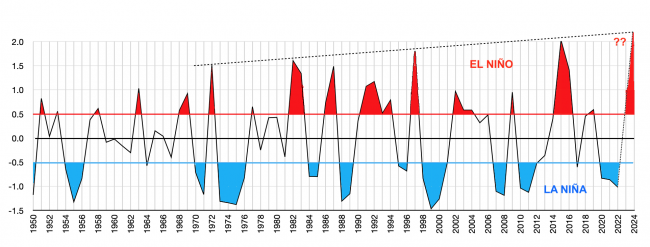
Pacific Ocean temperature anomaly data from NOAA, based on the INO measurement, one of several used to measure the intensity of El Niño and La Niña cycles; projections are mine, but are consistent with several of the latest climate models
When you live on the west coast of the Americas, you really feel the influence of El Niño (exceptionally warm ocean temperatures in the Pacific) and La Niña (exceptionally cool ocean temperatures in the Pacific). Here in Vancouver, we have just come off three years in a row of (on average) cooler than normal temperatures, as La Niña has held sway. And that’s despite the fact that we’ve broken all time high temperature records in each of the last two summers — at the -1.0º nadir of La Niña. It’s been two years of extremes for the usually-moderate weather of the coast. Last August was the hottest August on record, and last November the coldest November on record.
In our last El Niño cycle, in 2014-16, we broke records here for the hottest one-year moving average temperature. Meteorologists are predicting the next El Niño will start late this year or early next year, and if that’s true, we’ll get our eyes opened about climate collapse pretty quickly. If we hit 43ºC (110ºF) in suburban Vancouver in 2021 when La Niña was at -1.0ºC from normal, what will we be facing when El Niño tops out (as it did in 2015-16) at +2.6ºC from normal?
—— vs: ——

chart from Wikimedia Commons; projections for 2023-24 and Strong-El Niño trendline are my additions
The chart above from Wikimedia shows the inexorable rise of average global surface temperatures to well over 1.0ºC above ‘pre-industrial’ (1850-1900 average) levels. Climate scientists have made it clear that avoidance of climate collapse, and the livability of our planet, depends on keeping these increases to less than 1.5ºC above these levels.
As I’ve been reporting for 20 years now, an increasing number of climate scientists say that keeping increases to that level is practicably impossible. If you draw a trendline through recent El Niño maxima, then if we get another strong El Niño in 2024, as many climate predictors are now forecasting, we could easily shoot past the 1.5ºC ceiling next year. So much for predictions we’d have “until 2030” to achieve this.
Along with other recent revelations about Big Oil suppressing their actual huge emission levels, about alarming rises in methane emissions, about the utter failure of tech solutions like carbon offsets, carbon capture and storage, and transitions to renewables to have any impact whatever on rising emissions, about the staggering ecological cost of endless wars, and of course the failure of doltish, doddering, virtue-signalling politicians everywhere to even begin to act on their absurd promises, climate catastrophe is now inevitable. The only question is how much and what parts of the planet will become unlivable, and how fast.
These data suggest, once again, that this is coming faster than even last year’s gloomiest predictions anticipated.
I had the best burrata I’ve ever eaten.
Half with a straccetti pasta with tomato mushroom parsley sauce, half with a baby arugula salad with agrodolce lemon dressing.
Full details on the #FoodWiki.


 I recently ordered many of the official Orange Pi accessories for review with my Orange Pi 800 order (also coming up for review). The first of these accessories to come was the Orange Pi 14" 1080P portable monitor. This monitor is meant to be extremely portable and have a low footprint.
Today in this review we'll take a close look at Orange Pi's monitor offering and test it with several devices. We'll examine the build quality, functionality and try to determine whether picking one of these up might be worth it for you and what situations they would be most appropriate for.
Let's get started!
I recently ordered many of the official Orange Pi accessories for review with my Orange Pi 800 order (also coming up for review). The first of these accessories to come was the Orange Pi 14" 1080P portable monitor. This monitor is meant to be extremely portable and have a low footprint.
Today in this review we'll take a close look at Orange Pi's monitor offering and test it with several devices. We'll examine the build quality, functionality and try to determine whether picking one of these up might be worth it for you and what situations they would be most appropriate for.
Let's get started!
Google is not bound by the Fourth, Fifth, and Sixth Amendments, but its actions in a false positive CSAM case show that it is flouting the spirit behind them.
The first and most important takeaway from Kashmir Hill’s excellent article in the New York Times about Mark, the man flagged by Google as a purveyor of Child Sexual Abuse Material (CSAM) for taking pictures of his son’s penis and sending them to their family doctor, and who subsequently lost nearly every aspect of his digital life when Google deleted his account, are the tremendous trade-offs entailed in the indiscriminate scanning of users’ cloud data.
On one hand, it seems like an incredible violation of privacy to have a private corporation effectively looking through every photo you upload, particularly when those uploads happen as part of the expected way in which your smartphone operates (users technically agree to this scanning, but as part of an endless End User License Agreement that is both ridiculously long and, more pertinently, inescapable if you want to use your phone as it was intended). Moreover, Google doesn’t simply scan for CSAM photos that are already known to exist via the PhotoDNA database of photos of exploited children; the company also leverages machine learning to look for new CSAM that hasn’t yet been identified as such.
On the other hand, as horrific as the material in the PhotoDNA database is, much of it has been floating around the Internet for years, which is to say the abuse depicted happened long ago; Google’s approach has the potential to discover abuse as it is happening, making it possible for the authorities to intercede and rescue the child in question. Hill’s story noted that in 2021 the CyberTipline at the National Center for Missing and Exploited Children, the only entity legally allowed to hold CSAM (NCMEC also manages the PhotoDNA database), “alerted authorities to ‘over 4,260 potential new child victims'”. We don’t know how many of those children were subsequently rescued, but a question worth posing to anyone unilaterally opposed to Google’s approach is how big that number would have to be to have made it worthwhile?
But, to return to the original hand, one of those 4,260 potential new child victims was Mark’s son (and another was taken by Cassio, a second father found by Hill caught in the same predicament, for the same reasons): the question for those applauding Google’s approach is how big the number of false positives would have to be to shut the whole thing down?
It was the exploration of these trade-offs that was at the heart of the Update I wrote about Hill’s story last week; as I noted there are no easy answers:
Nearly every aspect of this story is incredibly complex, and I understand and respect arguments on both sides: should there be scanning of cloud-related content? Should machine learning be leveraged to find new photos? Is it reasonable to obliterate someone’s digital life — except for what you give the police — given the possibility that they may be committing horrific crimes? These are incredibly difficult questions, particularly in the absence of data, because the trade-offs are so massive.
However, it seemed to me that one aspect of the case was very clear:
There is, though, one part of the story that is black-and-white. Google is unquestionably wrong to not restore the accounts in question. In fact, I am stunned by the company’s approach in these cases. Even if you grant the arguments that this awesome exercise of surveillance is warranted, given the trade-offs in question, that makes it all the more essential that the utmost care be taken in case the process gets it wrong. Google ought to be terrified it has this power, and be on the highest alert for false positives; instead the company has gone in the opposite direction, setting itself as judge, jury, and executioner, even when the people we have collectively entrusted to lock up criminals ascertain there was no crime. It is beyond arrogant, and gives me great unease about the company generally, and its long-term investments in AI in particular.
Not that it matters, one may argue: Google can do what they want, because they are a private company. That is an argument that may ring familar.
In 2019 I discussed the distinction between public and private restrictions on speech in Tech and Liberty:
Alexander Hamilton was against the Bill of Rights, particularly the First Amendment. This famous xkcd comic explains why:
According to Randall Munroe, the author, the “Right to Free Speech” is granted by the First Amendment, which was precisely the outcome Hamilton feared in Federalist No. 84:
I go further, and affirm that bills of rights, in the sense and to the extent in which they are contended for, are not only unnecessary in the proposed Constitution, but would even be dangerous. They would contain various exceptions to powers not granted; and, on this very account, would afford a colorable pretext to claim more than were granted. For why declare that things shall not be done which there is no power to do? Why, for instance, should it be said that the liberty of the press shall not be restrained, when no power is given by which restrictions may be imposed? I will not contend that such a provision would confer a regulating power; but it is evident that it would furnish, to men disposed to usurp, a plausible pretense for claiming that power. They might urge with a semblance of reason, that the Constitution ought not to be charged with the absurdity of providing against the abuse of an authority which was not given, and that the provision against restraining the liberty of the press afforded a clear implication, that a power to prescribe proper regulations concerning it was intended to be vested in the national government. This may serve as a specimen of the numerous handles which would be given to the doctrine of constructive powers, by the indulgence of an injudicious zeal for bills of rights.
Hamilton’s argument is that because the U.S. Constitution was created not as a shield from tyrannical kings and princes, but rather by independent states, all essential liberties were secured by the preamble (emphasis original):
WE, THE PEOPLE of the United States, to secure the blessings of liberty to ourselves and our posterity, do ORDAIN and ESTABLISH this Constitution for the United States of America.
Hamilton added:
Here, in strictness, the people surrender nothing; and as they retain every thing they have no need of particular reservations.
Munroe, though, assumes the opposite: liberty, in this case the freedom of speech, is an artifact of law, only stretching as far as government action, and no further. Pat Kerr, who wrote a critique of this comic on Medium in 2016, argued that this was the exact wrong way to think about free speech:
Coherent definitions of free speech are actually rather hard to come by, but I would personally suggest that it’s something along the lines of “the ability to voluntarily express (and receive) opinions without suffering excessive penalties for doing so”. This is a liberal principle of tolerance towards others. It’s not an absolute, it isn’t comprehensive, it isn’t rigorously defined, and it isn’t a law.
What it is is a culture.
The context of that 2019 Article was the differing decisions between Facebook and Twitter in terms of allowing political ads on their platforms; over the ensuing three years the willingness and length to which these and other large tech platforms have been willing to go to police speech has expanded dramatically, even as the certainty that private censorship is good actually has become conventional wisdom. I found this paragraph in a New York Times article about Elon Musk’s attempts to buy Twitter striking:
The plan jibes with Mr. Musk’s, Mr. Dorsey’s and Mr. Agrawal’s beliefs in unfettered free speech. Mr. Musk has criticized Twitter for moderating its platform too restrictively and has said more speech should be allowed. Mr. Dorsey, too, grappled with the decision to boot former President Donald J. Trump off the service last year, saying he did not “celebrate or feel pride” in the move. Mr. Agrawal has said that public conversation provides an inherent good for society. Their positions have increasingly become outliers in a global debate over free speech online, as more people have questioned whether too much free speech has enabled the spread of misinformation and divisive content.
In other words, the culture has changed; the law persists, but it does not and, according to the New York Times, ought not apply to private companies.
The Google case is not about the First Amendment, either legally or culturally. The First Amendment is not absolute, and CSAM is an obvious example. In 1957’s Roth v. United States the Supreme Court held that obscene speech was not protected by the First Amendment; Justice William Brennan Jr. wrote:
All ideas having even the slightest redeeming social importance — unorthodox ideas, controversial ideas, even ideas hateful to the prevailing climate of opinion — have the full protection of the guaranties, unless excludable because they encroach upon the limited area of more important interests. But implicit in the history of the First Amendment is the rejection of obscenity as utterly without redeeming social importance. This rejection for that reason is mirrored in the universal judgment that obscenity should be restrained, reflected in the international agreement of over 50 nations, in the obscenity laws of all of the 48 States, and in the 20 obscenity laws enacted by the Congress from 1842 to 1956.
This reasoning is a reminder that laws ultimately stem from culture; still, the law being the law, definition were needed, which the Supreme Court provided in 1973’s Miller v. California. Obscene works (1) appeal to the prurient interest in sex, (2) portrays in a patently offensive way sexual conduct specifically defined by a relevant law and (3) lack serious literary, artistic, political, or scientific value. The Supreme Court went further in terms of CSAM in 1982’s New York v. Ferber, holding that the harm inflicted on children is sufficient reason to make all forms of CSAM illegal, above and beyond the standards set forth by Miller. Justice Byron White wrote:
Recognizing and classifying child pornography as a category of material outside the protection of the First Amendment is not incompatible with our earlier decisions. “The question whether speech is, or is not, protected by the First Amendment often depends on the content of the speech”…
The test for child pornography is separate from the obscenity standard enunciated in Miller, but may be compared to it for the purpose of clarity. The Miller formulation is adjusted in the following respects: a trier of fact need not find that the material appeals to the prurient interest of the average person; it is not required that sexual conduct portrayed be done so in a patently offensive manner; and the material at issue need not be considered as a whole. We note that the distribution of descriptions or other depictions of sexual conduct, not otherwise obscene, which do not involve live performance or photographic or other visual reproduction of live performances, retains First Amendment protection. As with obscenity laws, criminal responsibility may not be imposed without some element of scienter on the part of the defendant.
“Scienter”, the “knowledge of the nature of one’s act”, is what ties this judicial history back to the original discussion of Google’s actions against Mark. As Hill explained in the New York Times:
I have seen the photos that Mark took of his son. The decision to flag them was understandable: They are explicit photos of a child’s genitalia. But the context matters: They were taken by a parent worried about a sick child.
The problem in this case comes from who is determining scienter.
Quite clearly Mark did not intend for the pictures he took for his son’s telemedicine to be used for pornographic purposes. The San Francisco Police Department, which had been notified by Google after a human reviewer confirmed the machine learning-driven discovery of Mark’s photos of his son, agreed. From Hill’s story:
In December 2021, Mark received a manila envelope in the mail from the San Francisco Police Department. It contained a letter informing him that he had been investigated as well as copies of the search warrants served on Google and his internet service provider. An investigator, whose contact information was provided, had asked for everything in Mark’s Google account: his internet searches, his location history, his messages and any document, photo and video he’d stored with the company.
The search, related to “child exploitation videos,” had taken place in February, within a week of his taking the photos of his son. Mark called the investigator, Nicholas Hillard, who said the case was closed. Mr. Hillard had tried to get in touch with Mark but his phone number and email address hadn’t worked. “I determined that the incident did not meet the elements of a crime and that no crime occurred,” Mr. Hillard wrote in his report. The police had access to all the information Google had on Mark and decided it did not constitute child abuse or exploitation.
Mark asked if Mr. Hillard could tell Google that he was innocent so he could get his account back. “You have to talk to Google,” Mr. Hillard said, according to Mark. “There’s nothing I can do.” Mark appealed his case to Google again, providing the police report, but to no avail…A Google spokeswoman said the company stands by its decisions, even though law enforcement cleared the two men.
In short, the questions about Google’s behavior are not about free speech; they do, though, touch on other Amendments in the Bill of Rights. For example:
Again, Google is not covered by the Bill of Rights; all of these Amendments, just like the First, only apply to the government. The reason why this case is useful, though, is it is a reminder that specific legal definitions are distinct from questions of right or wrong.
Working backwards, Google isn’t legally compelled to give Mark a hearing about his digital life (Sixth Amendment); they are wrong not to. Google isn’t legally compelled to give Mark due process before permanently deleting his digital life (Fifth Amendment); they are wrong not to. Google isn’t legally compelled to not search all of the photographs uploaded to Google (by default, if you click through all of the EULA’s); they are…well, this is where it gets complicated.
I started out this Article discussing the impossible trade-offs presented by questions of CSAM. People can and do make the case that to not search for this vileness, particularly if there is a chance that it can lead to the rescue of an abused child, is its own wrong. Resolving this trade-off in this way, though — that is, to violate the spirit and culture of the Fourth Amendment — makes it all the more essential to honor the spirit and culture of the Fifth and Sixth.
James Madison answered Hamilton’s objections in a speech to Congress introducing the Bill of Rights. What is interesting is that while Hamilton took it as a given that people would know and value their rights, Madison assumed the culture would run in the opposite direction, making an articulation of those rights important not just to restrain the government, but to remind the majority to not trample the rights of the minority:
But I confess that I do conceive, that in a Government modified like this of the United States, the great danger lies rather in the abuse of the community than in the Legislative body. The prescriptions in favor of liberty ought to be levelled against that quarter where the greatest danger lies, namely, that which possesses the highest prerogative of power. But this is not found in either the Executive or Legislative departments of Government, but in the body of the people, operating by the majority against the minority.
It may be thought that all paper barriers against the power of the community are too weak to be worthy of attention. I am sensible they are not so strong as to satisfy gentlemen of every description who have seen and examined thoroughly the texture of such a defence; yet, as they have a tendency to impress some degree of respect for them, to establish the public opinion in their favor, and rouse the attention of the whole community, it may be one means to control the majority from those acts to which they might be otherwise inclined.
This Article is a manifestation of Madison’s hope. Start with the reality that it seems quaint in retrospect to think that any of the Bill of Rights would be preserved absent the force of law. This is one of the great lessons of the Internet and the rise of Aggregators: when suppressing speech entailed physically disrupting printing presses or arresting pamphleteers, then restricting government, which retains a monopoly on real world violence, was sufficient to preserve speech. Along the same lines, there was no need to demand due process or a restriction on search and seizure on any entity but the government, because only the government could take your property or send you to jail.
Aggregators, though, make private action much more possible and powerful than ever before: yes, if you are kicked off of Twitter or Facebook, you can still say whatever you want on a street corner; similarly, if you lose all of your data and phone and email, you are still not in prison — and thank goodness that is the case! At the same time, it seems silly to argue that getting banned from a social media platform isn’t an infringement on individual free speech rights, even if it is the corporations’ own free speech rights that enable them to do just that legally, just as it is silly to argue that losing your entire digital life without recourse isn’t a loss of property without due process. The big Internet companies are manifesting Madison’s fears of the majority operating against the minority, and there is nothing the Bill of Rights can do about it.
What remains are those paper barriers, and what respect they might still engender, if it is possible to “rouse the attention of the whole community.” Rights are larger than laws, and Google has violated the former, even if they are not bound by the latter. The company ought not only change its policy with regards to Mark and Cassio, but fundamentally re-evaluate the balance it has struck between its unprecedented power over people’s lives and the processes it has in place to ensure that power is not abused. If it doesn’t, the people ought to, with what power they still conserve, do it for them.
Subscription Information
Member: Roland Tanglao
Email: rolandt@gmail.com
Not a laptop or a tablet but a secret third thing
— Microsoft Surface (@surface) February 10, 2023


