Shared posts

23 Nov 23:07

Rejoice: Sonos Speakers are finally voice-controllable

If you’re among the millions who own Sonos speakers, then you don’t need a paragraph explaining how great they are (the speakers, not the owners).

A Sonos is an internet-connected speaker. It can deliver music from 50 music sources (Spotify, Pandora, Amazon, Apple, Google, etc.)—and you control it from an app on your phone or computer.

These speakers sound amazing for their size and cost. They’re entirely wireless, and they’re easy to name and group—Kitchen, Living Room, etc. In other words, they let you create a whole-home audio system for a fraction of what a professional installation would cost.

image
The older Sonos Play:One (left) and the new Sonos Play are suddenly voice-controllable.

Well, fine—until the Amazon Echo came out. The Echo sounds flat and tinny compared to a Sonos speaker, but it overtook Sonos in sales last year (5 million sold vs. 4 million) for one key reason: The Echo lets you ask for music by voice. “Alexa: Play ‘The White Album.’” “Alexa, play some cooking music.” “Alexa—play ‘Mr. Blue Sky.’”

This is what’s known as a killer app, people. It feels like “Star Trek,” like “The Jetsons,” like magic. You come home, you throw your keys in the bowl, you say, “Play some classical music,” and there it is.

But over on Planet Sonos, people still had to haul out their phones to start music, stop music, change tracks, or change the volume. I realize how first-worldly that sounds, but trust me: Sonos owners looked with longing over the fence at their Echo-owning neighbors.

People came up with all kinds of hacks to connect an Alexa to a Sonos (buying a Dot and using a wire, for example)—but in general, this was a missed opportunity the size of Texas.

The end of the era of suffering

Well, it took Sonos some time, but I’m happy—really happy—to report that it has finally come to its senses. The Sonos:1 ($200) speaker looks, sounds, and costs the same as its predecessor, the Sonos Play:1. (Who comes up with these confusing names—someone from Microsoft?)

image
Here it is: The Sonos One, a combination Amazon Echo and internet speaker.

There are two tiny differences: The new speaker doesn’t have a mounting bracket on the back, and its top buttons are touch-sensitive spots instead of physical switches.

image
Both the Play:One and the new One cost $200, but they look and sound identical except for the top buttons.

And there’s one huge difference:  the new speaker is an Amazon Echo. It has Alexa built in. So you can ask it for the time in Paris, for a 20-minute timer, for a joke, for last night’s sports results, for an NPR news update, for an Uber ride, for a Domino’s pizza, to set your Nest thermostat, and so on—and you can ask it to play any music in the world. (See my video above.)

But meanwhile, it’s a Sonos. So now you can not only ask, “Play Billy Joel”; you can say, “Play Billy Joel in the living room.” Or, “in the kitchen.” Or wherever you’ve set up your Sonoses.

You don’t have to replace your existing Sonos setup, either. Just one Sonos One speaker (with Alexa) can control all your older Sonos speakers (without Alexa).

That’s the review, right there. It’s Alexa smarts in a Sonos. If you’re a Sonos fan—or if you’re trying to come up with a killer big-ticket holiday gift for the music nut in your life—you have my blessing. Get this thing.

However…

It gets better

Ah, but Sonos did more than just put Alexa into a Sonos speaker. It also wrote a “skill”—a plug-in voice command—for existing Sonos speakers.

Yes, the days of wiring an Echo Dot into a Sonos speaker are over. If, indeed, you own both an Amazon Echo (any kind) and a Sonos speaker (any kind), you can have all the same voice control that you’d get if you bought a Sonos One (the new kind).

That sounds trickier in words than it is in practice. But here’s the idea:

image
If you already have an Echo and an old Sonos, you don’t have to buy anything new to get voice control of your music.

In other words, you don’t have to buy anything new from Sonos to get voice control over an existing Sonsos setup. If you have an Amazon Echo (or if you buy an Echo Dot this Black Friday for $30 or $40)—you can enter the same musical heaven.

You’ll probably have the same critique I do: The software setup has too many steps, with too little guidance. But you’ll muddle through.

A thrilling next few weeks

Voice-controlled speakers are a hot new item this year. It’s a great idea for a tech product (have I mentioned how great it is to own one?), and lots and lots of people will be buying them.

In December, Apple (AAPL) and Google (GOOG, GOOGL) will each enter the marketplace with bigger, badder, much more expensive voice-controlled speakers of their own. There’ll be the Apple HomePod ($350) and the Google Home Max ($400).

In other words, Sonos’ window of being The One and Only is fairly short. Soon, it will be surrounded by competitors.

Sonos enjoys the freedom, though, of being beholden to no particular ecosystem. If you buy an Apple HomePod, you’ll use “Hey Siri” commands to operate it; it’s great, if you belong to the Apple Army. If you buy a Google Home Max, you’ll use “Hey Google” commands; great, if you belong to the Android Army.

But after an update coming in the new year, the Sonos One will be able to respond either to “Alexa” commands or to “OK Google” commands—a feat I’ve never seen in a single piece of hardware.

(Speaking of updates: At this moment, there’s one important music service you can’t control by voice on the Sonos One—Spotify. The company says that’ll come within the next few weeks.)

The bottom line, though, is that the Sonos One (and the free “skill” for older Sonoses) is the harbinger of a glorious new era. Most people are fairly “meh” about most smart-home products—you don’t see internet-connected light bulbs, door locks, or electric drapes in many people’s houses. But voice-controlled music? That’s got mass appeal. That’s true joy. Mark my words: It’s going to become a thing. A really wonderful thing.

More from David Pogue:

Battle of the 4K streaming boxes: Apple, Google, Amazon, and Roku

iPhone X review: Gorgeous, pricey, and worth it

Inside the Amazon company that’s even bigger than Amazon

The $50 Google Home Mini vs. the $50 Amazon Echo Dot — who wins?

The Fitbit Ionic doesn’t quite deserve the term ‘smartwatch’

Augmented reality? Pogue checks out 7 of the first iPhone AR apps 

David Pogue, tech columnist for Yahoo Finance, is the author of “iPhone: The Missing Manual.” He welcomes nontoxic comments in the comments section below. On the web, he’s davidpogue.com. On Twitter, he’s @pogue. On email, he’s poguester@yahoo.com. You can read all his articles here, or you can sign up to get his columns by email


23 Nov 23:07

Pip: digital creation in your pocket from Curious Chip

by Alex Bate

Get your hands on Pip, the handheld Raspberry Pi–based device for aspiring young coders and hackers from Curious Chip.

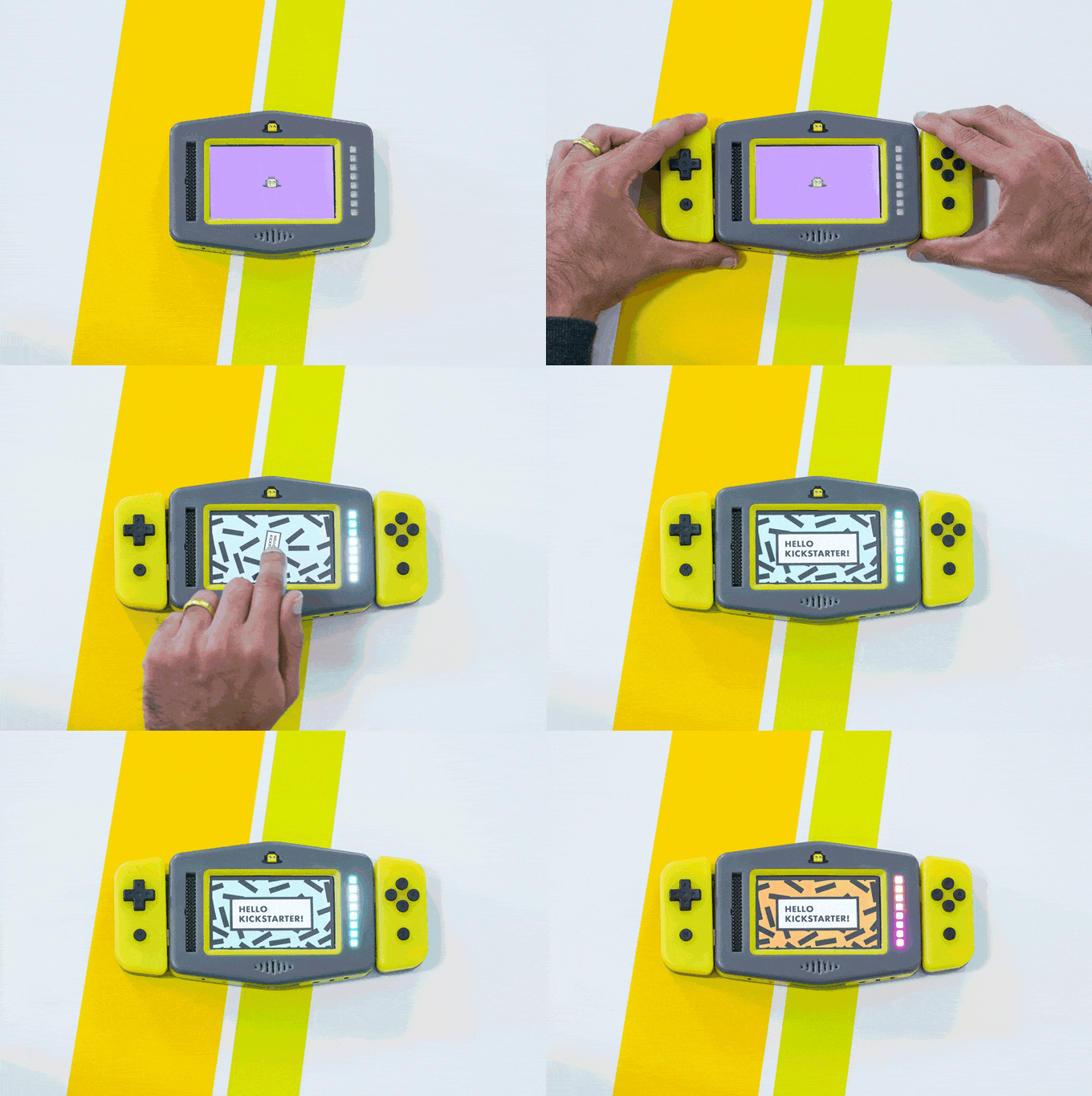
A GIF of Pip - Curious Chip - Pip handheld device - Raspberry Pi

Pip is a handheld gaming console from Curios Chip which you can now back on Kickstarter. Using the Raspberry Pi Compute Module 3, Pip allows users to code, hack, and play wherever they are.

We created Pip so that anyone can tinker with technology. From beginners to those who know more — Pip makes it easy, simple, and fun!

For gaming

Pip’s smart design may well remind you of a certain handheld gaming console released earlier this year. With its central screen and detachable side controllers, Pip has a size and shape ideal for gaming.

A GIF of Pip - Curious Chip - Pip handheld device - Raspberry Pi

Those who have used a Raspberry Pi with the Raspbian OS might be familiar with Minecraft Pi, a variant of the popular Minecraft game created specifically for Pi users to play and hack for free. Users of Pip will be able to access Minecraft Pi from the portable device and take their block-shaped creations with them wherever they go.

And if that’s not enough, Pip’s Pi brain allows coders to create their own games using Scratch, in addition to giving access a growing library of games in Curious Chip’s online arcade.

Digital making

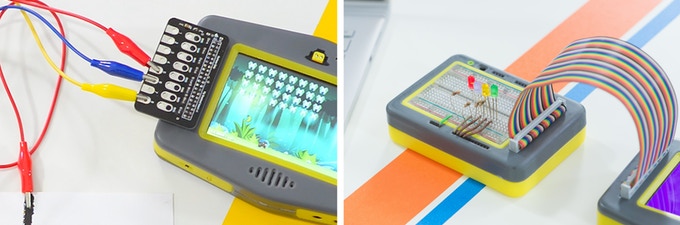
Pip’s GPIO pins are easily accessible, so that you can expand upon your digital making skills with physical computing projects. Grab your Pip and a handful of jumper leads, and you will be able to connect and control components such as lights, buttons, servomotors, and more!

A smiling girl with Pip and a laptop

You can also attach any of the range of HAT add-on boards available on the market, such as our own Sense HAT, or ones created by Pimoroni, Adafruit, and others. And if you’re looking to learn a new coding language, you’re in luck: Pip supports Python, HTML/CSS, JavaScript, Lua, and PHP.

Maker Pack and add-ons

Backers can also pledge their funds for additional hardware, such as the Maker Pack, an integrated camera, or a Pip Breadboard Kit.

PipHAT and Breadboard add-ons - Curious Chip - Pip handheld device - Raspberry Pi

The breadboard and the optional PipHAT are also compatible with any Raspberry Pi 2 and 3. Nice!

Curiosity from Curious Chip

Users of Pip can program their device via Curiosity, a tool designed specifically for this handheld device.

Pip’s programming tool is called Curiosity, and it’s hosted on Pip itself and accessed via WiFi from any modern web browser, so there’s no software to download and install. Curiosity allows Pip to be programmed using a number of popular programming languages, including JavaScript, Python, Lua, PHP, and HTML5. Scratch-inspired drag-and-drop block programming is also supported with our own Google Blockly–based editor, making it really easy to access all of Pip’s built-in functionality from a simple, visual programming language.

Back the project

If you’d like to back Curious Chip and bag your own Pip, you can check out their Kickstarter page here. And if you watch their promo video closely, you may see a familiar face from the Raspberry Pi community.

Are you planning on starting your own Raspberry Pi-inspired crowd-funded campaign? Then be sure to tag us on social media. We love to see what the community is creating for our little green (or sometimes blue) computer.

The post Pip: digital creation in your pocket from Curious Chip appeared first on Raspberry Pi.

23 Nov 23:06

Slipping into darkness. Atheism is basically illegal. 


Slipping into darkness. Atheism is basically illegal. 

23 Nov 23:06

nysaflcio:Facts matter. Call your representative today by...


nysaflcio:

Facts matter. Call your representative today by texting SCAM to 877877 and tell them to oppose the job-killing Republican tax reform bill. It’s not a tax plan, it’s a tax scam. http://ift.tt/2zPmmf9

23 Nov 23:06

"Oh, isn’t life a terrible thing, thank God?"

“Oh, isn’t life a terrible thing, thank God?”

- | Dylan Thomas, Under Milk Wood
23 Nov 23:06

November 2017 CA Communication

by Kathleen Wilson

Mozilla has sent a CA Communication to inform Certificate Authorities (CAs) who have root certificates included in Mozilla’s program about Mozilla’s expectations regarding version 2.5 of Mozilla’s Root Store Policy, annual CA updates, and actions the CAs need to take. This CA Communication has been emailed to the Primary Point of Contact (POC) and an email alias for each CA in Mozilla’s program, and they have been asked to respond to the following 8 action items:

  1. Review version 2.5 of Mozilla’s Root Store Policy, and update the CA’s CP/CPS documents as needed to become fully compliant.
  2. Confirm understanding that non-technically-constrained intermediate certificates must be disclosed in the Common CA Database (CCADB) within one week of creation, and of new requirements for technical constraints on intermediate certificates issuing S/MIME certificates.
  3. Confirm understanding that annual updates (audits, CP, CPS, test websites) are to be provided via Audit Cases in the CCADB.
  4. Confirm understanding that audit statements that are not in English and do not contain all of the required information will be rejected by Mozilla, and may result in the CA’s root certificate(s) being removed from our program.
  5. Perform a BR Self Assessment and send it to Mozilla. This self assessment must cover the CA Hierarchies (and all of the corresponding CP/CPS documents) that chain up to their CA’s root certificates that are included in Mozilla’s root store and enabled for server authentication (Websites trust bit).
  6. Provide a tested email address for the CA’s Problem Reporting Mechanism.
  7. Follow new developments and effective dates for Certification Authority Authorization (CAA)
  8. Check issuance of certs to .tg domains between October 25 and November 11, 2017.

The full action items can be read here. Responses to the survey will be automatically and immediately published by the CCADB.

With this CA Communication, we re-iterate that participation in Mozilla’s CA Certificate Program is at our sole discretion, and we will take whatever steps are necessary to keep our users safe. Nevertheless, we believe that the best approach to safeguard that security is to work with CAs as partners, to foster open and frank communication, and to be diligent in looking for ways to improve.

Mozilla Security Team

The post November 2017 CA Communication appeared first on Mozilla Security Blog.

23 Nov 22:07

How to Lie with Graphs

by Thejesh GN

Recently I chanced upon these visualizations on Transforming India by Government of India. The site is recording of how India has been transforming since 2014. While going through them I found a few charts/visuals which Darrell Huff in his 1954 book How to Lie with Statistics talks about in the context of how graphs can be used to lie. Lets take look.

Objects in a chart

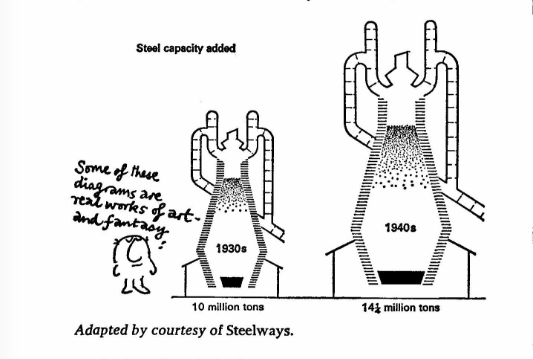
Here is an example from the book talking about using objects inside the chart.

Chapter: The One Dimensional Picture

From: The One Dimensional


The blast furnace representing the ten-million-ton capacity added in one decade was drawn just over two-thirds as tall as the
furnace representing the fourteen and a quarter million tons added in the next. The eye saw two furnaces, one of them
close to three times as big as the other. To say ‘almost one and one-half and to be heard as ‘three’ – that’s what the one
dimensional picture can accomplish.

The chart uses the HEIGHT to represent the value 10 and 14 & 1/4 million tons. But the objects here have an AREA (size?). AREA is what user sees. Hence user is mislead to perceive 42.5% increase as ~200% increase. Now lets see an Indian example

First Graph: Average output per ship berth day. Lets calculate the percentage.

(14576−13748)÷13748 = 0.060226942
0.060226942 * 100 = 6.02269421%

So it’s roughly 6% increase. And hence the second image should have just 6% bigger (AREA) compared to first. But bigger ship looks at least three times (300%) the smaller ship. Misleading.

Second Graph: Turn Around Time

(3.63−3.43)÷3.64 = 0.054945055
0.054945055 * 100 = 5.4945055%

So it’s roughly 5.49% decrease. But again the second anchor looks at least one-third the size first one. Misleading.

Y-axis doesn’t start at zero

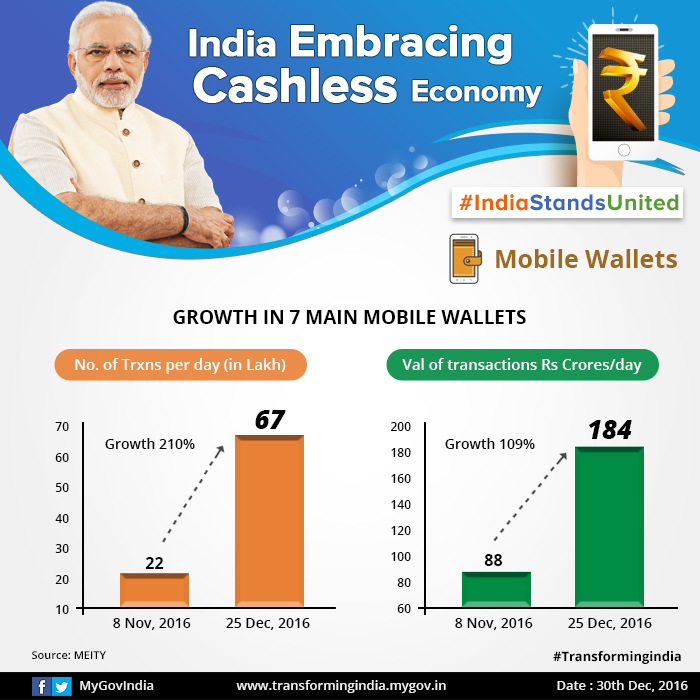
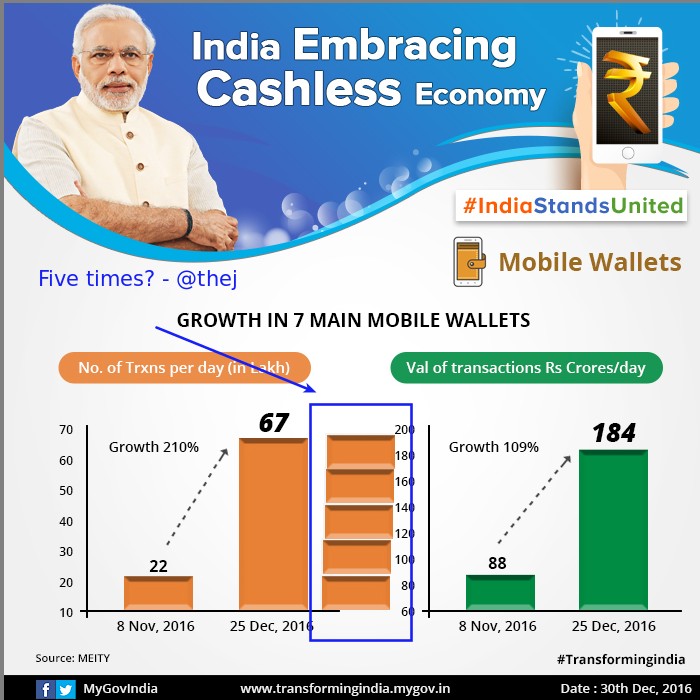
Again from How to Lie With Statistics, you would have learnt any graph whose Y-axis doesn’t start at zero is cause for suspicion. It may not always be misleading but needs to examined, specially if they are bar charts. Here is an example that talks about growth in mobile wallets. Lets take the first example, It talks about the ‘No. Transactions per day (in Lakh)’. The graph is supposed to depict 210% growth. Does it? Compare the sizes of bars. To make it easy I have added an extra bar by copy pasting the smaller bar multiple times. Isn’t it misleading?

Y-axis doesn't start at zero

Y-axis doesn’t start at zero

I have added one more bar copy pasting the first to show how much the second bar represents.

I have added one more bar copy pasting the first to show how much the second bar represents.

Some more examples of Y-axis doesn’t start at zero

Misleading: Read bar is at least 4 times bigger

Misleading: Red bar is at least 4 times bigger

Misleading. Red bar is at least 4 times bigger than blue.

Misleading. Red bar is at least 4 times bigger than blue.

I am planning to do more posts under a broad category DataCanLie. Let me know what do you think of this series?

23 Nov 22:06

reviewinhaiku:Baby Driver


reviewinhaiku:

Baby Driver

23 Nov 22:06

Who Filters Your News? Why we built gobo.social

by Ethan

Roughly ten years ago, as phones became smartphones and Facebook and Twitter began their rise towards ubiquity, a fundamental social shift took place: the majority of people in the developed world became content creators. The bloggers of the early 2000s were joined by hundreds of millions of people posting videos to YouTube channels, pictures to Instagram, essays to Medium and countless status updates from 140 characters to Facebook wall posts. Before the internet, publishing had been a distinction, with a limited number of people lucky, talented or wealthy enough to share ideas or images with a wide audience. After the rise of social media, publishing became a default, with non-participation the exception.

There’s a problem with this rise in shared self-expression: we’ve all still got a constant and limited amount of attention available. For those creating content, this means the challenge now is not publishing your work, but finding an audience. The problem for those of us in the audience – i.e., all of us – is filtering through the information constantly coming at us.

Before the internet, we relied on newspapers and broadcasters to filter much of our information, choosing curators based on their styles, reputations and biases – did you want a Wall Street Journal or New York Times view of the world? Fox News or NPR? The rise of powerful search engines made it possible to filter information based on our own interests – if you’re interested in sumo wrestling, you can learn whatever Google will show you, even if professional curators don’t see the sport as a priority.

Social media has presented a new problem for filters. The theory behind social media is that we want to pay attention to what our friends and family think is important. In practice, paying attention to everything 500 or 1500 friends are interested in is overwhelming – Robin Dunbar theorizes that people have a hard limit to how many relationships we can cognitively maintain. Twitter solves this problem with a social hack: it’s okay to miss posts on your feed because so many are flowing by… though Twitter now tries to catch you up on important posts if you had the temerity to step away from the service for a few hours.

Facebook and other social media platforms solve the problem a different way: the algorithm. Facebook’s news feed usually differs sharply from a list of the most recent items posted by your friends and pages you follow – instead, it’s been personalized using thousands of factors, meaning you’ll see posts Facebook thinks you’ll want to see from hours or days ago, while you’ll miss some recent posts the algorithm thinks won’t interest you. Research from the labs of Christian Sandvig and Karrie Karahalios suggests that even heavy Facebook users aren’t aware that algorithms shape their use of the service, and that many have experienced anxiety about not receiving responses to posts the algorithm suppressed.

Many of the anxieties about Facebook and other social platforms are really anxieties about filtering. The filter bubble, posited by Eli Pariser, is the idea that our natural tendencies towards homophily get amplified by filters designed to give us what we want, not ideas that challenge us, leading to ideological isolation and polarization. Fake news designed to mislead audiences and garner ad views relies on the fact that Facebook’s algorithms have a difficult time determining whether information is true or not, but can easily see whether information is new and popular, sharing information that’s received strong reactions from previous audiences. When Congress demands action on fake news and Kremlin propaganda, they’re requesting another form of filtering, based on who’s creating content and on whether it’s factually accurate.

Twitter’s problems with trolls, bots, extremists and harassment are filtering problems as well. Prominent users like Lindy West have left the system complaining that Twitter is unwilling to remove serial abusers from the platform, or to give people abused on the service stronger tools to filter out and report abuse. As questions arise about Russian influence on the platform, Twitter may need to aggressively identify and filter out automated accounts which are used to promote pro-Trump or pro-Kremlin hashtags – the Hamilton68 Project focuses on tracking these accounts and understanding their influence as Twitter since the service has not yet filtered them out, either banning them or allowing audiences to block them from their feed.

Why don’t social media platforms like Facebook and Twitter give users powerful tools to filter their own feeds? Right now, the algorithms control what we see, but we can’t control them. As the internet maxim goes, “If you’re not paying for something, you’re not the customer; you’re the product being sold”. Both Twitter and Facebook offer powerful filtering tools that allow advertisers to target exactly who they want their ads to reach. You can pay money and advertise to women of color between 40-60 in Seattle, but you can’t choose to read perspectives from those women. While we’ve seen great innovation from projects like BlockTogether, which lets users who experience harassment share Twitter blocklists, we’ve seen surprisingly little innovation on user-controllable filters from the platforms themselves. And unless we see something like public-service social media platforms, it’s unlikely that we will see platforms give users much more control over what they see.

Algorithmic filters optimize platforms for user retention and engagement, keeping our eyes firmly on the site so that our attention can be sold to advertisers. We thought it was time that we all had a tool that let us filter social media the ways we choose. What if we could choose to challenge ourselves one day, encountering perspectives from outside our normal orbits, and relax another day, filtering for what’s funniest and most viral. So we built Gobo.

What’s Gobo?

Gobo is a social media aggregator with filters you control. You can use Gobo to control what’s edited out of your feed, or configure it to include news and points of view from outside your usual orbit. Gobo aims to be completely transparent, showing you why each post was included in your feed and inviting you to explore what was filtered out by your current filter settings.

To use Gobo, you link your Twitter and Facebook accounts to Gobo and choose a set of news publications that most closely resembles the news you follow online. Gobo retrieves recent posts from these social networks and lets you decide which ones you want to see. Want more posts from women? Adjust a slider to set the gender balance of your feed… or just click on the “mute all men” button and listen to the folks who often get shouted down in online dialogs. Want to broaden the perspectives in your feed? Move the politics slider from “my perspective” to “lots of perspectives” and Gobo introduces news stories from sources you might not otherwise find.

How does it work?

Gobo retrieves posts from people you follow on Twitter and Facebook and analyzes them using simple machine learning-based filters. You can set those filters – seriousness, rudeness, virality, gender and brands – to eliminate some posts from your feed. The “politics” slider works differently, “filtering in”, instead of “filtering out” – if you set the slider towards “lots of perspectives”, our “news echo” algorithm will start adding in posts from media outlets that you likely don’t read every day.

That sounds great! Why isn’t everyone using it?

There are some serious limitations to Gobo at present. It’s slow – we’re generally showing you posts that appeared on Twitter three hours ago. As we refine and scale the tool, we’ll get faster, but right now, Gobo’s a good way to see how algorithms shape your newsfeed, but not a great way to keep up with breaking news.

You’ll also notice that there’s probably a lot less content from Facebook than from Twitter. Facebook allows us to show you posts from public pages, but not from your friends’ individual pages. We’re exploring ways you might be able to feed your whole, unedited Facebook news feed through Gobo, but we’re not there yet.

You may also notice that filters don’t always work the way you’d expect. We’re using off-the-shelf open source machine learning filters – we may end up fine-tuning these over time, but we don’t have the advantage of billions of user sessions to learn from the way Facebook does. It’s also a good reminder that these filters are always probabilistic and inexact – you get to see where our system screws up, unlike with Facebook!

Who built it?

Gobo is a project of the Center for Civic Media at the MIT Media Lab and Comparative Media Studies at MIT. The idea for the project came from conversations between Chelsea Barabas, Neha Narula and Ethan Zuckerman around decentralized web publishing, leading to the report “Back to the Future: The Decentralized Web”. Rahul Bhargava, Jasmin Rubinovitz and Alexis Hope built the tool itself, with Jasmin focusing on the AI filters, Alexis on the product design and Rahul on integration and deployment.

Our work on Gobo and on decentralized publishing, was made possible by the Knight Foundation, the founding donors behind our Center and supporters of some of our wackiest and most speculative work. We thank them for their trust and support.

Where’s Gobo going in the future?

We want Gobo to be more inclusive, incorporating content from new, decentralized social networks like Mastodon and Steemit, as well as existing networks like Instagram, YouTube and Tumblr. We really want to find a way to let users filter their Facebook feeds, as bringing transparency to that process was an inspiration for the process. We’d like to integrate RSS feed reading, possibly turning Gobo into a replacement for the late great Google Reader. And we’d like it to be lots faster. In the long run, we’d love to see Gobo run entirely in the browser so we don’t have central control over what content you’re seeing – an intermediate step may include allowing people to run local Gobo servers ala Mastodon or Diaspora.

That said, the real goal behind Gobo is to open a conversation about who gets to filter what you see on the web. If we prompt a conversation about why platforms don’t give you more control over what you see, we’d be really happy. If Facebook or another platform incorporated ideas from Gobo in their own design, we’d throw a party. We’d even invite you.

Can I help make Gobo better?

Heck yeah. There are bound to be lots of bugs in this prototype. Beyond that, Gobo is an open source project and we’ll be sharing source code on the MIT Media Lab github repository. We’ve designed the prototype to treat ML filters as modules that can be dropped into our processing queue — we’d love ideas of other text or image analysis modules we can introduce as filters for Gobo.

Why the name?

Ever seen a stage production where the lights look like they’re coming through a window, or the leaves of a forest? Those effects are created with gobos, filters cut from sheets of metal and placed in front of a light to shine a particular pattern on a curtain or other surface. We’re theater geeks, and it seemed like the perfect name for a product that lets you experiment with the effects of filters.

21 Nov 22:50

Reasoning About Data

In my ongoing discussion in my mind about what makes for a good data analysis, one of the ideas that keeps coming back to me is this notion of being able to “reason about the data”. The idea here is that it’s important that a data analysis allow you to understand how the data, as opposed to other aspects of an analysis like assumptions or models, played a role in producing the outputs. I think for a given problems, some kinds of analysis do a better job of that than others.

To Collect Garbage or Not?

Programmers talk a lot about the importance of being able to “reason about code”, in part so that you can understand what’s going on and perhaps make modifications in the future. If there are two software solutions that produce equivalent results, one might prefer the one that allows you to reason about the code and about what the software is doing, even if it is less efficient. Aside from having a certain common sense logic to it, there are also important implications for maintaining the code.

Along these lines, a while back I was listening to one of my favorite podcasts, the Accidental Tech Podcast, when Chris Lattner made a surprise appearance. Chris previously created LLVM and worked at Apple where he developed the Swift programming language. On this episode, around the 1 hour and 56 minute mark, Lattner and John Siracusa get into a discussion about memory management models for programming languages. In particular, Siracusa asks Lattner to discuss garbage collection versus automatic reference counting (ARC), a system that Lattner developed while working at Apple.

John Siracusa: Objective-C had garbage collection, as you mentioned. Eventually, Objective-C dropped the garbage collection and got ARC [Automatic Reference Counting], and of course, Swift doesn’t have garbage collection at all. Can you talk about the trade-offs there and why Swift is the way it is?

Just as a quick summary, garbage collection is a system by which programmers can allocate memory for objects and not have to worry about de-allocating the memory when their done with it. The idea is that a separate process called the garbage collector periodically goes through all the memory that a program is using and checks to see if it still being used by some aspect of the program. If the memory is not being used, the garbage collector marks the memory as available so that it can be allocated for something else. If the garbage collector never ran, then eventually all the memory would get allocated and nothing would free up.

Here’s how Siracusa sells it:

Siracusa: Well, the idea [is] that memory management is completely out of the hands of the programmer, and that some magical fairy behind the scenes will make it all good for you. What you’re giving up, as you mentioned before…you lack some amount of control…

If you use R, you’re using an application that uses a garbage collector (originally written by Luke Tierney). If you’ve ever noticed that sometimes you run an operation in R that normally takes a short amount of time and it takes an unusually long time to run, that’s often because R had to stop for a second or two to let the garbage collector run in the background. This “stutter” is the bane of all applications that use garbage collection. You can actually force the garbage collector to run in R by calling the gc() function (although you should never have to do that in practice). I don’t think the “stutter” is a big issue in R, but it can be a big problem for applications that demand a fluid user experience.

One downside of garbage collection is that it addes a random aspect to program operation. Since you never know when the garbage collector is going to get called (that is based on runtime conditions), you never know when your program is going to be halted to allow the garbage collector to do its thing. The upside though is that programmers don’t have to worry about memory management, which is often the source of nasty bugs.

Automatic reference counting is essentially a fancier version of manual memory management, where programmers have to manual allocate and deallocate. But instead, with ARC the compiler does most of the work for you. In order to allow for this, certain restrictions must be placed on the language to allow the compiler to analyze programs and determine whether certain blocks of memory will be in use at a given time. The advantage here is that the analysis occurs at compile time, thus allowing for the running of a program to be deterministic. The downside, of course, is that the programmer has to do more deliberate thinking about memory.

A key question then, as posed by Lattner is this:

Chris Lattner: You said GC [garbage collection] means that you don’t have to think about memory. Is that true?

Frankly, before hearing the rest, I would have said “yes, it’s true”. But Lattner continues (emphasis added):

Lattner: The stutter problem, to me, isn’t really the issue, even though that’s what GC-haters will bring up all the time. It’s more about being able to reason about when the memory goes away. The most important aspect of that is that ARC gets rid of finalizers.

If you use a garbage-collected language, you use finalizers. Finalizers are the thing that gets run when your object gets destroyed. Finalizers have so many problems that there are entire bodies of work talking about how to work around problems with finalizers.

For example, the finalizer gets run on the wrong thread, it has to get run multiple times, the object can get resurrected while the finalizer’s running. It happens non-deterministically later. You can’t count on it, and so you can’t use it for resource management for database handles and things like that, for example. There are so many problems with finalizers that ARC just defines [it] away by having deterministic destruction.

Even without knowing what a finalizer is, it’s clear that there’s a lot of complexity involved with using a garbage collector. Lattner’s final point is critical:

Lattner: There’s this question of if you’re building a large scale system, do you want people to “never think about memory?” Do you want them to think about memory all the time, like they did in Objective-C’s classic manual retain-and-release? Or do you want something in the middle?

His argument is that ARC is that “something in the middle”.

Lattner: I think that ARC strikes a really interesting balance, whether it’s in Objective-C or Swift. I look at manual retain-and-release as being a very imperative style of memory management…where you’re telling the code, line by line…this is what you should do at this point in time.

ARC then takes that model and bubbles it up a big step, and it makes it be a very declarative model…. The cool thing about that to me is that not only does it get rid of the mechanics of maintaining reference counting and define away tons of bugs by doing that, it also means that it is now explicit in your code what your intention was. That’s something that people who maintain your code benefit from.

The promise of garbage collection is clear: the programmer doesn’t have to think about memory. Lattner’s criticism is that when building large-scale systems the programmer always has to think about memory, and as such, garbage collection makes it harder to do so. The goal of ARC is to make it easier for other people to understand your code and to allow programmers to reason clearly about memory.

What About Data?

What does any of this have to do with data analysis? Well, nothing, directly. But I think there is an analogous spectrum of techniques in data analysis. In programming, one can think of garbage collection (“no thinking”) on one end of the spectrum and manual memory management (“constantly thinking”) on the other end. With data analysis, there are certain black box-type procedures proposed on one end and, well, just an uncoordinated jumble of procedures on the other end of the spectrum.

When I mention “black box-type” procedures, I’m not referring to machine learning prediction models, which are often derided as “black boxes” because of their complexity. Rather, I’m thinking of a way of doing data analysis that focuses primarily on outcomes and results. With these kinds of approaches, the discussion is almost entirely focused on whether the outcomes are “correct” or not, which I think is misguided in many scientific contexts. With prediction models, at least initially, it makes sense to focus on outcomes. But with data analysis, we often want to know more about how the data are connected to those outcomes.

One famous example of how seemingly equivalent methods can diverge is Anscombe’s Quartet. Anscombe presented four datasets that have exactly the same summary statistics but appear very different when plotted. In particular, the correlations for the four datasets are the same. My take from his paper is that computing a correlation coefficient provides a result and the correlation will provide you some information about the data. We could have endless discussions about whether this result is correct, whether it truly exists in the population, whether it might replicate in the next study, or whether we should have used some other correlation metric. But none of that matters once you make a scatterplot of the data. The scatterplots show you how the data inform the result. In this case, there are four different ways in which the data can inform a given correlation coefficient, some of which are perhaps more concerning than others.

The scatterplots in Anscombe’s Quartet allow us to reason about the data in a way that the correlation coefficient alone does not. They tell us more about what is going on with the data and aid us in interpreting the correlation coefficient. In this case, I think an analysis that includes the scatterplots is a better data analysis than one that does not. Of course, the scatterplots alone may not be sufficient because they don’t actually give you a number, which may be needed in subsequent analyses. But there’s nothing that says you can’t do both.

This is more than simply saying that you should make plots (although you should). When you run a simple linear regression, there are two contributing parts: (a) the data and (b) the assumption of linearity. Reporting the regression coefficient gives you a sense of the strength of the relationship between the predictor and the response, but does that relationship arise from the data or from the model’s assumptions? Any analysis that can help the reader elicit the relative contributions of those two components is better than an analysis that doesn’t.

Evaluating Data Analysis

Interestingly, Anscombe laid out four “myths” that he hoped to debunk:

  1. Numerical calculations are exact, but graphs are rough;

  2. For any particular kind of statistical data there is just one set of calculations constituting a correct statistical analysis;

  3. Performing intricate calculations is virtuous, whereas actually looking at the data is cheating.

Unfortunately, I think these three ideas are alive and well in much of the world of data analysis, especially points 2 and 3. In discussions with various people about what makes for a good data analysis, I’ve found there’s a common focus on “correctness”. For example, if a data analysis leads to a result that later replicates, then the original analysis is a good one. It’s hard to be against correctness, but I think it’s misguided. In particular, the correctness of a scientific claim cannot usually be evaluated with a single study, so this would imply that you cannot evaluate the data analysis that went into making that claim. If a replication study occurs 10 years later, that would imply that we will be waiting 10 years to determine if a data analysis is good.

I think it should be possible to evaluate the quality of a data analysis once it’s done, not 10 years later when a replication study verifies a scientific claim. One way to do so is to ask whether the analysis allows us to reason about the data relative to another possible analysis. If we can answer the question, “How do the data in this study inform the result?” then I think we are in good shape.

21 Nov 22:48

Oh hello there. (at Rain Dance Ranch)


Oh hello there. (at Rain Dance Ranch)

19 Nov 07:52

Here’s how DJ Steve Aoki puts his creative energy to work

by Liz Armistead

Photograph of Steve AokiDJ Steve Aoki is a two-time Grammy-nominated international producer/DJ, entrepreneur, and founder of Dim Mak Records. As one of the highest-grossing dance artists in North America, it’s no surprise he’s in high demand. His recently collaborated with the likes of Lil Uzi Vert, Bok Nero, T-Pain, 2Chainz, and Gucci Mane, to name just a few.

In today’s collaborative world of music entertainment, Aoki spends more time out of the studio than he does in it. For him, finding creative inspiration is about working with different people, from different backgrounds in different places. “One of the benefits of being on the road is that I’m always around new environments, new stimulus. I meet different producers, and ultimately I end up making music that I wouldn’t have made if I was just at home.”

In this day and age, you don’t need to be in this studio 24/7. I make sure that everything gets uploaded to Dropbox where I can share all my files and sessions from wherever I am in the world.

On his latest album, KOLONY, Aoki was inspired by entirely new collaborations—artists he hadn’t worked with before. “During the process of making KOLONY, I found it less about who I am and where I came from, and more about finding that new road with the artist.” This led to a creative output Aoki says he wouldn’t have found alone in a studio: “For me, it was about creating new music, something extraordinary and different. To do that, the way you make music has to change, and that’s where the magic lies.”

As a pioneer in digital creation and collaboration, Aoki uses technology both on and off screen to make his vision come to life: “In this day and age, you don’t need to be in this studio 24/7,” he explains. “I make sure that everything gets uploaded to Dropbox where I can share all my files and sessions from wherever I am in the world. I can do everything I need to do.”

To hear more from DJ Steve Aoki, see the video below.

19 Nov 07:52

Raspberry Pi – protector of the shed…

by Bryan Mathers
Shed temperature alert system

SOMEONE left the heater on in my shed.

You can read all about it here in the most recent dollop of thinkery to your inbox.

The post Raspberry Pi – protector of the shed… appeared first on Visual Thinkery.

19 Nov 07:52

ICYMI – D850 scan test results

by admin

Last month I published the results of my tests of the Nikon D850 “negative digitizer” on PetaPixel. Judging by the dialog and web traffic, a lot of people saw it.  I’m putting up a short synopsis here, along with a link for those who missed it.

The bottom line: great camera for scanning, digitizer not ready yet.

The Nikon D850 is a truly wonderful camera for scanning photographs as I outline in my book Digitizing Your Photos. It offers a significant bump in resolution over the Nikon D800 which I have been using. If you are looking for the highest quality camera scan from a 35mm style DSLR, then the D850 would be an excellent choice (as would the Canon 5DSR, or the Sony a7r II mirrorless).

The camera includes a “negative digitizer” feature which can flip B&W and color negatives into positives in the camera. In theory, this could provide some real workflow advantages over manual conversion. However, there are some problems in the current implementation. Here they are in brief:

  • Clips highlights and shadows too aggressively
  • Can only shoot JPEG, which means highlights and shadows not recoverable
  • Exposure compensation and contrast control disabled in digitizer feature
  • Uncontrolled variation between frames means that batch corrections are not possible

Blown highlights were a particular problem with flash photos. Because they are JPEG files, they are not recoverable. 

Here are two images from the same negative strip. As you can see, the color is rendered very differently. This makes it impossible to batch correct with a consistent look. 

Nikon’s unofficial response

At the PhotoPlus Expo, I got a chance to have an extended dialog with Nikon representatives. They had seen the PetaPixel article and understood the issues I raised. More important, they indicated that it’s essential to fix these problems. I left the meetings with the impression that there would be a concerted effort by the Nikon USA staff to address these problems.

When I hear back from Nikon, I’ll be sure to post an update on the situation. In the meantime, if you are interested in using your D850 (or any other camera) as a scanner, the best methodology is outlined in my newest book, Digitizing Your Photos.

Digitizing Your photos - a guide to photo scanning with a digital camera
Scanning your photos with a digital camera – a comprehensive guide by Peter Krogh

The post ICYMI – D850 scan test results appeared first on The DAM Book.

19 Nov 07:52

Firefox 58 Beta 3 Testday, November 17th

by Bogdan Maris

Hello Mozillians!

We are happy to let you know that Friday, November 17th, we are organizing Firefox 58 Beta 3 Testday. We’ll be focusing our testing on Web Compatibility and Tabbed Browser.

Check out the detailed instructions via this etherpad.

No previous testing experience is required, so feel free to join us on #qa IRC channel where our moderators will offer you guidance and answer your questions.

Join us and help us make Firefox better!

See you on Friday!

19 Nov 07:51

Data Science is Hard: What’s in a Dashboard

by chuttenc
1920x1200-4-COUPLE-WEEKS-AFTER
The data is fake, don’t get excited.

Firefox Quantum is here! Please do give it a go. We have been working really hard on it for quite some time, now. We’re very proud of what we’ve achieved.

To show Mozillians how the release is progressing, and show off a little about what cool things we can learn from the data Telemetry collects, we’ve built a few internal dashboards. The Data Team dashboard shows new user count, uptake, usage, install success, pages visited, and session hours (as seen above, with faked data). If you visit one of our Mozilla Offices, you may see it on the big monitors in the common areas.

The dashboard doesn’t look like much: six plots and a little writing. What’s the big deal?

Well, doing things right involved quite a lot more than just one person whipping something together overnight:

1. Meetings for this dashboard started on Hallowe’en, two weeks before launch. Each meeting had between eight and fourteen attendees and ran for its full half-hour allotment each time.

2. In addition there were several one-off meetings: with Comms (internal and external) to make sure we weren’t putting our foot in our mouth, with Data ops to make sure we weren’t depending on datasets that would go down at the wrong moment, with other teams with other dashboards to make sure we weren’t stealing anyone’s thunder, and with SVPs and C-levels to make sure we had a final sign-off.

3. Outside of meetings we spent hours and hours on dashboard design and development, query construction and review, discussion after discussion after discussion…

4. To say nothing of all the bikeshedding.

It’s hard to do things right. It’s hard to do even the simplest things, sometimes. But that’s the job. And Mozilla seems to be pretty good at it.

One last plug: if you want to nudge these graphs a little higher, download and install and use and enjoy the new Firefox Quantum. And maybe encourage others to do the same?

:chutten

19 Nov 07:48

Casey just started using the Note 8 Samsung is paying him to showcase

by Volker Weber

IMG 20171117 1223591

Samsung had a disaster last year with the Gallery Note 7 battery. To turn the tide the company is now dumping big money on Youtubers, or as Casey calls them "creators". Casey's problem is that he does not know much about technology. I bet he did not know that we could see all along he was using Twitter on iPhone (and the web) when he was pretending to have "always been the Android guy". When iOS had this terrible autocorrect bug that turned a simple "I" into "A (illegible)" it became apparent he was just a terrible liar.

I mean what can he do? His wife and kid hang out on iPad and he wants to Facetime and iMessage them. And Candice isn't going to give up her iPhone no matter what. He can wear his Samsung Gear on his wrist and hold up the Note 8 into the camera, but in real life he isn't shooting his videos with the Galaxy and he is a heavy iPhone user.

Now that he knows we know, he is stepping up his Note game and actually using it for Twitter as well. Just keep in mind he is being paid big bucks to pretend.

Update: This did not last long.

177fc9187a59311ef138d1f759c9ddad

19 Nov 07:48

What I want from a TV screen

by Volker Weber

I believe my perfect TV does not exist. But maybe you know better. Here is what I want (and don't want):

  • A large 4k flat display, up to 100". Large is good. No 3D or curved glass.
  • A TV satellite tuner for those moments I need to see live TV.
  • Digital audio out via TOSlink. I don't need speakers. IR control for my Sonos.
  • HDMI-CEC, USB Type A, several of each.
  • All connectors in separate hide-away box.
  • As little software as possible.
  • No branding on the frame, or as little as possible.

I love the screen on my 2012 Samsung TV. But the software and especially the missing software updates have taught me to separate display and smarts. I just want the perfect screen.

Samsung PR was very quick to offer a test, but the logistics of setting up (and returning) are just horrible for a home. I will replace my existing TV eventually, but I can't do what I do with other tech. Replacing a smartphone takes only minutes, replacing a TV is a nightmare for me. I need to think this through.

19 Nov 07:48

Apple Delays HomePod

by John Voorhees

Apple issued an official statement to TechCrunch and other news outlets today saying that the release of the HomePod would be delayed until 2018. Originally announced at WWDC in June with a promised ship date of December 2017, Apple’s statement says the HomePod will be released in ‘early 2018,’ and the smart Siri-enabled speaker will be available initially in the US, UK, and Australia.

The full text of the statement made to TechCrunch is as follows:

“We can’t wait for people to experience HomePod, Apple’s breakthrough wireless speaker for the home, but we need a little more time before it’s ready for our customers. We’ll start shipping in the US, UK, and Australia in early 2018.”


Support MacStories Directly

Club MacStories offers exclusive access to extra MacStories content, delivered every week; it's also a way to support us directly.

Club MacStories will help you discover the best apps for your devices and get the most out of your iPhone, iPad, and Mac. Plus, it's made in Italy.

Join Now
19 Nov 07:48

“A Path That Leads to Failure”

by Federico Viticci

Jony Ive, talking about the removal of the Home button on the iPhone X in an interview with TIME:

How does Apple decide when it’s time to move on? It’s not a decision to get rid of an existing technology as much as it’s a willingness to accept that what’s familiar isn’t always what’s best. “I actually think the path of holding onto features that have been effective, the path of holding onto those whatever the cost, is a path that leads to failure,” says Ive. “And in the short term, it’s the path the feels less risky and it’s the path that feels more secure.”

As someone else put it 7 years ago – “sometimes you just have to pick the things that look like they’re going to be the right horses to ride going forward”.

→ Source: time.com

19 Nov 07:48

Apple Encourages Developers to Update to watchOS 4

by John Voorhees

In a short note to developers on its Developer News and Updates site, Apple is encouraging developers to:

Take advantage of increased performance, new background modes for navigation and audio recording, built-in altimeter capabilities, direct connections to accessories with Core Bluetooth, and more. In addition, the size limit of a watchOS app bundle has increased from 50 MB to 75 MB.

The carrot of new functionality comes with something of a stick as well. After April 1, 2018, watchOS 1 app updates will no longer be accepted and all updates must be native apps built with the watchOS 2 SDK or later. New app submissions must be built with the watchOS 4 SDK.


Support MacStories Directly

Club MacStories offers exclusive access to extra MacStories content, delivered every week; it's also a way to support us directly.

Club MacStories will help you discover the best apps for your devices and get the most out of your iPhone, iPad, and Mac. Plus, it's made in Italy.

Join Now
19 Nov 07:48

Apple Fixes iPhone X Bugs with the Release of iOS 11.1.2

by John Voorhees

Not long after the iPhone X was released, there were reports that the screens of the devices became unresponsive when the temperature dropped rapidly. That issue along with ‘an issue that could cause distortion in Live Photos and videos captured with iPhone X’ were fixed in iOS 11.1.2, which was released a short time ago.

iOS 11.1.2 can be downloaded by going to Settings ⇾ General ⇾ Software Update.


Support MacStories Directly

Club MacStories offers exclusive access to extra MacStories content, delivered every week; it's also a way to support us directly.

Club MacStories will help you discover the best apps for your devices and get the most out of your iPhone, iPad, and Mac. Plus, it's made in Italy.

Join Now
19 Nov 07:47

Focos: Powerful Depth Image Controls in a Fun Package

by Ryan Christoffel

The iPhone's camera has long been one of its most important features. Every year when new models are introduced, it's a sure bet that camera improvements are part of the package. Last year that remained true, but it also proved an even more special year for the iPhone's camera setup. The introduction of dual rear-facing cameras with Portrait mode was something different – pictures no longer just looked a little better than on older iPhone models, they looked almost professional-quality.

This year, whether you picked up a new iPhone or not, Portrait mode is a better feature than before. Part of this is due to software improvements in iOS 11, but another key benefit is that third-party developers now have access to the depth information in Portrait photos. For the first time, Portrait images taken with the iPhone can be edited and enhanced in unique ways, and Focos is a new app that takes full advantage of that opportunity.

Focos serves both as a camera and an editing app. You can take Portrait-style photos with it, but you can also edit all Portrait photos taken on an iOS 11 device. While I've tried several other apps that specialize in editing depth data in photos, Focos is easily the most powerful and intuitive.

My favorite feature in Focos is the ability to easily change the focus point in Portrait photos. The effect is similar to what I've seen with Lytro cameras. All you have to do is tap the portion of the image you want in focus, and a shift will take place – the area you selected will come into focus, and the rest of the image will receive a blur effect. This works in real-time with images you take inside of Focos, but it also works with all existing iOS 11 Portrait photos in your library. It's a remarkable feature I'm planning to put to use any time my first attempts at capturing a Portrait image don't turn out perfect.

Like the simplicity of selecting a new focus point for photos, Focos' full editing mode is similarly easy to navigate, as there are only two primary settings to adjust: Aperture and Diaphragm. The former will adjust the blur level in your image so it can be more or less blurred to your liking, while the latter adjusts the shape of that blur effect. This is where another piece of Focos' uniqueness comes in. The app includes standard shape variations like circles, octagons, and more, but there's also a section of fun shapes you can use like stars, hearts, and even things like the Apple logo. The effect is subtle, and in most cases you have to be looking for it to see what difference it makes, but it's a fun way to add extra flavor to your photos.

If you want to tweak things outside of the simple Aperture and Diaphragm settings, you can do that, but Focos doesn't require it. The bulk of what you'll need most of the time lies behind those two simple settings. I do want to mention one more feature that's fun to play around with though: Effect mode. Tapping this option at the top of the screen will display your image in a 3D view powered by all the depth data embedded in the photo. You can pan around, adjust the bokeh, and see your image from a different perspective. If anything, it's worth trying just to marvel at all the depth information captured in a single photo.

Focos is the most fun I've had editing photos shot in Portrait mode. It's easy to use, with an intuitive layout of controls and a handy set of simple video tutorials to accompany each tool. Plus, the power behind the app is impressive, allowing you to adjust focus in an image with a simple tap, or see all the depth data in the 3D Effect mode. If you have an iPhone that can take Portrait photos, Focos is definitely worth checking out.

Focos is available on the App Store.


Support MacStories Directly

Club MacStories offers exclusive access to extra MacStories content, delivered every week; it's also a way to support us directly.

Club MacStories will help you discover the best apps for your devices and get the most out of your iPhone, iPad, and Mac. Plus, it's made in Italy.

Join Now
19 Nov 07:46

How to Automatically Generate Textual Descriptions for Photographs with Deep Learning

files/images/Example-of-the-CNN-and-LSTM-Architecture.png

Jason Brownlee, Machine Learning Mastery, Nov 19, 2017


Icon

OK, you're not actually going to learn how to do this simply by reading the article, but you will learn how it's done, and more importantly, that it can be done. The task breaks down into three parts: classifying images (do you see a cat, a rabbit?), describing images (providing a natural language summary of the content), and annotating images (generating text descriptions for specific parts of the image). So basically we're associating object recognition with language strings (in English, in French, whatever). Going further, the neural networks can act as feature extractors, which map images to "an internal representation of the image, not something directly intelligible." Language generation algorithms, coder-decoder algorithms, and an attention mechanism mechanism round out the picture. It's pretty interesting.

[Link] [Comment]
19 Nov 07:46

The field of AI research is about to get way bigger than code

files/images/ai_research.JPG

Dave Gershgorn, Nov 19, 2017


Icon

Lots of movement on the algorithmic accountability front (this is the idea that companies need to be able to explain, and be accountable for, conclusions their software draws about people). According to this article, Kate Crawford, principal researcher at Microsoft Research, and Meredith Whittaker, founder of Open Research at Google, "announced today the AI Now Institute, a research organization to explore how AI is affecting society at large. AI Now will be cross-disciplinary, bridging the gap between data scientists, lawyers, sociologists, and economists studying the implementation of artificial intelligence.” We've been hearing this idea, in this article and elsewhere, for example from Cathy O’Neil in the New York Times, that there's no academic reserach being done in this area. But as pointed out in this Chronicle article, "the piece ignored academics and organizations that study the issues.” Said Siva Vaidhyanathan, on Twitter, “There are CS departments and engineering schools that take this very seriously. MIT, Harvard, UVA, CMU, Princeton, GaTech, VaTech, Cornell Tech, UC-Irvine, and others all have faculty and programs devoted to critical and ethical examination of data and algorithms.” 


[Link] [Comment]
19 Nov 07:45

Are Cars the New Smoking?

by Ken Ohrn

Digital positive from celluloid negative.It took decades to move the conversation on smoking, but now it is pretty much a social faux pas to light up. Once, it was the epitome of in-crowd behaviour and carried a certain sophistication.

Will we ever get there with cars? We are, it seems to me, right in the middle of the process now.  And despite progress, the outcome remains uncertain.

An article in the Oxford Academic Journal of Public Health, published in 2011, introduces the topic this way.

Caution:  no words are minced in these paragraphs.

Results:   Private cars cause significant health harm. The impacts include physical inactivity, obesity, death and injury from crashes, cardio-respiratory disease from air pollution, noise, community severance and climate change. The car lobby resists measures that would restrict car use, using tactics similar to the tobacco industry. Decisions about location and design of neighbourhoods have created environments that reinforce and reflect car dependence. Car ownership and use has greatly increased in recent decades and there is little public support for measures that would reduce this.

Conclusions:   Car dependence is a potent example of an issue that ecological public health should address. The public health community should advocate strongly for effective policies that reduce car use and increase active travel.


19 Nov 07:45

The Case for SkyTrain and Longer Weekend Hours

by Sandy James Planner

There are two things that make a great city public transit system exceptional-having an accessible, clean transit system (preferably with washrooms)  and having that easy to use system operate throughout the night. Chicago, New York City, Barcelona, London and Paris do offer some rapid transit 24 hours a day.

But not Vancouver, and that fact makes it very hard for people leaving the downtown late, especially with the shortage of available taxis. BCTV disclosed that after all the years that TransLink said that it could not run a system late, surprise! Now they say they can, suggesting that SkyTrain may be able to run longer, “at least on weekends…The surprising revelation came from Matt Doyle, director of railway infrastructure, who oversees the overnight track maintenance that ensures trains can operate on schedule come rush hour.”

The public is normally told that maintenance crews need access to rails and switches to perform inspections and repairs at night. But since trains start service later on Saturday and Sunday mornings, the opportunity exists to run SkyTrain longer into the previous evenings. “Obviously 24-hour service or late-night service is successful around the world, so it is feasible,” Doyle said. “We don’t know what that would look like; it’s something that would require a significant amount of time, effort, planning and investment.”

That is good news as TransLink has always been positional about not offering late night service using the track maintenance excuse. However there was no comment on how Detroit, which has the same trains as TransLink, maintains service until 2 in the morning with no detrimental impact to needed track maintenance. And TransLink keeps trains runing during snowstorms to keep the tracks clear  Of course offering longer transit service will increase costs, but it would also keep night-time workers and  partiers going home on a safe reliable service. And that is how longer rapid transit  hours shape a city by offering more sustainable transportation at times when people need and use it.


19 Nov 07:45

Daily Scot – Seattle Congestion Pricing

by Scot Bathgate

I came across this live traffic report on KIRO 7 Seattle the other morning.  What stuck out besides the brutal traffic congestion and commuting times was the traffic reporters advice to avoid it.  See if you can pick it out in the video below:


What she is referring to are the Interstate 405 express toll lanes between Bellevue and Lynnwood which bypass Seattle on the region’s suburban Eastside.  Hotlanes as they are sometimes referred to are designated HOV or Express lanes rate adjusted depending on traffic congestion, the worst the traffic the more the single occupancy driver is charged for the right to use them.  The charges are levied via a transponder in the drivers car.


TollRoadMap_web_510x728px

Could we use these “Hot Lanes” on our roadways?   More on the 405 express lanes and others in the Puget Sound region from the Washington State Department of Transportation website here.


2017-11-14 19.41.31
19 Nov 07:45

Public Transit & Washrooms~Why Can’t We Have Both?

by Sandy James Planner

toilet_sign2

People in Canada have become used to the fact that a lot of our public realm often does not include a washroom. Price Tags Vancouver is using the Canadian term for that room that includes a toilet and a sink. This room is called a “rest room” in the United States, but it serves the same purpose-it’s a place that all humans need to use, and use more frequently as humans get older.  So why have we not been installing these necessary facilities, especially near our rapid transit or heavily used bus corridors, especially for an aging population that relies on transit as a major mode of transportation?

Kudos to the City of Vancouver’s Seniors Advisory Committee who are pushing for TransLink to install accessible public washrooms in all new stations, and in the Millennium Line Broadway Extension. As Glenda Luymes outlined in the Vancouver Sun  the lack of washrooms even drew the ire of the Raging Grannies who were in town to protest something else a few years back, but developed a special song about the lack of rapid transit washroom services. They sang that song in front of  Waterfront Station.

Seniors’ Advisory Committee Chair Colleen McGuiness stated “It’s beyond short-sighted not to put them in. Loneliness and isolation are a concern for seniors, and a lack of public washrooms on transit routes is a factor in that.” 

Oddly enough the renovated SkyTrain stations on the Expo line have space and are prepped with plumbing for washrooms, but TransLink won’t be  reporting  on  washroom availability until next year.  Issues will include the cost of maintenance, security, and sanitation. But if Edmonton, Toronto and Paris can provide washroom facilities at some stations, surely Vancouver can as well.  You can take a look at this older copy of The Buzzer that provides a chart of which transit systems have washrooms. This TransLink newsletter from 2011 also asks  “I’m curious what Buzzer readers think about the issue. Is adding more washrooms to the system important to you? If so, how do you think they should be implemented, and by whom?”

facebook


19 Nov 07:45

Dockless Bikeshare: Pitfalls and Promise

by pricetags

From Planetizen:

App-driven bikeshare, without the station, has been spreading rapidly, especially in China. But the system comes with its share of problems, including its own version of the tragedy of the commons.

With two Chinese companies leading the charge, dockless bikeshare is popping up in cities the world over. New York City, San Francisco, and Washington D.C. are all experimenting with the technology. But there are potential pitfalls. Dominic Rushe writes, “Unlike docking rental services, which require bikes to be returned to a fixed docking station, you can leave your ride wherever your journey ends, practically. And therein lies the problem.”

Large-scale dockless bikeshare is vulnerable to vandals and thieves, and legitimate riders have little reason to treat the ubiquitous bikes well. “In China, where there are some 16 million shared bikes on the street and MoBike alone now has over a million, the authorities have been forced to clear up ziggurats of discarded bikes.”

It’s another iteration of the tragedy of the commons. “With bikes literally littering the street, riders become less mindful of how they treat the bikes and where they leave them when there is always another to pick up.”

U.S. operators are keen to “maintain decorum.” Meanwhile, “DC’s dockless bike experiment is a beta test designed to run through April next year. It seems to be working beautifully. The city already has close to 4,000 docked bikes serving two million-plus riders a year with its Capital Bikeshare system.”