
When people move to different jobs, here's where they go. Read More
When people move to different jobs, here's where they go. Read More
Can you write a good book in two or three months? Maybe. But it takes planning and discipline. I’ve done it, and so have other authors I know. Many of us feel that we created our best work quickly. I wrote most of Groundswell in 11 weeks and Writing Without Bullshit in three months, and both are buttoned-down, … Continued
The post How to write a good book quickly: 12 simple rules appeared first on without bullshit.
I’m noticing a new discussion both in private and public amongst Silicon Valley’s VCs and entrepreneurs. Last night’s CurveJump dinner was a great example, and shows a new kind of conference that’s on the scene now: one where entrepreneurs and VCs are encouraged to share their enterpreneurial pain and shame.
Things like how did you handle getting fired? Or facing immense corporate pain like being given only a few weeks to either save the company or shut it down, both of which required laying off people who you see as your friends and family?
CurveJump is an invite-only series of events culminating with its annual meeting in Jackson Hole, Wyoming. Started by Megan Beck and Alex Hillinger it promises to bring together the startup community around a dynamic of trust, openness, and exploration of ideas that matter.
Sorry for the bad audio in this conversation between Megan Beck, Anne Dwane, early stage VC at Village Global, and Christopher Michel, founder of Military.com.
Also, here’s some better videos, uploaded directly to Google Photos, sorry uploading to YouTube added some sort of weird video flicker that I didn’t notice in time:
So, what did I take away from the conversation? That on the road to building disruptive companies entrepreneurs often hit sizable bumps. Christopher laid it out in this conversation, talking about how he was fired, then came back to save the company.
“It was an incredibly difficult journey,” he said, as he detailed many mistakes he made starting his company. “It really hurts losing 90% of the patients.”
“It was almost all too easy,” Beck says, talking about the early days of getting $5 million in funding back in 1999 (they went on to raise $30 million, and had a burn rate of a million a month when the market blew up). That encouraged them to spend more, grow more, as VCs told them to do. They spent a ton on outdoor advertising and weren’t tracking the effectiveness of their marketing spend.
He detailed having to go through several rounds of layoffs, each one he thought would be the last round of layoffs and told employees that, which lost trust with them. He was replaced by someone who sat in his chair and told him when he returned from a meeting “I think it’s best if you don’t come in anymore.” He had been fired from his baby.
Then he detailed how he came back from that. Military.com was weeks from being totally shut down, so he offered to come back and shut it down, which was accepted because no one wants to be around to be the last to close down a company (I have lived through that, at one startup I laid myself off after I had laid everyone else off).
Beck talked about the pressure to get sales. She knew that every sales call she made meant either closing the company down or surviving another payroll. “I told Megan ‘you need to go sell $50,000’ and she came back with $50,000,” Michel said.
“I think we are all forged in adversity,” Beck said.
They had too much money, too quickly, Michel said, but the real problem was people. Namely himself. He was too insecure, he said, and had too many technical people who were becoming a real cultural problem at the company. He turned it around by learning to build a culture of trust and empathy.
“The challenge around leadership is clarity and alignment,” she said, as she laid out how she empowers her employees to act with good judgment today.
In the last half of the video they took on a bunch things roiling the tech industry today like the cultural problems at companies like Uber and elsewhere.
“A hero is someone who is doing the right things, taking care of their teams,” Michel says, while calling people like me to task for making people like Steve Jobs or Elon Musk our entrepreneurial heroes.
Which is the whole point of these kinds of conversations: they help you look at your own situation in life and change. “I think we can do a better job,” Michel says.
If you’d like to talk about this post, come over to my Facebook Profile at https://www.facebook.com/RobertScoble

In the inception stage of the community lifecycle, you promote the community to the fringe radicals, the true believers, and the people who know you best and are closest to you. These are the people with the passion to create something that doesn’t exist yet.
In the establishment stage, you promote the community to the topic enthusiasts.
These are the people who most love the unique niche you’re targeting within the broader space. They are the ultramarathon runners among the marathon runners and the bitcoin miners among the bitcoin investors.
You find them via referrals, on social media, and build close relationships with them.
In the early-maturity stage, you target the people struggling with problems, want to improve themselves, and need a better solution than what’s out there today. It’s only now that you should begin promoting the community en-masse.
There are exceptions, I’m sure, but they are the exceptions. If you’re getting lots of people joining but not sticking around, you’re probably confused about either a) where you are in the lifecycle or b) who you should be promoting the community to.

Spotted: Penny farthing bicycle races circa late 1800s/early 1900s captured in a photo in the Peterborough Museum and Archives.
What: A photo reproduction on the wall at the Peterborough Museum and Archives display, possibly from 1885.
Where were the races held: Morrow Park adjacent to the Memorial Centre, where the Peterborough Pete's play.
When: The photo, likely from Peterborough's Roy Studio, is estimated to be taken some time between 1885 and 1905. The penny farthing races were reported on in the Peterborough Review.
Why we think it's dandy: Bicycle tourism is seeing a resurgence in popularity in the Peterborough region . It's great to see that the bicycle has always been part of the recreational culture in Peterborough and the Kawarthas.
We think this deserves further investigation, and so after doing more research we will report back on the historic bicycle archives and artifacts in Peterborough today. We will try to get a copy of the original photo too!
Related on dandyhorsemagazine.com
Spotted: Raccoon Riding a Bike
Spotted: How many bikes can you carry with a bike?
In the lead-up to WordCamp US we're in right now I chatted with Brian Krogsgard at Post Status in an hour podcast and we spoke about the core releases this year, Gutenberg, React, WooCommerce, and WordPress.org. On the 29th I'll be talking to WP Tavern, so tune in then as well. For something completely different, I was on the new OFF RCRD podcast with Cory Levy about the earliest days at Automattic and entrepreneurship.

I was on a cruise last month. I was using my camera quite a lot – over a thousand pictures in 19 days. And ashore I usually had my phone with me as well – searching for free wifi, cruise ship internet connections being both expensive and unreliable. The ship was docked in Corinto, Nicaragua and I had been ashore exploring the little town, but it was very hot and there was not a lot to see. So I had decided to go back on board, and see what I could find in the buffet. I did not have either phone or camera with me. But I had brought the new Samsung Galaxy Tab E tablet which I was using to read e-books I had downloaded before the cruise. I also made my own journal entries on it.
When I looked out of the window I saw this oil tanker passing us, and thought I should check out the tablet’s camera. I had seen quite a lot of people using tablets to take pictures – and in my experience with other tablets, that had been a bit awkward, and I was never very happy with the results. In fact I had never used the camera in this tablet. So this was indeed an Experimental picture. I am quite pleased with it, but it is still the only one on the tablet’s SD card.
And that strange UFO looking bright object over the headland is actually a reflection of one of the lights in the buffet. I think the window was pretty grubby too. I did not use any photo editing software in this image but it could certainly be improved by levelling the horizon and removing some of the artifacts, but then that would invalidate the experiment.


Personally, my goal is not to provide less expensive access to the same teaching and learning experience to more people – access and affordability have never been my end game.
"In the new context of inclusive access models, arguments about 'reducing the cost of college' and providing students with 'day one access' are increasingly ineffective at persuading faculty to adopt OER because publishers have completely co-opted these messages."
"If improving access and affordability are your end goal, you may be starting to feel like your work is just about finished – inclusive access models are delivering day one access and drastically lowered costs to students."
Because Pearson has the exclusive rights to distribute this title (Campbell's Biology), there is no competition and you’ll pay over $200 for a new copy. On the other hand, the public domain title Pride and Prejudice is about $8 per new paperback copy
I’ve been shouting this from the rooftops for months now (most recently in July). And yet here we are again, with OER characterized as nothing more than a free textbook and, consequently, inclusive access held up as a reasonable alternative to OER. When we allow the false notion that OER are free textbooks to prevail, this is what we get.
"Stephen is also upset that I accuse people of “‘not talking about open pedagogy’ when they take a perspective that is not based in the precious 5 Rs.” Because no one knows what ‘open pedagogy’ means, I am very careful not to use that term and I made no such accusation in my post."Sure, now. But it was a pretty constant refrain in the past.
if you want Lumen staff to be responsible and accountable for running, managing, and supporting your OER-related infrastructure, yes, we charge for that
Through the partnership, Follett will make Lumen Learning’s OER courseware available to institutions through Follett’s IncludED™ program and Follett Discover™ infrastructure. The seamless integration makes it easy for faculty members to find and evaluate Lumen’s OER course materials, and through the IncludED™ program, students pay low-cost Lumen course support fees ranging from $10 to $25, far less than the average cost of a commercial textbook.
The Follett partnership is focused on two of Lumen’s offerings – Waymaker and OHM (Online Homework Manager). Both of these products wrap significant additional functionality around OER.

If you ever wanted to know what it was like to drive around Metro Vancouver 60 years ago, the BC Ministry of Transportation has put together a 3 minute video of a road trip from Horseshoe Bay to Vancouver to New Westminster in 1966.
It is fascinating to see what a sleepy city Vancouver was, with a lot of low-rise buildings, gas stations, parking lots, and motels (but also some pretty sweet cars). Some people probably wish it would have stayed that way. So far, the video has over 100,000 views and some interesting comments (e.g. “I want to go back in time and tell everyone to buy as much property as you can. You will be a millionaire by 2017.″)
Check it out!

I recently wrote a feature for the national edition of Spacing Magazine. It profiles efforts to revive Hogan’s Alley, the city’s first and only Black community that was destroyed by the Georgia and Dunsmuir viaducts. The City of Vancouver is preparing to tear them down under the Northeast False Creek Community plan, a project that according to the City, will result in one of Vancouver’s most significant city-building opportunities in a generation.
You can order a copy online or pick it up today at these Canadian retailers.

I was an original supporter of Firefox in 2004. At the time, the Internet was in desperate need of change. The web browser market was dominated by Microsoft’s Internet Explorer, which was clunky and becoming an increasingly closed, proprietary system. Firefox found immediate success because it was fast and had an extension system for extending its functionality. Over time though, Firefox lost its speed advantage and fell out of favor.
Now, Firefox is back with a new and improved version called Firefox Quantum that focuses on speed and a fresh design. According to the Mozilla Foundation:
Firefox Quantum is over twice as fast as Firefox from 6 months ago, built on a completely overhauled core engine with brand new technology stolen from our advanced research group, and graced with a beautiful new look designed to get out of the way and let you do what you do best: surf a ton of pages, open a zillion tabs, all guilt free because Firefox Quantum uses less memory than the competition.
I haven’t had an opportunity to thoroughly test Firefox on my Mac, but even after opening 50 tabs on a fresh install of the browser, many of which were notoriously heavy sites, Firefox remained responsive. In addition to being twice as fast as the previous version of the app, Mozilla says Firefox Quantum uses 30% less memory than Google Chrome.
The under-the-hood improvements are coupled with a refreshed user interface that’s designed to scale from mobile devices to large screens. The redesign includes the incorporation of Pocket article recommendations. When you open a new tab, you get three article recommendations from Pocket, which was acquired by Mozilla earlier this year, along with links to popular Pocket article categories.

The update to Firefox for macOS is coupled with a similar design refresh on iOS. Version 10.1 of Firefox brings Firefox’s new design to iOS, including Pocket recommendations. The iOS version of the browser also has a ‘no image’ mode that uses less data and loads faster.
Firefox for macOS is available directly from the Mozilla Foundation. The iOS version of the browser is available on the App Store.
Club MacStories offers exclusive access to extra MacStories content, delivered every week; it's also a way to support us directly.
Club MacStories will help you discover the best apps for your devices and get the most out of your iPhone, iPad, and Mac. Plus, it's made in Italy.
Join NowKaran Varindani considers the potential of Apple's Clips to be a spiritual successor to Photo Booth:
With the iPad 2, back in early 2011, Apple brought Photo Booth to the iPad. I distinctly remember thinking that this was a no-brainer at the time. Growing up in Ghana, there weren’t that many Macs in my high school, but everybody that had one used Photo Booth. It was very regular to walk into the sixth form (senior year) common room and see groups of friends, myself included, behind a MacBook playing with the filters. Talking to several of my American friends, it sounds like it was the same deal here. I always thought that it was only a matter of time before Apple brought Photo Booth to the iPhone, but six years later it still just ships with Macs and iPads (and I don’t think that it’s been updated in that time).
Playing with the Selfie Scenes in Clips last week, I had the same feeling that I did playing with Photo Booth on my Mac many years ago. It was a little surreal, as someone with incredible front-camera shyness, to find myself having so much fun with it. The whole experience had me thinking: In a few years, once the Face ID technology has spread to the rest of the iOS line (and maybe even the Mac), could Clips be the successor to Photo Booth? Between Selfie Scenes, stickers, Live Titles, and fast sharing to social media, it seems the perfect fit.
I think the best modern equivalent of that Photo Booth social experience is Snapchat's lenses, which I've observed can consistently deliver laughter and interest among a group of friends or family members. While Clips' Selfie Scenes offer a similarly neat technical effect, if Apple is serious about being successful with the app, a couple big changes need to take place: the square orientation limit has to go, and Clips needs better hooks into apps like Instagram and Snapchat than the share sheet provides.
Photo Booth's prime was a very different era than where we are today, and without the aid of a true social network it will be hard for Apple to replicate its success. So far, Animoji seem much closer to meeting that goal than Clips.
→ Source: thoughtsandstuff.net

Earlier this year, I reviewed RAW Power for macOS and was impressed by its power and flexibility. Yesterday, Gentlemen Coders released a no-compromises version of RAW Power for iOS that matches the macOS version’s features and adds the ability to manage your photo library and make Depth Effect edits to Portrait mode photographs. There are a few rough edges here and there, but by and large, the app delivers on its promise of desktop-class, non-destructive photo editing on iOS devices.
The starting point in RAW Power is its Album view. From here, you can also organize your photo library. Albums are divided into three groups. The first section includes recently viewed images and albums. Built-in system albums like Favorites, Panoramas, Bursts, and Screenshots are found in the second section. The remainder of the view includes every album you’ve ever created in your photo library. Buttons in the toolbar allow you to create and rename albums, select multiple albums to delete, and search for albums by name.

RAW Power for macOS (top) and iOS (bottom)
Changes made in RAW Power are synced back to Apple’s Photos app. If you use iCloud Photo Library syncing, edits are synced across iOS and macOS devices too. What isn’t synced though, is the state of the app itself. This means the Recents section of the Album view will be different on each iOS device on which you use RAW Power. This isn’t an issue on macOS because that version of the app doesn’t include library organization features.
When you open an album, the contents are arranged in a grid. Photos in the album can be sorted oldest to newest or the other way around. As you scroll, the date is overlaid to give you an idea where you are in an album containing lots of pictures, which is a nice touch.

RAW Power's Recently Viewed album.
The info button in the top left corner opens an inspector that can be moved from one side of the screen to the other by tapping and holding the tab bar and then dragging it. While browsing an album, the inspector provides quick access to your album library and basic information about the selected album like the number of each type of photo it contains. When a photo in an album is selected, the Info tab shows metadata, including a map if GPS information was recorded.

RAW Power's Info inspector including location data.
The album view also supports iOS 11’s drag and drop feature. You can pick up multiple images and drag them into an album in the inspector’s Library tab. Although you can navigate to another album while dragging several photos, you can’t drop them into the new album. Instead, you can only drop your photos onto the small album icons in the inspector. I hope Gentlemen Coders changes this behavior so you can drop images inside an open album because the current mechanic is confusing to anyone accustomed to the Files app where you can drag items, open a folder, and drop them in the new location.
The third tab in the inspector is the Adjust tab for editing images, which is only available when an image is open. Given the large number of editing tools in the app, I appreciate that RAW Power only displays the ones that work on the image I’ve opened. For example, tools for editing RAW images are not shown if a JPEG photo is open.

RAW image editing mode.
RAW Power includes the same tools for editing images as its macOS counterpart. At the top of the inspector is a histogram with circular indicators that indicate whether any color channels are clipped. For RAW format images, there are also controls to modify Boost, Black Boost, Black Point, Luma Noise, Color Noise, Detail, RAW Sharpen, and RAW Contrast. There is more detail on how the RAW image controls work in my review of the macOS version of the app. The bottom line though is that RAW Power provides access to tools to modify RAW images that aren’t available in most photo editing apps, including Apple’s Photos app. That gives users greater flexibility to fine-tune their photos.
RAW Power can also edit other file formats like JPEG and PNG and features a long list of editing tools that aren’t specific to the RAW format. Cropping, straightening, white balance, tone, brightness, contrast, saturation, sharpening, and many other variables can be tweaked. There is also a Curves tool for editing color channels visually and a Depth Effect tool that works with Portrait mode photos taken while using iOS 11.

Editing a Portrait mode photo's depth mask.
RAW Power is a Universal app, but I don’t recommend using it on the iPhone or in Split View, except for quick edits. RAW Power’s inspector and its broad array of controls require as much screen space as possible. There’s just too much crammed into too little space for the app to be regularly used on an iPhone or in Split View. Even when the app is in full screen on an iPad, the touch targets of some controls are smaller than I’d like.
Also, on an iPhone and in Split View on an iPad the sections of the inspector become a tab bar along the bottom of the screen. It’s a somewhat jarring difference from the full-screen iPad experience and makes me wonder whether Gentlemen Coders would have been better served by reimagining the Mac app’s UI to accommodate a more consistent mobile experience across size classes, with fewer custom controls and bigger touch targets. The iOS app will benefit from being familiar to macOS users, but the familiarity comes with usability costs.
Despite the tight quarters in the inspector and incomplete implementation of drag and drop, RAW Power is a solid tool if you want more control over your photographs. The iOS version is an especially welcome addition for anyone who already uses RAW Power on macOS. Now, those users can modify photos in the field on an iPad or iPhone and finish up later on a Mac as needed, adding flexibility.
RAW Power is free to download from the App Store, but the Curves, White Balance, and Depth Effect tools are only available as part of an In-App Purchase.
Club MacStories offers exclusive access to extra MacStories content, delivered every week; it's also a way to support us directly.
Club MacStories will help you discover the best apps for your devices and get the most out of your iPhone, iPad, and Mac. Plus, it's made in Italy.
Join Now

Noah Berlatsky,
Chronicle of Higher Education,
Nov 19, 2017

At my conference presentations I have the option of using my own backchannel system to allow attendees to use my interface, or a Twitter interface, to post comments in real time. Here's an example of it at work. There are two key differences between my system and the system described in this article, where conference organizers show a Twitter stream behind the speaker. First, I can see the comments in real time, and respond to them directly. Second, I am in control; I can turn off Twitter, and I can turn off the system entirely. This is not to excuse the harassment of women speakers in conferences where Twitter is used. There's no excuse for it, and the attackers should be ashamed of themselves. Putting the speaker in charge of the response, though, goes at least some way toward redressing the power imbalance.
[Link] [Comment]

Olivia Solon,
The Guardian,
Nov 19, 2017

It's way too late for those who argued against the commercialization of the internet to say "I told you so." Though they could. We now need to ask the same questions about the education system. By way of context, here is Ttim Berners-Lee on the current state of the web: "“The system is failing. The way ad revenue works with clickbait is not fulfilling the goal of helping humanity promote truth and democracy... We have these dark ads that target and manipulate me and then vanish because I can’t bookmark them. This is not democracy – this is putting who gets selected into the hands of the most manipulative companies out there.”
[Link] [Comment]I continue to debate David Wiley in this post (skip if you're not interested). I believe the goal of OER is access for all. This is my goal, though I don't think it's just my goal. But it's not David Wiley's goal, and it bothers me when he says we should reframe our advocacy of OER to de-emphasize cost and access.
, , Nov 15, 2017 [Link]CTV News Vancouver had a feature last night on the City of Vancouver’s proposal to test a separated bike lane on the west side of the Cambie Bridge using a temporary barrier. As well as a collection of Yea or Nay opinions from the street, the report features NPA councillor George Affleck providing his two cents on the city’s bike lane proposal.

Check out the video link here


Price Tags Vancouver has previously written about the “Fight For Beauty” art exhibition hosted by Westbank developments at a downtown hotel. The theme of this free exhibition is the “fight” it takes to create and build cities and communities as interpreted by the art. There’s sculpture and film, and there are also models of some of the projects that Westbank developments have undertaken in their work in Vancouver.
In a direct juxtaposition to this exhibition Vancouver Art Gallery’s “Offsite” space on West Georgia has artist Asim Waqif installing a work he calls “Salvage” made up of the items that Dorothy Woodend of the Tyee calls “the remains of obliterated houses and destroyed buildings, the refuse and discards of a city in the midst of wholesale change. The construction largely resembles a M.C. Escher drawing come to 3D life.”
The artist has created an intriguing and curious collection out of the ordinary stuff found at construction sites and the transfer station including “old doors, dead keyboards, the remains of a shingled bit of roofing, glass jars and bottles, a bicycle and what looks like a stuffed chicken. ” Somehow there is harmony out of the use of these objects that resemble interiors that are strangely familiar and somewhat comforting.
But the exhibit also talks to our trashing of materials in demolishing the old for the new, and has a direct allegory to the loss of our urban fabric and our acceptance of new shiny replacements for that which was at one time familiar. As Mr. Waqif observes in the City of Vancouver “residents, businesses and institutions threw away approximately 351,000 tonnes of garbage“. His exhibition hints at what we have lost, and what could be recycled. It’s an interesting allegory, in the face of buffed new buildings defining Vancouver’s “modern times”.


As reported in Metro News by Jen St. Denis, Vancouver’s city council has been considering how to regulate short-term rentals like Airbnb. While it is clear that short-term rentals can assist with the high cost of home ownership in Vancouver, it also takes away housing stock from the local rental market.
Short-term rentals (called STR by the City) are defined as a home or a room that is rented for less than thirty days. Starting April 2018, short-term rentals will be allowed based upon this report from the October 2017 public hearing. Prior to April, only hotels and bed and breakfast places that are in the correct zone and properly licensed are allowed to be in short-term rental situations.
Residents can only rent their houses or apartments if it is their primary home, and laneway houses or basement suites cannot be rented short-term. In order to gain compliance residents must obtain a $49 dollar annual business license, and that number must be disclosed in any advertising listing. Of course regulation of housing compliance will need to be in place with a budget of $256,000 expected for “enforcement, administration and a new communications hire to explain the new rules to Vancouverites.”
The City of Vancouver already has a page on their website where you report on “concerns” of alleged illegal short-term rentals that are not following the new rules, and you can also look up more information on the decision-making process that resulted in this new regulation which will be enacted for April 2018.


Folks are asking me about Firefox Quantum and CCK2. Here are the answers to the most common questions.
The CCK2 Wizard is a legacy extension and as such will not work beyond Firefox 56. In order to use it, you’ll need to keep a copy of the Firefox 52 ESR around. The CCK2 Wizard does lots of interesting things (reading prefs, reading search engines, reading files, writing files, etc.) that are not possible in a WebExtension. Because the wizard itself is something that is used rarely (only to setup or modify a configuration), I don’t foresee a problem with this decision.
I updated the CCK2 Wizard to support Firefox Quantum on October 12. Those changes require that you push out an update to the CCK2 to your clients. The only files that need to be updated are the files in the cck2/modules directory. I recommend pushing out an update to cck2.cfg as well because I record the version of the CCK2 Wizard used to generate the config in that file. This makes it easier to debug things.
Going forward, when I update the CCK2 Wizard, I will display a web page letting folks know that they need to update their client configurations. I will also put on the CCK2 Wizard’s main page.
Starting with Firefox Quantum, AutoConfig is the only mechanism that will work with Firefox since the CCK2 Wizard generates legacy extensions. I have been recommending AutoConfig as the preferred method for a while now. I do not plan to remove the ability to create an extension, but I will be putting a warning around it.
Yes. I will continue to update the CCK2 for the foreseeable future. There are a few small issues with Firefox Quantum that were found as well as issues with Firefox 58. I plan to release an update to address these in the next week.
If you are simply reporting bugs, use Github. If you have a general question or have paid support, you can use Freshdesk.

Joshua Kim,
Inside Higher Ed,
Nov 18, 2017

The short answer to this is "no". I work in a building full of academics who are not university professors and who are almost invisible on social media in any professional sense. I know hundreds of others in other government, corporate and private research facilities. Their careers are doing just fine. Joshua Kim argues that social media is pretty essential, though. "Alternative academics, lacking many of the traditional disciplinary-based assets that bind traditional academics (journals, conferences, professional organizations etc.), have seemingly adopted social media our medium of communication, collaboration, and exchange." The key word here is seemingly. You can't judge the world by what you see on Twitter. You just can't. Image: University Affairs.
[Link] [Comment] |
| Action shot from the fabulous School of Rock |
 |
| The Safety Curtain from The Ashcroft Theatre in Croydon. |


You know, there was that team at Volkswagen that created software to cheat on emissions testing. And they probably checked off all the items on their to-do list. They probably even fixed most of the bugs that they were tracking. But if technology is actually negatively affecting the air that we breathe, then maybe we need to think bigger about the way we craft software these days.
At Fog Creek, we’re a company that was pretty much born to help squash bugs, whether it’s “this doesn’t look right in my browser!” or “we shouldn’t be secretly polluting the earth!” We launched FogBugz back in 2000 as one of the first and most influential bug-tracking systems around, and it evolved to be great at project management, issue tracking, and lots more. Since it launched, the platform has been used to fix over 50 million bugs, by tens of thousands of teams around the world. But recently, we’ve been thinking about “Big Bugs”, trying to imagine how we can address both the necessary parts of shipping software and the larger risks that too often get overlooked.
So today, we’re using that same engine to create something new: Manuscript. Manuscript helps any team craft great software. You should try it now!
https://medium.com/media/3892cf70c2af6653dfada225413fcad7/hrefThe first thing to know is that Manuscript is for making software. Manuscript is not a generic project management tool; if you want an approval desk for your legal team, you should use JIRA. Instead, Manuscript is deeply opinionated about how to help a team make great software, and we’ve built on the insights of the thousands of teams that we’ve watched use our platforms over the last 17 years.
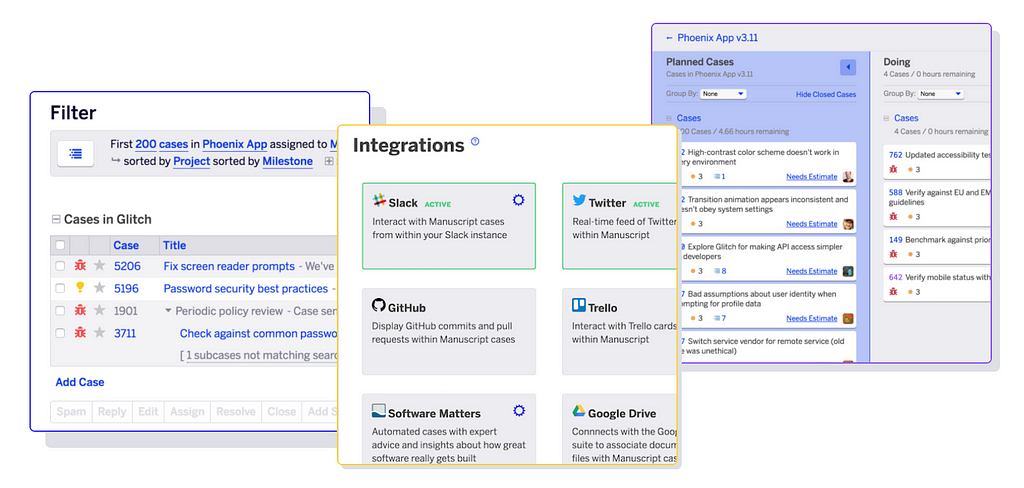
We knew Manuscript had to do all the essentials: task management, prioritization, scheduling, sprints, story points, and all that good stuff. And honestly, Manuscript is great at those fundamentals. But then we saw a chance to do something really new, based on a few simple ideas:

We’ve got a lot more to say about Manuscript coming soon, including a sneak peek into how Manuscript doesn’t just track tasks, it helps your team learn to craft better software — whether that’s making things more accessible, more secure, or just more thoughtful.
But you don’t have to wait for us to tell you the story: Sign up for Manuscript for free and find out for yourself. (And if you’re already a FogBugz user? We’ll be upgrading you to Manuscript for free — we’ll be in touch with all the details.)
Introducing Manuscript was originally published in Fog Creek Software on Medium, where people are continuing the conversation by highlighting and responding to this story.


