Rolandt
Shared posts
Russia is now the new frontier for Chinese smartphone makers
Intel just forgot to review the security of their firmware

In response to issues identified by external researchers, Intel has performed an in-depth comprehensive security review of its Intel Management Engine (ME), Intel Trusted Execution Engine (TXE), and Intel Server Platform Services (SPS) with the objective of enhancing firmware resilience.
As a result, Intel has identified several security vulnerabilities that could potentially place impacted platforms at risk. Systems using ME Firmware versions 11.0/11.5/11.6/11.7/11.10/11.20, SPS Firmware version 4.0, and TXE version 3.0 are impacted
Sonos before and after
been a huge Sonos fan for years, so Im mystified how they managed to completely fubar the whole system w/ awful recent UI & system updates
— briankrebs (@briankrebs) November 20, 2017
Brian Krebs has indeed been a huge Sonos fan. As have I. Then something changed. And I can smell it. This is former CEO and Sonos founder John MacFarlane commenting on Apple's decision not to ship the HomePod before it is ready.
These calls are why I respect Apple so much. They are what separates the great product companies from those that wish they were. Values at work.
— John MacFarlane (@JohnLMacFarlane) November 18, 2017
Sonos is missing his guidance. Sonos One shipped before it was done. So did the Sonos 8.0 software. Alexa is half-baked. It will eventually be OK. But Sonos should fix things before shipping.
BTW: Alex Warning until this Friday.
Where is Technology Taking the Economy
Irving Wladawsky-Berger,
Nov 23, 2017
Irving Wladawsky-Berger offers projections about the new technological environment. "Machines have started to exhibit associative intelligence," he writes, "Associative intelligence is no longer just housed in the brains of human workers, but emerges from the constant interactions among machines, software and processes." It made me think of e-Trucks interacting with each other to form convoys, for example. Then I began to imagine road construction priorities being automatically determined by automated vehicles reporting bottlenecks and slowdowns. Anyhow, Wladawsky-Berger identifies several key changes in our political economy that result from this trend (quoted):
- The criteria for assessing policies will change from 'growth' to 'job creation' (or maybe simply access to goods and services)
- The criteria for measuring the economy will change, as virtual goods "generate unmeasured benefits for the user, cost next to nothing, and are unpriced"
- Free market economies will be regulated. “In the distributive era free-market efficiency will no longer be justifiable if it creates whole classes of people who lose.”
- "The next era will not be an economic one, but a political one... until we’ve resolved access we’re in for a lengthy period of experimentation"
I think these changes mught be even more significant than depicted here. If we're looking decades ahead, as Wladawsky-Berger, we may be looking at the replacement of money as a mechanism for exchange, as the assumulation of trillions of unused dollars in secret accounts has undermined its effectiveness for the purpose of regulating commerce.
[Link] [Comment]Innovation Culture

Rideau Hall Foundation,
Nov 23, 2017
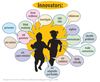
This website, and the associated project around it, are an outcome of the previous Governor-General of Canada, David Johnston, working with Tom Jenkins (of the Jenkins report on science and technology in Canada). The site says "Innovation is the creative combination of anything that, once done, makes something better." I have mixed views. The Canadian Museum of Science and Technology, now part of co-sponsor Ingenium, was one of my favourite childhood destinations. It just reopened (yay!). I should visit. And you can submit Canadian Innovation Stories (note that the site is slow). But innovation seems to me to be more than just 'combining' things, and more than just 'making something better'. The Governor-General's Innovation Awards, associated with the site, are almost exclusively for medical innovations and/or businesses. There are education resources, including a children's resource, that defines innovation as "creating or improving a thing (product) or action (process) to make a difference (impact)." This seems even narrower to me. It's not all about business. Disclosure: I was peripherally involved with the education resources and my name appears in the acknowledgements.
[Link] [Comment]Assembly Required
Tests That Protect Your Code From Without
I recently ran across an old post from Spotify about how the confluence of Spotify's generous policy for usernames, the oddities of Unicode, and a change in standard Python libraries led to a situation in which a person could hijack an existing username. The post explains how Spotify tracked down the problem and fixed it -- a good read.
The paragraph before the closing "Some Take-Aways" section says:
So changes in the standard python library from one python version to the next introduced a subtle bug in twisted's nodepre.prepare() function which in turn introduced a security issue in Spotify's account creation.
... which, to my mind, hints at a bonus takeaway not listed in the closing. It would really have been nice to have had a test that noticed when nodeprep's method for canonicalizing (ugh) usernames was no longer idempotent.
Not having such a test is understandable. I don't write tests for all or even many of the library functions I use. This means trusting the creators of the libraries I use. (It also means choosing libraries judiciously.) In this case, there wasn't even a bug in twisted's original code; a change in Python introduced one. It is hard to anticipate when a language upgrade will create a bug in a library that I am using.
However, when something like this occurs, I find that it is a good time to add a test. This bug exposed just how important it is for the code to ensure idempotence when lower-casing a username. A new test or two can protect the code base from unexpected errors from without without placing an unreasonable burden on me as a developer. And those tests give me peace of mind, which is usually more than worth an extra millisecond when running my tests.
Open In Order To...
OpenCon2017,
Nov 23, 2017
These are all papers submitted to OpenCon2017 in response to an essay competition that closed today. The conference is tomorrow. You might be able to vote but I encourage reading rather than voting. The papers run in the 500-1000 work range.
- Daniel Machado, “Open in order to [promote cooperation over competition]”
- Paula, “Imposed embargo”
- Imogen, “Open in order to…level the playing field”
- Andrea Bertino, "Open in order to [create a new balance between innovators and the rest of humanity]"
- Jerome Samson, “Open in order to [mess with a winning formula?]”
- Peifeng Wang, "Open access to foster universal value"
- sarah, "Optimize Scientific Research Process"
- Devin Berg, "Open in order to open engineering"
- Fulco Scherjon, "Open in order to reproduce"
- Asura Enkhbayar, "Open in order to ... have a plan B"
- Sara Bosshart, "On Open Access, Dandelions and “Open in Order to Grow”"
- Edit Gorogh, "Open in order to expand horizons"
- Marina Lubenow & Jens Crueger, "Open in order to think multidisciplinary!"
- Peter Murray-Rust, "Open Notebook Science Means Better Science"
- Leo Mack, "Open Science is Science at Web-scale"
- Isabel Jordan, "Open Access for Quality of Life and Partnership in Care"
- Dasapta Erwin Irawan, "Openness for the inferior: a view from Indonesian Scientist"
The conference is subtitled 'Empowering the next generation to advance open access, open education and open data'. I like how the essays represent a variety of different agendas and benefits all revolving around the idea of open access.
[Link] [Comment]
What do you do when your boss is an algorithm?

My boss is an algorithm
But what if the algorithm is our boss? Ries cited the example of an Uber driver. Who is the driver's boss? Who do they report to? Who tells them what to do? The answer, to all intents and purposes, is an algorithm (putting aside recent UK legislation about their legal status).
Imagine the scenario whereby a customer uses the app to hail a taxi in a high traffic area where there is a choice of driver. The algorithm decides which taxi driver(s) to show that too. That could be based on reviews (perhaps unverified), where the driver was the previous night, how frequently the driver chooses to drive for Uber, how safely the driver drives, who the driver is connected to on social networks and much more. And in that instance, who do you complain to anyway and what could they do? These algorithms are getting ever more complicated and anyway, this isn't a technical bug, this is an ethical question as much as anything.
I'm afraid, I don't have the answers, but I'm thinking about the implications of this in different aspects of work life.
Free book giveaway
Everyone at the BoS event last week got a copy of The Startup Way. I was lucky enough to come away with an extra copy which will be given away tomorrow evening at Swedish Beers in London as part of the Robot Ping Pong challenge. I do hope you can join us!
Eric Ries' Lean Startup talk & BoS archive
You can see Eric Ries's talk for BoS from 2010 when he'd just written Lean Startup. It's well worth revisiting.
Business of Software has archived all their previous talks and it's a fantastic resource. You can check it out here.
Firefox 58 Beta 3 Testday Results
As you may already know, last Friday – November 17th – we held a new Testday event, for Firefox 58 Beta 3.
Thank you all for helping us make Mozilla a better place!
From India team: Surentharan.R.A, Nagarajan Rajamanickam, Baranitharan, Fahima Zulfath, Aishwarya Narasimhan.
From Bangladesh team: Nazir Ahmed Sabbir, Md.Rahimul Islam, Md Maruf Hasan Hridoy, Tanvir Mazharul, Maruf Rahman, Sajedul Islam, Iftekher Alam, Mizanur Rahman Rony, Anika Alam, Forhad Hossain, Ratul Islam.
Results:
– several test cases executed for Web Compatibility and Tabbed Browser;
– 3 bugs verified: 1378111, 1415728 and 1413758;
– 1 new bug filed: 1418588.
Thanks for another successful testday 
We hope to see you all in our next events, all the details will be posted on QMO!
Is the Need for More Vancouver Housing Supply a “Myth”?

There’s a big news story circulating right now from the Globe and Mail by Kerry Gold which clearly suggests that increasing the supply of housing will not solve the affordability issues in Vancouver. Dr. John Rose has researched the idea that Vancouver has a housing supply shortage. And guess what~”he has concluded that Vancouver does not have a shortage of housing units. In fact, we have a surplus. And, as anybody in Metro Vancouver knows, prices have not plummeted as a result.”
In “The Housing Supply Myth”, Rose’s report looks at Statistics Canada census and Demographia Survey House Price Data. He also examined housing supply in other Canadian cities, the USA and Australia. What he found was that for every household that was in Vancouver in the last fifteen years, the region had added 1.19 “net” housing units. “Put another way, for every 100 households that came along, Metro Vancouver added 119 net units of housing. According to census data, there are also 66,719 unoccupied dwellings in Metro Vancouver.”
Even though there appears to be a housing surplus, affordability has worsened, which suggests the concept of increasing supply to solve affordability is not working. Rose does conclude that Vancouver does not have a shortage of housing units. In fact, we have a surplus. And, as anybody in Metro Vancouver knows, prices have not plummeted as a result.” Simon Fraser University’s Josh Gordon observed “There’s simply no evidence of a slowdown in construction or supply. The construction industry in Vancouver is operating at full throttle. There are around 40,000 units under construction, which is twice the historical average for the post-2000 period. The idea that we should get more supply into the pipeline is a bit silly.”
Talking about the need for housing supply distracts the public and policy makers of the “demand side, specifically in terms of foreign capital“. What to do? Rose ” favours taxes on speculation, and doesn’t rule out a ban on foreign buying of existing properties, as New Zealand is implementing next year. He also questions the building of housing units that are overpriced and intended for speculation, and therefore “pointless.” It is not the constraints of the Agricultural Land Reserve and Rose questions whether real estate developers are right in implicating citizens that will not accept density, noting that density benefits the developers and the well-meaning “smart growth” concept. Rose states “I’m leery of attributing our high housing costs and the escalation we’ve seen over the last 15 years to an inadequate densification.”
People pushing the supply side of housing can be direct and confrontational according to Rose but he notes his data is “publicly available. And when I did this research, I had my independence. Nobody owns this. I get no sponsorship from any industry, any sector. I’m a free agent…“I’m just saying look at the numbers, and we see Vancouver has plenty of supply. And can we build ourselves out of this? Not in this current model.”


What Happens to Those Shuttered Large Floorplate Malls? Lessons From the Sears Warehouses

There is no doubt that the heaving change in retail malls and major store closings will leave structural buildings demanding reuse. And this has all happened before-as reported in Citylab Sears built several “plants” across the country ninety years ago that were subsequently transformed into multi-use buildings and offices. Even the main headquarters for Seattle-based Starbucks is a former Sears warehouse. The locations of these former plant buildings were close to rail lines on the edges of cities, with lots of parking. These plants were huge, often a million square feet, and were local landmarks. Some sported towers, but these were really to provide water storage for the plant to provide water pressure for bathroom use during workers’ break times.
As Sears lost the need for rail transportation and chose trucking for deliveries plants near railway lines were no longer necessary and became opportunities to attract jobs and commerce. In Minneapolis the mayor and City morphed the old plant into the Midtown Exchange building with a corporate headquarters and 178 units of affordable housing and a food and crafts hall. This food market also used the existing railway bed beside the building as a new “Midtown Greenway” to bring customers to the hall by walking and by bicycle.
This pattern of reuse was also experienced at other Sears plants, where period architecture detail became a feature of the building reuse, and former rail access provided a green walkway and bikeway to the structure. Contrast this with shuttered suburban mall stores which are not near rail lines, but are industrial shell islands in huge tarred parking lots with no linear park greenway access and not near downtowns. Think of Amazon’s large warehouses. Can you see mixed use development occurring in those?
Where the previous Sears plants from nearly a century ago left industrial architecture and locations that were accessible by foot and valued, the shell structures from abandoned malls will be more difficult to readapt. Will these locations become sad decaying testaments to 20th century consumerism, or can these more remotely located malls be completely rehauled to new uses? As Ellen Denham-Jones states “the growing number of empty and under-performing retail sits throughout suburbia gives an opportunity to take the least-sustainable landscapes and convert them into more sustainable places. This allows us to redirect growth back into existing communities that could use a boost, and have the infrastructure in place, instead of continuing to tear down trees and to tear up the green space out at the edges”.


How to be an introverted or awkward salesperson
Learning Experience Platform – WRONG

Craig Weiss,
The Craig Weiss Group,
Nov 23, 2017

The 'wrong' in this article refers to the term 'experience'. Craig Weiss argues that the term houl be 'engagement' instead. Beyond that first argument he offers a pretty good overview of the platform, what is is, what it contains, and what it's supposed to do. He names a number of them at the end of the article: Learn Amp, Degreed, Grovo, Pathgather and Linkedin Learning. Based on both the description and the examples, my inclination would be to call them Learning Resource Platforms, because they are for the most part providing or selling access to learning content and resources.
[Link] [Comment]Pixelmator for iOS gets iPhone X support
We love the new iPhone X. So we took our time to polish the Pixelmator for iOS interface and make sure it looks and feels great on the brand new iPhone X screen.

The update is now ready for you to download from the App Store. It also includes a number of bug fixes and performance improvements. And, as always, it’s free for all those who have already purchased Pixelmator for iOS.
Scrivener 3 for macOS Is More Flexible and Powerful Than Ever for Long-Form Writing

Many text editors are just that – text editors. They take a document-focused approach to writing that centers on creating text. It’s an approach that works for most kinds of writing. However, long-form writing is a different animal altogether that benefits from a project-based approach that also includes tools for planning, organizing, researching, and tracking. Today, Literature and Latte released version 3.0 of Scrivener for macOS with a long list of new features that cements its spot as one of the premier project-focused apps available on the Mac for long-form writing.
Scrivener isn’t just for book writers, but the features that cater to them are what sets the app apart from other text editors. A Scrivener project is broken into pieces that include multiple text documents, research materials, and other elements. Fast, flexible navigation across multiple documents and bits of research is essential for big projects and is one of the areas where Scrivener excels. From the Binder in the left-hand sidebar, you can quickly navigate between documents in a project, create collections of documents across a project, and use Scrivener’s built-in search functionality to filter based on keyword searches.
In version 3, Scrivener has added a powerful bookmarking feature that supplements the existing search functionality. Bookmarks are available in the inspector pane on the right-hand side of the app. Bookmarks can be associated with a project or an individual document and applied to documents in the current project, elsewhere on your Mac, or even on the Internet. You can toggle between project and document bookmarks from the inspector or invoke project bookmarks from a dedicated bookmark button in the toolbar. Clicking on a bookmark in the inspector displays an editable version of the associated document below your list of bookmarks. If a bookmark links to an external document, double-clicking it opens the document in the app associated with it. It’s a nice way to keep disparate materials for cross reference always at your fingertips.

Date-based metadata.
The update to Scrivener also extends the app’s metadata system. Metadata helps organize documents, research, and other aspects of a writing project by associating bits of information with items. Version 3 adds checkboxes, lists, and dates to the app. Checkboxes can be used for any state that can be framed as the answer to a yes or no question. For example, you could add a custom metadata field with a checkbox that indicates whether a book chapter has been sent to your publisher or not.
Lists create multiple choice popup menus for those circumstances where you need more alternatives than the two that checkboxes provide. As you’d expect, date metadata lets you associate date and time information with an item. Metadata is searchable from Scrivener’s search field and can be incorporated in the outliner view of the app and to determine which parts of a project are compiled when you are ready to create a final exported version of your project.

Scrivener's new compile interface.
Compiling a project into a final document has been significantly revised in Scrivener 3 too. Compiling brings together all the pieces of a writing project and outputs a single document for printing or a file in a particular format. A compiled document is formatted according to each component document’s Section Type. Scrivener’s built-in templates create default Section Types, but they can be customized too. At compile time, Scrivener takes all the pieces of your project and assembles them, applying layouts based on the Section Types you defined and used.
The compile interface has also been simplified. The window is divided into three sections: compile formats, a preview pane, and project-specific settings. The redesign presents the compile options in a way that is better-organized than prior versions clarifying what will happen when the ‘Compile’ button is clicked. You can still dig into the minutia if you’d like, but for most users, I suspect the simplified interface presented by version 3 will be a welcome change.
Export options have been enhanced in the new version of Scrivener. There is now ePub 3 support and improved Kindle functionality. The details are available on their blog, but to provide a better Kindle experience, Literature and Latte had to create a rich text to MultiMarkdown converter as an initial step before converting the MultiMarkdown to the Kindle’s file format. As a result, Scrivener has also gained the ability to export to MultiMarkdown.
Scrivener’s MultiMarkdown export feature highlights a fundamental difference between it and plain-text editors. In Scrivener, text begins as rich text and can be exported to MultiMarkdown and other formats, whereas in plain-text editors, text often originates as Markdown and then is exported to formats like rich text. One is not an inherently superior approach over the other, but writers accustomed to plain text editors may find it harder to make the transition to Scrivener than someone coming from a styled-text word processor like Pages or Word.

Scrivener's Style panel.
Formatting presets from earlier versions of Scrivener have evolved into a styles system similar to one you would find in a word processor, where sets of formatting can be defined as a style. The app includes predefined styles that should suit the needs of most users, but styles can also be customized. When you compile a project and export it, styles are translated into the destination format whether that’s Word, ePub, or some other format.
To expand the number of documents that can be simultaneously displayed onscreen, Scrivener has added a new feature called copyholders. Prior versions of the app allowed you to view two documents side-by-side vertically or horizontally, but with copyholders, up to four documents can share the screen. A copyholder is essentially an editor without access to Scrivener’s corkboard, outliner, or ‘Scrivenings’ features. There are several options associated with laying out the editor panes in Scrivener, which can get fiddly. Fortunately, Literature and Latte has added several pre-defined layouts that provide sensible options for users who don’t want to adjust the layout of their editors.
In addition to a large number of new features in Scrivener 3, the app has a brand new, modern design that looks right at home with other modern Mac apps. Literature and Latte has also added a new round icon that looks great and is a big improvement over the previous one.
Scrivener is one of the most complex writing apps I’ve used. It’s not an understatement to say that virtually every aspect of the app can be customized to accommodate every writer’s particular tastes and needs. While the app can be used for any type and style of writing, the depth of customization possible in Scrivener is designed primarily for book writers who need to wrangle hundreds of pages of text and research. If you’re not that kind of writer, I would think hard before diving into Scrivener. For many people, it is more tool than needed, and there’s a risk of getting lost in its complexity and endlessly fiddling with its settings.
That said, Scrivener is also exactly what many long-form writers need – powerful tools to plan, organize, and track progress of big, unwieldy projects. With the update to version 3, Scrivener is more flexible and powerful than ever before, and many of its more complex features have been redesigned to be more approachable. I have not written anything book-length, but if I do, Scrivener will be the tool I’ll use to tackle a project of that scope.
Scrivener 3 is available directly from Literature and Latte for $45. A Mac App Store version is planned for future release. In the meantime, anyone who bought Scrivener 2 on the Mac App Store that provides Literature and Latte with a Mac App Store receipt will be sent a discount code to buy version 3 directly for the upgrade price of $25. Literature and Latte also offers a 30-day free trial if you want to take Scrivener for a spin before purchasing it.
Support MacStories Directly
Club MacStories offers exclusive access to extra MacStories content, delivered every week; it's also a way to support us directly.
Club MacStories will help you discover the best apps for your devices and get the most out of your iPhone, iPad, and Mac. Plus, it's made in Italy.
Join NowFirefox Private Browsing vs. Chrome Incognito: Which is Faster?
With the launch of Firefox Quantum, Mozilla decided to team up with Disconnect Inc. to compare page load times between desktop versions of Chrome’s Incognito mode and Firefox Quantum’s Private Browsing.
Firefox Quantum is the fastest version of Firefox we’ve ever made. It is twice as fast as Firefox 52 and often faster than the latest version of Chrome in head to head page load comparisons. By using key performance benchmarks, we were able to optimize Firefox to eliminate unnecessary delays and give our users a great browsing experience.
Most browser performance benchmarks focus on the use of a regular browsing mode. But, what about Private Browsing? Given that Private Browsing use is so common, we wanted to see how Firefox’s Private Browsing compared with Chrome’s Incognito when it came to page load time (that time between a click and the page being fully loaded on the screen).
Spoiler Alert…. Firefox Quantum’s Private Browsing is fast…. really fast.
Why would Private Browsing performance be any different?
Websites have the ability to load content and run scripts from a variety of sources. Some of these scripts include trackers. Trackers are used for a variety of reasons including everything from website analytics to tracking website engagement for the purposes of targeted advertising. The use of trackers on websites is very common. Unfortunately trackers can delay the completion of page loads while the browser waits for tracking scripts to respond.
In 2015, Firefox became the only browser to include Tracking Protection enabled by default in Private Browsing mode. Tracking Protection, as the name implies, blocks resources from loading if the URL being loaded is on a list of known trackers as defined by Disconnect’s Tracking Protection list. This list is a balanced approach to blocking and does not include sites that obey Do Not Track (as defined in the EFF guidelines). While the feature is meant to help keep users from being tracked when they have explicitly opted to use Private Browsing, the side effect is a much faster browsing experience on websites which attempt to load content from URLs on the tracking list. A previous Firefox study in 2015 showed that there was a reduction in median page load time on top News websites of 44%.
Since Firefox Quantum is the fastest version of Firefox yet, we thought it would be interesting to compare page load times between Firefox Quantum’s Private Browsing (which includes Tracking Protection), and Chrome’s Incognito mode which does not include a tracking protection feature.
Study Methodology
The study was conducted by Disconnect, the organization behind the domain lists used to power Tracking Protection. Page load times for the top 200 news websites as ranked by Alexa.com were measured using Firefox Quantum (v57.0b10v57 beta) in both default and Private Browsing modes and the most recent Chrome version (v61.0.3163.100) that was available at the time of testing – also in default and Incognito modes. News sites were tested because these sites tend to have the most trackers.
Each of the news websites were loaded 10 times. In order for the test to measure comparable timings and to be reproducible by others, load times were measured using the PerformanceTiming API for both Firefox and Chrome for each page load. In particular, the total load time is considered as the difference between PerformanceTiming.loadEventEnd and PerformanceTiming.navigationStart. The tests were controlled through an automated script.
All rounds of testing were conducted on a new Macbook Pro (13’’ Macbook Pro 2017, 3.1GHz i5, 16GB memory, OSX 10.13). We tested on a fast network connection with the Macbook Pro connected to a Webpass 100Mbps connection over WiFi (802.11ac, 867Mbit/s). For a deep dive into the methodology, check out our Mozilla Hacks post.
Results
Across the top 200 news websites tested, the average page load time for Firefox Quantum’s Private Browsing is 3.2 seconds compared to Chrome’s Incognito mode which took an average of 7.7 seconds to load a page for the fast Gigabit connection. This means that, on average, Firefox Quantum’s Private Browsing loads page 2.4x faster than Chrome in Incognito mode.
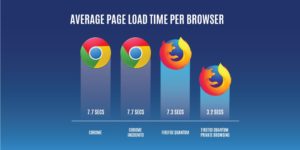
On average, Firefox Quantum’s Private Browsing loads page 2.4x faster than Chrome in Incognito mode
Comparing the average load times for Chrome also shows that Incognito mode alone does not bring any speed improvements. It is the Tracking Protection that makes the difference as can be seen from the results for Firefox Quantum.
Another way to look at this data is by looking at the time that is acceptable to users for pages to be loaded. A third party study by SOASTA Inc. recently found that an average session load time of 6 seconds already leads to a 70% user bounce rate. Therefore, it makes sense to put our measurements in the context of looking at the share of pages per browser that took longer than 6 seconds to load.

95% of page loads met the 6 second or faster threshold using Firefox Quantum Private Browsing with Tracking Protection
95% of page loads met the 6 second or faster threshold using Firefox Quantum Private Browsing with Tracking Protection enabled, while only 70% of page loads made the cut on Chrome, leaving nearly a third of the news sites unable to load within that time frame.
What’s next?
While the speed improvements in Firefox Quantum will vary depending on the website, overall users can expect that Private Browsing in Firefox will be faster than Chrome’s Incognito mode right out of the box.
In fact, due to these findings, we wanted users to be able to benefit from the increased speed and privacy outside of Private Browsing mode. With Firefox Quantum, users now have the ability to enable Tracking Protection in Firefox at any time.
Interested? Then try Private Browsing for yourself!
If you’d like to take it up a notch and enable Tracking Protection every time you use Firefox, then download Firefox Quantum, open Preferences. Choose Privacy & Security and scroll down until you find the Tracking Protection section. Alternatively, simply search for “Tracking Protection” in the Find in Preferences field. Enable Tracking Protection “Always” and you are set to enjoy both improved speed and privacy whenever you use Firefox Quantum.
When enabling it, please keep in mind that Tracking Protection may block social “like” buttons, commenting tools and some cross-site video content.

Tracking Protection in the new Firefox browser
If Tracking Protection is a feature that you’ve commonly used or that you will want to use more regularly, give Firefox Quantum a try to experience how fast it is!
Disconnect Inc. and Mozilla partnered up in 2015 to power Firefox’s Tracking Protection giving you control over the data that third parties receive from you online. The blocklist is based on a list of known trackers as defined by Disconnect’s Tracking Protection list. As a follow-up, we asked ourselves if Firefox’s Private Browsing mode with Tracking Protection might also offer speed benefits.
Contributors: Peter Dolanjski & Dominik Strohmeier – Mozilla, Casey Oppenheim & Eason Goodale – Disconnect Inc.
The post Firefox Private Browsing vs. Chrome Incognito: Which is Faster? appeared first on The Mozilla Blog.
Demystifying Data Analysis

In the world of media, marketing, apps and software, we are inundated with data. Arguably, we have more data than we'll ever know what to do with and it gets increasingly difficult to make sense of it all. It can feel overwhelming, and if you're not well versed in working with data, it can feel too much and you end up reverting to instinct rather than data. It's fair to say that instinct did ok for Steve Jobs but most people don't have his genius so are better off relying on data.
But what do you do when you're faced with loads of data after interviewing lots of people about a certain product, website or general day to day habits? This is a core part of anyone who works in user-experience. They're the people who work out what customers need or want or how they're using something and translate that into improving how your website or app will work. Of course, sometimes the advice is ignored, but in the main, it's advice you should be listening to.
If you're an SME or start-up or, perhaps, pre-startup, you can't always afford a dedicated user experience person to work with you but you need to start somewhere. This article from Rachel Hinman is a great starting point to give you a simple structure to working your way through your data to gain insights from it. Check it out now.
Day 20/30 NaBloPoMo
300 West Hastings Street

We saw the Inns of Court building that once stood here in an earlier post. From the 1890s offices for lawyers were here because the Courthouse was next door – where today the park of Victory Square is located. When we posted the Inns of Court comparison, the ‘after’ shot showed the 1950 Bank of Commerce designed by McCarter Nairne – one of the earliest modernist structures in the city. At the time it was one of a number of buildings occupied by the Vancouver Film School, and it’s seen here at the end of 2014, not long before it was demolished, and below in 1981.

It was replaced earlier this year with a rental residential building developed by Simon Fraser University, with a floor of educational space and a café on the main floor. Designed by Raymond Letkeman Architects, it used a hybrid construction method of concrete frame for the lower floors and woodframe for the upper residential floors, all clad in brick.
Image source: City of Vancouver Archives CVA 779-E11.20.


Tsawwassen Mills Mall Owners Have Malls For Sale!
mkalus
shared this story
from  Price Tags. Price Tags.
|

All is not well in merchandising mall land. As the Globe and Mail reports the Quebec “caisse de depot et placement du Quebec” has a real estate arm named Ivanhoé Cambridge. This real estate arm is attempting to sell their shares of three Canadian malls that are expected to sell for one billion dollars each. Ivanhoe Cambridge also owns the newly minted 1.2 million square foot Tsawwassen Mills Mall (with 6,000 parking spaces) built on class one agricultural land in Delta, away from supportive customer density and without good transit connections.
Ivanhoe Cambridge owns half of the three malls they are selling-Cadillac Fairview owns the other half. Coincidentally, Cadillac Fairview is the real estate branch of the Ontario’s Teachers’ Pension Plan, while the Quebec owned Ivanhoe Cambridge is controlled largely by a group of Quebec governmental pension plans. The three malls on the block include Fairview Mall in Toronto, Market Mall in Calgary and Richmond Centre in Richmond, B.C.
These commercial mall real estate services are quite secretive, and Ivanhoe Cambridge is no different. Telling the Globe and Mail “We don’t comment on rumours about our investment strategy” speaks volumes about the roller coaster ride occurring in shopping centre retail. Sears Canada is closing, Toys R Us is under creditor protection, and Hudson’s Bay Co. is selling store space to an office sharing company called WeWork as reported in this Price Tags Vancouver post.
These three jointly held malls “generate around $900 in sales per square foot, according to the Retail Council of Canada. “The top malls are in great locations and will always do well,” said Alex Arifuzzaman, a retail real estate adviser with InterStratics Consultants. Compare those figures with those of Tsawwassen Mills Mall which is making $275 per commercial retail unit square foot.
Ivanhoe Cambridge is getting rid of shared assets in their portfolio, perhaps after the nasty spat also reported in Price Tags with Sears Canada in Metrotown. In that case, Sears wanted to go ahead with a mixed use development on their portion of the Metrotown site, but was required to give notice of their intent and could not close the store for 150 days. Ivanhoe Cambridge was forced to disclose that they were also looking at “redevelopment options”. Certainly by getting rid of pesky co-ownership allows Ivanhoe Cambridge to develop their own plans unfettered by partners. As the Globe and Mail article observes “According to its most recent activity report, Ivanhoé said it is redeveloping and expanding three other shopping centres in Quebec and British Columbia. The company said it would continue to “increase the value” of its shopping centres and “capitalize on development opportunities.”Over all, Ivanhoé said it planned to “significantly increase the proportion of growth market investments in its overall portfolio, with the goal of diversifying its markets and asset base.”
Is there a future in big mall retail with on-line shopping and the return to downtown shopping? What will Ivanhoe Cambridge’s next steps be with Tsawwassen Mills Mall?


For Victoria & Kyle
(one more time: sub to the #rstats feed if you’re only on the blog for #rstats/datasci items)
Daughter #2 got married to a wonderful chap yesterday. I wanted to preserve the text of my speech and blessing for them here. I know it’s on their wedding video but I’d like to archive it into the historical record as well.
Hey everyone.
I’m Bob, Victoria’s dad. Her mom, Mary, and I want to express our deepest thanks to you all for sharing in this joyous day with us, Victoria, Kyle and Kyle’s parents.
Soon, you’ll be hearing a song that I believe fully describes the foundation of Kyle & Victoria’s new life together.
A story of grace.
A story of love.
A story of new beginnings.
And, a story of individual faiths united in the One who created an entire universe to make this very day possible for this very moment for them.
Before that, I have just a few words to say to the bride, the groom and to all here.
First: Victoria.
Your mom & I have watched you grow up from a small, fragile baby girl (to audience: who’s nickname was “spud”, btw, given her potato-like appearance at birth…I’m so dead now) into a strong, dynamic, loving, caring force de majeure. When you set upon a goal, there is no subtlety; just bold determination, founded in firm convictions, demanding flawless execution.
You have a sense of justice and purpose that — at times — fills us with sheer awe, and an unwavering Faith that is both inspiring and contagious to everyone around.
For 25 years, we’ve seen your tears, but have also seen you beam with joy; we’ve seen you stumble, but have seen you get back up run as if you could literally see the angels at your side. We’ve seen your disappointments but we’ve also seen you accomplish every goal you’ve set out to achieve. All along the way, you’ve made us proud and given us incredible memories to cherish, including today.
Now, for Kyle:
We’ve had an amazing opportunity to get to know Kyle as he’s been staying with us for a good part of this year. Since we first met you, Kyle, we’ve seen you express love, kindness and respect to Victoria. We’ve caught your transfixed gazes on her as she would dive into one of her meandering, nigh-endless stories at the dinner table (yep, I was watching you :-). We’ve seen you make her paramount in your life. I’ve come to know you as a talented, intelligent, soft-spoken gentleman and have seen your Faith regularly demonstrated in action. I thank your parents for raising such a man, and — while it is difficult to let go of my “little girl” — I know I am doing so into the hand of someone who will indeed love and cherish her for their days to come.
For all of us:
While this is most definitely Kyle & Victoria’s day, each of us here has helped to shape them into who they are today. And, thankfully, our jobs are not over! Our prayer is that we will all continue to give them the love and support they so richly deserve as they turn the page to start this new chapter of their lives together.
Let us all raise a glass to the new couple:
A toast to my daughter. She was a gift from God and I will always be grateful to have been given the honor of being her father. May God continue to bless her and her new husband, Kyle. Grant them safety, love, and happiness all the days of their lives.
Scrollama.js, a JavaScript library for scrollytelling
Russell Goldenberg released Scrollama.js in an effort to make scrollytelling more straightforward to implement.
Scrollytelling can be complicated to implement and difficult to make performant. The goal of this library is to provide a simple interface for creating scroll-driven interactives and improve user experience by reducing scroll jank. It offers (optional) methods to implement the common scrollytelling pattern to reduce more involved DOM calculations. For lack of a better term, I refer to it as the sticky graphic pattern, whereby the graphic scrolls into view, becomes “stuck” for a duration of steps, then exits and “unsticks” when the steps conclude.
Bookmarked for later.
Tags: JavaScript, scrollytelling
A Quick Definition of Neo-Liberalism
This is an interesting start, though I would have hoped for a more tightly bound definition at least by the end of part one. Each of the four senses of neo-liberalism that you raise can be qualified in important ways.
- the role of markets - does not just mean the use of markets. In neo-liberalism, this means that markets are unregulated, or minimally, self-regulated. Socialist and mixed-market economies often employ regulated free markets.
- the role of competition - even the Soviet Union engaged in competition, for example, the Olympics, hockey tournaments, and more. Public entities in Canada likewise compete for staff, for resources, and for recognition. The role of competition in neo-liberalism is that it is an existential struggle - you cannot survive (as a company, as a person) unless you succeed in competition.
the role of performance data - not sure exactly what you're up to here, but minimally, neo-liberalism endorses the idea of "you manage only what you can measure", which rules out such things as well-being, happiness and tranquility as measures.
the role of management - in neo-liberalism, management is focused on the bottom line, to the exclusion of all else. There is no sense of management for other outcomes, such as social good, environmental good, etc., unless some entity is willing to pay for these.
I think it is important, if you are going to talk about the neo-liberal university, not to soft-sell neo-liberalism. It has a hard edge, and to the extent that it doesn't, it's not neo-liberalism.

AI and Communities
You’ve probably read the same case studies as me about the ‘industry that didn’t adapt (or change)’. Trains, the ice trade, tour operators, postmen, music etc…you can take your pick, the pattern was the same.
First, they ignored the trend, then they fought the trend, then they were destroyed by the trend.
Did you ever think reading these stories “that won’t happen to me, I’m too smart!”.
This morning is the time to test that assumption.
Are you proactively exploring how you could use AI to reduce your workload by 90%?
What happens to your superuser program when people can just ask Siri or Alexa on their phones and get the best possible answer?
What happens to the community manager when a chatbot can greet members, introduce them to each other, remove bad actors/content better and guide them to participating quicker than they can?
What happens when reports are automatically generated and acted upon?
But people want the empathy of another person doing this work right. No-one wants a machine to do these tasks. People want to feel listened and responded to by a real person.
That’s almost the exact same response our operators, stock market brokers, milkmen, postmen, and checkout assistants used to give (and soon Uber drivers too).
A better expression here is denial.
Artificial Intelligence in its myriad of forms is happening right now on the fringes. It might stay on the fringe for 1 year, even 5 years. But when it moves it will move fast and I’d recommend you take action now.
Who is doing AI and community well? How can you make it work for you? Who can best figure out the shift in work from person to machines?
I’d bet the person who can answer these questions won’t be out of work when the inevitable happens.
Intel CPUs with integrated AMD graphics

Ok, this is completely off the charts in my book of unlikely partnerships.
Although details are scarce, I keep thinking about Apple’s strange fascination for AMD graphics and wondering if they’ll be the ones using this combo.
Twitter Favorites: [NormanJamesCTV] Toronto, once the dumpster fire of NA sports. Once. Now? TFC - Maybe MLS best ever Leafs - Dynastic potential Rap… https://t.co/P4qgzdJZWr

Toronto, once the dumpster fire of NA sports. Once. Now? TFC - Maybe MLS best ever Leafs - Dynastic potential Rap… twitter.com/i/web/status/9…

Here’s what’s coming to Netflix Canada in December

In December, Netflix Canada is set to launch new Netflix Original film called Bright, starring Will Smith, Marvel’s Guardians of the Galaxy Vol.2 and the latest Power Rangers movie.
Here’s a full list of all of the television shows and movies coming to Netflix Canada this December:
December 1st
- A StoryBots Christmas [Netflix Original] (available for download)
- All Hail King Julien: season 5 [Netflix Original] (available for download)
- Before I Fall (available for download)
- Dark: season 1 [Netflix Original] (available for download)
- Diana: In Her Own Words (available for download)
- DreamWorks: Home for the Holidays [Netflix Original] (available for download)
- Easy: season 2 [Netflix Original] (available for download)
- Enemy Mine
- Exodus: Gods and Kings
- Gods or Men (aka Born Strong) (available for download)
- Forbidden Games: The Justin Fashanu Story (available for download)
- Hired Gun (available for download)
- Monster Island (available for download)
- My Happy Family [Netflix Original]
- Night at the Museum: Secret of the Tomb
- Our Man Flint
- Sinister 2 (available for download)
- Slap Shot (available for download)
- Sleeping with the Enemy
- Table 19
- TURN: Washington’s Spies: season 4
- Under the Same Moon
- Voyeur [Netflix Original] (available for download)
- Wild
- Wilson
December 2nd
- Temple (available for download)
- The Survivalist (available for download)
December 3rd
December 4th
- Paris Can Wait (available for download)
- The Best of Me (available for download)
December 5th
- 7 Sisters (available for download)
- Craig Ferguson: Tickle Fight [Netflix Original] (available for download)
- Marvel’s Guardian of the Galaxy Vol.2
December 6th
- Born in China
- Final Fantasy VII: Advent Children (available for download)
- Power Rangers (available for download)
- Trolls Holiday Special (available for download)
December 7th
- The Red Tent: season 1 (available for download)
December 8th
- El Camino Christmas [Netflix Original] (available for download)
- The Crown: season 2 [Netflix Original] (available for download)
- The Oath (available for download)
December 10th
- The Little Hours (available for download)
December 12th
- It Comes at Night (available for download)
- Judd Apatow: The Return [Netflix Original] (available for download)
- LEGO: Justice League: Gotham City Breakout
- Manhunt Unabomber [Netflix Original] (available for download)
December 14th
- Concussion (available for download)
- Go Back to Where You Came From: season 1-3
- Halt and Catch Fire: season 4
- Murderous Affairs: season 2
December 15th
- Christmas Inheritance [Netflix Original] (available for download)
- Discovering Bigfoot (available for download)
- Erased: season 1 [Netflix Original] (available for download)
- Freeway: Crack in The System (available for download)
- PAW Patrol: season 4
- Reggie Yates Outside Man: Volume 2
- The Ranch: part 4 [Netflix Original] (available for download)
- Trollhunters: part 2 [Netflix Original] (available for download)
- Ultimate Beastmaster [Netflix Original] (available for download)
- Wormwood [Netflix Original] (available for download)
December 16th
December 17th
- Shot Caller (available for download)
December 18th
- Hello, My Twenties: season 2 [Netflix Original] (available for download)
December 19th
- Miss Me This Christmas (available for download)
- Russel Howard: Recalibrate [Netflix Original] (available for download)
- You Can’t Fight Christmas (available for download)
December 20th
December 21st
- Peaky Blinders: season 4 (available for download)
December 22nd
- 72 Dangerous Animals: Latin America: season 1 [Netflix Original] (available for download)
- Bright [Netflix Original] (available for download)
- Dope: season 1 [Netflix Original] (available for download)
- Fuller House: season 3 [Netflix Original] (available for download)
- Inconceivable (available for download)
- The Toys That Made Us: season 1 [Netflix Original] (available for download)
December 23rd
- Bright: The Music Videos
- Creep 2 (available for download)
- Myths and Monsters: season 1
December 25th
- Fallen (available for download)
- Cable Girls: season 2 [Netflix Original] (available for download)
December 26th
- El Vato: season 2 [Netflix Original] (available for download)
- NYE Countdowns
- Todd Barry Spicy Honey [Netflix Original] (available for download)
December 27th
- Chronically Metropolitan (available for download)
- Correspondence
- McLaren (available for download)
- My Life as a Zucchini (available for download)
- The Ottoman Lieutenant (available for download)
December 29th
- Bill Nye Saves the World: season 2: part 1 [Netflix Original] (available for download)
- La Mante: season 1 [Netflix Original]
- Sicario (available for download)
- The Climb [Netflix Original]
December 30th
- All Roads Lead to Rome (available for download)
December 31st
- Aliens: Zone of Silence (available for download)
- Blurred Lines: Inside the Art World (available for download)
- Dave Chappelle: Equanimity [Netflix Original] (available for download)
- Dead Draw
- Fun Mom Dinner (available for download)
- Haze (available for download)
- Standing Tall (available for download)
This is the last chance to watch
- Dragon’s Den: season 9-10 (12/01/2017)
- Glee: season 1-2 (12/01/2017)
- Runner Runner (12/01/2017)
- Sherlock Holmes (12/01/2017)
- The Revenant (12/01/2017)
- The Wolverine (12/01/2017)
- The Good Dinosaur (12/07/2017)
- No Reservations (12/14/2017)
- Pitch Perfect (12/14/2017)
The post Here’s what’s coming to Netflix Canada in December appeared first on MobileSyrup.
Google Lens is now available right in Google Assistant on Pixel devices

It looks like you no longer need to open up Google Photos to use Lens.
Users have reported that Lens is now available in Google Assistant on both the Pixel and Pixel 2 devices. Tapping the camera button while using the AI assistant now performs a search when you snap a photo.
Lens is able to identify what you’re looking at, search the web and launch other apps. Users are also now able to rate results, allowing Google to continuously refine Lens overtime.
The feature hasn’t landed on our Pixel 2 XL at the MobileSyrup office, but Google says it is rolling out now. This shift makes switch more convenient and easier to use.
Is Lens available directly through your Pixel’s camera yet? Let us know in the comment section.
Via: 9to5Google
The post Google Lens is now available right in Google Assistant on Pixel devices appeared first on MobileSyrup.
The Pixel 2 goes big in Japan: a photo essay

In the two years in which Google has made its own smartphone, the company has hosted a separate hands-on event for members of the Canadian press. I’ve gone both years, and in both 2016 and 2017 the same scenario has played out.
When I enter the hands-on area, a Google executive I’ve known for a couple of years warmly greets me before extolling the virtues of his company’s latest smartphone.
He knows I’m the camera guy at MobileSyrup, so without fail he makes sure to tell me, “Igor, next year you won’t have to bring your camera (a Sony a6300, in my case) to photograph one of these events.”

I could be wrong, but I’m pretty sure he also said something to the same effect when Google launched the Nexus 5X and Nexus 6P.
By this point, the idea that photographers will ditch their dedicated cameras to wholeheartedly embrace smartphones is a common one, reiterated by a number of different manufacturers over the years. In 2017, however, with the release of the Pixel 2 and iPhone 7, it seems that finally there’s more truth to that statement than marketing hype.

To see whether I could ever envision myself ditching my camera, I took the Pixel 2 on my recent trip to Japan. If you’ve ever travelled to Japan, you’ll know that it’s a photographers dream.
Whether it’s a colourful kimono or the stark contrast of a modern vending machine next to a shrine that’s still standing after centuries of earthquakes, fires and war, there’s always something visually interesting around the next corner. It is, in other words, the perfect place to put a new camera through its paces.

How did the Pixel 2 fare as travel camera?
In short, if all you want is a capable smartphone camera, and don’t want anything more complex than that, then the Pixel 2 is a great camera. It’s very capable, especially in less than ideal lighting conditions.
Moreover, Google’s high dynamic range capture solution, HDR+, is one of the best. It does a great job of preserving highlight and shadow detail while not making a photo look artificial.

The included portrait mode, while not the best I’ve seen on a smartphone, still does a decent job of emulating shallow depth of field.
The iPhone may still be a better choice, if only because of much greater choice of camera and editing apps that grace the iTunes App Store. And you’ll want to master at least one app like Snapseed to make any photos you take truly shine. The photos I’ve included in this post I left unedited, but looking at them now, it’s obvious they would greatly benefit from an editing pass.

Do I plan to leave behind my dedicated camera the next time I go on a trip?
No.
Even on this trip, I took my Sony a6300 and RX100IV with me.
Would I recommend the Pixel 2 to someone else?
Here’s the thing: in 2017, every camera is a great camera.

Recently, MobileSyrup’s Sameer Chabbra bought a Nikon D3400. The D3400 is Nikon’s entry-level DSLR, aimed at beginner photographers. Despite it’s limited feature set and manual controls, the D3400 can capture beautiful photographs. Sameer shot all the photos in his Xperia XZ1 review using the D3400. With a bit of mentorship, he was able to get great results.
What’s important then is to find a camera that inspires you. I’m always amused when someone sees one of my photos and tells me, “This an amazing photo. You must have an amazing camera.” Imagine if that same person experienced a delicious meal at a restaurant and told the chef that made their meal, “That was an amazing meal. You must have an amazing oven.”

You find a camera that inspires because it takes countless failed photographs to make one that resonates with other people. For some people, it’s going to be a DSLR or mirrorless camera. For others, it’s going to be the camera that comes with their smartphone.
I love my mirrorless cameras because they force me to slow down and really take in a place, but if the Pixel does the same for you, then it’s a great camera.
Bonus
Below are a couple of photographs I took with my other cameras. They’re not intended for comparison; merely to show off more of the beauty of Japan.








The post The Pixel 2 goes big in Japan: a photo essay appeared first on MobileSyrup.