
Some drivers will make illegal turns, even if motorists honk behind them. This BMW driver knew there was no consequ… twitter.com/i/web/status/9…
I recently read an old conversation between Neil Gaiman and Kazuo Ishiguro that started out as a discussion of genre but covered a lot of ground, including how stories mutate over time, and that the time scale of stories is so much larger than that of human lives. Here are a few of the passages about stories and time:
NG Stories are long-lived organisms. They're bigger and older than we are.
NG You sit there reading Pepys, and just for a minute, you kind of get to be 350, 400 years older than you are.
KI There's an interesting emotional tension that comes because of the mismatch of lifespans in your work, because an event that might be tragic for one of us may not be so for the long-lived being.
KI I'm often asked what my attitude is to film, theatrical, radio adaptations of my novels. It's very nice to have my story go out there, and if it's in a different form, I want the thing to mutate slightly. I don't want it to be an exact translation of my novel. I want it to be slightly different, because in a very vain kind of way, as a storyteller, I want my story to become like public property, so that it gains the status where people feel they can actually change it around and use it to express different things.
This last comment by Ishiguro made me think of open-source software. It can be adapted by anyone for almost any use. When we fork a repo and adapt it, how often does it grow into something new and considerably different? I often tell my compiler students about the long, mutated life of P-code, which was related by Chris Clark in a 1999 SIGPLAN Notices article:
P-code is an example [compiler intermediate representation] that took on a life of its own. It was invented by Nicklaus Wirth as the IL for the ETH Pascal compiler. Many variants of that compiler arose [Ne179], including the USCD Pascal compiler that was used at Stanford to define an optimizer [Cho83]. Chow's compiler evolved into the MIPS compiler suite, which was the basis for one of the DEC C compilers -- acc. That compiler did not parse the same language nor use any code from the ETH compiler, but the IL survived.
That's not software really, but a language processed by several generations of software. What are other great examples of software and languages that mutated and evolved?
We have no history with 100-year-old software yet, of course, let alone 300- or 1000-year-old software. Will we ever? Software is connected to the technology of a given time in ways that stories are not. Maybe, though, an idea that is embodied in a piece of software today could mutate and live on in new software or new technology many decades from now? The internet is a system of hardware and software that is already evolving into new forms. Will the world wide web continue to have life in a mutated form many years hence?
The Gaiman/Ishiguro conversation turned out to be more than I expected when I first found it. Good stuff. Oh, and as I wrap up this post, this passage resonates with me:
NG I know that when I create a story, I never know what's going to work. Sometimes I will do something that I think was just a bit of fun, and people will love it and it catches fire, and sometimes I will work very hard on something that I think people will love, and it just fades: it never quite finds its people.
Been there, done that, my friend. This pretty well describes my experience blogging and tweeting all these years, and even writing for my students. I am a less reliable predictor of what will connect with readers than my big ego would ever have guessed.
 Here are the best Black Friday cycling deals we could find. Black Friday cycling deals are surprisingly hard to find, due to the fact that “Cycling” is not a choice under most of Amazon’s drop down menus. But we searched hard, and have found some great stuff for you! Whether you want to treat yourself or get ahead of Christmas shopping, there are some great options here. All of these deals are for a very limited time, and some are going really fast, so if there is one you want, go for it fast!
The post Best Black Friday Cycling Deals appeared first on Average Joe Cyclist.
The folks at iA have been looking for new font to use in their iA Writer app (version 5.0 for iOS was launched just a couple of weeks ago), and they settled on the idea of a duospace font:
This year, again, we set out exploring our own writing font. We started from scratch, moved from proportional to monospace to three spaces (50% for i and j) and ended up with duospace for MWmw. Progressively, we came to realize that the right question is how to make a proportional font look like a monospace, but how many exceptions you allow until you lose the benefits of a sturdy monospace.
With Latin characters you need to free the m’s from their obsolete mechanical straight jacket. What about the w’s then? And if you give room to lower case letters, what about their parents? The M and the w look alright in mono, no? They almost look better, even… Well, not next to a free m. In Cyrillic, there are a couple of characters more that need breathing room. If you give 150% to the letters w, W, m, and M, you get a text image that has almost all benefits of a monospace font, but the text flows nicely. And born was the duospace concept.
Duospace is a notion familiar from Asian fonts where there are single and double width characters. Our candidate is a bit different. It offers single and four 1.5 width characters.
I've always loved the thought and care that goes into iA Writer's typography. In fact, I like iA Writer's approach so much, I bought the Nitti family last year and have been using it as my writing font in Ulysses since. Standard Nitti looks terrific in Ulysses, but the new iA Writer Duospace (which is based off the recently released IBM Plex) is gorgeous as well. I mean, just take a look at this.
I'm going to experiment with iA Writer Duospace as my writing font in Ulysses for a few weeks. Installing custom fonts in Ulysses for iOS is easy: go to the GitHub page, download each one, and open them in Ulysses (with the share sheet) to install them. Alternatively, I recommend using AnyFont to make custom fonts available system-wide in any native font picker for iOS.
→ Source: ia.net
Dan Provost of Studio Neat (makers of the excellent Glif) ran some tests to analyze the low-light performance of the iPhone X's telephoto lens:
Last year, when the iPhone 7 Plus was released, Glenn Fleishman wrote a terrific piece for Macworld about how the dual lens camera system works. In short, when you zoom-in to 2X, the camera does not always switch to the telephoto lens. In some cases (typically in low light scenarios), you will be presented with a cropped image from the wide angle lens instead. This was sacrilege to camera nerds, but Apple would argue that if the cropped image looks better in those low light situations, then that is the correct approach.
Results are impressive:
As you can see, the iPhone X required very little light before it decided to use the telephoto lens. The iPhone 7 Plus required quite a bit more. I used the app Light Meter to measure the light at each interval, which I denote in the video. The app measures the lux, which is a measure of illuminance equal to one lumen per square meter. (I measured from both devices and averaged the results, as the readings were slightly different. I wouldn’t expect an app to function as well as a true light meter, but this probably gets us in the ball park).
Make sure to check out the video to see the lens switching in action. The difference between the iPhone 7 Plus and the X is substantial when it comes to the amount of light required for the system to pick the telephoto lens.
→ Source: studioneat.com
Ars Technica:
we're resurfacing this story of four Microsoft engineers who predicted the downfall of DRM more than a decade ahead of its time (their paper turned 15 this month). This story originally ran on November 30, 2012, and it appears unchanged below.
[Thanks, Amy]
The world begins at a kitchen table. No matter what, we must eat to live.
The gifts of earth are brought and prepared, set on the table. So it has been since creation, and it will go on.
We chase chickens or dogs away from it. Babies teethe at the corners. They scrape their knees under it.
It is here that children are given instructions on what it means to be human. We make men at it, we make women.
At this table we gossip, recall enemies and the ghosts of lovers.
Our dreams drink coffee with us as they put their arms around our children. They laugh with us at our poor falling-down selves and as we put ourselves back together once again at the table.
This table has been a house in the rain, an umbrella in the sun.
Wars have begun and ended at this table. It is a place to hide in the shadow of terror. A place to celebrate the terrible victory.
We have given birth on this table, and have prepared our parents for burial here.
At this table we sing with joy, with sorrow. We pray of suffering and remorse. We give thanks.
Perhaps the world will end at the kitchen table, while we are laughing and crying, eating of the last sweet bite.
A great poem for Thanksgiving.
If your objective is growth, 60%+ of your time should be spent on growth.
This means improving SEO, high-profile guest blog posts, traditional PR, direct invitations, partnerships, paid social, getting the community positioned more prominently and featured on the homepage.
If your objective is retention, 60%+ of your time should be spent on retention.
This means building validated audience segments, satisfying each segment, developing a sense of community, converting newcomers into regulars, giving each member a scalable sense of ownership.
If your objective is internal support, 60% of your time should be spent winning over colleagues, building up stories, having coffees/meetings with others etc..
Make sure the bulk of your time is genuinely spent pursuing the main objective. I’m often amazed how few people are even spending a handful of hours a week pursuing their key aims.
via Photo Challenge: Transformation
I can’t do credit to the subject of today’s challenge in just one photo. Here are a series of photos taken at the Casa Santo Domingo in Antigua, Guatemala. This used to be a convent – now it has become a hotel, spa and houses a number of museums. Visitors are encouraged to wander around. It was the last stop on our walking tour of the old city. We had booked an excursion with the cruise ship company (Holland America) but decided to chose one that allowed us to wander around at our own pace, and look at the things we found interesting, rather than follow a guide. I would have liked to have spent more time here, since we had really left ourselves enough time as it did not sound like it was going to be the best part of the tour. There are a number of ruined monasteries and convents in the city, the result of the earthquake in 1773. The death toll was around 600 with about the same number dying of disease and starvation subsequently. The toll was particularly heavy on the occupants of these massive stone buildings and several still lie in ruins. We did visit another smaller scale hotel at Santa Catalina which was also a convent but nothing like as lavish as this one.


From convent to ruin to “best hotel in Antigua” – quite a Transformation. By the way in this picture – and some of the others – you can see the conical peak of one of the three volcanoes that encircle the town.


mkalus
shared this story
from  CityLab | All Articles. CityLab | All Articles.
|
In fact, they’ll do the opposite of what techno-optimists hope, and worsen—not ease—inequality.
For a growing chorus of techno-optimists and even urbanists, driverless cars are the solution to everything from traffic congestion to high housing prices. By providing an easy, flexible, hands-free commute, during which people can watch videos, talk, or get work done, they will stretch the current boundaries of our crowded metro areas, and enable more and more people, especially the affluent and the advantaged, to live in far-off suburbs and exurbs.
To this way of thinking, driverless cars are the most recent in a long line of technologies—from the horse-drawn carriage and the streetcar to subways, trains, and the automobile itself—that have allowed us to escape the clutches of geography and the constraints of distance.
But the reality of driverless cars is likely to be rather different.
The vision of millions of workers logging hours from their comfortable offices on wheels can be intoxicating. And, yes, it is true that the desire to avoid long commutes is one of the things that has sent affluent Americans streaming back to cities over the past decade and a half. But a driverless car is still a car. A growing number of metro regions, including the Bay Area, Washington, D.C., Philadelphia, Boston, Dallas, Houston, Miami, Atlanta, and Toronto, have now reached the physical point where the car is no longer an effective technology for moving people long distances. This is a limit that the new technology will not overcome.
The basic law of traffic congestion is that as more new roads get built, they quickly fill up with more cars, and congestion remains. Although you won’t be driving them yourself, driverless cars won’t be able to overcome the reality of congested roads, occasional accidents, and unpredictable commutes. Higher-income people who want to avoid such commutes will continue to use their money to avoid them by living closer to the urban center.
While cutting down on long commutes has mattered to the back-to-the-city movement, this is not the only factor—and not the most important one—that has shaped the return of advantaged people to the urban center. Two other factors have mattered as much, or more.
For one, knowledge workers have flocked back to cities because that is where the best, highest-paying professional, tech, and creative jobs are, and where their dense professional networks occur. On top of this, people have been drawn to the unique amenities—museums, art galleries, restaurants, theaters, nightlife, and much, much more—that cities offer. In fact, according to several econometric studies, dense concentrations of these amenities are a motivating factor in the back-to-the-city movement of the affluent and the educated. Driverless cars will do little to change either of these factors.
Trulia’s chief economist Ralph McLaughlin rightly argues that driverless cars will accentuate geographic inequality. But he sees this happening as both affluent people and businesses are able to locate farther and farther out in the green exurban fringe, while urban centers lose their current value and allure, and once again become home to less advantaged groups.
I fully agree that driverless cars will exacerbate spatial inequality. But I see it occurring in almost exactly the opposite way.
Driverless cars will do little to alter the basic factors and forces that have brought affluent people back to cities. What they will do instead is free up space on the urban periphery to house less advantaged groups and classes there. Driverless cars will open up cheap outer-edge land for low-cost development and make today’s “drive ’til you qualify” commutes look like a breeze. Rather than being used by a re-suburbanizing rich headed to far-flung luxury developments, driverless cars—or more likely, driverless busses—will extend the commuting range of blue-collar workers, service workers, and the poor. America’s metropolitan geography will come to look more like that of Europe or the developing world, with the rich clustered on the increasingly valuable land in and around the city center, and the low-income warehoused in the much cheaper land at the suburban and exurban fringe.
Over the past several decades, we’ve seen endless predictions about how new transportation, information, or communications technology would lead to the death of distance—the end of geography and the flattening of the world. And every one of them has been wrong. The world has become spikier. Superstar cities have become more prosperous. And the affluent have used their resources to colonize the most economically functional and amenity-rich areas near the urban center.
Driverless cars will do nothing to change that. In fact, they are only likely to make our current geographic divides even worse.
Firefox 57 is going to look and feel very different. The New Firefox Quantum, feels faster and actually loads faster too.
To reflect all of the amazing changes that were subtly happening behind-the-scenes, we wanted to update the user facing side of Firefox too. So, the Firefox UX team started work on the Photon Project.
For the mobile side of things, Bryan, Carol, and myself defined our own scope within the Photon Project. Our goal was to unify the Firefoxes across all of the systems and devices that we supported. We weren’t trying to be identical, we just wanted to be more similar. We wanted to help users take advantage of the different platforms whilst allowing our own design values to shine through.
It’s important for our users to get a consistent, familiar experience across all devices. If you choose to rely on Firefox on one platform, you should get the same dependability on any other platform you use Firefox on.
One of the issue I’ve struggled with while designing for 57 is defining the new design style for Firefox across platforms. It’s an interesting and challenging design problem — Carol Huang, Visual Design Lead, Taipei

During my time here working on Firefox Mobile products, I’ve never seen us look as consistent with ourselves as we do now. On desktop, tablet, and mobile devices, there’s a very strong nod towards the same core design values that we all love and share. This carries over into what we think Firefox should look like and feel like.
As Apple and Google remain committed to pushing their design guidelines and aesthetics forward in iOS and Android, we had to keep up too. Firefox had to feel like it belonged and compared to other top apps in the store. But instead, we were starting to feel out of place and sluggish.
For us, smart phone devices make up the bulk of our user base. So that’s where we started. But we knew we couldn’t leave tablets behind either. By only targeting a few key screens, we made it easier on ourselves and we really honed in on the areas of high visibility.
Firefox for iOS had not seen any significant revisions since its introduction, and its original design was not flexible enough to absorb the new features we had already added and were planning to add. In some ways, the mobile UI limitations mimicked those of the desktop product — Bryan Bell, Staff Product Designer, California





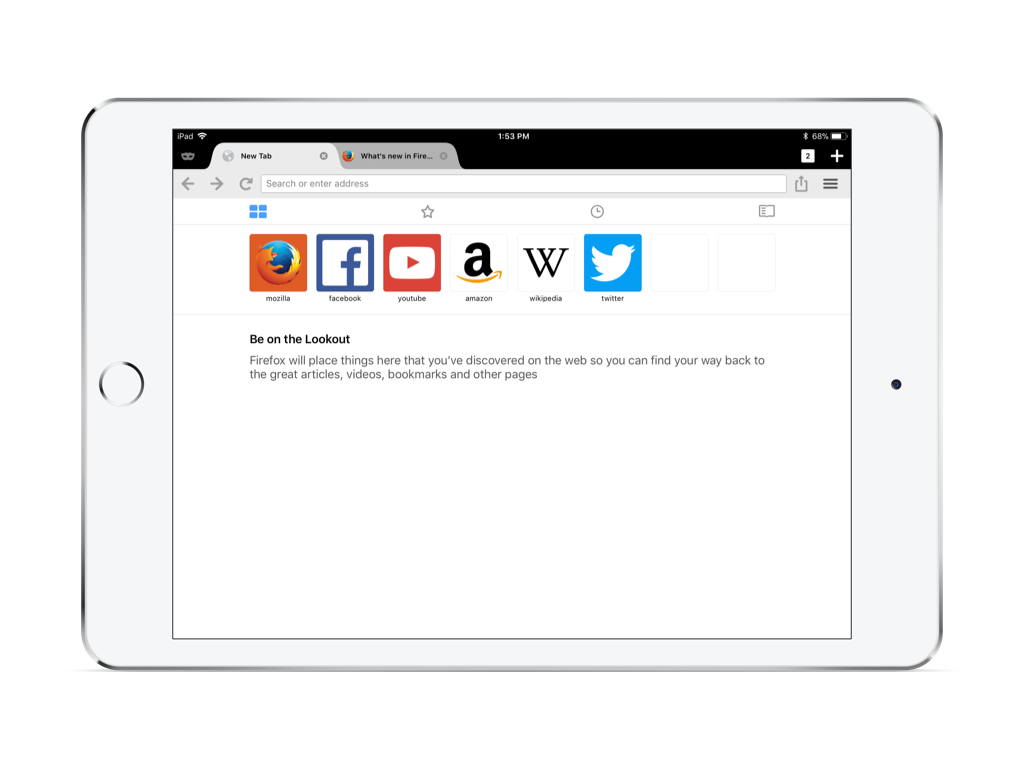

We concentrated on the most common screens that a Firefox user would (typically) interact with. This decision to scope down the initial iteration of the project really helped us get things moving.
Lucky for us, we didn’t have to do much guessing here either. With a wealth of existing user research and knowledge, we had a pretty good idea of what these key screens might be. Some examples of these common interactions and workflows were things like opening a webpage from an external app, typing a search term/URL, and opening the menu.
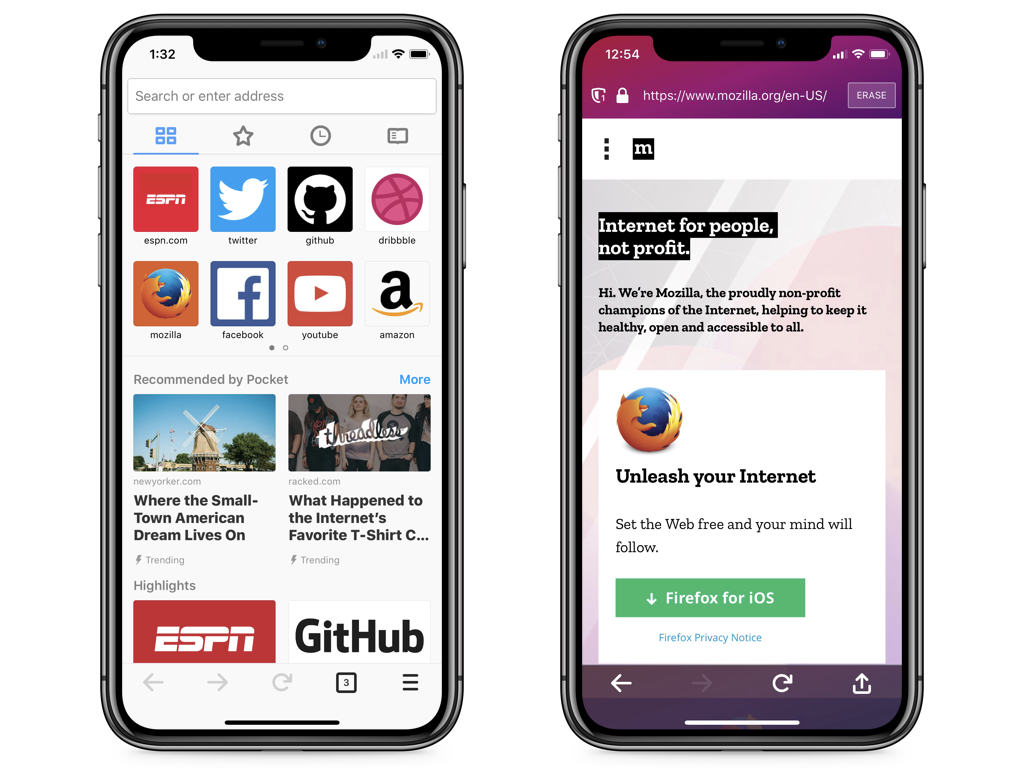
We started by aligning our iconography and introducing a new, vibrant colour palette to the UI. You can see this in multiple places of the product, such as the text highlight and the loading bar. The new gradient loading animation is one of my personal favourites because I think it’s an important part of our charm that gives us that extra bit of delight — Carol Huang, Visual Design Lead, Taipei
It’s essential that as the desktop version of Firefox evolves the mobile versions mature along with it. The Photon inspired redesign of Firefox for iOS focused on making sure the new organization of the Desktop UI translated to the iPhone, so things, like send to device, and bookmarking, worked the same way on both platforms — Bryan Bell, Staff Product Designer, California







For a while now, we’ve hung our hat on the curve as our identifying feature. When we first launched Firefox for iOS, it was there too. This signature look of ours separated us from other browsers (and even performed well in “blur-your-eyes” or “over-the-shoulder” tests). But at this point it felt dated and seemed kind of unnecessary. It also created a whole different set of UI challenges for ourselves too (think toolbar customization, PWA theming support, additional actions, etc…). It wasn’t very future proof.
As we know, these things are rarely “done”, if ever. But right now, I must say that I’m just incredibly proud of how far we’ve come and the work we’ve accomplished as a team. We had a specific vision in mind and we took big steps towards achieving that vision.
Firefox Quantum is looking great, and we’re keeping both eyes on the goals. If you have some critique or feedback you’d like to give or you just love the new Firefox, we’d definitely like to hear it. There will be lots of opportunities to iterate and improve, and we’ll continue moving forward, together.
Photon Project on Mobile was originally published in Firefox User Experience on Medium, where people are continuing the conversation by highlighting and responding to this story.
Hey there, SUMO Nation!
On the weekend of 18th & 19th of November 2017, SUMO representatives took part in a discussion and brainstorming session organized by the Open Innovation team. This post is a summary of what was discussed (including a few definitions to maintain clarity) and a call to action for all of you who express interest in participating in the next stage of community building across Mozilla.
Please read this post carefully in order to avoid confusion or surprises in the coming months. Thank you!
The introductory part allowed everyone invited (representatives from both staff and community for the Reps Council, the Indian community, Localization, and SUMO) explain their project’s goals and current community situation. There was also a presentation regarding the diversity & inclusion status at Mozilla.
Later on, we moved on to reviewing external cases and digging deeper into what was the main problem statement: the way we try to organize communities at the moment is not the most efficient and best use of everyone’s time, energy, and other resources. We want to find a better way with your help and make it work for everyone’s benefit.
Some of the big issues leading to this statement brought up during the session were: inconsistency, competition and conflict, accumulation of power, lack of equal opportunities and oversight.
Thus, our goal was to come together as a group to create and align around a set of principles for developing healthy and cohesive volunteer leadership structures for mission-driven Mozillians.
We agreed to reach this goal through alignment on challenges and opportunities facing volunteer leadership structures at Mozilla today, developing insight into a shared set of principles to guide Mozilla’s support of its community in the future, and engaging a broader audience (this means you) as the next step.
The second day was focussed on revisiting the discussion from the first day and then working together on generating a set of principles and planning the involvement of a larger audience (this includes you as well).
It is very important to note here that all of the information and planning connected with this project is meant to apply and appeal to Mozillians interested in coordinating community activities, without changing or compromising the more “technical” or “task-based” aspects of “getting stuff done” as a Mozillian.
In other words, do not expect any large changes in the way our Support Forums, Social Support or Localization work because of this project. You should expect more opportunities to engage with the wider Mozillian community in your area (of activity or geographical) – and be ready to get involved if you want to.
Non-coding volunteers & Mission-driven Mozillians
When mentioning the above, we talked about people who:
Their activities include: evangelizing, teaching, advocating, localizing, documenting, community building and doing testing.
Leadership & Community Coordination
During the meeting, for lack of a better catch-all term, we agreed to talk about “leadership” and “leaders” as our focus. We all agreed that in the future it would be much better to use a less “loaded” term. “Community coordination” and “Community Coordinators” are friendly replacement suggestions from the SUMO team. You’ve seen them here first! ;-)
We spent the whole weekend discussing the above and working on synthesizing our shared experiences, questions, and ideas.
Now it’s your time to get involved and take part in creating the future of Mozilla’s global community.
Please refer to this Mozilla Discourse thread and Question document to get started.
The deadline for this project is 11th of December.
Thank you & see you on Discourse!
Michał
Credits
Huge thanks to:
– Konstantina & Martyna for all the logistics
– Lucy, Emma, Sukhmani, Ruben & George for preparing & coordinating the talks and brainstorms
– Madalina, Paul & Simone for preparing & representing SUMO
– the Berlin MozSpace for being at its usual warm & welcoming atmosphere (despite and against the fiercely autumnal weather outside)
18 months ago we launched Zopa Plus, and since then it has been our most popular product for new investments. We’re pleased with how the loans in Plus are performing overall – the average investor has earned an annual return of 5.9% (after losses).
If you’re tracking your own investment performance in your monthly statements you may see months where losses from defaults are more than your earnings from interest. And we know that can be alarming!
However, it’s quite normal to have months like this, and we factor this into our calculations. Here’s a short video that explains when defaults occur and why:
In fact, you should expect a month where losses are more than earnings once every 4 or 5 months on average. Individual investors have had different experiences around this – some have had more, some less.
FACT: About 4 out of 5 Plus investors have had up to 3 months where their losses are more than earnings in the first 18 months of their investment. However, that doesn’t mean their investment is losing money overall. On average, these same customers have earned more than 6.4% annual return.
Because the loans default at different times, you’ll get some months with high earnings, and some months with low, or even negative earnings.
These graphs try to explain this in 5 steps.
Step 1: Your loans are paying a fixed interest rate over time…

Step 2: … but your loans default at different times.

Step 3: So your net returns in each month (your earnings minus your losses) look quite jumpy.

Step 4: But if you look at your total returns earned over time, you’ll see it trends towards the targeted return…

Step 5: …and if you’re re-lending your repayments you should expect to see your investment grow like this

So it’s important to take a longer-term view when you think about how your Plus investments are doing, as there will be months with losses and months without them.
We’re pleased that Plus is behaving how we expect it to overall. But it’s clear that we need to make it easier for you to understand your total returns, and we’d like to have a much more consistent experience between investors (so more people get the average performance).
So we’re working on better ways to show your returns to date, and where we think it will finish up given the loans you own. We hope to have something ready before March 2018.
Here’s a sneak peek at what we’ve tested so far.

In this prototype, which has proved quite popular in tests, we’re showing three things:
1. Your investment performance so far – with a graph showing the growth, and the net cash earnings (after losses)
2. What we expect your total returns to be – we show a range, that narrows as your loans come closer to maturity
3. What your target rate is given the target rates advertised when you made your investments
As always, we’d really appreciate your help in getting to the best way to do this – so we’ll be doing the usual user testing. If you’re interested in helping, email us on usertesting@zopa.com.
The post Why negative monthly returns in Plus don’t necessarily mean negative annual returns appeared first on Zopa Blog.

Photos courtesy of Fix Coffee + Bikes.
Spotted: Bike map mural at Fix Coffee + Bikes.
 Thanks Fix Coffee + Bikes for making this visual representation of our city's progress on becoming a truly bike-friendly city.

GitHub,
Nov 27, 2017

This, or something like this, defines at least in part where we're headed with digital learning resources (formerly known as learning objects). This web page provides links to several dozen 'notebooks' - these are files that can be run on an application called Jupyter Notebooks. You can also view them in your web browser. But running them in the notebook allows you to change and execute the code visible in cells throughout the page. So it's a web page you can reprogram on the fly. Jupyter Notebooks runs on Python, and is included as part of the Anaconda Python distribution, though there are other ways of getting it as well. You can also create Notebooks in other languages, including Perl and Ruby. The examples here show running code for everything from data analytics to neural networks.
[Link] [Comment]

Alexander Grech, Anthony F. Camilleri,
Joint Research Centre,
Nov 26, 2017
This is a long (136 page PDF) and detailed report on blockchains in education. The authors work slowly and deliberately in their pursuit of accuracy and clarity, which results in a presentation that will be easily understood by most readers. There is a wealth of examples in the document describing use cases, scenarious and pilot projects, and companies involved in the space. The study is a result of a literature serach, desk reserach and interviews. The recommendations display a knowledge of both education policy and blockchain technology. I have no objections to any of the conclusions and recommendations, and would indeed underline some, for example, this: "Only ‘fully-open’ blockchain implementations can reach the real goals and promise of blockchain in education. By this, we mean solutions whose fundamental components include: a) recipient ownership; b) vendor independence and c) decentralised verification." It's still early days; there's a call to bring experts in the space together to create the necessary agreements, and this should probably happen sooner rather than later. The publication is a Science for Policy report by the Joint Research Centre (JRC), the European Commission’s science and knowledge service.
[Link] [Comment]

Jim Reams,
edCircuit,
Nov 26, 2017

In the United States the chair of the Federal Communications Commission (FCC) has announced the end of 'net neutrality' policies. This will allow internet service providers to charge different rates to different content providers, to favour certain providers with faster speeds, and in a worst case scenario, could result in some content providers (eg., Netflix, Major League Baseball) to disappear entirely from certain provider networks. This article briefly describes the potential impact to education. Some more education-related coverage: Brookings ("a shameful scam that sells out consumers"), Education Dive ("larger companies will pay for faster delivery of their content"), Foundation for Economic Education (FEE) ("Internet socialism is dead; long live market forces"), Ian Bogost ("internet providers will abuse their power absent net-neutrality oversight"), TechCrunch ("no mention of the 22 million comments filed"). It's worth noting that Canada has taken a very different path and "emerged as a world leader in supporting net neutrality."
[Link] [Comment]

Mary Jo Madda,
EdSurge,
Nov 26, 2017

You have to read through to the last section to get to the "one thing computers can't do", and it's this: "“building and foster[ing] meaningful relationships with students.” Which, frankly, is silly. Not that we don 't need relationships; we do. But almost every person on earth is capable of providing them. My cats can provide them. And yes, computers will provide them. But even if they couldn't, this hardly seems to me to be the thing teachers should define as essential to the profession. It results in a picture where we're spending a lot of money to give a student a friend, money we could save by having student find their own friends.
[Link] [Comment]
With an update released today on the App Store, Ulysses – my favorite text editor on the iPhone and iPad – has received a series of notable improvements for the iPhone X.
To take advantage of the iPhone X's display, Ulysses now extends to the bottom edge of the device when you're reading a document. The iPhone's Home indicator is overlaid on top of text, and the word count – previously only available in a fixed toolbar, is now also displayed above the indicator as a tiny floating bubble. Visually speaking, it's very nice – you can even tap the word count to change the type of statistic displayed when you're editing a sheet.
In addition to refining various toolbars and title bars for the iPhone X's display, Ulysses 12.1 introduces a new look for element editors – the inline menus that used to appear when you double-tapped a link, a footnote, or an image within a sheet. Now, instead of double-tapping those elements to open an editor, you just need to tap them once, and a card will slide up on screen with contextual controls for different elements.

The new word count and element editors in Ulysses 12.1.
What I like about this design is that the card feels like a better visual fit for the iPhone X; it also does a good job at keeping the context of the underlying sheet when you're editing an individual element. When tapping a link, for instance, you can still see the text surrounding the link at the top of the card. This is a problem that standard Markdown text editors don't have as every piece of the syntax is displayed inline with plain text, but because Ulysses adopts a simplified approach to Markdown, the developers had to come up with a new behavior for editing elements. I think they succeeded with the new card-style interface.
There are some other improvements in this version – for example, Face ID is now supported for authentication and there's a new default theme that matches the iOS 11 aesthetic. I need to mention, however, that one of the best additions to Ulysses over the past year – inline image previews – still doesn't work the way I'd like it to. Ulysses 12.1 still only supports image previews within a sheet for local image attachments, which doesn't work for writers who, like me, publish their work on the web and tend to store images on servers, referencing them via URLs in a sheet. I understand that previewing external images would require adding downloading and caching logic to sheets, but this limitation has always stood out to me as an obvious omission from version 12 (which Ryan reviewed here), and I wanted to bring it up again.
I continue to be extremely happy with my decision to switch to Ulysses last year. Not only is Ulysses a text editor that combines elegance with incredibly deep automation options (which I use every week to manage Club MacStories), but the Ulysses developers are constantly innovating, rejuvenating the app, and coming up with ideas that only later show up in competing apps. The new element editors are another example of how Ulysses stays ahead of the curve and rethinks Markdown for easier editing on multitouch devices. Ulysses 12.1 is available on the App Store.
Club MacStories offers exclusive access to extra MacStories content, delivered every week; it's also a way to support us directly.
Club MacStories will help you discover the best apps for your devices and get the most out of your iPhone, iPad, and Mac. Plus, it's made in Italy.
Join NowBrian is the Support Manager at The Omni Group, and he has a bunch to say about how support — and the Support Humans — work at Omni, including how they’re involved with product decisions, and how we came to offer phone support.
DVD extras content: a video from 2006 of Brian doing the worm. Unmissable.
The Blix Komfort Prima was recently tested and reviewed by Electric Bike Action Magazine, one of the leading electric bike publications in U.S. Describing it as "cycling with simple, clean designs in nice colors, but more important, modernized with motorized assist." , the review captures the essence of this e-bike's blend of classic design with modern technology.
Insider tip: If you want to carry things with you, and think that a beautifully designed front basket with wooden bamboo plate and integrated drink holder for your afternoon coffee is something for you - make sure to add the Blix basket to your new Komfort Prima!
Insider tip #2: Make sure to take advantage of the holiday sales that gives you a whopping $300 off the regular price of Komfort Prima.
True to its name, the Komfort Prima is built for comfortable riding, making it a great choice for daily ebike commuting or weekend leisure riding:
"This is one of the most comfortable bikes we’ve ridden all year. The ride quality is very high, and there’s ample and quiet power from the Shimano motor."

"This is a comfort bike in the truest sense of the word. It’s perfect for weekend rides on country roads, jaunts through town or even as a daily commuter. It’s a versatile bike that does well carrying home loads of veggies from the farmers’ market as it is carrying books to class or going out for a leisurely ride."
Some of the highlighted features were the easy to read LED display, the high performance disc brakes and the quality motor system by Shimano, which create great value at this price point.
"the bike offers some impressive features at this price point. Not just the great motor, but things like Tektro hydraulic brakes are easy to modulate and provide ample stopping power and speed control."

The LED display was reviewed as well-contrasted and easy to use. The fact that the battery indicator shows charge percentage as apposed to a bar or graph makes it very easy to understand how much power you have left. As a matter of fact, you can actually see the exact mileage you have left depending on what power level you're using!
This article captures the overall design features of this model very well, highlighting not only the many interesting tech specs that electric bikes usually have, but also the overall comfortable and seamless riding experience that are at the core of Blix bike design.

As reported by Frances Bula in the Globe and Mail and as posted on the City of Vancouver website the City is finally developing a ten-year strategy to create thousands of new rental units in the city and to ensure these units are scaled to income with the hope of providing accommodation and lowering speculative building. You can view the report here which also includes four separate accompanying indexes. Yes we are also a year away from the next municipal election in Vancouver, one that could be challenging for the current council as housing affordability, accessibility and homelessness have increased to alarming levels.
As Ms. Bula observes “Ultimately, city planners say they want to see 72,000 new units of housing built in Vancouver in the next 10 years, but in specific categories.They have set targets of 24,000 purpose-built rentals, 12,000 social-housing or co-op units and 36,000 ownership units, which would include coach houses as well as condos. It is expected that about 12,000 of those purchased units would end up being rented out. About half the units in the plan are geared to households with less than $80,000 a year in income.”
Some of the concepts have already been debated including incentivizing development potential if 20 per cent of units in a building are accessible to citizens making low incomes. And there’s a proposal to permit homeowners in single family areas to build infill houses and add up to two units in older homes built over 75 years ago.
New ideas include constricting development speculation and demand by spelling out rental and subsidized housing requirements in areas with new neighbourhood plans. With the achievable market units already clearly outlined, developers “will be less likely to pay exorbitant amounts of money for land – something that happened in recent years along the Cambie corridor after it was rezoned for apartments to create density along the Canada Line.” Areas where this strategy will be implemented include the Broadway corridor and the three SkyTrain station precincts.
The City will change regulations to allow more than five people living in a house that are unrelated, and will create a “tenant-protection” manager at the City who will ensure that tenants are not evicted for renovations if those permits are not actually in place. This ten-year strategy is a game changer for the City of Vancouver which has been criticized for slow response on these important issues. The report is scheduled to go to Council next Tuesday the 28th of November. Staff has indicated that the actions contained in the report will be immediately acted upon if the report is approved on Tuesday.


The human behaviour is correct, even if the tech details aren’t. From 1930.

With thanks to Historical Pics.


Lovely mural that reminds me of Vancouver’s people who create digital animation, and use wirelines, polygons, shading and so on as steps in the process.


Vancouver NPA City Councilor George Affleck says he’ll neither run for Council nor seek the Mayor’s job in 2018. Thanks to CBC News.
“I wanted to let people know that after much discussion with my family, friends and others, I have made the decision not to seek the nomination of mayoral candidate for the NPA (Non-Partisan Association); nor will I be seeking a third term as a Councillor,” read Affleck’s Facebook post Wednesday morning.
As expected, Charlie Smith in the Straight has a few thoughts on Mr. Affleck’s political career.
If the NPA loses its fourth straight mayoral election in 2018, perhaps Affleck will finally get a chance to be the party’s standard-bearer in 2022.
But I’m betting that instead, he’ll run as a B.C. Liberal candidate or federal Liberal candidate before then. And given his track record, he’ll probably get elected.
In the meantime, the NPA will continue wandering in the political wilderness until it finally figures out that it’s going to have to dump that B.C. Liberal meanspiritness if it ever wants to regain control over Vancouver city council.




A new BMW concept aims to use artificial intelligence (AI) managed roads to ease traffic for e-bikes.
In a partnership with China-based Tongji University, the German automotive manufacturer has proposed ‘Vision E3 Way,’ which implements specially-designed roads for e-bikes that are assisted by AI and other technology.
“Traffic flow is permanently optimised by means of automated video surveillance systems and artificial intelligence as well as through the integration of smart city ecosystems,” writes BMW in the press release. “And the best thing is that its modular design and free scalability make the concept essentially suitable for use in any megacity.”
The hypothetical routes are intended to sit above regular roads and feature covering and a cooling system driven by purified rainwater.
The elevated roads would serve as direct links between key traffic hubs and be managed by an automatic speed limit (BMW suggests 15km) and AI-guided traffic to prevent vehicles from crashing.
Further, BMW envisions a rental system to allow for travellers to pick up bikes at various access points.
The full proposal can be viewed here.
Via: Engadget
The post BMW concept proposes AI-managed e-bike roads to reduce traffic appeared first on MobileSyrup.

As I thought about the making process behind my Raspberry Pi being installed as protector of my shed from overheating, I found myself wondering (as I do) about the principles of Makery. Here are three that came to mind in the building of this project.
If you think of others, let me know…
The post The Principles of Makery appeared first on Visual Thinkery.


