Traveling well can be one of life’s great pleasures, whether you’re alone or with friends and family. But what does it mean to travel well? Avoid hassle, pack a single bag, and bring only the necessities. “Traveling well is a fine balance between finding inspiration in the unknown while being grounded in something,” says Wirecutter founder Brian Lam. “Sometimes that is a memory of home, a family, a significant other, friends, etc. Sometimes it’s just the familiar, reliable stuff in your bag.”
Then Killian, who wears his Apple Watch to bed three to four nights a week for sleep tracking, says his Apple Watch woke him up around 1 am with an alert from a third-party app called HeartWatch saying his resting heart rate was elevated while sleeping (Apple recently introduced a built-in feature that can do this with Apple Watch Series 1 and later). Killian experienced mild indigestion which can be a sign of a heart attack, but says he generally didn’t feel sick.
His Apple Watch charted his heart rate at around 121 beats per minute in the middle of the night while data previously captured showed his average resting heart rate at around 49 beats per minute. The data also showed that this was the first time his resting heart rate had reached this level since he began wearing Apple Watch, so he decided to go to the emergency room as a precaution.
I’ve been using HeartWatch since it came out in late 2015 – if you care about heart rate stats monitored by the Apple Watch, I can’t recommend it enough.
Simply raise your eyebrows to move the emoji up, frown to move the emoji down, or make a neutral expression and the emoji stays still. Note that if you raise your eyebrows, and keep them raised, the emoji will continue to move in an upwards direction, and vice verse when maintaining a frowning expression.
While there are no levels, the game gets increasingly difficult as more obstacles appear. The goal is simply to get the highest score possible, but players can only compete against themselves right now. Gitter told us that he plans to integrate Apple's Game Center for multiplayer competition in a future update.
Here's a video of the game in action:
I played this for 20 minutes last night. It's genius. Using the TrueDepth camera on the iPhone X, Rainbrow can detect the movements of muscles around your eyes and thus ask you to raise or lower your eyebrows to move an emoji up and down to collect points. What makes this game feel like magic – as if the iPhone is reading your mind – is that there's no camera preview on screen and no buttons to press: you don't see your face in a corner; the game simply reacts to your expressions in real-time without an interface separating you from the actual gameplay. It's fun, and it's a good demonstration of the accuracy of the TrueDepth system.
I've been asking myself which parts of iOS and the iPhone experience could be influenced by attention awareness and redesigned to intelligently fit our context and needs. I don’t think this idea will be limited to Face ID, timers, and auto-lock in the future. What happens, for example, if we take attention awareness farther and imagine how an iPhone X could capture user emotions and reactions? TrueDepth could turn into an attention and context layer that might be able to suggest certain emoji if we’re smiling or shaking our heads, or perhaps automatically zoom into parts of a game if we’re squinting and getting closer to the screen. A future, more sophisticated TrueDepth camera system might even be able to guess which region of the display we’re focusing on, and display contextual controls around it. Siri might decide in a fraction of a second to talk more or less if we’re looking at the screen or not. Lyrics might automatically appear in the Music app if we keep staring at the Now Playing view while listening to a song.
It might be a silly game, but Rainbrow is the kind of different application of TrueDepth I had in mind. The same goes for Nose Zone, a game that uses ARKit's TrueDepth-based face tracking to turn your nose into a cannon to shoot squares (I'm serious). While these first TrueDepth games are fun gimmicks, I believe we're going to see invisible, persistent attention awareness and expression tracking become embedded into more types of apps over the next year.
To find the best bicycle lock, we ordered 27 of the toughest we could find and then sawed, chopped, and cut them to pieces. We learned that almost every lock can be defeated in under a minute, but the Kryptonite New-U Evolution Mini-7 offers enough of a security advantage over other locks in its price range to keep a modest commuter bike from becoming an easy target for thieves.
This is a two part article (part one, part two) describing how the 'big two' (Elsevier and Digital Science) are in a race to create "an entirely new class of products, those that support research workflow for the sciences" and how this could "marginalize other publishers large and small." The case is well made. "With the SSRN and Digital Commons preprint services that Elsevier has been purchasing, there is ample potential for connections with article submission and review." But what should the other publishgers do? Here's where the article falters. It likens the situation to the challenge faced by Google from Apple when it launched its iPhone; Google's response was to build a phone of its own and to open-source (but not really open) the Android operating system. But the response to centralization is not more centralization, it's to offer a distributed alternative, and that's what Google did, allowing multiple providers to work together to respond to Apple.
This is an op-ed from Dave McKay, president and CEO of Royal Bank of Canada. We are entering a skills revolution, he writes, but Canadian students are not being prepared for the future. We need "people who work well with technology and work well with people – that can be the Canadian difference." He touts an RBC program called Future Launch - actually started last March using a system called Talentlink. Here's the content. The program also includes "a 'no résumé required' paid internship program, with selection based on skills, not work experience" in partnership with WE Schools, a UK-US-based charity (download the WE Schools kit).
I cannot believe that in the midst of everything I’m trying to accomplish right now (namely my massive end-of-year writing project) I agreed to give a talk. But I did. And so tonight I spoke with the educators at NYCIST. They were very kind and put up with a very half-assed talk. Here’s the transcript:
I apologize in advance for what I feel is a total lack of preparation today. Typically, when I give a talk, I write out my speech in advance. A half an hour talk is about a 3000 word essay; an hour, about 5500 words – depending on how slowly I speak, how much I ad lib, if the slides all work, if there are no technical problems, and such.
I tend to write out my talks because I want to make sure I am telling a compelling story – that I have all the words in order, that I have all the details right, that there’s an arc, if you will, to the narrative. (I also write out my talk because I’m a writer, professionally, not a speaker. I’m good at writing – or I like to think. Speaking off the cuff, less so. And I like to have a record – a written record – so that other people can see what I said… or read.)
I know it’s trend to criticize keynotes and lectures and claim that they’re terrible ways to learn. People like to cite research that claims the human attention span is only 8 to 10 minutes. It’s cool to sneer at someone who stands in front of a room and explains things. Now, there isn’t a ton of evidence that that is actually true – that we can only pay attention for about the length of a YouTube video. But it’s a convenient figure for the tech industry to invoke, don’t you think. It’s a great story, particularly if you want to wield that factoid along with a product pitch for more “active learning” – like clicking on things.
We’re told an awful lot of stories about what “good teaching” looks like and what “bad teaching” looks like and how technology will purportedly enhance the former and replace the latter. Same goes for “good learning” and “bad learning,” somehow. Me, I am really much less interested in evaluating the various claims regarding “evidence-based teaching” – like, is the research any good, what does “the science” really tell us – than I am listening for these stories, looking at who’s telling them, looking at how they’re wielded politically, looking at how they’re backed financially, and asking why is this the story. Why, for example, would Microsoft famously put out a study in 2015 saying that humans’ attention spans are shorter than goldfish’s? (And why on earth would we believe that?!)
Now, I am not sure I really have “a talk” to give you today. Not sure I can pull together 3000 or so words of prepared remarks. And that’s mostly because, if you’re familiar with my work at all, you know that I’m in the middle of a project I undertake each December where I chronicle “the top ed-tech trends” of the past twelve months. It’s not really a look at “trends,” per se. And this year I’m trying to move away from that language. I’m not interested in identifying “trends” because I am not interested in pushing schools to buy certain products. My job isn’t in marketing. I don’t do “market research.” Rather, I want to look at the stories that are being told about education and technology. What are the stories that have been repeated again and again over the course of the year? What are the stories and why are they being told?
I have published 8 of these end-of-year articles. They’re about 6000 words apiece. I have two more still to write, including one that I’ve scheduled to post to my site on Wednesday that I’ve only written about 1500 words of. So I was feeling a bit stingy about the words I typed in preparation for this afternoon. I’m feeling sorta out of words and thoughts.
That’s a long-winded apology, in advance, that I don’t really have something splendid to read for you today.
What I want to do instead is to show you a photo. Talk about the photo. Talk a bit about the project – a separate project, one that I’m also still in the middle of – that I am currently working on as part of my Spencer Education Journalism Fellowship at Columbia this year. And then I’m happy to answer any questions you might have about the current state of ed-tech – products or propaganda.
This is the “PayPal Mafia.” The photo was taken as part of a 2007 profile in Fortune magazine. The phrase “PayPal Mafia” is used to describe the group of PayPal founders and employees who’ve gone on to become some of the most powerful players in Silicon Valley, forming additional technology companies and investment firms and becoming millionaires (and in a couple of cases, billionaires) in the process. Some of these men – and do note, they are all men – have become household names. Most of their products certainly have.
Back row from the left: Jawed Karim, the co-founder of YouTube; Jeremy Stoppelman, the CEO of Yelp; Andrew McCormack, co-founder of the venture capital firm Valar Ventures; Premal Shah, President of Kiva, the microfinancing company. Second row from the left: Luke Nosek, managing partner at the venture capital firm The Founders Fund; Kenny Howery, managing partner at the venture capital firm The Founders Fund; David Sacks, the CEO of Geni and Room 9 Entertainment; Peter Thiel, the CEO of the venture capital firm Clarium Capital and Founders Fund, the co-founder of Palantir Technologies, and the co-founder of Valar Ventures; Keith Rabois, the VP of business development at Slide (at the time of this photo), an executive at LinkedIn, an executive at Square, a venture capitalist at Khosla Ventures, and an original Youtube Investor; Reid Hoffman, the founder of Linkedin and a partner at the venture capital firm Greylock Partners; Max Levchin, the CEO of Slide at the time of this photo and now the CEO of the loan company Affirm; Roelof Botha, a partner at the venture capital firm Sequoia Capital; and Russel Simmons, the CTO and co-founder of Yelp.
Not pictured: Chad Hurley, the co-founder of YouTube. Steve Chen, another co-founder of YouTube. Dave McClure, the founder of the venture capital firm 500 Startups. And of course, Elon Musk, the founder of Tesla and SpaceX.
The PayPal Mafia has been credited by technology journalist Sarah Lacey and others with helping to build and fund the wave of consumer-focused Internet startups that emerged in the mid 2000s following the dot-com bubble burst. (PayPal itself was acquired by eBay in 2002. One might also include Pierre Omidyar in the PayPal Mafia, I suppose. Omidyar was the founder of eBay.)
According to Silicon Valley mythology at least, the Mafia have been successful because of the skills and confidence and camaraderie developed at PayPal. As the article in Fortune described them: “highly intelligent workaholics who were good at math. No frat boys, MBAs, or, God forbid, jocks.” The shared corporate culture at PayPal was coupled with a shared ideology among many Mafia members about the role of finance, technology, and private and public institutions – including most famously in the case of libertarian Peter Thiel, the role of governments and schools.
What interests me – and this is the focus of my Spencer Fellowship: Is there an equivalent to the PayPal Mafia in education technology? That is, is there a company or organization that has launched the careers of lots of education entrepreneurs and investors, that has become a powerful political, financial, and social network for education technology people and products? A company that really drives the ideology that underpins how we talk about the future of school and tech. Kaplan? The Princeton Review? The Gates Foundation? Pearson?
Of course, it’s important too for us to recognize how much influence the technology sector – I use “Silicon Valley” as a shorthand for that – has over education. Over the products that get built. Over the companies that get funded. Over the policies that get developed, and the laws that get passed. Over the ideas that get talked about. Over our imagination. The “PayPal Mafia” alone is a pretty good example of this.
Peter Thiel – where to start. He was Facebook’s first big investor. He’s probably tech’s most famous libertarian, and he believes that monopolies, not competition, are the natural and desirable order of things. He’s questioned the value of the 19th Amendment. Thiel bankrolled the lawsuit that put the publication Gawker out of business. He’s been a vocal Trump supporter – speaking at the Republican National Convention last summer. And he has plenty to say – and plenty of money to spend – on his beliefs about education. He wrote, along with fellow PayPal Mafia member David Sacks, a book called The Diversity Myth that criticizes “political correctness” on college campuses like Stanford and that claimed, among other things, that date rape is actually “seductions that are later regretted.” Thiel has entertained the idea there may be a biological connection between race and IQ. He was one of the first and one of the loudest to push the narrative that there’s a “college bubble” – that higher education is no longer worth it. He famously funded the Thiel Fellowship, giving a handful of young people under the age of 20 $100,000 to drop out of college. He’s also an investor in the private school AltSchool, the education data company Clever, the adaptive textbook company Knewton, the coding bootcamp Thinkful, the student loan company SoFi, and many others.
Max Levchin’s company Affirm is also in the student loan business.
Reid Hoffman was one of the first investors in Edmodo. He’s an investor in the learn-to-code company Treehouse and an investor in Knewton.
Dave McClure’s venture capital firm 500 Startups has been one of the most prolific investors in education technology companies in recent years. McClure is also just one of the investors who has stepped down from his position in 2017 due to allegations of sexual harassment.
Pierre Omidyar now runs the Omidyar Network. Its education investments include AltSchool, the African coding bootcamp Andela, the African private school chain Bridge International Academies, a startup that describes itself as an alternative to college called MissionU, and the publication Edsurge.
Elon Musk has founded a private school called Ad Astra for his own children and some of the children of SpaceX employees. There is almost nothing known publicly about this school. No website. No phone number. There are rumors that kids have to take an IQ test to get in. (I wonder if Musk has talked to his old PayPal pal Peter Thiel about IQ.)
Musk is fascinating and horrifying to me. He doesn’t have the best track record when it comes to business success, and yet he always seems to fail upward and his promises are always taken seriously. He repeatedly makes these claims about what his companies will do – he promised 20,000 Tesla 3s would ship by the end of this year. So far, his factories have produced just 260. He’s predicted SpaceX will have humans on Mars in seven years time. He says he’s going to build an underground tunnel that will get you from New York to DC in 29 minutes.
At first glance, it might not seem like Musk’s projects are all that relevant to education investing or education narratives. But what Musk says and what Musk does is still worth our paying attention to, I’d argue, because of how his work (and storytelling) in transportation and space exploration subverts or shifts our expectations for public investment and public responsibility. Stories about and stories by Elon Musk are very much stories about the future of public space, public science, public knowledge, and as such, public education.
Where do these stories about the future come from? Like, how do we know about “what’s happening” and “what’s trending” in education? Who are the people who are telling us what the future of education or technology or education technology is supposed to like? Who tells these stories? Who benefits from these stories? Who funds these stories? Why do we find these stories compelling?
The goal of my Spencer research – broadly speaking – is to identify and trace how certain stories get popularized, how they become embedded in education technology products, policies, and practices.
One example of this is the push for “everyone to learn to code.” Where did this story come from? Who tells it? Why do we believe it?
According to the Bureau of Labor Statistics, for example, the occupations that will add the most new jobs in the next decade are personal care aides (754,000 new jobs), food service workers (580,000 new jobs), registered nurses (437,000 new jobs), home health aides (426,000 new jobs), software developers (253,000 new jobs), and janitors and cleaners (233,000). The fastest growing occupations are solar photovoltaic installers (growing by 105%), wind turbine service technicians (growing by 96%), home health aides (growing by 47%), personal care aides (growing by 37%), and physicians assistants (growing by 37%). But just one of those occupations seems to dominate the storyline of how schools should prepare students for the “jobs of the future.” And it sure isn’t “everyone should learn nursing.”
Another storyline I am paying attention to – we should all pay attention too – involves “personalization,” a concept shared by tech and ed-tech alike. Your Facebook news feed is “personalized”; the list of movies Netflix recommends to you is “personalized”; suggestions for other products you might purchase on Amazon are “personalized.” And so too are the recommendation engines that ed-tech companies like Knewton or AltSchool say will help students navigate curriculum more efficiently. They even use same terminology, drawn from other digital content providers – “playlists.” Facebook’s CEO believes in personalized learning. Netflix’s CEO believes in personalized learning. What’s going on with that story?
Knewton founder Jose Ferreira formerly worked at Kaplan. AltSchool founder Max Ventilla was a Google exec. Peter Thiel is an investor in both of these companies. Is there an “ed-tech mafia”? And what do they want? What do they believe?
“Follow the money” is, perhaps, cliché. But as billions of dollars of venture capital flow into ed-tech every year, it’s essential nonetheless. Yet it’s complicated by the paucity of independent reporting on education technology – that is, from sites not partially or wholly funded by tech investors or tech philanthropists.
The education technology company Edsurge, for example, positions itself as a news organization while also promoting conferences and services selling ed-tech services to schools. It has raised almost $6 million in venture capital and at least as much in grant money – $5.22 million from the Gates Foundation alone. Edsurge’s investors include the very same investors in many of the products it covers. Edsurge’s investors are people who are very committed – politically, financially – to telling certain kinds of stories about the future. The Chan Zuckerberg Initiative – the venture philanthropy firm founded by Facebook’s Mark Zuckerberg – has funded Edsurge to write about “personalized learning,” for example.
My concerns, I suppose, are similar to my concerns about Elon Musk – we are talking about billionaires who have influence in reshaping public space and public infrastructure in ways that are profoundly anti-democratic. If nothing else, there’s not really research that supports their beliefs or their technologies. Can Musk get to Mars? Lots of scientists are pretty skeptical of his plan. Can the Zuckerberg-funded Summit Public Schools learning management system scale and provide a Facebook-like vision of “personalized learning” and content delivery to every school in the country? Is that the future we want?
One of Edsurge’s other investors, the Emerson Collective – the venture philanthropy firm founded by Laurene Powell Jobs (Steve Jobs’ widow) – is interested in stories about “rethinking school.” She paid for a glitzy television show on all four big networks to push that message: schools haven’t changed in hundreds of years. “Rethink school.” That’s what Secretary of Education Betsy DeVos says she’s interested in too.
Now, you can either imagine one of those scenes from a film where I’m connecting ed-tech brands to photos of venture capitalists with yarn. Who went to MIT. Who worked at Google. Or you can picture what statistics folks call “social network analysis” where I give you a nice visualization that will help us see these relationships – see them so we can talk about them. Because there are relationships and networks, “ed-tech mafia” or not.
There are really powerful forces – powerful stories and powerful storytellers – at play here. I would say that for far too long now, many people who work in education technology have seen themselves as underdogs in some sort of digital versus analog battle for the future of education. But that’s not really an accurate way to describe the setting for this particular story any longer, indeed if it ever was.
(This is the part where I gave up typing… So I’ll just add here, in lieu of a “happy ending” that I am really interested in helping educators understand the powerful networks that operate in education and education technology. Because we must think more critically about the vision and the model and the story of the future that we’re being sold.)
This is part two in a new series about the importance of setting appropriate key performance indicators (KPIs) for digital programs and the APIs that underpin them. In the first installment, we defined digital KPIs and discussed why they matter. Here, we’ll look at antipatterns in setting KPIs for API programs.
In isolation, API-centric KPIs can be misleading, and the wrong metrics can lead an enterprise astray. If they are not combined with business-level KPIs, simple IT-level metrics—such as the number of APIs produced, the number of developers using APIs, or the number of apps using APIs—can lead a team to emphasize the wrong incentives. Worse, even when teams achieve these targets, they may still come under-fire for “not providing business value.”
Anticipate broad transformation
Take the case of one major enterprise I worked with. The leadership had set hard and easily observed targets to create as many APIs as possible, across all platforms. At first glance, this appeared to cause the desired API building spree—so how did it lead to enormous waste and throw-away work?
It turned out that to deliver these targets cheaply and quickly, the enterprise’s legacy integration teams simply passed existing web services through the API platform layer, without simplifying or optimizing them for consumption or even consolidating security mechanisms on the platform. As a result, the application developers using these APIs had to continue building expensive and brittle business layers in their applications simply to wrangle the small set of relevant data elements from the large payloads.
The huge payloads bogged down communication channels and the processing burned battery life on mobile devices, degrading the customer experience. In the end, the APIs were used only by internal application developers under a mandate; distribution channels found the APIs too difficult to use.
One lesson from this example: while enterprises should revisit their highest level goals and adapt KPIs to be more compatible with digital opportunities, the stronger programs will often proactively shape their own targets to anticipate broader transformation, following some important guidelines:
Focus on driving growth, breadth, and speed of API adoption by the application programs that depend on them.
Accelerate the velocity of iterations in not only API and app development, but also the creation of user-facing digital experiences.
Align the metrics of the API program with the metrics of developers downstream in the digital value chain, such as channel partners using the APIs.
The program should NOT be a stand-alone P/L function. Otherwise, APIs may be perceived as exotic and apart from the core value creation activities of the organization, which prevents the APIs from creating value for the business.
Generally, avoid using “number of APIs” produced as a top-line target. Otherwise this is likely to lead to APIs of low value, low quality, and low adoption.
The program should NOT be governed in scope-budget-schedule terms. This mindset is largely incompatible with creating value in the fast-moving, agile digital economy.
KPIs in the digital value chain
Just like in other business areas, smartly designed KPIs can enable the API program to define its direction, to regularly assess the alignment of its work, and to constantly work toward intended outcomes. But to optimize API program success, the enterprise should also align the rest of the digital value chain around the API program with well-correlated incentives.
The front-end application software calls APIs from within its code in order to invoke services elsewhere in a network, all to return data or perform some processing. These apps are mobile apps, websites, a partner’s servers, etc., and are the products that actually create value among traditional customers.
The APIs that receive these calls have to have certain properties in order to be valuable to the apps: good design, good security, real business value, good performance, and good access to back-ends that do the heavy lifting. Because they function as products for developers, particularly valuable APIs can even be monetized for external audiences, becoming direct revenue streams in their own right.
Finally, the back-ends that do much of the enterprise’s core work should be well connected to the APIs, meaning they trust the APIs for access control, traffic management, security, proper identity of the user, coordination, lightweight orchestration of multiple back-ends, and more.
In order to be effective, an API program’s goals should be aligned with the goals across this value chain. For example, the application teams needs to have the incentives to launch valuable applications rapidly and transparently to avoid building brand new back-ends. Similarly, the back-end teams need to have the incentive to get the services of their systems into the hands of customers, not simply to other back-end servers.
Coming up next, we’ll discuss specific digital KPIs in API programs, and the benefits and pitfalls of each.
Michael Leppitsch works on transformation strategies for global enterprises at Google Cloud.
When Dr. Perry Kendall, the Chief Medical Health Officer of British Columbia wrote
“Where the Rubber Hits the Road” he aimed to highlight the high amount of deaths and disability caused in British Columbia due to crashes, on average about 280 deaths and 79,000 injuries. Price Tags Vancouver has previously written about these concerns, and the shocking fact that in 2011, 45.7 per cent of all injuries occurred to vulnerable road users, those using the street without a protective steel shell. Indeed the deaths of vulnerable road users has increased in British Columbia, from 31.7 per cent of all road deaths in 2009 to 34.9 per cent of all road deaths in 2011.
Dr. Kendall and international experts identify three main reasons for road crashes and deaths~road design, driver behaviour, and speed. It is well-known that reducing vehicle speed saves lives, as has been proven in Great Britain where municipalities are adopting the policy that “20 is plenty” and lowering road speeds to 20 miles per hour or 32 kilometers per hour. Now a study from the National Transportation Safety Board as reported in governing.com says that “Researchers have actually underestimated how often speed is a factor in fatal crashes, according to a summary of the report, which will be released in full in coming weeks.That’s significant, considering that speed is already one of the most widely reported causes of deadly crashes. In 2015, for example, it was identified as a factor in roughly as many traffic deaths (9,557) as alcohol (9,306) or people not wearing seat belts (9,874).”
In its news release, the National Transportation Safety Board linked speeding to 112,580 highway crash fatalities in the United States between 2005-2014. This number is close to the number of people who died in alcohol-related crashes in the same time period. That number was 112,948. Noting that speeding has few “negative social consequences” compared to driving under the influence of alcohol or drugs, the study acknowledges that speeding is “common driving behaviour“.
“You can’t tackle our rising epidemic of roadway deaths without tackling speeding,” said NTSB Acting Chairman Robert L. Sumwalt, “and you can’t tackle speeding without the most current research. Speed kills. This study examines how it kills and what actions can be taken to save lives and prevent speeding-related crashes.”
While issuing recommendations to various governmental bodies, the National Transportation Safety Board also recommended that automated speed enforcement be universally adopted in all states and actively used as a counter measure. There is also an opportunity for Complete Streets and Vision Zero advocates to insist on better road design so that vehicles cannot go faster than the posted speed, and a rethink of the current speeds within municipalities, as the posted speeds often encourage drivers to go faster through residential streets. Are these really supposed to be driven at 50 kilometers an hour? As Russ Martin of the Governors Highway Safety Association observed speed is “a traffic safety problem on par with drunk driving, and we hope that can dedicate resources to preventing speeding the same way we do that for drunk driving.”
The National Association of City Transportation Officials have released a companion guide to their Urban Bikeway Guide. This manual contains state of the art practices for designing and developing bikeways for people of all ages and abilities.
Companion Guidance to NACTO’s Groundbreaking Urban Bikeway Design Guide Elevates State-of-the-Practice Facilities for People of All Ages and Abilities
The National Association of City Transportation Officials (NACTO), an organization that represents 58 major cities in North America, today released guidance to help cities decide what types of bike infrastructure will best achieve their goals to build bike networks that are safe and comfortable for riders of all ages and abilities. The new guidance, Designing for All Ages and Abilities, builds upon the organization’s groundbreaking Urban Bikeway Design Guide, an internationally renowned technical guide that has helped cities to dramatically increase the number and quality of urban bike facilities in the United States and Canada over the past decade.
By focusing on two key safety factors—vehicle speeds and traffic volume—in addition to design factors like street width, Designing for All Ages and Abilities gives cities the tools they need to assess any street and decide which treatments will improve safety and support increases in bicycling. The guidance illustrates how on higher-volume streets with vehicle speeds above 20 mph, conventional infrastructure, such as painted lanes, can be insufficient, while on lower-speed streets where other traffic calming measures have been introduced, such treatments may be an adequate solution.
“Since the NACTO Urban Bikeway Design Guide launched in 2011, cities have built 307 miles of protected bike lanes—a dramatic 400% increase in safe and comfortable biking facilities that has been more than matched by pent-up demand for bicycling across the country,” said Linda Bailey, NACTO Executive Director. “Designing for All Ages and Abilities gives cities a powerful tool to evaluate their streets and make clear choices about what they can do to build safe, sustainable bike networks that attract riders of all ages and abilities.”
Thunderbird is going strong at version 52 (ESR) and 57, 58 beta
In April 2017 Thunderbird released its successful Extended Service Release (ESR) version 52. This release has just seen it’s fifth “dot update” 52.5.0, where fixes, stability and minor functionality improvements were shipped.
Thunder 57 “Photon” Visual Refresh
Thunderbird 57 beta was also very successful. While Thunderbird 58 is equally stable and offers further cutting-edge improvements to Thunderbird users, the user community is starting to feel the impact of Mozilla platform changes which are phasing out so-called legacy add-ons. The Thunderbird technical leadership is working closely with add-on authors who face the challenge of updating their add-ons to work with the Mozilla interface changes. With a few usually simple changes most add-ons can be made to work in Thunderbird 58 beta. https://wiki.mozilla.org/Thunderbird/Add-ons_Guide_57 explains what needs to be done, and Thunderbird developers are happy to lend a hand to add-on authors.
There has been some discussion about the modernisation of Thunderbird’s user interface. Thunderbird 57 is now following Mozilla’s Photon design, and there is also a new theme available based on the design by the Monterail team.
Since November 2016 the Thunderbird project has contracted the services of long-time Thunderbird volunteer contributor Jörg Knobloch. Since Jörg moved from being a volunteer to being a contractor, his focus has changed from chasing his favourite pet-hate bugs to taking on responsibility for the product. As the continuous integration engineer, he guarantees that Thunderbird Daily is always in sync with Mozilla core changes to keep Daily in a working order. Jörg manages all code for releases (beta and ESR) and monitors regressions as reported at BMO. As a Thunderbird and Mailnews peer he reviews the work of others and is part of the Engineering Steering Committee which is in charge of the code base.
In March 2017 Andrei Hajdukewycz joined the project. Andrei is the project’s infrastructure engineer. He’s been working on transitioning the project from using Mozilla infrastructure to procuring its own. He administers all the websites used by the project. There are many: Thunderbird.net*), the ISPDB, websites for telemetry, updates and release notes. And last not least: Add-ons. Soon Thunderbird add-ons will transition to Thunderbird’s own add-ons site. Watch this space!
In June 2017 Tom Prince joined the project as a build and release engineer. He makes sure that we can always build Daily, beta and ESR in en-US English and all localisations. He also helps out when diagnosing test and other miscellaneous failures. Most recently Tom has been migrating the Thunderbird build system from Buildbot to TaskCluster to future-proof this aspect of the project.
The project’s last hire in December 2017 has been Ryan Sipes (the guy posting this) as Community Manager. His task is to organise the community of voluntary contributors including add-on authors, spread the good news about Thunderbird, engage with donors to guarantee a solid income stream and be in touch with Thunderbird users.
These four staff members are just the beginning. The project is currently in the process of hiring developers to address some technical debt, fix some sore points in the software and transition the codebase from a mix of C++, JavaScript, XUL and XPCOM to be increasingly based on web technologies.
The Thunderbird project has taken control of the Thunderbird.net domain, of which the project will make increasing use. The www.thunderbird.net domain is being updated to be more helpful to users and eventually become Thunderbird’s home on the web. The in-product Thunderbird start page has already been served via this domain for several months. And, the members of the Thunderbird Council have received email accounts @ thunderbird.net, powered by FastMail, a gift that we are very grateful for.
Mr. West, a fierce critic of President Obama from the left, called Mr. Coates “the neoliberal face of the black freedom struggle.” Twitter wasn’t happy.
Elon Musk, the CEO of Tesla, has a utopian vision for transportation: that we all will drive automated electric Teslas through massive underground tunnels (with no traffic, of course). However, for anyone who loves communities designed for walkability - cities like New York, Paris, Vienna and Vancouver - his vision is a dystopian nightmare. If you enjoy bloated suburbs, then Elon’s vision is for you.
He even went so far as to attack public transit, saying at an artificial intelligence conference earlier this month that “public transport is painful. It sucks. Why do you want
to get on something with a lot of other people, that doesn’t leave where
you want it to leave, doesn’t start where you want it to start, doesn’t
end where you want it to end?”
He also said that you might end up next to a “serial killer” on public transit and that this is why people want individualized transport, that “goes where you want, when you want.”
Urbanists around the world united against Musk yesterday on Twitter with the hashtag #greatthingsthathappenedontransit and the responses are touching, funny, and true. From meeting the love of your life, to taking your baby home from the hospital, to losing 50 pounds, taking public transportation involves a sense of humanity not found when you drive around in your own metal box.
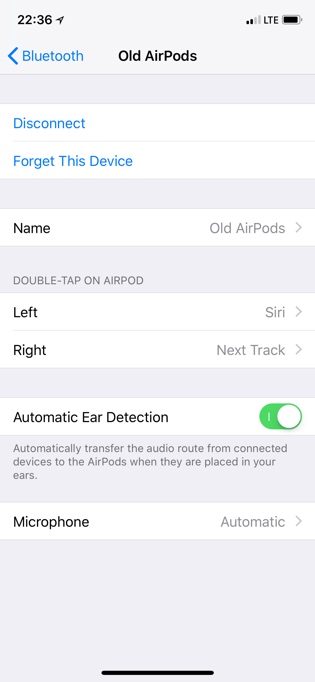
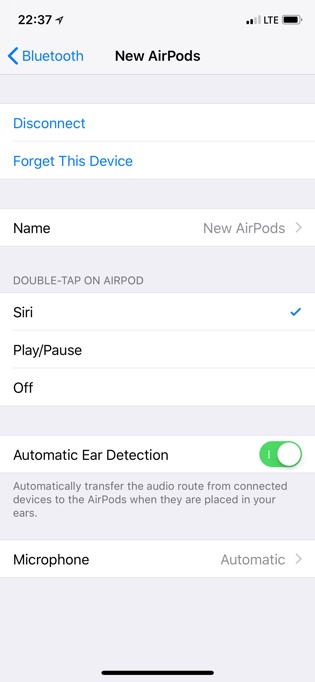
I replaced my AirPods and something disappeared. I want it back.
With iOS 11, Apple introduced a new feature for AirPods. You can set what the double-tap does individually for the left and the right AirPod. On the old AirPods I set the left one to call Siri and the right one to skip a track. I just found out this option is gone on the new ones. I have the old setup which is also missing the NextTrack option. Things I have tried to get this feature back:
Reboot phone.
Check firmware (3.7.2), hardware (1.0) for AirPods and iOS 11.2.1 for iPhone X and iPad Pro.
Unpair AirPods and re-pair them.
Unpair AirPods, reset AirPods to factory, re-pair them.
Log out from iCloud and re-login.
Update: Resolved. I removed the new AirPods from any Bluetooth device that had seen them before. Connected the case to power. Reset by holding the case button until the amber light flashed three times. Then I re-paired with iPhone and the option is back. I don't really know why, but I am happy to have it back.
For those non-German natives. We have a saying: "Der Teufel ist ein Eichhörnchen", literal translation "the devil is a squirrel". I have looked him straight in the eyes.
Sometimes, when you’re recording a podcast, it’s actually difficult to listen. That’s because while you’re recording you’re monitoring the network lag, the sound levels, the show notes, and the outline. On some episodes I’m just barely hanging on by a thread.
While Hilary Parker and I were recording Episode 50 of Not So Standard Deviations we had a discussion about her experience doing A/B testing at Etsy and how one experiment, which involved showing customers their passwords as they typed them, resulted in an increase in the number of failed login attempts, which was not what they were expecting. In the episode, we discuss how the problem was discovered and resolved and concluded that part of solving the problem involved a familiarity with how web forms can work.
Roger: It feels like your intuition and experience using the web, and apps, and—it’s all coming together, right?
Hilary: Exactly…which is part of why…it’s so important for data scientists to have genuine interest in the products they’re working on.
The idea here is that in this particular problem, an analyst’s experience with web forms played a significant role in interpreting and analyzing the data from the A/B test. They were then able to make modifications to the test and run it again. One thing that is interesting about this story is that understanding how web forms work has nothing to do with the data. It’s what you might think of as “prior knowledge”. In an alternative universe, one could imagine looking at the data, seeing that login failures were increasing, and then just nixing the feature, concluding that the “data had spoken”.
Hilary’s comment passed me by at the time, but now that I’ve had some time to consider it, I think if it’s true, it has profound implications for the field of data science. Perhaps another way to frame it is to ask the question: Does the quality of your data analysis depend on how much you care about the problem? It’s maybe not the best question because I think the answer can be both yes and no, depending on the problem.
However, I think there are multi-billion dollar unicorn startups whose future depends critically on the answer being “No”. I wrote a little about this in regards to Palantir. At the time, I wrote that Palantir was bouncing along a spectrum with boring old consulting company on one end and cool highly scalable software company on the other end. In particular, it appeared that their expertise in some areas wasn’t translating well to other areas:
it’s clear that Coke didn’t feel comfortable collaborating with Palantir’s personnel. Like any data science collaboration, it’s key that the data scientist have some familiarity with the domain. In many cases, having “deep expertise” in an area can give a collaborator confidence that you will focus on the things that matter to them. But developing that expertise costs money and time and it may prevent you from working with other types of clients where you will necessarily have less expertise. For example, Palantir’s long experience working with the US military and intelligence agencies gave them deep expertise in those areas, but how does that help them with a consumer products company?
If Palantir couldn’t translate their success into multiple areas, how could it justify it’s multi-billion dollar valuation?
Not having to care about the ins and outs of a given area of data analysis means that there are dramatically fewer costs involved with getting into the area. We don’t need to invest time understanding whatever products may be involved and understanding why other people like them and how other poeple use them. Ultimately, I think the need to care about an area or product when doing data analysis negatively affects the profit potential of that area.
Whether caring matters for data analysis also has implications for how to build a data analytic team. If you need your data analyst to be 100% committed to a product and to be fully invested, it’s difficult to achieve that with contractors or consultants, who are typically working on multiple projects with multiple companies. Some data analysis work is arguable generic, and thus can be done without emotional investment. But separating out the parts that “require caring” and those that don’t is arguably an important part of a data science manager’s job.
Puerto Rican Governor Ricardo Rosselló ordered a recount Monday of every death on the island since Hurricane Maria made landfall on September 20, as evidence continues to show that the official death toll grossly undercuts the true number, reports the New York Times.
There are at least two ways to do this. One way is inferential in nature, taking a look at what we might expect the mortality to be and looking at what was observed. This is tricky due to a variety of potential confounding factors and also comes with it statistical uncertainty. It seems the Governer is going to take a more “census-like” approach:
The recount will require interviewing doctors and family members of the dead to learn whether their cause of death could have been linked to the fallout from the storm. For example, a heart attack may have been brought on by the stress of the hurricane, or roads leading to the hospital may have been blocked by debris.
This approach does not have statistical uncertainty but has uncertainty of a different kind—separating proximate cause of death from ultimate cause of death. It’s going to be difficult either way.
Ridesharing services like Uber and Lyft might be contributing to a decline in public transit riders.
In its Ridership Growth Strategy (RGS) 2018-2022 Preliminary Report — published on December 11th, 2017 — the Toronto Transit Commission (TTC) cited a UC Davis study suggesting that fewer people were using public transit as a result of ridesharing services.
According to the TTC report, “46 to 61 percent of ride-hailing trips are net new or replacing transit, walking or cycling.”
The report also went on to cite Uber data suggesting that there are two million Uber trips in the Greater Toronto Area (GTA) per month, with an average wait time fewer than five minutes.
Additionally, there are approximately 40,000 Uber trips to and from a TTC terminal every month.
Overall, the TTC reported that its adult ridership has descreased the most, with 25 million fewer adults riders between 2014 and 2017.
Additionally, adult Metropass sales are down 15 percent.
Interestingly enough, however, the TTC’s ridership growth between 2015 and 2017 has actually increased by 0.2 percent, in comparison to other cities across Canada and the U.S.
With the introduction of newer ridesharing platforms like InstaRyde and Lyft, the TTC plans on recalibrating its service offerings to provide better services to a changing market.
I’ve been expecting a developer to do something interesting with Apple’s Kinect-like iPhone X TrueDepth camera module for months now, but I didn’t think one of the first apps to utilize the tech would be a game that involves controlling an emoji with your eyebrows.
The game, dubbedRainbrow, has players raising and lowering their eyebrows in order to move a smiling emoji face up and down the display, in order to collect stars worth one point each. Players need to make sure their emoji avoids obstacles like basketballs and ducks.
As you may have guessed, making a neutral expression results in the emoji staying still. The game doesn’t feature levels and instead gets continuously more difficult the longer you’re able to keep your emoji alive, with the only goal being getting the highest score possible.
Rainbrow‘s controls are surprisingly responsive — and exhausting if you’re me — and subtle changes in brow movement really does change the direction of the emoji almost instantly. I didn’t expect the game’s unique controls to work at all, but they really do.
Rainbrow was also developed using Apple’s ARKit mobile augmented reality development platform, along with iOS 11’s framework to detect the position, topology and expression of the user’s face, and of course, the iPhone X’s TrueDepth camera system.
While a silly example of what the tech powering Apple’s TrueDepth sensor can be used for, it’s interesting to see a developer other than Apple finally taking advantage of it.
The game comes from Washington University Computer Science graduate Nathan Gitter, according to Macrumours.
Huawei is set to unveil its next flagship smartphone, the Huawei P11, at this years Mobile World Congress (MWC), according to leaker Roland Quandt.
This device will feature Huawei’s Kirin 970 chipset and, just like the P10, will be available in Canada. The rumour mill also speaks to the phone having an Apple iPhone X-styled notch and technology that rival’s Apple’s Face ID.
According to a writer from NotebookItalia, who reached out to XDA Developers, the Huawei P11 will feature Huawei’s “Point Cloud Depth Camera” — the company’s 3D camera technology.
The Point Cloud Depth Camera, unveiled at the Honor 7X and Honor View 10 global launch event, utilizes multiple sensors, including: a structured light near-infrared projector, an IR camera and an RGB camera and a near-infrared illuminator. Currently this camera connects to a Huawei smartphone via USB C, however, it’s expected that the P11 will feature this technology integrated directly into the device.
Huawei claims its facial recognition technology is more accurate and secure than Apple’s, that its suitable for payment authentication, unlocks the device within 400ms and its facial reconstruction works with less than one millimetre of accuracy.
AirPods may look weird to some, but they’re some of the best wireless earbuds out there (I’d also argue that all wireless earbuds are rather strange looking).
According to Ming-Chi Kuo of KGI Securities, an Apple analyst often cited when it comes to rumours and reports, Apple will reportedly offer a new version of AirPods in the second half of 2018. The news, originally spotted by Apple Insider, reports that Kuo expects the earbuds to feature smaller components and a higher price tag.
In Canada, Apple’s AirPods, which are reportedly difficult to find this holiday season, sell for $219 CAD. Kuo also expects AirPod shipments in 2018 to double to 28 million units now that Apple has solved production issue related to the wireless earbuds.
It’s unclear exactly what other features will be added to the new version of Apple’s AirPods. It’s possible that Apple could shorten the stem that encloses wireless headphone’s microphone. The AirPods case will also likely be compatible with wireless charging. It’s possible Apple could offer the headphones in new colours as well.
Amazon Prime now has the most first-week downloaded of any Apple TV app, according to a report stemming from BestAppleTV.com and later confirmed by TechCrunch. The app was first released in the Canada, the U.S., Great Britain, France and Germany on December 6th, six months after the app was announced Apple’s WWDC back in June.
Prime Video’s popularity was also likely helped by the fact that the second season of The Grand Tour recently hit the platform. While I’ve been watching Amazon Prime Video via my 4th Gen Apple TV for a number of months now with AirPlay, having a dedicated app on the set-top box is significantly more convenient than casting content from an iPhone.
Apple and Amazon have been fierce rivals for years, with Amazon refusing to sell the Cupertino-based tech giant’s Apple TV devices in its online store, and Amazon not bringing its Prime Video platform to the set-top box. It seems the cold war between the two companies has thawed though.
Amazon Prime Video launched in Canada last December for $79 CAD per year, giving users access to free same-day shipping in Toronto and Vancouver, as well as Prime exclusive items.
Amazon offers a 30-day trial. In Quebec, however, the online retail giant offers a 13-month membership for $79, instead of a free trial. Content is only available in English, though Amazon says that French subtitles are available for much of the platform’s content.
Hockey Night in Canada will continue to have a home at the CBC — at least for the next seven years.
When CBC lost its national NHL broadcast rights to Rogers in 2013, Canada’s largest telecom decided to maintain the tradition of airing Hockey Night in Canada on the Mother Corp’s network every Saturday through a four-year sub-licensing agreement.
After adding on a one-year extension, Rogers and CBC have now signed a new seven-year sub-licensing agreement that includes the rights to broadcast Hockey Night in Canada on Saturday, as well as all four rounds of the Stanley Cup Playoffs, on TV and digitally through the CBC Sports and CBC TV apps.
The seven-year agreement begins in 2019 and will continue until Rogers’ 12-year broadcast rights deal expires following the 2025-26 season.
Hockey Night in Canada also broadcasts via Sportsnet and CityTV, and streams through Rogers NHL Live and Sportsnet NOW.
“CBC has been an excellent partner over the years and we are excited to extend our relationship,” said Rick Brace, President, Rogers Media. “Hockey Night in Canada is the most celebrated hockey brand in the country and is steeped in tradition. We are committed to working together to ensure it reaches the widest possible audience.”
Rogers says Sportsnet will continue to produce the games, retain all editorial control, and manage the advertising.
Rogers’s 12-year, $5.2 billion deal for the national broadcast and multimedia agreement with the NHL began with the 2014-15 season and is the largest media rights deal in the NHL’s history.
For more information on how to watch NHL games in Canada, check out our guide here.
It looks like Microsoft wasn’t impressed with Google’s move to sneakily add Chrome to the Windows Store.
Google recently published a Chrome app in the Windows Store that directed users to a download link that installed the app via a browser.
In response, Microsoft has released the following statement to The Verge.
“We have removed the Google Chrome Installer App from Microsoft Store, as it violates our Microsoft Store policies.”
Officially, Microsoft says that it allows any apps that “provide unique” and “distinct value” in the Windows App Store, continuing by stating, “we welcome Google to build a Microsoft Store browser app compliant with our Microsoft Store policies.”
The issue is it’s unlikelyGoogle will ever make Chrome compliant with Microsoft’s policies, in part because of the company’s recently instated Windows 10 S restrictions. Since Chrome utilizes HTML and Javascript, as well as Google’s own proprietary Blink rendering engine, the tech giant would need to create a specific app designed to adhere to Microsoft’s stringent store policies.
Given that Windows 10 S still isn’t very popular and only runs on a few devices, it doesn’t make sense for Google to put the effort into creating a specific app for the platform. Now that the app has been removed from the Windows App Store, users will once again need to navigate to Chrome’s download site via Microsoft’s Edge browser.
Windows 10 S is essentially Microsoft’s answer to Google’s Chrome OS, simplifying Windows for low-end devices with a renewed emphasis on the education market.
Global TV has announced that Global Go, the television station’s on-demand and live-streaming app, is now available for the fourth-gen Apple TV and the Apple TV 4K.
The app allows users to livestream the network’s content, including full-length television episodes and various clips, directly on their Apple TV. While Global Go was previously available on iOS and Android devices, this is the first time the streaming service has made its way to Apple’s set-top box.
“We know fans are watching Global’s content in more ways than one, and we’re committed to delivering a seamless and exciting viewing experience on any platform,” said Maria Hale, senior vice president, global entertainment & content acquisition at Corus Entertainment, in a statement sent to MobileSyrup.
The app also allows users to watch a show partway and then continue watching later from the same spot via a different device, as long as the content is being viewed on-demand. Along with Apple TV support, this update also adds support for the iPhone X’s edge-to-edge display and notch.
Telcos want to be platform players at varying points in their network architecture and service offerings.
But successful platforms generally need "anchor tenants" to gain scale.
The problem comes when anchor-tenants are themselves other 3rd-party platforms.
There is a risk of platforms-on-platforms acting as "cuckoos", pushing the native owner's eggs out of the nest.
Telcos face a risk from major cloud platforms overwhelming their MEC edge-compute platforms.
... and a risk from major AI-based commerce platforms overwhelming their messaging, voice and IoT platforms.
Other future platforms also face similar challenges.
To succeed as platform providers, telecom operators need to have their own anchor-type services, and to have a well-designed approach to combating the risk of parasitic cuckoo platforms.
Background: the Internet overcame its broadband host
The cuckoo bird is infamous for laying its eggs in other birds' nests. The young cuckoos grow much faster than the rightful occupants, forcing the other chicks out - if they haven't already physically knocked the other eggs overboard. (See "brood parasitism", here).
Analogies exist quite widely in technology - a faster-growing "tenant" sometimes pushes out the offspring of the host. Arguably Microsoft's original Windows OS was an early "cuckoo platform" on top of IBM's PC, removing much of IBM's opportunity for selling additional software.
In many ways, Internet access itself has outgrown its own host: telco-provided connectivity. Originally, fixed broadband (and the first iterations of 3G mobile broadband) were supposed to support a wide variety of telco-supplied services. Various "service delivery platforms" were conceived, including IMS, yet apart from ordinary operator telephony/VoIP and some IPTV, very little emerged as saleable services.
Instead, Internet access - which started using dial-up modems and normal phone lines before ADSL and cable and 3G/4G were deployed - has been the interloping bird which has thrived in the broadband nest instead of telcos' own services. It's interesting to go back and look at the 2000-era projections for walled-garden, non-Internet services.
The need for an anchor tenant
The problem is that everyone wants to be a platform player. And when you're building and scaling a new potential platform, it's really hard to turn down a large and influential "anchor tenant", even if you worry it might ultimately turn out to be a Trojan Horse (apologies for the mixed metaphor). You need the scale, the validation, and the draw for other developers and partners.
This is why the most successful platforms are always the one which have one of their own products as the key user. It reduces the cannibalisation risk. Office is the anchor tenant on Windows. iTunes, iMessage and the camera app are anchors on iOS. Amazon.com is the anchor tenant for AWS.
Unfortunately, the telecoms industry looks like it will have to learn a(nother) tough lesson or two about "cuckoo platforms".
MEC is a tempting nest
The more I look at Multi-Access Edge Computing (MEC), the more I see the risks of a questionable platform strategy. Some people I met at the Small Cells event, in the US a couple of weeks ago, genuinely believe it can allow telcos to become some sort of distributed competitor to Amazon AWS. They see MEC as a general-purpose edge cloud for mainstream app and IoT developers, especially those needing low-latency applications.
I think this is delusional - firstly because no developer will want to deal with 800 worldwide operators with individual edge-cloud services and pricing, secondly because this issue of latency is overstated & oversimplified (see my recent post, link), and thirdly because a lot of edge-computing tasks will actually be designed to reduce the use of the network and reliance/spend on network operators.
But also, this "MEC as quasi-Amazon" strategy will fail mostly because the edge/distributed version Amazon will be Amazon. The recent announcement by Nokia that it will be implementing AWS Greengrass in its MEC servers is a perfect example (link). I suspect that other MEC operators and vendors will end up acting as "nests" for Azure, IBM Bluemix and various other public cloud providers.
Apologies for the awful pun, but these "cloud-cuckoos" will use the ready-made servers at the telco edge to house their young distributed-computing services, especially for IoT - if the wholesale price is right. They will also build their own sites in other "deeper" network locations (link).
In other words, telcos' MEC deployments are going to help the cloud providers become even larger. They may get a certain revenue stream from their tenancy, but this will likely be at the cost of further entrenching the major players overall. The prices paid by an Amazon-scale provider for MEC hosting are likely to be far lower than the prices that individual "retail" developers might pay.
(The real opportunity for MEC, in my view, lies in hosting the internal network-centric applications of the operators themselves, probably linked to NFV. Think distributed EPCs, security gateways, CDN nodes and so on. Basically, stuff that lives in the network already, but is more flexible/responsive if located at the edge rather than a big data centre).
End-running Messaging-as-a-Platform (MaaP)
Another example of platform-on-platform cannibalisation is around the concept of "messaging as a platform", MaaP. Notwithstanding WeChat's amazing success in China, my sense is that it's being vastly over-hyped as a potential channel for marketing and customer interaction.
I just don't see the majority of people in other markets forgoing the web or optimised native apps, and using WhatsApp or iMessage or SnapChat or SMS as the centrepiece of their future purchases or "engagement" (ugh) with companies and A2P functions. But where they do decide to use messaging apps for B2C reasons, the chatbots they interact with will not be MaaP-dedicated or MaaP-exclusive.
These chatbots will themselves be general "conversational platforms" that work across multiple channels, not just messaging, with voice as well as text, and with a huge AI-based back-end infrastructure and ongoing research/deployment effort. They'll work in messaging apps, browsers, smart speakers, wearables, car and general APIs for embedding in apps and all sorts of other contexts.
Top of the list of conversational platforms are likely to be Google Assistant, Amazon Alexa, Apple Siri, Microsoft Cortana and Facebook M, plus probably other emergent ones from the Internet realm.
MaaP is "just another channel" for broad conversational/commerce platforms
In other words, some messaging apps might theoretically become "platforms", but the anchor tenants will be "wholesale" conversational platforms, not individual brands or developers. In some cases they will again be in-house assistants (iMessage + Siri, or Google Allo + Assistant for instance). In other cases, they may be 3rd-party bot ecosystems - we already see Amazon Alexa integrated into numerous other devices.
Now consider what telcos are doing around MaaP. As well as extending their existing SMS business towards A2P (application-to-person), they have also allowed third-parties like Twilio to absorb much of the added value as cPaaS providers. And when it comes to RCS* which has an explicit MaaP strategy, they have welcomed Google as a key enabler on Android, despite its obvious desire to use it mainly as a free iMessage rival. (*obviously, I'm not a believer in RCS succeeding for many other reasons as well, but let's leave that for this argument).
What the GSMA seems to have also missed is that Google isn't really interested in RCS MaaP per-se - it simply wants as many channels as possible for its Assistant, and its DialogFlow developer toolkit. To be fair, Google announced Assistant, and acquired API.AI (DialogFlow's original source) after it acquired Jibe. It's moved from mobile-first, to AI-first, since September 2015.
The Google conversational interface is not going to be exclusive to RCS, or especially optimised for it. (I asked the DialogFlow keynote speaker about this at last week's AI World conference in Boston, and it was pretty clear that it wasn't exactly top-of-mind. Or even bottom-of-mind). Google's conversational platform will be native in Android, in other messaging apps like Allo, Chrome, Google Home and presumably 1000 other outlets.
From an RCS MaaP perspective, it's a huge cuckoo that will be more important than the Jibe platform. There is no telco "anchor tenant" for RCS-MaaP as far as I can tell - I haven't even seen large deployment of MNOs' own customer-care apps using it. If I was an airline's or a retailer's customer experience manager, and I was looking beyond my own Android & iOS apps for message-based interactions, I wouldn't be looking at creating an RCS chatbot. I'd be creating an Assistant chatbot, plus one for Alexa and maybe Siri.
Can you cuckoo-proof a platform?
Apple, incidentally, has a different strategy. It tends to view its own services as integrated parts of a holistic experience. It tries to make its various platforms cuckoo-proof, especially where it doesn't have an anchor tenant app. This is a major reason for the AppStore policies being so restrictive - it doesn't want apps to be mini-platforms in their own right, especially around transactions. Currently, Google and Amazon are fighting their own mutual anti-cuckoo war over YouTube on Fire TV, and sales of Google Home on Amazon.com (link). Amazon and Apple are also mutually wary.
It's worth noting that telcos are sometimes pretty good at cuckoo-deterrence too. In theory, wholesale mobile networks could have a been a platform for all manner of disruptive interlopers, but in reality, MVNO deals have been carefully chosen to avoid commoditisation. A similar reticence exists around eSIM and remote SIM provisioning - probably wisely, given the various platform-on-platform concepts for network arbitrage that have been suggested.
Conclusions
In my view, both MEC and (irrespective of its many other failings) RCS are susceptible to cuckoo platforms. I also wonder if various telco-run IoT initiatives, and potentially network-slicing will become a platform for other platforms in future too.
One of the key factors here is a "the rush to platformisation". Platforms only succeed when they evolve out of already-successful products, which can become inhouse anchor tenants. Amazon's marketplace platform grew on the back of its own book and other retail sales. AWS success grew on the back of Amazon using its own APIs and cloud-computing.
MEC needs to succeed on the basis of telcos' own use of their edge-computing resources - which don't currently exist in a meaningful way, partly because NFV has been slower than expected. MaaP needs telcos' own messaging services and use-cases to be successful before it should look at external developers. With RCS, that's not going to happen.
Network-slicing needs to have telcos' own slices in place, before pitching to car manufacturers (or Internet players, again). IoT is the same too. Otherwise, expect even more telco eggs to be pushed out of the nest, as they help to foster other birds' offspring.


 Joseph Planta @Planta