I was interviewed recently by Lauren Simonetti of CreativesMX.
Check it out.
By Hannah Cassius, John Thai and Ben Solwitz
One of our co-workers sent us an email asking if we wanted to be a part of “The Matter Bootcamp.” She described it as a design thinking workshop, meant to support both entrepreneurs in the media space and larger media companies (like The New York Times) in developing ideas to build a more informed, empathetic and inclusive society.
We took the workshop along with a few other Times employees and admired the focus on the user-centered, prototype-driven product design process. At the end of the four days, we all had created product prototypes ranging from silent disco meditations to a dog-petting program. These ideas were more extreme than what we would actually create, but they got us outside of our comfort zone.
The four-day workshop is the kickoff for the extended 20-week program we participated in. The Times is one of Matter’s media partners, which lets a number of Times employees participate in their bootcamp. We learned valuable design and entrepreneurial skills that help us do our jobs better.
For a publication that is nearly two centuries old, we have to embrace continuous digital change to move forward. We have internal innovation challenges, like Maker Week, a week-long, cross-functional event where folks from Design, Product, Project, Marketing and Technology come together to work on envisioning, designing and developing cool new projects. The idea behind Maker Week is to allow people real freedom to work together with people they don’t usually interact with, to think about new problems, get creative, and explore wild ideas.
We used Maker Week as a way to get feedback on our idea. We took paper prototypes of our idea down to the food court under Rockefeller Center. We asked for people’s feedback and then incorporated it back into what we were building. Because of this process, we were better able to articulate what people wanted. We heard consistently that people felt like they were trapped in a news bubble, and that they often ended up going to the same sections or types of articles because it was what was algorithmically suggested to them. We came up with a prototype for diversifying a reader’s news diet.
We spoke to Corey Ford, Matter’s co-founder, about how internal innovative thinking programs like Maker Week differs from a program like Matter. “Many of our partners are doing great work with ‘inside out’ innovation with programs like Maker Week at The Times,” he said. “But we think it’s important to reinforce those efforts with an ‘outside-in’ approach like the Matter Partner Program. Since Matter is a neutral, independent place that serves both early stage media entrepreneurs and mission-aligned media partners we are able to create an immersive experience that challenges internal cultures and process and inspires them to take more risks, be more-human centered, be more iterative, and to think about their projects more like a multidisciplinary venture.”
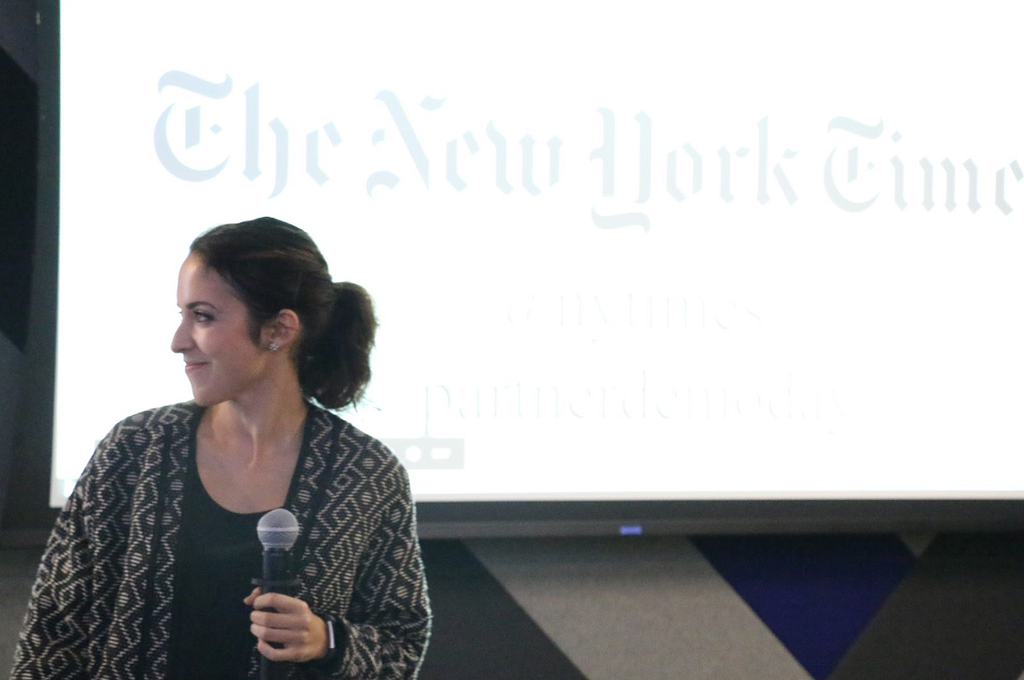
Hannah Cassius: As a product manager, I like to spend time upfront before any project to ensure that we are capturing a market need and achieving product-market fit. The challenge in a large company like the Times is that we have a lot of projects and limited time. Being able to focus most of our efforts on defining the problem, refining our solution based off of continuous feedback, and doing all of this work before committing to build anything differs from how projects are traditionally done.
One of the more interesting parts of being in the Matter program for me is that we were working alongside entrepreneurs. They encouraged us to be bolder and take risks, since that’s what they do on a daily basis. By taking a human-centered, prototype-driven approach the entrepreneurs in the Matter program are looking at media in a unique light. For example, one of the companies, Purple, created an SMS platform that connects users and journalists in a two-way messaging-based conversation. Another company, Gretta, is working to open up podcasts to search engines for greater discovery in audio storytelling. It was fascinating being able to work alongside them because they were always thinking outside the box of how to improve the media landscape.
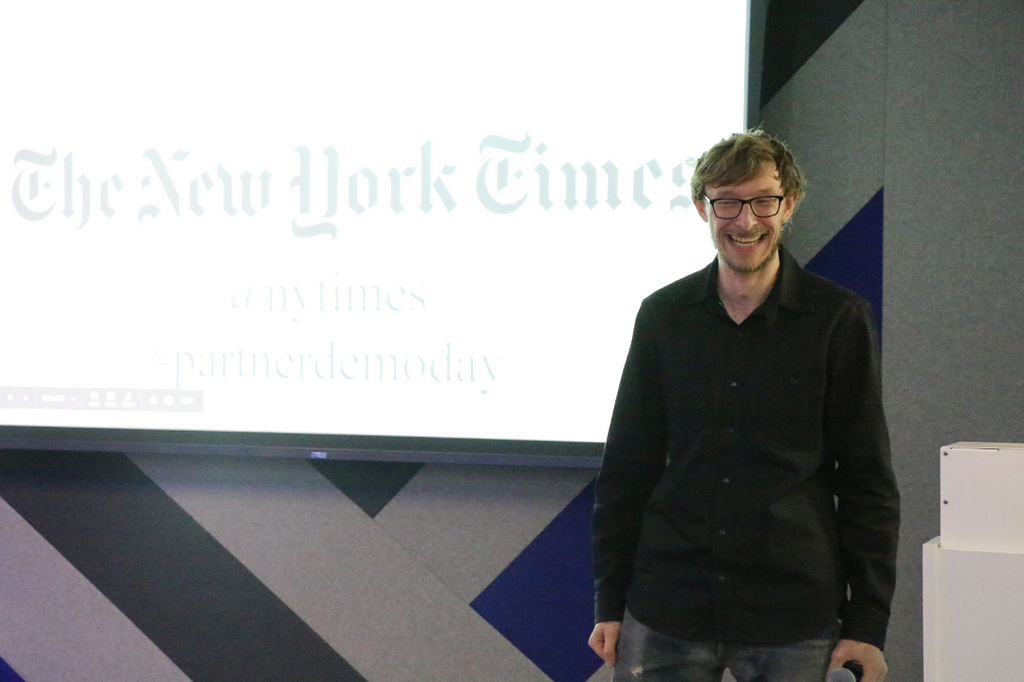
Ben Solwitz: I have been a developer for about ten years and had very little experience with product design prior to the Matter program. Usually the requirements for projects that I work on are relatively static, and determined before they get to me. The idea of exploring an open-ended problem with many possible solutions was intimidating at first because I didn’t know where to start. The user-centered, prototype-driven approach we learned gave me the tools to generate lots of ideas while remaining focused on specific needs of real users.
I learned a lot about how to quickly iterate and generate prototypes based on user feedback. Many of the developers on my team asked me if we had built any of the prototypes that we showed them, to which I replied that I wasn’t sure if we had come up with anything that anyone would really want yet. I realized how much more efficient it was to get feedback on a Sketch or Invision prototype than a fully-functional app. Interviewing users with our prototypes helped keep us focused on solving the needs of real users, and not focusing on only what we personally would find useful.
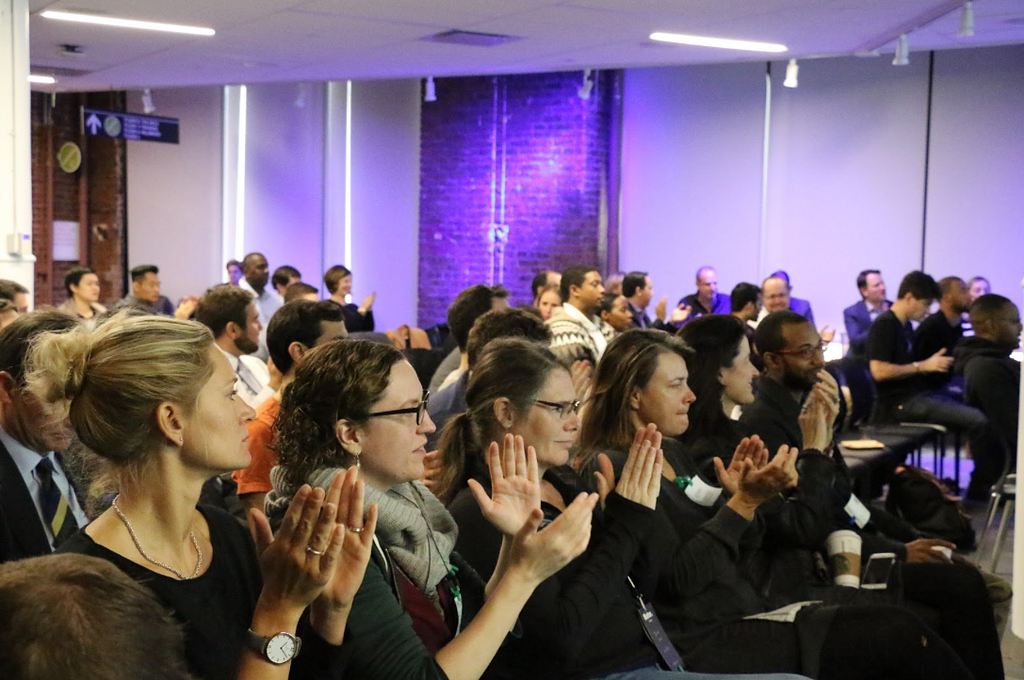
John Thai: Having the opportunity to participate in the early stages of a new idea is sometimes hard to come by depending on what stage your product is at.
For me, having worked with legacy systems and somewhat mature products, I’ve mainly focused on feature optimizations where the need came from already known problems and the solutions were fairly scoped and constrained.
The Matter program allowed me to start from scratch where the immediate focus was the end user and the solution was validated by the end user. During ideation where you’re not concerned with constraints nor scope, our team was able to let our minds flare, thinking freely and radically. We then trimmed down to focus on an idea that would be desirable, feasible, and solve a real user need.
By iterating on a high fidelity prototype and tweaking things based on user feedback, we had something we were able to move forward with and build incrementally. After participating in this program, I have tried to always start with the end user wherever possible and to keep them engaged throughout the process whether it be a new idea or optimizing an existing feature. I really enjoyed the program!
One of the challenges we face today is figuring out how best to implement the solutions we came up with during The Matter program. It’s great to understand user needs and develop innovative ideas, but we also have to work through getting buy-in and stakeholder agreement internally to build any product that requires significant staffing. If we could do the program all over again, it would be great to have parallel goals internally around buy-in and metrics, in addition to the design reviews with Matter. For example, this could mean including stakeholders from different teams, such as finance, marketing and analytics, in the process as opposed to focusing on just our idea and using design-thinking to refine it. Having them actively involved, and helping to measure the success of our prototype, throughout the process is something that would have been helpful at getting more buy-in.
Overall though, using this type of design-thinking methodology, not just within the design organization, but across a team of people who may not regularly be exposed to it, was vital to crafting new innovative ideas. This type of program from Matter, and the thinking it promotes, makes us all better at our day-to-day jobs and being open to the fact that ideas can come from anywhere. We are grateful to have had the chance to develop new ideas that work towards building a more informed, connected, and empowered society.
Thinking Like Entrepreneurs: Our Experience with Matter, a Design-Thinking VC Program was originally published in Times Open on Medium, where people are continuing the conversation by highlighting and responding to this story.
But now, that’s so passe. This time, it’s a hydrogen fuel cell. With thanks to Reuters.
French startup launches hydrogen-powered bicycle.

[Ed: note the small box-like object near the bike’s front wheel. It’s the fuel cell.]
Pragma Industries, which is based in Biarritz, France and makes fuel cells for military use, has sold some 60 hydrogen-powered bikes to French municipalities including Saint Lo, Cherbourg, Chambery and Bayonne.
. . . “Many others have made hydrogen bike prototypes, but we are the first to move to series production,” said founder and chief executive Pierre Forte.
The firm’s Alpha bike runs for about 100 km (62 miles) on a two-litre tank of hydrogen, a range similar to an electric bike, but a refill takes only minutes while e-bikes take hours to charge. One kilo of hydrogen holds about 600 times more energy than a one-kilo lithium battery.
. . . With bike’s range limited by the size of the hydrogen tank, Pragma is also working on a bike that will convert plain water into hydrogen aboard the bike, using a chemical reaction between water and aluminum or magnesium powder to produce hydrogen gas.
“In the next two-three years we want to enter the consumer market and massively increase the scale of our operations,” said Forte.


ddrucker has posted a comment:
Roland Tanglao Me too. There was more of a sense of community with a place to gather on evenings and weekends.

Recents hacks are about finding holes in the deep physics of computing.
Here's a technical explanation of Spectre and Meltdown, the two recent big ones. The words alone are beautiful: Spectre can be thought of as a (previously unknown) fundamental risk of speculative execution, one that can now be weaponized.
Here's a metaphor explaining both exploits, to do with librarians. In short, they involve measuring how long it takes for the computer to look up hidden data. Even if the data is eventually not shared, the computer has a terrible poker face.
I see this as a kind of information asymmetry. Computer chip architecture is about the regulated control of information. The design never anticipated that unregulated information - time - would be brought in from the outside.
See also: Rowhammer, which is an exploit of how memory chips work where the wild information, intruding from the outer reality, is electromagnetism and geography.
As DRAM manufacturing scales down chip features to smaller physical dimensions, to fit more memory capacity onto a chip, it has become harder to prevent DRAM cells from interacting electrically with each other. As a result, accessing one location in memory can disturb neighbouring locations, causing charge to leak into or out of neighbouring cells. With enough accesses, this can change a cell’s value from 1 to 0 or vice versa.
That is, the fact that two memory address happen to be physically close to one another is completely outside the computer's knowledge of itself. Geography and electromagnetism have no presence in the computer's inner reality. But bring that knowledge in from the outer reality...
Rowhammer was able to use this to induce bit flips ... and hence gain read-write access to all of physical memory.
Long profile in the New Yorker of Sam Altman, the head of Y Combinator (the incubator behind startups such as Airbnb, Dropbox, Stripe, and reddit).
This line:
Many people in Silicon Valley have become obsessed with the simulation hypothesis, the argument that what we experience as reality is in fact fabricated in a computer; two tech billionaires have gone so far as to secretly engage scientists to work on breaking us out of the simulation.
Emphasis mine.
Here's an interesting exploit that I feel should be better known: System Bus Radio.
Some computers are intentionally disconnected from the rest of the world. This includes having their internet, wireless, bluetooth, USB, external file storage and audio capabilities removed. This is called "air gapping". [However] Even in such a situation, this program can transmit radio.
Computers can now write to memory with a high enough frequency that it's in the radio spectrum. Now you're hitting the RAM fast enough, you can play it like a xylophone and carve radio waves into the air.
There is demo code provided. And:
Run this using a 2015 model MacBook Air. Then use a Sony STR-K670P radio receiver with the included antenna and tune it to 1580 kHz on AM.
You should hear the "Mary Had a Little Lamb" tune playing repeatedly.
So what happens when my mobile web browser loads an ad that loads some Javascript that reads my bitcoin exchange password and then runs tight array loops that hammer out arpeggios on memory, broadcasting access to all my worldly possessions to anyone standing nearby with a old-fashioned AM radio tuned into 1580 kHz?
Breaking out of the simulation.
By volume, the Sun produces about the same amount of heat as a reptile.
Also the average density of the Sun is 1,410 kg per cubic meter: 1.4x that of water. Or to put it another way, the same as honey.
So yeah. The Sun. A million times bigger than the Earth. As hot as a reptile. As thick as honey.
As much as I enjoyed Maps-Fulla-Icons-Style Open World when BioWare did it for Dragon Age: Inquisition… I might be done with it. Either that or Mass Effect: Andromeda wasn’t the best venue for it, because at the end of the game I’m left feeling a sense of relief.
There was so much game in that game. So many NPCs with so many quests, so many numbers to watch increment and decrement. So many collectibles and beautiful vistas.
Too much.
You land on a planet and the map’s already full of icons. Tasks you haven’t even been told about light up as little white hexagons with inconveniently-small text with poor readability (or I’m old). No signs of where habitation is, or structures, or points of interest, or regional names. Just icons, as far as the eyes can see. I’m happy to have a direction to stretch in to find what I’m after. But giving me all of the quest locations before I get to them… I’m thinking that was a patch job on a design fault where people couldn’t find content unless there was a marker on it.
Even though there’s too much of everything, there’s too little care spent on entire swathes. For instance, if you feel you have to tell players how to skip planet-to-planet animations, maybe that’s a sign of a problem you shouldn’t have shipped?
I didn’t purchase the game until after the 1.10 update hit, which means I was able to skip the worst of the bugs, but my companions would still clip through terrain (intentionally at gravity wells, unintentionally on planet surfaces) and I still haven’t received my trophy for 100% viability on all known worlds (possibly because I hit that milestone before the final fight). And emotions on faces just… aren’t there, most of the time?
A lot of this screams “new engine disease” to me. This was BioWare’s first tangle with Frostbite 3. When you build everything from scratch, you miss the bugs you’d fixed (with hackity hacks and inelegant architectural bypasses, true) years ago. So there are bugs. Audio that doesn’t fire, or pauses for several seconds before firing. Location-based triggers that yell over a character conversation that was honestly more interesting than “We’ve arrived at that place you know we’ve arrived at because we put a notification in the top-right that says you advanced your quest by one quest unit.”
Not all of it is bugs, though. This was an evolution of the Mass Effect design, not a revolution. Open World-ing it… well, that takes care of where to stage the battles and exploration. And the battles and exploration mechanics were fun. I liked the jump-jets, the way enemies kept me on my toes, and even the car (especially on the asteroid. Whee!).
But they haven’t accounted for what to do when your conversation wheel’s empty. And it’s still a conversation wheel. And the “Chose amongst these two imperfect choices” events are still present, mostly unimproved by the “You have three seconds to chose by hitting R2 or not” quick-time-event mechanic.
On the plus side, it was gorgeous. Every direction I looked was another screenshot. The combat was solid (when enemies didn’t become trapped in the scenery). Anything that was big felt absolutely massive. You drive towards this ship in the desert and keep driving… and driving… how big the planet feels. And when find yourselves up against an Architect and ohgod-ohgod-ohgod-… until you realize it’s just a repetitive bullet sponge.
*sigh* what I wouldn’t give for “difficult” to stop meaning “has an order of magnitude more HP”.
All in all, if what you’re after in a game is more Mass Effect, this will scratch that itch satisfactorily. The set-pieces were well-crafted, the worldbuilding quite alright. I’d be happy to see more done in this world.
But maybe something smaller? Give me the trials and tribulations of a young family just out of cryo trying to make it work. Skip a generation and show me what happens with the new crop of core species having grown up knowing only Andromeda and being quite done with caring about what happened in the Milky Way. You can really lean on how Salarians have so many fewer years than even humans.
There are stories to be told here, and games to play. Tell a different one this time, maybe?
Today is a very special day for us at Flickr as it marks the 10th anniversary of the Flickr Commons, one of the world’s most extensive archives of public images. Ten years ago today, the Library of Congress joined the Flickr Commons with the aim of ensuring better access to their historical photo collections. They wanted to expand their reach to more people throughout the world.
The idea of a mutually beneficial relationship between web users and cultural heritage institutions seemed ambitious but started modestly. Our pilot project began in 2008 with only one partner – the Library of Congress, which quickly became one of the largest and most active Commons accounts.
Increased access to photography archives deserves to be as publicly represented as possible. What better place to get historically relevant photographs seen than a photography platform with millions of people looking at images every day? Viewers have the opportunity to help enrich these collections by adding tags, comments, and making notes on the photos to enhance findability and contribute information that can potentially improve the quality of the archives.
Thanks to Flickr’s user-generated content, the Library of Congress have deciphered the story behind dozens of “mystery photos” like the one below, and folded almost 9,000 updated photo captions back into their own online catalog. Just as the Library, most other participating institutions have reported seeing very large increases in page views and engagement with their digital collections.
There are now over 110 participating institutions in the Flickr Commons. Some of the more popular ones are The Smithsonian, The British Library, The National Library of Medicine, the NASA, or the National Libraries of Scotland, Australia, Ireland, Sweden or Norway. Unsurprisingly, museums and local university archives are also famous among the Commons! In honor of the tremendous growth of this 10-year-old project, we’ve put together a gallery of the most popular photos from all of the Commons photographs. Check it out!
If you’re interested in seeing some of the most popular images from the Library of Congress’ Flickr account, which houses over 30 thousand photographs, be sure to check out their Top Favorites album on Flickr! And to get a better idea of how they are celebrating the Flickr Commons anniversary, visit their 10th Anniversary album. They’ve done a 10-day pictorial countdown!
If you are an administrator at a GLAM and you’re interested in joining the Flickr Commons, you can register and find more information at our Commons page.
CNBC reported that, according to Saxo Bank analyst Kay Van-Peterson, the price of bitcoin “could hit $100,000” in 2018. This is a good time to as, “Where do numbers like this come from?” Broadly speaking, analysts use detailed analysis and models to identify what is happening and predict what will happen. But what is the … Continued
The post Bitcoin at $100,000? For any prediction, ask “what’s your methodology?” appeared first on without bullshit.
On Monday January 22, Mozilla is bringing together a panel of the top VR industry insiders in the world to the Sundance Film Festival in Park City, Utah, to explain how VR storytelling is revolutionizing the film and entertainment industry.
“We want the storyteller’s vision to exceed the capacity of existing technology, to push boundaries, because then the technologist is inspired to engineer new mechanisms that enable things initially thought impossible” says Kamal Sinclair, Director of New Frontier Lab Programs at Sundance Institute. “However, this is not about creating something that appeals to people simply because of its novel technical achievements; rather it is something that has real meaning, and where that meaning can be realized by engineering the technologies to deliver the best experience possible.”
Mozilla selected the Sundance Film Festival as a destination because the Sundance Institute is a nonprofit organization that promotes artists in film, theatre, and new media to create and thrive. This is a perfect fit for Mozilla because both organizations are aligned with keeping creators first, especially within the Mixed Reality (VR & AR) space.
“We want to empower artists to create immersive, impactful storytelling with ease and accessible tools. It’s a part of our mission to ensure the internet is a global public resource, open and accessible to all,” said Sean White, Mozilla Senior Vice President of Emerging Technologies.
The all-star lineup includes Mozilla Senior Vice President of Emerging Technologies Sean White, founder and CEO of Emblematic Group Nonny de la Peña, Reggie Watts, and immersive director Chris Milk, CEO of WITHIN.
The panel will be moderated by Kamal Sinclair, Director of New Frontier Lab Programs at the Sundance Institute.
Attendees will also get to step inside an exclusive preview of an immersive volumtetric demonstration from immersive journalist Nonny de la Peña, as well as a special opportunity to deliver a powerful message about women in technology.
At Mozilla, our vision is an internet that truly puts people first, where individuals can shape their own experience and are empowered, safe and independent.
Our commitment to VR has been in the works for a while. Mozilla, the maker of Firefox, was the first browser to bring WebVR to the web browser in August of 2017. This created a fast lane for developers and artists to create web based VR experiences to browse with Firefox.
Please join Mozilla as we help creators use the web to the maximum of its potential to reach the world.
Mozilla and Sundance Film Festival Present: VR the People
Technology is often viewed as a barrier to immersive storytelling. Instead, it can be used to enhance, amplify, and simplify the creative process.
Join Mozilla at the Sundance Film Festival ClaimJumper building 3rd Floor as we explore how technology can be used to push the limits of storytelling
Our stellar lineup of speakers includes:
Mozilla Senior Vice President of Emerging Technologies Sean White,
Founder and CEO of Emblematic Group & Immersive Journalist Nonny de la Peña,
Reggie Watts,
CEO of WITHIN & Immersive Director Chris Milk,
and Moderator and Director, Kamal Sinclair New Frontier Lab Programs at Sundance Institute

Mon, January 22, 2018
Venue: Claim Jumper Court, 3rd Floor
12:00 PM – 1:30 PM MST
Park City, UT 84060
About Mozilla
Mozilla is the not-for-profit behind the popular web browser, Firefox. We believe the Internet is a global public resource, open and accessible to all. We work to ensure it stays open by building products, technologies and programs that put people in control of their online lives, and contribute to a healthier Internet.
About Sundance Film Festival
Founded in 1981 by Robert Redford, Sundance Institute is a nonprofit organization that provides and preserves the space for artists in film, theatre, and new media to create and thrive. The Institute’s signature Labs, granting, and mentorship programs, dedicated to developing new work, take place throughout the year in the U.S. and internationally. The Sundance Film Festival and other public programs connect audiences to artists in igniting new ideas, discovering original voices, and building a community dedicated to independent storytelling. Sundance Institute has supported such projects as Boyhood, Swiss Army Man, Manchester By the Sea, Brooklyn, Little Miss Sunshine, Life, Animated, Sonita, 20 Feet From Stardom, Beasts of the Southern Wild, Fruitvale Station, Sin Nombre, The Invisible War, The Square, Dirty Wars, Spring Awakening, A Gentleman’s Guide to Love and Murder and Fun Home. Join Sundance Institute on Facebook, Instagram, Twitter and YouTube.
The post Mozilla and Sundance Film Festival Present: VR the People appeared first on The Mozilla Blog.

Matt Birchler has published his list of requests for watchOS 5, and I wholeheartedly agree with all of his major feature ideas. His top request is identical to my own: letting third-party apps populate the Siri Watch face introduced last year.
Essentially, Apple should be making the Siri watch face the smartest, most useful watch face someone can choose. It already is the smartest, but to be useful to everyone, they need to make the apps people are actually using work with it.
I've been using the Siri face nearly non-stop since installing the watchOS 4 beta. Because I use a lot of first-party apps, it still offers me enough value to be the best Watch face for me. Once third-party apps can tap in though, it could end up becoming the best face for everyone.
Pair Siri face improvements with Birchler's other major requests – always-on Watch faces, an Apple Podcasts app, and further updates to Activity and Workout – and watchOS 5 would stack up to address all my outstanding issues with the platform.
→ Source: birchtree.me
For normal people, the end of the year is a time for celebration, vacation, and family.
For people in the tech industry, though, it’s a time of frantic preparation for the biggest trade show in the Western Hemisphere: CES.
The Consumer Electronics Show takes place in Las Vegas every January, perfectly timed to drain the joy out of the holidays for 170,000 people. It’s not open to the public — only to members of the industry and the media that covers it.

The purpose of the show is for nearly 4,000 companies to show off what they’re working on. When will these products reach stores shelves? Some of it soon, some of it next year, and lots of it, never.
Every year, everyone wants to know: What was new at CES? The world is hungry for an exciting answer, like, “Oh, there’s this thing called an iPad!” or “They showed this car called a Tesla!”
But every year, there are fewer new breakout inventions; at CES 2018 last week, I’d say there were zero. (In fact, the most talked-about display at CES last week was when the power went out for two hours. At an electronics show. #irony.)
Instead, CES these days is more about the same buzzword, technologies seep into existing products from across the industry, cross fertilizing. This year, six of these seeping technologies were on display — which, for your convenience, I’ve boiled down to a handy acronym: VICTOR.
It stands for voice, Internet of Things, cars, TVs, oddballs, and robots.
At this point, you probably know that the Amazon Echo is that cylinder that sits in your house and responds to voice commands, kind of like Siri for the home. Google has its own copycat version, called Google Home. These things are incredibly popular — already, they’re in 16% of American homes.
Both Amazon and Google have been aggressively encouraging other companies to build their voice technologies into their own appliances: refrigerators, light switches, lamps, speakers, robo-vacuums, TVs, headphones, security cameras, door locks, washers, dryers, cars, and so on. “Works with Amazon Alexa!” and “Works with OK Google!” signs were everywhere at CES last week.

What’s great is that this isn’t an either/or thing. It’s not another Betamax/VHS war, or a Blu-ray/HD-DVD war. Since Alexa and “OK Google” are just software, there’s nothing to stop them from coexisting in the same product. The Sonos One speaker, Vivitar smart speaker, and new TiVo models, for example, can all understand commands barked in either command language.
The Internet of Things, of course, is the nonsensical name for home devices that are networkable, so that we can control them by pulling out our phones and opening an app. For something that’s supposed to make our lives simpler and easier, that’s too much hassle. Consumers have been staying away in droves.
What may save the “I” in VICTOR is the “V” in VICTOR — voice control. “Alexa, is the dryer done yet?” “Hey Google, make it two degrees warmer in here.” “Alexa, lock the doors.” “OK Google, I want to watch ‘Rambo.’”
That arrangement actually works — and was everywhere at CES 2018. Samsung and LG, among others, demonstrated entire model living rooms and kitchens filled with appliances waiting for your verbal command.

The self-driving car courses at CES were a third bigger than last year. Every car company you’ve ever heard of, and a few you haven’t, were demonstrating their self-driving prototypes. Lyft was even giving a few lucky showgoers rides around town in self-driving cars.

For 10 years, people have been saying that these cars would hit the roads in 2020 — and guess what? Unlike most heavily hyped new technologies, this horizon isn’t receding. People are still saying 2020. That means it’s probably real.
Lots of people were also talking about Toyota’s e-Palette, a prototype self-driving store.

CES show floors have always been dominated by massive walls of brilliant TV screens, and this year was no exception. The industry is still hard at work pushing us to buy 4K TV screens, which have four times the number of pixels as hi-def screens. Only one problem: You can’t see the difference from a normal seating distance.

Even if you could see it, there’s very little to watch. Not a single TV network or cable channel broadcasts in 4K. If you own a 4K television, and you want to watch 4K shows and movies, you have two choices: Buy a 4K Blu-ray player and buy new movies on disc — or stream your shows online, from services like Netflix, Amazon, Hulu, iTunes, Google Play, Vudu, and YouTube.
In short, 4K is kind of a hoax.
(What you can see — what is worth upgrading to — is a much less catchy format. It’s called HDR, for high dynamic range. Much brighter brights, much darker darks; more detail in those bright and dark places; and more shades in between. More shades of color, too. Really fantastic.)
So the forehead-slapping breakthrough of CES 2018 was — get this — 8K screens. That’s right: four times as many pixels as 4K. If 4K was a stupid hoax, then 8K is four times as stupid. Really? They think we’re going to re-buy all our movies on disc again, to play on another new special disc player?
Samsung displayed a new display technology called MicroLED, which it claims to be as great-looking as OLED but at a lower price and less chance of burn-in. Cooler yet, the company proposes selling these TVs as one-foot, borderless tiles, which you can assemble to make as big a TV as you like. The one on the show floor, at 146 inches diagonal, dubbed “The Wall,” was a huge hit with showgoers.
LG also displayed (in an off-floor, invitation-only hotel area) a huge flat screen TV that rolls up. It’s built like an upside-down window shade; when you need the screen to get smaller, it wraps up around a roller at the bottom, hidden inside a wooden box.

Why? Because, the company says, you may want to watch different movies or shows that have different screen proportions. The real reason, of course, is, “Because we could.”
The “O” in VICTOR is the catch-all for all kinds of other crazy stuff on display. Walk the 50 football fields’ worth of exhibit space, and you’d find:

No surprise here: Robotics and automation were the stars of the show. Heck, they’re the stars of every show right about now. Everywhere you looked, there were shiny white plastic robo-things with big eyes and smiley mouths to look less threatening. Most of them seemed to be “because we could” designs, rather than “you need one of these.”
Here and there, though, you could spot far more purpose-built robots:

So, you get it: Same as last year, just more of it.
If all of that seems like a lot to read, well hey — here’s a rhyme to make it go down easier:
V is for the voice control in every gadget here —
“Alexa, do my bidding!”… “OK Google, bring my beer!”
In TVs, cars, and speakers, it’s a miracle of choice.
The world’s at your command — at least if you don’t lose your voice!
I is for the second realm, called Internet of Things,
It’s networked household stuff, complete with all the fun that it brings
It’s thermostats, refrigerators, all your kitchen gear…
So far, nobody’s buying it — but hey, perhaps next year.
C is for self-driving cars! So many at this show!
We’re told they’re really coming soon — about two years to go.
T is for the TV screens on all the expo floors.
They look amazing when they’re here — but less so once they’re yours.
O is for the oddball stuff! The offbeat and bizarre:
This laundry-folding robot, or this crazy concept car.
R is for the robots — Sony’s puppy stole my show.
This grocery bot asks what you want, then shows you where to go.
So there’s your whole mnemonic — VICTOR! Hope you liked the show
And don’t forget the greatest part — you didn’t have to go!
David Pogue, tech columnist for Yahoo Finance, welcomes non-toxic comments in the Comments below. On the Web, he’s davidpogue.com. On Twitter, he’s @pogue. On email, he’s poguester@yahoo.com. You can sign up to get his stuff by email, here.
Read more:
Exclusive: What Fitbit’s 6 billion nights of sleep data reveals about us
Tech that can help you keep your New Year’s resolutions
Pogue’s holiday picks: 8 cool, surprising tech gifts
Google’s Pixel Buds: Wireless earbuds for the extremely tolerant
Study finds you tend to break your old iPhone when a new one comes out
Rejoice: Sonos Speakers are finally voice-controllable
Follow Yahoo Finance on Facebook, Twitter, Instagram, and LinkedIn
 Cycling gives you ample opportunities for mindfulness, meditation, and generally being in the moment. This post explains how to combine meditation and cycling, for optimal mental health benefits while cycling. It includes excellent tips to guide you on how to practice mindfulness while cycling.
The post Meditation and Cycling – How to Practice Mindfulness While Cycling appeared first on Average Joe Cyclist.
Yesterday, I used the phrase “best Rock song ever recorded”. Well, why not two days in a row? Because another fine candidate is Clampdown from the Clash’s wonderful London Calling album. That record was a highlight of 1980 and Clampdown was a highlight of the record.

I think a listen is in order now in 2018 if only for the lyric In these days of evil presidentes… need I say more? Great tune, strong words, hot playing, fine production.
People hear that loud raw sound and might foolishly think that it’s easy to play. Clampdown, like a lot of their songs, is fast, and keeping that kind of thing together at that speed, particular with the lousy on-stage sound most rock bands have had to deal with, is a big deal. Credit is due to the thunderous precise drumming of Topper Headon; in fact, a whole lot of credit is due to Topper for the Clash in general, he’s one of the underappreciated greats. Listen to the rhythm on Clampdown.
I have a history with the Clash; caught their second North American tour, wrote about them and punk in general for an audiophile magazine (reproduced here), and was terribly hard-hit when Joe Strummer died suddenly; wow, that’s over fifteen years ago.
This is part of the Song of the Day series (background).
iTunes, Spotify, Amazon, live video: best visuals, best outfits, best playing.

Lisa Janicke Hinchcliffe,
The Scholarly Kitchen,
Jan 19, 2018

This article begins on a negative note about the RA21 authentication project, but reconciles itself by the end. The premise is that IP-based access to paywalled scholarly publications is coming to an end and will be replaced by (something like) RA21, which is an identity federation. This makes sense because the current system for accessing publications - even ones your institution has paid for - is irredeemably broken. But the cost is pervasive tracking and data collection. And the intent is probably to end anonymous access as a counter to services like Sci.Hub. It will also create a greater burden on smaller publishers, which works perfectly for the majopr players. More: Aaron Tay’s Understanding Federated Identity, RA21 and Other Authentication Methods.
Web: [Direct Link] [This Post]
Artificial intelligence was the headliner of this year’s Consumer Electronics Show, and it’s stealing the show here in Canada, as well.
In fact, AI has become such a hot button topic that NEXT Canada, the non-profit behind the well-known entrepreneurship program The Next 36 and NextAI commercialization program, has announced a new web platform dedicated to the Canadian AI space: Canada.ai.
In a press statement, NEXT Canada says Canada.ai is a hub for information about AI research, the leading startups and companies in AI and events happening across the country. It lists partners including Alberta Machine Intelligence Institute (Amii), Borealis AI, Canadian Institute for Advanced Research (CIFAR), Creative Destruction Lab and Element AI.
The platform aggregates content from respected Canadian startup news publications like MobileSyrup‘s sister site BetaKit, Digital Journal and Techvibes, as well as larger news organizations including The Globe and Mail and the Financial Post.
It also features posts directly from Canada’s AI researchers and institutes, along with a directory of AI organizations, a timeline of history of AI in Canada a comprehensive calendar of AI events.
The launch comes at a propitious time, as officials from Google and Microsoft commented a recent Montreal Board of Trade-sponsored AI conference that the lure of Montreal’s artificial intelligence scene is attracting highly skilled talent from around the world.
Correction: The headline initially read Canadian.ai rather than Canada.ai. This error has been corrected.
Source: CNW
The post Canada.ai launches as a handy aggregator for all Canadian AI news appeared first on MobileSyrup.
The Vancouver City Planning Commission presents Milestones 2017 on February 5 – a look back that invariably turns into a dialogue about the future of the city.
Four leading urban thinkers and achievers will discuss 2017 decisions and events in planning and development that have been identified as possibly having a transformative influence on the evolution of Vancouver.
The emerging milestones of 2017 will be added to the online Chronology of Planning and Development in Vancouver.
Moderator
Monday, February 5
6:45 – 9 pm
SFU Goldcorp Centre for the Arts, 149 West Hastings
FREE. RSVP Requested

One of the longstanding frustrations with the iPad Pro's Smart Keyboard is that it contains no place for holding the Apple Pencil. Last year Apple released separate accessories – the Leather Sleeve and Pencil Case – that could house the Pencil, but many iPad users still wanted something simpler: a Smart Keyboard with Pencil holder.
Twelve South, with its new PencilSnap accessory, appears to have made that possible.

The PencilSnap is a small leather holster, very similar to Apple's own Pencil Case, but with one significant difference: it includes magnets for attaching to other accessories, including Apple's Smart Keyboard and Smart Cover, and Twelve South's own SurfacePad. While we haven't been able to test the product yet, Twelve South stresses the strength of the magnets and tight grip of the Pencil holder – in other words, they're confident the PencilSnap won't get easily disconnected from its attachment point, nor will the Pencil come loose when you don't want it to.
PencilSnap is available for $29.99 in two colors: Black and Camel. If it works as advertised, it may well become the new go-to Pencil storage solution for iPad Pro users.
→ Source: twelvesouth.com

With the call for sustainability, why are we not seeing health benefits and energy reductions going hand in hand in office environments for workers? Studies indicate that people spend over 90 per cent of their time in doors, with little data being collected on what the impact of that is. But there is mounting evidence that there is a high physiological cost to being indoors, with unnatural light sources for such long periods of time.
E. O Wilson was a biologist that encouraged “biophilic design on the belief that humans are “hard-wired by our evolutionary biology to be emotionally attracted to the natural world.” As this New York Times article observes it is time to stop calling buildings and building use “green” with energy efficiency and small carbon footprints, but look at how to make these environments the very best health promoting places for people who spend significant parts of their lives living there.
Studies show that levels of the cortisol stress hormone are highest in people working in artificially lit cubicles without outside views. These are also typically where workers that are tied to their desks in the office are placed. Cognitive performance and mood can be further disordered by carbon dioxide levels from poor ventilation common in many older office buildings. As Judith Heerwagen, an environmental psychologist who has studied workplaces and their impact around the United States. “More time and creativity has gone into designing natural habitats for zoo animals,” she observed in an online post, “than in creating comfortable office spaces for humans.”
In Washington D.C. the U.S. General Services Administration is now designing buildings with green roofs and atriums, and daylight lit offices with large windows exposing views to the outdoors. Space is now being designed for office workers to engage with each other and to promote walking, “adding healthy exercise to work days spent largely sitting behind a desk.” And the paybacks are huge, with lower absenteeism. Research is also showing that workers in office with leafy plants concentrate better and are 15 per cent more productive. Studies have shown that fresh air and daylight help with health and alertness. A study of hospitals found that windows looking at nature resulted in patients needing less pain medication and being released a day earlier than average.
It just makes sense to meld sustainable building design with better health for workers using those buildings, and making health benefits just as important as green technology. There is a quick video on YouTube available here describing the biophilic approach to creating work space.

Introducing LinqAF, a low allocation re-implementation of LINQ-to-Objects. It’s a pretty questionable idea, but (in my opinion) a really interesting one too.
LINQ is a collection of methods provided by .NET that is used to perform a variety of operations like filtering, mapping, grouping, ordering, an so on. There are a multitude of LINQ providers but one of the most commonly used is LINQ-to-Objects which works on plain old .NET objects in memory (others include LINQ-to-Entities, LINQ-to-XML, and the defunct LINQ-to-SQL).
Microsoft’s implementation is done as a series of extension methods to IEnumerable. You can browse the source on Github if you’re curious, but I personally believe the best explanation of this pattern is Jon Skeet’s Edulinq series from 2011.

LINQ doesn’t visualize well, so I’m using cat photos to breakup the text.
Many (but not all) of LINQ’s operations can be done without allocating, and when I started LinqAF those were all I intended to provide (LinqAF stood for “Linq: Allocation Free”). When I decided to extend LinqAF to include reversing, sorting, grouping, and the various ToXXX operations (all of which require allocations) I started aiming for “a low number” of allocations.
LinqAF also includes the ability to re-use previously allocated collections, which I’ll expand on in a later post.
 , but a fun one
I cover why it’s possible to replace LINQ so seamlessly, and how it’s possible to do so with no allocations.
“What does your tweet mean?” This is one of the more chilling messages a person can receive, especially if they already feel as though they are too online. Though anybody who carries a phone with them is, in a sense, always online, only some identify with that as an identity — largely because we’re hyperconscious of how much time we spent on platforms like Twitter. So the question implies that maybe you’ve gone beyond simply using the internet, and are now just spewing nonsense. The best brains of a generation destroyed by memes, exploding, cosmic, galactic.
When “being online” feels like “being incomprehensible,” it can seem like a social and emotional dead end, a cul-de-sac with no other houses in sight. No wonder people increasingly feel the itch to leave the neighborhood altogether, and consciously shut out online. When should one consider this change? I was asked the question when I tweeted the following image:

To “get” this joke, one must know the context of “corn cob” and “binch” — respectively, a reference to a @dril tweet used to suggest that someone is trying too hard not to lose an argument, and a mocking variant on “bitch” developed to get around Twitter’s content filters. You must also have seen the specific tweet in which pundit John Stoehr, facing a veritable Space Jam’s worth of dunks, blithely asked about the meaning of both terms. And you must have seen the episode of Game of Thrones from which the screen cap is taken, in which the schemy character Littlefinger realizes he has been tricked into his own execution.
When “being online” feels like “being incomprehensible,” it can seem like a cul-de-sac with no other houses in sight
This is a high threshold to get a joke. And even if you get it, the joke may not be that funny to you. In a sense, the confluence of hyper-specific prerequisites to understanding the joke is the joke. In the same way a sitcom gag relies on a set of conventions for how people act and conversations unfold, online jokes often rely on combining references in an order that surprises.
But are such jokes worth the trouble? Given that online speech — including allusive, self-referential memes — is shaped by corporate platforms for profit and has contributed in open and obvious ways to our current societal turmoil, might there be some intrinsic benefit to construing oneself as a person who isn’t online, who steps away from all of it and implicitly (or explicitly) brags about how little they know? Put another way: Is being “extremely online” — that is, being invested in maintaining a fluency in online tropes — inherently toxic?
There are many reasons a person can wind up being extremely online. It could be that they’re antisocial, a troll, or simply like showing off their knowledge. (This is annoying, but not necessarily worse than the other million ways a person can be annoying.) Or it could be that, like many people in gig-based creative fields, they feel a crushing obligation to self-promote or make industry connections. Or it could simply be that they have found a community online. In any case, very online people find themselves entering a carnival of language where different games, booths, and attractions beckon, each with their own chaotic energy.
How to make sense of this sensory overload? If we are going to “be” online, how should we do it? Turning the cacophony of online discourse into intelligible sound is a task well suited to the work done by ordinary-language philosophy, a branch of thought that developed from the late work of 20th-century philosopher Ludwig Wittgenstein. It starts from the premise that speech — written or spoken, images and memes — does something rather than represents something. In his book How to Do Things With Words, ordinary language philosopher J.L. Austin offers the example of a wedding: When someone says “I do,” they aren’t describing something about the world, they’re changing something about their lives. The same is true of promising, daring, and retweeting.
Some words name things, of course, but that’s just one of an incalculable number of things you can do with words. Memes are not deposits of exclusionary knowledge and archaic references — at least, they’re not just that. They don’t just name things; they also do the work of creating and collapsing contexts. They don’t reproduce a world but bring one into being.
If the meaning of the word comes from the way it is deployed rather than some ineluctable “truth” about the world it is supposed to capture, then the relevant question is not what does this word mean, but what does this word do here? What is its use? This approach allows us to more effectively examine important questions, like “What is binch?”
Wittgenstein’s Philosophical Investigations, itself a meme-like series of hard-to-parse prose poems, is littered with concepts equally difficult for newcomers to grasp. What does Wittgenstein mean by “language-game” or “family resemblance”? What is to be “corn cobbed”? In particular contexts, even familiar words can suddenly seem meaningless, or worse, give us the wrong idea. In Revolution of the Ordinary, Norwegian philosopher Toril Moi gives the example of Spanish bullfighting jargon, in which ordinary Spanish words are repurposed to indicate minute bullfighting nuances. To translate such language, a Spanish to English dictionary is of no help — you have to be imbricated in the technical use of the language. The same might be said of Know Your Meme, or Urban Dictionary, or overly serious essays explaining memes at-length.
A meme — an endlessly replicable joke format that becomes repeated to the point where it loses any original meaning outside of the repetition itself — is a condensed form of “use” as ordinary-language philosophers understand it. Moi describes use as “a practice grounded on nothing” and whether you love or hate Chewbacca mom, that’s a rather apt description of her existence. “Dictionaries struggle to keep up with use, not the other way around,” Moi writes, a sentiment that will ring true to anyone who has had to read a story about a dictionary declaring some months-old piece of internet slang the “word of the year.” These words and phrases often have legible uses before they are pressed into service by different online communities. They simply acquire new ones — or, it might make more sense to say, the same set of letters becomes a different word, a different move in the game.
But the point here is not to say that being up on “online” requires traveling to some alternate world and learning totally norms distinct from those of “real” conversation. It’s that online conversation is like all conversation, which consists of what Wittgenstein calls language-games. In Philosophical Investigations, Wittgenstein gives the following examples of language-games: reporting an event, speculating about an event, forming and testing a hypothesis, making up a story, reading it, play-acting, singing catches, guessing riddles, making a joke, translating, asking, and thanking. Here are some additional examples: dunking on someone, signal boosting, virtue signaling, shitposting, pulling receipts, reading someone for filth. Many of these language-games originate in gay or black American vernacular, which adds “appropriating” to the list of games already being played. And while these language-games originate online they can also be played in offline spaces, as anyone who has interacted in the flesh with friends they connected with online, laughed at the opening strains of “Never Gonna Give You Up” in a bar, or wordlessly directed a friend’s attention to an image on their phone will know.
“Online,” then, is more a cluster of related language-games than a single overarching one capable of being catalogued. In fact, the use of the word online as a noun makes fun of the idea that it could possibly be one mode of speech or one place you could visit. I use the phrase “extremely online,” but even this will mean something only to a segment of people who spend a lot of time using specific online platforms in specific ways. But you don’t have to recognize yourself in the term to be playing these language-games.
To learn a language-game, even as an observer, is an ongoing matter of understanding specifics, complexities, and nuances. It requires, Wittgenstein insists, a “training of our attention as much as of our vocabulary and style.” For better or worse, being extremely online is a form of this training. It is to be attentive to the interplay of these different language-games, to put in the time to start to understand how they are played, and to learn how to speak to other people in different contexts. Like it or not, we’re not always there when the internet calls, but we’re always online.
Being extremely online means being sensitive to these language-games in action and knowing how to effectively spoil them
It’s possible to be good at being extremely online, and it’s possible to be bad at it. It’s possible to suffer unhealthy side effects from being extremely online (as many, many people will tell you), but it’s also possible that it could blend seamlessly with the rest of your life. This will largely depend on other, individual factors about your life beyond the internet. As Wittgenstein says, “explanations come to an end somewhere.”
What, then, does it mean to “get” a meme? And why should it embarrass anyone?
Consider the internet language-game of deploying the word nice in response to any possible appearance of the number 69. (Nice.) A practice that began as an intentionally buffoonish reference to the existence of the sex number, replying to 69 with “nice” has become almost totally divorced from the original joke or sexual context of the number, to the point where it’s as conventional as blessing someone when they sneeze — a practice with religious roots that is now simply part of standard etiquette. As Wittgenstein puts it, “If I have exhausted the justifications, I have reached bedrock and my spade is turned. Then I am inclined to say: ‘This is simply what I do.’” (Nice.)
That explanation, however, probably did nothing to make the practice at all funny to someone who doesn’t already get it and enjoy it. Trying to explain why something is funny often drains a joke of all comedic value; on the internet, where something can strike thousands of people as funny one minute and painfully trite the next, trying to force explanations is lethal. Is a meme simply a fad, where instead of carrying around pet rocks or going glamping, we feel giddily seized by the thought of staring at someone’s shoes and asking, “What are those?” In many cases, the context of who is using a meme changes the landscape for other people interested in using it — consider how quickly a meme dies when a branded account starts deploying it or, God forbid, your parents. Being extremely online is a willingness to speed up this process of churn, to tear through all of the possible permutations of one game in order to exhaust it and move on to the next one.
Understanding the blur between the way words are used in highly specific online language-games and the way they’re mistakenly deployed by dupes has also become crucially important political work. “Astute” political commentators are fond of observing that polarization has created “different realities” based on the demands of whatever tribe you happen to belong to. But it’s not that hyper-partisanship has made people “disregard” facts — language never had the ability to contain facts of the kind your dad’s friends publicly mourn in Facebook posts.
This, specifically, is what the “battlefield of ideas” implies: the fight over which use of certain phrases will come to dominate. Terms like “identity politics,” “intersectionality,” “political correctness,” and “neoliberalism” all originated in the academy with specific uses, articulating particular frames for social conditions and in turn suggesting potential political responses. But these terms have been repeatedly appropriated, watered down, and deliberately stripped of their efficacy by right-wing sophists and terrified white liberals, who have pressed them into service as often-sarcastic, intentionally obfuscating scare words, where the original use has been drowned in the fear and confusion the word is intended to provoke. The academic who insists on the “real” meaning of these terms may be technically right, in a sense — but they are also missing the point. Being extremely online means being sensitive to these language-games in action and knowing how to effectively spoil them.
Consider the phrase “free speech,” which ostensibly implies some sort of inalienable right to expression but has been manipulated until its primary deployment in certain contexts is to express fear of and belittle college students. When it comes to understanding what “free speech” means to those getting marching orders from white supremacist message boards, it won’t do to insist that that term “really” means this or that, and that they are misusing it — that is simply willful ignorance about what is actually happening.
That it’s possible to ignore your phone for an hour and come back to a wildly transformed landscape of expression is a testament to how easy it is to find oneself adrift
Imprecision abounds in public dialogue, but it’s not quite right to say language is “misused” by those with whom we disagree. Instead, we must understand how they are using words and expose the repellent belief system they are attempting to mask or launder. We must invest our energy not in loudly insisting that everyone stop getting it wrong and use “correct” definitions, as if that will be inherently binding to everyone who uses language. As Moi argues, “The more adept I am at ferreting out your hidden ideological agenda, the better I demonstrate my grasp of the finest nuances of your way of speaking. The more astute my critique, the better it demonstrates that we share both the words and the worlds we are fighting over.” The closer words are shared and the deeper they are held, the harder it becomes for their users to back away from the things they are doing when they speak.
Applied to the nonsense rampant in the public sphere, Moi’s project feels like a breath of fresh air. To internalize an ordinary-language philosophy approach is to lose interest in much of what passes for discourse — the constant insistence on speaking as I speak, doing as I do, memeing as I meme. Being online, and understanding the ways that we’re all constantly online whether we want to be or not, opens us to the winds of change and makes it difficult, maybe impossible, to impose a “correct” meaning on the words and phrases we deploy. You can only try to make your usage more compelling, more immediate to others, all while remaining opening to the ebb and flow — what Moi describes as the “constant transformation” of language.
The mere fact that it’s possible to ignore your phone for an hour and come back to a wildly transformed landscape of expression is a testament to how quickly language-games can move without us, how easy it is to find oneself adrift. But that doesn’t mean we should split memeified online language off from “real” language, or that offline speech should be taken as an effectively stabilizing counterpart to the fluidity of online speech. To think of the world without online language is to think of it without the letter “e” — you certainly could live that way but it wouldn’t be easy to navigate, and at the very least, you would be denying yourself a clear view of things. We must instead put the work in everywhere to understand how language use is changing and how we can participate in that process, which is precisely the use of one of my favorite memes: the expanding brain.
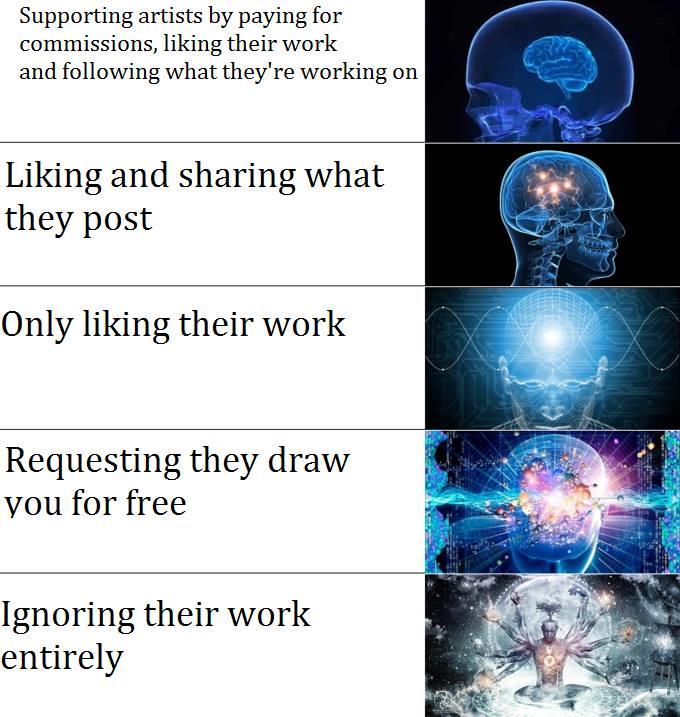
For the uninitiated, this is the expanding brain meme template:
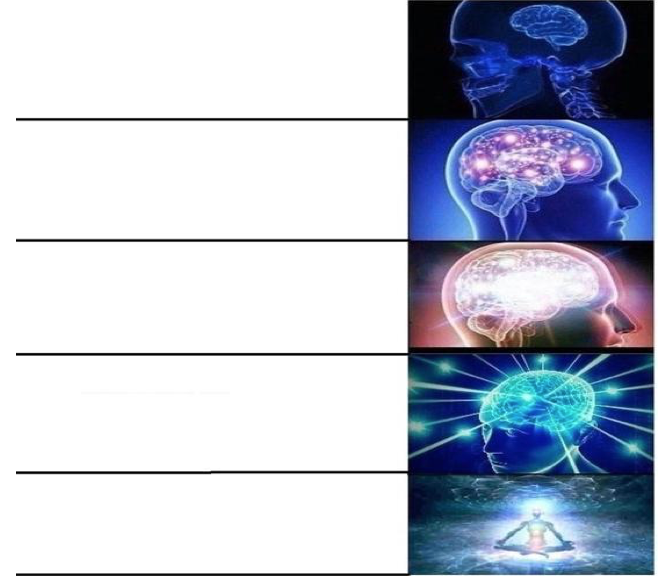
According to Know Your Meme, the popular version of the expanding brain template originated with this set:

Like many instances of the meme, this one is used to mock a tendency to over-intellectualize online. In the spirit of ordinary-language philosophy, though, it’s worth asking what else the meme can do. Where it originally was about comic escalation into absurdity (“whom’st”), the best uses of the expanding-brain meme make real arguments — albeit with a form of distance.
The existence of online jokes that require an extraordinary level of context to grasp trains us to re-consider what we think is obvious
The meme typically represents the progression from a basic, uncomplicated opinion — this TV show is good, I like this film, etc. — through an increasingly complex series of ideas about the subject and then back to a gut-level, earnest, simple reaction, as in this example about following artists in social media. But all the components of the expanding-brain meme can be (and often are) true at once. This allows it to, for instance, condense a reasonably sophisticated criticism of American capitalism into a single image. And it accommodates problematic affinities: Its format corresponds to how it can be true that, say, the Indiana Jones franchise is frequently racist and proud of its colonialist bent and that watching Harrison Ford blow stuff up and shoot Nazis can be pleasurable.
It’s not a coincidence that a frequent target of this meme is the academization of discourse around gender and sexuality. It’s a sort of hero’s journey through language and the mind, from an initial unmooring from the way we have been raised and trained see the world, through a dizzying array of ways of thinking about it that can be useful, clarifying, and/or nonsensical, and finally back again, transformed and capable of changing the world. The penultimate brain — the wokest, most byzantine, most self-assured brain — is unable to grapple with this infinite texture, the way many things can be true at once, that any given slab of language is going to grasp at best a piece of the reality.
But this doesn’t mean we should double down on returning to the earliest world of single, unitary “truth,” one that somehow existed before some mysterious force sent us into a “post-truth” world. There was never any “truth” like that to begin with, at least not in the way its most strenuous defenders think. Instead, moving through what we perceive as layers of description allows us to return to the original context, armed with firmer and more clear-sighted knowledge. This path may seem circuitous, but it puts us in a better position to see and to do things with our words.
Similar meme formats can act as funnels for the play of contexts, the texture we must grasp if we want to learn anything. They allow us to see the world not as an inflexible product of laws that can be discovered by careful reading and observation but as a series of intersecting clouds and constellations, what Wittgenstein might refer to as “family resemblances.” The existence of online jokes that require an extraordinary level of context to grasp continually trains us to pay attention to the way that context is demanded even in using what might appear to be commonplace language, forcing us to consider what we think is obvious and what is only obvious to us — and that what might seem obvious might really be totally obscure.
Playing language-games that originate online has many effects, but playing with an openness to everything people attempt in those games makes it difficult to hold on to only one of those pictures, only one brain, freeing us to begin thinking about how no thinking occurs in isolation. It’s okay that not everything conforms to a given idea of what it’s supposed to be, even if that rule-of-thumb definition has “worked” for most cases in the past — especially because what “works” is often “common sense” used to prop up systems of oppression and inequality. We simply have to be willing to admit that each case might, in large part, be its own case.
If it seems dubious to claim that memes as a form do important philosophical work and do it better than many who are paid to produce long-form opinions, consider the source: Wittgenstein, who allegedly said that “a serious and good philosophical work could be written consisting entirely of jokes.” At the outset of Philosophical Investigations, he writes that most of the problems of philosophy emerged because “a picture held us captive.” He could not have known another picture — a near-endless series of pictures — could free us, and that those pictures just might be stock photos of an abstracted human form moving through the cosmos, unceasingly seeking enlightenment.
This essay is part of a collection of essays on the theme of EXTREMELY ONLINE. Also from this week, Rina Nkulu on dressing for the internet.
“A photograph is incontrovertible proof that a given thing happened. The picture may distort; but there is always a presumption that something exists, or did exist, which is like what’s in the picture,” Susan Sontag writes in On Photography. The “what are you wearing today” (WAYWT) thread — now staple of fashion forums online, especially menswear forums — wants you to provide evidence. There are no other ways to answer the question without resorting to posting a photo of your outfit, or “posting a fit.”
WAYWT is still “WAYWT” on Reddit’s MaleFashionAdvice subreddit. It’s also “WDYWT,” or what did you wear today on 4chan’s fashion board, /fa/. On Reddit’s MaleFashion subreddit, I find “WIWT,” what I wore today; “WIWY,” what I wore yesterday; and “WIW,” what I wore. Members of communities like these seem to gravitate toward these spaces after a sudden urge to dress better overcomes them elsewhere on the site, in their early 20s or mid to late teens. Many learn how to dress on the internet now, and the trends, images, and conventions produced by their efforts bear the imprint of online dynamics.
Like photos in general, looking at a “fit pic” is not analogous to experiencing clothing in person. In real time, outfits are noticed, witnessed, spotted in motion; they are incidental to existing in public space. Bodies are attached to faces; brand names might be visible, but are sometimes deliberately left hidden, or implied. In public space, contexts shift and interlock: We are mindful of dressing for occasions — on the subway car, you can guess who’s on their way to class and who’s on their way to a job interview or the gym. Style is both a strength and a vulnerability. When you leave the house, you have no choice but to be seen; getting dressed is a way of making a pitch for yourself.
The contextual cues that we use to evaluate an outfit in real time are dynamic in public. But on these forums, a good picture of an outfit is a good outfit
By contrast, participation in WAYWT and its variants is voluntary, and necessitates deliberation: WAYWT isolates the unconscious act of noticing, witnessing, or spotting and converts it into something more intentional. The average of every “fit pic” is a careful photo of a man, face cropped out or scribbled over or carefully blurred. (Women participate in these communities as well, despite the menswear focus.) The image is typically more coherent than striking; it always makes sense to look at. Outfits are positioned in the most neutral corners of posters’ bedrooms or living rooms, or the spaces that match them the best; mirrors that reveal little reflected behind them. The brands present are neatly listed nearby, in the body of an image board or forum post, in the titles or comments of posts on Reddit.
The internet inverts geography and physical presence — it provides a collective space for disparate environments — and style is influenced by both. Fashion forums on the internet have developed a grammar that seems to understand this. Outfits are immediate and scrollable, elements easiest to assess within the confines of one’s browser. A picture has to look good against the web page it’s hosted on, before anything else — a good outfit alone is insufficient, even impossible, without a matching backdrop. The contextual cues that we use to evaluate an outfit in real time, which lead inevitably to some assessment of the person wearing it, are dynamic in public: an outfit assembled for a party is still worn on the subway, on the sidewalk. We have limited control over the backdrop that frames us, or the people on whom we might make an impression. A good outfit accounts for these variables. On these forums, the context is static: a good picture of an outfit is a good outfit. Users feel compelled to note when they are being “lazy,” or when they know that they are wearing something “basic” or “boring,” or when they are “trying something new.” They might explain where they wore an outfit; the event they might have worn it to. And a good outfit has less to do with the synergy between the wearer and their clothing than between the clothing and the backdrop, as well as the meta-backdrop — the confines of the threads these images exist in.
Good in these spaces is often represented by the quietly neutral, potentially even aloof. Guys eternally still or mid-stride against nondescript walls in photos that sit nicely against the endless clean of minimalist UI. Hidden faces mean you focus on the clothing, outfits disembodied, and some level of anonymity is allowed to be preserved — a photo of yourself with no face provides a clear limit to strangers’ critiques and presumptions. While participation is necessarily social and never not intentional, it is frustratingly impersonal for that reason. The fashion internet’s canon reflects the folded space it occupies more than anything.
Spaces like 4chan’s /fa/ are not only focused on fashionable clothing, but also fashionable lifestyles, or the appearance of them. The board is full of threads dedicated to establishing and building on their own aesthetics, and the advice offered is inclined toward fitting those conventions. The r/MaleFashion and r/streetwear subreddits are dotted with Imgur links to “inspo” albums; /fa/ houses a myriad of threads that classify, seek to classify, and provide inspiration for endless looks, along with questions about what is “/fa/” and what’s not — its definition is never fixed, entirely dependent on the opinions of strangers, and meant to look like the opposite: intuitive, immutable.
The posters in these threads are drawn to a specific aura, not a mere costume. The meaning is in making the identification, creating the category
Many posters on /fa/ are preoccupied with “–waves” and “–cores,” aesthetics built upon photographs with only remnants of their contexts — “terrorwave,” for example, which was founded on well-composed, entrancing photographs of Afghan fighters and soldiers in Eastern Europe, but only entailing utilitarian clothing, Adidas sneakers, and low-key military surplus wear in neutral tones. Carefully constructed movie stills can go into inspo threads — images of Ryan Gosling in The Place Beyond the Pines, candid photos of soldiers looking gritty and careless can go into inspo threads, the fervor of the gunman that assassinated Andrei Karlov can go into inspo threads, all of them qualifying for different “–cores” and “–waves” with every repost. Personal style is subordinate to these “waves,” which become recognizable through participation — filed into inspo albums, easily reblogged on Tumblr, “liked” on Instagram, infinitely sortable.
While anybody can bleach their hair and wear white T-shirts, or buy vintage military uniforms, or wear a suit, the posters in these threads are drawn to a specific aura, not a mere costume. They seem to need genres in order to make sense of things — a single photo allows one to ask “what core is this,” based on purely visual understandings, subsuming individual narrative into that of the thread itself. The meaning is in making the identification, creating the category.
The desire to be cool seems incompatible with the compulsive tendency to materialize a presence on the internet, and to sift anxiously through the presences of others. The passion for collection mediates no matter what, as long as one can suggest an underlying sort of critical-ironic distance, as demonstrated by the “starter pack” meme, a cousin of “get the look” packages in fashion magazines: a grid layout of the various components of a subculture, indexing uniforms to incredibly specific points. These points become strange signifiers; an item of clothing reaches “meme” status based on its documentation on the internet, how it’s documented, and who documents it, not when it becomes “trendy” off-screen. Starter packs identify the shared affects and social behaviors of these subcultures with the same pattern-recognition sense that leads to the construction of that aesthetic in the first place. The more thoroughly mapped an “aesthetic” is, the more difficult it is to execute earnestly — take the memetic evolution of “clout goggles” as tied to Soundcloud rap, now saturated to the point that wearing them must somehow imply some sort of bitter irony. These “aesthetics” have less to do with things people actually wear on their body than the idea that they would. They’re lifestyle brands, constantly collated in the past tense — “starter packs” as systems of reference that expire as they emerge, newly invented “cores” and “waves” that track aspirations.
A now-dated pejorative expression in the vernacular of these forums is “dressed by the internet” — as in, the source of a look is too obvious, evoking the primordial sense that one might be “trying too hard.” But dressed for the internet might be more accurate. The looks themselves are born online, and subject to online conventions; the outfits are partly assembled to be seen online, adapted to the message board or timeline more than to public space, and are meant to be judged against it. “The internet” almost always implies distance; the ability to recognize what it looks like is a nervous reminder. “The internet,” even now, almost always implies a distance from “real life,” which might be more accurately described as “real time” — the immediacy of bodies in public space. Of course, the internet is real life, but it’s a domain of reality subject to its own logics, its own sets of norms, as well as its own accelerated pace: ideas of whole ways of being, arrived at collaboratively and then passively falling away.
This essay is part of a collection of essays on the theme of EXTREMELY ONLINE. Also from this week, Eric Thurm on galaxy-braining the galaxy brain meme.


It looks like Nintendo has big plans for the Nintendo Switch now that the system has evolved into a resounding success for the Japanese gaming giant, both in the sales and fan reception department.
According to a recent interview with Nintendo’s president Tatsumi Kimishi, originally published by Yahoo Japan and first found by NintendoEverything, the Switch is entering a “crucial” second year in its life-cyclle, before emphasizing that the console will have a “long lifespan.”
This isn’t new for Nintendo, given the company has a history of supporting its consoles for a number of years, often even as they fail, with the GameCube and Wii U being the most prominent examples. The 3DS looks like it’s next in line to suffer this fate with few big titles on the horizon for the handheld over the course of 2018.
Nintendo recently revealed that ambitious goal of selling 20 million consoles during the 2018 fiscal year, with the company aiming to sell 14 million systems before the fiscal year closes in March.
Looking to the future, Kimishi says Nintendo wants to sell the Switch to “those who have never touched game machines too much,” which is a strategy similar to how the company brought the Wii to such high levels of popularity and sales.
Part of why the Switch continues to sell so well is due to its inherently compelling form factor. For someone like myself who often does their gaming on the go, the ability to play the system where ever I want, only to then take the console home and hook it up to a television, remains extremely compelling.
Source: Yahoo Japan Via: Business Insider
The post Nintendo says the Switch will have a ‘long lifespan,’ aims to target non-gamers appeared first on MobileSyrup.
My bank on the phone.
Bank: you recently made an international payment.
Me: yes, which one?
Bank: the one to [organisation name] in Belgium.
Me: yes, that’s correct.
Bank: we haven’t made the payment yet, as the intended recipient’s description contains a term that is on our sanctions list.
Me: ????, which term?
Bank: asbl
Me: you mean the official french abbreviation for a non-profit association?
Bank: oh, ok, in that case we’ll proceed with the transfer.
Me: yes, please do.
You’d think that they would have a list of official abbreviations for various EU legal entities to avoid false positives….or have the capacity to google it.
 When the Pixel 2 XL was first launched, it was heavily criticised for its sub-par OLED display which suffered from a significant blue shift when viewed at less than perfect angle. There were other issues with the display as well like image retention but it was the blue shift that bothered users the most as Google managed to solve most of the issues to a certain extent with software updates.
Continue reading →
When the Pixel 2 XL was first launched, it was heavily criticised for its sub-par OLED display which suffered from a significant blue shift when viewed at less than perfect angle. There were other issues with the display as well like image retention but it was the blue shift that bothered users the most as Google managed to solve most of the issues to a certain extent with software updates.
Continue reading →

![Identified! [Underwater breathing devices: "Dräger Gegenlunge" (left), "Momseng Lung" (center), and "Davis Submerged Escape Apparatus" (right)] (LOC)](https://farm6.staticflickr.com/5635/21701991690_1bebc0c71e_b.jpg)