Shared posts

22 Jan 19:24

My Quest for Home Automation, Part 1

by Rui Carmo

As the cold season started creeping in and the need to balance energy savings while keeping the house warm became more important, I began laying out plans for doing home automation “the modern way”, i.e., without clockwork timers all over the place and with some intelligence thrown in.

As you’d probably expect, it quickly got out of hand and turned into a full-blown “Internet Of Things” saga, of which this is but the first installment.

Background and Use Case

Back when X10 was a thing, home automation was too much of a pain (and costly) to get into, but these days, thanks to inexpensive microcontrollers like the ESP8266 and the Alexa/Cortana/Google Home hype, all sorts of solutions are competing for market share as supporting pillars for the lofty vision of the omnipresent, omniscient home assistant that turns on the mood lights, plays some light jazz and orders pizza when you get home.

I, however, have a rather more pragmatic take on things. The staple of X10 was physical monitoring and control: sensors of all kinds, lighting, outlets, shades, etc., and that’s largely what I put together, focusing on a very simple use case–lowering our power bill by managing heaters during the cold season, and laying down the groundwork for doing the same to the AC later in the year.

Monitoring power consumption on a per-device basis isn’t one of my goals–I have a pretty good idea of which appliances spend what and already replaced the vast majority of my lamps with LED lighting, so I’m only concerned about the overall consumption (which I’m working on monitoring centrally1).

So my use case effectively boils down to:

  • Switching heaters on and off via some a smart outlet
  • Controlling the ACs (which use pretty nasty infra-red remotes)
  • Placing and monitoring some sensors around the house

Technical Criteria

There were, however, five things I tried to stick to in my approach:

  • As simple as humanly possible (quick operation, manual overrides, etc.)
  • Avoiding bleeding edge/proprietary solutions
  • Minimal reliance on Internet access for operation (above all, zero open ports to the outside)
  • MQTT-based integration
  • Not breaking the bank

Choosing a Platform

Even as I started getting into the nitty-gritty of hardware and building my own sensors2, I began checking out possible Open Source automation solutions–of which there are now literally dozens out there.

I tried out Domoticz, Home Assistant, etc., but most of them were overly complex, although Home Assistant struck my fancy, given that it’s written in Python and has, by far, the most extensive device coverage I’ve seen yet.

However, I didn’t want to rely on web interfaces. And even though I wasn’t originally looking for voice control (reading Charles Stross‘ books and watching Black Mirror tends to deflate the excitement around having an active microphone in your home), I tried to get the original Google AIY Voice kit (which was made out of pure unobtainium for many months) to test Google Assistant and Alexa in a controlled environment.

I eventually got a ReSpeaker dual-mic HAT, which let me play around with various speech recognition APIs and understand how the home automation integrations worked at a very low level. As everything else related to Linux audio, that little board is somewhat temperamental, but I managed to get both Alexa and Google working for quick tests; the Alexa SDK worked (slowly) on a Raspberry Pi Zero, but the Google SDK required armv7, so I only managed to get it working on a Pi 3.

This took a fairly long time (i.e., most of November), during which I realized I wasn’t keen on having to connect my home devices to somebody else’s cloud, especially given the varying (sometimes haphazard) levels of security required (some scenarios required me to expose devices on the Internet, even if indirectly, or to let them “phone home” to their manufacturers, which, to be honest, I’m not at all keen on allowing).

HomeKit and HomeBridge

So I turned back to Apple. HomeKit is LAN-centric by default (your devices can talk to cloud services of their own, but they’re controlled via the LAN), and only relies on Apple servers for remote control (using an Apple TV or an iPad as relay).

Since all iOS devices now include the Home app (which even given its dumbed down interface is still a lot better than fiddling with web UIs), it also solved the problem of having an easy-to-use3 UI to control and monitor devices.

But it had a nice side benefit: it let me use Siri–a big challenge in terms of brains (or apparent lack thereof when compared to the Alexa and Google integrations I’ve been playing around with), but a big advantage in terms of hardware: Siri works beautifully with my Apple Watch, and it’s with me in every room.

Siri does rely on Apple servers for speech processing, but automation and device control is entirely local to my LAN–I don’t have to open ports on my home router for Alexa/Google/etc. API callbacks, and everything else is reasonably easy to lock down.

And there are a lot of HomeKit integrations out there, the most popular of which is HomeBridge, an Open Source HomeKit bridge with dozens of plugins, including MQTT support.

Picking Out Hardware

Going “the Apple way” and just buying stuff that worksTM was something I’d love to do, but HomeKit-certified hardware is still a little thin in the ground, and spending €200+ on a brand new Apple TV is something I have budgeted for next Autumn (or whenever the living room TV dies and we can go 4K). On top of that, all the interesting hardware seems to be US-only and/or expensive, and I certainly wasn’t going to pay €50 for a smart socket.

So I hunted down alternatives, the most interesting of which was the ITEAD S20 Smart Socket, which is part of an entire family of products with the same internals and can be had for around €12 if you shop around.

Plus (and this is the amazing bit) is based on the ESP8266 and can be re-flashed with Open Source firmware, enabling support for add-on sensors:

A couple of S20s and a DHT22 temperature/humidity sensor.
Note the 4-pin placeholder, which allows hooking up sensors to the GPIO pins.

Plus it has a physical button you can press to toggle the outlet state (which is pretty useful in a couple of places where the outlets are raised and/or easy to reach).

Making It Your Own

I ordered 4 S20s back in November and re-flashed them with Sonoff-Tasmota firmware using a very neat project called SonOTA, that spoofs the ITEAD OTA upgrade server and lets you re-flash the devices without having to open them and wire them up to an FTDI adapter (which is doable, but undesirable given the proximity to live mains).

You should be aware that ITEAD has recently started shipping a firmware version (1.6) that prevents SonOTA from working, but outlets I ordered 2 weeks ago were still running version 1.5. Your mileage may vary.

This effectively removes any chance of the devices calling home to the manufacturer or punching holes in my LAN–all they talk to is a local MQTT broker and HomeBridge, thanks to a plugin called homebridge-mqtt-switch-tasmota.

The end result is pretty decent–it all works fine from both the Apple Home app and Siri, and I soon realized that the entire system ran pretty well without any sensors given that all the heaters have built-in thermostats.

So most of the power optimization boiled down to some smart scheduling depending on where we were in the house. Scheduling with simple constraints works fine with my iPad mini as a Home Hub, but I’ve been investigating other options.

Caveats

There are a few, obviously. The first is that there is a degree of assembly required if you want to have a sane, easy to manage configuration, since HomeBridge requires NodeJS.

I’ve sorted that out by running it as a custom, isolated container on my ODROID, alongside separate containers for Node-RED, the MQTT broker and some Python services that manage specific topics.

The second is that Homekit only lets you share control of your entire house, which is… well, sub-optimal. I’d like to have finer-grained delegation, and (ideally) scheduled delegation.

The third is that Apple‘s Home app is pretty much useless for anything more complex than on/off buttons. I don’t have any smart light bulbs (or plan to), but I’m reliably told that the Philips Hue app puts Apple‘s attempts to shame.

But the Home app is enough for providing device names (and speech intents) for Siri, which in turn is clever enough to “turn off all outlets” or “everything in the living room” provided you name your devices properly–although it can be a bit trying at times, since many keywords are reserved for Apple apps.

Finally, there are a few things where HomeBridge itself falls short. For starters, each individual platform/accessory plugin is its own private little universe, and there is no central API for checking or setting device statuses or even a way to manipulate all acessories programmatically.

But there are workarounds, and on the next post I’ll go into the nitty-gritty details (and into more hardware).


  1. This is an interesting twist on its own, and I’ll write it up later, but in short I’ve stuck a Raspberry Pi Zero with a camera to my electricity meter and am working on reading the digits straight off it. ↩︎

  2. Which I’ve kept optimizing for power consumption, something I’ll get into in another post. ↩︎

  3. And, in some respects, extremely limited. ↩︎

22 Jan 19:23

SotD: Lust For Life

I suppose that in 2018 Lust For Life is an obscurity, something you might have heard on the radio or in an ad. That’s insane, it’s obviously one of the great rock songs of all time, and has given Iggy Pop, who co-wrote it with David Bowie, a performance vehicle that he’s taken a long, long way.

Iggy

I’m a hopeless fan of Iggy Pop. He’s a hardass rocker who never for even one on-stage instant is giving less than 100%. And a fine singer, always in tune. And, go read a few interviews; Iggy is an articulate, well-informed, pleasant dude, not at all full of himself. And — worth mentioning in 2018 — I’ve never heard an accusation of Iggy abusing women, or really anyone.

Let me tell you a story. The only time I saw Iggy play, he was opening for the Pretenders. This was not a good choice on the part of their management because, while I love a lot of their music, they’re not actually that dynamic live and Iggy made them look flat. But after the Pretenders’ first song, Chrissy said “Iggy played first and he sweated all over the stage, there’s some right there. I’m just going to bow down, get on my knees, and kiss the spot.” Gotta love that.

As for the song, what can I say? There’s nothing terribly innovative or groundbreaking about it, but on the other hand there’s nothing else in the world that sounds like it. Listen and you’ll know right away. Also, I have to say, when you’re in a musically-literate crowd, sometimes there’s a place in the conversation where you can toss in “I’m just a modern guy, you know…” and you’ll get appreciative knowing laughs.

This is part of the Song of the Day series (background).

Links

Amazon, iTunes, Spotify. Now, as for video, this was kind of an expensive piece to write because once you start watching performances of Lust for Life, it’s hard to stop. Anyhow, start with this one.

22 Jan 19:23

Surprise, the world was warmer again in 2017

by Nathan Yau

According to NASA estimates, 2017 was the second warmest year on record since 1880. Henry Fountain, Jugal K. Patel, and Nadja Popovich reporting for The New York Times:

What made the numbers unexpected was that last year had no El Niño, a shift in tropical Pacific weather patterns that is usually linked to record-setting heat and that contributed to record highs the previous two years. In fact, last year should have benefited from a weak version of the opposite phenomenon, La Niña, which is generally associated with lower atmospheric temperatures.

Good times ahead.

Tags: environment, global warming, New York Times

22 Jan 19:23

Twitter Favorites: [dentremontdani] took the most Toronto photo on my way home last night. https://t.co/NW2TRnSTVd

Danielle d'Entremont @dentremontdani
took the most Toronto photo on my way home last night. pic.twitter.com/NW2TRnSTVd
22 Jan 19:21

How to cancel app subscriptions on the App Store and Google Play Store

by Igor Bonifacic

Want to cut back on all those monthly expenses and get rid of some recurring app subscriptions? There are a few steps you’ll need to take.

Here’s how for both iOS and Android.

App Store

iOS unsubscribe how-to

Cancelling a subscription on the App Store on iPhone, iPad or iPod touch only takes a few steps.

1) Go to Settings > [your name] > iTunes & App Store.
2) Tap Apple ID at the top of the screen.
3) Tap View Apple ID.
4) Tap subscriptions.
5) Find the subscription you want to manage.
6) Tap ‘Cancel Subscription.’ Your subscription will stop at the end of the current billing cycle.
Note: If you don’t see the subscription listed, but you don’t see it in your list of subscriptions, it might be billed through a third party.

Google Play Store

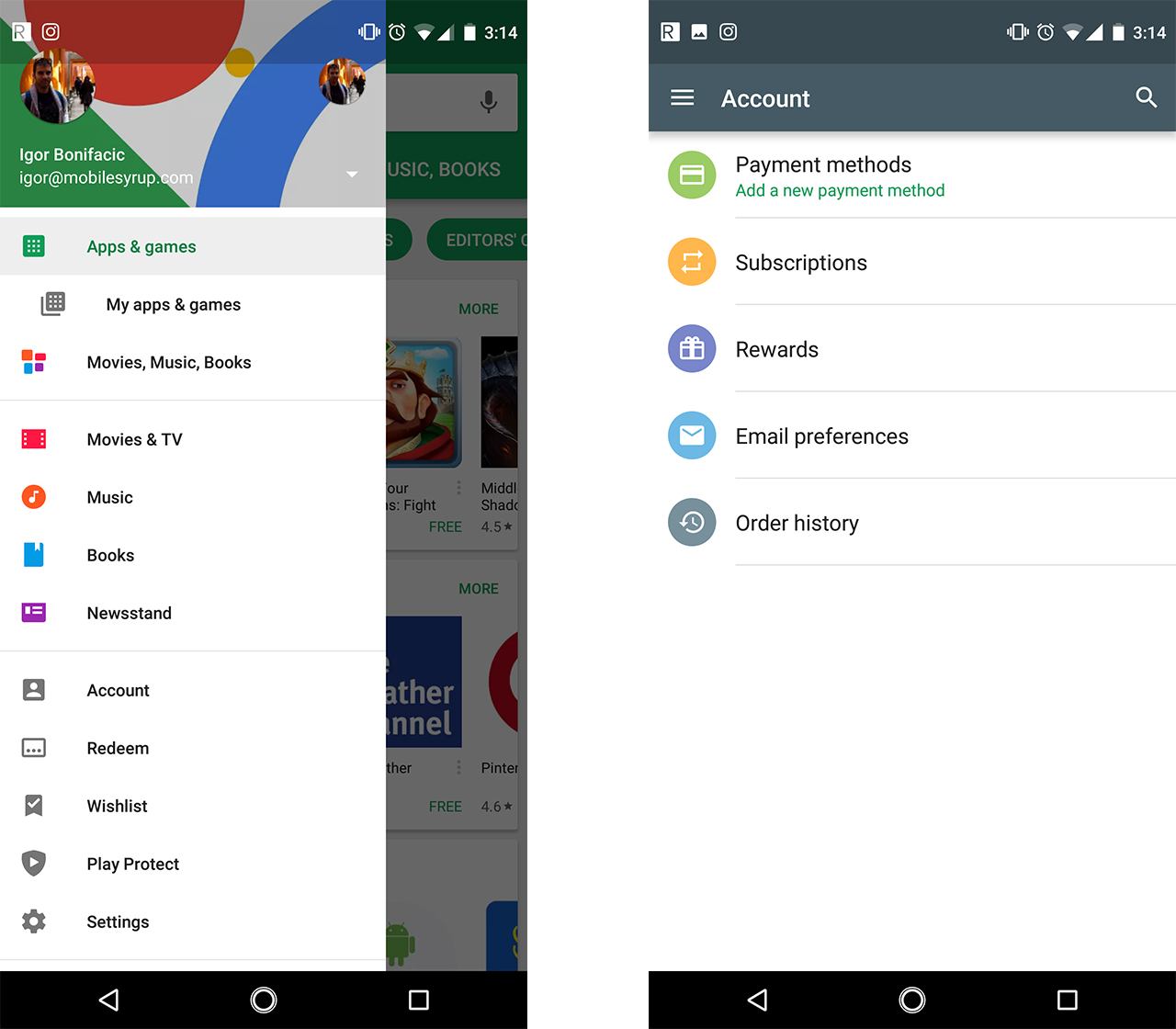
Google Play Subscriptions page

Cancelling an auto-renewing subscription on the Google Play Store is, once again, a fairly straightforward affair.

1) Launch the Play Store app.
2) Tap the three lines menu button, located on the right side of the search bar, or swipe right from the left edge of the screen to open the ‘Menu’ shelf.
3) Tap ‘Account.’
4) Tap ‘Subscriptions.’
5) On this screen you’ll see all the subscriptions associated with your Play Store account. Tap the one you would like to cancel.

The post How to cancel app subscriptions on the App Store and Google Play Store appeared first on MobileSyrup.

22 Jan 19:08

Nein, Pedelecs beißen nicht

by noreply@blogger.com (Christine Lehmann)
mkalus shared this story from Radfahren in Stuttgart.

Immer mehr schwere Unfälle mit E-Bikes, titelt der Spiegel. Wunderbar, wenn wir zumindest im Titel Räder mit elektrischem Antrieb verteufeln können. Die Unfallzahlen für Pedelecradler haben jedoch weniger mit dem Antrieb zu tun, sondern eher etwas mit dem Alter der Radler. 

Im Artikel selbst verpufft die Gefahr, die von Pedelecs für das Leben ihrer Fahrer ausgeht, in der statistischen Realität. Grundsätzlich haben ältere Menschen ein höheres Risiko, im Straßenverkehr zu verunglücken und dabei sogar zu sterben als jüngere Menschen (ausgenommen männliche Autofahrer  zwischen 18 und 30). Und in Deutschland steigt der Anteil der Älteren in der Bevölkerung. Also fahren auch mehr Ältere Fahrrad als früher. Nach Darstellung des Spiegels stiegen die Unfallzahlen bei Radfahrern im vergangen Jahr um 28 Prozent. Die Zahl der neu verkauften Pedelecs stieg im selben Zeitrum um 25 Prozent.

Wobei auch der Radverkehr insgesamt zugenommen hat, wie man allein schon in Stuttgart sehen kann. Damit scheint es nicht mehr sinnvoll, nach Gründen zu suchen, warum Pedelecs für ihre Fahrer besonders riskant sein sollen. Wir haben in Deutschland noch nicht den Punkt erreicht, wo die Zahl der Radfahrenden das Radfahren wieder sicherer macht.

Stimmt aber auch, dass Pedelecs meist von älteren Menschen gekauft und gefahren werden. Die einen steigen von ihrem Normalrad auf ein Pedelec um und radeln vielleicht im ersten Überschwang wieder wie ein junger Mann (seltener überfällt der jugendliche Geschwindigkeitsleichtsinn Frauen), ohne aber das jugendliche Reaktionsvermögen zu verfügen. An Erfahrungen fehlt es solchen Radlern nicht, und sie merken schnell, was geht, und was nicht. Das Risiko, mit einem Rennrad zu verunglücken, wäre für sie genauso hoch. Andere steigen jedoch mithilfe des Pedelecs nach Jahren erstmals wieder aufs Fahrrad. Das ist längerfristig gut und gesund. Nur am Anfang sollte man mit erhöhter Vorsicht und langsam radeln, bis man sich an die Verkehrsverhältnisse gewöhnt hat, sich gut auskennt und der der Körper Kraft und Reaktionssicherheit aufgebaut hat. Das dauert etwa ein Jahr. Für ältere Menschen gehen Stürze dabei oft leider schlechter aus als für junge Radler. Sie brechen sich eher was und sie erholen sich langsamer von solchen Verletzungen.

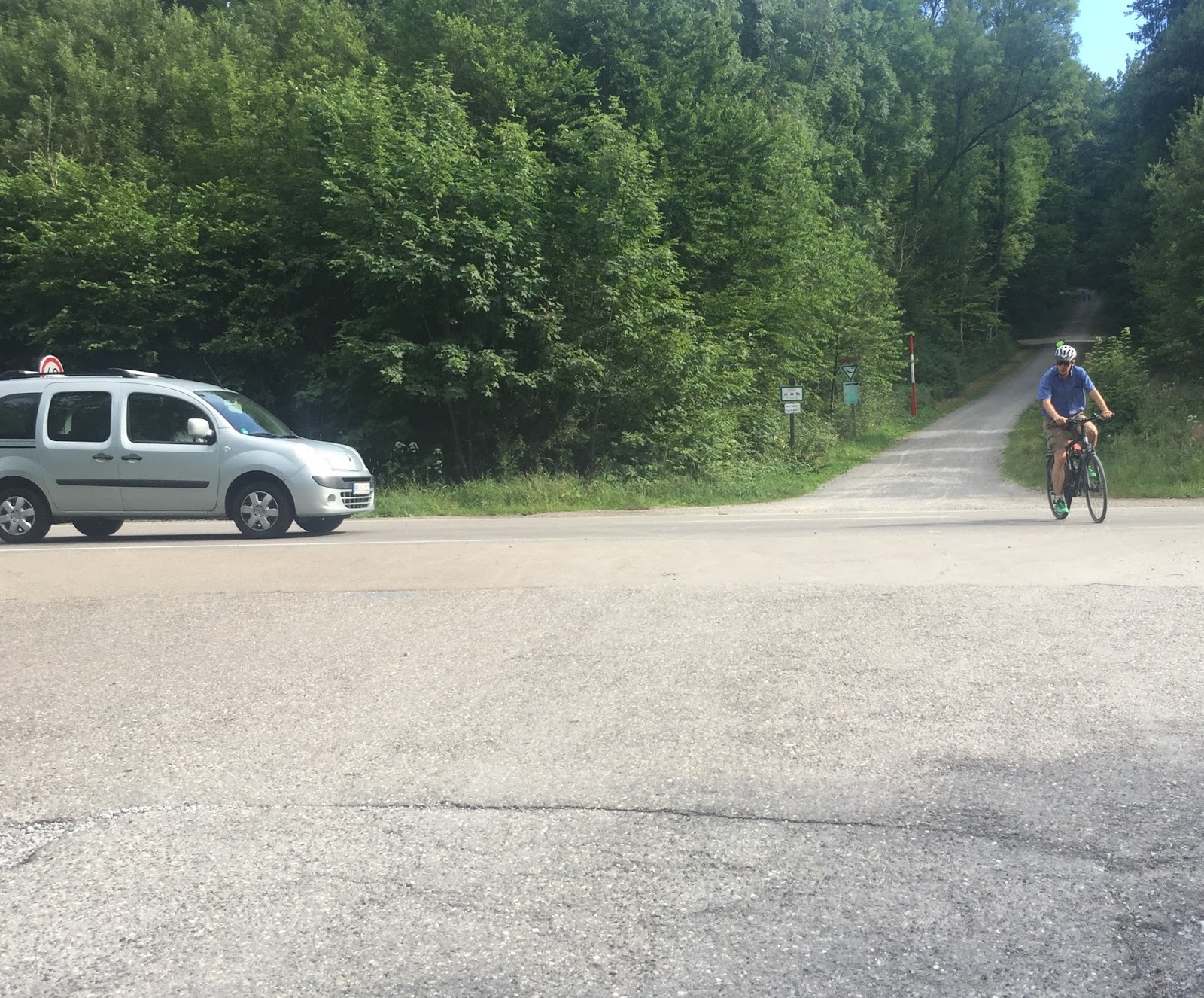
Besser so, als mit dem Auto (Foto Blogleser Holger)
Übrigens haben Ältere auch als Fußgänger deutlich mehr Unfälle als jüngere Fußgänger. Ganz generell passieren älteren Menschen mehr Unfälle, bei denen sie so verletzt werden, dass sie ins Krankenhaus müssen. Radfahren kann sogar helfen, dass die Genesung schneller geht, weil der Fitnesszustand insgesamt besser ist. Dass die Zahl der schweren Unfälle im Auto für dieselben Altersklassen dagegen zurückgeht, liegt nicht daran, dass ältere sicherer Auto fahren, sondern vor allem daran, dass sie weniger Auto fahren als jüngere.

Weil immer mehr Menschen so lange wie möglich in Bewegung bleiben wollen und das mit Pedelecs auch tun können, wird die Zahl der Pedelec-Unfälle vermutlich immer leicht überproportional steigen. Das liegt aber am Alter der Radelnden, nicht am Fahrrad. Wird die Infrastruktur besser und sicherer, dann nimmt auch die Zahl der Radlerunfälle im Verhältnis zur Zahl der Radfahrenden wieder ab. Und eines Tages haben wir so viele Radler auf unseren Straßen, der Effekt der Sicherheit durch Anzahl eintritt und sie sich selber schützen.

Also, Alarmstufe Rot wieder aufgehoben, Pedelecs tun nichts, sie sind ganz lieb, sie beißen nicht. 

Nachdem der Artikel im Text die Schlagzeile widerlegt hat, hat er aber doch noch was gefunden, was er skandalisieren konnte: getunte Pedelecs. Nicht, dass es Zahlen über besonders schwere Unfälle von S-Pedelec-Fahrern überhaupt gibt und deshalb auch keine von Radlern, die bei sich illegal die Motorgrenze von 25 km/h aufgehoben haben, aber theoretisch könnte man schon sagen, dass ein Fahrrad, das mithilfe eines Motors 30, 50 oder gar 60 km/h erreicht, seinem Fahrer gefährlicher werden könnte als eines, das nicht schneller als 25 fährt. Aber wie viele Leute manipulieren den Fahrradcomputer tatsächlich? Das Gros sicher nicht.

Und natürlich titeln alle anderen Medien heute auch so, zum Beispiel heise.online, und relativieren dann im Text wieder.


22 Jan 19:08

Lonely Road

by Adam Clair

I am listening to Coast to Coast AM tonight the way I usually do: on a long, lonely late-night drive home. I’m tired and alone, and the radio is on to keep me awake. The monolithic openness of the highway is perforated sparsely by taillights and winking brake lights. We all keep a respectful distance at this hour. I don’t know who is drunk or sleepy, only that anybody could be. The whispered drone of my tires against the asphalt and the parallax 79-mph whooshing of trees and billboards feel almost transgressive when everything else is so quiet and so still, but the effect is somewhere between hypnotic and soporific.

Host George Noory’s sonorous voice is an anchor for my exhausted, free-floating mind. Callers phone in to discuss conspiracy theories, paranormal activity, and other alternative epistemologies with Noory and his guests, who are usually experts in these fields. Though Coast to Coast is available on satellite radio, and a handful of the 600-plus terrestrial stations that air it are on the FM band, the quality of AM fidelity seems integral to its character. Even on a clear night, an AM broadcast is still prone to interference (much more so than FM, let alone satellite or internet-hosted content). Electromagnetic waves are all around us, and each pop and sizzle is the sound of the show’s signal crossing paths with the sinusoid discharge of nearby microwaves, CFL bulbs, cell phones, wi-fi routers and other electronics. The crackling sonic patina is a reminder that you’re not alone out here — between you and the transmitter, someone, somewhere, is doing something.

It’s Christmas night. Many shows might re-air an old episode so its staff can celebrate with their families. Coast to Coast is live, though, following through on a commitment Noory made when he took over hosting duties in 2003 to never settle for reruns on holidays. Nobody has to be alone tonight.

The crackling sonic patina is a reminder that you’re not alone out here — between you and the transmitter, someone, somewhere, is doing something

Noory’s guest for the second half of the show is Karen Anderson, an animal communicator and psychic medium. As a child, she was closer with animals than with people, discovering that she could communicate with animals directly, having “silly little conversations” with pets. Anderson put this skill to use as a deputy sheriff in Colorado, using eyewitness testimony delivered telepathically from cats, dogs, and horses to solve crimes, and she continues to commune with animals to break cold cases today.

Julie, a long-time first-time from Wisconsin, calls in to talk about how she can still feel the presence of her beloved Bichon, Riley, long after he passed. Another caller — Gary from California — shares a story about a service dog he trained who died and was reincarnated; Anderson confirms the existence of “shared souls.” Another caller tells a shaggy dog story about a Lhasa Apso named Sasquatch who had been hit by a car and later died of cancer. Anderson sympathizes. “Oftentimes, George,” she tells Noory, “it was that pet that got them through some of the toughest times, when all of the other humans in their lives had let them down.”


Syndicated across the country, Coast to Coast has been the most popular overnight AM radio show practically since its debut three decades ago, with ratings in line with daytime goliaths like Glenn Beck, Laura Ingraham, and some of NPR’s most popular programs. It remains a powerhouse in that world, but that world has gotten smaller: Its 2.75 million nightly listeners are the best in its time slot, but they’re a steep drop from the 10 million who tuned in during the show’s 1990s peak.

Even beyond its AM format, the show has been slow to keep up with trends in media technology. Despite airing four-hour shows every night, it offers only a paltry 10-minute “best of” podcast, which started only last year. It has a respectable social media following but uses the platforms modestly, generally steering clear of the modern distribution and engagement tools employed by other successful programs. The email address it lists for prospective guests to contact has an aol.com domain.

This anachronistic ambience can make the show sound like a dispatch from a once-booming industrial town that has fallen on hard times — albeit a town overrun with alien abductions and clandestine military operations. The callers who make it onto the broadcast tend to be older. The scant biographical details they volunteer suggest they have plenty of time to themselves. Lots of truckers and graveyard shifters, calling from towns I’ve never heard of. Spouses are rarely mentioned except to note they’ve died.

Coast to Coast often airs on conservative talk-radio stations: 1210 WPHT, the Philadelphia affiliate I listen in on, also carries commentators like Rush Limbaugh and Sean Hannity during the day, and Noory himself identifies as a libertarian. Highly engaged conservatives have been shown to be more prone to believing in conspiracy theories, according to a 2015 study by political scientists Joanne Miller, Kyle Saunders, and Christina Farhart, so this seems like a natural enough fit. The researchers stopped short of drawing hard conclusions about why this is, but it speculate that it stems from conservative distrust of government institutions and a media ecosystem incentivized to stoke the fears that distrust engenders and foment suspicion of “lamestream” non-conservative outlets.

The Facebook “fake news” bonanza during 2016 presidential campaign is illustrative. Stanford researchers found that pro-Trump stories were shared on Facebook at roughly quadruple the rate that pro-Clinton stories were shared. NPR tracked down a major purveyor of these falsehoods, who said his writers had tried to write “fake news for liberals,” but it was not nearly as effective. “It was just anybody with a blog can get on there and find a big, huge Facebook group of kind of rabid Trump supporters just waiting to eat up this red meat that they’re about to get served.”

On Coast to Coast, though, Noory usually steers clear of at least the most straightforwardly political content (as opposed to, say, his colleague Alex Jones, whose InfoWars is basically Breitbart with a chemtrails vertical). This allows Coast to Coast to feel more broadly inclusive. On conservative talk radio shows, ressentiment generally holds together the animating epistemology hosts and callers share — what is accepted as “true” is whatever seems likely to demonize or antagonize liberals (or any supposed Other). The villains are understood, and any accusation directed toward them may be aired without fear of contradiction. For listeners, this sustains a sense of belonging: If you share the same enemies, you can share the same set of “truths” among people who “get it.”

But on Coast to Coast, the foil is not immigrants or feminists or any concrete adversary at all, but something broader and more abstract. The show offers what conservative talk radio shows offer, in part — unqualified belief in an alternative to the elite opinion-makers and their so-called “facts” — but it modulates reactionary animus into something with looser, and possibly larger, stakes. On Coast to Coast, the wildest accusations aren’t received as confrontational rallying cries but as muted pleas for understanding.

On Coast to Coast AM, confirmation is less a bias than a house rule. If you share the same enemies, you can share the same set of “truths” among people who “get it”

In 2010, Coast to Coast producer Tom Danheiser offered this explanation of Noory’s appeal: listeners trust him. “And there’s not a lot of people on the air that you can really tune in to and not think you’re being fed a line of whatever,” he told the Atlantic. “These guys out there, these other dudes, they’re on there yelling and screaming, and they’re cutting off callers. And the listeners have a sense of trust with George, they know they can speak what’s on their minds and he’s not going to berate them or make them feel little — like a little person.”

But Noory’s gift may be less about listeners trusting him than about how much he trusts them. While he questions his guests and callers, it is always with the tacit sympathy of agreement. There are no rebuttals or debates, no implied critiques. Instead, he eggs on his interlocutors with whys and yes, ands. On Coast to Coast AM, confirmation is less a bias than a house rule.

Early in his segment with Karen Anderson, Noory takes a call from Dove in Toronto. She has been trying for over an hour to get through, and she interprets her success as “a sign from my little doggy,” a deaf five-pound rescue she had been able to communicate with mentally. A few years ago, after the dog died, Dove tried out an online dating site but found no companionship there, only people “harassing the heck out of me, targeting me. I became infamous, but I didn’t know how to stop it because I didn’t know much about technology, and I still don’t.” The dog came to her in a dream, bolting ahead of a “marauding band of minstrel gypsy ghosts.” They resembled beings Dove had seen in Casper the Friendly Ghost but dressed like Shriners, and they were beating drums and blowing horns and making a menacing racket. “She was warning me that people were coming for me,” Dove says.

“That’s a cool story,” Noory says. She then wishes him a Merry Christmas, and he reciprocates, saying he hopes she has a great one.

Dove replies cryptically, “Well, maybe. Very solitude.” Then, after wishing Anderson a Merry Christmas also, she adds, “George, you’re the only person I ever go to bed with these days.”


Loneliness is, by virtually any metric, very bad for you. Even the most introverted among us have a lot at stake if we don’t get the social connection we desire. Jane E. Brody compiled many of the negative effects of social isolation in this New York Times piece: Feeling lonely can increase stress hormones and inflammation, increasing the risk of “heart disease, arthritis, Type 2 diabetes, dementia and even suicide attempts.” It can disrupt everything from sleep patterns and immune systems to a person’s ability to perform basic daily tasks, like bathing or making dinner.

But the dangers obviously go beyond physical ailments. Social isolation has emotional and cognitive effects, including the susceptibility to paranoia and a propensity to believe in supernatural phenomena and conspiracies. A recent study found that “when people feel socially excluded they are more likely to endorse superstitious beliefs” and proposed that “social inclusion could be used to diminish the dissemination of superstitious beliefs and conspiracy theories.” These findings suggest being ostracized may lead to a more generalized suspicion of the broadly shared beliefs that allow society to function, producing further alienation.

A dark fact of personal isolation is that not only is there an absense of affirming companionship but there’s also no one to tell you that you’re wrong. If you stick a fork in an electrical socket or press your hand to a hot stove, you’ll learn quickly that those are harmful ideas. Depending on your circumstances, though, you may get no such lesson from believing the federal government is operating a secret Martian colony or that the knockout game is a popular teen after-school activity. In some social contexts, you’ll be disabused of those beliefs, maybe even excluded. But the threat of social exclusion is only as powerful as the extent to which you are not already alone.

In fact, the belief in such conspiracies may be compensatory. Some recent research, described by Katie Heaney in this piece for the Cut, suggests that people are drawn to conspiracy theories because they reinforce their sense of personal uniqueness and privileged insight into the world. Paranoia does not resolve loneliness or alienation, but when it is construed as a sign of one’s special insight, it at least offers a palatable explanation for it.

Social media platforms, at least in how they market themselves, would seem to militate or correct against this sort of isolation. Platforms tantalize with the promise of unlimited connectivity. Yet a series of studies have suggested that the more one uses these platforms, the lonelier one tends to feel. (To be clear, social media does not seem to make people less social in any tangible sense, but in this context, feelings of isolation may be more important than any objective social shortcomings.) When one consumes social media, it may appear to be full of connectivity and engagements, posts and comments and interaction. Invisible are the lonely, the quiet, the lurking. Lurkers may mainly see the activity of networks that don’t really include them, and a future unfolding without their input.

So even as social media present an obvious cure to feelings of isolation, their structure also serves to reinforce a unilateral, on-demand approach to sociality. One enters such a space at their convenience, and they can ignore or disengage from any interaction they find uncomfortable or challenging. Social media can provide an apparent community of like-minded people that can rationalize one’s prejudices without posing any demands that one defend, justify, clarify, or own up to the implications of their beliefs. Many social media by design filter the unfiltered thoughts of peers into a chorus of likes, agreement, and uniformity. But this may militate against a more intensive kind of attention and concern that could engage with the alternative belief systems that alienate others.

Paranoia does not resolve loneliness or alienation, but when it is construed as a sign of one’s special insight, it at least offers a palatable explanation for it

Similarly, Coast to Coast offers a sense of community without the explicit imposition of conformity. Regardless of topic, the calls into Coast to Coast tend to be more chatty than interrogative, coalescing into a kind of congenial conversation. For the January 11 episode, Noory welcomed George Haas and William Saunders, director and associate director of the Cydonia Institute, which the Coast to Coast website describes as a Mars research group. They are on to discuss the apparent pyramid discovered on the surface of the Red Planet. Jeff from Santa Rosa calls in to talk about his own research on the famous “Face on Mars” and his belief that the Martians were wiped out in a nuclear attack. Duane from Tacoma counters with a theory that a solar superflare destroyed all life on Mars (and perhaps Mercury and Venus too) but narrowly missed the Earth in its path. Cassie, “truck-driving in California somewhere,” talks about a dream she had about pyramids and suggests the Martian structure could be a “communications circuit board” of some kind.

Saunders says, “there could be something to it.”

There is no disagreement, because those who disagree are off agreeing somewhere else. As such, there is no reciprocal responsibility to keep one another in line, and an illusion of natural harmony arises. By offering a kind of accepting community for listeners, Coast to Coast caters to an audience of lurkers and outsiders while reinforcing beliefs that intensify the feelings of isolation that brought them there in the first place.


Conspiracy theories are often associated with the cognitive desire for order in the face of the unmanageable and incomprehensible chaos of the world. In “Conspiracy Theories in a Networked Society,” David Singh Grewal argues that a rise in paranoid thinking comes from the increased presence of systems of networked governance, which rely on informal structures of power rather than formal ones: “A formal hierarchy may be resented, but it is understood by those affected by it; in network systems, by contrast, it is often hard to determine who is in charge, even though such systems can heavily influence or even determine important social outcomes.” Grewal suggests that “some allegations of conspiracy may even function as cognitive shortcuts — ‘as-if’ conspiracies — which apply a cui bono style of reasoning to make sense of otherwise opaque modes of social control.”

That is, the conspiracy theories conform to their existing, antiquated notions of hierarchical governance. The fundamental premise is that some intentional power dictates the order of the world, the subtext of which is that any one person is powerless to resist it. Isolation is thus an excuse for resignation. Conspiracy theorizing “solves” feelings of powerlessness by enhancing them, just as social media can sometimes seem to solve loneliness by increasing feelings of isolation. The isolated come together to consume their collective helplessness as nourishment — and to experience their helplessness at the level of practice as a kind of omniscience at the level of theorizing.

Coast to Coast covers a wide range of supernatural and conspiratorial subjects — recent episode themes include alternative healing, giants, and the moon landing hoax — but what unites these topics is their abstraction from their actual lived social implications for participants. Neither Noory nor his guests and callers talk much about the stakes or ramifications of the beliefs they assert. They don’t frame their discussions in terms of what should be done — they are not, for example, seeking a plan to expose NASA for hiding signs of life on a nearby planet. Coast to Coast doesn’t try to synthesize information into strategy or debate tactics — these would threaten the possibility of theories being debunked. Calls play out instead as celebrations of the futility of knowledge, the ineffectuality of knowing what they perceive to be the truth. Understanding comes only at the expense of agency. What’s “really going on” is always precisely that which is beyond intervention — which would seem to rationalize further social isolation, since this means consensus and collective action can’t help anyway. But the show accommodates these rehearsals of impotence, offering a space for callers to articulate their views as both certain and useless. This gives listeners a path toward solace and companionship not necessarily in shared beliefs or shared visions of reality, but in a shared sense of incapacity. No one has to do anything but listen.

Belief is deeply social, whether it is derived from a radio show or a news feed or any other source. It has less to do with objective, verifiable reality than it does our ambitions toward community and identity. As the world becomes more connected, we are all increasingly vulnerable to the feeling that we are not connected enough. Coast to Coast offers a vision of an alternative world, one with infinite connectivity and possibility but which somehow remains infinitesimally mappable, comprehensible. It’s a world where belief costs nothing — where belief itself can sustain. It always leans toward more, toward those as-yet-still-coiled and uncoded forces in a universe where bigfoots and remote viewing and spontaneous human combustion are all real — but loneliness is not.


This essay is part of a collection of essays on the theme of ALTERNATIVE. Also from this week, Gavin Mueller on the trajectory of 1990s alternative culture

22 Jan 06:23

Samyang 135mm F2

What happened was, I stumbled across Why you should own a 135mm F2 lens in DPReview (another Amazon property, hmmm) and boy was it ever convincing, so I clicked over (to Amazon, natch) and picked up the Fujifilm X-mount version. DPReview’s piece opens with: “Image quality, weight and value for money. Well, two out of three ain’t bad.

It’s actually hard to find the lens’s home page behind the barrage of reviews and retailers, but I managed. And if you’re another click-through-to-Amazon type, here ya go. You gotta respect Samyang for shipping all those mount options: Canon, Canon M, Nikon, Pentax, Sony α, Sony E, Fujifilm X, Samsung NX, µ4/3. The focal length varies: On my Fuji, it’s actually 148mm.

Image quality?

Yes, but… First off, you might want to expand this one.

Stranger in coffee shop

Stranger in a coffee shop.

I’d call that luminous and sharp, which is great. Of course, to get that extreme bokeh effect you want to be shooting wide open at F2 most of the time, and this is a manual-focus lens. Now, Fujifilm X-cameras have the best manual-focus aids I’ve ever encountered, but damn do I ever miss a lot with this thing. When you hit though, oh my goodness.

You might conclude from the above that this is a hell of a portrait lens. You’d be right. I have a couple of my daughter in a dark room that just explode off the screen; the shading on her face looks like it’s by Da Vinci. Since I don’t publish pix of my kids’ faces, here’s the only family member you’re going to see.

Tilde the cat

~, the calico cat. Her eyes are exceptional.

I really wanted a human face so I shot the first portrait above surreptitiously in a café, something made possible only by the tilting LED on the back of my Fujifilm X-T1. I really like the look of the new X-E3, especially since I never use the dial it omits (ISO); but no flexi-LED so no can do.

Weight?

Are you kidding me? This sucker is heavier than the camera body. It’s also heavier than my 55-200mm zoom. Let’s check back with the “Low Weight” section of that DPReview article. Um, 830g, that’s light? Ahhhh, by comparison with a bunch of other “legendary” glass from Canon and Sigma. Fair enough, I guess; making something as long as 135mm as bright as F2 requires, well, a whole lot of glass.

Fuji X-T1 with Samyang 135mm F2 attached

But I have to say, it barely fits in my ten-year-old camera bag, my wrist feels it, and there aren’t gonna be any one-handed fast takes. Which means that shooting strangers in a café is not exactly its forte.

Value for money

Yep, way under $1000 (even in Canuck bucks) and I’m having lots of fun with it, so no disagreement here.

What’s it for?

It’s a portrait lens. You can point it at things that aren’t human faces, but you need to think like a portraitist, for example of a long-dead leaf:

Dead leaf

Here are portraits of light fixtures:

Arts & Crafts light fixture Light fixture

There are other advantages: At 135mm, you can take a picture of the upper third of a tree from a really long way away.

Tree against pink sky

And at F2, you can crank it up to 1/2000 of a second to freeze a waterfall, even on a grey Pacific-Northwest January day. Having a camera that’s comfy at ISO 5000 helps. I guess they all are these days. If you’d told me ten years ago that this shot would be technically possible I’d have laughed at you.

Waterfall

This thing, it’s really a lot of fun.

22 Jan 06:21

Bridgy, webmentions, and publishing.

by Joe Gregorio

Brid.gy has a cool feature for automatically posting blog posts to Twitter, which is interesting because it uses Webmentions to kick off the whole process. I.e. just including the link:

<a href="https://brid.gy/publish/twitter"></a>

The webmention sent to brig.gy triggers it to look back at the post, parse it and look for microformats indicating what content to publish, and then posts it to Twitter.

Using webmentions to trigger brid.gy to publish to Twitter

Note that this also works for Facebook and Flickr, and you obviously need to authorize brid.gy to post to Twitter for you.

22 Jan 06:21

"The crisis consists precisely in the fact that the old is dying and the new cannot be born; in this..."

“The crisis consists precisely in the fact that the old is dying and the new cannot be born;...
22 Jan 06:21

"The unthinkable is now commonplace."

“The unthinkable is now commonplace.” - | Roger Cohen, Year One in Donald Trump’s World
22 Jan 06:21

"I want my daughter to think about the larger world, beyond the echo chamber that narrowly reflects..."

“I want my daughter to think about the larger world, beyond the echo chamber that narrowly...
22 Jan 06:21

BIKE MINDS storytelling event launches with theme of Belonging

by dandy

Belonging at BIKE MINDS

Story by Derek Rayside, Photos by David Keogh

Belonging was the theme of the first BIKE MINDS event on January 17, 2018. Organized by Matt Pinder and Michelle Kearns, BIKE MINDS is a bicycle-themed storytelling event where guests share inspiring experiences, ideas and research related to cycling. Participants are invited to engage in thoughtful, inspiring, and inclusive conversations around a mutual appreciation for the bicycle. The evening was hosted at Fix Coffee + Bikes, with additional sponsorship from Amsterdam Brewery. This highly anticipated event had a waiting list larger than the venue.

We heard stories of how bicycles had been vehicles to welcome newcomers to Toronto and Canada, and of how bicycles had strengthened and enriched existing communities in Toronto. An emergent theme of the evening was how bicycles also created confidence and a sense of freedom. As keynote speaker Kyle Ashley said, “the heart of a bicycle is a person.”

Matt’s opening remarks echoed sci-fi author William Gibson: “The future is already here --- it’s just not very evenly distributed.” He set the stage by encouraging the audience to see these stories from this evening projected into creating a happier, healthier, more vibrant and sustainable future.

For the first story, recent Canadian newcomer Ping Pang spoke about how the Bike Host program by CultureLink had helped her integrate into Toronto and Canadian culture. She has made many lasting friendships through Bike Host, and cycling has given her the independence and confidence to go where and when she pleases.

Ping’s Bike Host mentor, native Torontonian Katie Wittmann, told of how teaching newcomers to ride had enriched her life and expanded her culinary horizons. She took us to Bike Host summer potluck picnics, with food and children from all around the world joyfully playing and riding around Toronto’s great parks and trails.

Katie also made a special mention of host venue Fix Coffee + Bikes, which donates fixed up old bikes to CultureLink so that newcomers can have a bike to take home.

Next, Claire McFarlane, co-founder of the Bad Girls Bike Club, (and also former dandyhorse editor) took us on a ride around Cape Breton island in Nova Scotia. We went up and down the mountains with her, as she overcame everything in her path, from rocky roads to mosquitos to wobbly brakes. With each new challenge, her confidence in her mastery of her bike and the terrain grew stronger.

For five years, Juno Stewart took his love to the streets, organizing a family bicycle parade for his neighbourhood north of Davenport. Kids had a great time, riding in the park, decorating their bikes, and banging pots and pans. Grown ups even had a race to see how slow they could go without falling over. He showed us everything we would need to know to organize family bicycle parades in our own neighbourhoods.

Erica Duque moved to Canada from Ecuador in 2005, and bikes have become her life in Canada: she is now an Active Transportation Planner for Peel Region. One of her first friends in Toronto took her out to buy a used bike. Their relationship has outlasted that lovely old bike by more than a decade. Biking is how she discovered Toronto --- and now she even loves biking more than she dislikes winter (winter was a new experience for her), so she rides all year round.

Chris Spinney and Chelsea Mohler expanded our view of blind people and bikes. They are part of the Trailblazers Tandem Cycling Club, where sighted volunteers ride tandems with the visually impaired. The club provides the tandems and training, and everyone enjoys riding the great ravines and trails in the Toronto area. As with Katie Wittmann from Bike Host, we heard how facilitating someone else’s experiences enriches the soul. Somehow it slipped out that Chris met his partner through Trailblazers, although he was quick to emphasize that it’s a cycling club, not a dating service --- but that nevertheless his is not the only marriage to have originated in the club. Trailblazers has been bringing people together to see a better world through cycling for over thirty years, and is always looking for new volunteers.

An enthusiastic round of cheering brought keynote speaker Kyle Ashley to the stage. Kyle transformed Toronto this past summer with his dedicated public service as a Parking Enforcement Officer with the Toronto Police. Historically, Parking Enforcement Officers in Toronto have been deployed with objectives such as maximizing revenue, or reducing congestion (under the Tory administration). Kyle convinced his superiors to let him serve with a different objective: public safety. This transformed not only Toronto’s bike lanes, but also how many citizens relate to the police. Kyle’s message and lived example of kindness also transformed how many people behave on the street --- for the better.

Kyle started with a playful spoof of The Fresh Prince of Bel-Air that had everyone laughing. He took us on his personal journey, of how bikes helped him find a place of belonging through public service. Once, at a time of self-doubt, his doctor advised him to pick up his bike and get pedalling --- advice that the Canadian Association of Physicians for the Environment encourages all doctors to give to their patients. That pivotal moment led him to the amazing summer of 2017, from which we all benefited so much.

As many readers know, Kyle is currently off Twitter and off the streets. He has filed a grievance. Kyle’s current situation and work this past summer have been covered extensively by The Toronto Star, CBC, Metro News, The Globe & Mail, NOW Magazine, and, of course, Dandy Horse. He has also garnered positive attention in other cities around the world. Many audience questions focused on his situation and when he might be back on the streets. Kyle was obviously unable to comment on his grievance file, but one thing he said was surprising: even he does not know the origin of the complaints against him --- not even specifically what the complaints were. David Rider has reported in the Toronto Star that a number of politicians who made proposals that Kyle was critical of have denied filing complaints, including Yvan Baker, Giorgio Mammoliti, and Denis Coderre of Montreal. For now it appears to remain a mystery as to who complained about Kyle’s service and what specifically they were complaining about.

Matt and Michelle created the BIKE MINDS events to share inspiring stories of the transformative power of bicycles. In their day jobs, they both use statistics to analyze transportation patterns, and they understand the vital role of statistics for public policy and infrastructure decisions. But they also know that statistics are rarely a basis for individual decisions, and that statistics do not paint a complete picture of the world. Statistics are good at concisely summarizing the routine and repetitive activities of the present, like commuting, but they typically do not do a good job of communicating transformative human experiences.

Stories can inspire individual action and lead to change that is measured by future statistics. Matt talked about The Netherlands in his opening remarks, which is a country that fifty years ago reacted to pedestrian fatalities by making conscious and systematic decisions to improve street design for the safety of all. New York City has similarly transformed its streets over the last decade, improving mobility and safety for everyone. Cities in Canada can choose a similar path, so that our future statistics reflect the present statistics of places like New York and Amsterdam. Sharing stories can help us make those changes.

The speakers at this first BIKE MINDS event inspired the audience with stories of how cycling helped to create communities, and how cycling connected them with others who had different life experiences: how bikes created a feeling of belonging. As Kyle Ashley said, “the heart of a bicycle is a person.”

BIKE MINDS will continue on the third Wednesday of every month until April, with a different theme each time. The next event is February 21st, and will share stories of how cycling integrates into different lifestyles.

Related on dandyhorsemagazine.com

Bring on the Bike Brigade (with Kyle Ashley)

Updated Bike Mural Map at Fix Coffee + Bikes

Taking a look at the pace of the Bike Plan implementation

22 Jan 06:21

Feelings Trump Facts

by Eric Karjaluoto

“…a gold mine right in our front yard.” That’s what American Tobacco Company president, George Washington Hill, called American women. At the time, many considered smoking inappropriate for women. (A 1908 New York City ordinance even prohibited women from smoking in public.) Tobacco execs like Hill weren’t willing to give up on 50% of the population, though.

Bring him in…

The tobacco industry started advertising to women. They even held lectures on “the art of smoking.” In these, they taught attendees smoking skills like how to properly hold a cigarette. Meanwhile, Hill hired Edward Bernays, to help him turn women into smokers.

A brilliant propagandist, The Wilson Administration previously hired Bernays to grow support for the war. He did so by spreading the idea that U.S. efforts would bring democracy to Europe. Bernays referred to the work he did for the U.S. Government as “psychological warfare”.

After the war, Bernays coined the term public relations. It was a replacement for the word propaganda, which had a bad rap. (BTW: Bernays also wrote the book Propaganda.) Later, he used fear to persuade people that only disposable cups were sanitary. He also convinced you that bacon and eggs are the all-American breakfast.

The cigarette dossier

The common ad man might have promoted a more “feminine” cigarette, by making it pink, or adding flowers. Alternatively, he might have talked about their “health benefits”. Bernays did something more audacious.

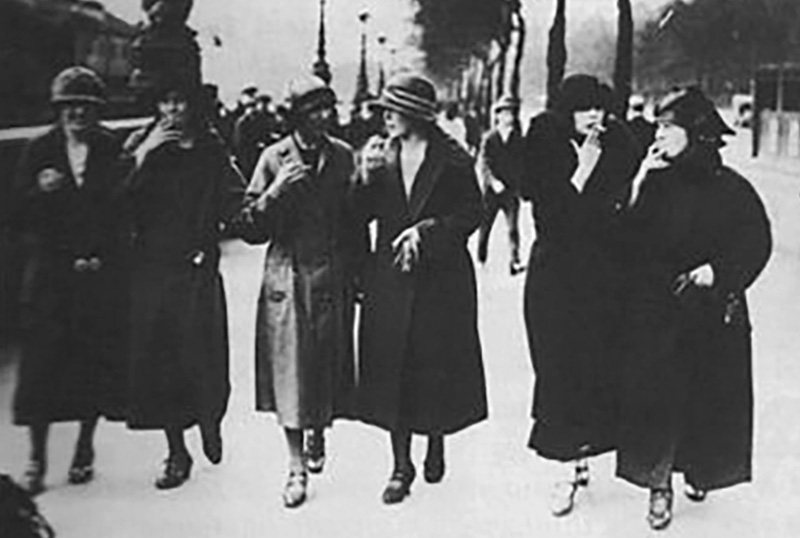
Bernays considered news stories more powerful than advertisements. So, he staged an event at the 1929 Easter Sunday Parade, in New York. Bernays paid rich debutantes to join the parade with cigarettes hidden under their clothes. He instructed them to dramatically light their cigarettes, on his signal. He then informed the press that a group of suffragettes intended to protest at the event, by lighting their “torches of freedom.”

With this stunt, Bernays reframed smoking as a means of emancipation. He linked one’s choice to smoke with her support for the women’s liberation movement. The media had a field day with the story. Even feminist Ruth Hale said: “Women! Light another torch of freedom! Fight another sex taboo!” Cigarette sales to women rose.

Show or tell?

In promoting your business, you probably attempt a rational approach. Maybe you talk about the features or benefits of what you’re selling. Perhaps you use facts, figures, research, or testimonials to make your case. Tell me this: How often does your sensible appeal go ignored?

Persuasion can be a more effective tactic. Consider your buyer’s desires, and the power of suggestion. Entitlement: “Because you’re worth it.” Empowerment: “I want my MTV.” Permanence: “A diamond is forever.” Safety: “Nobody ever got fired for buying IBM.” Excitement: “Red Bull gives you wings.” None of these famous phrases speak to facts. For humans, though, feelings often trump facts.

Nefarious tactics—but a sound example

I’m not praising Bernays techniques. His campaign resulted in countless illnesses and deaths, from cancer. It’s equally horrifying to consider those who subsequently exploited his methods. For example, Joseph Goebbels was a fan of Bernays’ work. He used these techniques to advance the Third Reich and slaughter millions.

I don’t propose you use Bernays’ methods. In fact, I’d rather such manipulation could be avoided altogether. Nevertheless, it’s important to recognize the way persuasion works—and how impervious emotions are to facts. (Especially in light of current events.)

OK—that’s it. I need to wrap this up and grab myself a glass of raw water.

The post Feelings Trump Facts appeared first on Eric Karjaluoto.

22 Jan 06:20

Letter of Termination

by Dave Pollard


image from Fill at Pixabay CC0

Dear Powers That Be Consortium:

This is to inform you that the services your organizations have been providing to us, as our agents, no longer meet our needs, and we are terminating our agreement (the Industrial Civilization Management Agreement) with you and will in future provide the needed services directly ourselves.

Following is a partial listing of some of the ways in which your consortium member organizations have abrogated the spirit and substance of our long-standing agreement with you, leaving us no alternative but to take this step:

Representative Democracy LLC: Your “representatives” have not represented us at all. They have lied to us. They have taken bribes, and in return lavished gifts, from money we entrusted to them, on rich and powerful interests, to our overwhelming detriment. They have not upheld the laws designed to protect us or our environment, and have instituted laws that do the opposite. They have incompetently managed our services and our resources. They are all herewith fired; we will henceforth manage our common resources and public services locally and directly. The experiment with their service delivery model of “representative democracy” has been an abject failure. We will try an “uncivilized” approach — community-based direct democracy — instead.

Industrial Growth Economics LLC: The “executive officers” you assigned to our account are utterly incompetent, narcissistic, and hopelessly corrupted. They seem utterly incapable of taking any action in the public interest. The model you instituted on our behalf ironically called the “free market economy” is the precise opposite: it is an oligarchy of obscenely rich and powerful overlords sucking up the commons — our resources — for their own personal enrichment, impoverishing us in the process. Their gargantuan fees for worthless and destructive “services” are unwarranted and must be returned to us. They too are all fired, and ordered to immediately return everything they have taken from us, including all assets they have purchased with the proceeds of their unconscionable “salaries”, bonuses, dividends and capital gains, and we ask that they leave our premises immediately. Their ruinous economy will be dismantled and replaced, gradually, with a non-hierarchical, egalitarian, locally-based gift economy.

Neo-Liberal Education Services LLC: The officers and “ministers” of this organization have created a massive and dysfunctional centralized system that has neglected our young people and forced many of them into indentured servitude to your other member organizations. We are abolishing the entire system. Some of the prison-like buildings they have constructed for so-called education will be converted into housing for those they have impoverished and for entrepreneurial offices to support the new gift economy. Over the coming years a system of locally-mentored, self-directed learning (deschooling and unschooling) will be introduced to teach our young people, finally, how to learn and how to discover what they are meant to do with their precious lives.

Public Private Health Services LLC: The “privatization” of public health by the czars of this organization is terminated immediately. Health services will hereinafter be a right of all people, and will be offered free of charge. The patients they have made dependent on the medical and pharmaceutical “industry” with its exorbitantly-priced products and specialist services catering mainly to elites with diseases of affluence, will soon learn how to self-manage their health through sound nutrition and exercise, simple self-diagnosis and holistic self-treatment, guided by local medical generalists. Our research indicates that this will increase the healthy life-span of our citizens by several years, at a fraction the cost the “industry”, and its parasitic insurance companies and lawyers, have been charging.

Monoculture Industrial Foods LLC: The titans in charge of this organization have perpetrated cruelty and caused illness far beyond anything in the history of our planet. They have addicted us to overpriced junk, monopolized and privatized on a massive scale a resource that truly belongs to all of us. They have confined and tortured billions of living creatures. They have poisoned our food, our water, and our land. They have replaced the nutritious staples of millennia of human adaptation and cultivation with over-packaged, over-processed, unhealthy, toxic foods that are responsible for the soaring rates of chronic diseases afflicting nearly all of us. They have ruined our soil, desolated our forests and exhausted and befouled our seas. We are taking it all back, and beginning the long road back to healthy, organic, diverse, locally-produced food using permaculture principles.

Centralized Utilities LLC: Along with good food, good health and a safe and healthy planet, our birthright includes the rights to light, warmth, clean water, and accurate information. The executives of this organization have stolen that birthright, charging us for modest use of what should be free, and using those charges to subsidize destructive and monopolistic corporations that have fouled the planet and its atmosphere with hydrocarbon wastes, production by-products and pollution, and exhausted these precious resources to the point our dependence on them now imperils our very existence. We are halting all utilities’ and other energy extraction activities that produce greenhouse gases immediately, and phasing out all non-essential and centralize utility operations as quickly as the shift to renewable, community-owned utilities can be put in place. We are immediately halting the production of bottled water, incandescent lightbulbs, and other inexcusably wasteful products using our precious resources. And we are dismantling the oligopolies of mainstream media, social media, and telecommunications.

Defence & Security Partners LLC: Your generals and chiefs and head wardens, and their business friends who manufacture weapons, have made our planet and people much less safe —unsafe in fact, squandered trillions of dollars needlessly, encouraged and armed wars between our people, militarized law enforcement, and made imprisonment into a cruel, profiteering enterprise. This is the opposite of what they were hired to do for us. With them gone, we will begin the hard, generations-long task of re-enabling local communities to look after their own security with minimal incarceration, and working with fellow citizens everywhere to demilitarize our world and destroy the massive arsenals of weaponry they created. We will do this work with the understanding that the best way to avoid conflict is through eliminating inequality and hardship.

You, the Powers That Be, have worked complicitly with each other and with the aforementioned consortium members to steal from, betray, defraud and intimidate us. You have clearly been counting on our unwillingness to terminate this agreement because of its centuries-long history and the massive task that will be entailed in untangling it and restoring the horrific damage you have done to us, our social fabric and our planet. We have finally come to realize just how much damage has been done, and that it must no longer continue.

What surprises us most is that we believe that your consortium and its members were, at least initially, doing what they thought was in all our best interests. As tempting as it is for many of us to find you to blame for your actions and the damage they have done, we have concluded that you were actually doing your best, based on what you have been taught, and in some cases brainwashed, to believe. So we don’t want punishment, just a return to us of the resources we mistakenly entrusted to you, so that we can begin to undo the damage. And for you to get out of the way so that we can do that work.

Respectfully,

The People of Earth

22 Jan 06:20

Twitter Favorites: [moore_oliver] A wrinkle of #UPX serving the commuter market is the weirdness of having two different types of Presto machines in… https://t.co/YmRabe7G5M

Oliver Moore @moore_oliver
A wrinkle of #UPX serving the commuter market is the weirdness of having two different types of Presto machines in… twitter.com/i/web/status/9…
22 Jan 06:17

E-Bikes: Zahl der schweren Unfälle steigt an

mkalus shared this story from heise online News.

Der Trend zu E-Bikes hält an und mit mehr Rädern steigt auch die Anzahl der Unfälle. Senioren waren besonders oft an Pedelec-Unfällen beteiligt und auch die Zahl der Toten steigt.

Mit der Anzahl der E-Bikes wächst auch die Zahl der schweren Unfälle: In den ersten neun Monaten des Jahres 2017 seien bundesweit knapp 4300 Unfälle mit Personenschäden registriert worden, an denen die oft auch als Pedelecs beteiligt gewesen seien, teilte das Statistische Bundesamt mit. Dies seien 28 Prozent mehr als im Vorjahreszeitraum. In Niedersachsen seien bei der Anzahl der tödlich verunglückten sowie der schwer- und leichtverletzten Pedelec-Nutzer für 2017 Steigerungen im Vergleich zum Vorjahr festzustellen, teilte das Innenministerium in Hannover mit. Auch in Bremen habe es mehr Verletzte gegeben, sagte Polizeisprecher Nils Matthiesen. Genaue Zahlen wollen die Innenressorts zu einem späteren Zeitpunkt bekanntgeben.

Laut des Fahrrad-Clubs ADFC gibt es in Deutschland mittlerweile rund 3,5 Millionen Pedelecs. Allein 2017 seien knapp 700 000 neu hinzugekommen, ein Anstieg um rund 25 Prozent. Grundsätzlich sei der Anstieg der Unfallzahlen durch die steigende Zahl der E-Bikes zu erklären, sagte ADFC-Sprecherin Stephanie Krone. Der Unfallforscher Siegfried Brockmann weist auf die steigende Zahl älterer Verkehrsteilnehmer hin, die Fahrräder mit zusätzlichem Elektromotor nutzen: "Der Anteil Älterer an Pedelec-Unfällen ist überdurchschnittlich hoch." Zudem steige die Zahl illegal getunter Pedelecs, die schneller fahren als die erlaubten 25 Stundenkilometer, sagte Brockmann, der die Unfallforschung der Versicherer (UDV) leitet.

Doppelt so viele Todesfälle

Nach Angaben des Statistischen Bundesamtes sind 2017 bis September 55 Pedelec-Fahrer ums Leben gekommen. Die Zahl der Toten für das gesamte Jahr dürfte damit voraussichtlich etwa doppelt so hoch sein wie 2014, dem ersten Jahr, in dem das Bundesamt Pedelec-Unfälle erfasst hatte. Damals gab es 39 Todesopfer.

Die Zahl der Elektrofahrräder werde weiter steigen und damit auch die Zahl der an Unfällen überproportional stark beteiligten Senioren, sagte Unfallforscher Brockmann. "Viele ältere Menschen fahren durch die Unterstützung des Elektromotors viel schneller, als es ihre Fähigkeiten eigentlich erlauben." Das führe vielfach zu Kontrollverlust und Stürzen. ADFC-Sprecherin Krone rät Älteren dazu, sich nicht ohne Vorbereitung auf ein Pedelec zu setzen: "Wer viele Jahre nicht mehr Fahrrad gefahren ist, sollte sich vor der ersten Ausfahrt mit dem Antriebs- und Bremsverhalten vertraut machen." Jeder dritte Unfall mit einem Pedelec sei die Folge unangepasster Geschwindigkeit.

Zu hohes Tempo

So starb kurz vor Weihnachten in Bremen ein E-Biker, als er mit überhöhtem Tempo frontal mit einem Fahrrad kollidierte. Brockmann plädiert für eine technische Lösung: Die Unterstützung, die der Elektromotor liefert, sollte an die Kraft gekoppelt sein, die Fahrer selbst aufwenden. "Wer langsam tritt, bekommt nur wenig Motorleistung oder wird im Tempo gedrosselt", schlägt Brockmann vor. "Das wird dazu führen, dass Senioren mit dem E-Bike nicht mehr schneller fahren können als Fahrradfahrer."

Besonders gefährlich wird es aus Sicht des Unfallforschers, wenn E-Bikes getunt werden. Das greife immer mehr um sich. So verfolgte die Polizei jüngst in Soest (Nordrhein-Westfalen) einen Radler, der sein getuntes Mountainbike bis auf 60 Stundenkilometer beschleunigte. In Erfurt flüchtete ein E-Bike-Fahrer mit hohem Tempo vor einer Polizeikontrolle. Auch er hatte sein Pedelec getunt. Vom E-Bike-Tuning riet der Unfallforscher ebenso ab wie der ADFC. Die Gefahr werde sonst vor allem für Ältere unkalkulierbar groß. Und illegal sei die Aufrüstung zumeist auch. (dpa) / (dpa) / (hcz)

22 Jan 06:17

Create an app without knowing code

by Paul Jarvis
There are so many possibilities to create an app or a website with a lot of functions and features but without ever looking at the source code.
22 Jan 06:15

Twitter Favorites: [Sean_YYZ] Streetcar tracks, disused since 1954 and since paved over, are reappearing on Church Street near Wellesley. https://t.co/F5C1z4gxbh

Sean Marshall @Sean_YYZ
Streetcar tracks, disused since 1954 and since paved over, are reappearing on Church Street near Wellesley. pic.twitter.com/F5C1z4gxbh
22 Jan 06:15

„Königsberger Klopse“ nach Omma

by Ronny
mkalus shared this story from Das Kraftfuttermischwerk.
Ich habe mal wieder gekocht. Wie ich alle paar mal Tage koche, ohne der Welt da draußen davon zu erzählen. Heute halt mal schon. Es gab „Königsberger Klopse“ nach dem Rezept von Oma. Ich mag die lieber mit ordinären Salzkartoffeln, aber der Rest der Familie hat „Kartoffelpü“ für sich eingefordert, also bin ich dem gerecht geworden.

Was wir brauchen:

Für die Klopse
• 1,5 KG gemischtes Bio-Hack
• 3 gehackte und in Butter karamellisierte Zwiebeln
• 2 gekochte Kartoffeln
• ein olles in Milch aufgeweichtes Brötchen oder zwei Scheiben in Milch aufgeweichtes olles Toast
• 2 Eier
• ordentlich Salz
• ordentlich Pfeffer
• 2-3 EL gehackte Petersilie
• die Zeste und den Saft einer halben großen Zitrone
• 3-4 EL trockenen Weißwein
• 150 Gramm Schmand

Ich hatte von heute Morgen noch eine halbe Avocado da. Kam dann gequetscht mit den gekochten Kartoffeln und dem in Milch aufgelösten Toast in den Pott.

Die Zwiebeln vorher in etwas Butter anbraten und mit bissl Petersilie karamellisieren. Dann alles in eine Schüssel geben und mit dem Knethaken durchkneten. Geht auch per Hand, dann durchmengen. Die Masse kühl stellen.

Lasst Semmelbrösel weg – wir haben nicht mehr die 50er Jahre.

Für die Brühe:
• 1 Bund Suppengrün
• 150 Gramm Butter
• 4 EL Zucker
• 500 ml trockenen Weißwein
• ein Lorbeerblatt
• ein Pimentkorn
• eine Wacholderbeere
• ordentlich Salz
• ordentlich Pfeffer
• eine halbe Zitrone
• eine Zwiebel
• 2-3 Liter Wasser

Butter zerlassen. Suppengrün, Lorbeer, Piment, Wacholderbeere, halbe Zitrone und Zwiebel darin anbrutzeln. Den Zucker drüber – kurz karamellisieren lassen. Mit Weißwein ablöschen und den dann auf ein Drittel runterköcheln lassen. Das Wasser drüber. Kurz dolle aufkochen und dann simmern lassen.

Aus dem Hack Klopse formen. Je nach Belieben die Größe bestimmen. In diesem konkreten Fall hier werden es dann 20-25 Stück. Kann man, und machen wir hier so, auch Morgen und Übermorgen noch essen. Wenn nicht, dann einfrieren.

Dann die Klopse bei kleiner Hitze in die Brühe geben. Nicht kochen lassen. Wenn die Klopse oben schwimmen, sind sie durch.

Klopse rausnehmen und abgedeckt zur Seite stellen.

Das Gemüse aus der Brühe holen. Den Rest kurz aufkochen lassen.

Für die Soße:
• die seicht kochende Brühe von oben
• Mehlschwitze aus 150 Gramm Butter und dementsprechend viel Mehl
• 200 Gramm Saure Sahne
• 200 Gramm Schmand
• etwas Bio-Brühe
• Salz und Pfeffer nach Geschmack
• 200 Gramm Kapern samt deren Saft
• gehackte Petersilie

Mehlschwitze aus Butter und Mehl schmelzen, in die Brühe geben. Saure Sahne, Schmand, Salz, Pfeffer und Petersilie dazu geben. Zum Abschluss die Kapern. Viele Kapern <3!

Ihr nebenbei noch schnell die Haare wieder schön machen:

Ich mag dazu total gerne und ganz trivial Salzkartoffeln. Die Familie wollte Kartoffelpü. Geht auch. Das bekommt ihr aber auch ohne Anleitung beides selber hin.

Ich bin so satt.


*börps*

Guten Appetit!

21 Jan 04:45

Tells

by Eric Karjaluoto

He makes eye contact, fidgets with his cigarette, or rocks back and forth in his chair. Each of these might be a tell. In poker, a tell signals information about the player’s hand. These changes in behavior/demeanor show incongruity between the presentation and actuality. For example, if his hand is crap, he might act forceful—and vice versa.

Can you spot the difference?

In a digital world, it’s easy to fake a credible presentation. Let’s say you’re starting a management consultancy and need a website. Odds are you’ll Google similar consultancies. Then, you might cut-and-paste their website text—and adjust it to suit your needs.

If you’re honest, this is a starting point you create something new from. If you aren’t, you might use the text as is—even if you can’t do what it says. (This also results “Me Too” marketing, but I’ll talk about that some other time.)

Decision making is harder for buyers when vendor presentations are so similar. Since they can’t trust words, they look for other ways to verify your claims. They ask for references. Or, they check review sites. Unconsciously, they also look for tells.

“This feels wrong.”

Knock-offs often have tells. For example, you can spot a fake Louis Vuitton bag. These have sloppy stitching, cheap lining materials, hollow hardware, and tilted patterns. An attached tag is another tell. So are lower-than-market prices (duh). And if a street vendor is selling it, it’s a fake.

Tells can be minor gaffs that most don’t recognize. Someone referring to herself as a “graphics” designer isn’t a skilled graphic designer. An executive who fails to remove the embroidered label from his coat sleeve is faking it. Meanwhile, a developer who overuses acronyms—or confuses them—is a noob.

Sometimes you can’t quite identify the tell, but you can feel it. When asked about such matters, you’ll say that you “trusted your gut”. Tells informed this perception.

I make note of tells (or brand missteps) I spot in the wild. Here are a few that made me smile:

Sometimes a home-spun sign is charming—but not this time.

If it’s so fresh, why is Pacman green and vomiting?

Not every business should focus on the impact it makes.

“So what if the letters aren’t perfect? Who’s gonna notice?”

Does this mean this brewery’s beer is piss?

When the tells are wrong

Good poker players use fake tells to their advantage. Shady companies do the same. As such, ones that don’t deserve our trust sometimes get it. Meanwhile, good companies—that aren’t competent at branding—sometimes don’t.

Their website highlights the wrong features. Their corporate typeface doesn’t match the company’s stature. Their mission statement is weird. Or, their staff seem unprofessional.

When a good company makes these mistakes, they aren’t tells. They’re misalignments. The brand manager needs to recognize such inconsistencies—and correct them. She might rewrite the website copy, update the visual identity, or contemplate the organization’s purpose. Or, she might ask the cashiers to stop swearing.

If your company doesn’t have a brand manager, you (the owner) are the brand manager. That means it falls on you to make sure every aspect of your brand is in alignment. In an upcoming post, I’ll provide suggestions on how to start correcting brand misalignments.

The post Tells appeared first on Eric Karjaluoto.

21 Jan 04:45

"Could you tell me what the value is to democracy from political gerrymandering? How does that help..."

“Could you tell me what the value is to democracy from political gerrymandering? How does that...
21 Jan 04:45

"British 15-year-old gained access to intelligence ...

mkalus shared this story from Fefes Blog.

"British 15-year-old gained access to intelligence operations in Afghanistan and Iran by pretending to be head of CIA, court hears"

Wait, what? Ein Brite auch noch!

The teenager persuaded call handlers at an internet giant that he was John Brennan, the then director of the CIA, to gain access to his computers and an FBI helpdesk that he was Mark Giuliano, then the agency’s Deputy Director, to re-gain access to an intelligence database.

He also targeted the US Secretary of Homeland Security and Barack Obama's Director of National Intelligence from his semi-detached council house in Coalville.

Und ich bin mir sicher, das wäre alles unter den Teppich gekehrt worden, aber er hat es persönlich werden lassen.
Gamble taunted his victims online, released personal information, bombarded them with calls and messages, downloaded pornography onto their computers and took control of their iPads and TV screens, a court heard.
OK, wenn beim Superbowl ungefragt der Kanal wechselt, dann kennen die Amis da keinen Spaß.

Was ich ja das tollste an der Story finde: Der hat sich nicht in die CIA gehackt. Der hat sich in die privaten Accounts bei Verizon und AOL gehackt. Und da hat er die geheimen Daten gefunden. Die hätte der CIA-Direktor selbstverständlich nicht nach Hause mitnehmen dürfen, aber darüber verlieren die jetzt natürlich kein Wort.

21 Jan 04:44

NewsBlur Blurblog: Playing video games as meditation

sillygwailo shared this story from kottke.org.

For GQ, Lauren Larson says that playing The Sims 2 is the closest thing she has to meditation.

Though I am a renowned fidgeter, I do not fidget. I am aware of the woke bikers who smoke below my window sharing their thoughts on “Cat Person,” but I feel no anger. I do not pause for snacks. I do not check my phone. I do not notice as day turns into night. My mind is clear. The Sims, agrees our photo editor Jared Schwartz, “is HELLA therapeutic.” It is the closest thing I have to meditation.

I’ve written before about how playing games on my iPhone, particularly Alto’s Adventure, has helped me through anxious times in my life.

I started playing the game when I was stressed or anxious. It became a form of meditation for me; playing cleared my mind and refocused my attention on the present. Even the seemingly stressful elements in the game became calming. The Elders, who spring up to give chase every few minutes, I don’t even notice anymore…which has become a metaphorical reminder for me to focus on my actions and what I can control and not worry about outside influences I can’t control.

I’ve also noticed this with Ski Safari, a game that came out more than 5 years ago that I still play when I want to relax. Which is funny because in the game, you control a skier trying to keep ahead of the constant avalanche following you, and if the avalanche catches you, you die. Sounds stressful, right? But as you get better at the game, the avalanche becomes less of a concern. You can’t do anything about it — as in life, the potentially crushing weight of something is always bearing down on you — so, you focus on being in the moment, controlling what you can control, and get on with your skiing.

For me, playing these games isn’t just meditative in the form of stress relief but also as a path to personal philosophical insight. The ideas of living in the present and emphasizing control over your reactions to external events (rather than to the events themselves) are found in ancient philosophies like Stoicism and Buddhism. It’s one thing to read about these things, but it was helpful to realize them on my own, in the simplified and sandboxed environment of video game play. And I keep going back to them because it reminds me to focus on practicing those things in the real world as well.

Tags: Lauren Larson   video games
21 Jan 04:44

iOS 11’s Lower Adoption Rate

by Federico Viticci

Rene Ritchie shared a comparison of iOS adoption rates over the years (starting with iOS 7 in January 2014) and, so far, iOS 11 has the lowest adoption of all major updates, four months after their public release.

Looking at the numbers, you can see a decline in the transition from iOS 7 to 8 (iOS 7's troubled rollout affected millions of users for months), a stabilization with iOS 9 and iOS 10, and another decrease with iOS 11 this year.

I see two potential reasons for this. With iOS 11's 32-bit cut-off, it's very likely that a good percentage of users who would have updated simply couldn't because they were on older hardware not supported by iOS 11. More importantly though, the widespread perception that software updates make Apple devices slower isn't helping adoption rates. This time, Apple itself had to confirm that iOS 11 did, in fact, throttle iPhone performance to compensate for aging batteries (a perfectly fine motivation, terribly communicated to customers from a software design and PR perspective).

A couple of weeks ago in our 2018 Apple predictions episode on Connected, I mentioned that I believe iOS 12 will have a focus on speed and performance as a tentpole feature, specifically called out at WWDC as an important effort by Apple's engineering teams. This is just my personal theory, but I don't think new emoji and Animoji will be enough to convince reluctant users to update their iPhones later this year. If Apple wants to counter the narrative surrounding iOS 11 and see these adoption rates pick up again, I think they'll have to demonstrate – not merely promise – that their next software update will have practical, tangible benefits on the everyday usage of an iOS device.

→ Source: twitter.com

21 Jan 02:42

On Second Thought and Viewing…

21 Jan 02:39

Building a worksheet for rhizomatic learning in the k12 classroom

by dave

The first paper I wrote on rhizomatic learning turns 10 this year, and if you’d told me that I was every going to write the word ‘worksheet’ and ‘rhizomatic learning’ in the same blog post i would have coughed my coffee on my keyboard.

And yet, here I am.

Two years ago I committed to using the Arduino to model rhizomatic learning and, for the last year, I’ve been leading the digital strategy for k12 in my province here in PEI. Next week we start the next phase of our work and start looking at how we can integrate microcontrollers and maker activities (and coding) into various parts of the curriculum in our schools.

But how to teach it?

And, more importantly, how do we support teachers (many of whom don’t currently use these approaches) in such a way that they don’t fall back to step by step approaches to using it. Because, i have to tell you, it’s really REALLY hard in the real world not to just tell people what to do with a microcontroller. I’ve found that each time I have this crazy urge to just go “look, plug this in here, nail that over there…” Technology is hard. The multitude of travelling road shows that make this stuff look attractive in the classroom might look snazzy when you see them, but the practicalities of using this stuff in the classroom can be overwhelming.

And yet… I want students to be able to follow their own paths with this stuff. To create a curriculum by interacting with their community. I want them to build connections to what they already know in an organic, authentically student lead manner.

To design things we can’t ourselves imagine.

Some challenges
Technology projects are hard
I have yet to find a limit to the possible impediments to a wide open “lets play with this to make something cool” approach to using microcontrollers in the classroom. I’ve had people straight out panic at the ideation point. I’ve had people go down a rabbit hole of something that was entirely impossible (at least, as far as i could tell). I’ve had people with full circuit boards with one wire out of place that we couldn’t find. lack of tools/resources appropriate to the task. Boredom. Frustration. Fine motor skill challenges. Organizational weaknesses. I mean… I could do this all day.

Error identification
lets assume that someone has a reasonable idea and a reasonable path to get there… sometimes it doesn’t work. Why doesn’t it work? Well… if i had time to sit down with it for 5 minutes I might be able to figure it out, but when 10 other people need my attention, i never get 5 uninterrupted minutes to look at it. Troubleshooting these things is partially about experience, but its also about process. Once your other students become more proficient, this isn’t such a problem… but first day… the day that will convince the teacher that this is really a terrible idea… those other kids aren’t always a whole lot of help.

Knowledge gaps
Some of that knowledge gap is simply mine as a teacher. Hey dave, any idea what voltage this is at? Hey dave, can i plug this in here? Hey dave… you get the idea. And, of course, in a rhizomatic classroom this should be student lead. But the internet is not generous to the uninitiated in this kind of technology. The forums can be terse and distant and, in some cases, totally unresponsive. Can i really let a kid wait 2 days for an answer to a question? And, as that question is a fact “what voltage does this thing need to be at?” finding it is not discovery (outside of effective searching practices which are important…) doesn’t it make more sense if i can save their time for the truly explorative part of this. Plus… I want lots and lots of teachers to be able to do this. Some structured resources are going to make creativity easier? Right?

Concepts of success
So much of our schools system is built around things being finished. Success is having a project done and presenting it. Finishing the paper. Finishing the test and getting a grade. many of these projects will not work OR get finished. The existing social contract does not really favour this. We need to provide a scaffold on which students can build their own sense of success.

All kinds of other feelings

“Educational research says:” you need to give people a clear sense of what success looks like. While I agree that having people understand the contract under which you are using your power as a teacher is important its that word ‘clear’ that gets me into trouble. I like learning to be messy. Like life. When you don’t give people a clear sense of what success like, we enter a whole realm of real (and super important) human feelings that we need a way to address. WHAT AM I SUPPOSED TO DO!!?!?

A worksheet
So I’m working on a worksheet for a core project. (it’s setup for comments. Feel free to go ahead and tell me what you think)

The project i’m designing this around is an elastic launcher

Arduino project unlocked. Attacked by my own children

A post shared by Dave Cormier (@cormierdave) on

It’s a pretty simple project from a tech perspective. At its core is an arduino uno, a button and a servo. Combine code from two into one… ur done.

Project management
The left side of the worksheet is for the project management pieces. What are your goals? How will you know you’ve reached them? What approaches are you going to take to get there. What will you actually do and when?

Put simply, I’m imagining giving this to teachers fully filled out. At least for one version of the project.

Goals (what change are you trying to make)
Main goal
Build an elastic band launcher
Subgoals
Accurate? Beautiful? Easy to use? Sturdy? What kind of launcher is right for you?

Success Measures (how will you be able to measure that change)
If it’s accurate? (i can hit a target five feet away)
Ease of use? (how quickly can people use it?) (Can a five year old use it?)

Approach (what approaches will you use to shape tasks)
Copying a list of actions from an existing model
Working with partners to fill out my task list
Ask for help

tasks and timelines
Process stuff
Getting the thing plugged in
Checking the arduino works (blink)
Checking the button works (button)
Checking the sweep works (sweep)
Building stuff
Trying to combine button and sweep
Building a gun
Getting a base
Attaching the sweeper
Finding a front peg
Attaching both in a reasonable space

The process from here, then, is to have teachers remove the pieces they wish to to allow for more student choice. You might hand out the worksheet with the sub-goal section blank. You might focus on strategy development one day. This approach allows you to develop different kinds of skills and limit the points of complexity on any given project.

Socio Emotional Learning
On the other side of the worksheet is the narrative. How are things going? Am I panicked at the ideation stage? What did I do when I couldn’t get the stupid thing to work? It’s a list of Writing prompts that you may or may not include… but the idea is to create a place for the discussion around the feelings that people are having related to the projects. Are you nervous about building? is it really just boring for you? Do you feel like its a rote process?

Goals
Ideation challenges
What if my goal isn’t cool enough?

Success measures
How do i measure things like beauty
How accurate do i need to be?

Strategies
My partner isn’t doing any work
Aren’t i just copying their work?
How much should i have done before i start working on that?
I can’t get the teacher’s attention
What should i know to ask for help as effectively as possible
Is this too much work? Can i make it easier?

Tasks and timeline
OMG what are they saying? I can’t read this
What are these little lines for on the resistors?
What happens when i can’t get it to work
What materials should i choose?

What I’m getting at
What I’m trying to do with this worksheet is scaffold the classroom experience so that 25 kids can all have some kind of success in the work they’re doing. They could be really successful in their reflection on feeling helpless when faced with this task. Most (all?) should be able to do the initial rote work that will be part of the testing phase for the technology. The tracking of their timelines and tasks will give them success markers and also allow them to return to the work two weeks later and find the place they were at.

Does this still retain enough creativity? Does it still allow learners to learn rhizomatically? Well. It still depends on the teacher. If you do a few like this will you be able to remove the shackles and let them just build? I hope so. Maybe they’ll be able to translate these skills to home and take a more rhizomatic approach there.

What I do know… is that the scaffolding is necessary. It wont be fair to teachers or students without it.

Thoughts?

21 Jan 02:39

Twitter Favorites: [carnivorous8008] I like chicken and pork for savoury dishes, roasting the bones (or using a roast chicken carcass) adds depth 100%… https://t.co/XzetQkbxbw

M̵̟̜̬̭̜a̦̥̭͈͟t̴̫t̶̫̖̤ ̼͓͝O͕̻̭̥̬̮ͅḷ̗̳͘so̖̫͠n @carnivorous8008
I like chicken and pork for savoury dishes, roasting the bones (or using a roast chicken carcass) adds depth 100%… twitter.com/i/web/status/9…
21 Jan 02:39

Twitter Favorites: [andreathegiant] #WomensMarch2018 #womensmarchSF https://t.co/Eju74ehxKO

21 Jan 02:39

Twitter Favorites: [Lesley_NOPE] Today was better than I could have imagined! The activities were so creative, the opportunities to meet players ple… https://t.co/syAKEaXFqQ

Sleeve Fierce @Lesley_NOPE
Today was better than I could have imagined! The activities were so creative, the opportunities to meet players ple… twitter.com/i/web/status/9…