Shared posts

29 Jan 21:52

More brand safety bullshit

There's enough bullshit on the Internet already, but I'm afraid I'm going to quote some more. This time from Ilyse Liffreing at IBM.

The reality is none of us can say with certainty that anywhere in the world, we are [brand] safe. Look what just happened with YouTube. They are working on fixing it, but even Facebook and Google themselves have said there’s not much they can do about it. I mean, it’s hard. It’s not black and white. We are putting a lot of money in it, and pull back on channels where we have concerns. We’ve had good talks with the YouTube teams.

Bullshit.

One important part of this decision is black and white.

Either you give money to Nazis.

Or you don't give money to Nazis.

If Nazis are better at "programmatic" than the resting-and-vesting chill bros at the programmatic ad firms (and, face it, Nazis kick ass at programmatic), then the choice to spend ad money in a we're-kind-of-not-sure-if-this-goes-to-Nazis-or-not way is a choice that puts your brand on the wrong side of a black and white line.

There are plenty of Nazi-free places for brands to run ads. They might not be the cheapest. But I know which side of the line I buy from.

21 Jan 04:46

This is actually a big deal for Ontario: Chief of staff for ex-Ontario premier Dalton McGuinty found guilty in gas plants trial j.mp/2mTla4b via @nationalpost pic.twitter.com/klckLMK9B2

by jordanbpeterson
mkalus shared this story from jordanbpeterson on Twitter.

This is actually a big deal for Ontario: Chief of staff for ex-Ontario premier Dalton McGuinty found guilty in gas plants trial j.mp/2mTla4b via @nationalpost pic.twitter.com/klckLMK9B2


Posted by jordanbpeterson on Saturday, January 20th, 2018 1:26am


144 likes, 68 retweets
21 Jan 04:45

Ebike Your Way Through The Winter Chill

by Blix PR

Using an electric bike as your primary means of transportation is amazing. Riding through the summer months is probably one of the greatest perks. Soaking in the sun's rays, working on your tan and not having to pay for parking - what more can you ask for...

However, winter, cold as it may be, is not without its own silver linings. Avoid the rammed public transport and jammed highways as the majority of people try to avoid the elements.

As long as you follow these four steps you will be well equipped to ebike your way through the winter!

1) Fenders, Fenders, Fenders!

When riding around in dry conditions, we often take our fenders for granted. Some cyclists don’t even have fenders on their bikes, and that's fine. When it comes to the winter months though, rain, snow, and even worse mud can lead to a very bad scenario! Fenders don’t just protect you from all kinds of dirt spray landing on your pants, coat and possibly, even face. They also protect your bike’s components potentially limiting the amount of maintenance and cleaning you have to do after your ride. All our Blix Electric Bikes (With the exception of our foldable Vika Travel) come fully equipped with front and rear fenders so you don’t have to worry about outsourcing bike parts and making sure they match and fit!

Blix Top Tip: Riding in the wet? You’re safe on your Blix bike but if you see a cyclist ahead of you who has not read this post and does not have fenders steer clear! Their back tire won’t just ensure that rider is a mess at the end of his or her journey, it will also spray you if you get too close!

2) Layer up!

So riding an ebike is as strenuous as you would like it to be. If you don’t want to put in too much effort and you are going to let the bike do the work for you then you have to dress warmer than if you were going to be doing most of the cycling yourself. The physical activity of cycling will warm up your body temperature so we have to factor that into our outfit.

Think "Essentials": Good quality waterproof gloves and a hat to wear under your helmet will keep your extremities warm. These are the most susceptible areas to getting cold and should be covered up. According to cycling experts when cycling during the winter, we should not wear heavy coats. Instead, we should opt for layers. Starting with a moisture-wicking layer against your skin to keep you dry and topping off with a windbreaker to keep you warm.

In a recent interview with NBC4, David Hohmann, an experienced winter rider, said he did not just jump into riding to work on a cold day. “I started out as a fair-weather bike commuter, and then I gradually extended it to more difficult days.”

Like everything finding the perfect amount of layers to wear takes practice.

Blix Top Tip: Step outside for a temperature check before you set off. You don’t want to feel totally warm. In fact,  you should still feel a little cold since cycling will warm you up!

3) Be Prepared!

Riding in the cold is one thing but standing around in the cold? That’s a different ball game! Rain often washes more debris onto the roads. To top it off, wet road conditions increase the possibility of shards of glass and sharp pieces of flint puncturing your tire. Often times, if you do experience a puncture, it will be at the worst time possible! That’s why you should be prepared even if you are blessed to never have to change a tire. Check out our video to make sure you know how to!

Blix Top Tip: The winter temperatures can lower your tire pressure. ( About 1 PSI for every 10 degrees Fahrenheit!) It’s good practice to check your tire pressure monthly.

4) Treat yourself!

It doesn't take much to convince us that we have earned a slice of pie. However, if you do decide to cycle through cold, rain, snow or even a warm summer's day, we would assume that 10/10 experts would agree you've done enough to warrant a slice or two (although we confess that this is complete speculation). So the moral of this point, is that if you're not going to cycle in the worst conditions for the love of it? Do it for the treats!

Blix Top Tip: In the Summer, we tend to remind ourselves more often to stay hydrated. However, we get just as dehydrated, if not more so, riding in the colder months. Use our Blix Roll and Ride water bottle to conveniently keep water on hand.

Share your winter Blix bike commuting fashion moments with us!

Tag us and use #blixbike so we can see how you stay warm!

Blix Bike Facebook   Blix Bike Instagram


21 Jan 04:45

What anti-bikelane advocates don’t want you to see

by Stephen Rees

This is the exact comment blogger Aaron Dixon left on a Victoria, BC anti-bike lane Facebook page that quickly got deleted twice because it was deemed as ‘spam’. Enjoy.

via What Anti-Bike Lane Advocates Don’t Want You To See

20 Jan 00:18

Hotel-blogger dustup: Elle Darby vs. The White Moose Café is a battle of rude losers

by Josh Bernoff

YouTube and Instagram “influencer” Elle Darby asked The White Moose Café in Dublin for some free lodging. The owners of the White Moose responded by ridiculing Darby and banning bloggers. They’re both losers. Learn by observing what they did, and then doing the opposite. Let’s start with Darby. With 90,000 followers on YouTube, she makes … Continued

The post Hotel-blogger dustup: Elle Darby vs. The White Moose Café is a battle of rude losers appeared first on without bullshit.

20 Jan 00:18

Apple says iOS 11 is now installed on more than 65 percent of iPhones and iPads

by Mackenzie Allen
iOS 11 control centre

Apple has released statistics related to iOS 11 adoption and they may be surprising to some.

According to figures, iOS 11 has an adoption rate of 65 percent, with its user base being more than twice that of iOS 10. Additionally, fewer than 8 percent of users are still running iOS 9 or lower.

This is only slightly behind the record-setting adoption rate of 76 percent that iOS 10 achieved this time last year. The number is expected to climb even further after Apple allows users to turn off its much-maligned performance-throttling handicap feature as well.

Even if this rate isn’t quite as impressive as last year’s, it’s still leaps and bounds ahead of its Android equivalent. Google released Android Oreo in August of 2017, yet it currently has an adoption rate of less than 0.7 percent.

Though nothing new, It’s also worth noting that iOS 11 adoption rates still radically outpace the latest version of Google’s mobile operating system, with just 0.7 percent of Android devices running Oreo. 26.3 percent of Android smartphones feature Nougat, which was first released in 2016, and 28.6 percent are still running 2015’s Marshmallow.

Update 01/19/18: This story has been updated for additional clarity.

Source: Apple

The post Apple says iOS 11 is now installed on more than 65 percent of iPhones and iPads appeared first on MobileSyrup.

20 Jan 00:18

No, machines can’t read better than humans

files/images/874806714.jpg.0.jpg

James Vincent, The Verge, Jan 22, 2018


This is a counter to a post published earlier this week suggesting that robots can now read better than humans. Technically, the headline wasn't wrong, but the problem lies in the test. "The test is actually a dataset, compiled by a group of Stanford university computer scientists," explains the author. "It’s called the Stanford Question Answering Dataset (or SQuAD for short)." It poses a set of questions based on a set of Wikipedia articles. But this sort of test is easy, says James Vincent. It's just a pattern matching test, and doesn't require inference or comprehension. 

Web: [Direct Link] [This Post]
20 Jan 00:18

Twitter EDU

files/images/58c3379979b9a75655c456b2f79d7b2c2ad47e68-thumb.jpg

David Truss, Jan 22, 2018


Icon

David Truss has published an eBook on using Twitter in education. According to the blurb, "If you follow along and tweet as you learn, this book will make your entry into Twitter much easier, and enjoyable! It has best practice tips, tricks and explanations that will assist you in building a great network much faster than you could do on your own." The book can be downloaded for free (and there are no signup forms or anything, so I'm already a fan). Available in ePub only. Via Alistair Creelman., who writes, "the real key to success with Twitter is engagement. To get something out you have to contribute. If you show that you provide useful information, ideas and tips then people will follow you."

Web: [Direct Link] [This Post]
20 Jan 00:18

SotD: Travelin’ Prayer

In the mid-Seventies, a women we found with a classified ad moved into my student house, and of course brought her record collection. It included something called Cold Spring Harbor by a guy I’d never heard of, Billy Joel. We were pretty well a heavy-music joint that didn’t listen to fluff without guitar solos, so Billy got no respect then, just like he gets no respect now. But, in among the cheesy ballads there was this song that got way under my skin, and still does: Travelin’ Prayer. It’s great, pretty well flawless.

Cold Spring Harbor

The problem with Billy

I earned my living most of my way through university by stage-managing the rock shows the student council put on, and then eventually the classicoids and jazzbos the University booked. I ran a Billy Joel show sometime probably around 1978, when he’d become a major star on the back of Piano Man.

That song always struck me as dumber-than-average pop. Oddly, his concert contract had all these draconian provisions that he not be referred to as “The Piano Man” in any promotional materials. I was actually impressed that he had the smarts to distance himself from that branding. I even shot the shit with him a bit while we sorted out piano logistics. Pleasant enough, wanted to know about the university he was entertaining.

But the concert was pretty terrible. I mean, he had a good band, and is a good singer and pianist, and the songs were OK, though he didn’t play Travelin’ Prayer. The problem was him not taking the concert or himself seriously. He had a nice line of lounge-lizard patter, was funny as hell actually. But he never broke a sweat or pushed his voice or pounded the piano.

Anyhow, I wrote Billy off as mostly harmless and not nearly intense enough to hit my sweet spot. But once every decade or two I hear Travelin’ Prayer and think “Damn, I like that song.” Maybe you will too. It’s got heart-warming words set to a great, fast, loping melody.

If you’re at all interested in Billy you’ll probably enjoy Thirty-Three-Hit-Wonder, a big New Yorker piece from 2014 about Billy’s later life. I admit to being left with warm feelings about him, a guy who apparently has mostly tried to do the right thing.

This is part of the Song of the Day series (background).

Links

Spotify, Amazon, iTunes, live video - there are a lot, on most of which Billy lapses into self-deprecating smarm, but on this 1975 TV show they take it so fast there’s no time for anything but the music; a hell of a performance and by the way check out the piano break. I wish Billy had taken himself more seriously.

19 Jan 22:46

Our iPhone X Review: The Smartphone of the Future

by Nick Guy
Our iPhone X Review: The Smartphone of the Future
Among Wirecutter staff, the iPhone X just may be the most controversial smartphone ever—but not for the reasons you might think. Most of us agree that it’s the best iPhone ever; many think it’s the best smartphone, period. If you can afford the higher price, the iPhone X is a fantastic phone. It feels like the first “new” iPhone since the original, while the iPhone 8 feels like the last “old” iPhone.
19 Jan 22:45

Twitter Favorites: [bmann] If you started following me recently because of my live tweeting of cooking, you should also follow… https://t.co/uWDP1IMFtI

Boris Mann @bmann
If you started following me recently because of my live tweeting of cooking, you should also follow… twitter.com/i/web/status/9…
19 Jan 22:45

Twitter Favorites: [Lesley_NOPE] This morning ALL of my TTC connections rolled up like clockwork and the elevator arrived on the dot for my medical appt. 🤩🤩🤩

Les Lesburlesquey @Lesley_NOPE
This morning ALL of my TTC connections rolled up like clockwork and the elevator arrived on the dot for my medical appt. 🤩🤩🤩
19 Jan 22:45

This week in references: echoes, breakbeats, the new sound of music

by russell davies

19 Jan 22:45

Peter Mayle gestorben

by Volker Weber

Die Tagesschau berichtet:

Der britische Autor Peter Mayle ist im Alter von 78 Jahren gestorben. Bekannt wurde der Schriftsteller vor allem durch seine Romane und Reisebeschreibungen über das Leben in der Provence.

Das ist ein großer Verlust. Die Scheffin liebt seine Bücher. Mit seinem ersten Werk kann man gut anfangen.
19 Jan 22:45

Stupid is who stupid does

by Volker Weber
In the year 2018, nobody expected human society would need an intervention to stop people from eating (drinking?) laundry detergent. And yet, actual thinking people are recording themselves consuming Tide Pods, which inspires others to follow suit on camera, begetting an endless cycle of Darwinian consequences. According to CNN, YouTube and Facebook have committed to taking down this content, proving so many critics of the internet right.

If this had happened just two years ago, the US might have elected its first female president.

More >

19 Jan 22:45

Using a Bike — Why and How Fast?

by Ken Ohrn

Results of a recent study from UBC asking 260 people about their bike trips — purpose and how fast (among other things).

It’s seems that the 2000+ bike trips were mostly for utilitarian reasons:  75% (school, errand, work).

React.Participant-summary

Also, in the coming months we will share research reports and papers generated from this data on our website.

Dr. Alex Bigazzi
Assistant Professor, Dept. of Civil Engineering and School of Community and Regional Planning, The University of British Columbia

19 Jan 22:45

New (short) book from Microsoft: The Future Computed

by Volker Weber

Sketch

It's a short read about AI and its role in society. Completely free, no registration required.

19 Jan 22:45

Using a Bike — Why and How Fast?

by Ken Ohrn
mkalus shared this story from Price Tags.

Results of a recent study from UBC asking 260 people about their bike trips — purpose and how fast (among other things).

It’s seems that the 2000+ bike trips were mostly for utilitarian reasons:  75% (school, errand, work).

React.Participant-summary

Also, in the coming months we will share research reports and papers generated from this data on our website.

Dr. Alex Bigazzi
Assistant Professor, Dept. of Civil Engineering and School of Community and Regional Planning, The University of British Columbia


19 Jan 22:43

The Foundation Of World Unrest

by Stowe Boyd

Climate Change and Drought Spreading, and Large Regions May Become Uninhabitable

Long-term drought in many countries is leading to the destabilization of vast regions of the earth.

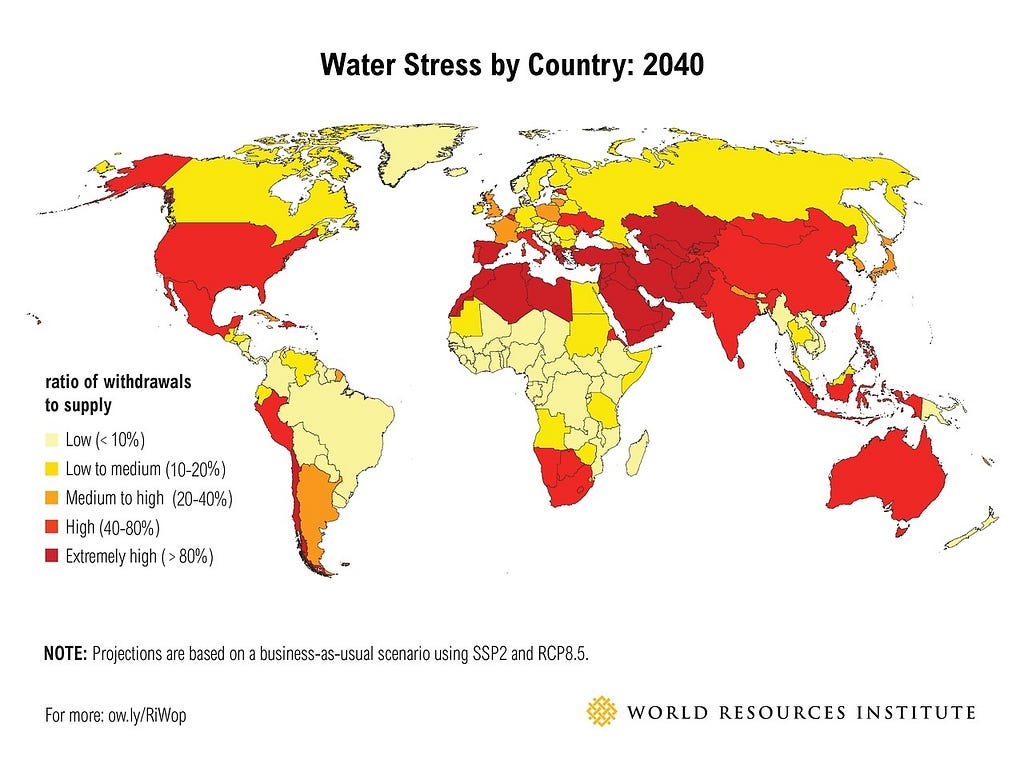
The World Resources Institute has identified 33 countries that face extreme water stress.

Ranking the World’s Most Water-Stressed Countries in 2040 | World Resources Institute | Andrew Maddocks, Robert Samuel Young, Paul Reig
Fourteen of the 33 likely most water stressed countries in 2040 are in the Middle East, including nine considered extremely highly stressed with a score of 5.0 out of 5.0: Bahrain, Kuwait, Palestine, Qatar, United Arab Emirates, Israel, Saudi Arabia, Oman and Lebanon. The region, already arguably the least water-secure in the world, draws heavily upon groundwater and desalinated sea water, and faces exceptional water-related challenges for the foreseeable future.
With regional violence and political turmoil commanding global attention, water may seem tangential. However, drought and water shortages in Syria likely contributed to the unrest that stoked the country’s 2011 civil war. Dwindling water resources and chronic mismanagement forced 1.5 million people, primarily farmers and herders, to lose their livelihoods and leave their land, move to urban areas, and magnify Syria’s general destabilization.
The problem extends to other countries. Water is a significant dimension of the decades-old conflict between Palestine and Israel. Saudi Arabia’s government said its people will depend entirely on grain imports by 2016, a change from decades of growing all they need, due to fear of water-resource depletion. The U.S. National Intelligence Council wrote that water problems will put key North African and Middle Eastern countries at greater risk of instability and state failure and distract them from foreign policy engagements with the U.S.

And the world’s largest economies aren’t protected:

While they will probably not face the extreme water stress blanketing the Middle East in 2040, global superpowers such as the United States, China and India face water risks of their own. High water stress in all three countries are projected to remain roughly constant through 2040. However, specific areas of each, such as the southwestern U.S. and China’s Ningxia province, could see water stress increase by up to 40 to 70 percent.

Can you imagine the wildfires in the southwest and California increasing by 50%? Will our local, regional, and federal governments take that as a starting point? Or are they simeply dreaming that things will ‘go back to normal’? The new normal is that there is no normal.

The recent flare-up of unrest in Iran is not just about the desire for a more relaxed society: it’s at the foundation all about water.

Warming, Water Crisis, Then Unrest: How Iran Fits an Alarming Pattern | Somini Sengupta

Iran is the latest example of a country where a water crisis, long in the making, has fed popular discontent. That is particularly true in small towns and cities in what is already one of the most parched regions of the world. Farms turned barren, lakes became dust bowls. Millions moved to provincial towns and cities, and joblessness led to mounting discontent among the young. Then came a crippling drought, lasting roughly 14 years.
[…]
Climate change is projected to make Iran hotter and drier. A former Iranian agriculture minister, Issa Kalantari, once famously said that water scarcity, if left unchecked, would make Iran so harsh that 50 million Iranians would leave the country altogether.

Iran, like many other countries, is pulling water from its aquifers more quickly than they can be replentished. And when there is less rain farming and industries that are most water-intensive increase the amount pumped up.

Sengupt points to Syria as cautionary tale:

For the leaders of water-stressed countries, the most sobering lesson comes from nearby Syria. Its drought, stretching from 2006 to 2009, prompted a mass migration from country to city and then unemployment among the young. Frustrations built up. And in 2011, street protests broke out, only to be crushed by the government of Bashar al-Assad. It piled on to long-simmering frustrations of Syrians under Mr. Assad’s authoritarian rule. A civil war erupted, reshaping the Middle East.

In the most extreme scenario, which is looking to be a near certainty based on global warming trends, large regions of the Earth — in particular the Persian Gulf region — become uninhabitable:

Study: Persian Gulf could experience deadly heat | MIT News
The study, published today in the journal Nature Climate Change, was carried out by Elfatih Eltahir, a professor of civil and environmental engineering at MIT, and Jeremy Pal PhD ’01 at Loyola Marymount University. They conclude that conditions in the Persian Gulf region, including its shallow water and intense sun, make it “a specific regional hotspot where climate change, in absence of significant mitigation, is likely to severely impact human habitability in the future.”
Running high-resolution versions of standard climate models, Eltahir and Pal found that many major cities in the region could exceed a tipping point for human survival, even in shaded and well-ventilated spaces. Eltahir says this threshold “has, as far as we know … never been reported for any location on Earth.”
[…]
This limit was almost reached this summer [2015], at the end of an extreme, weeklong heat wave in the region: On July 31, the wet-bulb temperature in Bandahr Mashrahr, Iran, hit 34.6 C — just a fraction below the threshold, for an hour or less.
But the severe danger to human health and life occurs when such temperatures are sustained for several hours, Eltahir says — which the models show would occur several times in a 30-year period toward the end of the century under the business-as-usual scenario used as a benchmark by the Intergovernmental Panel on Climate Change.
The Persian Gulf region is especially vulnerable, the researchers say, because of a combination of low elevations, clear sky, water body that increases heat absorption, and the shallowness of the Persian Gulf itself, which produces high water temperatures that lead to strong evaporation and very high humidity.

We can predict with near certainty that large scale heat-related die-offs will increase in the region, and this, and the unrelenting drought, will lead to a surge in climate refugees leaving their homes, and at first moving to cities. Then, these mass migrations combined with drought lead to economic disruptions and growing unrest. This was the case in all the Arab Spring uprisings and the civil war in Syria.

The world is unprepared for hundreds of millions of ecological refugees.

Meanwhile, the governing party in the US claims climate change is a hoax, we have relaxed CO2 standards, and we’ve dropped the corporate tax rate when we should be raising it. We should be raising business taxes worldwide to underwrite a war against the ecological collapse that has already commenced and threatens to destroy our world.

Brace yourself, because it’s going to get much worse, and it will be a thousand years before it gets better, even if we do everything possible. In the meantime, here’s the forecast:

The unrest in [fill in the blank from the dozens of affected countries] continues this week, as temperatures rise to extremely dangerous levels and the long-standing drought worsens. Migrants driven from their dust bowl towns and inhabitants of waterless cities are being stopped at the border of [adjoining coutries] demanding refugee status. But [adjoining coutries] say they cannot accept additional refugees given their own precarious situation.
In some locales, the border patrol and army units of [adjoining coutries] have reportedly fired into mobs of refugees when the migrants have stormed border crossings at [list of border towns in adjoining countries]. Reports are that thousands have been killed or injured, but this does not seem to slow the arrival of additional migrants.

Originally published at stoweboyd.com.

19 Jan 22:43

Evergreen Diary #7: Syncing and Immediate and Deferrable Actions

There are, as I mentioned previously, two types of syncable actions: immediate and deferrable.

An immediate action is something like adding a feed: it requires that the server is reachable right now, so that the feed actually gets added.

A deferrable action is something like marking articles as read. The sooner the server knows, the better, sure — but it can wait if necessary. It can even wait for weeks or months.

I’ve decided to make it simple and categorize these actions like this: any structural action that affects the list of feeds and folders (or tags) is an immediate action, while any action that affects the status (read, starred) of articles is deferrable.

Or, in UI terms: if it’s something you do in the sidebar, it’s immediate; it it’s something you do in the timeline, it’s deferrable.

Most importantly: you can read articles while you’re offline.

Discarded alternate approach

You could argue that all actions should be deferrable. For instance, Evergreen could remember that you want to add a given feed, and add that add-feed action to the sync queue and wait for the server to become reachable again.

But doing so would add more chance for conflicts. Consider the case where the add-feed action got queued (on your day Mac) and then just sat there. Then, on your night Mac, you add the feed and it succeeds — then you decide you don’t like it after all, then delete it.

The next day, back on your day Mac, the add-feed call finally goes through, and then you have to delete it again. (And then you report an Evergreen syncing bug.)

There are other issues as well: do you add the feed locally? And read it? No, because this gets ambiguous quickly, as Evergreen’s article IDs won’t match the article IDs the server has assigned. Evergreen might not even have found the same feed URL the server found (in the case where you just gave it a website URL).

So we’ll stick with these two categories, immediate and deferrable.

To refine the definitions: a deferrable action is one where the state change can be reflected locally without risking serious conflicts or ambiguity.

Immediate actions

These will result in an immediate API call, and the result will be reflected in the UI. This is straightforward.

Deferrable actions

These actions will be stored in a database.

The simplest way to do this is probably a set of tables: articlesToMarkRead, articlesToMarkUnread, articlesToStar, articlesToUnstar. Each table would have one single column: articleID.

This layout is probably the most efficient way to add/delete articles.

This is not actually an ordered queue, but I think that’s okay. Most of the time all four tables will be empty.

When articles are marked read (for instance), then those articles will be added to articlesToMarkRead and deleted from articlesToMarkUnread. The system will then know that it has pending status changes to the send to the server.

Then, periodically, the app will attempt to contact the server. Most of the time this should happen within a minute or so.

Part of the idea is using this system to coalesce calls: the app shouldn’t call the server every time you select an article (which marks it read). Better to update the database and call the server very-soon-ish, but not necessarily this exact second, to allow for multiple articles to queue up.

The downside to this particular layout, which may make me change it, is that supporting additional status types means adding more tables. But the alternative is to add more columns to a single table, which is better but not necessarily that much better.

Another downside is that there’s no automatic guarantee that an article ID won’t exist in, say, both articlesToMarkRead and articlesToMarkUnread at the same time. But the answer here is simple, careful coding: a single bottleneck function that never adds to one without deleting from the other.

19 Jan 22:41

Twitter Favorites: [BenSpurr] The statistics for the King pilot the TTC presented today (right) are significantly different than those in the das… https://t.co/RVyTBoCw3T

Ben Spurr @BenSpurr
The statistics for the King pilot the TTC presented today (right) are significantly different than those in the das… twitter.com/i/web/status/9…
19 Jan 22:41

NewsBlur Blurblog: Internet Privacy Has You Scared Silly? Don't Just Stand There - Do Something!

sillygwailo shared this story from The Innovation Hubs.

With the turning of the New Year, and the miserable weather Toronto gets every January, you might be forgiven for keeping your head nestled firmly under the covers, hoping cold would pass and you could go on, oblivious to the miseries outside the window, and to those lurking inside our computers, too. 

Since last I wrote – which isn't really that long ago – we have witnessed the surfacing of data from an Imgur breach (of over a million usernames and passwords), an Ebay account leak that was thankfully patched within days (though still exposed sensitive details of user's purchase histories), and a California data analytics company that lost control of personal information for 120 million (yes, million. With an 'M') households. And then came the Spectre and Meltdown firestorm, which would make many users throw up their hands in disgust and despair. Many of you likely felt like this:

painting representing anger
(image, Anger, courtesy of liza23q on Deviant Art)

Why bother? Why even try, when huge companies employing millions of dollars of equipment and expertise cannot secure simple things like user names and passwords? In point of fact, popular tech 'blog' Gizmodo was in danger of wearing readers out with endless articles of 'who got hacked today'. So readers can be forgiven for wanting it all to simply go away. 

Much like a toothache or health problem that is ignored, it doesn't simply go away. It usually gets worse; in this case, as more and more of our lives are carried out online, as we access services, keep track of our commitments, and socialize near and far, our activities are logged, tracked, analysed, and sold. Routinely without our knowledge, or consent. 

What better time than the turning of the new year, to make a commitment to better online health? Start by securing your online accounts using strong passwords, and securing those passwords in a password manager. Check out the new (and fantastic) Security Planner for details, or sign up for a privacy class at your local library.

You can also hide your tracks online using a variety of tools, one of the best of which is the free Tor browser. Originally developed for military use, Tor is browser that bounces your signal through three voluntarily-hosted relays around the world, and wraps your communication in three layers of encryption to obscure it from anyone trying to look in on your activity. It remains one of the most powerful tools for internet anonymity available today.

TORonion

And lucky for you, in celebration of Data Privacy Day, we are happy to host Tor developer Sukhbir Singh for a free workshop at Toronto Public Library. Mr Singh comes out of the University of Waterloo's Cryptography, Security, and Privacy (CrySP) group, and has been a software developer in the applications and community team of the Tor Project since 2012. He promises a hassle-free, no-question-left-unanswered, hand's on experience with Tor. 

So come on out, and learn just how easy it is to use the internet privately! Register in advance if you can, and bring your own devices to get the most out of it.

Start 2018 by telling the Internet giants that they will have to work a lot harder to get what they want from you. See you there.


19 Jan 22:41

Twitter Favorites: [Sean_YYZ] I Streetcar T.O. https://t.co/RrmLrRJCmF

Sean Marshall @Sean_YYZ
I Streetcar T.O. pic.twitter.com/RrmLrRJCmF
19 Jan 22:41

Free Public Wi-Fi

by Ken Ohrn

Shaw and City of Vancouver have put in place around 550 free public Wi-Fi locations in the City of Vancouver, with more to come. Shaw’s PDF HERE.

Locations are clustered along commercial areas in the city.  Apparently, there is no cost to the city, and none to the public during use.

. . .  the Shaw offering also includes an additional 500 plus WiFi locations spread widely throughout the downtown core and surrounding areas, including the following highly-concentrated spaces:

• Broadway (Oak to Cambie)
• Commercial Drive (Venables to 1st Ave)
• Davie Street (Jervis to Burrard)
• Denman Street (from Davie to W. Georgia)
• Downtown Eastside
• Gastown
• Granville Street (from Drake to Cordova)
• Main Street (Broadway to E. 16th Ave)
• Robson Street (from Denman to Burrard)

It also includes 125 Mobi by Shaw Go bike station locations, of which 49 are currently enabled with #VanWiFi provided by Shaw.

Bandwidth speed will generally be 10 Mbps and there is no limit or cap on data
usage. No personal information is required to access the VanWiFi network.

To connect to VanWiFi:

  • Select the VanWiFi network name from your device’s Wi-Fi settings menu
  • Open your browser and you will be automatically re-directed to the WiFi terms and conditions page. Read and then click the button to accept the terms and conditions.
  • You will be re-directed to the VanWiFi home page (vanwifi.vancouver.ca) and are then connected to the internet.
19 Jan 22:41

Twitter Favorites: [geerlingguy] Mollom is going away on April 2. DrupalCon is on April 9—if you don't have a plan for protecting your #Drupal site… https://t.co/0imZVQ7XWa

Jeff Geerling @geerlingguy
Mollom is going away on April 2. DrupalCon is on April 9—if you don't have a plan for protecting your #Drupal site… twitter.com/i/web/status/9…
19 Jan 22:40

Modern Retail in the Age of Amazon

by pricetags

Nordstroms, Friday afternoon.  What do you think, Guest, will hands-on sneaker construction pull them in?

19 Jan 22:40

Instagram begins rolling out Giphy GIF search feature to stories

by Bradly Shankar
Instagram app on iPhone

Back in November, it was reported that Instagram was testing a number of features, including support for GIFs.

Now, a number of users are reporting that they are now able to use GIFs generated from Giphy in their Instagram stories.

So far, only users in Brazil, Indonesia, and the Philippines are reporting that they feature is live for them, with a small handful of GIFs currently supported.

Still, these sorts of features are usually rolled out to a small group of users before a larger audience receives them.

When reached out to for comment by The Verge, Instagram merely responded with “We’re always testing ways to improve the Instagram experience.”

Earlier this week, it was also revealed that Instagram rolled out a new feature that lets people see when other users were last online.

Via: The Verge

The post Instagram begins rolling out Giphy GIF search feature to stories appeared first on MobileSyrup.

19 Jan 22:40

Break into the Cryptocurrency Game with this Training—Now half-off

by MobileSyrup

You’ve likely heard of Bitcoin and the booming success it has had now that its value has surged past the $10,000 mark. While many of us missed out on investing in Bitcoin while it was still cheap, there exist other opportunities for making a profit in the cryptocurrency game.

Boasting a $50 billion market cap, Ethereum is expected to be the next Bitcoin, and its value is increasing regularly. The Complete Ethereum (Cryptocurrency) Guide can walk you through turning a profit with it, and it’s on sale for only $12 CAD [$10 USD].

Across 9 lectures, this collection will teach you the essentials behind trading Ethereum. You’ll discover how to make an Ethereum wallet, earn Ethereum via Fosethub, and more. Plus, you’ll have access to your training 24/7, so you can always refer back to it once you’re trading.

Now, you can get the Complete Ethereum (Cryptocurrency) Guide on sale for $12 CAD [$10 USD], saving half-off the usual price.

The post Break into the Cryptocurrency Game with this Training—Now half-off appeared first on MobileSyrup.

19 Jan 22:39

Apple’s redesigned desktop App Store takes a page from iOS 11

by Igor Bonifacic

Apple has launched a new redesign of the App Store’s desktop interface.

Taking a page from its iOS 11 counterpart, the App Store on desktop now features a more modern design in-align with Apple’s other platforms.

Each App Store page now features a “This app is only available on the App Store for iOS devices” disclaimer, followed by screenshots of the app (across whatever number of Apple devices it’s available on), a short description, update information, customer reviews and a section that includes more general information.

In addition, some developers have started to display screenshots of their apps in action taken with the iPhone X.

As 9to5Mac notes, the redesign comes following Apple’s decision to remove the App Store from the iTunes desktop app.

What do you think of the new interface? Let us know in the comment section.

Via: 9to5Mac

The post Apple’s redesigned desktop App Store takes a page from iOS 11 appeared first on MobileSyrup.

19 Jan 22:39

Build a Better Homepage

by Eric Karjaluoto

Source image Manolo Chrétien.

When you redesign your website, the homepage seems like a blank canvas. It’s your company’s “Hello, World!” and you can put anything on it.

Everybody wants to make a mark on that homepage. Sales wants product placement. Marketing wants social integrations. The content team wants to share stories. The brand manager wants to reinforce core messages. HR wants a Careers link. Operations wants to show hours and rates. And this list goes on…

When everyone has their way with that canvas, you end up with a cluttered painting. This means viewers won’t know where to look, or what to do. They’ll only find a mess.

If you fail to define the outcome, you fail

I shouldn’t compare a homepage to a canvas. It’s a bad analogy. A stop sign is a better comparison. A stop sign is singular. It does not provide options or ambiguity. It tells viewers to do one thing. Could you put more information on a stop sign? Sure. But you don’t—because that’d confuse viewers.

You might say, “Hey—our customers aren’t stupid. They’ll read through the options and find what they need.” —and I’d say you’re wrong. Most visitors will bounce from your website. Those who remain will read only 20% of the words on your page. As such, visitors will miss inexplicit calls-to-action. This shouldn’t surprise you. Users are drowning in messages, so, they learn to avoid them.

If you aren’t smart enough to show visitors what to do… If you can’t make that action clear… you will lose those visitors. As they look at your homepage others seek to pry them away. Emails, text messages, and phone calls interrupt them. Other browser tabs beg for their attention. Ambiguity on your part results in confusion. Once something shiny crosses their field of vision, they’re gone.

Expedia.ca

Big organizations often suffer from cluttered websites—because everybody wants their bit of homepage real estate. Expedia’s website shows a lot of options—that overwhelm the viewer.

Close the door, cover the windows, and answer one question

Want to build a homepage that works? Bring your colleagues together in a room with no distractions. Hide any website comps; you will not look at these. You will not talk about what the website could do. You will not look at your competitors’ websites. You will not talk about feelings, aesthetics, or technologies.

Instead, you ask one question: What do we want people to do, when they visit this page? There are many suitable responses. For example: “We want them to subscribe to our newsletter.” Or, “we want them to ask for more information.” Or, “we want them to donate to our cause.” What you want your visitor to do doesn’t concern me. What does, is that you define the action you want them to take.

That’s it. The first step in building a homepage that works, is in defining what you want it to accomplish. Until you do, you have no right to talk about how that page looks. Nor do you have the right to to ask whether you should add a carousel (you shouldn’t). Nor do you have the right to contemplate which social media widgets to include. None of these points matter until you define what you want visitors to do on your homepage.

This approach is efficient. It cuts through all the bullshit surrounding a website redesign. It casts aside questions of style and personal preference. It prevents department heads from getting sucked into a turf war. Defining the purpose of your homepage focuses your efforts. When you do this, you’ll realize that you can do the same elsewhere.

Airbnb

The one job of the Airbnb homepage is to get visitors to search their inventory. Sure, there’s other stuff beneath, but that’s secondary.

Treat every web page like it has one job

Create a list of every page in your website and identify the single thing you need each page to do. This might seem tedious, but it’s a valuable exercise. If you do it, your website will be better. It will be clear. It will direct the visitor. It will be free of unneeded content. And it will outperform your competitors’ websites.

Also, by identifying what you want visitors to do, you can start to measure such behavior. When there are 10 random elements on a homepage, it’s hard to know what’s working. Focusing on one desired action makes it easier to measure—and optimize for.

“Wait a second, Eric. Does this mean I can’t put anything else on my homepage?” Oh shit, no. Of course you can put other stuff on your webpages. But, those items shouldn’t conflict with the primary purpose of the page. You can avoid such conflicts by making secondary items smaller and less conspicuous. (Also, avoid adding more elements than necessary.)

In life, those who attempt to do everything achieve little. But, those who do one thing well often outperform the rest. The same principle holds for your homepage—and every other marketing tool you create.

The post Build a Better Homepage appeared first on Eric Karjaluoto.