Shared posts

23 Jan 22:38

SotD: Visions of You

Jah Wobble grew up in East London with the Sex-Pistols-to-be, and his handle comes from a drunken Sid Vicious attempting to pronounce his real name (John Wardle). He joined John Lydon’s post-Pistols Public Image Limited and then formed Invaders of the Heart. Visions of You is the lead-off track on the Invaders’ Rising Above Bedlam disk, which I often play end-to-end. It’s a lightweight pop song with an icy slow-funk background, a real treat for the ears.

Jah Wobble

Wobble is a talented, dub-influenced bass player, and any time you’re listening to his music, you want to deploy the biggest speakers you have access to, ideally connected to a whole lot of amplifier wattage. I’ve also heard that certain organics about to become legal in many jurisdictions including mine are conducive to the experience. He’s got an appealing voice, a cute English accent, and works hard on his vocal performances.

Pretty well any collection of music with Jah Wobble’s name on it is apt to be good. I’m especially partial to a collaboration with fellow uber-bassist Bill Laswell on Radioaxiom: A Dub Transmission, which is just about the most chill-sounding recording available on Planet Earth.

This is part of the Song of the Day series (background).

Links

Amazon, Spotify, iTunes, live video with Sinéad O’Connor — I’d happily listen to his bass and her voice all day.

23 Jan 22:37

The Demographics of Others

by Nathan Yau

I think we can all benefit from knowing a little more about others these days. This is a glimpse of how different groups live. Read More

23 Jan 22:37

Twitter Favorites: [juliagalef] What's the most annoying common response people give to "X is bad and shouldn't happen" ? 1. "why are you paying… https://t.co/AAIn1J7bhS

Julia Galef @juliagalef
What's the most annoying common response people give to "X is bad and shouldn't happen" ? 1. "why are you paying… twitter.com/i/web/status/9…
23 Jan 22:37

Twitter Favorites: [chrisamaphone] Is there a name for the cinematic trope of cutting to a quiet, still scene for a moment before some familiar part o… https://t.co/KkGXVc7Btq

Chris Martens @chrisamaphone
Is there a name for the cinematic trope of cutting to a quiet, still scene for a moment before some familiar part o… twitter.com/i/web/status/9…
23 Jan 22:37

Latest Firefox Quantum release available with faster, always-on privacy with opt-in Tracking Protection and new features

by Nick Nguyen

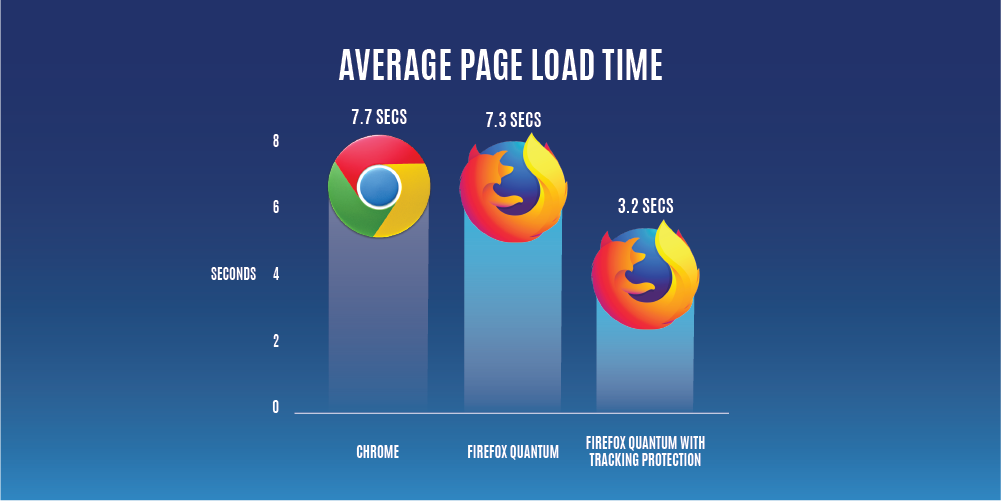
We accept things in the online world that we wouldn’t accept in the physical one. For instance, how would you feel if you popped your head in a store and that store now had the ability to keep sending you flyers even if you didn’t buy anything? Online, we often visit sites that track us, but it isn’t clear when this is happening or how the information is being used. Adding insult to injury, this often invisible tracking actually slows down web pages.

Since January 28 is International Data Privacy Day, it’s a good time to talk about one of Firefox Quantum’s most powerful features — Opt-in Tracking Protection. To jog your memory, we launched Tracking Protection in Private Browsing mode two years ago, which was unheard of at the time. Users could freely browse in Private Browsing mode without worrying about being tracked and getting inundated with ads. Since then we’ve studied Tracking Protection and found that, in addition to protecting their privacy, users actually have a better, faster experience with the web when pages load without trackers. That is why in November we upped the ante in Firefox Quantum and began offering our users the option to turn on Tracking Protection all the time. 24-7.

Results based on test found here

Besides privacy, we noticed that speed was one of the many benefits to having Tracking Protection turned on. Everyone likes a fast browser. Check out the video:


To turn on Tracking Protection, just open your “Preferences” and click on “Privacy & Security.” Scroll down to “Tracking Protection,” and click on “Always.” Now, you’re all set.

It’s also available on your mobile devices, to learn how to turn on Tracking Protection, click on the following: Firefox for iOS and Android.

More speed comes to Firefox for Fire TV this week

Leveraging the same Tracking Protection technology we use in Firefox and Firefox Focus, “Turbo Mode” will be available this week on Firefox for Fire TV. We’re calling it “Turbo Mode” because it gives you a faster and less cluttered browsing experience. The feature will be enabled by default. There may be times where sites may not load properly when Turbo Mode is enabled so the feature can be managed from the option menu in those instances.

New features for today’s Firefox releases

With today’s release, we’re building on the great foundation provided by Firefox Quantum on desktop and adding new capabilities for Firefox for Android.

A faster, smoother web with graphics engine enhancements

I’m sure you’ve all experienced that moment when you’re patiently waiting for a page to load, and the images and text get choppy. It slows down, and sometimes, it just hangs. We call this annoying phenomenon jank, and we’re always working on making Firefox less janky.

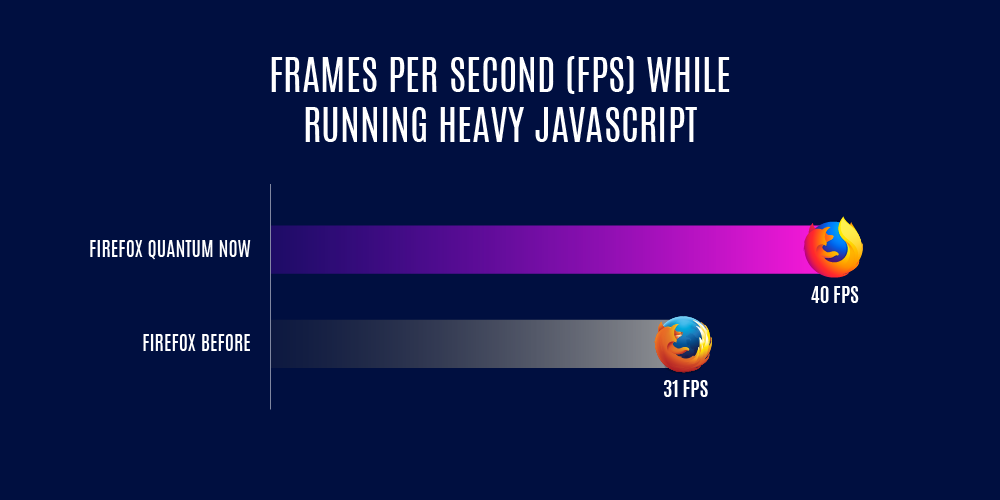
To help reduce jank, today Firefox Quantum is launching an improved engine that more efficiently paints your screen, using a dedicated CPU thread. The impact of this improvement is that Firefox Quantum is now even faster, and on certain websites, much smoother. Just how do we know? Our engineers created a test that simulates running heavy JavaScript. While running this test, Firefox’s frame rate improved by 30% (from 31 to 40 frames per second). You can read more here.

Frame rates based on Mozilla’s test described here

Solid progress, and we’re not stopping. We’re currently working on integrating WebRender, a next-generation web page renderer we initially developed as part of our Servo research project, into Firefox Quantum. We expect WebRender will result in Firefox Quantum having even faster frame rates. Stay tuned in the coming months to learn more about it.

New features for Firefox for Android

  • Improved Bookmarking – We revised our bookmarking feature to help you quickly get to the sites you want to visit. Instead of a dialog box, you’ll get a full screen where you can easily organize and see your folders, create new ones, and move your bookmarks in your respective folders.

  • Progressive Web Apps (PWA) Support – We’ve also improved Firefox for Android to better support PWAs, a specific type of website that can appear as a mobile app on your phone. When you are browsing in Firefox for Android and come across a website that is a PWA, you’ll see a house-shaped button in your address bar. If you want to add that website as an app, simply tap the house-shaped button and the website’s icon will appear on your home screen. Now, you can visit that website by simply tapping its icon – full-screen, outside of the browser UI, without an address bar. You can learn more about it here.

If you haven’t yet switched to the new Firefox Quantum browser, we invite you to download the latest version.


First published Jan. 23, 6a.m. PT.
Update, Jan. 25 6 a.m. PT: Adds details about Firefox for Fire TV.


The post Latest Firefox Quantum release available with faster, always-on privacy with opt-in Tracking Protection and new features appeared first on The Mozilla Blog.

23 Jan 22:36

Dropbox and Adobe expand partnership with previews for Adobe XD CC

by Billy Blau

Featured image for announcement about expanded Adobe partnership

Expanding on our partnership with Adobe, we’re introducing a new Adobe Creative Cloud integration that helps you stay in your creative flow by making it easier to find your latest Adobe XD document on Dropbox. In addition to previewing Adobe Photoshop and Illustrator files stored in Dropbox, users can now see a quick preview of files created in XD—Adobe’s latest solution for designing, prototyping, and sharing user experiences. These previews can be seen whether you’re working from dropbox.com or our mobile apps.

Adobe XD lets UX/UI designers switch from design to prototype inside the app itself. That means users can turn comps into interactive prototypes without interruption. And now with the Dropbox integration, your extended team members can easily find the designs they need to keep projects moving forward.

With the new integration, users can:

  • Share and preview XD files with any collaborator on your team from Dropbox. No matter their role on your team, your co-workers will be able to see a preview of the design’s home artboard across Dropbox on web, Android and iOS.
  • Streamline design collaboration without disrupting your workflow. Members of your extended team will also be able to use the comments and annotations features directly in Dropbox. For gathering comments and annotations on the prototypes themselves, designers can use the shared prototype features within Adobe XD.

“Adobe XD is an innovative all-in-one tool for UX designers, and we’re excited to bring the power of Dropbox, Adobe XD and Creative Cloud to our joint users,” said Daniel Wagner, Engineering Lead, Dropbox Previews. “Our goal is to unleash creative energy through an expanding partner ecosystem, and connect design tools like Adobe XD with core Dropbox mobile, web and desktop products.”

“Our aim is to make the design process more efficient with Adobe XD,” said Kate Eom, senior product manager for Adobe XD. “That’s why we’re excited to bring Dropbox native file preview to our users. Now, designers and their extended team members can preview XD from Dropbox without opening the file.”

To learn more about file types that preview on dropbox.com, check out our help center article or learn more about Adobe XD CC.

23 Jan 22:26

RED founder Jim Jannard details Hydrogen One specs

by Igor Bonifacic
Hydrogen One smartphone

Back in July, high-end camera manufacturer RED announced the Hydrogen One, a smartphone the company said would feature a holographic display.

Since then, we’ve heard relatively about the device. On Monday January 22nd, 2018, however, RED founder Jim Jannard took to the company’s community forums to share some new information on the upcoming phone.

Jannard started his post by saying, “If we [referring to himself and Jarred Land, president of RED] never sell one phone… I am totally happy. We both have exactly what we wanted,” before sharing some of Hydrogen One’s specs.

Jannard then discussed the Hydrogen One’s display. As we’ve learned in the past, the expensive smartphone will feature a 5.7-inch display with 2560 x 1440 pixel resolution. The display will ship with a traditional 2D viewing mode, as well as a 4V holographic mode.

Writing about the holographic viewing mode, Jannard said that the Hydrogen One’s display dims a bit when entering this mode and produces a “‘better than 3D’ image.'”

“So far, everyone that has seen it gasps, swears or just grins. I wish we had recorded all the reactions. Priceless,” he said, referring to the reactions the Hydrogen One’s display tech has garnered.

His post continues, noting that Hydrogen One users won’t need 3D glasses to take advantage of their phone’s holographic display. In addition, he wrote that the Hydrogen One will be able to capture 4V content, with both its front- and rear-facing cameras, natively — without the addition of another module.

Jannard also said that the company is working with content partners to launch the ‘HYDROGEN Network,’ a marketplace where Hydrogen One users will be able to purchase 4V content.

On the subject of modular components, Jannard said that those parts will be stackable, allowing Hydrogen One users to add multiple modules to their device.

In what might be a surprising turn to some, it appears that some carriers will carry the Hydrogen One when it ships later this year.

“Carrier support for the Hydrogen is unprecedented… we just can’t tell you yet. Safe to say it is as good as it gets,” wrote Jannard.

He added that carrier-subsidized devices will ship sometime in the summer, while unlocked devices will ship sometime before then.

Jannard didn’t give a specific date, but he did mention RED showing off the device to pre-order customers sometime in April, so it’s unlikely that the unlocked device will be available to purchase before late spring or early summer.

The Hydrogen One will also feature a Snapdragon 835 processor; a hybrid dual SIM slot, allowing Hydrogen One users to slot in either two SIM cards or a SIM card and microSD card; and a 4,500mAh battery with USB-C connectivity.

What do you think of the Hydrogen One based on what we know so far? Let us know in the comments.

Source: RED Via: Android Authority

The post RED founder Jim Jannard details Hydrogen One specs appeared first on MobileSyrup.

23 Jan 22:25

It’s still unclear when Apple’s $349 HomePod will launch in Canada

by Patrick O'Rourke
HomePod

Confirming rumours that surfaced yesterday, Apple has revealed that its upcoming HomePod smart speaker will launch in the U.S., U.K. and Australia on February 9th, 2018, with pre-orders starting on January 26th.

The company has also confirmed that the HomePod will make its way to France and Germany this spring. What remains unknown is when or if the HomePod will come to Canada at some point in the future. Apple Canada has told MobileSyrup that Canadian availability hasn’t been revealed yet.

It’s more than likely the HomePod will make its way to Canada at some point — it’s just unclear when that’s actually going to happen. It’s also likely that French language support is holding back the device’s Canadian release, though this is just speculation.

In terms of other smart home voice-activated speakers, Google Home officially supports Canadian French, while Amazon’s line of Echo devices do not.

At $349 USD (approximately $434 CAD), Apple is going after a very different market with the HomePod when compared to Amazon and Google’s cheaper, significantly more affordable voice-activated speakers. Unlike competing manufacturers, Apple’s HomePod aims to compete directly with Sonos’ high-end wireless speaker offerings.

It’s also worth noting that the HomePod seems to feature the same technical specifications as it did when the the tech giant first announced the speaker back at WWDC in June.

Rather than smart home integration, the HomePod is focused on sound quality and music, though it will feature an always-on Siri-powered voice assistant. That said, it looks like Siri’s implementation in the HomePod will be much more limited than what Google Assistant in the Home and Alexa in the Amazon Echo, are capable of doing.

There are also a few questions yet to be answered about the HomePod’s functionality, including whether or not the device will be capable of playing music from platforms like Spotify or Google Play Music. However, given Apple’s walled-garden approach to software and hardware, it’s likely that won’t be the case.

Additionally, Apple has stated that multi-room audio won’t be supported by the HomePod until next year. Competing devices like the Amazon Echo and Google Home are already capable of delivering multi-room audio. That being said, it does seem like stereo playback between two HomePods in the same room might be possible at launch.

Apple delayed the HomePod back in late November because the company said it needed “a little more time” to get it reader for customers.

MobileSyrup will have more on the HomePod in the coming weeks.

The post It’s still unclear when Apple’s $349 HomePod will launch in Canada appeared first on MobileSyrup.

23 Jan 03:54

You won’t believe who the MobileSyrup team’s Google Art Culture doppelgangers are

by Dean Daley
Google Arts and Culture

The Google Arts and Culture app’s ‘Selfie Feature’ became available in Canada this past weekend for both iOS and Android.

The app is available on both iOS and Android devices and users can find the selfie feature by scrolling partially down its launch page.

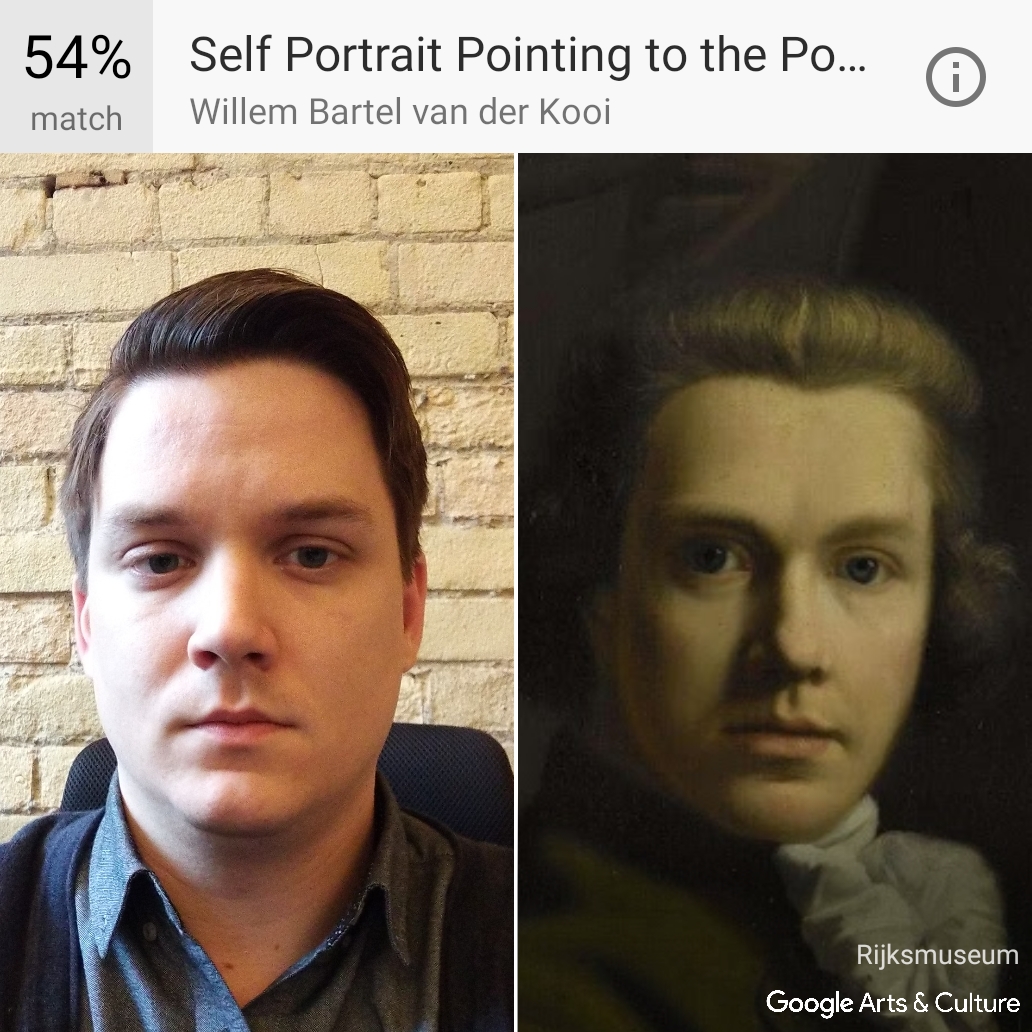
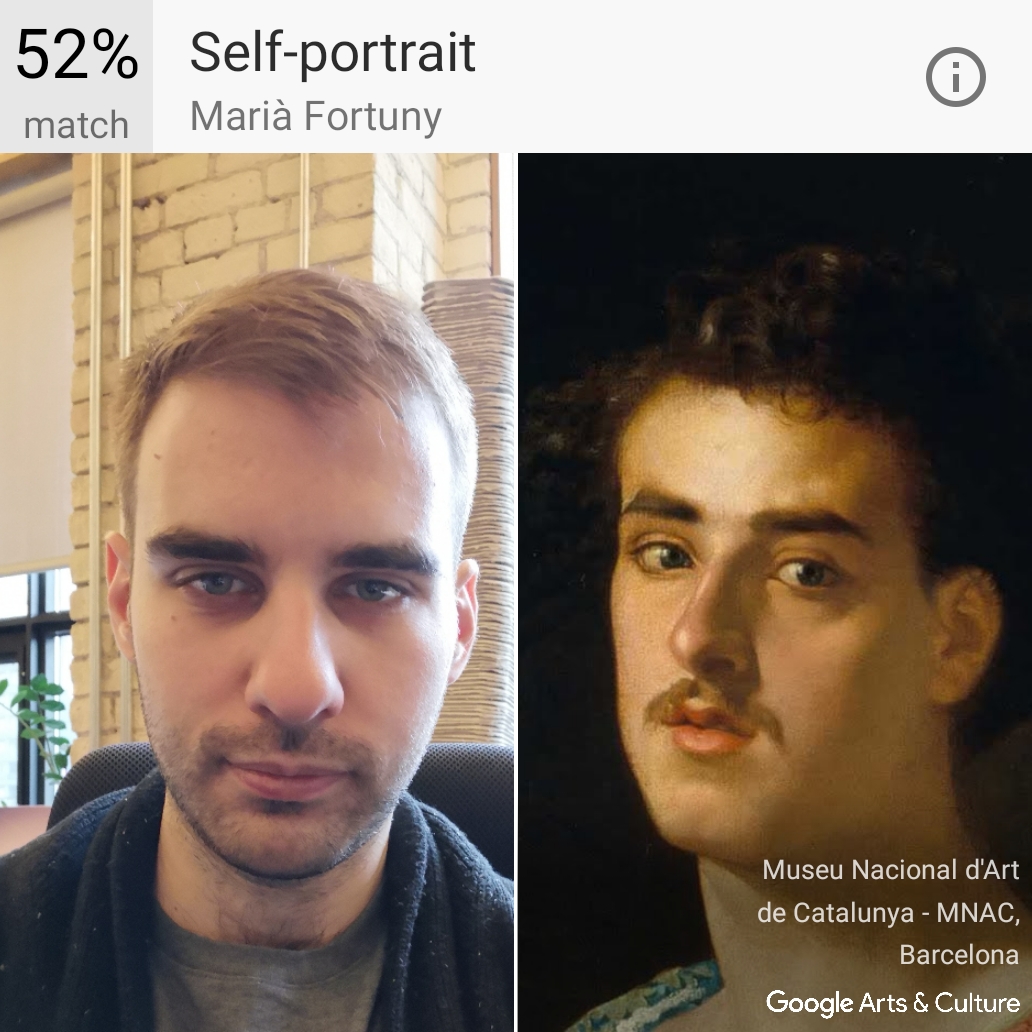
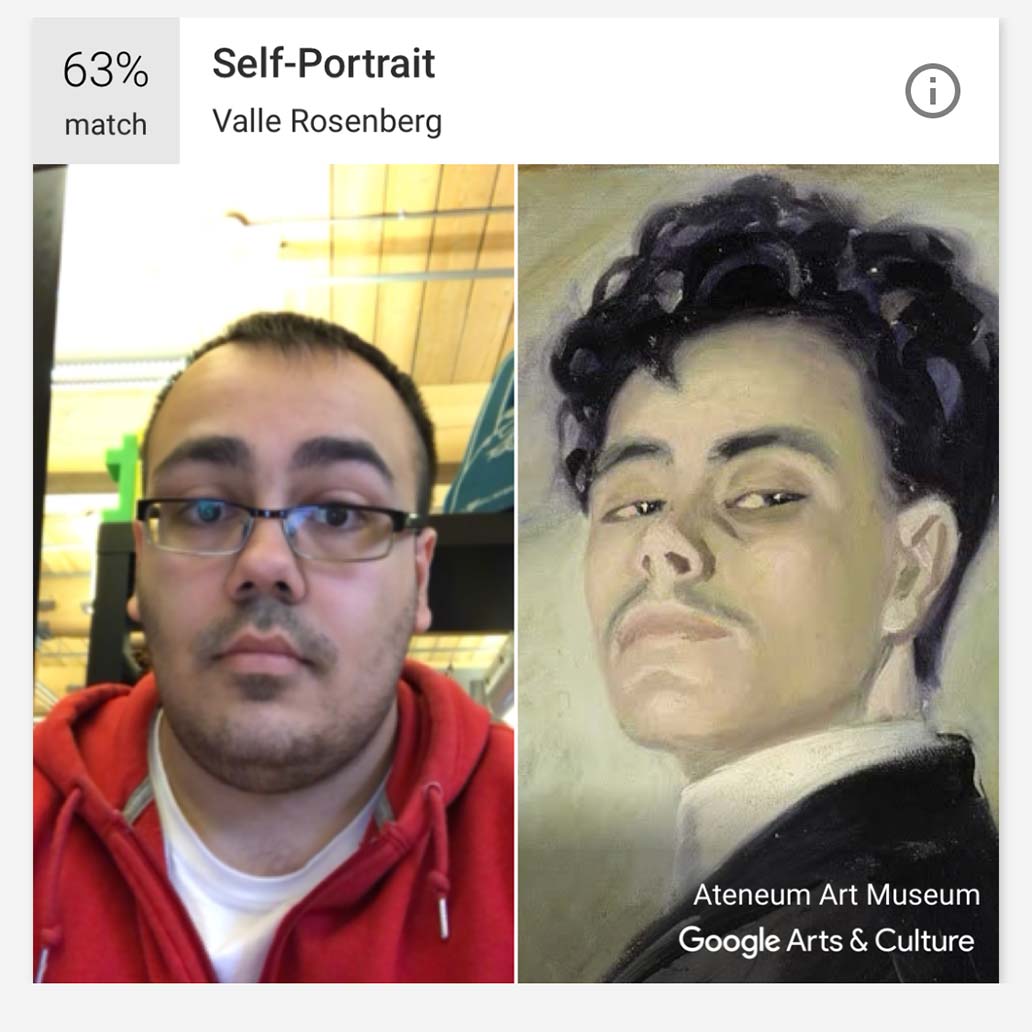
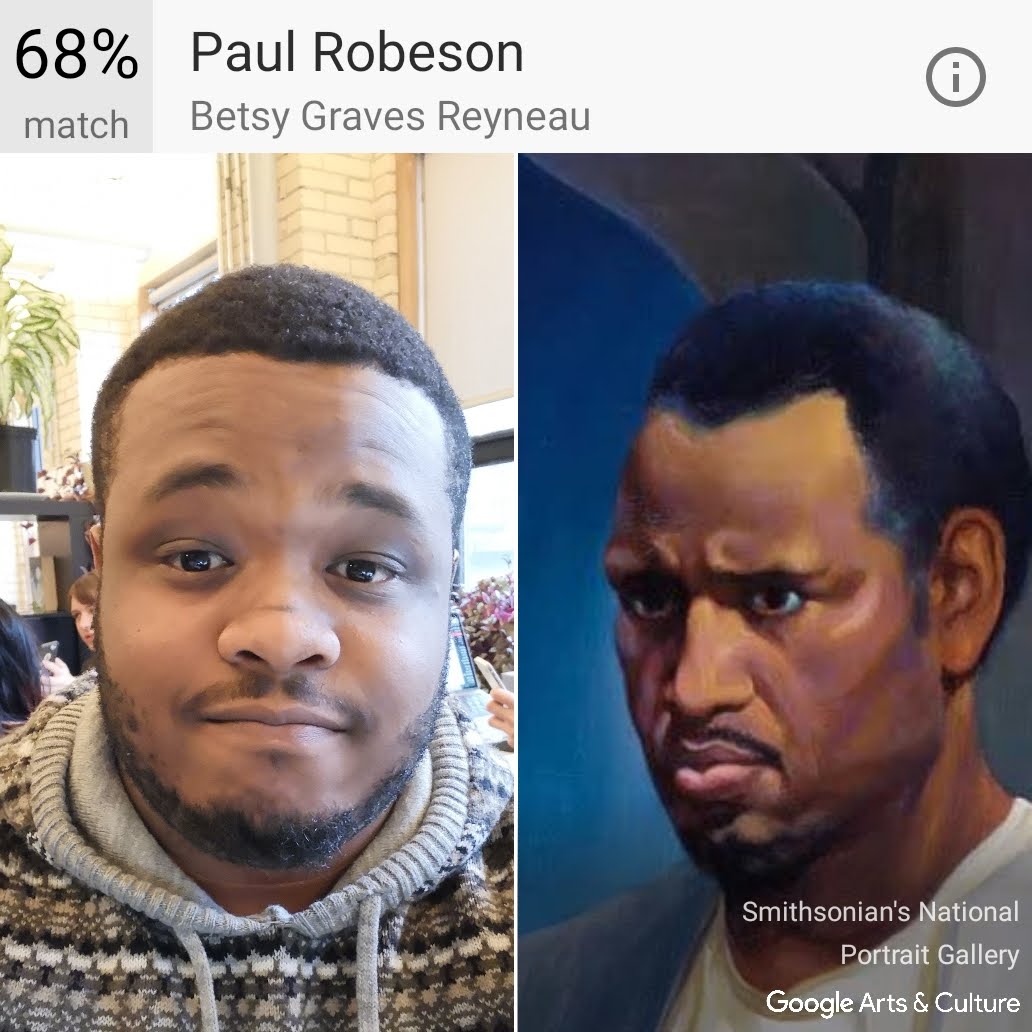
The app’s new feature is actually rather simple. It scans the user’s facial features and matches them with art from a variety of different eras of history. Almost amusingly, smiling or frowning seems to drastically change the results.

So, the MobileSyrup editorial team thought it would be fun to introduce you, our readers, to our artistic doppelgangers.

Patrick O’Rouke – Senior editor

Google Arts and Culture

Igor Bonifacic – Senior editor

Igor's arts and culture selfie

Rose Behar – Senior reporter

Rose's Google Arts and Culture selfie

Brad Shankar – Staff reporter

Brad's Arts and Culture selfie

Dean Daley – Staff reporter

Dean's Arts and Culture selfie

Sameer Chhabra – Staff reporter

Sameer Google Arts and Culture

Mackenzie Allen – Intern

Ian Hardy – Publisher

Ian's google arts and culture

The post You won’t believe who the MobileSyrup team’s Google Art Culture doppelgangers are appeared first on MobileSyrup.

23 Jan 03:53

iPhone X production to likely wind down this summer, says analyst

by Patrick O'Rourke
iPhone X

In a new research note first shared by Appleinsider, KGI Securities’ Ming-Chi Kuo estimates that Apple will ship 18 million iPhone X units in the first quarter of 2018, emphasizing that the device hasn’t sold as well as expected in China.

Kuo says that Chinese consumers feel that the iPhone X features less usable display space when compared to the iPhone 8 Plus due to the former’s prominent screen notch. Further, Kuo goes on to say that a trio of iPhone models will drop in Fall 2018, predicting that the iPhone X will reach ‘end of life’ status in the summer 2018 in in order to prepare for the release of next year’s devices.

Usually Apple keeps older versions of the iPhone around in order to offer consumers a lower cost option, but it seems that won’t be the strategy when it comes to the iPhone X. Given that the iPhone X was designed to be a one-off 10th anniversary device, this shift makes sense to an extent, though it’s still out of character for Apple. The only other time Apple has opted for the strategy with one of its iPhones is with the 5C, which was discontinued the year following its release back in 2014.

In a previous note to investors, Kuo said iPhone X features like Face ID will make their way to other versions of the iPhone, along with a new iPhone X Plus version designed to alleviate consumer concerns regarding usable screen space.

In terms of growth, Kuo says that the iPhone will experience growth in the first half of 2018, amounting to up to five percent. In the fall of 2018, Apple will experience 10 percent growth following the release of new devices.

This story has widely been reported by other outlets in a misleading way, with headlines stating that Apple plans to “discontinue” the iPhone X because sales have not met expectations. While this is true, it’s not as if Apple has reversed the direction it took the iPhone with following the release of the X — instead its key features will just be integrated into future iPhone models.

Source: Appleinsider 

The post iPhone X production to likely wind down this summer, says analyst appeared first on MobileSyrup.

23 Jan 03:53

Android 8.1 will now display the speed of public Wi-Fi networks

by Igor Bonifacic

Google today announced a new Wi-Fi-related feature addition to Android Oreo.

Moving forward, the latest version of the company’s mobile operating system will display the speed of nearby open Wi-Fi networks before the user joins them.

Network speeds are divided into four categories: ‘Very Fast,’ ‘Fast,’ ‘OK’ and ‘Slow.’

According to Google, Very Fast Wi-Fi networks will allow Android users to stream high-quality videos, while Fast networks will allow them to stream “most” videos. OK networks, meanwhile, are suited for reading webpages, streaming music and using social media.

For obvious reasons — mostly to do with privacy and network security — this feature won’t work with private Wi-Fi networks.

Since going back to Android Nougat with the Essential Phone, one of the features I’ve missed most from Oreo is the operating system’s ability to automatically turn Wi-Fi on when the operating system sees that it’s near a trusted network.

Source: Google (1), (2) Via: The Verge 

The post Android 8.1 will now display the speed of public Wi-Fi networks appeared first on MobileSyrup.

23 Jan 03:48

Twitter Favorites: [bmann] Mentor whiplash: I’ve gotten it and given it. What do you have for advice? How to deal with it?

Boris Mann @bmann
Mentor whiplash: I’ve gotten it and given it. What do you have for advice? How to deal with it?
22 Jan 22:04

Exploring handwritten digit classification: a tidy analysis of the MNIST dataset

by David Robinson

In a recent post, I offered a definition of the distinction between data science and machine learning: that data science is focused on extracting insights, while machine learning is interested in making predictions. I also noted that the two fields greatly overlap:

I use both machine learning and data science in my work: I might fit a model on Stack Overflow traffic data to determine which users are likely to be looking for a job (machine learning), but then construct summaries and visualizations that examine why the model works (data science). This is an important way to discover flaws in your model, and to combat algorithmic bias. This is one reason that data scientists are often responsible for developing machine learning components of a product.

I’d like to further explore how data science and machine learning complement each other, by demonstrating how I would use data science to approach a problem of image classification. We’ll work with a classic machine learning challenge: the MNIST digit database.

The challenge is to classify a handwritten digit based on a 28-by-28 black and white image. MNIST is often credited as one of the first datasets to prove the effectiveness of neural networks.

In a series of posts, I’ll be training classifiers to recognize digits from images, while using data exploration and visualization to build our intuitions about why each method works or doesn’t. Like most of my posts I’ll be analyzing the data through tidy principles, particularly using the dplyr, tidyr and ggplot2 packages. In this first post we’ll focus on exploratory data analysis, to show how you can better understand your data before you start training classification algorithms or measuring accuracy. This will help when we’re choosing a model or transforming our features.

Preprocessing

The default MNIST dataset is somewhat inconveniently formatted, but Joseph Redmon has helpfully created a CSV-formatted version. We can download it with the readr package.

library(readr)
library(dplyr)

mnist_raw <- read_csv("https://pjreddie.com/media/files/mnist_train.csv", col_names = FALSE)
mnist_raw[1:10, 1:10]
## # A tibble: 10 x 10
##       X1    X2    X3    X4    X5    X6    X7    X8    X9   X10
##    <int> <int> <int> <int> <int> <int> <int> <int> <int> <int>
##  1     5     0     0     0     0     0     0     0     0     0
##  2     0     0     0     0     0     0     0     0     0     0
##  3     4     0     0     0     0     0     0     0     0     0
##  4     1     0     0     0     0     0     0     0     0     0
##  5     9     0     0     0     0     0     0     0     0     0
##  6     2     0     0     0     0     0     0     0     0     0
##  7     1     0     0     0     0     0     0     0     0     0
##  8     3     0     0     0     0     0     0     0     0     0
##  9     1     0     0     0     0     0     0     0     0     0
## 10     4     0     0     0     0     0     0     0     0     0

This dataset contains one row for each of the 60000 training instances, and one column for each of the 784 pixels in a 28 x 28 image. The data as downloaded doesn’t have column labels, but are arranged as “row 1 column 1, row 1 column 2, row 1 column 3…” and so on). This is a useful enough representation for machine learning. But as Jenny Bryan often discusses, we shouldn’t feel constricted by our current representation of the data, and for exploratory analysis we may want to make a few changes.

  • We’d like to represent it as one-row-per-pixel-per-instance. It would be challenging to visualize this default data as images, but it becomes easier once we consider each pixel an “observation”.
  • We’d like custom features that have meaning within the problem For instance, we don’t just have 784 arbitrary features; we have 28 rows and 28 columns. So rather than having labels like “X2” and “X3”, we’d like to keep track of variables for x and y (as coordinate positions of the images).
  • We’d like to explore a subset first. While you’re first exploring data, you don’t need your full complement of training examples, since working with a subset lets you iterate quickly and create proof of concepts while saving computational time.

With that in mind, we’ll gather the data, do some arithmetic to keep track of x and y within an image, and keep only the first 10,000 training instances.

library(tidyr)

pixels_gathered <- mnist_raw %>%
  head(10000) %>%
  rename(label = X1) %>%
  mutate(instance = row_number()) %>%
  gather(pixel, value, -label, -instance) %>%
  tidyr::extract(pixel, "pixel", "(\\d+)", convert = TRUE) %>%
  mutate(pixel = pixel - 2,
         x = pixel %% 28,
         y = 28 - pixel %/% 28)

pixels_gathered
## # A tibble: 7,840,000 x 6
##    label instance value pixel     x     y
##    <int>    <int> <int> <dbl> <dbl> <dbl>
##  1     5        1     0     0     0  28.0
##  2     0        2     0     0     0  28.0
##  3     4        3     0     0     0  28.0
##  4     1        4     0     0     0  28.0
##  5     9        5     0     0     0  28.0
##  6     2        6     0     0     0  28.0
##  7     1        7     0     0     0  28.0
##  8     3        8     0     0     0  28.0
##  9     1        9     0     0     0  28.0
## 10     4       10     0     0     0  28.0
## # ... with 7,839,990 more rows

We now have one row for each pixel in each image. This is a useful format because it lets us visualize the data along the way. For example, we can visualize the first 12 instances with a couple lines of ggplot2.

library(ggplot2)
theme_set(theme_light())

pixels_gathered %>%
  filter(instance <= 12) %>%
  ggplot(aes(x, y, fill = value)) +
  geom_tile() +
  facet_wrap(~ instance + label)

center

We’ll still often return to the one-row-per-instance format (especially once we start training classifiers in future posts), but this is a fast way to understand and appreciate how the data and the problem is structured. In the rest of this post we’ll also polish this kind of graph (like making it black and white rather than a scale of blues).

Exploring pixel data

Let’s get more comfortable with the data. From the legend above, it looks like 0 represents blank space (like the edges of the image), and a maximum around 255 represents the darkest points of the image. Values in between may represent different shades of “gray”.

How much gray is there in the set of images?

ggplot(pixels_gathered, aes(value)) +
  geom_histogram()

center

Most pixels in the dataset are completely white, along with another set of pixels that are completely dark, with relatively few in between. If we were working with black-and-white photographs (like of faces or landscapes), we might have seen a lot more variety. This gives us a hint for later feature engineering steps: if we wanted to, we could probably replace each pixel with a binary 0 or 1 with very little loss of information.

I’m interested in how much variability there is within each digit label. Do all 3s look like each other, and what is the “most typical” example of a 6? To answer this, we can find the mean value for each position within each label, using dplyr’s group_by and summarize.

pixel_summary <- pixels_gathered %>%
  group_by(x, y, label) %>%
  summarize(mean_value = mean(value)) %>%
  ungroup()

pixel_summary
## # A tibble: 7,840 x 4
##        x     y label mean_value
##    <dbl> <dbl> <int>      <dbl>
##  1     0  1.00     0          0
##  2     0  1.00     1          0
##  3     0  1.00     2          0
##  4     0  1.00     3          0
##  5     0  1.00     4          0
##  6     0  1.00     5          0
##  7     0  1.00     6          0
##  8     0  1.00     7          0
##  9     0  1.00     8          0
## 10     0  1.00     9          0
## # ... with 7,830 more rows

We visualize these average digits as ten separate facets.

library(ggplot2)

pixel_summary %>%
  ggplot(aes(x, y, fill = mean_value)) +
  geom_tile() +
  scale_fill_gradient2(low = "white", high = "black", mid = "gray", midpoint = 127.5) +
  facet_wrap(~ label, nrow = 2) +
  labs(title = "Average value of each pixel in 10 MNIST digits",
       fill = "Average value") +
  theme_void()

center

These averaged images are called centroids. We’re treating each image as a 784-dimensional point (28 by 28), and then taking the average of all points in each dimension individually. One elementary machine learning method, nearest centroid classifier, would ask for each image which of these centroids it comes closest to.

Already we have some suspicions about which digits might be easier to separate. Distinguishing 0 and 1 looks pretty straightforward: you could pick a few pixels at the center (always dark in 1 but not 0), or at the left and right edges (often dark in 0 but not 1), and you’d have a pretty great classifier. Pairs like 4/9, or 3/8, have a lot more overlap and will be a more challenging problem.

Again, one of the aspects I like about the tidy approach is that at all stages of your analysis, your data is in a convenient form for visualization, especially a faceted graph like this one. In its original form (one-row-per-instance) we’d need to do a bit of transformation before we could plot it as images.

Atypical instances

So far, this machine learning problem might seem a bit easy: we have some very “typical” versions of each digit. But one of the reasons classification can be challenging is that some digits will fall widely outside the norm. It’s useful to explore atypical cases, since it could help us understand why the method fails and help us choose a method and engineer features.

In this case, we could consider the Euclidean distance (square root of the sum of squares) of each image to its label’s centroid.

pixels_joined <- pixels_gathered %>%
  inner_join(pixel_summary, by = c("label", "x", "y"))

image_distances <- pixels_joined %>%
  group_by(label, instance) %>%
  summarize(euclidean_distance = sqrt(mean((value - mean_value) ^ 2)))

image_distances
## # A tibble: 10,000 x 3
## # Groups: label [?]
##    label instance euclidean_distance
##    <int>    <int>              <dbl>
##  1     0        2               47.2
##  2     0       22               53.1
##  3     0       35               69.4
##  4     0       38               59.5
##  5     0       52               61.4
##  6     0       57               65.7
##  7     0       64               68.1
##  8     0       69               81.1
##  9     0       70               65.2
## 10     0       76               59.6
## # ... with 9,990 more rows

Measured this way, which digits have more variability on average?

ggplot(image_distances, aes(factor(label), euclidean_distance)) +
  geom_boxplot() +
  labs(x = "Digit",
       y = "Euclidean distance to the digit centroid")

center

It looks like 1s have especially low distances to their centroid: for the most part there’s not a ton of variability in how people draw that digit. It looks like the most variability by this measure are in 0s and 2s. But every digit has at least a few cases with an unusually large distance from their centroid. I wonder what those look like?

To discover this, we can visualize the six digit instances that had the least resemblance to their central digit.

worst_instances <- image_distances %>%
  top_n(6, euclidean_distance) %>%
  mutate(number = rank(-euclidean_distance))

pixels_gathered %>%
  inner_join(worst_instances, by = c("label", "instance")) %>%
  ggplot(aes(x, y, fill = value)) +
  geom_tile(show.legend = FALSE) +
  scale_fill_gradient2(low = "white", high = "black", mid = "gray", midpoint = 127.5) +
  facet_grid(label ~ number) +
  labs(title = "Least typical digits",
       subtitle = "The 6 digits within each label that had the greatest distance to the centroid") +
  theme_void() +
  theme(strip.text = element_blank())

center

This is a useful way to understand what kinds of problems the data could have. For instance, while most 1s looked the same, they could be drawn diagonally, or with a flat line and a flag on top. A 7 could be drawn with a bar in the middle. (And what is up with that 9 on the lower left?)

This also gives us a realistic sense of how accurate our classifier can get. Even humans would have a hard time classifying some of these sloppy digits, so we can’t expect a 100% success rate. (Conversely, if one of our classifiers does get a 100% success rate, we should examine whether we’re overfitting!).

Pairwise comparisons of digits

So far we’ve been examining one digit at a time, but our real goal is to distinguish them. For starters, we might like to know how easy it is to tell pairs of digits apart.

To examine this, we could try overlapping pairs of our centroid digits, and taking the difference between them. If two centroids have very little overlap, this means they’ll probably be easy to distinguish.

We can approach this with a bit of crossing() logic from tidyr:

digit_differences <- crossing(compare1 = 0:9, compare2 = 0:9) %>%
  filter(compare1 != compare2) %>%
  mutate(negative = compare1, positive = compare2) %>%
  gather(class, label, positive, negative) %>%
  inner_join(pixel_summary, by = "label") %>%
  select(-label) %>%
  spread(class, mean_value)

ggplot(digit_differences, aes(x, y, fill = positive - negative)) +
  geom_tile() +
  scale_fill_gradient2(low = "blue", high = "red", mid = "white", midpoint = .5) +
  facet_grid(compare2 ~ compare1) +
  theme_void() +
  labs(title = "Pixels that distinguish pairs of MNIST images",
       subtitle = "Red means the pixel is darker for that row's digit, and blue means the pixel is darker for that column's digit.")

center

Pairs with very red or very blue regions will be easy to classify, since they describe features that divide the datasets neatly. This confirms our suspicion about 0/1 being easy to classify: it has substantial regions than are deeply red or blue.

Comparisons that are largely white may be more difficult. We can see 4/9 looks pretty challenging, which makes sense (a handwritten 4 and 9 really differ only by a small region at the top). 7/9 shows a similar challenge.

What’s next

MNIST has been so heavily studied that we’re unlikely to discover anything novel about the dataset, or to compete with the best classifiers in the field. (One paper used deep neural networks to achieve about 99.8% accuracy, which is about as well as humans perform).

But a fresh look at a classic problem is a great way to develop a case study. I’ve been exploring this dataset recently, and I’m excited by how it can be used to illustrate a tidy approach to fundamental concepts of machine learning. In the rest of this series I’d like to show how we could demonstrate how we would train classifiers such as logistic regression, decision trees, nearest neighbor, and neural networks. In each case we’ll use tidy principles to demonstrate the intuition and insight behind the algorithm.

22 Jan 19:08

Filtered for water in history

1.

In 2003, the artist Natalie Jeremijenko built a robotic goose.

The robotic goose interface allows people to approach the birds, follow them closely and interact in a variety of ways that would not otherwise be possible without this interface.

The remote-controlled, human-haunted goose can speak:

The goose drivers can 'talk to' the geese, issuing utterances through the robotic interface, delivering prerecorded goose 'words,' their own vocal impersonations, or other sounds (such as goose flute hunting calls). Each utterance via the robotic goose triggers the camera in the robot's head to capture 2-4 seconds of video recording the responses of the actual biological geese. These video samples upload to the public web-based goosespeak database that the participants can annotate, i.e. "the goose was telling me to go away," "he was saying Hi." As this database of goose responses accretes, redundancy and correlations in the annotations may provide robust semantic descriptors of the library of video clips.

Speaking to animals not by attempting to translate, but by entering their world.

Here is a video of Jeremijenko's project.

See also: Umwelt, the semiotic world of the organism, including all the meaningful aspects of the world for any particular organism. A bat will see and inhabit a different world than a human, than a goose, than an artificial intelligence.

See also: Timo Arnall's film Robot readable world, an experiment in found machine-vision footage, exploring the aesthetics of the robot eye.

2.

From 2007, 3D Mailbox is an email client that visualises your messages as a virtual reality 3D environment.

The BBC covered the application, a virtual Miami Beach, a place where your e-mails are represented as bikini clad avatars.

When you receive an e-mail the avatars appear at the entrance to the hotel's pool. Your spam manager acts a gatekeeper, only allowing through genuine messages to lounge by the pool.

Spam is dispatched to the beach, where they are represented as overweight tourists. Hitting delete results in the spam taking a deadly swim in shark infested waters.

Meanwhile your unread e-mails perform lengths in the pool. Read e-mails tan themselves on the sun loungers.

There are pictures.

3.

It used to be, when I went hiking, I'd step across where a stream was marked on a map or mentioned in the guide, and it would be a measly trickle or a torrential river. Well that's clearly not a stream, I'd think.

For me a stream is a permanent feature of the landscape. It's a constant, regardless of rainfall or time of year. It flows gently and runs in a ditch maybe a metre wide. It is probably clear.

It turns out this is rare.

My conception of a stream is a chalk stream.

Underground chalk acts as an aquifer, and then

Bubbling up out of thousands of springs, chalk streams collect first in ponds and then ripple over gravel beds through chalk hills towards the sea. They are typically wide, shallow and crystal clear, their alkaline waters pure thanks to the constant purifying and filtering in the chalk.

They are an irreplaceable relic of our past, created as the ice sheets retreated from England 10,000 years ago.

The temperature remains static.

And:

There are at least 210 chalk streams in the world, and 160 of those are in England.

In particular, in the south of England. And in particular, in particular: where I grew up.

I never realised that my picture of a stream isn't how most people will think of a stream. Who knew.

4.

Stafford Beer was the cyberneticist and business management pioneer who, in the early 1970s, built Project Cybersyn for the revolutionary government of Chile. Command economy meets socialist proto-internet.

In the early 1960s, he was running a more esoteric experiment, in pursuit of his desire to build an automated factory.

From historian Andrew Pickering's essay, The Science of the Unknowable: Stafford Beer’s Cybernetic Informatics:

The T- and V-machines are what we would now call neural nets: the T-machine collects data on the state of the factory and its environment and translates them into meaningful form; the V-machine reverses the operation, issuing com- mands for action in the spaces of buying, production, and selling. Between the T- and V-machines lies the U-machine -- the homeostat, or artificial brain -- which seeks to find and maintain a balance between the inner and outer conditions of the firm

The U-machine.

By the way,

The cybernetic factory was not pure theory. By 1960 Beer had at least simulated a cybernetic factory at Templeborough Rolling Mills, a subsidiary of his employer, United Steel

It is a core tenet of (early) cybernetics that sufficiently complex learning systems are somewhat equivalent, whether they are made of flesh and blood, or vacuum tubes. It is this tenet which allowed the audicity of the cyberneticists to consider building "intelligent" machines, or to model the brain as a network of moving information.

And sure enough, when I went to the library to consult Beer's collected papers, How Many Grapes Went into the Wine: Stafford Beer on the Art and Science of Holistic Management, Beer discusses the search for his ideal U-machine:

a self-organizing system need not have its circuitry designed in detail -- otherwise what virtue is there in the self-organizing capability? Furthermore, if systems of this kind are to be used for amplifying intelligence, a fixed circuitry is a liability. Instead we seek a fabric that is inherently self-organizing, on which to superimpose (as a signal on a carrier wave) the particular cybernetic functions that we seek to model

And he continues:

Dr Gilbert, who had been trying to improve the Euglena cultures, suggested a potent thought. Why not use an entire ecological system, such as a pond?

So Stafford Beer captures a woodland pond, and attempts to train it to run a factory:

Accordingly, over the past year, I have been conducting experiments with a large tank or pond. The contents of the tank were randomly sampled from ponds in Derbyshire and Surrey. Currently there are a few of the usual creatures visible to the naked eye (Hydra, Cyclops, Daphnia, and a leech); microscopically there is the expected multitude of micro-organisms. In this tank are suspended four lights, the intensities of which can be varied to fine limits. At other points are suspended photocells with amplifying circuits which give them high sensitivity.

The intention was to communicate information about the factory into the pond via optical couplings. Earlier attempts, reported by Pickering, included attempts to induce small organisms -- Daphnia collected from a local pond --to ingest iron filings so that input and output couplings to them could be achieved via magnetic fields.

The state of this research at the moment is that I tinker with this tank from time to time in the middle of the night.

I have this picture of Beer, in his slippers in his basement, trying to figure out not only how to speak to this tank of water and algae in its own language, but attempting to put it through business school.

What would be the management style of such a factory foreman? Risk averse? A deep sympathy with the principles of sustainability and the circular economy? (Given it sits in a closed-system tank.)

Our modern efforts into machine learning and artificial intelligence have a familiar feel: we place the neural network at the heart of the system... and just turn it on. And although we can't tell how the neural network recognises a face or optimises a system, we can tell that they have some natural politics: AIs are unable - or unwilling - to correct for their implicit racism and sexism.

What is the umwelt of a pond? What is the umwelt of an AI?

Uber's marketplace and Facebook's newsfeed are run by captured artificial intelligences -- unreasonably efficient optimisers, blind to human feelings, natural free market libertarians; a warp core of tremendous ability and held only just in check. We don't know how these things make their decisions, but we are beginning to see the biases in their actions.

Obviously Stafford Beer's experiments came to nothing: the factories of China are not run by captured, semi-sentient woodland ponds.

Or. Who knows. Maybe we should put one in charge of Facebook.

22 Jan 19:06

When Does Mirrorless Supplant DSLR?

It seems a post I made on an Internet forum last week rattled a few cages. Basically I predicted that mirrorless sales would equal DSLR sales in 2020. 

That was a conservative prediction. 

Realistically, if Canon and Nikon introduce new mirrorless systems this year that are competent, the more likely date where mirrorless unit volume will surpass DSLR unit volume is 2019. …

22 Jan 19:06

Twitter Favorites: [bmann] @carnivorous8008 @sonyaellenmann surface vs purpose. Neither of those items are bad, but they are only the surface… https://t.co/TYE4Mj2t63

Boris Mann @bmann
@carnivorous8008 @sonyaellenmann surface vs purpose. Neither of those items are bad, but they are only the surface… twitter.com/i/web/status/9…
22 Jan 19:06

Fresh Container with New Saddles, Hubs, and Fender Hardware

by noreply@blogger.com (VeloOrange)
by Igor

We've just taken a fresh container with a bunch of new products and restocked on a bunch that you all have been patiently waiting on...Enjoy!

These Hubs Go To Eleven

As much as we've tried to resist it, it seems like this whole 11 speed thing may stick around for a while. These new hubs are compatible with 11 speed Shimano, Campagnolo, and SRAM (non-XD) cassettes.


In addition, these hubs retain the tool-free field-serviceability for which our hubs have become known. Though the hub displayed in these instructions is the 10 speed variant, the process is exactly the same.

For those running 8-10 speed cassettes, you have two options: 1) pick up a spacer and mount the cassette to the 11 speed freehub or 2) get the 10 speed hub versions which are on sale now.


For those running 7 speed cassettes, the same applies, you'll just need a thicker spacer on the 11 speed freehub body.

These Saddles are Silky Smooth

While our Microfiber Touring Saddles have quickly become our most popular offering, many have expressed a preference for a smoother top to find more fluid positions during long days in the saddle. So here it is:


The Smooth Touring Saddle has become a personal favorite of mine. While it has nearly the same dimensions as the Model 3 Leather Saddle, it is far lighter (410g) and retains the integrated bag loops.

The saddle is great for touring and city bikes as it is weather proof and since it isn't flashy, they'll hopefully be overlooked at the bike rack.

Hardware Kits for Fenders

We now offer a full hardware kit for metal fenders. This hardware is compatible with VO, Honjo, Lefol, and pretty much any other metal fender that uses drawbolts. The kits are available in both Silver and Noir.
This kit is perfect for those mounting the fenders to proper fender braze-ons, so if you need a specific hardware solution, find what you seek in our fender hardware section.

Call in the Fender Re-Inforcements

With the proliferation of off-road touring and gravel/all-road/any-road/road-plus/adventure/quiver-killer bikes, we have started including a pair of reinforcement plates in all of our alloy fender sets. Since you asked for it, we are now including them separately from the fender kits in 30mm and 40mm widths.


Just peel and stick it under the screw during installation - one under the seat stay bridge and one under the fork crown.


Get Your Klunk On

The Klunks are back in stock! While these super fun handlebars were designed with MTBs in mind, we've seen them on city bikes, too!


Crazy Bars are Crazy


They're back in stock and ready to get weird.

Make Your Back Happy with the Happy Stem


While they look a bit odd, these Happy Stems have proven to be incredibly popular!
22 Jan 19:06

Verizon’s Go Unlimited plan now works in Canada

by Rose Behar

Verizon’s Go Unlimited plan now works in Canada and Mexico, according to the carrier’s website.

Customers on the plan can now use their unlimited data, talk and text when they travel to either of the U.S.’s North American neighbours. Droidlife originally reported that the change was coming January 25th, but it appears to already be live.

The addition isn’t completely new — higher tier Beyond Unlimited and Business Unlimited plans already included the international calling, texting and data — but it does bring the feature to a new price level.

Go Unlimited starts at $75 USD per one line per month, while Beyond Unlimited starts at $85.

If you’re tempted by the prospect of unlimited data and want to attempt finagling the plan for yourself, though, it’s probably not worth it.

Customers who use more than 500MB of LTE data per day are throttled to 2G speeds and if Verizon detects you’re using more than 50 percent of the data allotment in a 60-day period, it might remove the service or limit it further.

T-Mobile also has a North American plan, though users can use 5GB of LTE data before being throttled to about 128Kbps.

As for the other major U.S. carriers, AT&T has a North American plan that throttles speeds after 22GB of usage. It might be removed if the customers exceeds 50 percent of total voice, text or data use for two consecutive months.

Meanwhile, Sprint includes free data up to 2G speeds, free text and 20 cent per minute calling through Sprint Global Roaming. LTE costs extra.

Image credit: Mike Mozart via Flickr

Source: Verizon Via: The Verge, Droidlife

The post Verizon’s Go Unlimited plan now works in Canada appeared first on MobileSyrup.

22 Jan 19:05

It looks like Apple’s HomePod voice-activated speaker could be launching soon

by Patrick O'Rourke
HomePod

If there’s any truth to new speculation, Apple’s voice-activated HomePod speaker is inching closer to a commercial release, at least in the U.S.

To start, the FCC recently approved the HomePod. While the filing doesn’t reveal anything we didn’t already know about the device, FCC approval is usually an indication that a launch is imminent.

iOS 11.2.5 also includes scene icons that reference Siri being turned off by a speaker, according to code spotted by iHelp BR’s Filipe Esposito. It looks like this code also references multiple voices, which makes sense given the device will likely be shared by an entire household, similar to the Amazon Echo or Google Home.

Esposito also says that HomePod users will be able to create ‘scenes’ that disable Siri temporarily.

In late November of last year, Apple delayed the release of the HomePod to early 2018, saying it needed “a little more time before it’s ready for our customers.”

Apple hasn’t revealed when it will release the HomePod in Canada, though the device is expected to come out here at point in 2018.

Source: Twitter (Filipe Esposito) Via: Engadget 

The post It looks like Apple’s HomePod voice-activated speaker could be launching soon appeared first on MobileSyrup.

22 Jan 19:04

Specificity in poems and songs

by Liz

Rambling a bit about songs. The other day someone giggled when I referred to a “mix tape” and I barely even meant “mix CD”, I believe it was a constructed playlist that I’d made. But in my mind and language a personally edited collection of music will always be a mix tape, probably made clunkily from breathless moments trying to catch the beginning of a song from the radio to cassette tape (on a modern gramophone or victrola) without getting a DJ talking, and maybe going from that tape to a second tape for even worse quality sound.

I was thinking about how it is disconcerting in songs when there is a very specific reference clearly personal to the singer. I’ll be happily singing along, or adding the song to a MIX TAPE meant to convey a mood, and then I get jarred by the singer’s reference to their friends or girlfriend or some private joke of the band’s. Sometimes I just edit it out mentally, bracketing the specifics that I will never know about and trying to see it as a charming instance of the mood of the song.

It is a bit like the iconic quality of comics or images that Scott McCloud describes in Understanding Comics. The more generic the image of a person, the easier it is for us to imagine ourselves into that artwork, in some ways. We might encounter the specifics as alienating or difficult as readers or listeners.

Sometimes I like the specifics and sometimes I edit them out when reading or listening. Or when writing.

Other times these details are the entire point especially if that point is the unknowability of the details of another person’s experience. Or, if part of the point is to make you wonder and work to figure those details out, to find them out.

This year I am aiming to put my old poetry books and anthologies from 10-20 years ago up as ebooks or reprint them in paperback. A few of them are up already. The one that led me down this path of thought is Woodbird Jazzophone, which is basically me from 2003 or so rambling in a notebook about lying in a forest meadow watching the birds at a sort of poets’ retreat in a beautiful redwood cabin somewhere probably in Marin. I re-printed it without re-reading it closely, but it does have some obscure specifics that will never merit footnotes – about the history of the cabin that one of the neighbors in the woods explained. Even when I can’t remember those details, I remember the mood of that time.

Echoes in the poem that would not be immediately apparent – I spent long hours wrapped up in blankets on the front porch, in a lot of pain, watching the fog come off the redwoods in the Santa Cruz mountains some years before that, and watching acorn woodpeckers fly around putting acorns into holes in the trees. They share their caches of acorns, pretty cool cooperative birds. I couldn’t get around very well, and the sound of the neighborhood, birds waking up in the grey morning, people in cars leaving for school and commute, acorns and jays and hawks doing their thing, then cars coming back as people came home. It was an entertaining part of the day, a soundscape to go with the lightscape. I was thinking of those times and the good but bitter memories that can come from physical impairments and pain. Another echo from the woodpeckers goes back to my happy years in cooperative housing. I don’t think any of that would be apparent in the poem, which comes off like someone rambling free form about an afternoon in the woods.

The song earworming me as I write this is Always Give Your Love Away by Twang Twang Shock-a-Boom, an Austin band from the late 80s/early 90s that does that specificity trick pretty well. Though I think that song stays general.

22 Jan 19:04

Getting Old,Giving up the Car and Why Ride Share May be Important

by Sandy James Planner

482494008

As cities mature and the population ages, the classic use of cars as the main way to get places is no longer an option for many seniors. Statistics Canada has reported that in 2009 nearly 30 per cent of seniors with licences have Alzheimer’s or another form of dementia.  In 2009 that total was 20,000 people. As reported in Vox.com “Americans are getting older: 14 percent are currently over the age of 65, and that’s expected to surpass 20 percent by 2030. Modern medicine has extended people’s lifespans — and people are spending more years with less physical independence. And yet a smaller percentage of seniors move in with family or to retirement homes than in the past.” 

What that means is that there are a whole bunch of senior citizens that should not be driving or cannot drive that live in areas that are car oriented, without good transit connections. Those communities that were seen as perfect for young families with station wagons and SUV’s are not easily connected by transit or alternative ride share services for people without wheels. In the United States, the Insurance Institute for Highway Safety reports that drivers over the age of 75 are more likely to be in fatal crashes. Drivers over the age of 85 years of age are more likely to be in fatal crashes than teenagers.

Seniors who are isolated have lower life expectancies and poorer health. While 90 per cent now want to live the rest of their lives in their current home, access to shops, services and social activities like volunteering must continue.  While assisted transit services like HandyDart are available, they must be booked in advance, and are often not on time. Some communities are planning ‘lifetime Communities” districts, which incorporate shops, services, parks and community centres that can all be reached by walking or a wheelchair. Other experts see Uber or Lyft as being vital to fill the gap between HandyDart and the use of a personal car, indeed even calling on cities to name ride sharing as part of paratransit services, with Uber and Lyft even delivering groceries and goods to seniors. These ride share services will provide “an easy means of getting around for people who can no longer drive — allowing millions of seniors to remain in their homes without becoming isolated.” 

It is already being reported that seniors are comprising up to 40 per cent of  Uber rides taken in some communities. Despite fears that the application would be challenging for seniors to use, it has been accepted, and the app now allows others to book for seniors if they do not have a smart phone.  Up to twenty-two per cent of the seniors’ population are “elder orphans” without spouses or children to provide driving assistance, and ride share provides them with independence.  As one  ninety year old observed:  “I can go wherever I want – the road is endless with Uber.”

uber-for-seniors


22 Jan 19:04

Something people don’t believe – 2

by pricetags

A comment from the previous post by Barry Rueger:

I had cause to drive over the new Burrard bridge this week. Wow! Did they get it right. No confusion, traffic flows smoothly and intuitively, and none of the dreaded fear that a cyclist might suddenly appear out of nowhere.

If other bridges can be re-engineered this well there’s no reason why any driver should complain.

I happened to be at the Burrard Bridge at 2:15 pm on Sunday afternoon.

So here’s the traffic on the lanes feeding into the northern intersection of the Burrard Bridge.

It’s important to note that traffic on the weekend in the core can in some ways be worse than on weekdays.  While not reaching peak volumes, the congestion off peak is worsened by more through traffic for leisure-bound and shopping purposes, more street parking in place and drivers less familiar with the traffic patterns.

And yet, no significant back-up on any lane.  The signalling system was moving the traffic through like clock-work.

Okay, a one-time anecdote.  But there’s lots of data available for every hour of the day, every day of the week – if a reporter wanted to follow up on this story:

Did the bike lanes on the Burrard Bridge create more congestion?

It seems like an obvious question to get an answer for, given that every story most of the media does on bike lanes has as a starting assumption that they do.

Alex Botta, in the previous post, notes:

Maintaining their perfectly predictable reputation, Global News this morning led with the Cambie Bridge bike lane story accompanied by a minor sarcastic lilt and a suppressed eye roll. “Here we go again …”

Adanac:

I used to think that the news media was just out to create divisions among people in order to make drama and sell ads. Now I think there’s something else going on. They seem to be always be against any alternatives to cars.

I wonder if the eye roll was in the script. If so, who put it there?  …

It’s too consistent to be random. I’m suspicious.


Maybe someone in the media can respond. Why the knee-jerk cynicism?  Why the unexamined assumption?  Why not a story on the congestion from bike lanes that never seems to happen?

22 Jan 19:01

Don’t Give Up on Mass Transit~Driverless Cars Equal Driverless Traffic Jams

by Sandy James Planner

driverless_cars_-_where_standards_intersect

The Economist offers an interesting look at traffic congestion and solutions in the North American context. While on this continent traffic congestion brings hundreds of billions of dollars of economic losses, there are challenges getting that money to fix things like existing transit systems. Somehow the driverless “deus ex machina”, letting the shiny new autonomous vehicle concept take up the commuting conversation puts  governmental decisions about finding money to fix transit in temporary abeyance.

Even The Economist cites the fact that you just can’t build more highways to get out of traffic congestion, and cite the paper by Duranton and Turner (2011). Building more roads “attracts more residents, leads to more driving by existing residents and boosts transport-intensive economic activity, until roads are once again crammed.”

So why do we think autonomous vehicles are so great? Driverless technology will mean fewer crashes and can drive closer together, temporarily boosting road capacity.  “But reductions in traffic will make living in currently congested areas more attractive and hence more populous. Miles travelled per person might also rise, since self-driving technology frees passengers to use travel time for work or sleep. And just as new highways prompt a rise in transport-intensive business, driverless vehicles could generate lots of new road-using activity. Where now a worker might pop into the coffee shop before going to work, for example, a latte might soon be delivered in a driverless vehicle. The technology of driverless cars may make us safer and more productive, but not necessarily less traffic-bound.”

And this is where road pricing comes in. If  “jams occur because a scarce resource, the road, is underpriced, so more people drive than it can accommodate. But tolls could favour use of the roadway by those who value it most. Some places already use such charges—London and Singapore are examples—but they are rarely popular. Some drivers balk at paying for what they once got for nothing, and others are uneasy about the tracking of private vehicles that efficient pricing requires. People seem not to object to paying by the mile when they are being driven—by taxis and services like Uber and Lyft—and the driverless programmes now being tested by Waymo and GM follow this model. If a driverless world is one in which people generally buy rides rather than cars, then not only might fewer unnecessary journeys be made, but also political resistance to road-pricing could ease, and congestion with it.

While this future would mean that fast transportation access is available to user payers, mass-transit and ride-hailing may be just as efficient and cheaper. And the expected congestion in the autonomous vehicle world will mean that underground transit~and faster ways to move a mass of people quickly and efficiently~will still be in fashion. As the Economist surmises ” should congestion prove ineradicable in a driverless world, people will continue to hope for technological solutions, like the long-promised flying cars. While we wait for that—and the clotted skyways that would soon follow—governments would be wise to keep their underground systems in good working order.”

image-20160823-30257-1dos8k6

22 Jan 19:01

Transparency report: Updating our report for the first half of 2017

by Kevin Spark
Illustration by Fanny Luor

Our relationship with millions of people and businesses around the world is built on trust, and Dropbox is committed to earning and maintaining that trust. One way we do this is by issuing a semi-annual Transparency Report describing government requests for user information and government requests to remove content from Dropbox. Today, we’re publishing our Transparency Report for the requests we received during the first half of 2017.

In responding to government requests, our Law Enforcement Response Team adheres to our data request principles: be transparent, fight overly broad requests, provide trusted services, and protect all users. These principles are designed to set a clear standard for protecting user information regardless of context.

In addition to publishing our regular Transparency Reports, we also advocate in court for the law to be developed in a way that protects user privacy. We recently signed an amicus brief in Carpenter v. United States, an important privacy case before the US Supreme Court. In our brief, we argued that Fourth Amendment protections, including the requirement for a search warrant, should apply to sensitive user information that is stored with a service provider like Dropbox.

We’re serious about protecting our users’ privacy and will continue striving to be worthy of their trust.

22 Jan 19:01

Networking to Find Better Work

by Dave Pollard

I’m retired, and hoping I won’t ever have to return to the work world, but I know most of the world doesn’t have that luxury, and many aren’t happy with the work they are doing as employees, freelancers or contractors (or they are unemployed, or unhappily self-employed).

I recently had the occasion to read Orville Pierson’s book Highly Effective Networking: Meet the Right People and Get a Good Job, written in 2009 but pretty savvy about the use of current technology, which explains how much more effective a particular kind of networking (not social networking, not sales networking — work-search networking) is in finding better work than what you’re doing (or not doing) right now.

Orville knows his stuff, and the book is full of sound ideas, some pretty obvious but often not followed in the struggle to land a better position. We’ve been indoctrinated to think of the process as entailing usually-humiliating rounds of want-ad/job board reading, applications, cover letters with résumés, phone calls, rejection letters, and interviews. Orville explains that the easiest (at least psychologically) and most effective way to find work with a desired employer is through networking. The objective, he says is to get the position through having met the Decision Maker, via the “strength of weak links” and a series of conversations with their contacts, before the job is even posted or perhaps before it is even considered.

Networking as a job search technique, he says, is not about aggressively searching or selling yourself or asking for jobs; it’s about getting your name, reputation and credentials in front of potential Decision Makers through having low-stress, authentic, comfortable conversations about common interests that have reciprocal information exchange value to each person you speak with.

Your search will be more effective if the large majority of your time is spent planning and in direct conversations, rather than doing secondary research in front of a computer screen. It will also help if you have a few ‘personal coaches/confidantes’ (can be anyone you trust who knows you) to use as sounding boards in each of the following steps, and to talk with about anything negative you encounter or feel (keep the negatives out of your search conversations).

The book is IMO a bit wordy and cute (in the sense of superficially clever), and the process is described three times in increasing order of detail, which I found confusing. Here’s a summary that I think captures the essential steps in the process, dense but delayered.

Step 1: Decide to find your next job via networking rather than other methods (replying to ads, using recruiters, walk-ins, direct mail, applications, cold calling etc). This means most of your energies will be spent on networking activities often with no immediate obvious payback, rather than those other methods.

Step 2: Map your Personal Contacts network (basically everyone you know that you have a significant current or past relationship and/or known shared interests with, “anyone who would readily take your phone call”). Think about all your possible networks — organizations, interests, educational institutions, clients, employers, vendors, political, community, charity, sports, hobbies, professional associations, friends, family, neighbours etc. Identify those who are Active (regularly meet or talk with), Dormant (once close but not in a while), and Passive (distant connection enough to know your name or at least probably be able to recall you if you tell them what your connection is). Think about how you might start each call, to quickly help them place you if necessary when you call them. On that basis assess the strength of each Personal Contact in your total contact, and start your calls (step 6) with the strongest (easiest). Call Passive contacts only if there are continuing shared interests/relationships or if you think these “weak links” may have strong connections of their own relevant to your search.

Step 3: Plan your search and network activities. Identify your Professional Objectives (what kind of work do you want to do), your Target Market (what kind of organization do you want to work with) and your Core Message (why you are so well qualified for work that meets your Professional Objectives in organizations in your Target Market, put in words your Target Market can relate to).

Step 4: Begin to identify your Target Organizations (those in your Target Market), and gather information on what their culture and values and challenges and needs and prevailing trends are, and who’s who in them.

Step 5: Identify possible Decision Makers in your Target Organizations. If possible (using online research or asking people) identify who might be in their networks, to see if you have any in common. In large organizations the Decision Makers are usually not C-suite people; they are the people with the strongest voice in who gets hired at your level.

Step 6: Get the word out to your Personal Contacts. Let everyone (identified in Step 2) know that you’re available and looking, and what you have to offer. Make them comfortable* with an amiable and authentic introduction and update — don’t rush into your request or “ask for 20 minutes of their time”. Once you’ve established or re-established rapport, ask if they have ideas about your search, and show them your Target Organizations list. Ask if they know others who might help refine your list or your search (Secondary Contacts), or if they know other potential Target Organizations to consider for your list, and if they have comments about or know anything about your Target Organizations, and most importantly (and when appropriate) if they know anyone in your Target Organizations (Professional Contacts), and if they’d be comfortable introducing those people to you (not just giving you or emailing you the person’s name), and if they say Yes to both questions, add those others to your network. You should plan to get at least one introduction to a new relevant contact for every two calls (and talk with your coach/confidantes if you’re not meeting this target).

Step 7: Meet and exchange information with Secondary and Professional Contacts (people you already know in Target Organizations, plus “weak links” — people who have been recommended to you for help or information about your search, and people in your Target Organizations you have been offered an introduction to in Step 6). Ideally, the first Professional Contacts you meet in one of your Target Organizations will be insiders at or below your own level, working in areas that interest you or where you have strong competencies applicable to that organization. Inquire about the organization’s priorities, skill prerequisites and challenges. Keep it businesslike — avoid too much personal stuff, without being dishonest, and focus on your process and specifically your Professional Objectives and Core Message (don’t mention your Target Organizations list to Professional Contacts inside one of them). Learn from them what is going on in the organization, clarify who the Decision Makers might be and as much about them as you can. You should be able to talk with them as professional peers and offer information in return to reciprocate their time and energy. Give/send your resume, if appropriate, only at the end of your meeting or phone call.

Step 8: Get in touch with Decision Makers and Influencers before the job opening happens. These will almost always come from introductions in the earlier steps. You are more likely to meet Influencers before Decision Makers, but both are important. Some of them might be Sponsors — people you get to know who will be actively helping you find a way to join the organization. Let them know you have useful qualifications for them, that you’re available and that you’re very interested in working with/for them. Drawing on information from other Insiders and your own research, convey your knowledge about the organization. You want to come across as interesting to Influencers and other Professional Contacts, and interested and competent to Decision Makers. For this level at least, have a script. Decision Makers want to know: “What’s in it for me? What do you want from me? Is this going to be awkward or difficult? How long will it take and will it be worth that amount of time?”

Step 9: Keep everyone informed about your progress. “Loop ahead” (re-contact past networking calls and bring them up to speed on how you’re doing, and see if they have more info or additional referrals). Contact any Decision Makers you’ve met every 2-3 weeks until they hire you; mention new information about the organization or people you’ve recently met in the organization. [More info in the book about managing your way through actual job interviews if they’re needed] And when you get the job, tell everyone and thank them.

Step 10: Ancillary use of a website and social media. Use your website and professional sites like LinkedIn to articulate your credentials, character and reputation — and in your case to subtly clarify that you’re gainfully self-employed and hence looking for a job as a choice rather than out of desperation. Use social media and blogs sparingly and avoid online squabbles or arrogance. Have a Facebook page but it’s fine if it’s innocuous and just about your work. Use LinkedIn and other social media to identify people in Target Organizations but don’t contact them cold — gather information and use it in your networking conversations. Identify “friends of friends” who might be worthwhile adding to your networks, and identify who in your existing networks might introduce you.

*Making your networking contact comfortable entails the following (1) “Manage their expectations. Tell them at the very outset what you have in mind and what your goals are in the conversation. Explain how you’re doing job hunting, and which steps you’re working on right now.” That will relieve concerns they may have that you’re looking for job openings or other guidance they may not feel qualified to give (and that they’ll be letting you down if they don’t), or that you’re going to press them for referrals or otherwise “put the squeeze” on them. It might help to have a short script to accomplish this upfront. (2) Always be honest and authentic. (3) Only accept an introduction to a new contact if you are convinced they are completely comfortable making the introduction. (4) Express gratitude for whatever they offer.          The book contains several ‘scripts’ for making networking conversations with various types of contacts ‘comfortable’ — some are a bit unnatural but they do provide some good ideas on how to do this, more than I can capture in a summary.

The process is somewhat iterative as your contacts and knowledge grow. As a former employer charged with interviewing and hiring professionals, it makes sense to me. No guarantee — I’ve known people who’ve used a process like this who I’ve bent over backwards to hire, and others who’ve used the same process that I wouldn’t hire (because I didn’t think they had the right skills for the job) despite their work-search savvy and perseverance.

In short, this is a book worth reading if you’re at that point in your life, and I know a lot of people are. If you find the book, and/or the summary above, useful, let me know.

22 Jan 18:55

No Alternative

by Gavin Mueller

Though I barely qualify as a millennial — I was born in 1982, a year after the Pew Research Center sets the cutoff, and right on the cusp according to the U.S. Census Bureau — I have to confess that I have long savored my classification. I enjoy being the subject of thinkpiece after thinkpiece about phones, debt, political leanings; part of the the generation destined to destroy everything from napkins to Applebee’s. But according to this Huffington Post article, which went viral last summer, I am not actually a millennial after all but a “xennial” — part of a microgeneration between Gen X and millennials that combines their governing attributes, Gen X “cynicism” and milliennial “striving.”

Defining generations has always struck me as like astrology — a potential conversation starter that shouldn’t be taken too seriously. But one “xennial” periodization struck me as too apt to ignore: analog childhood, digital adulthood. My adolescence coincided with the adolescence of the web, between its infancy as a preserve of academics and geeks and its mature ubiquity as social media (or now, “platforms”). Both unfolded in a decade that itself seems liminal, hard to pin down: the 1990s. Between the conquest of neoliberalism and the onslaught of neoconservativism — for some, a time of flannels and the other trappings of “alternative” culture but for me the time of the internet. As major media corporations quickly determined the most effective methods for presenting the latest dissident music culture, I’d discovered an impossibly labyrinthine digital alternative, full of parody, pranks, and politics that MTV and the Gap seemingly could never conquer. And though digital culture has never yielded an unconditional surrender to commerce and conformity, something else has happened: The internet’s ways became the foundation for all forms of expression, from “culture jam” to culture, period.

The brief times I got to experience something different, like the art theater or the indie record store, felt like unchecked rebellion, even if that rebellion was just another act of consumption

The internet was important to me then because I experienced it as an escape from provincial Ohio — as an extension of the books, movies, and music that already served this purpose. But media was also my home. My suburban ennui was inextricable from the full-spectrum dominance of mass commercial culture; the television was always on. Though I watched quite a lot of it, I understood that television was my enemy. So the brief times I got to experience something different — the occasional trip downtown to the art theater or the indie record store — felt like unchecked rebellion, even if that rebellion was just another act of consumption.

Television had been under suspicion since it infiltrated American homes in the 1940s and ’50s, but the ’90s were a great time to hate it. Bolstered by deregulation and the expansion of cable, it had never seemed more powerful or more deeply loathed. A mere decade after TV journalists had been credited with turning public opinion against the Vietnam War, television news had become a problem, not for what it reported but by sheer virtue of its form, which was seen as inherently open to manipulation and hostile to substantive facts. As political journalist William Greider wrote in 1984, “whatever the newspapers printed about Reagan, no matter how harsh, became almost irrelevant; only the pictures really mattered.” While Noam Chomsky meticulously detailed the way capitalist media companies and the state could construct a propaganda apparatus within a democracy, brasher voices blamed television for unleashing America’s basest elements: “Ronald Reagan is merely an anthology of the worst of American popular culture, edited for television,” wrote media critic Mark Crispin Miller. “Reagan won because he was the perfect television spectacle.”

All the concerns of academic postmodernism — the depthlessness of image-based culture, the end of grand meta-narratives in favor of the fragmentary, the loss of historical context and the rise of self-referentiality and intertextuality — could be detected in the distraught reaction to a decade of Reagan’s rule. Guy Debord’s claim, in the 1967 book The Society of the Spectacle, that “everything that was directly lived has moved away into a representation,” seemed to ring ever truer, and Jean Baudrillard, who became a touchstone for cultural criticism then, took this further, diagnosing the Western world as a “hyperreality” where representation had, in folding in on itself, mushroomed into an expanded universe that referred, ultimately and unverifiably, only to itself.

If we are trapped in a world of representations of representations, than what is to be done? In 1993, the year before I got online, writer Mark Dery penned a manifesto of sorts that addressed this question: “Culture Jamming: Hacking, Slashing, and Sniping in the Empire of Signs.” Dery reconceived the totalizing mediascape as a kind of battleground and, following semiotician Umberto Eco, theorized a new kind of political actor: “communications guerrillas, who would restore a critical dimension to passive reception” by making parodic versions of pop culture, corporate logos, and advertising slogans. Rather than completely sabotage the signal — think Roddy Piper blowing up the aliens’ mind-control device in John Carpenter’s 1988 film They Live — culture jammers intervened in the flow of media, détourning it as Debord’s Situationists had advocated, to inculcate viewers with a critical perspective on media.

Dery’s manifesto was not simply a call to arms, but a diagnostic that tried to knit together an assortment of contemporary aesthetic practices into an oppositional movement. Those practices, however, had already begun to crystallize under a different banner, the flimsy and seemingly self-negating term “alternative.”


As nationwide circuits for punk re-emerged, with Sonic Youth and then Nirvana as flagships, the concept of alternative was more and more frequently invoked but remained notoriously difficult to define. This was a running joke at the time: “Alternative to what?” was the obligatory rejoinder.

Even with the benefit of academic hindsight, “alternative media” has remained too baggy to hem in. Mitzi Waltz’s book on the subject, Alternative and Activist Media (2005), notes that it refers first to “media that provide a different point of view from that usually expressed, that cater to communities not well served by the mass media, or that expressly advocate social change.” It was defined by what it negates, which, as Waltz notes, means that “alternative media are ‘alternative’ only in the context of their response to, and participation in, the cultures within which they are produced and consumed.” Rather than articulate a clear vision of, say, a radically reorganized society, alternative is cursed to indicate the locus of rebellion but without anything programmatic following behind. In the context of a totalitarian mass media apparatus of the 1990s, this kind of reactionary inflection point felt significant enough. But as soon as the ground underneath shifts, that raison d’être disappears.

What it leaves behind is, often enough, little more than a sneer, a prank. The continual impulse to negate that was intrinsic to alternative revealed itself in the ironic pose and reflexive sarcasm so forcefully pinned to Generation X as its major cultural contribution. The mixture of radicalism bereft of seriousness is perfectly encapsulated by Sonic Youth guitarist Thurston Moore’s pastiche performance of a left intellectual in the tour documentary 1991: The Year Punk Broke: “I think we should destroy the bogus capitalist process that is destroying youth culture,” he babbles to some gobsmacked German fans. “The first step is to destroy the record companies. Do you not agree?”

Yet even without concrete precepts, other than perhaps a vague commitment to the ethos of “Do It Yourself” — what we now call, in its fully commodified form, “artisanal” — there nevertheless seemed to be something in the air. In 1993, Jürgen Habermas, the ur-theorist of the public sphere, was provoked to modify his view that the public sphere would inevitably be colonized by capitalism, positing instead a “periodically recurring violent revolt of a counterproject to the hierarchical world of domination, with its official celebrations and everyday disciplines.”

The early internet seemed like a perfect example of this revolt, an ideal setting for the apparently anti-corporate media criticism of alternative culture. Dery notes this with enthusiasm, enlisting alternativity as part of the web’s natural structure: Online space was “interactive rather than passive, nomadic and atomized rather than resident and centralized, egalitarian rather than elitist.” Again, the implicit foil here is television. The problem of TV was that it was seen as structurally producing a unidirectional and passive consumerist subjectivity. You watched what others chose to show you, or chose among their choices. But the web was something else: an unruly, unmappable mess that required tenacity and creativity to navigate, especially before the development of search engines. The web cultivated a researcher’s élan: Do a deep dive through a “rabbit hole” of links, and you might be rewarded with the treasure of truly eccentric content. (I’m still addicted to that feeling.)

Caught up in its radical difference from established media, many a media scholar temporarily shelved any antipathy to technological determinism and embraced rhetoric about the web’s inherently egalitarian and non-hierarchical nature. Yet if the web made for an alternative public sphere, this did not come about automatically as a consequence of its technological differences. Rather, it was a product of how people made their way through its networks and responded to the battles that flashed across its landscapes. That is, this alternate public sphere developed as a historical phenomenon.

If the web made for an ideal setting for anti-corporate alternative culture, it was a product of how people responded to the battles that flashed across its landscapes

One way the internet built a set of alternative media and cultural practices was through the practical demands going online made on would-be users. Like the punk scenes that flowed into alternative music, the early web was DIY, both by choice and by necessity, a kind of sprawling folk creation that artist Olia Lialina has dubbed “the vernacular web”: “bright, rich, personal, slow and under construction.” Corporations went online sluggishly and cautiously, which meant that much of the work of designing the web and filling it with information was left to amateurs and hobbyists. If you, like me, wanted to look up Nine Inch Nails lyrics, you had to go to someone’s meticulously (and likely poorly) crafted fan page. Official sites, if they existed at all, tended to hold back the good stuff anyway. What was one corporate-sanctioned background wallpaper and some old tour dates compared with a trove of lovingly hand-scanned images and arduously compiled discographies, compiled and given away freely by a fan just like you?

Second, there were real conflicts between corporations and the new capabilities being explored on the web. Many of the internet’s early adopters — programmers like Eric Raymond and Richard Stallman — had cut their teeth in the fight for free and open-source software and bequeathed to web culture an extensively articulated antipathy to copyright, which aligned with the art pranks of the early culture jammers. But this indifference to intellectual property extended beyond politicized rebels to anyone self-publishing online. The cease-and-desist notices sent to X-Files devotees, Harry Potter fanfiction writers, and even the tender souls with pages hosting images of Disney characters spoke to how quotidian the fight against corporate control and intellectual property could be online.

This politicization of copyright forged a strange alliance between those enthralled to the avatars of mass culture and those who sought to undermine them through parody. But at the time it made perfect sense. The web’s homespun aesthetics — the irreverence for professionalism contained in every gaudy color choice and trademark-flaunting Tinkerbell gif — came to signify, like the deliberate rawness of alternative music, a proudly adversarial culture. Among my earliest online activities were downloading a bitmap of the AdBusters “Corporate States of America” flag, and reading all manner of rough-and-ready cultural criticism, from reviews of Aphex Twin albums to rants about the vapidity of MTV. Soon I would be writing these sorts of things myself, posting them to my own ramshackle Geocities page. In its most heroic form, this online alternative media meant sites like muckraking anarchist infoshops, some still producing new anti-authoritarian FAQs after all these years. If we’re being honest, though, the major players at the time were shock sites like Rotten.com, which drew relatively huge audiences for its outrageous images without any of the apparatus of built-in likes and automated feedback loops that now makes for viral culture.

But the occasional Goatse was the price we paid for liberty: Extreme anti-authoritarianism and pornography have traveled arm in arm since at least the libelles that scandalized France’s ancien régime. After all, the internet was a frontier, as J.P. Barlow told us, and its rugged independence needed defending. The prophylactic web offered then by America Online presaged a web of safe and bland curation, of filters and restrictions, and so it was attacked in a thousand ways — rhetorically, of course, but more directly as well. A popular and rather easy-to-use set of hacking tools, AOHell, let even a novice script kiddie wreak havoc (more properly spelled HaVoK) on the gentler sorts just beginning to participate on the web, knocking newbies offline and flooding chat rooms with vulgar ASCII art. AOL’s merger with media conglomerate Time Warner proved the righteousness of our cause.

This kind of culture jamming was part of a defense against the intrusion of dreaded corporations, with their standardization, censorship, and perceived paternalistic approach to culture. But it was also the mark of a subcultural elitism. In meatspace, I was an unfashionable nerd, but online I was part of a thriving subculture where my outré tastes were acknowledged, and celebrated. And this, as much as anti-corporate rebellion, was a major attraction of dissident digital culture: It was a source of identity and status. This is the same mechanism that transformed the lackadaisical slackers of the alternative 1990s into the sneering hipsters of the indie 2000s. It is also, to some extent, what transformed niche gamers into the frothing swarms of Gamergate.

Of course, the pre-corporate web is gone, enclosed into a handful of proprietary platforms where our digital activity can be rationalized and monetized. Our free-ranging through shabby websites have been replaced by algorithmically curated feeds of standardized posts. But my point is less to mourn the death of the open web than to confront how the political valence of the normative ideals it embodied — an independent, homemade, anti-commercial “alternative” culture with a flippant orientation toward established media — have shifted. As the web was emerging from its adolescence, these ideals seemed inherently “progressive,” to use a shopworn term, but they have quickly deteriorated. Now they are suspect. What changed?


The internet did conquer the “dinosaurs” of old media. But rather than culturally jammed, the old media were economically disrupted. In their own grand act of appropriation, two platforms, Facebook and Google, snatched up the revenue sources of old media by seizing upon their product — the ability to deliver demographically aligned stables of data-producing consumers (a.k.a., us) — and supercharging it. We’ve got identity now, too much of it. Social media jacked the old media’s mass audiences and remixed them into targeted micro-demographics. The data analytics company YouGov tells me that Sonic Youth fans tend to be male, urban, Democrat, and earn six figures. One in five work in advertising and marketing. Truly, no alternative here.

Online interactivity has been limited to a few large sites oriented toward advertising and shopping. Scrolling through your feed — the word itself conjures a pig’s trough — feels more like flipping through channels than surfing the web of yore. What once seemed like the birth of an interactive and participatory new media environment has shifted to an ostensibly more consumer-friendly (and more scrutinized) method of watching television, and today’s cultural critics, rather than condemn television, help us use our high-speed connections to select which shows to “binge” on.

But beyond the conquest of digital cool, the internet, which not so long ago was viewed as having helped elect the U.S.’s first black president and spread “democratic revolutions” across the world, is now blamed for stoking the flames of dangerous right wing populism. Specifically, it is the techniques of culture jamming that, rather than show us a way out, have come under fire for bringing us to this point. Indeed, if culture jamming has an apotheosis, it was the 2016 election, where memes, hacking, conspiracy theories, infodumps, and pranks consistently scandalized the media and galvanized support for the alternative outsider candidate, who happened to be a billionaire game show host.

In the wake of Trump’s win, media hoaxing — “culture jamming in its purest form” according to Dery — has become the pernicious “fake news” that nudged voters into the arms of a dangerous incompetent. Trump was even able to détourn establishment media’s criticism of reactionary propaganda and turn it against them, making “fake news” a rallying cry for his supporters against CNN and the New York Times. And one has to admit that 4channers convincing people that Hillary Clinton was involved in a child-sex-trafficking ring run out of a pizza place is not miles away, in form, from the famous culture-jamming antics of the Yes Men, who have printed and distributed thousands of imitations of the New York Times and the New York Post.

In the wake of Trump’s election, intellectuals and politicos have not told us to hack, snipe, poach, or wage guerrilla war. Instead, we’ve been told to subscribe to the New York Times

During the election, all-volunteer cadres of racist meme warriors weaponized alternative aesthetics until even Hillary Clinton felt it necessary to publicly acknowledge Pepe the Frog, a character appropriated from underground comics, as a white supremacist symbol. In one of the purest examples of the inversion of the old values of the web, the cartoon’s creator, Matt Furie, has leaned on his intellectual property rights to issue DMCA takedowns of unauthorized uses of the frog.

In this truly topsy-turvy world, “alternative” has been truncated and appended to “right,” where irreverent appropriation is thriving. The style guide for “alt”-Nazi outlet the Daily Stormer boils down culture-jamming techniques to their essence. Rather than write news stories, Stormer specializes in reappropriation and recontextualization, deliberately modeled on snarky liberal sites like Gawker, with the goal to “hijack culture” and “co-opt the perceived authority of the mainstream media.” Rather than weighty sturm und drang, these fascists strive for a light and irreverent tone: “we rely on lulz.” The Stormer’s founder, Andrew Anglin, hails from the same Ohio suburb as I do. I might have run into him in the halls of my high school, but he attended the alternative program.

The alt-right cultivates a desire for an idealized past where white supremacy and patriarchy were more firmly entrenched, an aspiration unremarkable among American conservatives — normie — but for its lulzy vulgarity. Since Trump, though, a parallel nostalgia has risen on the shell-shocked #Resistance: a yearning for the past of Big Media. When political theorist Francis Fukuyama, who has taken aim at “postmodern relativism” for decades, despairs over the internet’s ability to “liberate us from gatekeepers” of authority, it comes as no surprise. But when Joan Donovan, a researcher from the tech-savvy Data & Society think tank, reproduces Fukuyama’s criticism almost exactly — “we have few gatekeepers and we’ve meshed all of the different ways in which we consume reality” — something has changed.

For critics like Jackson Lears, the post-election obsession with internet-based disinformation offers a convenient scapegoat for Democrats unwilling to confront their political failures. But it reveals something else: a complete reversal of the 1990s sensibilities that yearned to leave stodgy Big Media verities behind and valued a subversive and jocular underground media. So powerful is this reversal that it has produced the surreal spectacle of reverence for the New York Times, whose deceptions and collusions with the Bush regime, as Lears wryly notes, facilitated the Iraq War, and for the Washington Post, that illuminator of democracy now owned by Amazon’s Jeff Bezos, one of the wealthiest and most exploitative employers in the country.

Those who awoke on November 9, 2016 and found themselves in a nation they no longer recognized reached for old stabilities and comforts — for those who might once again keep the gates. Even Clinton partisan Peter Daou’s much-mocked platform Verrit, which promises to verify each of its talking points with a numeric code, speaks, in its clumsy fashion, to the yearning for stable truths and trustworthy institutions, even as its own bizarre recursivity comes off as the kind of knotty joke a culture jammer might play. (Facebook has recently unveiled a similar system but, in keeping true to their business model, has outsourced the work of authentication to their users.)

In short, we wanted off the frontier. We wanted the state back. We wanted its protection from hackers (especially Russian ones); we wanted its legal concepts of property, expression, identity, movement, and context; we wanted it to regulate Facebook and Google in ways we can barely articulate. We wanted to call our congressperson on the phone because it’s more “meaningful” than email. We wanted an end to anonymity. We wanted God. We wanted big media. Hell, we wanted IBM and ITT and AT&T and Union Carbide, if only they’d have us.

Once, not long ago, critical media scholars told us to jam culture for the sake of good. Now when we spread an obvious parody on Twitter, we are part of the problem, demonstrating “people’s willingness to suspend disbelief and their susceptibility to confirmation bias.” In the wake of Trump’s election, intellectuals and politicos have not enjoined us to create a “counterproject” media sphere to combat hegemonic ideology. They have not told us to hack, snipe, poach, or otherwise take to the semiotic hills to wage guerrilla war. Instead, we’ve been told to bolster capitalist media: to subscribe to the New York Times, to dutifully consume advertisements by whitelisting our favorite sites, to obtain our music from commercial platforms — so the artists get paid, of course.

Before, in the 1990s, one radical solution was finding means of creating more critical, combative, active media consumers and expanding the range of perspectives on offer. “Alternative” was, it seems to me now, itself a kind of insufficient consumerist prerogative, a demand for more choices that was agnostic to the content of those choices. It certainly left room for the reactionary alternative media we have today, which exploits as an alibi the reflexive ironization that the ’90s avant-garde used to obfuscate its aims and seduce outsiders: Poe’s Law as a weapons-grade version of alternative culture’s skepticism of earnestness.

But the rush back into the arms of establishment media seems like another kind of problem. It speaks to another simple solution, that the solution to Trump’s careening demagoguery is a return to the neoliberal technocracy and its officially sanctioned ideologies. It is a desire for a narrower world where corporations promise to, once again, produce a stable sense of shared reality through mass culture. If the world cannot be better, it can at least be predictable, the way television was. The new alternative is no alternative, again.


This essay is part of a collection of essays on the theme of ALTERNATIVE. Also from this week, Adam Clair on the alternative channel of loneliness.

22 Jan 18:55

ALTERNATIVE

by Real Life

What has happened to the idea of “alternative”? How did it go from signifying a proto-hipster cultural orientation (alternative radio, alternative weeklies) to being an organizing banner for avowed white supremacists, neo-Nazis, and a host of fellow traveling far-right reactionaries (alt-right)?

In the 1980s, while pursuing a course of deregulation, privatization, union busting, and dismantling of government social services, British Prime Minister Margaret Thatcher was fond of insisting that “there is no alternative.” That is, the debates over the relative benefits of capitalism and socialism were over; capitalism won, and all that was left to do was to clear any vestigial obstacles in its path, letting markets arbitrate everything.

The collapse of the Soviet Union seemed to confirm this view, with political theorist Francis Fukuyama famously suggesting it signaled the “end of history.” Socialism —the god that finally failed — would be left behind, and liberal democracies around the world would administer a globalized capitalist order. Economic and political issues had been solved — no alternatives — but individuals, Fukuyama wistfully lamented, would also lose a sense of historical purpose: “The end of history will be a very sad time,” he wrote. “The struggle for recognition, the willingness to risk one’s life for a purely abstract goal, the worldwide ideological struggle that called forth daring, courage, imagination, and idealism, will be replaced by economic calculation, the endless solving of technical problems, environmental concerns, and the satisfaction of sophisticated consumer demands.” We could no longer imagine a Red Dawn in which American teens would sacrifice everything to protect freedom and democracy from the communist menace. Instead they’d be consigned not even to the dustbin of history but to the mall.

At the moment when elites were convinced that alternatives had been abolished in the political and economic spheres, alternative abruptly reappeared as a cultural tag to mark an idiosyncratic individualistic disposition. What had been an inchoate blend of countercultural impulses — epitomized by DIY punk scenes, college radio stations, weekly city papers, used book stores and vintage shops, and fringy characters in teen movies — that mostly flew below the radar in the more massified times of Reagan-era America suddenly consolidated under the label of alternative, which seemed to outsiders to have sprouted fully formed from the head of Kurt Cobain in 1991. Here were the “sophisticated consumer demands” Fukuyama anticipated, appearing not as the culmination of neoliberalism but as an apparent form of resistance.

As the 1990s progressed, the futility and core incoherence of consumption as rebellion became more obvious. Performers used the idea of “refusing to sell out” as a means to  sell out. Alternative seemed less a rejection of mainstream culture than an intensified expression of the flourishing neoliberal ethos, the “new spirit of capitalism” described by Luc Boltanski and Eve Chiapello, in which free-thinking, flexible “creatives” generate value through their personalities and diverse interests.

As alternative was being standardized into a music genre and radio friendly bands named themselves the New Radicals, the word in its abbreviated form — alt. — was evolving into a designation for the unclassifiable heterogeneity on then emerging online newsgroups, the domain one would use to launch an hyper-niche fan group or trade pirated files as binaries. People who may have felt alone found that there were others who shared their interests or, if not their specific predilection, a broader shared interest in difference itself.

Metastasizing alt. groups were manifestations of a mercurial energy that capitalism has always tried to tame and recuperate, a force that discovered and defined itself through evading standardized categories. That energy had been ambient everywhere in the 1990s, and maybe it is always in the air, the yearning for something different that defies articulation until it suddenly coalesces and makes the implausible seem inevitable. This energy still seems to adhere to the “alt” tag, but there is no inherent ethical orientation to it. Recent use cases like “alt lit” or “alt-right” seem to appeal to that energy, as if those who evoke “alt” can feel as though they are wielding its untapped power.

The term now seems fatally compromised by its association with neo-Nazi agitation; just as alternative captured its era’s underlying neoliberalism, alt- captures the return of proud, overt fascism in our time.

In “No Alternative,” Gavin Mueller traces the migration of alternative online and examines the shifting political valence of media-thwarting tactics like culture jamming. “Once, not long ago, critical media scholars told us to jam culture for the sake of good,” he writes. “Now when we spread an obvious parody on Twitter, we are part of the problem, demonstrating ‘people’s willingness to suspend disbelief and their susceptibility to confirmation bias.’ “

Adam Clair, in “Lonely Road,” uses the example of the late night radio show Coast to Coast AM to explore how loneliness can fuel alternative epistemologies, like paranoia and the belief in the paranormal. Here, alternative beliefs are acknowledged and unchallenged; they secure acceptance even as they mark one’s point of view as singular. The show evokes a different sort of social media, harboring an oxymoronic community of the lonely.

The idea of “alternative” has always carried with it a sense of individual alienation and the faith in a community that might resolve or redeem it. The prominence of the alt-right, in discrediting the term, is also threatening to discredit the promise that has always been latent within it: that an ultimately inclusive solidarity can be forged through opposition to a mainstream that relies on so many exclusions. But now “alt” has been emptied of such hope, serving to aestheticize hatred instead.

Featuring: 

“No Alternative,” by Gavin Mueller

“Lonely Road,” by Adam Clair 


Thank you for your consideration. Visit us next week for Real Life’s next installment, REALITY TV, featuring the illusions of behind-the-scene footage, and the Bachelor as gaming spectacle.

22 Jan 18:54

City of Vancouver’s Engineering Services First Artist in Residence, Germaine Koh

by Sandy James Planner


koh_img_0655_13a

Germaine Koh, Galleries West

The City of Vancouver’s Engineering Services has announced their first artist in residence,  Germaine Koh.  Ms. Koh’s work “intervenes in existing technological, architectural, and social systems to create connections”. Marisa Espinosa, Director of Green Operations for Engineering Services stated “Germaine has an amazing vision for this residency and she will challenge us to think creatively about our infrastructure and how it interfaces with the public. Germaine’s contributions remind us how we are all connected to the city and the communities we serve.”

The objective is for the artist to explore opportunities for colloborative work with the City’s infrastructure and operations that could result in temporary and public art installations . “My work is concerned with revealing the systems, structures and technologies that a society uses to organize itself, often by playfully suggesting connections between apparently disparate phenomena,” says artist Germaine Koh. “I’m sure I’m not alone in being curious about the often-hidden workings of the urban and natural environments, so I’m excited about the prospect of delving into the city’s infrastructure. I commend the City of Vancouver and Engineering Services department for creating a position that invites an artist to look widely across their different operations and help bring them to light.”

mar12vancouver_koh_fallow

Germaine Koh, Fallow, 2009

22 Jan 18:54

Sobeys is bringing a brand new online grocery platform to Canada

by Mackenzie Allen

Sobeys has announced that the company is partnering with British grocery giant Ocado to bring a “best in the world” online grocery platform to the Canadian market.

The service, built upon the Ocado Smart Platform, will feature an end-t0-end shopping solution incorporating online grocery ordering, automated fulfillment and home delivery. Sobeys and Ocado will build their first Customer Fulfillment Center in the Greater Toronto Area. They project its construction will take approximately two years.

If the first venture is successful, Sobeys and Ocado are considering additional CFCs in more urban areas.

“Sobeys intends to play to win in Canadian online grocery shopping. We are very excited to bring this best-in-the-world grocery e-commerce experience to Canadian customers,” said Michael Medline, President & CEO of Sobeys.

“This unique and innovative Sobeys and Ocado experience will offer consumers the biggest selection, freshest products and most reliable delivery available anywhere on the planet. Our end-to-end e-commerce solution will allow Sobeys to build an online offer in a manner that is profitable and creates exceptional value for our customers, investors and supplier partners.”

Ocado has been at the forefront of the e-grocery industry for more than 15 years. It has been voted the best online supermarket by UK citizens seven years running.

“We are delighted to be working with one of the leaders in North American grocery retailing. Sobeys is a highly successful and much admired Canadian business and we are proud that they have chosen Ocado Solutions to partner with to build their online grocery business,” said Ocado CEO Tim Steiner.

Source: Sobeys

The post Sobeys is bringing a brand new online grocery platform to Canada appeared first on MobileSyrup.

22 Jan 18:54

Modern Retail in the Age of Amazon – 2

by pricetags

From Recode:

… the store’s real reason for being is to test what could be a breakthrough Amazon hypothesis: that by adding even more convenience to the convenience store model — with the help of a healthy dose of technology — Amazon might be able to carve out a loyal customer base outside of its website and inside a physical store where the vast majority of food and grocery shopping still occurs.

To that end, Amazon Go is outfitted with a cocktail of modern technology that enables shoppers to simply grab items off of shelves and automatically get charged the right amount without stopping to pay upon exit. No lines, no waiting.

While that means no cashiers are necessary, there are still people working at the store. On a recent visit, a greeter stood by the entrance, an ID checker was stationed near the booze, and at least six workers were visible inside the kitchen that passersby can view from the street. …

Shoppers need to download an Amazon Go app to their smartphone, and scan it at a high-tech turnstile upon entering the store.

After that, customers shop like they normally would, except for one crucial exception: when they’ve selected everything they want to purchase, they simply leave the store with the items and don’t stop to pay. If the store’s technology works as it should, their Amazon account is automatically charged for the right stuff they took as soon as they exit.

How? The store is outfitted with cameras and shelf sensors to help Amazon’s computer vision system work some magic. The technologies, in turn, connect you and the phone you scanned at the entrance with the items you grabbed off of shelves and carried out the door. On rare occasions, a human is needed to confirm that the technology got it right. …

Looking ahead, you can bet that Amazon didn’t spend five years building this technology to only use it in one store. … What about rolling out the technology to Whole Foods or Amazon Books locations, as many have speculated the company would do?

“There are no plans to … introduce this technology in any of the other physical settings that we have.”