Back in October 2017 at its Made by Google event, the search engine giant had unveiled Google Clips — a clip-on camera powered by machine learning. Clips is unlike any other camera we have ever seen. It is not an action camera despite what its diminutive size may suggest.
Continue reading →
Sending outIssue #288 of my Thought Shrapnel newsletter. This one was called ‘Socially and emotionally unavailable’ and featured curated links from the Thought Shrapnel blog (where you can also sign up if you don’t yet subscribe!)
Making a snowman with my seven year-old daughter on the field near our house. It’s never really snowed enough in her lifetime to do so before!
Celebrating my son’s eleventh birthday. Time. Flies.
Continuing work on Project MoodleNet. This week, whiteboarding and system architecture (not quite ready to show the world yet), meetings, planning for a trip to Moodle HQ in Perth, Australia next month, starting a GDPR course, catching up with Learn Moodle Basics 3.4, and finishing off a series of posts on the project blog.
Recording, editing and releasing Episode 95 of the Today In Digital Education (TIDE) podcast with my co-host Dai Barnes. We entitled this episode ‘New Year, same old TIDE’ and discussed what we’ve been up to since the end of last year, family life, book recommendations, using smartphones wisely, GDPR, and more!
Renegotiating our mortgage and deciding on which car to go with next, as our current lease expires in March. After a 24-hour test drive of a Toyota C-HR, which is a very cool car, we’ve decided to go with the 2018 version of our current Toyota Auris Touring Sports, as it’s extremely practical for the kind of life my family leads.
Curating and scheduling Issue #25 of Badge News, a regular newsletter for the Open Badges community. It’s going to be hitting inboxes on the last Friday of the month from now on.
Looking after my family, who all managed to lose their voice due to some kind of cold this week.
Participating in the first Mozilla Open Leadership Map community call, led by Chad Sansing. It’s promising work, and I showed up to say hello to former colleagues and connect the work with other initiatives (both previous Mozilla ones and elsewhere).
Next week I’m at home, working with Moodle from Monday to Thursday, and then planning with Bryan Mathers for upcoming work we’re doing on behalf of We Are Open Co-op with the Inter-American Development Bank in Washington D.C. next month.
Summary: We explore when it is safe to extract out an abstraction and when you need to go deeper and rebuild it from scratch.
I was recently in a discussion on JavaScript Jabber. Aimee Knight had been reading my articles about abstraction and asked a really poignant question, which I will paraphrase:
When do you think it’s okay to extract out an abstraction?
I wasn’t really prepared to answer this question. I was expecting to talk about ClojureScript. I gave the question a shot, but of course, after the recording I had a better idea of what to say.
One way to refactor code is to look for repetition. You look for blocks of code that are similar, then extract the common parts into a function. People justify this type of refactoring as supporting the principle of Don’t Repeat Yourself. They call it DRYing up your code.
DRYing up your code has become so common that now there is advice against doing it too much. Sandi Metz’s advice is very popular:
Duplication is far cheaper than the wrong abstraction.
Her article explains the problems very well. Go read it.
The situation goes like this: you see ten lines of code that are almost the same as ten lines of code somewhere else. They’re doing something similar and you think you could extract out the common parts into a function and make the uncommon parts into parameters to the function. You do so, your code gets shorter, and you’re happy.
Metz goes on to talk about the follow-on effects, which are that someone wants to reuse that abstraction but needs those ten lines to be different in just one more way, so they add another parameter. Parameters aggregate over time until the code is a mess.
People have different ways to mitigate this. Some people will say "wait until the code is repeated three times before you extract it". It is much more likely to be used a fourth time, and you’re more likely to capture all of the parameters the first time.
This method does count as an abstraction since you are naming a function. The name, of course, is of vital importance. Many people say that if you can’t think of a good name for your abstraction, it’s probably not a thing. I’m a fan of that, but naming is hard. Sometimes I can’t think of a good name when it really is a thing.
But there’s a deeper problem. I actually think ten lines of code is too big for an abstraction (Metz agrees). Ten lines of code that happen to be repeated are so unlikely to have any interesting properties, including being bug-free, reusable, and composable, that you should be very skeptical of being able to factor the whole thing out as common. However, don’t despair! You can more often than not find lots of one-, two-, or three-line bits of code that are 1.) easy to name and 2.) reusable. If you break enough of those out, you may start to see some underlying structure to those repeated ten lines as they become replaced by your new, small abstractions.
When people ask me "how do I refactor this?", that’s my first response. Start naming the small bits, even if they’re not repeated. Names give meaning to your code. It organizes your code and your thinking. And even if the named bit is never reused, it’s still valuable to have a name attached. If you get some reuse out of it, that’s gravy.
This process is a purely mechanical, almost statistical way of finding reusability. You’re betting that smaller abstractions are more likely to be reusable than big ones. It’s a good bet to make,. However, refactoring cannot fix code that’s broken. It can only improve the quality of the code, not its underlying meaning.
Sometimes that’s all you want to do. You’ve got some existing code. It works. You just want to clean it up. That’s fine. It’s like making your desk neater. You can stack up the papers more neatly, arrange the stapler and pencil holder. Throw away the old coke cans. You can do all of that without really knowing what the work is that is done at the desk.
But sometimes you need to look at the meaning of the code, and really do some work at that level. If you want to file those papers away, you have to know where to file them. You have to know what the paper is about and why you have it. Do we need this stapler? Maybe it’s not used in this line of work? Maybe it needs to be a longer stapler. We need to know much more about the meaning of that stapler in the work being done.
At this point, simple metrics about how many times something is repeated or how many lines of code are extracted won’t cut it. In fact, simply extracting existing code won’t cut it at all. We need to go deeper into what we’re trying to do and find the structure there–not in our code itself. When you’re at that point, there isn’t much advice. Here is what I’ve found/created.
Domain-Driven Design is a methodology for developing code alongside domain experts to really get into the "what and why" of your abstractions.
Denotational Design is a method for thinking deeply about abstractions using Category Theory.
Building Composable Abstractions is my attempt to elaborate a process for designing abstractions that doesn’t require complex math. It relies heavily on your intuition of physical systems and delays writing code as long as possible.
I appreciate these methods because they force us to revisit the domain in deep ways.
Conclusions
Repetition in our code can be a sign that there is an abstraction lurking in our code, ready to be extracted. Although the sign may be clear, we can’t always be sure how best to extract it. If you’re unsure, don’t extract it. The longer the abstraction is, the more likely it won’t be reusable. But every ten-line bit of repeated code has nine two-line bits and eight three-line bits. There’s probably something there to extract. Start there, with smaller abstractions. Start refactoring at the bottom! Finally, there are limits to refactoring. Sometimes you need to revisit the meaning of your abstractions, not just the current code.
It seems that almost everyone in the world except the NPA accepts that separated bike lanes are safer – and cities are rushing to build them.
. . . . Any party that bucks the worldwide cycling trend risks branding itself as a band of troglodytes. It’s a bit like railing against the internet: not a smart move for a party that needs to grow its base and freshen its image.
Really, it would make more sense for the NPA to pivot in favour of active transportation and bike lanes (like the DVBIA, based on their major survey of 11,000 downtown residents, workers, students and shoppers). Vision may be less dominant in the October civic election, leaving a large pro-bike constituency looking for a place to park their votes.
So now on to bigger things: affordable housing; rezoning for density; who’s running for Mayor?
Sensitive data stored by Lenovo Fingerprint Manager Pro, including users’ Windows logon credentials and fingerprint data, is encrypted using a weak algorithm, contains a hard-coded password, and is accessible to all users with local non-administrative access to the system it is installed in.
Every year, The Omni Group reflects on the past year and provides a roadmap for coming year. In 2018, OmniFocus will play a prominent role along with updates to OmniGraffle, OmniPlan, and OmniOutliner.
OmniFocus for iOS has been around since the earliest days of the App Store. One of the biggest changes that will be debuted in OmniFocus 3 for iOS is the elimination of contexts, a Getting Things Done concept that hasn’t aged well. Contexts will be replaced with tags, which can be used like contexts or to indicate other attributes of a task like its priority, location, or time. With tags, Omni is will also introduce manual reordering of tasks within a tag.
The way OmniFocus deals with dates and notifications is being revamped too. With version 3, OmniFocus will add more fine-grained control over repeating tasks. To avoid complexity, The Omni Group’s Ken Case says:
we turned to a design principle called progressive disclosure: we ask you to make simple decisions up front (like checking the option “does this repeat or not”), and as you proceed through the interface we progressively disclose more and more options based on what we already know about the task.
Similar flexibility is being added to notifications, which will include more detail in each notification. OmniFocus is also adding the ability to add multiple custom notifications to single tasks and notifications that will continually badger you until a task is marked as complete, as can be done today in apps like Due.
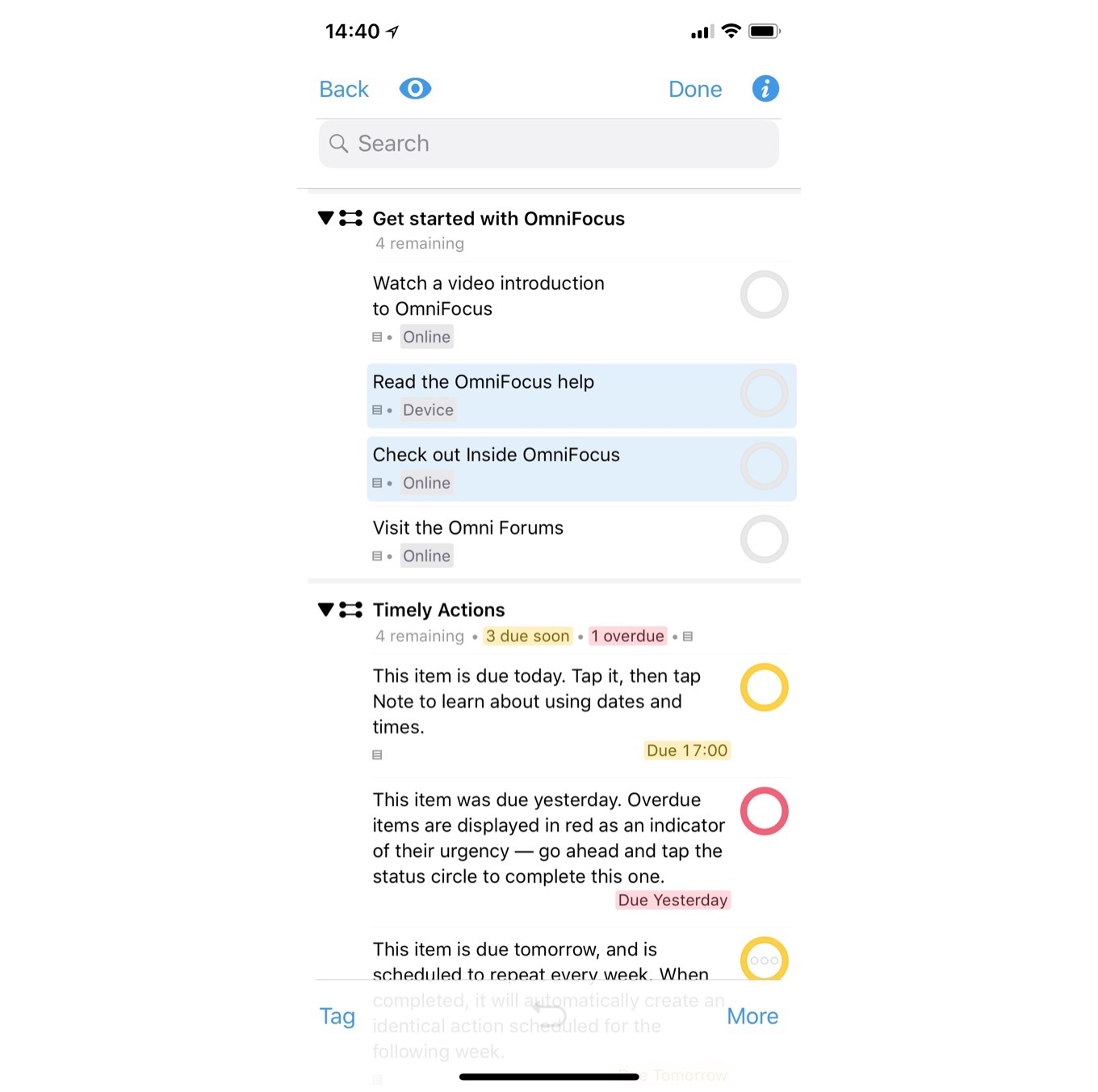
OmniFocus 3’s design will also be refreshed. Omni hasn’t shared many examples of what the update will look like, but here’s an example from the company’s blog post:
JavaScript-based automation, which is included in some of Omni’s other apps, is coming to OmniFocus as is collaboration, which will feature a system that lets multiple people share the same task by linking them. Omni says the system will allow everyone on a shared task to see its status, but place the task wherever they want within their task management setups. Finally, Omni plans a basic web version of OmniFocus that will allow users to access their tasks, though with a limited feature set.
Omni has changes in store for its other apps too. The first 2018 update to OmniGraffle for Mac will focus on the Stencil Browser, which users will be able to place in the left-hand sidebar. A later update will add improvements to SVG import and export support. Later in the year, another update is planned to improve diagramming.
OmniPlan for Mac will add a Project Summary Inspector that provides summary information about a project like its total cost and duration. OmniPlan Pro users will get a new timescale feature for customizing Dashboards too. Improvements to OmniPlan Pro’s publish and subscribe sync feature are planned for later in the year.
OmniOutliner 3 for iOS is scheduled for release in February 2018. The update will introduce Essentials and Pro versions of the app. Essentials offers a simplified outlining environment, while Pro includes advanced features like saved filters, encryption, and JavaScript automation.
It looks as though 2018 will be a busy year for Omni. Updates to apps like Things have raised the bar on task management apps, so it’s good to see Omni rethinking and redesigning some of the fundamental aspects of OmniFocus. I’m also looking forward to the OmniOutliner, an app that I’ve used on and off since it was first introduced on iOS.
Support MacStories Directly
Club MacStories offers exclusive access to extra MacStories content, delivered every week; it's also a way to support us directly.
Club MacStories will help you discover the best apps for your devices and get the most out of your iPhone, iPad, and Mac. Plus, it's made in Italy.
In advance of HomePod pre-orders, which began earlier today, Apple invited a handful of writers to hear the HomePod in action. Apple’s smart speaker was met with universal praise for its sound quality but also, some skepticism.
By all accounts, the HomePod produces exceptional sound for a 7-inch-tall device.
I came away from that test both impressed and shocked by the engineering Apple has put into making this tiny 7-inch speaker a musical powerhouse in your living room.
Audio quality is beautifully warm, yet the bass is not overpowering, even though it was still quite rich. If you close your eyes, it’s easy to feel like you’re at a live performance. We could pick out the vocals and instruments clearly. The speaker allows each instrument to shine through; you can hear precise guitar plucks. No, it doesn’t have that crisp sound you’d hear from very expensive high-end speakers, but then again, the HomePod doesn’t cost thousands yet still pushes brilliant sound quality out of a single, small enclosure.
The sound stage is deep for such a small device and the separation (the ability to hear individual instruments, details and vocals) is superb. There’s no rattling or distortion that we could hear in our early look, which is a testament to the HomePod structure’s design. And in case you’re wondering about the frequency range, we asked, and Apple told us that the HomePod’s range is 40Hz to 20kHz.
Instrument and vocal separation were a common highlight for many listeners:
The speaker is particularly adept at isolating vocals and maintaining often muddled aural aspects, like background singers and audience sounds in live recordings.
Whether it was a bass drum kick, crisp vocals or a muted guitar note, each layer sounded cleanly separated and as if it was emanating from various parts of the opposing wall rather than a 7in speaker.
Although it isn’t coming until later via a software update, dual-HomePod stereo pairing received rave reviews too.
Apple previewed this ability for me, and the two HomePods filled a huge room with very clear sound with impressive volume. The bass lacked the thump of dedicated subwoofer, but had everything else.
We had a chance to audition the upcoming stereo pairing feature of the HomePod. Running a pair of HomePods sounds significantly more robust. We were impressed with the spatial quality of having two HomePods working together in a stereo pairing.
Of course, the HomePod, the release of which was delayed, has some significant limitations too. AirPlay 2, stereo pairing of two HomePods, and multi-room support are all previously-promised features that will come after the first HomePods ship. Nor does the HomePod’s Siri integration support as wide a variety of voice commands as competing products like the Amazon Echo and Google Home.
Those issues, along with the HomePod’s sticker price, left some writers questioning how well the device will be received by consumers.
After spending a good chunk of the afternoon with Apple's new Siri-controlled speaker, listening to tunes in the company's tony Tribeca apartment meeting space, I'm more convinced than ever that Apple has built an aural triumph in its initial entry to the "smart speaker" space.
What I'm less convinced of, however, is whether customers will care.
The fact that Apple is finally entering the smart speaker race is cause for muted celebration. It’s attractive, sounds amazing and is an excellent Siri ambassador. And it’s $349. Is better sound and solid iOS integration (plus the added cost of an Apple Music subscription) worth spending nearly four times as much as a decent sounding Echo?
Guess we’ll have our answer when the HomePod goes on pre-order this Friday.
The question for iOS fans is whether that’s worth the price tag or potentially switching to an Apple Music subscription. With multi-room music and stereo pairing not available until ‘later this year’ Apple is, like the original Apple Watch, asking you to buy into the HomePod’s potential.
Unlike smartwatches in 2015, the difference here is that there are already some fantastic, versatile smart speakers out that work with equally fantastic music streaming services. We’ll bring you our final verdict on the HomePod very soon.
Overall, the initial impressions of most writers seem in line with the comments of those who heard the HomePod at WWDC last June. Although the most recent demonstrations showed off more functionality than ever before, including Siri, they were still held in an Apple-controlled environment. It will be interesting to see how HomePods perform once they are set up in a wide variety of homes on February 9th.
Support MacStories Directly
Club MacStories offers exclusive access to extra MacStories content, delivered every week; it's also a way to support us directly.
Club MacStories will help you discover the best apps for your devices and get the most out of your iPhone, iPad, and Mac. Plus, it's made in Italy.
Every #MeToo story makes me feel crushed. I wonder if all women feel this way? I have no right to be surprised. I’ve written about my own attempted rape.
I’ve experienced plenty of other seedy little dramas that amount to inappropriate sexual contact, beginning with the day in 8th grade when a “popular” boy grabbed my breasts in front of all his friends, who laughed of course. “We just wanted to see if they were real,” he said.
I remember feeling like it was my fault, like I should cover myself more. If I’d told an adult what had happened (I didn’t) I imagine that is actually what they would have told me back in 1993. That was the line back then. Girls had the goods, and it was their job to protect them from any poor man who could not control himself.
Blame and responsibility are hard things to tease apart. I’m good at taking care of myself, and I pride myself on being able to make smart, safe choices. But I also don’t blame anyone who, in a given situation, didn’t have the ability or agency to keep themselves safe. Or comfortable. Or vocal. Because there have been times when that has been me too, and a vast majority of the smart, savvy and strong women I love the most.
I reported in Barrie for four years, so of course I knew Patrick Brown. I liked working with him. I never got a creepy vibe from him; he was always incredibly professional. At that time, one of his friends lived in the same condo complex as me, and I would sometimes see Patrick leaving on the early weekend mornings, with girls in cocktail dresses from the night before.
It struck me as perhaps unusual for a sitting MP to be so blase about his partying, but I knew the strongest substance he used was Red Bull, and assumed (wrongly, I guess) that he would know better than to do anything that could hurt someone, and hurt his career. Nothing made me think the situation was newsworthy, or that anything non-consensual had gone on.
Partly because I’m a feminist, and partly because I respect CTV’s thorough reporting, I believe the women who have launched allegations against him.
However I struggle as I watch some CTV reporters’ slightly smug reporting on the story. They don’t have moral authority on this one.
What happened to me happened more than 12 years ago, and for months now I’ve been struggling with whether to reveal it.
I wasn’t raped. I didn’t say anything at the time. Why? And why bring it up now?
My husband reminded me that had I said anything at the time, no one would have supported me, and I undoubtedly would not have gone on to have an excellent career at CTV, something for which I’m very grateful.
As the #MeToo allegations have poured out these past few months, I think about this one specific incident that happened to me at CTV. I wonder if my silence allowed it to perpetuate, to affect other young women who worked there. I have a lot of guilt around not speaking out against the perpetrator, in hopes of protecting others. I wasn’t confident enough then, and I don’t know if it’s meaningful or helpful now, more than a decade later.
In Spring 2006, I was just starting as a freelance segment producer for the now-defunct Canada AM. It was a dream job, after months of trying to find TV work in Toronto.
In my first week there, I reached out to an award-winning CTV reporter and anchor, who is still on the air today. Literally today, talking about Patrick Brown.
I had met him at a birthday party some weeks earlier. I didn’t know the birthday girl, but was there as the guest of one of my friends. The CTV guy introduced himself to me, and I told him of my ambitions to work in television myself. He gave me his card and said I shouldn’t hesitate to call him if there was anything he could do to help.
I was thrilled to have made such a great contact. I was already feeling indebted to him, just for the offer.
When I got the job at Canada AM, I emailed him to ask if he’d like to get coffee in the cafeteria and reconnect. My work was not done, I was still just a freelancer, and wanted to make as many good contacts as I could, in the hopes of securing full time work.
He agreed, and suggested instead I come to his office after my shift. He worked in a satellite office, so after work I took the subway to go see him. He’d just finished his live hit and asked if I’d like a tour. I was thrilled at the idea.
He showed me around the storied building where he worked, introducing me to some of his colleagues. We ended the tour back in his office where his newscast was still on, so we watched some of it and he told me about his coworkers. It all seemed very designed to help me get to know people in the industry.
Until he started kissing me.
I was confused. This was not what I had anticipated at all. I thought, perhaps naively, that it was perfectly possible to visit someone’s office for purely professional reasons. In fact, I knew it was possible, because I had done that very thing with other men and women who were willing to help me, and who didn’t expect a sexual quid pro quo.
I didn’t want to be kissing him at all, but suddenly felt very worried about offending him.
Then he started pushing on the top of my head. Women, you know this move. The universal “please give me oral sex” move. It was enough to snap me out of my concern of offending him.
“I’m not giving you a blow job in your office,” I said bluntly, as is my style.
He whined and cajoled, and I’m ashamed to say that at this point I was more worried about my reputation than my safety. I didn’t want to be “that girl.”
I turned to leave, but realized I had no idea how to get back down to the entrance in this confusing mishmash of an ancient building.
And then, his penis was out. It was like being cornered by a flasher on the subway, but with an added level of fear. I stood frozen like a statue as this man proceeded to ejaculate in front of me right onto the fancy carpet of his office.
He zipped, and I felt like I’d been turned to stone. I couldn’t move, couldn’t speak.
“I’ll show you out,” he offered.
Our goodbyes were awkward to say the least. I didn’t tell anyone, I just cried for being so stupid. And then chastised myself for crying, because I wasn’t hurt. Disgusted and traumatized, yes. Hurt, no.
And I’ve known him ever since. Casually of course. You can bet I was never alone with him again. I saw him around CTV, and even after I’d moved on to Barrie, we would run into each other covering the same stories.
I never told him how awful our encounter was for me, or that it affected my ability to work with men around his age, forever after. My distrust and antipathy toward any man who reminded me of him has profoundly affected my career and my life.
We still follow each other on Twitter. Which his how I learned he is reporting what happened with Patrick Brown. Dispassionately, of course, as reporters do. I just wonder if there is any discomfort for him in describing the story of an older man, preying on a young woman just starting her career who came to him for help, and came away traumatized. I doubt it.
This essay has been adapted from my book, “Let’s Talk: A Memoir of Mental Illness in Broadcast News” to be published in 2019.
Joseph Planta@Planta
If you're interested in urban issues, this was a great show on Toronto's amalgamation, probably for all the shoutin… twitter.com/i/web/status/9…
Here’s a fabulous animated swoop (7:09, silent, and worth every second of your time) through the waterfront entertainment district of NEFC. It starts with an overall aerial view of the project, giving a look and feel that is, frankly, exciting; then moves through the District at street level. Many thanks to Joseph Hruda of CIVITAS Urban Design & Master Planning and Concord Pacific.
Things I saw: people, people, people; spaces of all shapes and sizes; places for people to sit, walk, sip, stare, eat, shop, live. More people. Greenways. The bike-ped overpass. Oh yeah, and a few cars.
The Entertainment District: a part of the massive NEFC development.
Friday afternoon, as the sun popped in and out of the clouds, I travelled to Granville Island, an area across from downtown, where locals and tourists go for food, shopping, and cultural activities. I searched for a quiet spot, away from the crowds, to watch the birds on the water and listen to the sounds of nature. Happy to discover a new place to relax.
I love adventuring!
To recap: On Sunday, January 21st, I completed Cycle 39 Week 2. I have multiple myeloma and anemia, a rare cancer of the immune system. Multiple myeloma affects the plasma cells, a type of immune cell that produces antibodies to fight infection. These plasma cells are found in the bone marrow. As a blood cancer, it is incurable, but treatable. Since February 9th 2015, I have been on Pomalyst and dexamethasone chemo treatment (Pom/dex). On July 16th, my dexamethasone treatment ended, due to eye damage, reported by my Glaucoma Specialist, from long-term use. On January 9th I began Ninlaro chemo to combat steadily rising cancer levels.
Weekly chemo-inspired self-portraits can be viewed in my flickr album.
Apple today shared its first series of HomePod ads on its official YouTube channel, titled Bass, Beat, Distortion, and Equalizer.
[...]
The music-focused ads are each set to their own song, including Ain't I by Lizzo, DNA by Kendrick Lamar, Holy Water by Hembree, and All Night by Big Boi. Apple continues to position the HomePod as a "breakthrough speaker" first and "intelligent home assistant" second in the description of each video.
If there was any doubt on how Apple is trying to position the HomePod, these ads have no mention – visual or otherwise – of Siri functionalities at all. They're just about music. (Personally, I love the style and animations.)
Does university illiberalism matter, or is it just campus hijinks? Cathy Young shows how campus politics is infecting American politics bostonglobe.com/ideas/2018/01/… via @BostonGlobe
Posted by
sapinker
on Sunday, January 28th, 2018 3:52pm
There’s a lot of weird stuff about NYC real estate and this post attempts to cover some of the things that I’ve experienced. I’ve spent years renting apartments in NYC, mostly from rather small-time landlords with pre-war, rent stabilized buildings. If you’re looking for luxury rentals in new construction, a lot of this advice probably doesn’t apply.
The Mysterious Other Renter
When I’ve found a place I like, invariably the real estate agent calls me a couple hours later telling me that someone else is willing to take the apartment for $100-$200 more per month. Luckily, I’ve never been in a position where I need that particular shitty rental, so I’ve always said, “That’s too bad, I guess I’ll keep looking.” Then a couple hours later the real estate agent calls back and tells me that the other deal miraculously fell through, would I still like the apartment?
This is, I assume, a scummy trick on the part of real estate agent to get an extra $100 commission for a few minutes of extra work (and ingratiate themselves with the landlord). If you have options, don’t fall into a bidding war over a rental.
“Legal rent” vs. what you’re paying
This can actually works out in your favor (at least in the short term). If you are looking for a cheap place, you’re likely to end up with a rent-stabilized apartment. Often, when you sign the lease, there will be an alarmingly high rent listed on the lease (e.g., if you agreed to pay $1,800/month, the lease lists $2,600).
How this works: for rent-stabilized apartments, the landlord is only allowed to raise the rent by a certain city-determined amount each year. For example, if you’re paying $2000/month and the city says landlords can raise rent-stabilized rents by 2%, the landlord can ask you to pay $2200 next year. However, let’s say you’re a good tenant: you always pay your rent on time. You threaten* to move unless the landlord keeps the rent at $2000. So they do: they’d rather have another “guaranteed” $24,000 than risk months of vacancy, a bad tenant, etc. for an extra $2,400.
The city also sometimes puts the rent increase at 0%. Up until last year, there were ~5 years of 0% rent increases. If a landlord had been bumping the legal rent by the max allowable amount before that, though, they could keep bumping the actually rent (up to the legal rent’s ceiling).
Gentrification also is an issue: if you are renting a rent-stabilized apartment and the landlord wants to renovate it into luxury apartments, they have to get rid of their current tenants, first. A great way to do this is to suddenly bump your rent to the max legal rent. If you balked at paying an extra $200/month for a crappy studio with no view, how would you feel about a $1k/month bump? Only the old tenants are gone, the landlord is free to renovate the apartment. Renovations increase the allowable rent they can charge for the apartment, often bumping it out of the range that the city will consider rent-stabilized… allowing the landlord to charge the new tenants absolutely anything.
The migratory patterns of renters
Most people move in the warmer months. Once it starts to get cold, people seem to have a nesting instinct and just don’t want to go out and find a place. This means that landlords are more likely to make concessions and give discounts in the winter months, if you can move then. And they’re more likely to be friendly about letting you out of your lease in the summer months.
Rental agents: the crème de la crap
Real estate agents work on commission: they literally make $0 salary. Like strippers, they generally pay the brokerage for getting to use their space. Because brokerages can charge agents to work for them, they’ll often hire literally anyone that can pass the licensing exam.
Now guess which gives a better commission: signing a lease on a rent-stabilized apartment or closing a $2.5 million sale. The lease gives the agent one month’s rent (maybe a thousand). The sale gives them a few percent of the listing price (maybe $30,000 for the example above).* There are more expenses with selling a listing, but still. Thus, the real estate agents you’ll be working with will generally be the least-experienced agents at the brokerage. A broker once told me, “If a new agent has a deep network and skills, I’m not going to waste them doing rentals.” Putting together rental deals is the latrine duty of real estate.
Thus, if you can avoid it, don’t work with an agent. They’re unlikely to be good at their job and are generally a huge waste of money. However, landlords of big buildings (especially) will sometimes only work with real estate agents. This is because the real estate agents will do some pre-screening (if you make $30k/year they’re not going to waste anyone’s time showing you a $3k/month place) and they will steer tenants to the buildings that they work with (which works out well for everyone, pretty much: the landlords get tenants, the tenants find a place, the real estate agent gets a commission fairly easily).
If you are trying to avoid a broker’s fee, though, you’ll want to avoid those buildings.
Leases
In Manhattan, you’re almost certainly going to have standard year-long leases. The landlord sends you a new lease within 90 days of your lease expiring and you either sign it, ask for modifications, or decline and move out. If you need to move out before that, try to find someone to take over your lease (hey, I know a startup that can help with that) or your landlord is likely to fine you at least a month’s rent (good bye security deposit) for breaking the lease.
A perk of Queens and Brooklyn is that leases often turn into month-to-month leases after then initial year is up (and occasionally will start as month-to-month leases). This gives you a lot more flexibility: often you only have to give 30 days notice before moving out. (I don’t know much about renting in the Bronx or Staten Island.)
Wrapping up
When dealing with landlords: remember that they really just want someone who will reliably pay rent. And, I mean, not burn the place down or turn it into a drug den, but hopefully you won’t have to work very hard to convince them of that side of it.
When working with agents: remember that they are in it for the commission and you are probably more skilled at literally everything than they are, but they have connections and (some) experience. But do your own research and don’t trust anything they say. And since I’m a real estate agent… and I wrote this post… well, I guess this was a huge waste of your time
I’d love to hear what your experiences have been, let me know in the comments.
* Threatening your landlord: I use the word “threaten” loosely. I’ve always had good luck with just calling the landlord and saying, “I’d really like to stay, is there any way you can see your way to keeping the rent at $2k?” So I’m not going all First Blood on them. * Commission on sales and rentals: I’m assuming that a brokerage is likely to take at least 50% of the commission for either, although this varies widely.
I sure do love me some reggae; my island-music tastes are mainstream, but once you get past Marley, the names
are fading from memories. Maybe I can reverse that a bit. Let’s start with
Winston Rodney; his first band was Burning Spear, then he just adopted
the name for himself. His music is a little deeper, his singing a little edgier, his horn arrangements excellent. Slavery
Days has all of those things, and deserves to live forever.
When you consider Mr Rodney, you have to take
Rastafari (the religion, I mean) into account; he’s serious about it. It’s
a strong flavor in a culture that produced a whole lot of really good music. Just like Lutheran Christianity was essential to Bach
and Eastern Orthodoxy is essential to Pärt. Doesn’t mean you have to believe in it, which is a particular relief when the faith
in question involves the divine aspect of Haile Selassie. I’m OK living in Babylon, myself.
Slavery Days appears on the superb Spear album Marcus Garvey,
whose title refers to an actual real human being, a seriously interesting dude, whatever you might think
of his more eccentric segregationist ideas. A quick tour through his life story on Wikipedia is a good investment of a few minutes.
Slavery Days isn’t religious at all, it’s just what the title says, a lament for those bad old days. Having said
that, it’s got a super happy sound, opening with an ebullient brass proclamation, then spinning and lurching back and forth through
chants and counter-chants and instrumental breaks, with the horn obbligato dancing around the reggae pulse and that beautiful
resonant Burning Spear voice at the center. It’s maybe my favorite
reggae song of all time. Back in the day, I used to use it as my ringtone (remember them?) and I smiled every time that horn
explosion went off meaning someone wanted to talk.
Winston is still living, last time I checked, and if he’s still performing, I’d recommend a trip to see him. Lots of interesting
stuff on
his YouTube Channel.
Amazon,
Spotify,
iTunes.
As for live video, the Net is full of it. The quality is wildly variable; some of the backup bands are better than others, and,
well, some nights seems like Burning Spear dug a little too deep in the herb drawer. That said, here’s a relatively clean
studio version, and a
1981 concert in which the Spear burns especially bright.A pity, none of those clips have Winston on percussion; he can really make the
congas sing. But I could listen to
that band play that groove all day and all night.
A tragedy is like a fault line. A life is split into a before and an after, and most of the time, the before was better. Few people will let you admit that out loud.
That bit resonated. Actually, the whole article resonated a bit more than I’m comfortable with. Small talk becomes a bit like navigating a mental minefield. “How are you?” is either answered with a gentle lie, or with the truth. The gentle lie is what people are usually asking for, and, frankly, is what I usually want to say anyway. The truth is brutal and scary and life-altering and nuanced and exhausting. “I’m fine. How are you?”
This article is part of a series of hands-on tutorials introducing FFA, or the Finite Field Arithmetic library. FFA differs from the typical “Open Sores” abomination, in that — rather than trusting the author blindly with their lives — prospective users are expected to read and fully understand every single line. In exactly the same manner that you would understand and pack your own parachute. The reader will assemble and test a working FFA with his own hands, and at the same time grasp the purpose of each moving part therein.
Add the above vpatch and seal to your V-set, and press to ffa_ch9_exodus.vpatch.
You should end up with the same directory structure as previously.
Now compile ffacalc:
cd ffacalc
gprbuild
But do not run it quite yet.
The “Egyptian” algorithm for multiplication (in its simplest Chapter 5 version, and likewise in the refined form given in Chapter 7) has a time cost that is proportional to the square of the operand bitness — i.e. it runs in O(N^2), or quadratic time. In Chapter 10, we will meet a substantially faster — subquadratic — algorithm for multiplication. However, for reasons which will become apparent to the reader, we would first like to obtain the fastest quadratic-time multiplier that we possibly can (without compromising any of the FFA design principles laid out in Chapter 1).
The ancient Egyptians came up with an easily-taught and reasonably efficient-method for multiplication. However, they ran it “on” human scribes, rather than automatic machinery. And it turns out that the latter, especially in the form of recently-made CPUs, is quite sensitive to the particular time-and-space “shape” of an algorithm. But we will expand on this point later.
Mathematician and astronomer Paul G. Comba (1926 — 2017) devised an elegant multiplication algorithm which superficially resembles the familiar “grade school” long-multiplication — but with the important difference that it does not require the generation of intermediate per-row temporary results. Instead, it generates each column — or digit — (or, in FFA parlance, Word) of the product, sequentially, from lowest to highest, using only a handful of words of memory for temporary storage. Let’s implement Comba’s algorithm:
FZ_Mul.ads:
with FZ_Type; use FZ_Type;

package FZ_Mul is

   pragma Pure;

   -- Comba's multiplier.
   procedure FZ_Mul_Comba(X     : in  FZ;
                          Y     : in  FZ;
                          XY_Lo : out FZ;
                          XY_Hi : out FZ);
   pragma Precondition(X'Length = Y'Length and
                         XY_Lo'Length = XY_Hi'Length and
                         XY_Lo'Length = ((X'Length + Y'Length) / 2));

end FZ_Mul;
FZ_Mul.adb:
with Words;    use Words;
with Word_Ops; use Word_Ops;
with W_Mul;    use W_Mul;


package body FZ_Mul is

   -- Comba's multiplier.
   procedure FZ_Mul_Comba(X     : in  FZ;
                          Y     : in  FZ;
                          XY_Lo : out FZ;
                          XY_Hi : out FZ) is

      -- Words in each multiplicand
      L : constant Word_Index := X'Length;

      -- Length of Product, i.e. double the length of either multiplicand
      LP : constant Word_Index := 2 * L;

      -- 3-word Accumulator
      A2, A1, A0 : Word := 0;

      -- Register holding Product; indexed from zero
      XY : FZ(0 .. LP - 1);

      -- Type for referring to a column of XY
      subtype ColXY is Word_Index range XY'Range;

      -- Compute the Nth (indexed from zero) column of the Product
      procedure Col(N : in ColXY; U : in ColXY; V : in ColXY) is

         -- The outputs of a Word multiplication
         Lo, Hi : Word;

         -- Carry for the Accumulator addition
         C      : WBool;

         -- Sum for Accumulator addition
         Sum    : Word;

      begin

         -- For lower half of XY, will go from 0 to N
         -- For upper half of XY, will go from N - L + 1 to L - 1
         for j in U .. V loop

            -- Hi:Lo := j-th Word of X  *  (N - j)-th Word of Y
            Mul_Word(X(X'First + j),
                     Y(Y'First - j + N),
                     Lo, Hi);

            -- Now add Hi:Lo into the Accumulator:

            -- A0 += Lo; C := Carry
            Sum := A0 + Lo;
            C   := W_Carry(A0, Lo, Sum);
            A0  := Sum;

            -- A1 += Hi + C; C := Carry
            Sum := A1 + Hi + C;
            C   := W_Carry(A1, Hi, Sum);
            A1  := Sum;

            -- A2 += A2 + C
            A2  := A2 + C;

         end loop;

         -- We now have the Nth (indexed from zero) word of XY
         XY(N) := A0;

         -- Right-Shift the Accumulator by one Word width:
         A0 := A1;
         A1 := A2;
         A2 := 0;

      end Col;
      pragma Inline_Always(Col);

   begin

      -- Compute the lower half of the Product:
      for i in 0 .. L - 1 loop

         Col(i, 0, i);

      end loop;

      -- Compute the upper half (sans last Word) of the Product:
      for i in L .. LP - 2 loop

         Col(i, i - L + 1, L - 1);

      end loop;

      -- The very last Word of the Product:
      XY(XY'Last) := A0;

      -- Output the Product's lower and upper FZs:
      XY_Lo := XY(0 .. L - 1);
      XY_Hi := XY(L .. XY'Last);

   end FZ_Mul_Comba;
   pragma Inline_Always(FZ_Mul_Comba);

end FZ_Mul;
I will omit the detailed analysis of why Comba’s Multiplication works, and leave the proof as an exercise for the reader. However, do observe that this routine demands a Mul_Word procedure. Which the reader will correctly guess, lives in the unit W_Mul:
W_Mul.ads:
with Words; use Words;

package W_Mul is

   pragma Pure;

   -- The bitness of a Half-Word
   HalfBitness : constant Positive := Bitness / 2;
   subtype HalfWord is Word range 0 .. 2**HalfBitness;

   -- The number of bytes in a Half-Word
   HalfByteness : constant Positive := Byteness / 2;

   -- Multiply half-words X and Y, producing a Word-sized product
   function Mul_HalfWord(X : in HalfWord; Y : in HalfWord) return Word;

   -- Get the bottom half of a Word
   function BottomHW(W : in Word) return HalfWord;

   -- Get the top half of a Word
   function TopHW(W : in Word) return HalfWord;

   -- Carry out X*Y mult, return lower word XY_LW and upper word XY_HW.
   procedure Mul_Word(X : in Word; Y : in Word; XY_LW : out Word; XY_HW : out Word);

end W_Mul;
W_Mul.adb (”Iron” Variant):
with W_Shifts; use W_Shifts;


package body W_Mul is

   function Mul_HalfWord(X : in HalfWord;
                         Y : in HalfWord) return Word is
   begin
      return X * Y;
   end Mul_HalfWord;
   pragma Inline_Always(Mul_HalfWord);


   -- Get the bottom half of a Word
   function BottomHW(W : in Word) return HalfWord is
   begin
      return W and (2**HalfBitness - 1);
   end BottomHW;
   pragma Inline_Always(BottomHW);


   -- Get the top half of a Word
   function TopHW(W : in Word) return HalfWord is
   begin
      return Shift_Right(W, HalfBitness);
   end TopHW;
   pragma Inline_Always(TopHW);


   -- Carry out X*Y mult, return lower word XY_LW and upper word XY_HW.
   procedure Mul_Word(X       : in  Word;
                      Y       : in  Word;
                      XY_LW   : out Word;
                      XY_HW   : out Word) is

      -- Bottom half of multiplicand X
      XL : constant HalfWord := BottomHW(X);

      -- Top half of multiplicand X
      XH : constant HalfWord := TopHW(X);

      -- Bottom half of multiplicand Y
      YL : constant HalfWord := BottomHW(Y);

      -- Top half of multiplicand Y
      YH : constant HalfWord := TopHW(Y);

      -- XL * YL
      LL : constant Word := Mul_HalfWord(XL, YL);

      -- XL * YH
      LH : constant Word := Mul_HalfWord(XL, YH);

      -- XH * YL
      HL : constant Word := Mul_HalfWord(XH, YL);

      -- XH * YH
      HH : constant Word := Mul_HalfWord(XH, YH);

      -- Carry
      CL : constant Word := TopHW(TopHW(LL) + BottomHW(LH) + BottomHW(HL));

   begin

      -- Get the bottom half of the Product:
      XY_LW := LL + Shift_Left(LH + HL, HalfBitness);

      -- Get the top half of the Product:
      XY_HW := HH + TopHW(HL) + TopHW(LH) + CL;

   end Mul_Word;
   pragma Inline_Always(Mul_Word);

end W_Mul;
Mul_Word, it turns out, is merely a Word*Word -> double-Word “schoolbook” multiplier. And: it is abundantly obvious that it could be replaced with a single IMUL instruction on x86/x86-64. But we won’t do this in standard FFA — recall the design principles from Chapter 1! We will not be “marrying” any particular iron.
A very sharp reader may have already noticed the “problematic” element in the above Mul_Word routine. Namely, Mul_HalfWord as given here creates a danger of timing sidechannel leakage on certain machine architectures!
CPUs widely known to suffer from this “helpful” “optimization” include x86-compatible VIA, old Intels (386, 486), and most of the commonly-met PowerPC and ARM devices. Others archs, as well as obscure implementations of well-known archs, may also belong on this list. (Please write in if you happen to know of one such that I have not listed here.)
If FFA were to continue with the above variant (let’s call it iron) of Mul_HalfWord, every machine on which it is put to use would have to be first probed for non-constanttime iron multiplication: every newly-purchased CPU is arguably “guilty until proven innocent”. But it turns out that there is a simple and relatively-inexpensive cure for this headache:
W_Mul.adb (”Soft” Variant, non-unrolled):
   -- Multiply half-words X and Y, producing a Word-sized product
   function Mul_HalfWord(X : in HalfWord; Y : in HalfWord) return Word is

      -- X-Slide
      XS : Word := X;

      -- Y-Slide
      YS : Word := Y;

      -- Gate Mask
      GM : Word;

      -- The Product
      XY : Word := 0;

   begin

      -- For each bit of the Y-Slide:
      for b in 1 .. HalfBitness loop

         -- Compute the gate mask
         GM := 0 - (YS and 1);

         -- Perform the gated addition
         XY := XY + (XS and GM);

         -- Crank the next Y-slide bit into position
         YS := Shift_Right(YS, 1);

         -- Advance the X-slide by 1 bit
         XS := Shift_Left(XS, 1);

      end loop;

      -- Return the Product
      return XY;

   end Mul_HalfWord;
   pragma Inline_Always(Mul_HalfWord);
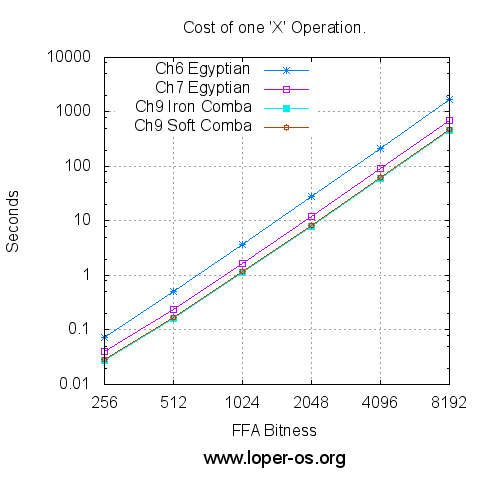
The above Mul_HalfWord replaces the “iron” multiplication with a miniature version of the Chapter 5 “Egyptian” algorithm. Because there is no multiwordism and no carry calculation, this safe (bitwise logical operations and shifts by one bit are constant-time on all CPUs known to me) alternative to the “leaky” MUL, when implemented in the partially unrolled form as follows — comes at a cost of a less than 6 percent (see further below) increase in required CPU time(see comments):
W_Mul.adb (”Soft” Variant, unrolled):
   -- Multiply half-words X and Y, producing a Word-sized product
   function Mul_HalfWord(X : in HalfWord; Y : in HalfWord) return Word is

      -- X-Slide
      XS : Word := X;

      -- Y-Slide
      YS : Word := Y;

      -- Gate Mask
      GM : Word;

      -- The Product
      XY : Word := 0;

      -- Performed for each bit of HalfWord's bitness:
      procedure Bit is
      begin

         -- Compute the gate mask
         GM := 0 - (YS and 1);

         -- Perform the gated addition
         XY := XY + (XS and GM);

         -- Crank the next Y-slide bit into position
         YS := Shift_Right(YS, 1);

         -- Advance the X-slide by 1 bit
         XS := Shift_Left(XS, 1);

      end Bit;
      pragma Inline_Always(Bit);

   begin

      -- For each bit of the Y-Slide (unrolled) :
      for b in 1 .. HalfByteness loop

         Bit; Bit; Bit; Bit; Bit; Bit; Bit; Bit;

      end loop;

      -- Return the Product
      return XY;

   end Mul_HalfWord;
   pragma Inline_Always(Mul_HalfWord);
And now, on the same machine as in previous Chapters, timed and plotted logarithmically:
Or, for those who prefer the raw numbers,
FFA Bitness
Ch.6 Egyptian ‘X’ (sec)
Ch.7 Egyptian ‘X’ (sec)
Ch.9 “Iron” Comba ‘X’ (sec)
Ch.9 “Soft” Comba ‘X’ (sec)
256
0.072
0.040
0.028
0.029
512
0.505
0.240
0.163
0.169
1024
3.685
1.672
1.125
1.177
2048
27.975
12.024
7.975
8.387
4096
217.966
90.439
59.356
62.725
8192
1720.127
699.979
457.103
483.993
Despite this small increase in runtime cost, standard FFA will from this point on use only the “soft” variant of Mul_HalfWord, so as to maintain the guarantee of constant-time operation on all known CPU architectures. Individual readers, can, of course, at their own risk — replace the entirety of Mul_Word — or even FZ_Mul_Comba — with an inline-assembly routine known to work safely on a particular CPU. But this type of optimization falls outside the scope of FFA as per the design principles introduced in Chapter 1.
… will pseudorandomly generate two numbers, each being one megabit in size, and produce a statement regarding their (two-megabit-wide, at most) product, that can be verified by the Python interpreter, in turn producing an output after around half a minute on the test box used thus far.
Now let’s feed this output into Python:
$ python < multest.py
Prints:
True
... after less than one fifth of a second, on the same machine.
The bulk of the remaining material in this series will concern methods of bridging the speed gap between our routines and traditional "bignum" mechanisms (such as those used in the Python interpreter) to the extent possible without compromising any of the design principles of FFA.
Homework:
1. Prove that Comba's Algorithm works. And in particular, that the three-word Accumulator space given, will always suffice.
2. Given that both "Egyptian" and Comba's multiplication run in O(N^2), why does Comba's method win speedwise? Does it continue to win for all possible operand bitnesses, or only over a particular range?
3. Write an inline assembly variant of FZ_Mul_Comba for your CPU architecture. Demonstrate how you determined that the resulting program, when operating on the exponentiation test tape from Chapter 6, still runs in constant time (i.e. its CPU time cost is unaffected by any aspect of the input other than the choice of FFA bitness) on your particular machine.
CES 2018 and the North American International Auto Show in Detroit are now over, but the implication is that Ford is making a big gamble. Putting itself in the unenviable role of trying to unite a fractious industry toward uniformity on an autonomous driving operating system, Ford is betting that its Transportation Mobility Cloud (TMC) will be the ticket.
Amidst all the talk of greater driving autonomy and the advent of 5G cellular, Ford is hinting at a total shift in priorities. CEO Jim Hackett didn’t explicitly say it, but he certainly implied that the company will need to focus on “transportation systems” rather than making more cars.
That’s almost like Apple saying it needs to focus on the way people communicate and consume content on the go, more than making iPhones. Hackett’s real point was that, while cars enabled freedom of movement, they restricted people through congestion, pollution and poor urban planning.
A systems-based approach essentially means that car ownership is going to matter less in the future. Lyft claims 240,000 of its passengers gave up their cars — and that’s only in the United States. The rideshare service entered Toronto in December 2017, but that didn’t figure into the report.
It’s not clear what similar impact Uber may have had, given its much wider reach, but it’s hardly surprising that automakers like Ford want to be on the right side of history on this one.
Leading the charge
The auto industry is known for its sense of order, except the consensus has usually been forced upon it, either through regulation, liability or consumer demand. Getting all the automakers to agree on something as monumental as a self-driving OS is lofty, to say the least.
Nevertheless, Ford is giving it a go. The TMC is an initiative converging from a few different fronts. It teamed up with Qualcomm to adopt the Cellular Vehicle-to-Everything (C-V2X) platform that will be driven by 5G connectivity. It has partnered with Domino’s Pizza, Lyft and Postmates to trial self-driving cars that work within their respective businesses.
Then, there is the collaboration with a company called Autonomic, a vendor helping build out TMC. Other partners will be needed to pull off what is an otherwise idyllic vision.
More people living and working in cities, yet fewer cars. More free-flowing traffic with less parking. Vehicles driving themselves and speaking the same language to navigate roads with precision.
Where cities have felt handcuffed in finding relief to never-ending gridlock, TMC and C-V2X imagine a future where transport is efficient everywhere. With a growing population, it’s a little like swimming upstream. How would this work?
Clearing a path
Migration to cities shows little sign of abating. The United Nations projects 66 per cent of the world’s population will live in urban areas by 2050. In the U.S., the average American spent 16 hours in traffic 30 years ago. Today, that number is 38.
“City administrators are looking for unique ways to basically address that through advanced hybrid technology — the ability to create geo-fences for hybrid electric vehicles to go into electric-only mode when inside a certain geo-fence. That’s something that’s of very much interest to those cities,” says Sunny Madra, CEO of Autonomic, in an interview with MobileSyrup.
Ford’s approach is designed to be open-source, but will everyone else see it that way? Madra confirms the automaker is going ahead with its plans, even if no else bites.
Some may be on a similar page, but with different goals. Samsung has indicated a willingness to adopt C-V2X because of its reliance on 5G, except its driving initiatives feel like an attempt to stick to a walled garden, however realistic that may be.
That sort of thing matters because the vision involves vendors from a variety of industries, plus government legislators and regulators. Madra believes Ford is “doing it at such a large scale that it will help kind of pull others into the platform because that commitment has already been made.” He cites Amazon as an example, noting that its Web Services platform became a cloud computing behemoth.
“To deliver the vision of smart cities, we really need to be able to exercise the other modes of V2X. X stands for not just vehicle-to-vehicle, but vehicle-to-infrastructure, vehicle-to-pedestrians and vehicle-to-network,” says Jovan Zagajac, Ford’s technology manager, in an interview with MobileSyrup. “It is very likely those will have many elements of a cellular solution. We want to stay very close to that ecosystem.”
Zagajac is referring to the way autonomy and connectivity are hurtling toward each other. Currently, smartphones act as the primary conduits in delivering the content drivers and passengers consume. That’s already sobering, considering vehicles increasingly have their own infotainment systems and Wi-Fi hotspots. Apple’s CarPlay and Google’s Android Auto exemplify that further, since those too run off mobile devices, too.
What’s interesting is that TMC will apparently work with vehicles running Ford’s Sync 3 infotainment system. Backward-compatibility is rare in automotive circles, but Qualcomm has already indicated that any C-V2X rollout will have to begin with 4G LTE first.
Bumps ahead
The thing about shows like CES is they envision utopic convergences. Would some of the concepts shown by Samsung, Panasonic, Toyota, Kia, and others pass regulatory safety hurdles? And if so, when?
Thinking differently about driving is central to what Ford, Qualcomm and others are trying to do. The car becomes the mobile device. It has the connectivity to stream video and audio in really high resolutions. Virtual meetings done through VR while the car is moving or not — which sounds insane by today’s standards. Only 5G bandwidth with lower latency, plus a decidedly efficient autonomous infrastructure will make both these things possible.
And, of course, they would have to pass the sniff test from bureaucrats.
“We have work to do with regulators to ensure the tech can be deployed. The current regulatory environment wouldn’t permit us to deploy this technology the way we would like to,” admits Jagavac. “We are very encouraged and thankful to the regulators for their willingness to listen, and are constantly keeping them informed about the progress we are making in testing.”
The truth is, connectivity has always been an afterthought to the auto industry. This recent wave in developing autonomous technology and electric power has forced a rethink. Automakers will have to view it more like carriers, phone manufacturers and app developers have.
“We got burned when we had to switch from 2G to 3G and then on to LTE. Now we have to think of 5G, so we’re kind of getting sharper and smarter in how we’re designing our cars,” says Jagavac. “In the long run, whether it’s 5G or some other ‘G,’ we’ll be able to provide those services without having you buy a new car.”
He wouldn’t say whether that would mean vehicles will also become more modular over time, at least when it comes to the dashboard.
Bottom line
Madra is fairly aggressive in projecting that “hundreds of thousands” of Level 5-capable autonomous vehicles will travel on roads by 2021. Ford has remained committed to releasing an self-driving car without a steering wheel by 2020.
Releasing it is one thing, but without the umbrella of connectivity and regulations to support its operation, the impact is still highly speculative. The mentality shift underway in the industry does at least signify automakers know car ownership is going to change dramatically in the years to come.
Ford has already gone all-in on its Chariot ride-sharing service currently operating in a handful of U.S. cities. It’s set to expand further this year.
So, while it continues on its own initiatives, Ford is hoping to draw in everyone else to adopt C-V2X and 5G as industry standards. The company’s previous attempt at unanimity with the SmartDeviceLink infotainment and telematics platform fell flat. It won’t be long until we see how this effort bears out.
One reigning paradigm of Motordom is that we all buy a car as soon as we can, and just keep on buying every few years for decades. Much to the profit of those who make cars and related stuff.
But it seems this paradigm is already eroding, and undergoing change. My suspicion is that even more change is in the works when and if autonomous vehicles (AVs) become a practical and cost-effective reality. If this does come to pass, it’s likely that the number of active motor vehicles will shrink, and the Ubers of the world will operate large fleets of AV’s at much higher utilization that the single-digit numbers for most currently-owned private cars. This on-demand mobility looks like it may become the new paradigm.
Thanks to VanCity for this look at car-share (17-page PDF). It seems that Vancouver is edging towards the new paradigm.
According to VanCity’s survey and research:
Vancouver has more car-sharing vehicles per capita than any other city in N.A. That’s 3000 vehicles, 4.22 per 1000 population.
Why? Convenience (95% of survey responders); save money (62%); environmental concern (58%).
A surprising finding: only 44% of younger responders agreed that they liked not owning a vehicle. The report’s authors point to money savings as this group’s main reason for using car-share.
Another: 26% of respondents dumped a private vehicle in favour of car-sharing; and 40% avoided buying one.
Expanding transportation choice (options) is the major benefit the survey’s respondents like.
Throughout the years, we have been extremely lucky to have an amazing array of great people joining us and contributing in many various ways. There has been some spam here and there, we’ve had some people getting very emotional and unhappy about various aspects of SUMO or Mozilla, but so far we have had relatively few cases that needed Administrator investigation.
Obviously, all that luck does not mean that interpersonal conflicts on different levels do not happen right now or will not happen in the future. We acknowledge this fact and want to be prepared for such moments, as infrequent as they are. Staying a step ahead of potential problems will help us provide you with a SUMO community experience you all can enjoy and be a part of.
As a team of Administrators, we want to make sure everyone feels safe and empowered to contribute to Mozilla and talk openly about people who are not acting in agreement with the Mozilla-wide Community Participation Guidelines or the SUMO Community Participation Guidelines that are being finalized with your help.
We want to be open, fair and serious about keeping Mozilla diverse, inclusive, and watchful without breaking any of the mutual trust we hold for each other in our community.
We also want to inform you about the current list of Administrators and Moderators – and officially introduce (and explain) the addition of a new team member.
We also have a new team member – Foxy McSUMO (Maybe we should change the name? Do you have suggestions? Let us know!):
Who is Foxy McSUMO?
Foxy McSUMO is a persona that represents the whole SUMO Administrator team, without being a single person in particular. You can consider this profile a communication/action tool that each and every member of the SUMO Administrator team can use, after discussing the need to do so with the other Administrators.
Why do we have Foxy McSUMO?
We want to experiment with removing personal bias and communicate some (not all) team projects and decisions without making any one of the Administrators the “go to” person. If you see a post by (or receive any message from) Foxy, it means that we are addressing you as a whole team, not “just” one of us – this should help everyone avoid confusion and/or personal bias in communication.
The writing’s been on the wall for a while, but it’s still sad to see some of these go away, especially because (for calendaring, for instance, or sharing contacts) the client-side apps are similarly neglected and only talk to public cloud services or (poorly) with Microsoft Exchange.
Most of these are trivial to set up on a Raspberry Pi if you really need them–but since Apple never got around to do the most basic of shared cloud services properly (even photo sharing is still a mess), not many people are likely to miss them.
Many thanks to Ralph Segal for this wonderful background on Vancouver’s Northeast False Creek (NEFC) plan, and the thinking that has led to the planned viaducts’ demolition.
This is for those who still question the wisdom of demolishing the Viaducts, as contained in Vancouver’s just released NorthEast False Creek (NEFC) Plan.
Between 2007 and 2010 (prior to my retirement from Planning in late 2011), the City’s NEFC team was developing a detailed Area Plan for implementation which assumed the viaducts were a given. Why would we think otherwise? Viaduct removal was nowhere on our radar. But as the team struggled to address the full range of planning and urban design objectives, development economics, provision of affordable/social housing, parks, etc., etc, we kept running into the obstacles that the viaducts presented….serious compromises to most objectives, sacrificed potential qualitatively, quantitatively and economically, not the least of which was foregoing the freeing up of two City-owned blocks either side of Main St. (800 Main from Quebec to Gore Streets). The list of missed opportunities, diminished “value” (value in the broadest sense, not merely dollars), just kept on growing. This was entirely aside from any concerns about viaduct aesthetics, the under-viaduct environment or negative references to a long-abandoned 1950’s discredited elevated freeway philosophy.
We had to ask – what compelling benefits are provided by the viaducts? The bottom line boiled down to a convenient vehicular access in and out of the Downtown, certainly a worthy benefit. But at what sacrifice to other compromised objectives as well as foregone opportunities! This is the point at which serious investigation of an at-grade street option began for the entire NEFC Plan area. Was there an at-grade street arrangement that would at least equal, or surpass, the viaducts’ vehicular capacity in terms of the City’s overall transportation policy for future Downtown and False Creek Flats development? The ensuing comprehensive investigation has delivered a re-designed “complete streets” network proposal that addresses this issue. Full details of this network are being advanced.
The City’s NEFC Plan illustrates a broad-based approach that can provide a truly transformative environment for this entire east end of the Creek, with vastly improved connectivity to, and enhancement of, surrounding established and future neighbourhoods, the full benefits of which will be passed on to future generations of Vancouverites. The comprehensive process with wide-ranging public consultation through which this Plan has evolved has yielded an outstanding detailed vision.
It's one thing to talk about robot teachers in an environment where human teachers abound, but in an environment like India's tech industry there is no possibility of the teaching load being carried by traditional educators. Hence the headlines. For example, "in a crucial deal struck between Indian IT major Tech Mahindra and edX... edX would reskill 117,000 of its employees in India and around the world in skill sets that are desperately sought-after today." Meanwhile "Coursera has attracted an astonishing 2 million learners in India and is tacking on 60,000 new learners every month." Meanwhile, "homegrown (Indian) companies such as AcadGild, UpGrad, Simplilearn, and Emeritus -- who are all experiencing unprecedented interest and business in their online offerings -- will continue to prosper."
DJI is the 800-pound gorilla of the drone world. At this point, every time the Chinese company introduces a new drone, it’s basically cannibalizing sales of its own existing products.
Never will that become more true than next week, when its new Mavic Air drone is unveiled. Far smaller than the older Mavic Pro, the Air folds up small enough to fit into a coat pocket — its most important feature by far.
But the Mavic Air is less expensive, too ($800 including remote controller), yet still does 4K video capture from a camera that’s on a 3-axis gimbal (meaning super-stable video). The Air has sensors on the back, so that it can avoid collisions, either forward or backward.
You can control the Air with hand motions, just as you can the $400, non-folding, equally small DJI Spark. In fact, you can use even more motions.
On the Spark, those “use the force” hand gestures were iffy. Sometimes, the drone just looked at you dumbly no matter how spastically you did the gestures. When I review the new Air next week, I’ll see if DJI has managed to improve that feature.
In the meantime, on paper, anyway, the Mavic Air is one juicy semi-pro drone indeed!
—
David Pogue, tech columnist for Yahoo Finance, welcomes non-toxic comments in the Comments below. On the Web, he’s davidpogue.com. On Twitter, he’s @pogue. On email, he’s poguester@yahoo.com. You can sign up to get his stuff by email, here.
Since when did bells go out of fashion? Even bell bottom jeans are struggling. This Flickr Friday theme was to #RingTheBell and we could tell people were definitely challenged. We’d just like to note that we added the photo below into the Flickr Friday gallery because after a thorough investigation, we’ve deemed chimes an acceptable enough relation to bells.
Did you know that “chimes” also goes by a different name? They are called “tubular bells” which therefore classifies it directly in the bell species.
Now if you’re wondering why bells have become so hard to come by lately, it’s because their classical use has become almost unnecessary. Take for example this bell on the bike. Yes, it does give it that retro, rustic 80’s feel but how useful really is it? If you’re riding alongside a car and you ring your bell, do you think they’ll be able to hear you with their windows up, engine on and most likely radio playing? The odds aren’t in your favor.
If you’re biking next to pedestrians, they’d most likely hear your bell! But everyone has their earphones in anyways so we’d highly doubt the bell would be of any use then either. Thanks, Apple.
We’re not 100% sure what’s going on in this photo, but we’re loving it anyways. It’s not too often you see a bell that clean. Actually it’s not too often you see anything that clean.
No matter where the bell goes in the future, it will always hold a special place in our hearts. For those of you that had a school bell, bells are associated with that eagerly anticipated lunch time or the end of another exhausting school day. For those of you that had a bell on your bike, it will be associated with the freedom of long rides and autumn afternoons. For every bell, there’s a memory to go with it. They hold a very oddly shaped piece in our hearts.
If you want to walk down memory lane, check out our #RingTheBell gallery and add your bell picture in the comments section using the format: [Flickr Link]. Don’t forget to submit your Flickr Friday themed photograph to the Flickr Friday Group for next weeks challenge!
More on AltSchool's pivot from running schools to selling personalized learning software as reported in December (more), including numerous criticisms of the company. AltSchool also reports that it has discontinued surveillance technologies that "included fisheye ceiling cameras and constantly running audio recorders to harvest massive volumes of data on its students." Not because they were wrong, of course, but because "the team has recognized that the utilities of some of those [data] is less than they had hoped for."
Microsoft has started selling Surface Laptops with Windows 10 Pro — but only through the company’s online store.
First spotted by Neowin, the professional version of Microsoft’s Windows 10 operating system can only be configured on devices purchased directly through the company’s online store.
Additionally, it seems that not all devices can access the configuration through the store’s front end. MobileSyrup was only able to configure a Windows 10 Pro-capable Surface Laptop by manually changing the Microsoft.com URL location from ‘en-us’ to ‘en-ca.’
Navigating to the online store from Microsoft.ca wasn’t always effective.
Individuals looking to purchase a Surface Laptop with Windows 10 Pro will be charged an additional $150 CAD, increasing the base model price from $1,449 to $1,599.
Microsoft initially sold the Surface Laptop exclusively with Windows 10 S. The operating system is a minimal, slimmed down version of Windows 10 that strips many of the operating system’s core features.
Additionally, Windows 10 S prevents users from installing third-party apps from sources other than the Windows App Store.
MobileSyrup senior reporter Rose Behar reviewed the Surface Laptop, praising the device for its user-friendly design, while docking points for its mid-range processor and the inconvenience of Windows 10 S — the latter problem easily rectified by the purchase of a Windows 10 Pro-equipped laptop.
 Back in October 2017 at its Made by Google event, the search engine giant had unveiled Google Clips — a clip-on camera powered by machine learning. Clips is unlike any other camera we have ever seen. It is not an action camera despite what its diminutive size may suggest.
Continue reading →
Back in October 2017 at its Made by Google event, the search engine giant had unveiled Google Clips — a clip-on camera powered by machine learning. Clips is unlike any other camera we have ever seen. It is not an action camera despite what its diminutive size may suggest.
Continue reading →


 Fefes Blog.


 Joseph Planta @Planta
 Boris Mann @bmann

 May 2014: Canada Line Fraser Bridge
 sapinker on Twitter.
 sapinker
on Sunday, January 28th, 2018 3:52pm
sapinker
on Sunday, January 28th, 2018 3:52pm


 Andrew Bucholtz @AndrewBucholtz
 uberfeminist on Twitter.
 uberfeminist
on Sunday, January 28th, 2018 7:06pm
uberfeminist
on Sunday, January 28th, 2018 7:06pm