Shared posts

30 Jan 05:42

The Problem Isn't Technology. It's Us.

by noreply@blogger.com (BOB HOFFMAN)

A few years ago we entered what might be termed the “technological” era of advertising. In this era, machines and software took a lot of the tasks that used to be done by people and started to do them quicker, and in some cases better.

Recently, we have thought of ad technology mostly in terms of media. But technology has influenced the advertising business in many other ways including film production, computer design, data collection and analysis, etc.

Technology, in fact, has influenced all aspects of the advertising business. In many instances for the better, in some, for the worse.

The problem we have yet to come to terms with is that there is a difference between technology and science. We view our modern technological tools as giving us a scientific way of doing advertising. Before technology we were mostly guessing at what was working and what wasn’t. Today we believe that technology gives us a much truer picture of advertising reality.

I am not convinced.

The essence of science lays in honesty. Scientists must approach their activities with the greatest skepticism. They must be doubtful. If they are approaching a problem - an experiment, if you will - and have already decided what the outcome must be, they are not doing science. They are doing advocacy.

Our boosterism about technology does not have the integrity of science because it has lacked skepticism and doubt. Ten years ago we decided what the technological revolution in advertising was going to deliver. We decided this with great anticipation but no facts. All we had were the assertions and promises of experts, and a set of outcomes we were aggressively anticipating.

Let’s review a few examples of what experts promised us about advertising technology and what has actually occurred.
1. We were told that technology - in particular the collection and analysis of online data — would allow us to produce advertising that was tailored to the personal interests and behaviors of individuals and would make advertising more relevant, more welcome, and more effective.

2.  We were told that technology would allow us to engage consumers as never before through digital social channels which would open up lines of communication that consumers would find compelling and lead them to “join the conversation” with us, and with each other, about our brands.

3. We were told that digital media buying technology - what we now call programmatic buying - would enable us to spend our media dollars in a far more efficient manner.
These are just a few of the many promises that experts assured us would be the benchmarks of the era of advertising technology.

It is not my intention in this piece to undertake a dismantling of these promises (I seem to have spent the last five years attempting that.) But I do want to be sure my point is clear, so let me state a few facts for the record:
1. Virtually every independent study I have seen on consumer attitudes about online advertising indicate that they are exactly the opposite of what we were told to anticipate. Online advertising is generally seen as the least trustworthy, the least liked, the least relevant and the most annoying.

2. The idea that consumers would be enthusiastic about “joining the conversation” about brands has turned out to be a fantasy. One look at a Facebook page and you can see there is not a conversation about brands to be found. In fact Facebook has essentially given up on providing brands with anything like significant organic social reach. According to most sources, the Facebook algorithm now delivers a brand’s page organically to about 1% of its followers. It has instead become the world’s leading distributor and beneficiary of paid display advertising -- the very thing it was supposed to replace.

3.  The waste in online advertising is beyond comprehension. Reliable estimates are that over $16 billion in online ad dollars will be stolen by fraud this year; ad tech middlemen are scraping about 75% of online ad dollars even when there is no fraud; of the 25% of non-fraud ads that actually “appear” only about 50% are visible to consumers.
In fairness to the early champions of advertising technology and the experts that waxed eloquently about its promise, they probably could not have foreseen any of these unintended effects of ad technology.

And here’s where science steps in. To a scientist with integrity, honesty is more important than ego. A scientist is out to discover the truth, not to prove himself right. If ad technology - and our industry - were being led by people of integrity instead of boosters and hustlers, we would have corrected the record long ago. We would have buried the many misconceptions about ad technology that are currently enormously influential in marketing circles.

I want to quote to you something from Richard Feynman, one of the most brilliant men of the 20th century.

“There are big schools of reading methods and mathematics methods and so forth, but if you notice, you’ll see the reading scores keep going down or hardly going up in spite of the fact that we continually use these same people to improve the methods. Another example is how we treat criminals. We obviously have made no progress — lots of theory but no progress — in decreasing the amount of crime by the methods we use to handle criminals.

Yet these things are said to be scientific. We study them. And I think ordinary people with commonsense ideas are intimidated by them. A teacher who has some good idea of how to teach her children to read is forced by a school system to do it some other way - or even fooled by a school system into thinking that her method is not necessarily a good one. Or a parent of “bad boys” after disciplining them in one way or another, feels guilty for the rest of her life because she didn’t do “the right thing” according to the experts.”


I’m sure by now you’re seeing where I'm going with this. It is my contention that with a few rare exceptions, we in the ad industry, despite our addiction to technology, are not practicing science.

If our commitment to technology is based on scientific principles about the efficacy of our technologies, why are we so confused? Why are we still so lost in our search for finding out what really works? Why is there so much disagreement? Why do we hear so often that marketing isn’t as effective as it once was? And that advertising isn’t as effective as it once was? Why are we chasing every shiny thing that comes around in the hope we can find a magic button? Aren't we exactly like the experts on reading and criminal reform that Feynman describes?

How did it reach the point that the brand leader of the largest advertiser on the planet had to characterize the online advertising ecosystem as “murky at best and fraudulent at worst" and threaten to withdraw all their support? How did it reach the point at which social media fraud is the lead story on the front page of The New York Times? It's simple -- years of obfuscation, misrepresentation, and flat-out lies by the "leaders" of our industry.

Technology has enchanted us but we have chosen to ignore its lessons because they have not confirmed our expectations. We pick and choose our examples to prove our points. We have acted like cheerleaders, not scientists.

We have experts coming around telling us that virtual reality is the answer, or QR codes, or “voice,” or AI, or content, or emojis, or Pokemon Go, or social media, or blockchain or...what will it be next week?

And where is the science to prove any of this? Well it turns out the science is usually just case histories and anecdotes. Sadly, these pseudo-scientific devices are convincing enough to fool most people. Just attend any marketing conference.

Feynman says about scientific inquiry, “The first principle is that you must not fool yourself — and you are the easiest person to fool.”

In my mind, advertising technology has lost its credibility for two reasons. First, we haven’t acknowledged the unanticipated consequences of what has ensued. Second, we have refused to act honestly and correct the errors of our expectations. Instead we have created an ongoing crisis of credibility with a constant stream of half-truths, lame excuses, and public scandals.

We have refused to admit that a great deal of what we promised has turned out to be wrong. We continue to behave as if the predictions and promises of years ago are still relevant. We continue to make excuses. When we are confronted with real world contradictions to our predictions we kick the can down the road, “just wait, you’ll see.”

Ad tech is now sounding an awful lot like religion. It’s always going to bring great things some day. Just not today.

Does this mean that technology has nothing to offer us? Of course not. But as Feynman would say, technology doesn't come with instructions. Until the ad tech industry and those who have been protecting and defending it in the agency world start to be truthful about what we have learned, our business will continue to be poisoned by a most dishonest and wasteful disease — technology without science.

It's not the technology that's the problem. It's us.
29 Jan 21:33

Twitter Favorites: [Stv] @sillygwailo I read your location as “holistic distillery district” & was all “what kind of hipster tomfoolery is t… https://t.co/uf0BJaGtx2

Steve @Stv
@sillygwailo I read your location as “holistic distillery district” & was all “what kind of hipster tomfoolery is t… twitter.com/i/web/status/9…
29 Jan 21:32

My Mobiles – 2009 to 2017

by Martin

Back in 2009 I posted the list of the mobile phones I owned from 1998 up to that point. Back then and even today it is interesting to see how technology evolved in those 10 years from voice + sms only to GPRS and first Internet connectivity to 3G and multimedia. So almost another 10 years have passed since then and things have changed even more since then. Time to have a look.

2008 – The Nokia N95

Back in 2009 the Nokia N95 was my main device for more than a year already. To set things into perspective, it came on the market in 2007, the same year as the first iPhone. I loved the N95, it was perfect for its time with a huge color screen (for its time), great camera, great keypad for T9 typing, fast 3G HSPA Internet connectivity, Nokia maps navigation, etc. etc. etc. This advertising video from back then pretty much says it all.

2010 – The Nokia N8

After 2007 touch screens became the new normal thanks to Apple iPhones and gave a lot of people in the industry a run for their money. While Nokia and others were far advanced on everything else in mobile they had a hard time catching up in this area and to me the Nokia N8 was the first worthy successor to my N95 so I bought one at the end of 2010 for €399. The touch screen might still not have been as good as on iPhones but at the time I was not yet ready to move away from the Symbian operating system. Symbian was slowly opening up, open sourcing a lot of things and by 2010 I was firmly going down the open source route so that was a good thing to me. Again, to set things into comparison, the first Android phone, the HTC Dream was launched in September 2008, i.e. almost two years before. It was obviously even more open source than Symbian but Symbian was still the way to go for me.

2012/13 – The Samsung S3-mini and the Nokia 808

But Apple and Google kept innovating at a relentless pace and Nokia was falling further and further back. So at 2012 I finally bought my first Android phone, a Samsung Galaxy S3-mini with an ST-Ericsson NovaThor 2G/3G chipset, no LTE yet! By that time Android had pretty much caught up with the features I had on my Nokia phones so I started to like the experience.

I wasn’t quite ready to completely switch to Android, however, and also used a Nokia 808 PureView. Being the last Symbian based Nokia phone I had to have it because of its stunning camera with optical zoom. Its a bit ironic, I still use the Nokia 808 today in 2017 when I want to quickly digitize documents at home as the camera produces crystal clear results even in far than optimal light conditions.

I kept using the 808 until the end of 2013 but by this time, Android was far ahead of Symbian. Nokia then committed commercial suicide by deciding to switch to the Windows Phone operating system instead of evolving Maemo, their open source Linux based operating. At the time Maemo was seen as Symbian’s successor in Nokia and already used for quite some time for their early Internet tablets such as the Nokia N800, which I also used enthusiastically for some time a few years before. The operating system made it into one Nokia smartphone, the Nokia N900 and the device and its software got raving reviews. But the phone was practically sabotaged by Nokia’s CEO already announcing before its launch that it would be the first and last Nokia smartphone with Maemo. So it was not to be and appalled by the prospect of a combination of Nokia, Microsoft and closed source I moved on with a broken tech heart.

2014 The Fairphone 1

At the beginning of 2013 I became aware of Fairphone, a Dutch company with a mission to produce a smartphone that was as fair as possible to the environment and the people producing it. I ordered one early in 2013 and was very pleased when it was finally delivered almost one year later at the beginning of 2014. It was a great Android based device and I loved it, despite the limitation of the Mediatek chipset which was still only 2G/3G.

2014 The Samsung Galaxy S4

I probably would have stuck with the Fairphone for quite some time but LTE networks had quite matured by 2014 and 3G started to feel a bit slow. So I moved on to a Samsung Galaxy S4 with a Qualcomm chipset in August 2014, my first smartphone with LTE on board. The other main reason I moved to the S4 was that one could install another operating system on it. It didn’t come a minute too soon as I was becoming quite concerned with my Android devices talking to Google all the time. So I installed CyanogenMod Android with as little Google proprietary software on top as possible. In addition I blocked all communication with google.com on the device and the device felt again like I owned and controlled it again.

2015 – 2017 The Samsung Galaxy S5

In September 2015 I wanted to have a backup option in case I dropped the device or if it failed for another reason so bought a second phone. Instead of an S4 I opted to go for a Samsung Galaxy S5 which, by the time, also had good support from CyanogenMod. Also, it supported a number of additional LTE bands which has come in handy in the past two years during my trips to the US and Asia. Having moved from CynanogenMod to LineageOS in 2017 I still use the S5 as my main device today at the end of 2017.

The move to touch, LTE and Android

At the end of 2017, nothing is as it was in 2007 with the Nokia N95. Back then the N95 was still somewhat seen as something for early adopters, geeks and nerds. Today, everyone has a smartphone and networks have evolved beyond anything I would have expected in 2007. Keypads on phones have disappeared, screen size and processing power has increased dramatically, early smartphone operating systems such as Symbian have faded away and the mobile world is ruled by a duopoly of Android and iOS. Fortunately, at least one is open source and allows to explore and innovate on mobile devices like it wasn’t possible before.

29 Jan 21:32

"To know what is right and not to do it is the worst cowardice."

“To know what is right and not to do it is the worst cowardice.” - | K'ung-fu-tzu (aka...
29 Jan 21:32

Photo


29 Jan 21:31

What Apple Must Do to Establish Its New Video Service

by Federico Viticci

It’s clear that Apple is building a video service. That much was obvious the moment it hired veteran entertainment executives Zack van Amburg and Jamie Erlicht. But you can’t flip a switch and create a streaming service—not even if you’re Apple. (You could buy one, but Apple has apparently chosen to build, not buy, at least for now.)

What has to happen between now and the day we all sit down and watch the first episode of van Amburg and Erlicht’s first major acquisition to play through our Apple TVs or on our iPads and iPhones?

Great article by Jason Snell on the challenges Apple is facing in building their video streaming service – which, if you've been keeping an eye on entertainment news, is perhaps the company's worst kept secret. (Jason Snell and Myke Hurley have a regular segment about this topic on their Upgrade podcast, which you should listen to.)

Unlike Snell, though, I have a hard time believing Apple will not offer their service on multiple platforms. If the company's goal is to generate more Services revenue with this product, it's only reasonable to expect as many people as possible could sign up for it.

Also, from a cultural perspective, I think it'd be wrong to have TV shows (and eventually movies too?) be locked to Apple devices. I was watching the Grammys last night, and there were plenty of Apple Music mentions (and ads) throughout the show; Apple Music, of course, is available both on iOS and Android, which meant everyone watching could access Apple's Grammys page and playlists. If Apple hopes to create shows that become cultural phenomena like Game of Thrones or Stranger Things, wouldn't it be best to ensure everyone can enjoy them?

→ Source: macworld.com

29 Jan 21:31

Twitter Favorites: [rtanglao] Balance in all things! We need frequent social discourse and even a wee bit of chit chat w/our fellow fab human bei… https://t.co/2UYR8YHVOY

Roland Tanglao 猪肉面 @rtanglao
Balance in all things! We need frequent social discourse and even a wee bit of chit chat w/our fellow fab human bei… twitter.com/i/web/status/9…
29 Jan 21:31

Twitter Favorites: [adamrg] @sillygwailo Amazing. https://t.co/79FJ3Yi9gW

29 Jan 21:31

Name that Ware, January 2018

by bunnie

The Ware for January 2018 is shown below.

This side of the board might be a little too non-descript to make a solid guess, so if nobody gets it within a couple of weeks, I’ll push a picture of the other side.

Thanks to spida for handing me pictures of this well-photographed ware at 34C3!

29 Jan 21:30

More on the mechanics of GDPR

by Doug Belshaw

Note: I’m writing this post on my personal blog as I’m still learning about GDPR. This is me thinking out loud, rather than making official Moodle pronouncements.


‘Enjoyment’ and ‘compliance-focused courses’ are rarely uttered in the same breath. I have, however, enjoyed my second week of learning from Futurelearn’s course on Understanding the General Data Protection Regulation. This post summarises some of my learning and builds upon my previous post.

This week, the focus was on the rights of data subjects, and started with a discussion about the ‘modalities’ by which communication between the data controller and processor, and the data subject take place:

By modalities, we mean different mechanisms that are used to facilitate the exercise of data subjects’ rights under the GDPR, such as those relating to different forms of information provision (in writing, spoken, electronically) and other actions to be taken when data subjects invoke their rights.

Although the videos could be improved (I just use the transcripts) the mix of real-world examples, quizzes, and reflection is great and suits the way I learn best.

I discovered that the GDPR not only makes provision for what should be communicated by data controllers but how this should be done:

In the first place, measures must be taken by data controllers to provide any information or any communication relating to the processing to these individuals in a concise, transparent, intelligible and easily accessible form, using the language that is clear and plain. For instance, it should be done when personal data are collected from data subjects or when the latter exercise their rights, such as the right of access. This requirement of transparent information and communication is especially important when children are data subjects.

Moreover, unless the data subject is somehow attempting to abuse the GDPR’s provisions, the data controller must provide the requested information free of charge.

The number of times my surname is spelled incorrectly (often ‘Bellshaw’) or companies have other details incorrect, is astounding. It’s good to know, therefore, that the GDPR focuses on rectification of individuals’ personal data:

In addition, the GDPR contains another essential right that cannot be disregarded. This is the right to rectification. If controllers store personal data of individuals, the latter are further entitled to the right to rectify, without any undue delay, inaccurate information concerning them. Considering the purpose of the processing, any data subject has the right to have his or her personal data completed such as, for instance, by providing a supplementary statement.

So far, I’ve focused on me as a user of technologies — and, indeed, the course uses Google’s services as an example. However, as lead for Project MoodleNet, the reason I’m doing this course is as the representative of Moodle, an organisation that would be both data controller and processor.

There are specific things that must be built into any system that collects personal data:

At the time of the first communication with data subjects, the existence of the right to object– as addressed earlier– must be indicated to data subjects in a clear manner and separately from other information. This right can be exercised by data subjects when we deal with the use of information society services by automated means using technical specifications. Importantly, the right to object also exists when individuals’ personal data are processed for scientific or historical research or statistical purposes. This is, however, not the case if the processing is carried out for reasons of public interest.

Project MoodleNet will be a valuable service, but not from a scientific, historical, or statistical point of view. Nor will the data processing be carrierd out for reasons of public interest. As such, the ‘right to object’ should be set out clearly when users sign up for the service.

In addition, users need to be able to move their data out of the service and erase what was previously there:

The right to erasure is sometimes known as the right to be forgotten, though this denomination is not entirely correct. Data subjects have the right to obtain from data controllers the erasure of personal data concerning them without undue delay.

I’m not entirely clear what ‘undue delay’ means in practice, but when building systems, we should build it with these things in mind. Being able to add, modify, and delete information is a key part of a social network. I wonder what happens when blockchain is involved, given it’s immutable?

The thing that concerns most organisations when it comes to GDPR is Article 79, which states that data subjects have legal recourse if they’re not happy with the response they receive:

Furthermore, we should mention the right to an effective judicial remedy against a controller or processor laid down in Article 79. It allows data subjects to initiate proceedings against data controllers or processors before a court of the Member State of the establishment of controllers or processors or in the Member State where they have their habitual residence unless controllers or processors are public authorities of the Member States and exercise their public powers. Thus, data subjects can directly complain before a judicial institution against controllers and processors, such as Google or others.

I’m particularly interested in what effect data subjects having the right “not to be subjected to automated individual decision-making” will have. I can’t help but think that (as Google has already started to do through granular opt-in questions) organisations will find ways to make users feel like it’s in their best interests. They already do that with ‘personalised advertising’.

There’s a certain amount of automation that can be useful, the standard example being Amazon’s recommendations system. However, I think the GDPR focuses more on things like decisions about whether or not to give you insurance based on your social media profile:

There are three additional rights of data subjects laid down in the General Data Protection Regulation, and we will cover them here. These rights are – the right not to be subjected to automated individual decision-making, the right to be represented by organisations and others, and the right to compensation. Given that we live in a technologically advanced society, many decisions can be taken by the systems in an automatic manner. The GDPR grants to all of us a right not to be subjected to a decision that is based only on an automated processing, which includes profiling. This decision must significantly affect an individual, for example, by creating certain legal effects.

Thankfully, when it comes to challenging organisations on the provisions of the GDPR, data subjects can delegate their representation to a non-profit organisation. This is a sensible step, and prevents lawyers become rich from GDPR challenges. Otherwise, I can imagine data sovereignty becoming the next personal injury industry.

If an individual feels that he or she can better give away his or her representation to somebody else, this individual has the right to contact a not-for-profit association– such as European Digital Rights – in order to be represented by it in filing complaints, exercising some of his or her rights, and receiving compensation. This might be useful if an action is to be taken against such a tech giant as Google or any other person or entity. Finally, persons who have suffered material or non-material damage as a result of an infringement of the GDPR have the right to receive compensation from the controller or processor in question.

Finally, and given that the GDPR applies not only across European countries, but to any organisation that processes EU citizen data, the following is interesting:

The European Union and its Member States cannot simply impose restrictions addressed in Article 23 GDPR when they wish to. These restrictions must respect the essence of the fundamental rights and freedoms and be in line with the requirements of the EU Charter of Fundamental Rights and the European Convention for the Protection of Human Rights and Fundamental Freedoms. In addition, they are required to constitute necessary and proportionate measures in a democratic society meaning that there must be a pressing social need to adopt these legal instruments and that they must be proportionate to the pursued legitimate aim. Also, they must be aiming to safeguard certain important interests. So, laws adopted by the EU of its Members States that seek to restrict the scope of data subjects’ rights are required to be necessary and proportionate and must protect various interests discussed below.

I learned a lot this week which will stand me in good stead as we design Project MoodleNet. I’m looking forward to putting all this into practice!


Image by Erol Ahmed available under a CC0 license

29 Jan 21:30

“Die Waschgelkapseln sind bunt und weich, ähneln Bonbons. Sie enthalten aber hochkonzentriertes, ätzendes Waschmittel.”

by Andrea

SWR3: Verbraucherzentrale geht gegen Waschmittelhersteller vor. “Zwischen ihren Briefen haben viele in den letzten Wochen auch Waschgelkapseln in ihrem Briefkasten gefunden. Die Werbeaktion könnte jetzt aber für den Hersteller Procter & Gamble zum Problem werden.”

“Die Verbraucherzentrale prüft jetzt rechtliche Schritte, um gegen den Hersteller Procter & Gamble vorzugehen. Manthey führt dafür drei Gründe an: „Es handelt sich erstens um unerwünschte Werbung, zweitens um ein Produkt, dass nicht in die Hände von Kindern gelangen darf und drittens muss es – wer es nicht verwenden will – über den Sondermüll entsorgen.“

Procter & Gamble teilte dem SWR mit, dass die Waschmittelkapseln in Beuteln aus reißfester Folie verteilt wurden. Die Folie sei so fest, dass Kleinkinder nicht in der Lage seien, diese zu öffnen. „Die Folie muss mit einer Schere aufgeschnitten werden. Das wurde bewusst so konstruiert, um auszuschließen, dass ein Kleinkind unbeaufsichtigt an den Inhalt der Beutel herankommt“, sagte eine Sprecherin. Dies habe man auch der Verbraucherzentrale mitgeteilt. Von rechtlichen Schritten sei dem Unternehmen nichts bekannt.”

Wir hatten die blöden Dinger auch im Briefkasten, gleich zwei Stück. Danke für den Sondermüll, kann ich da “Annahme verweigert” draufschreiben und das gnaze an den Absender zurückschicken? Waschmittel von dem Hersteller kaufe ich jetzt erst recht nicht. Mal davon abgesehen, dass die sicher ähnlich wie die Spülmaschinen-Tabs sehr hoch dosiert sind. Umweltfreundlich ist anders, nämlich gut dosierbares Pulver (oder von mir aus Flüssigwaschmittel).

29 Jan 21:30

2,500 cases of Beer Missing in Metro Vancouver

by Sandy James Planner

coorstruck

Thirty-five years ago before there was an internet, a remarkable thing happened on Galiano Island. The island is located a 55 minute ferry ride from the Tsawwassen Ferry Terminal, and you do need to take a ferry on and off the island. A truck of beer, wine and spirits had arrived the night before for the designated British Columbia liquor store. The next day the alcohol-all of it- was gone from the back of the sealed truck.  Locals assumed that someone had a very fine root cellar full of the booty, and suspiciously looked at the spirits being served at local parties for many years.

Another curious theft of alcohol has been reported in the Delta Optimist where a trailer full of Coors Light beer in Delta was burgled by a red semi-truck in the morning of January 20th. Since there was GPS tracking aboard, it is known that the trailer was driven to the 8000 block of Blundell Road in Richmond. When discovered the next day in Richmond, 2,592 cases of  Coors Light were missing from the trailer, which had a retail value of $155,000.  That means there are 67,184 cans of beer on the loose, a huge number to secret away.

Twitter of course went wild, stating that no self-respecting Vancouverite would be drinking these watered down suds, and another suggesting perhaps the robbers were just looking for empty beer cans for the deposit.  But despite the banter, Canadians do drink a lot of beer and the Toronto Star notes that Budweiser is the top beer in Canada with Coors Light being the top light lager.

If you do notice 2,500 cases of Coors Light, or see some unusual activity regarding someone selling a whole lot of this product, please contact the Delta Police or Crimestoppers.

Molson Canadian & Coors Light Vented Cans


29 Jan 21:30

Twitter Favorites: [moore_oliver] This is a claim that could use some evidence: "Right now, many of the businesses on King Street are silently supporting the pilot"

Oliver Moore @moore_oliver
This is a claim that could use some evidence: "Right now, many of the businesses on King Street are silently supporting the pilot"
29 Jan 21:30

The Case For Kickstands

by noreply@blogger.com (VeloOrange)
By Scott


Kickstands are something near and dear to the hearts of many city riders. The dirty looks you get from shop keepers when you lean your bike against a window or wall can be tough to take in a world where proper bike parking can be taxing to find.

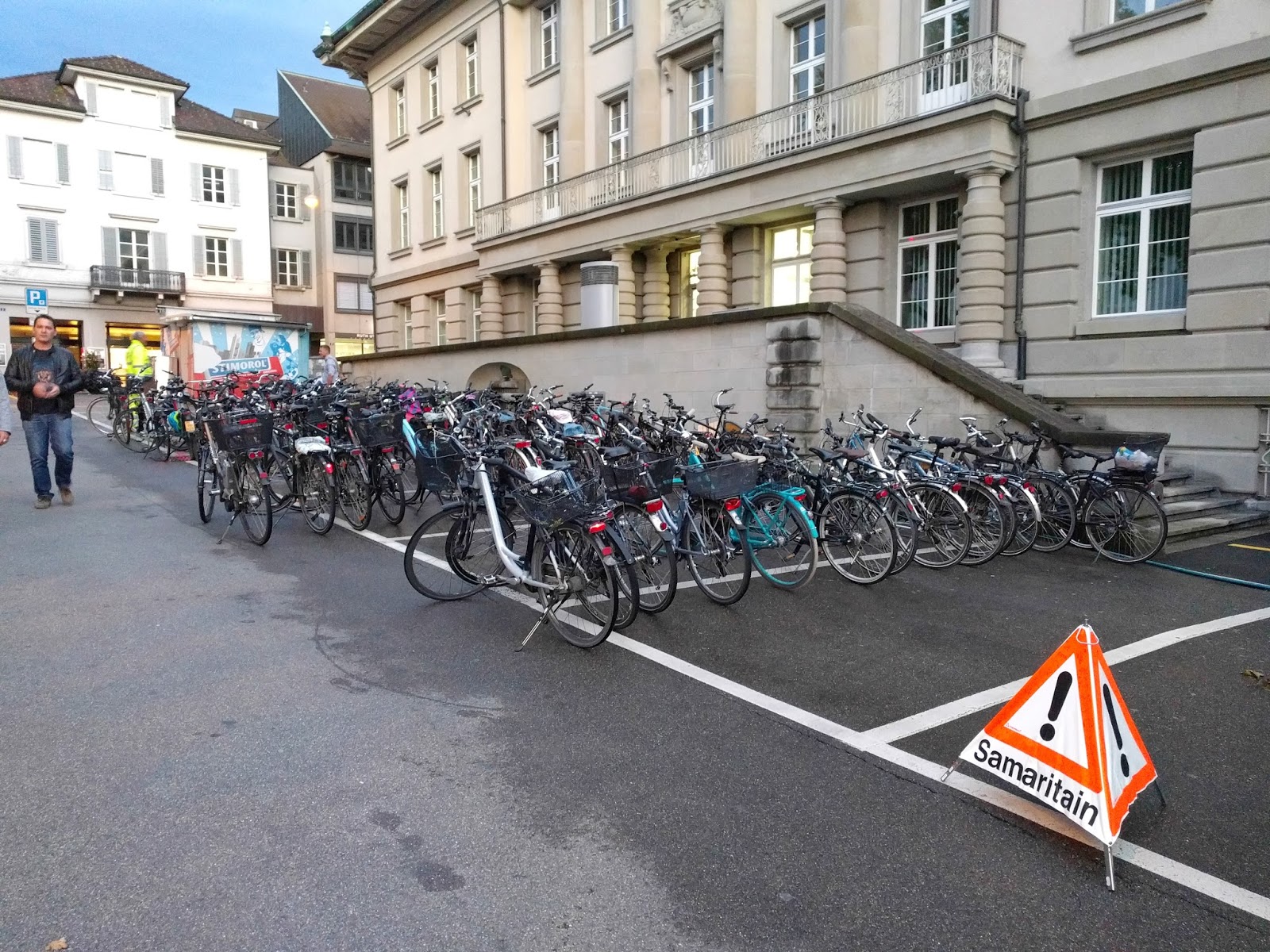
A swath of properly kickstanded bikes in Zug, Switzerland
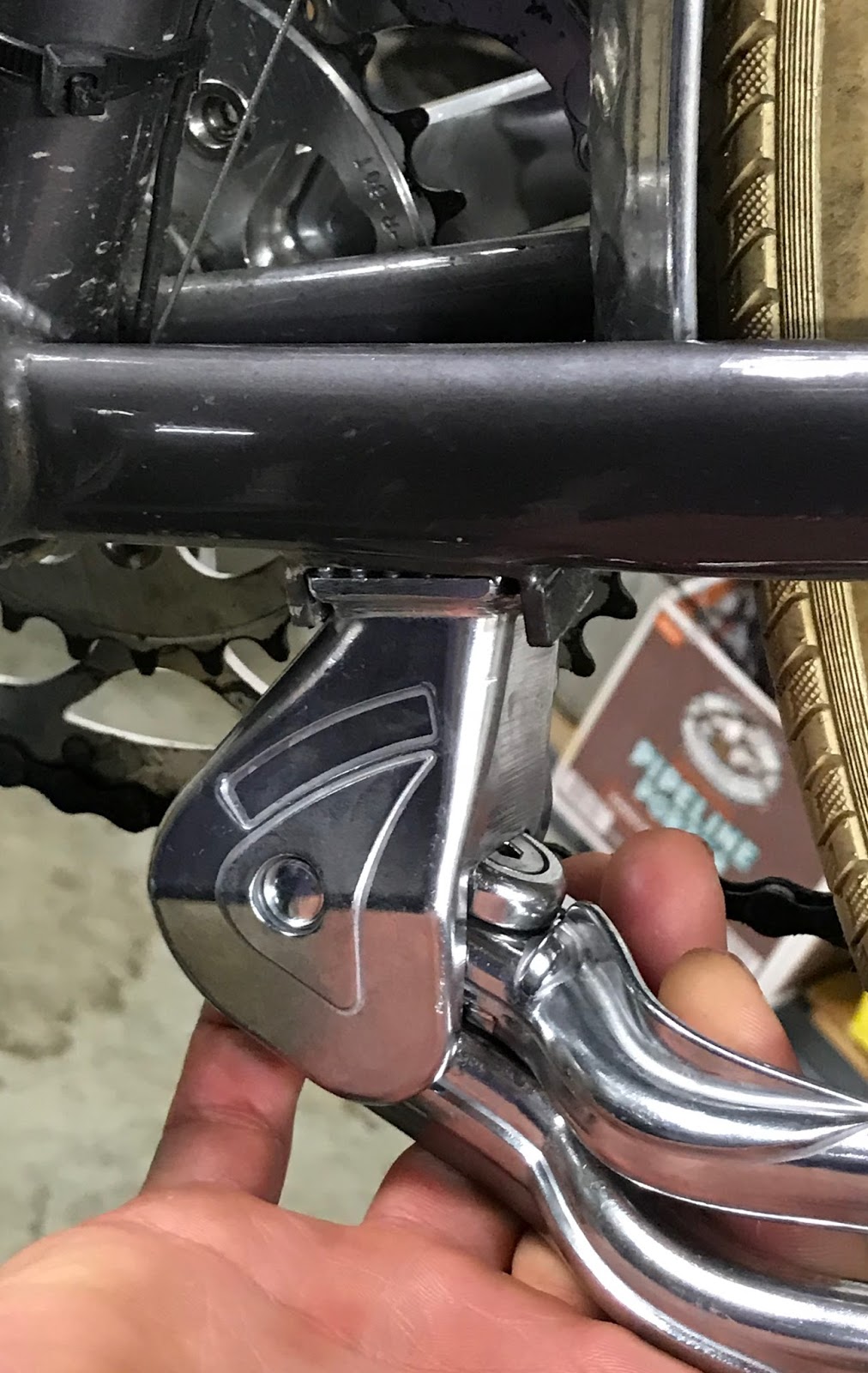
A solution to the dirty looks is a kickstand. Two VO frames, the Campeur and the upcoming Polyvalent, have kickstand plates welded in place to make installation a snap.


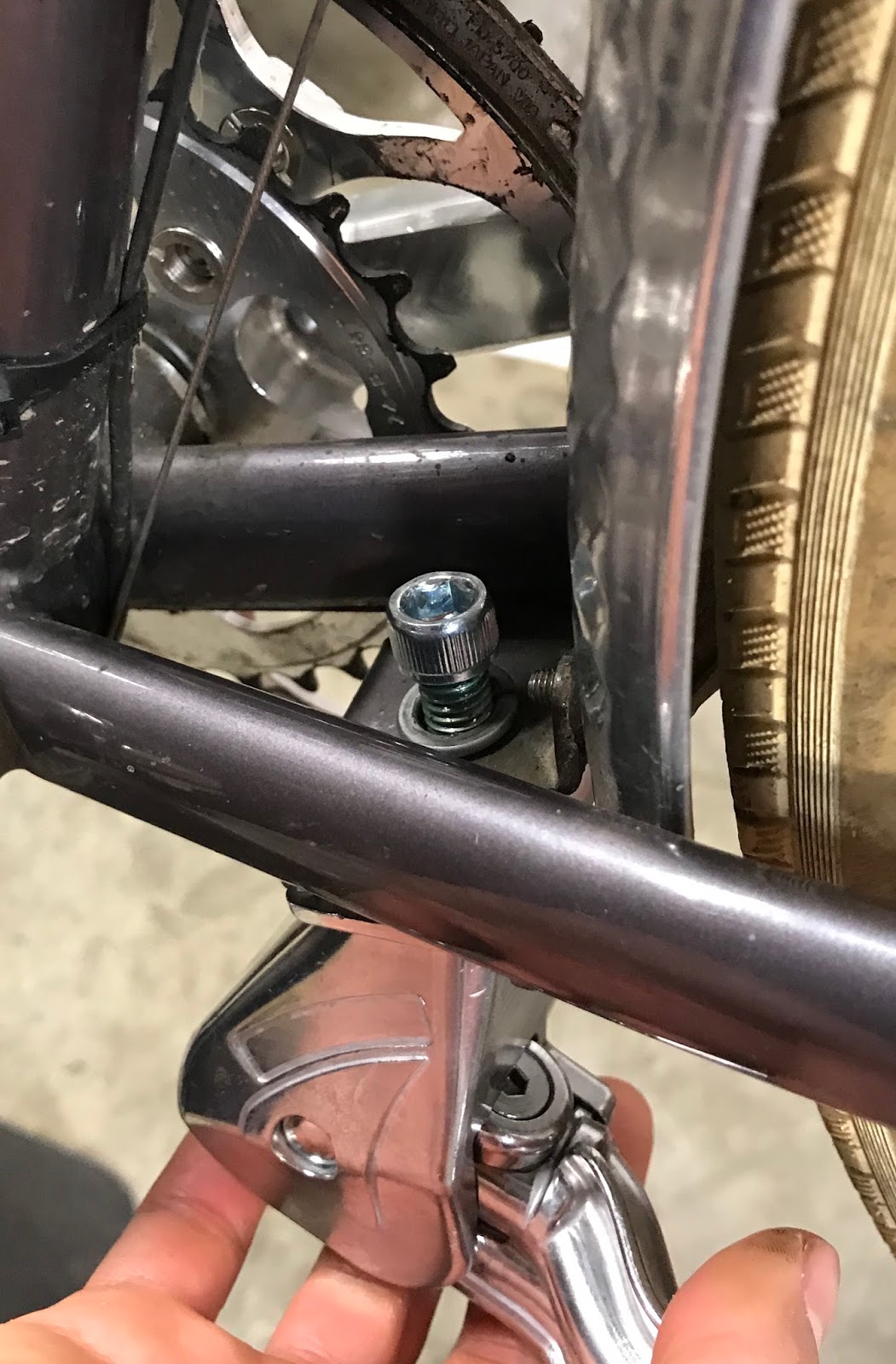
Just use the small allen head bolt that comes with our kickstands, instead of the long bolt. Remove the top part (put it in a safe place in case you want to use the kickstand later on a bike without a plate). Line up the kickstand with the underside of the kickstand plate, put the allen head bolt into the hole in the plate, and tighten up (it takes an 8 mm allen wrench FYI).


If your favorite urban roving bike does not have a kickstand plate, don't anguish. You can still install a kickstand on it. Both of our kickstand models come with a top plate and a longer bolt (a 14 mm wrench fits this nut) so you can put it on any steel bike. Note: Do not install a clamp-on kickstand on an aluminium or carbon fibre frame. You'll break the frame.


You want to install it between the bottom bracket and the chain stay bridge area. Put some tape or a cut up inner tube on the frame to protect the paint. Position the bottom part of the kickstand (the part with the legs attached) on the underside of the chain stays. Put the top clamp on the top of the chain stays. Insert the bolt through the top clamp and thread it into the bottom piece. Tighten the bolt until good and snug. There is no magic torque spec for this. It's a bit of a Goldilocks amount of pressure - not too loose and not too tight. You want it just right. Remember to check the tightness over time to ensure it does not loosen up at an inappropriate time/space/place.

The Copenhagen kickstand is the best if you have a rear cassette/freewheel. This kickstand has the legs both flip to the left (non drive) side, so the legs won't touch the chain.  The Porteur kickstand's legs flip up to be on either side of the tire and can clip the chain of a derailleur equipped bike. So it is better suited to IG/singlespeed hubs. Not much difference weight wise between the two - the Copenhagen weighs 1 lb 6 oz, the Porteur, 1 lb, 8 oz. For comparison, a fully filled VO water bottle weighs 1 lb 8 oz.

Are you a kickstand lover or hater? Let us know your deliberations on the issue of using a kickstand in the comments below.


29 Jan 21:30

Apple’s Podcast Analytics Prove the Medium’s Power

by Ryan Christoffel

Miranda Katz, writing for WIRED:

Podcasters and advertisers alike have long suspected that their listeners might just be a holy grail of engagement. The medium is inherently intimate, and easily creates a one-sided feeling of closeness between listener and host—the sense that the person talking into your ear on your commute is someone you know, whose product recommendations you trust, and whose work you want to support. Cox describes it as a “lean in” medium: “People are really listening and want to consume all of the content that is there and available. There’s a level of dedication that comes from podcast listeners that you otherwise don’t find.” And now the numbers prove it. Podcasts aren’t a bubble, they’re a boom—and that boom is only getting louder.

Last year at WWDC Apple announced that it would soon provide podcasters with new data regarding the behavior of listeners – data like how long an episode is listened to for, and whether ad reads are skipped or listened to.

As Katz shares in her WIRED piece, the early results have been extremely positive, proving what many podcast listeners already knew: podcasting is a uniquely engaging medium that breeds avid fans.

→ Source: wired.com

29 Jan 21:30

Full Breakdown of Audio That HomePod Can and Can’t Play

by Ryan Christoffel

We know the HomePod works great with Apple Music, but for those who aren't Apple Music subscribers, what audio content can the HomePod still play for them – with Siri support, and without?

Serenity Caldwell has put together a comprehensive guide for iMore that answers that question in exacting detail, filling in the gaps left by Apple's official marketing disclosures.

For iTunes Match subscribers, it's good news.

→ Source: imore.com

29 Jan 21:30

City of Vancouver Volunteer Opportunity~Public Space and Public Life Study

by Sandy James Planner

https3a2f2fcdn-evbuc-com2fimages2f388127852f2171682232912f12foriginal

City of Vancouver
Volunteers Deadline Jan 30
The City of Vancouver is conducting a Public Space and Public Life (PSPL) Study in partnership with Gehl to collect ‘people data’ to better understand how people use and spend time in Downtown Vancouver. The PSPL Study’s findings will be used to inform a Downtown Public Space Strategy and help bring the strategy from vision to action. Volunteer tasks include behavioural mapping, pedestrian counts and intercept surveys.
Volunteer survey shifts are on February 1 and February 3. Shifts will be four hours long between 8:00am and 8:00pm. You are welcome to participate in more than one shift.

Required training will take place on January 31 at UBC Robson Square (Room C300) from 7:00 to 9:00pm.
Volunteer for the Places for People Downtown
Public Space & Public Life Study
Required Training: Wednesday, January 31, from 7:00 pm to 9:00 pm. Location at UBC Robson Square – 800 Robson St. – Room C300
Survey Shifts: Volunteer survey shifts are on February 1 and February 3. Shifts will be four hours long between 8:00 am and 8:00 pm. You are welcome to participate in more than one shift.

Update -The winter phase of the PSPL study will span forty different public spaces across the downtown – from plazas to streets, beaches to laneways, and everything in between – contributing to a comprehensive study of how public life functions in Vancouver’s downtown neighbourhoods.
This is a great way to learn about Gehl’s approach to urban planning and design and play an active role in future changes to the public realm in Downtown Vancouver. Volunteer tasks include behavioural mapping, pedestrian counts and intercept surveys.
Please be prepared to dress warm and be outside for the duration of your shift. You will be assigned your study location at the required training session on January 31.
Learn more at: http://vancouver.ca/placesforpeople
Email: placesforpeople@vancouver.ca

DATE AND TIME

Wed, 31 January 2018
7:00 PM – 9:00 PM PST

LOCATION

UBC Robson Square
800 Robson St. – Room C300
Vancouver, BC V6Z 3B7

cov-pfp-archive-instagram-p02

29 Jan 21:30

Apple is about to do something their programmers definitely don’t want.

by Anil

Apple spent $5 billion on a beautiful new office, Apple Park. So it’s amazing they’re about to make an extremely costly, avoidable mistake: putting their coders in an open-plan layout.

Apple Park

I work at Fog Creek Software, where our cofounder and former CEO Joel Spolsky has been blogging for at least 17 years about how open-plan offices are terribly bad for programmer productivity. His insights on the topic are based on Tom DeMarco and Tim Lister’s classic book Peopleware, which has been around for literally thirty years. So this isn’t a particularly new insight. And of course, in the decades since, there have been countless academic studies confirming the same result: Workers in open plan offices are frustrated, distracted and generally unhappy.

That’s not to say there’s no place for open plan in an office — there can be great opportunities to collaborate and connect. For teams like marketing or communications or sales, sharing a space might make a lot of sense. But for tasks that require being in a state of flow? The science is settled. The answer is clear. The door is closed on the subject.

Or, well, it would be. If workers had a door to close.

Staying In The Flow

Now, when it comes to jobs or roles that need to be in a state of flow, programming may be the single best example of a task that benefits from not being interrupted. And Apple has some of the best coders in the world, so it’s just common sense that they should be given a great environment.

That’s why it was particularly jarring to see this side note in the WSJ’s glowing article about Apple’s new headquarters:

WSJ on Apple's new HQ

Usually, companies justify putting programmers into an open office plan for budget reasons. It does cost more to make enough room for every coder to have an office with a door that closes. But given that Apple’s already invested $5 billion into this new campus, complete with iPhone-influenced custom-built toilets for the space, it’s hard to believe this decision was about penny-pinching.

The other possible argument for skipping private offices would be if a company didn’t know that’s what its workers would prefer. But we can test this theory— let’s see what it looks like when we ask people what they want in an office, without any prompts or suggestions to guide their responses.

What you’ll find in the hundreds of responses to that tweet is dozens and dozens of people talking about how much they loved having a private office with a door that closed, or how much they wish they had one.

There’s no doubt that Apple would get the same responses if they talked to their own team. So the only possibility that’s left is that there just aren’t enough people in the industry who really, truly believe the benefits of having private offices for coders. So we’ll keep banging the drum on this subject.

A look inside

Almost a decade ago, I remember reading about the construction of the new Fog Creek office on Joel’s blog, and when it was finally complete, I remember seeing the New York Times breathlessly cover its innovations. At the time, I would never have imagined that I’d get to work from that office someday. And I’ve been thinking a lot about how it felt to look at that article and wonder a bit skeptically whether it was really worth all that effort.

And I have to admit, I had a moment of temptation as we started thinking about a new office for Fog Creek, wondering whether we might save a few bucks by having an office that was merely great, with the same open plan as almost every other company. It’d be so easy to make the case.

A lot has changed at Fog Creek — about 2/3 of our company works remotely, though almost all of them work from home offices that have, you guessed it, doors that close. And we’ve got teams like sales and support that benefit from being in a shared, open-plan space. We could make the argument for giving up and just falling in line with what everybody else does.

But even the teams that have shared spaces are excited about our new office having dedicated phone booths for them to make calls in a private space. And the members of our technical staff remain as hyper-productive as ever without working absurd hours, which we can attribute to them having the right environment to do their work.

Best of all, focusing on making a great workspace even has us thinking of new ideas that help people get the best of both worlds, like dedicating a large conference room as a “Quiet Car”. It’ll be a place where people can sit together but still enjoy peace and quiet, inspired by everybody’s favorite Amtrak amenity.

We would never presume to advise a company as successful as Apple about how to do products. Though we’re incredibly proud of Glitch and FogBugz, we of course have huge respect for everything Apple’s done for decades. But we didn’t want to let this one avoidable mistake go by without pointing it out, as it’s a shortcoming that Apple (and every company that has coders on its staff!) could easily fix.

We’re glad so many companies know it’s worthwhile to invest in their employees — in everything from great healthcare to having the latest-and-greatest computer hardware. But when it comes to forcing every worker to be in an open plan shared space, even when they’re trying to concentrate, it may be time for even the biggest and most successful companies to think… uh, differently?

29 Jan 21:29

Twitter Favorites: [joe_cressy] Just a few dozen King St commuters supporting local business at today's #KingEatsPilot. Follow the hashtag to find… https://t.co/Dxd21jwpQU

Joe Cressy @joe_cressy
Just a few dozen King St commuters supporting local business at today's #KingEatsPilot. Follow the hashtag to find… twitter.com/i/web/status/9…
29 Jan 21:28

Millennium Bridge, London, United Kingdom pic.twitter.com/myHCOePv7j

by archpics
mkalus shared this story from archpics on Twitter.

Millennium Bridge, London, United Kingdom pic.twitter.com/myHCOePv7j


Posted by archpics on Monday, January 29th, 2018 9:58am


387 likes, 94 retweets
29 Jan 21:28

Civic Election Strategy – 2 : Whither the NPA?

by pricetags

The NPA, once again, doubled down on its anti-bike-lane strategy by voting against an Engineering recommendation for a separated route on the Cambie Bridge.

As noted below, the Globe and Mail is mystified at this a traditional NPA platform issue:

. . . .  Any party that bucks the worldwide cycling trend risks branding itself as a band of troglodytes. It’s a bit like railing against the internet: not a smart move for a party that needs to grow its base and freshen its image.

After losing two elections with bike-lane opposition as a prominent plank, why do they keep doing this?  They’ve also voted against the removal of the Viaducts, and their mayoral candidate last time (and maybe this time) had as his key transportation strategy the facilitation of car traffic in and through the city. (The Curious Case of the Counterflow Lanes).

How far is the NPA from where the world is going?  Here’s an example:

Markus Shaw has worn many hats in his lifetime. The 58-year-old former lawyer turned businessman and environmental campaigner – and grandnephew of late TVB creator Sir Run Run Shaw – is now busily promoting an ambitious scheme to pedestrianise one of Hong Kong’s most crowded, polluted roads.

“That’s a direction in which I feel Hong Kong should be going and I’m convinced will be going, because more and more people will see and understand that our current car-focused transport policy is unsustainable.

“When I first went to China in the early ’80s, most of the cities were bicycle-focused. Now they have become car-focused cities and they are experiencing all the problems that come with that: congestion, pollution and destruction of old neighbourhoods. I’m sure they will be moving back to pedestrian-focused, bicycle-focused city planning as well. It’s inevitable.”


Maybe the NPA strategy is ‘Keep Vancouver Suburban!’

29 Jan 21:27

Overwhelmed by size, underwhelmed by quality: A review of EdTech’s largest show, BETT 2018

files/images/1_T7GB3u-s6Ic2kk7qaDTyPA.jpeg

Junaid Mubeen, Medium, Feb 01, 2018


Icon

This review of BETT by an educator left me with the impression of a reviewer completely convinced by the value of pedagogy and utterly unable to fathom the idea of people creating learning for themselves. Consider this: "They (the exhibitors) fell utterly silent when pushed on pedagogy. The learning content is often the most neglected part of a product demonstration because it exposes the absence of pedagogical intent ... In some cases, exhibitors were unable to direct me to the learning content at all." That's becaus contemporary learning is no longer about pushing content. It's about creating experiences. The tech vendors have their weaknesses, to be sure. But their failure to emulate traditional teaching isn't one of them.

Web: [Direct Link] [This Post]
29 Jan 21:27

CraveTV now supports the Amazon Fire TV Stick Basic Edition

by Rose Behar
Amazon Fire TV

CraveTV is hitting a growth spurt.

The Bell-owned streaming platform recently revealed it’s bringing Game of Thrones to the platform, subsequently discounted its services and has now announced that it supports Amazon Fire TV.

Specifically, CraveTV content is now accessible via the 2nd generation Amazon Fire TV Stick Basic Edition and above. The addition of Amazon Fire TV broadens the potential demographic for Crave, which has a much more limited breadth of support than major competitor Netflix.

See the full list of supporting devices below:

  • iPad, iPod and iPhone running iOS 8.0+ with AirPlay
  • Android tablets and smartphones running version 4.0+
  • Windows desktop, tablets and smartphones running version 8.1
  • Mac: 10.6+: Browsers: Safari 10, Firefox 52+ and Chrome 58+
  • PC: IE11+, Firefox 52+, Chrome 58+, Edge 14+
  • Apple TV: Apple TV 2+, OS Version of 6.0+
  • Samsung SmartTV and blu-ray players with Samsung Smart Hub: 2013 – 2017
  • Xbox One

In recent Twitter responses, the platform said Roku “is on its way” and also noted: “Soon, the CraveTV app is going to be on all your favorite devices — including PS3 & PS4. Actually, bringing CraveTV to more gaming consoles (specially PlayStation) is one of our top priorities.”

Amazon’s Fire TV Stick Basic Edition officially arrived in Canada in November 2017. This is the only Amazon Fire TV product that has been officially released in Canada.

Source: Bell

The post CraveTV now supports the Amazon Fire TV Stick Basic Edition appeared first on MobileSyrup.

29 Jan 21:27

Get these Noise-Cancelling Headphones for Half off

by MobileSyrup

From talkative co-workers to loud roommates, the world can get fairly noisy during the day-to-day, making it difficult to focus on the task at hand. Therein lies the value of noise-canceling technology. And while it’s been around for some time, most noise-canceling headphones will cost you a pretty penny on the market—unless you know where to shop. The Paww WaveSound 3 Noise-Cancelling Bluetooth Headphones block out as much as 20dB of unwanted ambient noise, and they’re on sale for nearly half-off the usual price.

In addition to filtering out unwanted noise, these headphones combine two 40mm Neodymium drivers to create a balanced, punchy sound and boast a built-in microphone that lets you make or receive calls when connected to your phone. Plus, these headphones are engineered for comfort and easily fold up into the included case for added portability.

Normally retailing for $185, the Paww WaveSound 3 Noise-Cancelling Bluetooth Headphones are on sale for $98 CAD [$80 USD].

The post Get these Noise-Cancelling Headphones for Half off appeared first on MobileSyrup.

29 Jan 21:27

Apple co-founder Steve Wozniak says he doesn’t believe Elon Musk’s promises anymore

by Rose Behar

Steve Wozniak is a man of many words, and lately, a fair amount of those words have been used to compose anti-Tesla rants.

At a recent talk at the Nordic Business Forum, the Apple co-founder said his trust in Tesla CEO Elon Musk took a hit after the electric car company repeatedly pushed back the timing of the cross-country, fully autonomous drive it promised by the end of 2017.

“I believed that stuff,” Wozniak said, according to Business Insider Nordic. “Now, I don’t believe anything Elon Musk or Tesla says. But I still love the car.”

He added: “I’m sure the next car will come out and Elon’s promise will be that [this is the car that delivers].”

Wozniak also likened Musk to his late Apple co-founder Steve Jobs — but not in a very flattering light.

“I love that car but the trouble is, Elon Musk is portrayed in a lot of movies with a lack of faith and trust,” he said. “What he says, can you really believe in him? Is he just a good salesman like Jobs and may not be there [in the end]?”

Wozniak further said he thought Tesla was using the fact that some of its features are in beta as a crutch.

“All Tesla says is, ‘it’s beta, so we’re not responsible. [As a driver] you have to be in control’. So that’s kind of a cheap way out of it. Everything I’ve read told me that every other car manufacturer in the world — Audi and BMW — are actually ahead of Tesla for self-driving cars.”

Wozniak still uses his two Model S Teslas and the extensive Tesla charging network for long road trips, though, he says he just prefers his Chevy Bolt EV for everyday journeys.

With Musk’s penchant for Twitter sass (and the occasional Silicon Valley beef), it’s unclear whether he’ll strike back at Wozniak. For now, he’s just hawking flamethrowers and providing inspiration for the next Borderlands game.

Wozniak spoke in Toronto in May 2017, touching on Apple, Jobs and artificial intelligence.

Source: Business Insider Nordic

The post Apple co-founder Steve Wozniak says he doesn’t believe Elon Musk’s promises anymore appeared first on MobileSyrup.

29 Jan 21:26

British Columbia to drivers: ride-sharing services still haven’t been legalized

by Sameer Chhabra

The Government of British Columbia is reminding drivers and passengers that ride-sharing is still technically illegal in the province.

According to a January 29th, 2018 media release, any driver who accepts passengers through ride-sharing apps in the province is operating illegally and is subject to “penalties and fines” of $1,150 CAD.

“It is important that drivers providing commercial transportation services through these social media apps understand they are assuming all of the risk related to providing the service,” reads an excerpt from the January 29th release. “It is the driver, not the app companies, that are operating illegally and are subject to penalties and fines of $1,150.”

The province singled out Longmao, Udi Kuaiche, U Drop, RaccoonGo, GoKabu, Dingdang Carpool and AO Rideshare as companies that “have been recruiting drivers to operate their personal vehicles as commercial passenger-directed vehicles on the Lower Mainland.”

The British Columbia government has issued 20 cease-and-desist orders, as well as 23 fines of $1,150 to “drivers identified as operating without a license.”

U.S.-based ride-sharing giant Uber is currently attending talks with provincial regulators looking to legalize ride-sharing services in the province.

Interesting to note is that British Columbia’s January 29th media release lends some insight into what the province might be expecting from any tech company looking to disrupt taxi services.

According to the release, provincial and municipal regulation currently requires “a reqular, government-approved safety inspection of the vehicle; insurance that will cover the carrying of paying passengers; and a police background check for drivers.”

British Columbia is expected to publish a formal report on ride-sharing in the province, on February 15th, 2018.

Until the report is published — and until provincial legislators pass a bill — the British Columbia government will no doubt continue reminding drivers and passengers that hailing cabs through ride-sharing apps is a punishable offence.

Source: Government of British Columbia

The post British Columbia to drivers: ride-sharing services still haven’t been legalized appeared first on MobileSyrup.

29 Jan 21:26

Apple’s lip-syncing Animoji ad is surprisingly charming

by Patrick O'Rourke
Animoji

Apple’s Animoji are one of the best things about the iPhone X.

That’s not a statement I think I ever thought I’d be making leading into the pricey 10th anniversary iPhone’s release a few months ago, but here we are.

At the 2018 Grammys, Apple showed off two new iPhone X ads that highlighted the smartphone’s clever Face ID technology.

The first ad, called ‘Amigos,’ features Apple’s dog and poop Animoji singing to ‘Stir Fry’ by hip-hop group Migos. A carrot, broccoli and cucumber emoji also make cameo appearances in the video, though they unfortunately aren’t Animoji, ruining my dreams of becoming a digitized piece of broccoli.

The other ad features Childish Gambino’s ‘Redbone,’ sung by an Alien emoji (the best animoji, in my opinion). The ad features unicorn backup singers and a cat, panda, robot and unicorn emoji.

Though Apple hasn’t promoted Animoji for their karaoke functionality, at least not until now, when the feature first launched alongside the iPhone X, Apple’s clever and cute animated creatures quickly became viral sensations.

Here’s hoping Apple soon brings Animoji to more apps than just iMessage. Not including Animoji in iMovie, which would effectively give Apple users an easy way to create their own karaoke videos without complicated work arounds, seems like a missed opportunity on the tech giant’s part.

Sure Animoji are silly, but like most examples of great tech, they manage to democratize a simple, but entertaining concept in a way everyone is capable of appreciating.

The post Apple’s lip-syncing Animoji ad is surprisingly charming appeared first on MobileSyrup.

29 Jan 21:26

A Westworld mobile game is currently in development

by Patrick O'Rourke
Westworld mobile game

If you watched HBO’s Westworld and thought to yourself, “this would make a great video game,” you probably aren’t alone.

While the triple A title of your dreams isn’t coming yet, it looks like a Westworld mobile game is in the works. A teaser first posted on a fictitious website for the television show’s Delos Incorporated hinted that something is in the works. Warner Bros. Entertainment later confirmed to Engadget that a mobile Westworld game is currently in development.

Westworld

Little is known about the game so far, beyond the fact that it’s being created by Dead by Daylight developer Behaviour Interactive. The game is apparently “currently being tested in limited release.”

The teaser shows off a ‘Delos Park Training Simulation,’ and hints that players will be managing what looks like a “miniature Westworld,” which includes caring for hosts (robots) and managing guest satisfaction. It sounds like the game will likely be a mix between Fallout Shelter and classic Sim City.

Here’s hoping my park fares better than the one in the show. Take a full look at the Delos Corporation handbook at this link.

Source: Delos Incorporated (fictitious Westworld site) Via: Engadget 

The post A Westworld mobile game is currently in development appeared first on MobileSyrup.

29 Jan 02:54

Something is brewing up in the Stockyards

by jnyyz

Since it was such a sunny afternoon, I though that I’d head a little ways north to check out the new location of Junction Craft Brewing. They had their grand opening this weekend.

A quick look at Google Maps shows that a nice cluster of craft breweries has sprung up north of St. Clair in the the Stockyards area, with three breweries having opened up in the past year on Symes Rd. At the same time, it looks like the old location for Junction Craft is being taken over by People’s Pint, and High Park Brewery has also announced a forthcoming brewpub in the area.

Screen Shot 2018-01-28 at 5.16.31 PM

Headed up Runnymede, just north of St. Clair, this is a former asian grocery that is going to be the location of High Park Brewery.

IMG_7797

Wanting to avoid biking along St. Clair, I worked my way north to Terry Rd. I was hoping that I didn’t have to bike all the way down the big hill that leads to Alliance Ave, but it but it seem that I ended up at least halfway down by turning onto Terry. Headed east, you can see a wide sidewalk on the north side that appears to be a multiuse trail just by the hydro corridor.

IMG_7798

At the end, you intersect Symes Rd. and you can see the short climb up to the right.

IMG_7799

Junction Craft Brewing is at the top of the hill in a beautifully restored historical building that used to be a trash incinerator. It was opened in 1934 by R.C. Harris.

DSC01948

Here is the Symes Rd facade, with Art Deco detailing.

DSC01958

A couple of interior shots.

DSC01949

A closer look at the bar.

DSC01954

I think that the street map was a feature at their old location.  You can see the bottle shop to the left.

DSC01957

First beer of the day. Note the “destructor” coaster. Only a half pint as it was the middle of the afternoon. A very nice amber ale.

DSC01953

Sadly, the only bike rack in front is a wheel bender.

IMG_7800

Next stop, Shacklands Brewing, which is just next door.

DSC01959

DSC01962

My host Dave was very friendly, and advised me on the best bike routes to his destination. This was a much smaller place with a homey feel to it.

DSC01961

Second beer of the afternoon.

IMG_7801

There was another brewery in the same building: Rainhard Brewing, but alas I was running out of time.  Will have to return. You can see some pictures here.

These buildings are all clustered in a former industrial area, sandwiched between the Stockyards Mall and a car storage parking lot. Fortunately, there is a cut though so that you can get to the St.Clair/Symes Rd intersection easily on foot or by bike.

DSC01960

I’ll have to come up here again in the spring. Perhaps we can organize a group ride / brewery tour.

29 Jan 02:53

Twitter Favorites: [karenkho] Serena Williams has won 23 Grand Slam titles, one of them while she was pregnant. https://t.co/0dCxrxx8e1

White Guy Confidence @karenkho
Serena Williams has won 23 Grand Slam titles, one of them while she was pregnant. twitter.com/Jim_Gardner/st…